
Submitted:
23 November 2026
Posted:
25 November 2026
You are already at the latest version
Abstract
Building-integrated photovoltaics (BIPV) offer opportunities to combine renewable en-ergy generation with building-envelope functions; however, semi-transparent BIPV roofs can introduce substantial solar heat gain in tropical buildings. This study presents a simulation-enabled framework for evaluating advanced solar-control material strategies for BIPV roofs, using a high-occupancy food-court building in Singapore as a case study. A digital building performance model was developed in Integrated Environmental So-lutions Virtual Environment (IESVE) to investigate the effects of alternative BIPV mate-rial configurations on solar heat gain, indoor air temperature, and cooling demand. The existing semi-transparent BIPV roof was established as the baseline, and eight alternative material configurations incorporating upconversion nanoparticles (UCNPs), glass beads, polymer films, and composite laminates were comparatively evaluated using experi-mentally derived optical properties. The baseline roof produced a peak solar gain of 25.44 kW, a peak indoor air temperature of 24.88 °C, and a maximum hourly cooling energy demand of 267.37 kWh under the simulated conditions. Among the investigated configurations, UCNP/nylon and UCNP/nylon-on-PET-film exhibited the strongest overall performance. The UCNP/nylon configuration reduced peak solar gain by ap-proximately 66%, lowered peak indoor air temperature by approximately 2.6 °C, and reduced peak chiller demand compared with the baseline. The results demonstrate how digital building-performance simulation can support the screening and optimisation of emerging envelope materials before physical deployment. The proposed approach pro-vides a practical pathway for integrating advanced material technologies with building simulation to improve the thermal and energy performance of BIPV-enabled built assets in hot-humid climates.
Keywords:
building-integrated photovoltaics
; upconversion nanoparticles
; solar-control materials
; building performance simulation
; solar heat gain
; cooling energy
; tropical buildings
1. Introduction
The rapid decarbonisation of the built environment requires simultaneous reductions in building energy demand and greater integration of renewable energy technologies into the building envelope. This challenge is particularly significant in hot-humid tropical climates, where high ambient temperatures, high relative humidity and year-round solar exposure create persistent challenges for maintaining indoor thermal comfort while limiting dependence on mechanical cooling. Thermal comfort studies in Southeast Asia have demonstrated that occupants in naturally ventilated buildings exhibit adaptive responses to prevailing climatic conditions, highlighting the importance of climate-responsive building design and the potential to reduce reliance on energy-intensive air-conditioning systems [1]. In Singapore, these challenges are compounded by the urban heat island effect, with urban-rural temperature differences reported to exceed 7 °C under certain conditions, while future climate change is expected to further intensify heat exposure. Consequently, strategies that reduce unwanted solar heat gain while maintaining indoor environmental quality and enabling renewable energy generation are increasingly important for the development of climate-responsive, low-carbon and resilient buildings.
Among building-scale renewable-energy technologies, building-integrated photovoltaics (BIPV) are particularly attractive because photovoltaic components can perform both energy-generation and building-envelope functions. Unlike conventional building-applied photovoltaic systems, BIPV components can replace conventional façade, glazing or roofing elements, enabling electricity generation without requiring additional land or dedicated roof-mounted infrastructure. Recent developments have expanded BIPV applications from conventional opaque roof systems towards semi-transparent glazing, photovoltaic façades, skylights and architecturally integrated roof systems. Reviews of transparent and semi-transparent BIPV highlight their potential to combine renewable-energy generation with daylighting and solar-control functions, but also emphasise the need to evaluate their optical, thermal and electrical behaviour concurrently [2,3]. Such multifunctionality is especially relevant in land-constrained, high-density urban environments such as Singapore, where building surfaces represent valuable opportunities for distributed solar-energy harvesting. [4] Singapore's Solar Energy Research Institute of Singapore (SERIS), for example, specifically identifies real-world tropical testing, thermal properties, solar and luminous properties, reliability and energy yield as important considerations in evaluating BIPV technologies.
The research problem addressed in this study is the potentially conflicting performance requirements of transparent and semi-transparent BIPV roofs in hot-humid climates.[5] While these systems provide renewable electricity generation and daylight transmission, solar radiation transmitted through the transparent regions can increase heat gain in occupied spaces and consequently increase cooling demand. Although advanced solar-control materials can substantially modify solar-optical properties, material-level performance alone does not establish whether these improvements will translate into meaningful reductions in building-level heat gain, indoor temperature and cooling demand. In particular, limited work has linked experimentally characterised UCNP- and glass-bead-based solar-control materials with whole-building simulation of semi-transparent BIPV roofs under tropical operating conditions. The solar heat gain coefficient (SHGC) is therefore a critical parameter for BIPV glazing, as it determines the fraction of incident solar energy ultimately transferred into the conditioned space. Recent work coordinated under IEA PVPS Task 15 also shows that SHGC assessment for BIPV glazing requires consideration of electricity generation and the optical inhomogeneity associated with photovoltaic cells, illustrating why conventional glazing metrics cannot always be transferred directly to BIPV products [6].
This thermal-energy interaction becomes particularly important under tropical conditions. Jhumka et al. [7], using validated thermal and whole-building simulations for a tropical climate, demonstrated that different BIPV envelope configurations can produce markedly different effects on building overheating, cooling loads and net energy performance. The roof-integrated BIPV configurations in their study produced more favourable thermal performance than selected façade arrangements. More broadly, studies of semi-transparent BIPV show that system performance cannot be assessed solely on photovoltaic output alone because changes in visible transmittance, solar heat gain, daylight availability and building cooling or lighting demand interact with one another [2,3,8].
Accordingly, this study aims to develop and demonstrate a simulation-enabled approach that integrates experimental material characterisation with whole-building performance simulation to evaluate advanced solar-control strategies for semi-transparent BIPV roofs in a hot-humid tropical climate. Specifically, the study aims to: (i) quantify how alternative solar-control material configurations affect solar heat gain through a semi-transparent BIPV roof; [9] (ii) determine how these changes influence indoor air temperature and cooling demand; and (iii) identify promising configurations for improving the thermal and energy performance of semi-transparent BIPV applications. [2,6] The alternative solar-control material configurations are functional materials which are coated on solar PV. These can potentially be integrated for building-scale performance assessment. [8]. A high-occupancy building in Singapore is used as the case study, with experimentally measured optical properties incorporated into an IESVE model for comparative assessment.
2. Materials and Methods
2.1. Research Framework and Case Study
This study adopted a simulation-enabled comparative approach to evaluate the influence of advanced solar-control material configurations on the thermal performance of a semi-transparent building-integrated photovoltaic (BIPV) roof. The framework integrated experimentally determined material optical properties with whole-building performance simulation. The methodology comprised four main stages:(i) development of a digital building-performance model of the case-study building;(ii) representation of the existing BIPV roof as the baseline condition;(iii) incorporation of experimentally characterised material configurations into the BIPV roof model; and(iv) comparative assessment of their effects on solar heat gain, indoor air temperature and cooling demand. Figure 1a shows the E4 Canteen (Foodgle Hub) at the Singapore Institute of Technology (SIT) Punggol Campus, Singapore which was selected as the case-study building. The site is located at approximately 1.406° N and 103.902° E and represents a high-occupancy institutional food-service environment containing dining areas, food stalls, back-of-house spaces and associated air-conditioning and mechanical ventilation systems. A distinctive feature of the building is its semi-transparent BIPV canopy, which covers part of the occupied seating area and simultaneously provides photovoltaic electricity generation, shading and daylight transmission (Figure 1b). The BIPV-covered seating area was selected as the principal zone of interest because of its direct exposure to roof-transmitted solar radiation. The comparative analysis therefore examined the performance pathway from BIPV optical properties and solar transmission to space solar gain, indoor thermal response and cooling demand. All non-BIPV parameters were maintained consistently between simulation scenarios to isolate the effect of the proposed material modifications.
2.2. Building and Simulation Model Development
The building-performance model was developed using the Integrated Environmental Solutions Virtual Environment (IESVE). Building geometry was constructed in ModelIT using architectural information obtained from the original building information model. A DXF file derived from the building's Revit model was used as the geometric reference for reproducing the floor plan, spatial dimensions, wall heights, roof configuration and principal envelope elements. Minor geometric simplifications were introduced where necessary to improve computational efficiency without altering the major surfaces governing solar and thermal performance.
Attention was given to the geometry and orientation of the BIPV canopy because its inclination and exposed area directly influences solar radiation. [10] The model was orientated approximately 11° from true north, consistent with the actual building orientation. The building was subdivided into thermal zones representing the seating area beneath the BIPV roof, internal seating areas, food stalls and back-of-house spaces. This zoning allowed differences in occupancy, equipment gains and solar exposure to be represented while retaining thermal interactions between adjacent spaces.
For the ground boundary condition, the ground surface visible in the three-dimensional IESVE representation (Figure 1c) primarily represents the building/site geometry and should not be interpreted as a detailed coupled ground heat-transfer model. Transient heat and moisture transfer within the surrounding soil was not explicitly investigated because the study focused on the comparative influence of BIPV roof solar-optical properties on solar heat gain, indoor temperature and cooling demand. The treatment of ground-contact surfaces was maintained consistently across all simulation scenarios; hence, building-ground interaction was not a variable in the comparative assessment.
Dynamic thermal simulations were performed using ApacheSim, while solar exposure and shading were evaluated using SunCast. Climatic boundary conditions were obtained from the Singapore Seletar EnergyPlus Weather (EPW) file available within the IESVE weather database. The recent weather data was collected using the Skyscanner and the pyranometer we have put up on the rooftop of E2 block. The weather file provides hourly outdoor temperature, humidity, solar-radiation and wind data required for the simulation. Internal heat gains due to occupants, lighting and equipment were represented using the operational assumptions adopted for the canteen model. The occupancy schedule extended from 07:30 to 19:30, with higher occupancy during meal periods. The actual campus is served by district cooling; however, modelling the complete district cooling network was outside the scope of the study. Cooling was therefore represented using an equivalent high-capacity water-cooled chiller, together with four air-handling units, of which two served the principal seating areas beneath the BIPV roof. All building geometry, internal loads, schedules, HVAC representations and climatic boundary conditions were kept unchanged across the material scenarios.
Figure 2 presents the diurnal rooftop microclimatic conditions measured at the SIT Punggol Campus. Solar irradiance increased rapidly during the morning, reaching approximately 1000–1100 W/m² around midday, accompanied by an increase in ambient temperature to approximately 36–37 °C. During the afternoon, irradiance showed greater fluctuations and subsequently declined as cloud cover increased, as reflected by the cloudiness measurements and all-sky images in Figure 2(b). In comparison, ambient temperature decreased more gradually, indicating the thermal lag of the surrounding environment relative to short-term variations in solar irradiance. These measurements establish the dynamic tropical solar conditions under which the PV material configurations were evaluated and provide the environmental basis for interpreting the subsequent PV-module temperature and BIPV building-performance results. The EPW file was used as the primary climatic boundary condition for the IESVE simulations, while rooftop measurements were used to characterise the local test conditions for the outdoor PV experiment. The simulations were performed using consistent climatic, geometrical, operational and HVAC boundary conditions across all investigated material scenarios. External climatic conditions were defined using the Singapore Seletar EPW weather file, providing hourly outdoor air temperature, humidity, solar radiation and wind data. The building geometry, orientation (approximately 11° from true north), BIPV roof geometry and thermal zoning were derived from the actual building information. Internal heat gains associated with occupants, lighting and equipment were represented according to the operational assumptions of the canteen, with occupancy scheduled from 07:30 to 19:30 and increased occupancy during meal periods. Cooling was represented by an equivalent high-capacity water-cooled chiller and four air-handling units. For the BIPV envelope, the baseline roof was represented using equivalent solar-optical properties, while the alternative configurations were assigned experimentally determined optical properties, including SHGC, TSER and visible-light transmittance. All boundary conditions and operational parameters were maintained unchanged between scenarios, with only the BIPV solar-optical properties varied, thereby enabling the effects of the investigated material configurations to be isolated.
2.3. Baseline BIPV Roof and Material Configurations
The existing roof comprises semi-transparent photovoltaic glazing with discrete opaque PV cells separated by transparent regions and was identified as an AGC Sunjoule photovoltaic glazing system. Since solar transmission occurs primarily through the transparent regions, the BIPV canopy was represented in the whole-building simulation using an equivalent-glazing approach, converting the heterogeneous cell and transparent-area arrangement into effective solar-optical properties. The baseline configuration adopted an average effective solar transmittance of approximately 0.30. This approach accounts for the optical inhomogeneity of BIPV glazing, whose SHGC is influenced by PV-cell coverage, system configuration and electrical operating conditions. It should therefore be interpreted as a building-level representation rather than a detailed cell-scale thermal model [11].
Upconversion nanoparticles (UCNPs) and related functional optical materials offer potential for modifying the solar spectrum transmitted through semi-transparent BIPV. Lanthanide-doped UCNPs absorb lower-energy photons, typically in the near-infrared region, and emit higher-energy photons in the visible or ultraviolet range [7]. In this study, UCNP-containing layers, micro glass beads (GBs), polymer films and composite laminates were investigated for their potential to reduce undesirable solar heat transmission while maintaining the functional requirements of semi-transparent BIPV. Previous studies have shown that UCNP concentration, emission characteristics and supporting-film properties collectively affect the performance of UCNP-functionalised PV modules [12,13]. Accordingly, each UCNP–polymer–substrate assembly was treated as an integrated material configuration rather than attributing its performance solely to the nanoparticles [14].
Eight functional material configurations and one PET-film reference were experimentally characterised: UCNP/nylon; UCNP/nylon on PET film; GB/PVB on PET film; GB/PDMS on PET film; UCNP/PVB; nylon/UCNP laminate and PET film; GB double laminate; and bare laminate. Measurements were performed using an LS182 spectrum transmission meter to determine solar heat gain coefficient (SHGC), total solar energy rejection (TSER), ultraviolet rejection and visible-light transmittance (VLT). These configurations represent different solar-control mechanisms, including UCNP-based spectral modification, glass-bead scattering, polymer/coating filtering and laminated reference systems.
2.4. Effect of UCNPs and Glass Beads on the Optical and Solar-Control Performance
Table 1 shows that incorporating upconversion nanoparticles (UCNPs) and glass beads (GBs) substantially modifies the solar-optical performance of the laminate/PET systems. Relative to the bare laminate (SHGC = 0.419), the UCNP-based configurations generally provided the strongest solar control. UCNP/nylon-on-PET achieved 94.2% IR rejection, 92.8% TSER and an SHGC of 0.072, while the nylon/UCNP sandwich laminate/PET configuration achieved the highest performance, with 98.2% IR rejection, 97.3% TSER and an SHGC of 0.027. These results indicate a substantial reduction in the potential for transmitted solar heat gain.
However, performance depended strongly on the complete material architecture rather than the presence of UCNPs alone. The UCNP/PVB on PET film retained a high visible-light transmittance (VLT) of 86.2% but exhibited a higher SHGC of 0.703, demonstrating a trade-off between daylight transmission and solar heat rejection. The GB-based configurations generally provided more moderate solar control, although GB/PDMS-on-PET performed strongly, achieving 93.9% IR rejection, 88.3% TSER and an SHGC of 0.117. Its very low VLT of 2.8%, however, would substantially restrict daylight transmission and could increase reliance on artificial lighting. Overall, the results demonstrate that the solar-control performance of both UCNP- and GB-based systems depends on the combined material, polymer matrix and multilayer configuration, and that SHGC improvement must be balanced against visible-light transmission when selecting materials for semi-transparent BIPV applications.[15]
Notably, combining glass beads with PDMS on PET film resulted in a much stronger solar control effect, increasing IR rejection to 93.9% and TSER to 88.3%, while reducing SHGC to 0.117. This indicates that the performance of the glass beads is also dependent on the surrounding matrix and multilayer optical configuration rather than solely on the beads themselves. However, the visible transmission drop to 2.8% which is not acceptable level into the indoor environment as it will incur cost needed for artificial lighting in E4 canteen.
2.5. Integration of Material Properties and Simulation Scenarios
Despite advances in characterising the IR rejection, total solar energy rejection (TSER) and solar heat gain coefficient (SHGC) of UCNP- and glass-bead-based composites, an important research gap remains. Existing BIPV studies have extensively examined PV technologies, façade and roof integration, cell coverage, glazing configurations and ventilation strategies [1,2,4,6], while UCNP research has primarily focused on material photophysics and photovoltaic spectral conversion [6,7]. Comparatively less attention has been given to how experimentally characterised advanced solar-control materials translate into the whole-building thermal performance of semi-transparent BIPV roofs under tropical conditions, particularly in high-occupancy buildings with substantial internal heat loads.
Building performance simulation provides a bridge between material scale characterisation and whole-building performance. Transparent and semi-transparent BIPV systems involve interacting optical, thermal, electrical and daylighting effects, making simulation valuable for assessing alternative configurations before full-scale implementation [1]. Dynamic simulation can incorporate building geometry, weather, occupancy, internal loads, envelope properties and building systems to assess how material-level changes influence operational performance. IES Virtual Environment (IESVE), for example, integrates solar and shading, daylight and dynamic thermal-energy analyses within a common computational workflow [16]. This enables alternative material and envelope configurations to be screened before undertaking costly full-scale deployment. The present study complements this simulation approach with rooftop PV-module testing to provide experimental evidence of the thermal response of selected UCNP/PVB- and glass-bead/PVB-on-PET configurations.
Because simulation tools can differ in their treatment of building geometry, solar resources, weather data, system configuration and performance losses, transparent modelling assumptions and clearly defined material and system inputs are essential for reliable comparative assessment [15]. Accordingly, the experimentally measured solar-optical properties of the investigated material configurations were incorporated into the semi-transparent BIPV model, while the building geometry, climatic conditions, occupancy, internal loads and HVAC assumptions were maintained consistently across the simulation scenarios.
2.6. Performance Indicators and Comparative Assessment
The material configurations were evaluated using three sequential building-performance indicators: solar heat gain through the BIPV roof, indoor air temperature in the BIPV-covered seating zone, and cooling demand. This material-to-building assessment reflects the established need to consider multiple performance criteria for transparent and semi-transparent BIPV, since changes in optical properties can affect solar transmission, indoor thermal conditions, daylight availability and energy demand differently [2,3,12].
All configurations were evaluated using identical building geometry, climatic boundary conditions, occupancy, internal loads and HVAC assumptions, with only the BIPV solar-optical properties varied. This controlled comparative approach isolates the effect of the alternative material configurations and enables experimentally characterised optical properties to be translated into building-level thermal-performance indicators. The assessment is intended as a pre-deployment screening methodology rather than a complete optimisation of BIPV performance.
For the initial external microclimatic conditions were defined using the time-varying Singapore Seletar EPW weather dataset, including outdoor air temperature, relative humidity, solar radiation and wind conditions. Indoor conditions were calculated dynamically from the zone heat balance rather than prescribed as fixed initial temperatures, accounting for envelope heat transfer, solar gains, internal gains and HVAC operation. Identical initialisation, weather, occupancy, internal-load and HVAC assumptions were maintained for all simulation cases, while only the solar-optical properties of the BIPV roof were varied. This approach minimised the influence of initial conditions on the comparative assessment of the different BIPV configurations.
The principal contribution of this work is therefore not solely the comparison of individual material configurations, but the demonstration of a workflow that links experimentally characterised emerging materials with building simulation to support pre-deployment screening of advanced BIPV envelope solutions. Specifically, the study seeks to (i) quantify the influence of alternative solar-control materials on heat transmission through a semi-transparent BIPV roof;(ii) determine how reductions in roof-level solar gain propagate to indoor temperature and cooling demand; and(iii) identify material configurations that offer promising thermal performance improvements for BIPV applications in hot humid tropical buildings. In this way, the work provides a simulation enabled decision support approach for translating material innovation into building scale performance outcomes.
3. Results and Discussion
The results are presented according to the sequential pathway through which material level optical characteristics influence building-level performance. Rather than evaluating the candidate materials solely on their experimentally measured properties, the analysis examines how these properties translate into changes in solar heat gain through the semi-transparent BIPV roof, indoor air temperature, and cooling demand. This approach enables the performance of the proposed material configurations to be assessed across three interconnected scales: material optical performance, building envelope response, and whole building thermal and cooling response.
3.1. Solar-Optical Performance of Advanced Material Configurations
The difference between full IR rejection and TSER provides additional insight into the spectral response of the material configurations. Full IR rejection characterises the ability of the composite material layers to reject infrared radiation, whereas TSER accounts for the overall solar-energy rejection across the solar spectrum (inclusive of UV and Visble light). Configurations in which IR rejection exceeds TSER, such as UCNP/nylon/PET and GB/PDMS/PET, indicate particularly strong rejection within the infrared region relative to their overall solar-spectrum performance and hence will be prefered option for adoption into BIPV.[10]
Figure 3 compares the experimentally characterised solar-control performance of the investigated material configurations and illustrates their proposed integration with the semi-transparent BIPV roof. As shown in Figure 3.1(a), the addition of UCNPs and glass beads with the host matrix of substantially altered the solar-rejection performance of the laminate/PET systems. The strongest performance was obtained for the nylon/UCNP sandwich laminate/PET, achieving 98.2% IR rejection and 97.3% total solar energy rejection (TSER). Similarly, UCNP/nylon on PET achieved 94.2% IR rejection and 92.8% TSER, while the glass-bead/PDMS/PET configuration achieved 93.9% and 88.3%, respectively. In comparison, UCNP/PVB/PET and the PET-film reference exhibited substantially lower solar rejection. These results demonstrate that solar-control performance depends not simply on the presence of UCNPs or glass beads, but on the complete material and multilayer configuration. UCNP-containing laminate systems provided the highest overall rejection, while glass-bead configurations also improved solar control, particularly when incorporated with PDMS.
Figure 3.1(b) illustrates how the functional material layer is conceptually applied to the transparent region of the existing semi-transparent photovoltaic roof. The experimentally determined optical properties are subsequently incorporated into the equivalent BIPV representation used within the building performance model which we will discuss in other subsections Overall, the experimental characterisation demonstrates that the material configurations provide distinctly different spectral-control behaviours. UCNP- and glass-bead-based configurations can substantially increase IR and total solar-energy rejection, but the strongest solar-control performance may be accompanied by reduced visible-light transmission. These results establish the material-level performance differences subsequently incorporated into the building simulation to determine their effects on solar heat gain, indoor air temperature and cooling demand. [18]
3.2. Effect of UCNP and Glass-Bead Layers on PV Module Temperature
In order to obtain some experimental evidence of the effectiveness of the investigated material configurations, the two optimal material configurations from Table I are applied by roll-to-roll film coater onto PET films. They are then transferred onto conventional PV module of 0.8m by 1m. In Figure 4b, we conducted the experiment on the rooftop with 3 PV panels using (i) only with PET film as reference, PV modules incorporating (ii) UCNP/PVB on PET and (iii) glass-bead (GB)/PVB on PET layers during a 180 min exposure period from 11am to 2pm. They are selected due to its higher Visible light transmission. and not only their IR rejection ability.
Figure 4 presents the outdoor thermal response of the reference PV module and PV modules incorporating UCNP/PVB-on-PET and glass-bead (GB)-on-PET layers during a 180 min exposure period. As shown in Figure 4(a), ambient temperature remained comparatively stable at approximately 36–39 °C, whereas the reference PV module with PET film reached substantially higher temperatures, generally between approximately 55 and 63 °C. The large temperature difference between the PV surface and ambient conditions demonstrates the strong thermal loading experienced by an exposed photovoltaic module under tropical solar conditions. gIn contrast, both modified PV configurations maintained substantially lower surface temperatures. The UCNP/PVB-on-PET and GB/PVB-on-PET configurations generally exhibited temperatures of approximately 40–52 °C, with both following similar temporal profiles. During the period when the reference PV module reached approximately 60–63 °C, the modified modules remained approximately 10–15 °C cooler. The temperature difference was not constant throughout the measurement period because the outdoor test was subjected to changing solar and ambient conditions, but the modified modules remained consistently below the reference PV temperature over most of the experiment.
The observed reduction is consistent with the solar-optical measurements presented in Section 3.1, which demonstrate that modifying the PET/laminate system changes its interaction with incident solar radiation. The glass-bead layer can modify radiation transmission through scattering and reflection, whereas the UCNP-containing configuration introduces a different wavelength-dependent optical response. Consequently, less of the incident solar energy may ultimately contribute to heating of the PV assembly. However, the temperature data should be interpreted as the combined response of the complete material configuration, rather than attributing the reduction solely to an individual optical mechanism. Importantly, the outdoor experiment complements rather than duplicates the building simulation. Figure 4 demonstrates that the material modifications produce a measurable thermal response under outdoor exposure, and the subsequent IESVE analysis determines whether these material and module-level effects translate into building-level benefits. We aim to achieve a reduction of PV/module temperature. With IESVE, we can project the reduction of roof-level solar heat gain without the actual testbed and it allows us to project the indoor temperature and cooling demand.
3.3. Influence of Material Configuration on BIPV Solar Heat Gain, Indoor Air temperature and Hourly Cooling Energy Demand
Figure 5 compares the simulated thermal performance of the baseline semi-transparent BIPV roof with selected UCNP- and glass-bead-based material configurations between 10:30 and 16:30. The simulations were conducted using the same building geometry, climatic conditions, occupancy, internal loads, and HVAC settings. The observed differences can therefore be attributed principally to the solar-optical properties assigned to the BIPV roof. Figure 5(b) presents the IESVE SunCast model used to account for the building orientation, BIPV roof geometry, and daytime solar position.
3.3.1. Solar Heat Gain
In Figure 5(a), the baseline BIPV roof consistently produced the highest solar gain, increasing from approximately 19.5 kW at 10:30 to a peak of approximately 25.4 kW at 12:30, before decreasing to approximately 11.5 kW at 16:30. This temporal profile follows the variation in incident solar radiation on the roof during the daytime simulation period as illustrated in Figure 5b. All modified configurations reduced solar gain relative to the baseline. The UCNP/nylon and UCNP/nylon-on-PET-film configurations produced the lowest values for most of the simulated period, with midday solar gains of approximately 8–9 kW. At the baseline peak of approximately 25.4 kW, these configurations reduced solar gain by approximately 65–66%. The strong reductions are consistent with their high IR and total solar-energy rejection and low SHGC reported in Section 3.1. The glass-bead/PDMS-on-PET configuration also substantially reduced solar gain.
3.3.2. Indoor Air-Temperature Response
Although its values were generally slightly higher than those of the strongest UCNP configurations. The nylon/UCNP laminate/PET and GB/PVB-on-PET systems provided intermediate reductions. These results demonstrate a clear material-to-building response: configurations with stronger solar rejection and lower SHGC generally produced lower roof-level solar gain. However, the ranking of materials cannot be determined from SHGC alone because the corresponding reductions in VLT, together with their smaller influence on whole building cooling demand, introduce important daylight thermal energy trade-offs
The reduction in solar gain resulted in lower indoor air temperatures in the BIPV-covered seating zone, as shown in Figure 5(c). The baseline configuration exhibited the largest daytime temperature increase, rising from approximately 22.1 °C at 10:30 to a peak of approximately 24.9 °C at 13:30. In comparison, the modified configurations generally maintained indoor air temperatures between approximately 21.8 and 22.7 °C. The strongest performing UCNP configurations limited the peak indoor air temperature to approximately 22.3 °C, giving a reduction of about 2.6 °C relative to the baseline. A similar moderation was observed for the glass bead/PDMS configuration. The indoor temperature peaked approximately one hour after the maximum solar gain, indicating a delayed zone-level thermal response caused by the thermal storage and heat-transfer characteristics of the roof and occupied space. The results demonstrate that reducing solar transmission through the BIPV roof can moderate the indoor thermal conditions beneath the canopy. However, indoor air temperature should not be interpreted as a complete measure of thermal comfort because operative temperature, humidity, air movement, clothing, and occupant activity were not evaluated through a recognised comfort index.
3.3.3. Hourly Cooling Energy Demand
Figure 5(d) shows that the lower solar gains and indoor air temperatures also resulted in reduced chiller cooling energy demand. Nevertheless, the differences among the configurations were smaller than those observed for roof-level solar gain. The baseline generally produced the highest hourly chiller demand, reaching approximately 267 kWh during the afternoon, while the strongest UCNP configurations remained approximately 10–15 kWh lower over much of the simulation period. This comparatively moderate reduction is reasonable for the food court environment. Material modifications reduce the solar component which added to the demand of cooling load, but they do not directly affect the substantial internal heat gains arising from occupants, lighting, cooking, food service equipment, ventilation, and other operational activities. Consequently, the approximately 66% reduction in peak solar gain does not produce an equivalent percentage reduction in total chiller demand, or about 5 to 10% of Chiller Cooling Energy (kWh) demand.
Among the evaluated configurations, the UCNP/nylon-based systems provided the strongest thermal-control performance, followed closely by the glass-bead/PDMS-on-PET system. However, the final selection of a BIPV material should not be based only on the lowest solar gain. Visible-light transmission, daylight availability, visual conditions, material durability, constructability, and compatibility with the existing BIPV assembly must also be considered. The results should therefore be interpreted as a pre-deployment screening of thermal performance, rather than a definitive selection of a single optimum material.

Table 2.
Integrated comparison of investigated BIPV material configurations.
| ID | Material configuration | IR rejection (%) | TSER (%) | VLT (%) | SHGC | Solar control assessment | Key trade-off |
| S1 | Bare laminate | 55.3 | 58.3 | 28.1 | 0.419 | Reference laminate | Moderate VLT and solar control |
| S2 | Nylon/laminate + PET | 67.8 | 68.4 | 5.2 | 0.316 | Moderate | Very low VLT |
| S3 | UCNP/nylon on PET | 94.2 | 92.8 | 4.2 | 0.072 | Very high | Strong solar control, very low VLT |
| S4 | UCNP/nylon laminate + PET | 98.2 | 97.3 | 2.4 | 0.027 | Highest | Best solar control but lowest VLT |
| S5 | UCNP/PVB on PET | 31.4 | 29.3 | 86.2 | 0.703 | Low | Highest daylight potential among functional configurations |
| S6 | GB on laminate | 71.1 | 64.3 | 19.9 | 0.355 | Moderate | Intermediate solar control/VLT |
| S7 | GB/PVB on PET | 69.2 | 64.1 | 50.8 | 0.360 | Moderate | More balanced solar-control/VLT combination |
| S8 | GB/PDMS on PET | 93.9 | 88.3 | 2.8 | 0.117 | Very high | Strong solar control but very low VLT |
3.4. Integrated Material-to-Building Performance Assessment
The integrated assessment demonstrates that the material configuration providing the strongest solar rejection is not necessarily the most suitable solution for semi-transparent BIPV applications. The investigated configurations exhibited substantial differences in SHGC, TSER and visible-light transmittance (VLT), indicating an inherent trade-off between solar control and daylight transmission. For example, the UCNP/nylon laminate/PET configuration achieved the lowest SHGC (0.027) and highest TSER (97.3%), but its VLT was only 2.4%. Conversely, UCNP/PVB-on-PET maintained a high VLT of 86.2% but exhibited a substantially higher SHGC of 0.703. These results demonstrate that material selection should not be based solely on maximising solar rejection or minimising SHGC. Recent BIPV assessment frameworks similarly advocate multi-criteria evaluation, since envelope properties, orientation, occupancy, lighting and equipment loads can affect energy, carbon, flexibility and cost outcomes differently [19]. The present findings reinforce this requirement for transparent and semi-transparent BIPV, where improved solar control may simultaneously reduce useful daylight transmission. Previous studies have similarly shown that reductions in SHGC can be accompanied by substantial reductions in VLT and that large reductions in envelope heat gain do not necessarily produce proportional reductions in whole-building cooling demand [14,15].
This distinction is evident in the present building simulations. The strongest UCNP configurations reduced peak solar heat gain from approximately 25.4 kW to 8–9 kW, corresponding to a reduction of approximately 65–66%, and reduced peak indoor air temperature by approximately 2.6 °C. However, the reduction in hourly chiller cooling demand was considerably smaller. This attenuation occurs because modification of the BIPV roof primarily reduces the solar component of the building heat balance, whereas internal and operational loads associated with occupancy, cooking, lighting, equipment and ventilation remain largely unchanged.
The observed behaviour is consistent with the literature. Kim et al. [12] reported that a 59.4% reduction in SHGC and approximately 38% reduction in window heat gain following the application of semi-transparent BIPV resulted in only approximately 1.7% reduction in building cooling load. Similarly, Scibetta et al. [11] reported that improving the thermal performance of semi-transparent BIPV glazing can reduce cooling demand but may also substantially reduce daylight availability. These findings support the present observation that improvements in material- and envelope-level solar control should not be interpreted directly as equivalent whole-building energy savings.
The present study, however, extends these previous building-scale BIPV investigations by linking experimentally characterised emerging solar-control materials directly with outdoor PV-module testing and whole-building simulation. Whereas much of the existing BIPV literature focuses on PV technology, cell coverage, glazing configuration, orientation or façade/roof integration, the present work examines whether experimentally measured optical improvements associated with UCNP- and glass-bead-based functional layers translate from the material scale to PV-module thermal response, BIPV-roof solar heat gain, indoor temperature and ultimately cooling demand. Outdoor testing provided supporting physical evidence for this pathway, with the UCNP/PVB-on-PET and GB/PVB-on-PET modified PV modules generally remaining approximately 10–15 °C cooler than the PET-film reference during periods of high solar exposure.
Therefore, the main contribution of this study is not simply the identification of the configuration with the lowest SHGC or solar heat gain, but the demonstration of a material-to-module-to-building assessment framework for pre-deployment screening of emerging functional materials for semi-transparent BIPV. The results indicate that future optimisation should simultaneously consider solar rejection, SHGC, VLT, daylight availability, PV electrical performance, cooling demand, durability and constructability rather than optimising a single thermal parameter. This broader interpretation is consistent with the multi-criteria assessment approach advocated in recent BIPV research [19].
4. Conclusions
This study addressed the challenge of reducing unwanted solar heat gain associated with semi-transparent BIPV roofs in hot-humid climates while retaining their potential for photovoltaic generation and daylight transmission. The study aimed to determine whether experimentally measured improvements in the solar-optical properties of advanced material configurations could translate into meaningful building-level thermal and cooling benefits. To address this aim, a simulation-enabled framework integrating material characterisation, outdoor PV testing and whole-building IESVE simulation was developed and demonstrated using a high-occupancy building in Singapore.
The results confirm that material level solar control improvements can translate into substantial reductions in roof-level solar heat gain and indoor temperature, although their influence on whole building cooling demand is more moderate because of significant internal and operational heat loads. The strongest UCNP configurations reduced peak solar heat gain from approximately 25.4 kW to 8–9 kW, equivalent to a reduction of about 65–66%, and reduced peak indoor air temperature by approximately 2.6 °C. The reduction in cooling demand was smaller because occupancy, cooking, equipment, ventilation and other internal loads were unaffected by the BIPV modification. The findings therefore demonstrate that experimentally characterised solar control materials should not be evaluated solely at material level. Instead, coupling experimental characterisation with whole building simulation provides a practical means of determining whether promising optical properties translate into meaningful building level benefits before full-scale deployment.
Author Contributions
Conceptualization, C.B.S. and M.A.K.; methodology, C.B.S. and M.A.K.; software, R.B.A.; validation, M.A.K. and R.B.A.; formal analysis, M.A.K.; investigation, M.A.K. and R.B.A.; resources, C.B.S.; data curation, M.A.K. and R.B.A.; writing—original draft preparation, M.A.K.; writing—review and editing, C.B.S. and R.B.A.; visualization, R.B.A.; supervision, C.B.S.; project administration, C.B.S.; funding acquisition, C.B.S. All authors have read and agreed to the published version of the manuscript.
Funding
The authors acknowledge the funding support by (i) Italy Singapore Science and Technology Cooperation, Grant Number [R23I0IR035] and (ii) under the Singapore Food Story (SFS) R&D Programme first Grant Call (Theme 1 Sustainable Urban Food Production) Award [SFS_RND_SUFP_001_09].
Institutional Review Board Statement
Not applicable.
Informed Consent Statement
Not applicable.
Data Availability Statement
The data supporting the findings of this study are available from the corresponding author upon reasonable request.
Conflicts of Interest
The authors declare no conflicts of interest.
References
- Nguyen, A.T.; Singh, M.K.; Reiter, S. An adaptive thermal comfort model for hot humid South-East Asia. Build. Environ. 2012, 56, 291–300. [Google Scholar] [CrossRef]
- Romaní, J.; Ramos, A.; Salom, J. Review of Transparent and Semi-Transparent Building-Integrated Photovoltaics for Fenestration Application Modeling in Building Simulations. Energies 2022, 15, 3286. [Google Scholar] [CrossRef]
- Shi, S.; Zhu, N. Challenges and Optimization of Building-Integrated Photovoltaics (BIPV) Windows: A Review. Sustainability 2023, 15, 15876. [Google Scholar] [CrossRef]
- Chen, T.; An, Y.; Heng, C.K. A Review of Building-Integrated Photovoltaics in Singapore: Status, Barriers, and Prospects. Sustainability 2022, 14, 10160. [Google Scholar] [CrossRef]
- Joseph, B.; Pogrebnaya, T.; Kichonge, B. “Semitransparent Building-Integrated Photovoltaic: Review on Energy Performance, Challenges, and Future Potential”. Hindawi Int. J. Photoenergy 2019, 5214150. [Google Scholar] [CrossRef]
- Wilson, H.R.; Kuhn, T.E.; Ishii, H.; Valencia-Caballero, D.; Martin Chivelet, N.; Peng, J.; Yang, R.J.; Zang, Y.; Ge, H.; Ye, K.; Jonsson, J.C.; Kapsis, K. Component-based SHGC determination of BIPV glazing for product comparison. Energy Build. 2024, 320, 114592. [Google Scholar] [CrossRef]
- Jhumka, H.; Yang, S.; Gorse, C.; Wilkinson, S.; Yang, R.; He, B.-J.; Prasad, D.; Fiorito, F. Assessing heat transfer characteristics of building envelope deployed BIPV and resultant building energy consumption in a tropical climate. Energy Build. 2023, 298, 113540. [Google Scholar] [CrossRef]
- Khalifeeh, R.; Alrashidi, H.; Sellami, N.; Mallick, T.; Issa, W. State-of-the-Art Review on the Energy Performance of Semi-Transparent Building Integrated Photovoltaic across a Range of Different Climatic and Environmental Conditions. Energies 2021, 14, 3412. [Google Scholar] [CrossRef]
- Gueymard, C. A.; DuPont, W. C. Spectral effects on the transmittance, solar heat gain, and performance rating of glazing systems. Sol. Energy 2009, 83(no. 6), 940–953. [Google Scholar] [CrossRef]
- Hwang, T.; Kang, S.; Kim, J. T. Optimization of the building integrated photovoltaic system in office buildings—focus on the orientation, inclined angle and installed area. Energy Build. 2012, vol. 46, 92–104. [Google Scholar] [CrossRef]
- Kim, H.; Kim, J.; Kim, J. Analysis of Building Energy Performance with Application of Semi-Transparent BIPV Window Systems. J. Korean Sol. Energy Soc. 2024, 44, 39–54. [Google Scholar] [CrossRef]
- Scibetta, J.; Shi, S.; Du, H.; He, B.-J.; Yang, S. Thermal and Optical Performance of Semi-Transparent BIPV Windows in High-Rise Office Buildings: A Case Study in the UK. In Urban Sustainability and Urban Design; Springer: Singapore, 2025; pp. 245–262. [Google Scholar] [CrossRef]
- Pang, L.Z.; Lim, W.J.; Ang, B.T.W.; An, H.; Chien, S.-C.; Soh, C.B. Integrating Up-Conversion Nanoparticle Films to Maximize Photovoltaic Power Output. J. Sustain. Energy Revolut. 2024, 5, 1–7. [Google Scholar] [CrossRef]
- Ang, B. T. W.; Fong, Y.M.; Soh, C.B.; Chien, S.-C.; An, H.; Tay, R.H.S. “Passive Infrared-to-Visible-Light Upconversion Using NaYF4:Yb,Er Nanoparticle Films for Greenhouse Façades”. ACS Appl. Nano Mater. 2024, 7(16), 18851–18860. [Google Scholar] [CrossRef]
- Chaudhary, N.; Pahuja, M.; Ghosh, K. Upconversion as a spear carrier for tuning photovoltaic efficiency. Mater. Adv. 2024, 5, 1783–1802. [Google Scholar] [CrossRef]
- Integrated Environmental Solutions (IES), Apache, SunCast and VE Compliance Simulations. IES Virtual Environ. Help Doc. 2025.
- Koyunbaba, B. K.; Yilmaz, Z.; Ulgen, K. An approach for energy modeling of a building integrated photovoltaic (BIPV) Trombe wall system. In Energy and Buildings; 2013; Volume 67, pp. 680–688. [Google Scholar]
- Li, Y.; Pu, J.; Lu, L. A quantitative analysis for radiative cooling of a novel window composed of nanoparticles film in hot seasonal region. Appl. Therm. Eng. 2025, 279, Part E, 127946. [Google Scholar] [CrossRef]
- Wang, R.; Tang, C.; Ma, Y.; Lu, S.; Lin, Q. Research on a Comprehensive Performance Analysis Method for Building-Integrated Photovoltaics Considering Global Climate Change. Buildings 2025, 15, 4463. [Google Scholar] [CrossRef]
Figure 1.
Case-study building and simulation model: (a) location of the E4 Canteen within the SIT Punggol Campus; (b) interior seating area beneath the semi-transparent BIPV canopy; (c) three-dimensional IESVE representation of the building and BIPV roof, where the displayed site/ground plane provides geometrical context and does not represent a detailed coupled ground heat-transfer domain and (d) thermal zoning adopted in the building-performance model, including the food-stall/back-of-house (BOH), internal seating, and BIPV-covered seating zones. The BIPV-covered seating zone was used as the principal analysis zone for evaluating the influence of alternative BIPV material configurations on solar gain and indoor thermal conditions.
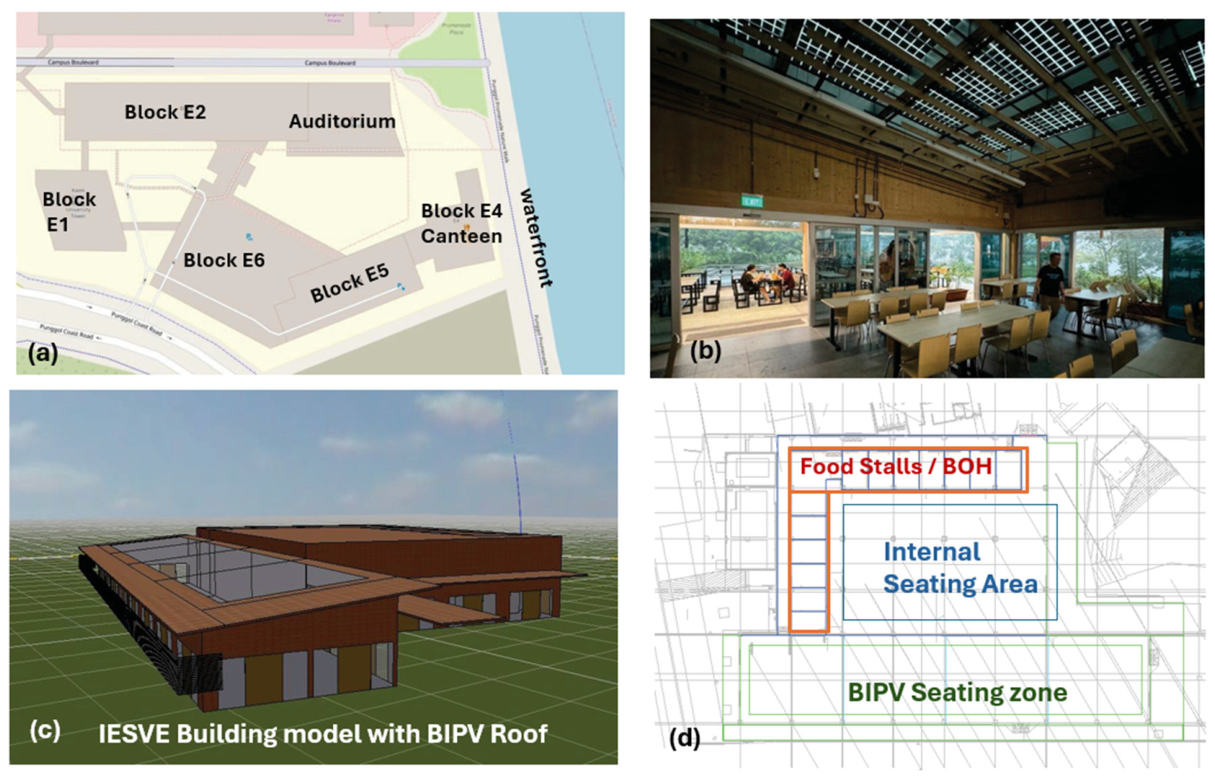
Figure 2.
Rooftop microclimatic conditions measured using the all-sky imaging and weather-monitoring system at the SIT Punggol Campus. (a) Diurnal variation in solar irradiance and ambient air temperature, together with the installed ASI-16/52 all-sky imaging and meteorological monitoring system; (b) corresponding temporal variation in cloudiness, with representative all-sky images illustrating changes in cloud-cover conditions throughout the monitoring period. The measurements characterise the dynamic tropical solar environment used to support the subsequent assessment of PV and BIPV thermal performance.
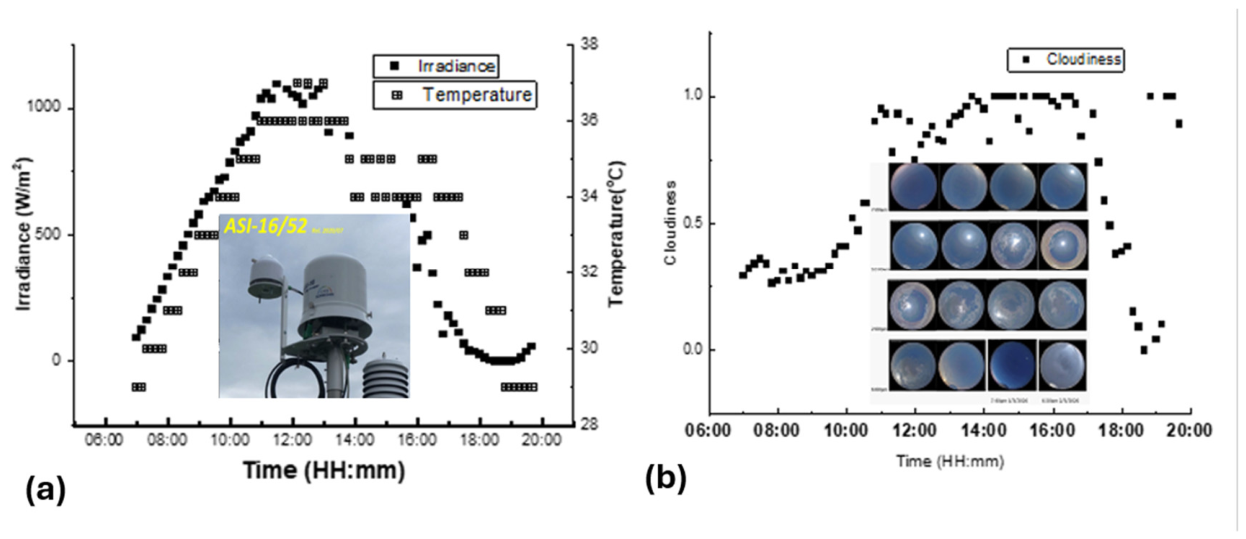
Figure 3.
Solar-control characteristics and proposed integration of advanced material layers with the BIPV roof: (a) full infrared (IR) rejection and total solar energy rejection (TSER) of the investigated material configurations; and (b) conceptual representation of the functional material layer applied to the semi-transparent BIPV roof for subsequent building-performance simulation.
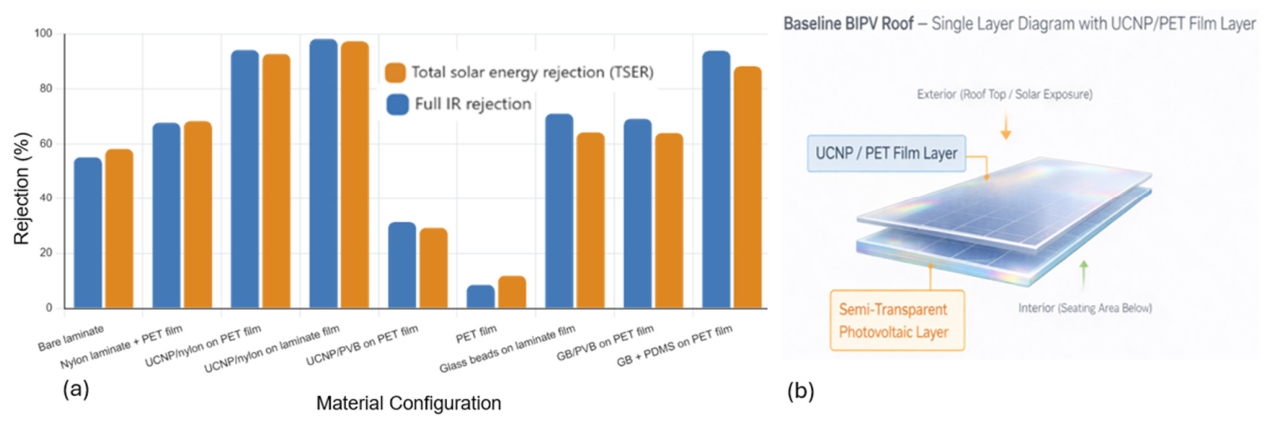
Figure 4.
Outdoor thermal evaluation of PV modules with different surface-material configurations: (a) ambient and PV module temperatures over a 180 min exposure period for the reference PET film, UCNP/PVB-on-PET film and glass-bead (GB) on PET film configurations; (b) outdoor experimental setup; (c) multichannel temperature data acquisition system; and (d) representative PV module with surface-mounted (thermocouple) temperature sensor.
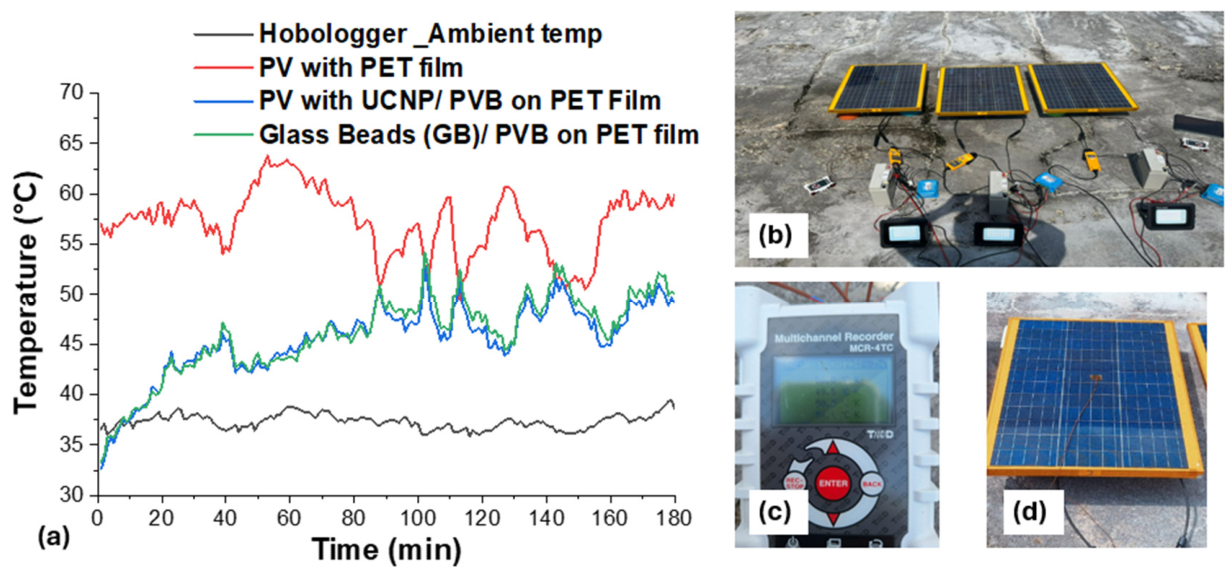
Figure 5.
Influence of alternative material configurations on the thermal performance of the semi-transparent BIPV roof: (a) simulated solar gain from 10:30 to 16:30 for the baseline BIPV and selected UCNP- and glass-bead-based configurations; (b) IESVE SunCast representation of the case-study building and BIPV roof under the simulated solar position; (c) corresponding indoor air-temperature profiles of the BIPV-covered seating zone; and (d) corresponding Hourly Chiller Cooling Energy Demand. All configurations were evaluated using identical building geometry, weather conditions, occupancy, internal loads, and HVAC settings, with only the BIPV solar-optical properties varied.
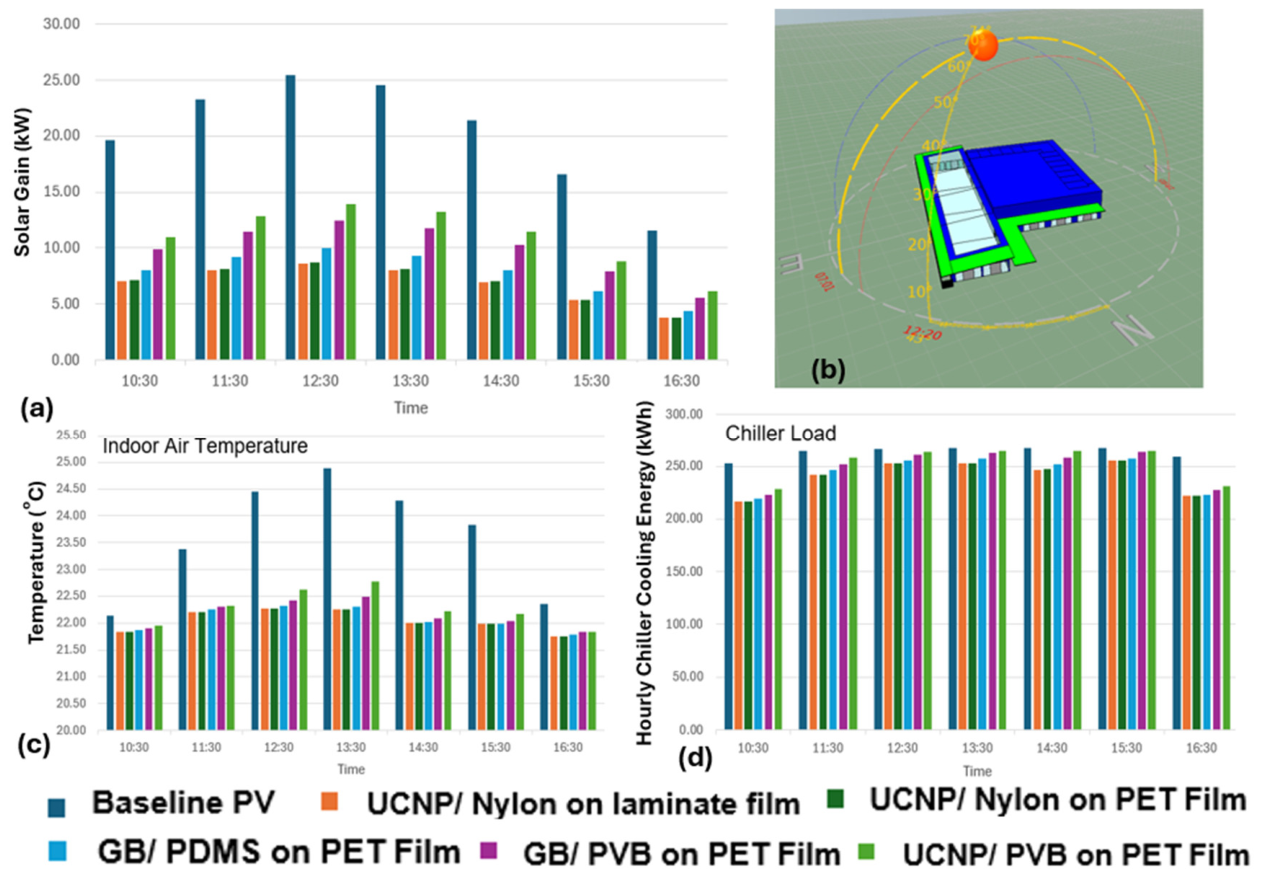
Table 1.
Parameters of eight different configuration (S1 to S8) of materials layers for transfer to BIPV with Ref PET Film.
Table 1.
Parameters of eight different configuration (S1 to S8) of materials layers for transfer to BIPV with Ref PET Film.
| Sample | Label |
UV Rejection |
Full IR Rejection |
VLT | TSER | SHGC |
| Bare laminate | S1 | 71.9 | 55.3 | 28.1 | 58.3 | 0.419 |
| Nylon % Laminate and PET film | S2 | 99.2 | 67.8 | 5.2 | 68.4 | 0.316 |
| UCNP/ nylon on PET film; | S3 | 99.4 | 94.2 | 4.2 | 92.8 | 0.072 |
| UCNP/ nylon on laminate film | S4 | 99.7 | 98.2 | 2.4 | 97.3 | 0.027 |
| UCNP/PVB on PET Film | S5 | 24.6 | 31.4 | 86.2 | 29.3 | 0.703 |
| PET film | Ref | 18.8 | 8.6 | 86.3 | 11.9 | 0.884 |
| Glass Beads on laminate film | S6 | 87.5 | 71.1 | 19.9 | 64.3 | 0.355 |
| Glass Beads (GB)/PVB on PET film | S7 | 82.6 | 69.2 | 50.8 | 64.1 | 0.36 |
| Glass beads with PDMS on PET film; | S8 | 96.7 | 93.9 | 2.8 | 88.3 | 0.117 |
Disclaimer/Publisher’s Note: The statements, opinions and data contained in all publications are solely those of the individual author(s) and contributor(s) and not of MDPI and/or the editor(s). MDPI and/or the editor(s) disclaim responsibility for any injury to people or property resulting from any ideas, methods, instructions or products referred to in the content. |
© 2026 by the authors. Licensee MDPI, Basel, Switzerland. This article is an open access article distributed under the terms and conditions of the Creative Commons Attribution (CC BY) license.
Copyright: This open access article is published under a Creative Commons CC BY 4.0 license, which permit the free download, distribution, and reuse, provided that the author and preprint are cited in any reuse.