

Submitted:
20 November 2026
Posted:
25 November 2026
You are already at the latest version
Abstract
Context: Dependency bots open upgrade pull requests at scale, and each failing upgrade build needs manual triage. Gap: Language models for maintenance are mostly evaluated on generic log benchmarks that contain no upgrade failures. Objective: To determine where small language models (SLMs) add value over deterministic tooling and classical learners in upgrade triage. Method: On BUMP (571 reproduced breaking upgrades in 153 Java/Maven projects), I study failure-mode anticipation, failure diagnosis and broken-API localization with project-grouped and temporal splits, comparing non-neural baselines with five open SLMs (1.7–8B parameters; prompted, retrieval-augmented, QLoRA-tuned) and a 32B model. Contributions: One Maven summary line almost determines the failure category (0.974 accuracy). Build logs mention 56.4% of broken API elements; adding client code raises this to 91.7%, and a learned ranker reaches 0.818 F1. With retrieved past failures, a 4B model matches the 32B model in diagnosis (0.937 vs. 0.935) at one-third the latency, but for localization no language model exceeds 0.523 F1. Limitations: Java/Maven only; localization uses 114 annotated updates. Implications: Rule-based log condensation, client source, a learned ranker and retrieval should come first, with a small model reserved for explanation. All data, code, prompts and predictions are public.
Keywords:
dependency upgrades
; breaking changes
; build failures
; small language models
; software maintenance
; empirical study
1. Introduction
Keeping third-party dependencies current is one of the most frequent maintenance activities in modern software projects. Upgrades deliver security fixes and keep technical debt in check, yet developers routinely postpone them because new versions break client code [20,29,32]. Bots such as Dependabot and Renovate now open upgrade pull requests automatically [13,28], which turns the problem around: the upgrade itself is cheap, but every failing upgrade build must be triaged by a developer who has to decide what broke, why, and what to change.
In the vocabulary of ISO/IEC/IEEE 14764 [18], such work is preventive maintenance: the upgrade is gated in continuous integration (CI) so that latent incompatibilities are detected and corrected before they reach production. Three questions arise along the life of a bot upgrade (Figure 1). Before the build runs: given only the upgrade descriptor (which dependency, from which version to which), how is the upgrade likely to fail? After a failing build: which kind of failure is it (compilation, test, build-rule enforcement, …)? And, for compilation-type failures, which API elements of the dependency are responsible? Answering these quickly is what a developer needs to repair the client, pin the version, or reject the upgrade.
Language models are a natural fit for reading build logs and code, and small language models (SLMs, here 1–8B parameters) can run on a single commodity GPU, inside the organisation’s network, at a cost compatible with CI. This paper asks where, on real upgrade failures, such models actually add value over deterministic tooling and classical learners. Language-model approaches to AIOps and maintenance are commonly evaluated on generic runtime-log anomaly benchmarks such as HDFS and BGL [3,22], or on synthetic upgrade scenarios. Those benchmarks contain no upgrades, and synthetic labels cannot show that a model predicts upgrade outcomes. I therefore restrict the scope to one well-defined class of upgrades, Java library upgrades in Maven builds, for which a reproduced, public, labelled benchmark exists: BUMP [35].
Contributions.
- Task formulation and protocol. I define three upgrade-specific tasks (failure-mode anticipation, failure diagnosis, broken-element localization) on the 571 reproduced breaking updates of BUMP, with project-grouped and temporal splits that prevent leakage between projects, and I recover the client source code at every reported compiler error from the projects’ repositories (Section 3).
- Characterisation of the problem. I show that the failure category is almost entirely determined by one summary line, a shortcut that makes category accuracy uninformative unless masked, and that logs alone cannot localize 44% of the broken API elements, whereas logs plus client source can localize all but 8% (Section 6).
- Problem-derived components. The pipeline components follow from these observations rather than from a list of available techniques: an upgrade-aware log condensation for small context windows, client-source context for localization, and retrieval over past upgrade failures, which recur across projects (Section 4). Each component is evaluated in isolation and ablated.
- Comparative study of SLMs. Five open SLMs from three families (Qwen3, Phi-4, Llama 3.2), prompted with and without retrieved examples and QLoRA-tuned, are compared with rules, classical learners, retrieval, and a 32B model under identical prompts. Retrieved examples, not model size, drive diagnosis accuracy, and a non-neural ranker remains far ahead for localization.
- Replication package with the dataset builder, condensation, baselines, prompts, fine-tuning and evaluation code, tests, and all predictions, so that every reported number can be regenerated [26].
2. Background and Related Work
2.1. Dependency Upgrades and Breaking Changes
Library upgrades break clients through API changes that violate semantic versioning [29,32]; fear of such breakage is a main reason developers lag behind [20]. Automated pull requests raise upgrade rates [28], but bot upgrades are frequently ignored or closed when CI fails [13]. Reyes et al. [35] built BUMP, a benchmark of breaking dependency updates that are reproducible in Docker images, together with failure categories. Breaking-Good [34] explains breaking updates by combining build-log analysis with dependency-tree analysis and produces explanations for about 70% of 243 compilation-breaking cases; Byam [36] uses LLMs (GPT-4o-mini, o3-mini, Gemini 2.0 Flash, Qwen2.5-32B, DeepSeek V3) to repair client code given the compiler error, the failing class and a japicmp API diff, fully repairing about 27% of builds in its best configuration. This work is complementary: I do not repair code but study the triage steps that precede repair, and I focus on models small enough for on-premise CI. Outside library upgrades, Zhang et al. [38] characterise upgrade failures in distributed systems (data-format and protocol incompatibilities between versions) and build a testing tool for them; Horton and Parnin [15] detect configuration drift in Python snippets caused by breaking dependency changes; and Abreu et al. [1] gate risky code changes during release deployment at Meta with LLM-based risk scores. These works show that upgrade risk is multi-faceted (API, data format, configuration); this study covers the API and build-configuration facets observable in Maven builds.
2.2. Build Logs and Log Analysis
CI build failures in Java projects are dominated by compilation, test and dependency problems [33]. Build logs are long and noisy; LogChunks [2] provides manually labelled log chunks that explain why builds fail, which motivates extracting the relevant part of a log before analysis. Runtime log analysis has a long history [14]: parsing (e.g., Drain [12]), and anomaly detection with sequence models [6], masked language models [11] and LLMs [3,10]. Le and Zhang [22] showed that random splits of overlapping log windows inflate anomaly-detection scores, a lesson I apply by splitting by project and by time. EvLog [17] handles log-template evolution across software versions, and AdaptiveLog [25] routes uncertain log-analysis queries from an SLM to an LLM. These works target runtime logs of long-running systems; none addresses build logs of dependency upgrades.
2.3. Small Language Models, Adaptation and Retrieval
I use instruction-tuned open models of 1.7–8B parameters from three families: Qwen3 [31], Phi-4-mini [27] and Llama 3.2 [9]. They are adapted with low-rank adapters [16] trained on a 4-bit quantised base model (QLoRA [4]). Retrieval-augmented generation [23] supplies retrieved documents in the prompt; here the documents are past upgrade failures with known outcomes, retrieved with BM25 [37]. Because models use long contexts unevenly [24], what is placed into a small context window matters, which motivates the condensation step.
3. Problem Formulation and Data
3.1. The BUMP Benchmark
BUMP [35] contains breaking dependency updates mined from GitHub projects that build with Maven. Each update is a pair of commits: the pre-commit builds and passes its tests; the breaking commit changes one dependency version in a pom.xml and fails. Every pair was reproduced in a Docker image, and the reproduction log of the breaking build is part of the benchmark. I use all 571 reproduced updates (benchmark commit 324d551), which span 153 projects and 175 distinct dependencies. Table 1 lists the failure categories assigned by BUMP’s reproduction. No label in this study is synthetic.
For each update I use three inputs. The upgrade descriptor d contains dependency coordinates, old and new version, BUMP’s version-update type (major/minor/patch/other), the dependency scope, the pom.xml section (e.g., dependencies, dependencyManagement, buildPlugins), the artifact type and whether a bot authored the change. The build log L is the reproduction log of the breaking commit. After removing download-progress and other noise lines, its median length is 4,369 tokens (90th percentile 33,160), and 53% of logs exceed 4,096 tokens. The client source S consists of the files named in compiler errors (<file>:[line,col]), which I retrieve at the breaking commit from each project’s Git repository with a blob-less fetch, keeping a ±3-line window around every reported location (first eight files per update). Source windows were recovered for 228 of the 243 compilation-type updates; 15 repositories or commits are no longer available.
3.2. Tasks
T1 – failure-mode anticipation (pre-build). Given only d, predict the failure category y ∈ of an upgrade that will break. T1 is conditioned on breakage: BUMP contains no non-breaking updates, so I cannot evaluate whether an upgrade will break, only how. Even so, T1 tells a CI system which check (compilation, tests, dependency rules) is likely to fail and can be run first.
T2 – failure diagnosis (post-build). Given d and L, predict y.
T3 – broken-element localization (post-build). For compilation-type failures, given d, L and, optionally, S, output the set E of simple names of dependency API elements (classes, methods, fields, constructors) whose change breaks the client. Ground truth comes from BUMP’s API-difference analysis, which links japicmp/revapi differences between the two dependency versions to concrete compiler errors in the client. It is available for 114 updates with 484 element mentions in total. I compare names after normalisation (lower case, generics and arguments stripped, last segment of a qualified name).
3.3. Why Logs Alone Are Not Enough, and When Logs Are Available
Logs are available only after the build has run. T2 and T3 are therefore post-build, pre-merge tasks: the upgrade is still prevented from reaching the main branch and production, which is the preventive part. T1 is the only pre-build task, and it uses the descriptor and the history of earlier upgrades, not logs. The build log of a failing upgrade describes symptoms (“cannot find symbol”), but the responsible API element is often not named in the log: the compiler reports the client construct that no longer resolves, while the dependency element is visible only in the client code at that position. Section 6.3 quantifies this gap. Configuration state and dependency graphs, which Zhang et al. [38] and Breaking-Good [34] also use, enter this study through the descriptor (pom section, scope) and through the enforcer and dependency-lock failure categories.
3.4. Splits
Project-grouped 5-fold cross-validation (stratified by category) keeps all updates of a project in the same fold. BUMP contains up to dozens of updates per project with near-identical logs, so random splits would leak project-specific log idioms. All 5× results are pooled over the five test folds (each update is predicted exactly once). The temporal split orders updates by the commit date of the breaking commit, which I recover from Git for 551 updates. The newest 30% form the test set, and any project that also appears in the test period is removed from the training period (186 train, 166 test updates; test period from 2023-02-20). Retrieval indexes, rule tables, classifier weights, thresholds and adapters are built from training data only.
4. Approach
The pipeline has four components, each motivated by a property of the tasks.
(1) Upgrade-aware log condensation. Half of the logs exceed a 4K-token window, so some selection is unavoidable. Selection must not drop the decisive diagnostics, and Maven prints them twice: in place, and again in a final summary. The condenser removes noise lines, assigns priorities (P0: failure anchors such as Failed to execute goal and reactor FAILURE lines; P1: error blocks, i.e., [ERROR] lines, test-failure headers, enforcer and dependency-resolution messages, each with up to 12 continuation lines; P2: lines that mention the upgraded artifact; P3: warnings), de-duplicates lines by template (log-level prefix, hexadecimal identifiers and timings masked; file paths and line numbers kept, so distinct compiler errors are never merged), ranks lines within a priority level by their last occurrence in the log, fills the token budget greedily, and emits the selected lines in their original order with “…” marking gaps. Baselines are head, tail, head+tail and an error-line grep (Section 6.2).
(2) Client source context. For T3, the source windows at the reported error locations are appended to the prompt (or used as features by the learned baselines).
(3) Retrieval over past upgrade failures. The same dependency often breaks several projects (for example, slf4j-api accounts for 36 updates and jackson-databind for 33). Under project-grouped splits, the dependency of 46% of test updates also occurs in the training history. A BM25 index over the training updates (key: descriptor plus a 256-token condensed log) returns the k most similar past failures, which are shown with their known category and, when annotated, their broken elements.
(4) Model and output. A model receives a fixed instruction, a category glossary, the retrieved cases, the current descriptor, the condensed log and the source windows (prompt in Appendix A), and returns a JSON object with category, broken_elements, a one-sentence explanation and a one-sentence remediation. Unparseable outputs count as errors and are never replaced by a default. Models are used in three ways: prompted without examples (k = 0), prompted with k = 3 retrieved examples, and QLoRA-tuned on the training folds. Fine-tuning targets are the gold structured fields only (category; broken elements when annotated). BUMP has no gold explanations, so no explanation text is synthesised for training.
Scope of the pipeline. Upgrade-planning components that are often proposed for AI-assisted maintenance, such as integer-programming schedulers, scalar risk scores over model hidden states, playbook generation or continuous re-training, are not part of the pipeline: their benefit cannot be measured against real upgrade outcomes with public data. The one aspect of continuous learning that real data can test, whether more history improves later predictions, is studied as a learning curve on the temporal split (Section 6.4).
5. Study Design
5.1. Research Questions
RQ1
How well can the failure mode of a breaking upgrade be anticipated before the build, from the descriptor and the history of past upgrades?
RQ2
How much diagnostic evidence do condensation strategies retain under SLM-sized token budgets?
RQ3
How accurately do rules, classical learners, retrieval and SLMs diagnose failures (T2) and localize broken elements (T3)? Which inputs matter (log, descriptor, client source, retrieved cases, condensation)?
RQ4
What do SLMs cost (latency, memory) relative to the baselines, and how does accuracy evolve as upgrade history accumulates?
5.2. Baselines
Rules. (i) The failing-goal rule maps the plugin of the last Failed to execute goal line to the majority category of that plugin in the training folds, and falls back to (ii) content rules (ordered regular expressions for resolution, lock, -Werror, enforcer, compiler and test messages). (iii) javac rules extract element names from standard javac diagnostics (symbol: lines, package … does not exist, cannot access, constructor/method … cannot be applied, …). Classical learners. For T1, logistic regression (LR) and random forest (RF) over one-hot descriptor fields, coordinate tokens and the major-version jump; a same-dependency vote; and a BM25 kNN vote. For T2, TF-IDF (word uni-/bigrams) with LR or linear SVM over the condensed log, and a BM25 kNN vote. For T3, a learned candidate ranker: every identifier in javac error, symbol: and location: lines (and, optionally, on the source line at the error) becomes a candidate with features (pattern matched, line type, capitalisation, position relative to the error column, call syntax, frequency), scored by class-balanced LR with a threshold tuned by inner project-grouped cross-validation. I also report the identifier at the error column of the source line.
5.3. Models
The SLMs were chosen to separate size from family: Qwen3-1.7B, -4B and -8B [31] form a size series with one tokenizer and training recipe, and Phi-4-mini-instruct (3.8B) [27] and Llama-3.2-3B-Instruct [9] provide two other families at the 3–4B scale. All are open-weight, instruction-tuned and have context windows of at least 32K tokens, so the 1,536-token log budget plus examples always fits. Qwen3 runs in non-thinking mode. As a large-model reference I use Qwen3-32B (official 4-bit AWQ weights, so that it fits a single GPU) with exactly the same prompts and examples (prompted, k ∈ {0, 3}). Comparing fine-tuned small models with a zero-shot large model would confound adaptation with model size; here every prompted model sees the same inputs, and fine-tuned SLMs are compared with prompted large models only as a cost–accuracy trade-off, labelled as such. Decoding is greedy; at most 200 new tokens are generated.
5.4. Fine-Tuning
QLoRA with a 4-bit NF4 base model, LoRA rank 16, α = 32, dropout 0.05 on all attention and MLP projections, learning rate 2 × 10⁻⁴ with cosine decay and 5% warm-up, effective batch size 8, 3 epochs, maximum length 4,096 tokens (prompts truncated from the left, never the target), loss on completion tokens only, seed 0. One adapter is trained per fold on the fold’s training updates, with no early stopping on test data. These values are common QLoRA defaults and were not tuned on the test folds.
5.5. Metrics and Statistics
T1/T2: accuracy and macro-F1 over the categories present (macro-F1 weights the rare enforcer, lock, -Werror and resolution categories). T3: micro precision, recall and F1 over element mentions, and per-update F1 averaged over updates. RQ2: the share of BUMP evidence lines (the compiler-error lines that BUMP links to broken elements; 326 lines in 114 updates) that survive condensation, the share of updates whose failing-goal line survives, and downstream rule performance. I report 95% percentile-bootstrap confidence intervals over updates (2,000 resamples) [7], exact McNemar tests for paired classifiers [5], and Wilcoxon signed-rank tests for paired per-update F1. Bootstrap intervals and non-parametric paired tests are used because per-update scores are bounded and far from normally distributed, in line with recommendations for robust statistical methods in empirical software engineering [19].
5.6. Implementation
Python 3, scikit-learn, Hugging Face Transformers and PEFT. Prompted runs are served with vLLM [21] with parallel requests; QLoRA-tuned models are evaluated with Transformers. Latency is measured separately, one request at a time on 50 updates per model, so that it is not inflated by queueing; peak memory is taken from the Transformers evaluation runs (bf16 base model plus adapter). All non-neural experiments run on a 2-core CPU in about 30 minutes. All GPU experiments ran on one NVIDIA A100 80 GB in Google Colab; the core suite (all prompted runs, the 32B reference, 25 QLoRA adapters and their evaluation, and latency timing) took 9.7 GPU-hours. Token counts in budgets use a tokenizer-agnostic estimate (words and punctuation), which is within roughly 15–30% of BPE counts on build logs; exact model token counts are logged for every SLM call.
6. Results
6.1. RQ1: Anticipating the Failure Mode Before the Build
Table 2 shows that the descriptor carries real but limited signal. Under project-grouped cross-validation, a random forest over descriptor fields reaches 0.636 accuracy (95% CI 0.60–0.67) and 0.426 macro-F1, against 0.412 and 0.097 for the majority class. The simplest use of history, predicting the most frequent outcome of the same dependency in other projects, already reaches 0.601 accuracy, but it applies only to the 46% of test updates whose dependency appears in the training history and falls back to the majority class otherwise. The temporal split is harder because the category mix shifts: enforcer failures dominate the older period (70 of 186 training updates) and compilation failures the newer one (93 of 166 test updates), so the majority class drops to 0.175. Logistic regression is the most robust learner under this shift (0.657 accuracy, 0.466 macro-F1), whereas the random forest’s macro-F1 falls to 0.295. Pre-build anticipation is therefore useful for ordering CI checks, but it cannot replace running the build. Language models add nothing here. Prompted without examples, every model is at majority-class level or below (accuracy 0.40–0.42, macro-F1 0.10–0.15). Qwen3-1.7B collapses entirely, answering “dependency resolution failure” for 570 of 571 upgrades (accuracy 0.011). With five retrieved past upgrades in the prompt, the models other than Qwen3-1.7B (0.179) reach 0.585–0.627 accuracy and 0.292–0.368 macro-F1, which is the level of the simple same-dependency vote (0.601/0.381) and below the descriptor random forest (0.636/0.426). The 32B model is no better (0.616/0.320). The models thus mainly copy the outcome of the retrieved precedents rather than reason about the upgrade.
6.2. RQ2: What Survives Condensation
Figure 2 and Table 3 compare the strategies. Keeping the head of the log is useless: Maven prints dependency downloads and plugin set-up first, and only 15.3% of the evidence lines survive in 1,024 tokens. Tail truncation is a strong baseline because Maven repeats the decisive diagnostics in its final summary: it keeps 86.2% of the evidence lines at 512 tokens and 92.9% at 1,024. The upgrade-aware condenser keeps 95.4% at 1,024 and 99.4% at 2,048 tokens, and it keeps the failing-goal line in 99.5% of the updates at every budget (the remaining updates are resolution failures that have no such line), against 78.8–91.1% for the tail. At 512 tokens, however, the tail retains more evidence lines (86.2% vs. 78.2%), because the condenser spends part of the budget on anchors and reactor summaries. Downstream, javac-rule extraction on 1,024-token condensations reaches the same F1 with tail and upgrade-aware condensation (0.514 vs. 0.510), and both match extraction on the full log (0.494).
The ablations show which design decisions matter. Ranking lines by their last occurrence is the most important one: ranking by first occurrence loses 20 points of evidence retention at 1,024 tokens (74.8% vs. 95.4%), because early [ERROR] lines often come from unrelated modules or are later repeated. De-duplication adds 3.7 points at 1,024 tokens. Boosting lines that mention the upgraded artifact has no measurable effect, so I keep it only because it is free.
Answer to RQ2. In-context budgets of 1–2K tokens suffice to retain more than 95% of the benchmark’s evidence lines. The upgrade-aware condenser reliably preserves the failure anchors and is best at 1,024 tokens, but simple tail truncation is a strong, sometimes better, baseline at very small budgets. The decisive design choice is to prefer late occurrences.
6.3. RQ3: Diagnosis and Localization
T2: diagnosis and the shortcut.
Table 4(a) confirms what the data analysis suggested: a rule that reads the plugin of the last Failed to execute goal line, with a plugin-to-category table learned from the training folds only, reaches 0.974 accuracy and 0.947 macro-F1. BUMP’s categories are defined by the Maven phase in which the build fails, so this line encodes the label almost directly. Any model that sees this line can score highly without reading the diagnostics, a textbook shortcut [8]. Category accuracy on unmasked logs therefore says little about a language model’s understanding. I report it for completeness and focus on the masked setting and on T3.
With the shortcut lines removed (Table 4(b)), content rules drop to 0.799 accuracy, and TF-IDF with logistic regression reaches 0.905 accuracy but only 0.692 macro-F1 (McNemar against content rules: 75 vs. 14 discordant updates, p < 10−10). The learners fail on the rare categories: the 14 dependency-lock failures come from a handful of projects, and under project-grouped splits no learner recognises them (per-class F1 = 0), whereas the hand-written content rule does when the shortcut is visible. Masked, the best language models only match the learned baseline: Qwen3-4B with three retrieved examples reaches 0.895 accuracy and 0.733 macro-F1, statistically indistinguishable from TF-IDF with logistic regression (McNemar: 31 vs. 37 discordant updates, p = 0.54), and Qwen3-8B is significantly less accurate (0.837; 40 vs. 79, p < 0.001) despite a similar macro-F1 (0.732). The models’ macro-F1 edges ahead of the learned baselines (0.733 vs. 0.692), possibly because the category glossary in the prompt helps on rare classes, but not enough to change the overall picture.
On unmasked logs (Table 4(a)), retrieved examples matter more than model size. Qwen3-4B rises from 0.741 accuracy without examples to 0.937 with three (macro-F1 0.600 to 0.882), and with examples it is indistinguishable from the 32B reference (0.935; McNemar 23 vs. 22, p = 1.0). No prompted model reaches the failing-goal rule (Qwen3-4B: 2 vs. 23 discordant updates, p < 10−4). QLoRA-tuned models do: Qwen3-4B reaches 0.998 accuracy and 0.999 macro-F1 and beats the rule (15 vs. 1, p < 10−3), because it learns the shortcut line together with plugins that are rare or absent in a training fold. Given the shortcut, this shows that tuning learns the Maven summary well, not that it understands failures.
T3: localization needs the client code.
Only 56.4% of the ground-truth element mentions occur anywhere in the full build log (53.5% in the 1,536-token condensation). With the client source windows added, 91.7% occur in the input. This upper bound applies to every log-only method, including any language model that does not guess. Table 5 shows its consequence: javac rules reach 0.494 F1 on the full log, and a learned ranker over log candidates performs the same (0.494), whereas the same ranker with source candidates reaches 0.818 F1 (precision 0.827, recall 0.810). The per-update improvement is significant (Wilcoxon p = 7.5 × 10⁻¹²). Naively taking the identifier at the reported error column is poor (0.136), because javac’s column often points to the receiver of a call or to a type, not to the missing member. Source context is thus the single most valuable input for localization, and the learned ranker is a demanding baseline for SLMs. The language models do not come close. The best is Qwen3-4B with three retrieved examples (0.503 F1; 0.523 with tail condensation), at the level of the javac rules (0.494), and the 32B reference is no better (0.487). Every model is significantly below the learned ranker with source (Wilcoxon on per-update F1, p < 10−4 for Qwen3-4B and Qwen3-32B; mean per-update difference −0.19 to −0.22). Fine-tuning makes localization worse, not better: QLoRA-tuned Qwen3-4B drops to 0.152 F1. It returns no element list for 70 of the 114 annotated updates, because about half of the compilation failures in its training folds have no element annotation, and their training targets omit the field.
Retrieval quality.
Table 6 evaluates the retrieval component on its own. Descriptor-only keys always retrieve the same dependency when it exists in the history (hit@3 = 1.0), but only 58.4% of the retrieved cases share the query’s category. Keys built from a 256-token condensed log retrieve cases with the same category 91.8% of the time (BM25, P@3), but find the same dependency in only 54.6% of eligible queries. Combining descriptor and log balances the two (P@3 0.898, dependency hit 0.698 with BM25; 0.880 and 0.767 with TF-IDF), which is the key I use for in-context examples. Masking the shortcut lines costs 2.6–7.6 points of P@3 for log-based keys and nothing for descriptor keys. A kNN vote over these neighbours is itself a reasonable classifier (0.912 accuracy unmasked, 0.907 masked; Table 4).
Input ablations.
Table 7 isolates the contribution of each input source for the SLM: client source, upgrade descriptor, retrieved examples, condensation strategy and budget, and shortcut masking. Three results stand out. First, retrieved examples are the decisive input for diagnosis (macro-F1 0.600 without, 0.882 with), but add little to localization (0.485 to 0.503). Second, the client source, the input that lifts the learned ranker from 0.494 to 0.818 F1, barely helps the language model: micro-F1 is 0.503 with and 0.509 without it, and per-update F1 improves by only 0.045 on average (Wilcoxon p = 0.037). The models do not exploit the code context that holds the missing information. Third, shorter inputs are not worse: a 512-token condensation gives the best category macro-F1 (0.951) and the same element F1 (0.493), while 3,072 tokens lowers macro-F1 to 0.848. Removing the descriptor does not hurt (0.897/0.517), and tail condensation is comparable to the upgrade-aware condenser for the language model (0.855/0.523 vs. 0.882/0.503). The same ablations with QLoRA tuning were not run, for compute-cost reasons; the fine-tuned results therefore cover the full configuration only.
6.4. RQ4: Cost and Accumulating History
The deterministic components are cheap: cleaning a log takes 9.6 ms, condensing it 18.8 ms and applying the failing-goal rule 0.4 ms on average (Table 8). On one A100, a prompted small model answers a failing build in 0.42 s (Qwen3-1.7B) to 1.21 s (Qwen3-8B), with about 3,000 prompt tokens at k = 3; the 4-bit 32B reference needs 2.18 s. Peak memory ranges from 4.1 GB to 17.5 GB in bf16. All small models therefore fit a single 24 GB GPU, and inference cost is not the obstacle. Any SLM must therefore pay for itself with accuracy on tasks the rules and the ranker do not already solve: masked diagnosis of rare categories, localization beyond 0.818 F1, and natural-language explanations, which the benchmark cannot score automatically.
Figure 3 tests the premise behind continuous-learning maintenance pipelines that real data can test: does accumulated upgrade history help later upgrades? For anticipation it clearly does (macro-F1 from 0.245 with 25 past failures to 0.466 with 186). For masked diagnosis the gain is small (0.435 to 0.482). Element localization with source context is already at 0.889 F1 with 18 annotated past failures and does not improve further, which suggests that its features transfer across projects and need little history. The learning curve was not repeated for fine-tuned models, for compute-cost reasons.
7. Discussion
Where SLMs can and cannot help. The measurements available without any language model already redraw the map. Category triage of Maven upgrade failures is a solved problem for deterministic tooling as long as the build log is complete. A model is needed only when the summary is missing (truncated logs, non-Maven builds) or when rare categories must be recognised from the content alone. Localization, in contrast, is not solved: rules reach about 0.5 F1 and are bounded by the 56% of elements that logs mention, while a ranker with source context reaches 0.82. This is where an SLM that reads code and log together has room to add value, and where its explanations and remediation suggestions, which no baseline produces, can matter to developers. The SLMs did not realise this potential. Their localization F1 (0.15–0.52) is no better than the javac rules, they hardly use the source context that makes the ranker work, and fine-tuning on BUMP’s partial annotations made them drop the element list altogether. Their one clear contribution is diagnosis with retrieved precedents, where a 4B model matches a 32B one at a third of the latency. Whether their free-text explanations help developers is an open question that the benchmark cannot score; it needs a user study.
Implications for tool builders. (1) Run the cheap things first: noise removal, the failing-goal rule and a tail or upgrade-aware condensation cost milliseconds and settle the category. (2) Fetch the client code at the error locations before asking any model what broke; without it, more than 40% of the answers are not in the input. (3) Keep a history of past upgrade failures: the same dependencies break many projects, and retrieval over descriptor and log finds a same-category precedent in about 90% of cases. (4) Evaluate on project-grouped or temporal splits; near-duplicate updates of one project otherwise leak.
Scope. This study is deliberately narrow: library upgrades in Java/Maven projects, where a reproduced, labelled benchmark exists. Upgrade-planning components often proposed for AI-assisted maintenance, such as risk-based scheduling, playbook generation or continuous re-training, are outside the scope because they cannot be evaluated against real upgrade outcomes with public data. Operating-system and service upgrades remain important (cf. Zhang et al. [38]); I know of no public, reproduced, labelled dataset for them comparable to BUMP, and building one is future work.
Pre-build risk. T1 is conditioned on breakage because BUMP contains only breaking updates. Predicting whether an upgrade breaks a given client requires negative examples (non-breaking updates of the same projects) and, most likely, the client’s usage of the changed API, as in Byam’s use of japicmp reports [36]. Extending BUMP with reproduced non-breaking updates would enable this.
8. Threats to Validity
Construct validity. BUMP’s category labels are defined by the Maven phase that fails, which explains the shortcut of Section 6.3; I report masked results to separate content understanding from reading the summary line. Masking is regex-based and may leave residual cues (for example, the word “Tests” in surefire output), so masked results are an optimistic estimate of performance on logs without summaries. Element ground truth exists for only 114 of the 243 compilation-type updates, and it is derived by BUMP’s tooling from API differences linked to compiler errors. Elements that break the client without a matching japicmp/revapi difference may be missing from it, which would understate precision for all methods equally. Names are compared after normalisation to simple names, so overloaded methods are not distinguished. Token budgets use a tokenizer-agnostic estimate; the SLM runs log exact token counts.
Internal validity. All learned components are fitted on training folds only (rule tables, vocabularies, thresholds via inner project-grouped CV, retrieval indexes, adapters). The condenser was developed while inspecting BUMP logs, and one design iteration (ranking by last instead of first occurrence) was made after observing results on the full dataset. I report both variants (Table 3) rather than only the better one. The hand-written content rules and javac patterns follow standard Maven and javac message formats, but they were also written with BUMP logs in view. Fine-tuning hyper-parameters are standard QLoRA defaults and were not tuned on test folds. The language-model results use greedy decoding, and fine-tuning was run with one seed per fold, so seed-to-seed variance is not estimated; small differences between fine-tuned models should be read with caution. The lenient parser (Appendix B) was added after observing that Llama-3.2 systematically omitted the final brace of otherwise complete answers. It only closes unfinished JSON and drops values cut off mid-string; strict scores are reported alongside.
External validity. All updates are Java library upgrades built with Maven and reproduced with Java 11 or 17. Gradle builds, other ecosystems (npm, PyPI) and operating-system or service upgrades may differ, for example in how much of the failure the log reveals. 15 of 243 compilation-type updates lack source windows because their repositories or commits are no longer available. The temporal split has only 166 test updates and few rare-category cases, so per-class estimates there are noisy. The open SLMs I study are recent snapshots; newer models may behave differently, which is why the full pipeline and prompts are released.
Conclusion validity. I report 95% bootstrap confidence intervals and paired tests. With 114 annotated updates for T3 and 14 or fewer updates in three categories, small differences between methods should not be over-interpreted.
9. Conclusion
I studied where small language models can help triage breaking dependency upgrades, using 571 reproduced upgrade failures instead of generic log benchmarks. Before any model is involved, three facts constrain the answer. Failure categories are encoded in one summary line. Build logs alone mention only 56.4% of the API elements that break the client, against 91.7% when the client code at the error locations is added. And 1–2K-token condensations retain more than 95% of the diagnostic evidence, provided late occurrences are preferred. A learned ranker over log and source candidates sets a strong bar for localization (0.818 F1). The SLMs help where precedents exist: with three retrieved past failures, a 4B model diagnoses failures as well as a 32B one in 0.7 s per build. They do not help with localization, where they reach at most 0.52 F1, ignore most of the source context, and get worse when fine-tuned on partial annotations. For upgrade triage, the best current recipe is cheap: deterministic condensation, client source, a learned ranker, and retrieval over past failures, with a small model reserved for explanation. Future work includes reproduced non-breaking updates for true pre-build risk prediction, other build systems and ecosystems, and user studies of model-generated explanations.
Supplementary Materials
The following supporting information can be downloaded at the website of this paper posted on Preprints.org.
Funding
No funding was received for conducting this study. The University of the Cumberlands is listed for affiliation only; no institutional funding, facilities or resources were used.
Acknowledgments
The author thanks the BUMP authors for making reproducible breaking updates, logs and API-difference analyses publicly available.
Declaration of Competing Interests
The author declares no competing interests relevant to the content of this article.
Appendix A. Prompt Template
All models (prompted, retrieval-augmented, QLoRA-tuned, and the 32B reference) receive the following messages. Bracketed parts are filled per update; the “Similar past upgrades” block is present only when k > 0, and the source block only when source context is enabled. QLoRA targets are the gold JSON with category and, when annotated, broken_elements.
<system>
You are a build engineer who triages failed dependency upgrades in Java/Maven projects. Answer only with one JSON object and no other text.
<user>
Failure categories:
- COMPILATION_FAILURE: the project no longer compiles against the new dependency version.
- TEST_FAILURE: the project compiles but tests fail with the new version.
- ENFORCER_FAILURE: a build rule (e.g. maven-enforcer dependency convergence or upper-bound checks) rejects the new dependency graph.
- DEPENDENCY_LOCK_FAILURE: the new version does not match a committed dependency lock file.
- WERROR_FAILURE: compilation emits warnings (e.g. deprecations) and the build treats warnings as errors.
- DEPENDENCY_RESOLUTION_FAILURE: the new version or one of its transitive dependencies cannot be resolved.
A bot changed one dependency version in the pom.xml and the build failed.
Diagnose the failure.
Return JSON with keys:
"category": one of ["COMPILATION_FAILURE", "TEST_FAILURE", "ENFORCER_FAILURE", "DEPENDENCY_LOCK_FAILURE", "WERROR_FAILURE", "DEPENDENCY_RESOLUTION_FAILURE"],
"broken_elements": list of simple names of the dependency API elements (classes, methods, fields, constructors) whose change breaks the project; [] if not a compilation-type failure,
"explanation": one sentence,
"remediation": one sentence.
Similar past upgrades and their known outcomes:
[Case 1]
Past upgrade: <descriptor of retrieved case>
Build log (condensed):
<256-token condensation of its log>
Outcome: {"category": ..., "broken_elements": [...]}
... (k cases)
[Current upgrade]
Upgrade: dependency <group>:<artifact> <old> -> <new> (update type: ...; scope: ...;
pom section: ...; artifact type: ...; author: bot|human)
Build log (condensed):
<1,536-token upgrade-aware condensation>
Client source at the reported compiler errors:
<path>:<line> (<javac message>)
58 ...
61> <erroneous line>
...
JSON:
For T1 (anticipation) the task paragraph is replaced by:
A bot proposes the dependency upgrade below. The build has NOT been run yet.
Assume the upgrade will break the build and predict the most likely way it breaks.
Return JSON with key "category": one of ["COMPILATION_FAILURE", "TEST_FAILURE", "ENFORCER_FAILURE", "DEPENDENCY_LOCK_FAILURE", "WERROR_FAILURE", "DEPENDENCY_RESOLUTION_FAILURE"].
and neither log nor source is included.
Appendix B. Output Validity and Parsing
Model outputs are parsed in two ways. The strict parser accepts the first complete JSON object with a valid category. The lenient parser, used for all reported scores, additionally closes an unfinished object (a missing final brace, or an answer cut off by the 200-token limit): it drops a value cut off mid-string, removes a dangling key or comma, and appends the missing brackets. It never adds content. Table A1 reports both. Only Llama-3.2 is materially affected: it ends 98% of its prompted answers at k = 3 without the final brace.

Table A1.
Strict parse failures, share of outputs repaired by the lenient parser, and category accuracy under both parsers (diagnosis, full condensed log, project-grouped CV).
Table A1.
Strict parse failures, share of outputs repaired by the lenient parser, and category accuracy under both parsers (diagnosis, full condensed log, project-grouped CV).
| Strict parse | Repaired | Category accuracy | ||
| Run | failures (%) | (%) | strict | lenient |
| Qwen3-1.7B, prompted, k = 0 | 0.7 | 0.7 | 0.736 | 0.737 |
| Qwen3-1.7B, prompted, k = 3 | 0.7 | 0.4 | 0.848 | 0.851 |
| Qwen3-1.7B, QLoRA | 0.0 | 0.0 | 1.000 | 1.000 |
| Llama-3.2-3B-Instruct, prompted, k = 0 | 29.9 | 29.9 | 0.545 | 0.816 |
| Llama-3.2-3B-Instruct, prompted, k = 3 | 98.4 | 98.2 | 0.012 | 0.848 |
| Llama-3.2-3B-Instruct, QLoRA | 0.5 | 0.5 | 0.961 | 0.967 |
| Phi-4-mini-instruct (3.8B), prompted, k = 0 | 4.6 | 4.6 | 0.622 | 0.639 |
| Phi-4-mini-instruct (3.8B), prompted, k = 3 | 4.4 | 4.4 | 0.814 | 0.855 |
| Phi-4-mini-instruct (3.8B), QLoRA | 0.7 | 0.7 | 0.970 | 0.977 |
| Qwen3-4B, prompted, k = 0 | 0.5 | 0.5 | 0.741 | 0.741 |
| Qwen3-4B, prompted, k = 3 | 0.2 | 0.2 | 0.937 | 0.937 |
| Qwen3-4B, QLoRA | 1.6 | 1.4 | 0.984 | 0.998 |
| Qwen3-8B, prompted, k = 0 | 1.4 | 1.4 | 0.713 | 0.713 |
| Qwen3-8B, prompted, k = 3 | 0.0 | 0.0 | 0.897 | 0.897 |
| Qwen3-8B, QLoRA | 0.0 | 0.0 | 0.993 | 0.993 |
| Qwen3-32B (large reference), prompted, k = 0 | 0.0 | 0.0 | 0.736 | 0.736 |
| Qwen3-32B (large reference), prompted, k = 3 | 0.0 | 0.0 | 0.935 | 0.935 |
References
- Abreu, Rui; Murali, Vijayaraghavan; Rigby, Peter C.; Maddila, Chandra; Sun, Weiyan; Ge, Jun; Chinniah, Kaavya; Mockus, Audris; Mehta, Megh; Nagappan, Nachiappan. Moving faster and reducing risk: Using LLMs in release deployment. In Proceedings of the IEEE/ACM 47th International Conference on Software Engineering: Software Engineering in Practice (ICSE-SEIP), 2025. [Google Scholar] [CrossRef]
- Brandt, Carolin E.; Panichella, Annibale; Zaidman, Andy; Beller, Moritz. LogChunks: A data set for build log analysis. In Proceedings of the 17th International Conference on Mining Software Repositories (MSR), 2020; pp. pages 583–587. [Google Scholar] [CrossRef]
- Cabello, Miguel De la Cruz; Sales, Tiago Prince; Machado, Marcos R. AIOps for log anomaly detection in the era of LLMs: A systematic literature review. Intell. Syst. With Appl. 28, 200608, 2025. [CrossRef]
- Dettmers, Tim; Pagnoni, Artidoro; Holtzman, Ari; Zettlemoyer, Luke. QLoRA: Efficient finetuning of quantized LLMs. Advances in Neural Information Processing Systems (NeurIPS), 2023. [Google Scholar]
- Dietterich, Thomas G. Approximate statistical tests for comparing supervised classification learning algorithms. Neural Comput. 1998, 10(7), 1895–1923. [Google Scholar] [CrossRef]
- Du, Min; Li, Feifei; Zheng, Guineng; Srikumar, Vivek. DeepLog: Anomaly detection and diagnosis from system logs through deep learning. In Proceedings of the ACM SIGSAC Conference on Computer and Communications Security (CCS), 2017; pp. pages 1285–1298. [Google Scholar] [CrossRef]
- Efron, Bradley; Tibshirani, Robert J. An Introduction to the Bootstrap; Chapman & Hall/CRC: New York, 1993. [Google Scholar] [CrossRef]
- Geirhos, Robert; Jacobsen, Jörn-Henrik; Michaelis, Claudio; Zemel, Richard; Brendel, Wieland; Bethge, Matthias; Wichmann, Felix A. Shortcut learning in deep neural networks. Nat. Mach. Intell. 2020, 2, 665–673. [Google Scholar] [CrossRef]
- Grattafiori, Aaron; et al. The Llama 3 herd of models, 2024. arXiv arXiv:2407.21783.
- Guan, Wei; Cao, Jian; Qian, Shiyou; Gao, Jianqi; Ouyang, Chun. LogLLM: Log-based anomaly detection using large language models. arXiv 2024, arXiv:2411.08561. [Google Scholar]
- Guo, Haixuan; Yuan, Shuhan; Wu, Xintao. LogBERT: Log anomaly detection via BERT. In Proceedings of the International Joint Conference on Neural Networks (IJCNN), 2021. [Google Scholar] [CrossRef]
- He, Pinjia; Zhu, Jieming; Zheng, Zibin; Lyu, Michael R. Drain: An online log parsing approach with fixed depth tree. In Proceedings of the IEEE International Conference on Web Services (ICWS), 2017; pp. pages 33–40. [Google Scholar] [CrossRef]
- He, Runzhi; He, Hao; Zhang, Yuxia; Zhou, Minghui. Automating dependency updates in practice: An exploratory study on GitHub Dependabot. IEEE Trans. Softw. Eng. 2023, 49(8), 4004–4022. [Google Scholar] [CrossRef]
- He, Shilin; He, Pinjia; Chen, Zhuangbin; Yang, Tianyi; Su, Yuxin; Lyu, Michael R. A survey on automated log analysis for reliability engineering. ACM Comput. Surv. 2021, 54(6), 130:1–130:37. [Google Scholar] [CrossRef]
- Horton, Eric; Parnin, Chris. V2: Fast detection of configuration drift in Python. In Proceedings of the 34th IEEE/ACM International Conference on Automated Software Engineering (ASE), 2019. [Google Scholar] [CrossRef]
- Hu, Edward J.; Shen, Yelong; Wallis, Phillip; Allen-Zhu, Zeyuan; Li, Yuanzhi; Wang, Shean; Wang, Lu; Chen, Weizhu. LoRA: Low-rank adaptation of large language models. In Proceedings of the International Conference on Learning Representations (ICLR), 2022. [Google Scholar]
- Huo, Yintong; Lee, Cheryl; Su, Yuxin; Shan, Shiwen; Liu, Jinyang; Lyu, Michael R. EvLog: Identifying anomalous logs over software evolution. In Proceedings of the IEEE 34th International Symposium on Software Reliability Engineering (ISSRE), 2023; pp. pages 391–402. [Google Scholar] [CrossRef]
- ISO/IEC/IEEE. ISO/IEC/IEEE 14764:2022 – software engineering – software life cycle processes – maintenance; International Organization for Standardization. 2022.
- Kitchenham, Barbara; Madeyski, Lech; Budgen, David; Keung, Jacky; Brereton, Pearl; Charters, Stuart; Gibbs, Shirley; Pohthong, Amnart. Robust statistical methods for empirical software engineering. Empir. Softw. Eng. 2017, 22(2), 579–630. [Google Scholar] [CrossRef]
- Kula, Raula Gaikovina; German, Daniel M.; Ouni, Ali; Ishio, Takashi; Inoue, Katsuro. Do developers update their library dependencies? An empirical study on the impact of security advisories on library migration. Empir. Softw. Eng. 2018, 23(1), 384–417. [Google Scholar] [CrossRef]
- Kwon, Woosuk; Li, Zhuohan; Zhuang, Siyuan; Sheng, Ying; Zheng, Lianmin; Yu, Cody Hao; Gonzalez, Joseph E.; Zhang, Hao; Stoica, Ion. Efficient memory management for large language model serving with PagedAttention. In Proceedings of the 29th Symposium on Operating Systems Principles (SOSP), 2023. [Google Scholar] [CrossRef]
- Le, Van-Hoang; Zhang, Hongyu. Log-based anomaly detection with deep learning: How far are we? In Proceedings of the 44th International Conference on Software Engineering (ICSE), 2022; pp. pages 1356–1367. [Google Scholar] [CrossRef]
- Lewis, Patrick; Perez, Ethan; Piktus, Aleksandra; Petroni, Fabio; Karpukhin, Vladimir; Goyal, Naman; Küttler, Heinrich; Lewis, Mike; Yih, Wen tau; Rocktäschel, Tim; Riedel, Sebastian; Kiela, Douwe. Retrieval-augmented generation for knowledge-intensive NLP tasks. Adv. Neural Inf. Process. Syst. (NeurIPS) 2020, volume 33. [Google Scholar]
- Liu, Nelson F.; Lin, Kevin; Hewitt, John; Paranjape, Ashwin; Bevilacqua, Michele; Petroni, Fabio; Liang, Percy. Lost in the middle: How language models use long contexts. Trans. Assoc. Comput. Linguist. 2024, 12, 157–173. [Google Scholar] [CrossRef]
- Ma, Lipeng; Yang, Weidong; Li, Yixuan; Fei, Ben; Zhou, Mingjie; Li, Shuhao; Jiang, Sihang; Xu, Bo; Xiao, Yanghua. AdaptiveLog: An adaptive log analysis framework with the collaboration of large and small language model. ACM Trans. Softw. Eng. Methodol. 2026, 35(5), 1–42. [Google Scholar] [CrossRef]
- Madeyski, Lech; Kitchenham, Barbara. Would wider adoption of reproducible research be beneficial for empirical software engineering research? J. Intell. Fuzzy Syst. 2017, 32(2), 1509–1521. [Google Scholar] [CrossRef]
- Microsoft; Abouelenin, Abdelrahman; Ashfaq, Atabak; Atkinson, Adam; Awadalla, Hany; Bach, Nguyen; et al. Phi-4-Mini technical report: Compact yet powerful multimodal language models via mixture-of-LoRAs, 2025. arXiv arXiv:2503.01743.
- Mirhosseini, Samim; Parnin, Chris. Can automated pull requests encourage software developers to upgrade out-of-date dependencies? In Proceedings of the 32nd IEEE/ACM International Conference on Automated Software Engineering (ASE), 2017; pp. pages 84–94. [Google Scholar] [CrossRef]
- Ochoa, Lina; Degueule, Thomas; Falleri, Jean-Rémy; Vinju, Jurgen. Breaking bad? Semantic versioning and impact of breaking changes in Maven Central. Empir. Softw. Eng. 2022, 27(3), 61. [Google Scholar] [CrossRef]
- Paramkusham, Ramesh B. Replication package: Small language models for triaging breaking dependency upgrades – an empirical study on 571 reproduced upgrade failures. 2026. [Google Scholar] [CrossRef]
- Qwen Team. Qwen3 technical report, 2025. arXiv arXiv:2505.09388.
- Raemaekers, Steven; van Deursen, Arie; Visser, Joost. Semantic versioning and impact of breaking changes in the Maven repository. J. Syst. Softw. 2017, 129, 140–158. [Google Scholar] [CrossRef]
- Rausch, Thomas; Hummer, Waldemar; Leitner, Philipp; Schulte, Stefan. An empirical analysis of build failures in the continuous integration workflows of Java-based open-source software. In Proceedings of the 14th International Conference on Mining Software Repositories (MSR), 2017; pp. pages 345–355. [Google Scholar] [CrossRef]
- Reyes, Frank; Baudry, Benoit; Monperrus, Martin. Breaking-Good: Explaining breaking dependency updates with build analysis. In Proceedings of the IEEE International Conference on Source Code Analysis and Manipulation (SCAM), 2024a. [Google Scholar] [CrossRef]
- Reyes, Frank; Gamage, Yogya; Skoglund, Gabriel; Baudry, Benoit; Monperrus, Martin. BUMP: A benchmark of reproducible breaking dependency updates. In Proceedings of the IEEE International Conference on Software Analysis, Evolution and Reengineering (SANER), 2024b. [Google Scholar] [CrossRef]
- Reyes, Frank; Mahmoud, May; Bono, Federico; Nadi, Sarah; Baudry, Benoit; Monperrus, Martin. Byam: Fixing breaking dependency updates with large language models, 2025. arXiv arXiv:2505.07522.
- Robertson, Stephen; Zaragoza, Hugo. The probabilistic relevance framework: BM25 and beyond. Found. Trends Inf. Retr. 2009, 3(4), 333–389. [Google Scholar] [CrossRef]
- Zhang, Yongle; Yang, Junwen; Jin, Zhuqi; Sethi, Utsav; Rodrigues, Kirk; Lu, Shan; Yuan, Ding. Understanding and detecting software upgrade failures in distributed systems. In Proceedings of the ACM SIGOPS 28th Symposium on Operating Systems Principles (SOSP), 2021; pp. pages 116–131. [Google Scholar] [CrossRef]
Figure 1.
Where the three studied tasks sit in the life of a bot-generated dependency upgrade. T1 runs before the build; T2 and T3 run on the failing build, before the upgrade is merged or deployed.
Figure 1.
Where the three studied tasks sit in the life of a bot-generated dependency upgrade. T1 runs before the build; T2 and T3 run on the failing build, before the upgrade is merged or deployed.

Figure 2.
RQ2 – retention of BUMP’s evidence lines (114 updates, 326 lines; left) and of the failing-goal line (all 571 updates; right) as a function of the token budget.
Figure 2.
RQ2 – retention of BUMP’s evidence lines (114 updates, 326 lines; left) and of the failing-goal line (all 571 updates; right) as a function of the token budget.
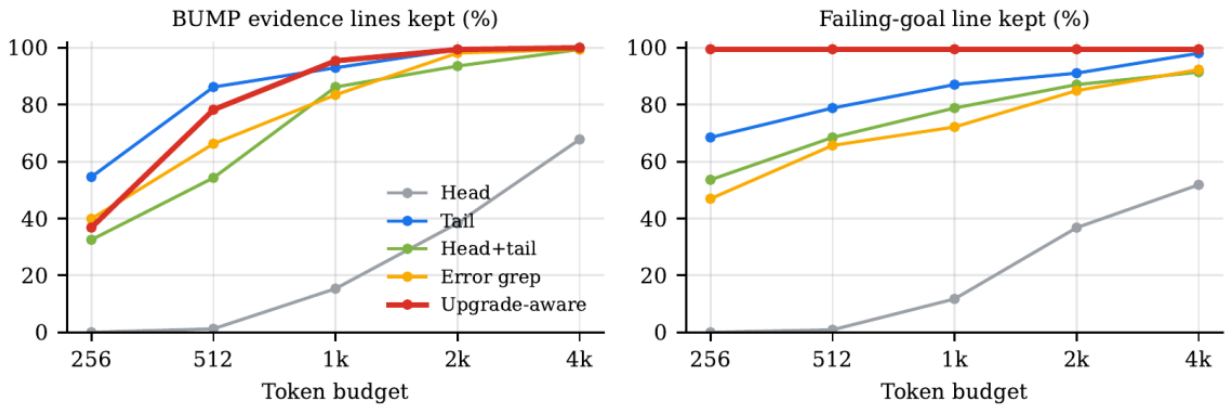
Figure 3.
Learning curve on the temporal split: models trained on the n most recent past upgrade failures (from other projects) and tested on the 166 newest updates. Element F1 is computed once at least 10 annotated training updates are available (41 annotated test updates).
Figure 3.
Learning curve on the temporal split: models trained on the n most recent past upgrade failures (from other projects) and tested on the 166 newest updates. Element F1 is computed once at least 10 annotated training updates are available (41 annotated test updates).
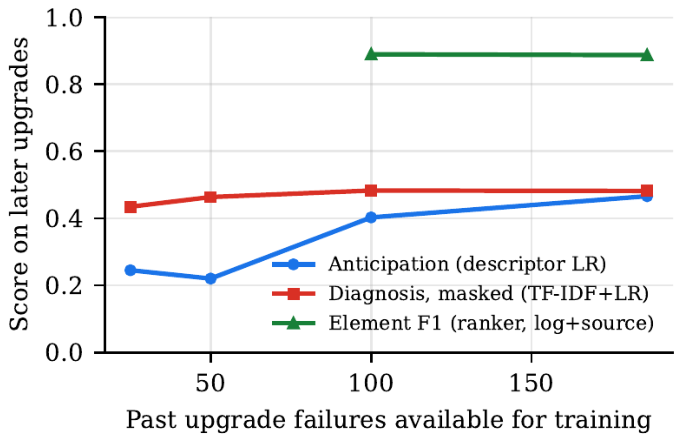
Table 1.
BUMP breaking updates by failure category.
| Failure category (BUMP label) | Upgrades | % |
| COMPILATION_FAILURE | 235 | 41.2 |
| TEST_FAILURE | 188 | 32.9 |
| ENFORCER_FAILURE | 121 | 21.2 |
| DEPENDENCY_LOCK_FAILURE | 14 | 2.5 |
| WERROR_FAILURE | 8 | 1.4 |
| DEPENDENCY_RESOLUTION_FAILURE | 5 | 0.9 |
| Total | 571 | 100.0 |
Table 2.
RQ1 – failure-mode anticipation from the upgrade descriptor (T1). Brackets: 95% bootstrap CI. Temporal: train on older updates of other projects, test on the newest 30%. SLM rows use descriptor-only prompts with k retrieved past upgrades; “–”: not run.
Table 2.
RQ1 – failure-mode anticipation from the upgrade descriptor (T1). Brackets: 95% bootstrap CI. Temporal: train on older updates of other projects, test on the newest 30%. SLM rows use descriptor-only prompts with k retrieved past upgrades; “–”: not run.
| Project-grouped 5-fold CV | Temporal split | |||
| Method | Acc. | Macro-F1 | Acc. | Macro-F1 |
| Majority class | 0.412 [0.37, 0.45] | 0.097 [0.09, 0.10] | 0.175 | 0.050 |
| Same-dependency history vote | 0.601 [0.56, 0.64] | 0.381 [0.31, 0.43] | 0.361 | 0.178 |
| kNN history (BM25, k=5) | 0.604 [0.57, 0.64] | 0.352 [0.30, 0.41] | 0.530 | 0.248 |
| Descriptor LR | 0.560 [0.52, 0.60] | 0.387 [0.31, 0.47] | 0.657 | 0.466 |
| Descriptor RF | 0.636 [0.60, 0.67] | 0.426 [0.36, 0.48] | 0.651 | 0.295 |
| Qwen3-1.7B, prompted, k = 0 | 0.011 | 0.025 | – | – |
| Qwen3-1.7B, prompted, k = 5 | 0.179 | 0.170 | – | – |
| Llama-3.2-3B-Instruct, prompted, k = 0 | 0.413 | 0.116 | – | – |
| Llama-3.2-3B-Instruct, prompted, k = 5 | 0.627 | 0.368 | – | – |
| Phi-4-mini-instruct (3.8B), prompted, k = 0 | 0.412 | 0.098 | – | – |
| Phi-4-mini-instruct (3.8B), prompted, k = 5 | 0.585 | 0.292 | – | – |
| Qwen3-4B, prompted, k = 0 | 0.424 | 0.145 | – | – |
| Qwen3-4B, prompted, k = 5 | 0.602 | 0.315 | – | – |
| Qwen3-8B, prompted, k = 0 | 0.399 | 0.111 | – | – |
| Qwen3-8B, prompted, k = 5 | 0.608 | 0.338 | – | – |
| Qwen3-32B (large reference), prompted, k = 0 | 0.419 | 0.126 | – | – |
| Qwen3-32B (large reference), prompted, k = 5 | 0.616 | 0.320 | – | – |
Table 3.
RQ2 – condensation strategies at three budgets. Evidence lines: compiler-error lines that BUMP links to broken API elements. Elem. F1: javac-rule element extraction run on the condensed log (1,024 tokens). Lower block: ablations of the upgrade-aware condenser.
Table 3.
RQ2 – condensation strategies at three budgets. Evidence lines: compiler-error lines that BUMP links to broken API elements. Elem. F1: javac-rule element extraction run on the condensed log (1,024 tokens). Lower block: ablations of the upgrade-aware condenser.
| Evidence lines kept (%) | Failing-goal line kept (%) | Elem. F1 | |||||
| Strategy | 512 | 1024 | 2048 | 512 | 1024 | 2048 | @1024 |
| Head | 1.2 | 15.3 | 38.3 | 0.9 | 11.7 | 36.8 | 0.148 |
| Tail | 86.2 | 92.9 | 99.4 | 78.8 | 87.0 | 91.1 | 0.514 |
| Head+tail | 54.3 | 86.2 | 93.6 | 68.5 | 78.8 | 87.0 | 0.507 |
| Error grep | 66.3 | 83.4 | 98.2 | 65.7 | 72.2 | 84.9 | 0.462 |
| Upgrade-aware (proposed) | 78.2 | 95.4 | 99.4 | 99.5 | 99.5 | 99.5 | 0.510 |
| – earliest-first ranking | 47.2 | 74.8 | 96.9 | 99.5 | 99.5 | 99.5 | 0.448 |
| – no de-duplication | 73.6 | 91.7 | 98.8 | 99.5 | 99.5 | 99.5 | 0.523 |
| – no dependency boost | 78.2 | 95.4 | 99.4 | 99.5 | 99.5 | 99.5 | 0.510 |
Table 4.
RQ3 – failure-category diagnosis (T2), project-grouped 5-fold CV, logs condensed to 1,536 tokens. Block (b) removes the Failed to execute goal lines, the Maven reactor summary and plugin names before condensation. Brackets: 95% bootstrap CI.
Table 4.
RQ3 – failure-category diagnosis (T2), project-grouped 5-fold CV, logs condensed to 1,536 tokens. Block (b) removes the Failed to execute goal lines, the Maven reactor summary and plugin names before condensation. Brackets: 95% bootstrap CI.
| Method | Accuracy | Macro-F1 |
| (a) Full condensed log | ||
| Rules: failing goal (+content fallback) | 0.974 [0.96, 0.99] | 0.947 [0.82, 0.99] |
| Rules: content only | 0.834 [0.80, 0.86] | 0.859 [0.74, 0.91] |
| TF-IDF + LR | 0.928 [0.91, 0.95] | 0.708 [0.60, 0.77] |
| TF-IDF + linear SVM | 0.930 [0.91, 0.95] | 0.730 [0.61, 0.79] |
| kNN retrieval vote (k=5) | 0.912 [0.89, 0.94] | 0.669 [0.54, 0.75] |
| Qwen3-1.7B, prompted, k = 0 | 0.737 | 0.510 |
| Qwen3-1.7B, prompted, k = 3 | 0.851 | 0.635 |
| Qwen3-1.7B, QLoRA | 1.000 | 1.000 |
| Llama-3.2-3B-Instruct, prompted, k = 0 | 0.816 | 0.639 |
| Llama-3.2-3B-Instruct, prompted, k = 3 | 0.848 | 0.554 |
| Llama-3.2-3B-Instruct, QLoRA | 0.967 | 0.725 |
| Phi-4-mini-instruct (3.8B), prompted, k = 0 | 0.639 | 0.483 |
| Phi-4-mini-instruct (3.8B), prompted, k = 3 | 0.855 | 0.673 |
| Phi-4-mini-instruct (3.8B), QLoRA | 0.977 | 0.783 |
| Qwen3-4B, prompted, k = 0 | 0.741 | 0.600 |
| Qwen3-4B, prompted, k = 3 | 0.937 | 0.882 |
| Qwen3-4B, QLoRA | 0.998 | 0.999 |
| Qwen3-8B, prompted, k = 0 | 0.713 | 0.707 |
| Qwen3-8B, prompted, k = 3 | 0.897 | 0.829 |
| Qwen3-8B, QLoRA | 0.993 | 0.955 |
| Qwen3-32B (large reference), prompted, k = 0 | 0.736 | 0.724 |
| Qwen3-32B (large reference), prompted, k = 3 | 0.935 | 0.903 |
| (b) Shortcut lines masked (failing goal, plugin names, Maven summary) | ||
| Rules: content only | 0.799 [0.76, 0.83] | 0.613 [0.54, 0.69] |
| TF-IDF + LR | 0.905 [0.88, 0.93] | 0.692 [0.56, 0.76] |
| TF-IDF + linear SVM | 0.905 [0.88, 0.93] | 0.692 [0.56, 0.76] |
| TF-IDF + LR (tail condensation) | 0.909 [0.88, 0.93] | 0.666 [0.55, 0.74] |
| kNN retrieval vote (k=5) | 0.907 [0.88, 0.93] | 0.649 [0.56, 0.73] |
| Qwen3-1.7B, prompted, k = 3 | 0.813 | 0.650 |
| Llama-3.2-3B-Instruct, prompted, k = 3 | 0.851 | 0.643 |
| Phi-4-mini-instruct (3.8B), prompted, k = 3 | 0.772 | 0.514 |
| Qwen3-4B, prompted, k = 0 | 0.757 | 0.537 |
| Qwen3-4B, prompted, k = 3 | 0.895 | 0.733 |
| Qwen3-8B, prompted, k = 3 | 0.837 | 0.732 |
Table 5.
RQ3 – broken-API-element localization (T3) on the 114 updates with BUMP ground truth (484 element mentions). Micro P/R/F1 over element mentions; per-case F1 averaged over updates. Logs condensed to 1,536 tokens except where noted. Brackets: 95% bootstrap CI of micro-F1.
Table 5.
RQ3 – broken-API-element localization (T3) on the 114 updates with BUMP ground truth (484 element mentions). Micro P/R/F1 over element mentions; per-case F1 averaged over updates. Logs condensed to 1,536 tokens except where noted. Brackets: 95% bootstrap CI of micro-F1.
| Method | Precision | Recall | F1 (micro) | F1 (per case) |
| javac rules (full log) | 0.530 | 0.463 | 0.494 [0.44, 0.54] | 0.424 |
| javac rules (condensed log) | 0.544 | 0.463 | 0.500 [0.45, 0.55] | 0.426 |
| Learned candidate ranker (log only) | 0.562 | 0.440 | 0.494 [0.43, 0.54] | 0.370 |
| Learned candidate ranker (log + source) | 0.827 | 0.810 | 0.818 [0.77, 0.86] | 0.702 |
| Identifier at error column (source only) | 0.208 | 0.101 | 0.136 [0.08, 0.19] | 0.078 |
| Qwen3-1.7B, prompted, k = 0 | 0.297 | 0.134 | 0.185 | 0.185 |
| Qwen3-1.7B, prompted, k = 3 | 0.404 | 0.209 | 0.275 | 0.299 |
| Qwen3-1.7B, QLoRA | 0.596 | 0.244 | 0.346 | 0.292 |
| Llama-3.2-3B-Instruct, prompted, k = 0 | 0.227 | 0.219 | 0.223 | 0.209 |
| Llama-3.2-3B-Instruct, prompted, k = 3 | 0.386 | 0.372 | 0.379 | 0.357 |
| Llama-3.2-3B-Instruct, QLoRA | 0.456 | 0.227 | 0.303 | 0.250 |
| Phi-4-mini-instruct (3.8B), prompted, k = 0 | 0.431 | 0.306 | 0.358 | 0.286 |
| Phi-4-mini-instruct (3.8B), prompted, k = 3 | 0.425 | 0.353 | 0.386 | 0.336 |
| Phi-4-mini-instruct (3.8B), QLoRA | 0.465 | 0.345 | 0.396 | 0.370 |
| Qwen3-4B, prompted, k = 0 | 0.539 | 0.440 | 0.485 | 0.483 |
| Qwen3-4B, prompted, k = 3 | 0.567 | 0.452 | 0.503 | 0.516 |
| Qwen3-4B, QLoRA | 0.413 | 0.093 | 0.152 | 0.192 |
| Qwen3-8B, prompted, k = 0 | 0.492 | 0.388 | 0.434 | 0.383 |
| Qwen3-8B, prompted, k = 3 | 0.578 | 0.399 | 0.472 | 0.446 |
| Qwen3-8B, QLoRA | 0.492 | 0.124 | 0.198 | 0.213 |
| Qwen3-32B (large reference), prompted, k = 0 | 0.589 | 0.390 | 0.470 | 0.436 |
| Qwen3-32B (large reference), prompted, k = 3 | 0.606 | 0.407 | 0.487 | 0.482 |
Table 6.
Retrieval quality of the history index under project-grouped CV. P@k: share of the k retrieved past failures with the query’s category. Dep. hit@3: share of queries (among the 262 whose dependency occurs in the training history) for which a retrieved case involves the same dependency.
Table 6.
Retrieval quality of the history index under project-grouped CV. P@k: share of the k retrieved past failures with the query’s category. Dep. hit@3: share of queries (among the 262 whose dependency occurs in the training history) for which a retrieved case involves the same dependency.
| Query/key representation | Scorer | P@1 | P@3 | MRR@3 | Dep. hit@3 | P@3 (masked) |
| descriptor | BM25 | 0.608 | 0.584 | 0.663 | 1.000 | 0.584 |
| descriptor | TF-IDF | 0.587 | 0.587 | 0.649 | 1.000 | 0.587 |
| condensed log (256) | BM25 | 0.925 | 0.918 | 0.933 | 0.546 | 0.892 |
| condensed log (256) | TF-IDF | 0.898 | 0.893 | 0.923 | 0.573 | 0.833 |
| descriptor + condensed log (256) | BM25 | 0.911 | 0.898 | 0.916 | 0.698 | 0.872 |
| descriptor + condensed log (256) | TF-IDF | 0.895 | 0.880 | 0.918 | 0.767 | 0.804 |
Table 7.
Ablations with Qwen3-4B (project-grouped 5-fold CV). Upper block: prompted with k = 3 retrieved examples; lower block: QLoRA-tuned.
Table 7.
Ablations with Qwen3-4B (project-grouped 5-fold CV). Upper block: prompted with k = 3 retrieved examples; lower block: QLoRA-tuned.
| Qwen3-4B configuration | Category macro-F1 | Element F1 |
| Full configuration (upgrade-aware, 1536 tok., descriptor, source, k = 3) | 0.882 | 0.503 |
| – client source | 0.882 | 0.509 |
| – upgrade descriptor | 0.897 | 0.517 |
| – retrieval (k = 0) | 0.600 | 0.485 |
| tail instead of upgrade-aware condensation | 0.855 | 0.523 |
| budget 512 tokens | 0.951 | 0.493 |
| budget 3072 tokens | 0.848 | 0.488 |
| shortcut lines masked | 0.733 | 0.491 |
| QLoRA, full configuration (k = 0) | 0.999 | 0.152 |
Table 8.
Cost per failing build. CPU: 2-core cloud VM. GPU latency: one request at a time, k = 3, 50 updates, vLLM; peak memory: Transformers, bf16 base + adapter. GPU: one NVIDIA A100-SXM4 80 GB.
Table 8.
Cost per failing build. CPU: 2-core cloud VM. GPU latency: one request at a time, k = 3, 50 updates, vLLM; peak memory: Transformers, bf16 base + adapter. GPU: one NVIDIA A100-SXM4 80 GB.
| Component | Hardware | Median latency / case | Peak memory |
| Log cleaning (noise removal) | CPU | 9.6 ms | – |
| Upgrade-aware condensation (1536 tok.) | CPU | 18.8 ms | – |
| Failing-goal rule | CPU | 0.38 ms | – |
| Qwen3-1.7B, k = 3 | GPU | 0.42 s | 4.1 GB |
| Llama-3.2-3B-Instruct, k = 3 | GPU | 0.63 s | 7.2 GB |
| Phi-4-mini-instruct (3.8B), k = 3 | GPU | 0.80 s | 8.7 GB |
| Qwen3-4B, k = 3 | GPU | 0.71 s | 9.0 GB |
| Qwen3-8B, k = 3 | GPU | 1.21 s | 17.5 GB |
| Qwen3-32B (large reference), k = 3 | GPU | 2.18 s | – |
Disclaimer/Publisher’s Note: The statements, opinions and data contained in all publications are solely those of the individual author(s) and contributor(s) and not of MDPI and/or the editor(s). MDPI and/or the editor(s) disclaim responsibility for any injury to people or property resulting from any ideas, methods, instructions or products referred to in the content. |
© 2026 by the author. Licensee MDPI, Basel, Switzerland. This article is an open access article distributed under the terms and conditions of the Creative Commons Attribution (CC BY) license.
Copyright: This open access article is published under a Creative Commons CC BY 4.0 license, which permit the free download, distribution, and reuse, provided that the author and preprint are cited in any reuse.