

Submitted:
20 November 2026
Posted:
25 November 2026
You are already at the latest version
Abstract
Mirror-matter and braneworld models allow neutral particles to mix with partners in a hidden sector, and field-induced ``matter swapping'' has been proposed for neutrons. We ask what it would take to convert a macroscopic solid (illustratively \(1~\mathrm{t}\) within \(\tau = 0.1~\mathrm{s}\)) on demand, using the standard two-state rate for a mixed system whose sector is continually recorded by its environment. Four independent bounds apply. (i) Even coherent, degenerate conversion needs a per-atom mixing \(\varepsilon \ge 1.0 \times 10^{-14}~\mathrm{eV}\). (ii) Lattice interactions at \(\nu \approx 10^{13}~\mathrm{s^{-1}}\) make conversion overdamped (quantum Zeno), raising this to \(4.7 \times 10^{-9}~\mathrm{eV}\). (iii) An atom converted inside a lattice loses its bonds, so isolated conversion is off-resonant by the cohesive energy (\(1.5\)--\(4.9~\mathrm{eV}\)) and its probability falls to \(\le 2 \times 10^{-28}\). (iv) Because ordinary matter has survived for \(4.5~\mathrm{Gyr}\), the conversion rate would have to be switchable by a factor \(\ge t_\oplus/\tau \approx 1.4 \times 10^{18}\); with permanent mixing, the visible and hidden levels must be offset by \(\gtrsim 8~\mathrm{MeV}\) in a solid, far beyond Stark tuning (\(\lesssim 10^{-3}~\mathrm{eV}\)). Collective routes do not escape: with local operators, whole-object conversion is of \(N\)-th order; the mean-field (bosonic Josephson) version is self-trapped (\(\Lambda \sim 10^{14}\)); and keeping the whole-object superposition coherent needs \(\varepsilon_{\mathrm{eff}} \ge 0.34~\mathrm{eV}\) in air. We state five conditions that any loophole must satisfy simultaneously, and laboratory signatures that would test them.
Keywords:
mirror matter
; hidden sector
; neutron–mirror-neutron oscillation
; quantum Zeno effect
; decoherence
; matter stability
1. Introduction
Mirror matter goes back to Lee and Yang [1] and Kobzarev, Okun and Pomeranchuk [2]; a modern review is [3]. In these models neutral particles can mix with their hidden partners. Neutron–mirror-neutron (n–) mixing arises from six-quark operators [4,5]. In the absence of a mirror magnetic field, free-neutron experiments limit the mixing to eV [6], and a regeneration search found no signal [7]. Conversion in matter is suppressed by collisions and potentials [8,9] and is overdamped in neutron stars [10]. In two-sheeted braneworld models, “matter swapping” between branes is induced by magnetic vector potentials [11], and laser-driven, induced swapping of ultracold neutrons has been proposed [12]; passing-through-walls experiments bound the neutron swapping probability per collision to [13] and [14] (95% C.L.).
These works concern single neutrons. Here we ask a different question: could a whole, bound, macroscopic solid be converted into its hidden counterpart on demand, and quickly? The general theory needed is old: the damping of two-state systems in media (the “Turing paradox”) [15,16,17], and decoherence of macroscopic superpositions [18,19,20]. We found no paper that applies these results to on-demand conversion of a bound solid, or that lists the conditions a loophole would have to meet; this statement reflects searches up to November 2026 and is not a priority claim. The motivation was a critical assessment of speculative proposals in which matter is moved out of the visible sector at will; the bounds derived here are independent of any such proposal.
We use an illustrative object of 1 t (Mg, Al, Ti or Fe) with 18 of surface and a switching time s. All bounds scale simply with and are stated so that other values can be substituted. Every number below is produced by the script in the Supplementary Information.
2. Model
For each convertible unit (an atom, or a molecule in a gas) we take the two-level Hamiltonian
where v and h label the visible and hidden states. Any interaction that distinguishes the two states (a collision, a phonon, an emitted photon) records which sector the unit is in; we call the rate of such records . Eliminating the coherence adiabatically gives the standard transition rate [15,16]
In the coherent, degenerate limit a full swap takes ; in the overdamped limit , , the quantum Zeno regime [17]. We require . For a detuning swept at rate , the Landau–Zener transition probability is when small [21].
As a yardstick only, we compare with the free-neutron limit eV [6]. That limit is model-dependent (it is weaker if mirror magnetic fields are present), and the mixing of a whole atom is a different, unspecified operator. None of our bounds relies on the comparison.
Cohesive energies are from Kittel [22] (Ch. 3, Table 1): Mg 1.51, Al 3.39, Ti 4.85 and Fe 4.28 eV per atom. All numbers are computed by a single Python script (Supplementary Information). Use of AI tools. Grok Bot, an AI assistant based on a large language model, was used under the author’s direction to draft and check the analysis code, to search the literature and to draft and edit text. The author defined the questions and the model, re-ran the script, checked every equation, number and reference against the cited sources, and takes full responsibility for the content.
3. Results
3.1. Rate Bounds
Table 1 gives the mixing needed for . For a solid we take , of the order of the phonon (Debye) frequency, since a hidden atom does not take part in the visible lattice’s phonons; for a gas at sea level, . At the free-neutron yardstick, even a perfectly coherent swap would take 544 s. Figure 1a shows conversion time against .
3.2. Binding-Energy Mismatch
An atom converted inside a visible lattice no longer bonds to its neighbors, so a single conversion is detuned by . At the coherent mixing of Table 1, the maximum (Rabi) conversion probability is (Mg) to (Ti). With dephasing and detuning, Eq. (2) requires – eV. A drive at could supply the energy, which totals only 6–12 GJ per tonne, so energy is not the obstacle. The obstacle is resonance: the drive would have to match every site’s local to within , whereas thermal and defect broadening are of order meV.
3.3. Matter Stability and the Required On/off Ratio
If the mixing were present naturally, ordinary matter would itself convert. Survival over the age of the Earth, Gyr, requires a natural rate . A switch needs . Independently of any model, the switch must therefore change the conversion rate by
In terms of per-record probabilities, a solid must go from to per phonon record.
If the mixing is permanent and the switch works by tuning the detuning, Eq. (2) with gives the natural offset needed for stability, (Table 2, Figure 1b). The switch would have to remove this offset. The available knob is small: the Stark (polarizability) shift of a visible atom relative to its unshifted hidden partner is , which is eV for N2 at the air breakdown field (3 MV/m) and of order eV for a polarizable atom at 1 GV/m in an insulating solid (fields are screened inside metals). Even granting eV everywhere, the shortfall is (gas, 0.1 s) to (solid). A switch therefore cannot be a tuning knob acting on permanent mixing. Note that the per-collision neutron bounds of [13,14] do not by themselves exclude the per-record probability of Table 1; it is the stability requirement that does.
3.4. Collective Conversion of the Whole Object
(a) Locality. Any mixing term in a local field theory acts on a few particles at a time. The resonant path, with all N atoms converting together, then appears only at N-th order, ; for 1 t of Mg, . Partial paths pass through states with a visible–hidden interface, which costs about per unit area, J eV per (taking J for Mg, an order-of-magnitude value [23]).
(b) Mean-field version. Treat the visible and hidden lattices as two modes coupled by , as in a bosonic Josephson junction [24,25]. Population transfer is self-trapped when exceeds a critical value of order 2. Taking the interaction energy per atom (a heuristic estimate), – at the coherent . Escaping self-trapping needs hidden–visible cohesion comparable with visible–visible cohesion, i.e. a “sector-blind” binding of order eV per atom, while the hidden state must not couple to anything else visible. Electromagnetic binding is sector-specific, so no known interaction does both.
(c) Isolation. A superposition of “visible object” and “hidden object” is recorded by every air molecule that strikes the visible branch and by every thermal photon it emits or absorbs. Using the overdamped rate with equal to the record rate gives the effective mixing in Table 3. This adds to the internal phonon channel, which isolation cannot remove (compare [26] for spatial superpositions).
3.5. A Dilute Gas Layer Instead of a Solid
Converting a thin gas layer rather than a bound solid removes the binding mismatch and lowers the required mixing by a factor of about 45 (Table 1). It does not remove the stability requirement: the natural offset would have to be keV for a 0.1 s switch and MeV for a 10 µs switch (Table 2), while the Stark shift at air breakdown is eV. Strong fields in the gas also detune it further, so a field acts as an “off” switch rather than an “on” switch.
4. Conditions for Any Loophole
A fast conversion of bulk matter survives only if all of the conditions in Table 4 hold. The closest published idea is condition C1 for neutrons: in two-sheeted braneworld models the swapping is controlled by vector potentials [11,12]. Whether any such mechanism can act on whole atoms, including their charged constituents, with an on/off ratio is an open question that those experiments do not address.
5. Testable Consequences
If C1 held for whole atoms, samples would lose mass only under held, sharply tuned conditions and not under fast sweeps: the Landau–Zener probability at the coherent is , and for sweep rates of 0.01, 1 and 1000 eV . Two inexpensive tests follow: a sealed gas cell read by a capacitive manometer, and a mass comparator, each held in a strong static field and read at the microgram level. For neutrons, a field-induced resonance would appear in disappearance or regeneration searches with applied electric and magnetic fields, extending [6,7,14].
6. Limitations
The phonon record rate is an order-of-magnitude choice; even leaves the solid-state requirement times the yardstick. The interface cost and are order-of-magnitude estimates, and is heuristic. No microscopic operator for whole-atom mixing is specified; it would be of high dimension. The stability bound assumes that natural matter has the same as the switched object and that conversion is not reversed by back-conversion; it is conservative because it uses only survival, not heat or missing-mass signatures. The results apply to ordinary matter bound by electromagnetism and to local mixing operators.
7. Conclusions
Fast, on-demand conversion of bound, macroscopic ordinary matter into a mirror or hidden sector is excluded by four independent bounds (rate, binding mismatch, matter stability and collective-path obstacles), under local mixing operators and electromagnetic binding. Any loophole must meet all five conditions C1–C5 at once; at a minimum it needs new physics for C1 and C4.
Supplementary Materials
The supplementary archive contains sector_switch.py, which produces every number, table and figure in this paper, its output sector_switch.json, and a run log.
Author Contributions
K.K. is the sole author and carried out all parts of the work.
Funding
No funding was received for conducting this study.
Institutional Review Board Statement
Not applicable (no human or animal subjects).
Data Availability Statement
No datasets were generated or analyzed; all values are computed from the cited physical constants and reference data by the code in the Supplementary Information. Code availability: The Python script, its output and a run log are provided as Supplementary Information (MIT license).
Acknowledgments
Grok Bot (an AI assistant based on a large language model) assisted with code drafting and checking, literature search and text drafting, as described in Sec. Section 2. The author reviewed and verified all output and takes full responsibility for the content.
Conflicts of Interest
The author has no competing interests to declare that are relevant to the content of this article.
References
- Lee, T.D.; Yang, C.N. Question of parity conservation in weak interactions. Phys. Rev. 1956, 104, 254–258. [Google Scholar] [CrossRef]
- Kobzarev, I.Y.; Okun, L.B.; Pomeranchuk, I.Y. On the possibility of experimental observation of mirror particles. Sov. J. Nucl. Phys. 1966, 3, 837. [Google Scholar]
- Foot, R. Mirror dark matter: Cosmology, galaxy structure and direct detection. Int. J. Mod. Phys. A 2014, 29, 1430013. [Google Scholar] [CrossRef]
- Berezhiani, Z.; Bento, L. Neutron–mirror-neutron oscillations: How fast might they be? Phys. Rev. Lett. 2006, 96, 081801. [Google Scholar] [CrossRef]
- Berezhiani, Z. More about neutron–mirror neutron oscillation. Eur. Phys. J. C 2009, 64, 421–431. [Google Scholar] [CrossRef]
- Abel, C.; et al. A search for neutron to mirror-neutron oscillations using the nEDM apparatus at PSI. Phys. Lett. B 2021, 812, 135993. [Google Scholar] [CrossRef]
- Broussard, L.J.; et al. Experimental search for neutron to mirror neutron oscillations as an explanation of the neutron lifetime anomaly. Phys. Rev. Lett. 2022, 128, 212503. [Google Scholar] [CrossRef]
- Kerbikov, B.O. Neutron–mirror neutron conversion in the vacuum, a trap, material, and a neutron star. Phys. Rev. D. 2022, 106, 015015. [Google Scholar] [CrossRef]
- Kamyshkov, Y.; Ternullo, J.; Varriano, L.; Berezhiani, Z. Neutron–mirror neutron oscillations in absorbing matter. Symmetry 2022, 14, 230. [Google Scholar] [CrossRef]
- Kerbikov, B.O. Overdamping of neutron–mirror-neutron transitions in neutron stars. arXiv [hep-ph]. 2026, arXiv:2603.11930. [Google Scholar] [CrossRef]
- Sarrazin, M.; Petit, F. Equivalence between domain walls and “noncommutative” two-sheeted spacetimes: Model-independent matter swapping between branes. Phys. Rev. D. 2010, 81, 035014. [Google Scholar] [CrossRef]
- Sarrazin, M.; Petit, F. Laser frequency combs and ultracold neutrons to probe braneworlds through induced matter swapping between branes. Phys. Rev. D. 2011, 83, 035009. [Google Scholar] [CrossRef]
- Sarrazin, M.; et al. Search for passing-through-walls neutrons constrains hidden braneworlds. Phys. Lett. B 2016, 758, 14–17. [Google Scholar] [CrossRef]
- Stasser, C.; et al. Probing neutron-hidden neutron transitions with the MURMUR experiment. Eur. Phys. J. C 2021, 81, 17. [Google Scholar] [CrossRef]
- Harris, R.A.; Stodolsky, L. Two state systems in media and “Turing’s paradox”. Phys. Lett. B 1982, 116, 464–468. [Google Scholar] [CrossRef]
- Stodolsky, L. Treatment of neutrino oscillations in a thermal environment. Phys. Rev. D. 1987, 36, 2273–2277. [Google Scholar] [CrossRef]
- Misra, B.; Sudarshan, E.C.G. The Zeno’s paradox in quantum theory. J. Math. Phys. 1977, 18, 756–763. [Google Scholar] [CrossRef]
- Joos, E.; Zeh, H.D. The emergence of classical properties through interaction with the environment. Z. Phys. B 1985, 59, 223–243. [Google Scholar] [CrossRef]
- Zurek, W.H. Decoherence, einselection, and the quantum origins of the classical. Rev. Mod. Phys. 2003, 75, 715–775. [Google Scholar] [CrossRef]
- Leggett, A.J. Testing the limits of quantum mechanics: motivation, state of play, prospects. J. Phys. Condens. Matter 2002, 14, R415–R451. [Google Scholar] [CrossRef]
- Zener, C. Non-adiabatic crossing of energy levels. Proc. R. Soc. Lond. A 1932, 137, 696–702. [Google Scholar] [CrossRef]
- Kittel, C. Introduction to Solid State Physics, 8th ed.; Wiley: Hoboken, NJ, 2005. [Google Scholar]
- Tyson, W.R.; Miller, W.A. Surface free energies of solid metals: Estimation from liquid surface tension measurements. Surf. Sci. 1977, 62, 267–276. [Google Scholar] [CrossRef]
- Smerzi, A.; Fantoni, S.; Giovanazzi, S.; Shenoy, S.R. Quantum coherent atomic tunneling between two trapped Bose-Einstein condensates. Phys. Rev. Lett. 1997, 79, 4950–4953. [Google Scholar] [CrossRef]
- Albiez, M.; Gati, R.; Fölling, J.; Hunsmann, S.; Cristiani, M.; Oberthaler, M.K. Direct observation of tunneling and nonlinear self-trapping in a single bosonic Josephson junction. Phys. Rev. Lett. 2005, 95, 010402. [Google Scholar] [CrossRef]
- Henkel, C.; Folman, R. Universal limit on spatial quantum superpositions with massive objects due to phonons. Phys. Rev. A 2024, 110, 042221. [Google Scholar] [CrossRef]
Figure 1.
(a) Conversion time against mixing for coherent conversion and for dephased conversion in a gas, in a solid, and for a whole 1 t object in sea-level air (effective mixing ). Horizontal lines: s and the age of the Earth; vertical line: the free-neutron yardstick. (b) Natural level offset required for matter stability (bars) compared with the reach of Stark tuning at air breakdown and at 1 GV/m in a solid (vertical lines).
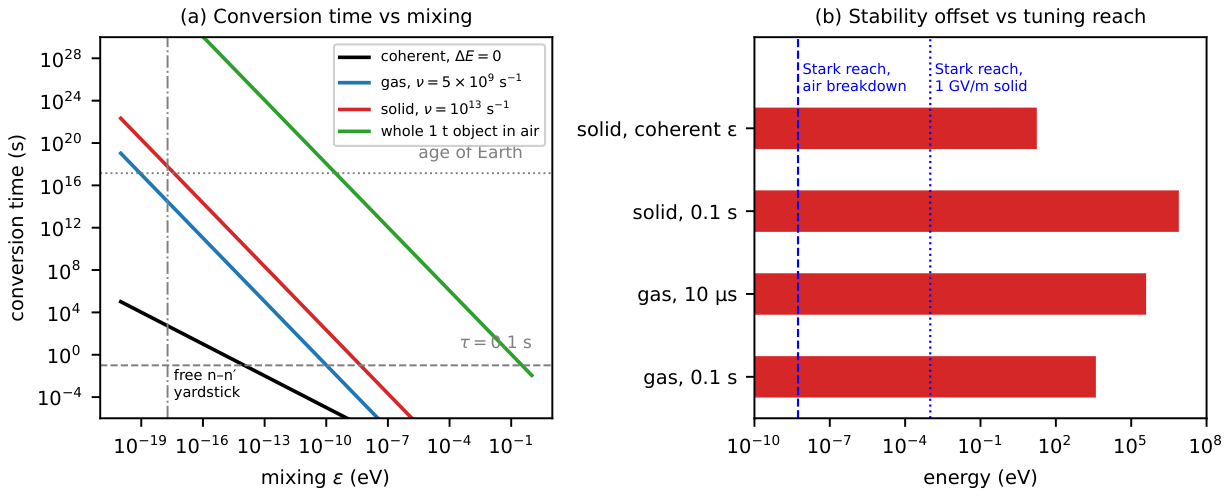

Table 1.
Mixing needed for , and the per-record conversion probability .
| Regime | (eV) | × yardstick | per record |
|---|---|---|---|
| Coherent, | – | ||
| Gas, , 0.1 s | |||
| Gas, , 10 µs | |||
| Solid, , 0.1 s |
Table 2.
Natural level offset needed for matter stability, .
| Case | (eV) | () | |
|---|---|---|---|
| Gas, 0.1 s | 3.9 keV | ||
| Gas, 10 µs | 0.39 MeV | ||
| Solid, dephased, 0.1 s | 7.8 MeV | ||
| Solid, coherent | 17 eV |
Table 3.
Environmental which-sector record rate for an 18 object and the effective mixing needed for conversion within 0.1 s.
Table 3.
Environmental which-sector record rate for an 18 object and the effective mixing needed for conversion within 0.1 s.
| Environment | Records () | (eV) |
|---|---|---|
| Sea-level air, 293 K | 0.34 | |
| Own thermal emission, 293 K | ||
| Vacuum, object cooled to 2.7 K |
Table 4.
Conditions that a loophole must satisfy simultaneously.
| Condition | Quantitative requirement | Known realization | |
|---|---|---|---|
| C1 | Field-induced mixing (zero when off) | on/off rate ratio ; eV | Proposed for neutrons only [12] |
| C2 | Dephasing suppressed per unit | , or eV at phonon rates | None for a warm solid |
| C3 | Resonance at every site | site-to-site spread of (broadening is ∼meV) | None |
| C4 | Collective path (no interface cost, no self-trapping) | inter-sector binding ≈ intra-sector binding (eV per atom) | Contradicts sector-specific electromagnetic binding |
| C5 | Isolation of the whole-object superposition | eV in air ( eV cold, in vacuum) | None |
Disclaimer/Publisher’s Note: The statements, opinions and data contained in all publications are solely those of the individual author(s) and contributor(s) and not of MDPI and/or the editor(s). MDPI and/or the editor(s) disclaim responsibility for any injury to people or property resulting from any ideas, methods, instructions or products referred to in the content. |
© 2026 by the author. Licensee MDPI, Basel, Switzerland. This article is an open access article distributed under the terms and conditions of the Creative Commons Attribution (CC BY) license.
Copyright: This open access article is published under a Creative Commons CC BY 4.0 license, which permit the free download, distribution, and reuse, provided that the author and preprint are cited in any reuse.