

Submitted:
23 November 2026
Posted:
24 November 2026
You are already at the latest version
Abstract
Artificial General Intelligence (AGI) is increasingly envisioned as a transformative force in education, yet research on AGI-driven education remains fragmented across educational stages and rarely incorporates sustainability into system design and evaluation. This systematic review examines how AGI and large language model (LLM)/generative AI technologies reshape education across the learning lifespan and how sustainability can be embedded in AGI-powered education. Following PRISMA guidelines, we searched Scopus, Web of Science, IEEE Xplore, ACM Digital Library, and Google Scholar for studies published between 2015 and 2026, using keyword groups related to general intelligence, education, and sustainability. After screening, 85 peer-reviewed studies were included and synthesized through narrative synthesis. Given that full AGI remains unrealized, current LLM and generative AI systems are treated as emergent approximations of AGI’s educational potential. We develop an organizing framework that maps AGI’s transformative roles, key mechanisms, and sustainability implications across early childhood, K–12, higher education, and lifelong learning. The review identifies four emerging application scenarios and introduces a multidimensional sustainability lens encompassing cognitive, economic, social, and ethical–environmental dimensions, extending evaluation beyond conventional academic performance indicators. It also highlights persistent technical, social, and ethical challenges. By integrating stage-specific transformations with a lifespan and sustainability perspective, this review provides a reference and research agenda for the responsible and sustainable integration of AGI into Education 5.0.
Keywords:
artificial general intelligence
; education 5.0
; learning lifespan
; sustainable learning
1. Introduction
The global education landscape is undergoing a profound metamorphosis, driven by the visionary framework of Education 5.0 (Babu, 2024). Moving beyond the focus on digital-skills of Education 4.0, Education 5.0 proposes a value-driven human-centric model that leverages advanced technologies to promote social well-being and sustainability (S. Ahmad et al., 2023). This paradigm envisions learning ecosystems that leverage advanced technologies to enhance the learning experience, shifting the core focus from mere knowledge transfer toward cultivating creativity, ethical reasoning, and collaborative problem-solving, as reflected in systematic reviews of 21st century skills frameworks (González-Pérez & Ramírez-Montoya, 2022).
However, the path towards the full promise of Education 5.0 is fraught with systemic challenges. Current educational systems often remain siloed, standardized, and slow to adapt, struggling to provide personalized, experiential learning required for sustainability competencies (Agarwal et al., 2025). Significant implementation barriers persist, including outdated curricula, insufficient digital infrastructure, a lack of comprehensive stakeholder engagement, and crucially, a shortage of educator preparedness and training for this technological leap (Luna et al., 2024). These challenges are exacerbated by the rapid pace of technological change, which creates a growing gap between the skills taught and those demanded. Moreover, while Education 5.0 espouses sustainability as a core tenet, the practical integration of Sustainable Development Goals (SDGs) into its technological fabric remains inconsistent and underexplored (Ramírez-Montoya et al., 2025).
Currently, Artificial General Intelligence (AGI) and its transformative potential are transitioning from theory to reality. Exhibiting human-like understanding and generalization across diverse cognitive tasks, AGI promises to reshape the very foundations of how knowledge is produced, disseminated, and applied (Raman et al., 2025). For example, Latif et al. explored the role of AGI in future education, specifically in setting educational goals, designing pedagogy and curriculum, and conducting assessments (Latif et al., 2023), while their discussion remains largely confined to K-12 education. Raddaoui et al. examined the impacts of AGI on higher education, offering insights that allow stakeholders to use existing frameworks to understand and guide institutional change, aiming for a future where AGI assists rather than dictates our trajectory (Raddaoui & Raddaoui, 2024). Nevertheless, the transformative impact of AGI heralds a systemic shift across the entire learning lifespan from early childhood initiation to continuous Lifelong Learning (LL), which necessitates a holistic framework to understand and guide this transformation. Recent comprehensive reviews have examined data-driven AI in education (K. Ahmad et al., 2023), while most remain technology-centric and do not adopt a full-lifespan or sustainability lens, which this review addresses.
It is worth noting that, although true AGI has not yet been fully realized, recent advances in Large Language Models (LLMs) and Generative Artificial Intelligence (GenAI) have demonstrated emergent abilities that mirror certain aspects of general intelligence. Accordingly, in this paper we use the term AGI to denote the future vision of generally intelligent educational systems, whereas current technologies are referred to as LLMs or GenAI when describing concrete systems and applications.
To address this gap, we conducted a systematic review of AGI applications in education across the entire learning lifespan, guided by two research questions:
- RQ1: how do AGI and LLM technologies reshape education across early childhood, K-12, higher education, and LL?
- RQ2: how can sustainability be embedded in AGI-driven education?
The main contributions of this article are as follows:
- Providing a systematic review of AGI applications in education across the full learning lifespan, from early childhood initiation to continuous LL.
- Synthesizing the reviewed literature into an organizing framework that maps each educational stage to the corresponding AGI transformation roles, key mechanisms, and sustainability implications.
- Introducing a multidimensional sustainability lens covering cognitive, economic, social, and ethical-environmental dimensions that extends the evaluation of AGI-driven education beyond traditional academic performance indicators.
Section 2 details the systematic review methodology. Section 3 synthesizes the literature, presents the framework and sustainability metrics, and describes emerging application scenarios. Section 4 examines the technical, social, and ethical challenges. Section 5 concludes by outlining directions for future research.
2. Materials and Methods
To synthesize the fragmented landscape of AGI applications in education, we conducted a systematic literature review following the PRISMA guidelines (Page et al., 2021). We searched Scopus, Web of Science, IEEE Xplore, ACM Digital Library, and Google Scholar for publications between 2015 and 2026, using three keyword groups: (i) general intelligence and foundation models (e.g., “artificial general intelligence,” “large language model,” “generative AI,” “multimodal foundation model”); (ii) education (e.g., “education,” “learning,” “pedagogy,” “assessment,” “lifelong learning”); and (iii) sustainability (e.g., “sustainable development goals,” “education for sustainable development,” “Education 5.0”). The search yielded 1,280 records from databases and 35 records from other sources.
After removing duplicates, 950 records remained. We screened titles and abstracts against the following inclusion criteria: studies published in English in peer-reviewed journals or conference proceedings that primarily address AGI, LLMs, or GenAI in education, or sustainability in education. Editorials, opinion pieces, and studies mentioning AI only tangentially were excluded. This phase retained 350 studies for full-text assessment. After full-text evaluation, 265 studies were excluded (e.g., out of scope, not peer-reviewed, or insufficiently relevant), resulting in a final corpus of 85 studies. Figure 1 illustrates the screening process.
For each included study, we extracted the educational stage, underlying technology, pedagogical mechanism, and sustainability implications. The evidence was synthesized through narrative synthesis, organized by educational stage and by the four sustainability dimensions of our framework, informing both the related-work discussion in the Results and the framework construction in Section 3.3.
3. Results
3.1. Sustainable Education
Sustainable education extends beyond the traditional focus on environmental topics to encompass a holistic, future-oriented approach that integrates economic viability, social equity, and cultural relevance (Rieckmann, 2017). In the context of the 2030 Agenda for Sustainable Development, particularly SDG 4, education is called upon to ensure inclusive and equitable quality education and promote LL opportunities for all (Colglazier, 2015; Rieckmann, 2017). However, the translation of these broad goals into concrete pedagogical practices remains inconsistent. Many educational systems continue to prioritize knowledge transmission and standardized testing over the cultivation of competencies such as systems thinking, anticipatory reasoning, and normative competence—skills essential for addressing complex sustainability challenges (Rieckmann, 2018).
Recent research highlights a growing disconnect between sustainability rhetoric and implementation. Agarwal et al. found that in emerging economies, structural barriers such as inadequate teacher training, rigid curricula, and limited stakeholder engagement significantly hinder the integration of SDGs into mainstream education (Agarwal et al., 2025). Similarly, Ramirez-Montoya et al. conducted a systematic review and noted that while Education 5.0 frameworks frequently mention sustainability, the practical embedding of SDGs into technological designs and assessment mechanisms remains fragmented and underexplored (Ramírez-Montoya et al., 2025). This gap is particularly salient as educational systems increasingly adopt digital and AI-driven technologies, echoing systematic reviews of how SDGs are implemented in universities (Alcántara-Rubio et al., 2022). Without a deliberate sustainability lens, technological innovation may inadvertently reinforce unsustainable patterns, such as increased energy consumption, electronic waste, and cognitive overload (S. Ahmad et al., 2023).
Therefore, a sustainable learning framework requires not only green infrastructure but also a pedagogical shift toward regenerative learning cycles, where learners are empowered to continuously adapt, reflect, and contribute to social-ecological well-being. LL emerges as the cornerstone of this framework, as it enables people to reskill and upgrade in response to evolving environmental and labor market conditions. Nevertheless, traditional LL models are often fragmented, lacking personalized pathways and credible certification mechanisms. As argued by Poquet and De Laat, the age of AI demands a capability-oriented approach to LL—one that prioritizes human agency, critical reflection, and adaptive expertise over mere skill acquisition (Poquet & De Laat, 2021). This sets the stage for exploring how AGI can serve as an enabler of truly sustainable education across the entire learning lifespan.
3.2. AGI and Education
AGI is regarded as possessing human-like cognitive capabilities across a wide range of tasks, and has transitioned from a distant aspiration to an imminent technological frontier (Goertzel, 2014). Unlike narrow AI, which excels at specific functions such as language translation or image recognition, AGI is characterized by its ability to generalize knowledge across domains, reason abstractly, and learn continuously from limited data (Raman et al., 2025). While true AGI has not yet been fully realized, recent advances in LLMs (e.g., GPT-4, Gemini) and multimodal foundation models have demonstrated emergent abilities that mirror certain aspects of general intelligence, including in-context learning, chain-of-thought reasoning, and cross-modal transfer (Fei et al., 2022). These advances carry both promises and risks for human learning, as recent evidence on GenAI highlights (Yan et al., 2024).
In the educational domain, early explorations of AGI have focused on its potential to personalize learning, automate assessment, and assist educators. Latif et al. (2023) provided a comprehensive overview of AGI applications in K-12 education, highlighting its role in setting educational goals, designing pedagogy and curriculum, and conducting real-time assessments. However, their analysis remained largely within the boundaries of formal schooling and did not extend to early childhood or LL contexts. Raddaoui and Raddaoui (2024) examined AGI’s impact on higher education, offering a strategic framework for institutional change that positions AGI as an assistant rather than a replacement for human educators. Nevertheless, both studies acknowledge that the transformative potential of AGI extends far beyond any single educational stage.
A growing body of literature has begun to explore AGI’s role in early childhood education. Su and Yang (2023) proposed a theoretical framework for using GenAI to create dynamic, child-centered learning narratives that adapt to individual interests and developmental levels. Empirical work by Bertacchini et al. (2023) integrated LLMs into social robots, demonstrating that LLM-based systems can engage young children in real-time story co-creation and logical guidance, thereby fostering cognitive development through natural conversation. Similarly, Williams et al. (Williams et al., 2019) introduced the PopBots platform, where children learn about AI by training social robots themselves—a process that enhances metacognitive reflection.
In higher education and LL, LLMs and GenAI are being leveraged to support scientific research, interdisciplinary learning, and continuous skill development. Wu et al. (Wu et al., 2025) developed an automated literature review generation method based on LLMs, significantly improving research productivity. Elbadawi et al. (Elbadawi et al., 2024) demonstrated that GPT-4 can generate complete original scientific papers, including experimental hypotheses and simulated data, raising both opportunities and ethical concerns. For LL, Wang et al. (Wang et al., 2025) proposed an LLM-powered multi-agent framework (GenMentor) that autonomously plans personalized learning pathways aligned with career goals, overcoming the limitations of static recommendation systems.
Despite these promising developments, significant gaps remain. Most existing research focuses on isolated applications or single educational stages, lacking a holistic lifecycle framework that spans from early childhood initiation to LL. Moreover, sustainability metrics such as cognitive efficiency, long-term learner autonomy, and ethical alignment are rarely integrated into the design of current intelligent educational systems. The proposed framework in this paper aims to address these gaps by offering a stage-specific yet interconnected model of AGI-driven sustainable education, supported by multidimensional evaluation criteria.
3.3. Towards a Sustainable Learning Framework: A Synthesis of the Review
According to the International Standard Classification of Education (ISCED) (UNESCO United Nations Educational & Organization, 2003) and Piaget’s theory of cognitive development (Huitt & Hummel, 2003), formal education can be categorized into three sequential stages, namely early childhood initiation, K-12 education, and higher education. They are further complemented by a cross-cutting LL dimension that extends across the entire learning lifespan. Figure 2 presents an overview of the organizing framework synthesized from the reviewed literature across these stages.
Drawing on the systematic review described in Section 2, this section synthesizes the reviewed literature into an organizing framework. The framework is structured by educational stage, and each stage is examined from the perspectives of pedagogical transformation and sustainability implications.
3.3.1. Overview of the Framework
Table 1 summarizes the synthesized framework across the four stages, mapping each stage to the corresponding AGI transformation roles, key mechanisms, and sustainability implications.
3.3.2. Early Childhood Education
The reviewed literature indicates that AGI technologies are reshaping early childhood education along two complementary directions: pedagogical content and methodology transformation, and interactive learning companionship (Zhang et al., 2026).
Intelligent Transformation of Pedagogical Content and Instructional Methodologies
In the context of early childhood education, the application of AGI transcends the level of traditional instrumental assistance, catalyzing a systemic transformation in both instructional content and methodologies. Distinct from conventional technologies that serve merely as passive conveyors of knowledge, AGI leverages its robust generative capabilities and multimodal, interactive characteristics to precipitate a transformation in early childhood education, constructing a child-centric intelligent ecosystem.
Regarding Pedagogical content, traditional early childhood education relies predominantly on fixed materials, such as picture books and nursery rhymes, which often lack the flexibility to align precisely with individual children’s interests and cognitive developmental levels. Conversely, LLM-driven educational tutoring systems currently possess real-time feedback capabilities, enabling the instantaneous construction of customized narratives and gamified tasks tailored to a child’s preferred characters, scenarios, or immediate emotional states. Empirical comparisons have shown that children engage in distinct interactive styles when co-creating stories with ChatGPT versus with a parent (Chin et al., 2024), suggesting that generative agents can serve as flexible storytelling partners in early learning. As emphasized by Su and Yang (2023) within their theoretical framework, GenAI facilitates the seamless integration of core developmental objectives into dynamically generated fairy tale narratives and role-playing scenarios. This mechanism shifts the realization of educational goals from rigid inculcation to a natural “play-based learning” approach, thereby catering to individual needs while simultaneously dismantling the rigid boundaries inherent in traditional pedagogy. This data-driven mechanism of real-time computation and adaptive adjustment not only circumvents the limitations of homogeneity inherent in traditional teaching materials but also fundamentally ensures the sustained engagement and adaptability of the learning experience.
At the pedagogical level, classroom dialogue serves as a pivotal element for facilitating communication and interaction with young children. LLMs have demonstrated robust capabilities in processing and interpreting verbal exchanges within educational settings, having the potential to transform classroom instruction. For instance, Bertacchini et al. (2023) integrated LLMs into social robots to validate a novel adaptive conversational pedagogy. This approach is capable of following the unconstrained imagination of young children to engage in real-time story co-creation and logical guidance, thereby accomplishing cognitive intervention within a natural conversational flow. Similarly, LLM-driven social robots have been shown to foster children’s creativity during story co-creation, with gains in fluency, flexibility, and elaboration (Elgarf et al., 2024). Furthermore, education in the AGI era extends beyond mere cognitive interaction to encompass emotional resonance. Given that GenAI has demonstrated high-level emotional awareness (Elyoseph et al., 2023) and emotion detection in learning contexts has been systematically reviewed (Anwar et al., 2023), next-generation intelligent teaching assistants are evolving into empathetic developmental companions capable of accurately detecting and responding to emotional shifts in young children. GenAI-empowered instructional environments are suggested to significantly enhance learner agency (Chiu, 2024). By fostering psychological safety, these environments facilitate the transition of young children from passive reception to autonomous exploration.
Interactive Learning Companionship and Early Cognitive Instruction
Recognizing early childhood as a critical period for cognitive development and habit formation, AGI systems leverage deep perception capabilities and dynamic generation mechanisms to dismantle the unidirectional and static interaction frameworks of traditional early instruction, a transformation that scoping reviews of AI in early childhood education have begun to map (Su & Yang, 2022).
LLM-based algorithms create engaging interactive learning experiences for children by enhancing the design and usability of digital tools and improving the accessibility of learning resources (Latif et al., 2023). For example, LLM-powered intelligent robotic toys can effectively stimulate the individual interests of young children, thereby guiding them to transition from passive observation to active inquiry and exploration during interactions (Kewalramani et al., 2020). Systematic reviews of AI-based robots in education corroborate their potential to support young learners’ active engagement (Chu et al., 2022).
LLM-based systems establish an adaptive interaction loop driven by real-time individual behavioral feedback, thereby providing personalized and adaptive support to children. Through progressive task design, immediate feedback, and reward mechanisms, the system facilitates the formation of a “trial-reflection-adjustment” learning cycle that is aligned with individual characteristics. This trend is already becoming evident in contemporary research, exemplified by the PopBots platform developed by MIT, which enables children to comprehend the fundamental logic of AGI by training social robots (Williams et al., 2019). Beyond such platforms, fostering children’s AI literacy has been identified as both a challenge and an opportunity in early childhood education (Su et al., 2023). During this process, children continuously refine their teaching strategies in response to real-time feedback from the robot, thereby strengthening their logical reflection and metacognitive capabilities through the iterative interplay of “teaching” and “learning”. This early learning model, predicated on individual interaction trajectories, establishes a critical psychological and behavioral foundation for personalized learning in subsequent educational stages.
3.3.3. K-12 Education
For K-12 education, the literature converges on two transformative roles of AGI: personalized learning and diagnosis-driven tutoring and feedback (Crompton et al., 2024).
Personalized Learning
K-12 education represents a critical period for the transition from concrete thinking to abstract logical thinking. However, confronted with significant individual heterogeneity among students, traditional standardized classroom models struggle to transcend the boundaries between scalability and personalization. Leveraging its robust semantic understanding and generative reasoning capabilities, AGI reshapes the underlying logic of personalized learning by constructing high-fidelity cognitive digital twins and generative learning environments. Prior systematic reviews of personalized learning have largely centered on rule-based adaptive systems (Bernacki et al., 2021), while AGI extends this by generating content and reasoning about individual cognitive states in real time.
Addressing the profound demands of personalized learning in K-12 education, AGI dynamically adjusts generative content and adaptive difficulty, thereby achieving a precise alignment of instructional resources. Specifically, AGI systems are capable of accommodating each student’s individual learning pace. By recognizing non-verbal cognitive cues such as gaze patterns and facial expressions, AGI-driven systems can potentially assess a student’s comprehension in real time, drawing on advances in multimodal foundation models (Fei et al., 2022; Lu et al., 2021). Furthermore, in the context of K-12 education, AGI empowers teachers with extensive subject matter knowledge, customized lesson plans, and expanded instructional resources. This enables educators to transcend the constraints of traditional textbooks, thereby curating learning experiences for students that are significantly more personalized and engaging.
In summary, AGI should be regarded as a complementary tool that facilitates differentiated instruction and enhances subject matter expertise, rather than a substitute. Although AGI delivers adaptive feedback via cognitive cue recognition and supplies customized classroom resources, it necessitates human teachers to fine-tune generated content to ensure strict alignment with students’ psychological development, learning styles, and preferences.
Diagnosis-Driven Tutoring and Feedback
Within K-12 education systems, Learning Analytics (LA) serves as a critical pillar of intelligent education, where interventions grounded in LA can significantly enhance student learning outcomes (Foster & Francis, 2020; Y. Liu et al., 2025). Unlike traditional learning analytics, which is often confined to the statistical analysis of historical performance, AGI monitors students’ cognitive states and problem-solving processes in real time, transforming educational decision-making from an experience-driven to a data-driven paradigm. This part elucidates how AGI reshapes the mechanisms of learning error correction and feedback for K-12 students, approaching the subject from the dual perspectives of diagnosis and targeted tutoring and feedback.
At the level of diagnosis and analysis, AGI enables deep insights into the entire learning process. Specifically, it comprehensively captures students’ knowledge mastery (Shen et al., 2024), problem-solving strategy preferences, and classroom engagement, moving beyond merely identifying “what went wrong” to analyzing “why it occurred”. For instance, when a student provides an incorrect answer due to conceptual confusion, LLMs utilize their reflective and error-correction capabilities to diagnose the error, thereby analyzing the student’s level of conceptual mastery (Smart et al., 2024). Furthermore, influenced by psychological factors or a reluctance to expose knowledge gaps, the majority of students refrain from proactively seeking guidance from teachers, with only a small minority soliciting assistance after class. By engaging in one-on-one tutoring, the AGI system precisely analyzes specific student issues; this approach not only protects student privacy but, more critically, facilitates the implementation of subsequent instructional guidance.
At the level of intervention and feedback, the role of AGI aligns with Vygotsky’s sociocultural learning theory, as AGI acts as the “More Knowledgeable Other” to guide within the learner’s Zone of Proximal Development (Vygotsky, 1978). Specifically, rather than merely offering solutions, AGI adheres to the principles of inquiry-based learning, fostering students’ deep cognitive engagement through generative constructive feedback and step-by-step guidance. Taking the Khanmigo system as an example (Khanmigo, 2024), when students encounter complex mathematical problems, the AGI refrains from providing direct answers and guides students to deconstruct core concepts and encourages them to apply these concepts to solve the problem autonomously through a series of heuristic questions. Empirical studies of GPT-4-based tutoring systems report significant gains in engagement and learning outcomes (S. Liu et al., 2024), complementing the inquiry-based feedback described above.
3.3.4. Higher Education
In higher education, the reviewed studies highlight three AGI-enabled transformations: cultivation of scientific research capabilities, interdisciplinary learning, and diversified evaluation (Bobula, 2024).
Cultivation of Scientific Research Capabilities
In the era of AGI, the talent cultivation objectives of higher education are undergoing a fundamental reshaping. The focus of education is gradually shifting from standardized knowledge dissemination to the holistic cultivation of students’ independent research capabilities and their proficiency in identifying frontier problems. This section elucidates the transformative pathways of AGI-empowered cultivation of scientific research capabilities, focusing on the dual dimensions of knowledge acquisition and scientific research training.
In the phase of knowledge acquisition, AGI is capable of monitoring research frontiers in real-time. By automatically retrieving academic literature and synthesizing knowledge points, it facilitates students’ rapid comprehension of core concepts and developmental trends within their research domains. For instance, Wu et al. (2025) proposed an automated review generation method based on LLMs, enhancing research productivity and literature recommendation efficiency. Furthermore, relevant studies indicate that LLMs (specifically GPT-4) are capable of generating a complete, original scientific research paper—including experimental hypotheses, data, and figures—without human intervention (Elbadawi et al., 2024).
During scientific research training, AGI serves as an intelligent assistant for experimental design and data analysis across diverse fundamental disciplines. Based on research objectives and experimental conditions, AGI is capable of proposing experimental protocols, simulating results, generating data visualizations, and providing analytical insights alongside recommendations for improvement. For example, GenAI, represented by ChatGPT, is significantly enhancing productivity, particularly in the domains of statistics and data science, by assisting in code generation, data analysis, and model fitting (Glickman & Zhang, 2024). This assistance not only improves experimental efficiency but also enhances students’ data processing capabilities and scientific reasoning, thereby empowering them to exercise independent judgment and engage in innovative practices within complex research scenarios.
Interdisciplinary Learning
In response to increasingly complex scientific problems and societal challenges, interdisciplinary learning has emerged as a core pathway in higher education for cultivating versatile and innovative talents. However, within traditional learning paradigms, knowledge transfer is often constrained by disciplinary barriers and experiential limitations, hindering learners from efficiently applying existing knowledge structures to new domains. The emergence of AGI offers novel possibilities for cross-domain knowledge transfer. Leveraging its robust capabilities in semantic understanding, reasoning, and pattern recognition, AGI can perform deep modeling and semantic alignment of knowledge across diverse disciplines, thereby enabling the interdisciplinary transfer and recombination of concepts, methodologies, and skills. For instance, Moor et al. (2023) proposed the concept of Generalist Medical Artificial Intelligence (GMAI), demonstrating that multimodal foundation models can perform a wide range of medical tasks and thus hold potential for bridging knowledge across engineering and medicine.
Moreover, AGI extends beyond knowledge transfer, actively catalyzing innovation through cross-domain knowledge fusion. Through multimodal learning and analogical reasoning, AGI enables the cross-integration of knowledge from diverse domains, transcending traditional single-discipline boundaries, and is widely applied in generating creative insights and novel methodologies. For instance, the LLM-based system developed by Boiko et al. (2023) successfully integrated vast amounts of online chemical literature, Python programming capabilities, and laboratory hardware control knowledge to autonomously design and execute complex chemical reactions, thereby demonstrating the immense potential of AGI in interdisciplinary innovative practices.
Diversified Evaluation System
While diversified evaluation is similarly prioritized in basic education, its urgency and implementation complexity in higher education exhibit fundamental differences. Basic education primarily emphasizes the acquisition of foundational knowledge and the nascent development of core competencies. In contrast, higher education demands that students possess the capability to solve complex, open-ended problems, exhibit interdisciplinary innovative thinking, and master professional skills that are directly aligned with vocational roles. Traditional standardized testing and Grade Point Average (GPA) systems struggle to quantify these higher-order cognitive abilities and tacit competencies (Gao et al., 2024). This results in a long-standing disconnect between evaluation outcomes and talent cultivation objectives. AGI mitigates this challenge to a certain extent. By processing high-dimensional, multimodal data, it facilitates the transition of evaluation systems from traditional summative examinations toward process-oriented and multi-dimensional approaches.
In terms of specific evaluation dimensions, the AGI-empowered evaluation system centers on comprehensive competencies. AGI integrates deeply into the entire process of coursework, scientific research training, and social practice. It captures granular real-time data on students’ interaction behaviors, problem-solving strategies, and collaborative communication. Simultaneously, leveraging deep semantic reasoning technologies, AGI addresses the challenges of evaluating complex attributes such as critical thinking and leadership. By transforming unstructured data into dynamic, comprehensive competency profiles, it provides foundational support for evaluation paradigms that transcend traditional GPA systems.
Regarding the evaluation of project outcomes and practical capabilities, AGI demonstrates robust potential for intelligent analysis. In scientific research projects, innovative experiments, and internships, student deliverables typically comprise non-standardized outputs, including source code, design schematics, and experimental reports. AGI is capable of grading the accuracy of experimental results and automatically analyzing the logical rigor of experimental reports, the execution efficiency of code, and the novelty of design proposals, a capability that systematic reviews of AI-supported online assessment have begun to examine (Üstün et al., 2026). For instance, when evaluating complex scientific tasks, GenAI has demonstrated scoring reliability highly consistent with human experts (Zhai, 2023), although systematic evidence also cautions that ChatGPT integration raises academic-integrity and information-security concerns (You, 2024).
Moreover, AGI provides generative diagnostic feedback that extends beyond mere numerical scores, thereby achieving a deep integration of assessment and learning. This capability enables higher education to transcend the dual constraints of a singular outcome orientation and reliance on manual grading. By facilitating scalable implementation, it achieves a comprehensive assessment of multi-dimensional evidence, spanning research processes, practical performance, and innovative contributions. In this way, it establishes an evaluation framework that genuinely reflects a diversified competency structure.
3.3.5. Lifelong Learning
LL refers to the continuous process by which individuals acquire, update, and refine knowledge, skills, and competencies throughout their lifespans via formal, non-formal, and informal learning pathways (Unesco, 2024). In today’s rapidly evolving labor market, LL has shifted from a theoretical advocacy to a survival imperative: LLM-based tools may affect a substantial portion of work tasks across most occupations and all wage levels, with high-education, high-wage professions facing greater exposure risks (Eloundou et al., 2024). The concept of self-determined learning (heutagogy) offers a theoretical foundation for contemporary LL (Moore, 2020), emphasizing learner agency and self-direction. AGI can operationalize such learner-directed pathways, providing a concrete mechanism to realize this vision for individuals navigating professional uncertainty.
Adaptive Learning Ecosystems
To foster LL, nations worldwide have formulated numerous educational frameworks and strategies. For instance, the European Commission underscores the importance of LL for personal fulfillment, employability, social inclusion, and active citizenship (Sala & Herrero Rámila, 2022). Furthermore, UNESCO explicitly states that educational transformation should be dedicated to realizing the ambitious goal to “ensure inclusive and equitable quality education and promote LL for all” (Miao & Cukurova, 2024).
However, traditional educational systems struggle to accommodate the diverse learning needs of learners across varying backgrounds and proficiency levels. They often fail to provide personalized, adaptive learning schemes tailored to individual developmental status. The emergence of AGI systems transforms the LL framework, driving its evolution into an adaptive ecosystem. Such an ecosystem can respond in real time to individual developmental needs and shifts in the external employment landscape, a direction supported by systematic reviews of AI-mediated personalized learning paths for LL (Bayly-Castaneda et al., 2024).
This transformation facilitates workers in cultivating adaptability, resilience, and sustained employability across diverse work scenarios (Tushar & Sooraksa, 2023). In doing so, it enhances productivity and improves the overall work experience. More significantly, with the advent of the AGI era, the connotation of LL should transition from human capital towards human development. The emphasis should be placed on cultivating human capabilities to address both individual and societal needs (Laal, 2011; Poquet & De Laat, 2021).
Personalized Learning Pathways and Intelligent Tutoring
Intelligent tutoring systems have been systematically reviewed for their characteristics and effectiveness (Mousavinasab et al., 2021), yet AGI-powered tutors mark a distinct departure from these classical architectures. Specifically, through individualized cognitive understanding and automated assessment, AGI resolves the challenges associated with resource provision and personalized needs in LL. On the one hand, LLMs are capable of processing complex professional skill descriptions and unstructured personal experiences to dynamically generate personalized learning content. On the other hand, multi-agent systems serve as intelligent tutors providing real-time accompaniment. When faced with tasks involving emerging technologies or seeking new employment opportunities, adult learners may struggle to locate viable solutions or experience uncertainty regarding which professional skills to cultivate (Aarkrog & Wahlgren, 2022). To address this issue, AGI integrates current labor market dynamics and employs automated skill gap analysis to translate ambiguous career requirements into concrete, personalized learning plans. For instance, GenMentor, an LLM-based multi-agent framework, leverages the collaboration between skill identification and path scheduling agents to autonomously plan learning paths aligned with individual career goals, effectively overcoming the limitations of traditional technologies regarding dynamic reasoning (Wang et al., 2025).
The learning loop is closed by a complementary certification mechanism: in the assessment phase, the integration of AGI-generated competency evidence with micro-credentials establishes a novel certification framework. The global adoption of micro-credentials has grown rapidly, yet their assessment and delivery remain heterogeneous across institutions and regions, as a recent systematic review of digital microcredentials highlights (Moore et al., 2025). By embedding AGI-generated competency evidence within such credentialing schemes, the resulting framework can standardize the validation of skills acquired through informal and non-formal learning, complementing existing European initiatives (Bideau & Kearns, 2022). This facilitates the labor market’s recognition of LL outcomes, while reducing the costs associated with career transitions and thereby enabling sustainable learning.
In summary, AGI technology transcends the spatiotemporal limitations of traditional education, emphasizing education as a sustainable process rather than a static endpoint. By providing personalized learning schemes and establishing a credible process-oriented certification system, AGI effectively addresses the critical challenges faced by adult learners, such as resource mismatches, ambiguous career objectives, and employment difficulties. Under this paradigm shift, AGI emerges as a pivotal support for individuals navigating professional uncertainty. This not only guarantees the workforce’s adaptability for continuous learning amidst technological transformation but also fundamentally drives the transition of LL towards the free and comprehensive development of individuals, thereby offering a viable pathway for constructing a more equitable learning society.
3.3.6. Evaluation of Sustainability
To guide the sustainable development of AGI-driven education, we introduce a multidimensional sustainability lens to analyze the reviewed literature. Drawing upon the triple-bottom-line perspective of sustainable development and the core tenets of Education 5.0, we propose four interconnected dimensions: cognitive sustainability, economic sustainability, social sustainability, and ethical-environmental sustainability. The evaluation metrics are shown in Figure 3.
Cognitive sustainability evaluates whether AGI systems enhance learners’ higher-order cognitive capacities. Key metrics include cognitive efficiency, long-term retention, and metacognitive development, where cognitive efficiency is defined as the ratio of learning gains to cognitive load, drawing on cognitive load theory (Sweller et al., 2019). Learner autonomy is further emphasized, reflecting whether learners maintain independent thinking and self-regulated learning rather than becoming over-reliant on intelligent systems.
Economic sustainability assesses the cost-effectiveness and scalability of AGI-enabled education. Metrics encompass the computational efficiency (Hasan et al., 2025) of underlying models, the marginal cost of delivering personalized learning at scale, and the return on investment in terms of reskilling and employability (Tushar & Sooraksa, 2023), particularly for lifelong learners navigating labor market transitions.
Social sustainability focuses on equity and inclusion. Indicators include the accessibility of AGI educational resources across regions and socioeconomic strata, the mitigation of the digital divide (Khan et al., 2024), and the capacity of systems to accommodate diverse learners, including those with special educational needs (Hopcan et al., 2023).
Ethical-environmental sustainability captures the value alignment and ecological footprint of AGI systems. This dimension tracks algorithmic fairness, data privacy protection, and the transparency of AI decision-making through explainable mechanisms, alongside the energy consumption and carbon footprint of model training and inference, aligning technological innovation with the low-carbon principles of Education 5.0 (Hasan et al., 2025).
Table 2 operationalizes these dimensions by specifying representative metrics, their measurement approaches, and the educational stages to which they primarily apply.
Collectively, these multidimensional metrics move the evaluation of AGI-driven education beyond conventional academic performance, enabling stakeholders to monitor and steer its development toward outcomes that are not only academically effective but also cognitively empowering, economically viable, socially inclusive, and environmentally responsible.
3.4. Emerging Applications and Trends
Drawing on the reviewed literature, this section synthesizes four emerging application directions that illustrate how AGI technologies are reshaping learning experiences across different educational stages and contexts.
3.4.1. Personalized Learning
One of the most promising applications of AGI in education is the real-time construction of personalized learning pathways, which has received great attention (Fortuna et al., 2025). Unlike traditional adaptive learning systems that rely on pre-defined rule-based logic, AGI leverages its generative and reasoning capabilities to dynamically adjust content, pacing, and pedagogical strategies based on individual learners’ cognitive states, emotional feedback, and long-term learning goals.
For example, in K-12 education, an LLM-powered tutor can continuously assess a student’s understanding through multimodal data such as facial expressions, eye-tracking, and problem-solving traces, and generate customized explanations, alternative problem sets, or scaffolding prompts (Munaye et al., 2025). This aligns with Vygotsky’s Zone of Proximal Development, as AGI acts as a “More Knowledgeable Other” to guide learners just beyond their current competence level. Over time, the system co-constructs a LL portfolio that evolves with the learner, supporting transitions across educational stages.
3.4.2. Immersive Metaverse Learning Environment
The metaverse has been systematically examined in higher education over the past fifteen years (UNESCO United Nations Educational & Organization, 2003; Villalonga-Gómez et al., 2023). Its convergence with AGI further enables adaptive, open-ended learning environments. AGI can generate immersive, context-aware, and adaptive virtual environments that respond intelligently to learner actions and inquiries. Unlike static virtual simulations, AGI-driven metaverse environments enable open-ended exploration, real-time narrative generation, and role-playing scenarios that cultivate creativity, ethical reasoning, and systems thinking.
In higher education, for instance, medical students can interact with GenAI-generated virtual patients that exhibit realistic symptoms, emotional responses, and clinical variability. These patients adapt their conditions based on students’ diagnostic decisions, providing a safe yet challenging environment for clinical reasoning training (García-Torres et al., 2024). Similarly, history learners can engage with AGI-generated historical figures and events, fostering deeper empathetic understanding and critical reflection. Such environments not only enhance engagement but also align with the sustainability principle of reducing physical resource consumption in education.
3.4.3. Explainable Education
As AGI systems become deeply integrated into instructional processes, the need for transparency and trustworthiness grows. Explainable Education refers to the design of AGI systems that can generate human-understandable justifications for their pedagogical decisions, feedback, and assessments (Chaushi et al., 2023). This is critical for fostering learner autonomy, teacher acceptance, and ethical accountability.
For example, when an AGI tutor recommends a specific learning activity or identifies a knowledge gap, it should also provide an explanation. Such explanations empower learners to reflect on their own cognitive processes and encourage metacognitive development. For educators, explainable AGI systems facilitate informed intervention, allowing teachers to override or refine AI-generated recommendations based on classroom realities. This scenario directly addresses the “black box” concern prevalent in current AI applications (Gunasekara & Saarela, 2025).
3.4.4. Brain-Inspired looped feedbacks
Drawing inspiration from neuroscientific principles of learning and memory consolidation, brain-inspired looped feedback systems utilize AGI to implement iterative cycles of activation, reflection, and reinforcement. These systems simulate how the human brain processes, stores, and retrieves information through spaced repetition, error-driven learning, and cross-modal association, building on insights from the emerging field of neuroeducation (Pradeep et al., 2024).
In practice, AGI can orchestrate personalized feedback loops that adapt to a learner’s neural and behavioral signals. For instance, using non-invasive brain-computer interfaces (Xia et al., 2024) or wearable devices, AGI can detect cognitive load, attention lapses, or emotional states. Based on this real-time input, the system adjusts the timing, modality, or difficulty of subsequent learning prompts. This creates a closed-loop interaction between the learner’s biological states and the instructional environment. Such brain-inspired mechanisms hold promise for enhancing long-term retention drawing on the well-established benefits of spaced retrieval practice and successive relearning (Rawson & Dunlosky, 2022). It allows to support learners with attention-related disorders. Moreover, this scenario exemplifies how AGI can align with the sustainability goal of optimizing human cognitive resources without overburdening learners.
4. Discussion
4.1. Technical Challenges
At the technical infrastructure level, while AGI systems offer significant convenience to educators and learners, they simultaneously introduce a multitude of challenges spanning data privacy, algorithmic bias, model reliability, and computational demands.
Data Privacy and Algorithmic Bias
In the context of satisfying the demands of large models for multimodal data acquisition, it is imperative to establish strict privacy protection boundaries and construct a transparent governance framework centered on Explainable Artificial Intelligence (XAI). Algorithmic bias further threatens the fairness of educational decisions, necessitating continuous auditing and mitigation of biased outputs.
Model Reliability and Hallucination
It is crucial to address the issue of “hallucinations” inherent in AGI-driven models to ensure the accuracy of knowledge acquired by learners. Unreliable or fabricated content can mislead learners and undermine the credibility of AI-assisted instruction.
Computational Cost and Environmental Sustainability
Confronted with escalating computational demands, technical practitioners must prioritize improving computational efficiency to align with the low-carbon and environmental protection principles advocated by Education 5.0. Consequently, the greening of algorithms and models serves as the foundation for realizing facility safety and environmentally friendly education, providing robust underlying technical support for the sustainable development of the educational ecosystem.
Future research should therefore focus on developing privacy-preserving and explainable AGI architectures, as well as energy-efficient model design, to reconcile intelligent education with data-protection and low-carbon constraints.
4.2. Social Challenges
The social dimension of AGI-driven education encompasses issues of equity, educator readiness, and labor-market adaptation.
Digital Divide and Educational Equity
The digital divide constitutes a formidable challenge within the paradigm of Education 5.0 (Gan et al., 2022). The inequitable access to AGI technologies threatens to exacerbate existing educational disparities. AI’s benefits remain unevenly distributed, with low-income regions facing significant infrastructural and capacity barriers (Khan et al., 2024), further widening the digital divide in education. Consequently, it is incumbent upon technologists to ensure that AGI solutions can transcend infrastructural constraints, thereby enabling underdeveloped regions to access equivalent educational resources and realizing a genuinely inclusive and equitable educational system.
Educator Readiness
Simultaneously, the structural lag in the digital literacy of educators impedes the advancement of Education 5.0, necessitating intensive training programs for the teaching workforce (S. Ahmad et al., 2023). In this regard, AI literacy has been conceptualized as a foundational competency that educators must develop to harness AI responsibly (Ng et al., 2021). Such programs should guide educators to critically embrace and correctly utilize AGI technologies. This approach not only effectively mitigates the adaptive anxiety associated with emerging technologies but also ensures their compliant and efficient application within pedagogical contexts.
Labor-Market Transformation
Furthermore, as a substantial number of routine cognitive roles are displaced by AGI, corporate employees and certain adult learners face heightened risks of unemployment. Concurrently, a misalignment between educational supply and labor market demand has rendered it increasingly difficult for university graduates to secure satisfactory employment. Consequently, educational systems must address these structural transformations within the labor market by promptly recalibrating lagging talent cultivation models, thereby averting structural unemployment and skills mismatch.
Addressing these gaps calls for longitudinal studies on educator upskilling, equitable infrastructure deployment, and the re-alignment of talent cultivation models with evolving labor-market structures.
4.3. Ethical Challenges
Education 5.0 must be oriented towards social values and premised on safeguarding the equal rights to cognitive development for every learner, thereby infusing the educational ecosystem with the momentum for sustained self-iteration.
Learner Autonomy and Academic Integrity
However, excessive dependence on AGI-driven intelligent systems risks eroding students’ independent thinking capabilities and innovative cognition. The ethical issues of GenAI have been systematically mapped (Stahl & Eke, 2024), underscoring the risks of over-reliance for learners’ autonomy and academic integrity. Such reliance may precipitate profound concerns regarding the authenticity of scholarly outputs (Ahmed et al., 2024), fundamentally contravening the core values of education.
Humanistic Values and Interpersonal Interaction
Furthermore, AGI systems are incapable of engaging in interpersonal interactions comparable to human teachers and lack the human-centric philosophy inherent in traditional instruction. This limitation stands in tension with the complex humanistic values pursued by education, including moral cultivation, critical thinking, and social responsibility.
Consequently, it is imperative to regulate AGI technologies through the lens of core pedagogical values to construct a sustainable educational ecosystem imbued with humanistic care. Future work must establish value-aligned governance frameworks and human-centric design principles to ensure that AGI augments, rather than erodes, learners’ autonomy and academic integrity.
5. Conclusions
This paper has presented a systematic review of AGI and LLM applications in education across the learning lifespan, synthesizing the findings into an organizing framework for sustainable Education 5.0. By delineating the transformative role of AGI from early childhood to LL, the framework shows how AGI can reshape pedagogical content, personalized learning, precision intervention, research training, and continuous skill development, while the multidimensional sustainability metrics introduced offer a lens that extends evaluation beyond traditional academic performance. Four application scenarios illustrate the practical viability of the framework, and the technical, social, and ethical challenges discussed highlight the need for robust governance, equitable infrastructure, and educator preparedness. Future research should prioritize four directions. First, longitudinal empirical studies are needed to validate the proposed framework and its sustainability metrics across diverse educational contexts, moving from conceptual articulation to evidence-based evaluation. Second, the development of standardized benchmarks for measuring cognitive efficiency, learner autonomy, and ethical alignment will facilitate comparative evaluation and continuous improvement of AGI-powered education. Third, institutional mechanisms should foster sustained collaboration among educators, cognitive scientists, computer scientists, and ethicists, ensuring that AGI serves humanistic educational values. Finally, policymakers should establish transparent governance and accreditation mechanisms including micro-credentials and explainable AI frameworks that safeguard equity, privacy, and the integrity of learning in the AGI era.
References
- Aarkrog, V., and B. Wahlgren. 2022. Goal orientation and decision-making in education. Vocations and Learning 15, 1: 71–86. [Google Scholar] [CrossRef]
- Agarwal, V., P. Verma, and G. Ferrigno. 2025. Education 5.0 challenges and sustainable development goals in emerging economies: A mixed-method approach. Technology in Society 81: 102814. [Google Scholar] [CrossRef]
- Ahmad, K., W. Iqbal, A. El-Hassan, J. Qadir, D. Benhaddou, M. Ayyash, and A. Al-Fuqaha. 2023. Data-driven artificial intelligence in education: A comprehensive review. IEEE transactions on learning technologies 17: 12–31. [Google Scholar] [CrossRef]
- Ahmad, S., S. Umirzakova, G. Mujtaba, M. S. Amin, and T. Whangbo. 2023. Education 5.0: requirements, enabling technologies, and future directions. arXiv, arXiv:2307.15846. [Google Scholar]
- Ahmed, Z., S. S. Shanto, M. H. K. Rime, M. K. Morol, N. Fahad, M. J. Hossen, and M. Abdullah-Al-Jubair. 2024. The generative ai landscape in education: Mapping the terrain of opportunities, challenges and student perception. IEEE Access. [Google Scholar] [CrossRef]
- Alcántara-Rubio, L., R. Valderrama-Hernández, C. Solís-Espallargas, and J. Ruiz-Morales. 2022. The implementation of the SDGs in universities: A systematic review. Environmental Education Research 28, 11: 1585–1615. [Google Scholar] [CrossRef]
- Anwar, A., I. U. Rehman, M. M. Nasralla, S. B. A. Khattak, and N. Khilji. 2023. Emotions matter: A systematic review and meta-analysis of the detection and classification of students’ emotions in stem during online learning. Education Sciences 13, 9: 914. [Google Scholar] [CrossRef]
- Babu, B. 2024. Education 5.0: an overview. Advances in technological innovations in higher education, 168–243. [Google Scholar]
- Bayly-Castaneda, K., M. S. Ramirez-Montoya, and A. Morita-Alexander. 2024. Crafting personalized learning paths with AI for lifelong learning: a systematic literature review. In Frontiers in education. Vol. 9. [Google Scholar]
- Bernacki, M. L., M. J. Greene, and N. G. Lobczowski. 2021. A systematic review of research on personalized learning: Personalized by whom, to what, how, and for what purpose (s)? Educational psychology review 33, 4: 1675–1715. [Google Scholar] [CrossRef]
- Bertacchini, F., F. Demarco, C. Scuro, P. Pantano, and E. Bilotta. 2023. A social robot connected with chatGPT to improve cognitive functioning in ASD subjects. Frontiers in Psychology 14: 1232177. [Google Scholar] [CrossRef] [PubMed]
- Bideau, Y.-M., and T. Kearns. 2022. A European approach to micro-credentials for lifelong learning and employability. Journal of European CME 11, 1: 2147288. [Google Scholar] [CrossRef] [PubMed]
- Bobula, M. 2024. Generative artificial intelligence (AI) in higher education: A comprehensive review of challenges, opportunities, and implications. Journal of Learning Development in Higher Education.
- Boiko, D. A., R. MacKnight, B. Kline, and G. Gomes. 2023. Autonomous chemical research with large language models. Nature 624, 7992: 570–578. [Google Scholar] [CrossRef] [PubMed]
- Camilleri, M. A. 2024. Metaverse applications in education: a systematic review and a cost-benefit analysis. Interactive Technology and Smart Education 21, 2: 245–269. [Google Scholar] [CrossRef]
- Chaushi, B. A., B. Selimi, A. Chaushi, and M. Apostolova. 2023. Explainable artificial intelligence in education: A comprehensive review. In World conference on explainable artificial intelligence. pp. 48–71. [Google Scholar]
- Chin, J. H., S. Lee, M. Ashraf, M. Zago, Y. Xie, E. A. Wolfgram, T. Yeh, and P. Kim. 2024. Young children’s creative storytelling with ChatGPT vs. Parent: comparing interactive styles. In Extended abstracts of the chi conference on human factors in computing systems. pp. 1–7. [Google Scholar]
- Chiu, T. K. 2024. The impact of Generative AI (GenAI) on practices, policies and research direction in education: A case of ChatGPT and Midjourney. Interactive Learning Environments 32, 10: 6187–6203. [Google Scholar] [CrossRef]
- Chu, S.-T., G.-J. Hwang, and Y.-F. Tu. 2022. Artificial intelligence-based robots in education: A systematic review of selected SSCI publications. Computers and education: Artificial intelligence 3: 100091. [Google Scholar] [CrossRef]
- Colglazier, W. 2015. Sustainable development agenda: 2030. Science 349, 6252: 1048–1050. [Google Scholar] [CrossRef] [PubMed]
- Crompton, H., M. V. Jones, and D. Burke. 2024. Affordances and challenges of artificial intelligence in K-12 education: A systematic review. Journal of research on technology in education 56, 3: 248–268. [Google Scholar] [CrossRef]
- Elbadawi, M., H. Li, A. W. Basit, and S. Gaisford. 2024. The role of artificial intelligence in generating original scientific research. International Journal of Pharmaceutics 652: 123741. [Google Scholar] [CrossRef] [PubMed]
- Elgarf, M., H. Salam, and C. Peters. 2024. Fostering children’s creativity through LLM-driven storytelling with a social robot. Frontiers in Robotics and AI 11: 1457429. [Google Scholar] [CrossRef] [PubMed]
- Eloundou, T., S. Manning, P. Mishkin, and D. Rock. 2024. GPTs are GPTs: Labor market impact potential of LLMs. Science 384, 6702: 1306–1308. [Google Scholar] [CrossRef] [PubMed]
- Elyoseph, Z., D. Hadar-Shoval, K. Asraf, and M. Lvovsky. 2023. ChatGPT outperforms humans in emotional awareness evaluations. Frontiers in psychology 14: 1199058. [Google Scholar] [CrossRef] [PubMed]
- Fei, N., Z. Lu, Y. Gao, G. Yang, Y. Huo, J. Wen, H. Lu, R. Song, X. Gao, T. Xiang, H. Sun, and J.-R. Wen. 2022. Towards artificial general intelligence via a multimodal foundation model. Nature Communications 13, 1: 3094. [Google Scholar] [CrossRef] [PubMed]
- Fortuna, A., F. Prasetya, A. D. Samala, S. Rawas, S. Criollo-C, D. Kaya, M. Raihan, W. Andriani, D. Safitri, and R. A. Nabawi. 2025. Artificial intelligence in personalized learning: A global systematic review of current advancements and shaping future opportunities. Social Sciences & Humanities Open 12: 102114. [Google Scholar] [CrossRef]
- Foster, C., and P. Francis. 2020. A systematic review on the deployment and effectiveness of data analytics in higher education to improve student outcomes. Assessment & Evaluation in Higher Education 45, 6: 822–841. [Google Scholar] [CrossRef]
- Gan, W., M. S. Dao, K. Zettsu, and Y. Sun. 2022. IoT-based multimodal analysis for smart education: Current status, challenges and opportunities. In Proceedings of the 3rd acm workshop on intelligent cross-data analysis and retrieval. pp. 32–40. [Google Scholar]
- Gao, R., H. E. Merzdorf, S. Anwar, M. C. Hipwell, and A. R. Srinivasa. 2024. Automatic assessment of text-based responses in post-secondary education: A systematic review. Computers and Education: Artificial Intelligence 6: 100206. [Google Scholar] [CrossRef]
- García-Torres, D., M. A. Vicente Ripoll, C. Fernández Peris, and J. J. Mira Solves. 2024. Enhancing clinical reasoning with virtual patients: a hybrid systematic review combining human reviewers and ChatGPT. Healthcare Vol. 12: 2241. [Google Scholar] [CrossRef] [PubMed]
- Glickman, M., and Y. Zhang. 2024. AI and generative AI for research discovery and summarization. arXiv, arXiv:2401.06795. [Google Scholar]
- Goertzel, B. 2014. Artificial general intelligence: concept, state of the art, and future prospects. Journal of Artificial General Intelligence 5, 1: 1–48. [Google Scholar] [CrossRef]
- González-Pérez, L. I., and M. S. Ramírez-Montoya. 2022. Components of Education 4.0 in 21st century skills frameworks: systematic review. Sustainability 14, 3: 1493. [Google Scholar] [CrossRef]
- Gunasekara, S., and M. Saarela. 2025. Systematic literature review on explainable learning analytics and educational data mining. IEEE Access 13: 214387–214408. [Google Scholar] [CrossRef]
- Hasan, S. M., T. Islam, M. Saifuzzaman, K. R. Ahmed, C.-H. Huang, and A. R. Shahid. 2025. Carbon emission quantification of machine learning: A review. IEEE Transactions on Sustainable Computing 10, 6: 1085–1102. [Google Scholar] [CrossRef]
- Hopcan, S., E. Polat, M. E. Ozturk, and L. Ozturk. 2023. Artificial intelligence in special education: A systematic review. Interactive Learning Environments 31, 10: 7335–7353. [Google Scholar] [CrossRef]
- Huitt, W., and J. Hummel. 2003. Piaget’s theory of cognitive development. Educational psychology interactive 3, 2: 1–5. [Google Scholar] [CrossRef] [PubMed]
- Kewalramani, S., I. Palaiologou, and M. Dardanou. 2020. Children’s engineering design thinking processes: The magic of the ROBOTS and the power of BLOCKS (electronics). Eurasia Journal of Mathematics, Science and Technology Education 16, 3: em1830. [Google Scholar] [CrossRef] [PubMed]
- Khan, M. S., H. Umer, and F. Faruqe. 2024. Artificial intelligence for low income countries. Humanities and Social Sciences Communications 11, 1: 1422. [Google Scholar] [CrossRef]
- Khanmigo, M. 2024. Khan Academy’s AI-powered teaching assistant & tutor. Khan Academy. Available online: https://www. (accessed on 2024-01-19).
- Laal, M. 2011. Lifelong learning: What does it mean? Procedia-Social and Behavioral Sciences 28: 470–474. [Google Scholar] [CrossRef]
- Latif, E., G. Mai, M. Nyaaba, X. Wu, N. Liu, G. Lu, S. Li, T. Liu, and X. Zhai. 2023. Artificial general intelligence (AGI) for education. arXiv 1: 1–34. [Google Scholar]
- Liu, S., X. Guo, X. Hu, and X. Zhao. 2024. Advancing generative intelligent tutoring systems with GPT-4: design, evaluation, and a modular framework for future learning platforms. Electronics 13, 24: 4876. [Google Scholar] [CrossRef]
- Liu, Y., W. Wang, and E. Xu. 2025. The Effectiveness of Learning Analytics-Based Interventions in Enhancing Students’ Learning Effect: A Meta-Analysis of Empirical Studies. SAGE Open 15, 2: 21582440251336707. [Google Scholar] [CrossRef]
- Lu, Y., N. Kasabov, and G. Lu. 2021. Multi-view geometry consistency network for facial micro-expression recognition from various perspectives. In 2021 international joint conference on neural networks (ijcnn). pp. 1–8. [Google Scholar]
- Luna, A., M. Chong, and A. C. da Silva-Ovando. 2024. Challenges for education in the new era: education and training in Industry 5.0 roles. In 2024 ieee world engineering education conference (edunine). pp. 1–5. [Google Scholar]
- Miao, F., and M. Cukurova. 2024. Ai competency framework for teachers. UNESCO: Available online: https://unesdoc.unesco.org/ark:/48223/pf0000391104.
- Moor, M., O. Banerjee, Z. S. H. Abad, H. M. Krumholz, J. Leskovec, E. J. Topol, and P. Rajpurkar. 2023. Foundation models for generalist medical artificial intelligence. Nature 616, 7956: 259–265. [Google Scholar] [CrossRef] [PubMed]
- Moore, R. L. 2020. Developing lifelong learning with heutagogy: contexts, critiques, and challenges. Distance Education 41, 3: 381–401. [Google Scholar] [CrossRef]
- Moore, R. L., S. S. Lee, A. T. Pate, and A. J. Wilson. 2025. Systematic review of digital microcredentials: Trends in assessment and delivery. Distance Education 46, 1: 8–35. [Google Scholar] [CrossRef]
- Mousavinasab, E., N. Zarifsanaiey, S. R. Niakan Kalhori, M. Rakhshan, L. Keikha, and M. Ghazi Saeedi. 2021. Intelligent tutoring systems: a systematic review of characteristics, applications, and evaluation methods. Interactive learning environments 29, 1: 142–163. [Google Scholar] [CrossRef]
- Munaye, Y. Y., W. Admass, Y. Belayneh, A. Molla, and M. Asmare. 2025. ChatGPT in education: A systematic review on opportunities, challenges, and future directions. Algorithms 18, 6: 352. [Google Scholar] [CrossRef]
- Ng, D. T. K., J. K. L. Leung, S. K. W. Chu, and M. S. Qiao. 2021. Conceptualizing AI literacy: An exploratory review. Computers and education: Artificial intelligence 2: 100041. [Google Scholar] [CrossRef]
- Page, M. J., J. E. McKenzie, P. M. Bossuyt, I. Boutron, T. C. Hoffmann, C. D. Mulrow, L. Shamseer, J. M. Tetzlaff, E. A. Akl, S. E. Brennan, R. Chou, J. Glanville, J. M. Grimshaw, A. Hróbjartsson, M. M. Lalu, T. Li, E. W. Loder, E. Mayo-Wilson, S. McDonald, and D. Moher. 2021. The PRISMA 2020 statement: an updated guideline for reporting systematic reviews. BMJ 372: n71. [Google Scholar] [CrossRef] [PubMed]
- Poquet, O., and M. De Laat. 2021. Developing capabilities: Lifelong learning in the age of AI. British Journal of Educational Technology 52, 4: 1695–1708. [Google Scholar] [CrossRef]
- Pradeep, K., R. Sulur Anbalagan, A. P. Thangavelu, S. Aswathy, V. Jisha, and V. Vaisakhi. 2024. Neuroeducation: understanding neural dynamics in learning and teaching. In Frontiers in education. Vol. 9. [Google Scholar]
- Raddaoui, A. H., and O. Raddaoui. 2024. Deploying AGI in Higher Education: What Does the Future Hold? In Digital transformation in higher education, part a: Best practices and challenges. Emerald Publishing Limited: pp. 101–114. [Google Scholar]
- Raman, R., R. Kowalski, K. Achuthan, A. Iyer, and P. Nedungadi. 2025. Navigating artificial general intelligence development: societal, technological, ethical, and brain-inspired pathways. Scientific Reports 15, 1: 1–22. [Google Scholar] [CrossRef] [PubMed]
- Ramírez-Montoya, M. S., R. Tariq, H. Rozo-García, and F. A. G. C. Muñoz. 2025. A look at Sustainability through the Lens of the Sustainable Development Goals and Education 5.0: A systematic Review of the Literature. Journal of Social Studies Education Research 16, 1: 32–57. [Google Scholar]
- Rawson, K. A., and J. Dunlosky. 2022. Successive relearning: An underexplored but potent technique for obtaining and maintaining knowledge. Current Directions in Psychological Science 31, 4: 362–368. [Google Scholar] [CrossRef]
- Rieckmann, M. 2017. Education for sustainable development goals: Learning objectives. UNESCO publishing. [Google Scholar]
- Rieckmann, M. 2018. Learning to transform the world: Key competencies in Education for Sustainable Development. Issues and trends in education for sustainable development 39, 1: 39–59. [Google Scholar]
- Sala, A., and C. Herrero Rámila. 2022. LifeComp into Action: Teaching Life Skills in the Classroom and Beyond. In European Union. [Google Scholar]
- Shen, S., Q. Liu, Z. Huang, Y. Zheng, M. Yin, M. Wang, and E. Chen. 2024. A survey of knowledge tracing: Models, variants, and applications. IEEE Transactions on Learning Technologies 17: 1858–1879. [Google Scholar] [CrossRef]
- Smart, F., N. D. Bos, and J. T. Bos. 2024. Can large language models recognize and respond to student misconceptions? In Adaptive instructional systems. Edited by R. A. Sottilare and J. Schwarz. Springer: pp. 288–299. [Google Scholar] [CrossRef]
- Stahl, B. C., and D. Eke. 2024. The ethics of ChatGPT–Exploring the ethical issues of an emerging technology. International journal of information management 74: 102700. [Google Scholar] [CrossRef]
- Su, J., D. T. K. Ng, and S. K. W. Chu. 2023. Artificial intelligence (AI) literacy in early childhood education: The challenges and opportunities. Computers and Education: Artificial Intelligence 4: 100124. [Google Scholar] [CrossRef]
- Su, J., and W. Yang. 2022. Artificial intelligence in early childhood education: A scoping review. Computers and Education: Artificial Intelligence 3: 100049. [Google Scholar] [CrossRef]
- Su, J., and W. Yang. 2023. Unlocking the power of ChatGPT: A framework for applying generative AI in education. ECNU Review of Education 6, 3: 355–366. [Google Scholar] [CrossRef]
- Sweller, J., J. J. Van Merriënboer, and F. Paas. 2019. Cognitive architecture and instructional design: 20 years later. Educational psychology review 31, 2: 261–292. [Google Scholar] [CrossRef]
- Tushar, H., and N. Sooraksa. 2023. Global employability skills in the 21st century workplace: A semi-systematic literature review. Heliyon 9, 11. [Google Scholar] [CrossRef] [PubMed]
- Unesco. 2024. Global education monitoring report summary, 2024/5: Leadership in education: lead for learning/unesco. Author. [Google Scholar]
- UNESCO. 2003. International standard classification of education, ISCED 1997. In Advances in cross-national comparison: A european working book for demographic and socio-economic variables. Springer: pp. 195–220. [Google Scholar]
- tün, ustun2026artificial, A. G. Üstün, B. Kayalı, and M. Yavuz. 2026. Artificial Intelligence Supported Online Assessment and Evaluation in Higher Education: A Systematic Review With SWOT Analysis. Sage Open 16, 2: 21582440261423669. [Google Scholar] [CrossRef]
- Villalonga-Gómez, C., E. Ortega-Fernández, and E. Borau-Boira. 2023. Fifteen years of metaverse in higher education: A systematic literature review. IEEE Transactions on Learning Technologies 16, 6: 1057–1070. [Google Scholar] [CrossRef]
- Vygotsky, L. S. 1978. Mind in society: The development of higher psychological processes. Harvard university press: Vol. 86. [Google Scholar]
- Wang, T., Y. Zhan, J. Lian, Z. Hu, N. J. Yuan, Q. Zhang, X. Xie, and H. Xiong. 2025. Llm-powered multi-agent framework for goal-oriented learning in intelligent tutoring system. In Companion proceedings of the acm on web conference 2025. pp. 510–519. [Google Scholar]
- Williams, R., H. W. Park, L. Oh, and C. Breazeal. 2019. Popbots: Designing an artificial intelligence curriculum for early childhood education. In Proceedings of the aaai conference on artificial intelligence. Vol. 33, pp. 9729–9736. [Google Scholar]
- Wu, S., X. Ma, D. Luo, L. Li, X. Shi, X. Chang, X. Lin, R. Luo, C. Pei, C. Du, Z.-J. Zhao, and J. Gong. 2025. Automated literature research and review generation method based on large language models. National Science Review 12, 6: nwaf169. [Google Scholar] [CrossRef] [PubMed]
- Xia, Q., T. K. Chiu, and X. Li. 2024. A scoping review of BCIs for learning regulation in mainstream educational contexts. Behaviour & Information Technology 43, 10: 2096–2117. [Google Scholar] [CrossRef]
- Yan, L., S. Greiff, Z. Teuber, and D. Gašević. 2024. Promises and challenges of generative artificial intelligence for human learning. Nature human behaviour 8, 10: 1839–1850. [Google Scholar] [CrossRef] [PubMed]
- You, S. 2024. A systematic review of the impact of ChatGPT on higher education. International Journal of Technology-Enhanced Education (IJTEE) 3, 1: 1–14. [Google Scholar] [CrossRef]
- Zhai, X. 2023. ChatGPT for next generation science learning. XRDS: Crossroads, The ACM Magazine for Students 29, 3: 42–46. [Google Scholar] [CrossRef]
- Zhang, Y., S. H. B. Halili, and Z. Zainuddin. 2026. Applications of generative AI in early childhood education: A systematic review. Eurasia Journal of Mathematics, Science and Technology Education 22, 3: em2793. [Google Scholar] [CrossRef] [PubMed]
Figure 1.
The PRISMA Flow Diagram of the Systematic Literature Review.
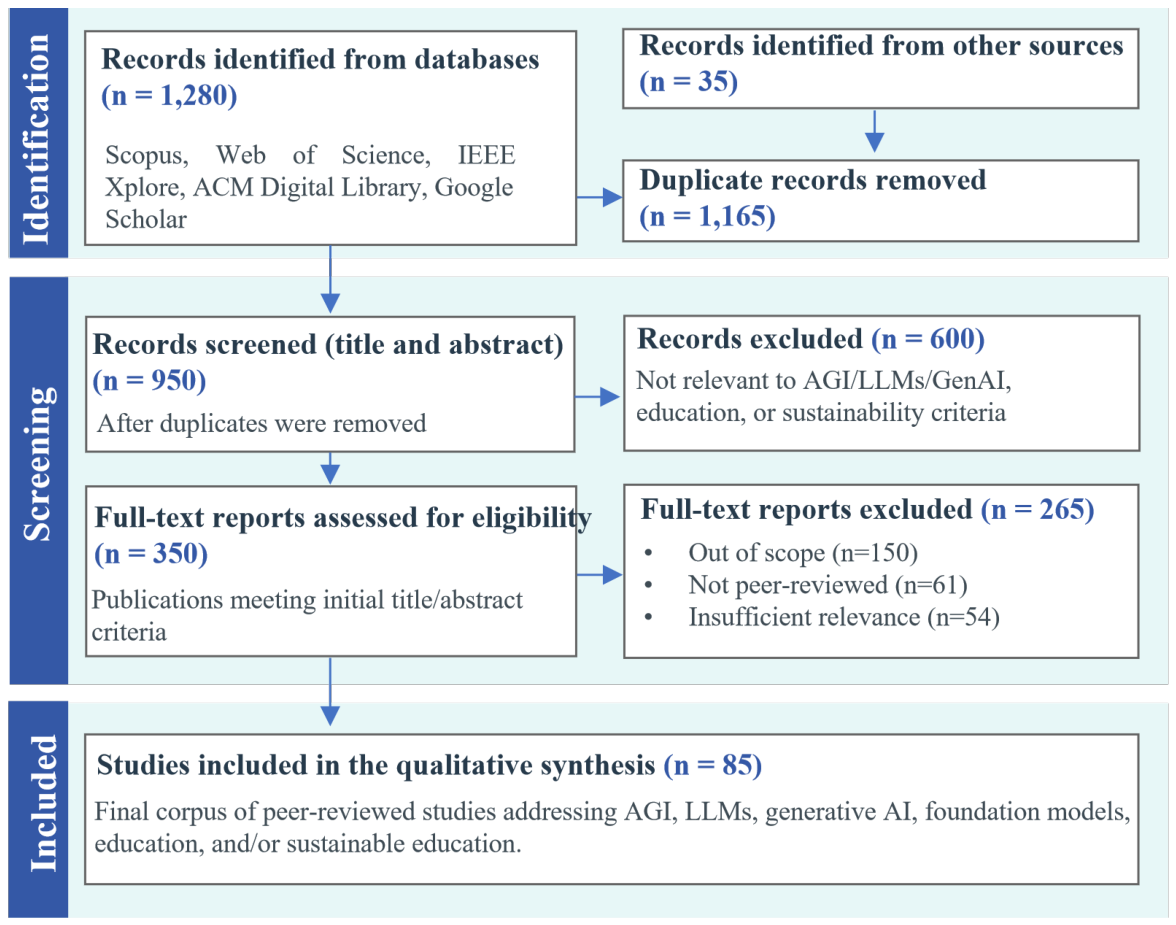
Figure 2.
The AGI-driven Learning Framework of Sustainable Education.
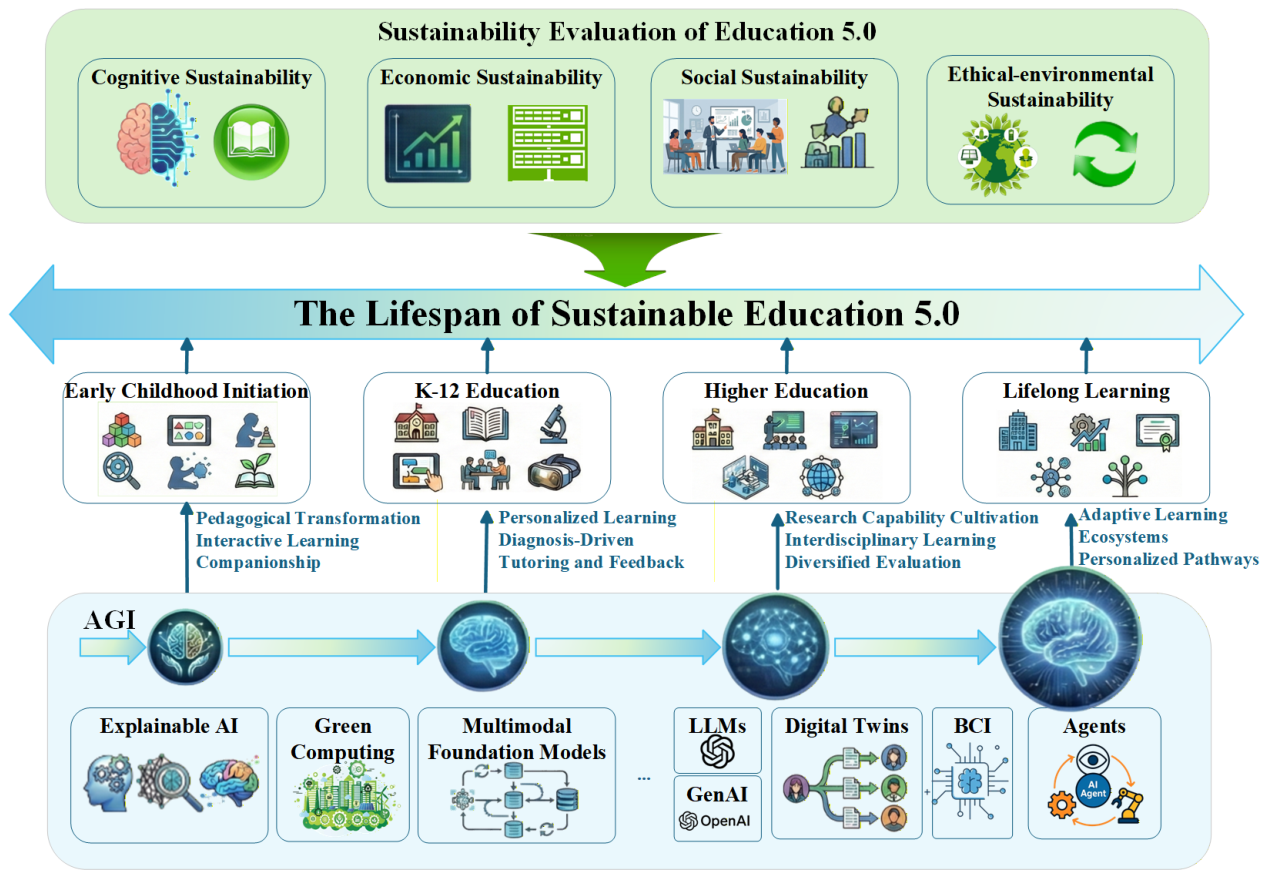
Figure 3.
The Multidimensional Sustainability Evaluation Metrics.
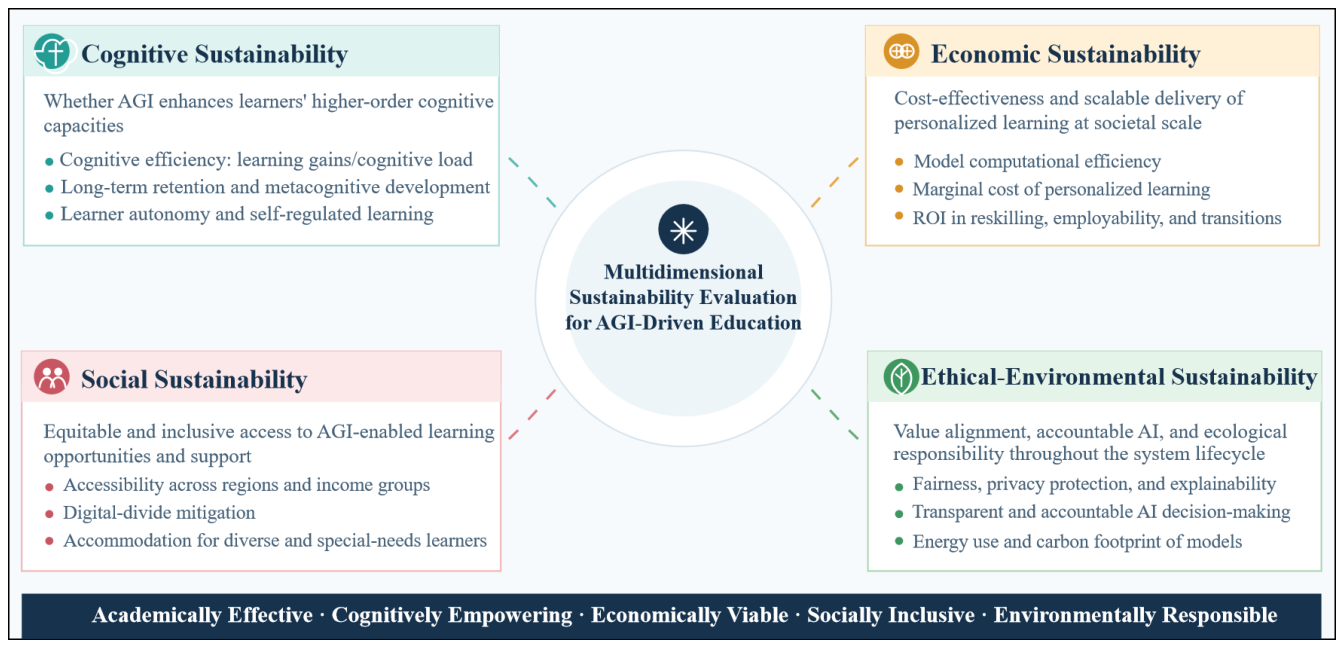

Table 1.
The AGI-Driven Sustainable Education Framework across the Learning Lifespan.
| Stage | AGI transformation role | Key mechanisms | Sustainability implications |
|---|---|---|---|
| Early childhood | Pedagogical transformation; interactive companionship | Dynamic narrative generation; multimodal interactive learning; emotional awareness | Cognitive sustainability: metacognitive reflection; learner agency |
| K-12 | Personalized learning; diagnosis-driven tutoring | Cognitive digital twins; real-time cognitive cue recognition; zone of proximal development tutoring | Cognitive sustainability: cognitive efficiency; long-term retention |
| Higher education | Research capability cultivation; interdisciplinary learning; diversified evaluation | Automated literature review; cross-domain knowledge transfer; process-oriented assessment | Cognitive & social sustainability: autonomy; competency-based evaluation |
| LL | Adaptive LL ecosystems; skill gap analysis; certification | Multi-agent tutoring; skill gap analysis; micro-credentials | Economic & social sustainability: employability; reskilling returns |
Table 2.
Operationalization of the Multidimensional Sustainability Evaluation Metrics.
| Dimension | Representative metrics | Measurement approach / data sources |
|---|---|---|
| Cognitive | Cognitive efficiency; learner autonomy; metacognitive development; long-term retention | Pre/post learning assessments; cognitive-load measures (e.g., eye-tracking, self-report scales); portfolio analysis of self-regulated learning |
| Economic | Computational efficiency; cost-effective scaling; reskilling and employability returns | Energy consumption and inference cost per learner; cost per competency unit; employment and wage follow-up surveys |
| Social | Equitable access; digital divide mitigation; inclusion of diverse learners | Enrollment and usage statistics across regions and socioeconomic groups; accessibility audits; inclusive design evaluations |
| Ethical-environmental | Algorithmic fairness; privacy; explainability (XAI); low-carbon footprint | Fairness and bias audits; privacy impact assessments; explainability evaluations; carbon emissions of model training and inference |
Disclaimer/Publisher’s Note: The statements, opinions and data contained in all publications are solely those of the individual author(s) and contributor(s) and not of MDPI and/or the editor(s). MDPI and/or the editor(s) disclaim responsibility for any injury to people or property resulting from any ideas, methods, instructions or products referred to in the content. |
© 2026 by the authors. Licensee MDPI, Basel, Switzerland. This article is an open access article distributed under the terms and conditions of the Creative Commons Attribution (CC BY) license (http://creativecommons.org/licenses/by/4.0/).
Copyright: This open access article is published under a Creative Commons CC BY 4.0 license, which permit the free download, distribution, and reuse, provided that the author and preprint are cited in any reuse.