

Submitted:
21 November 2026
Posted:
24 November 2026
You are already at the latest version
Abstract
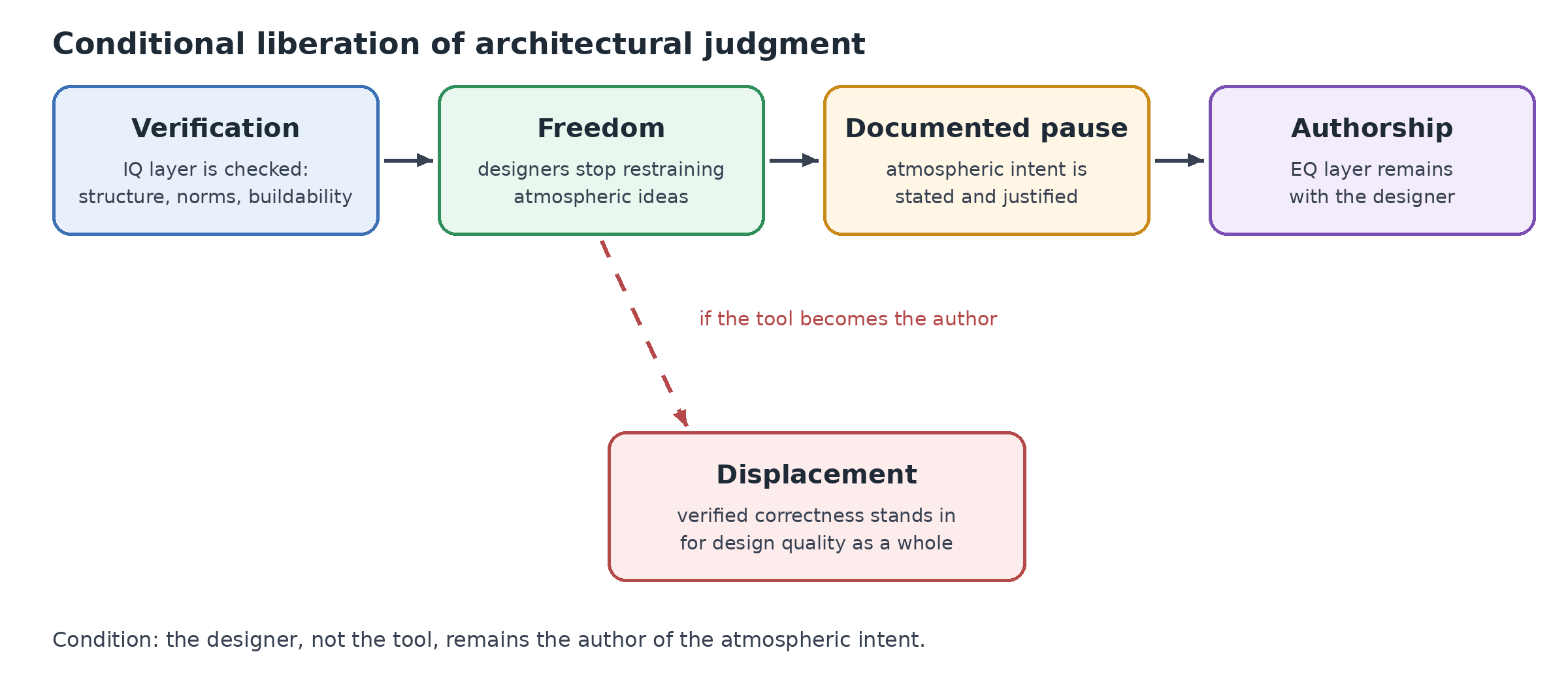
This paper argues that as generative AI moves from image synthesis toward architectural embodiment, computational verification protocols secure the discipline's IQ dimension, its measurable, rule-governed correctness. It proposes that this need not displace EQ, the atmospheric and empathetic core of architectural judgment, but can liberate it: once feasibility is verified, designers no longer have to restrain atmospheric ideas by what they believe can be built. This liberation is conditional. It holds only where the designer, not the tool, remains the author of the atmospheric intent. Rather than a validated framework, the paper offers a conceptual contribution: it names the condition under which verification frees rather than displaces affective judgment, locates a structural point in the design workflow where that judgment is articulated, and proposes a boundary between atmospheric questions that can be reviewed and those that cannot. Embodiment is read in two senses, the computational embodiment of generative tools and the bodily, tacit knowledge of the practitioner.
Keywords:
generative AI
; architectural education
; authorship
; atmosphere
; design verification
; Technical Sealing
; emotional judgment
; design studio
1. Introduction
I have, throughout my own prior work on AI-integrated architectural education, argued consistently for generative AI's value in the design studio: as a tool that widens formal exploration, accelerates iteration, and lowers the barrier to spatial experimentation. I still hold that view. But a contra has become impossible to ignore, and this paper exists to name it plainly: whatever a generative system reaches computationally, however sophisticated, there remains a part of architectural practice that no verification layer addresses, and on which the discipline's judgment still rests. That part is not computational. It is affective and experiential.
The distinction is not new in psychology. Goleman (1995) separated IQ, measurable, rule-governed cognitive ability, from EQ, the capacity to perceive, interpret, and respond to emotional and social meaning. In this paper, EQ is used as a shorthand rather than as a psychometric construct, whose status remains contested: it refers to empathic and affective judgment in design, the capacity to anticipate how a space will be felt by the people who use it, as shaped by their culture and environment. Architecture has always required both, but the discipline's encounter with generative AI has, so far, developed almost exclusively along the IQ axis: can a system calculate a valid structural span, verify a code clearance, or optimize a floor plan against stated constraints. My own prior contribution, the Technical Sealing protocol (Kaya Orhon, Çekerol, & Uğur, 2026a), sits squarely in this IQ tradition: a deterministic, BIM-embedded verification layer that catches exactly the kind of rule-governed error a generative system is prone to produce.
The problem this paper addresses can be stated plainly. In architecture, the question of AI is usually posed as a question of replacement: will generative systems take over the designer's work, or will they merely accelerate production? Both framings leave the most important relation unexamined, the relation between what can be verified and what designers allow themselves to imagine. Architects have always restrained atmospheric and empathetic ideas by what they believed could be built. If verification now takes over the question of buildability, it changes this relation, but the direction of change is open: it can free designers to pursue ideas they would earlier have held back, or it can let verified correctness stand in for design quality as a whole. Much of the profession's hesitation toward AI, this paper suggests, stems from an unarticulated fear of the second outcome, the fear of losing the part of design that cannot be checked. The question is therefore not whether AI can feel, but under which conditions its verification of the buildable frees human judgment of the felt.
Authorship is the concept on which this argument turns. It is understood here not as ownership of an image, but as answerability for the decisions that shape a space: the designer is the author of a design to the extent that she or he can state, justify and stand by the decisions it embodies, in particular the atmospheric ones that no verification can make. This understanding is close to Lokumcu's (2026) notion of answerability, and it is the reason why the liberation described in this paper is tied to a condition: freedom gained through verification becomes design quality only where it is exercised by an author.
The timeliness of this argument is sharpened, not softened, by recent developments. OpenAI's GPT-6 Astra (released in September 2026) authors editable three-dimensional scenes directly in Blender and inspects its own renders for internal coherence, an IQ-type capability more sophisticated than anything available even months earlier. Its own published case study (Ricouard, 2026) is telling in what it does not claim: every judgment of whether a space feels right, whether a room earns a few more seconds of looking, is made by the human directing the tool, while Astra's self-inspection stays confined to visual and geometric coherence. As IQ-type capability accelerates this quickly, the risk is not that verification protocols like Technical Sealing become unnecessary. It is that their success, solving the IQ problem convincingly, quietly displaces the harder, unresolved EQ question from the research agenda altogether.
This paper takes a different view of what that risk implies. Verification need not displace EQ; it can liberate it. Once feasibility is checked, designers no longer have to restrain atmospheric ideas by what they believe can be built. This liberation is, however, conditional: it holds only where the designer, not the tool, remains the author of the atmospheric intent. Where that condition fails, the displacement described above follows. The time to bring this condition into focus is now, while AI-architecture research is still being defined, rather than after curricula, accreditation frameworks, and professional practice have already settled around IQ-only tools and IQ-only metrics of success.
Two senses of embodiment meet in this argument. In the first, generative systems become embodied computationally: tools such as Astra act on three-dimensional scenes, no longer only on images. In the second, architectural judgment is embodied in the practitioner: bodily, tacit and felt (Pallasmaa, 2009). The question this paper asks is what happens when the first kind of embodiment accelerates while the second has no counterpart anywhere in the verification workflow.
2. Positioning: Computational Capability and Human Judgment
Two bodies of literature map cleanly onto the IQ and EQ axes, and their near-total separation in current architecture-AI scholarship is itself the gap this paper addresses.
On the IQ side, Carpo (2023) describes generative design as a shift from making to choosing among machine-generated variation, an account of computational capability that says nothing about whether the chosen output serves the people who will occupy it. Floridi's (2014) account of the infosphere and Picon's (2010) account of digital materiality both describe how convincingly the synthetic can imitate the physical, again a claim about representational and computational fidelity, not about emotional or experiential truth.
On the EQ side, Pallasmaa's (2009) account of the thinking hand argues that architectural judgment is inseparable from bodily, tacit, pre-verbal knowledge, exactly the register a generative system, however capable, does not possess. Norberg-Schulz's (1980) concept of genius loci, the felt spirit of a place, names a quality of architectural success that has no rule-based check: two buildings can be equally code-compliant and structurally sound while one moves the people inside it and the other does not. Schön's (1983) reflective practitioner integrates technical and experiential knowledge through reflection-in-action, implicitly requiring the emotional attunement Goleman (1995) formalized as EQ.
A useful shorthand for this divide is one German usage already makes available: the distinction between Gebäude, the building, the physical structure, and Raum, the space that is felt and lived in. Generative AI, however embodied its outputs become, designs Gebäude. A Gebäude is verifiable: it can be measured, checked against a standard, and sealed, which is exactly what Technical Sealing does. A Raum is not simply the geometric volume a building encloses. Following Norberg-Schulz (1980), a space becomes a Raum, or more precisely an Ort, a place, only once it is inhabited and felt, and no deterministic check currently available can certify that this has happened.
This does not mean taste sits entirely beyond discussion. A substrate of shared aesthetic response exists, documented for instance in Appleton's (1975) prospect-refuge theory, the finding that people across cultures tend to favor spaces combining a vantage point with a sense of shelter, broad enough that a generative system trained on it can often produce a space that reads as pleasant to most viewers. What that shared substrate cannot supply is the layer above it: the specific meaning a color, a material, or a threshold carries for the particular people who will live with it. That layer is irreducibly personal, and, as Section 4.1's self-test shows directly, not something even two humans reliably share.
This gap has begun to be named in adjacent work, and this paper builds on it rather than claiming to discover it first. Sepanta (2023) argues, in a widely syndicated piece, that AI can support architects technically but lacks the empathy and ethical judgment the discipline requires, a claim this paper's Section 4 shares and develops further. At a more theoretical register, Gerber and Gavagnin (2026) introduce the concept of architectural empathy, asking through a deliberate thought experiment whether AI can grasp architecture as lived, inhabited experience rather than as a describable object, and conclude that it falls short precisely where description gives way to inhabitation. Working from the opposite, applied direction, Zahra, Samra, and El Gizawi (2025) propose an AI-based model that analyzes students' facial expressions and body language to help instructors respond to student emotion in real time, an important response to the same felt problem, but one that asks AI to detect emotion rather than asking what should happen once a design decision's emotional stakes resist AI verification altogether. None of these three positions the question inside a working verification protocol, which is where this paper's own prior contribution, and Section 6's proposal, are situated.
A growing body of work from architectural schools in Turkey has begun to examine the design studio itself. Karadağ (2025) argues that AI acts not merely as a technical instrument but as a co-creative partner that reshapes studio culture, authorship and critique, and calls for reflexive pedagogical frameworks. Karadağ and Ozar (2025) show how text-to-image generators can support the conceptual design phase in interior design education while advocating a balanced integration that respects human creativity, Özorhon et al. (2025) propose an AI-assisted architectural design studio in which AI enters the curriculum as a creative agent through a workshop format, and Çiçek and Özkar (2026), evaluating AI-generated design solutions in a basic design studio, argue that AI applications can free students' design exploration. At the theoretical level, Lokumcu (2026) argues that generative image systems remove the trace of design decisions, the temporal interval in which reasoning takes place and an author who can answer for the result, and that architectural intelligence must therefore relocate from image making to the governance of meaning. Together, these studies move the discussion from what AI produces to how studios teach and think with it. To our knowledge, none of them asks how the verification of the buildable changes what designers allow themselves to imagine.
What is missing is a body of work that holds both axes in view at once, specifically in the context of generative AI. Verification research, including my own, has advanced the IQ axis considerably. The EQ axis has, by comparison, barely been asked as a question at all, and almost never in its most hopeful form: not only whether AI-assisted designs are correct, but whether verified feasibility can free the practitioner's capacity to sense what a space will mean to the people in it, and under which conditions the process of AI-assisted design cultivates rather than erodes that capacity.
2.1. Evidence Base: A Structured Rapid Scoping Search
To avoid resting this paper's argument on assertion alone, a structured scoping search was conducted (September 2026) using the terms "AI architecture emotion," "AI architecture empathy," "AI architecture emotional intelligence education," and "affective computing architecture design," across general web and Google Scholar-indexed sources. No subscription database (Scopus, Web of Science) was queried, so this evidence base is indicative rather than exhaustive, and is reported as such rather than as a full systematic review. Inclusion criterion: published or preprint work from 2021 to 2026 directly addressing emotional, empathetic, or affective dimensions of AI-architecture interaction. Five sources met this criterion.
| Source | Type | Method / sample | Relevant finding |
| Sepanta (2023) | Opinion / commentary | None | Asserts AI lacks the empathy and ethical judgment architecture requires; no empirical test offered. |
| Gerber and Gavagnin (2026) | Philosophical / conceptual | Thought experiment | AI's architectural understanding breaks down specifically at experiential, inhabited meaning, not at description. |
| Zahra, Samra, and El Gizawi (2025) | Empirical, educational intervention | Survey, n = 204; pilot, n = 13 |
Reports that AI-assisted analysis of students' facial expressions and body language helped the instructor respond to emotion and was followed by higher grades; the grade comparison is across two courses without statistical testing. Targets teaching practice, not design output. |
| Zhang, Fort, and Giménez Mateu (2024) | Empirical, experimental | n = 789 | AI-generated architectural imagery reliably conveys positive emotion (joy) but is markedly weaker at conveying negative emotion; architecture students showed greater overall sensitivity to emotional nuance than non-architecture students. |
| Ji, Kim, and Jun (2025) | Empirical / technical, proof of concept |
EEG dataset, n = 15; VR validation, n = 4 |
An early attempt to classify emotional state from EEG signals in architectural VR reaches 60.3% accuracy and is explicitly described by its own authors as preliminary. |
Two of the five sources are conceptual and offer no data; three are empirical, but each measures a narrow, already-quantifiable slice of emotion, classroom affect, image-level sentiment, EEG signal, rather than asking what should happen at the point where a design decision's emotional stakes exceed what any of these measurements can capture. None of the five proposes a structural checkpoint inside a design or verification workflow. This is the specific gap Section 4 and Section 6 address, and it is a gap in mechanism, not merely a gap in concern: the concern that AI lacks emotional depth is, as this table shows, already being raised from several directions at once. What these sources do not propose is where, structurally, a human is required to act on that concern before a design proceeds.
3. The IQ Layer: What Verification Already Solves
Before arguing for what is missing, it is worth being precise about what has already been secured, so that the EQ argument that follows is read as an addition, not a rejection.
Technical Sealing, developed in my own prior work (Kaya Orhon, Çekerol, & Uğur, 2026a), requires AI-generated design proposals to be transferred into a BIM model and checked there in five steps against verifiable criteria: transfer, dimensions, material, structure and clashes, and standards such as DIN 18040-2. A failed check returns a named, specific objection, and the element is revised and resubmitted rather than discarded (Figure 1).
This mechanism addresses the IQ question on its own terms: it is a closed, auditable loop that catches exactly the class of error, an unsupported cantilever, an undersized panel, a non-compliant clearance, that a generative system is structurally prone to producing. What it does not, and cannot, answer is whether a sealed, fully compliant design is one anybody would want to live, work, or grieve in. A stairwell can pass every structural and normative check and still feel cold. A classroom can meet every accessibility standard and still fail to put a nervous first-year student at ease. Technical Sealing has no criterion for either of these failures, because neither is a rule violation. This is not a flaw in the protocol; it is the boundary of what any deterministic check can be asked to do.
3.1. A Practitioner's Reflection: Verification as Freedom
My own practice offers a modest illustration of why verification may free rather than constrain. Before I worked with CAD and later BIM, I designed with T-square and technical pen. Every change was costly, and I learned to restrain ideas I was not sure could be drawn, let alone built. When digital tools made it easy to change drawings and to check them, I began to draw more boldly. Later, in courses I co-taught, I had the impression that students' designs grew stronger in the same way. Recordings of student projects from CAD courses I co-taught at an Istanbul university (2017–2019), published on YouTube, document this period before generative AI (Figure 2).
The pattern is not personal. In architecture's digital turn, tools that lowered the cost of describing and checking complex form made buildable what designers would earlier have held back (Carpo, 2011). Verification by AI extends this pattern one step further: it lowers not the cost of changing a design, but the cost of knowing whether it can be built. In doing so, it may free the designer to pursue atmospheric ideas that would otherwise remain unexplored.
4. The EQ Layer: What Remains with the Designer
Three qualities recur in accounts of what makes an architect an architect, and none of the three is, at present, a computable property of a model, however embodied its outputs become. They are not gaps for AI to close. They are the domain that verification can free, and the domain in which the designer's authorship lies.
Empathy for the unstated user. A generative system responds to what is specified in a prompt or a brief. A practicing architect routinely designs for needs the client has not stated and may not be able to articulate: the dementia patient's disorientation in an unfamiliar corridor, the child's need for a window seat low enough to see the garden, the grieving family's need for a chapel that does not feel institutional. These needs are read from context, silence, and lived experience, not from a specification an AI system could be given as input.
Cultural and emotional memory. Genius loci (Norberg-Schulz, 1980) is a claim that a place carries meaning accumulated through the lives lived in and around it. A generative system can make a designer aware of a typology's history, its climate and the rituals connected with it, and in this sense it can widen the designer's empathy for an unfamiliar context. It has no purchase, however, on why that typology matters to the people who inherited it. That understanding, and the design response to it, remain the designer's.
Ethical judgment under ambiguity. Structural and normative compliance can be checked by rule. Whether to spend a constrained budget on accessibility beyond the legal minimum, or whether to override a client's aesthetic preference because it will make a shared space exclude the people who most need it, are ethical judgments made under ambiguity, weighing competing human interests that no rule set fully resolves.
None of these three qualities argues against generative AI's continued use in the studio. Each argues that the freedom verification gives must be used. A design process that treats IQ-type verification, however rigorous, as a proxy for design quality as a whole measures the wrong thing. A design can be Technically Sealed and atmospherically empty, not because verification failed, but because the freedom it opened was not taken up. This is not a limitation of Technical Sealing specifically; it is the reason EQ requires its own research and pedagogical attention rather than being assumed to follow automatically once IQ-type verification is solved.
Empirical work points in the same direction. Zhang, Fort, and Giménez Mateu (2024), testing 789 university students (architecture and non-architecture majors) against AI-generated architectural imagery, found that generative systems reliably produce positive emotional responses, joy above all, but perform markedly worse at conveying negative emotion, and that architecture-trained viewers showed greater overall sensitivity to the images' emotional nuance than untrained viewers did. Generative AI can thus widen the range of atmospheres a designer can quickly explore, but the trained judgment that reads their nuance, and decides among them, remains with the designer.
4.1. A Self-Test Observation: Where the Comparison Method Itself Breaks Down
The comparison reported here began as an attempt to pair the author's own lived design judgment against a generative AI system's responses to open-ended, empathy-requiring design prompts. Constructing that comparison surfaced an observation in its own right, arrived at reflexively (Schön, 1983) rather than through the discrimination-task design proposed in Section 6: EQ-implicated design questions do not form a single category. Some resolve into a domain where experienced practitioners, whatever their personal history, tend to converge on comparable design moves. Others resolve into a domain that is irreducibly personal, where no convergence exists even between two humans who share the same loss. Comparing an AI's answer to a human answer is only a meaningful test in the first domain. In the second, the comparison method itself is the wrong instrument, and this section reports why.
Where practitioner judgment converges. Two prompts asked for a design response to a stated user need, a trust-building shelter entrance and a wayfinding corridor for dementia care, where professional literature and practitioner experience already converge on comparable moves regardless of who is asked. Personal, lived response to the shelter threshold: "To build trust, I would create a space that is bright but protected, a place not easily reached from outside, that does not require you to put your back against a wall. Warm colors." Generated response: "An entrance sequence that balances visibility with a sense of enclosure tends to build trust for people arriving in crisis: sightlines that let a visitor see who else is present before committing to enter, soft indirect lighting rather than institutional fluorescents, warm and muted color palettes, acoustic buffering from the street, and seating arranged so no one is forced to sit with their back exposed to an open approach." Personal, lived response to the dementia corridor: "Signs and objects that will not be forgotten and are easy to remember. Open, calming colors. Neutral tones like cream, like gray." Generated response: "Wayfinding for residents with dementia benefits from high-contrast, consistent signage combining text and recognizable pictograms, landmark objects or color-coded zones at decision points to aid orientation, non-reflective flooring to reduce visual confusion, and a calm, low-stimulation palette of neutral tones combined with warm, indirect lighting to reduce agitation."
A pattern recurs across both pairs. The author's answers are singular and economical: one gesture, one material choice, stated with an implicit "this, not that." The generated answers are structurally different: comprehensive, itemized, and additive, naming lighting, material, acoustics, color, and precedent together rather than choosing among them, in the same measured, reassuring register regardless of which prompt was asked. This pattern is consistent with what Forer (1949) described, in an unrelated context, as the fallacy of personal validation: a sufficiently broad, favorably worded statement can feel individually resonant to almost any reader precisely because it commits to nothing specific enough to be wrong. In this convergent domain, where an experienced reviewer can recognize a stronger or weaker answer, that generality is a meaningful weakness worth naming.
Where no convergence exists. A third prompt in the original set asked what to do with a deceased child's belongings. The author's own lived answer, singular and specific, drawn from a remembered case, was: "I would use a material object the child loved most. I would frame it and light it so its scent would not fade. I would place it in the corner where I spent the most time with them, to not forget, but to grow used to the absence." The AI system produced an equally confident, comprehensive answer covering display, lighting, and material choice. Read side by side, the two initially appear to repeat the pattern above, a specific human answer against a general AI one. A second reading exposes a different problem. Two grieving parents, or two siblings mourning the same child, could each give an answer as singular and as different from one another as the author's answer is from the AI's, without either being wrong. There is no third, independently correct answer this question converges toward, human or artificial. Using this prompt to argue that AI lacks empathy therefore proves nothing that asking two different humans the same question would not equally have proven: the comparison method itself has no purchase here, because the question has no convergence point for it to measure against.
This is the self-test's central observation: an emotional-intelligence framework for architecture, including the Emotional Sealing checkpoint proposed in Section 6, needs an explicit category boundary. It can meaningfully ask a designer to justify a decision within the convergent domain, where an experienced reviewer can recognize a stronger or weaker answer even without a formal rule. It cannot, and should not attempt to, adjudicate the non-convergent domain, where the appropriate design response is irreducibly personal and no external checkpoint, human or computational, has standing to call one answer better than another. The role of design in that domain is to hold space for whatever response the specific people involved need, not to converge on a validated one.
Two limitations should be stated plainly. This is an illustrative self-test of a single respondent against a single AI system, not a validated empirical study; no claim of statistical or thematic saturation is made. The AI responses above were also generated after the author's own answers were already recorded, so even the convergent-domain comparison is not blind in the way a rigorous discrimination task would require; a genuinely blind version, using independent third-party judges unaware of which answer came from which source, and restricted to the convergent domain identified here, is proposed as future work in Section 6.
5. Discussion: Toward an Architectural Pedagogy That Uses the Freedom
Institutional attention is presently IQ-weighted, and the freedom described here is largely not yet realized. The German Chamber of Architects reports that only 29 percent of its members use AI-based tools in their daily work (Bundesarchitektenkammer, 2025), and an economic assessment of the German construction sector lists insufficient digitalization, alongside regulation and bureaucracy, among the main obstacles to productivity (Grömling et al., 2025). Neither source asks whether AI-assisted design could free architects' atmospheric and empathetic judgment, or how education could prepare them to use that freedom. This is not a criticism of those bodies; it reflects that EQ has not yet been posed as a governable, assessable dimension of architectural competency in the way IQ-type compliance has.
A research and assessment gap, and an opportunity. Process-oriented assessment instruments in AI-integrated design education, including the Merit Report, introduced in Kaya Orhon, Çekerol, & Uğur (2026a) and developed into a process-oriented rubric in 2026b, have so far been built to evaluate curatorial and technical judgment: did the student catch the error, document the verification. None currently assess whether a student uses verified feasibility to pursue a bolder atmospheric idea, or whether design decisions show developing empathy for an unstated user, sensitivity to cultural and environmental context, or ethical reasoning under ambiguity. Building such an instrument, and validating it empirically, is a substantial undertaking outside the scope of this paper, but the absence of any existing instrument is itself a finding: among the sources reviewed here, the field has built assessment infrastructure for IQ and none yet for EQ.
A caution against overcorrection. The argument here is not that generative AI should be curtailed, nor that verification protocols such as Technical Sealing are sufficient on their own. Liberation and displacement are two possible outcomes of the same tools. Which of them occurs depends on whether the designer remains the author of the atmospheric intent; the two axes therefore need to be pursued in parallel, not in sequence.
A first teaching observation points in a more cautious direction. The course began in October 2026 with a four-week stair exercise as preparation for the main semi-detached house project: students designed an accessible stair for one of the two households, were free to use any AI tool, and documented how they checked the AI's suggestions against standards. Given this open responsibility for their AI use, students initially hesitated and asked for more guidance, yet in practice they began, unprompted, to use AI to check their own work. This did not yet translate into bolder atmospheric ideas; the freed capacity remained largely unused, consistent with the conditional character of Proposition 1. The teaching observations reported here are the author's own reflections and do not constitute research data collected from students.
6. Toward Emotional Sealing: Where Freed Judgment Is Articulated
Technical Sealing works because a structural load, a material thickness, or a code clearance can be checked against a deterministic standard. No equivalent standard exists, or should be invented, for whether a space is emotionally right. Proposing a literal Emotional Sealing, a pass or fail gate scoring empathy the way Technical Sealing scores wind load, would repeat exactly the mistake this paper warns against: reducing a human quality to a rule a system can verify. That is not what is proposed here.
What can be borrowed from Technical Sealing is not its rule set but its structural position: a mandatory, documented pause inserted at the same point in the workflow, before an AI-assisted design proceeds to further development or presentation, that requires the designer to answer a small number of open, unscored questions and record the answers for peer review. What atmosphere is this space meant to create, and for whom specifically. What did verification free you to try that you would otherwise have avoided. What does the cultural and environmental context ask of this space, and who is the unstated user this design might currently fail. This is not a new instrument invented for this paper; it extends the same process-oriented peer-review logic already built into the Merit Report framework (Kaya Orhon, Çekerol, & Uğur, 2026a, 2026b), applied here to a different set of questions.
Read this way, Emotional Sealing is one operational form of what Lokumcu (2026) calls the governance of meaning: at a fixed point in the workflow, it restores the three things generative tools tend to remove, a trace of the design decision, an interval in which it can be reasoned, and an author who answers for it.
Early technical attempts to close this gap by measurement rather than by structure exist, and their current state supports treating the checkpoint, not the sensor, as the right unit of intervention for now. Ji, Kim, and Jun (2025) fine-tuned a model to classify emotional state from EEG signals recorded in architectural VR environments, reaching 60.3% accuracy on a validation sample of four participants, a result their own authors describe as a preliminary proof of concept. Emotional Sealing does not wait for that measurement problem to be solved. It asks a documented human question at a fixed point in the workflow regardless of whether a reliable sensor for the answer exists.
The urgency is Astra-shaped. As generative tools compress the distance between a prompt and a finished-looking three-dimensional scene toward zero, the same speed can work in two directions. It can return time to the designer for atmospheric work, or it can remove the moment in which a designer stops to ask whether an output is right rather than only whether it is buildable. A structural requirement to pause is not bureaucratic overhead; in a workflow this fast, it is what turns saved time into freedom rather than into further production.
What such a checkpoint should actually ask, how its answers should be reviewed, and whether it measurably changes design outcomes are empirical questions this paper leaves open and calls on the field to take up. One concrete instrument for that agenda, suggested directly by Section 4.1's self-test, is a blind discrimination task in which independent judges attempt to distinguish human from AI-generated responses to open-ended design-empathy prompts, restricted to the convergent domain identified there. Testing whether such judgments are reliable, and what predicts success or failure at making them, would begin to answer how much human judgment itself can be trusted as a verification layer for emotional claims, the same trust this checkpoint depends on a human reviewer being able to supply in practice. That same self-test sets the boundary the checkpoint must respect: its open questions are answerable, and reviewable, only within the domain where practitioner judgment converges. Extending it into the irreducibly personal domain, treating a bereaved family's needs as something a reviewer could score against a reference answer, would repeat the category error the checkpoint exists to avoid.
7. Propositions
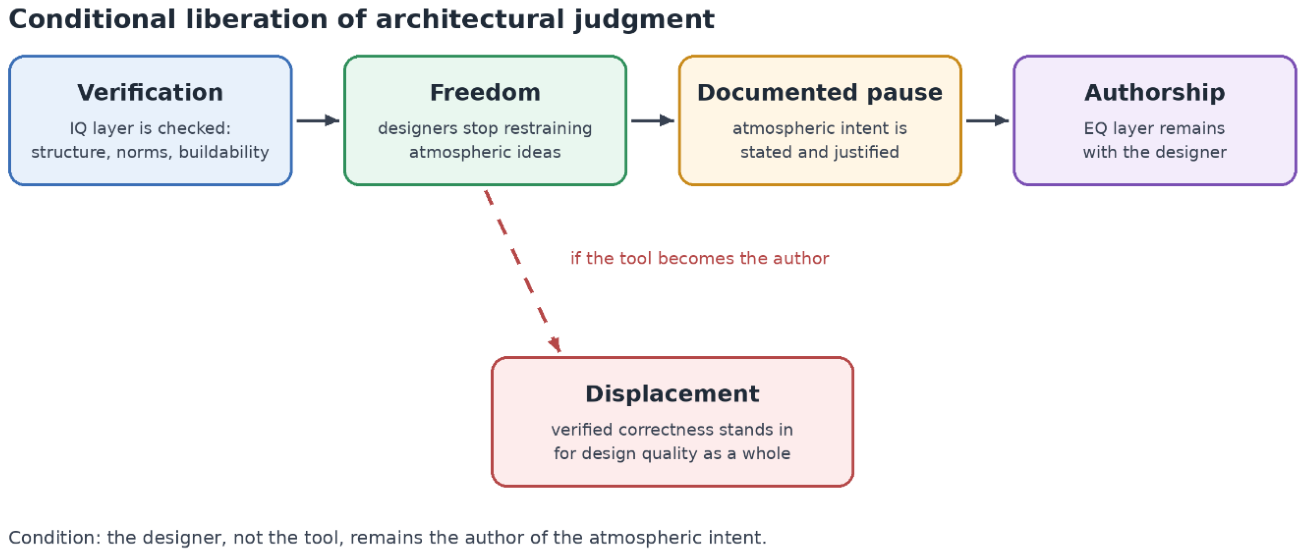
To make the conceptual argument of this paper open to examination, it is condensed here into four propositions. Each describes a conditional liberation: what verification and generative AI can free in architectural judgment, and under which condition (Figure 3). They are offered as starting points for empirical work, not as established findings.
Proposition 1. When feasibility is verified, designers no longer need to restrain atmospheric ideas by what they believe can be built. Verification of the IQ layer thus liberates the EQ layer, provided that the designer, not the tool, remains the author of the atmospheric intent. The condition matters because digital tools have cut both ways before. Robertson and Radcliffe (2009) found that CAD enhanced visualisation and communication, but also produced circumscribed thinking and premature design fixation, with detailed models creating an illusion of completeness that discouraged creative thought. More recent studio research points to the liberating side: Çiçek and Özkar (2026) argue that AI applications can free students' design exploration. Verification can free, but it can equally narrow, depending on who remains the author of the design intent.
Proposition 2. Aesthetics lies in the eye of the beholder, and that eye is shaped by culture and environment. Generative AI can introduce designers to unfamiliar cultural and environmental contexts and thereby support empathy for the people who will inhabit a space; the creative response to that context remains the designer's. Where the meaning of a space is personal to its users, no external review, human or computational, has standing. The contextual knowledge offered by generative systems reflects their training data and is not neutral. It widens empathy only where designers examine it critically against the site and the people concerned; uncritically adopted, it widens prejudice instead.
Proposition 3. The freedom gained through verification becomes design quality only if the atmospheric intent is articulated. A documented pause at a fixed point in the workflow, such as the Merit Report, is where this intent is stated, justified and owned. Studies of AI-integrated design studios support this view: AI can foster deeper conceptual inquiry, student reflection and new modalities of authorship, but only within reflexive pedagogical frameworks that enhance rather than displace human creativity (Karadağ, 2025).
Proposition 4. Time saved on IQ tasks can be returned to the designer for atmospheric work. Whether it is, depends on whether education deliberately protects that time rather than filling it with further production. Saved time does not return to deep work by itself. Gerlich (2025) found a significant negative correlation between frequent AI tool use and critical thinking, mediated by cognitive offloading. Freed time therefore becomes atmospheric work only where education deliberately claims it.
Proposition 1 in particular can be examined in process-oriented assessment settings, by comparing the atmospheric intent students articulate before and after a verification step, and by asking whether verified feasibility leads them to pursue bolder ideas.
8. Conclusion
This paper has argued that generative AI's rapid gains in computational, IQ-type capability, most recently evidenced by tools that author embodied three-dimensional geometry directly, open a choice for architectural education. Verification protocols such as Technical Sealing can quietly stand in for the whole of design quality, or they can free designers to pursue atmospheric ideas they would otherwise have held back. Which of the two happens is not decided by the tools. It depends on whether the designer remains the author of the atmospheric intent, and on whether that intent is articulated at a fixed point in the workflow.
This is offered as a conceptual and positional contribution, a synthesis of existing psychological and architectural-phenomenological literature applied to a genuinely new technical situation, rather than as an empirically validated framework. Its contribution is threefold: it names the condition under which a solved verification problem frees rather than displaces affective judgment; it locates a possible remedy at a structural point in the design workflow instead of in a rule set; and it proposes a boundary between atmospheric design questions that can be reviewed and those that cannot. The proposal of Emotional Sealing in Section 6 is deliberately left as a call rather than a method: the natural next step, left for future work, is the collaborative development and empirical testing of such a reflective checkpoint, and of assessment instruments capable of evaluating EQ-type competencies, empathy for the unstated user, cultural and emotional sensitivity, ethical judgment under ambiguity, in AI-assisted design education, alongside the IQ-type verification instruments the field has already begun to build.
The argument also completes earlier work on Technical Sealing and the Merit Report (Kaya Orhon, Çekerol, & Uğur, 2026a, 2026b), which makes the IQ layer verifiable and the designer's decisions traceable. What that work left implicit, this paper makes explicit: authorship is the point at which the freedom gained through verification becomes design quality. The four propositions state this claim in a form that empirical studies can take up.
Declaration on the Use of Generative AI
The concept, the argument, the self-test and the conclusions of this paper are the author's own. In preparing the manuscript, the author used Claude (Anthropic) for language editing, for structuring and revising the text according to the author's instructions, and for locating and verifying references. All AI-assisted passages were reviewed and edited by the author, who takes full responsibility for the content.
Conflicts of Interest
The author declares no conflicts of interest.
References
- Appleton, J. The experience of landscape; Wiley, 1975. [Google Scholar]
- Bundesarchitektenkammer (BAK). Berufspolitische Befragung 2025: Ergebnisse zur Digitalisierung und Einsatz von Künstlicher Intelligenz in Architektur; BAK e.V.: Berlin, Germany, 2025. [Google Scholar]
- Carpo, M. The alphabet and the algorithm; MIT Press, 2011. [Google Scholar]
- Carpo, M. Beyond digital: Design and automation at the end of modernity; MIT Press, 2023. [Google Scholar]
- Çiçek, S.; Özkar, M. Evaluating AI-generated design solutions in a basic design studio. Int. J. Technol. Des. Educ. 2026, 36(3), 1201–1236. [Google Scholar] [CrossRef]
- Floridi, L. The fourth revolution: How the infosphere is reshaping human reality; Oxford University Press, 2014. [Google Scholar]
- Forer, B. R. The fallacy of personal validation: A classroom demonstration of gullibility. J. Abnorm. Soc. Psychol. 1949, 44(1), 118–123. [Google Scholar] [CrossRef]
- Gerber, A.; Gavagnin, E. Artificial intelligence and architectural empathy. Khōrein J. Archit. Philos. 2026, 4(2), 191–212. [Google Scholar] [CrossRef]
- Gerlich, M. AI tools in society: Impacts on cognitive offloading and the future of critical thinking. Societies 2025, 15(1), 6. [Google Scholar] [CrossRef]
- Goleman, D. Emotional intelligence: Why it can matter more than IQ; Bantam Books, 1995. [Google Scholar]
- Grömling, M.; Voigtländer, M.; Wetzstein, S. Internationale Produktivitätsunterschiede in der Bauwirtschaft. In Gutachten im Auftrag des Hauptverbands der Deutschen Bauindustrie e.V. Institut der deutschen Wirtschaft (IW); Cologne, Germany, 2025; Available online: https://www.iwkoeln.de/studien/michael-groemling-michael-voigtlaender-internationale-produktivitaetsunterschiede-in-der-bauwirtschaft.html.
- Ji, S.-Y.; Kim, M.-K.; Jun, H.-J. Emotion analysis AI model for sensing architecture using EEG. Appl. Sci. 2025, 15(5), 2742. [Google Scholar] [CrossRef]
- Karadağ, D. AI in architectural education: Rethinking studio culture. Plan. – Des. Plan. Res. 2025, 9(2), 243–253. [Google Scholar] [CrossRef]
- Karadağ, D.; Ozar, B. A new frontier in design studio: AI and human collaboration in conceptual design. Front. Archit. Res. 2025, 14(6), 1536–1550. [Google Scholar] [CrossRef]
- Kaya Orhon, F.; Çekerol, K.; Uğur, S. Integration of artificial intelligence into architectural education: An online model proposal for instructor training for studio courses. Buildings 2026a, 16(19), 3912. [Google Scholar] [CrossRef]
- Kaya Orhon, F.; Çekerol, K.; Uğur, S. Assessing human-AI collaboration in design education: A process-oriented rubric grounded in an extended AI-TPACK framework; EdArXiv, 2026b. [Google Scholar] [CrossRef]
- Lokumcu, B. AI image generation and the relocation of architectural intelligence. Master's thesis, Middle East Technical University, 2026. Available online: https://open.metu.edu.tr/bitstream/handle/11511/121028/Bartu_Lokumcu_M.Arch_thesis.pdf.
- Norberg-Schulz, C. Genius loci: Towards a phenomenology of architecture; Rizzoli, 1980. [Google Scholar]
- Özorhon, G.; Nitelik Gelirli, D.; Lekesiz, G.; Müezzinoğlu, C. AI-assisted architectural design studio (AI-a-ADS): How artificial intelligence join the architectural design studio? Int. J. Technol. Des. Educ. 2025, 35, 1999–2023. [Google Scholar] [CrossRef]
- Pallasmaa, J. The thinking hand: Existential and embodied wisdom in architecture; Wiley, 2009. [Google Scholar]
- Picon, A. Digital culture in architecture: An introduction for the design professions; Birkhäuser, 2010. [Google Scholar]
- Ricouard, T. Architectural visualization with Astra. OpenAI Developers. 4 September 2026. Available online: https://developers.openai.com/blog/architectural-visualization-with-astra.
- Robertson, B. F.; Radcliffe, D. F. Impact of CAD tools on creative problem solving in engineering design. Comput.-Aided Des. 2009, 41, 136–146. [Google Scholar] [CrossRef]
- Schön, D. A. The reflective practitioner: How professionals think in action; Basic Books, 1983. [Google Scholar]
- Sepanta, F. Artificial intelligence can support architects but lacks empathy and ethics. The Conversation. June 2023. Available online: https://theconversation.com/artificial-intelligence-can-support-architects-but-lacks-empathy-and-ethics-201069.
- Zahra, S.; Samra, M.; El Gizawi, L. Working toward advanced architectural education: Developing an AI-based model to improve emotional intelligence in education. Buildings 2025, 15(3), 356. [Google Scholar] [CrossRef]
- Zhang, Z.; Fort, J. M.; Giménez Mateu, L. Decoding emotional responses to AI-generated architectural imagery. Front. Psychol. 2024, 15, 1348083. [Google Scholar] [CrossRef]
Figure 1.
The IQ layer: the five checks of the Technical Sealing protocol in the BIM model.
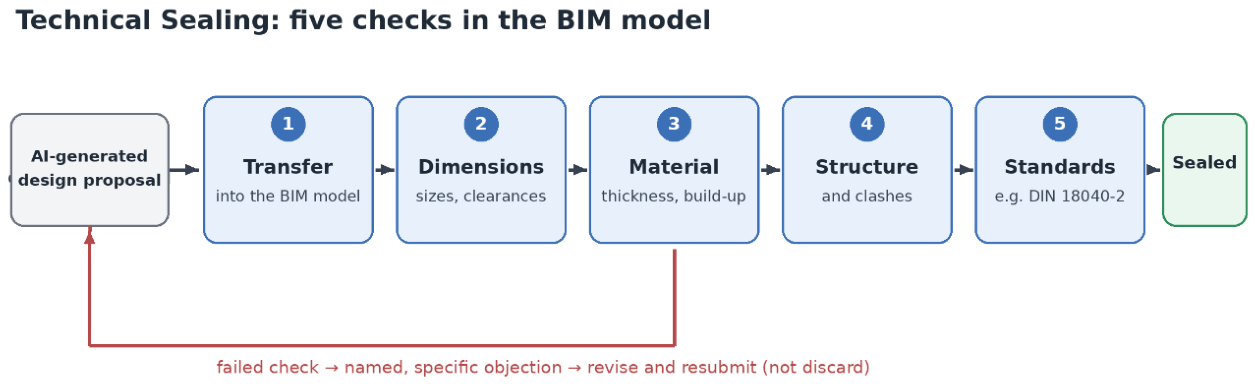
Figure 2.
Student projects from CAD courses co-taught by the author at an Istanbul university, 2017–2019, before generative AI. Video links: youtube.com/watch?v=amCTFh1BzB8 (from 2:35); youtube.com/watch?v=zVsrhJhKaRc (from 39:47 and from 9:02).
Figure 2.
Student projects from CAD courses co-taught by the author at an Istanbul university, 2017–2019, before generative AI. Video links: youtube.com/watch?v=amCTFh1BzB8 (from 2:35); youtube.com/watch?v=zVsrhJhKaRc (from 39:47 and from 9:02).

Figure 3.
Conditional liberation of architectural judgment: verification frees atmospheric ideas only where the designer remains the author of the atmospheric intent; otherwise verified correctness displaces it.
Figure 3.
Conditional liberation of architectural judgment: verification frees atmospheric ideas only where the designer remains the author of the atmospheric intent; otherwise verified correctness displaces it.
Disclaimer/Publisher’s Note: The statements, opinions and data contained in all publications are solely those of the individual author(s) and contributor(s) and not of MDPI and/or the editor(s). MDPI and/or the editor(s) disclaim responsibility for any injury to people or property resulting from any ideas, methods, instructions or products referred to in the content. |
© 2026 by the author. Licensee MDPI, Basel, Switzerland. This article is an open access article distributed under the terms and conditions of the Creative Commons Attribution (CC BY) license.
Copyright: This open access article is published under a Creative Commons CC BY 4.0 license, which permit the free download, distribution, and reuse, provided that the author and preprint are cited in any reuse.