
Submitted:
22 November 2026
Posted:
24 November 2026
You are already at the latest version
Abstract
How much of gene regulation survives a change in the molecule that performs it? This critical narrative review examines published replacements and molecular perturbations across RNA processing, transcription, chromatin organization, and translation, building on established concepts of complementation, modularity, degeneracy, and functional equivalence. We distinguish direct substitution from engineered recruitment, endogenous regulation, and evolutionary analogy, and ask which unit was changed, which output was measured, and under what conditions. Protein-only ribonuclease P enzymes can sustain growth despite substrate-processing defects; heat-shock-factor module swaps preserve selected memory outputs; and replacement of an ARID1A disordered region restores assembly-related properties without restoring native transcription. Additional studies show how tRNA identity, RNA processing, partner availability, covalent modification, and genomic context redirect regulatory activity. Together, these findings separate preservation of a measured property from preservation of a gene program, physiological function, or patient benefit. Uneven endpoint coverage, context dependence, and incomplete knowledge of molecular dynamics limit interpretation, and emerging sequence-design and prediction methods do not yet provide general predictors of regulatory interchangeability. For scientists, the review connects molecular interventions to the conclusions they support; for physicians, it distinguishes mechanistic correction, therapeutic redirection, and clinical evidence, offering an evidence-centered synthesis of regulatory plasticity and its biological limits.
Keywords:
gene regulation
; molecular substitution
; complementation
; regulatory plasticity
; RNA processing
; chromatin
; intrinsically disordered regions
; translational evidence
1. Introduction
Gene regulation controls when, where, and how much gene product is made, processed, used, and removed. A recurrent experimental question is whether a different molecular component can preserve a native output. The answer depends on what is measured: recovery of growth, binding, assembly, transcription, and physiological function need not coincide. This review therefore asks which outputs survive molecular replacement, under which conditions, and with what uncertainty, rather than whether two molecules are interchangeable without qualification.
Gene regulation requires reproducible responses from molecules whose shapes and partners change. Early models explained control through regulator–DNA interactions: the operon model explained bacterial gene control [1], and lac-repressor isolation and specific λ-repressor binding established protein-based control [2,3]. Later work extended regulation beyond single protein–DNA pairs: McClintock's mobile genetic elements showed that moving DNA can alter expression elsewhere [4], and Britten and Davidson extended coordinated regulation to eukaryotic genomes [5].
The regulator–DNA models just described rely on complementary molecular shapes, which remain essential, but fixed structures cannot describe every event [6,7]. Activation domains, the parts of transcription factors that recruit expression machinery, can bind in alternative orientations [8]. Chromatin, the genome's DNA–protein package, transiently exposes DNA [9], and some proteins recognize both DNA and RNA [10]. These examples motivate a distinction between the molecular arrangement and the output it supports.
Several established concepts describe how recognition can tolerate changing shape, and they frame the output-focused question considered here. Two concern binding itself: induced fit means reshaping during binding, and allostery means that binding at one site changes behavior elsewhere [11,12]. Intrinsically disordered regions, which lack a persistent fold, extend this tolerance: activation-domain studies [14], heterogeneous bound complexes [15,16], and coupled folding and binding [17,18,19] established selective recognition without rigid geometry. Condensate models concern locally enriched, membrane-free assemblies [20,21]. Two further concepts concern function rather than shape: moonlighting proteins perform distinct tasks [13], and biological degeneracy describes different arrangements producing overlapping outputs [22]. Quantitative network treatments [23] and applications to epigenomics [24] provide relevant precedents for the output-focused question.
The replacement question itself is not new, and this review does not present conditional equivalence, complementation, or modularity as discoveries. Jaeger and Calkins defined functional equivalence by outcomes, emphasized that discriminating conditions can reveal differences, and discussed protein-for-RNA RNase P complementation [25]. Sloan and colleagues analyzed molecular interchangeability and barriers arising from interactions, dosage, divergence, and functional importance [26]. Systematic yeast humanization offers a particularly useful experimental perspective: complementation depended strongly on the functional module, while sequence similarity and expression were only partial predictors [27]. Foundational modularity experiments likewise showed that a bacterial DNA-binding domain could replace the DNA-binding function of a yeast transcriptional activator in an engineered system [28].
To address that question, we bring together whole-enzyme replacement, transcription-factor module swaps, engineered recruitment, changes in RNA sequence and processing, and regulatory redundancy, asking what each intervention preserves, alters, or fails to restore while keeping their evidentiary roles distinct. For scientists, this synthesis connects apparently similar rescue results to different molecular dependencies and regulatory consequences. For physicians, it clarifies why restored molecular activity is not yet evidence of tissue delivery, clinical efficacy, or acceptable harm, and why a useful therapy may redirect a pathway rather than reproduce its native mechanism.
This focus also distinguishes the review from related contributions. The recent exchange-dynamics Perspective emphasizes transient assemblies and kinetic control [29], whereas UNified FramewOrk for reguLatory Dynamics (UNFOLD) classifies robustness and related properties in simulated regulatory circuits [30]. Our recent related review surveyed molecular ensembles from their physicochemical basis to therapeutic implications [31]. Here, the organizing question is narrower: what do published changes to regulatory molecules reveal about the relationship between molecular identity and gene-regulatory output? These earlier contributions supply context rather than competing claims to a new general theory.
Section 2 defines the review’s scope and terminology. Section 3 examines direct replacements and informative failures, and Section 4 distinguishes the conclusions supported by different kinds of molecular intervention. Section 5 and Section 6 synthesize the mechanisms and biological contexts that explain divergent outcomes. Section 7 separates molecular correction from clinical benefit. Section 8 and Section 9 discuss the implications, unresolved questions, emerging computational literature, and future directions before drawing the main conclusions.
2. Scope, Literature Approach, and Terminology
This section states what kind of review this is, how the literature was assembled and selected, and which terms are used in a fixed sense in later sections. Table 1 defines the terms most prone to overinterpretation, and the closing paragraph separates two neighboring concepts from controlled replacement results.
This is a critical narrative review, not a systematic review, meta-analysis, or estimate of replacement prevalence. The existing manuscript bibliography was the starting corpus, and a targeted update completed on 17 November 2026 used academic-index and web-index searches, retrieval of PubMed records, publisher and PubMed Central articles, and backward citation checking. Representative concept searches concerned protein-only RNase P replacement/complementation, molecular interchangeability, systematic yeast humanization, and endogenous enhancer dissection. Primary experiments were prioritized for replacement outcomes and consequential mechanistic statements, whereas reviews and Perspectives were used for definitions and synthesis. We assessed English-language records and accessible English full text, preferring publisher versions when available. Preprints were not used as sole support for the central replacement or clinical claims.
Examples were selected for controlled replacement, informative failure, mechanistic discrimination, or a consequential distinction between molecular and clinical evidence. Studies that alter a molecule without replacing an entire native regulator are included when they clarify why a regulatory output changes. Literature identification was neither exhaustive nor protocol-registered, and the targeted update does not reconstruct an undocumented original search history. The article synthesizes published work; it does not generate a new experimental dataset or computational prediction.
Table 1 distinguishes related terms that otherwise invite overinterpretation. “Functional substitution” is used descriptively for an alternative component supporting a specified native activity or output, not as a new biological category. We report historical complementation based on the actual measurements and controls. Formal statistical equivalence is a narrower claim than phenotypic rescue or an absence of a statistically significant difference; historical studies are not retrospectively assigned equivalence margins [25,32,33].
Two further concepts are easily confused with a controlled replacement result and are set aside here as background. Structural quasi-equivalence describes identical viral-shell subunits occupying similar but nonidentical geometric environments [34,35]. Moonlighting concerns one molecule performing distinct functions, whereas degeneracy concerns different arrangements with overlapping outputs [13,22,23]. These concepts provide background, not interchangeable names for a controlled replacement result.
3. What Controlled Replacement Actually Shows
This section examines what controlled replacement experiments show, in four parts: whole-enzyme replacement of RNase P (3.1), transcription-factor modules and engineered recruitment (3.2), physical-property rescue and enhancer redundancy (3.3), and tRNA identity (3.4). At the end, the section summarizes the unit replaced in each study and the boundary of the inference it supports.
3.1. RNase P: Growth Rescue and Precise RNA Maturation are Different Endpoints
Ribonuclease P (RNase P) removes the 5′ leader from precursor transfer RNAs (tRNAs), producing ends required for normal tRNA function. Its catalytic architectures range from RNA-containing complexes to protein-only enzymes. Reconstitution of human mitochondrial RNase P established a multisubunit protein-only solution, while the Arabidopsis organellar enzyme PRORP1 provided a single-protein precedent and bacterial complementation evidence [36,37]. These findings show that an essential reaction need not have a single universal catalytic material; they do not establish identical substrate coverage or cellular performance.
In Escherichia coli depleted of its native RNase P RNA, Arabidopsis PRORP isoenzymes supported growth under some conditions, but processing defects remained. All three supported growth at 28 °C, whereas PRORP2 failed at 37 °C in the tested system. Correct maturation of selected tRNAs and 4.5S RNA was not fully restored [38]. Because 4.5S RNA participates in the signal-recognition-particle pathway, its maturation is a specific molecular output rather than another name for proliferation. Survival can therefore indicate sufficient essential activity while remaining insensitive to precise maturation defects.
Yeast provides an important complementary result. Weber and colleagues replaced the nuclear RNase P RNA gene with Arabidopsis PRORP3 and examined growth and RNA processing across conditions [39]. The replacements were viable, with no serious growth deficiency in the tested settings, but precursor patterns and background-dependent fitness effects were not identical. The RNase P-specific protein Rpr2 could also be removed. Most other associated proteins remained because they also serve essential RNase MRP functions. Thus, replacement of the catalytic architecture should not be described as elimination of every protein associated with the original complex.
Minimal protein-only homologs of Aquifex RNase P, termed HARPs, further broaden the architecture comparison. They supported bacterial and yeast growth in the original complementation experiments, although more slowly than native controls [40]. Later structural work resolved how a minimal HARP engages a precursor substrate [41]. A targeted recent addition is particularly informative: bacterial and archaeal HARPs complemented E. coli viability while inefficiently processing selected tRNA precursors and pre-4.5S RNA; an upstream adenine and the absence of an extended stable acceptor stem favored cleavage [42]. This is evidence for particular substrate–enzyme constraints, not for a universal replacement mechanism.
Even exchanging only the RNase P protein subunit can reveal hidden costs. Heterologous rnpA genes complemented loss of the native gene while delaying the approach to maximal growth; maximal growth rate alone would have missed that boundary [43]. The distinction among catalytic architecture, accessory-subunit compatibility, growth dynamics, and substrate-specific processing is therefore experimentally consequential. Contemporary mechanistic syntheses of protein-only RNase P should be read alongside these direct replacements [44].
3.2. Transcription-Factor Modules and Engineered Recruitment
The LexA–GAL4 hybrid established a foundational modularity principle: a bacterial repressor's DNA-binding function could direct the activation function of yeast GAL4 to a promoter containing a LexA operator [28]. The conclusion concerns replacement of a targeting module in that engineered setting. It is not evidence that the hybrid preserves GAL4's endogenous target repertoire, timing, or metabolic program.
Engineered RNAs activated yeast reporters at strengths approaching protein activation domains [45]. A promoter-tethered RNA containing an otherwise inhibitory aptamer for TFIIB, a general initiation factor, also activated reporters [46]. Disrupting its binding loops abolished activity, and other factor-binding aptamers failed. DNA targeting still required a protein adaptor: the RNA supplied an activation function, not an entire transcription factor or native gene program.
Plant heat-stress memory shows that the outcome of a module swap depends on the module and the endpoint measured. Arabidopsis heat-shock factor A2 (HSFA2) sustains responses after an earlier heat exposure, whereas related HSFA1D has a different regulatory role. HSFA1D-derived DNA-binding and selected C-terminal substitutions in HSFA2 rescued tested transcriptional-memory outputs to differing extents, and the selected C-terminal swap largely restored physiological memory [47]. However, HSFA1D expressed from the HSFA2 promoter, a complete regulatory-region substitution, and an oligomerization-domain swap did not restore physiological memory; for the oligomerization swap, later protein loss limits attribution to intrinsic domain incompatibility. The result is therefore not simply that related domains “work” or “fail”: construct persistence, the particular module, and the chosen memory endpoint determine the conclusion.
The separation of catalytic and regulatory functions offers a complementary kind of molecular intervention. E6-associated protein, E6-AP/UBE3A, was identified as a coactivator of nuclear hormone receptors, including the progesterone receptor. Its ubiquitin-ligase activity was dispensable for the coactivation measured, and most patient-associated mutants examined retained progesterone-receptor coactivation despite impaired ligase activity [48]. This is separation-of-function evidence within one protein, not proof that a different molecule replaces UBE3A in neurons. It also cautions against treating all activities associated with a disease-linked protein as one inseparable endpoint.
3.3. Physical-Property Rescue is not Restoration of a Native Gene Program
ARID1A is a subunit of canonical BAF (cBAF), an ATP-dependent complex that reorganizes nucleosomes to regulate DNA access. In an engineered endometrial-carcinoma-cell system, replacement of an ARID1A disordered region with regions from FUS or DDX4 restored condensation-associated properties and cBAF assembly but not native interactions, genomic targeting, accessibility, or transcription [49]. This is strong negative evidence against treating generic condensation as sufficient for regulatory rescue in that system. It does not imply that condensation is irrelevant or that all sequence features of an intrinsically disordered region are dispensable.
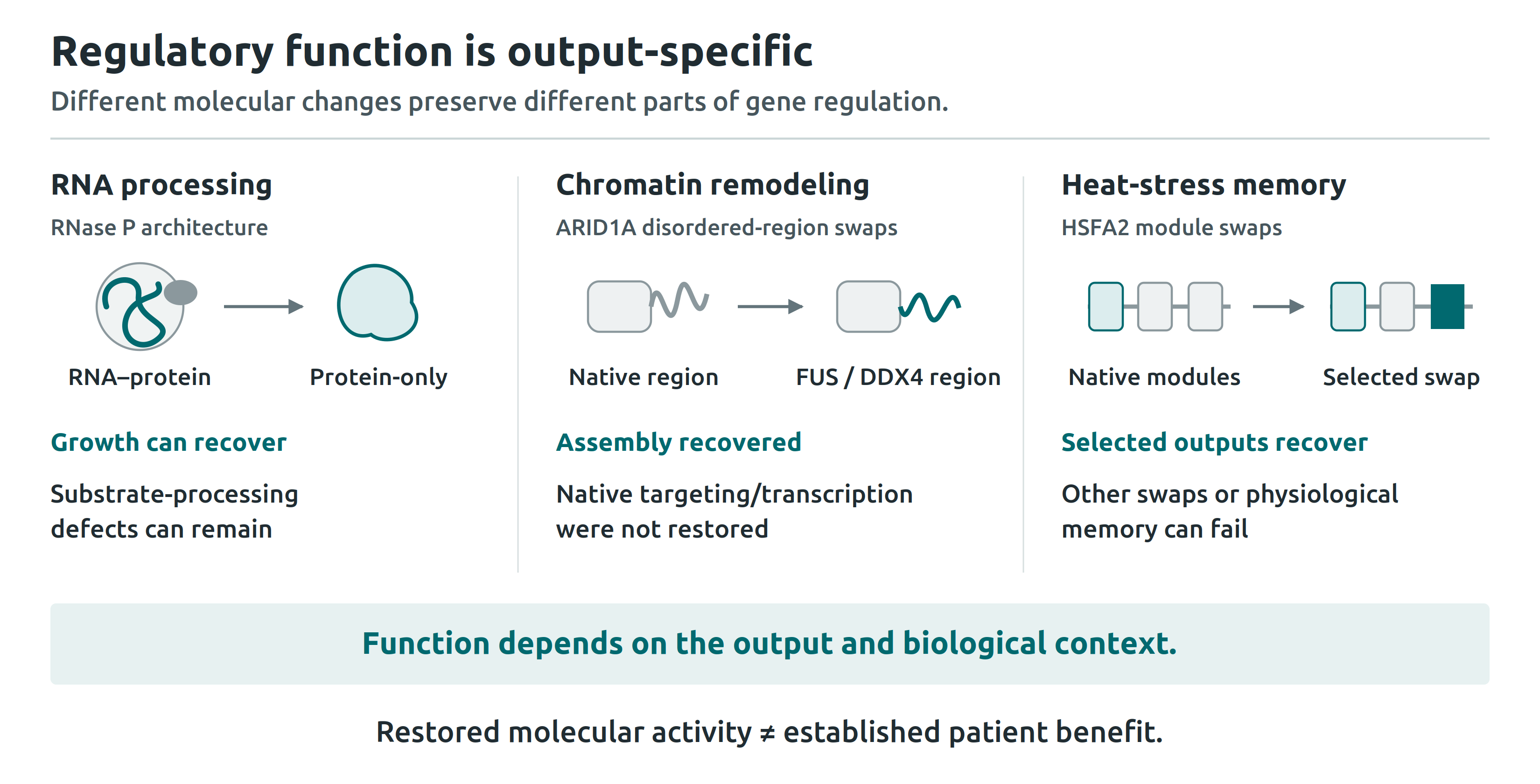
Enhancer redundancy addresses a related but distinct question. At the Drosophila snail locus, primary and shadow enhancers produced overlapping outputs under permissive conditions, yet increased temperature or reduced regulatory input exposed failures [50]. This comparison tests conditional buffering by regulatory DNA configurations, not replacement of an entire enzyme or transcription factor. Table 2 labels the experimental units and evidence roles explicitly; Figure 1 summarizes why an apparently successful endpoint must be accompanied by its boundary.
3.4. tRNA Identity Connects Translation to Chromatin and Cell Lineage
An isodecoder is a tRNA that shares an anticodon with other tRNAs but differs elsewhere in sequence, and a study of prostate-cancer models shows that a shared decoding label did not make isodecoders interchangeable. Depletion of tRNA₁Arg(UCU) reduced androgen-receptor pathway expression and promoted lineage plasticity, whereas its addback restored androgen-related expression and sensitivity to androgen-receptor inhibitors in the studied cells. Other arginine tRNA isodecoders with the same anticodon did not reproduce that regulatory effect [51]. Thus, a shared decoding label did not establish interchangeable regulation in this system.
The link to gene control involved translation of chromatin-regulatory proteins. SMARCC2, a BAF-complex component, changed in protein abundance without a corresponding change in its mRNA abundance. In a SMARCC2 reporter, replacing arginine AGA codons with synonymous CGC codons removed sensitivity to the lineage states examined; SMARCC2 depletion also counteracted the effects of tRNA addback [51]. The combined perturbations support a translation-mediated connection between tRNA dosage and chromatin-associated lineage control. They do not show that tRNAs are universally noninterchangeable, nor do the retrospective patient associations establish a treatment-selection biomarker. This example complements ARID1A replacement by showing that a change upstream in translation can alter the supply and function of a chromatin complex without exchanging that complex's subunits directly.
Across these comparisons, the endpoint that was preserved, or that failed to be preserved, was narrower than the native program. RNase P replacements sustained growth while selected processing defects remained [38,39,42]; module swaps and tethered RNAs supplied a targeting or activation function without a whole factor or its native target repertoire [28,45,46,47]; replacement of the ARID1A disordered region restored assembly-related properties but not native targeting or transcription [49]; and arginine tRNA isodecoders sharing an anticodon were not interchangeable for lineage-associated regulation [51]. Section 4 asks what each kind of intervention can and cannot establish.
4. What Published Molecular Interventions Establish
This section asks what each kind of published molecular intervention can establish. It first distinguishes direct complementation, module swaps, tethering, endogenous perturbation, and evolutionary analogy; it then illustrates the separation with the RNase P, ARID1A, and engineered-recruitment studies, considers how controls limit causal interpretation, and contrasts the biological use of “equivalence” with its formal statistical meaning.
The literature contains several questions that are related but not interchangeable. Direct complementation asks whether an alternative component supports an activity lost when the native component is absent or impaired. Module swaps localize functions to parts of a molecule. Tethering establishes an activity under engineered recruitment conditions. Endogenous sequence changes, depletion, or catalytic mutations identify dependencies without necessarily demonstrating that another molecule can replace the original regulator. Evolutionary analogies establish recurrent solutions, but only a subset includes experimental cross-system activity. The distinctions matter because the same word, “rescue,” can refer to growth, a reporter, a biochemical reaction, or a native gene program [25,26,27,28,38,45,46,47,49,50].
RNase P provides particularly clear examples of endpoint separation: growth and precise processing were not equally preserved after replacement [38,39,42]. The ARID1A study separates recovery of condensation-associated properties and complex assembly from endogenous targeting and transcription [49]. Conversely, the LexA–GAL4 and RNA-activator studies demonstrate productive recruitment in engineered systems without establishing restoration of the original factor's full target repertoire [28,45,46]. These are substantial biological findings at their measured levels, not incomplete versions of one universal substitution test.
A rescue result supports only as much causal inference as its controls allow. Residual native activity, altered localization, unstable constructs, and incomplete recovery can each explain a result without implying intrinsic incompatibility of an alternative molecule. The HSFA2 oligomerization-domain swap is illustrative because later protein loss limits assignment of the physiological defect to the domain's intrinsic regulatory activity [47]. The converse case needs equal care: an alternative that performs like the intact molecule has shown an observation, not a mechanism, and if native rescue was also inadequate, the reason for the similarity is less secure. A failed or partial rescue can therefore be informative without being assigned uniquely to a molecular mechanism.
Formal equivalence and noninferiority have established statistical meanings that differ from these biological descriptions [32,33,52]. In particular, failure to detect a difference does not establish equivalence, and failure to establish equivalence does not demonstrate a biologically important difference. The sections that follow therefore retain each study's reported conclusions and uncertainty rather than imposing a retrospective pass-or-fail classification, and emphasize the biological information gained from a molecular change, including the output that was preserved and the output that was not. Section 5 begins with the mechanistic constraints that explain why one preserved property can accompany a changed regulatory output.
5. Mechanistic Constraints on Preserving a Regulatory Output
This section asks why a replacement that preserves one property can still change a regulatory output. It proceeds from molecular recognition (5.1) and DNA and chromatin context (5.2) to the classes of regulatory RNA (5.3), the formation, completion, and reuse of RNA products (5.4), processing changes that create different regulatory molecules (5.5), and the redistribution of regulatory machinery by RNA abundance and covalent modification (5.6). Table 3 at the end of the section summarizes the resulting limits of interpretation.
5.1. Flexible Recognition can Remain Selective
The yeast activator Gcn4 binds Med15, a receptor for activators in the Mediator coactivator complex [8,16]. Hydrophobic residues in its acidic disordered region contact several Med15 surfaces in alternative orientations; a short segment gains helical character [16]. Multiple domains maintain association while individual contacts exchange [8]. Flexible recognition thus preserves chemical selectivity without fixed geometry.
CREB, the cAMP response element-binding transcription factor, instead becomes more ordered when its phosphorylated activation segment binds KIX, a docking domain of CREB-binding protein (CBP). Encounter and partially folded intermediates precede the bound state [19]. Partner and modification determine whether recognition retains or reduces disorder [7,18].
These examples show why disorder cannot be equated with absence of molecular recognition. Distributed hydrophobic, charged, or short sequence-specific contacts can collectively provide selectivity, while changing partners or modifications can alter the binding ensemble [7,8,16,18]. Conversely, reproducing bulk dimensions or amino-acid composition does not guarantee preservation of the contacts needed at an endogenous locus. The ARID1A swaps make this distinction experimentally concrete: an assembly-related property was recoverable while native regulatory interactions were not [49].
Zinc-finger proteins provide a complementary warning about shared labels. Their zinc-coordinating architectures can recognize DNA, RNA, proteins, or modified histones [53,54]. GATA-1 uses distinguishable surfaces for DNA and its cofactor FOG-1, whereas Ikaros separates recognition and dimerization functions [55,56]. The MDM2–MDMX RING study established heterodimer structure and dimerization-dependent trans-ubiquitylation of the partner RING domain, rather than directly testing a p53-substrate reaction [57]. A domain name therefore does not specify either a common fold across all classes or one interchangeable regulatory function.
Measured affinity depends on the method and conditions, as the linker histone H1–prothymosin α complex shows. H1, a positively charged chromatin-packaging protein, binds the acidic disordered chaperone prothymosin α [58]; single-molecule fluorescence and calorimetry gave markedly different affinities [58,59], making labels, solution conditions, and analysis part of the result rather than incidental details.
Prothymosin α competes with DNA through a transient three-component encounter, helping release H1 from nucleosomes—DNA–histone particles [60]. Assembly also depends on reaction direction and supplied components [59]. Shared electrostatics therefore do not make protein and DNA interchangeable.
Charge patterning means the arrangement of charged amino acids along a sequence. Permuting charges in a human Notch1 disordered region, while preserving composition and selected binding and nuclear-localization segments, changed conformation, CSL binding, and transcription in HeLa cells [61]. CSL is the DNA-binding factor responding to intracellular Notch signaling. Greater charge segregation reduced activity, but composition alone did not predict the variants. This study links a controlled sequence change to altered regulatory behavior; it is not evidence that a physical-property match predicts endogenous substitution.
The strongest binder need not reproduce the behavior of a native regulatory partner, because affinity and specificity answer different questions. Affinity measures interaction strength under stated conditions; specificity compares relevant alternatives. Residence time, accessibility, competitors, and later reactions can separate equal equilibrium affinities from equal cellular behavior [62,63]. Strong binding can therefore coexist with impaired release, productive turnover, or competition with inappropriate targets.
Partner-dependent changes in transcription are also illustrated by the retinoblastoma protein, pRb, and E2F. The identification of E2F as a pRb target established a connection between a cell-cycle regulator and a DNA-binding transcription factor [64]. Recruitment of histone deacetylase by pRb subsequently supplied a mechanism for transcriptional repression [65]. These experiments changed the understanding of what an E2F-containing complex does without making E2F a different DNA-binding protein. They illustrate a general interpretive distinction: a retained recognition module can participate in different regulatory outputs when its associated partners change.
5.2. DNA Context, Chromatin Access, and Recruitment
This subsection moves from the local determinants of recognition, DNA shape and alternative DNA conformations, through topology and nucleosome access, to higher-order genome organization and enhancer logic, including regulatory transcription at enhancers. At each level the same caution applies: recognition, contact, and productive transcription are different observations.
DNA shape contributes to recognition alongside base sequence. A narrow minor groove—the smaller channel between backbones—strengthens negative electrostatic potential and favors protein arginine contacts [66]. Different sequences can share recognition shapes, while small sequence changes can alter binding.
Alternative DNA conformations, including G-quadruplexes and RNA–DNA hybrids, add conditional recognition surfaces. Their occupancy and lifetime depend on sequence, ions, pH, torsion, and competing interactions; formation in vitro is not sufficient evidence of a regulatory role in cells [67]. Probes and ligands can themselves stabilize the state being measured. Consequently, altered expression after a structural perturbation can reflect changed recognition, template accessibility, or DNA damage rather than a single isolated mechanism.
Bacterial transcription changes DNA supercoiling—its over- or underwinding. Chromosome-associated proteins then bend, bridge, wrap, or stiffen DNA: H-NS forms silencing filaments, while HU and integration host factor (IHF) generate other architectures [68]. Topology is therefore part of the regulatory input.
Neighboring transcription counteracted H-NS silencing without traversing the silenced gene; an intervening DNA-gyrase site suppressed this effect, supporting communication through positive supercoiling [69]. Its reach depends on packaging and topological constraints, limiting extrapolation across cellular compartments and organisms [68,69].
Nucleosomes contain DNA wrapped around eight histone proteins [70,71]. Transient unwrapping exposes sites without removing the core [9]. Remodelers use the energy carrier adenosine triphosphate (ATP) to reorganize nucleosomes under transcription-factor control [49,72,73]. Thermal sampling and active remodeling are complementary routes to accessibility.
BAF subunit switching during neural differentiation illustrates regulated redirection rather than preservation of the original state. Progenitor-associated subunits are exchanged for neuronal counterparts, and blocking this switch impairs differentiation [74]. The appropriate endpoint is acquisition of the neuronal program, not equivalence to the progenitor program. In another setting, loss of the chromatin protein ARID1A increased CTCF/cohesin occupancy, shifted long-range contacts toward shorter promoter-proximal interactions, and recruited the alternative BAF-family complex PBAF [75]. Such recruitment can accompany an altered regulatory organization; it should not be treated as evidence that the original organization has been preserved.
Three-dimensional context imposes another boundary. ATP-dependent cohesin activity can enlarge DNA loops, while boundary proteins constrain regulatory contacts [76,77]. Disease-associated structural variants at a developmental locus rewired enhancer interactions, showing why inappropriate targets and spatial expression can matter even when average transcript abundance appears plausible [78]. A contact map, an imaged encounter, and productive transcription are different observations; none should be substituted for another.
Compartment-specific genome organization adds a useful comparison. Mitochondrial transcription factor A (TFAM) and mitochondrial DNA formed multiphase assemblies in reconstitution, while enlarged mitochondrial nucleoids in premature-aging fibroblasts remained transcriptionally active [79]. Local transcript enrichment and transcriptional labeling did not correspond to an increase in population-level mitochondrial RNA abundance. The study therefore connects architectural properties to local activity without making nucleoid size a surrogate for total transcription. It is a mechanistic perturbation and reconstitution study, not a demonstration that another DNA-packaging molecule replaces TFAM.
In cancer cells, clustered extrachromosomal DNA (ecDNA) molecules can share enhancers and support cooperative oncogene expression. BRD4-associated hub organization, sensitivity to JQ1, and CRISPR-interference results implicated a regulatory contribution beyond amplification alone [80]. Here, the changed unit is the organization and interaction of amplified DNA molecules, not just an isolated enhancer sequence. The comparison with TFAM and cohesin emphasizes that similar-looking assemblies can have different molecular constituents and regulatory consequences. Neither spatial clustering nor a contact frequency alone specifies the transcriptional output or the effect of disrupting the assembly.
Early simian virus 40 (SV40) enhancer experiments increased β-globin expression from distant sites in either orientation [81]. Enhancer grammar describes how binding-site number, affinity, orientation, spacing, and context shape activity [73]. Tightly organized enhanceosomes [82] and more permissive billboard arrangements [83] differ in constraints, not in whether context matters.
Fly expression patterns can survive extensive enhancer-sequence turnover [73,84], yet chimeras of individually functional species-specific parts can fail [84]. This epistasis—dependence of one change on another—distinguishes preserved output from freely exchangeable components.
Enhancer-associated RNA illustrates why the genomic element, the act of transcription, and the RNA product are distinct potential regulatory units [85,86]. At the Drosophila Sex combs reduced (Scr) locus, perturbation of enhancer-associated noncoding transcription altered long-range contacts and the timing of developmental gene activation [87]. The study is particularly useful because greater local enhancer transcription cannot simply be equated with greater or earlier target-gene activation. Its implications concern temporal and spatial regulation, not just average RNA abundance. At the same time, perturbing a transcribed enhancer does not, by itself, assign the entire phenotype exclusively to the RNA molecule. The result complements the enhancer-turnover studies: similar regulatory outputs can arise from divergent sequences, while a local change in transcription can alter when an otherwise functional element acts [84,85,86,87].
5.3. Regulatory RNA Class does not Specify Mechanism
RNA can recognize proteins, other RNAs, or DNA-associated features; organize assemblies; compete for partners; and catalyze reactions. Ribosomal, transfer, messenger, and long noncoding RNA labels describe partly different classification criteria, not a universal mechanism. Self-splicing and RNase P experiments established RNA catalysis, and later ribosome structures placed the peptidyl-transferase center in an RNA-rich catalytic environment [88,89,90]. Earlier retention of peptidyl-transferase activity after protein extraction supported an RNA-centered catalytic interpretation; that extraction result alone did not structurally locate the active site [91].
The long noncoding RNA GAS5 (growth arrest-specific 5) binds the glucocorticoid receptor’s DNA-binding domain and competes with DNA response elements [92]. Sequence mutations disrupted binding and repression despite retained duplex structure. This is selective mimicry, not conversion of RNA into a promoter.
Bacterial 6S RNA resembles an open DNA promoter and binds housekeeping RNA polymerase. Under suitable nucleotide conditions, polymerase copies 6S RNA into short product RNAs, destabilizing the inhibitory complex and releasing a product-RNA–6S RNA hybrid [93]. The same enzyme therefore participates in inhibition and its relief. This example makes recognition, reaction completion, and recovery of available polymerase experimentally distinguishable.
The lin-4 studies established developmental regulation through complementary sites in the lin-14 mRNA 3′ untranslated region [94,95]; double-stranded RNA later produced potent interference [96]. Animal microRNAs guide Argonaute proteins to RNAs, with strong contributions from pairing near the guide’s 5′ end [97]. Repression can involve translation, poly(A)-tail shortening, cap removal, and decay. Many-to-many guide–target relationships complicate therapeutic replacement [97,98].
Arabidopsis IPS1 (INDUCED BY PHOSPHATE STARVATION 1) pairs with miR399 but avoids cleavage through a local mismatch. Making IPS1 cleavable abolishes inhibition [99]. Pairing geometry distinguishes a degradable substrate from a guide-sequestering competitor.
Other extensively paired targets recruit the ZSWIM8 ubiquitin ligase, causing Argonaute degradation and exposing its microRNA to destruction [100]. Pairing can thus produce repression, cleavage, sequestration, or guide loss. PIWI-interacting RNAs (piRNAs) instead guide transposon control, especially in animal germlines, through species-dependent RNA-cleavage and chromatin pathways [101].
These examples distinguish recognition from downstream fate. Similar pairing can lead to repression, cleavage, sequestration, or destruction of the guide itself. A candidate that binds the same RNA but changes which of these events follows has not necessarily preserved the native regulatory output. The same logic applies to therapeutic target-site blockers and guide RNAs.
Long noncoding RNAs similarly require product-specific interpretation. The foundational X-chromosome-inactivation hypothesis focused on differential chromosome activity [102]; the subsequent identification of XIST expression from the inactive X provided an RNA-centered entry point [103]. Later domain studies distinguished Xist localization, partner recruitment, silencing, and chromatin marks [104]. NEAT1_2 organizes paraspeckles and can alter the availability of proteins such as SFPQ, rather than necessarily acting at each affected promoter [105,106]. Nuclear accumulation, shared partners, or formation of a visible body is therefore not a sufficient replacement endpoint.
The long noncoding RNA lncPRESS1 illustrates regulation through the availability of an enzyme rather than sequence-specific targeting to every affected gene; a protein's total abundance, catalytic label, and local availability can therefore make different predictions about gene regulation. In human embryonic stem cells, lncPRESS1 interacted with SIRT6 and limited its association with chromatin. Depletion of the RNA increased chromatin-associated SIRT6, reduced histone H3 lysine-56 and lysine-9 acetylation at pluripotency loci, and compromised the pluripotent state [107]. In a different setting, SIRT6 repressed LINE1 retrotransposons through mono-ADP-ribosylation of the corepressor KAP1, and stress-associated loss of SIRT6 from LINE1 loci accompanied increased expression [108]. These are distinct activities in distinct models, not one transferable lncRNA mechanism.
Coding transcripts also have regulatory structures. In-cell chemical probing of 194 Escherichia coli transcripts linked ribosome-site unfolding kinetics to translation and identified conserved structured untranslated elements [109]. Thiamine riboswitches directly bind vitamin derivatives and reshape the host transcript to control expression [110]. These effects act in cis, i.e., on the same RNA.
Other mRNA functions reach beyond the transcript. p53 mRNA binds Mdm2, reducing its ubiquitin-ligase activity and promoting p53 translation; silent mutations weakened this interaction [111]. A long CD47 3′ untranslated region promotes cell-surface rather than endoplasmic-reticulum localization of the same encoded protein [112]. Oskar transcripts with protein-disabling mutations rescued early oogenesis in Drosophila [113]. Conversely, the RNA coactivator SRA [114] also encodes a conserved protein [115].
Coding loci can thus encode both a protein and regulatory RNA functions, and nominally noncoding loci can encode small proteins [115,116,117]. In Arabidopsis, complementary RNA-preserving and protein-preserving perturbations separated regulatory transcript activity from encoded-protein function for BT2 and GSL8 [118]. These studies identify the molecular activity affected by a change more directly than RNA–chromatin proximity alone. They also explain why replacing an encoded protein may leave an independently acting transcript function unrestored.
5.4. Product Formation, Completion, and Reuse
Nascent RNA folds while it is synthesized, so ligand availability and polymerase timing can change the final output without changing the sequence. Single-molecule analysis of a bacterial adenine riboswitch linked competing RNA structures to transcription continuation or termination [119]. A replacement measured only after equilibrium can miss the temporal competition responsible for native regulation.
Adenoviral studies established splicing—the removal of introns between exons retained in mature RNA [120,121]. The spliceosome couples RNA catalysis to ATP-driven rearrangements. Structural and biochemical work identified coordinated helicases, enzymes remodeling RNA contacts, and recycling factors during termination [122]. Completion requires active dismantling rather than passive dissociation.
Cells deficient in the intron-debranching enzyme DBR1 accumulate lariat introns, retain spliceosomal factors, and show increased unspliced RNA and exon skipping [123]. Delayed release can therefore limit the availability of factors for subsequent reactions. A replacement that preserves a first splicing event could still fail when the same machinery is needed again.
Completion and reuse are distinct properties of a regulatory cycle. Correctly processed RNA establishes product formation, whereas release of that product and restoration of available machinery concern subsequent activity. The 6S RNA, spliceosome, and DBR1 studies connect these stages through different molecular mechanisms [93,122,123]. A steady-state RNA abundance can reflect synthesis, maturation, retention, or decay; its recovery alone does not establish that all these processes have returned to their native behavior.
RNA persistence, not only product formation and release, can depend on the assembly state of the degradation machinery. In Caulobacter, RNase E’s disordered tail supports bacterial RNA–protein BR-bodies that enrich poorly translated RNAs while excluding translating ribosomes and highly structured RNAs [124,125]. RNA supply promotes assembly, and cleavage favors dissolution. Other bacterial decay systems differ; this feedback is not universal [124].
Similar changes in RNA production can conceal opposing effects on decay. CCR4–NOT, best known for mRNA-tail shortening and decay, also controls nuclear expression. Depleting scaffold CNOT1 or associated ubiquitin ligase CNOT4 increased repeat-associated nascent transcription, yet CNOT1 loss stabilized repeat RNAs while CNOT4 loss shortened persistence [126]. Two limits apply: altered repressor transcription did not establish causation, and mobilization was not measured.
One locus can also generate products with different persistence and functions. The SNHG14 locus produces small nucleolar RNAs (snoRNAs) and longer RNAs protected by snoRNA-associated protein complexes. Some longer products have snoRNA structures at both ends [127]; others have a snoRNA-protected 5′ end and a 3′ poly(A) tail and accumulate with splicing regulators [128]. During neuronal differentiation, product abundance need not follow host transcription in the same way [129]. Consequently, “restored expression of the locus” can conceal failure to restore the relevant product, cell state, or temporal pattern.
5.5. Processing Changes can Create a Different Regulatory Molecule
RNA processing does more than determine whether a transcript is present. In senescent cells, transcriptional read-through at convergently oriented protein-coding genes generated antisense START RNAs that repressed corresponding sense transcripts [130]. Local H2A.Z occupancy and polymerase elongation were linked to whether transcription terminated before reaching the opposing gene. This study connects a change in transcriptional completion to a new regulatory RNA product. It does not imply that read-through is always adaptive or that all downstream expression changes are caused by the same mechanism.
In lung adenocarcinoma, retention of different introns in STAT2 produced different effects on interferon signaling. Retention of intron 6 or intron 12 reduced full-length STAT2, while intron 12 also generated a truncated, dominant-negative isoform [131]. The relative retention pattern was associated retrospectively with response to anti-PD-L1 therapy. This is a mechanistically informative clinical association, not a prospectively validated treatment-selection rule. It also shows why total STAT2 RNA abundance cannot stand in for the balance of functional and inhibitory protein products.
RNA structure can couple splicing outcome to the physical environment. A guanine-rich structure in the RBM3 pre-mRNA acted as a temperature- and potassium-sensitive RNA thermometer, influencing skipping of a poison exon, an exon whose inclusion can make the RNA susceptible to degradation [132]. Stabilization of this structure increased RBM3 expression, and 4-aminopyridine-associated neuroprotection was studied in mouse subarachnoid-hemorrhage models. The work links a molecular structural change to productive transcript abundance and a preclinical phenotype; it does not establish clinical neuroprotection in humans. Together, the STAT2 and RBM3 examples show that an intervention can change regulatory output by changing which molecular species is made, rather than by changing transcription alone.
5.6. RNA Abundance and Covalent Modification Redistribute Regulatory Machinery
RNA can alter the assembly in which a protein acts, not merely recruit it to a target. Henninger and colleagues combined modeling, reconstitution, and cellular perturbations to support an RNA-mediated feedback model: low RNA concentrations promoted transcription-associated condensates, whereas higher concentrations promoted dissolution [133]. Effects depended on RNA length, charge balance, and the molecular system. The study did not directly establish a complete endogenous transcriptional cycle in which every burst terminates through condensate dissolution. Its broader value is to show why increasing the abundance of the same RNA can produce opposite physical and regulatory effects.
A distinct biochemical mechanism involves WDR5, a component of the KMT2A/MLL1 histone methyltransferase complex. RNA binding displaced WDR5 and inhibited the reconstituted complex; RNA length was more influential than sequence in the interactions examined, and nonbinding RNA and RNA-binding-deficient protein controls supported the mechanism [134]. These results establish a route from RNA interaction to altered enzyme-complex activity. The proposed transcription-to-RNA-to-inhibition feedback remains less directly established at endogenous loci. This distinction preserves the mechanistic result without treating a plausible regulatory cycle as already observed in full.
Covalent modification can likewise change a molecule's preferred regulatory environment. Phosphorylation of the C-terminal domain (CTD) of RNA polymerase II altered its partitioning between Mediator-associated and splicing-factor-associated condensates in reconstitution, with complementary cellular observations [135]. The study links the chemical state of one polymerase domain to different molecular associations; it is not a substitution of one polymerase for another. In conjunction with the RNA-feedback and WDR5 studies, it illustrates how an unchanged protein sequence can support different activities as modification, RNA supply, and local partners change. Such mechanisms explain regulatory plasticity without implying that visible condensation is sufficient or necessary for every transcriptional event.
Across these mechanisms, similar outputs can conceal different causal paths. Flexible contacts preserve selectivity without fixed geometry; chromatin and DNA organization determine which targets are reachable; and RNA sequence, structure, processing, and partner availability determine what follows recognition. Covalent modifications and changes in RNA abundance can redistribute the same protein among regulatory activities. Product formation, completion, and reuse add temporal dependencies that are not captured by a single steady-state measurement. These observations explain why substitution can succeed for one property while changing another, without requiring a single shared mechanism.
Table 3 summarizes the distinctions between commonly reported observations and broader biological conclusions. The comparison keeps physical and biochemical findings separate from wider functional inferences.
6. Context Defines the Boundary of a Comparison
This section turns from mechanisms to conditions. It considers chemical and physical conditions (6.1), evolutionary conservation and convergence (6.2), cell state, dosage, and spatial organization (6.3), and mobile elements as sources of regulatory substrates and targeting systems (6.4), each of which defines the boundary within which a comparison holds.
6.1. Chemical and Physical Conditions Alter Regulatory Activity
Ion concentration, pH, metabolites, temperature, and energy availability can alter folding, binding, catalysis, and assembly. Histone acetylation, reader proteins, and salts changed reconstituted chromatin behavior in different ways; acetylation should not be treated as a universal synonym for chromatin opening [136,137,138]. Such observations place molecular substitution in a chemical and energetic environment: a candidate and a native component can differ in their sensitivity to the same condition. They do not establish one general physical explanation for regulatory plasticity.
A shared molecular family name can also conceal different operations. Mammalian CRY1/CRY2 repress clock-associated transcription without light, whereas plant CRY2 photobodies have been linked to recruitment of RNA-methylation machinery and altered clock-mRNA decay [139,140]. This comparison identifies mechanistic diversity; it is not evidence of cross-species interchangeability or a quantum advantage. Broader physical phenomena are outside the review's scope unless they change the replacement unit, condition, or functional measurement.
6.2. Evolutionary Conservation does not Guarantee Exchangeability
Developmental system drift describes divergence in the regulatory basis of related traits [141]. Conserved output can coexist with changed interaction partners, substrate features, and dosage requirements. Yeast humanization demonstrates module-dependent complementation directly, whereas the HARP studies connect substrate features to processing success [27,42]. Comparative conservation can nominate a replacement, but the controlled experiment remains the causal test.
Functional convergence supplies the converse perspective: substantially different RNAs can support related regulatory activities. The marsupial RNA Rsx coats the inactive X chromosome and shares Xist-like properties despite a lack of significant linear sequence homology. An Rsx transgene inserted into a mouse autosome induced local gene silencing in cis [142]. This cross-system activity is more informative than expression correlation alone, but it is not rescue of an Xist-deficient chromosome or evidence of complete chromosome-wide interchangeability.
Rodent BC1 and primate BC200 RNAs provide a second example at translation initiation. These independently evolved neuronal RNAs use corresponding structural motifs to inhibit eIF4B interaction with ribosomal 18S RNA and to inhibit the RNA-helicase activity of eIF4A [143]. Mutational and biochemical analyses support a shared dual mode of repression in the systems examined. The result concerns convergent molecular activity, not organismal cross-species replacement or identical regulation of every neuronal transcript. Compared with the arginine tRNA isodecoders, these examples show that neither sequence similarity nor sequence divergence alone determines the scope of shared function.
Different lineages also place regulation at different stages. Trypanosomatids emphasize processing, translation, and decay of polycistronic transcripts, while archaeal chromatin can use different DNA-packaging architectures [144,145,146]. These are background dependencies rather than replacement experiments. They explain why a conserved biochemical reaction can operate within regulatory systems that assign different importance to transcription, RNA processing, and translation.
Persistence across time is another context-dependent property. A response maintained in an exposed organism or its directly exposed developing offspring does not, by itself, establish transgenerational epigenetic inheritance [147]. For molecular interventions, persistent gene expression, continued presence of the altered molecule, and transmission of a regulatory state are therefore different explanations. The heat-memory examples likewise distinguish a sustained molecular response from the physiological response to a later challenge [47].
6.3. Cell State, Dosage, and Spatial Organization
Cell type, developmental stage, dosage, temperature, and stimulation can change the biological meaning of a molecular intervention. Imprinting illustrates this dependence particularly clearly: parental-origin effects and neuronal maturation can determine which allele is active [148,149]. Reactivating a transcript in an immature cell therefore does not establish correctly dosed expression in mature neurons. More generally, a molecular activity can be conserved while its regulatory partners, target repertoire, or permissible abundance differ across cell states.
Tissue architecture adds spatial inputs absent from an isolated-cell assay. Mechanosensitive YAP/TAZ signaling links physical context to gene control, while engineered Wnt-secreting organizers pattern human kidney organoids through spatial signaling [150,151]. These studies extend the importance of local molecular context to multicellular organization. Organoid patterning is not equivalent to organ function, and cultured-cell transcriptional rescue is not evidence of organismal benefit.
6.4. Mobile Elements Supply Regulatory Substrates and Targeting Systems
Mobile genetic elements offer a historically important link between changing DNA and changing gene control [4]. In human innate immunity, selected endogenous retroviral sequences were co-opted as interferon-responsive enhancers. CRISPR deletion of particular elements impaired expression of nearby immune genes [152]. This establishes locus-specific regulatory contributions, not a common function for every member of a repeat family. It also shows why removing a sequence described as “viral” or “repetitive” can remove a host regulatory activity.
Bridge RNAs belong to programmable molecular targeting and genome reorganization rather than to the direct complementation evidence in Section 3, but they extend this perspective to the relationship between recognition and DNA rearrangement. In an IS110-associated recombination system, separate RNA recognition loops paired with target and donor DNA, and changes to those loops reprogrammed recombination [153]. The resulting insertion, excision, or inversion can change the DNA substrate on which regulation acts. However, reporter expression used to detect recombination is not evidence that a native gene-regulatory program has been preserved.
Taken together, these conditions show that a comparison holds only within the setting in which it was made. Chemical and physical conditions can change how candidate and native components respond [136,137,138]; conservation can nominate a replacement but does not guarantee exchangeability [27,42,141]; cell state, dosage, and tissue organization alter what the same molecular change means [148,149,150,151]; and mobile elements contribute locus-specific regulatory substrates and targeting systems [152,153]. Section 7 asks how far results obtained under such conditions can support clinical claims.
7. Why Molecular Rescue is not Yet Clinical Benefit
This section separates molecular rescue from clinical benefit. It first sets out a translational evidence ladder and contrasts clinical, preclinical, and regulatory examples (7.1), and then uses allele reactivation to show how cell state and study design limit what a molecular result can support (7.2).
7.1. A Translational Evidence Ladder, not an Automatic Progression
Translational evidence can be read as a ladder of increasingly demanding claims: target engagement, product correction, physiological effect, patient benefit, and acceptable harm. These are related but nonidentical questions, and no rung follows automatically from the one below. A regulatory intervention can be mechanistically active without reaching the appropriate tissue, cell type, dose, or duration. Conversely, a therapy can benefit patients by redirecting a pathway rather than reproducing every native molecular interaction. Physicians therefore need each causal and clinical claim stated separately.
Nusinersen provides a clinically grounded contrast to assay-only rescue. Its splice-modifying action was accompanied by randomized sham-controlled evidence in infantile-onset spinal muscular atrophy [154]. That evidence supports the outcomes and population studied, not universal interchangeability of splicing interventions. The MRX34 miR-34a-mimic trial provides a counterweight: a plausible regulatory mechanism and delivery formulation did not prevent serious immune-related toxicity in early clinical development [155]. Molecular rationale alone is therefore not an adequate benefit–risk argument.
Clinical interpretation of a gene-regulatory intervention must account for the administered product, conditioning, exposure, monitoring, and the outcomes measured, not only the regulatory edit. The cited July 2026 CASGEVY prescribing information illustrates this: it describes an ex vivo edited-cell intervention and its clinical and procedural context [156]. It is used to illustrate evidence levels, not to summarize every indication or safety update.
7.2. Allele Reactivation Illustrates Cell-State and Evidence Boundaries
Allele reactivation shows how cell state and study design bound what a molecular result can support. Rugonersen aims to reactivate paternal UBE3A in Angelman syndrome by reducing its antisense transcript. The TANGELO phase 1 study enrolled 61 children and primarily assessed safety and tolerability; exploratory electroencephalographic and developmental observations require interpretation within an open-label design [157]. The mechanistic endpoint and the clinical hypothesis should therefore be reported separately, with attention to neuronal state, timing, and dosage [149].
In Prader–Willi syndrome, SMCHD1 reduction was studied through different interventions in different systems. Genetic Smchd1 deletion improved selected outcomes in mice. Separately, exon-skipping antisense oligonucleotides increased expression from the affected cluster in patient-derived neural cells, with incomplete and variable activation [158]. The study did not establish pharmacological phenotypic rescue in mice; it should not be described as a failed mouse drug-treatment experiment. This distinction prevents both overstatement of therapeutic readiness and erroneous dismissal of the pharmacological approach.
Taken together, these examples show that the level of evidence, not the molecular mechanism alone, determines which clinical claim is justified. Nusinersen is supported by randomized sham-controlled evidence, MRX34 shows that a plausible regulatory mechanism does not ensure an acceptable benefit–risk profile, and rugonersen and SMCHD1 reduction remain at early-phase or preclinical levels of evidence [154,155,157,158]. The Discussion considers what these distinctions imply for regulatory function and for scientists and physicians.
8. Discussion: What Molecular Changes Reveal about Gene Regulation
This Discussion draws out what the reviewed interventions jointly imply about regulatory function (8.1), where the current evidence is incomplete or biased (8.2), and what the distinctions mean for scientists and for physicians (8.3).
8.1. Regulatory Function is a Relationship, not an Intrinsic Label
The central conclusion of the studies reviewed here is relational: the activity that survives a molecular change is defined by the particular biological output and setting, not by a molecule's name or one recovered physical property. This conclusion does not establish a common molecular mechanism. A regulatory activity depends on a molecule's interactions with substrates, partners, cellular conditions, and prior states. RNase P architecture can change while growth remains possible, but substrate coverage can narrow. An ARID1A disordered region can be replaced in a way that restores assembly while disrupting targeting and transcription. HSFA2 module substitutions can preserve selected aspects of a temporally extended response while failing physiological memory [38,39,42,47,49].
The mechanistic comparisons beyond whole-component swaps extend that conclusion. A shared anticodon did not make the tested arginine tRNA isodecoders interchangeable for lineage-associated gene regulation [51]. STAT2 intron retention changed the balance of functional and inhibitory protein products [131]. RNA binding, phosphorylation, and partner availability redirected the activities of existing complexes without exchanging their constituent protein sequences [107,108,134,135]. These observations connect sequence-level interventions to gene-regulatory consequences through translation, processing, localization, and complex composition. They explain why a narrow biochemical similarity may coexist with a substantial difference in cellular output.
Equally important, the evidence does not support the opposite extreme that every molecular detail is indispensable. Engineered RNA activators, protein-only RNase P, and modular transcription factors demonstrate substantial flexibility [28,36,37,39,40,45,46]. Rsx and BC RNAs show that evolutionary divergence can retain related silencing or translational-control activities [142,143]. Regulatory systems can therefore tolerate some changes while remaining sensitive to others. The field's explanatory challenge is to account for that unevenness, rather than to select between universal interchangeability and universal uniqueness.
8.2. Informative Failures and the Limits of the Current Literature
Negative and partial outcomes constrain explanations more sharply than an unqualified statement that a replacement “works” or “does not work.” The ARID1A swaps show that recovery of a material or assembly-related property need not restore the interactions through which a complex acts as a regulator [49]. The RNase P studies reveal substrate and growth-dynamic costs that viability alone can conceal [38,39,42,43]. Enhancer chimeras and stress-sensitive shadow-enhancer configurations show that related DNA elements can depend on coadapted sequences and environmental input [50,84].
Several limits prevent a quantitative account of how often substitution succeeds. First, the literature spans different organisms, molecular units, expression systems, and endpoints, and the present selection is narrative rather than systematic. Second, successful replacements may be more likely to be reported than unproductive candidates. Third, some studies resolve local mechanisms in depth, whereas others establish activity in a reporter or one growth condition. Fourth, most historical experiments were not designed to demonstrate statistical equivalence, and their results cannot be reclassified by supplying margins after the fact [25,32,33]. Together, these differences support comparison of mechanisms and evidence boundaries, not a pooled success rate or an evidence ranking based only on molecular complexity.
Another limitation is the uneven coverage of dynamics and heterogeneity. A population-average transcript measurement can obscure changes in the responding cells, onset time, duration, burst pattern, or balance of synthesis and decay. The Scr, RNA-feedback, and DBR1 studies show different ways in which timing and completion contribute to regulation [87,123,133]. Physical enrichment, local transcriptional activity, and total RNA abundance can also diverge, as illustrated by TFAM-associated nucleoids [79]. Consequently, similar endpoint values remain compatible with different regulatory trajectories. This uncertainty is a property of the available evidence, not a reason to discount well-supported findings at their measured level.
Together, these limits indicate what would make future replacement studies more informative: stating which unit was changed, which output was measured, under what conditions and over what time the test was made, and whether the controls excluded residual native activity, construct instability, and altered localization as alternative explanations.
8.3. Relevance to Scientists and Physicians
For scientists, the review connects fields that often use different vocabulary for related causal questions. Complementation emphasizes recovered activity; modularity emphasizes separable parts; RNA biology emphasizes processing and molecular species; and chromatin studies emphasize targeting, architecture, and state. Reading these literatures together helps distinguish a preserved reaction from a preserved regulatory relationship. It also brings foundational complementation and equivalence work into direct conversation with recent sequence perturbations and RNA-dependent changes in regulatory complexes [25,26,27,28,51,134].
For physicians, the practical value of this review is interpretive: it clarifies which biological and clinical conclusions follow from a reported molecular intervention. The same distinctions prevent both premature enthusiasm and inappropriate dismissal. A therapy may be clinically useful precisely because it changes an abnormal regulatory state rather than restoring every native interaction. Conversely, a molecular correction in cells does not establish exposure in the affected tissue, an acceptable dose, safety, or benefit to patients. The nusinersen, MRX34, rugonersen, and SMCHD1 examples occupy different evidentiary positions and should not be collapsed into one therapeutic narrative [154,155,157,158].
9. Future Directions and Conclusions
This section considers how emerging sequence-design and prediction methods might be connected to context-aware explanation (9.1), which open questions about dynamics, cell state, and therapeutic redirection remain (9.2), and the main conclusions of the review (9.3).
9.1. From Sequence-Based Prediction to Context-Aware Explanation
Recent computational methods make molecular variation increasingly accessible. GOOSE supports property-based design of disordered protein sequences, while ALBATROSS predicts sequence-dependent ensemble dimensions using deep learning [159,160]. Machine-guided cis-regulatory design has also produced sequences with experimentally assessed cell-type-dependent activity [161]. These are substantive advances in designing sequences or predicting selected properties. They are not, by themselves, evidence that a candidate preserves an endogenous regulatory program.
Connecting sequence models with contextual knowledge is the forward-looking opportunity, but two gaps currently separate prediction from regulatory function. For proteins, the ARID1A results identify an important unresolved gap between physical-property design and regulatory function [49]: length, charge, composition, or predicted dimensions can contribute to an explanation while remaining insufficient to determine the required partner contacts and genomic targeting. For regulatory DNA, reporter activity and cell-type selectivity do not encompass all effects of native chromatin, genomic position, developmental timing, or long-range interactions [78,84,85,86,87,161]. Endogenous dissection of the BCL11A erythroid enhancer illustrates how local sequence contributions can be mapped within a disease-relevant regulatory setting [162], and such contextual knowledge can inform sequence models without equating a model score with molecular or clinical replacement.
The literature therefore points toward more context-aware accounts of regulatory function, incorporating molecular partners, processing states, localization, and time alongside sequence. This is an explanatory direction rather than a claim that a general predictor already exists. The contrast between tRNA isodecoder specificity and convergent BC RNA activity is particularly instructive: models need to explain both why similar molecules can diverge in function and why different molecules can converge on related activities [51,143]. Neither global sequence similarity nor a single physical descriptor currently resolves both problems.
9.2. Dynamics, Cell State, and Therapeutic Redirection
A major open question is which regulatory features are portable and which depend on the history of the system. Heat-stress memory, cotranscriptional RNA folding, and processing-factor recycling place prior exposure and reaction timing within the mechanism itself [47,119,122,123]. RNA-mediated changes in condensates and polymerase partitioning further suggest that a molecule's activity can depend on its production rate and modification state [133,135]. A fuller synthesis of these processes may explain why apparently comparable substitutions behave differently under repeated stimulation, differentiation, or stress. The existing evidence does not yet justify a single kinetic account across these systems.
Cell-state transitions are an especially consequential boundary for medicine. Intron retention can change interferon signaling, tRNA dosage can influence lineage-associated expression, and neuronal maturation can determine the meaning of allele reactivation [51,131,149]. These examples connect gene regulation to disease-relevant plasticity while also limiting extrapolation between cell models and patients. The unresolved translational issue is not simply whether a molecular activity can be restored, but how the intended change interacts with dosage, tissue state, persistence, and competing effects on normal regulation.
Therapeutic redirection also merits distinction from native-output preservation. BCL11A-enhancer editing alters erythroid regulation rather than reproducing the intact enhancer's output [156,162]. Allele reactivation seeks to change an imprinted state, while splice-modifying treatment can increase a productive transcript [149,154,157,158]. These interventions make the limits of molecular interchangeability clinically relevant without making interchangeability a therapeutic requirement. Their future interpretation depends on the clinical evidence for each product and population, not on whether all endogenous molecular interactions have been reconstructed.
9.3. Conclusions
Published molecular substitutions and perturbations reveal substantial regulatory flexibility, but that flexibility is uneven across outputs, substrates, cell states, and time. The same intervention can preserve growth while changing RNA maturation, recover assembly while losing transcription, or alter gene expression by changing the molecular species produced. These are complementary findings about gene regulation rather than manifestations of a new universal category. Foundational work on complementation, modularity, degeneracy, and functional equivalence remains essential to their interpretation [22,25,26,27,28].
Section 8.2 listed what future replacement studies should report; the same requirements can be posed as four questions to ask of any reported replacement or perturbation. What unit was changed: a whole component, a module, an activation function, or a regulatory configuration? Which output was measured: growth, binding, assembly, product formation, transcription, physiological function, or patient benefit? Under what conditions, in which cell state, and over what time was it tested? And did the controls exclude residual native activity, construct instability, and altered localization as alternative explanations?
The contribution of this review is to connect the established concepts of complementation, modularity, degeneracy, and functional equivalence with mechanistic and translational evidence while keeping direct replacement, regulatory perturbation, evolutionary convergence, and clinical intervention distinct. The resulting perspective is useful to scientists because it links molecular changes to the particular regulatory conclusions they support, and to physicians because it separates mechanistic correction from therapeutic redirection and patient benefit. Future progress lies in explaining which molecular relationships support a function, why some survive change, and how those dependencies vary across biological settings. No single molecular property or general predictor currently establishes that an alternative will preserve a native gene-regulatory program.
Author Contributions
Writing – original draft preparation and writing – review and editing, R.P. and W.A.H. Both authors contributed to the review.
Funding
This work received no external funding and was supported by ACCESS Health International.
Institutional Review Board Statement
Not applicable.
Informed Consent Statement
Not applicable.
Data Availability Statement
Not applicable. This narrative review did not generate or analyze a new experimental dataset.
Acknowledgments
During preparation and revision of this manuscript in November 2026, the authors used Microsoft Copilot and Perplexity Computer (Perplexity AI; session model GPT 6.1 Sol) to organize and renumber citations, assist with targeted literature checks, revise language and structure, and prepare code-drawn schematic figures and tables. No new experimental dataset was generated. The authors reviewed and verified the final text, citations, figures, and disclosures and take responsibility for the content of the published article.
Conflicts of Interest
The authors declare no conflicts of interest.
Abbreviations
| Abbreviation | Definition |
| ASO | Antisense oligonucleotide |
| ATP | Adenosine triphosphate |
| BAF / cBAF | BRG1/BRM-associated factor / canonical BAF |
| CTD | C-terminal domain |
| HARP | Homolog of Aquifex RNase P |
| HSF | Heat-shock factor |
| IDR | Intrinsically disordered region |
| PRORP | Protein-only RNase P |
| RNP | Ribonucleoprotein |
| tRNA | Transfer RNA |
References
- Jacob, F.; Monod, J. Genetic regulatory mechanisms in the synthesis of proteins. J. Mol. Biol. 1961, 3, 318–356. [Google Scholar] [CrossRef] [PubMed]
- Gilbert, W.; Müller-Hill, B. Isolation of the lac repressor. Proc. Natl. Acad. Sci. U S A 1966, 56, 1891–1898. [Google Scholar] [CrossRef] [PubMed]
- Ptashne, M. Specific binding of the λ phage repressor to λ DNA. Nature 1967, 214, 232–234. [Google Scholar] [CrossRef] [PubMed]
- McClintock, B. The origin and behavior of mutable loci in maize. Proc. Natl. Acad. Sci. U S A 1950, 36, 344–355. [Google Scholar] [CrossRef] [PubMed]
- Britten, R.J.; Davidson, E.H. Gene regulation for higher cells: a theory. Science 1969, 165, 349–357. [Google Scholar] [CrossRef] [PubMed]
- Komives, E.; Sanchez-Rodriguez, R.; Taghavi, H.; et al. Fuzzy protein-DNA interactions and beyond: a common theme in transcription? Curr. Opin. Struct. Biol. 2024, 89, 102941. [Google Scholar] [CrossRef] [PubMed]
- Udupa, A.; Kotha, S.R.; Staller, M.V. Commonly asked questions about transcriptional activation domains. Curr. Opin. Struct. Biol. 2024, 84, 102732. [Google Scholar] [CrossRef] [PubMed]
- Tuttle, L.M.; Pacheco, D.; Warfield, L.; et al. Gcn4-Mediator specificity is mediated by a large and dynamic fuzzy protein-protein complex. Cell Rep. 2018, 22, 3251–3264. [Google Scholar] [CrossRef] [PubMed]
- Polach, K.J.; Widom, J. Mechanism of protein access to specific DNA sequences in chromatin: a dynamic equilibrium model for gene regulation. J. Mol. Biol. 1995, 254, 130–149. [Google Scholar] [CrossRef] [PubMed]
- Hudson, W.H.; Ortlund, E.A. The structure, function and evolution of proteins that bind DNA and RNA. Nat. Rev. Mol. Cell Biol. 2014, 15, 749–760. [Google Scholar] [CrossRef] [PubMed]
- Koshland, D.E., Jr. Application of a theory of enzyme specificity to protein synthesis. Proc. Natl. Acad. Sci. U S A 1958, 44, 98–104. [Google Scholar] [CrossRef] [PubMed]
- Monod, J.; Wyman, J.; Changeux, J.P. On the nature of allosteric transitions: a plausible model. J. Mol. Biol. 1965, 12, 88–118. [Google Scholar] [CrossRef] [PubMed]
- Castello, A.; Hentze, M.W.; Preiss, T. Metabolic enzymes enjoying new partnerships as RNA-binding proteins. Trends Endocrinol. Metab. 2015, 26, 746–757. [Google Scholar] [CrossRef] [PubMed]
- Sigler, P.B. Transcriptional activation. Acid blobs and negative noodles. Nature 1988, 333, 210–212. [Google Scholar] [CrossRef] [PubMed]
- Tompa, P.; Fuxreiter, M. Fuzzy complexes: polymorphism and structural disorder in protein-protein interactions. Trends Biochem Sci. 2008, 33, 2–8. [Google Scholar] [CrossRef] [PubMed]
- Brzovic, P.S.; Heikaus, C.C.; Kisselev, L.; et al. The acidic transcription activator Gcn4 binds the mediator subunit Gal11/Med15 using a simple protein interface forming a fuzzy complex. Mol. Cell 2011, 44, 942–953. [Google Scholar] [CrossRef] [PubMed]
- Wright, P.E.; Dyson, H.J. Intrinsically unstructured proteins: re-assessing the protein structure-function paradigm. J. Mol. Biol. 1999, 293, 321–331. [Google Scholar] [CrossRef] [PubMed]
- Wright, P.E.; Dyson, H.J. Intrinsically disordered proteins in cellular signalling and regulation. Nat. Rev. Mol. Cell Biol. 2015, 16, 18–29. [Google Scholar] [CrossRef] [PubMed]
- Sugase, K.; Dyson, H.J.; Wright, P.E. Mechanism of coupled folding and binding of an intrinsically disordered protein. Nature 2007, 447, 1021–1025. [Google Scholar] [CrossRef] [PubMed]
- Alberti, S.; Gladfelter, A.; Mittag, T. Considerations and challenges in studying liquid-liquid phase separation and biomolecular condensates. Cell 2019, 176, 419–434. [Google Scholar] [CrossRef] [PubMed]
- Stortz, M.; Presman, D.M.; Levi, V. Transcriptional condensates: a blessing or a curse for gene regulation? Commun. Biol. 2024, 7, 187. [Google Scholar] [CrossRef] [PubMed]
- Edelman, G.M.; Gally, J.A. Degeneracy and complexity in biological systems. Proc. Natl. Acad. Sci. U S A 2001, 98, 13763–13768. [Google Scholar] [CrossRef] [PubMed]
- Tononi, G.; Sporns, O.; Edelman, G.M. Measures of degeneracy and redundancy in biological networks. Proc. Natl. Acad. Sci. U S A 1999, 96, 3257–3262. [Google Scholar] [CrossRef] [PubMed]
- Maleszka, R.; Mason, P.H.; Barron, A.B. Epigenomics and the concept of degeneracy in biological systems. Brief. Funct. Genom. 2014, 13, 191–202. [Google Scholar] [CrossRef] [PubMed]
- Jaeger, L.; Calkins, E.R. Downward causation by information control in micro-organisms. Interface Focus 2012, 2, 26–41. [Google Scholar] [CrossRef] [PubMed]
- Sloan, D.B.; Warren, J.M.; Williams, A.M.; Kuster, S.A.; Forsythe, E.S. Incompatibility and interchangeability in molecular evolution. Genome Biol. Evol. 2023, 15, evac184. [Google Scholar] [CrossRef] [PubMed]
- Kachroo, A.H.; Laurent, J.M.; Yellman, C.M.; Meyer, A.G.; Wilke, C.O.; Marcotte, E.M. Systematic humanization of yeast genes reveals conserved functions and genetic modularity. Science 2015, 348, 921–925. [Google Scholar] [CrossRef] [PubMed]
- Brent, R.; Ptashne, M. A eukaryotic transcriptional activator bearing the DNA specificity of a prokaryotic repressor. Cell 1985, 43, 729–736. [Google Scholar] [CrossRef] [PubMed]
- Johnson-Buck, A.; Chauvier, A.; Abidi, A.A.; Kissiov, D.U.; Darzacq, X.; Tjian, R.; Woodson, S.A.; Walter, N.G. Exchange dynamics and kinetic control of gene regulation complexes. Nat. Rev. Mol. Cell Biol. 2026, 27, 781–792. [Google Scholar] [CrossRef] [PubMed]
- Chakraborty, D.; Rengaswamy, R.; Raman, K. UNified FramewOrk for reguLatory Dynamics (UNFOLD): Dissecting robustness, plasticity, evolvability and canalisation of biological function. PLoS Comput Biol. 2026, 22, e1014289. [Google Scholar] [CrossRef] [PubMed]
- Patarca, R.; Haseltine, W.A. Form and function in flux: molecular ensembles from structure to therapy. Int. J. Mol. Sci. 2026, 27(22), 10192. [Google Scholar] [CrossRef]
- Schuirmann, D.J. A comparison of the Two One-Sided Tests Procedure and the Power Approach for assessing the equivalence of average bioavailability. J. Pharmacokinet. Biopharm. 1987, 15, 657–680. [Google Scholar] [CrossRef] [PubMed]
- Lakens, D. Equivalence tests: a practical primer for t tests, correlations, and meta-analyses. Soc. Psychol. Personal. Sci. 2017, 8, 355–362. [Google Scholar] [CrossRef] [PubMed]
- Caspar, D.L.D.; Klug, A. Physical principles in the construction of regular viruses. Cold Spring Harb. Symp. Quant. Biol. 1962, 27, 1–24. [Google Scholar] [CrossRef] [PubMed]
- Harrison, S.C. Protein tentacles. J. Struct. Biol. 2017, 200, 244–247. [Google Scholar] [CrossRef] [PubMed]
- Gobert, A.; Gutmann, B.; Taschner, A.; Gößringer, M.; Holzmann, J.; Hartmann, R.K.; et al. A single Arabidopsis organellar protein has RNase P activity. Nat. Struct. Mol. Biol. 2010, 17, 740–744. [Google Scholar] [CrossRef] [PubMed]
- Holzmann, J.; Frank, P.; Löffler, E.; et al. RNase P without RNA: identification and functional reconstitution of the human mitochondrial tRNA processing enzyme. Cell 2008, 135, 462–474. [Google Scholar] [CrossRef] [PubMed]
- Gößringer, M.; Lechner, M.; Brillante, N.; et al. Protein-only RNase P function in Escherichia coli: viability, processing defects and differences between PRORP isoenzymes. Nucleic Acids Res. 2017, 45, 7441–7454. [Google Scholar] [CrossRef] [PubMed]
- Weber, C.; Hartig, A.; Hartmann, R.K.; Rossmanith, W. Playing RNase P evolution: swapping the RNA catalyst for a protein reveals functional uniformity of highly divergent enzyme forms. PLoS Genet. 2014, 10, e1004506. [Google Scholar] [CrossRef] [PubMed]
- Nickel, A.I.; Wäber, N.B.; Gößringer, M.; et al. Minimal and RNA-free RNase P in Aquifex aeolicus. Proc. Natl. Acad. Sci. U S A 2017, 114, 11121–11126. [Google Scholar] [CrossRef] [PubMed]
- Teramoto, T.; Koyasu, T.; Yokogawa, T.; et al. Structural basis of transfer RNA processing by bacterial minimal RNase P. Nat. Commun. 2025, 16, 5456. [Google Scholar] [CrossRef] [PubMed]
- Davydov, S.; Wäber, N.B.; Gößringer, M.; Klemm, P.; Rennar, I.; Lechner, M.; Hartmann, R.K. Bacterial/archaeal protein-only RNase P: complementation in Escherichia coli uncovers coevolution of protein-only RNase P and precursor tRNA structures in Aquifex aeolicus. RNA 2025, 31, 1503–1522. [Google Scholar] [CrossRef] [PubMed]
- Turrini, P.C.G.; Loveland, J.L.; Dorit, R.L. By any other name: heterologous replacement of the Escherichia coli RNase P protein subunit has in vivo fitness consequences. PLoS ONE 2012, 7, e32456. [Google Scholar] [CrossRef] [PubMed]
- Rossmanith, W.; Giegé, P.; Hartmann, R.K. Discovery, structure, mechanisms, and evolution of protein-only RNase P enzymes. J. Biol. Chem. 2024, 300, 105731. [Google Scholar] [CrossRef] [PubMed]
- Buskirk, A.R.; Kehayova, P.D.; Landrigan, A.; et al. In vivo evolution of an RNA-based transcriptional activator. Chem. Biol. 2003, 10, 533–540. [Google Scholar] [CrossRef] [PubMed]
- Wang, S.; Shepard, J.R.E.; Shi, H. An RNA-based transcription activator derived from an inhibitory aptamer. Nucleic Acids Res. 2010, 38, 2378–2386. [Google Scholar] [CrossRef] [PubMed]
- Oberkofler, V.; Baltzer, J.; Szymanski, W.; et al. Promoter and domain swap analysis delineates heat stress memory-specific determinants of heat shock factor HSFA2. Plant Physiol. 2025, 199, kiaf585. [Google Scholar] [CrossRef] [PubMed]
- Nawaz, Z.; Lonard, D.M.; Smith, C.L.; et al. The Angelman syndrome-associated protein, E6-AP, is a coactivator for the nuclear hormone receptor superfamily. Mol. Cell Biol. 1999, 19, 1182–1189. [Google Scholar] [CrossRef] [PubMed]
- Patil, A.; Strom, A.R.; Paulo, J.A.; et al. A disordered region controls cBAF activity via condensation and partner recruitment. Cell 2023, 186, 4936–4955.e26. [Google Scholar] [CrossRef] [PubMed]
- Perry, M.W.; Boettiger, A.N.; Bothma, J.P.; et al. Shadow enhancers foster robustness of Drosophila gastrulation. Curr. Biol. 2010, 20, 1562–1567. [Google Scholar] [CrossRef] [PubMed]
- Kim, Y.S.; Arora, S.; Young, D.; et al. tRNA dosage regulates lineage dependency and resistance in prostate cancer. Nature. 2026. [CrossRef]
- Berger, R.L.; Hsu, J.C. Bioequivalence trials, intersection-union tests and equivalence confidence sets. Stat. Sci. 1996, 11, 283–319. [Google Scholar] [CrossRef]
- Miller, J.; McLachlan, A.D.; Klug, A. Repetitive zinc-binding domains in the protein transcription factor IIIA from Xenopus oocytes. EMBO J. 1985, 4, 1609–1614. [Google Scholar] [CrossRef] [PubMed]
- Krishna, S.S.; Majumdar, I.; Grishin, N.V. Structural classification of zinc fingers: survey and summary. Nucleic Acids Res. 2003, 31, 532–550. [Google Scholar] [CrossRef] [PubMed]
- Liew, C.K.; Simpson, R.J.Y.; Kwan, A.H.Y.; et al. Zinc fingers as protein recognition motifs: structural basis for the GATA-1/Friend of GATA interaction. Proc. Natl. Acad. Sci. U S A 2005, 102, 583–588. [Google Scholar] [CrossRef] [PubMed]
- McCarty, A.S.; Kleiger, G.; Eisenberg, D.; et al. Selective dimerization of a C2H2 zinc finger subfamily. Mol. Cell 2003, 11, 459–470. [Google Scholar] [CrossRef] [PubMed]
- Linke, K.; Mace, P.D.; Smith, C.A.; et al. Structure of the MDM2/MDMX RING domain heterodimer reveals dimerization is required for their ubiquitylation in trans. Cell Death Differ. 2008, 15, 841–848. [Google Scholar] [CrossRef] [PubMed]
- Borgia, A.; Borgia, M.B.; Bugge, K.; et al. Extreme disorder in an ultrahigh-affinity protein complex. Nature 2018, 555, 61–66. [Google Scholar] [CrossRef] [PubMed]
- Feng, H.; Zhou, B.R.; Bai, Y. Binding affinity and function of the extremely disordered protein complex containing human linker histone H1.0 and its chaperone ProTα. Biochemistry 2018, 57, 6645–6648. [Google Scholar] [CrossRef] [PubMed]
- Heidarsson, P.O.; Mercadante, D.; Sottini, A.; et al. Release of linker histone from the nucleosome driven by polyelectrolyte competition with a disordered protein. Nat. Chem. 2022, 14, 224–231. [Google Scholar] [CrossRef] [PubMed]
- Sherry, K.P.; Das, R.K.; Pappu, R.V.; Barrick, D. Control of transcriptional activity by design of charge patterning in the intrinsically disordered RAM region of the Notch receptor. Proc. Natl. Acad. Sci. U S A 2017, 114(44), E9243–E9252. [Google Scholar] [CrossRef] [PubMed]
- Stitzinger, S.H.; Sohrabi-Jahromi, S.; Söding, J. Cooperativity boosts affinity and specificity of proteins with multiple RNA-binding domains. NAR Genom. Bioinform. 2023, 5(2), lqad057. [Google Scholar] [CrossRef] [PubMed]
- Jankowsky, E.; Harris, M.E. Specificity and non-specificity in RNA–protein interactions. Nat. Rev. Mol. Cell Biol. 2015, 16, 533–544. [Google Scholar] [CrossRef] [PubMed]
- Chellappan, S.P.; Hiebert, S.; Mudryj, M.; et al. The E2F transcription factor is a cellular target for the RB protein. Cell 1991, 65, 1053–1061. [Google Scholar] [CrossRef] [PubMed]
- Brehm, A.; Miska, E.A.; McCance, D.J.; Reid, J.L.; Bannister, A.J.; Kouzarides, T. Retinoblastoma protein recruits histone deacetylase to repress transcription. Nature 1998, 391, 597–601. [Google Scholar] [CrossRef] [PubMed]
- Rohs, R.; West, S.M.; Sosinsky, A.; et al. The role of DNA shape in protein-DNA recognition. Nature 2009, 461, 1248–1253. [Google Scholar] [CrossRef] [PubMed]
- Bochalis, E.; Dereki, I.; Wang, G.; et al. Non-B DNA structures and their contributions to genetic diversity, aging, and disease. Nucleic Acids Res. 2026, 54, gkag084. [Google Scholar] [CrossRef] [PubMed]
- Hustmyer, C.M.; Landick, R. Bacterial chromatin proteins, transcription, and DNA topology: inseparable partners in the control of gene expression. Mol. Microbiol. 2024, 122, 81–112. [Google Scholar] [CrossRef] [PubMed]
- Figueroa-Bossi, N.; Fernández-Fernández, R.; Kerboriou, P.; et al. Transcription-driven DNA supercoiling counteracts H-NS-mediated gene silencing in bacterial chromatin. Nat. Commun. 2024, 15, 2787. [Google Scholar] [CrossRef] [PubMed]
- Kornberg, R.D. Chromatin structure: a repeating unit of histones and DNA. Science 1974, 184, 868–871. [Google Scholar] [CrossRef] [PubMed]
- Luger, K.; Mäder, A.W.; Richmond, R.K.; et al. Crystal structure of the nucleosome core particle at 2.8 Å resolution. Nature 1997, 389, 251–260. [Google Scholar] [CrossRef] [PubMed]
- Chan, Y.S.; Gao, Q.; Robinson, S.A.; et al. β-Catenin functions as a molecular adapter for disordered cBAF interactions. Mol. Cell 2025, 85, 3041–3056.e9. [Google Scholar] [CrossRef] [PubMed]
- Jindal, G.; Farley, E.K. Enhancer grammar in development, evolution, and disease: dependencies and interplay. Dev. Cell 2021, 56, 575–587. [Google Scholar] [CrossRef] [PubMed]
- Lessard, J.; Wu, J.I.; Ranish, J.A.; et al. An essential switch in subunit composition of a chromatin remodeling complex during neural development. Neuron 2007, 55, 201–215. [Google Scholar] [CrossRef] [PubMed]
- Debek, S.; Meydan, C.; Chin, C.R.; et al. SWI/SNF complexes shape 3D chromatin architecture through CTCF and cohesin. Nature. 2026 Oct 28. Online ahead of print. [CrossRef] [PubMed]
- Fudenberg, G.; Imakaev, M.; Lu, C.; et al. Formation of chromosomal domains by loop extrusion. Cell Rep. 2016, 15, 2038–2049. [Google Scholar] [CrossRef] [PubMed]
- Davidson, I.F.; Bauer, B.; Goetz, D.; et al. DNA loop extrusion by human cohesin. Science 2019, 366, 1338–1345. [Google Scholar] [CrossRef] [PubMed]
- Lupiáñez, D.G.; Kraft, K.; Heinrich, V.; et al. Disruptions of topological chromatin domains cause pathogenic rewiring of gene-enhancer interactions. Cell 2015, 161, 1012–1025. [Google Scholar] [CrossRef] [PubMed]
- Feric, M.; Demarest, T.G.; Tian, J.; et al. Self-assembly of multi-component mitochondrial nucleoids via phase separation. EMBO J. 2021, 40, e107165. [Google Scholar] [CrossRef] [PubMed]
- Hung, K.L.; Yost, K.E.; Xie, L.; et al. ecDNA hubs drive cooperative intermolecular oncogene expression. Nature 2021, 600, 731–736. [Google Scholar] [CrossRef] [PubMed]
- Banerji, J.; Rusconi, S.; Schaffner, W. Expression of a beta-globin gene is enhanced by remote SV40 DNA sequences. Cell 1981, 27, 299–308. [Google Scholar] [CrossRef] [PubMed]
- Thanos, D.; Maniatis, T. Virus induction of human IFN beta gene expression requires the assembly of an enhanceosome. Cell 1995, 83, 1091–1100. [Google Scholar] [CrossRef] [PubMed]
- Arnosti, D.N.; Kulkarni, M.M. Transcriptional enhancers: intelligent enhanceosomes or flexible billboards? J. Cell Biochem. 2005, 94, 890–898. [Google Scholar] [CrossRef] [PubMed]
- Ludwig, M.Z.; Bergman, C.; Patel, N.H.; et al. Evidence for stabilizing selection in a eukaryotic enhancer element. Nature 2000, 403, 564–567. [Google Scholar] [CrossRef] [PubMed]
- McDonel, P.; Guttman, M. Approaches for understanding the mechanisms of long noncoding RNA regulation of gene expression. Cold Spring Harb. Perspect. Biol. 2019, 11, a032151. [Google Scholar] [CrossRef] [PubMed]
- Engreitz, J.M.; Haines, J.E.; Perez, E.M.; et al. Local regulation of gene expression by lncRNA promoters, transcription and splicing. Nature 2016, 539, 452–455. [Google Scholar] [CrossRef] [PubMed]
- Batut, P.J.; Levine, M.S. Noncoding transcription controls the developmental dynamics of long-range gene regulation. Science 2026, 394, 402–407. [Google Scholar] [CrossRef] [PubMed]
- Kruger, K.; Grabowski, P.J.; Zaug, A.J.; et al. Self-splicing RNA: autoexcision and autocyclization of the ribosomal RNA intervening sequence of Tetrahymena. Cell 1982, 31, 147–157. [Google Scholar] [CrossRef] [PubMed]
- Guerrier-Takada, C.; Gardiner, K.; Marsh, T.; et al. The RNA moiety of ribonuclease P is the catalytic subunit of the enzyme. Cell 1983, 35, 849–857. [Google Scholar] [CrossRef] [PubMed]
- Nissen, P.; Hansen, J.; Ban, N.; et al. The structural basis of ribosome activity in peptide bond synthesis. Science 2000, 289, 920–930. [Google Scholar] [CrossRef] [PubMed]
- Noller, H.F.; Hoffarth, V.; Zimniak, L. Unusual resistance of peptidyl transferase to protein extraction procedures. Science 1992, 256, 1416–1419. [Google Scholar] [CrossRef] [PubMed]
- Kino, T.; Hurt, D.E.; Ichijo, T.; et al. Noncoding RNA Gas5 is a growth arrest and starvation-associated repressor of the glucocorticoid receptor. Sci. Signal. 2010, 3, ra8. [Google Scholar] [CrossRef] [PubMed]
- Wassarman, K.M.; Saecker, R.M. Synthesis-mediated release of a small RNA inhibitor of RNA polymerase. Science 2006, 314, 1601–1603. [Google Scholar] [CrossRef] [PubMed]
- Lee, R.C.; Feinbaum, R.L.; Ambros, V. The C. elegans heterochronic gene lin-4 encodes small RNAs with antisense complementarity to lin-14. Cell 1993, 75, 843–854. [Google Scholar] [CrossRef] [PubMed]
- Wightman, B.; Ha, I.; Ruvkun, G. Posttranscriptional regulation of the heterochronic gene lin-14 by lin-4 mediates temporal pattern formation in C. elegans. Cell 1993, 75, 855–862. [Google Scholar] [CrossRef] [PubMed]
- Fire, A.; Xu, S.; Montgomery, M.K.; et al. Potent and specific genetic interference by double-stranded RNA in Caenorhabditis elegans. Nature 1998, 391, 806–811. [Google Scholar] [CrossRef] [PubMed]
- Bartel, D.P. Metazoan microRNAs. Cell 2018, 173, 20–51. [Google Scholar] [CrossRef] [PubMed]
- Seyhan, A.A. Trials and tribulations of microRNA therapeutics. Int. J. Mol. Sci. 2024, 25, 1469. [Google Scholar] [CrossRef] [PubMed]
- Franco-Zorrilla, J.M.; Valli, A.; Todesco, M.; et al. Target mimicry provides a new mechanism for regulation of microRNA activity. Nat. Genet. 2007, 39, 1033–1037. [Google Scholar] [CrossRef] [PubMed]
- Shi, C.Y.; Kingston, E.R.; Kleaveland, B.; et al. The ZSWIM8 ubiquitin ligase mediates target-directed microRNA degradation. Science 2020, 370, eabc9359. [Google Scholar] [CrossRef] [PubMed]
- Ozata, D.M.; Gainetdinov, I.; Zoch, A.; et al. PIWI-interacting RNAs: small RNAs with big functions. Nat. Rev. Genet. 2019, 20, 89–108. [Google Scholar] [CrossRef] [PubMed]
- Lyon, M.F. Gene action in the X-chromosome of the mouse (Mus musculus L.). Nature 1961, 190, 372–373. [Google Scholar] [CrossRef] [PubMed]
- Brown, C.J.; Ballabio, A.; Rupert, J.L.; et al. A gene from the region of the human X inactivation centre is expressed exclusively from the inactive X chromosome. Nature 1991, 349, 38–44. [Google Scholar] [CrossRef] [PubMed]
- Loda, A.; Heard, E. Xist RNA in action: past, present, and future. PLoS Genet. 2019, 15, e1008333. [Google Scholar] [CrossRef] [PubMed]
- Yu, B.; Shan, G. Functions of long noncoding RNAs in the nucleus. Nucleus 2016, 7, 155–166. [Google Scholar] [CrossRef] [PubMed]
- Hirose, T.; Virnicchi, G.; Tanigawa, A.; et al. NEAT1 long noncoding RNA regulates transcription via protein sequestration within subnuclear bodies. Mol. Biol. Cell 2014, 25(1), 169–183. [Google Scholar] [CrossRef] [PubMed]
- Jain, A.K.; Xi, Y.; McCarthy, R.; et al. LncPRESS1 is a p53-regulated LncRNA that safeguards pluripotency by disrupting SIRT6-mediated de-acetylation of histone H3K56. Mol. Cell 2016, 64, 967–981. [Google Scholar] [CrossRef] [PubMed]
- Van Meter, M.; Kashyap, M.; Rezazadeh, S.; et al. SIRT6 represses LINE1 retrotransposons by ribosylating KAP1 but this repression fails with stress and age. Nat. Commun. 2014, 5, 5011. [Google Scholar] [CrossRef] [PubMed]
- Mustoe, A.M.; Busan, S.; Rice, G.M.; et al. Pervasive regulatory functions of mRNA structure revealed by high-resolution SHAPE probing. Cell 2018, 173, 181–195.e18. [Google Scholar] [CrossRef] [PubMed]
- Winkler, W.; Nahvi, A.; Breaker, R.R. Thiamine derivatives bind messenger RNAs directly to regulate bacterial gene expression. Nature 2002, 419, 952–956. [Google Scholar] [CrossRef] [PubMed]
- Candeias, M.M.; Malbert-Colas, L.; Powell, D.J.; et al. p53 mRNA controls p53 activity by managing Mdm2 functions. Nat. Cell Biol. 2008, 10, 1098–1105. [Google Scholar] [CrossRef] [PubMed]
- Berkovits, B.D.; Mayr, C. Alternative 3′ UTRs act as scaffolds to regulate membrane protein localization. Nature 2015, 522, 363–367. [Google Scholar] [CrossRef] [PubMed]
- Jenny, A.; Hachet, O.; Závorszky, P.; et al. A translation-independent role of oskar RNA in early Drosophila oogenesis. Development 2006, 133, 2827–2833. [Google Scholar] [CrossRef] [PubMed]
- Lanz, R.B.; McKenna, N.J.; Onate, S.A.; et al. A steroid receptor coactivator, SRA, functions as an RNA and is present in an SRC-1 complex. Cell 1999, 97, 17–27. [Google Scholar] [CrossRef] [PubMed]
- Chooniedass-Kothari, S.; Emberley, E.; Hamedani, M.K.; et al. The steroid receptor RNA activator is the first functional RNA encoding a protein. FEBS Lett. 2004, 566, 43–47. [Google Scholar] [CrossRef] [PubMed]
- Matsumoto, A.; Pasut, A.; Matsumoto, M.; et al. mTORC1 and muscle regeneration are regulated by the LINC00961-encoded SPAR polypeptide. Nature 2017, 541, 228–232. [Google Scholar] [CrossRef] [PubMed]
- Ge, Q.; Jia, D.; Cen, D.; et al. Micropeptide ASAP encoded by LINC00467 promotes colorectal cancer progression by directly modulating ATP synthase activity. J. Clin. Invest. 2021, 131, e152911. [Google Scholar] [CrossRef] [PubMed]
- Han, L.; Yuan, Y.; Liu, Y.; et al. Regulation of target gene expression by chromatin-associated protein-coding transcripts in plants. Science 2026, 394, eadz4903. [Google Scholar] [CrossRef] [PubMed]
- Frieda, K.L.; Block, S.M. Direct observation of cotranscriptional folding in an adenine riboswitch. Science 2012, 338, 397–400. [Google Scholar] [CrossRef] [PubMed]
- Berget, S.M.; Moore, C.; Sharp, P.A. Spliced segments at the 5′ terminus of adenovirus 2 late mRNA. Proc. Natl. Acad. Sci. U S A 1977, 74, 3171–3175. [Google Scholar] [CrossRef] [PubMed]
- Chow, L.T.; Gelinas, R.E.; Broker, T.R.; et al. An amazing sequence arrangement at the 5′ ends of adenovirus 2 messenger RNA. Cell 1977, 12, 1–8. [Google Scholar] [CrossRef] [PubMed]
- Boreikaite, V.; Faraway, R.; Vorländer, M.K.; et al. Mechanism of spliceosome termination. Nature 2026, 659, 248–255. [Google Scholar] [CrossRef] [PubMed]
- Buerer, L.; Clark, N.E.; Welch, A.; et al. The debranching enzyme Dbr1 regulates lariat turnover and intron splicing. Nat. Commun. 2024, 15, 4617. [Google Scholar] [CrossRef] [PubMed]
- Nandana, V.; Schrader, J.M. Roles of liquid-liquid phase separation in bacterial RNA metabolism. Curr. Opin. Microbiol. 2021, 61, 91–98. [Google Scholar] [CrossRef] [PubMed]
- Al-Husini, N.; Tomares, D.T.; Bitar, O.; et al. α-Proteobacterial RNA degradosomes assemble liquid-liquid phase-separated RNP bodies. Mol. Cell 2018, 71, 1027–1039.e14. [Google Scholar] [CrossRef] [PubMed]
- Kulkarni, S.D.; Morrissey, A.; Sebastian, A.; et al. CCR4-NOT is required for suppressing pervasive transcription and retrotransposable elements. J. Biol. Chem. 2026, 302, 113289. [Google Scholar] [CrossRef] [PubMed]
- Yin, Q.F.; Yang, L.; Zhang, Y.; et al. Long noncoding RNAs with snoRNA ends. Mol. Cell 2012, 48, 219–230. [Google Scholar] [CrossRef] [PubMed]
- Wu, H.; Yin, Q.F.; Luo, Z.; et al. Unusual processing generates SPA lncRNAs that sequester multiple RNA binding proteins. Mol. Cell 2016, 64, 534–548. [Google Scholar] [CrossRef] [PubMed]
- Helwak, A.; Turowski, T.; Spanos, C.; et al. Roles of SNORD115 and SNORD116 ncRNA clusters during neuronal differentiation. Nat. Commun. 2024, 15, 10427. [Google Scholar] [CrossRef] [PubMed]
- Muniz, L.; Deb, M.K.; Aguirrebengoa, M.; et al. Control of gene expression in senescence through transcriptional read-through of convergent protein-coding genes. Cell Rep. 2017, 21, 2433–2446. [Google Scholar] [CrossRef] [PubMed]
- Englander, R.P.; Brugiolo, M.; Devoucoux, M.; et al. Intron retention regulates STAT2 function and associates with immunotherapy response in lung cancer. Science 2026, 394, eaea7156. [Google Scholar] [CrossRef] [PubMed]
- Zhang, M.; Zhang, B.; Liu, C.; et al. Stabilizing a mammalian RNA thermometer confers neuroprotection in subarachnoid hemorrhage. Nat. Commun. 2025, 16, 8319. [Google Scholar] [CrossRef] [PubMed]
- Henninger, J.E.; Oksuz, O.; Shrinivas, K.; et al. RNA-mediated feedback control of transcriptional condensates. Cell 2021, 184, 207–225.e24. [Google Scholar] [CrossRef] [PubMed]
- Kainth, A.S.; Sirjoosingh, P.; Werner, M.S.; et al. Promiscuous RNA binding by WDR5 remodels the KMT2A (MLL1) histone methyltransferase complex to an inactive state. Mol. Cell 2026, 86, 3740–3758.e9. [Google Scholar] [CrossRef] [PubMed]
- Guo, Y.E.; Manteiga, J.C.; Henninger, J.E.; et al. Pol II phosphorylation regulates a switch between transcriptional and splicing condensates. Nature 2019, 572, 543–548. [Google Scholar] [CrossRef] [PubMed]
- Allfrey, V.G.; Faulkner, R.; Mirsky, A.E. Acetylation and methylation of histones and their possible role in the regulation of RNA synthesis. Proc. Natl. Acad. Sci. U S A 1964, 51, 786–794. [Google Scholar] [CrossRef] [PubMed]
- Gibson, B.A.; Doolittle, L.K.; Schneider, M.W.G.; et al. Organization of chromatin by intrinsic and regulated phase separation. Cell 2019, 179, 470–484.e21. [Google Scholar] [CrossRef] [PubMed]
- Hansen, J.C.; Maeshima, K.; Hendzel, M.J. The solid and liquid states of chromatin. Epigenet. Chromatin 2021, 14, 50. [Google Scholar] [CrossRef] [PubMed]
- Griffin, E.A., Jr.; Staknis, D.; Weitz, C.J. Light-independent role of CRY1 and CRY2 in the mammalian circadian clock. Science 1999, 286, 768–771. [Google Scholar] [CrossRef] [PubMed]
- Wang, X.; Jiang, B.; Gu, L.; et al. A photoregulatory mechanism of the circadian clock in Arabidopsis. Nat. Plants 2021, 7, 1397–1408. [Google Scholar] [CrossRef] [PubMed]
- True, J.R.; Haag, E.S. Developmental system drift and flexibility in evolutionary trajectories. Evol. Dev. 2001, 3, 109–119. [Google Scholar] [CrossRef] [PubMed]
- Grant, J.; Mahadevaiah, S.K.; Khil, P.; et al. Rsx is a metatherian RNA with Xist-like properties in X-chromosome inactivation. Nature 2012, 487, 254–258. [Google Scholar] [CrossRef] [PubMed]
- Eom, T.; Berardi, V.; Zhong, J.; et al. Dual nature of translational control by regulatory BC RNAs. Mol. Cell Biol. 2011, 31, 4538–4549. [Google Scholar] [CrossRef] [PubMed]
- Clayton, C. Regulation of gene expression in trypanosomatids: living with polycistronic transcription. Open Biol. 2019, 9, 190072. [Google Scholar] [CrossRef] [PubMed]
- Mattiroli, F.; Bhattacharyya, S.; Dyer, P.N.; et al. Structure of histone-based chromatin in archaea. Science 2017, 357, 609–612. [Google Scholar] [CrossRef] [PubMed]
- Blombach, F.; Werner, F. Chromatin and gene regulation in archaea. Mol. Microbiol. 2025, 123, 218–231. [Google Scholar] [CrossRef] [PubMed]
- Heard, E.; Martienssen, R.A. Transgenerational epigenetic inheritance: myths and mechanisms. Cell 2014, 157, 95–109. [Google Scholar] [CrossRef] [PubMed]
- Hark, A.T.; Schoenherr, C.J.; Katz, D.J.; et al. CTCF mediates methylation-sensitive enhancer-blocking activity at the H19/Igf2 locus. Nature 2000, 405, 486–489. [Google Scholar] [CrossRef] [PubMed]
- Hsiao, J.S.; Germain, N.D.; Wilderman, A.; et al. A bipartite boundary element restricts UBE3A imprinting to mature neurons. Proc. Natl. Acad. Sci. U S A 2019, 116, 2181–2186. [Google Scholar] [CrossRef] [PubMed]
- Panciera, T.; Azzolin, L.; Cordenonsi, M.; et al. Mechanobiology of YAP and TAZ in physiology and disease. Nat. Rev. Mol. Cell Biol. 2017, 18, 758–770. [Google Scholar] [CrossRef] [PubMed]
- Fausto, C.C.; Glykofrydis, F.; Kumar, N.; et al. Patterning human kidney organoids with synthetic Wnt-secreting organizers. Science 2026, 393(6806), eadu9122. [Google Scholar] [CrossRef] [PubMed]
- Chuong, E.B.; Elde, N.C.; Feschotte, C. Regulatory evolution of innate immunity through co-option of endogenous retroviruses. Science 2016, 351, 1083–1087. [Google Scholar] [CrossRef] [PubMed]
- Durrant, M.G.; Perry, N.T.; Pai, J.J.; et al. Bridge RNAs direct programmable recombination of target and donor DNA. Nature 2024, 630, 984–993. [Google Scholar] [CrossRef] [PubMed]
- Finkel, R.S.; Mercuri, E.; Darras, B.T.; et al. Nusinersen versus sham control in infantile-onset spinal muscular atrophy. N Engl. J. Med. 2017, 377, 1723–1732. [Google Scholar] [CrossRef] [PubMed]
- Hong, D.S.; Kang, Y.K.; Borad, M.; et al. Phase 1 study of MRX34, a liposomal miR-34a mimic, in patients with advanced solid tumours. Br. J. Cancer 2020, 122, 1630–1637. [Google Scholar] [CrossRef] [PubMed]
- US Food and Drug Administration. CASGEVY (exagamglogene autotemcel) prescribing information. July 2026. Available online: https://www.fda.gov/media/174615/download (accessed on 17 November 2026).
- Hipp, J.F.; Bacino, C.A.; Bird, L.M.; et al. The UBE3A-ATS antisense oligonucleotide rugonersen in children with Angelman syndrome: a phase 1 trial. Nat. Med. 2025, 31, 2936–2945. [Google Scholar] [CrossRef] [PubMed]
- Iminitoff, M.; Le Fevre, A.; Cameron, T.; et al. SMCHD1 is a target for gene-activation therapy to treat Prader-Willi syndrome. Sci. Adv. 2026, 12, eaej5702. [Google Scholar] [CrossRef] [PubMed]
- Hunter, K.; Brandt, T.; Guadalupe, K.; et al. Rational design of disordered proteins for sequence–function investigation. Nature 2026, 658, 250–259. [Google Scholar] [CrossRef] [PubMed]
- Lotthammer, J.M.; Ginell, G.M.; Griffith, D.; et al. Direct prediction of intrinsically disordered protein conformational properties from sequence. Nat. Methods 2024, 21, 465–476. [Google Scholar] [CrossRef] [PubMed]
- Gosai, S.J.; Castro, R.I.; Fuentes, N.; et al. Machine-guided design of cell-type-targeting cis-regulatory elements. Nature 2024, 634, 1211–1220. [Google Scholar] [CrossRef] [PubMed]
- Canver, M.C.; Smith, E.C.; Sher, F.; et al. BCL11A enhancer dissection by Cas9-mediated in situ saturating mutagenesis. Nature 2015, 527, 192–197. [Google Scholar] [CrossRef] [PubMed]
Figure 1.
Output-specific replacement evidence. Different studies replace different units: a catalytic architecture, a targeting or regulatory module, an activation function, or an enhancer configuration. The central comparison separates physical-property or assembly rescue from regulatory, physiological, and whole-system claims. RNase P, ARID1A, and HSFA2 illustrate informative boundaries, rather than a single universal ordering of biological complexity. Boxes summarize qualitative published findings, not quantitative data; no historical experiment is assigned a retrospective equivalence margin [36,38,39,47,49].
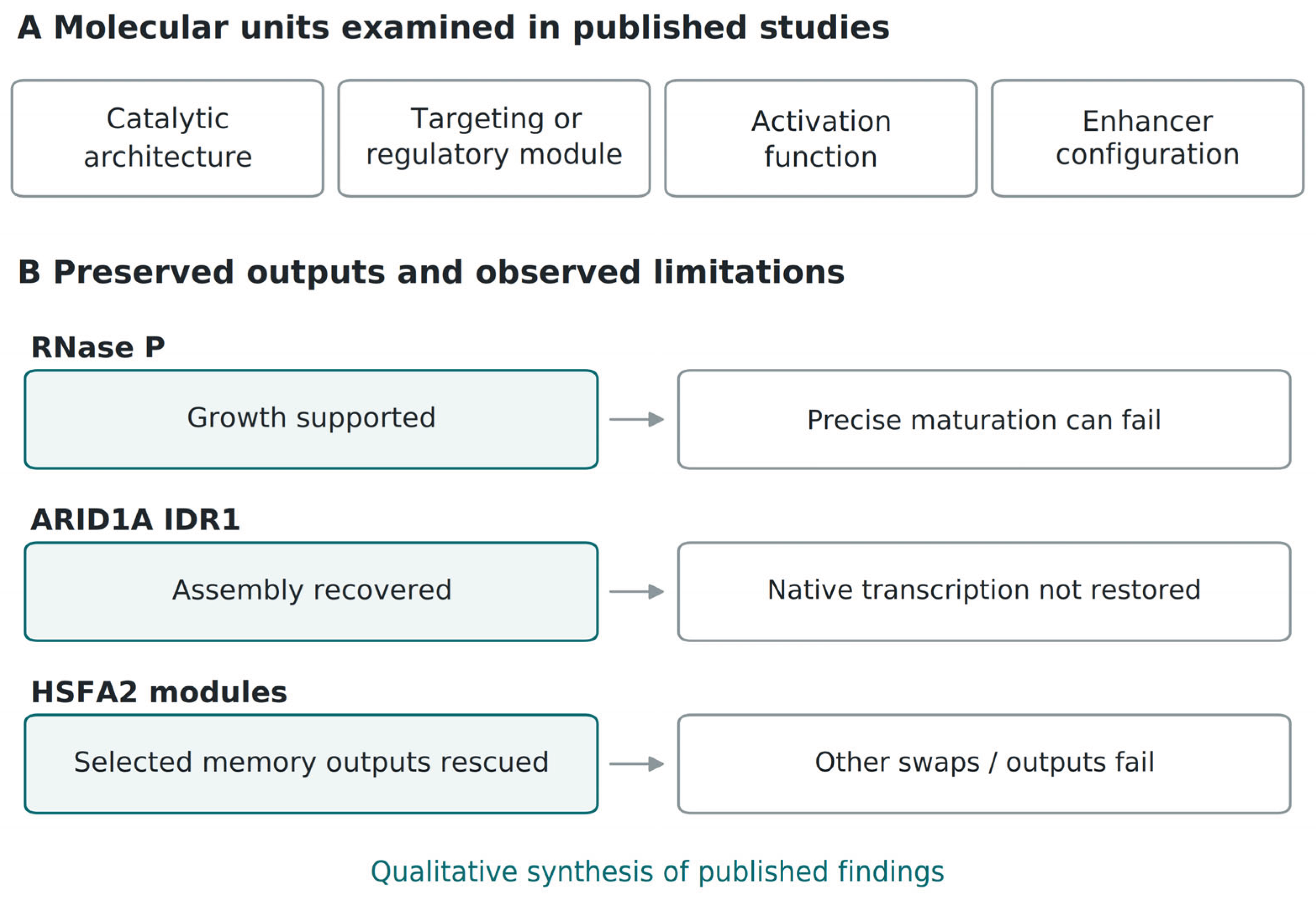
Figure 2.
Distinct evidence levels in molecular and therapeutic interpretation. Arrows separate molecular-property rescue, native regulatory output, and physiological function from tissue delivery, safety, and patient-centered outcomes. No transition is automatic; molecular correction, therapeutic redirection, and clinical benefit remain distinct [154,155,157,158].
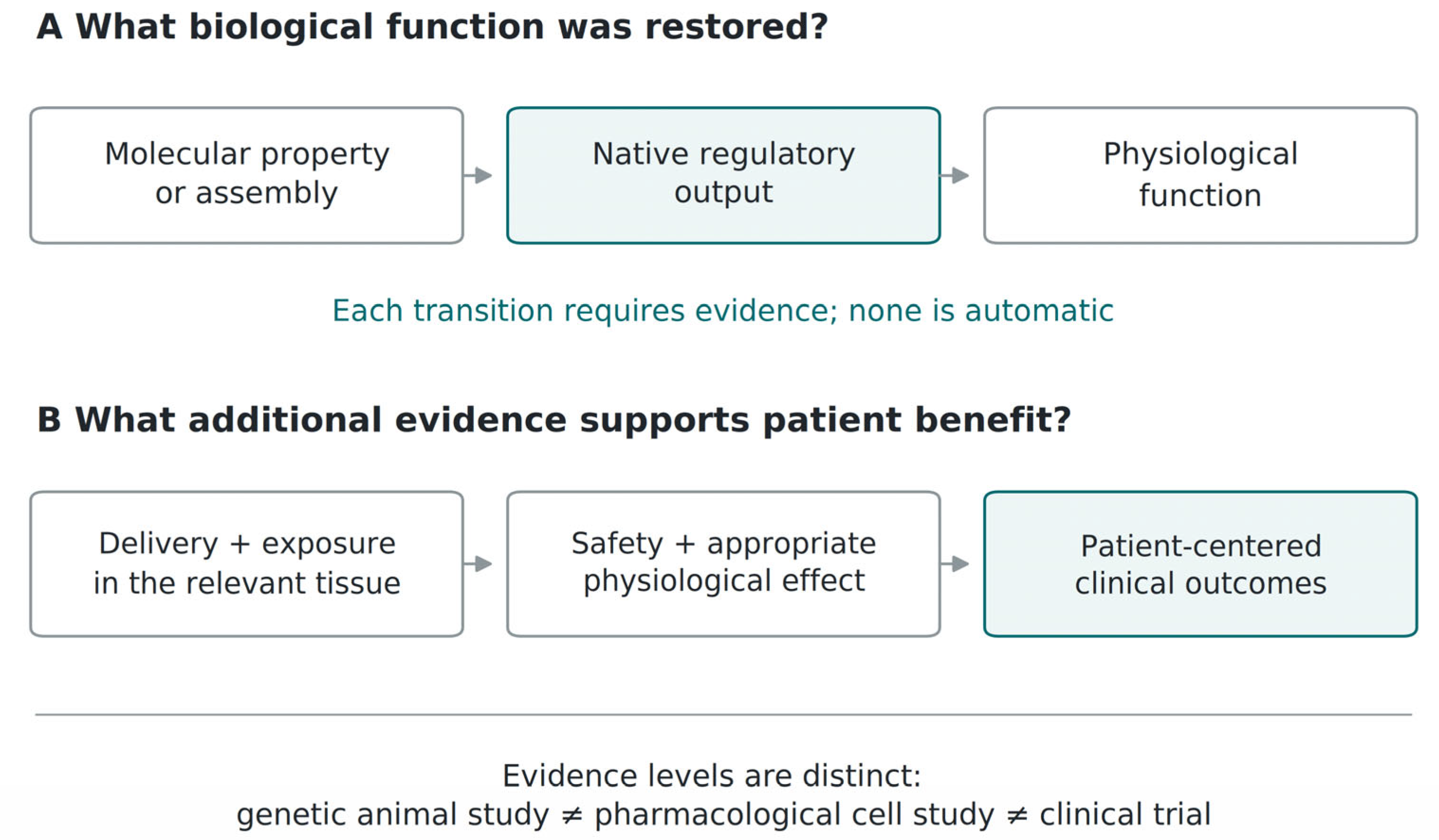

Table 1.
Terminology for interpreting the literature. Similarity, rescue, convergence, and statistical equivalence answer different questions.
Table 1.
Terminology for interpreting the literature. Similarity, rescue, convergence, and statistical equivalence answer different questions.
| Term | Meaning in this review | Important limit |
| Replacement and rescue | Replacement supplies an alternative in place of a native component; rescue recovers a loss-of-function phenotype. Native rescue restores the native component. | Recovery relative to a deficient state need not match the intact state. |
| Functional substitution | An alternative component supports a specified activity or output normally associated with a native component, in the biological setting examined. | Descriptive substitution does not imply complete interchangeability or formal statistical equivalence. |
| Equivalence and noninferiority | Equivalence excludes changes beyond both acceptable bounds. Noninferiority excludes an unacceptable loss when improvement is allowed. | A nonsignificant difference establishes neither claim [32,33]. |
| Flexibility and intrinsic disorder | Flexibility concerns alternative conformations; intrinsic disorder is the absence of one persistent folded structure under stated conditions [17,18]. | Folded domains can be flexible; disorder does not imply nonspecificity. |
| Partner or subunit exchange | A change in interaction partners, subunits, modules, or regulatory contacts. | This is not viral reassortment, DNA recombination, or proof of preserved output. |
| Condensation and phase separation | Condensation denotes local enrichment. Liquid–liquid phase separation is a specific physical mechanism that requires additional evidence [20,21]. | A punctum, fusion event, or fluorescence-recovery curve alone does not establish a liquid-phase requirement. |
| Completion and reuse | Completion produces the specified mature product and resolves the reaction; reuse restores machinery for subsequent cycles. | Stable product abundance or one successful response can conceal defective release or recycling. |
Table 2.
Published molecular substitutions and informative boundaries. Evidence roles differ across studies; historical results are not assigned retrospective equivalence criteria.
Table 2.
Published molecular substitutions and informative boundaries. Evidence roles differ across studies; historical results are not assigned retrospective equivalence criteria.
| Comparison and unit | What was demonstrated | Boundary and inferential role |
| RNA-based RNase P → PRORP; catalytic architecture | Bacterial growth rescue and selected RNA-processing activity [36,38]. | PRORP2 failed at 37 °C; selected tRNA and 4.5S maturation defects remained. Whole-enzyme complementation, not complete processing equivalence. |
| Yeast nuclear RNase P → PRORP3; catalytic architecture | Viability, growth across tested conditions, and processing measurements [39]. | Precursor and background effects remained; shared RNase MRP proteins were retained. |
| RNA-based RNase P → HARP; catalytic architecture | Essential activity sufficient for bacterial or yeast growth [40]; substrate-dependent cleavage behavior [42]. | Slower growth and processing limitations; a structural mechanism alone does not establish every cellular output [41]. |
| GAL4 → LexA–GAL4; DNA-binding module | Activation directed to a LexA-operator-containing yeast promoter [28]. | Engineered targeting-module replacement, not an endogenous target-program test. |
| Protein activation function → tethered RNA | Reporter activation with RNA and binding controls [45,46]. | Protein-mediated targeting remained; reporter recruitment does not replace an entire transcription factor. |
| HSFA2 → HSFA1D-derived modules | Selected domain swaps restored tested memory outputs [47]. | Other swaps failed physiological memory; abundance and observation time constrain attribution. |
| ARID1A IDR1 → FUS/DDX4 regions | Condensation-associated properties and cBAF assembly recovered [49]. | Native targeting, accessibility, and transcription did not recover. |
| Primary/shadow enhancer configurations; regulatory redundancy | Overlapping expression and permissive-condition rescue [50]. | Stress and reduced input revealed limits. This is buffering evidence, not whole-regulator replacement. |
| Arginine tRNA isodecoder addbacks; translation-to-lineage regulation | tRNA₁Arg(UCU) restored androgen-pathway expression in the studied lineage-plastic cells; other tested same-anticodon isodecoders did not [51]. | Specificity in prostate-cancer models; synonymous SMARCC2 reporter changes support a translation-mediated link. Retrospective clinical associations are not validated prediction. |
Table 3.
Mechanistic observations and the limits of their interpretation.
| Regulatory property | Relevant published observations | What the measurement does not establish alone |
| Selective recognition | Desired and competing interactions, kinetics, and substrate access [8,63]. | Endogenous targeting, productive turnover, or transcription. |
| Assembly or condensation | Complex composition, enrichment, exchange dynamics, and a justified physical model [20,49]. | A liquid-phase requirement or rescue of a native gene program. |
| Genomic targeting and access | Occupancy together with chromatin accessibility and appropriate negative loci [49,78]. | Correct transcriptional amplitude, timing, or spatial pattern. |
| RNA-product formation | Nascent products, mature ends, precursor accumulation, and substrate-dependent processing defects [38,42]. | Release, repeated use, or preservation of unmeasured substrates. |
| Completion and reuse | Time-resolved product release, recovery of available factors, or repeated responses [93,122,123]. | Whole-system interchangeability or long-term safety. |
Table 4.
Selected translational contrasts and the inference each supports.
| Example | Evidence and useful lesson | Boundary |
| Nusinersen | Randomized sham-controlled clinical evidence accompanies a splice-modifying intervention [154]. | Benefit is tied to the studied population and outcomes, not every molecular or disease context. |
| MRX34 | Early clinical experience with a liposomal miRNA mimic exposed serious immune toxicity [155]. | Regulatory plausibility and target activity do not establish acceptable benefit–risk. |
| Ex vivo BCL11A-enhancer editing | The July 2026 CASGEVY label documents a clinical edited-cell product and procedural context [156]. | The document is not evidence of molecule-for-molecule equivalence; clinical interpretation requires product-specific outcome and safety data. |
| Rugonersen | An open-label phase 1 trial assessed safety/tolerability with exploratory electroencephalographic and developmental observations [157]. | Exploratory changes are not randomized efficacy evidence. |
| SMCHD1 reduction in Prader–Willi models | Genetic deletion improved selected mouse outcomes; an exon-skipping ASO activated genes in patient-derived neural cells [158]. | Mouse pharmacological phenotypic rescue was not established; the two intervention/model combinations cannot be conflated. |
Disclaimer/Publisher’s Note: The statements, opinions and data contained in all publications are solely those of the individual author(s) and contributor(s) and not of MDPI and/or the editor(s). MDPI and/or the editor(s) disclaim responsibility for any injury to people or property resulting from any ideas, methods, instructions or products referred to in the content. |
© 2026 by the authors. Licensee MDPI, Basel, Switzerland. This article is an open access article distributed under the terms and conditions of the Creative Commons Attribution (CC BY) license (http://creativecommons.org/licenses/by/4.0/).
Copyright: This open access article is published under a Creative Commons CC BY 4.0 license, which permit the free download, distribution, and reuse, provided that the author and preprint are cited in any reuse.