
Submitted:
21 November 2026
Posted:
24 November 2026
You are already at the latest version
Abstract
A quartic cost built from anticommuting Pauli observables can quantify simultaneously unresolved measurement distinctions, but its fixed-frame minimum does not distinguish product and entangled stabilizer states. We construct a finite-dimensional operator specialization of the Architecture of Distinction tension-functional form, using Pauli variances and squared commutator norms. For n qubits, the minimum is d²(d−1)²/16 (d=2ⁿ), attained exactly by pure stabilizer states; the pure-state excess is proportional to linear stabilizer entropy. For two qubits, averaging over common SU(2) rotations uniquely minimizes the score at the spin singlet. Every separable state satisfies the sharp bound Φ̄₂ ≥ 9 + 37/105, and a specified rational rotation yields an exact two-frame singlet certificate. A positive-weight 405-frame rule evaluates the full rotational average exactly. Explicit Heisenberg-exchange and Lindblad-pumping solutions demonstrate both the witness’s detection limitations and its failure to be a universal Lyapunov functional. We also give a four-copy unbiased estimator with finite-sample bounds. The results extend established stabilizer and entanglement methods for this particular functional; they do not postulate wavefunction collapse, derive Born probabilities, or model the production of an individual measurement record.
Keywords:
architecture of distinction
; tension functional
; pauli anticommutation
; stabilizer entropy
; two-qubit entanglement
; singlet
; rotational symmetry
; separability witness
; heisenberg exchange
; lindblad dynamics
1. Introduction
A product state and the spin singlet can both be pure stabilizer states, even though one is unentangled and the other maximally entangled. A pairwise incompatibility functional constructed from Pauli uncertainties must therefore confront a stringent ambiguity: stabilizer simplicity in a chosen coordinate frame is not an entanglement criterion. Here the physical symmetry of common spin rotations resolves that degeneracy for a specified nonlinear functional. The purpose is structural: to show how the rotationally averaged functional acquires a unique singlet minimizer, rather than to model an individual measurement outcome or outperform conventional entanglement tests. We quantify its separability bound, its sampling cost, and its behavior under fully specified dynamics.
The Architecture of Distinction (AoD) introduces a pairwise tension functional assigning nonnegative cost to incompatible distinctions while both remain unresolved [1, Definition 1.3]. Its physical-sector proposal identifies pair incompatibility with the squared norm of an operator commutator [1, Proposition 4.5]. The present work makes that construction explicit for the finite Pauli family: each binary Pauli question is assigned an unresolvedness activity, and each pair is weighted by its commutator norm. With a common finite-depth weight absorbed into the overall normalization, these assignments reproduce Equation (1) exactly. This is a concrete, calculable operator specialization of the AoD tension-functional form, not merely a qualitative analogy; the Pauli family, common-depth convention, and normalization remain declared modeling choices. AoD separately states three admissibility conditions for its broader dynamical construction [1, Conditions 7.3]: (A1) local compatibility, expressed as constrained stationarity at a stable tension configuration; (A2) preserved noncommutative structure, together with its associated dynamical circulation; and (A3) bounded information compression, represented in its selected diffusion model by a strictly positive diffusion floor. These are conditions of the broader AoD reconstruction, not extra assumptions of the Pauli theorems proved here.
The realization also gives the tension functional an operational interpretation in quantum measurement. Pauli unresolvedness is one quarter of the variance of a dichotomic measurement, while noncommutation selects incompatible measurement settings. Repeated measurements on independently prepared copies therefore permit reconstruction of the score; averaging it over common spin rotations distinguishes the singlet from product stabilizer states and supplies a sharp separability bound. The construction shows how the AoD tension form can organize measurement incompatibility and discriminate quantum states. The minimization is an optimization over states and measurement frames, not a time-dependent account of a detector forming a record. It does not show that an apparatus relaxes to a minimum, and it does not derive an individual registered outcome. Conventional Born statistics, state preparations and measurement settings are supplied quantum inputs; the need to specify a physical observable and instrument separately is consistent with [2].
The relevant prior work includes stabilizer Rényi entropy [3,4], graph-theoretic uncertainty [5,6], nonlinear stabilizer witnesses [7], collective randomized spin measurements [8], shared-reference-frame methods [9], state-polynomial uncertainty optimization [10], and the Pauli-observable compatibility preprint [11]. The experimental methodological category is not new: Imai, Tóth, and Gühne [8] already use simultaneous local rotations, collective-angular-momentum moments, and frame-independent entanglement criteria (including higher-body settings). Their observable moments and criteria are not the specific quartic sum over the sixty two-qubit Pauli anticommutation edges defined below. Here the claim is narrower: an exact functional-specific characterization of the singlet minimum, a sharp separability constant, an explicit two-frame selector, an exact positive Haar quadrature, and fully evaluated coherent/dissipative responses. We make no claim to have invented collective randomization or stabilizer-resource measures, and we do not assert better sample efficiency than existing spin-squeezing, fidelity, or tomography methods. In particular, the new state-space/measurement-incompatibility correspondence of McNulty, Facchi, and Pascazio [11] concerns compatibility regions and parent measurements rather than the present state-scored entanglement functional. The two problems are mathematically related through the Pauli graph but operationally distinct.
Three further precedents delimit the novelty claim. Gühne [12] developed separability criteria from uncertainty and variance inequalities; variance-based entanglement witnessing is therefore established. Liu et al. [13] use Pauli anticommutation (frustration) graphs to analyze reduced stabilizer polytopes and certify nonstabilizerness, or quantum magic. Their graph-theoretic starting point is closely related to ours, but their resource-theoretic optimization does not define the present quartic state score or its collective-rotation separability threshold. Chu and Kharel [14] introduce stabilizer Rényi entropy averaged over independent local phase-reference changes, with symmetry group U(1)ⁿ; their phase-insensitive magic measure differs from averaging a Pauli-variance-product functional over common physical SU(2) rotations. Accordingly, we do not claim novelty for the anticommutation graph, uncertainty-based witnesses, stabilizer entropy, or reference-frame averaging as general methods. The specific contributions are the exact characterization of the selected functional, its sharp 37/105 separability gap, the rational two-frame singlet certificate, the 405-frame quadrature and its explicitly computed dynamics.
2. Anticommutation-Graph Definition
Let n ≥ 2, d = 2n, and let be the d2 − 1 nonidentity Hermitian Pauli strings with phases chosen so that each squares to I. For a state ρ define mP = tr(ρP) and . Connect P and Q if they anticommute, {P,Q} = 0. Define the frustration score by
The relation to the AoD pairwise tension form can be written precisely. For each Pauli observable, define its normalized binary coordinate and apply the activity function χ. Since every Pauli string squares to the identity, its activity equals one quarter of the outcome variance of the corresponding ±1 measurement:
Use the squared commutator norm as the incompatibility coefficient, as proposed for the physical sector in [1, Proposition 4.5]. With the common finite-depth weight normalized to unity, this gives the explicitly selected operator specialization:
For anticommuting Pauli strings the squared commutator norm equals four, while commuting pairs contribute zero. Consequently the specialization becomes the variance-product expression:
This is exactly Equation (1), the finite uniformly weighted Pauli form of the AoD pairwise tension functional. The recursive AoD model also contains depth-dependent weights; their physical determination is not attempted here. These variances are estimated from separate measurement contexts on independent preparations, not from a joint sharp measurement of incompatible observables.
Each vertex has degree d2/2 and the number of unordered edges is d2(d2 − 1)/4. In particular, the two-qubit graph has fifteen vertices of degree eight and precisely sixty edges. The coefficient 1/4 corresponds to the operator-norm convention ∥[P,Q]∥2 = 4 for anticommuting Pauli strings. The score is a specified model quantity; it is not a Hamiltonian energy, a Lindblad rate or a direct physical force.
The 15-vertex anticommutation graph and its 60 unordered edges are shown in Figure 1. Related anticommutation graphs appear in the resource-theoretic analysis of Liu et al. [13], where the objective is stabilizer-polytope geometry and magic certification rather than the present quartic measurement-variance score.
3. Many-Qubit Minimum, Stabilizer Relation, and Strong Concavity
Theorem 1 (minimum and stabilizer identity). For every n ≥ 2 and every n-qubit density operator,
The minimizers are precisely the pure stabilizer states. For every pure state,
Here Mlin is the linear Pauli/stabilizer entropy; it is an established nonstabilizerness measure on pure states [3,4], not an original information-theoretic resource. The nonlinear extension of Φn to mixed states must not be called a magic monotone.
Proof. Write . Expanding each edge yields
Pauli orthogonality implies . The edge-product term is nonnegative, giving (2). Equality requires purity and no edge with two nonzero expectations. Any pair of such Pauli operators commutes. Their commuting support has at most d − 1 nonidentity elements: modulo phases the mutually commuting Pauli strings form an isotropic subspace of the 2n-dimensional binary symplectic vector space, and every isotropic subspace has dimension at most n, hence at most 2n − 1 = d − 1 nonzero strings. As each |mP| ≤ 1, purity forces precisely d − 1 expectations of modulus one. For a common pure eigenvector, the eigenvalue signs multiply consistently under products of commuting Pauli strings. The resulting signed operators form an abelian subgroup of order d, exclude −I, and stabilize the unique rank-one projector . Conversely, a pure stabilizer state saturates (2). On a pure state, the Pauli anticommutation identity
gives the edge sum , and (3) follows. ▫
Theorem 2 (strong concavity). For any affine state segment ρt = ρ0 + tΔρ and hP = tr(PΔρ),
when Δρ ≠ 0 and n ≥ 2. Consequently the Haar average of Φn over any unitary group is also strictly concave.
Proof. Let , with Q in this sum denoting a Pauli-string label rather than the scalar edge functional. The general anticommutation identity is . Differentiating the edge functional twice and using 2|ab| ≤ a2 + b2 gives . The negative quadratic part of (4), divided by four, contributes . Combining yields (6). Because Pauli strings span Hermitian operators, a nonzero trace-zero Δρ has some hP ≠ 0. ▫
For two qubits d = 4, inequality (6) guarantees a strong-concavity coefficient of one in the stated Pauli-coordinate norm; optimality of that coefficient is not claimed. In a single Pauli frame there are sixty stabilizer minimizers: 36 product and 24 maximally entangled. This includes the singlet and parallel-polarized product states. The score does not distinguish them before an additional physical symmetry criterion is imposed.
4. Collective Su(2) Rotation Selects the Singlet
For a common physical spin rotation U ∈ SU(2), define
The score must be evaluated after each rotation and before averaging, because Φ2 is nonlinear. Averaging ρ first would lead to a different quantity. The collective action U⊗U is a physically selected representation; using would select a different invariant Bell projector.
Theorem 3 (unique Haar singlet minimum). Let PS = |S⟩⟨S| denote the singlet projector, . Over all two-qubit density operators,
Proof. Theorem 1 gives Φ2 ≥ 9 pointwise. The singlet is invariant under every collective rotation, and its score is 9, proving attainability. If the average equals 9, nonnegativity and continuity imply score 9 for every rotation. Therefore every collectively rotated state belongs to the finite set of pure stabilizer projectors. The connected group SU(2) has a connected orbit; a connected subset of a finite set is one point. Thus ρ is invariant under the entire common-rotation group. The two-qubit U⊗U representation has a one-dimensional antisymmetric singlet sector and a three-dimensional triplet sector. The only invariant pure projector is the singlet. ▫
This is a variational uniqueness theorem. It does not imply that the physical dynamics of arbitrary qubits minimizes . Its strict two-qubit singlet conclusion is not a general n-qubit result: collective U⊗n has no total-spin-zero vectors for odd n, while for even n ≥ 4 the total-spin-zero subspace has nontrivial multiplicity (already dimension two for four spins). A comparable many-qubit uniqueness theorem would require additional assumptions beyond this proof.
5. Exact Sharp Separability Threshold
Theorem 4 (all-separable 37/105 bound). For every separable two-qubit density matrix,
The bound is sharp; parallel and antiparallel pure-product Bloch vectors attain equality. A measured value below the right-hand side is a sufficient witness of entanglement, provided estimator and calibration uncertainties are accounted for.
Proof. Consider a pure product with unit Bloch vectors a,b and c = a ⋅ b. Put . Counting the sixty edges and using purity yields
For a common Haar rotation R ∈ SO(3), standard spherical moments give and
The quartic harmonic A(n) − 3/5 transforms in degree four; its autocorrelation is proportional to P4(c), with the coefficient fixed by Var[A(n)] = 16/525 (Appendix B). Substitution gives
Since P4(c) ≤ 1 for −1 ≤ c ≤ 1, the right side is at least 9/25 − 4/525 = 37/105, saturated at c = ±1. Every separable state is a convex mixture of pure products; Theorem 2 makes concave. Jensen’s inequality therefore extends the pure-product bound to every separable mixture. ▫
Figure 2 displays the exact product-state dependence and the singlet–separability gap.
The criterion is intentionally not optimal for noise tolerance: many entangled two-qubit states remain above the separability threshold. For comparison, the Peres partial-transpose test [15] is necessary and sufficient for separability of a two-qubit density matrix [16]; the present nonlinear witness is only sufficient. For a Werner-type isotropic two-qubit state [17] with singlet fidelity F, the isotropic correlation is T = −[(4F − 1)/3]I3 and
The witness is positive only when , or equivalently . Standard singlet-fidelity and PPT criteria already detect the Werner family’s entanglement for F > 1/2. We therefore emphasize the exact model-specific bound, not an experimental superiority claim.
6. Two Finite Frames Suffice for Unique Singlet Selection
Continuous Haar averaging is not required merely to identify the global minimum. Consider the explicit proper rational rotation
Let UR be either spin-1/2 lift of R and define . Both terms are at least 9.
Theorem 5 (explicit rational two-frame selector). The unique minimizer of Φ2,R over all density operators is the singlet PS, with minimum 9.
Proof. Equality requires a state minimizing the individual fixed-frame scores simultaneously. The sixty minima in the first frame comprise 36 pure product stabilizers with local Bloch vectors equal to signed coordinate axes and 24 maximally entangled stabilizers whose correlation tensors are signed permutation matrices with determinant −1. The chosen R has no column that is a signed coordinate vector, so it sends none of the 36 product stabilizers to a product stabilizer. For any entangled stabilizer, the rotated correlation tensor is . Exact rational enumeration of the 24 physical signed-permutation tensors gives an exactly one-element intersection with the signed-permutation set: T = −I3, the singlet. Hence the sum has one minimizer. ▫
The finite enumerations and exact rational certificates are reproduced in verify_pauli.py and independently checked in the accompanying audit script. Among the 59 other first-frame stabilizer minimizers, the smallest excess in the second frame is 28224/390625 (attained by an entangled stabilizer); the smallest product-stabilizer excess is 61352816/284765625. These are margins on the finite candidate set, not a positive separation from arbitrarily close non-stabilizer density operators. The rotation is a calibrated experimental choice, not a prediction that nature selects these coordinates.
7. A Rigidity Law on the Maximally Entangled Pure Manifold
A pure maximally entangled two-qubit state has zero local Bloch vectors and a real orthogonal correlation tensor T = −O with O ∈ SO(3). Let F = tr(PSρ) = (1 + trO)/4 ∈ [0,1]. Under common rotations the axis of O is isotropically distributed while its conjugacy class is fixed. Direct fourth-moment averaging of Rodrigues’ formula gives
The cubic factor is nondecreasing because its derivative is 6(4F − 1)2 ≥ 0 and its value at F = 0 equals one. Consequently
The coefficient is optimal within this restricted pure-maximally-entangled family. This is not claimed for arbitrary mixed states. Comparison of (15) with 37/105 reveals a non-detection interval: approximately 0.697644 < F < 0.827720 even though every state in this manifold is maximally entangled.
The full fidelity dependence, including the interval where entanglement is not detected, is plotted in Figure 3.
8. Two Coupled-Spin Dynamics
8.1. Coherent Heisenberg Exchange
Let with J an energy, and put τ = Jt/ℏ. From the separable initial state |01⟩, the exact evolution, up to an overall phase, is
The concurrence is C(τ) = |sinτ| and the singlet fidelity is FS(τ) = 1/2. We use the standard two-qubit concurrence terminology of Wootters [18]. The singlet fidelity therefore remains constant despite coherent entanglement generation. Define v = sin2τ.
Proposition 6 (exact exchange response). Along this trajectory,
Therefore the chosen witness certifies entanglement exactly when
Proof. A common rotation sends ez to a uniformly distributed unit vector n. The state’s local Bloch vectors are ±cosτ n, and the correlation tensor is up to a sign convention on the antisymmetric part. On a pure two-qubit state, (3) reduces to . Applying the even spherical moments through order eight gives (18); Appendix B supplies the explicit sums. ▫
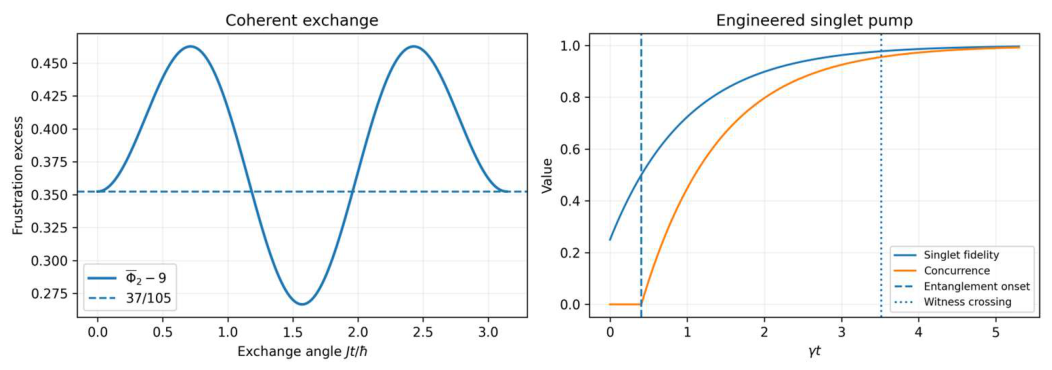
At τ = 0 the initial product saturates (9); for small positive v the cost initially increases even though entanglement becomes nonzero. Thus Pauli frustration is not a universal entanglement monotone or a Lyapunov function for this coherent dynamics.
8.2. Engineered Dissipative Singlet Pump
Let |T+⟩=|00⟩, , |T−⟩=|11⟩, and prescribe jumps for j ∈ {+,0,−}. The ensuing open-system generator is in Lindblad form [19]. With the same isotropic exchange Hamiltonian, let
The singlet is the unique stationary state because the triplet population is pumped into it. The jump operators were engineered by design; such dissipative preparation is established quantum control [20], not a dynamical implication of the Pauli score. From the maximally mixed input ρ(0) = I4/4 one obtains exactly
The concurrence of this Werner path is C(t) = max(0,2FS(t) − 1), hence entanglement starts at
Its Pauli correlators are ⟨XX⟩=⟨YY⟩=⟨ZZ⟩=−(1 − e−γt) with vanishing local Bloch vectors. Direct edge counting gives
The witness (9) responds only for
Thus the witness detection is delayed by more than three dimensionless damping times relative to actual entanglement onset. It is a sensitivity limitation of this score, not a physical latency of entanglement. Starting instead from the equal triplet mixture PT/3 gives , which increases from 43/3 to 15 at γt = ln(4/3) before decreasing to nine. Therefore is not a Lyapunov function even for every initial state of this fixed singlet-pumping generator.
The two distinct dynamical responses and their detection thresholds are compared in Figure 4.
9. A Finite-Sample, Unbiased Randomized Measurement Protocol
The sharp inequality (9) is an operational entanglement witness only after one specifies a score estimator. For a selected common frame U and a uniformly chosen unordered anticommuting edge {P,Q}, use four independently prepared copies of the same two-qubit state. Measure P on copies 1 and 2, obtaining p1,p2 ∈ {±1}, and Q on copies 3 and 4, obtaining q3,q4 ∈ {±1}. Define
With independently sampled Haar frames and edges, . The estimator is exactly unbiased under independent identical preparations and ideal calibrations; it does not separately square noisy empirical means. By Hoeffding’s inequality [21],
A tighter, state-uniform Bernstein bound. Under the same i.i.d. assumptions the trial variable B is Bernoulli with . The graph definition ensures 0 ≤ Φ2 ≤ 15, so q ≤ 1/4 and Var(B) = q(1 − q) ≤ 3/16. The standard Bernstein-type concentration inequality [22] then gives, for ϵ > 0,
This bound is valid globally for the ideal protocol, without knowing the state in advance; it is sharper than Hoeffding for 0 < ϵ < 11.25. State-dependent confidence intervals or empirical Bernstein methods may improve it further but require careful adaptation if the state or calibration drifts. It does not make the witness competitive with direct singlet-fidelity or PPT measurements.
Therefore certifies entanglement with confidence at least 1−δ whenever (26) holds. This conservative bound consumes four state copies per trial, so 4N copies are needed. Because the maximum singlet–separable gap is only 37/105, the simple unbiased protocol can be statistically expensive. Better correlated measurement designs may reduce this cost but require separate proofs and calibration assumptions. Device miscalibration, common-frame errors, crosstalk and nonidentical input states are not covered by Hoeffding’s bound.
The distinction between a finite selector and a finite integration rule is important. The two-frame construction of Section 6 proves uniqueness of a variational minimum, not the 37/105 separability bound. For the latter, one can in fact construct a separate exact cubature, with positive weights.
Proposition 7 (exact 405-frame positive Haar cubature). Let , , be the nodes and weights of the five-point Gauss–Legendre rule on [−1,1], so . Define ϕj = 2πj/9, ψk = 2πk/9 for j,k = 0,…,8, and . For either spin lift of and every two-qubit density operator,
There are only 5 ⋅ 9 ⋅ 9 = 405 positive-weight frames, and the identity involves no angular quadrature bias.
Proof. Each local Pauli expectation in a rotated frame is linear in matrix entries of R, and each joint Pauli expectation is quadratic. Every summand in (1) is therefore a polynomial of degree at most eight in entries of R. Products of up to eight matrix coefficients of the spin-one representation decompose into Wigner matrix coefficients with 0 ≤ L ≤ 8. In the Euler convention R = Rz(ϕ)Ry(θ)Rz(ψ), has azimuthal factors e−imϕe−inψ, with |m|,|n| ≤ 8. Each uniform nine-point angular sum exactly removes all nonzero such Fourier modes. The survivors have m = n = 0, for which . Five-point Gauss–Legendre quadrature integrates every polynomial of degree at most nine, hence each PL for L ≤ 8, with the exact normalized Haar weight dx/2. By linearity this integrates the entire score exactly. ▫
Equation (27) allows a deterministic set of 405 calibrated frames with known positive weights, or exact sampling from the corresponding discrete weighted distribution. It replaces continuous randomization without changing Theorem 4. It does not remove uncertainty from finite state copies, imperfect gates, or detector errors. The group-theoretic Fourier/Gauss quadrature itself is standard; the explicit order bound and 405-frame application are supplied here for reproducibility. Independent double-precision checks on product, entangled, and random mixed states agree with analytical Haar results to better than 4 × 10⁻¹⁴.
Sample cost. For ϵ = 0.16 and δ=0.05, Hoeffding requires N ≥ 259,375 independent four-copy trials (1,037,500 state copies). The state-uniform Bernstein formula (26a) requires N ≥ 195,453 four-copy trials (781,812 state copies), a reduction of about one quarter but still an expensive protocol. These tolerances are sufficient, with at least 95% coverage under ideal identical singlet preparations, for because 2ϵ < 37/105. They are conservative two-sided estimates and do not include SPAM or rotation-calibration uncertainty. More economical protocols or a benchmark against direct singlet-fidelity/PPT witnesses would require a separate efficiency analysis. The exact frame rule is not a claim of experimental superiority.
10. Discussion and Conclusions
For the Architecture of Distinction, this construction provides a concrete operational realization of the pairwise tension form: χ(σ_P) is one quarter of a measurable Pauli outcome variance, and the commutator norm specifies which incompatible pairs contribute jointly to the score [1]. Its connection to the three defined AoD admissibility conditions is limited and precise. Minimizing the Pauli functional gives a static analogue of local tension compatibility (A1), and the Pauli commutation relations supply the algebraic prerequisite, but not the nonvanishing dynamical circulation, of (A2). No bound on information compression or positive source-space diffusion (A3) is derived or tested. In particular, the positive floor Φ₂=9 is a result about the chosen finite-dimensional operator functional; it is not a proof of the AoD source-space vacuum-tension floor. Likewise, the unique rotation-averaged singlet minimizer and the separability gap characterize quantum-state statistics, not the temporal production of a definite measurement record.
The operator-level result has three separate meanings. First, the unaveraged Pauli graph cost is a strict-concave mixed-state extension of a known pure-state stabilizer resource; it is not intrinsically an entanglement criterion. Second, the selected collective SU(2) symmetry lifts the frame degeneracy: its Haar average uniquely minimizes at the singlet and provides a sharp all-separable lower bound of 9 + 37/105. Third, an exact rational second frame suffices to identify the global minimum without a continuous integral. These are mathematical properties of the specified functional within ordinary quantum mechanics.
The proximity to earlier work can now be stated precisely. Gühne’s variance criteria [12] establish the broader uncertainty-witness methodology; Liu et al. [13] use Pauli frustration graphs to study magic certification and the geometry of projected stabilizer polytopes; and Chu and Kharel [14] remove local phase-frame ambiguity from stabilizer Rényi entropy. None of these general techniques is attributed to the present paper. What is specific here is a quartic incompatibility score interpreted as an AoD tension-functional specialization, together with its global common-SU(2) singlet selection, its exact all-separable constant, and its finite-frame characterization. The selected symmetry and weights are explicit inputs of this operator model, not consequences of a specified measurement instrument or an individual-outcome dynamics.
The coupled-spin calculations prevent an incorrect dynamical inference. Pure coherent exchange produces entanglement without changing singlet fidelity; engineered Lindblad evolution prepares the singlet but its entanglement onset precedes the nonlinear witness crossing by a wide interval. A score minimum does not define a physical relaxation law. The nonlinear witness is not a Bell inequality, a new Born probability rule, a microscopic model of record formation, or a demonstrated improvement over partial-transpose/tomographic tests. AoD does not posit physical wavefunction collapse: the word selection in the present paper designates only the unique mathematical minimizer under an explicitly chosen symmetry; it does not mean reduction of the quantum state during a measurement.
The finite-copy estimator and exact 405-frame quadrature make the selected witness statistically explicit, but not economical: conservative 95% state-uniform concentration still requires hundreds of thousands of four-copy trials in an ideal singlet test. The scientific role is to exhibit an exact symmetry-resolved structural discriminator of stabilizer minima, not a practical replacement for familiar two-qubit witnesses. An experimental contribution would require a declared common-rotation protocol, measured Pauli distributions, properly propagated errors and comparison with existing witnesses [7,8]. The source of any physical coupling must be determined independently of the observed score. Within these limits, the result provides an exact and reproducible bridge between graph-based Pauli incompatibility, reference-frame symmetry and the dynamical preparation/detection of two-qubit entanglement.
Funding
This research received no external funding.
Data Availability Statement
No empirical data were collected. The analytical results are presented within the article; supporting Python verification scripts and their outputs are supplied with the submission package and may be provided as supplementary material.
Acknowledgments
During preparation of this manuscript, the author used ChatGPT (OpenAI, GPT-6, November 2026) to assist with manuscript drafting and language revision, literature organization, preparation of computational verification scripts, and document formatting. The author reviewed the resulting content and accepts responsibility for the accuracy, originality, and integrity of the final manuscript. No AI system is listed as an author.
Conflicts of Interest
The author declares no conflicts of interest.
Appendix A. General Pauli Identities and Strong Concavity
Every nonidentity Pauli string corresponds to a nonzero binary symplectic vector in ; it anticommutes with exactly half of the d2 strings. Thus the graph is regular of degree d2/2. Pauli orthogonality gives . The identity
follows by expanding ρ in the Pauli basis and evaluating conjugation by P. Since ρ and PρP are positive, tr(ρPρP) ≥ 0.
For along a segment with derivatives hP, differentiation gives
Using 2|ab| ≤ a2 + b2 bounds the second sum by and (A.1) makes . The other term of 4Φn has second derivative , giving (6). Strict concavity of Φn follows for d ≥ 4, and Haar averaging preserves this strict inequality.
For a pure state ; each edge contributes exactly once to , which gives (3). This identity provides a cross-check against the standard linear stabilizer entropy of Leone, Oliviero and Hamma [3]. The identity is not asserted for mixed states because purity was explicitly used.
Appendix B. Haar Moment Calculations
Let n = (n1,n2,n3) be a uniformly random unit vector. For nonnegative integers a,b,c,
In particular , , and for distinct indices. For one finds and , so its degree-four harmonic part has variance 16/525. These identities establish (11) and (12).
For a pure maximally entangled state write T = −O and , with c = 2F − 1 and s2 = 1 − c2. The diagonal entries have the form , the off-diagonal entries (1 − c)ninj ± snk. The total averaged fourth power is . Substituting into yields (15).
For the exchange state of Eq. (17), local Bloch vectors are and the correlation tensor . The averaged fourth-power sum is
Then simplifies to (18). Direct matrix expectation values under 35,000 randomly sampled common frames validate the formulas within Monte Carlo standard error; the proofs are analytical and do not rely on this simulation.
Appendix C. Exact Two-Frame Enumeration
The explicitly chosen rotation in (14) is obtained from the normalized unit quaternion . Its three columns have no coordinate-axis form. For each ordered pair of local stabilizer axes ei,ej, the rotated product excess is [3 − A(Rei) − A(Rej) − A(Rei)A(Rej)]/4, whose exact minimum over the nine axis pairs is 61352816/284765625 > 0.
Every pure maximally entangled stabilizer tensor is a signed 3 × 3 permutation matrix with determinant −1; there are exactly 24. The rotated tensor is again such a matrix only when T = −I3. The minimum nonzero rotated excess is 28224/390625. These statements are exhaustive exact rational checks over six coordinate permutations and eight sign patterns, restricting to determinant −1. The complete algorithm and the rational rotation appear in verify_pauli.py. The all-identity positive tensor +I3 is not a physical pure two-qubit correlation tensor in this family.
Appendix D. Dissipative solution and finite-sample estimator
The jump sum satisfies and . Therefore for every initial state. Starting from I4/4 the exact invariant Werner family gives (21). The exchange Hamiltonian commutes with both singlet and triplet projectors, so it does not modify that family. At finite time the concurrence criterion is FS > 1/2 and the score is (23). Solving the inequality (9) gives (24). This is an engineered CP dynamics, not a consequence of minimizing the score.
For the estimator of Eq. (25), conditional on frame and chosen edge, the four independent measurement results yield . Averaging over uniform edges and Haar frames gives . Each B is Bernoulli, and independent trials give Hoeffding’s bound (26). As Φ2 ≤ 15, its variance is at most 3/16, yielding the Bernstein bound (26a). Both bounds require exactly calibrated, independently prepared copies and i.i.d. random frame/edge choices; finite-sample overdispersion, readout error or drift requires separate calibration and controls.
Computational Methods and Reproducibility
Analytical proofs are presented in the main text and appendices. The accompanying Python verification scripts (verify_pauli.py and independent_checks.py) perform exact rational enumeration of finite Pauli configurations, independent checks of the 405-frame positive quadrature, and numerical checks of the stated quantum-state and dynamical identities. The figures are theoretical illustrations rather than laboratory observations. AI-assisted tools were used during manuscript preparation for drafting, literature organization, and assistance with computational verification code; they are not independent empirical evidence or a substitute for the proofs. The author is responsible for examining and validating the final work.
References
- Schmieke, M. The Architecture of Distinction: How Quantum Theory, Spacetime, and Consciousness Unfold from a Single Act; VASATI Verlag, 2026; ISBN 978-3-912966-04-6. [Google Scholar]
- Schmieke, M. Fokker–Planck Dynamics, Schrödinger Evolution, and Quantum Measurement: A Consolidated Compatibility Analysis with a Multimode Common-Clock Criterion. Quantum Rep. 2026, 8(4), 119. [Google Scholar] [CrossRef]
- Leone, L.; Oliviero, S. F. E.; Hamma, A. Stabilizer Rényi Entropy. Phys. Rev. Lett. 2022, 128, 050402. [Google Scholar] [CrossRef] [PubMed]
- Bittel, L.; Leone, L. Operational interpretation of the Stabilizer Entropy. Quantum 2026, 10, 2069. [Google Scholar] [CrossRef]
- de Gois, C.; Hansenne, K.; Gühne, O. Uncertainty relations from graph theory. Phys. Rev. A 2023, 107, 062211. [Google Scholar] [CrossRef]
- Xu, Z.-P.; Schwonnek, R.; Winter, A. Bounding the Joint Numerical Range of Pauli Strings by Graph Parameters. PRX Quantum 2024, 5, 020318. [Google Scholar] [CrossRef]
- Tóth, G.; Gühne, O. Entanglement detection in the stabilizer formalism. Phys. Rev. A 2005, 72, 022340. [Google Scholar] [CrossRef]
- Imai, S.; Tóth, G.; Gühne, O. Collective Randomized Measurements in Quantum Information Processing. Phys. Rev. Lett. 2024, 133, 060203. [Google Scholar] [CrossRef] [PubMed]
- Bartlett, S. D.; Rudolph, T.; Spekkens, R. W. Reference frames, superselection rules, and quantum information. Rev. Mod. Phys. 2007, 79, 555–609. [Google Scholar] [CrossRef]
- Bermejo Morán, M.; Huber, F. Uncertainty Relations from State Polynomial Optimization. Phys. Rev. Lett. 2024, 132, 200202. [Google Scholar] [CrossRef] [PubMed]
- McNulty, D.; Facchi, P.; Pascazio, S. Compatibility of Pauli Observables. arXiv 2026, arXiv:2611.06592. Available online: https://arxiv.org/abs/2611.06592.
- Gühne, O. Characterizing Entanglement via Uncertainty Relations. Phys. Rev. Lett. 2004, 92, 117903. [Google Scholar] [CrossRef] [PubMed]
- Liu, Y.; Gasull, A.; Hu, M.; Zhang, R.; Baccari, F.; Tura, J. Graph Theoretic Approach to Quantum Nonstabilizerness. arXiv 2026, arXiv:2607.26154. Available online: https://arxiv.org/abs/2607.26154.
- Chu, J.; Kharel, S. Stabilizer Rényi Entropy Without a Phase Reference. arXiv 2026, arXiv:2610.18955. Available online: https://arxiv.org/abs/2610.18955.
- Peres, A. Separability Criterion for Density Matrices. Phys. Rev. Lett. 1996, 77, 1413–1415. [Google Scholar] [CrossRef] [PubMed]
- Horodecki, M.; Horodecki, P.; Horodecki, R. Separability of Mixed States: Necessary and Sufficient Conditions. Phys. Lett. A 1996, 223, 1–8. [Google Scholar] [CrossRef]
- Werner, R. F. Quantum states with Einstein-Podolsky-Rosen correlations admitting a hidden-variable model. Phys. Rev. A 1989, 40, 4277–4281. [Google Scholar] [CrossRef] [PubMed]
- Wootters, W. K. Entanglement of Formation of an Arbitrary State of Two Qubits. Phys. Rev. Lett. 1998, 80, 2245–2248. [Google Scholar] [CrossRef]
- Lindblad, G. On the Generators of Quantum Dynamical Semigroups. Commun. Math. Phys. 1976, 48, 119–130. [Google Scholar] [CrossRef]
- Kastoryano, M. J.; Reiter, F.; Sørensen, A. S. Dissipative Preparation of Entanglement in Optical Cavities. Phys. Rev. Lett. 2011, 106, 090502. [Google Scholar] [CrossRef] [PubMed]
- Hoeffding, W. Probability Inequalities for Sums of Bounded Random Variables. J. Am. Stat. Assoc. 1963, 58, 13–30. [Google Scholar] [CrossRef]
- Boucheron, S.; Lugosi, G.; Massart, P. Concentration Inequalities: A Nonasymptotic Theory of Independence; Oxford University Press, 2013. [Google Scholar] [CrossRef]
Figure 1.
Two-qubit Pauli anticommutation graph with 15 nonidentity Pauli strings and 60 unordered anticommuting edges. The graph visualizes the exact operator relation, not experimental data.
Figure 1.
Two-qubit Pauli anticommutation graph with 15 nonidentity Pauli strings and 60 unordered anticommuting edges. The graph visualizes the exact operator relation, not experimental data.
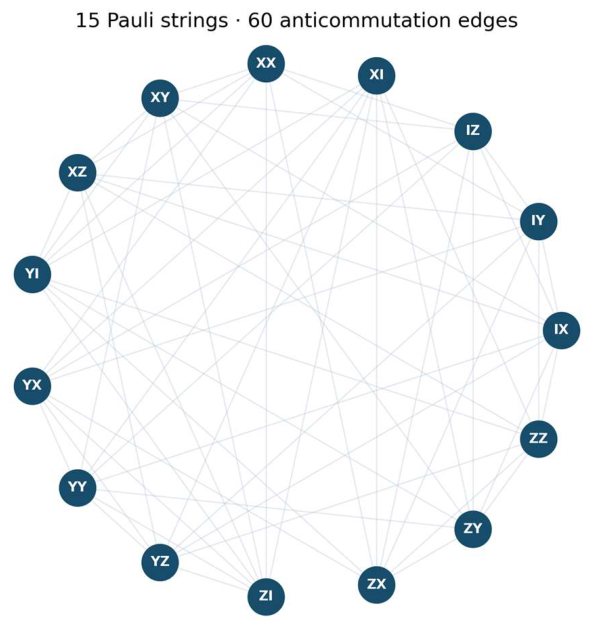
Figure 2.
Common-SU(2)-rotation-averaged frustration for pure product states as a function of Bloch-vector alignment, with the sharp separable bound 9 + 37/105 and the singlet score 9. All curves are analytic.
Figure 2.
Common-SU(2)-rotation-averaged frustration for pure product states as a function of Bloch-vector alignment, with the sharp separable bound 9 + 37/105 and the singlet score 9. All curves are analytic.
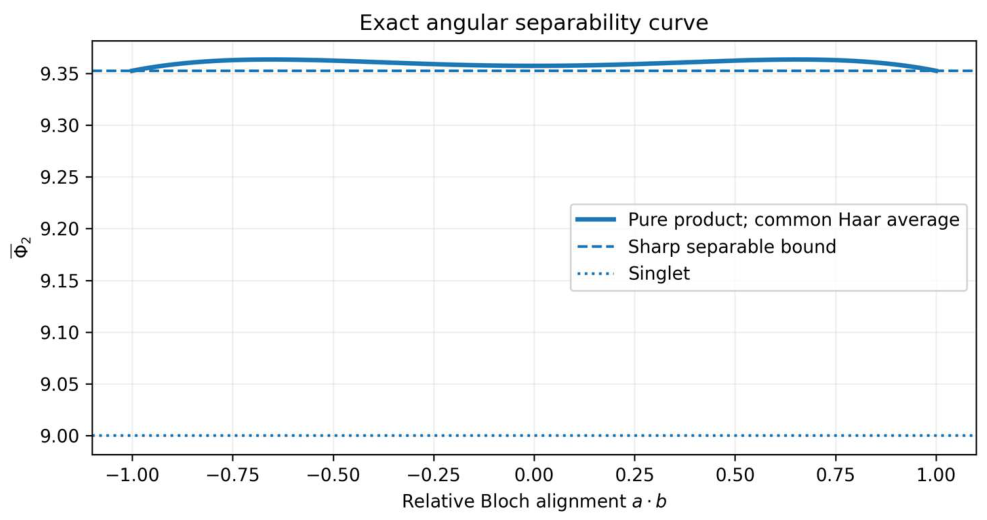
Figure 3.
Exact rotationally averaged frustration as a function of singlet fidelity for pure maximally entangled two-qubit states. The plot shows the non-detection interval of the nonlinear entanglement witness; the curve is analytic.
Figure 3.
Exact rotationally averaged frustration as a function of singlet fidelity for pure maximally entangled two-qubit states. The plot shows the non-detection interval of the nonlinear entanglement witness; the curve is analytic.
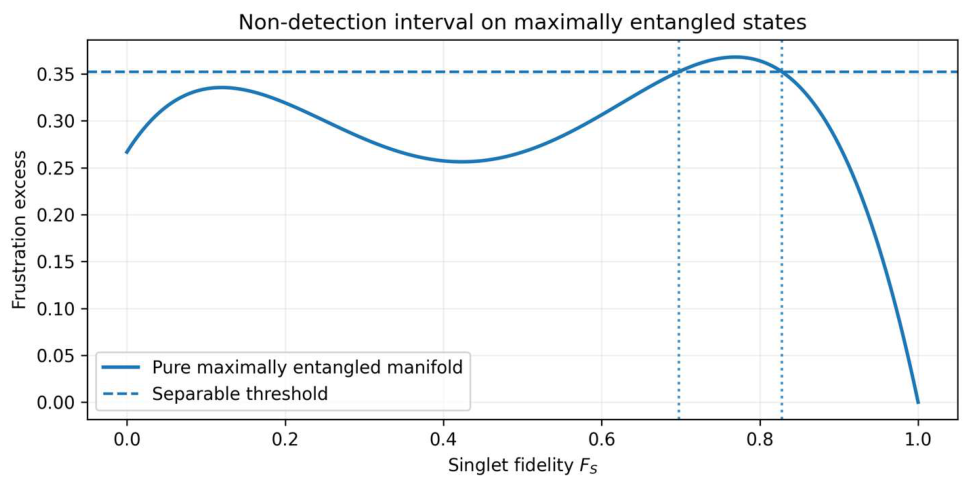
Figure 4.
Exact coherent-exchange and engineered dissipative singlet-pumping trajectories for two qubits. The panels compare Pauli frustration with independent entanglement criteria and show that witness detection need not coincide with entanglement onset; all traces are theoretical.
Figure 4.
Exact coherent-exchange and engineered dissipative singlet-pumping trajectories for two qubits. The panels compare Pauli frustration with independent entanglement criteria and show that witness detection need not coincide with entanglement onset; all traces are theoretical.
Disclaimer/Publisher’s Note: The statements, opinions and data contained in all publications are solely those of the individual author(s) and contributor(s) and not of MDPI and/or the editor(s). MDPI and/or the editor(s) disclaim responsibility for any injury to people or property resulting from any ideas, methods, instructions or products referred to in the content. |
© 2026 by the authors. Licensee MDPI, Basel, Switzerland. This article is an open access article distributed under the terms and conditions of the Creative Commons Attribution (CC BY) license (http://creativecommons.org/licenses/by/4.0/).
Copyright: This open access article is published under a Creative Commons CC BY 4.0 license, which permit the free download, distribution, and reuse, provided that the author and preprint are cited in any reuse.