

Submitted:
20 November 2026
Posted:
24 November 2026
You are already at the latest version
Abstract
The “Daydreaming Factory” is a conceptual framework in which a digital model is used to explore future operating scenarios before they occur. It has not been given a formal mathematical form or an executed demonstration of its central algorithmic claim, that AI-guided search finds reliability-critical scenarios more efficiently than manual or random exploration. This paper gives a reduced-order, single-cell instantiation for a battery-electric rail vehicle (BERV) Li-ion cell, using equivalent-circuit and ageing parameters previously identified from NASA PCoE data. We define a four-dimensional scenario space (current stress, resistive fault, ageing-rate stress, initial state of charge) and a criticality score that includes a battery-management-system (BMS) overcurrent trip, which makes the landscape discontinuous: the worst case lies just below the trip point, not at the corner of the space. Differential evolution (DE) found a score of 7.867 with 1,345 evaluations, matching an exhaustive 390,625-point grid (7.847) at 0.34% of its cost, whereas random search with the same budget reached 7.447 ± 0.178 over ten trials. A coarse-versus-fine time-step check gave perfect rank agreement (Spearman ρ = Kendall τ = 1.000), although this is a weak test. The landscape and its constants are assumptions of this study, and DE was run once. The work is an algorithmic proof of concept, not a validated vehicle-level system.
Keywords:
Daydreaming Factory
; scenario generation
; differential evolution
; criticality
; verification
; validation and uncertainty quantification
; battery-electric rail vehicle
1. Introduction
Nassehi et al. introduced “daydreaming factories”: engineering systems that become more reliable by using a high-fidelity digital representation to explore many possible operating futures, and to store the outcomes, before physical designs or strategies are fixed [1]. The idea belongs to the wider digital-twin paradigm [2,3,4], but, as presented, it is descriptive. It does not define a scenario space, a criticality function or a search procedure, and it offers no executed comparison showing that guided search beats simpler alternatives.
Two strands of work are relevant. Search-based generation of test scenarios has been shown to outperform random search for cyber-physical systems [5]. And trust in a simulation-based tool depends on verification, validation and uncertainty quantification (VVUQ) [6]; for digital twins, rank-correlation metrics such as Spearman’s ρ and Kendall’s τ have been proposed as quantitative acceptance criteria [7]. In the sources we reviewed we did not find a study that combines a formal scenario-criticality function, an executed guided-versus-exhaustive search comparison and a computed VVUQ check for a rail traction battery, even at reduced order.
We build the smallest instantiation that we can fully compute: a single-cell twin that reuses, without refitting, the equivalent-circuit and ageing parameters identified from NASA PCoE data in the companion identification study of this series [8]. The contributions are:
- a formal scenario space and a deterministic criticality score for a rail traction cell;
- a demonstration that a BMS overcurrent trip makes the criticality landscape discontinuous, so that the worst case is not at an extreme of the parameter box;
- an executed comparison of DE [9], random search and an exhaustive grid used as ground truth;
- a computed VVUQ fidelity check, with an account of why it is a weak test;
- a list of what is needed to scale the proof of concept to a vehicle-level system.
2. Materials and Methods
2.1. Digital-Twin Core
The simulator is the first-order Thévenin equivalent-circuit model (ECM) and the power-law ageing model identified from measured data of NASA PCoE cell B0005 in the companion study, used without refitting: R0 = 0.14384 Ω, R1 = 0.06127 Ω, C1 = 183.82 F, and the open-circuit-voltage polynomial coefficients c0–c3 = 3.38696, 2.58313, −4.21974 and 2.63744. The scenario parameters scale these values; no new physical parameter is fitted. One caution carries over from that study: R0 and R1 were not separately identifiable from constant-current data, so a scenario that scales R0 alone changes a quantity that is only weakly determined by the data.
2.2. Scenario Space
A scenario is a point in a four-dimensional box:
Here Imult scales the nominal 2 A discharge current (traction-current stress), R0,mult scales the series resistance (a degraded-contact fault), amult scales the ageing-rate coefficient of the power law (a coarse proxy for combined thermal and vibration stress, pending the physical coupling proposed in the companion study), and SoC0 is the initial state of charge.
2.3. Forward Simulation
For a given ω, the ECM is simulated under constant current I = Imult × 2 A with R0 = R0,mult × 0.14384 Ω, using the closed-form SoC trajectory under constant current and the fitted OCV polynomial. The simulation yields the minimum terminal voltage Vmin and the time tcrit at which a critical undervoltage threshold is reached. [Numerical values of the nominal cut-off voltage Vcutoff, the critical threshold and the horizon tmax are to be inserted by the authors from the simulation code.]
2.4. Criticality Score with BMS Protection
The score combines the voltage margin below the nominal cut-off, ΔV = max(0, Vcutoff − Vmin), a time-urgency term Ut = 1 − min(tcrit, tmax)/tmax, the ageing stress and the fault severity:
Real rail BMS units disconnect the load above a calibrated overcurrent threshold. We model this with a trip at Imult = 2.6 that cuts the score to 15% of its value:
A preliminary version without the trip was increasing in almost every dimension, so its maximum sat at a corner of Ω and offered only a weak test; DE gained about 6.5% over random search there, and both converged to the boundary. The trip was added for that reason and because it reflects real protection logic. We stress that the trip threshold (2.6), the 15% factor and the term weights are assumptions of this study, not measured rail-BMS parameters. The landscape is therefore constructed, and the results describe how the search behaves on it, not the criticality of a real vehicle.
2.5. Search Procedures
Three procedures were applied to the same score: (i) random search, uniform sampling of Ω with 300 evaluations, and again with the DE budget of 1,345 evaluations repeated over 10 independent trials; (ii) DE [9], a global evolutionary optimiser, run once to convergence (1,345 evaluations); and (iii) an exhaustive grid of 25 points per dimension (254 = 390,625 evaluations), used as ground truth. The grid step is 0.104 in Imult, which matters for interpreting the results.
2.6. VVUQ Fidelity Check
Following the rank-correlation approach for digital twins [7], criticality scores computed with a coarse time step (dt = 5 s) and a fine one (dt = 0.1 s) were compared for 82 scenarios (80 random scenarios plus the DE and grid optima) using Spearman’s ρ and Kendall’s τ, together with the mean absolute error (MAE), root-mean-square error (RMSE) and maximum absolute difference of the scores.
3. Results
3.1. Landscape Structure
Figure 1 is a one-dimensional slice of the landscape along Imult. The score rises with current up to the trip at 2.6 and then falls to about 1, so the worst case lies just below the trip, and a search that simply pushes every parameter to its limit would miss it.
3.2. Search Comparison
Table 1 and Figure 2 compare the searches. DE found a score of 7.867 with 1,345 evaluations, 0.34% of the grid budget. This slightly exceeds the grid optimum of 7.847, as expected for a continuous optimiser: the best grid point has Imult = 2.583, 0.017 below the trip, while DE reached 2.598, only 0.002 below it. Random search with the same 1,345 evaluations reached 7.447 ± 0.178 (ten trials) and never matched the DE result, about 5.6% higher than the random mean. With 300 evaluations random search reached 7.059. The DE and grid optima agree on the main features: Imult just under the trip and R0,mult and amult at or near their upper bounds. They differ in SoC0 (0.666 vs. 0.600), which suggests that the score is only weakly sensitive to it near the optimum.
3.3. VVUQ Fidelity
Coarse and fine time-step scores agreed perfectly in rank (ρ = τ = 1.000, n = 82; Table 2, Figure 3), with a maximum absolute difference of 0.003 score units. This is an easy test to pass. With a closed-form SoC trajectory under constant current, the time step mainly affects how precisely the threshold-crossing time is detected, not the dynamics. Perfect rank agreement therefore shows numerical consistency, not model validity.
4. Discussion
The results support three limited statements. A discontinuity caused by protection logic can hide the worst case from naive extreme-value reasoning. On this landscape, DE located the optimum region at a small fraction of the cost of a grid and did better than random search at equal cost. And a basic VVUQ check can be computed and reported, including its weaknesses. They do not show that the same advantage holds on a real vehicle model, where the landscape may be smoother, noisier or higher-dimensional.
The main limitations are these:
- Constructed landscape. The trip threshold, the 15% attenuation factor and the term weights are assumed. The finding that the worst case sits just below the trip follows from this construction. A sensitivity study over these constants is needed.
- Single DE run. DE was run once, against ten random-search trials, so its run-to-run variability is unknown. Repeated runs with different seeds are needed before an efficiency ratio is quoted with confidence.
- Scale. A real pack has many cells with cell-to-cell variation; the twin here is one fitted cell.
- Fault realism. Resistive fault and ageing stress are scalar multipliers on fitted parameters, not simulated fault mechanisms such as an internal short or a degrading connector. The R0 multiplier also inherits the identifiability issue noted in Section 2.1.
- Vibration. The ageing multiplier is a placeholder for a vibration-coupled law that is itself unvalidated.
- VVUQ severity. A stronger check would compare different model structures, for example a first-order against a second-order RC network, motivated by the systematic residuals near the discharge knee reported in the companion study.
- No hardware validation. No test-rig comparison has been made, and one would be required before any claim of a validated Daydreaming Factory for rail hardware. Models trained or assessed on such scenarios must also be tested under non-stationary operating conditions, as has been done for learning-based diagnosis of other rotating equipment [10].
5. Conclusions
We gave a formal, executable reduced-order form to the central algorithmic claim of the Daydreaming Factory for one BERV cell. On a criticality landscape made discontinuous by an assumed BMS trip, differential evolution found the global optimum region with 0.34% of the grid budget and outperformed matched-budget random search. The fidelity check passed but is weak. The result is a proof of concept for the algorithm, resting on assumed constants and a single optimiser run; scaling it to a validated vehicle-level system is the next phase of this research programme.
Author Contributions
Conceptualization, methodology, writing original draft preparation and review and editing: D.M. L.M and K.O.
Data Availability Statement
The NASA PCoE Li-ion battery ageing dataset is publicly available [8].
Acknowledgments
The authors acknowledge institutional support from the National University of Science and Technology, Bulawayo, Zimbabwe.
Conflicts of Interest
The authors declare no conflicts of interest.
Abbreviations
The following abbreviations are used in this manuscript:
| BERV | Battery-electric rail vehicle |
| BMS | Battery management system |
| DE | Differential evolution |
| ECM | Equivalent-circuit model |
| MAE | Mean absolute error |
| OCV | Open-circuit voltage |
| RMSE | Root-mean-square error |
| SoC | State of charge |
| VVUQ | Verification, validation and uncertainty quantification |
References
- Nassehi, A.; Colledani, M.; Kádár, B.; Lutters, E. Daydreaming Factories. CIRP Ann. 2022, 71, 671–692. [Google Scholar] [CrossRef]
- Grieves, M.; Vickers, J. Digital Twin: Mitigating Unpredictable, Undesirable Emergent Behavior in Complex Systems. In Transdisciplinary Perspectives on Complex Systems; Kahlen, F.-J., Flumerfelt, S., Alves, A., Eds.; Springer: Cham, Switzerland, 2017; pp. 85–113. [Google Scholar] [CrossRef]
- Wu, B.; Widanage, W.D.; Yang, S.; Liu, X. Battery Digital Twins: Perspectives on the Fusion of Models, Data and Artificial Intelligence for Smart Battery Management Systems. Energy AI 2020, 1, 100016. [Google Scholar] [CrossRef]
- Dubarry, M.; Howey, D.; Wu, B. Enabling Battery Digital Twins at the Industrial Scale. Joule 2023, 7, 1134–1144. [Google Scholar] [CrossRef]
- Humeniuk, D.; Khomh, F.; Antoniol, G. A Search-Based Framework for Automatic Generation of Testing Environments for Cyber-Physical Systems. Inf. Softw. Technol. 2022, 149, 106936. [Google Scholar] [CrossRef]
- Oberkampf, W.L.; Roy, C.J. Verification and Validation in Scientific Computing; Cambridge University Press: Cambridge, UK, 2010. [Google Scholar] [CrossRef]
- Ershenko, D.; Derbysheva, G.; Panayi, A.; Fortin, C. Quantitative Metrics for Validation and Decision-Making in Digital Twins: A Comparative Study on a Railway Braking System. Proc. Des. Soc. 2025, 5, 2671–2680. [Google Scholar] [CrossRef]
- Saha, B.; Goebel, K. Battery Data Set; NASA Ames Research Center: Moffett Field, CA, USA, 2007; Available online: https://c3.nasa.gov/dashlink/resources/133/ (accessed on 10 October 2026).
- Storn, R.; Price, K. Differential Evolution—A Simple and Efficient Heuristic for Global Optimization over Continuous Spaces. J. Glob. Optim. 1997, 11, 341–359. [Google Scholar] [CrossRef]
- Mashava, D.; Kimotho, J.K.; Muvengei, O.M. Gearbox Multiple Faults Diagnosis under Stationary and Non-Stationary Operating Conditions Using Convolutional Neural Networks. Eng. Adv. 2022, 2, 1–17. [Google Scholar] [CrossRef]
Figure 1.
Slice of the criticality landscape along Imult with the other scenario dimensions fixed, showing the discontinuity at the assumed BMS trip (Imult = 2.6).
Figure 1.
Slice of the criticality landscape along Imult with the other scenario dimensions fixed, showing the discontinuity at the assumed BMS trip (Imult = 2.6).
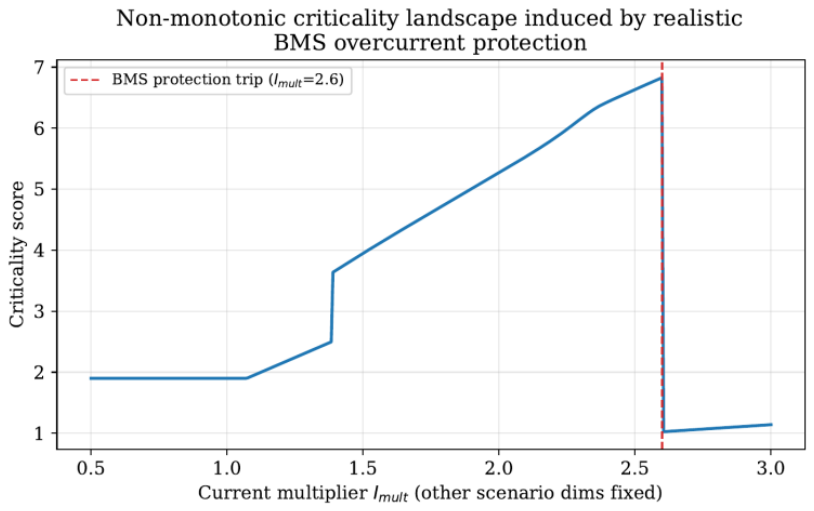
Figure 2.
Left: distribution of criticality scores from 300 random-search samples, with the DE and grid optima marked. Right: best score found by random search (matched budget, ten trials), DE and the grid.
Figure 2.
Left: distribution of criticality scores from 300 random-search samples, with the DE and grid optima marked. Right: best score found by random search (matched budget, ten trials), DE and the grid.
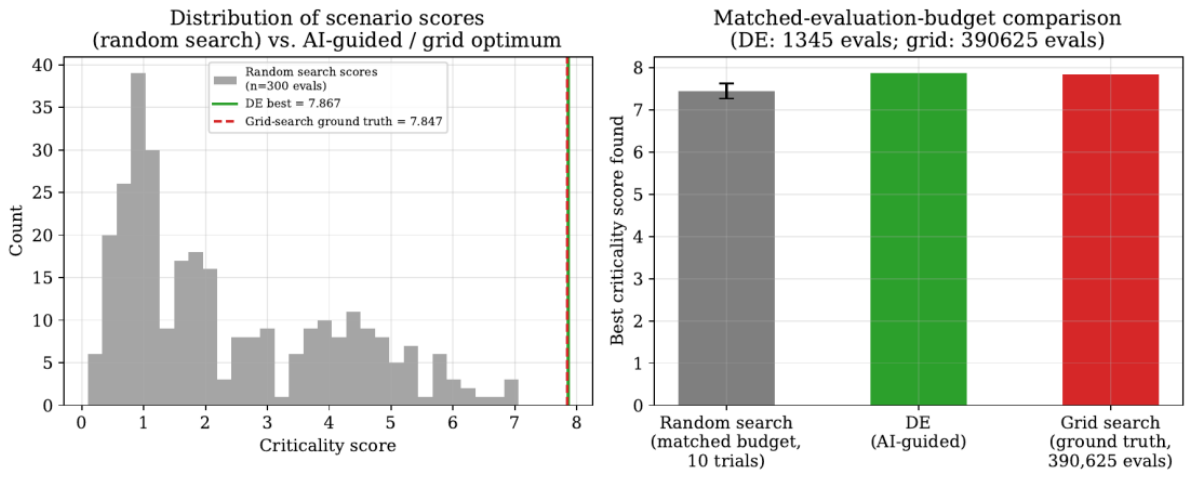
Figure 3.
Criticality scores at coarse and fine time resolution for 82 scenarios; the dashed line is perfect agreement.
Figure 3.
Criticality scores at coarse and fine time resolution for 82 scenarios; the dashed line is perfect agreement.
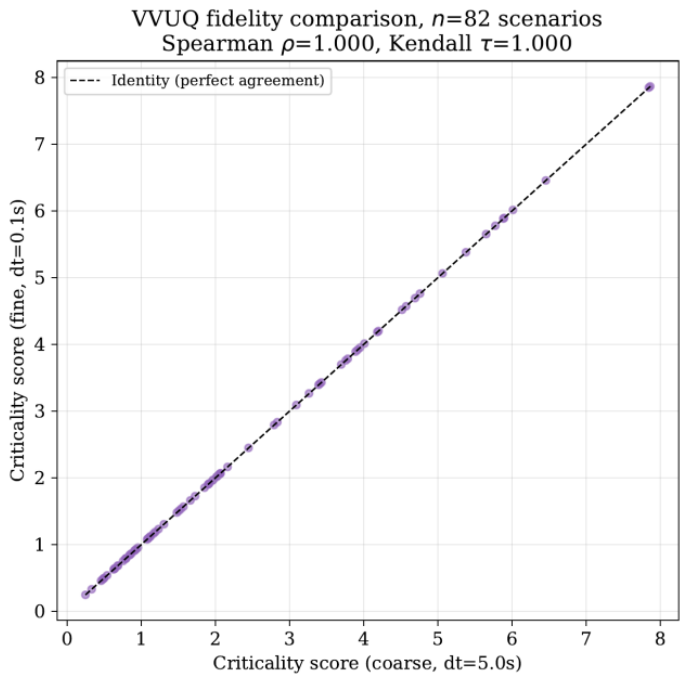

Table 1.
Search comparison on the same simulator and score. ω = (I_{mult}, R_{0,mult}, a*mult, SoC0) is the best scenario found.
Table 1.
Search comparison on the same simulator and score. ω = (I_{mult}, R_{0,mult}, a*mult, SoC0) is the best scenario found.
| Method | Evaluations | Best score | Imult | R0,mult | amult | SoC0 |
| Random search (fixed budget) | 300 | 7.0594 | 2.537 | 1.903 | 2.575 | 0.674 |
| Random search (DE-matched budget, mean of 10) | 1345 | 7.4467 ± 0.1784 | — | — | — | — |
| Differential evolution | 1345 | 7.8666 | 2.598 | 1.998 | 2.992 | 0.666 |
| Grid search (ground truth) | 390,625 | 7.8472 | 2.583 | 2.000 | 3.000 | 0.600 |
Table 2.
Rank agreement between scores computed with dt = 5.0 s and dt = 0.1 s (n = 82 scenarios).
| Metric | Value |
| Spearman ρ | 1.00000 |
| Kendall τ | 1.00000 |
| MAE (score units) | 0.00067 |
| RMSE (score units) | 0.00119 |
| Max. absolute difference | 0.00306 |
Disclaimer/Publisher’s Note: The statements, opinions and data contained in all publications are solely those of the individual author(s) and contributor(s) and not of MDPI and/or the editor(s). MDPI and/or the editor(s) disclaim responsibility for any injury to people or property resulting from any ideas, methods, instructions or products referred to in the content. |
© 2026 by the authors. Licensee MDPI, Basel, Switzerland. This article is an open access article distributed under the terms and conditions of the Creative Commons Attribution (CC BY) license.
Copyright: This open access article is published under a Creative Commons CC BY 4.0 license, which permit the free download, distribution, and reuse, provided that the author and preprint are cited in any reuse.