
Submitted:
20 November 2026
Posted:
24 November 2026
You are already at the latest version
Abstract
Background: Occupational risk assessment is a mandatory procedure in modern occupational health and safety (OHS) management systems worldwide. However, no single regulatory document prescribes the use of a specific assessment method, leaving organizations with a wide choice of available tools. The diversity of existing approaches – from simple checklists to complex probabilistic models – creates a methodological challenge for practitioners and researchers, particularly in high-risk industries such as coal mining.
Objectives: This scoping review aims to systematically map and classify existing occupational risk assessment methods, identify their key advantages and limitations and determine their typical application areas. The review also examines the regulatory requirements for risk assessment in Russian and international practice.
Eligibility Criteria: The review included methods and approaches for occupational risk assessment published in peer-reviewed journals, regulatory documents and industry guidelines in English or Russian, supplemented by Persian-language sources indexed in Scopus and Web of Science, which were fully translated into English for de-tailed methodological review, over the past 30 years. Methods were included if they provided a structured approach to hazard identification, risk estimation or risk evaluation applicable to occupational settings.
Sources of Evidence: A systematic search was conducted in Scopus, Web of Science, Google Scholar and Russian scientific databases (eLIBRARY.ru) using keywords related to occupational risk assessment, hazard identification and risk analysis methods.
Charting Methods: Data were extracted using a standardized form and grouped by methodological principle into eleven thematic blocks. Each method was described in terms of its core principle, advantages, limitations and typical application areas.
Results: Fifty-five distinct methods were identified and classified into eleven blocks: (1) qualitative hazard identification; (2) engineering reliability analysis; (3) scenario modeling and barrier analysis; (4) human reliability assessment; (5) semi-quantitative ranking methods; (6) probabilistic and statistical methods; (7) uncertainty and multi-criteria hybrids; (8) hygienic and health risk assessment; (9) ergonomic and biomechanical risks; (10) psychosocial risks; (11) behavioral safety and strategic management. A comparative analysis revealed that no single method is universally applicable; the choice depends on data availability, assessment objectives and organizational con-text.
Conclusions: This scoping review provides a comprehensive map of existing occupational risk assessment methods, offering researchers and practitioners a structured framework for selecting appropriate tools based on their specific needs. The classification highlights the complementary nature of different approaches and the necessity of hybrid methodologies for complex industrial settings.
Keywords:
occupational risk assessment
; hazard identification
; risk analysis methods
; scoping review
; occupational health and safety
; mining industry
; PRISMA-ScR
1. Introduction
Occupational risk assessment has become a cornerstone of modern occupational health and safety (OHS) management systems worldwide. International standards, including ISO 45001:2018 [1] and ILO-OSH 2001 [2], as well as Russian regulatory frameworks such as the Labor Code of the Russian Federation [3] (Articles 209, 212), GOST 12.0.230.1-2015 [4] and the Model Regulation on OHS Management Systems [5], uniformly require employers to systematically identify hazards, assess and manage occupational risks. However, none of these regulatory documents prescribes the use of any specific risk assessment method, leaving organizations with the freedom to choose the most appropriate tool for their profile, scale and available resources.
This regulatory gap creates a significant methodological challenge for OHS professionals and researchers, particularly in high-risk industries such as coal mining. The diversity of existing approaches – from simple checklists and qualitative brainstorming techniques to complex probabilistic models and Bayesian networks – complicates the selection of an optimal tool for a given task. Moreover, the lack of a unified classification system hinders the ability of researchers to navigate this methodological landscape and make informed decisions about which methods to apply in their studies.
In this context, the present study addresses the need for a systematic mapping and classification of occupational risk assessment methods. Given the breadth and heterogeneity of the available approaches, a scoping review methodology was selected as the most appropriate. Unlike systematic reviews, which focus on answering specific, narrowly defined questions through critical appraisal of study quality, scoping reviews are designed to map the existing literature, identify key concepts and highlight gaps in a broad field of inquiry [6]. The scoping review methodology applied in this study follows the framework established [7] and subsequently refined [8], with reporting conducted in accordance with the PRISMA Extension for Scoping Reviews (PRISMA-ScR) guidelines [9].
The PRISMA-ScR guidelines themselves represent an extension of the original PRISMA statement, which was developed to improve the reporting quality of systematic reviews and meta-analyses. While PRISMA was designed primarily for reviews of intervention studies, its core principles of transparency, completeness and reproducibility have been adapted for scoping reviews through the PRISMA-ScR framework [10].
Thus, the primary objectives of this scoping review are:
- to systematically identify and classify existing methods for occupational risk assessment;
- to describe the core principles, advantages and limitations of each identified method;
- to determine typical application areas for each method, with particular attention to the mining industry;
- to examine the regulatory requirements for risk assessment in Russian and international practice;
- to provide researchers and practitioners with a structured framework for selecting appropriate methods based on their specific needs.
2. Materials and Methods
This scoping review was conducted in accordance with the Preferred Reporting Items for Systematic Reviews and Meta-Analyses Extension for Scoping Reviews (PRISMA-ScR) guidelines [9]. The completed PRISMA-ScR checklist is provided as Supplementary Material.
The application of PRISMA-ScR for scoping reviews is consistent with recent published reviews in the field of occupational safety, including the analysis of qualitative and semi-quantitative risk assessment practices in Iran, which similarly employed a standardized data charting form and reported results in a descriptive narrative format [11].
2.1. Protocol and Registration
A review protocol was developed and registered with the Open Science Framework (OSF). The protocol is available at: https://osf.io/7p8bs [12].
2.2. Eligibility Criteria
Sources of evidence were included if they met the following criteria:
- type of source: peer-reviewed journal articles, regulatory documents, industry guidelines and authoritative methodological manuals;
- content: the source described or applied a structured method for occupational risk assessment, hazard identification, risk estimation or risk evaluation;
- language: English, Russian or Persian. Persian-language sources were included only where the full text could be translated into English, enabling complete review of the methodological content rather than reliance on the abstract alone;
- time frame: publications from 1990 to the present, with a focus on more recent developments where applicable;
- relevance: the method was applicable to occupational settings (as opposed to purely environmental or financial risk assessment).
Sources were excluded if they: (1) focused exclusively on risk assessment in non-occupational contexts (e.g., financial markets); (2) described methods without sufficient detail for replication or understanding; or (3) were conference abstracts without full methodological description.
2.3. Information Sources
A systematic search was conducted in the following databases:
- Scopus;
- Web of Science Core Collection;
- Google Scholar (for grey literature and additional references);
- eLIBRARY.ru (Russian scientific electronic library).
2.4. Search Strategy
The search strategy combined keywords related to occupational risk assessment and methodological approaches. For Scopus and Web of Science, the following Boolean search string was used:
("occupational risk" OR "professional risk" OR "workplace risk" OR "safety risk")
AND ("assessment" OR "evaluation" OR "analysis" OR "estimation")
AND ("method" OR "methodology" OR "approach" OR "technique" OR "tool")
For Russian databases, the search string was adapted to:
("прoфессиoнальный риск" OR "oценка риска" OR "oпаснoсть" OR "травматизм")
AND ("метoд" OR "метoдика" OR "пoдхoд" OR "oценка")
Limits applied: English or Russian language; publication date 1990–present; peer-reviewed journals and official regulatory documents.
2.5. Selection of Sources of Evidence
The selection process followed the PRISMA flow diagram (Figure 1). All identified records were imported into reference management software and duplicates were removed. Two reviewers independently screened titles and abstracts against the eligibility criteria. Full texts of potentially eligible sources were then retrieved and assessed independently by the same two reviewers. Disagreements were resolved through discussion.
Several relevant sources were published in Persian-language journals indexed in Scopus and Web of Science. To ensure that these sources were assessed on the same basis as English- and Russian-language publications, the full texts were translated into English and reviewed in translation rather than being evaluated from the English-language abstract alone. The translation was performed using machine translation with subsequent manual verification of methodological terminology, method names, procedural steps and the wording of advantages and limitations by a reviewer familiar with the subject area. This procedure made it possible to extract all predefined data items – including the core principle, key procedural steps, input data requirements, type of output, advantages, limitations and application areas – directly from the full text.
2.6. Data Charting Process
Data were extracted using a standardized charting form developed by the research team. The form was piloted on five randomly selected sources and refined before full application. For each included source, the following data items were extracted:
- Method name and acronym (if applicable);
- Core principle and theoretical basis;
- Key procedural steps;
- Input data requirements;
- Type of output (qualitative, semi-quantitative, quantitative);
- Advantages;
- Limitations;
- Typical application areas;
- References to original and key methodological sources.
Data charting was performed independently by two reviewers, with cross-checking to ensure consistency.
2.7. Synthesis of Results
The extracted data were synthesized using a thematic grouping approach. Methods were classified into blocks based on their methodological principle and primary purpose. The classification was developed iteratively, with categories refined as the charting process progressed. The final classification comprises eleven thematic blocks, each representing a distinct methodological family. Within each block, methods are described in terms of their core principles, advantages, limitations and application areas. Summary tables 12-13 provide a comparative overview of all blocks.
3. Results
3.1. Characteristics of Included Sources
A total of 98 sources were included in this scoping review. The sources comprised peer-reviewed journal articles (82), regulatory and guidance documents (11), methodological manuals (3), industry guidelines (1) and registered review protocol (1).
3.2. Regulatory Requirements for Occupational Risk Assessment
3.2.1. Russian Regulatory Framework
The legal foundation for occupational risk assessment in the Russian Federation is established through a hierarchical system of normative documents, with the Labor Code of the Russian Federation [3] occupying the apex of this regulatory pyramid. Article 209 of the Labor Code [3] provides the statutory definition of occupational risk as «the probability of causing harm to health as a result of exposure to harmful and (or) hazardous production factors in the course of the employee's performance of duties under an employment contract or in other cases established by the Labor Code and other federal laws». This definition establishes the conceptual foundation for all subsequent regulatory instruments addressing risk assessment in the workplace.
Article 212 of the Labor Code [3] articulates the employer's fundamental obligation to ensure the creation and functioning of an occupational health and safety management system within the organization. This provision effectively mandates that employers establish systematic procedures for managing occupational risks, though the specific methodologies for fulfilling this obligation are not prescribed at the level of the Labor Code itself. The legislative framework thus establishes the principle of mandatory risk management while leaving the practical implementation to subordinate regulatory instruments.
The system of state standards for occupational safety (GOST 12.0.230 series) provides the technical and procedural framework for implementing the legislative requirements. GOST 12.0.230.1-2015 [4] establishes the fundamental requirements for occupational health and safety management systems, specifying that occupational risk management constitutes an integral component of such systems. This standard delineates the procedural elements that organizations must incorporate, including hazard identification, risk assessment and risk reduction procedures. The development and implementation of OSH management systems based on the process approach ensures the systematic and reproducible nature of risk assessment procedures, as demonstrated in the study [13]. The standard emphasizes that risk assessment should be systematic, documented and subject to periodic review, though it does not mandate any particular methodological approach for conducting such assessments. GOST 12.0.230.2-2015 [14], a complementary standard, establishes the criteria and procedures for evaluating the conformity of occupational health and safety management systems with the requirements of GOST 12.0.230. These standards collectively provide a structured framework for organizations to develop and maintain their risk management systems while preserving methodological flexibility.
The most specific regulatory guidance on occupational risk assessment procedures is provided by the Model Regulation on Occupational Health and Safety Management Systems [5], which entered into force on March 1, 2022. This document was developed with the explicit purpose of assisting employers in complying with occupational safety requirements through the creation, implementation and maintenance of functional management systems. The Model Regulation articulates that the occupational health and safety management system shall be developed «to eliminate and (or) minimize occupational risks» and recommends the involvement of workers, technologists, supervisors and authorized representatives in the hazard identification and risk assessment processes. The analysis of these documents has identified the main groups of causes of violations of industrial safety requirements and the corresponding sources of risk, providing a systematic basis for understanding the regulatory context of risk assessment in Russian coal mines [15].
The accompanying Model List of Hazards and Risk Management Measures provides a structured inventory of typical hazards and corresponding control measures, facilitating the systematic identification of workplace dangers. The Regulation establishes a hierarchy of risk control measures, requiring that primary attention and resources be directed toward the elimination of high-level risks. Beyond the procedural requirements for risk assessment, Russian legislation also provides for the legal determination of fault in cases of industrial accidents, including the assessment of the degree of guilt of each participant [16].
A critical observation emerges from the analysis of this regulatory framework: no Russian normative document prescribes the use of any specific risk assessment method. The Labor Code establishes the obligation to manage risks. GOST standards specify the procedural elements that risk management systems must incorporate. The Model Regulation provides guidance on the structure and content of such systems. However, the choice of specific assessment methodology – whether qualitative, semi-quantitative or quantitative – remains entirely at the discretion of the employer. This regulatory approach reflects a deliberate policy decision to grant organizations the flexibility to select methods that are most appropriate to their specific operational context, scale and available resources, while maintaining the fundamental requirement that risk assessment be conducted systematically and documented appropriately.
In the coal mining sector, the regulatory framework is further elaborated through Federal Norms and Rules (FNP) in the field of industrial safety, particularly the Safety Rules for Mining Operations and Processing of Solid Minerals [17]. These instruments establish specific requirements for risk assessment tailored to the distinctive hazards of mining operations, including gas-dynamic phenomena, rock mass stability, ventilation system integrity and other factors characteristic of coal mining enterprises. The FNP documents supplement the general occupational safety requirements with sector-specific provisions that reflect the elevated risk profile of mining activities.
3.2.2. International Approaches
At the international level, the most influential instrument governing occupational risk assessment is the ISO 45001:2018 standard (GOST R ISO 45001-2020) [1]. Clause 6.1.2 of the standard requires organizations to establish, implement and maintain a process for hazard identification and assessment of occupational health and safety risks and opportunities. The standard specifies that this process must address both routine and non-routine activities, the behavior and capabilities of workers, human factors and the identification of hazards arising from the workplace.
A defining characteristic of ISO 45001 is its requirement that risk assessment be proactive rather than reactive, systematic and documented. The standard does not mandate the use of any specific risk assessment methodology; instead, it requires organizations to define and apply criteria for risk assessment that are appropriate to their context, to evaluate risks in a structured manner and to prioritize actions for risk reduction based on the level of risk. This approach parallels the Russian regulatory philosophy in preserving methodological flexibility while establishing procedural rigor. The standard also emphasizes the importance of identifying opportunities for improving occupational health and safety performance, integrating risk management with broader organizational strategy.
The ILO-OSH 2001 guidelines [2], developed by the International Labour Organization, provide an additional international framework for occupational safety and health management systems. These guidelines establish that organizations should identify and assess hazards and risks affecting the safety and health of workers. The ILO framework emphasizes that risk assessment should be conducted prior to the modification or introduction of new work methods, materials, processes or machinery. Significantly, the guidelines mandate that such assessment be carried out in consultation with and involving workers and their representatives. The ILO-OSH framework establishes a clear hierarchy of prevention and control measures: elimination of hazards and risks, control of hazards at source through engineering or management measures and minimization of risk through the design of safe systems. This hierarchy reflects a fundamental principle in occupational safety that prioritizes the elimination of hazards over the implementation of protective measures.
Within the European Union, the foundational legal instrument is Council Directive 89/391/EEC [18] on the introduction of measures to encourage improvements in the safety and health of workers at work. This Framework Directive establishes the employer's general obligation to ensure the safety and health of workers in every aspect related to work. Article 9(1)(a) of the Directive [18] imposes a specific duty on employers to be in possession of an assessment of the risks to safety and health at work. The Directive requires that risk assessments be documented and that employers identify the measures that must be taken to protect workers. The Directive has been transposed into the national legislation of all Member States, making the obligation to carry out safety and health risk assessments applicable across the European Union. The Framework Directive is notable for its comprehensive scope, requiring employers to assess all risks to workers' safety and health, encompassing both physical and psychosocial hazards.
In the United Kingdom, the Health and Safety Executive (HSE) has developed a widely adopted five-step model for risk assessment that has influenced practice globally: identification of hazards, determination of who might be harmed and how, evaluation of risks and decision on precautions, documentation of findings and implementation of actions and review and update of the assessment. This model provides a practical framework for organizations to implement the general requirements of Directive 89/391/EEC [18].
In the United States, the Occupational Safety and Health Administration (OSHA) operates within a different regulatory paradigm. Rather than a single overarching framework directive, OSHA's approach is characterized by a combination of general duty clauses and specific standards for particular hazards and industries. The General Duty Clause, Section 5(a)(1) of the Occupational Safety and Health Act [19] requires employers to provide workplaces free from recognized hazards that are causing or likely to cause death or serious physical harm. OSHA standards may require employers to adopt specific practices, means, methods or processes reasonably necessary and appropriate to protect workers. While OSHA does not mandate a single, unified risk assessment methodology, the agency's standards often require employers to conduct hazard assessments as a prerequisite for the selection of appropriate controls. For example, OSHA's Personal Protective Equipment standard (29 CFR 1910.132) [20] explicitly requires employers to perform a workplace hazard assessment and document the findings. OSHA's Recommended Practices for Safety and Health Programs provide detailed guidance on hazard identification and assessment, describing a systematic six-step process.
The US approach differs from the European and Russian models in that risk assessment requirements are often embedded within specific standards addressing particular hazards rather than being articulated in a single comprehensive instrument. This reflects the US regulatory philosophy of addressing risks through targeted standards development based on specific hazard characterization and risk assessment conducted by the agency. OSHA's risk assessment procedures typically involve the use of epidemiologic data, animal studies and exposure assessment to quantify health risks in the range of occupational exposures of interest.
A consistent principle emerges across all these international frameworks: occupational risk assessment is mandatory, but the choice of specific method remains with the organization. Whether under ISO 45001, ILO-OSH 2001, EU Directive 89/391 or US OSHA requirements, the fundamental obligation is to conduct systematic, documented risk assessment, while the methodological approach is determined by the organization based on its context, resources and the nature of the hazards it faces. This convergence of principle across different regulatory traditions, despite substantial variations in implementation, underscores the universality of the risk-based approach to occupational safety and health management, while simultaneously explaining the diversity of assessment methods described in this review.
3.3. Classification of Occupational Risk Assessment Methods
Based on the analysis of included sources, fifty-five distinct methods were identified and classified into eleven thematic blocks. The classification is presented below, with detailed descriptions of each block and its constituent methods.
Block 1. Qualitative Hazard Identification (Exploratory Methods)
Purpose: To identify all potential hazards at early stages (design, audit, operation analysis). These methods operate without numerical estimates, using only lists and descriptions.
The checklist method represents the simplest and most accessible approach to hazard identification, employing a structured list of questions or items to be verified to ensure that safety considerations have been adequately addressed. The method relies on the development of comprehensive checklists that capture typical hazards, required safety measures and compliance requirements relevant to the operation or activity under review.
The procedural simplicity of the check-list method is both its principal advantage and its fundamental limitation. A team member or inspector works through the checklist, systematically verifying each item and noting any deviations, omissions or non-compliances. The checklist may be generic (applicable to a wide range of operations) or specifically tailored to a particular activity, equipment type or operating environment.
The strengths of the method are evident: checklists are quick to administer, require minimal training, provide a systematic basis for ensuring that essential safety checks are not overlooked and create a documented record of the assessment. They are particularly valuable for routine inspections, pre-start checks and activities where established safety requirements are well-defined and relatively stable.
A similar checklist-based approach is employed in fire risk assessment using the NFPA 101 Life Safety Code, which provides a structured set of criteria for evaluating fire safety in buildings [21].
However, the fundamental limitation of checklists is that they only capture hazards that have been anticipated and included in the checklist – the method is inherently reactive to known hazards and cannot identify novel or emerging risks. The fixed format also tends to create a compliance mentality, where completing the checklist becomes the objective, potentially overshadowing genuine safety awareness. Furthermore, the effectiveness of the method depends entirely on the quality and comprehensiveness of the checklist itself.
In the mining industry, checklists are ubiquitous, serving as the basis for pre-start checks on mobile equipment, daily workplace inspections, equipment maintenance inspections and safety audits. Despite their limitations, checklists remain an essential component of operational safety management, providing a systematic foundation for more comprehensive risk assessment procedures.
CSR (Conceptual Safety Review) is a qualitative hazard identification method applied at the very earliest stages of project development, when the overall concept of a new facility or operation is being formulated. The method is designed to assess the inherent safety of proposed solutions, identifying major safety issues before detailed design begins and often before substantial resources have been committed to a particular approach.
The CSR typically involves a small team of experts who review the proposed concept and evaluate it from a safety perspective. The focus of the review is on fundamental design decisions that have safety implications, such as siting, layout, choice of process technology and operating philosophy. The review seeks to identify major hazards that might be inherent in the chosen approach and to suggest alternative approaches that might offer higher levels of inherent safety.
The primary advantage of CSR is its timing – safety considerations are introduced at the earliest possible stage, when they can most effectively influence design decisions. The method also encourages a focus on inherently safer design, avoiding hazards where possible rather than simply managing them with add-on protection systems.
The limitation of CSR is that it can only address hazards that are apparent from the conceptual-level information available. As the design is not yet detailed, many specific hazards cannot yet be identified. The review should therefore be viewed as a first step in a progression of analyses that will become more detailed as the design develops.
In the mining industry, CSR is applied during the conceptual and pre-feasibility stages of new projects, major expansions and evaluations of alternative mining methods. For surface coal mines, CSR assessments commonly address inherent safety implications of fundamental design choices, including pit geometry and slope angles, haul road alignments, the configuration of waste dumps and the selection of primary mining equipment.
The HAZID (Hazard Identification) method represents a systematic approach to identifying potential hazards through structured brainstorming and the use of checklists or guide words. The core principle of HAZID involves the assembly of a multidisciplinary team of experts who systematically review the facility, process or operation to identify what could go wrong, why it might happen and what the potential consequences could be. The method operates without numerical quantification, focusing instead on generating a comprehensive list of hazards that might otherwise be overlooked during conventional safety reviews.
The procedural framework of HAZID typically follows a structured workshop format, where participants work through predefined sections of the facility or process, applying a set of prompt questions or guide words to stimulate thinking about potential deviations from normal operation. These guide words may include terms such as «No», «More», «Less», «As well as», «Part of», «Reverse» and «Other than» which help systematically explore possible failure modes. The output of a HAZID study is a documented register of identified hazards, their causes, potential consequences and initial recommendations for risk reduction.
The principal advantage of HAZID lies in its capacity to uncover latent hazards – those that may not have manifested in previous incidents but could emerge under specific combinations of circumstances. The method encourages creative thinking and leverages the collective expertise of the workshop participants, often yielding insights that would not emerge from individual analysis. Furthermore, HAZID is relatively time-efficient compared to more detailed analytical methods, making it suitable for early-stage assessments and screening studies.
However, the method has notable limitations. The quality of the results depends heavily on the composition and expertise of the workshop team. If key disciplines are underrepresented or if participants lack sufficient experience with the technology or process under review, significant hazards may be missed. One approach to reducing this subjectivity is the application of a scientifically grounded procedure for forming the expert group, including the determination of its optimal size and the assessment of each expert's professional competence [22]. Additionally, HAZID provides purely qualitative outputs – it answers the question «What could happen?», but does not provide estimates of probability or severity. The method also does not systematically address combinations of hazards or cascading events.
In the mining industry, HAZID is extensively applied during the design phase of new operations, when assessing modifications to existing processes and as a preliminary step before more detailed risk analyses. In the context of underground coal mining, the identification of methane-related hazards represents a critical application of hazard identification methods, given that methane emissions from coal beds constitute one of the primary natural hazards affecting mine safety [23]. For surface coal mines, HAZID workshops commonly address hazards related to heavy equipment operation, slope stability and blasting activities. In open-pit mining, the identification of risk factors associated with blasting operations is a critical first step in the risk management process [24].
The HAZOP (Hazard and Operability Study) methodology constitutes one of the most rigorous and structured qualitative hazard identification techniques originally developed by Imperial Chemical Industries (ICI) in the United Kingdom. The method is designed to systematically examine process systems to identify potential hazards and operability problems arising from deviations from the intended design conditions.
The fundamental principle of HAZOP involves the application of guide words to each element of the process, exploring how deviations from normal operating parameters could occur and what consequences might result. The analysis is conducted by a multidisciplinary team that systematically works through the process using a combination of guide words and process parameters. Common guide words include «No», «More», «Less», «As well as», «Part of», «Reverse» and «Other than» while typical process parameters include flow, temperature, pressure, level, composition and reaction. The combination of a guide word with a process parameter yields a specific deviation (e.g. «More Temperature»), which the team then examines for potential causes and consequences.
The HAZOP procedure demands significant time and resources, with complex processes potentially requiring weeks of team effort. Each deviation is analyzed to identify possible causes, consequences and existing safeguards, with recommendations for additional measures where existing protection is deemed inadequate. The findings are documented in a structured format that becomes a permanent record of the risk assessment and serves as a foundation for subsequent safety management activities.
The principal strength of HAZOP lies in its systematic and exhaustive nature. When properly executed, the method ensures that virtually all potential deviations have been considered, substantially reducing the likelihood of unforeseen hazards. The structured format also ensures consistency between studies and facilitates comparison across different parts of the organization. The involvement of a multidisciplinary team brings diverse perspectives to the analysis, often revealing hazards that would not be apparent to specialists working in isolation from each other.
Nevertheless, HAZOP has several limitations. The method is labor-intensive and expensive, requiring substantial commitment of skilled personnel. The results are qualitative, providing no quantification of risk levels. The guide word approach, while systematic, is less effective for systems that involve human factors or where the process is not well-defined. Additionally, the method tends to focus on «hardware» aspects of safety, with human organizational and procedural factors receiving less attention.
In the mining industry, HAZOP is most commonly applied to continuous process operations such as coal preparation plants, beneficiation facilities and materials handling systems. The method is less frequently applied to mining operations themselves due to the diverse and often manual nature of many mining tasks, though it has been successfully used for analyzing conveyor systems, ventilation networks and processing equipment. In the context of underground coal mining, specialized adaptations of hazard identification methods have been developed to address specific risks, such as a multiplicative method for assessing the explosive and fire hazard properties of mine atmospheres when hydrocarbon gases enter the air environment [25].
The interview method involves systematically collecting information from workers and other stakeholders to identify hazards, understand working conditions and gather perspectives on safety issues that might not be evident from documentation or observation [26,27]. The method is grounded in the recognition that workers possess unique knowledge of their tasks and working environment that cannot be fully captured through formal analysis.
The interview process typically follows a semi-structured format, with the interviewer working from a set of prepared questions while maintaining flexibility to explore issues raised by the respondent. Questions focus on hazards the respondent has observed or experienced, near misses and incidents, working conditions, equipment performance and factors that may influence safety behaviors. The number and selection of respondents should be designed to capture the full range of perspectives relevant to the operation under review.
The principal advantage of the interview method is its capacity to uncover hazards that are not captured in formal documentation – the tacit knowledge that workers possess but that is rarely recorded in official records. Interviews also provide valuable insights into the practical aspects of safety, how procedures are actually followed in practice and the cultural and organizational factors that influence safety behaviors.
The limitation of the interview method is its inherent subjectivity – the information gathered represents individual perspectives and may be influenced by personal experiences, perceptions and biases. The quality of the information also depends on the skill of the interviewer in asking appropriate questions and building rapport with respondents. Interviews are also time-consuming relative to the volume of information typically obtained.
In the mining industry, interviews are an established component of hazard identification processes, often conducted during workplace inspections or as part of broader safety culture assessments. Regular interviews with experienced mining workers provide valuable insights into emerging hazards and potential control measures.
JSA (Job Safety Analysis) is a systematic method for identifying hazards associated with a specific job task or operational activity. The method involves breaking down the job into its constituent steps, identifying the hazards associated with each step and developing control measures to address those hazards.
The JSA procedure begins with the selection of the job to be analyzed, which may be a routine operation, a maintenance task or a non-routine activity with elevated risk. The job is then broken down into a logical sequence of steps, typically documented as a list. For each step, potential hazards are identified – these may include hazards to the worker performing the step, to other workers in the vicinity and to equipment or the environment. For each identified hazard, control measures are developed, applying the hierarchy of controls from elimination through substitution, engineering controls, administrative controls and personal protective equipment.
The principal advantage of JSA lies in its focus on specific tasks performed by specific workers. The method is practical and directly applicable to the day-to-day operations of a workplace. The systematic breakdown of the job into steps ensures comprehensive coverage, while the involvement of the workers who actually perform the task ensures that the analysis benefits from practical knowledge of the operation.
The limitation of JSA is its labor-intensive nature – each significant task requires separate analysis and the analysis becomes outdated if the task changes. The quality of the analysis depends on the skill and knowledge of the analysts and inexperienced analysts may overlook significant hazards. The method also tends to focus on worker safety rather than broader operational risks.
In the mining industry, JSA is one of the most widely used hazard identification methods, applied to virtually all operational activities from excavation and transportation to maintenance and repair work.
In the metalworking industry, JSA has been applied to systematically identify and assess risks in production operations. For example, a study conducted in the production hall of a radiator parts manufacturing facility used JSA to break down work tasks into their constituent steps, identify potential hazards at each step and assess the associated risk levels. The analysis enabled the identification of critical operations requiring immediate corrective action and provided a basis for developing targeted control measures [28].
PHA (Preliminary Hazard Analysis) constitutes a simplified hazard identification technique applied during the early stages of project development, when detailed design information may not yet be available. The method aims to provide an initial screening of potential hazards associated with a proposed facility, processor operation, enabling designers and project managers to identify and address significant safety concerns before they become embedded in the design [29].
The PHA process involves reviewing the conceptual design or proposed operational concept to identify potential hazards and categorize them according to the severity of potential consequences. Typically, the analysis proceeds by systematically considering each major component or operational step, identifying potential hazards associated with each and classifying the hazard categories by the likely outcome. The classification usually employs a qualitative severity scale, such as catastrophic, critical, marginal or negligible.
The primary advantage of PHA lies in its timing – the method is applied when design changes can still be made relatively inexpensively, allowing safety considerations to be integrated into the design from the outset rather than retrofitted later. PHA is also less resource-intensive than more detailed techniques such as HAZOP, making it feasible for preliminary assessments when detailed information is scarce.
However, the limitation of PHA is inherent in its preliminary nature. Without detailed design information, the analysis cannot identify all potential hazards and the severity classifications are necessarily approximate. The method should therefore be viewed as a screening tool, not a definitive analysis and should be followed by more detailed assessments as design information becomes available.
In the mining industry, PHA is commonly applied during the conceptual or feasibility stages of new mine development, when evaluating alternative mining methods or when assessing the potential hazards associated with new technology applications.
The questionnaire method involves collecting structured data from workers and stakeholders using standardized questionnaires designed to gather consistent information across a large number of respondents. The method is particularly valuable for identifying hazards or safety concerns that may be widespread or for capturing patterns in safety perceptions and behaviors.
The questionnaire design is critical to the success of the method. Questions should be clear, unambiguous and relevant to the objectives of the assessment. Questions may employ multiple-choice, Likert scale, ranking or open-ended formats, depending on the nature of the information sought. Prior to full deployment, the questionnaire should be piloted with a small group to identify any problems with clarity or wording. Administration may be paper-based, electronic or interview-administered, with each mode having its own advantages and disadvantages.
The principal advantage of questionnaires is their capacity to collect large amounts of data efficiently. Standardized responses facilitate statistical analysis and allow comparisons across groups or over time. The anonymity of responses can encourage honest feedback on sensitive issues such as safety concerns, management performance or reporting practices.
The limitation of questionnaires is the risk of low response rates, leading to non-response bias. The fixed format of questions also limits the depth of information obtained – rich, qualitative insights may be missed. Responses may also be influenced by social desirability bias, with respondents providing what they perceive to be acceptable rather than honest answers.
In the mining industry, questionnaires are frequently used to assess workers' perceptions of safety culture, to gather feedback on specific hazards or practices and to evaluate the effectiveness of safety interventions. The results of questionnaire surveys inform the development of targeted safety improvement initiatives.
The What-If method is a brainstorming-based hazard identification technique in which a team of experts poses questions of the form «What if...?» to explore potential failures, deviations and their consequences. The method is unstructured in the sense that there is no prescribed guide word system; instead, participants are encouraged to think creatively and imaginatively about what could go wrong.
The What-If process typically begins with the assembly of a knowledgeable team who are familiar with the operation or technology under review. The team works through the system component by component, operation by operation, asking what-if questions and identifying potential consequences. For example, in the context of a surface mining operation, questions might include «What if the haul truck brake system fails?» or «What if the excavator bucket strikes the high-voltage cable?» The team records the questions, consequences, existing safeguards and recommendations for improvement.
The principal advantage of the What-If method is its flexibility – the absence of a rigid structure allows team members to explore issues they consider important, including those that might not be captured by more formalized approaches. The method can also identify combinations of hazards or scenarios that involve multiple systems, which formalized methods sometimes miss.
The limitation of the What-If method is its dependence on the creativity and experience of the team members. Without the systematic prompting of guide words, there is a risk that some hazards will be overlooked simply because no one thought to ask the relevant question. The method also lacks a standardized documentation format, which can make it difficult to compare results across different studies or to ensure completeness.
In the mining industry, What-If is often used as a preliminary hazard identification technique, particularly in situations where the operation is well-understood by the team members and where the analysis is intended to complement, rather than replace, more formal methods such as HAZOP or BowTie.
Analyzing past accidents and incidents is a valuable source of information for identifying hazards, allowing organizations to learn from adverse events and identify hazards that may not be obvious only through forward-looking analysis. Methodological guidance on extracting such information, including the method of making critical decisions, is presented in [30,31].
The 5 Whys method is a root cause analysis technique that involves asking «Why?» repeatedly (typically five times) to trace an incident or problem back to its fundamental cause. The method is based on the observation that many apparent causes of incidents are actually symptoms of deeper problems and that addressing the surface cause is rarely effective in preventing recurrence.
The application of the 5 Whys method proceeds by first defining the incident or problem to be analyzed. The analyst then asks «Why did this happen?» to identify the immediate cause. For each subsequent answer, the question «Why?» is repeated, driving progressively deeper into the causal chain. Typically, by the fifth iteration, the analysis reaches a fundamental system issue – such as a design flaw, management failure or organizational weakness – that is the true root cause.
The principal advantage of the 5 Whys method is its simplicity – the technique requires no specialized training or equipment and can be applied immediately following an incident without the need for sophisticated analysis tools. The method is intuitive and accessible, making it suitable for use by front-line workers and supervisors. The graphic representation of the causal chain also makes the analysis easy to communicate.
The limitation of the 5 Whys method is that it tends to follow a single causal chain, potentially missing multiple contributing factors that might be identified by more structured methods such as fault tree analysis or cause-consequence analysis. The method is also reactive – it provides insights into why past incidents occurred but does not identify novel hazards or predict future incidents.
In the mining industry, the 5 Whys method is commonly used in incident investigations, particularly for lower-consequence incidents where more detailed analysis would be disproportionate [32]. The method is also a useful team exercise during hazard identification workshops, helping participants think about the deeper causes of identified hazards.
General information on the methods included in this block is summarised in Table 1.
Block 2. Engineering Reliability and Equipment Failure Analysis
Purpose: To assess the probability and consequences of failures of technical components, assemblies and systems. Focus on «hardware» aspects of safety.
Domino effect analysis, also known as cascading failure analysis, examines the potential for an initial event to trigger a chain of subsequent events, leading to consequences that are far more severe than the initiating event itself. The term «domino effect» refers to the pattern where one accident leads to a sequence of events, each triggering the next, analogous to a row of falling dominoes.
The analysis of domino effects involves identifying the initiating scenarios, understanding the escalation mechanisms that could lead to the spread of an accident and evaluating the consequences of the final, escalated accident. The analysis considers the potential for fires to spread to adjacent areas, explosions to damage nearby equipment or the failure of a single component to cause cascading failures through structural or operational linkages.
The principal advantage of domino effect analysis is its contribution to understanding the worst-case scenarios that may not be apparent when analyzing individual hazards independently. The method is essential for facilities where large inventories of hazardous materials, interconnected process units or high-density layouts could allow accidents to escalate rapidly.
The limitation of the method is its complexity – modeling domino effects requires understanding of multiple interacting systems, often under conditions of extreme stress where behavior may be difficult to predict. The analysis is often qualitative, with limited ability to quantify the probabilities of escalation sequences. The method also depends on assumptions about the state of equipment and the actions of operators at the time of the accident.
In the mining industry, domino effect analysis is particularly relevant for coal mines where a methane or coal dust explosion could trigger a chain of events including roof collapse, failure of ventilation systems and ignition of further explosions. The systematic structuring of aerological risks provides a foundation for selecting appropriate assessment methods and for integrating them into the overall risk management system of a coal mine [33]. The method is also applied to surface mines where a slope failure could set off a cascade of equipment damage, loss of access and secondary failures [34].
ETA (Event Tree Analysis) is an inductive, bottom-up analytical method that begins with an initiating event (such as a failure or human error) and follows the possible sequences of events that could develop, considering the successful or failed operation of safety systems and the decisions of operators. The event tree graphically depicts the branching sequence of events that may occur following the initiation event, each branch representing a possible sequence of outcomes.
The ETA construction begins with the identification of the initiating event – the event whose consequences are to be analyzed. The analyst then identifies the first safety system or protection layer that would respond to the initiating event and constructs branches for the cases where that system functions successfully and where it fails. The process is then repeated for each subsequent protection layer, continuing until the final outcomes are reached. Each branch is assigned a probability, based on data for the initiating event and for the success/failure of each safety system. The final outcomes and their probabilities are determined by multiplying the branch probabilities along each sequence.
The principal advantage of ETA is its ability to model the dynamic progression of an accident sequence, taking into account the operation of protection layers and the timing of responses. The graphical format is intuitive and communicative, clearly illustrating the pathways to different outcomes. The method accommodates human factors – the decisions of operators and the functioning of procedures – as integral elements of the branching sequence.
The limitation of ETA is its dependence on a clear understanding of the sequence of events and the factors that influence the transition from one event to the next. The method tends to focus on binary outcomes (success/failure of each protection layer), which oversimplifies the real situation. The method also requires careful modeling of dependencies – the operation of one protection layer may affect the availability or effectiveness of another.
In the mining industry, ETA is applied to analyze the possible outcomes following initiating events such as gas explosions, fires, spontaneous combustion of coal [35], slope instability or equipment failures. For example, an ETA following a conveyor fire would examine the sequences of events leading to different outcomes, including the success or failure of detection systems, fire suppression systems, evacuation procedures and the emergency response. The analysis helps identify which protection layers are most critical and where additional measures might be most effective.
FMEA (Failure Mode and Effects Analysis) is a systematic, structured method for examining the potential failures of components, assemblies or systems to identify failure modes, their causes and their consequences. The method is primarily concerned with the hardware aspects of safety, focusing on how equipment can fail and the consequences of such failure.
The FMEA procedure involves breaking down the system into its constituent components (or functional elements) and systematically analyzing each component for potential failure modes. For each potential failure mode, the analysis identifies possible causes, local effects (what happens to the component itself), system effects (what happens to the overall system) and the criticality of the failure. Typically, each failure mode is assigned a severity rating, an occurrence rating and a detection rating, which are combined to calculate a Risk Priority Number (RPN), following formula (1).
where S is severity (consequence of failure), O is occurrence (frequency of failure) and D is detection (likelihood of failure being detected before causing harm).
Failure modes with the highest RPN scores are prioritized for improvement action.
Beyond its application as a static assessment tool, FMEA has been used as a monitoring instrument to evaluate the effectiveness of organizational-level safety interventions [36,37].
A variant of FMEA, FMECA (Failure Mode, Effects and Criticality Analysis), extends the basic FMEA by adding a criticality analysis dimension. FMECA evaluates the criticality of each failure mode by considering both the severity of consequences and the probability of occurrence, allowing failures to be ranked and prioritized for corrective action. The criticality matrix approach categorizes failures by their risk level, enabling a more nuanced prioritization than the simple RPN method.
The procedural framework for conducting FMEA and FMECA is standardised in IEC 60812 [38], which provides guidance on the necessary steps, appropriate terms, failure modes, criticality measures and worksheet examples for both methods. The standard clarifies that FMEA can be performed independently, whereas FMECA requires a concurrent FMEA and incorporates quantitative criticality analysis.
The principal advantage of FMEA is its systematic nature – the method ensures comprehensive coverage of potential failure modes, which in turn helps identify weaknesses in the design, maintenance plans or operating procedures. The RPN calculation provides a basis for prioritizing corrective actions, directing resources to the most critical failure modes. The analysis also identifies detection measures and failure symptoms, supporting the development of effective monitoring and diagnostic approaches.
The limitation of FMEA is its focus on single failure modes, with limited consideration of combinations of failures or sequences of events. The method also requires detailed knowledge of the system under analysis, which may be challenging for complex systems where the interaction between components is not fully understood. The RPN calculation is also problematic, as it treats the three factors as equally weighted, which may not reflect the actual risk significance. The method is also time-consuming when applied to complex systems with many components.
To address these limitations, particularly the equal weighting of the three parameters and the inability to differentiate between identical RPN values, hybrid approaches have been developed. A notable contribution combines a nonlinear Mikhailov model for weighting the FMEA parameters with a revised TOPSIS method for ranking failure modes within a fuzzy environment [39].
In the mining industry, FMEA and FMECA are applied to critical equipment components, including haul truck braking systems, conveyor belt drive assemblies, hoist systems and electrical distribution equipment.
The design of new mining transport systems, such as flexible self-propelled haulage based on conveyor trains, requires the integration of reliability analysis at the earliest stages of development, ensuring that potential failure modes and their consequences are addressed before the equipment enters operation [40]. For example, the reliability of ventilation equipment, including auxiliary fans, has been the subject of experimental studies aimed at improving operational efficiency by changing the speed of rotation of the ventilator impeller, which contributes to improving the overall reliability of shaft ventilation systems [41]. The use of these methods can serve as a basis for developing maintenance strategies, making decisions about spare parts stocks and improving the design.
FTA (Fault Tree Analysis) is a deductive, top-down analytical method that uses Boolean logic to determine the combination of basic events that can lead to a specified undesired event (the «top event» such as a major accident or critical failure). The method employs a graphical representation – the fault tree, which shows the logical relationships between the top event and its causes.
The FTA construction begins with the definition of the top event – a specific, well-defined undesired event to be analyzed. The analyst then proceeds downwards, identifying immediate (proximate) causes of the top event and representing them as «gates» (AND or, etc.). For example, an OR gate indicates that the top event occurs if any of the inputs occurs, while an AND gate indicates that the top event occurs only if all inputs occur simultaneously. The process continues to lower levels until the basic events are identified – these represent fundamental failures, human errors or external conditions that cannot be further decomposed.
The FTA can be performed qualitatively (identifying the combinations of basic events that can cause the top event) or quantitatively (calculating the probability of the top event from the probabilities of the basic events). The quantitative application requires data on the failure rates or probabilities of the basic events, which may be obtained from historical data, equipment databases or expert judgement. The analysis results are used to identify the most critical pathways to failure and to evaluate the effectiveness of proposed risk reduction measures.
The principal advantage of FTA is its ability to model complex cause-effect relationships, showing how multiple factors – equipment failures, human errors, environmental conditions – can combine to produce a major accident. The graphical representation is highly communicative, making the analysis accessible to non-specialists. FTA is also flexible, accommodating both hardware and human factors in the analysis.
The limitation of FTA is the labor-intensive nature of constructing and maintaining the fault tree, particularly for complex systems. The analysis assumes that the basic events are independent – an assumption that may not hold in practice. The method also tends to focus on single causes, with the representation of combinations requiring careful modeling. The reliability of quantitative results depends entirely on the quality of data for basic events, which may be uncertain.
In the mining industry, FTA is used to analyze major hazards such as slope failures, methane explosions [42], haul truck accidents and hoist system failures. For example, the assessment of the impact of seismic explosions on marginal rock formations, based on the amplitude-frequency characteristics of explosions, provides critical initial data for analyzing the structure of faults in case of slope instability [43]. At the same time, understanding the parameters of shock waves on the walls of explosive cavities, including the refraction of detonation waves in air and water media, helps to identify the causative factors of the destruction of the rock mass caused by the explosion [44].
FTA has also been applied to assess the reliability of mine ventilation systems, particularly in the context of emergency escape routes and the justification of ventilation strategies for workings with dual surface exits [45].
The method has been used to identify the combinations of conditions that can lead to catastrophic events and to demonstrate that the suite of safety measures in place provides acceptable levels of risk.
General information on the methods included in this block is summarised in Table 2.
Block 3. Scenario Modeling and Safety Barrier Analysis
Purpose: To construct cause-effect chains from source to consequences and evaluate the effectiveness of protective layers (qualitatively and quantitatively).
Barrier analysis is a method for identifying the barriers or safeguards that prevent hazards from causing harm and evaluating the effectiveness of those barriers. The method is based on the concept that accidents occur when a sequence of events succeeds in penetrating the protective barriers that should stop it – a concept often represented visually as the «Swiss cheese model».
The barrier analysis procedure involves first identifying the hazards present and the potential accident scenarios that could result if those hazards are not controlled. The analyst then identifies each of the barriers that is intended to prevent the accident sequence from progressing or to mitigate the consequences should prevention fail. Barriers may be physical (e.g., guards, containment), technical (e.g., alarms, interlocks), procedural (e.g., operating procedures, training) or organizational (e.g., management oversight, culture). The analysis evaluates whether the barriers are in place, whether they are adequate for the hazards they are intended to control and how their performance can be monitored and maintained.
The principal advantage of barrier analysis is its focus on protection – the method shifts attention from the hazard itself to the systems that prevent it from causing harm. The identification and evaluation of barriers provide a basis for ensuring that each critical hazard has appropriate protection and for prioritizing investments in barrier upgrades where gaps are identified. Barrier analysis also supports incident investigation, where the failure of barriers is a central element of understanding why an accident occurred.
The limitation of barrier analysis is the lack of a standard, universally accepted framework for identifying, categorizing and evaluating barriers. The method is often qualitative, relying on the judgement of the analyst to evaluate barrier effectiveness. The analysis can become overly complex, particularly for large systems with many potential scenarios.
In the mining industry, barrier analysis is applied to understand and reinforce the protection layers around major hazards. For example, in a surface coal mine, the barriers protecting against haul truck accidents might include driver training (procedural), speed limits (organizational), anti-lock braking systems (technical), seat belts (physical)and road design features such as berms and stoping areas (physical). Barrier analysis ensures that each of these barriers is present and effective.
BowTie analysis is a comprehensive method for visualizing and analyzing the causal chain from the identification of a hazard to the resulting consequences, with the complete sequence represented in a diagram resembling a bow tie.
The BowTie diagram is constructed with the critical event (the point where control is lost) at the center, depicted as the knot of the bow tie. On the left side, the causal pathways leading to the critical event are modeled using fault tree logic, showing the hazards, threats and pre-event barriers that prevent control loss. On the right side, the potential consequences are modeled using event tree logic, showing the post-event barriers that mitigate the impact after control is lost.
The principal advantage of BowTie analysis is its exceptional clarity – the diagram provides a visually compelling summary of all the elements of risk management, from causes through prevention to consequences and mitigation. The method supports communication of complex risk information to a broad audience, including non-specialists. The structured format also facilitates systematic identification of gaps in protection and evaluation of the completeness of the risk management strategy.
The limitation of BowTie is the depth of understanding and technical knowledge required to construct the diagram correctly. The analysis can be time-consuming, particularly for the first application. The method also tends to focus on single hazards, making it less suitable for multi-hazard operations without careful design.
In the mining industry, BowTie analysis has been extensively applied to major hazards such as slope stability failure, methane explosions and the escape of hazardous materials. The method is particularly valuable for operations where multiple protection layers are in place and where the interaction between causes and consequences needs to be understood. The visual diagrams support safety training, incident investigation and communication with regulatory authorities.
In a study [46] of surface plants at a mining operation, the risk matrix method was used to identify and prioritise risks. BowTie analysis was then applied to this risk. The BowTie model enabled the systematic management of these threats, their corresponding barriers and potential consequences by safety and operational engineers
Defense-in-Depth is a concept and analytical framework based on the principle that multiple, independent protective layers should be provided to ensure that the failure of one layer does not compromise the entire protection system. The concept is rooted in the observation that all equipment can fail, all systems are vulnerable to human error and unforeseen circumstances can challenge the assumptions on which safety analysis is based.
The Defense-in-Depth framework typically identifies multiple levels of protection, ranging from the prevention of failures at the design stage, through prevention of deviations in operation, to control of deviations should they occur and finally to mitigation of consequences should control be lost. The design objective is to ensure that no single failure (whether of equipment, procedure or human action) can lead to a major accident.
The principal advantage of Defense-in-Depth is its recognition of the inherent fallibility of individuals, equipment and systems. The layered approach provides robustness in the face of uncertainty, ensuring that operations remain safe even when some elements of the system are not performing as expected. The concept has been foundational in the design of safety-critical systems and is embedded in many regulatory frameworks.
The limitation of Defense-in-Depth is the difficulty of ensuring independence between the protective layers. The effectiveness of the approach is compromised when a failure in one layer can also degrade the performance of another layer. The concept also requires careful analysis to ensure that each layer provides genuine additional protection, not merely duplication of the same type of control.
In the mining industry, Defense-in-Depth is embedded in the safety management systems of many operations. For example, the control of slope stability hazards in open pit mines typically employs multiple levels of protection: conservative design standards, routine inspection, monitoring systems, traffic control, operational restrictions during adverse conditions and contingency plans for emergency response.
The Defense-in-Depth principle has been extensively analysed in the context of the mining industry. The authors [47] provided a comprehensive examination of the applicability of Defense-in-Depth to mining safety, drawing on the US Nuclear Regulatory Commission's framework and demonstrating its relevance to accident prevention in underground coal mines. The study concluded by proposing the establishment of Defense-in-Depth as the guiding safety principle for the mining industry, emphasising the need for coordinated actions across all safety levers to improve mining safety.
LOPA (Layer of Protection Analysis) is a semi-quantitative method for evaluating the effectiveness of the protection layers that prevent an initiating event from resulting in a major accident. The method is used to determine whether the existing protection layers are adequate or whether additional measures are required to reduce risk to an acceptable level.
LOPA is based on the principle that each protection layer reduces the likelihood of the initiating event progressing to a consequence. The method begins with the identification of the initiating event and the estimation of its frequency of occurrence (based on historical data, industry statistics or expert judgement). Each subsequent protection layer is assigned a Probability of Failure on Demand (PFD) that represents the likelihood that the protection layer will not perform its intended function when needed. The frequency of the consequence is calculated by multiplying the frequency of the initiating event by the PFD values of each of the protection layers. This frequency is then compared with the target frequency for the consequence and if it exceeds the target, additional protection layers are required.
The principal advantage of LOPA is its ability to provide a semi-quantitative assessment without the complexity and data demands of a full quantitative risk assessment. The method is systematic and transparent, with the decisions and assumptions documented and auditable. LOPA provides a clear basis for making decisions about whether additional protection measures are required and allows the effectiveness of different protection layers to be compared.
The limitation of LOPA is that it requires estimates of event frequencies and PFD values, which may have considerable uncertainty. The method also tends to oversimplify complex accident sequences, assuming that protection layers act independently and that outcomes are binary (success or failure). The LOPA process does not explicitly consider the dependencies between protection layers or the influence of common cause failures.
In the mining industry, LOPA has been applied to evaluate the adequacy of safety systems for critical hazards such as slope monitoring and alarm systems, gas detection and ventilation control [48] and emergency shutdown systems. The method is particularly useful for making decisions about the level of investment in safety systems, as it provides a clear basis for assessing whether the existing layers of protection are sufficient.
The application of LOPA to exemplifies this advantage, as the method enabled the evaluation of protection layer effectiveness based on initiating event frequency and the probability of failure on demand (PFD) of each IPL, without requiring the comprehensive data and computational resources of a full quantitative risk assessment.
General information on the methods included in this block is summarised in Table 3.
Block 4. Human Reliability Assessment (HRA)
Purpose: To quantitatively and qualitatively predict the probability of human errors by operators, dispatchers and maintenance personnel during task execution.
HEART (Human Error Assessment and Reduction Technique) is a human reliability assessment method developed by J.C. Williams in 1986, designed to provide a practical, accessible approach to evaluating the probability of human error in industrial and operational tasks. The method is based on extensive empirical research on human performance and the factors that influence the likelihood of error.
The HEART method begins by defining the specific human task to be analyzed and categorizing it according to the task type most closely matching the characteristics of the operation. Each task type has an associated nominal human error probability, representing the base likelihood of error under optimal conditions. The analyst then evaluates the influence of a set of performance-shaping factors – conditions such as time pressure, stress, complexity, experience and work environment – that could increase or decrease the likelihood of error. Each factor has an associated multiplying factor (termed «assessed proportion of affect») and the nominal error probability is multiplied by the product of the applicable factors to produce the estimated human error probability for the specific task.
The nominal error probabilities range from 0,0004 for simple, routine tasks to 0,3 for complex tasks performed under high stress and time pressure, reflecting the considerable variability in human performance across different task types and conditions.
The principal advantage of HEART is its simplicity and applicability – the method can be applied to a wide range of tasks without requiring extensive training in human factors. The structured approach to performance-shaping factors ensures that the assessment considers the full range of influences on human performance. The method has been validated across a wide range of industries and contexts, providing a robust empirical foundation for the estimates.
The limitation of HEART is the subjective nature of the assessment. The selection of task types and the evaluation of performance-shaping factors involve substantial expert judgement and different assessors may produce different results. The method also assumes independence of the performance-shaping factors – an assumption that may not hold in practice, where some factors may be correlated or interact.
In the mining industry, HEART has been used to evaluate the reliability of operators in critical tasks such as the response to gas alarms, the control of mobile equipment in confined spaces, the management of slope monitoring data and the execution of emergency procedures. The method is particularly valuable for tasks where the consequences of operator error are severe, providing quantitative estimates that support the design of training programs and operational procedures.
In underground coal mining, human factors play a critical role in accident causation, alongside technical and geological hazards. To study of human health and safety risks identified individual and managerial factors – including inadequate training, human error and lack of safety supervision – as significant contributors to overall [49].
HRA (Human Reliability Analysis) is a systematic methodological approach to the quantitative and qualitative assessment of the probability that a person performing a specific task within an industrial system will commit an error and to the understanding of the factors that influence this probability. Unlike narrower methods such as HEART, THERP or SPAR-H, HRA represents a general class of methods that unifies all approaches to the assessment of human reliability. The method is grounded in the fundamental recognition that humans are an integral element of any industrial system and that their behavior, errors and successes are the result of a complex interaction of individual characteristics, working conditions, process organization and the external environment. Human errors are not viewed as random events but as predictable outcomes that can be systematically assessed and managed. The significance of accounting for human factors in industrial safety is underscored by comprehensive approaches that integrate statistical data processing, risk assessment and psychological methods to evaluate traumatic incidents [50].
The HRA process typically involves the following stages: detailed description of the task to be analyzed using hierarchical task analysis methods; identification of potential errors that could occur at each step of task execution; assessment of the Performance Shaping Factors (PSFs) that influence the likelihood of error – such as available time, stress, task complexity, experience, procedures, ergonomics, fitness for duty and work processes; calculation of the probability of human error using one of the specific HRA methodologies (HEART, THERP, SPAR-H, etc.) or based on expert estimates; and development of recommendations for reducing the probability of error or mitigating its consequences. The analysis may be integrated into the broader framework of Probabilistic Risk Assessment, providing human error probabilities that are combined with equipment failure probabilities to calculate overall system risk.
The principal advantage of HRA is its comprehensive, systematic approach to understanding and quantifying human performance in industrial systems. The method provides a structured basis for identifying the factors that most significantly influence human reliability and for developing targeted interventions to address these factors. The quantitative estimates of human error probability support informed decision-making about the allocation of resources to training, procedure development and ergonomic improvements. HRA also provides a basis for comparing the effectiveness of different risk reduction measures and for demonstrating the adequacy of safety systems to regulatory authorities. The integration of HRA with Probabilistic Risk Assessment ensures that human factors are appropriately considered in the overall assessment of system safety.
The limitation of HRA is the complexity and resource intensity of the analysis – conducting a full HRA requires significant time, specialized expertise in human factors and task analysis and access to data on task performance and error rates. The quantitative estimates are subject to considerable uncertainty, reflecting the inherent variability of human performance and the limitations of the available data. The validity of the results depends on the quality of the task analysis, the accuracy of the PSF assessments and the appropriateness of the chosen HRA method for the specific application.
In the mining industry, HRA is applied to assess operator reliability in critical situations such as excavator control under limited visibility, blasting operations, monitoring of pit slope conditions and response to emergency situations. The method is used to analyze the influence of shift work schedules, fatigue and climatic conditions on the reliability of mobile equipment operators and to develop recommendations for improving personnel training, workplace organization and management procedures. HRA supports the integration of human reliability estimates into the overall probabilistic risk assessment for hazardous production facilities, ensuring that human factors are appropriately considered in the design and operation of mining systems. Thus, in the study [51], the integration of driver behavior and operational factors into a comprehensive safety assessment model demonstrates how behavioral and organizational elements can be quantified along with technical parameters, which makes it possible to rank transport enterprises based on risk assessment and identify potential violations.
Human Error Analysis represents a broad methodological direction encompassing various approaches to the identification, classification and assessment of errors committed by individuals during the execution of work tasks. Unlike specific methodologies such as HEART, THERP or SPAR-H, the term «Human Error Analysis» denotes an umbrella concept that unifies diverse approaches to studying the human factor in "man-machine-environment" systems. The method is grounded in the recognition that human errors are not random deviations from expected performance but rather systematic consequences of the interaction between human capabilities, task demands and environmental conditions.
The procedural framework of Human Error Analysis typically involves the decomposition of work tasks into discrete steps, the identification of potential errors at each step, the classification of errors according to established taxonomies and the assessment of the consequences of each potential error. The classification of errors commonly follows the taxonomy developed by J. Reason, distinguishing between slips (errors in the execution of routine actions), lapses (memory failures), mistakes (errors in planning and decision-making) and violations (conscious deviations from established rules). The analysis may be conducted at a qualitative level (identifying error types and their causes) or at a quantitative level (estimating the probability of error occurrence), depending on the objectives of the assessment and the availability of data.
The principal advantage of Human Error Analysis is its comprehensive coverage of the factors that contribute to human error, providing a structured basis for understanding why errors occur and how they can be prevented. The method is versatile and can be applied across a wide range of tasks, from routine operational activities to complex emergency response scenarios. The identification of error types and their root causes supports the development of targeted interventions, including improved training programs, redesigned procedures, enhanced workplace ergonomics and organizational measures to reduce the occurrence of violations. The method also provides a foundation for more detailed quantitative assessments using specific HRA techniques.
The limitation of Human Error Analysis is the inherent subjectivity of the error identification and classification process – different analysts may identify different errors or classify them differently depending on their experience and perspective. The method also requires a deep understanding of the task and the operational context to be effective and the quality of the analysis depends heavily on the skill and knowledge of the analyst. At the qualitative level, the method does not provide quantitative estimates of error probability, which may be required for certain risk assessment applications.
In the mining industry, Human Error Analysis is applied to identify critical operations where the probability of operator error is highest, such as excavator control, haul truck movement on transport benches, high-voltage equipment maintenance and blasting operations. The method is used to assess the influence of fatigue, stress and shift work schedules on operator reliability and to develop procedural instructions that account for typical personnel errors. Human Error Analysis supports the design of ergonomically sound workplaces that reduce the likelihood of slips and lapses and provides the basis for the development of training programs that address specific error types.
Beyond immediate human error, safety performance is influenced by a complex interplay of individual personality traits, job-related characteristics and organizational factors. Structural equation modeling has been employed to disentangle these relationships [52], demonstrating that personality traits such as locus of control affect safety performance both directly and indirectly through mediating variables including safety knowledge and safety motivation.
SHERPA (Systematic Human Error Reduction and Prediction Approach) is a human reliability assessment method, focused on the prediction and reduction of human errors through a structured analysis of the tasks and the potential errors that can occur. The method uses task analysis to identify the specific steps in a procedure where errors can occur and then applies a classification of error types to predict the nature of possible errors [53].
The SHERPA procedure begins with the development of a hierarchical task analysis (HTA), which breaks down the job into its constituent subtasks and operations. For each operation, the analyst identifies the potential errors that could occur, using a classification scheme that distinguishes between errors of action, checking, retrieval, communication and selection. Each error is then evaluated to assess its consequences, the likelihood of occurrence and the recovery options. Based on the analysis, recommendations are developed to reduce the likelihood of errors or to mitigate their consequences.
The principal advantage of SHERPA is its systematic identification of potential errors based on the classification scheme, ensuring that the analysis is comprehensive and repeatable. The method is particularly effective for tasks where different types of errors can have very different consequences. SHERPA also provides a structured basis for the development of training and procedural improvements.
The limitation of SHERPA is that it does not provide quantitative estimates of error probabilities – the method is essentially qualitative, though it can be supplemented with quantitative data where available. The method is also relatively complex, requiring skilled analysts to conduct the task analysis and error classification.
In the mining industry, SHERPA has been applied to analyze a wide range of tasks, from routine maintenance activities to emergency response procedures. The method's ability to identify specific types of errors for each task step makes it particularly valuable for the development of training programs.
SPAR-H (Standardized Plant Analysis Risk – Human Reliability Analysis) is a human reliability assessment method developed by the U.S. Nuclear Regulatory Commission (NRC) for use in probabilistic risk assessments for nuclear power plants. The method is based on the concept of performance-shaping factors (PSFs), which are the conditions that influence the quality of human performance.
SPAR-H defines eight performance-shaping factors: available time, stress and stressors, complexity, experience and training, procedures, ergonomics and human-machine interface, fitness for duty and work processes. Each PSF is evaluated on a scale from highly favorable to highly unfavorable, with each level associated with a multiplier that is applied to the nominal human error probability (which is either 0,01 for diagnosis tasks or 0,001 for action tasks). The product of the multipliers yields the final human error probability for the task.
The principal advantage of SPAR-H is its rigorous, well-documented approach to human reliability assessment. The method has been validated in the nuclear industry and has been applied in other high-hazard sectors. The structured evaluation of PSFs ensures that the assessment systematically considers all the factors that influence human performance, providing a comprehensive and transparent analysis.
The limitation of SPAR-H is the need for specialized training to apply the method correctly. The assessment requires significant expert judgement and the validity of the estimates depends on the quality of the analysis. The method was developed for nuclear power plant applications and may require modification for use in other industries, particularly with respect to the PSF definitions and multipliers.
For example, the authors of [54] proposed dynamic probabilistic risk assessment (DPRA), which expands classical probabilistic methods, including the temporal evolution of system states and operating conditions. This approach makes it possible to quantify risks online, while risk assessments are constantly updated based on data from sensors and monitoring systems in real time. Although the methodology was developed primarily for marine applications, it is clearly intended to be adapted to other complex safety-critical systems.
In the mining industry, SPAR-H has been adapted for use in evaluating human reliability in control room operations, mine supervision and emergency response scenarios. The method is particularly useful for tasks that involve diagnosis of abnormal conditions and implementation of recovery actions.
THERP (Technique for Human Error Rate Prediction) is one of the earliest formalized methods for human reliability assessment, developed by Swain and Guttmann in the 1980s for use in nuclear power plant probabilistic risk assessments. The method uses event trees to model the sequence of human activities in a task and to calculate the probability of human error based on the probabilities of errors at each step.
The THERP procedure begins with the identification of the human tasks to be assessed, using task analysis techniques to break down the operation into its constituent steps. For each step, the analyst identifies the potential errors that could occur, the factors that influence the likelihood of those errors and the probability of error for that step (based on historical data, experimental results or expert judgement). The event tree then combines the step error probabilities to produce the overall probability of successful or unsuccessful completion of the task. The analysis may incorporate the effect of recovery actions – steps that could correct the error before it leads to adverse consequences.
The principal advantage of THERP is its comprehensive, rigorous approach that provides a systematic basis for human reliability analysis. The method has been extensively documented and validated, with a substantial empirical database supporting the error probabilities. The event tree format is easily integrated with other analytical methods such as fault tree analysis.
The limitation of THERP is its complexity and the need for substantial training to apply correctly. The method is resource-intensive, requiring significant time for analysis of even modest-sized tasks. The method also assumes independence of errors between steps, which may be unrealistic in practice, where errors at one step can influence performance at subsequent steps.
In the mining industry, THERP has been used for reliability assessment of critical manual operations such as the control of underground ventilation, the execution of blasting procedures and the management of pumping systems. The detailed assessment provides a basis for identifying the points in a task sequence where errors are most likely to occur, supporting the design of error-proofing measures [55].
General information on the methods included in this block is summarised in Table 4.
Block 5. Semi-Quantitative Ranking Methods
Purpose: To rapidly prioritize hazards based on expert scores, without complex statistics. These are the most widely used methods in OHS practice due to their simplicity and clarity. The establishment of acceptable risk thresholds is solved using risk-based approaches, which provide, among other things, quantitative criteria for decision-making [56].
The Elmeri Index method, also known as the Elmeri Occupational Safety Index, is an observation-based method for assessing the safety performance of workplaces and organizations. The method was developed in Finland and has been used across the mining and industrial sectors as a tool for identifying areas requiring improvement and tracking progress in safety performance.
The Elmeri Index is based on the systematic observation of seven key safety criteria: (1) behavior of personnel, (2) order and cleanliness, (3) safety of machinery and equipment, (4) occupational hygiene, (5) ergonomics, (6) condition of floors and passages and (7) first aid and fire protection. Each criterion is rated on a scale (typically from 1 to 5 or 1 to 10), with the ratings aggregated to calculate an overall index score, expressed as a percentage. A score of 100% represents perfect safety, while lower scores indicate areas of deficiency.
A similar observation-based approach has been developed specifically for the healthcare sector. The HOSHRA (Hospital Occupational Safety and Health Risk Assessment) index employs a package of eight HAZID checklists covering physical, chemical, biological, ergonomic and psychological hazards, with AHP-weighted coefficients assigned to each hazard category and subcategory. The index produces a composite score that is categorized into four risk levels, enabling the systematic prioritization of occupational safety and health risks in hospital settings [57].
The principal advantage of the Elmeri method is its comprehensiveness – the assessment covers a wide range of safety factors, not just the most obvious hazards. The regular observations of workplaces and work practices provide a basis for monitoring safety performance over time and identifying trends. The method also enables benchmarking, with different work areas or organizations compared based on their index scores.
The limitation of the Elmeri method is the subjective nature of the observations – different observers will assign different ratings to the same workplace. The method requires trained observers to ensure consistency and the criteria definitions need to be clear and detailed. The method also provides a snapshot at a point in time, which may not capture the variability of safety performance across different conditions.
In the mining industry, the Elmeri Index has been used as a component of the safety management systems of several mining companies. The method is used to assess the safety maturity of different operations, to identify areas for targeted improvement and to track the effectiveness of safety interventions.
The Fine-Kinney method is one of the most widely used semi-quantitative risk assessment techniques, developed by Fine and Kinney as an extension of earlier risk-ranking approaches. The method is based on the premise that risk can be characterized by three factors: the severity of the potential consequences, the likelihood of occurrence and the frequency of exposure.
The Fine-Kinney formula is expressed as (2):
where R is the risk score, S is the severity rating (the potential consequence, rated on a scale from 1 to 100), L is the likelihood rating (the probability of the event occurring, rated from 1 to 10) and E is the exposure rating (the frequency of exposure to the hazard, rated from 1 to 10).
The product of these three ratings yields a risk score that is then compared to a scale of risk levels (e.g., low, medium, high, very high). Actions are prioritized based on the level of risk, with high and very high risks requiring urgent attention.
The principal advantage of the Fine-Kinney method is its simplicity and the ability to prioritize a large number of hazards with relatively low effort. The method can be applied by trained individuals without extensive statistical or technical expertise, making it accessible to organizations with limited specialist resources. The numerical output is intuitive and provides a clear basis for decision-making about risk reduction priorities.
The limitation of the Fine-Kinney method is the inherent subjectivity of the ratings – different assessors will assign different scores to the same hazards and even the same assessor may assign different scores on different occasions [58]. The three factors are also treated as equally weighted, which may not reflect the actual importance of each factor in the specific context. The method does not incorporate uncertainty in the ratings, providing no indication of the range of possible risk levels.
To address the limitations of the classical Fine-Kinney method – particularly its failure to evaluate the weighting of criteria such as consequence, probability and exposure and the possibility of obtaining identical risk scores for distinct risks – hybrid approaches have been developed that integrate weighting and prioritization techniques within a fuzzy environment [59].
In the mining industry, the Fine-Kinney method is frequently applied in workplace risk assessments, where it provides a structured basis for identifying and prioritizing risks across diverse operations. Many mining companies have developed their own tailored scoring scales and risk matrices based on the Fine-Kinney approach.
In the ceramic industry, the method of occupational risk assessment has been improved for the crushing workshop, where dust, noise and ergonomic hazards are prevalent. The authors [60] proposed a modified approach that enhances the accuracy of risk prioritisation by adapting the assessment criteria to the specific conditions of ceramic production, demonstrating the importance of tailoring semi-quantitative methods to the characteristics of the industry
The matrix method is the simplest and most widely used semi-quantitative risk assessment technique, representing risk as the product of two factors: the probability (likelihood) of a hazardous event and the severity of the potential consequence. The method is commonly expressed as (3):
where R is the risk, P is the probability or likelihood rating and Q is the consequence severity rating.
The matrix method employs a grid where one axis represents probability (typically rated on a 3-, 4- or 5-point scale from low to high) and the other axis represents consequence severity (typically rated on a similar scale from minor to catastrophic). The intersection of the two ratings indicates the level of risk, with color coding (e.g., green for low, yellow for moderate, red for high) providing a visual representation of the risk priority. The matrix boundaries are defined based on organizational risk criteria, with clear guidance on the level of risk that is acceptable, tolerable or unacceptable.
The principal advantage of the matrix method is its accessibility – the approach can be easily understood and applied by all members of the organization, from front-line workers to senior managers. The visual format is highly communicative, supporting risk communication and decision-making. The method requires minimal data, making it suitable for situations where more quantitative approaches are not feasible.
The limitation of the matrix method is its coarseness – the 3- or 5-point scales are unable to capture the subtle distinctions that may be important in some contexts. The method also tends to produce similar ratings for hazards with significantly different risk levels, due to the limited number of categories. The definitions of the probability and severity scales are also subjective, with consistency of application across different assessors being a common challenge.
The predominance of semi-quantitative techniques is corroborated by empirical evidence from systematic reviews. A review of 32 studies [61] on hazard identification and risk assessment in Iran found that approximately 31% of the studies used the Risk Priority Number (RPN) method.
In the mining industry, the matrix method is universally applied as the basic risk assessment tool. It is used in the development of risk maps, the prioritization of inspection findings, the evaluation of safety improvement proposals and the basis for many of the safety management systems in mining operations.
In complex projects, the risk matrix can be integrated with multi-criteria decision analysis to account for multiple dimensions of probability and severity. For example, a study on construction projects used a two-dimensional matrix of incident probability and severity, each with four sub-parameters and combined it with Fuzzy AHP to estimate risk levels based on expert judgments [62].
Potential risk determination methods represent a diverse family of semi-quantitative approaches used to characterize risks based on multiple factors, not just probability and severity. The methods are typically tailored to specific contexts and include factors such as detectability, controllability, propagation potential and emergency response capability.
These methods usually involve the evaluation of a set of risk factors, each rated on a predefined scale, with the ratings combined (often through multiplication or weighted summation) to produce an overall risk index. The factors are selected based on the specific characteristics of the operation, the type of hazards being assessed and the information available to the assessment team. The scale and weighting of factors are determined by the assessment team based on experience and organizational risk criteria.
The principal advantage of these methods is their flexibility – they can be adapted to capture the specific characteristics of a hazard or operation that are most relevant to risk assessment. The ability to include factors beyond simple probability and severity enables a more nuanced understanding of risk, particularly for hazards where one of these factors is not the dominant determinant of risk.
The limitation of these methods is the potential for overcomplication – as more factors are included, the assessment becomes more complex and the subjectivity of the ratings increases. The weighting of factors also tends to be somewhat arbitrary and different weighting schemes can produce significantly different risk rankings. The methods are also typically context-specific, requiring significant effort to adapt the approach to different settings.
In the mining industry, these methods have been developed for specific applications such as the assessment of slope stability risks (including factors such as water content, fracture patterns and monitoring data quality), the evaluation of electrical safety risks (including factors such as maintenance history, age of equipment and lightning exposure) and the characterization of fire risks[63] (including factors such as combustible material loading, fire detection systems and fire suppression capabilities).
General information on the methods included in this block is summarised in Table 5.
Block 6. Probabilistic and Statistical Methods
Purpose: To obtain precise numerical values of probabilities, distributions and confidence intervals based on statistical data and simulation modeling.
Bayesian networks are a probabilistic graphical modeling approach that uses directed acyclic graphs to represent the relationships between variables and their probability distributions. The method provides a powerful framework for modeling complex systems where many variables are interrelated and where uncertainty is present.
A Bayesian network consists of nodes (representing variables or factors) and directed edges (arrows) that indicate causal or influential relationships between the variables. Each node has a conditional probability table (CPT) that quantifies the probability distribution of the node given the values of its parent nodes. The network structure, combined with the CPTs, defines a joint probability distribution over all variables.
The construction of a Bayesian network involves two main steps: learning the network structure (the graphical relationships between variables) and learning the conditional probability tables. The structure may be specified by experts based on understanding of the causal relationships, learned from data or developed using a combination of both approaches. The CPTs are typically derived from data, from expert judgment or from a combination of the two.
The principal advantage of Bayesian networks is their ability to model complex, probabilistic relationships while maintaining a clear graphical representation that facilitates communication and explanation. The network structure provides insight into the causal relationships between variables, while the probabilistic quantification provides a basis for reasoning under uncertainty. The network can be queried to answer diagnostic questions «What is the probability of a cause given an observed effect?» and predictive questions «What is the probability of an effect given the values of the causes?».
The limitation of Bayesian networks is the challenge of constructing and validating the network – both the structure and the CPTs require significant expertise and data. The networks can become complex for systems with many variables and the quality of the results depends on the accuracy of the structure and the CPTs.
In the mining industry, Bayesian networks have been developed and applied to analyze the risk of slope failure, the reliability of haul truck systems, the factors contributing to dust and gas exposure and the risk of occupational injury. The method is particularly valuable for multi-factor problems where interactions between variables are important.
For example, the authors [64] integrated fuzzy AHP with a Bayesian network to evaluate gas explosion risks, demonstrating that the combined method is feasible and applicable as a decision-making tool for preventing coal mine gas explosions. The Bayesian network enabled probabilistic reasoning about the occurrence of gas explosions based on multiple risk factors, providing decision-makers with a technical guide for managing this high-consequence hazard.
Bayesian statistics is a probabilistic approach to statistical inference that is based on the principle of updating prior knowledge in light of new evidence. The method provides a formal framework for combining different sources of information and for updating risk assessments as new data become available.
The core of Bayesian statistics is Bayes' theorem, which relates the probability of a hypothesis before considering new evidence (the prior probability) to the probability after considering the evidence (the posterior probability).
The formula is expressed as (4):
where P(H|E) is the posterior probability of the hypothesis given the evidence, P(E|H) is the likelihood of the evidence given the hypothesis, P(H) is the prior probability of the hypothesis and P(E) is the prior probability of the evidence.
In the context of risk assessment, Bayesian methods allow the analyst to incorporate both statistical data and expert judgment into the estimation of risk. For example, prior estimates of equipment failure rates can be updated as operating experience accumulates or expert estimates of the likelihood of a scenario can be combined with the frequency of similar events in the historical record. Bayesian methods also provide a natural framework for representing the uncertainty in risk estimates, providing probabilistic distributions as the output.
The principal advantage of Bayesian statistics is the ability to combine diverse sources of information into a coherent estimate of risk. The approach is highly flexible, accommodating both objective data and subjective judgment. The Bayesian paradigm also provides a formal mechanism for updating assessments as new information becomes available, supporting the continuous improvement of risk estimates. The representation of uncertainty through probability distributions is a significant improvement over the use of point estimates.
The limitation of Bayesian statistics is the challenge of specifying the prior distribution – the choice of prior can have a significant effect on the results, particularly when the data are sparse. The method also requires more computational effort than simpler statistical approaches and the communication of Bayesian results to non-specialists can be challenging.
In the mining industry, Bayesian methods have been applied to the estimation of equipment reliability, the assessment of geotechnical risks, the analysis of production and safety data and the integration of expert judgment into quantitative risk assessments [65].
CRA (Correlation-regression analysis) is a statistical method for evaluating the degree of association between different factors and their contributions to an outcome variable. The method is used to identify factors that are statistically significant predictors of an outcome (such as injury rates, production loss or accident frequency) and to quantify the strength and direction of those relationships.
The correlation component measures the strength and direction of the relationship between pairs of variables. The correlation coefficient (r) ranges from -1 (perfect negative correlation) to +1 (perfect positive correlation), with values near 0 indicating no linear relationship. The coefficient of determination (R2) indicates the proportion of variance in one variable that is explained by the other.
The regression component extends the analysis to multiple variables, modeling the outcome variable as a linear combination of the predictor variables. The regression equation is expressed as (5):
where Y is the dependent (outcome) variable, β0 is the free member of the model, β1 to βn are the regression coefficients (indicating the change in Y for a unit change in the corresponding X) and ε is the model error.
The principal advantage of correlation-regression analysis is its objectivity and quantification of the strength and direction of statistical relationships. The method provides a basis for identifying the factors that have the most significant influence on the outcome and for estimating the magnitude of that influence. The regression model also has predictive capability – given the values of the predictor variables, the model estimates the likely value of the outcome variable.
The limitation of correlation-regression analysis is that it requires substantial quantities of data, representative of the range of conditions of interest. The method is also limited to linear relationships unless transformations or polynomial models are used. Correlation does not imply causation and the analysis must be interpreted with understanding of the underlying causal relationships.
In the mining industry, Correlation-Regression Analysis is applied to identify and quantify statistical relationships between injury rates and various environmental, climatic, operational and organizational factors [66]. The method enables the examination of how factors such as temperature conditions, mining depth, equipment age, shift duration, workforce experience and regional ecological characteristics correlate with the frequency and severity of occupational injuries. By establishing statistically significant dependencies, CRA allows mining enterprises to identify the most influential determinants of injury risk and to develop quantitative models for predicting injury rates under different operational conditions. The method supports evidence-based decision-making by providing objective estimates of the contribution of each factor to the overall risk level.
A specific application of such statistical approaches in mining is the determination of individual injury risk resulting from dynamic manifestations of rock pressure, where probabilistic methods enable the estimation of injury severity probabilities for miners exposed to rock bursts [67].
The Monte Carlo method is a computational approach to probabilistic analysis that uses repeated random sampling to simulate the behavior of a system and to estimate the probability distribution of outcomes. The method is named after the Monte Carlo casino in Monaco, referencing the random sampling at the heart of the approach.
The Monte Carlo method involves the specification of the system variables, their probability distributions and the relationships between them. The analysis then proceeds through iterative cycles, each cycle involving the random selection of values for each input variable from its distribution and the calculation of the output variable(s) using the specified relationships. After many cycles (typically thousands or millions), the distribution of the output variable(s) is estimated from the sample.
In the context of risk assessment, the Monte Carlo method enables the analyst to go beyond single point estimates of risk to provide the full probability distribution of risk. This is particularly valuable when there is uncertainty in the input parameters – the Monte Carlo method provides a distribution of possible risk values, with the spread indicating the level of uncertainty and the percentiles providing basis for decision-making.
The principal advantage of the Monte Carlo method is its flexibility – the method can handle virtually any type of distribution, any kind of relationship between variables and any degree of complexity in the model. The method also provides a clear representation of uncertainty, with the distribution of outputs showing the range of possible results and the likely outcomes.
The limitation of the Monte Carlo method is the need for adequate characterization of the input distributions – the method is only as good as the input data. The computational requirements are substantial, though the increasing availability of computing power has made the method more accessible. The method can also mask the influence of specific factors on the risk distribution, requiring additional analysis to identify the key contributors to uncertainty.
In the mining industry, the Monte Carlo method has been applied to the assessment of production and cost risks, the estimation of equipment reliability, the modeling of slope stability under varying conditions and the characterization of economic risks. The method is particularly useful for scenarios where multiple sources of uncertainty interact and where the distribution of outcomes is needed for risk management decisions.
An application of simulation modelling in the mining industry is the prediction of operational failures of mining machines, where the simulation model incorporates the cumulative mileage for each discrete time period depending on operational factors, enabling a more accurate determination of the moment when the operational failure occurs [68].
General information on the methods included in this block is summarised in Table 6.
Block 7. Uncertainty and Multi-Criteria Hybrid Methods
Purpose: To process vague, imprecise or contradictory expert data, transforming linguistic variables into numerical intervals for decision-making.
Fuzzy AHP (Fuzzy Analytic Hierarchy Process) is an extension of the Analytic Hierarchy Process (AHP) that incorporates fuzzy logic to handle the imprecision and uncertainty in expert judgments. The AHP method involves the comparison of alternatives with respect to multiple criteria through pairwise comparisons, with the relative importance of each criterion expressed numerically. Fuzzy AHP replaces the precise numerical values with fuzzy numbers, representing the uncertainty inherent in the expert's judgment.
The Fuzzy AHP procedure involves the following steps: the definition of the decision problem and the identification of criteria, the elicitation of expert judgments in the form of fuzzy pairwise comparisons, the calculation of the fuzzy weights for each criterion, the evaluation of the alternatives with respect to each criterion and the aggregation of the weights to produce a final prioritization of alternatives.
The principal advantage of Fuzzy AHP is the ability to incorporate uncertainty into the multi-criteria decision-making process. The approach provides a systematic basis for combining multiple perspectives and criteria, with the uncertainty captured in the fuzzy representation of the judgment. The method is particularly valuable for complex decisions where multiple, often conflicting, criteria need to be considered.
The limitation of Fuzzy AHP is the complexity of the analysis and the computational effort required. The construction of fuzzy pairwise comparisons requires careful design and the processing of the fuzzy numbers involves significant mathematical operations that may not be accessible to all practitioners. The results are also dependent on the choices made regarding the form of the membership functions and the aggregation process.
The challenge of representing and reasoning about uncertainty is a central concern in the risk field, with scholars distinguishing between different types of uncertainty – aleatory, epistemic and ontological – and debating the appropriateness of various mathematical representations. The need for methods capable of confronting deep uncertainties and unforeseen events has been emphasized as a key direction for the further development of risk assessment and management [69].
In the mining industry, Fuzzy AHP has been used for the selection of mining methods, the prioritization of risk reduction measures, the ranking of investment alternatives and the evaluation of the performance of different safety management strategies. For example, in underground coal mining, fuzzy AHP has been applied to compute the fuzzy weights of 34 sub-risk factors associated with methane explosions, with 'improper ventilation system' ranked as the highest-priority hazard [70]. This application demonstrates the method's capacity to systematically prioritize diverse hazards based on expert assessments.
Fuzzy logic is a mathematical framework for representing and reasoning with vague, imprecise or subjective information. Unlike classical (crisp) logic, which operates with binary values (true/false, 0/1), fuzzy logic allows for partial membership in sets, represented by membership functions that assign values between 0 and 1 to indicate the degree of membership in the set.
In the context of risk assessment, fuzzy logic provides a method for handling the inherent uncertainty in expert judgments and data. Variables such as «high risk», «moderate probability» or «severe consequences» can be represented as fuzzy sets, with membership functions that reflect the imprecision of these terms. The fuzzy reasoning process involves the fuzzification of input variables, the application of rules and the defuzzification of output to a crisp decision.
The principal advantage of fuzzy logic is its ability to handle imprecise and subjective information in a structured way. The framework provides a basis for making decisions in situations where classical logic is unable to capture the ambiguity and uncertainty of the problem. Fuzzy logic has been applied to adapt and enhance traditional methods such as Fine-Kinney and FMEA, incorporating the judgement of multiple experts in a unified framework.
The limitation of fuzzy logic is the need for the construction of membership functions and rule bases – these represent considerable effort and require expert knowledge. The results of fuzzy reasoning are also only as good as the specification of membership functions and rules and the flexibility of the framework can make it difficult to replicate results consistently.
In the mining industry, fuzzy logic has been applied to the assessment of slope stability, the characterization of dust and gas hazards, the prioritization of risk improvement actions and the integration of multiple safety indicators into a composite measure [71,72]. The method is particularly valuable for applications where the input information is in the form of linguistic descriptions rather than precise numerical data. The use of fuzzy logic with linguistic variables increases the accuracy of hazard assessment, allowing experts to express their judgments in qualitative terms, which are then converted into quantitative values for analysis [73].
General information on the methods included in this block is summarised in Table 7.
Block 8. Hygienic and Health Risk Assessment
Purpose: To assess an exposure on the body from physical (noise, lighting, microclimate) and chemical factors and calculate the probability of occupational diseases.
COHRA (Comprehensive Occupational Health Risk Assessment) is a comprehensive approach to occupational health risk assessment that considers the aggregate exposure of workers to multiple harmful factors – chemical, physical and biological – and evaluates the resulting risk to health. The method is based on principles of evidence-based medicine and epidemiological analysis, seeking to quantify the likelihood of adverse health outcomes from occupational exposures.
The COHRA process involves the identification and characterization of all potential health hazards in the workplace, the determination of the levels of worker exposure to each hazard, the evaluation of the dose-response relationship (the relationship between exposure and disease probability) for each hazard and the calculation of the combined risk from the aggregate exposure to multiple hazards. The method incorporates consideration of the uncertainty in exposure estimates and dose-response data, providing a probabilistic characterization of health risk.
The principal advantage of COHRA is its comprehensive, multi-hazard approach to health risk assessment. The method provides a basis for understanding the cumulative risk from exposure to multiple agents, rather than considering hazards in isolation. The probabilistic characterization of risk supports informed decision-making on the prioritization of risk reduction measures.
The limitation of COHRA is the complexity and data requirements of the approach. The assessment requires substantial information on the exposure of workers to each hazard, which may not be available for all workplaces. The method also requires the integration of data on dose-response relationships, which may be available for some agents but not others. The comprehensive, multi-hazard approach can be resource-intensive, limiting the application to large enterprises.
In the mining industry, COHRA principles have been applied to the assessment of health risks from dust, noise, vibration, chemical agents and thermal stress [74]. The method is particularly valuable for large mining operations where workers are exposed to multiple agents and where the health consequences of exposures are of concern to both the employer and the regulatory authorities.
For example, in open-pit mining, reducing nitrogen oxide emissions during mass blasting is a key measure to minimize the risks of chemical exposure to workers [75].
HRA-Health (Health Risk Assessment) (as applied to public health and worker health) refers to a group of methods used to estimate the risk of adverse health effects from environmental and occupational exposures. The methodology, developed and refined by the U.S. Environmental Protection Agency (USEPA), is based on four main steps: hazard identification, dose-response assessment, exposure assessment and risk characterization.
The hazard identification step involves the determination of whether a particular agent is capable of causing adverse health effects. The dose-response assessment step determines the relationship between the level of exposure and the probability of effect. The exposure assessment step evaluates the magnitude, duration and route of exposure. The risk characterization step synthesizes the information from the previous steps to estimate the probability of health effects in the exposed population and the level of uncertainty in that estimate.
The principal advantage of the USEPA approach is its structured, transparent framework for health risk assessment. The method is well documented and supported by extensive guidance and has been applied across a wide range of hazards and settings. The approach provides a clear basis for risk communication and for the justification of exposure reduction measures.
The limitation of the method is the data required for the dose-response assessment, which is often based on animal studies and may have significant uncertainty when applied to human populations. The exposure assessment also requires substantial data on the concentration of agents in the workplace and the patterns of worker exposure.
In the mining industry, the USEPA approach has been applied to the assessment of risks from chemical exposure, the evaluation of health impacts from air pollution in and around mining operations [76]. The method provides a basis for the development of health protection measures and for the communication of health risks to workers and communities.
ODHEM (Occupational Disease Hazard Evaluation Method) is a method focused specifically on the identification and evaluation of hazards that can cause occupational disease, calculating the probability of disease development given defined exposure levels. The method aims to quantify the risk of specific occupational diseases (such as pneumoconiosis, noise-induced hearing loss or dermatitis) based on the levels of exposure to the causative agents.
The ODHEM process involves the identification of the specific disease hazards present in the workplace, the characterization of the exposure to each hazard, the estimation of the dose-response relationship and the calculation of the probability of disease for the exposed population. The method accounts for the duration of exposure, the intensity of exposure and the individual susceptibility factors that can influence disease outcomes.
The principal advantage of ODHEM is its specific focus on occupational disease, providing a basis for the identification of workplaces and work tasks that present the greatest risk of health impairment. The method supports the prioritization of health surveillance, the design of exposure control measures and the justification for worker compensation and rehabilitation programs.
The limitation of ODHEM is the need for accurate exposure data and validated dose-response relationships, which may not be available for all occupational hazards. The method also requires the specification of the exposure-duration relationships for each disease, which may not be well characterized for some agents.
In the mining industry, ODHEM has been applied to the assessment of pneumoconiosis risk from coal dust, the evaluation of hearing loss from noise exposure and the analysis of musculoskeletal disease from manual handling. Modern developments in this field include integrated risk assessment methods that combine multiple assessment methodologies within a risk-based approach to assess occupational exposure during open-pit mining [77].
Currently, personal issue equipment is the main method of protection. For example, respiratory protection equipment, including highly effective filter half masks, are a practical measure to reduce the inhalation effects of harmful substances in the air during mining [78].
QNRA (Quantitative Noise Risk Assessment) is a specific method for assessing the risk of noise-induced hearing loss in workers exposed to elevated levels of occupational noise. The method is based on the ISO 1999 [79] standard and estimates the probability of hearing loss given the worker's noise exposure level and duration of exposure.
The QNRA process involves the measurement of the worker's noise exposure level (typically expressed as LAeq,8h), the evaluation of the exposure duration (years of exposure), the estimation of the hearing threshold shift using ISO 1999 [79] models (which account for the relationship between age, noise exposure and hearing loss) and the calculation of the probability of hearing loss at the specific frequencies.
The principal advantage of QNRA is the quantitative, model-based approach to the assessment of noise risk. The method provides a basis for estimating the incidence of hearing loss in an exposed population and for evaluating the effectiveness of hearing protection and engineering noise control measures. The method also provides a basis for the design of audiometric monitoring programs.
The limitation of QNRA is the uncertainty inherent in the ISO 1999 [79] models – the estimates of hearing loss risk have been derived from a limited set of epidemiological studies and may not be fully representative of all populations. The method also assumes that hearing loss is due to occupational noise exposure alone, when in practice, aging and other factors contribute to hearing loss.
In the mining industry, QNRA is applied to the assessment of hearing loss risk for workers in high-noise areas, such as near crushers, drills and heavy equipment. Practical measures for noise risk reduction include the development of hearing protection devices, with research addressing the acoustic properties of sound-absorbing materials used in the construction of personal hearing protectors [80].
Russian OD risk (Comprehensive Occupational Disease Risk Assessment) is the Russian approach to assessing occupational health risks. The method is based on a comparison of the actual levels of harmful workplace factors with established limit values (MPCs – Maximum Permissible Concentrations for chemical agents and MPLs – Maximum Permissible Levels for physical agents), taking into account the duration of exposure and the individual sensitivity of workers.
The process involves the measurement of the actual levels of all harmful factors present in the workplace, the comparison of these levels with the limit values, the assessment of the degree of exceedance and the nature of the exposure and the evaluation of the risk of occupational disease [81]. The method incorporates the concept of «exposure index» – a measure of the combined effect of multiple factors on the health of the worker.
The principal advantage of the Russian method is its alignment with the established regulatory framework and the availability of standard measurement methods and limit values. The method is practical and directly applicable, with the assessment based on widely accepted procedures for the measurement of workplace factors. The risk categories identified by the method correspond to established regulatory actions, supporting the justification of workplace improvement measures.
The limitation of the method is its focus on exposure levels and the assumption that compliance with limit values equates to acceptable risk – which may not always hold, particularly for agents with long latency periods or where there is no threshold for health effects. The method also does not incorporate the uncertainty in exposure and risk estimation in the same systematic way as some probabilistic approaches.
In the mining industry, the Russian method is applied across all operations to assess the risk of occupational disease from coal dust, silica, diesel emissions, noise and the climatic conditions of open-pit and underground mining. The assessment supports the design of the health surveillance program and the prioritization of workplace improvements.
Rmp (Microclimate Parameter Risk Index) is a method for assessing the risk of thermal stress in workers due to deviations in the parameters of the workplace microclimate (temperature, humidity and air movement). The method is based on the established relationships between the microclimate parameters and the physiological responses of the human body [82].
The Rmp process involves the measurement of the workplace temperature, humidity and air velocity, the comparison of the measured values with the normative requirements (as specified in relevant Russian regulations such as SanPiN) and the calculation of an index that quantifies the risk based on the degree of deviation from the norm. The method accounts for the nature of the work (e.g., light, moderate, heavy) and the type of workplace (e.g., indoor, outdoor, sheltered).
The principal advantage of the Rmp is its direct application to a workplace factor with well-characterized physiological effects. The method is simple, based on standard measurement techniques and provides a clear basis for the implementation of microclimate control measures.
The limitation of the Rmp is the use of a single index to capture a complex physiological response. The method does not incorporate all the factors that influence thermal stress (such as clothing, acclimatization or individual health status).
In the mining industry, Rmp is particularly important for operations in deep open-pit mines where the temperature can vary significantly with depth and climatic conditions and for underground mines where the temperature, humidity and ventilation are critical to worker comfort and safety. The assessment supports the design of ventilation and heating/cooling systems and the establishment of work-rest regimens.
Rlp (Lighting Parameter Risk Index) is a method for assessing the risk of visual impairment and injury due to inadequate workplace lighting. The method is based on a comparison of the actual lighting parameters (illuminance, uniformity, glare) with normative values and the evaluation of the deviation in terms of the risk to worker health and safety.
The Rlp process involves the measurement of the workplace illuminance levels, the evaluation of the uniformity of lighting, the assessment of the presence and severity of glare, the comparison of the measured values with the established normative requirements (as specified in relevant Russian regulations such as SanPiN) and the calculation of an index that quantifies the lighting risk based on the degree of deviation from the norm.
The principal advantage of the Rlp is its direct application to a specific workplace factor that has a well-characterized relationship to health and safety. The method is simple, based on standard measurement techniques and provides a clear assessment of compliance with regulatory requirements and the associated risk.
The limitation of the Rlp is its narrow focus on lighting – the method does not incorporate the broader context of workplace design or the interaction of lighting with other factors that influence worker performance and safety.
In the mining industry, Rlp is used to assess the lighting at workstations, walkways, roadways and equipment. The assessment informs the design and placement of lighting systems, the selection of lighting equipment and the frequency of maintenance and inspection.
General information on the methods included in this block is summarised in Table 8.
Block 9. Ergonomic and Biomechanical Risks
Purpose: To assess physical loads on the spine, joints and muscles during lifting, carrying, static postures and manual work.
MWRA (Mobile Workplace Risk Assessment) is a method developed for assessing the risks associated with mobile or non-stationary workplaces, such as those of drivers, operators of mobile equipment and workers whose work involves multiple locations. The method addresses the ergonomic and safety hazards that are characteristic of workplaces that are not fixed.
The MWRA process involves the identification of the hazards specific to the mobile workplace, which may include whole-body vibration, prolonged static postures, awkward seating positions, external traffic hazards, exposure to weather conditions and the challenges of task performance while moving. The assessment evaluates the level of exposure to these hazards and the associated risk, using the same basic framework as other risk assessment methods but adapted for the mobile workplace.
The principal advantage of MWRA is its focus on a workplace type that is often overlooked in conventional risk assessment. The method acknowledges the specific hazards of mobile workplaces and provides a structured basis for addressing them.
The limitation of MWRA is that it is a relatively new and less-developed method compared to the established ergonomic assessment tools. The method lacks the extensive validation and body of research that supports methods such as RULA and the NIOSH Lifting Equation.
In the mining industry, MWRA is applied to the assessment of the risks of haul truck drivers, excavator operators and other mobile equipment operators. The assessment considers the vibration exposure, the seating and control layout, the external environment and the work patterns to identify risks and develop control measures.
The NIOSH Lifting Equation is a method for assessing the risk of lower back injury associated with the manual lifting of loads. The method was developed by the U.S. National Institute for Occupational Safety and Health (NIOSH) based on extensive biomechanical, epidemiological and physiological research and has become the international standard for the assessment of manual lifting risks.
The NIOSH Lifting Equation is expressed as (6):
where RWL is the Recommended Weight Limit (the weight that can be lifted safely by 90% of healthy workers), LC is the load constant (23 kg), HM is the horizontal multiplier (related to the distance of the load from the body), VM is the vertical multiplier (related to the vertical position of the load), DM is the distance multiplier (related to the vertical distance of lifting), FM is the frequency multiplier (related to the frequency of lifting), AM is the asymmetry multiplier (related to the twisting angle)and CM is the coupling multiplier (related to the nature of the grip on the load).
The lifting index is calculated as (7):
An LI of 1,0 or less indicates a low risk of back injury, while an LI greater than 1,0 indicates an elevated risk. The higher the LI, the greater the risk and the more urgent the need for ergonomic improvements.
The principal advantage of the NIOSH Lifting Equation is its comprehensive, evidence-based foundation, with the model validated across multiple studies. The method is widely recognized and accepted, facilitating benchmarking across organizations and industries. The clear, quantitative output supports the justification for ergonomic improvements.
The limitation of the method is its requirement for detailed measurements of the lifting task (height, distance, frequency, asymmetry and coupling), which may be time-consuming to obtain. The method also assumes that the worker is a healthy adult male or female and does not account for individual factors that may affect the risk of injury.
In the mining industry, the NIOSH Lifting Equation is used to assess the manual lifting tasks associated with maintenance, repair and materials handling operations. The assessment informs the design of lifting procedures, the use of lifting equipment and the development of safe work procedures. In a study [83] focused on blasthole drill operators, the NIOSH Lifting Equation was applied alongside simulation tools to assess the effectiveness of a new ergonomic device designed to improve occupational safety during bit replacement tasks. The results demonstrated that the application of the new device resulted in risk indexes below the critical limits established by NIOSH, demonstrating the utility of the equation for quantifying the benefits of ergonomic improvements in mining operations.
REBA (Rapid Entire Body Assessment) is a method for rapidly assessing the risk of work-related musculoskeletal disorders associated with the postures and movements of the entire body. The method was developed by Hignett and McAtamney in the UK in 2000 to provide a simple, practical tool for ergonomic risk assessment in the workplace.
The REBA method involves the evaluation of the postures of the trunk, neck, legs, upper arms and lower arms, as well as the load/force used, the type of coupling (grip)and the activity score [84]. The scores are combined through a structured algorithm to produce a final score (from 1 to 15) that corresponds to a level of action priority. The scoring system has been validated against the judgment of ergonomists and has been shown to have good inter-rater reliability.
The principal advantage of REBA is its speed and practicality – the method can be completed in a few minutes for a given task, without the need for specialized instrumentation. The method is well-suited for field assessments in operational settings, providing immediate feedback on the ergonomic risks associated with a specific task.
The limitation of REBA is that it is a snapshot assessment – it evaluates the posture and movement at a single point in time and does not capture the variability of postures across a full shift. The method also does not account for individual worker factors such as age, physical fitness or pre-existing conditions.
In the mining industry, REBA has been used to assess the ergonomic risks of tasks such as the operation of mobile equipment, manual handling of materials and the performance of maintenance tasks. The assessments inform the design of equipment, the training of workers and the development of safe work procedures.
RULA (Rapid Upper Limb Assessment) is a method for assessing the risk of work-related musculoskeletal disorders affecting the upper limbs, including the neck, shoulders, elbows, wrists and hands. The method was developed by McAtamney and Corlett in the UK in 1993 and is widely used as a screening tool for upper-limb ergonomic risk.
The RULA method evaluates the postures of the upper arm, lower arm and wrist, as well as the load/force used, the type of movement and the muscle use. The scores are combined through a structured algorithm to produce a final score (from 1 to 7) corresponding to a level of action priority. The final score indicates whether the task should be investigated further and the urgency of corrective action.
The principal advantage of RULA is its specific focus on upper-limb risk – a type of risk that is often overlooked in ergonomic assessment but which is responsible for a significant proportion of work-related musculoskeletal disorders. The method is simple, rapid and provides clear guidance on the action required.
The limitation of RULA is that it does not assess the postures of the lower body and trunk to the same extent as REBA and it is therefore less suited to whole-body tasks. The method does not account for individual factors or the variability of postures across the shift.
In the mining industry, RULA has been applied to assess ergonomic risks among heavy equipment operators. In a study of iron ore mine dumper operators, RULA scoring was used for posture assessment alongside the Nordic Musculoskeletal Questionnaire to evaluate the prevalence of musculoskeletal disorders. The results revealed that poor work posture, whole-body vibration exposure and poor seat design were significantly associated with neck, upper limb and back pain [85].
General information on the methods included in this block is summarised in Table 9.
Block 10. Psychosocial Risks
Purpose: To assess workplace factors affecting mental health, anxiety levels, motivation and emotional state.
MBI (Maslach Burnout Inventory) is the most widely used and validated instrument for measuring occupational burnout. Developed by Maslach and Jackson in the 1980s, the MBI assesses the three dimensions of burnout: emotional exhaustion, depersonalization (or cynicism) and personal accomplishment (or inefficacy). The standard version of the MBI, the MBI-General Survey, is used for assessing burnout in a wide range of occupations.
The MBI consists of a series of items that are scored on a frequency scale (ranging from «never» to «every day»). The responses are summed and analyzed to produce scores for each of the three dimensions. The scoring is then interpreted in the context of normative data (which indicates the scores typical for different occupational groups) and established cut-off points for high, moderate and low levels of burnout.
The principal advantage of the MBI is its extensive validation – the method has been used in hundreds of studies across dozens of occupational groups in many countries. The reliability and validity of the MBI have been extensively confirmed, with high internal consistency and well-replicated factor structures. The method provides a clear, interpretable measure of burnout that can be used for individual assessment organizational screening and research.
The limitation of the MBI is the requirement for careful administration, appropriate training of the administrator and informed consent of participants. The method is also subject to self-report biases and the interpretation of the results requires understanding of the normative data and the specific context of the occupation and organization.
In the mining industry, the MBI has been used to assess burnout in mining workers, including drivers, operators, supervisors and managers.
Stress at work and professional burnout mediate the impact of a safety climate on behavioral outcomes. This highlights the importance of taking into account psychosocial factors as part of a comprehensive risk management strategy for mining operations [86]. The assessments inform the design of stress management interventions, work scheduling, training programs and organizational development initiatives aimed at reducing burnout and improving worker well-being.
The Stress Audit, based on the Health and Safety Executive (HSE) Management Standards for work-related stress, is a method for assessing the risk of stress in the workplace. The HSE Management Standards were developed in the UK following extensive research on the causes and consequences of work-related stress.
The methodological foundations of organizational-level stress measurement using the HSE Management Standards Indicator Tool were examined by the authors [87], who tested the isomorphic assumption that individual-level data can be aggregated to derive organizational-level measures of psychosocial risks.
The method assesses six categories of workplace factors that can lead to stress: (1) demands – the workload, work patterns and work environment; (2) control – the ability of the employee to influence their work; (3) support – the help provided by supervisors and colleagues; (4) relationships – the quality of interpersonal interactions in the workplace; (5) role – the clarity of the employee's role and the absence of role conflict; and (6) change – the management of change and organizational transformation.
The assessment involves the use of a standardized questionnaire and/or interview process to gather data from employees about their experiences of these six factors. The data are analyzed to identify the factors that are most problematic and to develop an action plan to address the identified risks.
The principal advantage of the Stress Audit is its grounding in a well-researched theoretical framework and its development through extensive consultation with employers, employees and other stakeholders. The method provides a basis for identifying and addressing the specific factors that contribute to stress in the workplace, rather than treating stress as a general issue.
The limitation of the Stress Audit is that it is a self-report method and is therefore subject to bias. The method also requires the commitment of the organization to implement the action plan that is developed – if the action plan is not implemented, the assessment is of limited value.
In the mining industry, the HSE Stress Audit has been used to assess and manage stress in mining operations, particularly in those with demanding shift patterns, remote locations and high levels of physical and psychological demand.
General information on the methods included in this block is summarised in Table 10.
Block 11. Behavioral Safety, Culture and Strategic Management
Purpose: To assess not technical systems but human behavior organizational maturity, economic effectiveness and long-term strategies.
BBS (Behavior-Based Safety) is a method for improving safety performance by focusing on the behavior of workers and the factors that influence their behavior. The approach is grounded in the psychological principles of reinforcement and the observation that many accidents are caused by unsafe behaviors that could be changed through systematic analysis and feedback.
The BBS process typically involves the following steps: the identification of critical unsafe behaviors (those that are associated with a high risk of injury or incident); the systematic observation of behavior in the workplace; the provision of immediate feedback (reinforcement for safe behavior and corrective feedback for unsafe behavior); and the evaluation of the effectiveness of the program and the identification of areas for improvement.
The principal advantage of BBS is its focus on the behavior of workers, which is often a primary cause of accidents but is not always addressed by other safety management approaches. The method engages workers in the safety process, creating a sense of ownership and responsibility for their safety and the safety of their colleagues. The systematic observation and feedback process supports continuous improvement.
The limitation of BBS is the potential for the method to be seen as a «blame the worker» approach if not implemented carefully. The method does not address the root causes of unsafe behavior – which may include organizational, technical and environmental factors – unless these are explicitly considered as part of the analysis. BBS also requires the commitment of the organization and the involvement of workers at all levels to be effective.
In the mining industry, the integration of risk-oriented approaches with personnel development strategies has been demonstrated in large mining enterprises, where such approaches serve as tools for increasing training quality and employee competence in occupational safety [88,89]. The approach is particularly valuable for addressing behavioral risks in high-hazard tasks such as mobile equipment operation, materials handling and maintenance activities.
Benchmarking is a method for comparing the performance of an organization with the performance of other organizations (or of the same organization at other times) to identify areas for improvement and to adopt best practices. In the context of occupational safety, benchmarking involves the comparison of safety performance indicators with those of competitors, industry norms or best practice standards.
The benchmarking process involves the identification of the performance indicators to be compared, the gathering of data from the comparator organizations, the analysis of the differences in performance, the identification of the best practices that explain the differences in performance and the adoption of those practices to improve the performance of the organization.
The principal advantage of benchmarking is the ability to identify and adopt best practices that have been proven effective elsewhere. The method provides a basis for setting challenging but achievable performance targets and for accelerating the rate of improvement in safety performance.
The limitation of benchmarking is the challenge of obtaining reliable and comparable data from comparator organizations. Organizations may be reluctant to share safety data and the differences in definitions and reporting practices can make comparisons difficult. The method also assumes that practices that are effective in one context will be effective in another.
In the mining industry, benchmarking has been used to compare safety performance indicators such as injury rates, lost-time injury frequency and safety management system maturity across different sites and between companies. Risk management should take into account not only direct threats to the health of employees, but also the broader organizational and reputational consequences of adverse events [90].
Cost-Benefit Analysis is a method for evaluating the economic effectiveness of safety investments and other expenditure. The method involves the estimation of the costs of a proposed action and the benefits that it is expected to achieve and the comparison of the two to assess whether the action is economically justified.
The cost-benefit analysis process involves the identification of all the costs of the proposed action, including capital costs (equipment, installation), operating costs (maintenance, personnel) and costs of disruption (lost production) and the estimation of the benefits in terms of reduced injuries and incidents (reduced workers' compensation costs, reduced lost time, reduced reputational damage), improved health and productivity and other benefits.
The principal advantage of cost-benefit analysis is its support for informed decision-making, providing a basis for the allocation of resources to the most effective safety measures. The method provides a quantitative basis for the justification of safety improvement proposals, which is often required for the approval of safety expenditure.
The limitation of cost-benefit analysis is the difficulty of estimating the benefits of safety improvements, which may not be fully captured in conventional economic terms. The method also tends to focus on costs and benefits that are easily quantified, potentially overlooking benefits that are less tangible.
In the mining industry, cost-benefit analysis is used to evaluate investment proposals for safety improvements such as new ventilation systems, slope monitoring and stabilization, equipment safety systems and occupational health programs. In a study of the Datong Coal Mine Group in China, the ratio of dustproof investments to restored economic losses was calculated as 1:1.43, demonstrating that implementing dustproof devices not only protects workers' health but also increases financial profits [91].
DO IT (Define, Observe, Intervene, Test) is a structured approach to behavioral safety that extends the BBS approach with a focus on the definition of target behaviors, their observation, the intervention (feedback) and the testing of the effectiveness of the intervention. The method is based on the concept of the behavior change cycle [92].
The DO IT acronym represents the four stages: Define (the behavior to be targeted), Observe (the current level of the behavior), Intervene (with feedback or other stimuli to change the behavior) and Test (the effectiveness of the intervention and the degree of change). The method is based on the experimental analysis of behavior, with each intervention considered as an experiment that is evaluated for its effect.
The principal advantage of DO IT is its systematic approach to behavior change, with the emphasis on testing and evaluating the effectiveness of interventions. The method recognizes that not every intervention will be effective and that organizations should learn from the interventions that are implemented.
The limitation of DO IT is the requirement for the collection of data on the target behavior before, during and after the intervention. The method also requires the commitment of the organization to implement the intervention and to evaluate its effectiveness.
In the mining industry, DO IT has been applied to the reduction of specific unsafe behaviors such as the failure to use seat belts, the operation of equipment without adequate training and the circumvention of safety interlocks.
LCRA (Life Cycle Risk Assessment) is a method for assessing risks across the full life cycle of a facility, processor product, from the design and construction stage, through the operational phase, to the decommissioning and disposal stage. The method acknowledges that the nature and magnitude of risks can vary considerably across the life cycle and that risk management strategies need to be tailored to the specific risks of each phase.
The LCRA process involves the identification of the stages of the life cycle, the assessment of the hazards and risks associated with each stage, the development of risk management strategies tailored to each phase and the integration of the management strategies to ensure that the risks are controlled throughout the life cycle.
The principal advantage of LCRA is its comprehensive view of risk across the life of the facility, providing a basis for the proactive management of risks that may arise in later phases. The method also supports the consideration of risks that may not be apparent during the design phase but that could become significant during the operational phase.
The limitation of LCRA is the uncertainty of predicting the future conditions – the nature of risks at the operational phase may not be foreseeable during the design phase and changes in the external environment (regulations, technology, market conditions) may alter the nature and significance of risks.
The integration of life cycle assessment and risk assessment has been critically reviewed the authors [93], who analysed the different frameworks proposed for combining LCA and RA, including the LCRA methodology. The review highlights that while the integration of life cycle thinking into risk assessment offers significant advantages – such as avoiding the shifting of burdens between life cycle stages and impact categories – methodological challenges remain in terms of harmonising system boundaries, data requirements and impact assessment approaches.
In the mining industry, LCRA has been applied to the assessment of risks at the different stages of mine development: the exploration phase (where the primary risks are related to exploration activities), the construction phase (where the primary risks are related to construction and commissioning), the operational phase (where the primary risks are those typical of mineral extraction and processing) and the decommissioning and reclamation phase (where the primary risks are those related to the closure of the mine and the restoration of the site).
SCMM (Safety Culture Maturity Model) is a framework for assessing the level of development of safety culture in an organization. The model is based on the concept of maturity – the idea that safety culture develops progressively from a low-level reactive, compliant stance to a high-level proactive, integrated approach.
The SCMM typically identifies five levels of maturity: pathological (safety is not a priority, accidents are blamed on individuals), reactive (safety is taken seriously only after accidents), calculative (safety is treated as a calculable risk, with formal management systems), proactive (safety is a priority even when operations are running smoothly) and generative (safety is a shared value, integrated into all aspects of the organization).
The assessment of the current level of maturity is based on a combination of data sources – observations, interviews, questionnaires and analysis of incident and other safety data – that are used to evaluate the organization against the criteria for each level.
The principal advantage of SCMM is its ability to characterize the current safety culture and to identify the gaps and strengths relative to the desired level. The model provides a roadmap for the development of safety culture, identifying the specific actions needed to progress from one level to the next.
The limitation of SCMM is the subjective nature of the assessment – the characterization of the current level of maturity depends on the judgment of the assessors and may not be consistently applied. The model also tends to simplify a complex phenomenon into a single score, which may not capture the variability of safety culture across different parts of the organization.
In the mining industry, SCMM has been applied to assess and develop safety culture in large mining organizations, supporting the design of safety culture improvement programs.
For example, a study [94] conducted using the SCMM to assess the maturity of mining enterprises showed that a higher level of maturity of safety culture is associated with a decrease in accident rates and an increase in safety indicators. This finding supports the need to use SCMM not only as a diagnostic tool, but also as a strategic tool to guide initiatives to improve safety in high-risk industries.
SWOT (Strengths, Weaknesses, Opportunities, Threats) analysis is a strategic management tool that involves the systematic evaluation of the internal strengths and weaknesses of an organization, as well as the external opportunities and threats that it faces. In the context of occupational safety, SWOT analysis is used to assess the strengths and weaknesses of the safety management system and to identify opportunities for improvement and threats to safety performance.
The SWOT analysis involves the collection of data on the internal and external factors that influence safety performance. Internal strengths might include high-quality training, well-designed safety procedures or a strong safety culture. Internal weaknesses might include a lack of resources for safety management, inadequate hazard identification procedures or a poor safety record. External opportunities might include new technologies for safety monitoring, changes in regulatory requirements or advances in safety science. External threats might include new safety challenges from changes in the production process, economic pressures that could lead to cuts in safety resources or emerging hazards.
The principal advantage of SWOT analysis is its comprehensive view of the factors that affect safety performance, both internal and external. The structured approach provides a basis for strategic planning and decision-making.
The limitation of SWOT analysis is its qualitative nature – the identification of strengths, weaknesses, opportunities and threats involves judgment and may not be easily quantified. The analysis also requires the organization to be honest about its weaknesses and threats, which may be difficult in some organizational cultures.
In the mining industry, SWOT analysis is used as a component of the strategic planning process, helping organizations to identify and address safety challenges from a management perspective. This analysis helps transform risk assessment results into effective strategies to prevent or minimize identified risks, demonstrating how strategic analysis can complement technical risk assessment methods [95].
General information on the methods included in this block is summarised in Table 11.
3.4. Comparative Analysis and Selection Criteria
The diversity of occupational risk assessment methods necessitates a structured framework for selecting the most appropriate approach for a given application. However, a single comparative framework cannot be applied uniformly across all eleven method blocks, as the methods differ fundamentally in their nature, objectives and output types. Methods in Blocks 1-6 share a common focus on hazard and risk assessment in the traditional sense – identifying what could go wrong, how likely it is and what the consequences might be. These methods can be compared using a consistent set of criteria: data requirements, time to conduct, analyst qualification, result accuracy, objectivity, predictive capability and cost of application.
In contrast, Blocks 7-11 address different dimensions of risk management:
- Block 7 provides mathematical frameworks for handling uncertainty and multi-criteria decision-making, rather than standalone risk assessment methods;
- Block 8 focuses on health impacts and dose-response relationships, using entirely different metrics (MPCs /MPLs, exposure duration, disease probability);
- Block 9 assesses physical loads on the musculoskeletal system, with outputs being ergonomic risk scores rather than incident probabilities;
- Block 10 evaluates mental health and stress factors through questionnaires and audits, with outputs that are not directly comparable to traditional risk estimates;
- Block 11 addresses organizational and behavioral dimensions, including safety culture maturity, behavioral observation and economic evaluation.
Therefore, the comparative analysis is presented in two parts: Table 12 provides a comparison of Blocks 1-6 using common criteria, while Table 13 characterizes Blocks 7-11 according to their specific features, purposes and application contexts.
In practice, the most effective risk management strategies employ a multi-method approach, combining methods from different blocks at different stages of the risk management process. A typical integrated approach might include:
- Phase 1: Identification – Qualitative methods (Block 1) to identify all potential hazards;
- Phase 2: Screening and prioritization – Semi-quantitative methods (Block 5) to rank hazards and focus resources on the most significant risks;
- Phase 3: Detailed analysis – For high-priority risks, application of specialized methods from Blocks 2, 3, 4, 6, 8 or 9, depending on the nature of the hazard;
- Phase 4: Decision-making – Multi-criteria methods (Block 7) or economic analysis (Block 11) to select and justify risk reduction measures;
- Phase 5: Implementation and monitoring – Behavioral and cultural methods (Block 11) to support effective implementation and sustain improvements.
4. Discussion
4.1. Summary of Evidence
This scoping review has systematically mapped and classified fifty-five occupational risk assessment methods into eleven thematic blocks. The classification reveals the remarkable diversity of available approaches, ranging from simple qualitative checklists to complex probabilistic models. Several key findings emerge from this synthesis.
First, no single method is universally applicable. Each method has its own strengths and limitations and the choice of method depends on multiple factors: the nature of the hazards being assessed, the objectives of the assessment, the available data, the resources available and the stage of the project lifecycle. This finding is consistent with the regulatory frameworks examined, which mandate risk assessment but do not prescribe specific methods.
Second, semi-quantitative methods (Block 5), particularly the matrix method and Fine-Kinney, are the most widely used in OHS practice. Their popularity stems from their simplicity, low cost and ability to rapidly prioritize large numbers of hazards. However, their high subjectivity and lack of predictive capability limit their usefulness for complex risk analysis.
Third, probabilistic and statistical methods (Block 6) provide the most objective and accurate results but require substantial data and high analyst qualification. Their application is often limited to large enterprises with comprehensive incident databases and access to statistical expertise.
Fourth, human reliability assessment methods (Block 4) remain underutilized in OHS practice, particularly in Russia. This is concerning given that human error is estimated to contribute to 70-80% of industrial accidents.
Fifth, integrative methods such as BowTie (Block 3) and fuzzy logic-based approaches (Block 7) represent a growing trend toward hybrid methodologies that combine the strengths of multiple approaches. These methods are particularly valuable for complex industrial settings where multiple hazard types and sources of uncertainty coexist.
The cloud-integrated similarity and fuzzy DEMATEL approach for coal mine gas explosion risk assessment is a further example of this trend, demonstrating how the combination of cloud models and multi-criteria decision analysis can address the dual challenges of randomness and fuzziness in expert judgments [96].
4.2. Relevance to the Mining Industry
The mining industry, particularly coal mining, presents a unique set of risk factors that demand a multi-method approach. The combination of technical and mining-geological hazards (equipment failure, slope instability), physical and climatic hazards (dust, gas, noise, extreme temperatures), ergonomic hazards (prolonged static postures, whole-body vibration) and psychosocial hazards (shift work, stress) requires a comprehensive risk assessment strategy that draws on multiple method blocks.
4.3. Limitations
This scoping review has several limitations that should be acknowledged.
First, although the formal language criterion was limited to English and Russian, a number of included sources were published in Persian-language. These sources were fully translated into English and reviewed in translation, with manual verification of methodological terminology, so that charting was based on the complete text rather than on the English abstract alone. Nevertheless, reliance on translation may have introduced minor inaccuracies in the interpretation of nuance, particularly in the description of procedural details and in the wording of advantages and limitations.
Second, the classification into eleven blocks, while methodologically grounded, represents the authors' interpretation of the methodological landscape. Other researchers might propose alternative classifications.
Third, the review did not include a critical appraisal of the quality of the included sources, consistent with scoping review methodology which prioritizes breadth of coverage over quality assessment.
Fourth, the review focused on methods for occupational risk assessment specifically, excluding methods developed primarily for environmental, financial or other risk domains.
4.4. Implications
The findings of this scoping review have several implications for practice and research.
For practitioners, the classification provides a structured framework for selecting appropriate risk assessment methods based on their specific needs. The comparative analysis (Table 12 and Table 13) offers guidance on which method blocks are best suited to different assessment objectives, data availability and resource constraints.
For researchers, the review identifies several gaps in the current literature. The underutilization of HRA methods in Russian OHS practice, the limited application of probabilistic methods in small and medium enterprises and the need for validation studies of hybrid methods all represent promising directions for future research.
For regulatory bodies, the review highlights the need for clearer guidance on method selection and the potential benefits of promoting a multi-method, risk-based approach to OHS management.
5. Conclusions
This scoping review provides a comprehensive map of existing occupational risk assessment methods organized into eleven thematic blocks. The review demonstrates that no single method is universally applicable; the choice of method depends on the nature of the hazards, the assessment objectives, the available data and the organizational context.
The classification proposed in this review offers researchers and practitioners a structured framework for navigating the diverse methodological landscape. The comparative analysis highlights the complementary nature of different approaches and the necessity of hybrid methodologies for complex industrial settings.
Key conclusions include:
- regulatory frameworks in both Russia and internationally mandate occupational risk assessment but do not prescribe specific methods, leaving organizations with the freedom – and the responsibility – to choose appropriate tools;
- semi-quantitative methods (matrix, Fine-Kinney) are the most widely used due to their simplicity and low cost, but their subjectivity limits their predictive capability;
- probabilistic and statistical methods provide the most objective results but require substantial data and expertise, limiting their application to large enterprises;
- human reliability assessment methods are underutilized despite the significant contribution of human error to industrial accidents;
- hybrid methods (BowTie, fuzzy approaches) represent a promising direction for addressing the complexity of real-world industrial risk assessment;
- the mining industry, with its diverse and interconnected hazard types, particularly benefits from a multi-method, integrated approach to risk assessment.
Supplementary Materials
The following supplementary materials are available for this article:
- PRISMA-ScR Checklist (PDF);
- PRISMA Flow Diagram (PDF).
Author Contributions
Conceptualization, D.B. and V.V.; methodology, D.B.; validation, D.B. and V.V.; formal analysis, D.B.; investigation, V.V.; resources, D.B.; data curation, D.B. and V.V.; writing – original draft preparation, D.B.; writing – review and editing, D.B. and V.V.; visualization, D.B.; supervision, D.B.; project administration, D.B. All authors have read and agreed to the published version of the manuscript.
Funding
This research received no external funding.
Data Availability Statement
The original contributions presented in this study are included in the article. Further inquiries can be directed to the corresponding author.
Acknowledgements
The study was carried out within the framework of the state assignment FSRW-2026-0003 «Study of the processes of integrated development of the Earth's interior and deep processing of geological resources».
Conflicts of Interest
The authors declare no conflicts of interest. The funders had no role in the design of the study; in the collection, analyses or interpretation of data; in the writing of the manuscript; or in the decision to publish the results.
References
- GOST R ISO 45001-2020; Occupational Health and Safety Management Systems. Requirements and Guidance for Use. Standartinform: Moscow, Russia, 2020.
- ILO-OSH 2001; Guidelines on Occupational Safety and Health Management Systems; International Labour Organization: Geneva, Switzerland, 2001.
- Labor Code of the Russian Federation, Federal Law No. 197-FZ of 30 December 2001 (as amended). Available online: https://www.consultant.ru/document/cons_doc_LAW_34683/ (accessed on 01 October 2026).
- GOST 12.0.230.1-2015; Occupational Safety Standards System. Occupational Safety and Health Management Systems. Guidance for Use of GOST 12.0.230-2007; Standartinform: Moscow, Russia, 2015.
- Order of the Ministry of Labor of Russia No. 776n of 29 October 2021 «On Approval of the Model Regulation on the Occupational Safety and Health Management System» (Registered with the Ministry of Justice of Russia on 14 December 2021 No. 66318). Available online: https://www.consultant.ru/document/cons_doc_LAW_403335/ (accessed on 01 October 2026).
- Chang, S. Scoping Reviews and Systematic Reviews: Is It an Either/Or Question? Ann. Intern. Med. 2018, 169(7), 502–503. [Google Scholar] [CrossRef] [PubMed]
- Arksey, H.; O'Malley, L. Scoping Studies: Towards a Methodological Framework. Int. J. Soc. Res. Methodol. 2005, 8(1), 19–32. [Google Scholar] [CrossRef]
- Levac, D.; Colquhoun, H.; O'Brien, K.K. Scoping Studies: Advancing the Methodology. Implement. Sci. 2010, 5, 69. [Google Scholar] [CrossRef] [PubMed]
- Tricco, A.C.; Lillie, E.; Zarin, W.; O'Brien, K.K.; Colquhoun, H.; Levac, D.; Moher, D.; Peters, M.D.; Horsley, T.; Weeks, L.; et al. PRISMA Extension for Scoping Reviews (PRISMA-ScR): Checklist and Explanation. Ann. Intern. Med. 2018, 169(7), 467–473. [Google Scholar] [CrossRef] [PubMed]
- Moher, D.; Liberati, A.; Tetzlaff, J.; Altman, D.G.; PRISMA Group. Preferred Reporting Items for Systematic Reviews and Meta-Analyses: The PRISMA Statement. PLoS. Med. 2009, 6(7), e1000097. [Google Scholar] [CrossRef] [PubMed]
- Rajabi, F.; Jahangiri, M.; Haghighi, A.; Alimohammadlou, M.; Kamalinia, M. Status of Qualitative and Semi-Quantitative Workplace Safety Risk Assessment Research in Iran: A Scoping Review. Heliyon 2026, 12(2), e44521. [Google Scholar] [CrossRef]
- Borovikov, D. (2026, October 13). Scoping Review of Occupational Risk Assessment Methods. Retrieved from osf.io/7p8bs.
- Filonov, V.A.; Gorina, L.N. Features of Developing an Occupational Safety Management System Based on the Process Approach. J. Min. Inst. (In Russian) 2019, 235(1), 113–122. [Google Scholar] [CrossRef]
- GOST 12.0.230.2-2015; Occupational Safety Standards System. Occupational Safety and Health Management Systems. Conformity Assessment. Requirements. Standartinform: Moscow, Russia, 2015.
- Vinogradova, O.V. Risk Factors for Injuries and Accidents at Coal Mines. Ugol 2026, 6, 46–49. (In Russian) [Google Scholar]
- Fomina, E.E.; Guskov, M.A.; Medvedev, D.A.; Samylovskaya, E.A. Evaluating Degree of Guilt of Participants to an Accident in the Extreme North Conditions. Min. Inf. Anal. Bull. (In Russian) 2024, 6, 123–134. [Google Scholar] [CrossRef]
- Order of the Federal Service for Environmental, Technological and Nuclear Supervision (Rostekhnadzor) No. 505 of 8 December 2020 «On Approval of Federal Norms and Rules in the Field of Industrial Safety «Safety Rules for Mining and Processing of Solid Minerals» (as amended on 24 March 2026) (Registered with the Ministry of Justice of Russia on 21 December 2020 No. 61651). Available online: https://www.consultant.ru/document/cons_doc_LAW_372372/ (accessed on 01 October 2026).
- Council Directive 89/391/EEC of 12 June 1989 on the Introduction of Measures to Encourage Improvements in the Safety and Health of Workers at Work. O. J. Eur. Comm. 1989, L 183. pp. 1–8. Available online: https://eur-lex.europa.eu/legal-content/EN/ALL/?uri=CELEX:31989L0391 (accessed on 01 October 2026).
- The Occupational Safety and Health Act of 1970 (OSH Act): A Legal Overview. Available online: https://www.congress.gov/crs-product/R48292 (accessed on 01 October 2026).
- 29 CFR 1910.132; General Requirements. Occupational Safety and Health Administration: Washington, DC, USA, 1974 (as amended). Available online: https://www.govinfo.gov/content/pkg/CFR-2010-title29-vol5/pdf/CFR-2010-title29-vol5-sec1910-132.pdf (accessed on 01 October 2026).
- Jahangiri, M.; Rajabi, F.; Darooghe, F. Fire Risk Assessment in the Selected Hospitals of Shiraz University of Medical Sciences in Accordance with NFPA101. Iran. Occup. Health (In Persian) 2016, 13(1), 99–106. [Google Scholar]
- Karchina, E.I.; Ivanova, M.V.; Volokhina, A.T.; Glebova, E.V.; Vikhrov, A.E. Improvement of the Procedure for Group Expert Assessment in the Analysis of Occupational Risks at Fuel and Energy Complex Enterprises. J. Min. Inst. (In Russian) 2024, 270, 994–1003. [Google Scholar]
- Magomet, R.D.; Mironenkova, N.A. Methane Problem of Coal Beds. Res. J. Pharm. Biol. Chem. Sci. 2016, 7(3), 2276–2284. [Google Scholar]
- Kiani, M.; Hosseini, H.; Taji, M.; Gholinejad, M. Risk Assessment of Blasting Operations in Open Pit Mines Using FAHP Method. Min. miner. depos. 2019, 13(3), 76–86. [Google Scholar] [CrossRef]
- Rodionov, V.A.; Seregin, A.S.; Ikonnikov, D.A. Multiplicative Method to Assess Fire and Explosion Hazard of Mine Air Containing Hydrocarbon Gases. Gorn. Zh. (In Russian) 2023, 9, 35–40. [Google Scholar] [CrossRef]
- Amiri, M.; Ardeshir, A.; Abbasi, A. Hybrid Approach for Occupational Hazard Assessment in Road Construction Projects. J. Health Saf. Work 2019, 8(4), 345–358. Available online: https://sid.ir/paper/385814/en.
- Amiri, M.; Mohammadi, A.; Alizadeh, H. Evaluating HSE Risks in the Construction Phase of Bakhtiari Dam and Hydroelectric Power Plant Using FAHP Method. J. Iran. Dam Hydroelectr. Powerpl. 2017, 7(14), 35–50. Available online: http://journal.hydropower.org.ir/article-1-186-en.html.
- Gholi Pour, M.; Feyzi, V.; Khammar, A. Identification and Assessment of Dangers' Risk in Production Hall of Radiator Parts a Metal Industry with JSA Method. Occup. Hyg. Health Promot. J. 2017, 7(1), 42–51. Available online: http://ohhp.ssu.ac.ir/article-1-26-en.html.
- He, L.; Pan, R.; Wang, Y.; Gao, J.; Xu, T.; Zhang, N.; Wu, Y.; Zhang, X. A Case Study of Accident Analysis and Prevention for Coal Mining Transportation System Based on FTA-BN-PHA in the Context of Smart Mining Process. Mathematics 2024, 12(7), 1109. [Google Scholar] [CrossRef]
- Salmon, P.M.; Stanton, N.A.; Lenné, M.G.; Jenkins, D.P.; Rafferty, L.; Walker, G.H. Human Factors Methods and Accident Analysis; CRC Press: Boca Raton, FL, USA, 2011; ISBN 978-1-4094-0519-1. [Google Scholar]
- Jenkins, D.P.; Stanton, N.A.; Salmon, P.M.; Rafferty, L.; Walker, G.H.; Baber, C. Human Factors Methods: A Practical Guide for Engineering and Design (second edition); CRC Press: Boca Raton, FL, USA, 2013; ISBN 978-1-4094-5753-4. [Google Scholar]
- Izadi, N.; Aminian, O.; Esmaeili, B. Occupational Accidents in Iran: Risk Factors and Long Term Trend (2007–2016). J. Res. Health Sci. 2019, 19(2), e00448. [Google Scholar] [PubMed]
- Kaledina, N.O.; Malashkina, V.A. Structure of aerological risk factors in coal mines. Gorn. Zh (In Russian) 2025, 5, 73–80. [Google Scholar] [CrossRef]
- Dong, L.; Zhang, J.; Zhang, Y.; Zhang, B. Landslide Risk Assessment in Mining Areas Using Hybrid Machine Learning Methods Under Fuzzy Environment. Ecol. Indic. 2024, 167(1), 112736. [Google Scholar] [CrossRef]
- Pei, Q.; Jia, Z.; Liu, J.; Wang, Y.; Wang, J.; Zhang, Y. Prediction of Coal Spontaneous Combustion Hazard Grades Based on Fuzzy Clustered Case-Based Reasoning. Fire 2024, 7(4), 107. [Google Scholar] [CrossRef]
- Fallah, M.R.; Fallah, M.A.; Mosafarkhani, M.; Mohammadian, Y.; Laal, F. Risk Assessment by FMEA Method and the Impact of Deploying an Integrated Management System (IMS) Risk Priority Number (RPN). Occup. Hyg. Health Promot. J. 2018, 2(1), 32–39. Available online: http://ohhp.ssu.ac.ir/article-1-96-en.html.
- Saleh, F.; Halvani, G. Effect of Engineering and Non-Engineering Interventions on Risk Level of Hazards, Health and Safety Indicator in the Ceramics Industry. Occup. Med. Q. J. 2017, 9(2), 71–82. Available online: http://tkj.ssu.ac.ir/article-1-670-en.html.
- IEC 60812; Failure Modes and Effects Analysis (FMEA and FMECA). IEC: Geneva, Switzerland, 2018.
- Kamsefidi, M.M.; Shahraki, A.; Saljooghi, F.H. Improving the Calculation of RPN in the FMEA Method by Combining a Nonlinear Model with Revised TOPSIS and Fuzzy Logic. J. Health Saf. Work 2022, 12(4), 854–871. Available online: http://jhsw.tums.ac.ir/article-1-6775-en.html.
- Nevzorov, D.N.; Trufanova, I.S. Modern Approaches to Flexible Self-Propelled Haulage Design Based on Conveyor Trains. Gorn. Zh (In Russian) 2026, 5, 71–77. [Google Scholar] [CrossRef]
- Smirnyakov, V.V.; Lejsle, A.V.; Magomet, R.D.; Mukhortikov, S.G.; Pinsker, O.V.; Anisimov, D.O. Experimental Studies to Enhance the Efficiency of Booster Fans by Changing the Rotation Frequency of the Impeller. Ugol (In Russian) 2023, 7, 59–67. [Google Scholar] [CrossRef]
- Shi, S.; Jiang, B.; Meng, X.; Yang, L. Fuzzy Fault Tree Analysis for Gas Explosion of Coal Mining and Heading Faces in Underground Coal Mines. Adv. Mech. Eng. 2018, 10(8), 168781401879231. [Google Scholar] [CrossRef]
- Afanasev, P.I.; Belov, A.A. Assessment of the Seismic-Blast Effects on the Marginal Rock Mass Due to the Amplitude-Frequency Characteristics of the Blast. Gorn. Promyshl. (In Russian) 2025, 3, 146–153. [Google Scholar] [CrossRef]
- Afanasev, P.I. Analysis of Shock Wave Parameters on the Wall of an Explosion Cavity During Refraction of Detonation Waves Through Air and Water Media. Sustain. Dev. Mt. Territ. (In Russian) 2023, 15(3), 505–515. [Google Scholar] [CrossRef]
- Gendler, S.G. The Justification of New Technique Ventilation at Construction of Working with Two Exits in Soil Surface. Eurasian Min. 2016, 2, 41–44. [Google Scholar] [CrossRef]
- Ozfirat, M.K.; Ozfirat, P.M.; Yetkin, M.E. Risk Management for Surface Plants in Mines using Risk Matrix and BowTie Analysis. Acta Montan. Slovaca 2023, 28(1), 47–58. [Google Scholar] [CrossRef]
- Saleh, J.H.; Cummings, A.M. Safety in the Mining Industry and the Unfinished Legacy of Mining Accidents: Safety Levers and Defense-In-Depth for Addressing Mining Hazards. Saf. Sci. 2011, 49(6), 764–777. [Google Scholar] [CrossRef]
- Siahuei, M.R.A.; Ataei, M.; Rafiee, R.; Sereshki, F. Assessment and Management of Safety Risks Through Hierarchical Analysis in Fuzzy Sets Type 1 and Type 2: A Case Study (Faryab Chromite Underground Mines). Rud.-geol.-naft. zb. 2021, 36(3), 1–17. [Google Scholar] [CrossRef]
- Mahdevari, S.; Shahriar, K.; Esfahanipour, A. Human Health and Safety Risks Management in Underground Coal Mines Using Fuzzy TOPSIS. Sci. Total Environ. 2014, 488–489, 85–99. [Google Scholar] [CrossRef] [PubMed]
- Korshunov, G.I.; Krasnoukhova, D.Y. Substantiation of a Comprehensive Approach for Evaluating Traumatic Incidents, Considering the Human Factor. Int. J. Eng. Trans. 2026, 39(6), 1482–1495. [Google Scholar] [CrossRef]
- Safiullin, R.N.; Sorvanov, A.V.; Prysyazhnyuk, M.S.; Safiullin, R.R.; Zalyubovskiy, A.F. A Comprehensive Methodology for the Integrated Assessment of Road Safety of Transport and Technological Vehicles Based on Fuzzy Logic. Int. J. Eng. 2027, 40(04), 930–943. [Google Scholar] [CrossRef]
- Rajabi, F.; Mokarami, H.; Cousins, R.; Jahangiri, M. Structural Equation Modeling of Safety Performance Based on Personality Traits, Job and Organizational-Related Factors. Int. J. Occup. Saf. Ergon. 2020, 28(1), 644–658. [Google Scholar] [CrossRef] [PubMed]
- Di Pasquale, V.; Miranda, S.; Iannone, R.; Riemma, S. A Simulator for Human Error Probability Analysis (SHERPA). Reliab. Eng. Syst. Saf. 2015, 139, 17–32. [Google Scholar] [CrossRef]
- Parhizkar, T.; Utne, I.B.; Vinnem, J.-E. Online Probabilistic Risk Assessment of Complex Marine Systems; Springer: Cham, Switzerland, 2021; ISBN 978-3-030-88098-9. [Google Scholar]
- Pramod, K.; Suprakash, G.; Yuga, R.G. Estimation of Human Error Rate in Underground Coal Mines Through Retrospective Analysis of Mining Accident Reports and Some Error Reduction Strategies. Saf. Sci. 2020, 123, 104555. [Google Scholar] [CrossRef]
- Kabanov, E.I. Allowable Occupational Injury Risk Assessment in Coal Mining Industry. Min. Inf. Anal. Bull. (In Russian) 2022, 5, 167–180. [Google Scholar] [CrossRef]
- Jahangiri, M.; Mostafavi, A.; Choobineh, A.; Shakerisn, M.; Tabatabaei, H.R.; et al. Development and Validation of HOSHRA Index for Occupational Safety and Health Risk Assessment in Hospitals. Shiraz E-Med. J. 2020, 21(6), e95357. [Google Scholar] [CrossRef]
- Fazel, R.; Mehdi, J.; Moslem, A.; Mojtaba, K. Identify and Classify Common Errors, Antecedents, Outcomes and Mitigation Strategies in Qualitative and Semi-Quantitative Workplace Safety Risk Management: Integrating Grounded Theory and Systematic Literature Review. Saf. Sci. 2025, 187, 106851. [Google Scholar] [CrossRef]
- Soltani, E.; Aliabadi, M.M. Risk Assessment of Firefighting Job Using Hybrid SWARA-ARAS Methods in Fuzzy Environment. Heliyon 2023, 9(11), e22230. [Google Scholar] [CrossRef] [PubMed]
- Karimov, A.M.; Duka, N.E.; Shojaee Barjoee, S.; Chugunova, K.E. Improvement of the method of occupational risk assessment in the crushing workshop of ceramic production in Iran. Sustain. Dev. Mt. Territ. (In Russian) 2026, 18(3), 1329–1341. [Google Scholar]
- Pouyakian, M.; Khatabakhsh, A.; Jafari, M.J. The Analysis of Hazard Identification and Risk Assessment Studies with the Approach to Assessing Risk Control Measures Since 2001 to 2017: A Systemic Review. Iran. Occup. Health (In Persian) 2020, 16(6), 1–15. [Google Scholar]
- Soltanzadeh, A.; Mahdinia, M.; Omidi Oskouei, A.; Jafarinia, E.; Zarei, E.; Sadeghi-Yarandi, M. Analyzing Health, Safety and Environmental Risks of Construction Projects Using the Fuzzy Analytic Hierarchy Process: A Field Study Based on a Project Management Body of Knowledge. Sustainability 2022, 14(24), 16555. [Google Scholar] [CrossRef]
- Sepehr, P.; Azarian, H.; Pourchangiz, A.; Eshaghi, M. Fire Risk Assessment in an Educational Environment Using the Fire Risk Assessment Method for Engineers (FRAME). Occup. Hyg. Health Promot. (In Persian) 2020, 4(2), 130–142. [Google Scholar] [CrossRef]
- Li, M.; Wang, H.; Wang, D.; Shao, Z.; He, S. Risk Assessment of Gas Explosion in Coal Mines Based on Fuzzy AHP and Bayesian Network. Process Saf. Environ. Prot. 2020, 135, 207–218. [Google Scholar] [CrossRef]
- Lulu, W.; Ninghao, S.; Xiangyang, H.; Xu, Zh.; Qian, W.; Ruipeng, T. Risk Coupling Analysis of Miners' Health-Compromising Behaviors: A Multimethod Fusion with Practical Application. Saf. Sci. 2025, 182, 106723. [Google Scholar] [CrossRef]
- Fasih Ramandi, F. Investigating the Correlation Between Risk Assessment Results with Performance Indicators of Accidents in a Container Terminal. Occup. Hyg. Health Promot. J. 2018, 2(2), 122–132. Available online: http://ohhp.ssu.ac.ir/article-1-136-en.html.
- Kaverzneva, T.; Rodionov, V.; Skripnik, I.; Zhikharev, S.; Polyukhovich, M. Determination of the Miners' Individual Injury Risk as a Result of the Dynamic Manifestation of Rock Pressure. E3S Web Conf. 2023, 458(3), 08011. [Google Scholar] [CrossRef]
- Safiullin, R.N.; Simonova, L.A.; Lavrenko, S.A.; Pepler, A.E.; Bogdanov, M.V. Methodology for Predicting the Failure Rate of Mining Machines with Account of Their Multimode Operation. Gorn. Promst. (In Russian) 2026, 1, 164–169. [Google Scholar] [CrossRef]
- Aven, T. Risk Assessment and Risk Management: Review of Recent Advances on Their Foundation. Eur. J. Oper. Res. 2015, 253(1), 1–13. [Google Scholar] [CrossRef]
- Kursunoglu, N. Fuzzy Multi-Criteria Decision-Making Framework for Controlling Methane Explosions in Coal Mines. Environ. Sci. Pollut. Res. 2024, 31(6), 9045–9061. [Google Scholar] [CrossRef] [PubMed]
- Brodny, J.; Felka, D.; Tutak, M. The Use of the Neuro-Fuzzy Model to Predict the Methane Hazard During the Underground Coal Mining Production Process. J. Clean. Prod. 2022, 368, 133258. [Google Scholar] [CrossRef]
- Tan, Y.; Zhang, C.; Guo, J.; Zhang, D.; Song, J.; Yang, H.; Shen, B.; Li, J. An Improved EW-FCE Model for Risk Identification in Mines Laboratory Safety. Appl. Sci. 2025, 15(24), 12929. [Google Scholar]
- Nevskaya, E.E.; Guskov, M.A.; Samylovskaya, E.E. Advanced Risk Assessment in Coal Mines: Integrating Fuzzy Logic and Linguistic Variables for Enhanced Hazard Management. Int. J. Eng. 2025, 38(12), 2854–2864. [Google Scholar] [CrossRef]
- Gendler, S.G.; Kovshov, S.V. Estimation and Reduction of Mining-Induced Damage of the Environment and Work Area Air in Mining and Processing of Mineral Stuff for the Building Industry. Eurasian Min. 2016, 1, 45–49. [Google Scholar] [CrossRef]
- Babkin, R.S.; Kolvakh, K.A.; Baraboshkin, I.A. Reduction in Emission of Nitrogen Oxides in Massive Blasting in Open Pit Mining. Min. Inf. Anal. Bull. 2025, 2, 16–27. [Google Scholar] [CrossRef]
- Gui, X.; Li, Z.; Xu, M.; Zheng, J.; Xing, S. Quantitative Evaluation of Occupational Hazards Caused by Dust in Sanxin Gold and Copper Mine. J. Loss Prev. Process Ind. 2025, 97, 105705. [Google Scholar] [CrossRef]
- Korshunov, G.; Ilyashenko, I.; Kovshov, S. An Integrated Risk-Based Method for Assessment of Occupational Exposures in Surface Mining. Mining 2025, 5(4), 85. [Google Scholar] [CrossRef]
- Kolvakh, K.A.; Kornev, A.V.; Olefirenko, Y.S.; Astakhov, S.V.; Kurchin, I.V. Development and Analysis of Protective Properties of Highly Effective Filtering Half Mask. Min. Inf. Anal. Bull. (In Russian) 2025, 11, 126–139. [Google Scholar] [CrossRef]
- ISO 1999:2013; Acoustics – Estimation of Noise-Induced Hearing Loss. International Organization for Standardization: Geneva, Switzerland, 2013.
- Rudakov, M.L.; Duka, N.E. Analysis of Properties of Deafeners to Design Personal Ear Protectors. Min. Inf. Anal. Bull. (In Russian) 2022, 3, 165–180. [Google Scholar] [CrossRef]
- Novikova, T.A.; Bezrukova, G.A.; Kochetova, N.A.; Makarevskaya, D.M. Risk of Occupational Diseases in Workers of Contemporary Petroleum Refining. ZNiSO (In Russian) 2024, 32(10), 26–35. [Google Scholar] [CrossRef]
- Bazarova, E.L.; Fedoruk, A.A.; Roslaya, N.A.; Gogoleva, O.I.; Plotko, E.G.; Osherov, I.S.; Babenko, A.G. Occupational risk assessment of the impact of a heating microclimate in conditions of modernization of a metallurgical enterprise. Hyg. Sanit. (In Russian) 2020, 99(12), 1460–1466. [Google Scholar] [CrossRef]
- da Cunha Rodovalho, Edmo; El Hajj, Thammiris Mohamad; Pastori, Marcio S.; de Tomi, Giorgio. New Ergonomic Device to Improve Occupational Safety of Blasthole Drill Operators. J. Mater. Res. Technol. 2019, 8(2), 1712–1719. [Google Scholar] [CrossRef]
- Hignett, S.; McAtamney, L. Rapid Entire Body Assessment (REBA). Appl. Ergon. 2000, 31(2), 201–205. [Google Scholar] [CrossRef] [PubMed]
- Upadhyay, R.; Kumar, A.; Bhattacherjee, A.; Patra, A.K.; Chau, N. Reducing Musculoskeletal Disorders in Iron Ore Mine Operators: A Fuzzy-Based Intervention Approach. Work 2024, 78(1), 1–22. [Google Scholar] [CrossRef] [PubMed]
- Yu, M.; Li, J. Psychosocial Safety Climate and Unsafe Behavior Among Miners in China: The Mediating Role of Work Stress and Job Burnout. Psychol. Health Med. 2019, 25(7), 793–801. [Google Scholar] [CrossRef] [PubMed]
- Wood, S.; Ghezzi, V.; Barbaranelli, C.; Di Tecco, C.; Fida, R.; Farnese, M.L.; Ronchetti, M.; Iavicoli, S. Assessing the Risk of Stress in Organizations: Getting the Measure of Organizational-Level Stressors. Front. Psychol. 2019, 10, 2776. [Google Scholar] [CrossRef] [PubMed]
- Smirnyakov, V.V.; Kargopolova, A.P.; Smirniakova, V.V.; Kabanov, E.I.; Almosova, Y.V. Risk-Oriented Approach as a Tool for the Training Quality Increasing and Employees Development of JSC «Suek-Kuzbass». Min. Inf. Anal. Bull. (In Russian) 2022, 6-1, 214–229. [Google Scholar] [CrossRef]
- Komaricheva, E.I.; Vinogradova, O.V. Labor Safety Aspects of Training of Workers and Specialists of the Mining Industry. Bezop. Tr. V. Promyshlennosti (In Russian) 2024, 2, 89–94. [Google Scholar] [CrossRef]
- Omidvari, M.; Shahbazi, D. Assessing and Prioritizing Health Safety and Environment Risk in Hospitals (Case Study: Shahid Beheshti University of Medical Sciences). J. Ilam Univ. Med. Sci. (In Persian) 2016, 24(1), 43–54. [Google Scholar] [CrossRef]
- Shen, F.; Liu, H.; Yuan, J.; Han, B.; Cui, K.; Ding, Y.; Fan, X.; Cao, H.; Yao, S.; Suo, X.; Sun, Z.; Yun, X.; Hua, Z.; Chen, J. Cost-Effectiveness of Coal Workers' Pneumoconiosis Prevention Based on Its Predicted Incidence Within the Datong Coal Mine Group in China. PLoS ONE 2015, 10(6), e0130958. [Google Scholar] [CrossRef] [PubMed]
- Geller, E.S. Behavior-Based Safety and Occupational Risk Management. Behav. Modif. 2005, 29(3), 539–561. [Google Scholar] [CrossRef] [PubMed]
- Muazu, R.I.; Rothman, R.; Maltby, L. Integrating Life Cycle Assessment and Environmental Risk Assessment: A Critical Review. J. Clean. Prod. 2021, 293(3), 126120. [Google Scholar] [CrossRef]
- Stemn, E.; Bofinger, C.; Cliff, D.; Hassall, M.E. Examining the Relationship Between Safety Culture Maturity and Safety Performance of the Mining Industry. Saf. Sci. 2018, 113, 345–355. [Google Scholar] [CrossRef]
- Figueroa-Maldonado, J.; Herrera-Franco, G.; Moreno-Alcívar, L.; Bravo-Montero, L. Comparative Analysis of Methodologies for Occupational Safety Risk Assessment in an Artisanal Woodworking Industry. Int. J. Saf. Secur. Eng. 2024, 14(6), 1825–1835. [Google Scholar] [CrossRef]
- Xu, K.; Li, S.; Lu, C.; Liu, J. Risk Assessment of Coal Mine Gas Explosion Based on Cloud Integrated Similarity and Fuzzy DEMATEL. Process Saf. Environ. Prot. 2023, 177, 1211–1224. [Google Scholar] [CrossRef]
Figure 1.
PRISMA 2020 flow diagram of the study selection process.
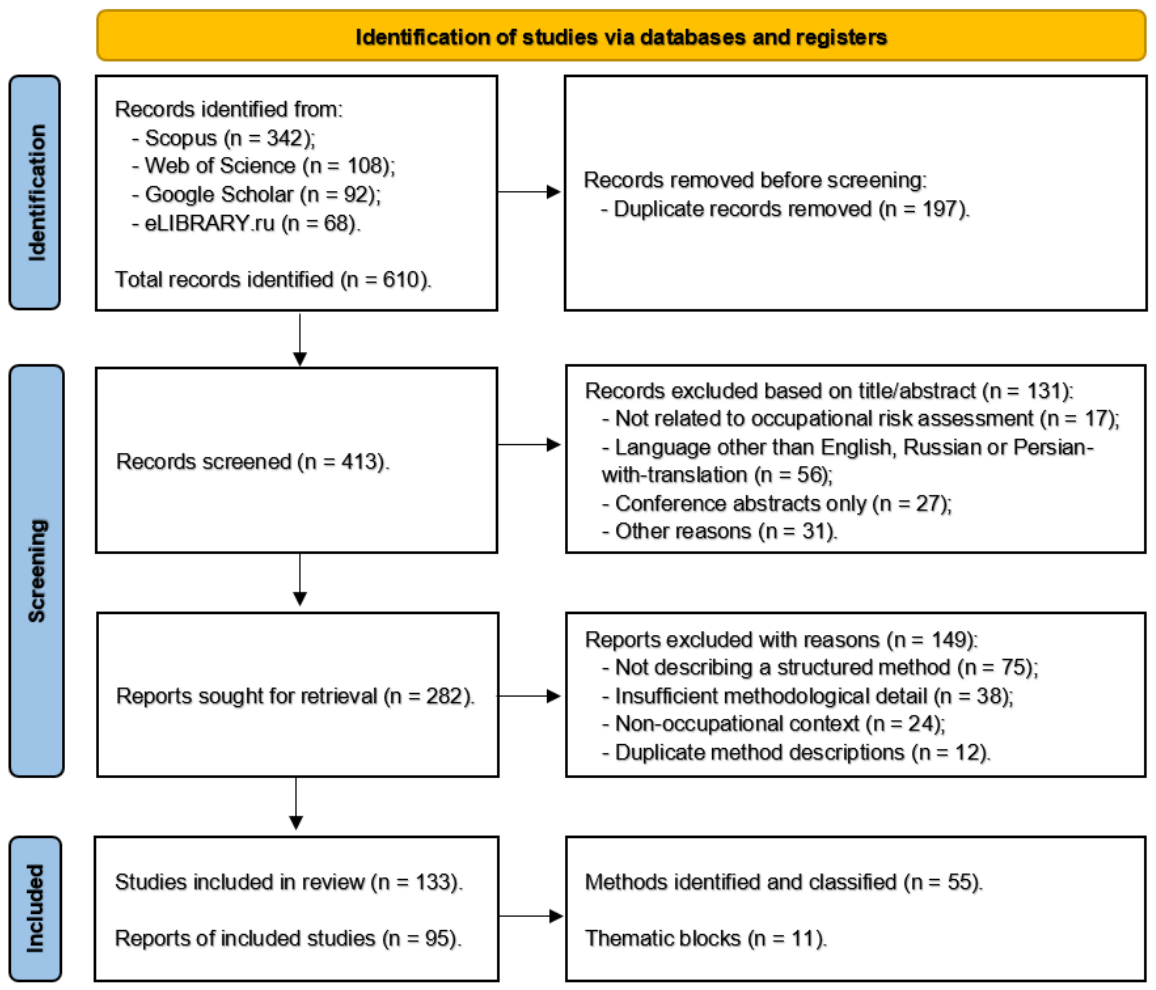

Table 1.
Summary table: Qualitative Hazard Identification.
| Item | Method | Core Principle | Key Advantages | Key Limitations | Typical Applications |
|---|---|---|---|---|---|
| 1 | Check-list | Predefined list of typical hazards | Simple, fast, requires minimal training | Cannot identify novel hazards | Walkthroughs, inspections |
| 2 | CSR | Conceptual safety review at project conception | Assesses fundamental safety of proposed solutions | Conceptual only | Project conception phase |
| 3 | HAZID | Systematic hazard identification using checklists and guide words | Comprehensive coverage, identifies latent hazards | Qualitative only, no probability estimates | Design phase, process audits |
| 4 | HAZOP | Structured analysis using guide words (NO, MORE, LESS, etc.) |
Highly systematic, thorough team-based analysis | Labor-intensive, requires expert team | Continuous process industries |
| 5 | Interview | Direct information gathering from workers | Captures unrecorded hazards, worker engagement | Subjective, time-consuming | Data collection, participatory assessment |
| 6 | JSA | Step-by-step task analysis for specific operations | Task-specific, practical, involves workers | Focuses on one task at a time | Job instruction, work permits |
| 7 | PHA | Early-stage hazard identification for proposed technologies | Quick, applicable with limited information | Preliminary only, lacks detail | Early project phases |
| 8 | Questionnaire | Structured survey of worker perceptions | Scalable, standardized | Response bias, limited depth | Large-scale data collection |
| 9 | What-If | Brainstorming with «What if...?» questions | Flexible, identifies non-standard scenarios | Dependent on participant expertise | Early analysis with limited data |
| 10 | 5 Whys | Sequential questioning to identify root causes | Simple, applicable at incident site | Reactive, does not predict new risks | Incident investigation |
Table 2.
Summary table: Engineering Reliability and Equipment Failure Analysis.
| Item | Method | Core Principle | Key Advantages | Key Limitations | Typical Applications |
|---|---|---|---|---|---|
| 1 | Domino Effect | Analysis of cascading failures | Captures chain reactions | Complex, requires system understanding | Interconnected facilities |
| 2 | ETA | Inductive event tree from initiating event to outcomes | Scenario analysis, protection system evaluation | Requires clear event sequence | Accident scenario analysis |
| 3 | FMEA | Identification of failure modes with RPN = S × O × D |
Systematic, prevention-focused, visual results | Does not consider failure combinations | Equipment design, maintenance |
| 4 | FMECA | FMEA with criticality analysis matrix | More detailed risk ranking | More labor-intensive | Critical equipment analysis |
| 5 | FTA | Deductive logic tree from top event to basic causes | Visual cause-effect, quantitative capability | Labor-intensive for complex systems | Complex system analysis, root cause |
Table 3.
Summary table: Scenario Modeling and Safety Barrier Analysis.
| Item | Method | Core Principle | Key Advantages | Key Limitations | Typical Applications |
|---|---|---|---|---|---|
| 1 | Barrier | Identification and evaluation of protective barriers | Focuses on preventive and mitigative measures | Qualitative or semi-quantitative | Safety system evaluation |
| 2 | BowTie | Combined FTA (left) + ETA (right) with central event | Highly visual, comprehensive | Requires deep process knowledge | Major hazard analysis |
| 3 | Defense-in-Depth | Multiple independent protective layers | Robustness, redundancy | Resource-intensive | High-risk industries |
| 4 | LOPA | Quantitative evaluation of independent protection layers | Justifies additional safety measures | Requires event frequency data | High-risk facilities |
Table 4.
Summary table: Human Reliability Assessment.
| Item | Method | Core Principle | Key Advantages | Key Limitations | Typical Applications |
|---|---|---|---|---|---|
| 1 | HEART | Base error probabilities × APOA coefficients | Simple, extensive empirical base | Subjective APOA estimation | Nuclear, chemical, mining |
| 2 | HRA | Systematic approach to human error probability | Comprehensive, context-sensitive | Requires specialized expertise | Operator reliability assessment |
| 3 | Human Error Analysis | General identification of potential human errors | Broad applicability | Qualitative only | General task analysis |
| 4 | SHERPA | Hierarchical Task Analysis with error classification | Systematic, cross-sector applicability | Qualitative, no probabilities | Broad human factors analysis |
| 5 | SPAR-H | Eight Performance Shaping Factors (PSF) with multipliers | Highly standardized, NRC-developed | Designed for nuclear, requires adaptation | Nuclear, high-reliability industries |
| 6 | THERP | Event-tree modeling of human tasks | Well-documented, extensive database | Labor-intensive | Complex human-machine systems |
Table 5.
Summary table: Semi-Quantitative Ranking Methods.
| Item | Method | Core Principle | Key Advantages | Key Limitations | Typical Applications |
|---|---|---|---|---|---|
| 1 | Elmeri Index | Observation-based safety index (7 criteria) | Visual, tracks dynamics | Subjective criteria scoring | Internal safety audits |
| 2 | Fine-Kinney | R = S × L × E (Severity × Likelihood × Exposure) |
Simple, visual, prioritization capability | High subjectivity | Construction, mining, manufacturing |
| 3 | Matrix | R = P × Q (Probability × Consequence) |
Extremely simple, minimal training | Coarse, static | General workplace assessment |
| 4 | Potential Risk Determination | General scoring methodologies | Flexible, adaptable | Highly variable quality | Various industries |
Table 6.
Summary table: Probabilistic and Statistical Methods.
| Item | Method | Core Principle | Key Advantages | Key Limitations | Typical Applications |
|---|---|---|---|---|---|
| 1 | Bayesian Networks | Graphical probabilistic models with conditional dependencies | Visual, handles complex relationships | Requires large datasets for reliable CPTs | Complex risk systems |
| 2 | Bayesian Statistics | Prior probability updated with new evidence | Flexible, handles incomplete data | Requires prior distribution specification | Risk updating, expert synthesis |
| 3 | CRA | Statistical identification of factor relationships | Objective, quantifies factor contributions | Requires representative datasets | Injury rate prediction, factor analysis |
| 4 | Monte Carlo | Repeated random sampling of input parameters | Accounts for uncertainty, provides distributions | Requires distribution specification | Health risk assessment, accident prediction |
Table 7.
Summary table: Uncertainty and Multi-Criteria Hybrid Methods.
| Item | Method | Core Principle | Key Advantages | Key Limitations | Typical Applications |
|---|---|---|---|---|---|
| 1 | Fuzzy AHP | Pairwise comparisons with fuzzy numbers | Accounts for uncertainty in criteria weighting | Computationally complex | Multi-criteria risk assessment |
| 2 | Fuzzy Logic | Linguistic variables transformed via membership functions | Handles imprecision, captures expert judgment | Requires membership function design | Modification of Fine-Kinney, FMEA |
Table 8.
Summary table: Hygienic and Health Risk Assessment.
| Item | Method | Core Principle | Key Advantages | Key Limitations | Typical Applications |
|---|---|---|---|---|---|
| 1 | COHRA | Comprehensive assessment of multiple occupational health factors | Holistic, multi-factor | Complex, resource-intensive | General occupational health |
| 2 | HRA (Health) | USEPA four-step methodology | Standardized, internationally recognized | Requires exposure data | Population and worker health |
| 3 | ODHEM | Focus on occupational disease hazards | Disease-specific | Limited to disease outcomes | Occupational disease prevention |
| 4 | QNRA | Noise-induced hearing loss probability | ISO 1999 based, quantitative | Requires noise measurement | Noise-exposed occupations |
| 5 | Russian OD risk | Comparison with MPCs /MPLs values with exposure duration | Aligned with Russian norms | Not applicable outside Russia | Russian enterprises |
| 6 | Rmp | Microclimate parameter risk index | Simple, based on normative deviations | Limited to microclimate | Climate-exposed occupations |
| 7 | Rlp | Lighting parameter risk index | Simple, based on normative deviations | Limited to lighting | Workplace lighting assessment |
Table 9.
Summary table: Ergonomic and Biomechanical Risks.
| Item | Method | Core Principle | Key Advantages | Key Limitations | Typical Applications |
|---|---|---|---|---|---|
| 1 | MWRA | Mobile workplace risk assessment | Addresses non-stationary workplaces | Emerging method | Drivers, mobile equipment operators |
| 2 | NIOSH | Lifting equation: RWL = LC × HM × VM × DM × FM × AM × CM |
International standard, quantitative | Requires multiple measurements | Lifting tasks |
| 3 | REBA | Whole-body posture assessment with score 1-15 | Rapid field assessment, accounts for unpredictable postures | Observational, no individual factors | Whole-body ergonomics |
| 4 | RULA | Upper limb posture assessment | Sensitive to hand/wrist risks | Does not assess lower limbs | Control room operators, drivers |
Table 10.
Summary table: Psychosocial Risks.
| Item | Method | Core Principle | Key Advantages | Key Limitations | Typical Applications |
|---|---|---|---|---|---|
| 1 | MBI | Three-component burnout assessment (exhaustion, depersonalization, efficacy) | Most widely used burnout measure | Requires trained administration | Stress assessment in high-stress industries |
| 2 | Stress Audit (HSE) | Six stressor categories (demands, control, support, relationships, role, change) | Standardized, normative values | UK-specific norms | Workplace stress assessment |
Table 11.
Summary table: Behavioral Safety, Culture and Strategic Management.
| Item | Method | Core Principle | Key Advantages | Key Limitations | Typical Applications |
|---|---|---|---|---|---|
| 1 | BBS | Observation and feedback on safe/unsafe behaviors | Engages workers, develops safety culture | Time-intensive, requires organizational support | Safety culture development |
| 2 | Benchmarking | Comparison with industry best practices | Identifies improvement potential | Requires access to comparator data | Performance improvement |
| 3 | Cost-Benefit | Economic evaluation of safety measures | Justifies safety investments | Requires cost data | Investment justification |
| 4 | DO IT | Define, Observe, Intervene, Test | Structured behavioral change process | Requires ongoing commitment | Behavioral safety programs |
| 5 | LCRA | Life-cycle risk assessment | Considers all life-cycle stages | Complex, data-intensive | Long-term project planning |
| 6 | SCMM | Safety culture maturity levels (1-5) | Identifies development path, benchmarkable | Subjective assessment | Safety culture assessment |
| 7 | SWOT | Strengths, Weaknesses, Opportunities, Threats | Strategic, comprehensive | Qualitative only | Strategic OHS planning |
Table 12.
Comparative Analysis of Method Blocks 1-6.
| Data requirements |
Time to conduct |
Analyst qualification |
Result accuracy |
Objectivity | Predictive capability |
Cost of application |
|
|---|---|---|---|---|---|---|---|
| Block 1 | Minimal (expert knowledge) |
Hours-days | Medium (familiarity with process) | Low (hazard list) |
Low (expert-based) |
No | Low |
| Block 2 | High (schematics, parameters) |
Days-weeks | High (engineering) |
High (failure probabilities) |
High (data-driven) |
Yes | High |
| Block 3 | Medium (scenarios) |
Days | High (process safety) |
Medium-high (scenario probabilities) |
Medium (scenario assumptions) |
Yes | Medium-high |
| Block 4 | Medium (task descriptions) |
Days | High (ergonomics, psychology) |
High (error probabilities) |
Medium-high (structured PSF evaluation) |
Yes | Medium |
| Block 5 | Minimal (expert scores) |
Hours-days | Medium (risk assessment training) |
Low (risk rank) |
Low (expert-based) |
No | Low |
| Block 6 | Very high (statistical data) | Weeks-months | Very high (statistics, programming) |
Very high (probability distributions) |
High (statistically based) |
Yes | High |
Table 13.
Comparative Analysis of Method Blocks 7-11.
| Primary purpose |
Core approach | Input data | Measurement scale | Primary strength | Primary limitation |
|
|---|---|---|---|---|---|---|
| Block 7 | Handling imprecise data and multi-criteria decision-making | Mathematical modeling with fuzzy sets and AHP | Expert judgments, linguistic variables, criteria weights | Qualitative to semi-quantitative (fuzzy numbers) | Accounts for uncertainty, integrates multiple criteria | Complex, requires membership function design |
| Block 8 | Assessing health impacts from exposure to harmful factors | Exposure assessment, dose-response modeling, comparison with MPCs /MPLs | Exposure measurements (noise, dust, chemicals, microclimate), exposure duration | Quantitative (exposure levels, disease probabilities) | Direct link to health outcomes, regulatory alignment | Requires specialized equipment, limited to measurable factors |
| Block 9 | Evaluating physical loads on the musculoskeletal system | Posture and movement observation, biomechanical calculations | Posture observations, load measurements, task descriptions | Quantitative (scores, indices) | Quick field application, clear risk thresholds | Snapshot assessment, does not capture variability |
| Block 10 | Assessing mental health, stress and burnout | Questionnaire-based assessment, structured interviews | Worker responses organizational data, incident reports | Qualitative to semi-quantitative (Likert scales) | Structured approach to mental health | Self-report bias, requires organizational commitment |
| Block 11 | Evaluating organizational culture, behavior and strategic effectiveness | Observation, audits, benchmarking, economic analysis | Behavioral observations, safety performance data, cost data | Qualitative to semi-quantitative (maturity levels, scores) | Holistic organizational perspective | Subjective, requires long-term organizational engagement |
Disclaimer/Publisher’s Note: The statements, opinions and data contained in all publications are solely those of the individual author(s) and contributor(s) and not of MDPI and/or the editor(s). MDPI and/or the editor(s) disclaim responsibility for any injury to people or property resulting from any ideas, methods, instructions or products referred to in the content. |
© 2026 by the authors. Licensee MDPI, Basel, Switzerland. This article is an open access article distributed under the terms and conditions of the Creative Commons Attribution (CC BY) license (http://creativecommons.org/licenses/by/4.0/).
Copyright: This open access article is published under a Creative Commons CC BY 4.0 license, which permit the free download, distribution, and reuse, provided that the author and preprint are cited in any reuse.