
Submitted:
20 November 2026
Posted:
24 November 2026
Read the latest preprint version here
Abstract
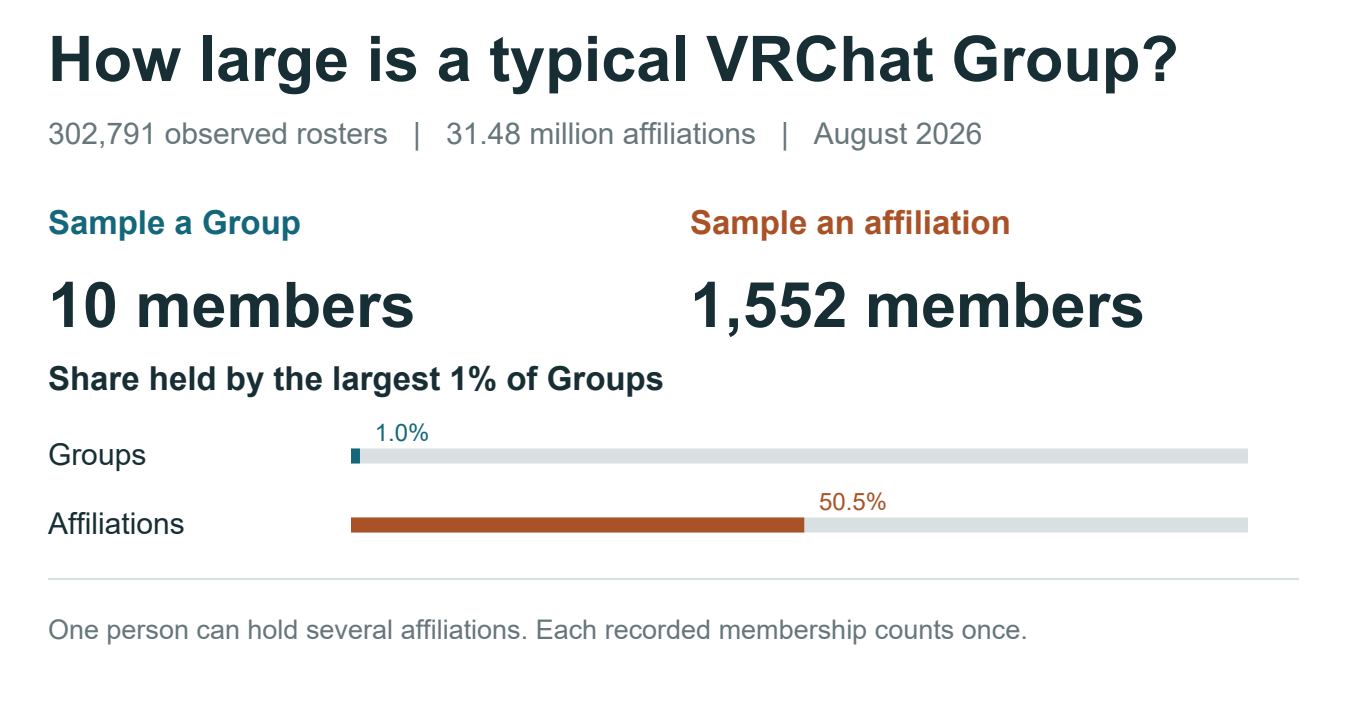
How large is a typical organization in social virtual reality? The answer depends on whether one samples organizations or the affiliations connecting people to them. An archive assembled in August 2026 identifies 302,968 VRChat Groups, including 302,791 with measured rosters. The median Group had ten members, while the median roster attached to a recorded membership had 1,552. The largest one percent held 50.5% of memberships. Across seven overlapping combinations of search rounds, this share ranged from 49.7% to 50.8%. Creation-year differences accounted for 20.5% of Theil inequality; most dispersion occurred within cohorts. A separate analysis used 3,785 Groups with same-response roster and online counts. The pooled count-model exponent was 0.899 (95% robust interval 0.867–0.931). In a fixed-roster simulation, a constant probability of being online produced a median log-plus-one slope of 0.770, close to the empirical 0.758. Conversely, changing a keyword boundary rule reassigned 24.5% of Group labels. The results support a stable descriptive claim about the concentration of affiliations. They also show why digital traces of online status and organizational purpose require independent validation before they can explain participation.
Keywords:
social virtual reality
; VRChat
; online communities
; membership
; organizational inequality
; digital trace data
; computational social science
Copyright: This open access article is published under a Creative Commons CC BY 4.0 license, which permit the free download, distribution, and reuse, provided that the author and preprint are cited in any reuse.