

Submitted:
20 November 2026
Posted:
23 November 2026
You are already at the latest version
Abstract
Physics-informed hybrid models are often reported as better than purely physical or purely data-driven prognostics, usually on same-cell train/test splits. We test this under a leave-one-battery-out (LOBO) protocol on four NASA PCoE Li-ion cells (B0005, B0006, B0007, B0018), comparing (i) a power-law model fitted to the first 30% of each cell’s life and extrapolated, (ii) a Gaussian process regression (GPR) trained on the other three cells, and (iii) a hybrid that adds a pooled GPR residual correction to the power-law fit. The data-driven model gave the lowest mean held-out RMSE (118.4 mAh), followed by the hybrid (173.0 mAh) and the physics-only model (321.0 mAh). The hybrid beat the data-driven model on one cell (B0018: 87.4 vs. 190.9 mAh) but was worse on the other three, most strongly on B0006 (361.1 vs. 94.7 mAh), where the physics-only extrapolation was the best of the three (51.7 mAh). With four cells, none of these differences can be tested statistically, and the data-driven and hybrid models use cycle-concurrent health indicators, so they perform health estimation rather than forecasting. A pooled residual correction therefore cannot be assumed to help. We outline what a test on non-stationary rail duty cycles would require.
Keywords:
prognostics and health management
; Gaussian process regression
; physics-informed hybrid model
; leave-one-battery-out validation
; NASA PCoE dataset
; battery-electric rail vehicles
1. Introduction
Prognostics and health management (PHM) of Li-ion batteries draws on three families of methods: data-driven models, which learn degradation from measured features [1,2,3]; physics-based or empirical ageing models [4,5]; and hybrids that embed degradation physics in a learning model [6]. Studies of all three report strong results. A common design choice behind many of them is to evaluate on the same cell that was used for training, for example by predicting the later cycles of a cell from its earlier ones, and to report the hybrid as the best option.
Same-cell splits can overstate how well a model will serve a new cell. When data come in groups, here cells, validation should hold out whole groups [7]. For battery-electric rail vehicles (BERVs) the issue is sharper, because duty cycles are non-stationary, with traction bursts, regenerative-braking charge and long idle periods. Learning-based diagnosis is known to be sensitive to the operating regime; one of the present authors examined this for gearbox faults under stationary and non-stationary conditions [8]. A prognostic model for rail must therefore generalise across cells and, eventually, across regimes.
This paper asks a simpler question first: on data we already have, and under a leave-one-battery-out (LOBO) protocol, does a physics-informed hybrid outperform simpler alternatives? We answer with real, trained models on the NASA PCoE dataset [9]. Our contributions are (i) a LOBO comparison of physics-only, data-driven and hybrid capacity prognostics on four cells; (ii) a reported failure case of the hybrid (cell B0006) with a hypothesis that fits the numbers better than the usual regime-mismatch explanation; and (iii) a list of what is needed to extend the test to rail duty cycles. The rail extension itself is not tested.
2. Materials and Methods
2.1. Data and Health Indicators
We used the four PCoE cells B0005, B0006, B0007 and B0018 [9], cycled at 24 °C with a 2 A constant-current discharge and tested to a 30% capacity fade (1.4 Ah). The cells, protocol and the power-law fade model are the same as in the companion identification study of this series. Three health indicators (HIs) were extracted from each discharge: the mean discharge voltage, the final-sample terminal voltage and the mean discharge temperature. The GPR inputs were the cycle number, the mean discharge voltage and the mean discharge temperature.
While extracting HIs we found that, in the mirror of the dataset we used, the per-sample elapsed-time arrays of the co-tested cells B0005, B0006 and B0007 were identical to the bit across all 168 shared discharge cycles, even though their discharge cut-off voltages differ (2.7, 2.5 and 2.2 V). This suggests that the time channel records a shared acquisition schedule rather than a cut-off-triggered duration. We therefore used no time-derived feature, such as discharge duration. The voltage, current and temperature arrays differ across cells and cycles as expected. The observation is specific to the mirror and should be checked against the official files.
2.2. Models
Physics-only. Capacity fade follows the power law
fitted to the first 30% of the held-out cell’s own discharge cycles and extrapolated over the remaining 70%, which mimics an early-life prognosis.
Data-driven. A Gaussian process regression [10] with an anisotropic radial-basis-function kernel plus a white-noise term was trained on the pooled data of the other three cells, (n, V̄, T̄) → Q, and applied to the features of the held-out cell. It returns a prediction and a predictive standard deviation.
Physics-informed hybrid. The prediction is
where Qphys is the held-out cell’s own early-life power-law fit and g is a GPR trained on the residuals Qi − Qphys,b(ni) of the three other cells b, each against its own early-life fit, and pooled. This tests whether a learned correction transfers between cells, not only along one cell’s trajectory.
2.3. Evaluation Protocol
Each cell was held out in turn. All three models were scored on the same held-out 70% test window of measured capacities. We report the root-mean-square error (RMSE) and the end-of-life (EoL) cycle error, the signed difference in cycles between the predicted and observed crossing of 1.4 Ah, where both exist.
3. Results
Table 1 and Figure 1 give the LOBO results. The data-driven model had the lowest mean RMSE (118.4 mAh) and the narrowest spread across cells (93.6–190.9 mAh). The physics-only model was erratic: the best of the three on B0006 (51.7 mAh) but the worst on B0005 and B0007 (428.1 and 526.6 mAh), showing how strongly early-life extrapolation depends on which 30% of the life is observed. The hybrid sat between them on average (173.0 mAh). It was the best model for B0018 (87.4 mAh) but worse than the data-driven model for three of the four cells (B0005, B0006 and B0007), and for B0006 about seven times worse than the physics-only model (361.1 vs. 51.7 mAh).
Figure 2 shows B0018, the cell on which the hybrid did best. The physics-only extrapolation drifts steadily below the data, reaching roughly 0.83 Ah at the last cycle against about 1.34 Ah measured. The data-driven prediction stays above the measurements after about cycle 45 and ends near 1.5 Ah. The hybrid follows the data until about cycle 100 and then falls below it, ending near 1.26 Ah, so even its best case shows a late divergence.
4. Discussion
4.1. Why Did the Hybrid Fail on B0006?
A natural explanation is regime mismatch: B0006 has a strongly sublinear fade (power-law exponent b = 0.684, against 0.947–1.058 for B0005 and B0007), so residuals learned from other cells should transfer poorly. The numbers do not fully support this. B0018 has almost the same exponent (b = 0.688) and was in B0006’s training pool, and B0018 was in turn the cell on which the hybrid worked best, with B0006 in its pool.
A second hypothesis fits Table 1 better, and we state it as untested. The correction g is learned from cells whose early-life power-law extrapolation was poor: when B0005, B0007 and B0018 were held out, the physics-only RMSE was 428.1, 526.6 and 277.7 mAh, so the residuals the GPR sees are several hundred mAh. B0006 is the one cell where the physics-only extrapolation was already accurate (51.7 mAh). Applying a large learned correction to a model that needs almost none adds error, which is consistent with the 361.1 mAh obtained. If this is right, the remedy is to scale the correction by the confidence in the physics model, for example by shrinking it, or by weighting each training cell by the similarity of its early-life trajectory to that of the target cell. Both are directions for future work, not results of this study.
4.2. Limitations
- Four cells give four RMSE values per model. No confidence intervals or significance tests are possible, and the ranking could change with other cells or another training window (30% here).
- The comparison is not like-for-like. The data-driven and hybrid models use health indicators measured in the same cycles they predict, so they estimate present capacity; the physics-only model forecasts from an early window. A forecasting version of the GPR would need features restricted to the training window.
- The cells share one chemistry, test bench and discharge protocol, so cross-cell does not mean cross-regime. The results say nothing about rail duty cycles.
- The hybrid is one specific design, a pooled-residual GPR. Other hybrids, such as physics-informed neural networks [6], may behave differently.
- Small experimental datasets are common in engineering machine learning, for example in artificial-neural-network regression on laboratory data [11]; in such settings held-out validation by whole experimental units is the safeguard against optimistic results.
4.3. Towards Non-Stationary Rail Duty Cycles
Extending the test to BERV duty needs three things that we have not done. First, a dataset or a duty-cycle generator that combines variable-C-rate traction bursts, regenerative-braking charge pulses and idle periods, labelled as synthetic if no real rail telemetry is available. Second, a health indicator tied to regenerative-braking recovery, a braking-recuperation charge signature, which we have not found defined in the literature. Third, a repetition of the physics, data-driven and hybrid comparison under that duty with whole cells and, where possible, whole regimes held out [7], to learn whether the transfer problem seen here gets worse, better or stays the same.
5. Conclusions
Under leave-one-battery-out evaluation on real NASA PCoE data, a pure GPR model had the lowest mean error, the hybrid beat it on only one of four cells, and the hybrid was worse than the physics-only model on B0006 by a factor of about seven. A pooled residual correction should not be assumed to improve prognostics, especially when the target cell is already well described by the physics. Whether the same holds under rail duty cycles is an open question that the requirements above would require further research.
Author Contributions
Conceptualization, methodology, writing original draft preparation and review and editing: D.M. J.K.K and W.S.T.F.
Data Availability Statement
The NASA PCoE Li-ion battery ageing dataset is publicly available [9].
Acknowledgments
The authors acknowledge institutional support from the National University of Science and Technology, Bulawayo, Zimbabwe.
Conflicts of Interest
The authors declare no conflicts of interest.
Abbreviations
The following abbreviations are used in this manuscript:
| BERV | Battery-electric rail vehicle |
| EoL | End of life |
| GPR | Gaussian process regression |
| HI | Health indicator |
| LOBO | Leave-one-battery-out |
| PCoE | Prognostics Center of Excellence |
| PHM | Prognostics and health management |
| RMSE | Root-mean-square error |
References
- Li, P.; Zhang, Z.; Xiong, Q.; Ding, B.; Hou, J.; Luo, D.; Rong, Y.; Li, S. State-of-Health Estimation and Remaining Useful Life Prediction for the Lithium-Ion Battery Based on a Variant Long Short Term Memory Neural Network. J. Power Sources 2020, 459, 228069. [Google Scholar] [CrossRef]
- Richardson, R.R.; Osborne, M.A.; Howey, D.A. Gaussian Process Regression for Forecasting Battery State of Health. J. Power Sources 2017, 357, 209–219. [Google Scholar] [CrossRef]
- Severson, K.A.; Attia, P.M.; Jin, N.; Perkins, N.; Jiang, B.; Yang, Z.; Chen, M.H.; Aykol, M.; Herring, P.K.; Fraggedakis, D.; et al. Data-Driven Prediction of Battery Cycle Life before Capacity Degradation. Nat. Energy 2019, 4, 383–391. [Google Scholar] [CrossRef]
- Saldaña, G.; San Martín, J.I.; Zamora, I.; Asensio, F.J.; Oñederra, O.; González, M. Empirical Electrical and Degradation Model for Electric Vehicle Batteries. IEEE Access 2020, 8, 155576–155589. [Google Scholar] [CrossRef]
- Baghdadi, I.; Briat, O.; Delétage, J.-Y.; Gyan, P.; Vinassa, J.-M. Lithium Battery Aging Model Based on Dakin’s Degradation Approach. J. Power Sources 2016, 325, 273–285. [Google Scholar] [CrossRef]
- Wang, F.; Zhai, Z.; Zhao, Z.; Di, Y.; Chen, X. Physics-Informed Neural Network for Lithium-Ion Battery Degradation Stable Modeling and Prognosis. Nat. Commun. 2024, 15, 4332. [Google Scholar] [CrossRef]
- Roberts, D.R.; Bahn, V.; Ciuti, S.; Boyce, M.S.; Elith, J.; Guillera-Arroita, G.; Hauenstein, S.; Lahoz-Monfort, J.J.; Schröder, B.; Thuiller, W.; et al. Cross-Validation Strategies for Data with Temporal, Spatial, Hierarchical, or Phylogenetic Structure. Ecography 2017, 40, 913–929. [Google Scholar] [CrossRef]
- Mashava, D.; Kimotho, J.K.; Muvengei, O.M. Gearbox Multiple Faults Diagnosis under Stationary and Non-Stationary Operating Conditions Using Convolutional Neural Networks. Eng. Adv. 2022, 2, 1–17. [Google Scholar] [CrossRef]
- Saha, B.; Goebel, K. Battery Data Set; NASA Ames Research Center: Moffett Field, CA, USA, 2007; Available online: https://c3.nasa.gov/dashlink/resources/133/ (accessed on 10 October 2026).
- Rasmussen, C.E.; Williams, C.K.I. Gaussian Processes for Machine Learning; MIT Press: Cambridge, MA, USA, 2006. [Google Scholar]
- Sinkhonde, D.; Mashava, D. An Artificial Neural Network Approach to Predict Particle Shape Characteristics of Clay Brick Powder under Various Milling Conditions. Results Mater. 2024, 100650. [Google Scholar] [CrossRef]
Figure 1.
Held-out RMSE under leave-one-battery-out evaluation for the three model types and four cells.
Figure 1.
Held-out RMSE under leave-one-battery-out evaluation for the three model types and four cells.
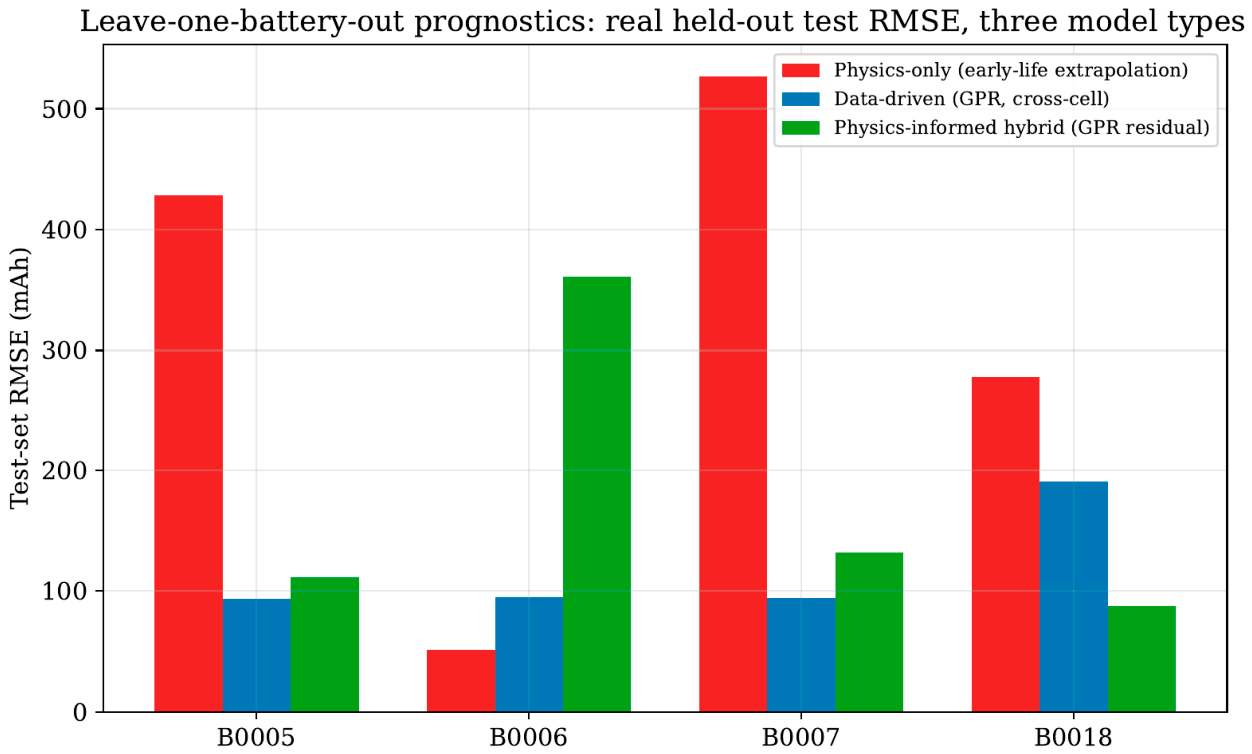
Figure 2.
Measured capacity of the held-out cell B0018 and the physics-only, data-driven and hybrid predictions, with GPR predictive-uncertainty bands for the data-driven model and for the hybrid correction term. The dotted vertical line marks the end of the 30% training window.
Figure 2.
Measured capacity of the held-out cell B0018 and the physics-only, data-driven and hybrid predictions, with GPR predictive-uncertainty bands for the data-driven model and for the hybrid correction term. The dotted vertical line marks the end of the 30% training window.
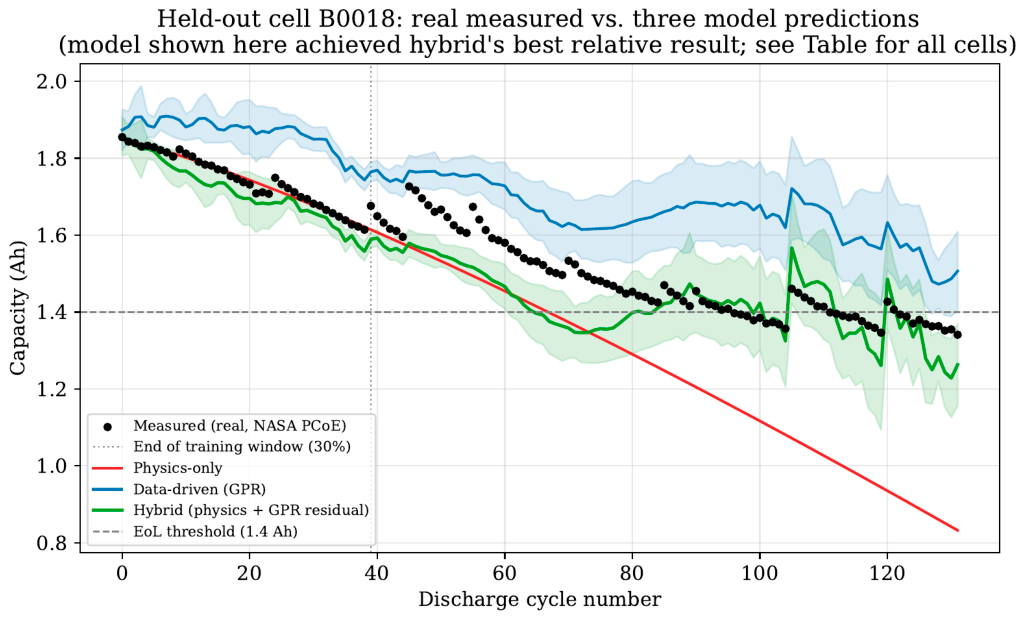

Table 1.
Leave-one-battery-out results: held-out RMSE (mAh) and EoL cycle error for the physics-only, data-driven (GPR) and hybrid (GPR-residual) models.
Table 1.
Leave-one-battery-out results: held-out RMSE (mAh) and EoL cycle error for the physics-only, data-driven (GPR) and hybrid (GPR-residual) models.
| Held-out cell | RMSE physics | RMSE data-driven | RMSE hybrid | EoL error physics | EoL error data-driven | EoL error hybrid |
|---|---|---|---|---|---|---|
| B0005 | 428.1 | 93.6 | 111.5 | −25 | n/a | 50 |
| B0006 | 51.7 | 94.7 | 361.1 | 6 | −15 | 89 |
| B0007 | 526.6 | 94.4 | 131.9 | n/a | n/a | n/a |
| B0018 | 277.7 | 190.9 | 87.4 | −29 | n/a | −37 |
| Mean | 321.0 | 118.4 | 173.0 |
EoL error is undefined (n/a) where the measured cell (B0007 never reaches 1.4 Ah in the recorded cycles) or the model prediction does not cross the threshold.
Disclaimer/Publisher’s Note: The statements, opinions and data contained in all publications are solely those of the individual author(s) and contributor(s) and not of MDPI and/or the editor(s). MDPI and/or the editor(s) disclaim responsibility for any injury to people or property resulting from any ideas, methods, instructions or products referred to in the content. |
© 2026 by the authors. Licensee MDPI, Basel, Switzerland. This article is an open access article distributed under the terms and conditions of the Creative Commons Attribution (CC BY) license.
Copyright: This open access article is published under a Creative Commons CC BY 4.0 license, which permit the free download, distribution, and reuse, provided that the author and preprint are cited in any reuse.