
Submitted:
20 November 2026
Posted:
23 November 2026
You are already at the latest version
Abstract
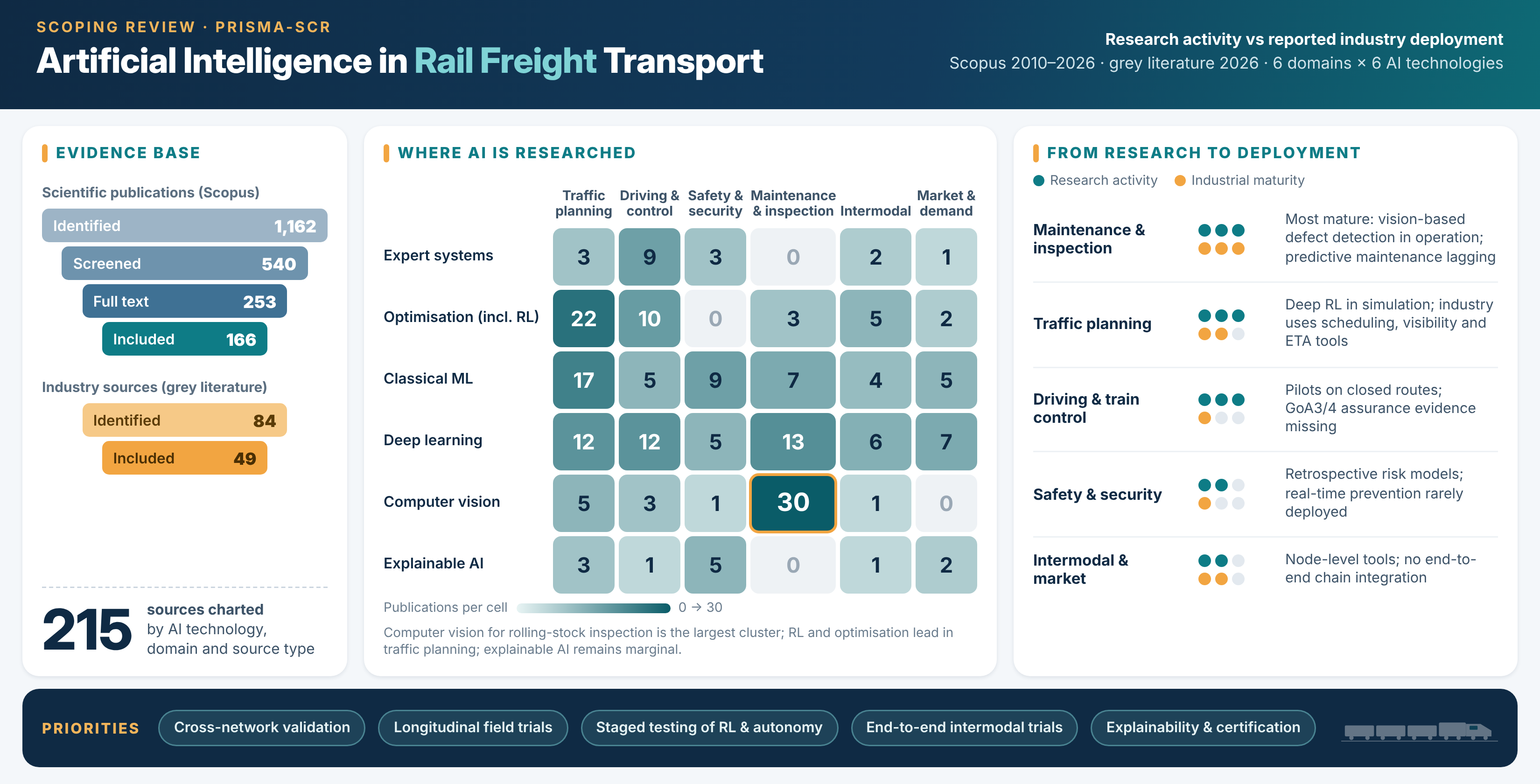
Artificial intelligence (AI) is increasingly investigated and deployed in rail freight transport, despite fragmented evidence across operational domains, technologies, and implementation status. This scoping review maps AI applications in rail freight and compares scientific publications with industrial practice. English-language sources pub-lished from 2010 onwards addressing direct rail freight applications were eligible. Sci-entific publications were identified in Scopus using combined rail freight and AI search strings. Grey literature was examined separately to identify industrial deployments. In total, 166 scientific publications and 49 grey-literature sources were included. Sources were charted by AI technology, application domain, and source type. Evidence was organised into six domains: traffic planning and management; assisted driving and train control; safety and security; maintenance and inspection; intermodal operations; and market analysis and demand forecasting. Maintenance and inspection emerged as the most extensively researched and industrially mature domain for defect detection, driven by computer vision and machine learning (ML), although predictive maintenance re-mains less mature. reinforcement learning (RL) featured frequently in train control, scheduling, and energy optimisation, whereas explainable AI (XAI) and emerging ap-proaches remained underrepresented. Findings highlight the need for cross-network validation, longitudinal field trials, transparent models, and stronger evidence con-cerning safety, transferability, and lifecycle benefits.
Keywords:
artificial intelligence
; rail freight transport
; machine learning
; computer vision
; reinforcement learning
; predictive maintenance
; autonomous train operation
; scoping review
; deep learning
1. Introduction
Rail freight transport is expected to contribute substantially to the decarbonisation of the European transport system. The European Green Deal sets the objective of achieving climate neutrality by 2050 [1], while the Sustainable and Smart Mobility Strategy envisages a 100% increase in rail freight traffic by 2050 [2]. Achieving these targets will require rail freight to improve its reliability, flexibility, capacity, and cost competitiveness.
Despite these strategic objectives, the rail freight sector faces a significant technological and digital lag compared to both passenger rail and road freight transport. Passenger networks have integrated advanced digital signalling, automated operations, and real-time information systems at a faster pace, but freight operations remain constrained by legacy infrastructure, manual workflows, and a general lack of digitalisation. This lag stems not only from technical constraints but also from structural and economic barriers. The rail freight sector operates under severely compressed profit margins, which limit the financial capacity and economic incentives to invest in digital technologies such as artificial intelligence (AI) [3]. This financial and digital divide limits operational agility, undermining the sector’s competitiveness against more flexible modes [4]. AI has the potential to bridge this digitalisation gap, enabling the sector to modernise its operations, accelerate automation, and meet the ambitious traffic and sustainability targets set for 2050.
AI has been extensively studied across railway systems for several decades, and recent systematic reviews have sought to synthesise this body of literature. A comprehensive synthesis was provided by Tang et al. [5] in 2022, mapping AI applications across traffic management, train control, safety, maintenance, and passenger transport up to 2020. Similarly, Zhang and Zhang [6] conducted a systematic literature review in 2023 focusing specifically on AI applied to rail traffic planning and management. More recently, Flammini [7], co-author of the Tang et al. review, extended the analysis to the 2020–2025 period, addressing emerging topics such as explainable AI (XAI), digital twins and large language models (LLMs). However, these railway-wide and domain-specific reviews do not fully capture the particularities and deployment challenges specific to rail freight transport.
Given the breadth and heterogeneity of the evidence, a scoping review was considered appropriate for mapping AI technologies, application domains, and implementation and deployment status without restricting the analysis to a narrowly defined intervention or outcome [8,9]. The review was reported in accordance with the discipline-independent PRISMA Extension for Scoping Reviews (PRISMA-ScR) to ensure transparency and reproducibility [10].
Because industrial deployment is not always captured in indexed scientific publications, the scientific review was complemented by a targeted screening of grey literature. This component was designed to identify reported commercial solutions, demonstrators, pilot projects, and operational applications of AI in rail freight, rather than to provide an exhaustive market assessment. Scientific publications and grey-literature sources were therefore treated as complementary forms of evidence. The first group mainly indicates research activity and methodological development, whereas the second group provides indications of industrial uptake and reported deployment.
This study maps AI research and reported deployment in rail freight transport and compares both evidence streams to identify concentrations of research activity, areas of emerging industrial use, and gaps between experimentation and implementation. The scientific and grey-literature searches followed different procedures, as described in the Methodology section.
The review addresses the following research questions:
- Which AI technologies are being researched or applied in rail freight transport?
- How are these applications distributed across the principal operational domains of rail freight?
- What evidence is available regarding their implementation status and industrial deployment?
2. Methodology
2.1. Taxonomy of Rail Freight Domains
To systematically map AI applications in rail freight transport, this review adapts the railway domain taxonomy originally proposed by Bešinović et al. [11] and applied later by Tang et al. [5], both developed within the framework of the RAILS project. Their framework identifies seven railway sub-domains: maintenance and inspection, safety and security, autonomous driving and control, traffic planning and management, revenue management, transport policy, and passenger mobility. For the specific context of rail freight transport, we retain four of these sub-domains (traffic planning and management, assisted driving and train control, safety and security, and maintenance and inspection). We explicitly excluded passenger mobility, as it falls outside the scope of freight transport. Furthermore, revenue management and transport policy were excluded as distinct categories because the scientific literature reveals no dedicated AI applications for these domains in the freight context (a finding consistent with Tang et al. [5]). Any publications associated with these two domains identified during the search were incorporated into two new freight-specific domains: intermodal operations, and market analysis and demand forecasting.
A similar structural adaptation was applied to define the sub-domains. Rather than imposing the hierarchy used by Tang et al. [5], the sub-domains were defined inductively based on the specific operational challenges, decision-making horizons, and data modalities identified in the reviewed literature. The resulting framework of six main domains and their corresponding sub-domains and thematic areas is summarised in Table 1.
2.2. Taxonomy of AI Technologies
The classification of AI technologies follows the same reference framework from the RAILS project. Bešinović et al. [11] distinguish three conceptual levels (AI techniques, AI research fields, and AI applications) and separate, for example, a learning paradigm from the algorithm that implements it or from the application in which it is embedded. Tang et al. [5] operationalised this framework into eleven general AI fields. Both levels of detail were considered excessive for the purposes of this review, where the objective is to map which technologies are applied to which freight problems rather than to classify algorithms.
The framework was therefore condensed into six categories: (1) expert systems, including rule-based and fuzzy logic approaches; (2) optimisation methods, including heuristics, metaheuristics, and reinforcement learning (RL); (3) classical machine learning (ML), covering supervised, unsupervised, and time-series learning; (4) deep learning (DL), comprising fully connected, convolutional, and recurrent neural networks; (5) computer vision, covering image and video analysis based on both handcrafted features and learned representations; and (6) XAI. Figure 1 shows the resulting conceptual map and the relations between its branches.
Figure 1 represents a trade-off between taxonomic precision and charting reliability. The six categories were therefore defined to be coarse enough for consistent assignment across a heterogeneous evidence base while retaining relevant distinctions to interpret the results.
Two consequences follow from this design. First, the categories are not mutually exclusive. Computer vision overlaps with deep learning whenever detection or segmentation is performed by a neural network, and expert systems overlap with classical ML in neuro-fuzzy controllers. Second, RL is grouped under optimisation methods rather than treated as a separate category, because the reviewed studies use it predominantly for sequential decision-making and optimisation tasks in scheduling, marshalling, resource allocation, and train control. Each publication was primarily assigned to the category corresponding to its principal methodological contribution; however, studies addressing more than one problem or combining several paradigms may appear in more than one subsection of Section 3.3. XAI is treated as a cross-cutting category, since explainability mechanisms are applied to models belonging to any of the other five groups rather than constituting a separate class of algorithms.
2.3. Literature Search and Selection Process
The systematic part of the review was conducted in line with the PRISMA extension for scoping reviews; the completed PRISMA-ScR checklist is provided in Table S1 (Supplementary Materials). Publications were considered from 2010 onwards, and only records with an abstract available in English were screened, so that the scope of each study could be assessed consistently; records whose full text was not available in English were excluded at the full-text stage. The literature search was performed in Scopus, which was selected because its journal coverage is broader than that of Web of Science and includes almost all of the journals indexed in that database [12,13]. Given the size of the resulting record set, no additional bibliographic database was searched.
The search strings used in this review were derived from the general AI fields identified by Tang et al. [5] and Bešinović et al. [11], including machine learning, deep learning, neural networks, expert systems, data mining, pattern recognition, operations research, natural language processing, and computer vision. The search was extended to adjacent enabling domains that recent railway-wide reviews identify as increasingly relevant to AI deployment, such as cybersecurity, digital twins, the Internet of Things (IoT), and data-driven methods [7]. This extension was intended to capture studies in which AI is embedded within a broader digital system but is not labelled as such in the title or abstract.
Two complementary searches were carried out: the first between 30 June and 16 July 2025, and a second, focused search on 24 February 2026 to extend the scope to AI applications in marshalling yards and shunting operations. The first search combined the terms rail freight and freight train with a range of keywords spanning the main AI domains and adjacent domains, such as cybersecurity, digital twins or IoT. The second search combined marshalling yard, rail shunting, and rail yard operations with high-level AI concepts. Each search used Boolean combinations of these terms, progressing from broad AI concepts towards more specific AI terminology. The search strings and their result counts are reported in Table 2. A record was retrieved when the AI term and the rail freight term of a string appeared in its title, abstract, or keywords. The exact Scopus syntax, the date on which each string was run, and the deduplication procedure are provided in the Supplementary Materials (Tables S2 and S3).
In addition to the systematic search, a less exhaustive review of the grey literature (technical articles) was carried out to capture industry- and practitioner-oriented applications that the scientific databases do not index. Two web publications widely followed in the rail freight transport community, www.railmarket.com and www.railfreight.com, were screened with a reduced set of search strings. The searches were conducted on www.railmarket.com in August 2026, with a complementary check in September 2026, and on www.railfreight.com in October 2026; the access dates reported in the reference list correspond to these searches. This review was deliberately less systematic than the scientific search. It covered only these two sources and was not intended to be exhaustive as its aim was to identify which AI applications have begun to be implemented in practice. The material indexed on these sites is relatively recent with the main focus on Europe and with the earliest items dating from 2018. Given the exploratory purpose of this part of the review, the limited time depth was not a material constraint. Given the different target audiences of these two platforms, with www.railmarket.com addressing the broader railway industry and www.railfreight.com focusing specifically on rail freight, distinct search strings were employed for each. The specific search strings used for each website are summarised in Table 3.
While Table 2 reflects the initial number of records identified in the academic databases, the numbers in Table 3 represent a first preselection of technical articles based on their title and introductory paragraph, as these platforms do not provide standardised abstract indexing.
For both the scientific publications and the technical articles, included records were required to describe a direct application of AI to rail freight. Studies focusing on general railway infrastructure (e.g., bridges, sleepers, or track) without a specific rail-freight application were excluded, as were records in which no explicit rail freight use case was identifiable. Title and abstract screening of the scientific publications was supported by Elicit (AI research assistant, Elicit Research; accessed September 2025–December 2025), and all inclusion and exclusion decisions were verified by two reviewers. Following the screening, two reviewers independently charted and assessed the included studies using a standardised data extraction form. The extracted fields comprised the title, authors, publication year, AI technology used, rail-freight application area, and source type (e.g., journal paper, conference paper, or industry article). Implementation status was not charted as a separate data item for the scientific publications, as most of them report validation in simulation or on historical datasets without a formal maturity level. The evidence on implementation status and industrial deployment (third research question) therefore relies solely on the grey-literature sources. Any disagreements between the reviewers were resolved through discussion, with a third reviewer consulted when necessary. A review protocol was not registered. Consistent with scoping review methodology, no formal critical appraisal of the included sources was performed.
The complete study selection process, including the number of records identified, screened, excluded, and finally included, is summarised in the PRISMA flow diagram presented in Section 3.
3. Results
The study selection process followed the PRISMA-ScR guidelines and was structured in two parallel tracks: scientific publications and grey literature.
For the scientific literature, the initial search in Scopus identified 1,162 records. After removing 622 duplicates, 540 records were screened by title and abstract, resulting in the exclusion of 287 records. The remaining 253 articles underwent full-text assessment. Of these, 87 were excluded for the following reasons: non-English full text (n = 18), publication outside the defined timeframe (n = 15), duplicated records (n = 2), or lack of relevance (n = 52). The irrelevant studies comprised research focused solely on general infrastructure (n = 16), non-AI methodologies (n = 17), or non-freight rail applications (n = 19). Consequently, 166 scientific publications were included in the review.
For the grey literature, 84 technical articles were identified from the webpages described in Section 2.3. Full-text screening led to the exclusion of 35 articles: duplicated content (n = 3) and lack of relevance (n = 32), the latter comprising non-AI methodologies (n = 16), general infrastructure (n = 2), non-rail freight applications (n = 3), and other reasons (n = 11). Consequently, 49 technical sources were included in the review.
In total, the final evidence base comprises 215 sources (166 scientific publications and 49 technical articles). Figure 2 illustrates the complete selection process.
3.1. AI Applications Across Rail Freight Operational Domains
Following the domain taxonomy defined in Section 2.1, the reviewed publications are organised into six operational domains: traffic planning and management, assisted driving and train control, safety and security, maintenance and inspection, intermodal operations, and market analysis and demand forecasting. Within each domain, applications are further classified according to the sub-domains and thematic areas outlined in Table 1.
3.1.1. Traffic Planning and Management
Traffic planning and management represent a core operational challenge in rail freight, where AI is increasingly leveraged to optimise resource allocation, network resilience, and real-time responsiveness. A technological evolution is evident in the reviewed literature. Early studies predominantly relied on classical ML (e.g., random forests, support vector machines (SVM), gradient boosting) for structured delay prediction and ETA estimation. Recent research shows a shift towards DL and RL architectures designed to capture complex spatial-temporal dependencies in large-scale networks. To structure this heterogeneous evidence, the reviewed publications are categorised below into three classic temporal decision-making layers: strategic, tactical, and operational.
Strategic level
At the strategic level, research primarily addresses long-term optimisation of rail freight systems, with a strong emphasis on infrastructure design and network resilience. Johnson et al. (2022) employed Gradient Boosting Machines (GBM) alongside partial dependence plots to analyse spatial vulnerabilities of freight networks to disasters [14]. Regarding infrastructure design, Wang (2023) integrated Neural Networks (NN) with Ant Colony Optimisation (ACO) algorithms to optimise transfer station locations, effectively balancing highway logistics and railway transportation [15].
Tactical level
At the tactical level, research shifts towards medium-term planning, employing AI for dynamic resource allocation and scheduling. This is primarily addressed in two areas: yard and terminal operations, and crew management. Regarding yard operations, Qi (2016) developed hybrid intelligent optimisation models based on stochastic simulation, NN, and genetic theory to improve wagon placing-in and taking-out operations [16]. Expanding on this, Wu et al. (2025) proposed a dual-agent system for heavy-haul railway port stations that tightly integrates operational planning with resource allocation. Their framework combined a Pareto-based approach to model trade-offs between operations and resources with Convolutional Neural Network (CNN) to extract patterns from real-time scheduling data [17]. Finally, addressing workforce management, Brezulianu et al. (2023) applied supervised ML through a Random Forest (RF) model to optimise driver scheduling [18].
Operational level
At the operational level, AI applications focus on real-time or near-real-time decision-making, targeting dynamic constraints and immediate system responsiveness. This domain is structured across four main areas: marshalling yard operations, energy-efficient driving, predictive analytics and traffic forecasting, and rescheduling and disruption management.
Marshalling yard operations
Marshalling yards represent a particularly intensive area of operational optimisation, further reinforcing the broader theme of AI-driven decision support in railway systems. Within this domain, the focus narrows to highly dynamic, operationally constrained environments where real-time or near-real-time decisions significantly impact overall network performance. Hirashima (2011a, 2011b, 2011c, 2013, 2014a, 2014b, 2020) consistently applied RL to marshalling processes, targeting improvements in freight car arrangement, locomotive movements, and processing times [19,20,21,22,23,24,25]. Advancing this, Lavrukhin et al. (2019) presented a Genetic Algorithm (GA) for wagon rearrangement considering dangerous goods safety positioning [26], and Qiu (2025) employed Deep Q-Networks (DQN) to optimise shunting operation plans by minimising the number of required shunting hooks [27].
Regarding automation and vision-based control, Boddiford et al. (2015) proposed a robotic system designed to automate the uncoupling of freight cars, based on machine vision algorithms [28]. Shabelnikov et al. (2020) applied nonlinear regression models to calculate the optimal exit speed from the brake position for a group of wagons that slide from the hump [29]. More recently, Guo et al. (2022) used NN (YOLOv5) to identify the type of coupler rod and its position to enable automated uncoupling in marshalling yards [30]. Zhang et al. (2024) integrated a Graph NN with Deep RL to minimise railcar dwell time in marshalling yards [31], and Shulzhenko et al. (2024) combined a data-driven algorithm based on a deep learning NN model for recognising wagon cuts with a virtual model of the classification bowl based on multisensory data to solve the necessity of wagon cuts monitoring in the classification bowl [32].
For predictive yard operations, Panchenko et al. (2020) proposed applying RF models to forecast the expected cargo dispatch times [33], while Wan et al. (2021) evaluated several NN architectures, including a Recurrent NN called Long Short-Term Memory (LSTM), attention-based models, and error-corrected LSTM networks, to predict key points of wagon braking curves [34]. Panasov et al. (2024) applied classification algorithms based on hierarchic Decision Trees (DT) to improve the track occupancy measurements from trackside equipment [35].
Regarding wagon identification and recognition, Zhang et al. (2017) applied CNN for the recognition of characters of lateral inscriptions in rail freight trains [36], while Xiucai and Gongli (2020) used deep learning to identify train numbers under difficult environmental conditions [37].
Energy-efficient driving
Energy-efficient driving links operational control with sustainability by optimising speed profiles and traction. Zhou et al. (2021) proposed a DL model combining an attention mechanism with LSTM, to predict air pressure dynamics in heavy-haul train braking systems [38]. For trajectory optimisation, Lin et al. (2022) and Lin et al. (2023) developed RL methods for multi-objective speed trajectory optimisation [39,40]. Zhang et al. (2023) applied an improved Q-learning algorithm to jointly optimise energy use and running time [41]. Finally, Istomin et al. (2023) proposed an LSTM-based model to iteratively optimise traction and braking forces in freight electric locomotives using historical data [42].
Predictive analytics and traffic forecasting
This domain emphasises data-driven system understanding, leveraging predictive models to anticipate traffic dynamics, estimate travel times, and monitor network performance.
In traffic and behavioural analysis, Zheng et al. (2018) analysed GPS data using SVM and tree-based methods to identify distinct train driving modes [43]. To optimise door-to-door railway route calculation, Wang et al. (2019) and Gong et al. (2019) tested different swarm intelligence algorithms to accelerate optimisation models [44,45].
Regarding delay prediction and cause analysis, Pineda-Jaramillo and Viti (2023) developed ML operations workflows using a LightGBM model to enable real-time delay prediction [46]. Complementing this and using the same LightGBM model approach, Pineda-Jaramillo et al. (2023) predicted short-term arrival delays in freight rail operations and identified the features most associated with them [47].
Travel time and ETA prediction is a major focus, with studies comparing various ML techniques. Barbour et al. (2018a) demonstrated the effectiveness of support vector regression for ETA estimation [48], while Barbour et al. (2018b) applied deep NN [49]. Prokhorchenko et al. (2019) selected a Multi-Layer Perceptron (MLP)-NN to forecast the ETA of freight dispatches [50], and Makarov (2019) demonstrated the effectiveness of GBM models for reducing travel time prediction error [51]. Balster et al. (2020) developed tree-based ETA models for proactive responses to delays, particularly in intermodal transport chains [52]. Liu et al. (2022) introduced a phased prediction approach that combines RF with feature-weighted K-Nearest Neighbours (KNN) [53]. Minbashi et al. (2023, 2024) enhanced yard arrival and departure predictions through ML-assisted macro-simulation frameworks based on DT algorithms [54,55]. Milenković et al. (2024) compared a range of forecasting methods, including ARIMA, LSTM, hybrid ARIMA-LSTM, and singular spectrum analysis models, using monthly freight traffic data from four international railway border crossings [56]. Yaghini and Ezati (2025) improved prediction accuracy by incorporating geospatial features into RF models [57], and Kumar et al. (2025) ensembled Graph Convolutional Networks, LSTM, and Kalman filters for dynamic travel time calculations [58].
For large-scale and complex networks, Zhang et al. (2025) proposed a hybrid deep learning model combining discrete wavelet transform, CNN, and bidirectional Gated Recurrent Units (GRU) to forecast travel times for the China–Europe Railway Express [59], while Bretas et al. (2025) developed a Multi-Agent deep RL framework to manage real-time traffic and resolve deadlocks [60].
Rescheduling and disruption management
Rescheduling and disruption management emphasises real-time responsiveness and adaptive planning under uncertainty. Rößler et al. (2018) developed an agent-based model combined with classical ML algorithms to test robustness of freight train schedules against delays [61]. Bretas et al. (2021, 2023) applied Multi-Agent deep RL to freight train scheduling, allowing multiple decision-making agents to coordinate in real time without relying on a single centralised controller [62,63]. Alaei et al. (2024) implemented agent-based re-routing algorithms for synchromodal transport networks, enabling flexible adjustments in response to missed connections or delays across interconnected modes of transport [64]. Li et al. (2025) utilised DQN for adaptive resource allocation, modelling real-time interactions between rail logistics and urban traffic [65]. Finally, Stein et al. (2025) proposed a conceptual RL-based framework to detect disruptive events and communicate alternative routing options in real time [66].
3.1.2. Assisted Driving and Train Control
Assisted driving and train control research encompasses technologies ranging from driver assistance to fully autonomous operation, aiming to reduce human intervention while optimising energy efficiency and safety. The literature demonstrates a progressive shift from classical rule-based and fuzzy logic controllers towards advanced Deep Reinforcement Learning (Deep RL) and hybrid data-driven models capable of handling nonlinear dynamics and real-world uncertainties. Recent studies have also begun to address the verification, validation, and certification challenges associated with higher Grades of Automation (GoA). The following subsections detail these developments, structured around control algorithm implementations, energy optimisation, and verification methodologies.
Control algorithm implementations.
Deep RL and data-driven methods have become dominant for autonomous control, evolving from basic implementations to complex, dynamic adaptations. Tang et al. (2019) proposed an RL architecture based on a double-switch Q-network for optimal control of multiple electric locomotives in heavy-haul freight operations, eliminating reliance on prior dynamic modelling [67]. Feng et al. (2021) extended this approach by integrating deep RL with a mass estimation network to address dynamically varying train masses [68], and Lin et al. (2022) applied Q-learning to optimise control sequences without requiring prior knowledge of train dynamics, focusing on safe and energy-efficient speed trajectory optimisation [39].
More recent developments address real-world complexities. Zhang et al. (2024) developed a data-driven approach combined with an NN model to monitor in-train forces under service conditions [69], and Costa-Barros and Lima de Castro (2025) developed an AI planner using DQN-RL to generate driving strategies for heavy-haul trains, balancing speed limits, travel time, and fuel efficiency on real railway routes [70]. Furthermore, Yi et al. (2024a) and Yi et al. (2024b) proposed hybrid controllers combining predictive active disturbance rejection or affinity propagation with Elman NN to enhance speed tracking and prevent wheel slip [71,72].
To address uncertainty, nonlinear dynamics, and time-delay effects, fuzzy logic combined with NN has been progressively refined. Initial work focused on specific operational tasks. Bai et al. (2014) proposed a Fuzzy Neural Network (FNN) based on historical train stopping data to model braking performance to estimate braking distances and advise drivers on the optimal braking initiation point [73]. This evolved into multi-modal fuzzy proportional–integral–derivative controllers enhanced with NN learning for traction and speed tracking (Yang et al. (2017) [74]; Sun et al. (2019) [75]). Recent studies have expanded this to comprehensive control schemes. Yi et al. (2024c) proposed a freight train speed tracking control scheme based on a Takagi-Sugeno FNN to improve freight train speed regulation and anti-slip performance under varying track conditions [76], and Zhang et al. (2025) proposed a hybrid control framework combining Northern goshawk optimisation, optimised LSTM networks, variable-universe fuzzy control, and sliding-mode control to improve the stability and safety of heavy-haul train operations [77].
Parallel advancements in positioning and coordinated control have leveraged multi-agent systems and advanced sensor fusion. Betazzi Dordal and Coelho Avila (2016) developed a rule-based multi-agent framework for autonomous train coordination through inter-agent communication [78].
For positioning, Li et al. (2021) improved Ultra-wideband accuracy in multipath environments using Bayesian filtering [79], followed by Li et al. (2023), who evaluated monocular visual–inertial Simultaneous Localisation And Mapping (SLAM) methods to leverage simple sensor setups [80]. Most recently, Li et al. (2024) utilised CNN to optimise speed curve generation while preserving real-time performance constraints of automatic train control systems [81].
Energy optimisation.
Energy optimisation has evolved from basic simulation to advanced, multi-objective AI-driven models. Early approaches by Vecino-Sato et al. (2012) included a software agent to simulate automated driving and estimate energy consumption relative to human drivers [82], the application of an ACO algorithm by Li et al. (2016) to optimise the train speed curve [83], and the use of DT by Huang et al. (2016) to derive optimal driving patterns from expert behaviour [84].
As the field matured, Istomin et al. (2023) conducted a comprehensive analysis of existing methods and technical solutions applied globally to improve the energy management efficiency of electric rolling stock [85]. The field has since shifted towards hybrid AI models. Lin et al. (2022) formulated the train speed trajectory optimisation problem using Q-learning [39]. Lin et al. (2023), with the same lead author, introduced a Q-learning variant incorporating a GRU network to address energy efficiency, punctuality, and accurate parking [40]. In parallel, Zhang et al. (2023) improved Q-learning by modifying the update rule to reduce overestimation in energy consumption predictions [41].
Other research has focused on large-scale forecasting and harvesting. Komyakov et al. (2024) developed linear regression models combined with an NN model for forecasting the fuel and electricity consumption of a sample of freight trains [86]. Tao et al. (2024, 2025) proposed a data-driven optimisation model for traction substation energy consumption, combining Dynamic Programming with multi-input, multi-output self-organising FNN [87], and later addressed the optimisation problem with a competitive swarm optimisation algorithm [88]. Tang et al. (2025) presented an AI-driven device designed to harvest energy from inter-carriage vibrations in freight trains. This work used a GRU-based deep learning model to assess the status of the train [89].
Verification and validation.
Verification and validation methodologies have advanced to ensure the safety of increasingly autonomous systems. Peleska et al. (2022) analysed software technologies for certifying GoA4 architectures, specifically addressing the certification challenges of safety-critical control functions based on AI methods [90]. Niu et al. (2022) further verified the robustness and real-time performance of a track line recognition algorithm based on Zhang–Suen thinning theory under diverse track geometries and weather conditions [91]. Gleirscher et al. (2023) proposed a quantitative risk assessment framework combining statistical analysis with parametric stochastic model checking for AI-based obstacle detection systems [92]. Finally, Wang et al. (2024) conducted extensive testing across diverse railway environments spanning over 3,000 km to validate their multi-LiDAR SLAM system [93].
3.1.3. Safety and Security
Safety and security applications in freight rail leverage AI-driven systems to address operational risks, prevent accidents, and strengthen physical and digital resilience. The reviewed studies demonstrate the application of ML, computer vision, and DL to quantify financial risks, predict derailment severity, and enable real-time proactive parameter estimation. While several models analyse historical accident data to identify risk factors, recent research has also shifted towards real-time monitoring and digital risk mitigation. The following subsections synthesise these efforts, organised by risk management, railway accident prevention, and real-time monitoring.
Risk management.
Applications in this field employed AI techniques to identify, assess, and mitigate a broad spectrum of risks across freight rail systems, extending from physical and operational hazards to financial, human, and cyber vulnerabilities. Regarding the quantification of financial and economic risks, Dhingra et al. (2023) identified and ranked factors associated with financial losses in Class I railroad accidents using various ML techniques, including RF, KNN, SVM, stochastic gradient boosting, Extreme Gradient Boosting (XGBoost), and stepwise linear regression [94]. Later, Huang et al. (2025) analysed freight-train derailment severity by predicting economic costs based on factors such as the number of derailed cars, derailment speed, loading factor, and residual train length. Their model employed a Choquet integral-based multivariate polynomial regression approach [95]. In terms of pre-operational cargo safety, Li et al. (2022) employed LiDAR-assisted stereo vision to analyse drone-acquired images of rail freight wagons and measure oversized cargo [96].
From a vehicle dynamics and systems perspective, several studies have focused on modelling mechanical interactions and enhancing operational interfaces. Bosso et al. (2024) developed digital twin models based on surrogate models via supervised kernel-based ML regressions to represent the railway vehicle dynamics and apply these models to analyse the wheel-rail forces in different scenarios [97]. Complementing this approach, Ran et al. (2025) introduced a Hybrid CNN and Extreme Learning Machine (ELM) model to dynamically identify coupler forces in heavy-haul locomotives [98]. Concerning the human-machine interface within locomotive cabins, Wei et al. (2024) proposed an FNN including an adaptive control of light intensity to reduce the impact that the light environment may have on the quality of the driver’s virtual image information acquisition [99]. Finally, expanding the scope of risk mitigation to the digital domain of cybersecurity, Yu et al. (2025) designed an unsupervised autoencoder-based deep learning approach to detect false data injection attacks in the virtual coupling systems of heavy-haul trains [100].
Railway accident prevention.
These studies target specific failure modes and accident scenarios, employing AI to predict, detect, and prevent incidents before they escalate.
A significant research effort has focused on derailment analysis and severity prediction. Klein Schaarsberg et al. (2021) analysed the relationship between the speed of freight trains and ground vibrations using RF-ML models. While originally focused on reducing environmental noise in residential areas, the methodology can be extended to derailment prevention [101]. Song et al. (2022) combined structured and non-structured data using linear discriminant analysis models to improve the severity estimation of derailment accidents [102]. Lotfi et al. (2023) tested different ML classification methods including DT, RF, SVM, and AdaBoost techniques to identify factors affecting the severity of freight train derailment [103]. More recently, Liu et al. (2025) presented a prediction model based on an RF algorithm for the assessment and prevention of freight-train derailment accidents and their severity. The application of the Shapley Additive Explanations (SHAP) method facilitated the identification of the key variables [104].
Beyond derailment-focused research, several studies have addressed other specific operational failure modes. Jiang (2024) presented a Backpropagation NN for train flatbed loading and unloading accident prevention [105]. Rad et al. (2025) analysed factors contributing to signals passed at danger in Canadian freight operations using XGBoost with SHAP-based interpretability [106].
Real-time monitoring and proactive parameter estimation are also critical for accident prevention. Silva et al. (2023) developed an AI-based methodology using wayside monitoring (accelerometers and strain gauges) to detect unbalanced vertical loads in real time, addressing a critical instability factor that can directly lead to derailments [107]. Asperti et al. (2024) developed a data-driven signal processing algorithm for derailment detection that processes real-time data and demonstrates improved robustness against false positives compared to traditional mechanical–pneumatic detectors [108]. Zhang et al. (2024) estimated changes in suspension parameters of freight trains due to ageing and degradation applying CNN-GRU techniques, providing a new approach to augmenting safety and stability of train operations [109]. Finally, Ćirić et al. (2025) developed a hybrid fuzzy logic–homography method for obstacle distance estimation using fuzzy logic tailored to regulatory braking distances [110].
3.1.4. Maintenance and Inspection
Maintenance and inspection constitute the most extensively researched domain for AI in rail freight, driven by the availability of high-speed wayside imagery (e.g., from the Trouble of moving Freight car Detection System, TFDS) and sensor data. The literature reveals a paradigm shift from classical computer vision techniques (e.g., HOG, SVM) to advanced deep learning architectures (e.g., CNN, YOLO, Vision Transformers) for single-component and multi-component fault detection. Alongside visual inspection, sensor-based approaches utilise vibration signals and vehicle dynamics to monitor component health. The following subsections review these complementary paradigms, structured into visual-based and sensor-based maintenance approaches.
Visual-based approaches
Single-component defect detection
The evolution of visual fault detection in freight trains began with traditional computer vision techniques. For instance, Schlake et al. (2010) analysed the feasibility of applying machine vision methods, such as multiscale image segmentation and template matching, to detect structural damage in railcar underframes [111]. Similarly, Zhou et al. (2014) designed automated angle cock inspection systems operating during train movement under TFDS, employing a classical machine-vision approach with gradient encoding histogram features and a linear SVM classifier in a cascaded detection framework [112]. Building on these early efforts, Nan and Yao (2015) proposed a real-time visual inspection method for cross rod end fastening bolts based on supervised machine learning, using Histogram of Oriented Gradients (HOG) features and a linear SVM classifier to process TFDS images [113]. In a parallel line of work, the research group of Liu et al. (2016a, 2016b, 2016c) expanded this classical machine vision approach to other components. They implemented an automated status inspection for fastening bolts using gradient-orientation features and a linear SVM [114], and simultaneously developed hierarchical frameworks for detecting missing Bogie Block Keys (BBK) using either sparse HOG features with an SVM [115] or an AdaBoost classifier for bearing cap localisation followed by a linear SVM for BBK verification [116].
As the field transitioned from classical ML to DL, research initially focused on applying these advanced architectures to specific, challenging components and operational anomalies before scaling to comprehensive multi-component frameworks. For instance, Zhou et al. (2018) combined stacked autoencoders with CNN to detect centre plate bolts under challenging conditions such as small size, contamination, and occlusion [117].
Following a progressive research line, a research group including Xiao, Wu and Hu developed a series of deep learning architectures tailored to specific freight train defects. The first publication (2019) introduced hierarchical feature-based CNN to detect surface anomalies such as oil leaks, broken chains, and wire defects [118], and the same team later optimised this approach with image pyramid models to improve defect inspection (2020) [119,120]. Further advancing pixel-level precision for small components, the same group developed a two-stage model for missing fasteners, combining an improved Region Proposal Network (RPN) with a fully convolutional network for pixelwise segmentation [121]. This specialised DL approach was also extended to different modalities and broader operational states: Li et al. (2021) applied YOLO-based systems to identify fault states such as open doors and foreign object obstructions [122], while Huang et al. (2021) applied the YOLOv3 deep learning detector to track-side camera imagery for the intelligent monitoring of freight train braking performance, specifically detecting brake shoe wear and abnormal clearances [123]. Similarly, Merainani et al. (2023) combined the YOLO algorithm with a Kalman filter to track overheated wheel axles in thermal infrared sequences [124].
Multi-component fault detection frameworks
Following these foundational steps, research groups began developing comprehensive multi-component detection frameworks. Sun and Xiao (2016) introduced a CNN into the TFDS and proposed a potential fault region detection system that detects four typical components: BBK, dust collectors, cut-out cocks, and fastening bolts on brake beam, to improve automatic fault recognition [125]. Building on this work, Sun et al. (2017) developed an automatic fault recognition system using CNN to recognise four typical faults in TFDS. Their two-stage methodology first detected target regions of side frame keys and shaft bolts, then performed multi-fault determination [126], establishing a hierarchical approach that combined localisation with classification.
Yang Zhang and Guodong Sun’s research group has advanced their visual fault detection frameworks for freight trains, transitioning from traditional image processing to DL. As an early foundation, Sun et al. (2015) proposed an automatic recognition method for the side frame key in TFDS using OpenCV-based preprocessing and geometric calibration [127]. Building on this, the group developed a progressive series of CNN-based frameworks for multi-fault detection. Initially, they proposed a unified framework for real-time vision-based fault detection, Freight Train Images Fault Detection (FTI-FDet) (2018), to inspect BBK, dust collectors, cut-out cocks, and fastening bolts [128]. To address computational constraints, they later introduced Light FTI-FDet (2020), adding the angle cock to the monitored components [129]. This architecture was further optimised with Reconstruction from Detection Network (2021), a lightweight backbone coupled with multi-RPN, which expanded the inspection to six components by including the brake shoe key [130]. Continuing the line of research, Zhang’s team (2023) proposed a lightweight, anchor-free CNN for detecting multi-scale faults in freight trains components (BBK, dust collectors, cut-out cock and fastening bolts on brake beams) related to the braking system [131]. That same year, Sun et al. (2022) developed a lightweight, non-maximum suppression (NMS)-free FTI-FDet, which combines a lightweight backbone, a novel fault detection pyramid with attention mechanisms and dilated convolutions, and custom loss functions [132]. To increase the efficiency, Zhang’s research group (2023) developed an efficient fault detection system for brakes using a heterogeneous self-distillation deep learning framework. This teacher-student CNN architecture transfers privileged feature knowledge to a lightweight student model [133]. More recently, they (2024) applied neural architecture search to optimise the NN architecture for fault detection in braking system components of freight trains [134]. In parallel, Zhang’s team (2024) proposed a DL method based on an MLP architecture to detect visual faults in the braking system of freight trains [135].
Longxin Zhang also applied CNNs to multicomponent fault identification. Zhang et al. (2023) developed a multi-class CNN model to identify faults in four distinct multiscale elements: cut-out cock, top rod, locking plate, and angle cock [136]. More recently Zhang and a different team of collaborators (2025) extended this line of research by proposing a lightweight CNN-based approach enhanced with location information to detect visual faults in the braking system components of freight trains [137].
Complementary to fault identification, robust image preprocessing is critical for the success of these DL models. Addressing this, Fu et al. (2022) developed feature-based underbody image registration methods for TFDS using scale invariant feature transform and speeded up robust features algorithms. Although this approach does not focus on the identification of specific train elements, it addresses distortion correction in freight train underbody images, improving the input quality for downstream detection networks [138]. Other authors have also explored lightweight detection approaches. Sun et al. (2024) developed a semi-supervised DL framework using a lightweight Vision Transformer and dynamic label assignment to detect faults in critical freight train components (BBK, Angle Cock Holders, and Pull Ring Mechanisms) [139]. Similarly, Feng et al. (2024) proposed EF-YOLO, a lightweight YOLO-based convolutional neural network, for real-time detection of six critical freight train components (including rolling bearings, BBK, and locking plates) detected by TFDS [140].
Sensor-based approaches
Wheelsets, bogies, and rolling bearings monitoring
While visual inspection systems rely on optical data to assess the physical condition of components, a parallel line of research utilises sensor data, vibration signals, and vehicle dynamics simulations to monitor freight train health.
For wheelsets, research has focused on detecting surface defects and modelling wear evolution. Pioneering this sensor-based approach, Gericke and Hecht (2012) demonstrated the use of NN for wheel flat classification by analysing real axle-box vibration and speed signals from freight wagons in operation [141]. Shifting towards proactive strategies, Lu et al. (2020) proposed a numerical method to optimise freight vehicle wheel profiles during the design cycle, combining a backpropagation NN, a multipoint Kik-Piotrowski contact model, and a GA to minimise circular wear [142]. In the realm of operational monitoring, Mosleh et al. (2021) applied autoregressive models and Principal component analysis to track acceleration signals for predicting wheel defects [143], while Vyplaven et al. (2021) integrated adaptive Kalman filtering and linear convolution to process strain gauge signals for detecting rolling surface defects [144]. To further model long-term degradation, Xue et al. (2022) developed a hybrid GA-backpropagation NN [145], and Wang et al. (2022) proposed a chaotic quantum particle swarm optimisation-optimised ELM [146]. More recently, Bustos et al. (2024) combined Empirical mode decomposition with a Feedforward NN to classify wheelset crack severity [147], and Kortian et al. (2024) demonstrated a big data framework combining CNNs for image processing with LSTM for individual wheelset analysis [148]. Finally, Jorge et al. (2025) applied unsupervised DL and stacked sparse autoencoders to detect out-of-roundness from wayside data [149]. For bogies, the focus has shifted towards real-time fault early warning using self-powered sensing systems. Fang et al. (2024) [150] and Zeng et al. (2024) [151] utilised LSTM networks to analyse signals from self-powered, multi-node sensing systems for real-time bogie fault early warning.
For rolling bearings, advanced DL has been widely exploited for fault diagnosis under challenging conditions. Early work by Maraini and Nataraj (2015) employed artificial NN and SVM to detect faults [152]. Building on this, Li et al. (2021) developed a framework combining a 1D-CNN for feature extraction with a Conditional Wasserstein - Generative Adversarial Network (GAN) to diagnose bearing faults under limited training data [153]. Similarly, Fang et al. (2023) integrated a triboelectric nanosensor with an LSTM model for self-powered, real-time bearing condition monitoring [154]. Beyond vibration, Si et al. (2022) extracted spatiotemporal features from bearing temperature data to construct health indicators for early fault warning, supporting condition-based maintenance strategies [155]. Zhao et al. (2024) introduced a Transformer-enhanced GAN for data augmentation in bearing fault diagnosis [156].
Braking systems and powertrains diagnostics
Regarding braking systems and powertrains, alternative monitoring strategies focus on system-level performance rather than isolated visual components. Wang et al. (2021) proposed a feature engineering framework using ML to analyse air brake technical issues, highlighting the efficacy of RF algorithms for fault diagnosis [157]. Luber et al. (2020) evaluated traditional ML algorithms (DT, SVM, Gaussian processes) to assess the impact of composite brakes on wheel profiles based on vehicle dynamics simulations [158]. Extending predictive maintenance to the locomotive and system level, Arruda et al. (2019) exploited various ML algorithms (including RF, SVM, and NN) applied to instant fuel consumption data to identify locomotive positions in distributed-power freight trains, demonstrating how such data-driven approaches can forecast wear and degradation patterns [159]. Similarly, Engbers et al. (2020) developed a concept using meta-learning to select suitable forecasting models for individual diesel engine components [160].
3.1.5. Intermodal Operations
Intermodal operations research examines the coordination between rail and other transport modes, addressing logistics challenges that require multi-modal integration across diverse transportation networks. The reviewed literature employs optimisation algorithms, ML, and RL to improve operational efficiency, demand forecasting, and disruption management in rail-road, rail-water, and comprehensive multimodal systems. The following subsections detail these applications, categorised by rail-road coordination, rail-water intermodal operations, and comprehensive multimodal integration.
Rail-road coordination
Rail-road coordination constitutes the most extensively researched intermodal application, with studies generally focusing on three main problem categories: train design, infrastructure planning, and dispatch decisions.
Regarding train design and consolidation, Chatterjee et al. (2022) developed a GA-based optimisation model to address the challenge of combining consignments from multiple customers. Their approach optimises block formation and block swaps between rail and road transport at railway yards while minimising work events [161].
Building on the need for efficient physical transfers, Huang et al. (2022) introduced a lightweight CNN alongside an adaptive morphological image processing algorithm to automate container lifting operations in rail-truck intermodal transport [162]. Subsequently, Wang (2023) optimised transfer station locations integrating rail and highway logistics using NN and improved ACO algorithms, considering logistics costs, construction costs, and transportation distances to guide freight transfer and distribution across modes [15].
Concerning dispatching operations, Aghazadeh and Wang (2023) applied a Q-learning RL algorithm to derive an optimal dispatch policy for intermodal freight transport, deciding whether orders should be shipped by truck or train under time-window and capacity constraints [163]. Furthermore, Dhulipala and Patil (2024) investigated shipper preferences for dedicated freight corridors versus road transport using discrete choice models and ML-RF and XGBoost [164].
Rail-water intermodal
Rail-water operations focused on port and terminal coordination. You and Li (2024) addressed the supply-demand balance in rail-water intermodal stations by applying bandwidth configuration models based on ARIMA-Kalman evaluation methods [165]. Wu et al. (2025) subsequently developed a dual-agent actor-critic RL system for heavy-haul railway port stations, integrating loading and combination operations at the rail terminal with unloading and waterway transportation processes to enable seamless modal transfer [17]. Complementing these operational control approaches, Wang et al. (2025) proposed a Weight Assignment-Enhanced CNN to predict daily freight volume in sea-rail intermodal container systems [166].
Comprehensive multimodal
Comprehensive multimodal addresses broader integration challenges across transportation modes. Jing et al. (2020) addressed the coordination of the Chinese railway freight system and its collection-and-distribution network. Their quantitative framework combined an Entropy-weighted Technique for Order of Preference by Similarity to Ideal Solution model with a coupling-development degree model and Fuzzy C-Means ML techniques to evaluate, classify, and improve synergy among subsystems [167].
Building on the need for predictive capabilities across multi-modal networks, Balster et al. (2020) developed ML-based ETA prediction systems for intermodal freight transport networks incorporating road, rail, and terminal processing times, using linear regression trees for road transport and RF for rail transport [52]. Subsequently, Prakash et al. (2024) employed Monte Carlo simulation to create training datasets that are later used to train an LSTM-NN to predict intermodal routes under certain constraints [168]. More recently, Liu and Huang (2025) integrated RL with DL to predict freight modes for container transportation, analysing transportation costs, time, and national policy incentives to optimise mode selection [169].
Addressing resilience topics, Pineda-Jaramillo and Viti (2023) trained several supervised ML models to predict delay times in intermodal rail freight operations caused by disruptions, providing actionable insights for contingency planning [170]. Expanding on this reactive approach, Stein et al. (2025) presented a conceptual framework incorporating RL to suggest alternative routes in case of disruptions within a multimodal transport context, shifting the focus from delay prediction to proactive rerouting [66].
Synchromodality has also been explored as AI application. Alaei et al. (2024) implemented agent-based modelling for synchromodal transport networks combining trucks, trains, and barges. Their simulation-based approach evaluated costs and environmental impacts across different scenarios, demonstrating that synchromodal operations achieved superior economic and environmental efficiency compared to business-as-usual scenarios [64].
3.1.6. Market Analysis and Demand Forecasting
Market analysis and demand forecasting applications explore the use of AI to anticipate freight flows, from macro-level national volume predictions to micro-level customer behaviour and mode-choice analysis. The evidence shows a reliance on hybrid DL models (e.g., Prophet-DeepAR, CNN-LSTM) and classical machine learning (e.g., RF, XGBoost) to process historical data, macroeconomic indicators, and survey responses. The following paragraphs synthesise this research, divided into national/regional volume forecasting, specific freight flow prediction, and customer behaviour analysis.
The main body of research has focused on forecasting national or regional transport volumes to support scheduling and planning. For instance, Guo et al. (2019) developed a model combining an NN algorithm with an RF regression algorithm to forecast China’s railway freight volumes [171]. Subsequently, Soloviev et al. (2020) developed forecasting models based on macroeconomic indicators using ML for coking coal transportation volumes in Russia to optimise product availability [172], and Wang and Lu (2021) applied RF regression to predict China’s railway freight volume using historical data and independent variables representing consumer behaviour at macro-market levels [173]. Building on these macroeconomic approaches, Gai et al. (2022) proposed a GA-Backpropagation NN model for national railway freight volume forecasting in China [174]. More recently, Liu et al. (2023) applied Grey relational analysis and deep NN to analyse explanatory variables and predict rail freight demand in China [175], while Zhao et al. (2023a) introduced a hybrid Prophet-DeepAR model that combines Prophet’s ability to extract trends with DeepAR’s probabilistic time series prediction for railway freight volume forecasting in China [176] .
Beyond national aggregates, AI has been increasingly applied to forecast specific freight flows, intermodal operations, and operational metrics. At an operational level, Cai et al. (2023) optimised the repositioning of empty containers by forecasting their supply and demand under a set of fuzzy constraints using ML [177]. Expanding to international corridors, Yuan et al. (2025) used DeepAR alongside permutation feature importance to forecast and identify the key drivers of rail freight flows between China and Europe [178]. Similarly, focusing on intermodal systems, Wang et al. (2025) proposed a Weight Assignment-Enhanced CNN to predict daily freight volumes in sea-rail intermodal container systems [166].
Shifting from volume prediction to customer behaviour and market acceptance, AI is also utilised to understand shipper preferences and retain clients across different geographical contexts. In a study focused on customer retention, Zhao et al. (2023b) developed a modified LSTM network to predict customer churn in railway freight, enabling the identification of customers at risk of churn to improve service retention [179]. Broadening the geographical scope, Dhulipala and Patil (2024) evaluated shipper acceptance of dedicated rail freight corridors as sustainable alternatives to road transport in India, utilising RF and XGBoost to analyse survey replies from relevant stakeholders [164]. Most recently, addressing mode choice decisions, Liu and Huang (2025) integrated RL with deep learning to predict optimal freight mode selection for container transport, accounting for cost, transit time, and policy incentives [169].
3.2. AI Applications in Industry
Grey-literature sources were analysed using the domain taxonomy defined in Section 2.1 to enable comparison with scientific publications. As noted in the methodology, the grey-literature search was exploratory, not exhaustive, and restricted primarily to European sources. Consequently, the findings presented in this section should not be interpreted as a comprehensive market assessment. Rather, they provide an indicative overview of current industrial trends, illustrating the direction of commercial deployments, demonstrators, and operational applications across the six domains.
3.2.1. Traffic Planning and Management
Recent developments in rail freight demonstrate how AI and digital technologies are applied to optimise operational planning, resource allocation, and network management. Examples include AI-based staff scheduling systems that improve workforce planning [180], digital platforms that automate terminal coordination and data exchange [181], and telematics solutions that enhance fleet visibility and logistics decision-making [182]. Industry initiatives focus on “one-click” resource planning, synchronising drivers, ground staff, and wagon inspectors in real time to replace legacy, manual, or spreadsheet-based workflows [183]. Other initiatives address overall freight operations through digitalisation, analysing rail freight challenges, and supporting cross-border transport management [184,185,186], including paperless freight corridors [187] and shipper logistics managed through AI-powered transport management systems [188]. A share of industrial activity in this domain concentrates on the reliability of arrival information, where ML algorithms are applied to historical train journeys and delay records to improve the accuracy of ETA [189].
3.2.2. Assisted Driving and Train Control
Automation represents a central focus of rail freight innovation, with numerous projects exploring autonomous train operation, automated shunting, and digital train control technologies. Demonstrations of autonomous locomotives, automated freight train operation, and autonomous wagon concepts indicate a transition towards higher levels of operational autonomy [190,191,192,193,194]. In parallel, digital automatic coupling initiatives enable more automated train formation and control processes, paving the way for future intelligent freight operations [195].
Driver-assistance systems combine multi-zone video cameras, millimetre-wave radar, and thermal imaging to recognise signals, detect obstacles, and initiate automatic safe stops if the driver fails to respond [196,197]. Shunting constitutes the second dominant entry point, with publicly funded programmes supporting the automation of marshalling operations to revitalise single-wagon-load traffic. This includes remote operation in which a single operator controls movements from off-site locations using AI-assisted obstacle detection [198], and the development of GoA4 retrofit solutions that utilise sensor fusion and AI-based functionality alongside safe, approvable measurement procedures [199,200]. The most advanced autonomous pilots target short-distance, closed or semi-closed industrial services, where limited route complexity and acute driver shortages make automation economically attractive [201].
3.2.3. Safety and Security
Safety and security applications aim to reduce operational risks, improve situational awareness, and protect railway assets. Several projects use sensors [186], geofencing technologies [202], digital wagon monitoring and advanced warning systems to enhance the detection of hazardous situations and improve the reliability of freight operations [203]. Research on LiDAR-based obstacle detection and digital freight wagon technologies demonstrates the industry’s effort to increase operational safety through continuous monitoring and real-time information [204]. Beyond the locomotive cab, intelligent sensing is applied to secure the broader operational environment. At intermodal terminals, computer vision is used for workplace safety compliance, such as the automated detection of missing personal protective equipment [196], and for automated safety checks on seals, locks, and train composition [205].
3.2.4. Maintenance and Inspection
Among the reviewed domains, maintenance and inspection represents the most advanced area of commercial deployment, with AI-based computer vision moving from R&D concepts to operational, large-scale systems. National railway undertakings operate high-speed camera gantries at major freight stations that analyse wagon images for visible damage and automatically read wagon markings, extracting operational data such as tare weight and braking configuration in seconds [182,206]. Machine vision portals capture and analyse images of passing railcars to identify anomalies [207,208], and commercial wayside and terminal monitoring systems are offered on a Data-as-a-Service model, using hundreds of AI-trained computer vision models to recognise failures automatically [209,210,211]. The vendor ecosystem also includes AI-driven video gates able to identify UIC numbers, hazardous goods codes, open tank domes, and specific cargo types at speeds of up to 120 km/h and in extreme temperatures [212,213,214,215], as well as image analysis to detect damage to wagon tarpaulins [216].
Other applications remain at the trial or demonstrator stage. Underframe inspection is being tested with underfloor cameras and acoustic sensors that provide 360-degree views and detect anomalies such as wheel flats [217,218]; AI-based image recognition is mounted on robotic platforms to inspect wagon components [219,220]; and camera-based automated wagon inspection is being developed at terminals, with results transmitted directly to inspectors’ mobile applications [205,221,222]. Automated diagnostic platforms complement these developments by enabling faster identification of anomalies and reducing the need for manual inspections [223].
3.2.5. Intermodal Operations
Intermodal terminals bring together gate handling, yard storage, loading, and the transfer of units between transport modes within a single, data-rich environment. Reported examples include AI-powered Terminal Operating Systems (TOS) integrated to dynamically allocate yard space, optimise crane movements, and coordinate multimodal handovers [224]. In pioneering facilities, fully integrated digital ecosystems combine 3D digital twins, 5G-controlled remote cranes, and centralised data platforms to provide real-time oversight of large-scale facilities [196]. Furthermore, machine learning is applied to predict container dwell times, reducing unnecessary restacking and optimising terminal planning [225].
3.2.6. Market Analysis and Demand Forecasting
While academic research explores macro-level volume predictions and customer behaviour analysis, industry applications of demand forecasting focus on integrating predictions into operational decision-making. Forecasts of freight demand are used to allocate capacity, form trains, and position assets across a network. AI and discrete loading optimisation models are utilised to analyse historical booking data and derive forecasts for future load-unit volumes per origin–destination pair. These forecasts are fed directly into network-level optimisation models to maximise train capacity, minimise transhipments, and avoid the practice of running empty return trips [226,227]. Similarly, AI platforms leverage demand forecasts combined with IoT data to dynamically distribute available trains and containers where needed, directly supporting the modal shift from road to rail by making capacity planning proactive rather than reactive [228].
3.3. Classification of AI Technologies
This section presents an overview of AI technologies applied to freight railway problems, following the taxonomy introduced in Section 2.2 and Figure 1. The analysis is structured in two parts. First, the reviewed studies are classified by their primary AI method to identify prevalent techniques and detect underrepresented state-of-the-art technologies. Second, the adoption of XAI is evaluated in the last subsection, reflecting the growing requirement for model transparency and interpretability.
It should be noted that this classification is not strictly orthogonal, as some studies combine multiple AI paradigms. For instance, DL techniques may also be classified under the computer vision category depending on the application domain. Similarly, RL methods are grouped within optimisation approaches, since the reviewed literature primarily employed RL for sequential decision-making and optimisation tasks.
3.3.1. Expert Systems
Expert systems emulate human decision-making through predefined rules and knowledge representations. These approaches rely on logical inference mechanisms, rule-based reasoning [32,63,64,78,82,92,108], and fuzzy logic [73,74,75,76,77,87,99,110,167,177] to solve problems in domains where expert knowledge can be formally encoded and represented. They are particularly suitable for deterministic and interpretable decision-support tasks.
3.3.2. Optimisation Methods
Optimisation-based AI methods aim to identify optimal or near-optimal solutions under defined constraints and objectives. This category includes classical optimisation algorithms like linear programming, heuristics and metaheuristics such as GA, swarm intelligence, ACO, or simulated annealing [16,26,44,45,66,82,83,87,88,142,145,146,161,174].
In recent years, RL techniques have increasingly been applied to optimisation problems. RL is a learning paradigm in which an agent interacts with an environment and learns optimal actions through trial and error. The agent receives rewards or penalties based on its decisions and seeks to maximise cumulative rewards over time. Common algorithms include Q-learning, DQN, and actor–critic methods. These techniques are widely applied to scheduling, resource allocation, and control problems [17,19,20,21,22,23,24,25,27,31,39,40,41,60,62,63,65,66,67,68,70,163,169].
3.3.3. Classical Machine Learning
Classical ML comprises a set of data-driven methods that learn patterns, relationships, and predictive models from historical data without relying on deep neural network architectures. These techniques are generally computationally efficient, interpretable, and well-suited for structured datasets. Depending on the learning paradigm and data characteristics, machine learning methods can be broadly categorised into supervised learning, unsupervised learning, and time-series learning.
Supervised Learning algorithms are trained using labelled data, where the target outcome is known during training. The objective is to learn a mapping between input features and output variables for tasks such as classification [18,33,35,43,46,51,53,54,57,61,82,84,90,103,104,106,157,158,159,164,170] and regression [14,29,47,48,49,52,55,86,94,95,97,101,171,172,173,178]. Common algorithms include SVM, DT, RF, GBM, and KNN.
Unsupervised Learning methods identify hidden patterns, structures, or relationships in unlabelled data. These techniques are commonly used for clustering, dimensionality reduction, anomaly detection, exploratory data analysis, and natural language processing [102,107]. Representative algorithms include K-Means, DBSCAN, Principal Component Analysis, and Self-Organising Maps.
Time-Series Learning focuses on analysing and forecasting data collected over time while accounting for temporal dependencies and trends. These methods are widely applied in demand forecasting, predictive maintenance, financial analysis, and process monitoring [79,143,144,155,160,165]. Common approaches include ARIMA, SARIMA, Exponential Smoothing, Prophet, and state-space models.
3.3.4. Deep Learning
DL is a subset of machine learning based on multilayer artificial neural networks capable of automatically learning hierarchical feature representations from large datasets. DL methods can be categorised according to their underlying neural network architecture: fully connected NN [15,16,49,50,73,74,75,76,86,89,99,100,105,141,142,145,147,149,152,171,174,175], CNN [17,59,69,81,98,109,125,153,156,162,166,169], and recurrent NN, including LSTM networks [34,38,40,42,56,58,71,72,77,148,150,151,154,168,176,179]. DL approaches have demonstrated strong performance in complex tasks. These methods generally require substantial computational resources and training data.
3.3.5. Computer Vision
Computer vision focuses on enabling machines to interpret and analyse visual information from images and videos. Traditional computer vision methods rely on handcrafted features and image-processing techniques [80,91,93,96,111,112,113,114,115,116,127,138,162], while modern approaches increasingly employ deep learning architectures for object detection, segmentation, and visual recognition tasks [28,30,32,36,37,117,118,119,120,121,122,123,124,126,128,129,130,131,132,133,134,135,136,137,139,140,148]. In the reviewed rail freight literature, computer vision is primarily applied to rolling-stock inspection, defect detection, wagon identification, and operational monitoring.
3.3.6. Explainable Artificial Intelligence
XAI comprises methods and techniques designed to make AI models more transparent, interpretable, and understandable to human users. While early AI systems such as expert systems were inherently explainable due to their rule-based nature, the increasing adoption of complex ML and DL models has created a need for mechanisms that clarify how decisions are made. Interest in XAI has grown significantly in recent years due to concerns regarding trust, accountability, fairness, and the deployment of AI in high-stakes domains such as healthcare, finance, and critical infrastructure. This trend has also been reinforced by regulatory initiatives and guidelines, including the European Union’s AI Act [229] and recommendations from organisations such as the European Commission and the OECD [230], which emphasise transparency and explainability as key principles for trustworthy AI. Despite this growing interest, only a limited number of reviewed studies include some kind of XAI in their results [43,47,55,90,94,95,103,104,106,170,175,178]. Common XAI techniques include feature importance analysis, SHAP, Local Interpretable Model-agnostic Explanations (LIME), and attention-based visualisation methods.
4. Discussion
This section interprets the main patterns emerging from the review without repeating the individual applications described in Section 3. Table 4 is first used to examine the relationship between AI technologies and rail freight application domains. The discussion then considers differences in technological and operational maturity, the gap between scientific research and industrial deployment, and the main limitations of the evidence base.
4.1. Distribution of AI Technologies Across Application Domains
Table 4 maps the reviewed scientific publications by rail-freight application domain and primary AI technology. This table does not include the grey-literature sources analysed in Section 3.2. It should be read as a representation of research activity, not as a ranking of effectiveness or readiness. Studies that combine technologies or address several operational problems may appear in more than one category.
The distribution reflects the structure of the underlying problems. Computer vision is concentrated in maintenance and inspection, where wayside imagery, observable targets, and the possibility of human verification support incremental automation, whereas DL is distributed across all six domains. This concentration mirrors the macro-trend observed in broader railway AI syntheses, such as Tang et al. (2022) [5], where maintenance and inspection dominate the general research landscape. The industrial evidence follows this pattern, with camera portals, underfloor systems, robotic platforms, and wagon-recognition tools reported in trials or operational use [182,206,207,208,209,210,211,212,213,214,215,216,217,218,219,220,221,222,223].
This concentration does not imply that predictive maintenance is equally mature. Most vision systems detect defects that are present, whereas predictive maintenance must anticipate degradation early enough to change an intervention. This pattern is consistent with the broader railway evidence base. Tang et al. (2022) [5] reported that defect detection dominates maintenance research, while Flammini (2026) [7] identifies predictive maintenance as a promising but still maturing application across the sector. Sensor-based studies on wheelsets, bearings, bogies, braking systems, and powertrains demonstrate diagnostic and early-warning capability [141,142,143,144,145,146,147,148,149,150,151,152,153,154,155,156,157,158,159,160], but rarely establish effects on component life, fleet availability, in-service failures, or whole-life cost.
The use of thermal imaging, drones, LiDAR, robotic platforms, and multisensor monitoring broadens inspection beyond components visible to fixed wayside cameras [89,96,124,150,151]. This expansion aligns with the general railway trend documented by Flammini (2026) [7], who notes the growing role of mobile and multimodal sensing. It also shifts the unit of assessment from the model to the integrated system, including calibration, data fusion, communications, edge processing, and equipment maintenance.
RL and optimisation are concentrated in sequential decision problems such as traffic planning, marshalling, resource allocation, energy-efficient driving, and train control. When contrasted with sectoral reviews on railway traffic planning and management (e.g., Zhang and Zhang, 2023 [6]), which map a progression towards network-wide deep RL, the freight evidence base reveals a divergence. Freight studies are frequently evaluated in a single simulated yard, corridor, train configuration, or scenario [19,20,21,22,23,24,25,26,27,31,39,40,41,60,62,63,65,67,68,70], supporting technical feasibility but providing limited evidence of transferability or operational readiness.
Classical ML methods are distributed more broadly across operational, safety, condition-monitoring, and commercial applications. Their continued use is not evidence of technological lag and reflects a pattern observed across the wider railway literature (Tang et al., 2022 [5]), where classical ML remains prevalent given data constraints and validation requirements. DT, RF, GBM, and SVM may be preferable when data are limited or when interpretability, computational efficiency, robustness, and validation effort outweigh small gains in predictive accuracy. Because the categories overlap, Table 4 is most useful for identifying research concentrations and underrepresented combinations, rather than a single dominant AI approach. The comparatively lower representation of expert systems, relative to optimisation methods, classical ML, and DL, partially reflects the 2010 temporal boundary of this review, which excludes earlier research in this area, as detailed in Section 4.5.
XAI remains underrepresented across the literature despite its increasing importance for trust, accountability, regulatory compliance, and human oversight in safety-critical transportation systems. While broader railway assessments, such as Flammini (2026) [7], identify XAI as a critical pathway for safety certification and predictive maintenance under emerging frameworks like EN 50716 [231], the freight evidence base relies predominantly on established computer vision and classical ML. Its limited presence is concentrated primarily in safety and security applications, where model transparency is often required to justify automated decisions, support risk assessment, and facilitate operator acceptance. As AI systems become more deeply integrated into operational decision-making, the incorporation of explainability mechanisms is likely to become an increasingly important research and deployment requirement.
4.2. Research Versus Industrial Applications
This section compares the scientific evidence mapped in Section 3.1 with the industrial applications reported in Section 3.2, in order to assess operational maturity across the six rail freight domains. Two asymmetries condition this comparison. First, the two streams provide different types of evidence: scientific publications report methodological development, whereas grey-literature sources report announced, demonstrated, or commercial deployments. Second, the scientific literature contains a high volume of Asian, and particularly Chinese, studies, whereas the grey literature analysed mainly reflects reported commercial deployments in Europe. The identified gaps therefore describe the European industrial context, and the deployment status in other major markets cannot be inferred from this evidence base. Citations in this section refer to the industrial sources, since the research base is already documented in Section 3.1 and Section 4.1.
In maintenance and inspection, research and industry show the closest alignment. The transition from classical computer vision to deep learning described in Section 3.1.4 has a counterpart in operational systems. Examples of this transition are high-speed camera gantries at freight stations [206], underfloor imaging and acoustic sensing [217], robotic inspection platforms [219,220], and commercial wayside monitoring offered on a Data-as-a-Service model [209,210,211]. Vendor systems report recognition of wagon markings, hazardous goods codes, and open tank domes at line speed [212,213,214,215]. Maturity within the domain is nonetheless uneven. These systems identify defects that are present, but predictive maintenance requires anticipating degradation early enough to alter an intervention. The sensor-based studies reviewed in Section 3.1.4 establish diagnostic and early-warning capability, but the industrial reports describe detection and identification functions rather than prognostic ones [205,221]. Condition monitoring can therefore be considered industrially mature, whereas predictive maintenance cannot.
In traffic planning and management, the two streams diverge. Research emphasises deep RL and network-wide optimisation, evaluated in simulated yards, corridors, or single networks (Section 3.1.1). Industrial applications address a narrower problem set, such as staff and resource scheduling [180,183], terminal coordination and data exchange [181], fleet visibility [182], and ETA prediction from historical journey and delay records [189]. Maturity is moderate and probably constrained by integration into legacy workflows rather than by algorithmic performance. Forecast accuracy remains an intermediate outcome, as the reviewed reports do not establish resulting changes in reliability, capacity use, or delay.
In assisted driving and train control, research has advanced control algorithms, energy optimisation, and autonomous operation (Section 3.1.2). However, industrial activity concentrates on driver assistance [196,197], automated and remotely operated shunting [192,193,198,199,200], digital automatic coupling [195], and autonomous pilots on closed or semi-closed industrial routes [190,191,201]. The intended Grade of Automation governs the interpretation. At lower grades, staff retain operational responsibility and AI outputs can be checked before execution. GoA3 and GoA4 require provisions for degraded modes, remote supervision, obstacle detection, and fallback operation. The limited certification and risk-assessment evidence identified in Section 3.1.2 indicates that control development has progressed faster than the assurance evidence needed for open-network deployment.
In safety and security, the gap between experimentation and deployment is structural. Research relies on retrospective accident and operational records for risk modelling and derailment severity prediction, alongside wayside monitoring (Section 3.1.3). Industrial applications address situational awareness and asset protection through geofencing [202], wagon monitoring and warning systems [203], LiDAR-based obstacle detection [204], and terminal safety compliance [196,205]. Retrospective prediction is not equivalent to real-time prevention, which requires timely inputs, acceptable false-alarm rates, and predefined operational responses. Cybersecurity remains marginal in both streams despite being a cross-cutting requirement for connected sensing, remote control, and automated operation.
Intermodal operations and market analysis face fewer certification barriers and show moderate maturity. Industrial applications include AI-supported TOS for yard allocation and crane coordination [224], integrated digital terminal environments [196], dwell-time prediction [225], and demand forecasts feeding network-level capacity and asset allocation models [226,227,228]. The limitation, shared with the research reviewed in Section 3.1.5 and Section 3.1.6, is the absence of end-to-end integration. Applications operate at one node or decision point rather than across a complete transport chain. Organisational boundaries, data ownership, and authority to act appear to constrain deployment as much as model performance.
Across the domains, industrial implementation concentrates where data are accessible, benefits are measurable, and uncertain outputs can be verified by human operators. Grey-literature reports show that a system has been announced, demonstrated, or commercialised. However, they seldom provide independent evidence on false alarms, lifecycle cost, or sustained benefit, and deployment status and effectiveness must be assessed separately from the mere existence of a commercial offering.
4.3. Operational Gaps and Priorities
The preceding sections have mapped the distribution of AI technologies across rail freight domains (Section 4.1) and examined the disparities between research activity and industrial applications (Section 4.2). Building on the patterns and limitations identified in that analysis, this section outlines concrete research and deployment priorities. Rather than proposing novel applications, these priorities address the methodological, validation, and integration shortcomings observed in the current evidence base, and are organised around key methodological themes and deployment challenges.
External validation is the most immediate methodological priority. Defect- and fault-detection models should be tested across rolling stock and acquisition systems from geographically and operationally distinct railway networks. Evaluation should use in-service conditions and report false-positive and false-negative rates over realistic traffic volumes [114,115,116,126]. Even a low false-positive rate may create a substantial manual workload when thousands of wagons are inspected.
Predictive-maintenance applications require longitudinal field studies covering complete maintenance cycles. Safety-critical components such as bearings, wheelsets, and suspension systems should be monitored within operational fleets and compared with existing time-based or condition-based maintenance regimes. Relevant outcomes include fleet availability, unplanned failures, component life, maintenance cost per vehicle-kilometre, and the proportion of alerts resulting in confirmed interventions [146,155,158,160]. Multi-year observation may be required to capture seasonal variation and degradation adequately.
RL systems for scheduling, marshalling, and autonomous control should move beyond single-yard or single-corridor simulations. Evaluation should include different layouts, train compositions, demand patterns, infrastructure failures, wagon defects, and other out-of-distribution conditions [27,31,62,63]. A staged pathway from simulation to deployment could include digital twins, hardware-in-the-loop testing, shadow operation, human-supervised trials, and restricted operational design domains.
Autonomous-operation studies should specify the intended GoA and operational design domain. Validation should address communications failures, degraded modes, obstacle detection, remote supervision, uncertainty, cybersecurity, and responsibility for fallback operation. Human-machine interaction should also be treated as an explicit outcome where operational staff retain monitoring or intervention responsibilities. Empirical security and adversarial robustness evaluations of AI systems deployed in safety-critical freight rail functions (including obstacle detection networks, automatic train protection, and remote condition monitoring) should be conducted using established adversarial attack frameworks and evaluated against operational hazard rate thresholds. Given the regulatory issues identified for AI certification in freight rail [90], these studies should be designed to produce evidence directly applicable to safety case construction under existing and emerging standards such as ANSI/UL 4600 [232], with the specific infrastructure context (single-operator private network versus open national network) treated as a primary moderating variable.
Intermodal research should progress from node-specific optimisation towards end-to-end trials. Collaborative studies involving railway undertakings, infrastructure managers, terminal operators, road carriers, and logistics providers should integrate yard-departure prediction, ETA propagation, modal allocation, and re-routing under disruption [52,64,66,163]. Evaluation should consider end-to-end delay, connection reliability, capacity utilisation, and carbon emissions, together with the organisational arrangements required to share data and implement model outputs.
At the deployment level, decisions should begin with a clearly defined operational problem rather than with a preferred AI technique. Evaluation should include the complete sociotechnical system, including data quality, sensors, communications, interfaces, human procedures, cybersecurity, and maintenance. Accuracy in a controlled experiment does not compensate for missing interfaces, fallback procedures, or data pipelines. A more complex model is justified only where it provides a measurable advantage over simpler and more interpretable alternatives.
4.4. Emerging AI Technologies
The method-level charting in Section 3.3 indicates that several emerging AI technologies are absent or only marginally represented in the reviewed literature. This limited presence does not necessarily mean that these technologies are unsuitable for rail freight. Instead, it reveals opportunities to address some of the data scarcity, transferability, and system-integration challenges identified in Section 4.3.
GANs have been used in a small number of bearing-diagnosis studies [153,156]. Because railway failures and abnormal operating events are comparatively rare, GANs could generate synthetic examples for training predictive-maintenance, fault-detection, and anomaly-detection models. This may be particularly useful where safety-critical failures are insufficiently represented in historical datasets. However, generated samples may reproduce existing biases or contain physically unrealistic characteristics. Consistent with the need for external validation identified in Section 4.3, their value should therefore be demonstrated through validation on independent operational data rather than solely through improved performance on augmented datasets.
Graph NNs are also marginally represented [31,58], despite the relational structure of railway systems. Railway networks, train formations, marshalling yards, and intermodal chains can be represented as connected nodes and edges. Graph NNs could consequently support network-wide traffic prediction, resource allocation, infrastructure-dependency modelling, and disruption-propagation analysis. Their benefits over conventional ML or optimisation methods should nevertheless be demonstrated under realistic operating conditions, addressing the transferability limitations identified in Section 4.3, particularly where added model complexity may affect interpretability and validation.
Only two Transformer-based applications were identified in the reviewed literature: a lightweight Vision Transformer for semi-supervised fault detection [139] and a Transformer-enhanced GAN for bearing fault diagnosis [156]. However, their architectural strengths align with several methodological gaps observed in the current evidence base. Transformer architectures could provide advantages for rail freight applications involving time-series and multimodal data. Their ability to capture long-range dependencies may be relevant to sensor measurements, maintenance histories, operational records, and traffic patterns. Potential applications include condition monitoring, travel-time prediction, demand forecasting, and the integration of heterogeneous data across multiple stages of a freight journey. However, their performance will depend on the availability of sufficiently large and representative datasets.
The practical absence of LLMs in the reviewed literature is notable, though not necessarily indicative of non-use. Given the rapid professional adoption of LLM-based tools across industries in recent years, it is plausible that such models already support analytical or administrative tasks in rail freight operations, even without formal documentation in scientific publications. Nevertheless, the combined use of structured and unstructured accident information in [102] illustrates the value of textual evidence. LLMs could support the analysis of maintenance reports, incident logs, technical documentation, operating procedures, and regulatory requirements. In safety-relevant settings, their outputs would require traceable source attribution, domain-specific evaluation, human verification, and controls against unsupported or inconsistent information.
The reliance on single-network or proprietary datasets identified across multiple domains in Section 3 highlights a barrier to model transferability. Federated learning could help address the distributed ownership and confidentiality of railway data. It may allow railway undertakings, infrastructure managers, wagon keepers, terminal operators, and technology providers to train shared models without transferring raw datasets to a central repository. This could increase dataset diversity and improve the transferability of predictive-maintenance and operational models while protecting commercially sensitive information. Federated learning would not, however, eliminate governance or technical challenges. Participating organisations would still need to agree on data definitions, model ownership, cybersecurity controls, validation criteria, intellectual-property arrangements, and responsibility for erroneous outputs. Differences between local datasets could also produce biased or unstable shared models.
A comparison with the recent review by Flammini [7] reveals both convergences and divergences in the identification of emerging AI technologies. Both reviews concur that LLMs, XAI, and digital twins remain underrepresented in current applications despite their recognised potential. However, the emphasis differs substantially. Flammini prioritises digital twins as a core paradigm for predictive maintenance, knowledge ontologies and graphs for reusing railway knowledge, self-powered sensing for sustainable asset monitoring, and runtime monitoring for handling unforeseen operational variations. In contrast, the present freight-specific review prioritises algorithmic and data-governance solutions to address the sector’s specific constraints, such as data scarcity and fragmented ownership. These differences reflect the different operational characteristics of freight transport, where fragmented data ownership across multiple stakeholders and the relational structure of marshalling yards and intermodal chains prioritise data efficiency and network representation over pure asset monitoring.
The adoption of emerging AI technologies in rail freight must navigate the tension between innovation potential and operational conservatism. The deployment of these technologies would therefore require not only technical validation but also the development of new certification frameworks and adversarial robustness standards. Rather than treating these technologies as replacements for existing approaches, future research should explore hybrid architectures that combine the strengths of different methods. The pace of adoption will mainly depend on whether these technologies can demonstrate operational trustworthiness within the regulatory, organisational, and safety constraints that define rail freight transport.
4.5. Limitations of the Review
This review has several limitations. First, the scientific search was conducted only in Scopus. This database provides extensive coverage of engineering, transport, and computer science. However, relevant studies indexed in other platforms such as Web of Science or IEEE Xplore may have been omitted. Furthermore, the search terminology may have excluded studies applying relevant methods without explicitly using the selected AI or rail freight terms in their title, abstract, or keywords. Additionally, the search strings incorporated adjacent enabling domains such as cybersecurity, digital twins, and the Internet of Things. Nevertheless, the broadness of the topic means that some relevant studies embedding AI within broader digital systems may still have been overlooked.
Second, general AI applications developed for the wider railway sector were excluded unless they explicitly addressed rail freight. Some of these general solutions could be directly applicable to freight operations, meaning the review might underestimate the total potential of AI in this domain.
Third, the review considered publications from 2010 onwards and sources available in English. This reflects the period of rapid development in modern AI but excludes earlier work on expert systems, optimisation, pattern recognition, and automated control, as well as sources not published in English.
Fourth, the grey-literature search cannot be considered exhaustive and introduces a geographic asymmetry. Industrial applications may be reported in internal company documents, national-language sources, procurement records, project deliverables, or commercial materials that are not consistently indexed. Public reporting also tends to describe successful or high-profile initiatives, introducing potential publication and promotional bias. In addition, the included grey literature reflects commercial deployments predominantly in Europe, a pattern that differs from the high volume of Chinese research in the scientific publications. Consequently, the comparison between academic research and industrial deployment is geographically constrained and does not represent a global assessment of AI maturity in rail freight.
Fifth, assessing implementation maturity involves judgement when a source does not report a formal Technology Readiness Level (TRL). This absence of standardised reporting limits the ability to classify the exact deployment stage of the identified applications across the spectrum from conceptual research to routine operational use.
Sixth, title and abstract screening was supported by an AI research assistant (Elicit). Although all inclusion and exclusion decisions were verified by two reviewers, automated pre-screening may have influenced which records were prioritised. In addition, the grey-literature searches (August–October 2026) were conducted several months after the last scientific search (February 2026), so the two evidence streams cover slightly different periods. Finally, consistent with scoping review methodology, no formal critical appraisal of the included sources was performed; the mapped evidence therefore indicates the extent and nature of research activity rather than the strength of the reported results.
5. Conclusions
This scoping review mapped the research and deployment of AI in rail freight transport to address the sector’s significant digital lag and support the modal shift. By answering the three research questions, this study fills the gap left by previous railway-wide reviews, providing a dedicated analysis of the particularities and deployment challenges specific to freight operations. The evidence demonstrates that AI is being investigated across the entire rail freight value chain, yet its development and implementation remain uneven across technologies and operational domains.
Regarding the first two research questions on technologies and domains, ML, DL, computer vision, and RL are the most prominent technological approaches. Their distribution reflects the nature of the operational problems addressed. Computer vision is concentrated in rolling-stock inspection, DL is applied across all operational domains, and RL and optimisation methods are used primarily in traffic planning, marshalling, energy-efficient driving, and train control. Classical ML models remain prevalent across safety analysis, condition monitoring, delay prediction, and demand forecasting, particularly where structured datasets, interpretability, and computational efficiency are important. Nevertheless, recent publications indicate a clear evolution towards DL and RL architectures to address more complex, unstructured, and real-time operational challenges.
Addressing the third research question on implementation status, maintenance and inspection constitute the most extensively researched and industrially mature domain. Automated image-based inspection, condition monitoring, and wagon-recognition systems have progressed from experimental research to demonstrators and operational applications. However, this maturity applies more clearly to the detection of existing defects than to predictive maintenance. Evidence that AI reduces whole-life maintenance costs, extends component life, or improves fleet availability remains limited. This limitation may be partly related to limited economic incentives, which complicate the large-scale installation of standardised sensors and the collection of longitudinal degradation data.
Traffic planning, ETA prediction, assisted driving, energy optimisation, and autonomous operation also show substantial research activity. Nevertheless, many applications are validated using simulations, historical records, or proprietary single-network datasets. Autonomous freight operation remains largely confined to pilots and restricted operational environments, while evidence supporting higher GoA certification, fallback operation, and safety assurance is still insufficient. Intermodal and market-oriented applications are expanding, but end-to-end integration across organisations and transport modes has not yet been demonstrated consistently.
Comparison of scientific and grey literature suggests a gap between algorithmic development and operational deployment. However, this observation must be interpreted with caution given the limited sample size of the reviewed industrial sources, which are predominantly focused on the European market and do not constitute an exhaustive global assessment. High predictive accuracy or successful simulation does not, by itself, establish implementation maturity. Deployment depends on the complete sociotechnical system, including representative data, sensors, communications, operational interfaces, staff procedures, cybersecurity, safety assurance, maintenance, and governance.
The evidence base is also constrained by limited external validation, short evaluation horizons, and insufficient attention to human factors. Future research should prioritise multi-network validation, longitudinal field studies, realistic false-alarm analysis, out-of-distribution testing, and operational outcomes such as fleet availability, energy use, service reliability, maintenance cost, and safety performance. Autonomous and reinforcement-learning systems require staged evaluation under clearly specified operational design domains, while intermodal applications should be assessed across complete transport chains.
Emerging technologies, including GANs, Graph NNs, Transformers, LLMs, and federated learning, may help address data scarcity, network representation, multimodal analysis, and distributed data ownership. Their adoption should nevertheless be based on demonstrated advantages over simpler models and supported by robust validation, human oversight, data governance, and cybersecurity.
Overall, AI has considerable potential to improve the efficiency, safety, reliability, and sustainability of rail freight transport, thereby contributing to the 2050 decarbonisation objectives. The principal challenge is no longer only to develop more accurate models, but to convert experimental performance into transferable, explainable, secure, and operationally validated systems that deliver measurable benefits throughout their lifecycle, overcoming the specific structural and economic barriers of the freight ecosystem to close the digital divide with passenger rail and road transport.
Supplementary Materials
The following supporting information can be downloaded at the website of this paper posted on Preprints.org, Table S1: PRISMA-ScR checklist; Table S2: Complete Scopus search strategy, batch 1 (general search, 52 strings); Table S3: Complete Scopus search strategy, batch 2 (marshalling yards and shunting, 7 strings).
Author Contributions
Conceptualization, C.S.-M., F.R. and J.F.; methodology, C.S.-M., F.R. and J.F.; validation, C.S.-M.; formal analysis, C.S.-M., F.F.-P., F.R. and J.F.; investigation, C.S.-M., F.F.-P., F.R. and J.F.; data curation, C.S.-M., F.R. and J.F.; writing—original draft preparation, C.S.-M., F.F.-P., F.R. and J.F.; writing—review and editing, C.S.-M. and J.F.; supervision, J.F.; project administration, C.S.-M.; funding acquisition, C.S.-M., F.R. and J.F. All authors have read and agreed to the published version of the manuscript.
Funding
Funded by the European Union. The ESEP4Freight project HORIZON-ER-JU-2022-02 is supported by the Europe’s Rail Joint Undertaking and its members under the Horizon Europe Programme with the grant agreement no. 101121840.
Data Availability Statement
The original contributions presented in this study are included in the article and its Supplementary Materials. Further inquiries can be directed to the corresponding author.
Acknowledgments
During the preparation of this manuscript, the authors used Microsoft 365 Copilot (accessed March–November 2026) for the purposes of grammatical correction and summarising technical articles, Qwen (Alibaba Cloud, via Qwen Chat; accessed March–November 2026) for writing assistance, Elicit (AI research assistant, Elicit Research; accessed September 2025–December 2025) for the initial screening of scientific articles, and Claude Opus 5.5 (Anthropic; accessed November 2026) for the final review. The authors have reviewed and edited the output and take full responsibility for the content of this publication.
Conflicts of Interest
The authors declare no conflict of interest. Views and opinions expressed are, however, those of the authors only and do not necessarily reflect those of the European Union or the Europe’s Rail Joint Undertaking. Neither the European Union nor the granting authority can be held responsible for them. The project ESEP4Freight is supported by the Europe’s Rail Joint Undertaking and its members.
Abbreviations
The following abbreviations are used in this manuscript:
| ACO | Ant Colony Optimisation |
| AI | Artificial Intelligence |
| ARIMA | Autoregressive Integrated Moving Average |
| BBK | Bogie Block Keys |
| CNN | Convolutional Neural Network |
| DBSCAN | Density-Based Spatial Clustering of Applications with Noise |
| DL | Deep Learning |
| DQN | Deep Q-Network |
| DT | Decision Tree |
| ELM | Extreme Learning Machine |
| ETA | Estimated Time of Arrival |
| FNN | Fuzzy Neural Network |
| FTI-FDet | Freight Train Images Fault Detection |
| GA | Genetic Algorithm |
| GAN | Generative Adversarial Network |
| GBM | Gradient Boosting Machine |
| GoA | Grade of Automation |
| GPS | Global Positioning System |
| GRU | Gated Recurrent Unit |
| HOG | Histogram of Oriented Gradients |
| IoT | Internet of Things |
| KNN | K-Nearest Neighbours |
| LiDAR | Light Detection and Ranging |
| LIME | Local Interpretable Model-agnostic Explanations |
| LLM | Large Language Model |
| LSTM | Long Short-Term Memory |
| ML | Machine Learning |
| MLP | Multi-Layer Perceptron |
| NMS | Non-Maximum Suppression |
| NN | Neural Network |
| OECD | Organisation for Economic Co-operation and Development |
| PRISMA-ScR | Preferred Reporting Items for Systematic Reviews and Meta-Analyses extension for Scoping Reviews |
| RAILS | Roadmaps for AI integration in the raiL Sector |
| RF | Random Forest |
| RL | Reinforcement Learning |
| RPN | Region Proposal Network |
| SARIMA | Seasonal Autoregressive Integrated Moving Average |
| SHAP | Shapley Additive Explanations |
| SLAM | Simultaneous Localisation And Mapping |
| SVM | Support Vector Machine |
| TFDS | Trouble of moving Freight car Detection System |
| TOS | Terminal Operating System |
| TRL | Technology Readiness Level |
| UIC | International Union of Railways (Union Internationale des Chemins de fer) |
| XAI | Explainable Artificial Intelligence |
| XGBoost | Extreme Gradient Boosting |
| YOLO | You Only Look Once |
References
- European Parliament The European Green Deal | Legislative Train Schedule. Available online: https://www.europarl.europa.eu/legislative-train/theme-a-european-green-deal/file-european-green-deal?sid=3701 (accessed on 21 October 2026).
- European Commission Sustainable and Smart Mobility Strategy – Putting European Transport on Track for the Future 2020.
- Hackober, R.; Reinhardt, A.; Elbert, R. Innovation Adoption in Rail Freight Transport: Drivers, Barriers and Mechanisms – A Qualitative Study from Germany. Res. Transp. Bus. Manag. 2026, 69, 101859. [Google Scholar] [CrossRef]
- Ozbiltekin-Pala, M.; Ozkan-Ozen, Y.D. Challenges in Adopting Digital Technologies in Rail Freight Transportation. Res. Transp. Bus. Manag. 2026, 67, 101674. [Google Scholar] [CrossRef]
- Tang, R.; De Donato, L.; Bes̆inović, N.; Flammini, F.; Goverde, R.M.P.; Lin, Z.; Liu, R.; Tang, T.; Vittorini, V.; Wang, Z. A Literature Review of Artificial Intelligence Applications in Railway Systems. Transp. Res. Part C Emerg. Technol. 2022, 140, 103679. [Google Scholar] [CrossRef]
- Zhang, J.; Zhang, J. Artificial Intelligence Applied on Traffic Planning and Management for Rail Transport: A Review and Perspective. Discret. Dyn. Nat. Soc. 2023, 2023, 1832501. [Google Scholar] [CrossRef]
- Flammini, F. Artificial Intelligence in the Railway Sector: A Review of Recent Research. IF Ing. Ferrov. 2026, 543. [Google Scholar]
- Arksey, H.; O’Malley, L. Scoping Studies: Towards a Methodological Framework. Int. J. Soc. Res. Methodol. 2005, 8, 19–32. [Google Scholar] [CrossRef]
- Peters, M.D.J.; Marnie, C.; Tricco, A.C.; Pollock, D.; Munn, Z.; Alexander, L.; McInerney, P.; Godfrey, C.M.; Khalil, H. Updated Methodological Guidance for the Conduct of Scoping Reviews. JBI Evid. Synth. 2020, 18, 2119–2126. [Google Scholar] [CrossRef] [PubMed]
- Tricco, A.C.; Lillie, E.; Zarin, W.; O’Brien, K.K.; Colquhoun, H.; Levac, D.; Moher, D.; Peters, M.D.J.; Horsley, T.; Weeks, L.; et al. PRISMA Extension for Scoping Reviews (PRISMA-ScR): Checklist and Explanation. Ann. Intern Med. 2018, 169, 467–473. [Google Scholar] [CrossRef] [PubMed]
- Bešinović, N.; De Donato, L.; Flammini, F.; Goverde, R.M.P.; Lin, Z.; Liu, R.; Marrone, S.; Nardone, R.; Tang, T.; Vittorini, V. Artificial Intelligence in Railway Transport: Taxonomy, Regulations, and Applications. IEEE Trans. Intell. Transp. Syst. 2022, 23, 14011–14024. [Google Scholar] [CrossRef]
- Mongeon, P.; Paul-Hus, A. The Journal Coverage of Web of Science and Scopus: A Comparative Analysis. Scientometrics 2016, 106, 213–228. [Google Scholar] [CrossRef]
- Singh, V.K.; Singh, P.; Karmakar, M.; Leta, J.; Mayr, P. The Journal Coverage of Web of Science, Scopus and Dimensions: A Comparative Analysis. Scientometrics 2021, 126, 5113–5142. [Google Scholar] [CrossRef]
- Johnson, P.M.; Barbour, W.; Camp, J.V.; Baroud, H. Using Machine Learning to Examine Freight Network Spatial Vulnerabilities to Disasters: A New Take on Partial Dependence Plots. Transp. Res. Interdiscip. Perspect. 2022. [Google Scholar] [CrossRef]
- Wang, L. Location Method of Transit Station for Rail Transit Based on Variable Step Size Any Colony Algorithm. Sixth International Conference on Computer Information Science and Application Technology (CISAT 2023), 2023. [Google Scholar] [CrossRef]
- Qi, B. Placing-In and Taking-Out Method for Working Wagons Under the Random Environment. In Proceedings of the Proceedings of the 2015 International Conference on Electrical and Information Technologies for Rail Transportation; Qin, Y., Jia, L., Feng, J., An, M., Diao, L., Eds.; Springer: Berlin, Heidelberg, 2016; pp. 777–785. [Google Scholar]
- Wu, Y.; He, S.; Long, Z.; Tang, H. Integrated Operations Scheduling and Resource Allocation at Heavy Haul Railway Port Stations: A Collaborative Dual-Agent Actor–Critic Reinforcement Learning Framework. Systems 2025, 13, 762. [Google Scholar] [CrossRef]
- Brezulianu, A.; Geman, O.; Popa, I.V. Artificial Intelligence Component of the FERODATA AI Engine to Optimize the Assignment of Rail Freight Locomotive Drivers. Appl. Sci. 2023. [Google Scholar] [CrossRef]
- Hirashima, Y. A New Reinforcement Learning System for Train Marshaling with Selectable Desired Layout. IFAC Proc. Vol. 2011, 44, 6976–6981. [Google Scholar] [CrossRef]
- Hirashima, Y. A Reinforcement Learning Method for Train Marshaling Based on Movements of Locomotive. IAENG Int. J. Comput. Sci. 2011, 38. [Google Scholar]
- Hirashima, Y. An Intelligent Train Marshalling Based on the Processing Time Considering Group Layout of Freight Cars. In IAENG Transactions on Electrical Engineering; WORLD SCIENTIFIC, 2013; Volume 1, pp. 229–243. ISBN 978-981-4439-07-7. [Google Scholar]
- Hirashima, Y. An Intelligent Train Marshaling Plan of Freight Cars Considering I/O Arrangements. In Transactions on Engineering Technologies; 2014. [Google Scholar] [CrossRef]
- Hirashima, Y. A New Reinforcement Learning for Train Marshaling with Generalization Capability. Adv. Mater. Res. 2014, 974, 269–273. [Google Scholar] [CrossRef]
- Hirashima, Y. A New Reinforcement Learning for Multi-Train Marshaling with Time Evaluation. IFAC-PapersOnLine 2020. [Google Scholar] [CrossRef]
- Hirashima, Y. A New Design Method for Train Marshaling Evaluating the Transfer Distance of Locomotive. In Lecture Notes in Electrical Engineering; Springer New York, 2011; pp. 163–176. ISBN 978-1-4614-1694-4. [Google Scholar]
- Lavrukhin, O.; Kovalov, A.; Kulova, D.; Panchenko, A. Formation of a Model for the Rational Placement of Cars with Dangerous Goods in a Freight Train. Procedia Comput. Sci. 2019, 149, 28–35. [Google Scholar] [CrossRef]
- Qiu, J. Optimization of Shunting Operation Plan in Large Freight Train Depot Based on DQN Algorithm. PLoS ONE 2025. [Google Scholar] [CrossRef] [PubMed]
- Boddiford, A.; Chheda, D.; Hammel, C.; Ashok, P.; Tesar, D. Autonomous Robotic System for Pin Pulling Operation in Rail Yard. 2015; Volume 5. [Google Scholar] [CrossRef]
- Shabelnikov, A.N.; Olgeizer, I.A.; Sukhanov, A.V. Machine Learning in Calculating Speeds in a Railway Sorting Yard. IOP Conference Series: Materials Science and Engineering, 2020. [Google Scholar] [CrossRef]
- Guo, R.; Feng, J.; Yang, H.; Luan, D.; Yang, G.; Li, E. Perception for Coupler Rod of Freight Train Based on Image and Point Clouds. In Proceedings of the 2022 China Automation Congress (CAC); IEEE: Xiamen, China, 25 November 2022; pp. 3262–3267. [Google Scholar]
- Zhang, H.; Lu, G.; Zhang, Y.; D’ariano, A.; Wu, Y. Railcar Itinerary Optimization in Railway Marshalling Yards: A Graph Neural Network Based Deep Reinforcement Learning Method. Transp. Res. Part C Emerg. Technol. 2024. [Google Scholar] [CrossRef]
- Shulzhenko, A.A.; Sukhanov, A.V.; Butakova, M.A.; Ierusalimov, V.S. Intelligent Approach to Solving the Problem Control over Railway Cars in the Marshalling Yard; 2024. [Google Scholar] [CrossRef]
- Panchenko, A.; Prokhorchenko, A.; Panchenko, S.; Dekarchuk, O.; Gurin, D.; Medvediev, I. Predicting the Estimated Time of Cargo Dispatch from a Marshaling Yard. East.-Eur. J. Enterp. Technol. 2020. [Google Scholar] [CrossRef]
- Wan, J.X.; Zhou, K.T.; Liu, Y.; Tong, M.S. Prediction of Feature Points in Train Braking Curve Based on EC-LSTM Multiple Regression Network. In Proceedings of the 2021 Photonics & Electromagnetics Research Symposium (PIERS); IEEE: Hangzhou, China, 21 November 2021; pp. 429–433. [Google Scholar]
- Panasov, V.L.; Tseligorov, N.A.; Nechitaylo, N.M. Using Decision Tree-Based Classification Rules to Improve Land Device Measurement Accuracy at a Railway Marshaling Yard. Int. Conf. Digit. Transform. Inform. Econ. Educ. 2024. [Google Scholar] [CrossRef]
- Zhang, W.; Zhou, G.; Jiang, M. Convolutional Neural Network for Freight Train Information Recognition. In Proceedings of the Proceedings of the 9th International Conference on Machine Learning and Computing, February 24 2017; ACM; pp. 167–171. [Google Scholar]
- Xiucai, G.; Gongli, C. Railway Freight Train Number Detection Method Based on Deep Learning. In Proceedings of the 2020 IEEE 9th Joint International Information Technology and Artificial Intelligence Conference (ITAIC); IEEE: Chongqing, China, 11 December 2020; pp. 927–930. [Google Scholar]
- Zhou, K.T.; Wan, J.X.; Liu, Y.; Tong, M.S. Accuracy and Efficiency Enhancement for Air Pressure of Train Braking Based on Multidimensional LSTM-Attention Model. In Proceedings of the 2021 Photonics & Electromagnetics Research Symposium (PIERS); IEEE: Hangzhou, China, 21 November 2021; pp. 74–80. [Google Scholar]
- Lin, X.; Liang, Z.; Yan, T.; Cao, T.; Cheng, H.; Mao, J.; Deng, R. Q-Learning for the Speed Trajectory Optimization of the Freight Train. In Proceedings of the International Conference on Frontiers of Traffic and Transportation Engineering (FTTE 2022); Ma, C., Ed.; SPIE, 21 November 2022. [Google Scholar]
- Lin, X.; Liang, Z.; Shen, L.; Zhao, F.; Liu, X.; Sun, P.; Cao, T. Reinforcement Learning Method for the Multi-Objective Speed Trajectory Optimization of a Freight Train. Control Eng. Pract. 2023. [Google Scholar] [CrossRef]
- Zhang, W.; Sun, X.; Liu, Z.; Yang, L. Research on Energy-Saving Speed Curve of Heavy Haul Train Based on Reinforcement Learning. 2023 IEEE 26th International Conference on Intelligent Transportation Systems (ITSC), 2023. [Google Scholar] [CrossRef]
- Istomin, S.; Perestenko, A.; Shantarenko, S. Control of Mainline Freight Electric Locomotives with Adjustment of Operating Modes. In Networked Control Systems for Connected and Automated Vehicles; Lecture Notes in Networks and Systems; Guda, A., Ed.; Springer International Publishing: Cham, 2023; Vol. 510, pp. 251–259. ISBN 978-3-031-11050-4. [Google Scholar]
- Zheng, H.; Cui, Z.; Zhang, X. Identifying Modes of Driving Railway Trains from GPS Trajectory Data: An Ensemble Classifier-Based Approach. ISPRS Int. J. Geo-Inf. 2018. [Google Scholar] [CrossRef]
- Wang, R.; Zhang, Z.; Wang, L.; Zhang, H. Resource-Expandable Railway Freight Transportation Routing Optimization. IEEE Access 2019. [Google Scholar] [CrossRef]
- Gong, D.; Tang, M.; Xue, G.; Zhang, H.; Buchmeister, B. Multi-Objective Cluster Intelligent Algorithms for Railway Door-to-Door Transportation Routing Design. IEEE Access 2019. [Google Scholar] [CrossRef]
- Pineda-Jaramillo, J.; Viti, F. MLOps in Freight Rail Operations. Eng. Appl. Artif. Intell. 2023, 123, 106222. [Google Scholar] [CrossRef]
- Pineda-Jaramillo, J.; Bigi, F.; Bosi, T.; Viti, F.; D’ariano, A. Short-Term Arrival Delay Time Prediction in Freight Rail Operations Using Data-Driven Models. IEEE Access 2023, 11, 46966–46978. [Google Scholar] [CrossRef]
- Barbour, W.; Martinez Mori, J.C.; Kuppa, S.; Work, D.B. Prediction of Arrival Times of Freight Traffic on US Railroads Using Support Vector Regression. Transp. Res. Part C Emerg. Technol. 2018, 93, 211–227. [Google Scholar] [CrossRef]
- Barbour, W.; Samal, C.; Kuppa, S.; Dubey, A.; Work, D.B. On the Data-Driven Prediction of Arrival Times for Freight Trains on U.S. Railroads. 2018 21st International Conference on Intelligent Transportation Systems (ITSC), 2018. [Google Scholar] [CrossRef]
- Prokhorchenko, A.; Panchenko, A.; Parkhomenko, L.; Nesterenko, H.; Muzykin, M.; Prokhorchenko, H.; Kolisnyk, A. Forecasting the Estimated Time of Arrival for a Cargo Dispatch Delivered by a Freight Train along a Railway Section. EEJET 2019, 3, 30–38. [Google Scholar] [CrossRef]
- Makarov, I. Russian Freight Flights Time Prediction. In Proceedings of the 2019 2nd International Conference on Computer Applications & Information Security (ICCAIS); IEEE, May 2019; pp. 1–5. [Google Scholar]
- Balster, A.; Hansen, O.; Friedrich, H.; Ludwig, A. An ETA Prediction Model for Intermodal Transport Networks Based on Machine Learning. Bus. Inf. Syst. Eng. 2020, 62, 403–416. [Google Scholar] [CrossRef]
- Liu, Z.; Ma, Q.; Tang, H.; Li, J.; Wang, P.; He, Q. Forecasting Estimated Times of Arrival of US Freight Trains. Transp. Plan. Technol. 2022. [Google Scholar] [CrossRef]
- Minbashi, N.; Sipilä, H.; Palmqvist, C.-W.; Bohlin, M.; Kordnejad, B. Machine Learning-Assisted Macro Simulation for Yard Arrival Prediction. J. Rail Transp. Plan. Manag. 2023. [Google Scholar] [CrossRef]
- Minbashi, N.; Zhao, J.; Tyler, D.C.; Bohlin, M. Enhancing Freight Train Delay Prediction with Simulation-assisted Machine Learning. IET Intell. Transp. Syst. 2024. [Google Scholar] [CrossRef]
- Milenković, M.; Gligorić, M.; Bojović, N.; Gligorić, Z. A Comparison between ARIMA, LSTM, ARIMA-LSTM and SSA for Cross-Border Rail Freight Traffic Forecasting: The Case of Alpine-Western Balkan Rail Freight Corridor. Transp. Plan. Technol. 2024, 47, 89–112. [Google Scholar] [CrossRef]
- Yaghini, M.; Ezati, A. Prediction of the Estimated Times of Arrival of Freight Train Based on Operational and Geospatial Features. J. Rail Transp. Plan. Manag. 2025, 34, 100508. [Google Scholar] [CrossRef]
- Kumar, S.; Sharma, A.; Kumar, G. Data-Driven Predictive Model for Dynamic Expected Travel Time Estimation in Rail Freight Networks: A Case Study. Transp. Res. Part E Logist. Transp. Rev. 2025, 200, 104201. [Google Scholar] [CrossRef]
- Zhang, Y.; Gu, L.; Guo, J.; Yan, X.; Hu, X.; Chen, Z.-S. Forecasting Train Travel Times of China–Europe Railway Express through a Hybrid Deep Learning Model Optimized with a Bandit-Based Approach. Eng. Appl. Artif. Intell. 2025, 150, 110552. [Google Scholar] [CrossRef]
- Bretas, A.M.C.; Mendes, A.; Chalup, S.; Jackson, M.; Clement, R.; Sanhueza, C. Addressing Deadlock in Large-scale, Complex Rail Networks via Multi-agent Deep Reinforcement Learning. Expert Syst. 2025, 42, e13315. [Google Scholar] [CrossRef]
- Rößler, M.; Wastian, M.; Landsiedl, M.; Popper, N. An Agent-Based Model for Robustness Testing of Freight Train Schedules. In Proceedings of the 17th International Conference on Modeling and Applied Simulation, MAS 2018, 2018; pp. 101–105. [Google Scholar]
- Bretas, A.M.C.; Mendes, A.; Chalup, S.; Jackson, M.; Clement, R.; Sanhueza, C. Freight Train Scheduling via Decentralised Multi-Agent Deep Reinforcement Learning. In Proceedings of the Proceedings of the International Congress on Modelling and Simulation, MODSIM, 2021. [Google Scholar]
- Bretas, A.M.C.; Mendes, A.; Jackson, M.; Clement, R.; Sanhueza, C.; Chalup, S. A Decentralised Multi-Agent System for Rail Freight Traffic Management. Ann. Oper. Res. 2023, 320, 631–661. [Google Scholar] [CrossRef]
- Alaei, S.; Durán-Micco, J.; Macharis, C. Synchromodal Transport Re-Planning: An Agent-Based Simulation Approach. Eur. Transp. Res. Rev. 2024. [Google Scholar] [CrossRef]
- Li, S.; Ma, J.; Su, S.; Wei, W. Research on Collaborative Optimization Path between Beijing Marshalling Yard and Urban Planning Based on Reinforcement Learning. In Proceedings of the 2025 8th International Conference on Advanced Algorithms and Control Engineering (ICAACE), 2025. [Google Scholar]
- Stein, S.; Stamm, J.V.; Simons, J.; Hoeborn, G.; Schroer, T. A New Concept for Resilient and Green Freight Transport and Logistics Networks Against Disruptive Events. In Proceedings of the Transport Transitions: Advancing Sustainable and Inclusive Mobility, 2025. [Google Scholar]
- Tang, H.; Wang, Y.; Liu, X.; Feng, X. Reinforcement Learning Approach for Optimal Control of Multiple Electric Locomotives in a Heavy-Haul Freight Train: A Double-Switch-Q-Network Architecture ✩. Knowl.-Based Syst. 2019. [Google Scholar] [CrossRef]
- Feng, W.; Dong, W.; Zhai, S.; Zhang, G.; Sun, X.; Ji, Y. A Deep Reinforcement Learning Method for Freight Train Driving Based on Domain Knowledge and Mass Estimation Network. 2021 6th International Conference on Machine Learning Technologies, 2021. [Google Scholar] [CrossRef]
- Zhang, S.; Huang, P.; Yan, W. A Data-Driven Approach for Railway in-Train Forces Monitoring. Adv. Eng. Inform. 2024. [Google Scholar] [CrossRef]
- Costa Barros, G.J.; Lima de Castro, P.A. Driving Planner for Freight Trains Using Reinforcement Learning. In Proceedings of the Artificial Intelligence and Applications; Arabnia, H.R., Deligiannidis, L., Amirian, S., Shenavarmasouleh, F., Ghareh Mohammadi, F., de la Fuente, D., Eds.; Springer Nature Switzerland: Cham, 2025; pp. 99–114. [Google Scholar]
- Yi, L.; Yi, Y.; Wang, Y.; Li, J. Speed Tracking and Train Anti-Slip Control Based on Active Disturbance Rejection for Freight Trains with Large Inertia. 2024, 32, 102–111. [Google Scholar]
- Yi, L.; Yi, Y.; Wang, Y.; Xie, C. Optimal Speed Tracking of Freight Trains Combined with Segmented Soft-Switching Control. J. Electr. Eng. Technol. 2024, 19, 613–626. [Google Scholar] [CrossRef]
- Bai, Y.; Mao, B.; Ho, T.; Feng, Y.; Chen, S. Station Stopping of Freight Trains with Pneumatic Braking. Math. Probl. Eng. 2014, 2014, 172549. [Google Scholar] [CrossRef]
- Yang, J.; Jia, L.; Fu, Y.; Lu, S. Speed Tracking Based Energy-Efficient Freight Train Control Through Multi-Algorithms Combination. IEEE Intell. Transp. Syst. Mag. 2017, 9, 76–90. [Google Scholar] [CrossRef]
- Sun, Z.P.; Kang, W.H.; Wan, G.C.; Tong, M.S. A Fuzzy PID Controller with Neural Network Algorithm for Freight Trains’ Braking System. 2019 Photonics & Electromagnetics Research Symposium - Fall (PIERS - Fall), 2019. [Google Scholar] [CrossRef]
- Yi, L.; Jiang, W.; Yi, Y.; Li, J.; Xie, C. Freight Train Speed Active Disturbance Rejection Tracking and Wheel Anti-Slip Based on Fuzzy Neural Network with DBO Optimization. Electr. Eng. 2024, 106, 631–644. [Google Scholar] [CrossRef]
- Zhang, K.; Tang, J.; Yang, H. Research on Traction Optimization Control Strategy for 10,000-Ton Heavy Haul Trains. In The Proceedings of the 19th Annual Conference of China Electrotechnical Society;Lecture Notes in Electrical Engineering; Yang, Q., Bie, Z., Yang, X., Eds.; Springer Nature Singapore: Singapore, 2025; Vol. 1313, pp. 662–673. ISBN 978-981-96-1394-6. [Google Scholar]
- Betazzi Dordal, O.; Coelho Avila, B. Efficient Autonomous Driving Freight Trains in Bidirectional Crossing Loop Avoiding Stops. IECON 2016 - 42nd Annual Conference of the IEEE Industrial Electronics Society, 2016. [Google Scholar] [CrossRef]
- Li, Q.; Shen, F.; Diao, P. Freight Positioning Technology of High Speed Railway Carriage Based on UWB. IEEE 2021. [Google Scholar] [CrossRef]
- Li, R.; Lou, Y.; Song, W.; Wang, Y.; Tu, Z. Experimental Evaluation of Monocular Visual–Inertial SLAM Methods for Freight Railways. IEEE Sens. J. 2023, 23, 23282–23293. [Google Scholar] [CrossRef]
- Li, J.; Sun, X.; Yao, Z. An Optimized Speed Curve Generation Algorithm for Trains Based on CNN. 2024 IEEE International Conference on Control Science and Systems Engineering (ICCSSE), 2024. [Google Scholar] [CrossRef]
- Vecino Sato., D.M.; Pinz Borges, A.; Leite, A.R.; Betazzi Dordal, O.; Coelho Avila, B.; Enembreck, F.; Scalabrin, E.E. Lessons Learned from a Simulated Environment for Trains Conduction. IEEE 2012. [Google Scholar] [CrossRef]
- Li, Z.; Wei, X.; Wang, H.; Jia, L. Optimizing Power for Train Operation Based on ACO. In Proceedings of the Proceedings of the 2015 International Conference on Electrical and Information Technologies for Rail Transportation; Qin, Y., Jia, L., Feng, J., An, M., Diao, L., Eds.; Springer: Berlin, Heidelberg, 2016; pp. 453–462. [Google Scholar]
- Huang, J.; Deng, Y.; Yang, Q.; Sun, J. An Energy-Efficient Train Control Framework for Smart Railway Transportation. IEEE Trans. Comput. 2016. [Google Scholar] [CrossRef]
- Istomin, S.; Avdienko, E.; Domanov, K.; Shatohin, A. The Categorization of Methods and Means of Energy Optimized Control of Electric Railway Rolling Stock. In Proceedings of the Networked Control Systems for Connected and Automated Vehicles; Guda, A., Ed.; Springer International Publishing: Cham, 2023; pp. 503–511. [Google Scholar]
- Komyakov, A.; Davydov, A.; Vitovskaya, V. Application of Linear Regression and Artificial Neural Networks for Load Forecasting the Consumption of Fuel and Energy Resources Train Traction. In Proceedings of the 2024 International Conference on Industrial Engineering, Applications and Manufacturing (ICIEAM); IEEE, 20 May 2024; pp. 1118–1123. [Google Scholar]
- Tao, X.; Sun, P.; Xiao, Z.; Fu, C.; Feng, X.; Wang, Q. Modeling and Energy-Optimal Control for Freight Trains Based on Data-Driven Approaches. Future Gener. Comput. Syst. 2024. [Google Scholar] [CrossRef]
- Tao, X.; Fu, C.; Xiao, Z.; Wang, Q.; Feng, X.; Sun, P. Dynamic Modeling and Solving Methods for Multi-Train Energy-Efficient Operation and Network Voltage Stability. IEEE Trans. Intell. Transp. Syst. 2025. [Google Scholar] [CrossRef]
- Tang, M.; Fang, Z.; Fan, C.; Zhang, Z.; Kong, L.; Chen, H.; Zeng, Z.; Yang, Y.; Qi, L. An AI-Driven Electromagnetic-Triboelectric Self-Powered and Vibration-Sensing System for Smart Transportation. Eng. Struct. 2025, 323, 119275. [Google Scholar] [CrossRef]
- Peleska, J.; Haxthausen, A.E.; Lecomte, T. Standardisation Considerations for Autonomous Train Control. In Lecture Notes in Computer Science; Springer Nature Switzerland, 2022; pp. 286–307. ISBN 978-3-031-19761-1. [Google Scholar]
- Niu, W.; Chen, Z.; Zhu, Y.; Sun, X.; Li, X. Track Line Recognition Based on Morphological Thinning Algorithm. Appl. Sci. 2022. [Google Scholar] [CrossRef]
- Gleirscher, M.; Haxthausen, A.; Peleska, J. Probabilistic Risk Assessment of an Obstacle Detection System for GoA 4 Freight Trains. International Workshop on Formal Techniques for Safety-Critical Systems, 2023. [Google Scholar] [CrossRef]
- Wang, Y.; Song, W.; Zhang, Y.; Huang, F.; Tu, Z.; Li, R.; Zhang, S.; Lou, Y. Four Years of Multimodal Odometry and Mapping on the Rail Vehicles. J. Field Robot. 2024. [Google Scholar] [CrossRef]
- Dhingra, N.; Bridgelall, R.; Lu, P.; Szmerekovsky, J.; Bhardwaj, B. Ranking Risk Factors in Financial Losses From Railroad Incidents: A Machine Learning Approach. Transp. Res. Rec. J. Transp. Res. Board 2023, 2677, 299–309. [Google Scholar] [CrossRef]
- Huang, G.; Li, H.; Gao, X.; Guo, Z.; Wang, G.; Zhao, H.; Song, Z. A Novel Choquet Integral-Based Regression Approach for Analyzing Freight-Train Derailment Severity. Transp. Res. Rec. J. Transp. Res. Board 2025. [Google Scholar] [CrossRef]
- Li, J.; Zhou, W.; Gong, W.; Lu, Z.; Yan, H.; Wei, W.; Wang, Z.; Shen, C.; Pang, J. LiDAR-Assisted UAV Stereo Vision Detection in Railway Freight Transport Measurement. Drones 2022. [Google Scholar] [CrossRef]
- Bosso, N.; Magelli, M.; Trinchero, R.; Zampieri, N. Application of Machine Learning Techniques to Build Digital Twins for Long Train Dynamics Simulations. Veh. Syst. Dyn. 2024, 62, 21–40. [Google Scholar] [CrossRef]
- Ran, X.; Chen, S.; Xie, B.; Wang, K. Dynamic Identification of Coupler Force of Heavy Haul Locomotive under Typical Working Conditions. In Proceedings of the ICRT 2024; American Society of Civil Engineers: Shanghai, China, 18 March 2025; pp. 435–443. [Google Scholar]
- Wei, G.; Yang, X.; Yong, Y.; Darui, Y.; Ping, T.; Jien, M. AR-HUD Light Intensity Adaptive Control Based on Fuzzy Neural Network. In Proceedings of the 2024 China Automation Congress (CAC); IEEE, 1 November 2024; pp. 4053–4058. [Google Scholar]
- Yu, X.; Li, W.; Li, S.; Yang, Y.; Peng, J. False Data Injection Attack Detection for Virtual Coupling Systems of Heavy-Haul Trains: A Deep Learning Approach. JACIII 2025, 29, 175–186. [Google Scholar] [CrossRef]
- Klein Schaarsberg, F.L.H.; De Niet, A.C.; Zandberg, H.; Dijkgraaf, G.J. Investigating the Relationship between Train Speed and Ground Vibrations Using Random Forest Machine Learning Models. INTER-NOISE and NOISE-CON Congress and Conference Proceedings, 2021. [Google Scholar] [CrossRef]
- Song, B.; Zhang, Z.; Qin, Y.; Liu, X.; Hu, H. Quantitative Analysis of Freight Train Derailment Severity with Structured and Unstructured Data. Reliab. Eng. Syst. Saf. 2022. [Google Scholar] [CrossRef]
- Lotfi, A.; Bagheri, M.; Ahmadi, A. Using Machine Learning Methods for Modeling Freight Train Derailment Severity. Transp. Res. Rec. J. Transp. Res. Board 2023, 2677, 961–973. [Google Scholar] [CrossRef]
- Liu, J.; Wang, Y.; Deng, C.; Hou, F.; Jin, Z.; Qiao, L.; Wang, G. A New Procedure for Assessing and Predicting the Severity of Accidents: A Case Study on Freight-Train Derailments. J. Loss Prev. Process Ind. 2025. [Google Scholar] [CrossRef]
- Jiang, J. A Train F-TR Lock Anti-Lifting Detection Method Based on Improved BP Neural Network. J. Meas. Eng. 2024. [Google Scholar] [CrossRef]
- Rad, M.A.; Lefsrud, L.M.; Hendry, M.T.; Cen, A.C.; Soltaninejad, S. Analysis of Freight Train Passing a Stop Signal Using Machine Learning: Application of XGBoost and SHAP. J. Rail Transp. Plan. Manag. 2025, 35, 100532. [Google Scholar] [CrossRef]
- Silva, R.; Guedes, A.; Ribeiro, D.; Vale, C.; Meixedo, A.; Mosleh, A.; Montenegro, P.A. Early Identification of Unbalanced Freight Traffic Loads Based on Wayside Monitoring and Artificial Intelligence. Sensors 2023. [Google Scholar] [CrossRef] [PubMed]
- Asperti, M.; Zanelli, F.; Sabbioni, E. Data-Driven Design of a Derailment Detection System for Freight Wagons. Proceedings of the Institution of Mechanical Engineers, Part F: Journal of Rail and Rapid Transit 2024. [Google Scholar] [CrossRef]
- Zhang, C.; Wang, Y.; He, J. Suspension Parameter Estimation Method for Heavy-Duty Freight Trains Based on Deep Learning. Big Data Cogn. Comput. 2024, 8, 181. [Google Scholar] [CrossRef]
- Ćirić, I.; Pavlović, M.; Ristić-Durrant, D.; Dimitrov, L.; Nikolić, V. FuzzyH Method for Distance Estimation in Autonomous Train Operation. Symmetry 2025. [Google Scholar] [CrossRef]
- Schlake, B.W.; Todorovic, S.; Edwards, J.R.; Hart, J.M.; Ahuja, N.; Barkan, C.P.L. Machine Vision Condition Monitoring of Heavy-Axle Load Railcar Structural Underframe Components. Proceedings of the Institution of Mechanical Engineers, Part F: Journal of Rail and Rapid Transit 2010. [Google Scholar] [CrossRef]
- Zhou, F.; Zou, R.; Qiu, Y.; Gao, H. Automated Visual Inspection of Angle Cocks during Train Operation. Proceedings of the Institution of Mechanical Engineers, Part F: Journal of Rail and Rapid Transit 2014. [Google Scholar] [CrossRef]
- Nan, G.; Yao, J. A Real-Time Visual Inspection Method of Fastening Bolts in Freight Car Operation. Appl. Opt. Photonics China 2015. [Google Scholar] [CrossRef]
- Liu, L.; Zhou, F.; He, Y. Automated Status Inspection of Fastening Bolts on Freight Trains Using a Machine Vision Approach. Proceedings of the Institution of Mechanical Engineers, Part F: Journal of Rail and Rapid Transit 2016. [Google Scholar] [CrossRef]
- Liu, L.; Zhou, F.; He, Y. Vision-based Fault Inspection of Small Mechanical Components for Train Safety. IET Intell. Transp. Syst. 2016. [Google Scholar] [CrossRef]
- Liu, L.; Zhou, F.; He, Y. Automated Visual Inspection System for Bogie Block Key Under Complex Freight Train Environment. IEEE Trans. Instrum. Meas. 2016, 65, 2–14. [Google Scholar] [CrossRef]
- Zhou, F.; Song, Y.; Liu, L.; Zheng, D. Automated Visual Inspection of Target Parts for Train Safety Based on Deep Learning. IET Intell. Transp. Syst. 2018. [Google Scholar] [CrossRef]
- Xiao, L.; Huang, T.; Wu, B.; Hu, Y.; Zhou, J. Surface Defect Detection Using Hierarchical Features. 2019 IEEE 15th International Conference on Automation Science and Engineering (CASE), 2019. [Google Scholar] [CrossRef]
- Xiao, L.; Wu, B.; Hu, Y.; Liu, J. A Hierarchical Features-Based Model for Freight Train Defect Inspection. IEEE Sens. J. 2020. [Google Scholar] [CrossRef]
- Xiao, L.; Wu, B.; Hu, Y. Surface Defect Detection Using Image Pyramid. IEEE Sens. J. 2020, 20, 7181–7188. [Google Scholar] [CrossRef]
- Xiao, L.; Wu, B.; Hu, Y. Missing Small Fastener Detection Using Deep Learning. IEEE Trans. Instrum. Meas. 2021, 70, 1–9. [Google Scholar] [CrossRef]
- Li, X.; Liu, Q.; Liu, T.; Wang, J. Research on YOLO Model and Its Application in Fault Status Recognition of Freight Trains. In Proceedings of the Advances in Artificial Intelligence and Security; Sun, X., Zhang, X., Xia, Z., Bertino, E., Eds.; Springer International Publishing: Cham, 2021; pp. 144–156. [Google Scholar]
- Huang, C.; Sun, T.; He, L. A Study on the Intelligent Monitoring of Braking Performance of Freight Trains Based on Deep Learning Algorithm. In Proceedings of the International Conference on Frontiers of Electronics, Information and Computation Technologies, May 21 2021; ACM: Changsha China; pp. 1–5. [Google Scholar]
- Merainani, B.; Toullier, T.; Dumoulin, J. Moving Train Wheel Axles Automated Detection, Counting, and Tracking by Combining AI with Kalman Filter Applied to Thermal Infrared Image Sequences. In Proceedings of the Multimodal Sensing and Artificial Intelligence: Technologies and Applications III; Stella, E., Ceglarek, D., Kemao, Q., Soldovieri, F., Eds.; SPIE: Munich, Germany, 9 August 2023; p. 4. [Google Scholar]
- Sun, J.; Xiao, Z. Potential Fault Region Detection in TFDS Images Based on Convolutional Neural Network; Beijing, China, 25 October 2016; p. 101571L. [Google Scholar]
- Sun, J.; Xiao, Z.; Xie, Y. Automatic Multi-Fault Recognition in TFDS Based on Convolutional Neural Network. Neurocomputing 2017, 222, 127–136. [Google Scholar] [CrossRef]
- Sun, G.; Feng, W.; Zhao, D.; Yang, L. An Automatic Fault Recognition Method for Side Frame Key in TFDS. TOMEJ 2015, 9, 22–27. [Google Scholar] [CrossRef]
- Zhang, Y.; Lin, K.; Zhan, H.; Guo, Y.; Sun, G. A Unified Framework for Fault Detection of Freight Train Images Under Complex Environment. In Proceedings of the 2018 25th IEEE International Conference on Image Processing (ICIP); IEEE: Athens, October 2018; pp. 1348–1352. [Google Scholar]
- Zhang, Y.; Liu, M.; Chen, Y.; Zhang, H.; Guo, Y. Real-Time Vision-Based System of Fault Detection for Freight Trains. IEEE Trans. Instrum. Meas. 2020, 69, 5274–5284. [Google Scholar] [CrossRef]
- Zhang, Y.; Liu, M.; Yang, Y.; Guo, Y.; Zhang, H. A Unified Light Framework for Real-Time Fault Detection of Freight Train Images. IEEE Trans. Ind. Inf. 2021, 17, 7423–7432. [Google Scholar] [CrossRef]
- Zhang, Y.; Zhou, Y.; Pan, H.; Wu, B.; Sun, G. Visual Fault Detection of Multiscale Key Components in Freight Trains. IEEE Trans. Ind. Inf. 2023, 19, 9082–9090. [Google Scholar] [CrossRef]
- Sun, G.; Zhou, Y.; Pan, H.; Wu, B.; Hu, Y.; Zhang, Y. A Lightweight NMS-Free Framework for Real-Time Visual Fault Detection System of Freight Trains. IEEE Trans. Instrum. Meas. 2022, 71, 1–11. [Google Scholar] [CrossRef]
- Zhang, Y.; Pan, H.; Zhou, Y.; Li, M.; Sun, G. Efficient Visual Fault Detection for Freight Train Braking System via Heterogeneous Self Distillation in the Wild. Adv. Eng. Inform. 2023, 57, 102091. [Google Scholar] [CrossRef]
- Zhang, Y.; Li, M.; Pan, H.; Liu, M.; Zhou, Y. Efficient Visual Fault Detection for Freight Train via Neural Architecture Search With Data Volume Robustness. IEEE Trans. Ind. Inf. 2024, 20, 11919–11929. [Google Scholar] [CrossRef]
- Zhang, Y.; Pan, H.; Li, M.; Wang, A.; Zhou, Y.; Ren, H. Spatial-Wise Dynamic Distillation for MLP-Like Efficient Visual Fault Detection of Freight Trains. IEEE Trans. Ind. Electron. 2024, 71, 13168–13177. [Google Scholar] [CrossRef]
- Zhang, L.; Hu, Y.; Chen, T.; Wen, H.; Zhou, P.; Zeng, W. Novel Freight Train Image Fault Detection and Classification Models Based on CNN. Int. J. Comput. Sci. Eng. 2023, 26, 567–578. [Google Scholar] [CrossRef]
- Zhang, L.; Hu, Y.; Tan, R.; Zeng, W.; Chen, J. Lightweight Train Image Fault Detection Model Based on Location Information Enhancement. Eng. Appl. Artif. Intell. 2025, 143, 109941. [Google Scholar] [CrossRef]
- Fu, W.; Cao, Q.; Wang, J. Design of Feature-Based Underbody Image Registration Method in TFDS. In Proceedings of the 2022 IEEE 4th International Conference on Power, Intelligent Computing and Systems (ICPICS); IEEE, 29 July 2022; pp. 813–821. [Google Scholar]
- Sun, G.; Pan, X.; Liang, Q.; Wu, B. Dynamic Balanced Teacher: A Semi-Supervised Object Detection Algorithm for Train Faults. Eng. Appl. Artif. Intell. 2024, 138, 109407. [Google Scholar] [CrossRef]
- Feng, J.; Shi, H.; Qiu, J.; Yu, Z.; He, C. EF-Yolo: An Efficient and Lightweight Network for Real-Time Components Detection of Freight Trains. IEEE Sens. J. 2024, 24, 35872–35888. [Google Scholar] [CrossRef]
- Gericke, C.; Hecht, M. CargoCBM – Feature Generation and Classification for a Condition Monitoring System for Freight Wagons. J. Phys. Conf. Ser. 2012, 364, 012003. [Google Scholar] [CrossRef]
- Lu, Y.; Yang, Y.; Wang, J.; Zhu, B. Optimization and Design of a Railway Wheel Profile Based on Interval Uncertainty to Reduce Circular Wear. Math. Probl. Eng. 2020, 2020, 1–10. [Google Scholar] [CrossRef]
- Mosleh, A.; Meixedo, A.; Ribeiro, D.; Montenegro, P.A. Feature Extraction and Normalization for Wheel Flat Detection on Railway Vehicles. In Proceedings of the International Conference on Structural Health Monitoring of Intelligent Infrastructure: Transferring Research into Practice, SHMII; Porto, Portugal, 2021. [Google Scholar]
- Vyplaven, V.; Kolomeets, A.; Popkov, A. Processing of Strain Gauge Control Signals by the Kalman Filter. Journal of Physics: Conference Series, 2021. [Google Scholar] [CrossRef]
- Xue, X.; Zheng, Y.; Wang, X. Prediction Method of Heavy Load Wheel/Rail Wear Mechanical Properties Based on GA-BP Hybrid Algorithm. TECM 2022. [Google Scholar] [CrossRef]
- Wang, M.; Jia, S.; Chen, E.; Yang, S.; Liu, P.; Qi, Z. Research and Application of Neural Network for Tread Wear Prediction and Optimization. Mech. Syst. Signal Process. 2022. [Google Scholar] [CrossRef]
- Bustos, A.; Rubio, H.; Castejon, C.; Garcia-Prada, J.C. EMD-Based Intelligent Crack Detection in Freight Railway Axles. In Advances in Mechanism and Machine Science; Mechanisms and Machine Science; Okada, M., Ed.; Springer Nature Switzerland: Cham, 2024; Vol. 149, pp. 815–825. ISBN 978-3-031-45708-1. [Google Scholar]
- Kortian, V.; Pal, S.; Ghevondian, N.; Harrison, N. Challenges and Issues in Implementing & Operationalising Big Data Analytics Capabilities in a Major Australian Railway Organisation: A Case Study. SN Comput. Sci. 2024. [Google Scholar] [CrossRef]
- Jorge, T.; Magalhães, J.; Silva, R.; Guedes, A.; Ribeiro, D.; Vale, C.; Meixedo, A.; Mosleh, A.; Montenegro, P.; Cury, A. Early Identification of Out-of-Roundness Damage Wheels in Railway Freight Vehicles Using a Wayside System and a Stacked Sparse Autoencoder. Veh. Syst. Dyn. 2025, 63, 232–257. [Google Scholar] [CrossRef]
- Fang, Z.; Kong, L.; Chen, J.; Chen, H.; Zhao, X.; Luo, D.; Zhang, Z. A Multi-Node Self-Powered Fault Detection System by Triboelectric-Electromagnetic Nanosensors for Smart Transportation. Nano Energy 2024, 128, 109882. [Google Scholar] [CrossRef]
- Zeng, L.; Zhao, J.; Tang, H.; Zhang, Z.; Wu, X.; Luo, D.; Li, Y.; Liu, W.; Hao, D.; Fang, Z. A Self-Powered and Self-Sensing Hybrid Energy Harvester for Freight Trains. Sustain. Energy Technol. Assess. 2024, 71, 104004. [Google Scholar] [CrossRef]
- Maraini, D.; Nataraj, C. Freight Car Roller Bearing Fault Detection Using Artificial Neural Networks and Support Vector Machines. In Vibration Engineering and Technology of Machinery; Mechanisms and Machine Science; Sinha, J.K., Ed.; Springer International Publishing: Cham, 2015; Vol. 23, pp. 663–672. ISBN 978-3-319-09917-0. [Google Scholar]
- Li, C.; Yang, K.; Tang, H.; Wang, P.; Li, J.; He, Q.M. Fault Diagnosis for Rolling Bearings of a Freight Train under Limited Fault Data: Few-Shot Learning Method. 2021. [Google Scholar] [CrossRef]
- Fang, Z.; Zhou, Z.; Yi, M.; Zhang, Z.; Luo, X.; Ahmed, A. A Roller-Bearing-Based Triboelectric Nanosensor for Freight Train Synergistic Maintenance in Smart Transportation. Nano Energy 2023, 106, 108089. [Google Scholar] [CrossRef]
- Si, J.; Shi, H.; Yang, J. Evaluation of Chinese Freight Train Bearing Condition Based on Spatiotemporal Feature Extraction. Proceedings of the Institution of Mechanical Engineers, Part F: Journal of Rail and Rapid Transit 2022, 236, 1047–1057. [Google Scholar] [CrossRef]
- Zhao, J.; Li, J.; Yuan, Z.; Mu, T.; Ma, Z.; Liu, S. Sample Augmentation Using Enhanced Auxiliary Classifier Generative Adversarial Network by Transformer for Railway Freight Train Wheelset Bearing Fault Diagnosis. Entropy 2024, 26, 1113. [Google Scholar] [CrossRef] [PubMed]
- Wang, Q.; Gao, T.; Tang, H.; Wang, Y.; Chen, Z.; Wang, J.; Wang, P.; He, Q. A Feature Engineering Framework for Online Fault Diagnosis of Freight Train Air Brakes. Measurement 2021, 182, 109672. [Google Scholar] [CrossRef]
- Luber, B.; Sorribes-Palmer, F.; Müller, G.; Pietsch, L.; Six, K. On-Board Wheel Profile Classification Based on Vehicle Dynamics - From Physical Effects to Machine Learning. In Lecture Notes in Mechanical Engineering; Springer International Publishing, 2020; pp. 113–118. ISBN 978-3-030-38076-2. [Google Scholar]
- Arruda, H.; Ohashi, O.; Ferreira, J.; De Souza, C.; Pessin, G. Exploiting Machine Learning for the Identification of Locomotives’ Position in Large Freight Trains. Appl. Artif. Intell. 2019. [Google Scholar] [CrossRef]
- Engbers, H.; Leohold, S.; Freitag, M. Individual Predictive Maintenance Approach for Diesel Engines in Rail Vehicles. In Dynamics in Logistics; 2020. [Google Scholar] [CrossRef]
- Chatterjee, A.; Maity, S.; Nag, B. Towards Green Freight Transportation Using Train Design Optimization. Glob. Bus. Rev. 2022. [Google Scholar] [CrossRef]
- Huang, Q.; Zhang, Y.; Huang, Y.; Mi, C.; Zhang, Z.; Mi, W. Two-Stage Container Keyhole Location Algorithm Based on Optimized SSD and Adaptive Threshold. J. Comput. Methods Sci. Eng. 2022. [Google Scholar] [CrossRef]
- Aghazadeh, H.; Wang, X. Reinforcement Learning for Intermodal Transportation Planning with Time Windows and Limited Cargo Capacity. In Proceedings of the 16th ACM SIGSPATIAL International Workshop on Computational Transportation Science, 2023. [Google Scholar] [CrossRef]
- Dhulipala, S.; Patil, G.R. Shippers/Freight Forwarders’ Acceptance of Dedicated Rail Freight Corridors for Freight Mobility in India. J. Rail Transp. Plan. Manag. 2024, 32, 100481. [Google Scholar] [CrossRef]
- You, Y.; Li, M. Limited Data-Driven Router Bandwidth Configuration for Cyber Physical Internet. In Proceedings of the 2024 IEEE 20th International Conference on Automation Science and Engineering (CASE); IEEE, 28 August 2024; pp. 3334–3339. [Google Scholar]
- Wang, Y.; Li, W.; Qi, X.; Yu, Y. A Weight Assignment-Enhanced Convolutional Neural Network (WACNN) for Freight Volume Prediction of Sea–Rail Intermodal Container Systems. Algorithms 2025, 18, 319. [Google Scholar] [CrossRef]
- Jing, Y.; Guo, S.-Y.; Wang, X.; Chen, F.-Q. Research on Coordinated Development of a Railway Freight Collection and Distribution System Based on an “Entropy-TOPSIS Coupling Development Degree Model” Integrated with Machine Learning. J. Adv. Transp. 2020. [Google Scholar] [CrossRef]
- Prakash, S.; Mehta, U.; Sharma, B. Artificial Intelligence-Driven Multimodal Route Planning: Addressing Dynamic Unavailability and Disruptions. IEEE Access 2024, 12, 172088–172100. [Google Scholar] [CrossRef]
- Liu, L.; Huang, L. Reinforcement Learning-Based Multimodal Transport Prediction: Collaborative Optimization in PU Data Scenarios. In Proceedings of the 2025 8th International Conference on Advanced Algorithms and Control Engineering (ICAACE); IEEE, 21 March 2025; pp. 2655–2658. [Google Scholar]
- Pineda-Jaramillo, J.; Viti, F. Identifying the Rail Operating Features Associated to Intermodal Freight Rail Operation Delays. Transp. Res. Part C Emerg. Technol. 2023, 147, 103993. [Google Scholar] [CrossRef]
- Guo, J.; Wang, J.; Li, Q.; Guo, B. Construction of Prediction Model of Neural Network Railway Bulk Cargo Floating Price Based on Random Forest Regression Algorithm. Neural Comput Applic 2019, 31, 8139–8145. [Google Scholar] [CrossRef]
- Soloviev, V.; Titov, N.; Smirnova, E. Coking Coal Railway Transportation Forecasting Using Ensembles of ElasticNet, LightGBM, and Facebook Prophet. In Proceedings of the Machine Learning, Optimization, and Data Science; Nicosia, G., Ojha, V., La Malfa, E., Jansen, G., Sciacca, V., Pardalos, P., Giuffrida, G., Umeton, R., Eds.; Springer International Publishing: Cham, 2020; pp. 181–190. [Google Scholar]
- Wang, Y.; Lu, X. Random Forest Regression Model Application for Prediction of China’s Railway Freight Volume. In Collaborative Logistics and Intermodality: Integration in Supply Chain Network Models and Solutions for Global Environments; Hernández, J.E., Li, D., Jimenez-Sanchez, J.E., Cedillo-Campos, M.G., Wenping, L., Eds.; Springer International Publishing: Cham, 2021; pp. 91–120. ISBN 978-3-030-50958-3. [Google Scholar]
- Gai, S.; Xie, H.; Jia, C. Research on Prediction Model of National Railway Freight Volume Based on GA-BP Network. In Proceedings of the 2022 7th International Conference on Automation, Control and Robotics Engineering (CACRE); IEEE: Xi’an, China, July 2022; pp. 382–386. [Google Scholar]
- Liu, C.; Zhang, J.; Luo, X.; Yang, Y.; Hu, C. Railway Freight Demand Forecasting Based on Multiple Factors: Grey Relational Analysis and Deep Autoencoder Neural Networks. Sustainability 2023, 15, 9652. [Google Scholar] [CrossRef]
- Zhao, F.; Dong, B.; Sun, Y.; Huang, S. Analysis and Forecast of Railway Freight Volume Based on Prophet-Deep AR Model. Teh. vjesn. 2023, 30. [Google Scholar] [CrossRef]
- Cai, M.; Li, H.; Guo, Z.; Lu, S. Data-Driven Empty Container Repositioning for Large Scale Railway Network With Fuzzy Demands. IEEE Trans. Fuzzy Syst. 2023. [Google Scholar] [CrossRef]
- Yuan, S.; Jia, P.; Liu, Q.; Si, R. Unraveling the Dynamics of China Railway Express (CRE) in China: A Multi-Method Analysis. Transp. Policy 2025, 171, 370–388. [Google Scholar] [CrossRef]
- Zhao, F.; Dong, B.; Pan, H.; Shi, A. A Mining Algorithm to Improve LSTM for Predicting Customer Churn in Railway Freight Traffic. Stud. Inform. Control 2023. [Google Scholar] [CrossRef]
- Cech, L. AI-Powered Staff Scheduling by ZEDAS. Available online: https://railmarket.com/news/technology-innovation/33885-ai-powered-staff-scheduling-revolutionizes-rail-freight-planning (accessed on 15 August 2026).
- Cech, L. Green Cargo Has a New API in Terminals Operation. Available online: https://railmarket.com/news/technology-innovation/43874-new-api-link-enables-green-cargo-to-replace-manual-terminals-coordination (accessed on 15 August 2026).
- Novak, K. AI Speeds up Freight Wagon Checks in Germany. Available online: https://railmarket.com/news/technology-innovation/50137-ai-speeds-up-freight-wagon-checks-in-germany (accessed on 15 August 2026).
- Raimondi, M. ‘Railway Undertakings Want to Plan with One Click’. Available online: https://www.railfreight.com/technology/2026/02/03/railway-undertakings-want-to-plan-with-one-click/ (accessed on 16 October 2026).
- Novak, K. Germany Tests Digital Boost for Rail Freight. Available online: https://railmarket.com/news/technology-innovation/38044-germany-tests-digital-boost-for-rail-freight (accessed on 15 August 2026).
- Horpeniakova, M. AI Speeds up DB Cargo’s Rail Freight Operations. Available online: https://railmarket.com/news/freight-rail/26570-ai-speeds-up-db-cargo-s-rail-freight-operations-in-germany (accessed on 15 August 2026).
- Cech, L. GATX Rail Europe with PJM Telematics Solutions. Available online: https://railmarket.com/news/technology-innovation/26605-gatx-rail-europe-partners-with-pjm-to-expand-telematics-sensor-offerings (accessed on 15 August 2026).
- Raimondi, M. EAEU and China Plan Paperless Rail Freight. Available online: https://www.railfreight.com/beltandroad/2026/08/12/eaeu-and-china-plan-paperless-rail-freight/ (accessed on 16 October 2026).
- Leijen, M. van Total Goes Digital for Its Rail Operations in Germany. Available online: https://www.railfreight.com/railfreight/2021/06/24/total-goes-digital-for-its-rail-operations-in-germany/ (accessed on 16 October 2026).
- Leijen, M. van Estimated Time of Arrival Rail Freight to Become More Accurate. Available online: https://www.railfreight.com/policy/2018/12/11/estimated-time-of-arrival-to-become-more-accurate/ (accessed on 16 October 2026).
- Novak, K. DB Cargo Equip First Loco for Automated Operation. Available online: https://railmarket.com/news/technology-innovation/35793-db-cargo-equips-europe-s-first-locomotive-for-automated-operation (accessed on 15 August 2026).
- Cech, L. ProRail Starts ATO Testing on Betuweroute. Available online: https://railmarket.com/news/technology-innovation/41450-prorail-begins-one-year-autonomous-freight-train-testing-on-betuweroute (accessed on 15 August 2026).
- Cech, L. DB Cargo’s Fully Automated Shunting Locomotive. Available online: https://railmarket.com/news/technology-innovation/31725-db-cargo-prepares-fully-automated-shunting-locomotive-for-series-production (accessed on 15 August 2026).
- Horpeniakova, M. Alstom Has Demonstrated Fully Autonomous Shunting Locomotive Control in the Netherlands. Available online: https://railmarket.com/news/freight-rail/2253-alstom-has-demonstrated-fully-autonomous-shunting-locomotive-control-in-the-netherlands (accessed on 1 September 2026).
- Horpeniakova, M. Arc Infrastructure Unveils Autonomous Rail Wagon. Available online: https://railmarket.com/news/freight-rail/14833-arc-infrastructure-unveils-autonomous-rail-wagon-prototype-for-efficient-freight-logistics (accessed on 1 September 2026).
- Cech, L. Rail Cargo Group Starts Testing DAC Demo Train. Available online: https://railmarket.com/news/technology-innovation/48829-oebb-started-dac-demo-train-for-testing-in-real-operating-conditions (accessed on 15 August 2026).
- Papatolios, N. 5G, Digital Twin and AI: Inside One of Europe’s Most Innovative Intermodal Terminals. Available online: https://www.railfreight.com/railfreight/2025/10/01/5g-digital-twin-and-ai-inside-one-of-europes-most-innovative-intermodal-terminals/ (accessed on 16 October 2026).
- Papatolios, N. Cognitive Rail Pilot: Can Robots Take over Train Driving? Available online: https://www.railfreight.com/technology/2022/01/25/cognitive-rail-pilot-can-robots-take-over-train-driving/ (accessed on 16 October 2026).
- Leijen, M. van Shunting by a Single Person Who Is Not Even at the Site. Available online: https://www.railfreight.com/technology/2020/09/25/shunting-by-a-single-person-who-is-not-even-at-the-site/ (accessed on 16 October 2026).
- Leijen, M. van DB Cargo Automates Shunting to Boost Single Wagon Load Traffic. Available online: https://www.railfreight.com/railfreight/2021/10/27/db-cargo-automates-shunting-to-boost-single-wagon-load-traffic/ (accessed on 16 October 2026).
- Leijen, M. van German Ministry Grants DB Cargo 7 Million to Test Automatic Shunting. Available online: https://www.railfreight.com/railfreight/2020/12/07/german-ministry-grants-db-cargo-7-million-to-test-automatic-shunting/ (accessed on 16 October 2026).
- Papatolios, N. A Finnish Company Wants to Make Freight Trains Autonomous. Available online: https://www.railfreight.com/railfreight/2021/08/06/a-finnish-company-wants-to-make-freight-trains-autonomous/ (accessed on 16 October 2026).
- Cech, L. Pecovasa Equips 350 Wagons with IoT Devices. Available online: https://railmarket.com/news/technology-innovation/34798-pecovasa-introduces-geofencing-system-for-vehicle-transport-wagons (accessed on 15 August 2026).
- Cech, L. Real Examples of Solutions Digitalizing Railways. Available online: https://railmarket.com/news/technology-innovation/25588-four-real-world-solutions-driving-digitalization-in-railways (accessed on 1 September 2026).
- Novak, K. New Research Regarding LiDAR Technology Allows Train Driver to See Environment behind Train and Detect Objects on Tracks. Available online: https://railmarket.com/news/freight-rail/227-new-research-regarding-lidar-technology-allows-train-driver-to-see-environment-behind-train-and-detect-objects-on-tracks (accessed on 1 September 2026).
- Papatolios, N. Towards Industry 4.0 in Terminals: How Do AI and 5G Work? Available online: https://www.railfreight.com/railfreight/2021/10/19/towards-automated-terminal-operations-how-do-ai-and-5g-work/ (accessed on 16 October 2026).
- Laan, D. van der DB Expands AI Use for Wagon Checks in Nationwide Test. Available online: https://www.railfreight.com/technology/2024/09/02/db-expands-ai-use-for-wagon-checks-in-nationwide-test/ (accessed on 16 October 2026).
- Cech, L. NS Is Deploying AI to Identify Defects on Trains. Available online: https://railmarket.com/news/technology-innovation/10796-norfolk-southern-introduces-ai-powered-train-inspection-system-video (accessed on 15 August 2026).
- Horpeniakova, M. 13 Duos Railcar Inspection Portals across US. Available online: https://railmarket.com/news/technology-innovation/7349-duos-technologies-expansion-of-ai-driven-railcar-inspection-portals-across-north-america (accessed on 15 August 2026).
- Leijen, M. van Abu Dhabi Firm Injects 3.5 Million in German RailWatch. Available online: https://www.railfreight.com/railfreight/2021/06/22/abu-dhabi-firm-injects-3-5-million-in-german-railwatch/ (accessed on 16 October 2026).
- Papatolios, N. RailWatch and METRANS Test Digital Wagon Inspection System. Available online: https://www.railfreight.com/railfreight/2021/05/21/railwatch-and-metrans-test-digital-wagon-inspection-system/ (accessed on 16 October 2026).
- Papatolios, N. RailWatch Rolls-out Monitoring System in Three More Countries. Available online: https://www.railfreight.com/technology/2022/02/02/railwatch-rolls-out-monitoring-system-in-three-more-countries/ (accessed on 16 October 2026).
- Laan, D. van der Automatic Railcar Recognition for Identification and Inspection — Powered by Cutting-Edge AI. Available online: https://www.railfreight.com/technology/2025/01/13/automatic-railcar-recognition-for-identification-and-inspection-powered-by-cutting-edge-ai/ (accessed on 16 October 2026).
- Laan, D. van der Himmelsbach GmbH Offers Efficient Scrap Wagon Identification for Steel Plants. Available online: https://www.railfreight.com/railfreight/2025/02/12/himmelsbach-gmbh-offers-efficient-scrap-wagon-identification-for-steel-plants/ (accessed on 16 October 2026).
- Laan, D. van der Himmelsbach GmbH: 25 Years Pioneering AI-Powered Rail Wagon Recognition Worldwide. Available online: https://www.railfreight.com/technology/2025/04/24/himmelsbach-gmbh-25-years-pioneering-ai-powered-rail-wagon-recognition-worldwide/ (accessed on 16 October 2026).
- Raimondi, M. Keeping an Eye on Freight Trains with Control Points. Available online: https://www.railfreight.com/railfreight/2023/08/16/keeping-an-eye-on-freight-trains-with-control-points/ (accessed on 16 October 2026).
- Novak, K. DB Cargo: AI Diagnostics for Wagon Tarpaulins. Available online: https://railmarket.com/news/technology-innovation/34936-db-cargo-ai-supported-diagnostics-for-freight-wagon-tarpaulins (accessed on 15 August 2026).
- Raimondi, M. DB Cargo Tests Underfloor Sensors for Improved Wagon Inspections. Available online: https://www.railfreight.com/technology/2025/12/10/db-cargo-tests-underfloor-sensors-for-improved-wagon-inspections/ (accessed on 16 October 2026).
- Cech, L. DB Cargo and AI Inspections of Wagons Underfloor. Available online: https://railmarket.com/news/technology-innovation/44157-db-cargo-trials-ai-supported-underfloor-imaging-and-acoustic-monitoring-for-wagon-inspections (accessed on 15 August 2026).
- Novak, K. DB Cargo: Dog Robot Inspects Wagons. Available online: https://railmarket.com/news/freight-rail/8019-db-cargo-dog-robot-inspects-wagons (accessed on 15 August 2026).
- Cech, L. LTG Cargo Tests Robotic Dogs for Wagon Inspection. Available online: https://railmarket.com/news/technology-innovation/41608-ltg-cargo-tests-ai-powered-robotic-dog-for-wagon-inspections (accessed on 15 August 2026).
- Laan, D. van der CargoBeamer Launches Automatic Wagon Inspection Project with Partners. Available online: https://www.railfreight.com/railfreight/2024/07/23/cargobeamer-launches-automatic-wagon-inspection-project-with-partners/ (accessed on 16 October 2026).
- Novak, K. CargoBeamer: Automated Wagon Inspection. Available online: https://railmarket.com/news/technology-innovation/21794-cargobeamer-automated-wagon-inspection (accessed on 15 August 2026).
- Horpeniakova, M. RSSB’s New Wheelset Intervention Tool. Available online: https://railmarket.com/news/technology-innovation/26761-ai-technology-to-improve-rail-freight-wheelset-maintenance (accessed on 15 August 2026).
- Papatolios, N. AI at Work: Real Intelligence behind Container Moves. Available online: https://www.railfreight.com/technology/2025/04/15/ai-at-work-real-intelligence-behind-container-moves/ (accessed on 16 October 2026).
- Leijen, M. van HHLA Implements Machine Learning for the First Time. Available online: https://www.railfreight.com/technology/2020/07/13/hhla-implements-machine-learning-for-the-first-time-to-increase-productivity/ (accessed on 16 October 2026).
- Newsroom AI Project Aims to Optimise Combined Transport Starting from Germany. Available online: https://www.railfreight.com/technology/2025/10/31/ai-project-aims-to-optimise-combined-transport-starting-from-germany/ (accessed on 16 October 2026).
- Papatolios, N. From Static Timetables to Living Networks: How AI Reshapes Combined Transport Planning. Available online: https://www.railfreight.com/technology/2025/12/16/from-static-timetables-to-living-networks-how-ai-reshapes-combined-transport-planning/ (accessed on 16 October 2026).
- Papatolios, N. Artificial Intelligence for Greener Rail: Is This the Future? Available online: https://www.railfreight.com/railfreight/2021/07/30/artificial-intelligence-for-greener-rail-is-this-the-future/ (accessed on 16 October 2026).
- European Parliament and Council of the European Union Regulation (EU) 2024/1689 of the European Parliament and of the Council of 13 June 2024 Laying down Harmonised Rules on Artificial Intelligence (Artificial Intelligence Act) 2024
- OECD Recommendation of the Council on Artificial Intelligence, OECD/LEGAL/0449 2024.
- CENELEC EN 50716:2023; Railway Applications - Requirements for Software Development. CENELEC: Brussels, 2023.
- UL Standards & Engagement ANSI/UL 4600: Standard for Safety for the Evaluation of Autonomous Products, 3rd Ed. ed; UL Standards & Engagement: Evanston, IL, USA, 2023.
| 1 | Studies combining several AI technologies or addressing several application domains are counted in each relevant cell; cell values therefore sum to more than the 166 included scientific publications. |
Figure 1.
Conceptual map of AI technologies, methods, and techniques used for charting the reviewed publications.
Figure 1.
Conceptual map of AI technologies, methods, and techniques used for charting the reviewed publications.
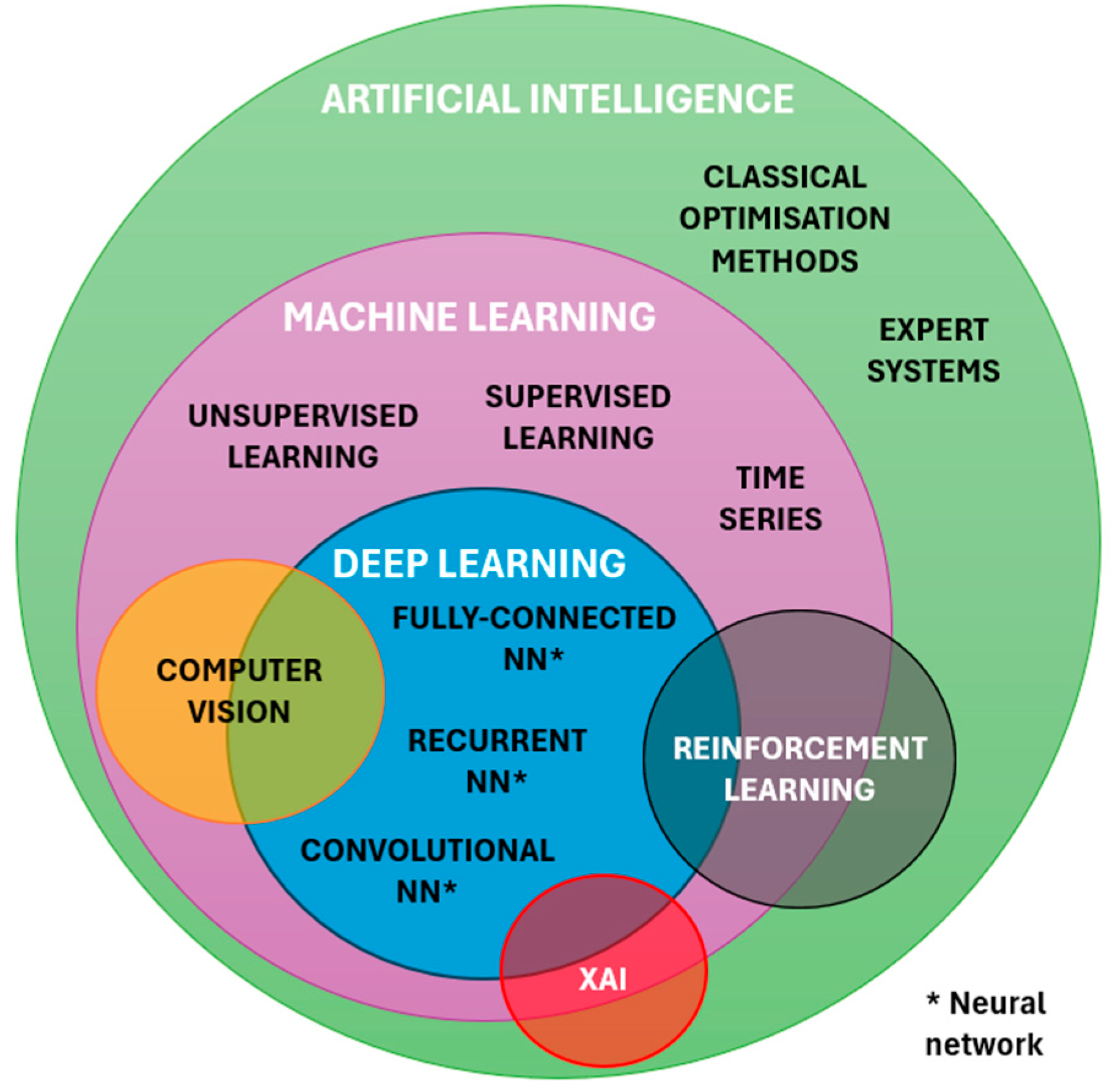
Figure 2.
PRISMA-ScR flow diagram of the study selection process for scientific publications and grey literature.
Figure 2.
PRISMA-ScR flow diagram of the study selection process for scientific publications and grey literature.
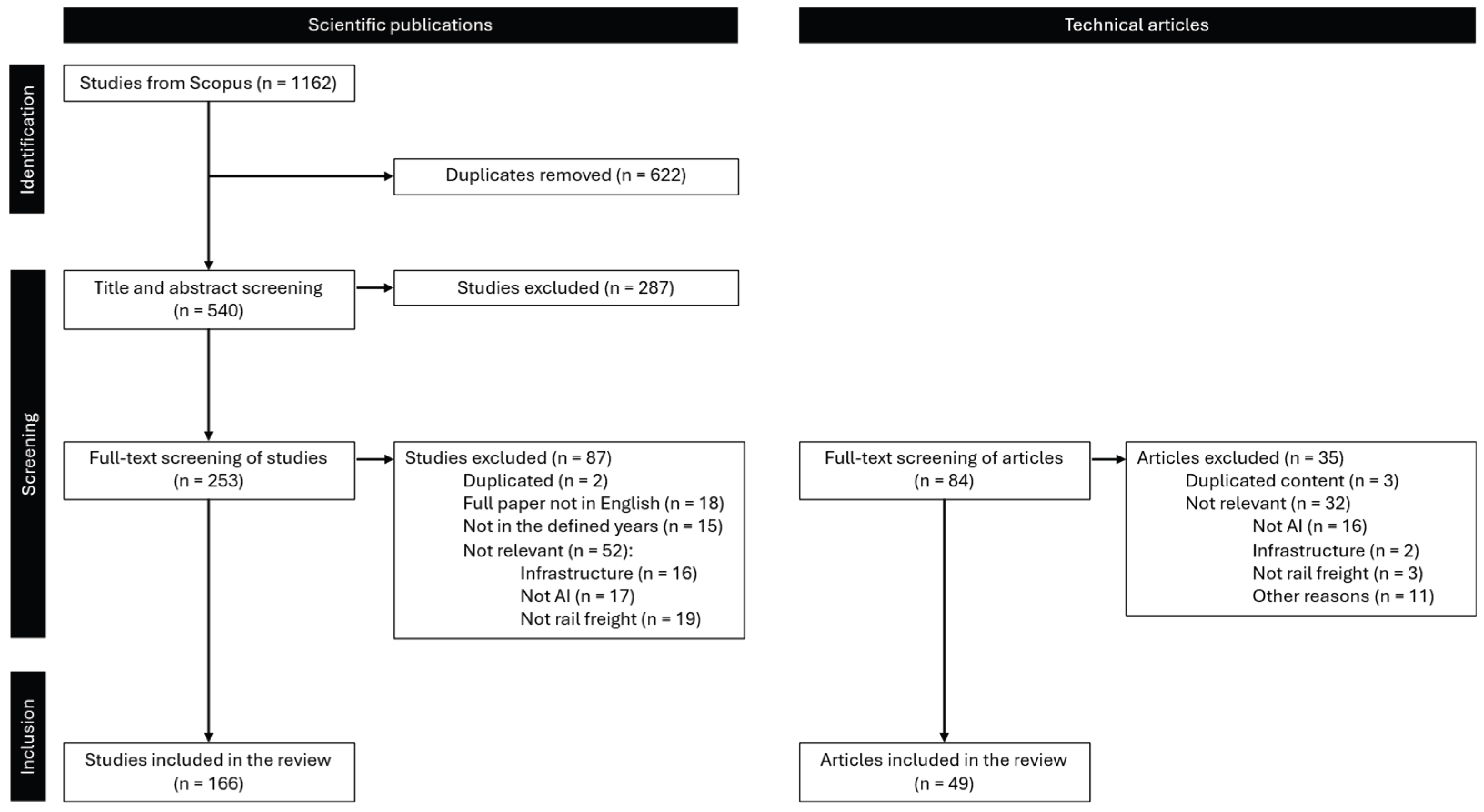

Table 1.
Operational domains, sub-domains and thematic areas.
|
Main Operational Domain |
Sub-domain | Thematic Area |
| Traffic Planning and Management | Strategic planning | |
| Tactical planning | ||
| Operational planning | Marshalling yard operations | |
| Energy-efficient driving | ||
| Predictive analytics and traffic forecasting | ||
| Rescheduling and disruption management | ||
| Assisted Driving and Train Control | Control algorithm implementations | |
| Energy optimisation | ||
| Verification and validation | ||
| Safety and Security | Risk management | |
| Railway accident prevention | ||
| Maintenance and Inspection |
Visual-based approaches | Single-component defect detection |
| Multi-component fault detection frameworks | ||
| Sensor-based approaches | Wheelsets, bogies, and rolling bearings monitoring | |
| Braking systems and powertrains diagnostics | ||
| Intermodal Operations | Rail-road coordination | |
| Rail-water intermodal | ||
| Comprehensive multimodal | ||
| Market Analysis and Demand Forecasting |
Table 2.
Summary of search strings and results for scientific publications.
| String | Results |
| “Artificial intelligence” AND rail freight | 58 |
| “Artificial intelligence” AND freight train | 53 |
| “Machine learning” AND rail freight | 62 |
| “Machine learning” AND freight train | 73 |
| “Deep learning” AND rail freight | 19 |
| “Deep learning” AND freight train | 49 |
| “Neural network” AND rail freight | 58 |
| “Neural network” AND freight train | 111 |
| “Expert system” AND rail freight | 8 |
| “Expert system” AND freight train | 10 |
| “Data mining” AND rail freight | 17 |
| “Data mining” AND freight train | 15 |
| “Pattern recognition” AND rail freight | 5 |
| “Pattern recognition” AND freight train | 2 |
| “Adversarial search” AND rail freight | 0 |
| “Adversarial search” AND freight train | 0 |
| “Evolutionary computing” AND rail freight | 0 |
| “Evolutionary computing” AND freight train | 1 |
| “Operations research” AND rail freight | 58 |
| “Operations research” AND freight train | 40 |
| “Logic programming” AND rail freight | 0 |
| “Logic programming” AND freight train | 1 |
| “Natural language processing” AND rail freight | 1 |
| “Natural language processing” AND freight train | 2 |
| “Large language model” AND rail freight | 0 |
| “Large language model” AND freight train | 2 |
| “Speech recognition” AND rail freight | 0 |
| “Speech recognition” AND freight train | 0 |
| “Computer vision” AND rail freight | 18 |
| “Computer vision” AND freight train | 27 |
| “Image processing” AND rail freight | 19 |
| “Image processing” AND freight train | 32 |
| “Autonomous system” AND rail freight | 1 |
| “Autonomous system” AND freight train | 0 |
| “Robotics” AND rail freight | 13 |
| “Robotics” AND freight train | 12 |
| “Digital twin” AND rail freight | 16 |
| “Digital twin” AND freight train | 11 |
| “Autonomous” AND rail freight | 75 |
| “Autonomous” AND freight train | 77 |
| “Cybersecurity” AND rail freight | 7 |
| “Cybersecurity” AND freight train | 4 |
| “IoT” AND rail freight | 21 |
| “IoT” AND freight train | 28 |
| “Data-driven” AND rail freight | 27 |
| “Data-driven” AND freight train | 32 |
| “Reinforcement learning” AND rail freight | 8 |
| “Reinforcement learning” AND freight train | 44 |
| “Swarm intelligence” AND rail freight | 3 |
| “Swarm intelligence” AND freight train | 3 |
| “Intelligent algorithm” AND rail freight | 2 |
| “Intelligent algorithm” AND freight train | 3 |
| “Artificial intelligence” AND rail yard operations | 2 |
| “Artificial intelligence” AND marshalling yard | 9 |
| “Machine learning” AND marshalling yard | 2 |
| “Machine learning” AND rail shunting | 2 |
| “Deep learning” AND marshalling yard | 3 |
| “Neural network” AND rail yard operations | 9 |
| “Neural network” AND rail shunting | 7 |
| TOTAL | 1162 |
Table 3.
Summary of search strings and results for technical articles.
| String | Results |
| www.railmarket.com | |
| Automated | 20 |
| Artificial intelligence AND freight | 10 |
| Maintenance AND freight | 8 |
| Data AND freight | 1 |
| Safety AND freight AND prevention | 4 |
| Autonomous train driving AND freight | 4 |
| www.railfreight.com | |
| Artificial intelligence | 37 |
| TOTAL | 84 |
Table 4.
Number of reviewed scientific publications by application domain and primary AI technology.1
Table 4.
Number of reviewed scientific publications by application domain and primary AI technology.1
| Application Domain | |||||||
|
Traffic Planning and Management |
Assisted Driving and Train Control |
Safety and Security |
Maintenance and Inspection | Intermodal Operations | Market Analysis and Demand Forecasting | ||
| AI Technology |
Expert systems |
3 | 9 | 3 | 0 | 2 | 1 |
| Optimisation methods (incl. RL) | 22 | 10 | 0 | 3 | 5 | 2 | |
| Classical ML | 17 | 5 | 9 | 7 | 4 | 5 | |
|
Deep learning |
12 | 12 | 5 | 13 | 6 | 7 | |
| Computer vision | 5 | 3 | 1 | 30 | 1 | 0 | |
| Explainable AI | 3 | 1 | 5 | 0 | 1 | 2 | |
Disclaimer/Publisher’s Note: The statements, opinions and data contained in all publications are solely those of the individual author(s) and contributor(s) and not of MDPI and/or the editor(s). MDPI and/or the editor(s) disclaim responsibility for any injury to people or property resulting from any ideas, methods, instructions or products referred to in the content. |
© 2026 by the authors. Licensee MDPI, Basel, Switzerland. This article is an open access article distributed under the terms and conditions of the Creative Commons Attribution (CC BY) license (http://creativecommons.org/licenses/by/4.0/).
Copyright: This open access article is published under a Creative Commons CC BY 4.0 license, which permit the free download, distribution, and reuse, provided that the author and preprint are cited in any reuse.