

Submitted:
19 November 2026
Posted:
19 November 2026
You are already at the latest version
Abstract
Emotional, motivational, and attentional responses sometimes intensify long after an initial event has ended, despite the absence of further external reinforcement. Such phenomena have been observed across largely separate psychological literatures — from anxiety and craving to romantic infatuation and delusion — often treated as distinct because of their differing content. This paper presents a unified framework by formalising Eysenck’s concept of “incubation” through a minimal modification of the Rescorla–Wagner model of Pavlovian conditioning. By allowing reactivation of internal representations to contribute to subsequent strengthening or weakening, we show that response growth, maintenance, and decay can emerge from a single dynamical system. A representation’s long-term trajectory depends less on the severity of the initial learning episode than on the ongoing competition between internal rehearsal and extinction. We apply this shared computational architecture to post-event processing in social anxiety, anger rumination, incentive sensitization, and conditioned attention, showing that healthy motivation and clinical pathology often differ in degree rather than kind. The framework recasts incubation not as a narrow theory of fear conditioning, but as a domain-general principle governing how recurrent reactivation alters the future significance of psychological representations.
Keywords:
incubation
; Pavlovian conditioning
; incentive learning
; emotion
; post event processing
1. Introduction
- “If you can look into the seeds of time,
- And say which grain will grow and which will not,
- Speak then to me.”
Macbeth
Since Epicurus, it has been recognised that emotional consequences can outlive the experiences that produced them. A reminder or a fleeting return to the scene can reopen what seemed closed. Yet some responses decay with time while others grow with each re-encounter, real or imagined. Variations of “incubation” theory attempt to explain this growth. Eysenck developed a relevant mechanism in 1968, building on his earlier discussion of single-trial conditioning and the “Napalkov” phenomenon (Eysenck, 1967), and subsequently incorporated it into broader conditioning models of neurosis and behaviour therapy (Eysenck, 1979, 1981). He proposed that, after a sufficiently intense pairing of a conditioned stimulus with a significant outcome, subsequent reminders, including thoughts of the stimulus or fragmentary approximations of its sensory properties, can reactivate fear. Each reactivation acts as a partial unconditioned stimulus, rehearsing the original association and progressively amplifying the conditioned response.
By the time the organism meets the conditioned stimulus again, fear may have grown far beyond its initial strength: an incubation effect. Although early human tests of Eysenck’s specific parameters produced mixed or null results (Nicholaichuk et al., 1982; Sandin & Chorot, 1989, 2002), more recent rodent work has demonstrated a robust delayed-onset form of conditioned fear. After extended conditioning, conditioned fear is initially low but increases over roughly a month and remains elevated for at least two months (Pickens et al., 2009, 2010; Pickens, Golden, & Nair, 2013). This modern “fear incubation” paradigm does not simply replicate Eysenck’s original procedure, but it provides a controlled animal model in which conditioned responding grows after acquisition without further reinforcement.
Incubation theory attracted substantial criticism, including from habituation and sensitisation accounts (e.g., Bindra, 1979; Bolles, 1979; Gray, 1979; Gray & McNaughton, 2000), and from the peer responses to Eysenck (1979). Direct empirical support for incubation in human clinical populations is lacking (Lissek & van Meurs, 2015). Yet those debates rarely settled the underlying question: was Eysenck’s intuition wrong, incomplete, or simply imprecisely expressed? Although incubation theory itself faded from prominence, phenomena with a similar structure persist across academic and folk psychology. Imagining eating a food can alter later intake (Morewedge et al., 2010), and simulated eating increases salivation and desire for food cues (Keesman et al., 2016). Such findings are not themselves demonstrations of incubation, but they establish a premise central to the present account: internally generated reactivation can modify subsequent responding even in the absence of renewed contact with the original outcome.
Conceptual relatives extend further still. Post-event processing in social anxiety (Clark & Wells, 1995; Rapee & Heimberg, 1997), depressive rumination (Nolen-Hoeksema, 1991), threat simulation (Revonsuo, 2000), anger rumination (Sukhodolsky et al., 2001; Denson, 2013), craving elaboration (Kavanagh et al., 2005), attachment preoccupation (Mikulincer & Shaver, 2007), positive savouring (Bryant & Veroff, 2007), and reward anticipation (Berridge & Kringelbach, 2015) are seldom considered together, their emotional contents differing so markedly. Yet each involves psychological reverberations after an event, thought, cue, or representation has already been activated. What these literatures lack is a common grammar: an account of shared mechanics, and of when repeated engagement intensifies rather than diminishes a response.
What if these phenomena, despite their different mechanisms, share a common dynamical structure of recurrent post-event updating? The contents may vary wildly (threat, grievance, reward, attachment, status) while the underlying dynamics may not. On this view, the seemingly idiosyncratic details of one domain could illuminate the others. Here, we formalise Eysenck’s intuition through a modification of the Rescorla–Wagner model. The formalisation converts Eysenck's verbal account into explicit boundary conditions and generates prospective predictions about which representations should strengthen, stabilise, or attenuate following reactivation.
2. The Model
2.1. The Problem of Incubation
Associative learning theories generally predict that responding should weaken when a conditioned stimulus (CS) is repeatedly presented while its expected unconditioned stimulus (UCS) is omitted. Incubation theory was developed to account for a puzzling anomaly: under some conditions, responding instead increases across nonreinforced presentations or subsequent reactivations.
Although Eysenck developed his account primarily in relation to fear and neurosis, the underlying problem is much broader. To explain post-acquisition strengthening, he proposed that an unreinforced conditioned stimulus could nevertheless evoke response-produced nocive stimulation capable of reinforcing the existing association (Eysenck, 1968, 1979). His later formulations explicitly extended the relevant occasions for reactivation to symbolic representations, words, imagination, self-induced thoughts, and therapeutic discussion (Eysenck, 1979, 1981). Reminders of a stimulus, thoughts about it, or partial sensory approximations can therefore evoke conditioned responses that function analogously to supplementary learning experiences.
While intuitively appealing, this proposal remained largely verbal. It lacked the formal architecture to specify when incubation should occur, how it competes with extinction, or why some experiences grow in significance while others fade.
2.2. Adding Rehearsal to Rescorla-Wagner Learning
As a foundation, consider the standard Rescorla-Wagner model:
where represents the associative strength between a CS and UCS, is CS salience, is UCS salience, and is the maximum associative strength supported by the UCS. Associative strength increases when outcomes exceed expectations and decreases when expected outcomes fail to occur. Thus, when a CS is presented without its expected UCS, the standard model predicts declining associative strength; it contains no mechanism for associative strength to increase across such presentations.
To translate Eysenck's verbal argument into a minimal computational model, suppose that reactivation of a conditioned representation can produce a strengthening influence even in the absence of the original UCS. Reactivation may be internally generated or externally cued (e.g., by “reminders”); the critical assumption is that subsequent updating need not require renewed presentation of the original outcome. We represent this influence with an additional parameter, , initially corresponding to Eysenck's proposed process of response-produced self-reinforcement (Eysenck, 1968, 1979). In the original account, the unreinforced CS still elicited a partial response, and the experience produced by that response could reinforce the CS–response relation. Eysenck described this as a positive-feedback cycle in which the conditioned response contributes to its own subsequent strengthening.
Let indicate whether external reinforcement occurs on trial . The modified learning rule becomes:
where is the conditioned response expressed on trial , and represents the gain associated with an internal rehearsal or self-reinforcement loop. The first term represents standard Rescorla-Wagner learning. The second term introduces the possibility that responding itself contributes a strengthening influence whenever reinforcement is absent. In plain terms, the model allows an organism to “practise” a response even when nothing new happens in the world. Each time a representation is reactivated without the original outcome, its subsequent influence can diminish or strengthen, depending on the balance between weakening and internally generated strengthening.
Note that the parameter is purposively implementation-neutral. It may represent covert rehearsal, mental replay, associative self-reinforcement, memory consolidation reactivation, repeated simulation, or any process causing prior responding to influence future responding. At this stage, no commitment to a specific underlying biological or cognitive mechanism is required.
2.3. The Threshold for Incubation
Assume that conditioned responding is directly proportional to associative strength:
During strictly non-reinforced occasions (), the update rule becomes:
which simplifies to:
Because , the trajectory of associative strength is given by:
This reveals three qualitatively distinct regimes. (1) Incubation, where associative strength grows despite the absence of external reinforcement (); (2) maintenance, where associative strength remains stable over time (); and (3) extinction, where associative strength successively dwindles across non-reinforced reactivations (). Eysenck’s original formulation already treated incubation and extinction as opposing consequences of nonreinforced CS presentation: extinction was observed when decremental influences predominated, whereas incubation was observed when incremental influences predominated (Eysenck, 1968). Later versions placed this competition within a broader verbal account of Pavlovian conditioning and identified exposure duration, UCS strength, and individual differences as important moderators (Eysenck, 1979, 1981). However, these accounts did not specify how the influences combined. Our simple threshold condition captures the core logic of incubation. Growth, stability, and decline emerge from the balance between rehearsal and extinction rather than from the strength of the original learning episode alone.
Put simply, the fate of a new memory depends less on how intense the original event was and more on whether the mind keeps returning to it. A small event that is repeatedly revisited can come to matter more than a large one that is quickly forgotten. More generally, incubation emerges whenever strengthening exceeds weakening, maintenance arises when the two are balanced, and extinction occurs when weakening dominates. The specific psychological interpretation of these processes may vary across domains, but the underlying dynamical logic remains unchanged.
Figure 1.
Divergent trajectories of emotional and motivational responding arising from a common dynamical system. Incubation (), maintenance (), and extinction () emerge from the balance between internal strengthening and weakening processes during offline reactivation. All trajectories originate from the same initial associative strength (). When strengthening exceeds weakening, responding increases toward an asymptote (); when the two processes are balanced, responding remains stable; and when weakening exceeds strengthening, responding progressively declines toward extinction. Rather than representing distinct psychological mechanisms, these trajectories arise as alternative regimes of the same underlying dynamics operating on the same representation. (Note: The asymptotic ceiling limiting the incubation trajectory is derived in Section 2.5).
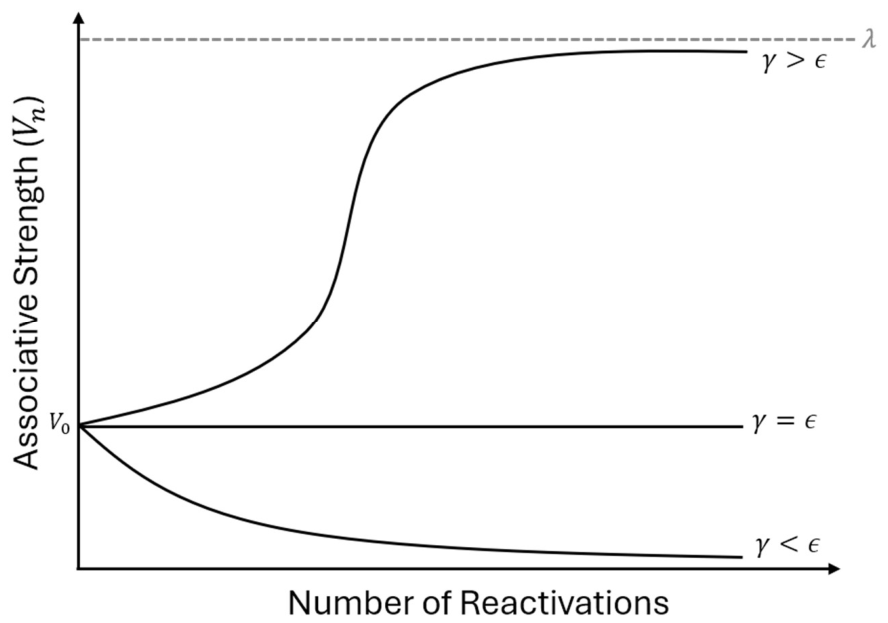
An important implication follows immediately from this architecture. While Eysenck emphasised factors determining the strength of initial conditioning, the present formulation cleanly separates two distinct dimensions: the strength of initial acquisition versus the post-acquisition trajectory. The initial learning episode simply determines the starting value of . The subsequent trajectory is determined by the balance between rehearsal and extinction. Consequently, strong initial conditioning is neither necessary nor sufficient for incubation. A powerful traumatic or rewarding episode will nevertheless extinguish if rehearsal is weak (). Conversely, a relatively mild initial learning event can compound into substantial strength if internal rehearsal consistently outweighs extinction. Individual differences traditionally attributed to initial acquisition sensitivity may therefore emerge from variation in post-acquisition dynamics. Identical learning histories can therefore diverge radically.
The same analysis points to another, less obvious individual-difference prediction. Vulnerability to incubation may arise from either side of the updating balance: unusually strong recurrent strengthening, unusually inefficient attenuation, or both. Individuals could therefore show similar escalating trajectories despite differing substantially in the processes producing them. This distinction is empirically consequential: independent measures of recurrent processing and attenuation processes, such as extinction or corrective updating, should explain prospective variation in subsequent trajectory beyond initial response magnitude alone.
Within our Rescorla-Wagner implementation, threshold condition also highlights a potential role for classical learning-rate parameters in determining whether representations strengthen or weaken following reactivation. Substituting the Rescorla-Wagner extinction term into the model yields the criterion , implying that incubation becomes progressively less likely as either cue salience () or learning rate () increases. Conversely, lower values of either parameter reduce the influence of extinction and expand the range of conditions under which reactivation can produce strengthening. The model therefore predicts that vulnerability to incubation depends not only on the magnitude of internal strengthening processes (), but also on the efficiency with which associative strength is updated during extinction.
2.4. Exposure Duration
The preceding formulation treats each non-reinforced presentation of the conditioned stimulus as a discrete trial. However, Eysenck's original discussion placed considerable emphasis on exposure duration. Brief reminders of a stimulus were expected to favour incubation, whereas prolonged exposure was expected to favour extinction.
A simple way to represent this distinction is to allow the rehearsal process to decline during a continuous exposure. Let:
where represents the initial strength of rehearsal and determines how rapidly it diminishes with continued exposure. This exponential decay of rehearsal is not yet derived from an independent psychological mechanism. Rather, it is a deliberately minimal assumption representing the idea that a CS produces a strong internal response when first encountered, but that this response loses potency as uninterrupted exposure continues without reinforcement. Intuitively, this captures a familiar experience: the first time one returns to a troubling memory, it may hit hard; but if one dwells on it continuously, the emotional charge tends to wear off. Brief reminders keep the response fresh; sustained exposure lets it fade.
When exposure is modelled continuously, the discrete extinction term must be replaced by a continuous extinction rate, . The change in associative strength during an unreinforced exposure can then be written as:
At the beginning of exposure, incubation occurs whenever . However, because declines over time, a point may eventually be reached where rehearsal becomes weaker than extinction. Importantly, the point at which rehearsal and extinction become equal is not necessarily the point at which responding has returned to baseline. The transition occurs when:
A brief reminder may terminate while incubation still dominates, whereas a sufficiently prolonged exposure may continue until extinction becomes the stronger process.
Eysenck's (1981) account postulated a critical duration beyond which continued exposure shifted responding from incubation toward extinction. The present formulation generates such a transition directly by allowing rehearsal strength to decay during prolonged exposure. This extension preserves the basic logic of the model while accommodating one of Eysenck's most distinctive predictions. Whether a non-reinforced encounter strengthens or weakens responding depends not only on the balance between rehearsal and extinction, but also on the duration of exposure and the rate at which rehearsal decays during that exposure.
The model also distinguishes the duration of individual reactivation episodes from the conditions governing their recurrence. Duration affects how far a given episode proceeds before strengthening gives way to weakening, whereas unresolved uncertainty, ambiguity, or counterfactual alternatives may promote repeated reactivation across episodes. Conversely, resolution or corrective information may reduce further reactivation, favour weakening when reactivation occurs, or both. These temporal and cognitive features therefore provide independently testable candidates for predicting whether recurrent processing produces incubation or attenuation.
2.5. Bounded Growth
Although the simplest formulation predicts unrestricted growth when rehearsal exceeds extinction, Eysenck's own illustrations of incubation implicitly suggest asymptotic responding rather than indefinite escalation. To impose a psychologically plausible ceiling, the rehearsal term can be scaled by the remaining opportunity for learning:
Under this bounded formulation, rehearsal drives rapid change when associative strength is low but progressively loses influence as approaches its asymptotic limit (). Incubation remains possible, but runaway exponential growth is prevented: repeated reactivation can substantially amplify a response, but each additional reactivation contributes less as the response approaches its biological ceiling.
2.6. Relation to Habituation and Sensitisation
A common criticism of incubation theories is that growth in responding need not depend on Eysenck's proposed mechanism of response-produced self-reinforcement. Ordinary associative plasticity, such as Hebbian strengthening during recurrent activation, provides another route by which subsequent responding might change, including through offline replay or consolidation. Alternatively, apparent incubation could arise through non-associative processes such as sensitisation or shifts in response gain. These possibilities differ importantly in biological mechanism.
The present model does not adjudicate among these implementations; it asks what follows when their net strengthening influence exceeds, matches, or falls below opposing weakening processes. In this sense, operates as an implementation-neutral, macro-level summary parameter. Under a narrow interpretation, incubation reflects structural growth in associative strength through self-reinforcement or recurrent associative plasticity. Under a broader interpretation, similar observable dynamics may arise through sensitisation, memory reactivation, or changes in response gain. For particular phenomena studied at neurobiological levels, these specific mechanisms may provide more informative explanations than incubation itself. The value of the abstract formulation lies elsewhere: it allows mechanistically different phenomena to be described within a common dynamical framework, translating their shared logic into a single threshold condition ().
A related criticism is that, although Eysenck depicted incubation and extinction as separated by a critical point, the original theory did not specify the mechanism generating this transition. The present formulation provides one possible dynamical interpretation (Figure 2). Strengthening processes (), which may be interpreted as associative rehearsal or, more broadly, sensitisation, initially exceed weakening processes (), producing incubation. As strengthening decays across continued exposure, a critical duration emerges at which the two forces become equal, after which weakening predominates and associative strength declines. In this sense, the model may be viewed as a formalisation and extension of Eysenck's original proposal rather than a competing account.
Consequently, the model should be viewed primarily as a description of the dynamics required for incubation rather than as a commitment to a particular biological or psychological implementation. The critical question is not what mechanism is assumed a priori, but whether the phenomenon under investigation exhibits dynamics consistent with repeated strengthening, maintenance, or extinction across successive reactivations. More broadly, the present formalisation should be understood as a clarification and extension of Eysenck's account rather than a competing explanation. Eysenck proposed that conditioned responding could either strengthen or weaken following non-reinforced exposure, that exposure duration influenced this outcome, and that individual differences moderated the process. The present model preserves these central assumptions while rendering them explicit as a dynamical system. In doing so, it identifies threshold conditions, clarifies the role of exposure duration, and generates novel predictions concerning when representations strengthen, stabilise, or weaken following repeated reactivation. It is these broader implications, rather than the formalism itself, that are explored in the following sections. Formalising Eysenck's heuristic makes the framework prospectively testable rather than merely descriptive. If determinants of strengthening and weakening can be estimated or manipulated independently of the subsequent trajectory, the model generates several distinctive predictions. First, exposure structure should affect the direction of updating: brief reactivation can terminate while strengthening still dominates, whereas sufficiently prolonged exposure can allow weakening to overtake it (Figure 2). Second, vulnerability should depend jointly on processes promoting recurrent strengthening, such as unresolved ambiguity or counterfactual simulation, and processes supporting attenuation or extinction. Third, because the model separates initial acquisition from post-acquisition dynamics, initial event severity is neither necessary nor sufficient for subsequent incubation: weak initial responses may escalate, whereas strong ones may attenuate. The critical empirical test is therefore prospective: whether independently measured determinants of these opposing processes can predict subsequent incubation, maintenance, or attenuation before those trajectories are observed.
3. Discussion
Our modified model suggests several implications not immediately obvious from purely verbal accounts of incubation. The model first separates eventual responding from the severity of the original event. The initial learning episode sets the starting value of a representation, but its subsequent trajectory depends on the ongoing competition between rehearsal and extinction. A mild event that is repeatedly rehearsed can therefore come to produce stronger responding than an intense traumatic or rewarding experience that rapidly extinguishes. What matters is not the size of the initial impact, but the balance of forces acting afterwards. A crucial distinction here is between recurrent reactivation and incubation itself. Reactivation provides an opportunity for change; incubation refers only to the trajectory in which net strengthening occurs. Recurrent processing may instead maintain responding, promote attenuation, or transform the underlying representation in ways not captured by the present model. The exceptional case requiring explanation may therefore be not recurrent strengthening itself, but the conditions under which strengthening escapes the processes that normally constrain it. Incubation may reflect unusually strong amplification, unusually weak attenuation, or both. Recurrent reactivation is therefore not intrinsically pathological. Whether internal replay amplifies, maintains, or attenuates responding depends on the net balance between rehearsal and extinction. The same activation may escalate fear in one person, leave another unchanged, and attenuate it in a third. Clinical distinctions between adaptive and maladaptive post-event processing may thus reflect differences in temporal dynamics rather than the mere presence or absence of mental replay.
Post-trauma trajectories provide a useful illustration. Most trauma-exposed individuals do not develop chronic PTSD, instead showing either stable resilience or recovery after initially elevated symptoms (Galatzer-Levy et al., 2018). Such heterogeneity is consistent with the present framework: recurrent post-event processing need not produce strengthening, and recovery represents the kind of trajectory expected when weakening ultimately dominates. Incubation is the opposing regime, not the default consequence of reactivation.
The same logic identifies two broad intervention targets: rehearsal and extinction. Deliberate dwelling, repeated mental simulation, or frequent reminders promote incubation only insofar as they strengthen a representation more than they weaken it. Conversely, processes that increase corrective updating, inhibit recurrent activation, or accelerate the decay of rehearsal should reliably reduce subsequent responding. These predictions follow directly from the model’s formal structure, independent of any particular biological or cognitive interpretation of the rehearsal term.
Though derived from classical conditioning, this architecture potentially describes how reactivation alters the subsequent influence of representations beyond classical conditioning. What matters is not whether the representation corresponds to a traditional Pavlovian conditioned stimulus, but whether it can be repeatedly reactivated and thereby subjected to processes analogous to rehearsal and extinction.
Viewed this way, incubation is no longer a niche, historically isolated theory of fear conditioning. It is a general dynamical principle. Across fields, the critical question becomes whether recurrent activation causes a representation to become more influential, less influential, or stable over time. More elaborate computational architectures may provide richer accounts of the mechanisms supporting offline updating. The present framework serves a different purpose. Its value lies in identifying a minimal dynamical structure shared by theories developed largely independently across psychological domains. Formalising that structure makes implicit assumptions explicit: theories of recurrent processing must specify the conditions under which reactivation should strengthen, maintain, or attenuate subsequent responding. The resulting predictions may already be latent within domain-specific theories, but the common formalism exposes them systematically and permits direct comparison across domains. And by appending a single, mathematically agnostic rehearsal parameter to the canonical Rescorla–Wagner equation, the core dynamics of post-event processing, craving, and delusion can be generated within a highly parsimonious framework.
The remainder of this paper therefore considers whether theories developed around ostensibly distinct psychological phenomena instantiate variations of this common dynamical problem. Fear, romantic attraction, grievance, craving, and attentional salience differ dramatically in content and expression, and have consequently been studied largely within separate literatures. Yet each may involve a common process through which representations are repeatedly reactivated and updated after the events that initially established them.
The sections that follow examine whether this framework can organise empirical findings across post-event processing in social anxiety, anger rumination, craving and appetitive motivation, and attachment-related preoccupation. The aim is not to flatten the real differences between these phenomena, but to show that they are domain-specific manifestations of a common class of post-representation updating. Mapping disparate fields onto a shared framework reconciles findings, generates predictions, and reveals parallels obscured by fragmentation.
3.1. On Love and Limerence
The idea that attraction can intensify after an initial encounter is hardly confined to academic theory. Literature, popular music, and everyday experience echo the same puzzle: feelings toward another person can grow substantially stronger after little more than a first meeting. Not all cases resemble “love at first sight,” but many involve persistent preoccupation culminating in stronger feelings than originally experienced. If post-encounter rehearsal is experimentally disrupted (e.g., through cognitive load or distraction), the model predicts that attraction should decay rather than intensify, whereas rehearsal-enhancing manipulations should amplify it.
Reinforcement accounts may explain why a person becomes attractive in the first place. Positive interactions, shared experiences, and sexual interest provide immediate reinforcement. What they explain less straightforwardly is why two seemingly similar encounters can produce dramatically different long-term trajectories. On our account, the critical variable is not solely the quality of the original interaction, but the nature of the subsequent processing. Attraction undergoes incubation when reactivation produces net strengthening of the person's representation. After an encounter, one may replay conversations, analyse signals, anticipate meetings, or elaborate the target’s representation. If this reactivation strengthens the representation more than it weakens it—if rehearsal outpaces extinction—the person’s motivational significance grows despite the absence of further contact. Attraction becomes a product of post-event processing, not merely of direct experience.
This interpretation aligns with Tennov’s (1979) account of limerence. This proposed that uncertainty about reciprocation intensifies preoccupation, whereas consistent reciprocation reduces it. In our model, uncertainty need not be attractive in its own right; rather, it repeatedly draws attention back to the individual, increasing the frequency and potency of rehearsal. Unresolved outcomes sustain the reactivation loop.
Baumeister and Bratslavsky’s (1999) proposal that passion depends on increases in intimacy, rather than absolute intimacy, can be reinterpreted through the same dynamical lens. Rapidly rising intimacy generates continual novelty and shifting expectations, which naturally sustain mental rehearsal. Passion may arise not from intimacy itself, but from the repeated reactivation and updating that interpersonal volatility affords.
The framework also accounts for the positive distortions and idealisation that often accompany infatuation (Murray et al., 1996). Rather than treating these illusions as independent cognitive biases, we suggest that they are a mechanism through which repeated reactivation progressively alters the representation. Each act of mental rehearsal offers an opportunity not merely to recall the individual, but to elaborate and amplify their perceived value. Even the classic misattribution-of-arousal effect (Dutton & Aron, 1974), where excitement or danger increases perceived attraction, fits this account. Arousing encounters may therefore be more memorable, more frequently processed offline, and more likely to acquire motivational significance.
The same logic extends to the darker side of romantic preoccupation. Two people may undergo highly similar encounters yet diverge radically in their aftermath, depending on how each processes what happened. If an individual repeatedly simulates interactions and assigns increasing significance to a target despite limited reciprocal reinforcement, recurrent reactivation can drive increasingly persistent approach tendencies. At the extreme, this process contributes to obsessive pursuit or stalking-like behaviour. Thus, differences in romantic preoccupation may reflect differences in post-encounter dynamics rather than differences in the quality of the original interaction.
Perhaps relatedly, adult attachment theory views “hyperactivating strategies” in anxiously attached individuals as chronic, trait-like developmental adaptations (Mikulincer & Shaver, 2010). The present model suggests a reinterpretation: the intensity of attachment panic is not merely a direct readout of a fragile internal working model, but a downstream product of iterative amplification. If an individual repeatedly simulates abandonment scenarios, consistently outweighs , escalating the response. On this interpretation, developmental history may determine the initial strength and parameters of the attachment representation without fixing its subsequent trajectory. If recurrent strengthening is sufficiently reduced relative to weakening, the model predicts attenuation even for strongly established representations.
3.2. Post-Event Processing
Post-event processing (PEP), frequently implicated in social anxiety, also fits. PEP refers to the tendency to reflect on, mentally replay, and evaluate social interactions after they have ended (Clark & Wells, 1995; Rapee & Heimberg, 1997). These recurrent episodes often fixate on perceived mistakes, signs of negative evaluation, awkward moments, or alternative ways the interaction might have unfolded. Within cognitive models of social anxiety, PEP is commonly treated as a maintenance process: by reinforcing negative self-perceptions and expectations, it sustains anxiety across encounters (for a review, see Edgar et al., 2024).
At first glance, PEP bears a striking resemblance to Eysenck’s proposed rehearsal mechanism. A social interaction occurs and is subsequently reactivated offline. The individual repeatedly reviews the event, reconstructs aspects of it, and often experiences acute emotional responses in doing so. From the perspective of the present model, PEP is a direct psychological implementation of the rehearsal parameter. Anxiety continues to evolve not because of further external social failures, but because of repeated internal reactivation.
This interpretation differs from much of the standard clinical literature. Cognitive accounts often implicitly treat recurrent post-event thinking as inherently maladaptive. The formal model shows otherwise: replay itself is not pathological. Whether PEP increases, decreases, or maintains anxiety depends on the balance of updating processes. Reflecting on an interaction to identify genuine mistakes and improve future behaviour may reduce anxiety if the resulting update strongly favours extinction. Conversely, if repeated reactivation preferentially strengthens threat-related representations, it will amplify responding and drive incubation.
This distinction clarifies longstanding ambiguities around safety behaviours and avoidance. In standard cognitive models, safety behaviours are problematic primarily because they prevent corrective learning. The present framework offers a more precise criterion: a behaviour maintains anxiety only if it prevents experiences that would otherwise produce a net weakening of the representation. If a behaviour improves competence, reduces threat, or diminishes future exposure potency, it is problem-focused coping, not avoidance. Whether a behaviour is maladaptive depends not on its surface appearance, but on its influence on the long-term trajectory of the response.
The model also reframes individual differences in social anxiety. Cognitive accounts emphasise attentional biases, self-focused attention, and fear of evaluation. Within this framework, these are best understood as candidate determinants of the rehearsal process itself. Individuals who repeatedly elaborate perceived failures, or simulate adverse future outcomes, drive stronger recurrent reactivation (Brozovich & Heimberg, 2011). Severe social anxiety may therefore reflect differences in post-event dynamics rather than in the severity of the initial social experiences. Two people can encounter the same awkward situation yet diverge dramatically over time: one repeatedly reactivates it, while the other lets it fade. The effects of post-event processing may then depend less on its presence than on how it alters subsequent updating.
This yields a clinical prediction not commonly emphasised in discussions of PEP. If repeated replay can either strengthen or weaken responding, interventions should not necessarily aim to eliminate post-event processing altogether. The critical objective is to alter the nature of the updating that occurs during replay. Future research would benefit from distinguishing forms of post-event processing that contribute to incubation from those that facilitate extinction, adaptation, or problem-solving (for an example of a measurement instrument (PEP-I) that could support this distinction empirically, see Blackie & Kocovski, 2017).
This mathematical agnosticism regarding adaptiveness also applies to entirely unconscious offline simulations, such as dreaming. Threat Simulation Theory posits that dreaming evolved as an adaptive mechanism to repeatedly simulate threats and improve waking preparedness (Revonsuo, 2000). The present framework focuses purely on the computational updating rule, predicting a highly specific bifurcation based on duration and resolution. If a dream simulates a threat briefly and intensely (acting as a partial UCS where ), our model predicts greater subsequent fear. However, if the dream involves prolonged, unreinforced exposure where the internal simulation eventually decays (), the simulation should instead favour attenuation.
3.3. Anger Rumination
Anger provides another compelling context in which recurrent post-event processing alters emotional and motivational trajectories. “Anger rumination” refers to a cognitive-emotional process of dwelling on past anger experiences and frustrations (Sukhodolsky, Golub, & Cromwell, 2001). After an insult, betrayal, injustice, or perceived status threat, individuals often continue to dwell on the event long after it has ended. Rather than fading with time, resentment can intensify (Bushman, 2002; Wilkowski & Robinson, 2010). A relatively minor slight can gather momentum, coming to occupy a disproportionate place in a person’s thoughts, driving increasingly strong desires for confrontation, revenge, or the restoration of status. Research on anger rumination describes a recurrent-processing structure closely analogous to anxiety-related post-event processing. Individuals repeatedly replay the event, revisit details of the interaction, infer hidden motives, imagine alternative responses, and mentally simulate future confrontations (Denson, 2013; Sukhodolsky, Golub, & Cromwell, 2001). Crucially, this processing occurs offline, in the absence of further provocation. The original event has ended, yet its emotional consequences continue to compound.
From the perspective of the present model, anger rumination is an approach-oriented analogue of incubation. The representation being reactivated is not a feared stimulus but a grievance. If repeated replay strengthens the representation more than it weakens it, the motivational significance of the offence grows, negative interpretations of the perpetrator solidify, and tendencies toward retaliation amplify. The ultimate emotional impact of an insult is therefore determined not solely by the initial provocation, but by the balance of updating that occurs afterwards.
This account explains why apparently minor provocations can sometimes elicit disproportionately severe reactions. Two people may experience the same insult, yet one moves on quickly while the other enters a spiral of escalating preoccupation. This divergence need not reflect differences in the objective severity of the offence. It arises because one person repeatedly reactivates and elaborates the representation, favouring rehearsal, while the other allows it to decay, favouring extinction.
The framework also clarifies the role of uncertainty. Grievances involving ambiguous motives, unresolved disputes, or unclear intentions are especially likely to undergo repeated reactivation (Wilkowski & Robinson, 2010). Internal questions — “Why did they do that?”, “What did they really mean?”, “Was that deliberate?” — repeatedly drag attention back to the event. As with limerence, unresolved social ambiguity can sustain the rehearsal loop and amplify the original experience over time.
While neurocognitive accounts like the Multiple Systems Model attribute prolonged rumination and maintained anger to poor executive control (Denson, 2013), the present framework translates this into a purely temporal and computational metric: a persistently high relative to . This yields a counterintuitive prediction: the objective severity of the initial provocation is mathematically separable from the terminal anger. A mild insult with high ambiguity that sustains a high loop can result in greater ultimate associative strength than a severe, unambiguous insult that triggers rapid resolution and subsequent extinction ().
3.4. Incentive Learning and Motivation
Traditional accounts of instrumental incentive learning demonstrate that changes in goal-directed action typically require direct consummatory experience of an outcome in a new motivational state (e.g., Balleine, 1992; Dickinson & Balleine, 1994). In a commonly used paradigm, animals trained to perform an action for a mildly valued outcome (e.g., while sated) will not automatically increase that action when shifted to a high-value state (e.g., hunger). To adjust their instrumental performance commensurately, they must first directly re-experience the outcome in the deprived state. If this re-evaluation experience is omitted (Roy, Burton, & Balleine, 2026), or if the neural circuitry mediating it is disrupted (Malvaez et al., 2019; Parkes & Balleine, 2013), the upswing in goal-directed behaviour fails to occur.
The present framework does not contest this requirement for instrumental action; rather, it suggests an independent mechanism through which the motivational significance of associated cues can escalate in the absence of direct re-exposure. Even if the instrumental incentive valuation process is bypassed or impaired, an organism might still escalate its Pavlovian conditioned responses (CRs) through the incubation of outcome-associated stimuli. Repeated offline reactivation of the outcome representation permits updating through internal rehearsal alone. A food cue initially associated with modest pleasure can thus acquire high motivational significance if its representation is repeatedly reactivated under conditions of deprivation, anticipation, or craving. If offline reactivation is sufficient for updating, then manipulating rehearsal frequency or vividness—without altering direct consummatory experience — should shift subsequent incentive value in the predicted direction.
Eysenck himself briefly considered whether incubation might extend beyond aversive conditioning. He noted that conditioned appetitive reinforcers possess motivational properties and suggested that an analogous process was conceivable but left the question open because direct evidence was unavailable (Eysenck, 1968, 1979). As with the earlier verbal treatment, our account thus also extends naturally to findings that mentally simulating reward consumption influences later desire and behaviour. Repeated offline imagination of enjoyable foods or anticipated rewards does not merely reflect an existing motivational state, nor does it strictly require physical re-experiencing to alter future approach tendencies. Because these simulations function as internal learning trials, they actively shape subsequent changes in motivational significance. Recurrent rehearsal may therefore be not only a consequence of wanting, but a cause of increased wanting.
3.5. Craving and Incentive Sensitization
Addictive behaviours provide a striking domain in which emotional and motivational responses escalate long after the original learning episode has ended. Individuals frequently report escalating desire for a substance despite diminishing hedonic effects, prolonged abstinence, or infrequent direct exposure. In some cases, environmental cues associated with drug use acquire extraordinary motivational significance, eliciting intense craving and approach behaviour despite the absence of direct reinforcement.
An influential account is the incentive sensitization theory of addiction (e.g., Berridge & Robinson, 2016; Robinson & Berridge, 1993). On this view, repeated drug exposure sensitizes neural systems involved in incentive motivation, causing drug-related cues to evoke progressively stronger “wanting” responses. Crucially, sensitization affects incentive salience more than experienced pleasure. Individuals may come to intensely crave a substance even when they no longer derive much enjoyment from consuming it. Historically, sensitization accounts have been presented as non-associative alternatives to associative explanations such as incubation. Yet both address the same theoretical puzzle: the tendency for the motivational significance of cues to increase after learning has occurred. In both cases, the central question is not how initial acquisition happens, but why the behavioural influence of representations continues to grow over time.
The present model offers a formal point of convergence. As established earlier, the rehearsal parameter was introduced without prior commitment to a specific biological mechanism. Under a narrow interpretation, it reflects associative self-reinforcement produced through mental replay. Under a broader interpretation, it represents the net consequence of any process that increases a representation’s impact across successive activations. Viewed at a more abstract dynamical level, sensitisation provides one possible mechanism capable of producing the strengthening captured by .
This convergence can be seen as especially relevant when individuals mentally simulate drug use by looking at Figure 2. Cognitive architectures such as Elaborated Intrusion theory describe craving as sustained by intrusive thoughts that trigger mentally elaborated imagery (Kavanagh et al., 2005; May et al., 2004) —a high-resolution phenomenological account of processes that could contribute to . However, where Elaborated Intrusion theory suggests that distraction or working memory load generally reduces craving, the present model specifies a precise temporal threshold (). Craving will only extinguish if the cognitive disruption forces the rehearsal rate () below the baseline extinction rate (); otherwise, the craving simply continues to grow, albeit at a slower velocity.
The model therefore predicts that craving intensifies not because a reward has become objectively more valuable, nor because additional external reinforcement has occurred, but because representations associated with the reward undergo continuous strengthening through recurrent offline activation (Robinson & Berridge, 2025). Crucially, whereas incentive sensitisation theory roots the escalation of “wanting” in the neuropharmacological rewiring of dopaminergic pathways due to physical consumption, the present model predicts that purely internal offline reactivation can drive this escalation independently. Extended mental elaboration of an outcome can drive associative strength toward its asymptotic limit () through the updating rule alone, suggesting that behaviours paralleling severe incentive sensitization can occur in behavioural addictions or cue-induced craving long after drug exposure has ceased, provided . Drug cues, anticipated rewards, memories of past consumption, and fantasies about future use all serve as occasions for this updating loop (Kavanagh et al., 2005). Whether this process is best characterised as associative incubation, incentive sensitization, memory replay, or some combination remains an open empirical question. The theories may therefore describe different levels of the same underlying dynamics.
3.6. Attention and Delusion
The preceding applications have focused on the incubation of emotional and motivational responses. Another possibility is that the response undergoing incubation is attentional. If so, the same underlying dynamics have implications not only for neurosis, as Eysenck originally envisaged, but also for belief formation and, under certain circumstances, delusion. This possibility is particularly relevant in connection to theories that treat attention itself as a learned response. For example, Lubow’s (1989) Conditioned Attention Theory models attention as a conditioned response. On this view, Pavlovian processes help explain how organisms learn which stimuli are informative and therefore warrant continued attention. In general, stimuli that consistently predict meaningful outcomes attract increasing attention, whereas stimuli that prove irrelevant gradually lose their capacity to capture processing resources. Repeated exposure to uninformative stimuli therefore produces learned inattention, or “learned irrelevance.” Crucially, the adaptive functioning of such a system depends as much on the attenuation of attention when predictive value fails to materialise as on its initial acquisition.
The incubation framework we have been considering lends itself to an interesting extension. If emotional responses can be strengthened through recurrent offline reactivation, attentional responses may be subject to analogous dynamics. A stimulus initially judged noteworthy may continue to be mentally revisited, analysed, interpreted, and reconsidered long after the original encounter has ended. If these reactivations produce net strengthening rather than attenuation, attentional significance will increase despite the absence of confirming external evidence. This generates a straightforward prediction within latent-inhibition paradigms. Nonreinforced physical presentations of a stimulus may ordinarily promote learned inattention, as proposed by Lubow, but subsequent offline reactivation of that representation should oppose this tendency when recurrent strengthening exceeds attenuation. Thus, organisms receiving equivalent histories of actual stimulus preexposure may nevertheless show different degrees of latent inhibition depending on what happens to the representation while the stimulus itself is absent. Experimentally manipulating reminders or representational reactivation while holding physical preexposure constant would provide a direct test of this prediction.
This mechanism parallels proposals that delusion-like beliefs emerge when the normal processes of learned irrelevance are chronically disrupted (Roy, 2017). Whereas Eysenck was primarily concerned with the persistence of fear responses, the present perspective highlights that attentional responses can similarly fail to undergo their normal decline. In both cases, pathology arises because recurrent internal activation prevents the extinction processes that ordinarily limit a representation’s long-term influence.
The model also implies that factors facilitating associative updating do not necessarily increase vulnerability to incubation. Because incubation depends on the rehearsal-extinction balance, greater cue salience () shifts the system toward extinction rather than incubation, within the present formulation and holding , , and other determinants constant. Vulnerability to persistent attentional significance may therefore arise not only from excessive replay, but also from comparatively inefficient updating. Counterintuitively, the cues that most readily command attention need not be those most vulnerable to pathological persistence; rapid updating can also facilitate their subsequent loss of associative strength.
Although not explicitly represented in the present equations, attention and recurrent reactivation may themselves form a positive-feedback loop1. Increased attention creates more opportunities for replay, interpretation, and elaboration. Increased elaboration, in turn, strengthens emotional or motivational responding. A coincidence that initially captures attention may provoke curiosity, uncertainty, or fear, which then increases the likelihood that the stimulus is revisited and interpreted again. What emerges is a self-perpetuating cycle in which attentional capture and representational strengthening mutually sustain one another.
This framework thus reveals a structural symmetry between Eysenck’s conditioning model of neurosis and conditioning-based approaches to delusion. Neurosis arises when threat-related responses continue to strengthen despite the absence of external reinforcement. Delusion arises when attentional significance continues to persist or strengthen despite the absence of informational value. The behavioural manifestations may differ radically, yet the proposed dynamical structure is closely analogous: threat-related or attentional representations can gain persistent influence when recurrent strengthening outweighs the processes that would ordinarily weaken them.
3.7. General Principles
The foregoing discussion examined domains that differ dramatically in content, ranging from attraction and anxiety to addiction and delusion. Despite their superficial differences, these domains may share a common dynamical architecture, illustrated in Figure 3. In each case, an initial event establishes a representation whose subsequent trajectory depends on recurrent reactivation and the balance between strengthening and weakening processes. If strengthening outweighs weakening, the representation incubates; if weakening predominates, it fades; and if the two balance, it remains stable.
Several principles recur across domains. First, the eventual magnitude of responding is not strictly bound by the intensity of the original event; a mild event that is repeatedly rehearsed can outweigh an intense one that rapidly extinguishes. Second, recurrent reactivation is not intrinsically pathological; t recurrent reactivation can be associated with amplification, maintenance, or attenuation depending on the net balance of updating. Third, uncertainty and ambiguity sustain the reactivation loop by repeatedly drawing attention back to the unresolved representation, whether the domain is romantic uncertainty, social ambiguity, or an unexplained perceptual anomaly. Fourth, the same computational logic applies across appetitive and aversive contents: rehearsal amplifies approach as readily as avoidance, depending on what is being reactivated.
Table 1 translates this general architecture into candidate empirical mappings across the domains considered above. For each domain, it identifies a candidate representation and mode of reactivation, factors that may promote strengthening () or weakening (), and a distinctive prediction generated by interpreting the phenomenon through the incubation framework. These mappings are intended as hypotheses for empirical testing rather than as established correspondences.
Figure 3 abstracts away from these domain-specific details to show the common dynamical architecture. Representational content may differ across fear, attraction, grievance, reward, craving, or attentional significance, but recurrent reactivation provides further opportunities for updating in each case. The balance between strengthening and weakening then determines whether the representation incubates, persists, or extinguishes. Looked at together, the figure and table capture complementary aspects of the proposal. Figure 3 specifies the hypothesised common architecture; Table 1 shows how that architecture might be instantiated and tested across otherwise separate psychological literatures. The critical question is therefore not simply what is being reactivated, but what determines whether repeated reactivation increases, maintains, or diminishes its subsequent influence.
3.8. A Rejoinder to Historical Critiques
The present paper does more than revisit incubation theory. By expressing incubation as an explicit dynamical system, it clarifies several longstanding criticisms of the original verbal account. Many historical objections were directed not at the possibility of incubation itself, but at ambiguities in how the mechanism was described. Once formalised, several debates that previously appeared fundamental become questions about the interpretation and determinants of a common set of parameters.
Bindra (1979), for example, argued that Eysenck’s account remained overly committed to stimulus–response concepts and should instead be framed in terms of central motivational states. The present formalisation suggests this opposition may be overstated. The model does not require a sharp distinction between associative and motivational interpretations, because the relevant quantity is the strength of a representation and its subsequent change through reactivation. Whether this quantity is read as associative strength, motivational significance, attentional priority, or some combination, the same dynamical principles apply. The same formal principles can therefore apply across fear, craving, attachment, attentional capture, and perhaps many more domains.
More fundamentally, formalisation changes the kind of explanation required. Bolles (1979) and Lyons (1979) argued that incubation theory risked an infinite regress, in which fear was strengthened by fear, which was in turn strengthened by fear of fear, leaving the mechanism of growth underspecified. The present formalisation replaces recursive verbal description with an explicit updating rule. Associative strength at time depends directly on associative strength at , allowing prior activation to influence future activation without invoking an additional explanatory layer at each step. Growth emerges through iterative amplification of a single representational variable, not through an endless hierarchy of higher-order fear states. The critical question is therefore not whether fear can generate further fear, but whether strengthening exceeds weakening. Incubation becomes a property of the system’s dynamics rather than a consequence of recursive assumptions.
The same shift addresses concerns about circularity. Gray (1979) argued that incubation risked functioning simultaneously as the phenomenon to be explained and the explanation itself. In verbal form, this criticism is hard to dismiss, because incubation is often invoked precisely where strengthening occurs. On our account, incubation is not a primitive explanatory construct. It emerges as one regime of a broader dynamical system defined by explicit strengthening and weakening parameters. The explanatory question shifts from whether incubation occurs to which factors govern when strengthening exceeds attenuation. Incubation is transformed from a descriptive label into a formal, potentially testable dynamical prediction.
This distinction also reframes debates over sensitisation and habituation. Gray and McNaughton (2000) argued that fear enhancement could be explained by standard sensitisation processes without invoking a distinct incubation mechanism; on this view, incubation merely relabelled a familiar phenomenon. The present model takes a different approach. Rather than defining incubation by a particular mechanism, it specifies the conditions under which representations strengthen or weaken over time. Incubation is therefore a dynamical consequence of the balance between these processes, not a rival to sensitisation. It need not replace sensitisation, habituation, or other mechanistic descriptions where these are more informative. Its value lies at a higher level of abstraction, where formally similar dynamics can be compared across phenomena implemented by different mechanisms. The same logic applies to associative alternatives. Recurrent activation might strengthen a representation through ordinary associative plasticity without invoking Eysenck's specific mechanism of response-produced reinforcement. Such an account simply replaces one proposed biological implementation of the strengthening parameter (), rather than challenging the higher-level dynamical distinction between strengthening, maintenance, and weakening.
Nor does the framework require cognitive processes to be set against associative principles. Eysenck argued that internally generated thoughts and expectations could themselves function as conditioned stimuli, via Pavlov’s second signalling system. The present model makes this proposal explicit. Rehearsal, rumination, post-event processing, imagery, and cognitive elaboration become quantifiable processes that alter representational strength over time. The framework therefore requires no strict choice between cognitive and associative explanations.
The formalisation may also clarify why fear incubation has historically proved difficult to reproduce consistently under laboratory conditions with human participants. Most laboratory tests of human fear incubation have necessarily used stimuli orders of magnitude removed from the kinds of events Eysenck ultimately sought to explain clinically. For example, Malloy and Levis (1990) manipulated shock intensity, CS-exposure duration, and personality variables in 110 undergraduates, yet fear extinguished across all conditions. Sandín and Chorot (1989) moved somewhat closer to biologically relevant material by using snake and spider slides paired with aversive noise, obtaining resistance to extinction under high-intensity, brief-exposure conditions. Yet even these procedures remain far removed from the profound, personally consequential experiences implicated in many clinical fears. For reasons of friction with Institutional Review Boards alone (Roy, 2026), the stimuli capable of generating a sufficiently large rehearsal parameter () to trigger incubation may be precisely those that are increasingly difficult to administer experimentally to humans.
The generality of the present model provides a practical route around this problem. Institutional review necessarily restricts the range of aversive experiences that can be experimentally induced, creating not only an ecological constraint but a potential obstacle to cumulative replication: preparations approaching the parameter space most likely to generate fear incubation may be difficult to reproduce unchanged across laboratories and jurisdictions. The model’s dynamical predictions can, however, be tested in appetitive domains where strongly motivating outcomes and recurrent positive simulation can be studied with substantially less institutional friction. Human appetitive conditioning has already been demonstrated using biologically meaningful outcomes such as food rewards. Such preparations provide a highly reproducible test bed, allowing researchers to manipulate post-event rehearsal directly and ask whether the threshold condition () dictates subsequent growth, stability, or decay. If equivalent dynamics emerge across independently replicated appetitive preparations, it would provide stronger evidence for a general updating principle than further isolated demonstrations of fear incubation under constrained aversive protocols.
Many historical criticisms of incubation theory, whether theoretical or empirical, appear to have arisen because the theory existed in an intermediate state between intuition and formal mechanism. By specifying incubation as a domain-general dynamical principle, the present paper suggests that some apparently fundamental disputes concern alternative interpretations of the model’s parameters, rather than competing accounts of the underlying phenomena.
3.9. Limitations
Our model offers a formal structural account of incubation, but several theoretical and empirical limitations warrant consideration. Firstly, the model introduces parameters governing rehearsal and extinction without fully specifying how they should be measured. If the relative strength of rehearsal and extinction is inferred solely from whether a response ultimately increases or decreases, the framework risks tautology. Independent operationalisations are therefore required. Potential candidates include experience-sampling of recurrent thought, self-reported rumination frequency, or neural markers of offline replay. A task for future research is determining which independent measures best predict the subsequent growth, maintenance, or decline of a response.
Secondly, the model deliberately compresses heterogeneous forms of recurrent processing into a single magnitude term. An intrusive traumatic memory, angry rumination, problem-solving, and positive savouring may all involve recurrent activation yet differ substantially in content and function. The state variable likewise leaves open what is changing: depending on the domain, it may describe the influence of an association, goal, incentive representation, memory, belief, or attentional priority. Moreover, recurrent processing may transform a representation rather than simply strengthen or weaken it, with the output of one cycle becoming the input to the next (McNaughton & Vann, 2022). Such qualitative transformations would require a richer, multidimensional model.
Thirdly, the framework is computational rather than mechanistic. It specifies the competition between strengthening and weakening but not the biological systems producing either. Response-produced self-reinforcement, ordinary associative plasticity, sensitisation, hippocampal replay, and memory consolidation could all contribute to the predicted dynamics. Conversely, temporal changes in memory expression or accessibility could alter observed responding without corresponding changes in and should not be mistaken for incubation. This abstraction is deliberate: the aim is to determine how much follows from a minimal set of assumptions before introducing additional machinery. Richer architectures become necessary when they explain phenomena the scalar model cannot, or when the underlying neural implementation is itself the explanandum.
Fourthly, the underlying learning architecture is itself a limitation. Because the formalisation inherits the simplicity of the single-cue Rescorla–Wagner model, it treats incubation as operating on a single, isolated representation. Yet various canonical learning phenomena (blocking, overshadowing, latent inhibition) suggest that multiple representations compete for associative strength. Contemporary perspectives also distinguish Pavlovian stimulus–outcome learning from instrumental action–outcome learning, which often show divergent acquisition and extinction dynamics (Bouton et al., 2021). Future extensions must therefore examine how the rehearsal parameter operates when multiple representations compete for processing, and whether recurrent reactivation affects Pavlovian and instrumental representations symmetrically. Such extensions will be particularly critical for domains where attention, action selection, and belief formation interact deeply, including addiction, compulsive behaviour, and delusion.
The precise threshold and some secondary predictions also depend on the Rescorla–Wagner learning rule. Models in which associability varies dynamically, such as Pearce–Hall (Pearce & Hall, 1980), would preserve the general requirement that strengthening exceed weakening but replace the fixed threshold with one that changes across trials. For example, omission-induced surprise could increase subsequent associability, strengthening extinction after an initial period of incubation. The central balance principle is therefore more general than the particular prediction that lower fixed learning rates favour incubation.
Finally, the breadth of the framework is both a strength and a vulnerability. The model connects phenomena as diverse as romantic infatuation, post-event processing, anger rumination, addiction, and conditioned attention. The possibility that such varied phenomena share a common computational structure is an intriguing synthesis, but future work must test the limits of this generalisation. The framework will prove useful only if it generates falsifiable, domain-specific predictions, rather than merely accommodating disparate literatures retrospectively.
We should also emphasise that strongest test of the framework is prospective. Parameters governing strengthening and weakening must be operationalised independently of the trajectories they are invoked to explain; otherwise, inferring from subsequent growth risks rendering the model circular. Candidate indicators might include independently measured reactivation frequency and duration, ambiguity or unresolvedness, imagery or counterfactual processing, and extinction or corrective-updating efficiency. Their validity as indicators of or , however, must itself be established rather than assumed. The critical prediction is that such antecedent measures should forecast subsequent incubation, maintenance, or attenuation beyond initial response magnitude.
4. Summary and Conclusion
Ovid’s advice in Remedia Amoris was to “resist the beginnings,” warning that remedies come too late once problems have gathered strength through long delay. Though millennia distant, the intuition captures a central implication: if emotional, motivational, and attentional representations continue to evolve offline through recurrent reactivation, the most consequential psychological processes often occur long before a behaviour, symptom, belief, or desire reaches clinical significance. What eventually manifests as obsession, craving, delusion, severe anxiety, or profound infatuation may begin as an ordinary experience whose significance progressively compounds through repeated internal updating.
Eysenck originally proposed incubation theory to explain how conditioned fear might increase after learning rather than extinguish. Though developed primarily in the context of neurosis, and historically debated against habituation and sensitization accounts, its essential insight remains relevant: the consequences of an event continue to evolve long after the event itself has ended. The present paper captured this intuition through a minimal formal extension of the Rescorla–Wagner model. The formulation shows that the critical determinant of subsequent change is not the severity of initial learning alone, but the ongoing temporal balance between the processes that strengthen and weaken representations during offline reactivation. Within this architecture, growth, maintenance, and extinction emerge as alternative trajectories of a single dynamical system, rather than as fundamentally different psychological phenomena.
The implications go beyond fear conditioning. Romantic infatuation, post-event processing in social anxiety, anger rumination, craving, incentive sensitization, and conditioned attention all involve representations that continue to be revisited, elaborated, or mentally simulated after their initial occurrence. Though their contents and mechanisms may differ substantially, they may exhibit similar higher-level dynamics. Incubation may therefore prove useful as a general description of recurrent post-event updating when repeated reactivation systematically increases the subsequent influence of a representation. Whether expressed as escalating fear, desire, grievance, or attentional salience, the same fundamental dynamical principle operates whenever repeated reactivation systematically alters the future influence of a representation. Future work must determine the precise biological implementations of these updating loops across domains. The possibility remains that phenomena traditionally isolated across psychology share a common dynamical architecture.
| 1 | A richer model could distinguish representational strength (V) from attentional allocation (A) as coupled state variables. Greater V may increase A, while greater A may increase the probability or potency of subsequent reactivation, indirectly increasing opportunities for further change in V. Such coupling could generate an additional positive-feedback loop, V↑→A↑→ reactivation ↑→V↑. The present model collapses these processes into a single state variable, but separating them may be particularly useful when applying incubation dynamics to learned attention and delusion. |
References
- Baumeister, R. F.; Bratslavsky, E. Passion, intimacy, and time: Passionate love as a function of change in intimacy. Personal. Soc. Psychol. Rev. 1999, 3(1), 49–67. [Google Scholar] [CrossRef]
- Berridge, K. C.; Robinson, T. E. Liking, wanting, and the incentive-sensitization theory of addiction. Am. Psychol. 2016, 71(8), 670. [Google Scholar] [CrossRef] [PubMed]
- Bindra, D. Conditioning theory and neurosis. Behav. Brain Sci. 1979, 2(2), 166–167. [Google Scholar] [CrossRef]
- Blackie, R. A.; Kocovski, N. L. Development and validation of the trait and state versions of the post-event processing inventory. Anxiety Stress Coping 2017, 30(2), 202–218. [Google Scholar] [CrossRef] [PubMed]
- Bolles, R. C. The nonextinction of fear: Operation bootstrap. Behav. Brain Sci. 1979, 2(2), 167–168. [Google Scholar] [CrossRef]
- Bouton, M. E.; Maren, S.; McNally, G. P. Behavioral and neurobiological mechanisms of pavlovian and instrumental extinction learning. Physiol. Rev. 2021, 101(2), 611–681. [Google Scholar] [CrossRef] [PubMed]
- Brozovich, F.; Heimberg, R. G. The relationship of post-event processing to self-evaluation of performance in social anxiety. Behav. Ther. 2011, 42(2), 224–235. [Google Scholar] [CrossRef] [PubMed]
- Bushman, B. J. Does venting anger feed or extinguish the flame? Catharsis, rumination, distraction, anger, and aggressive responding. Personal. Soc. Psychol. Bull. 2002, 28(6), 724–731. [Google Scholar] [CrossRef]
- Clark, D. M.; Wells, A. A cognitive model of social phobia. In Social phobia: Diagnosis, Assessment, and Treatment; Heimberg, R. G., Liebowitz, M. R., Hope, D. A., Schneier, F. R., Eds.; Guilford Press, 1995; pp. 69–93. [Google Scholar]
- Dannahy, L.; Stopa, L. Post-event processing in social anxiety. Behav. Res. Ther. 2007, 45(6), 1207–1219. [Google Scholar] [CrossRef] [PubMed]
- Denson, T. F. The multiple systems model of angry rumination. Personal. Soc. Psychol. Rev. 2013, 17(2), 103–123. [Google Scholar] [CrossRef] [PubMed]
- Balleine, B. W. Instrumental performance following a shift in primary motivation depends on incentive learning. J. Exp. Psychol. Anim. Behav. Process. 1992, 18(3), 236. [Google Scholar] [CrossRef]
- Balleine, B.W.; Ball, J.; Dickinson, A. Benzodiazepine-induced outcome revaluation and the motivational control of instrumental action. Behav. Neurosci. 1994, 108, 573–589. [Google Scholar] [CrossRef] [PubMed]
- Dutton, D. G.; Aron, A. P. Some evidence for heightened sexual attraction under conditions of high anxiety. J. Personal. Soc. Psychol. 1974, 30(4), 510. [Google Scholar] [CrossRef] [PubMed]
- Edgar, E. V.; Richards, A.; Castagna, P. J.; Bloch, M. H.; Crowley, M. J. Post-event rumination and social anxiety: A systematic review and meta-analysis. J. Psychiatr. Res. 2024, 173, 87–97. [Google Scholar] [CrossRef] [PubMed]
- Eysenck, H. J. Single-trial conditioning, neurosis, and the Napalkov phenomenon. Behav. Res. Ther. 1967, 5(1), 63–65. [Google Scholar] [CrossRef] [PubMed]
- Eysenck, H. J. A theory of the incubation of anxiety/fear responses. Behav. Res. Ther. 1968, 6(3), 309–321. [Google Scholar] [CrossRef] [PubMed]
- Eysenck, H. J. The conditioning model of neurosis. Behav. Brain Sci. 1979, 2(2), 155–199. [Google Scholar] [CrossRef]
- Eysenck, H. J. Behavior therapy and the conditioning model of neurosis. Int. J. Psychol. 16 1981, 343–370. [Google Scholar] [CrossRef]
- Galatzer-Levy, I. R.; Huang, S. H.; Bonanno, G. A. Trajectories of resilience and dysfunction following potential trauma: A review and statistical evaluation. Clin. Psychol. Rev. 2018, 63, 41–55. [Google Scholar] [CrossRef] [PubMed]
- Gray, J. A. Is there any need for conditioning in Eysenck's conditioning model of neurosis? Behav. Brain Sci. 1979, 2(2), 169–171. [Google Scholar] [CrossRef]
- Gray, J. A.; McNaughton, N. The Neuropsychology of Anxiety, 2nd ed.; Oxford University Press, 2000. [Google Scholar]
- Kavanagh, D. J.; Andrade, J.; May, J. Imaginary relish and exquisite torture: the elaborated intrusion theory of desire. Psychol. Rev. 2005, 112(2), 446. [Google Scholar] [CrossRef] [PubMed]
- Keesman, M.; Aarts, H.; Vermeent, S.; Häfner, M.; Papies, E. K. Consumption simulations induce salivation to food cues. PLoS ONE 2016, 11(11), e0165449. [Google Scholar] [CrossRef] [PubMed]
- Lissek, S.; van Meurs, B. Learning models of PTSD: Theoretical accounts and psychobiological evidence. Int. J. Psychophysiol. 2015, 98(3), 594–605. [Google Scholar] [CrossRef] [PubMed]
- Lubow, R. E. Latent Inhibition and Conditioned Attention Theory; Cambridge University Press, 1989. [Google Scholar]
- Lyons, W. On some key concepts in Eysenck's conditioning theory of neurosis. Behav. Brain Sci. 1979, 2(2), 174. [Google Scholar] [CrossRef]
- Malloy, P. F.; Levis, D. J. A human laboratory test of eysenck's theory of incubation: A search for the resolution of the neurotic paradox. J. Psychopathol. Behav. Assess. 1990, 12(4), 309–327. [Google Scholar] [CrossRef]
- Malvaez, M.; Shieh, C.; Murphy, M. D.; Greenfield, V. Y.; Wassum, K. M. Distinct cortical-amygdala projections drive reward value encoding and retrieval. Nat. Neurosci. 2019, 22(5), 762–769. [Google Scholar] [CrossRef] [PubMed]
- Marr, D. Vision: A Computational Investigation into the Human Representation and Processing of Visual Information; W. H. Freeman, 1982. [Google Scholar]
- May, J.; Andrade, J.; Panabokke, N.; Kavanagh, D. Images of desire: Cognitive models of craving. Memory 2004, 12(4), 447–461. [Google Scholar] [CrossRef] [PubMed]
- McNaughton, N.; Vann, S. D. Construction of complex memories via parallel distributed cortical–subcortical iterative integration. Trends Neurosci. 2022, 45(7), 550–562. [Google Scholar] [CrossRef] [PubMed]
- Mikulincer, M.; Shaver, P. R. Attachment in Adulthood: Structure, Dynamics, and Change; Guilford Publications, 2010. [Google Scholar]
- Morewedge, C. K.; Huh, Y. E.; Vosgerau, J. Thought for food: Imagined consumption reduces actual consumption. Science 2010, 330(6010), 1530–1533. [Google Scholar] [CrossRef] [PubMed]
- Murray, S. L.; Holmes, J. G.; Griffin, D. W. The benefits of positive illusions: Idealization and the construction of satisfaction in close relationships. J. Personal. Soc. Psychol. 1996, 70(1), 79. [Google Scholar] [CrossRef]
- Nicholaichuk, T. P.; Quesnel, L. J.; Tait, R. W. Eysenck's theory of incubation: an empirical test. Behav. Res. Ther. 1982, 20(4), 329–338. [Google Scholar] [CrossRef] [PubMed]
- Parkes, S. L.; Balleine, B. W. Incentive memory: evidence the basolateral amygdala encodes and the insular cortex retrieves outcome values to guide choice between goal-directed actions. J. Neurosci. 2013, 33(20), 8753–8763. [Google Scholar] [CrossRef] [PubMed]
- Pearce, J. M.; Hall, G. A model for Pavlovian learning: variations in the effectiveness of conditioned but not of unconditioned stimuli. Psychol. Rev. 1980, 87(6), 532. [Google Scholar] [CrossRef]
- Pickens, C. L.; Golden, S. A.; Adams-Deutsch, T.; Nair, S. G.; Shaham, Y. Long-lasting incubation of conditioned fear in rats. Biol. Psychiatry 2009, 65(10), 881–886. [Google Scholar] [CrossRef] [PubMed]
- Pickens, C. L.; Golden, S. A.; Nair, S. G. Incubation of fear. Curr. Protoc. Neurosci. 2013, 64(1), 6–27. [Google Scholar] [CrossRef] [PubMed]
- Rapee, R. M.; Heimberg, R. G. A cognitive-behavioral model of anxiety in social phobia. Behav. Res. Ther. 1997, 35(8), 741–756. [Google Scholar] [CrossRef] [PubMed]
- Rescorla, R. A.; Wagner, A. R. A theory of Pavlovian conditioning: Variations in the effectiveness of reinforcement and nonreinforcement. In Classical conditioning II: Current research and Theory; Black, A. H., Prokasy, W. F., Eds.; Appleton-Century-Crofts, 1972; pp. 64–99. [Google Scholar]
- Revonsuo, A. The reinterpretation of dreams: An evolutionary hypothesis of the function of dreaming. Behav. Brain Sci. 2000, 23(6), 877–901. [Google Scholar] [CrossRef] [PubMed]
- Robinson, T. E.; Berridge, K. C. The neural basis of drug craving: an incentive-sensitization theory of addiction. Brain Res. Rev. 1993, 18(3), 247–291. [Google Scholar] [CrossRef] [PubMed]
- Robinson, T. E.; Berridge, K. C. The incentive-sensitization theory of addiction 30 years on. Annu. Rev. Psychol. 2025, 76(1), 29–58. [Google Scholar] [CrossRef] [PubMed]
- Roy, D. J. A conditioning model of delusion. Neurosci. Biobehav. Rev. 2017, 80, 223–239. [Google Scholar] [CrossRef] [PubMed]
- Roy, D. J. The Costs of Ethics Creep; Preprints, 2026. [Google Scholar] [CrossRef]
- Roy, D. J.; Burton, T. J.; Balleine, B. W. The motivational control of instrumental performance by nutrient-specific appetites depends on incentive learning. bioRxiv 2026, 2026–06. [Google Scholar] [CrossRef]
- Sandín, B.; Chorot, P. The incubation theory of fear/anxiety: Experimental investigation in a human laboratory model of Pavlovian conditioning. Behav. Res. Ther. 1989, 27(1), 9–18. [Google Scholar] [CrossRef] [PubMed]
- Sukhodolsky, D. G.; Golub, A.; Cromwell, E. N. Development and validation of the anger rumination scale. Personal. Individ. Differ. 2001, 31(5), 689–700. [Google Scholar] [CrossRef]
- Tennov, D. Love and Limerence. Stein and Day. 1979.
- Wagner, A. R. SOP: A model of automatic memory processing in animal behavior. In Information Processing in Animals: Memory Mechanisms; Spear, N. E., Miller, R. R., Eds.; Erlbaum, 1981; pp. 5–47. [Google Scholar]
- Wang, S. H.; Ostlund, S. B.; Nader, K.; Balleine, B. W. Consolidation and reconsolidation of incentive learning in the amygdala. J. Neurosci. 2005, 25(4), 830–835. [Google Scholar] [CrossRef] [PubMed]
- Wilkowski, B. M.; Robinson, M. D. The anatomy of anger: An integrative cognitive model of trait anger and reactive aggression. J. Personal. 2010, 78(1), 9–38. [Google Scholar] [CrossRef] [PubMed]
Figure 2.
From incubation to extinction: a reinterpretation of Eysenck's critical point. Rehearsal strength () is assumed to decay exponentially during sustained exposure, whereas extinction () remains constant. Their intersection defines a critical duration () at which associative strength reaches its maximum. Before this point, rehearsal dominates and associative strength increases (incubation). After this point, extinction dominates and associative strength decreases. However, associative strength does not immediately return to baseline. Instead, it remains elevated until a later break-even point (), where the cumulative effects of extinction offset earlier strengthening. The model therefore predicts three successive phases of exposure: incubation, decline from peak while remaining above baseline, and eventual net extinction.
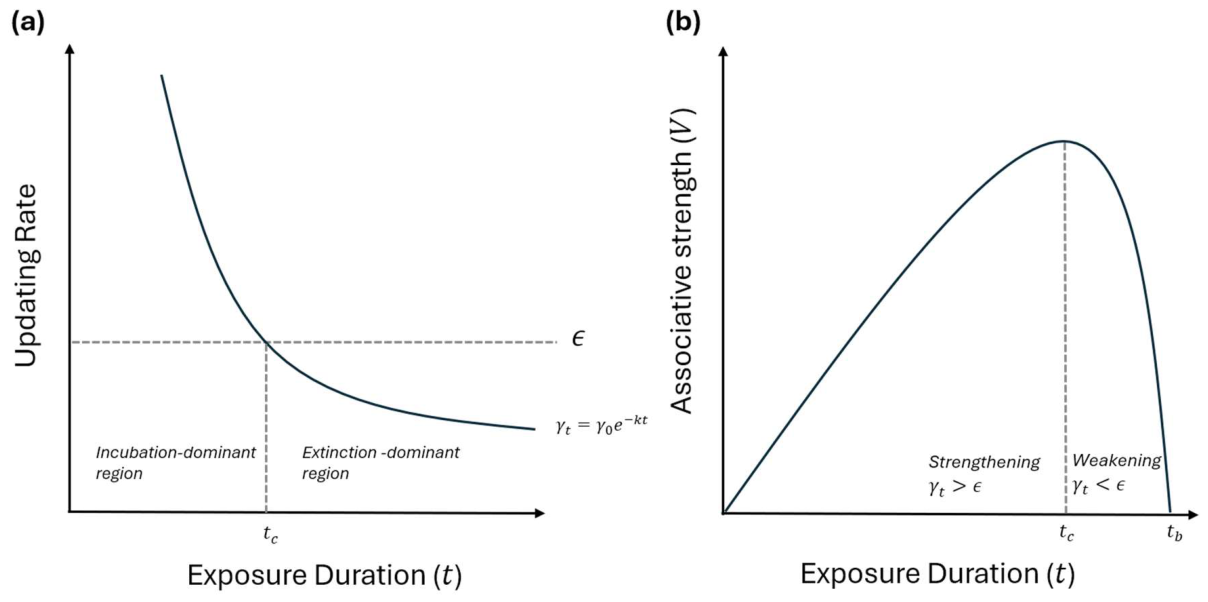
Figure 3.
General framework for recurrent updating of mental representations. An initial event establishes a representation whose content may be emotional, motivational, interpersonal, or attentional (e.g., fear, reward, romantic attraction, grievance, or attentional significance). Subsequent reactivation through replay, rumination, anticipation, simulation, or reinterpretation provides opportunities for further updating. The relative strength of strengthening () and weakening () processes determines the resulting trajectory: incubation when , maintenance when , and extinction when . Representational content is therefore separable from dynamical trajectory: fear, attraction, grievance, craving, or attentional significance may each grow, persist, or diminish according to the same general updating principle.
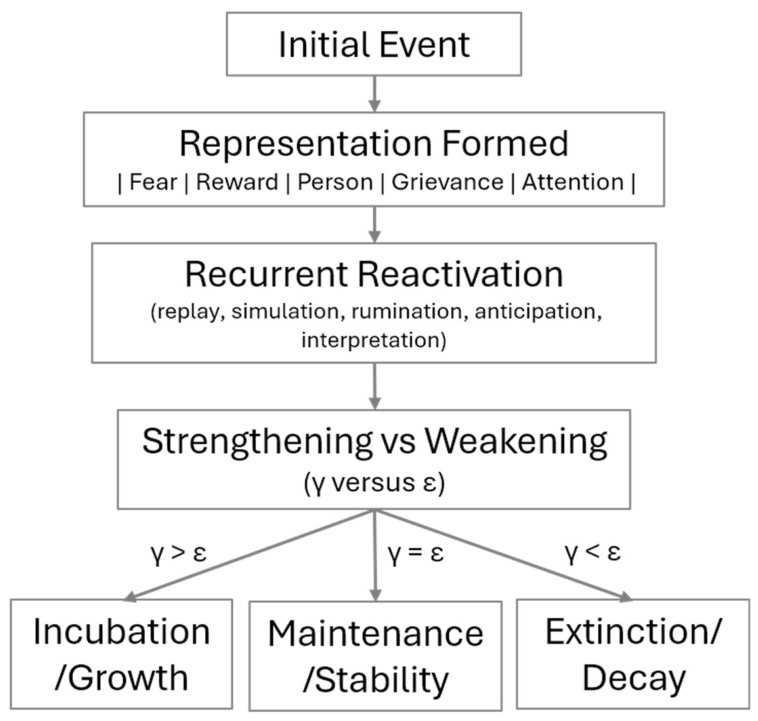

Table 1.
Examples of candidate mappings of the incubation model across psychological domains.
| Domain | Candidate representation | Reactivation process |
γ-promoting factors | ε-promoting factors |
Prediction |
|---|---|---|---|---|---|
| Infatuation | Romantic/incentive value | Fantasy, anticipation, replay | Uncertainty, ambiguity | Resolution, disengagement | If post-encounter rehearsal is high, then attraction intensifies despite limited contact; if rehearsal is disrupted, attraction decays. |
| Social anxiety | Social threat/self-evaluation | PEP | Negative reinterpretation |
Corrective updating, effective problem-solving |
PEP can amplify or attenuate anxiety. If it favours corrective updating, then anxiety attenuates; if it favours threat elaboration, then anxiety amplifies. |
| Anger | Grievance/status injury | Anger rumination | Ambiguous intent, counterfactual replay | Resolution/ reappraisal |
Small insults can grow into major grievances. If ambiguity sustains replay, then grievance intensity grows; if intent is clarified, then grievance decays. |
| Appetitive motivation | Outcome value | Reward simulation |
Relevant motivational state |
Devaluation/ extinction |
Reactions can manifest as if value has been updated without direct re-experience. |
| Addiction | Incentive salience | Craving imagery/cue replay | Sensitisation, cue activation |
Extinction/ inhibitory learning |
If cue reactivation outpaces extinction, then wanting grows even as liking declines. |
| Delusion | Attentional significance | Interpretation/pattern search | Repeated anomalous salience | Learned irrelevance | Initially trivial anomalies can acquire persistent significance. If reactivation outpaces learned irrelevance, then attentional significance persists despite disconfirmation |
Disclaimer/Publisher’s Note: The statements, opinions and data contained in all publications are solely those of the individual author(s) and contributor(s) and not of MDPI and/or the editor(s). MDPI and/or the editor(s) disclaim responsibility for any injury to people or property resulting from any ideas, methods, instructions or products referred to in the content. |
© 2026 by the authors. Licensee MDPI, Basel, Switzerland. This article is an open access article distributed under the terms and conditions of the Creative Commons Attribution (CC BY) license (http://creativecommons.org/licenses/by/4.0/).
Copyright: This open access article is published under a Creative Commons CC BY 4.0 license, which permit the free download, distribution, and reuse, provided that the author and preprint are cited in any reuse.