

Submitted:
19 November 2026
Posted:
19 November 2026
You are already at the latest version
Abstract
Machine learning is widely used to predict the environmental behavior and effects of pollutants. Molecular representation strongly influences these predictions, yet its suitability varies with the endpoint and the available data. This review examines how descriptors, fingerprints, SMILES strings, molecular graphs, and pretrained models evolved and were applied to physicochemical properties and environmental fate, bioaccumulation and bioconcentration, and ecotoxicity. Which representation suits a task therefore follows from what information the endpoint requires, not from how recent the method is. Conventional descriptors and fingerprints remain competitive for endpoints governed by size, polarity, or specific functional groups, and graph-based and pretrained models have not consistently outperformed them. Where endpoints also depend on uptake, exposure, or organism characteristics, contextual variables can matter as much as the encoding itself. Direct comparisons under identical conditions remain few, and reported performance is rarely comparable across studies because datasets, algorithms, validation procedures, and chemical coverage differ. Representation choice should therefore be reported with the data conditions under which it was evaluated. Claims of improvement should rest on external validation and an explicit applicability-domain analysis, so that model predictions can support screening and risk assessment.
Keywords:
molecular representations
; machine learning
; environmental pollutants
; environmental fate
; bioaccumulation
; ecotoxicity
1. Introduction
The increasing number and diversity of anthropogenic chemicals pose substantial challenges for environmental monitoring and risk assessment. Once released into the environment, industrial chemicals, pesticides, pharmaceuticals, and other emerging contaminants undergo complex processes such as partitioning, degradation, bioaccumulation, and biological uptake, and their toxicological effects are costly and time-consuming to characterize experimentally [1,2]. Computational approaches such as quantitative structure–activity/property relationship (QSAR/QSPR) modeling and machine learning (ML) therefore provide an important complement to experimental testing by predicting environmental properties and biological effects directly from chemical structure [3].
Molecular representation, the encoding of chemical structures into a computationally processable form, is a central component of such models. Traditional environmental QSAR models rely on molecular descriptors and fingerprints encoding physicochemical properties, topology, or structural fragments [3]. Deep learning has shifted this practice toward learned representations: molecular structures are now commonly encoded as SMILES strings or molecular graphs, enabling sequence models, Transformers, and graph neural networks (GNNs) to learn task-specific structural features, while large-scale self-supervised pretraining yields chemical language models that generate transferable molecular embeddings from unlabeled chemical data [4,5,6].
However, more complex representations may not guarantee better performance in environmental applications. Environmental datasets are typically small, heterogeneous, and derived from different species, exposure conditions, media, and experimental protocols. Under such conditions, conventional descriptors and fingerprints may remain competitive because of their low data requirements and high interpretability, whereas SMILES-based models, GNNs, and pretrained models offer advantages when sufficient chemical diversity or transferable information is available [4,5,6]. Environmental endpoints differ substantially in the information they require, and biodegradation, bioaccumulation, persistence, and ecotoxicity also depend on environmental and biological context, the choice of representation should be guided by both the prediction task and the characteristics of the available data.
Several recent reviews have covered related work. Zhang [7] reviewed chemical structure representation learning for toxicity prediction, and other work has surveyed ML-based QSAR models in environmental science, covering data preparation, feature engineering, validation, and applications [3]. However, few studies have discussed which representation is most suitable for a given endpoint and dataset, and the choice is often still guided by convention rather than by evidence. This review therefore traces how molecular representations have evolved and been applied for ML-based prediction of environmental pollutants, from classical descriptors and fingerprints, through SMILES strings and molecular graphs, to pretrained molecular models, and examines their use across physicochemical properties and environmental fate, biodegradation and persistence, bioaccumulation, and ecotoxicity [8,9,10].
This review adopts a narrative and critical approach, focusing on representative studies of molecular representations for environmental pollutant prediction. Relevant literature was identified through searches of Web of Science and Scopus, supplemented by reference tracking of key studies. The literature covers foundational representation methods and their subsequent environmental applications, with emphasis on studies published since 2015. Studies were selected based on their relevance to the main molecular representation approaches and the three environmental prediction domains examined in this review. Priority was given to studies reporting the molecular features, prediction endpoints, model performance, and validation procedures. Studies directly comparing representations or incorporating biological and environmental variables were examined in greater detail. Reviews and perspective articles provided background context, while original research papers formed the basis of the comparative assessment.
2. Evolution of Molecular Representations for Environmental Pollutant Modeling
Molecular representation is a fundamental component of machine learning-based environmental pollutant modeling, since it determines how chemical structure information is encoded and provided to predictive models. This section is organized into four subsections covering the major representation paradigms utilized in this field: (1) handcrafted molecular representations, including molecular descriptors and fingerprints; (2) sequence-based representations, mainly based on SMILES strings [4]; (3) graph-based representations, in which molecules are modeled as atom–bond graphs [5]; and (4) pretrained molecular representations, including chemical language models, graph pretraining, and emerging LLM-enhanced approaches [6]. Together, these approaches illustrate the transition from predefined structural features toward learned and transferable molecular representations. Figure 1 illustrates these four paradigms using 4-chlorophenol as a common example.
2.1. Handcrafted Molecular Representations: Descriptors and Fingerprints
Handcrafted representations convert molecular structures into predefined numerical features and remain the basis of traditional QSAR models for environmental chemicals. They fall into two families: molecular descriptors, which summarize physicochemical, electronic, or topological properties, and fingerprints, which record the presence or frequency of structural fragments.
Descriptors are often compact and interpretable. Molecular weight, log P, polar surface area, hydrogen-bond counts, and connectivity indices are typical examples. Tools such as RDKit and Mordred can calculate many of these features for machine learning models including random forests, support vector machines, and gradient boosting [11,12]. Because such features relate directly to molecular size, polarity, hydrophobicity, and connectivity, they are particularly informative for endpoints governed by these properties. Molecular descriptors differ further in the structural information required for their calculation. Zero-dimensional descriptors summarize molecular composition, while one-dimensional descriptors include counts of functional groups and structural fragments. Two-dimensional descriptors describe molecular connectivity and topological properties, whereas three-dimensional descriptors capture molecular geometry and spatial arrangement. Quantum chemical descriptors provide electronic information, including atomic charges, orbital energies, and reactivity indices. These categories overlap, as many quantum chemical descriptors require optimized molecular geometries. The choice of descriptors depends on the information relevant to the target endpoint, with quantum chemical descriptors used in studies of reaction kinetics and ecotoxicity. Fingerprints take a different route, encoding local substructures into fixed-length vectors. MACCS keys [13] and circular fingerprints such as Morgan and extended-connectivity (ECFP) fingerprints represents the occurrence of specific motifs rather than global properties, which makes them well suited to structure–activity relationships tied to particular functional groups [14]. Their binary or count format is also computationally cheap and compatible with most machine-learning methods.
Handcrafted features remain competitive long after the arrival of deep learning. Environmental datasets are small and heterogeneous, conditions under which descriptors and fingerprints are robust, inexpensive, and readily interpreted. Their weakness is the reverse of their strength: because the features are predefined, information outside the chosen descriptor set is simply lost. The following sections will address this weakness by discussing the SMILES-based and graph-based representations [15,16].
2.2. Sequence-Based Molecular Representations: SMILES
The Simplified Molecular Input Line Entry System (SMILES) encodes a molecule as a character sequence covering atoms, bonds, branches, ring closures, and stereochemistry [4]. Molecular descriptors and fingerprints transform molecules into predefined numerical features, while SMILES preserves the structure in symbolic form and can be processed directly by sequence-learning models. Using SMILES, molecular structures can be analyzed with methods built for natural language, which is what makes it a practical bridge between cheminformatics and NLP. Early SMILES-based approaches generally converted these strings into character- or token-level vectors and used recurrent or convolutional networks, such as RNNs, LSTMs, gated recurrent units, and CNNs, to extract task-relevant patterns [17]. Recent work increasingly relies on Transformer architectures, which capture long-range dependencies between tokens through self-attention and produce contextual molecular embeddings [18]. Alongside canonical SMILES [19], randomized SMILES can serve as a form of data augmentation to generate several valid strings for the same molecule. This reduces excessive dependence on a single string ordering and is particularly useful when the labeled dataset is limited.
SMILES-based representations offer several advantages for environmental pollutant modeling. They allow end-to-end feature learning without extensive manual descriptor selection, and their sequence format is computationally convenient and compatible with mature deep-learning architectures developed for language modeling [6]. Most importantly, the availability of large unlabeled chemical databases makes SMILES well suited to self-supervised pretraining, so molecular representations learned from broad chemical space can be transferred to smaller environmental datasets [20]. Environmental endpoints such as ecotoxicity, biodegradability, and bioaccumulation rarely have labeled data at the scale these models can exploit, which makes the ability to pretrain elsewhere decisive. However, SMILES still carries representation-specific limitations. A molecule may be expressed by multiple valid SMILES strings, so the sequence is not inherently unique unless canonicalization is applied [4]. More fundamentally, the linear order of a SMILES string does not correspond directly to the molecular graph: atoms that are close in the graph may appear far apart in the sequence, and sequence models can only recover such relationships implicitly [15]. These properties make downstream performance sensitive to tokenization strategy, sequence length, stereochemical encoding, and the consistency of molecular standardization.
For environmental pollutant prediction, these strengths and limitations suggest that SMILES-based models are most valuable when the objective is to learn molecular features directly from chemical structure or to exploit pretrained chemical language models. Whether they outperform conventional descriptors and fingerprints depends strongly on dataset size, chemical diversity, and prediction endpoint [15]. In small environmental datasets, simpler handcrafted representations may remain competitive, whereas SMILES-based models become increasingly attractive when transfer learning or large-scale pretraining can be utilized [20]. Graph-based representations, which encode connectivity explicitly, address several of these issues and are discussed in the next section.
2.3. Graph-Based Molecular Representations
Graph-based representations describe a molecule as a graph in which atoms are nodes and chemical bonds are edges. The graph is usually built by parsing a SMILES string or a structure file with a cheminformatics toolkit, which returns the atoms and bonds as an explicit connection table [11]. Each heavy atom becomes a node carrying features such as element type, valence, charge, aromaticity, and hybridization, and each bond becomes an edge carrying bond type, order, conjugation, and stereochemistry [5]. Built this way, the graph is two-dimensional: it records which atoms are bonded, not where they sit in space. Graphs can also be built at coarser scales, for example by collapsing functional groups or ring systems into single nodes, which trades atomic detail for longer-range connectivity [21].
A molecular graph defines the input structure but not the learning algorithm. Most current work learns from it with graph neural networks (GNNs), which iteratively aggregate information from neighboring atoms and bonds [22,23,24,25]. The message-passing framework underlying these models appears in several variants, including graph convolutional, graph attention, and graph isomorphism networks. Through repeated message passing, each atom representation incorporates information from progressively larger local neighborhoods, so structural motifs and their relationships are learned directly from molecular topology rather than supplied in advance. This matches the structure of many environmental endpoints, which are governed by connectivity, functional groups, and local chemical environment, and it supports atom-level attribution, for example by identifying the fragments associated with toxicity or bioaccumulation [26,27].
However, graph-based models are not always superior to conventional approaches. They are parameter-heavy and need more training data. Environmental datasets rarely meet, and even the larger ones are usually imbalanced and heterogeneous [15]. Their computational cost and model complexity are also higher than those of descriptor- or fingerprint-based methods. Most commonly used molecular graphs are further limited to two dimensions and therefore do not explicitly capture conformational or environmental effects [21,28]. The advantage of graph-based learning thus depends strongly on dataset size, endpoint complexity, and validation strategy, and for environmental applications GNNs are best treated as a complementary strategy rather than an automatic replacement for traditional QSAR features.
2.4. Pretrained Molecular Representations and Emerging LLM-Enhanced Approaches
Pretraining separates representation learning from task-specific training. A model is first trained on a large unlabeled corpus through a self-supervised objective, for example reconstructing masked tokens, atoms, or subgraphs. The resulting embeddings are then reused across downstream tasks. In chemistry, pretraining has been applied to SMILES sequences through Transformer-based chemical language models, to molecular graphs through graph-based objectives, and to three-dimensional conformers [20,29,30,31,32]. Representative models include ChemBERTa [33] for SMILES pretraining and MolFormer, which has since been examined for transfer to environmental endpoints [34], alongside graph-based models such as GROVER [6] and three-dimensional frameworks such as Uni-Mol [32]. More recent work combines these inputs, fusing chemical language embeddings with molecular graphs, textual descriptions, or experimental metadata [29], and early studies have begun to apply such fused representations to toxicity and environmental property prediction [35].
The main advantage of pretrained representations is their ability to carry chemical knowledge learned from large datasets into tasks with limited labeled data [20]. Environmental pollutant modeling faces a problem that many endpoints rest on small samples and incomplete experimental coverage. A pretrained model can supply chemically informative embeddings that reduce reliance on task-specific training data and may generalize better to underrepresented chemical classes [34]. Transfer learning through fine-tuning or feature extraction has accordingly become a common alternative to training deep models from scratch.
These approaches nonetheless remain at an early stage in environmental science, and several limitations qualify their current value. One major obstacle is domain shift. Pretraining corpora and environmental contaminant datasets differ in ways that can degrade transferred performance, and it is not yet clear which models transfer well to which endpoints. Another problem is interpretability: learned embeddings cannot be read the way conventional descriptors can. Large pretrained models also demand significant computing power, and they do not by themselves fix poor data quality, endpoint heterogeneity, or weak external validation. Consequently, pretrained and LLM-enhanced representations are best seen as an extension of existing strategies rather than a replacement. Whether they improve on simpler baselines under realistic validation conditions, particularly for toxicity and bioaccumulation endpoints, remains an open question. Table 1 summarizes the encoding characteristics, typical models, strengths, and limitations of the four paradigms discussed in this section.
3. Applications of Molecular Representations in Environmental Pollutant Prediction
Molecular representations have been applied to a wide range of environmental prediction tasks, but their effectiveness varies with the nature of the endpoint, dataset size, and degree of dependence on molecular structure. In general, current applications can be grouped into three major categories: physicochemical properties and environmental fate, bioaccumulation and bioconcentration, and ecotoxicity. These tasks differ substantially in both data characteristics and mechanistic complexity, providing a useful basis for comparing the practical performance of handcrafted, sequence-based, graph-based, and pretrained molecular representations. Figure 2 organizes these applications by domain, and Table 2 summarizes the representative studies discussed in the following subsections.
3.1. Physicochemical Properties and Environmental Fate
Physicochemical properties and environmental fate are established applications of QSAR and machine learning in environmental chemistry. The endpoints discussed here include aqueous solubility, persistence, biodegradability, and degradation kinetics [3]. Molecular size, hydrophobicity, polarity, functional groups, and connectivity provide important information for these predictions. Their relative importance differs across endpoints. Solubility is closely related to molecular physicochemical properties, while biodegradation and environmental persistence also depend on the conditions under which chemicals undergo transformation.
Molecular representation choice affects predictive performance even when models target the same endpoint. Fernandez et al. built a consensus approach for ready biodegradability from several in silico models, each restricted to a descriptor-defined chemical subset [36]. Yin et al. then compared CORINA descriptors, MACCS keys, and ECFP4 fingerprints for the same endpoint, and the three differed in predictive performance [37]. Across more than 8,400 organic compounds, Tayyebi et al. found that random forest models using Mordred descriptors outperformed those using Morgan fingerprints, and SHAP analysis identified the physicochemical features associated with those predictions [16].
Reaction-rate prediction places additional emphasis on molecular reactivity and local structural features. Sanches-Neto et al. used molecular fingerprints to predict hydroxyl radical reaction rate constants for 903 atmospheric organic pollutants [38]. SHAP analysis identified structural features associated with the predicted rates. For water contaminants, Liu et al. compiled 2,358 kinetic records and combined group contribution methods with semisupervised learning to improve prediction and expand applicability-domain coverage [39]. Their final model achieved a test R² of 0.77, while the applicability domain expanded by 117% relative to the model trained on the original dataset alone. These results demonstrate the importance of both molecular features and data coverage in reaction-rate modeling.
Hybrid models add electronic and three-dimensional information that descriptors and fingerprints do not carry. Shao et al. developed Molreac-Oxi, integrating quantum chemical descriptors, pretrained Uni-Mol representations, and stacked machine learning models to predict kOH for 968 pollutants [40]. The ensemble reached a test R² of 0.806. Reaction-pathway and active-site analysis were handled by separate computational components rather than by the predictive model itself. Descriptors and fingerprints therefore remain adequate for endpoints fixed by molecular structure, and hybrid models help where reactivity and three-dimensional geometry are needed.
3.2. Bioaccumulation and Bioconcentration
Bioaccumulation and bioconcentration are central to the environmental risk assessment of organic contaminants. They are quantified by the bioconcentration factor (BCF) and the bioaccumulation factor (BAF). The BCF is measured in the laboratory from waterborne uptake alone, whereas the BAF also includes dietary uptake and therefore depends on the food web and on the exposure setting [41]. Because measurement is costly and slow, QSAR models have long been used to estimate both endpoints for screening [42]. The BCF is largely determined by hydrophobicity, molecular size, polarity, and functional groups [43]. The BAF shares these drivers and adds the organism and the exposure conditions [41]. The same molecule can therefore accumulate to different degrees depending on species and exposure route, which makes bioaccumulation a useful test case for how representations handle context.
Early machine learning studies primarily relied on handcrafted molecular descriptors. Ai et al. built an SVM-based QSAR model from two-dimensional molecular descriptors to predict BCFs for structurally diverse organic chemicals, showing that appropriately selected structural descriptors can provide effective estimates for aquatic risk assessment [44]. Kobayashi et al. combined physicochemical properties calculated using OPERA with Mordred descriptors to evaluate several machine learning algorithms for fish BCF prediction, and XGBoost gave best performance [45]. These studies reflect the continuing importance of descriptor-based representations for bioaccumulation, where prediction rests on interpretable molecular properties such as hydrophobicity and molecular connectivity. Xu et al. built a QSAR–QSIIR framework on 17 conventional molecular descriptors plus five bioactivity descriptors to extend BCF prediction across multiple chemicals and species [46]. The 22 inputs are still handcrafted numerical descriptors, but five of them now describe the species rather than the molecule.
Recent work has concentrated on per- and polyfluoroalkyl substances (PFAS). Chandra et al. combined machine learning with quantitative read-across structure–property relationships (q-RASPR) to predict BCFs for PFAS and used read-across to estimate BAFs [47]. The model was then applied to a screening set of 2,411 PFAS without experimental BCF measurements, where the applicability domain and extrapolation become the limiting factors for chemical prioritization. Song et al. used molecular fingerprints to represent PFAS and trained models to predict BAFs in plant tissues. Their dataset contained 811 observations covering 22 PFAS, and XGBoost performed well across root, leaf, stem, and fruit [48]. Li et al. combined PFAS descriptors with crop type, plant tissue, soil properties, and cultivation conditions to predict plant BCFs and concentrations, with carbon-chain length and soil pH contributing substantially [49].
Descriptors remain the default for BCF prediction because the endpoint tracks properties they encode directly. What the later studies add is not a different representation but a wider input: species, tissue, and environmental conditions enter as separate variables. For an endpoint defined by both the chemical and the setting, a wider input does more than a richer encoding of the molecule.
3.3. Ecotoxicity Prediction
Machine learning has been widely applied to ecotoxicity prediction to complement experimental toxicity testing, which is often costly and time-consuming. Common endpoints include acute and chronic toxicity to aquatic and terrestrial organisms, such as fish, Daphnia magna, algae, earthworms, and pollinators [1]. Ecotoxicity depends on molecular structure as well as species sensitivity, exposure duration, dose, and experimental conditions [9]. These factors have motivated the use of different molecular representations in machine learning models for ecotoxicity prediction.
Molecular descriptors and fingerprints have long been used in toxicity prediction. DeepTox combined chemical descriptors with deep neural networks to predict a range of toxicological endpoints, demonstrating that predefined molecular features can also be used in deep learning models [50]. In aquatic ecotoxicity, Yu developed classification models using molecular descriptors to predict acute toxicity to Daphnia magna [51]. Xu investigated the same species but focused on pesticide toxicity, using 15 quantum chemical descriptors and random forest regression to predict acute toxicity for 745 pesticides [52]. These studies illustrate the use of molecular descriptors in both toxicity classification and regression, with physicochemical and electronic features providing information relevant to toxic effects. Structural fingerprints offer a different approach by encoding molecular fragments that may be associated with toxicity. Although descriptors summarize selected molecular properties, fingerprints emphasize the presence of structural patterns. Both representations remain useful in conventional QSAR modeling, and their relative performance depends on the chemical dataset and toxicity endpoint.
Graph-based representations have been applied to ecotoxicity prediction because they allow models to learn molecular features from atom–bond connectivity. Lei et al. compared molecular descriptors, fingerprints, and molecular graphs for chronic freshwater toxicity prediction [28]. Their study provides a direct comparison of predefined and learned molecular representations for the same toxicity endpoint. Although graph attention networks learned structural features from molecular graphs, conventional descriptor-based models remained competitive in predictive performance. This result shows that graph-based learning does not necessarily improve prediction accuracy over established molecular features. Yeom et al. investigated graph neural networks for Daphnia toxicity prediction and examined molecular substructures associated with toxic responses [21]. The three representation types were compared on one endpoint under the same protocol, and the learned one did not pull ahead.
Pretrained molecular representations have also been applied to ecotoxicity prediction, particularly for tasks with limited labeled data. In honey-bee toxicity prediction, de Souza Pinho et al. compared pretrained MolFormer embeddings with conventional QSAR representations [34]. A random forest model using Morgan fingerprints achieved a ROC-AUC of 0.866, slightly higher than the 0.859 obtained using MolFormer embeddings with a support vector machine. This comparison shows that pretrained representations do not automatically outperform conventional molecular features on small toxicity datasets. Another approach combines pretrained embeddings with other molecular representations. Chen et al. developed BeeEcoTox, which integrates ChemFM embeddings, molecular graphs, and MACCS fingerprints for predicting the toxicity of agrochemicals to bees [35]. The model achieved a ROC-AUC of 0.91 on the test set and 0.85 on an independent external dataset. Pretrained embeddings therefore helped where they were combined with other inputs, not where they replaced conventional features.
Ecotoxicity studies have also examined the use of molecular features across different chemical classes and exposure conditions. Li et al. combined RDKit and Mordred descriptors, molecular fingerprints, soil properties, and pesticide formulation information to predict the toxicity of commercial pesticides to Eisenia fetida [53]. Their gradient boosting model achieved an accuracy of 0.83 and an AUROC of 0.88. Liu et al. developed a QSAR–machine learning framework for soil organic pollutants using quantum chemical descriptors together with environmental and species-related variables [54]. The study included 2,108 toxicity records covering 305 compounds and 77 species and used the predicted toxicity values to derive ecological thresholds.
PFAS toxicity studies provide further examples of how molecular information is selected for specific chemical classes. Park and Lee used RDKit descriptors and explainable machine learning to identify structural features associated with PFAS toxicity [55]. Ye et al. applied PaDEL descriptors to model six toxicity endpoints for 267 PFAS, examining the contributions of hydrophobicity, charge distribution, and molecular topology [56]. Cheng et al. used quantum chemical descriptors to investigate structure–toxicity relationships among 26 PFAS, highlighting carbon-chain length and electronic characteristics [57]. The toxicity endpoints in the latter two studies were estimated using ECOSAR rather than measured experimentally. Lai et al. extended PFAS modeling to large-scale chemical screening by generating and evaluating more than 260,000 candidate structures [58]. These studies demonstrate the continued use of molecular descriptors for toxicity prediction and structural analysis, while the soil ecotoxicity studies show how environmental and biological variables can supplement molecular information for exposure-dependent endpoints.
4. Comparative Assessment and Reliability of Molecular Representations
The studies reviewed in Section 3 demonstrate the application of different molecular representations across environmental prediction tasks. However, the reported performance varies with the target endpoint, molecular features, and modeling conditions, making it difficult to draw general conclusions from individual studies. This section therefore examines the evidence for selecting molecular representations and discusses the factors affecting the comparability, reliability, and generalizability of their reported performance.
4.1. Comparative Evidence for Representation Selection
Direct comparisons within the same prediction task provide the clearest evidence for selecting molecular representations. Tayyebi et al. compared Mordred descriptors and Morgan fingerprints for aqueous solubility prediction using more than 8,400 organic compounds. Random forest models using molecular descriptors performed better than those based on fingerprints [16]. Lei et al. compared molecular descriptors, fingerprints, and molecular graphs for chronic freshwater toxicity prediction. Conventional descriptor-based models remained competitive with graph attention networks [28]. Neither study establishes a consistent advantage for learned representations over predefined features. Tayyebi et al. nonetheless reported a clear performance difference between the two representations on the same dataset, showing that representation choice can affect prediction even when the task and data are fixed.
The chemical information needed for prediction helps identify suitable candidate representations, but does not determine which one will perform best. Aqueous solubility is closely related to molecular size, polarity, and hydrogen-bonding characteristics, which can be expressed through physicochemical descriptors [16]. The same chemical information can also be represented in different ways. Fingerprint fragments can encode structural patterns associated with polarity, allowing models to access related information through different representations. The need to represent polarity therefore helps identify candidate features without establishing which encoding will perform best. Hydroxyl radical reaction rates depend on molecular reactivity and structural features associated with reaction pathways. Sanches-Neto et al. used MACCS fingerprints to predict these rate constants for atmospheric organic pollutants [38]. Quantum chemical descriptors provide additional electronic information relevant to reaction kinetics [40]. Bioaccumulation and ecotoxicity involve a broader range of factors. Molecular properties remain important, but the observed endpoints also depend on organisms, exposure routes, and environmental conditions. A molecular graph or pretrained embedding represents chemical structure but does not directly encode soil conditions, species, or plant tissues. These differences help determine which inputs should be considered, rather than which molecular encoding will achieve the highest predictive performance.
Studies using pretrained and context-enriched inputs illustrate different ways to extend molecular prediction models. In honey-bee toxicity prediction, de Souza Pinho et al. compared MolFormer embeddings with conventional QSAR representations and found that a Morgan fingerprint-based model performed slightly better under the reported conditions [34]. Other studies combined learned representations with established molecular features. BeeEcoTox integrated ChemFM embeddings, molecular graphs, and MACCS fingerprints for agrochemical toxicity prediction [35], while Molreac-Oxi combined quantum chemical descriptors and pretrained Uni-Mol representations for hydroxyl radical reaction-rate modeling [40]. A different approach appears in bioaccumulation and soil ecotoxicity studies. Xu et al. combined molecular and bioactivity descriptors for BCF prediction [46]. Studies of PFAS accumulation in plants incorporated tissue, crop, and soil information [48,49], while soil toxicity models included environmental, species-related, or pesticide formulation variables [53,54]. These approaches address different information requirements. For endpoints closely related to intrinsic molecular properties, representation choice can focus on how effectively structural and physicochemical information is encoded. For endpoints influenced by uptake, exposure, or organism characteristics, these factors must also be considered as model inputs.
4.2. Reliability and Generalizability of Representation Comparisons
The reliability of a representation comparison depends first on whether the effects of molecular features and predictive algorithms can be distinguished. A model's performance reflects its input representation along with the learning algorithm, hyperparameter settings, and training procedure. In the honey-bee toxicity study by de Souza Pinho et al., Morgan fingerprints with a random forest achieved a ROC-AUC of 0.866, compared with 0.859 for MolFormer embeddings with a support vector machine [34]. The conventional pipeline performed slightly better, but the comparison changed both the representation and the classifier, so the difference cannot be assigned to molecular encoding alone. The same issue arises when evaluating fusion models. BeeEcoTox and Molreac-Oxi combine multiple feature sources with specific learning architectures [35,40], and their reported performance describes the complete modeling system rather than any single input. Controlled comparisons using consistent algorithms, data partitions, and training procedures provide stronger evidence of representation effects, while feature ablation helps assess the contribution of individual input components.
Dataset composition provides a second source of variation. Studies summarized in Table 2 address different environmental endpoints and report R² or Q² for regression, and ROC-AUC or accuracy for classification. These metrics describe different prediction tasks and cannot be used to rank representations across unrelated datasets. Even studies reporting the same metric can differ in endpoint definitions, experimental methods, and chemical coverage. For example, Song et al. collected 811 observations of PFAS accumulation in plant tissues, but these records represented only 22 distinct PFAS [48]. Measurements from different tissues add biological and exposure information without increasing the number of molecular structures. This distinction matters for models that learn directly from chemical representations, particularly when measurements for the same compound appear in both training and test sets. Validation design is equally important. Random splitting can place measurements of the same compound or structurally related compounds in both training and test sets, making the evaluation less informative about generalization to new chemical structures. Chemically separated splits test generalization across structural differences, whereas external and temporal evaluations assess performance on independently collected or later-available data. BeeEcoTox reported a ROC-AUC of 0.91 in its main held-out evaluation and also examined performance under other validation settings [35]. A comparison of representations is most informative when models use consistent compound assignments, molecular preprocessing, and evaluation procedures [10,59].
Applicability-domain analysis addresses the use of models beyond the chemicals represented during training. It evaluates whether a new compound is sufficiently supported by the model's development data, commonly through structural or descriptor-space relationships [60,61]. This is particularly important when predictive models are used to screen large sets of emerging pollutants. Chandra et al. developed a PFAS bioconcentration model using 33 modeling compounds and applied the framework to a screening set of 2,411 PFAS without experimental BCF measurements [47]. The screening increased the number of chemicals receiving estimates, but those estimates were not independently validated by experimental BCF values for the screened compounds. The number of predictions therefore needs to be distinguished from the number of experimentally supported predictions. For pollutant prioritization, reporting which screened compounds fall within the defined domain makes the results more informative than reporting the screening total alone.
Interpretation methods address a different part of model assessment: which inputs contribute to the fitted model's predictions. In hydroxyl radical reaction-rate modeling, Sanches-Neto et al. used SHAP to examine structural features associated with predicted reactivity [38]. Yeom et al. analyzed molecular substructures associated with Daphnia toxicity using graph-based models [21]. PFAS toxicity studies have also examined the importance of physicochemical, topological, and quantum chemical descriptors [55,56,57]. These analyses identify associations within fitted models. They do not, by themselves, establish reaction mechanisms or causal relationships between molecular features and toxic effects. The origin of the target values is another part of the evidence. In the PFAS studies by Ye et al. and Cheng et al., the target values were generated using ECOSAR rather than measured experimentally [56,57]. Performance on these targets’ measures agreement with model-derived estimates rather than independent experimental toxicity data. Model interpretation therefore requires attention to both the features driving predictions and the experimental or computational origin of the target values.
5. Conclusions and Future Directions
Molecular representations differ in the chemical information they encode, and the applications reviewed here do not establish a consistent ranking across environmental prediction tasks. Descriptors, fingerprints, SMILES-based representations, molecular graphs, and pretrained models have all been used to predict physicochemical properties, environmental fate, bioaccumulation, and ecotoxicity. Few studies have compared them under otherwise identical conditions. Descriptor-based models outperformed Morgan fingerprint models for aqueous solubility [16]. For chronic freshwater toxicity, conventional descriptors remained competitive with graph attention networks [28]. Neither result gives learned representations a general advantage. Endpoint characteristics decide which information is worth representing. Whether a particular encoding predicts better is a separate question, and only direct comparison answers it.
Representation selection therefore involves two steps. The first is identifying the information relevant to the target endpoint. Solubility and reaction-rate prediction both follow from molecular structure, so descriptors and fingerprints provide the information these endpoints require [16,38]. Bioaccumulation and ecotoxicity also depend on biological and environmental factors. When models cover different organisms or exposure settings, relevant contextual variables should be included alongside molecular features [48,49,53,54,62]. The second step is comparing candidate representations under consistent modeling conditions. Existing comparisons rarely isolate the effect of the representation. Some change both the molecular encoding and the learning algorithm. Hybrid models combine several feature sources and architectures, so their reported performance describes the whole system [34,35,40]. Controlled comparisons and feature ablation can clarify which components contribute to predictive performance.
Future research should strengthen the evidence supporting representation selection through validation and transparent reporting. Validation strategies should reflect the intended application, with structure-based or independent external testing when models are applied to chemically distinct pollutants [10,59]. Large-scale screening studies should report applicability-domain coverage alongside the number of chemicals evaluated [47,60,61]. Studies using toxicity values estimated by other predictive tools should identify these targets as model-derived rather than experimental measurements [56,57]. Together, these practices would make reported performance more informative for selecting representations and applying prediction models to environmental pollutant screening and risk assessment.
Author Contributions
Conceptualization, Shiyang Cheng and Chunsheng Liu; investigation, Jueting Liu; resources, Jueting Liu and Chunsheng Liu; writing-original draft, Jueting Liu and Yuchang Lei; writing-review and editing, Jueting Liu and Shiyang Cheng; funding acquisition, Tingting Xu and Zehua Wang.
Funding
This research was funded by the National Natural Science Foundation of China, grant number No.22106168 and the Natural Science Foundation of Jiangsu Province, grant number BK20241641.
Institutional Review Board Statement
Not applicable.
Informed Consent Statement
Not applicable.
Data Availability Statement
No new data were created or analyzed in this study. The performance values summarized in Table 2 are reproduced from the cited original publications. Data sharing is not applicable to this article.
Acknowledgments
The authors thank the National Natural Science Foundation of China (grant number 22106168) and the Natural Science Foundation of Jiangsu Province (grant number BK20241641) for financial support. During the preparation of this manuscript, the authors used DeepSeek V4.1 for language editing and grammar revision. The authors have reviewed and edited the output and take full responsibility for the content of this publication.
Conflicts of Interest
Not applicable.
Abbreviations
The following abbreviations are used in this manuscript:
| BAF | Bioaccumulation Factor |
| BCF | Bioconcentration Factor |
| BERT | Bidirectional Encoder Representations from Transformers |
| CNN | Convolutional Neural Network |
| ECFP | Extended-connectivity Fingerprint |
| ECOSAR | Ecological Structure–activity Relationships |
| MACCS | Molecular ACCess System |
| PFAS | Per- and Polyfluoroalkyl Substances |
| QSAR | Quantitative Structure–activity Relationship |
| QSPR | Quantitative Structure–property Relationship |
| SHAP | SHapley Additive exPlanations |
| SMILES | simplified molecular input line entry system |
References
- Dong, X.; et al. Machine Learning in Ecotoxicology: Pollutant Exposure Levels and Detection, Biotoxicity and Environmental Behavior Prediction. Sci. Total Environ. 2025, 1008, 180985. [Google Scholar] [CrossRef]
- Tan, H.; et al. Deep Learning in Environmental Toxicology: Current Progress and Open Challenges. ACS ES&T Water 2024, 4, 805–819. [Google Scholar] [CrossRef]
- Chen, C.; et al. Applications of Machine Learning-Based Quantitative Structure–Activity Relationship (ML-QSAR) Models in Environmental Science. Environ. Res. 2026, 294, 123853. [Google Scholar] [CrossRef]
- Weininger, D. SMILES, a Chemical Language and Information System. 1. Introduction to Methodology and Encoding Rules. J. Chem. Inf. Comput. Sci. 1988, 28, 31–36. [Google Scholar] [CrossRef]
- Kearnes, S.; McCloskey, K.; et al. Molecular Graph Convolutions: Moving Beyond Fingerprints. J. Comput.-Aided Mol. Des. 2016, 30, 595–608. [Google Scholar] [CrossRef]
- Rong, Y.; Bian, Y.; et al. Self-Supervised Graph Transformer on Large-Scale Molecular Data. Adv. Neural Inf. Process. Syst. 2020, 33, 12559–12571. [Google Scholar] [CrossRef]
- Zhang, J.; Zhao, L.; et al. New Trend on Chemical Structure Representation Learning in Toxicology. Crit. Rev. Environ. Sci. Technol. 2025, 55, 951–976. [Google Scholar] [CrossRef]
- Meng, L.; Zhou, B.; et al. Advancing Toxicity Studies of Per- and Polyfluoroalkyl Substances (PFASs) through Machine Learning: Models, Mechanisms, and Future Directions. Sci. Total Environ. 2024, 946, 174201. [Google Scholar] [CrossRef]
- Barua, S.; Balaji, B.; Balaji, S. AI/ML-Based Computational Models for Toxicity Prediction. Environ. Sci. Pollut. Res. 2026, 1–26. [Google Scholar] [CrossRef]
- Belfield, S.J.; Cronin, M.T.D.; et al. Guidance for Good Practice in the Application of Machine Learning in Development of Toxicological Quantitative Structure-Activity Relationships (QSARs). PLoS ONE 2023, 18, e0282924. [Google Scholar] [CrossRef]
- RDKit: Open-Source Cheminformatics Software. Available online: https://www.rdkit.org (accessed on 5 November 2026).
- Moriwaki, H.; Tian, Y.S.; et al. Mordred: A Molecular Descriptor Calculator. J. Cheminform. 2018, 10, 4. [Google Scholar] [CrossRef]
- Durant, J.L.; Leland, B.A.; Henry, D.R.; Nourse, J.G. Reoptimization of MDL Keys for Use in Drug Discovery. J. Chem. Inf. Comput. Sci. 2002, 42, 1273–1280. [Google Scholar] [CrossRef]
- Rogers, D.; Hahn, M. Extended-Connectivity Fingerprints. J. Chem. Inf. Model. 2010, 50, 742–754. [Google Scholar] [CrossRef]
- Yang, K.; Swanson, K.; et al. Analyzing Learned Molecular Representations for Property Prediction. J. Chem. Inf. Model. 2019, 59, 3370–3388. [Google Scholar] [CrossRef]
- Tayyebi, A.; Alshami, A.S.; et al. Prediction of Organic Compound Aqueous Solubility Using Machine Learning: A Comparison Study of Descriptor-Based and Fingerprints-Based Models. J. Cheminform. 2023, 15, 99. [Google Scholar] [CrossRef]
- Winter, R.; Montanari, F.; et al. Learning Continuous and Data-Driven Molecular Descriptors by Translating Equivalent Chemical Representations. Chem. Sci. 2019, 10, 1692–1701. [Google Scholar] [CrossRef]
- Vaswani, A.; Shazeer, N.; et al. Attention Is All You Need. Adv. Neural Inf. Process. Syst. 2017, 30. [Google Scholar] [CrossRef]
- Weininger, D.; Weininger, A.; Weininger, J.L. SMILES. 2. Algorithm for Generation of Unique SMILES Notation. J. Chem. Inf. Comput. Sci. 1989, 29, 97–101. [Google Scholar] [CrossRef]
- Huang, Z.; Yu, J.; et al. Large-Scale Chemical Language Models for Accurate and Interpretable Prediction of Reactivity and Toxicity. Process Saf. Environ. Prot. 2025, 108113. [Google Scholar] [CrossRef]
- Yeom, J.; Jeong, H.; et al. Graph Neural Network-Based Prediction and Interpretation of Daphnia Toxicity Using Distinct Scale Molecular Representations. Water Res. 2026, 125676. [Google Scholar] [CrossRef]
- Kipf, T.N.; Welling, M. Semi-Supervised Classification with Graph Convolutional Networks. arXiv 2017, arXiv:1609.02907. [Google Scholar] [CrossRef]
- Gilmer, J.; Schoenholz, S.S.; et al. Neural Message Passing for Quantum Chemistry. In Proceedings of the 34th International Conference on Machine Learning (ICML), Sydney, Australia, 6–11 August 2017. [Google Scholar]
- Veličković, P.; Cucurull, G.; et al. Graph Attention Networks. In Proceedings of the 6th International Conference on Learning Representations (ICLR), Vancouver, BC, Canada, 30 April–3 May 2018. [Google Scholar]
- Xu, K.; Hu, W.; et al. How Powerful Are Graph Neural Networks? In Proceedings of the 7th International Conference on Learning Representations (ICLR), New Orleans, LA, USA, 6–9 May 2019. [Google Scholar]
- Gao, Q.; Balhorn, L.S.; et al. Environmental Impacts Prediction Using Graph Neural Networks on Molecular Graphs. Comput. Chem. Eng. 2026, 109362. [Google Scholar] [CrossRef]
- Medina, H.; Drake, R.; et al. Accelerated Prediction of Molecular Properties for Per- and Polyfluoroalkyl Substances Using Graph Neural Networks with Adjacency-Free Message Passing. Environ. Pollut. 2025, 382, 126705. [Google Scholar] [CrossRef]
- Lei, L.; Zhang, L.; et al. Advancing Chronic Toxicity Risk Assessment in Freshwater Ecology by Molecular Characterization-Based Machine Learning. Environ. Pollut. 2024, 342, 123093. [Google Scholar] [CrossRef]
- Rollins, Z.A.; et al. MolPROP: Molecular Property Prediction with Multimodal Language and Graph Fusion. J. Cheminform. 2024, 16, 56. [Google Scholar] [CrossRef]
- Devlin, J.; Chang, M.-W.; et al. BERT: Pre-Training of Deep Bidirectional Transformers for Language Understanding. In Proceedings of the 2019 Conference of the North American Chapter of the Association for Computational Linguistics: Human Language Technologies (NAACL-HLT), Minneapolis, MN, USA, 2–7 June 2019. [Google Scholar] [CrossRef]
- Brown, T.B.; Mann, B.; et al. Language Models Are Few-Shot Learners. In Proceedings of the 34th Conference on Neural Information Processing Systems (NeurIPS), Vancouver, BC, Canada, 6–12 December 2020. [Google Scholar]
- Zhou, G.; Gao, Z.; Ding, Q.; Zheng, H.; Xu, H.; Wei, Z.; Zhang, L.; Ke, G. Uni-Mol: A Universal 3D Molecular Representation Learning Framework. In Proceedings of the 11th International Conference on Learning Representations (ICLR), Kigali, Rwanda, 1–5 May 2023. [Google Scholar]
- Singh, R.; Barsainyan, A.A.; et al. ChemBERTa-3: An Open Source Training Framework for Chemical Foundation Models. Digit. Discov. 2026, 5, 662–685. [Google Scholar] [CrossRef]
- de Souza Pinho, A.V.; et al. Transfer Learning for Honey Bee Toxicity Prediction: MolFormer versus Classical QSAR Representations. Ecotoxicology 2026, 35, 166. [Google Scholar] [CrossRef]
- Chen, X.; Shen, L.; et al. BeeEcoTox: A Large Language Model-Empowered Graph-Learning Framework for Predicting Ecotoxicity of Agrochemicals to Bees. Environ. Sci. Technol. 2026, 60, 12076–12086. [Google Scholar] [CrossRef]
- Fernandez, A.; Rallo, R.; Giralt, F. Prioritization of In Silico Models and Molecular Descriptors for the Assessment of Ready Biodegradability. Environ. Res. 2015, 142, 161–168. [Google Scholar] [CrossRef]
- Yin, H.; Lin, C.; et al. Prediction and Structure–Activity Relationship Analysis on Ready Biodegradability of Chemical Using Machine Learning Method. Chem. Res. Toxicol. 2023, 36, 617–629. [Google Scholar] [CrossRef]
- Sanches-Neto, F.O.; Dias-Silva, J.R.; et al. Evaluating and Elucidating the Reactivity of OH Radicals with Atmospheric Organic Pollutants: Reaction Kinetics and Mechanisms by Machine Learning. Atmos. Environ. 2022, 275, 119019. [Google Scholar] [CrossRef]
- Liu, Z.; Shang, L.; et al. Combining Group Contribution Method and Semisupervised Learning to Build Machine Learning Models for Predicting Hydroxyl Radical Rate Constants of Water Contaminants. Environ. Sci. Technol. 2025, 59, 857–868. [Google Scholar] [CrossRef]
- Shao, F.; Li, W.; et al. Molreac-Oxi: An End-to-End Deep Learning–Quantum Chemistry Platform for •OH Reactivity (kOH), Pathways, and Active-Site Insight. Environ. Res. 2026, 293, 123763. [Google Scholar] [CrossRef]
- Arnot, J.A.; Gobas, F.A.P.C. A Review of Bioconcentration Factor (BCF) and Bioaccumulation Factor (BAF) Assessments for Organic Chemicals in Aquatic Organisms. Environ. Rev. 2006, 14, 257–297. [Google Scholar] [CrossRef]
- Papa, E.; Dearden, J.C.; Gramatica, P. Linear QSAR Regression Models for the Prediction of Bioconcentration Factors by Physicochemical Properties and Structural Theoretical Molecular Descriptors. Chemosphere 2007, 67, 351–358. [Google Scholar] [CrossRef]
- Dearden, J.C.; Hewitt, M. QSAR Modelling of Bioconcentration Factor Using Hydrophobicity, Hydrogen Bonding and Topological Descriptors. SAR QSAR Environ. Res. 2010, 21, 671–680. [Google Scholar] [CrossRef]
- Ai, H.; Wu, X.; et al. QSAR Modelling Study of the Bioconcentration Factor and Toxicity of Organic Compounds to Aquatic Organisms Using Machine Learning and Ensemble Methods. Ecotoxicol. Environ. Saf. 2019, 179, 71–78. [Google Scholar] [CrossRef]
- Kobayashi, Y.; Yoshida, K. Development of QSAR Models for Prediction of Fish Bioconcentration Factors Using Physicochemical Properties and Molecular Descriptors with Machine Learning Algorithms. Ecol. Inform. 2021, 63, 101285. [Google Scholar] [CrossRef]
- Xu, J.-Y.; Wang, K.; et al. QSAR-QSIIR-Based Prediction of Bioconcentration Factor Using Machine Learning and Preliminary Application. Environ. Int. 2023, 177, 108003. [Google Scholar] [CrossRef]
- Chandra, A.; Banerjee, A.; Roy, K. Prediction of Bioconcentration Factors (BCFs) and Bioaccumulation Factors (BAFs) for Per- and Polyfluoroalkyl Substances (PFASs) Using Read-Across and q-RASPR. Sci. Total Environ. 2025, 993, 180007. [Google Scholar] [CrossRef]
- Song, C.; Gu, Q.; et al. Prediction of PFAS Bioaccumulation in Different Plant Tissues with Machine Learning Models Based on Molecular Fingerprints. Sci. Total Environ. 2024, 950, 175091. [Google Scholar] [CrossRef]
- Li, R.; Yi, J.; et al. Predicting Bioconcentration Factors and Concentrations of Per- and Polyfluoroalkyl Substances in Plants with Machine Learning. Environ. Sci. Technol. 2026, 60, 25786–25799. [Google Scholar] [CrossRef]
- Mayr, A.; Klambauer, G.; Unterthiner, T.; Hochreiter, S. DeepTox: Toxicity Prediction Using Deep Learning. Front. Environ. Sci. 2016, 3, 80. [Google Scholar] [CrossRef]
- Yu, X. Global Classification Models for Predicting Acute Toxicity of Chemicals towards Daphnia magna. Environ. Res. 2023, 238, 117239. [Google Scholar] [CrossRef]
- Xu, S. Predicting Acute Toxicity of Pesticides towards Daphnia magna with Random Forest Algorithm. SAR QSAR Environ. Res. 2025, 36, 189–203. [Google Scholar] [CrossRef]
- Li, S.; Zhang, P.; et al. A Machine Learning-Based QSAR Model for Predicting Toxicity of Commercial Pesticides to Eisenia fetida. Ecotoxicol. Environ. Saf. 2026, 311, 119804. [Google Scholar] [CrossRef]
- Liu, Y.; Fu, R.; et al. A QSAR–Machine Learning Hybrid Model for Predicting the Ecotoxicity of Soil Organic Compounds and Deriving Thresholds. J. Clean. Prod. 2026, 549, 147869. [Google Scholar] [CrossRef]
- Park, J.; Lee, W.H. Explainable Machine Learning for Predicting PFAS Toxicity Using Molecular Descriptors. Environ. Eng. Res. 2026, 31, 250595. [Google Scholar] [CrossRef]
- Ye, C.; Liu, H.; et al. Machine Learning-Driven Quantitative Modeling and Mechanistic Interpretation of Per- and Polyfluoroalkyl Substances (PFAS) Toxicity. J. Environ. Chem. Eng. 2026, 14, 121063. [Google Scholar] [CrossRef]
- Cheng, Z.; Zhou, J.; et al. Unraveling Structure–Toxicity Relationships of PFAS: Insights from Quantum Chemical Descriptors and QSAR Models. Environ. Res. 2026, 294, 123911. [Google Scholar] [CrossRef]
- Lai, T.T.; Kuntz, D.; et al. Molecular Screening and Toxicity Estimation of 260,000 Perfluoroalkyl and Polyfluoroalkyl Substances (PFASs) through Machine Learning. J. Chem. Inf. Model. 2022, 62, 4569–4578. [Google Scholar] [CrossRef]
- Wu, Z.; Ramsundar, B.; et al. MoleculeNet: A Benchmark for Molecular Machine Learning. Chem. Sci. 2018, 9, 513–530. [Google Scholar] [CrossRef]
- Hanser, T.; Barber, C.; et al. Applicability Domain: Towards a More Formal Definition. SAR QSAR Environ. Res. 2016, 27, 893–909. [Google Scholar] [CrossRef]
- Jaworska, J.; Nikolova-Jeliazkova, N.; et al. QSAR Applicability Domain Estimation by Projection of the Training Set in Descriptor Space: A Review. Altern. Lab. Anim. 2005, 33, 445–459. [Google Scholar] [CrossRef]
- Zubrod, J.P.; Galic, N.; et al. Bio-QSARs 2.0: Unlocking a New Level of Predictive Power for Machine Learning-Based Ecotoxicity Predictions by Exploiting Chemical and Biological Information. Environ. Int. 2024, 186, 108607. [Google Scholar] [CrossRef]
Figure 1.
Schematic overview of molecular representation approaches, illustrated using 4-chlorophenol.
Figure 1.
Schematic overview of molecular representation approaches, illustrated using 4-chlorophenol.
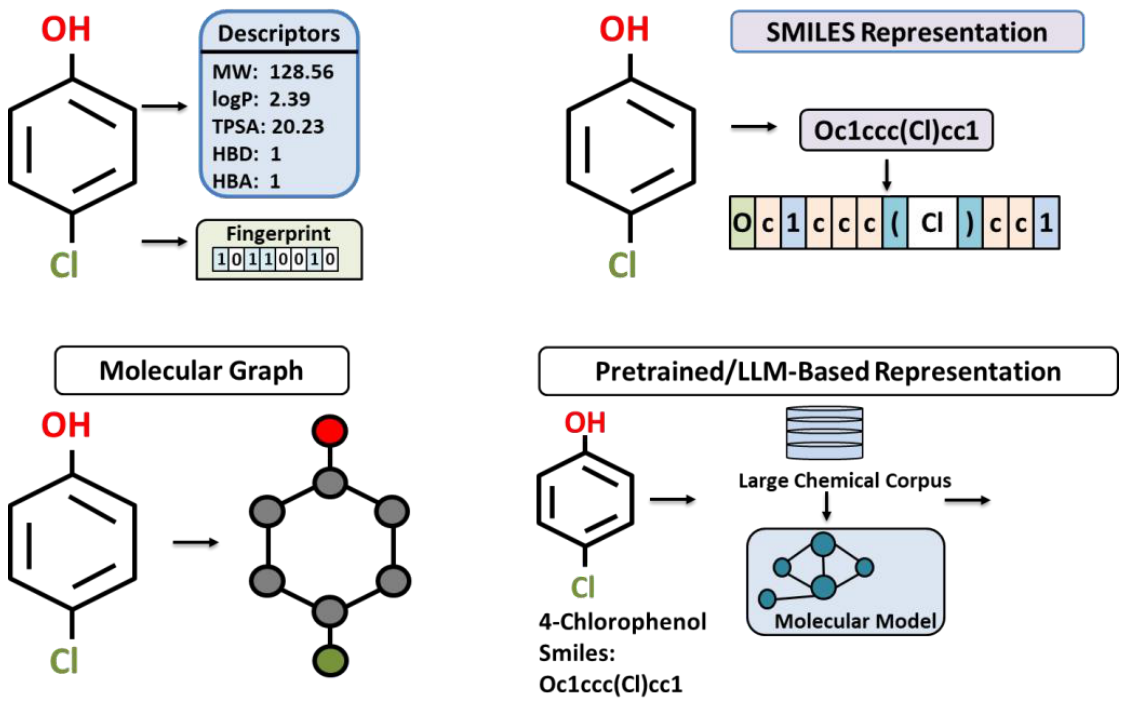
Figure 2.
Applications of molecular representations across physicochemical properties and environmental fate, bioaccumulation, and ecotoxicity.
Figure 2.
Applications of molecular representations across physicochemical properties and environmental fate, bioaccumulation, and ecotoxicity.
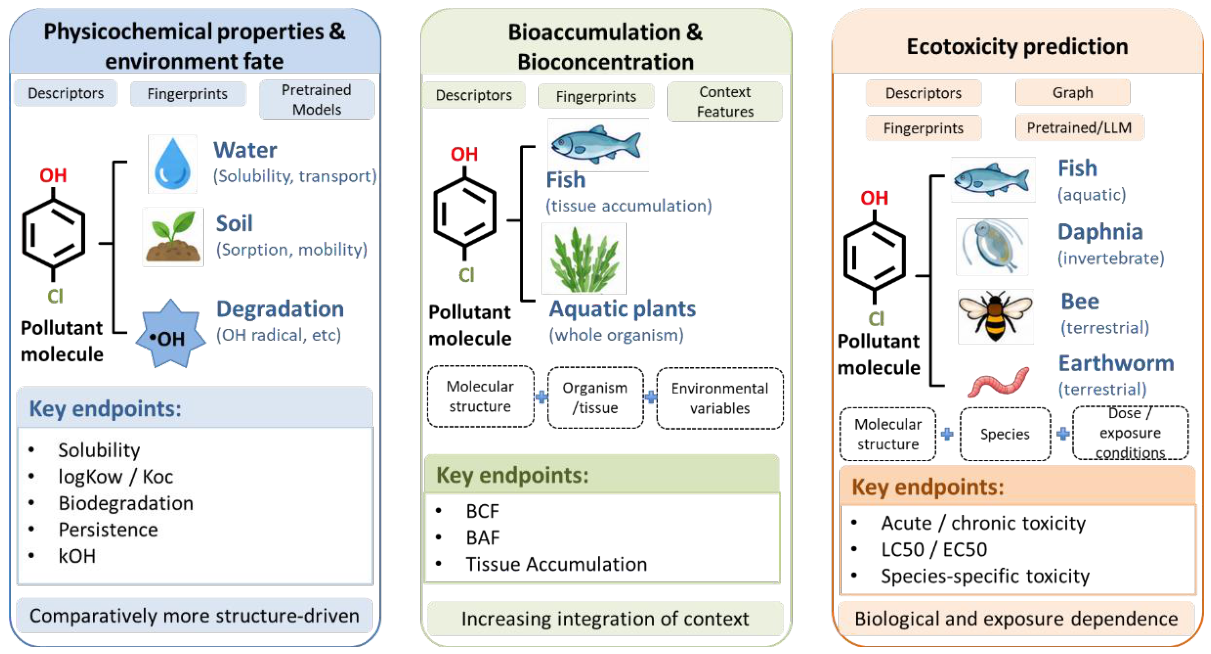

Table 1.
Overview of molecular representation approaches, encoding characteristics, typical models, strengths, and limitations.
Table 1.
Overview of molecular representation approaches, encoding characteristics, typical models, strengths, and limitations.
| Representation | Encoding / information | Typical models | Main strengths | Main limitations |
| Molecular descriptors / Molecular fingerprints |
Predefined physicochemical/topological features | RF, SVM, XGBoost, conventional QSAR | Interpretable; effective for structure-driven endpoints | Feature-dependent; may miss structural details |
| Binary/count vectors of structural fragments | RF, SVM, XGBoost, other conventional ML | Efficient; captures local motifs | Limited global information and interpretability | |
| SMILES-based representations | Molecular token sequences | RNN, LSTM, GRU, CNN, Transformer | End-to-end learning; suitable for pretraining | Sequence-dependent; topology encoded indirectly |
| Graph-based representations | Atom–bond graphs | GCN, GAT, MPNN, GIN | Explicit topology; local interpretability | Data-demanding; higher model complexity |
| Pretrained / LLM-enhanced representations | Learned embeddings from large chemical corpora | ChemBERTa, MolFormer, multimodal models | Transfer learning; broader learned chemical features | Domain shift; limited interpretability |
Table 2.
Representative studies applying molecular representations to the prediction of physicochemical properties and environmental fate, bioaccumulation and bioconcentration, and ecotoxicity of environmental pollutants.
Table 2.
Representative studies applying molecular representations to the prediction of physicochemical properties and environmental fate, bioaccumulation and bioconcentration, and ecotoxicity of environmental pollutants.
| Application domain | Representative study | Pollutants / environmental endpoint | Representation & model | Dataset size & key results |
| Physicochemical properties & environmental fate | Tayyebi et al. (2023) [16] | Organic compounds; aqueous solubility | Mordred vs. Morgan; RF | 8,400+ compounds; R2= 0.88 vs. 0.81 |
| Sanches-Neto et al. (2022) [38] | Atmospheric organic pollutants; ·OH reactivity | MACCS; XGBoost + SHAP | 903 pollutants; MACCS–XGB external Q2 = 0.921 |
|
| Liu et al. (2025) [39] | Water contaminants; ·OH reaction kinetics | Group contribution + semisupervised ML | 2,358 records; test R2 = 0.77 |
|
| Shao et al. (2026) [40] | Organic pollutants; ·OH kinetics and mechanisms | Quantum descriptors + Uni-Mol; ensemble | 968 pollutants; test R2 = 0.806 |
|
| Bioaccumulation & bioconcentration | Xu et al. (2023) [46] | Organic chemicals; BCF | Molecular + bioactivity descriptors; QSAR–QSIIR | 150 compounds; test R2 = 0.7924 |
| Song et al. (2024) [48] | PFAS in plant tissues; BAF | ECFP; XGBoost | 811 observations, 22 PFAS; R2 = 0.82 − 0.93 |
|
| Chandra et al. (2025) [47] |
PFAS; freshwater fish BCF/BAF |
Descriptors + read-across; LSVM q-RASPR | 33 modeling compounds; = 0.930 |
|
| Li et al. (2026) [49] | PFAS in crops; BCF/concentration | Molecular + soil/crop/tissue features; XGBoost | 21 PFAS; R2 = 0.951 |
|
| Ecotoxicity prediction | Yu (2023) [51] | Chemicals; acute Daphnia magna toxicity | Descriptors; RF-QSAR | 1,517 records; accuracy = 0.856 |
| de Souza Pinho et al. (2026) [34] | Agrochemicals; honey-bee toxicity | Morgan vs. MolFormer; RF/SVM | 1,035 compounds; ROC-AUC = 0.866 vs. 0.859 |
|
| Li et al. (2026) [53] | Pesticides; Eisenia fetida toxicity | RDKit/Mordred + soil features; GBDT | 947 records; accuracy = 0.83, ROC-AUC = 0.88 |
|
| Chen et al. (2026) [35] | Agrochemicals; acute bee toxicity | ChemFM + graphs + MACCS; GIN | 1,139 agrochemicals; ROC-AUC=0.91, recall = 0.90 |
Disclaimer/Publisher’s Note: The statements, opinions and data contained in all publications are solely those of the individual author(s) and contributor(s) and not of MDPI and/or the editor(s). MDPI and/or the editor(s) disclaim responsibility for any injury to people or property resulting from any ideas, methods, instructions or products referred to in the content. |
© 2026 by the authors. Licensee MDPI, Basel, Switzerland. This article is an open access article distributed under the terms and conditions of the Creative Commons Attribution (CC BY) license.
Copyright: This open access article is published under a Creative Commons CC BY 4.0 license, which permit the free download, distribution, and reuse, provided that the author and preprint are cited in any reuse.