

Submitted:
17 November 2026
Posted:
19 November 2026
You are already at the latest version
Abstract
Fertilizers are increasingly recognised as a pathway for microplastic (MP) entry into agricultural systems. This review critically evaluates the sources, formation mechanisms, characteristics, fate, environmental implications, analytical challenges, and mitigation options associated with fertilizer-derived MPs. Polymer-coated controlled-release fertilizers generate MPs through coating deterioration, including cracking, abrasion, wetting and drying, photooxidation under sunlight exposure, and polymer-specific biological transformation. Organic fertilizers, composts, digestates, biosolids, and manure-based amendments may also introduce pre-existing MPs originating from contaminated waste streams. Evidence from China, Bangladesh, Europe, the United Kingdom, and Japan confirms fertilizer-associated MP occurrence. However, source attribution is often complicated by mulch films, irrigation infrastructure, packaging, atmospheric deposition, and historical soil contamination. Japanese paddy systems provide the strongest field evidence for direct release, retention, and hydrological export of coated-fertilizer microcapsules. Fertilizer-derived MPs may persist in soil, fragment into smaller particles, redistribute vertically, and move through runoff and drainage. Experimental studies indicate possible effects on soil chemistry, microbial communities, enzyme activities, cadmium availability, and early crop establishment; however, many studies use concentrations exceeding field-relevant exposure levels. Evidence directly linking fertilizer-derived MPs to uptake by edible crops or human exposure remains insufficient. Analytical inconsistencies, especially in recovery efficiency, particle-size limits, polymer identification, and source attribution, further constrain comparison across studies. Bio-based and biodegradable coatings are promising alternatives but require verification of soil mineralization, residual-particle formation, additive safety, and field performance. Future research should prioritise source-resolved field mass balances, standardised analytical workflows, realistic exposure experiments, and life-cycle evaluation of alternative fertilizer technologies.
Keywords:
fertilizer-associated microplastics
; polymer-coated fertilizers
; agricultural soils
; soil-plant interactions
; microplastic transformation
1. Introduction
Microplastics (MPs), generally defined as plastic particles smaller than 5 mm, are now recognized in both aquatic and terrestrial environments [1,2]. Agricultural soils can receive MPs from multiple sources, including plastic mulches and covers, irrigation infrastructure, atmospheric deposition, organic amendments, sewage-sludge-derived fertilizers, and polymer-containing fertilizer products [3,4,5]. Once introduced, MPs may persist, fragment, migrate within the soil profile, or be transported from cultivated land by erosion and runoff [6,7]. Their presence can also modify soil physical and biological processes, although the magnitude and direction of these effects depend on polymer type, particle size, concentration, soil properties, and exposure duration. Fertilization deserves specific attention because it can be linked to MPs in fundamentally different ways. Polymer-coated controlled-release fertilizers can directly generate plastic residues when their coatings weather and fragment after nutrient release [8,9,10]. By contrast, manure, compost, digestate, and biosolids can act as vectors for MPs that originated elsewhere in waste-management or wastewater systems [3,4,11]. Packaging, handling equipment, and other farm plastics may provide additional inputs associated with fertilization activities. These pathways should not be treated as equivalent. In this review, the term fertilizer-derived MPs is reserved for particles generated from polymer-containing fertilizer formulations. In contrast, fertilizer-associated MPs is used more broadly to refer to plastics introduced or mobilized through fertilization and related amendment practices. Long-term and field studies demonstrate why this distinction is necessary. Repeated manure application has been associated with substantial MP accumulation in agricultural soil [12], while archived UK soils show increasing MP burdens over time under several agricultural treatments, including fertilized plots [5]. However, baseline contamination and overlapping sources can obscure the fraction attributable to a specific fertilizer or amendment [13]. Similarly, experimental evidence demonstrates uptake and translocation of sufficiently small plastic particles by crop plants, but these observations do not by themselves establish the contribution of fertilizer-derived MPs to edible tissues under field conditions [14].
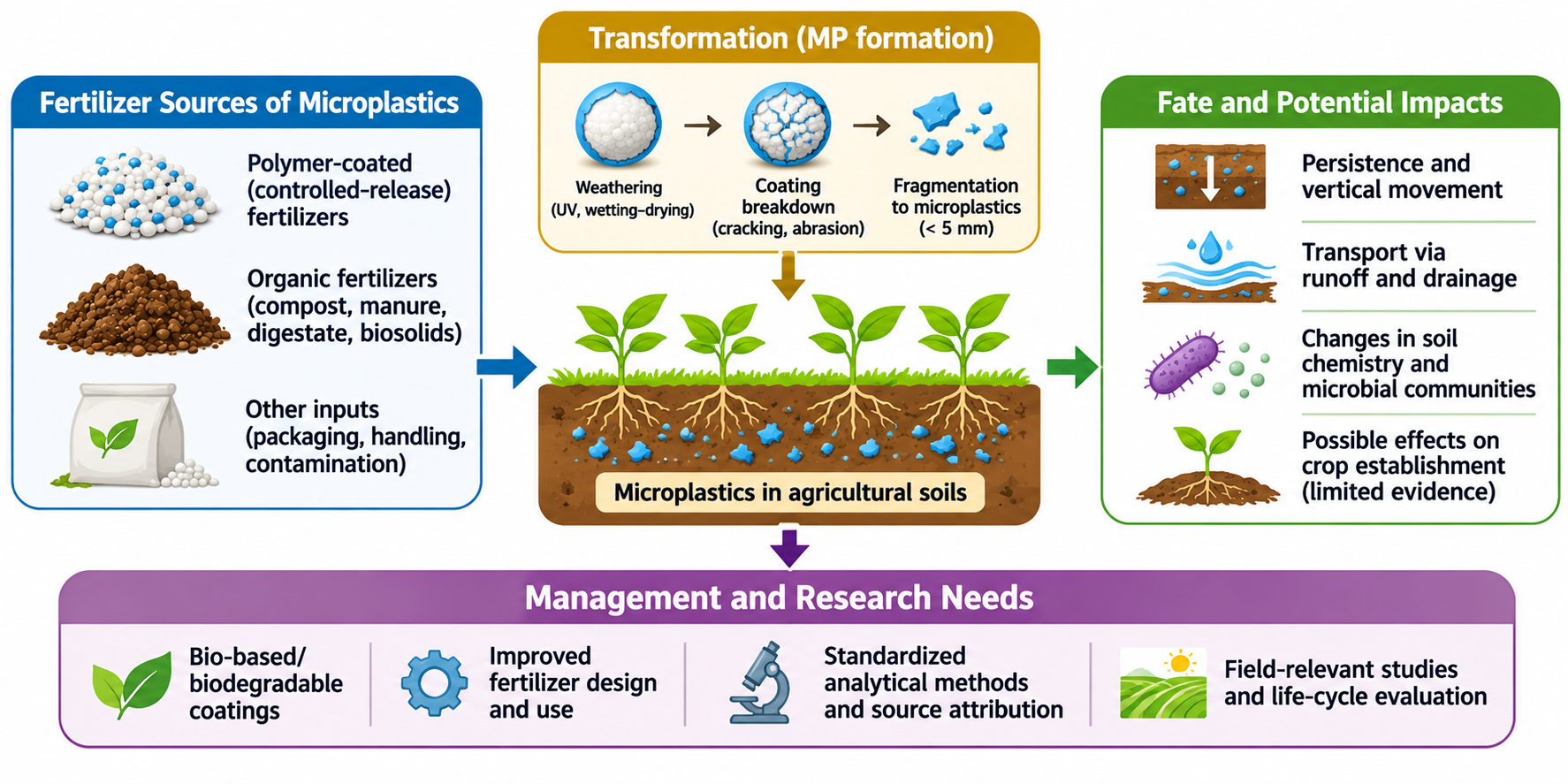
Accordingly, this review critically examines: (i) direct, indirect, and ancillary pathways linking fertilization to MPs; (ii) mechanisms by which polymer-coated fertilizers generate MPs; (iii) the fate and physicochemical evolution of these particles in soil; (iv) evidence for effects on soil processes, co-contaminant behavior, and plants; and (v) analytical and management challenges. The aim is to separate well-supported observations from emerging hypotheses and to identify the evidence needed for source-resolved risk assessment and lower-plastic nutrient-delivery strategies. Figure 1 provides a system-level conceptual overview linking fertilizer-associated MP sources with particle generation, environmental transformation, soil and rhizosphere interactions, and potential plant and food-system implications.
2. Pathways of Fertilizer-Associated Microplastics
For clarity, fertilizer-associated MPs are grouped here into three pathways. Direct inputs originate from polymers intentionally incorporated into fertilizer formulations, particularly coatings used for controlled nutrient release. Indirect inputs are pre-existing MPs carried into soil with organic or waste-derived amendments such as manure, compost, digestate, and biosolids. Ancillary inputs arise from activities associated with fertilizer storage, handling, transport, and application, including packaging and polymer-containing equipment. Only the first category is unambiguously fertilizer-derived; the latter two are fertilizer-associated pathways because the plastics may originate outside fertilizer manufacture. This distinction is essential for source attribution and prevents background agricultural plastics from being incorrectly assigned to fertilizers [3,4,15,16].
2.1. Direct Polymer Inputs
Direct polymer inputs occur when synthetic or semi-synthetic polymers are intentionally incorporated into fertilizer products to regulate nutrient release. Polymer-coated controlled-release fertilizers commonly use coating materials based on polyethylene, polyurethane, or other polymer systems around nutrient granules [8,10,17]. After nutrient release, coating residues may remain in soil and progressively weather. Field observations from Japanese paddy systems provide direct evidence that fertilizer-derived polymer microcapsules can accumulate in soils and be exported through drainage and runoff [8,9,15]. The environmental persistence of a coating depends on its chemistry, thickness, formulation, and exposure conditions. Photochemical oxidation before or near the soil surface, wet–dry cycling, abrasion, and biological colonization can weaken coatings and promote cracking or fragmentation [10,18,19]. These processes support a direct mechanistic link between polymer-coated fertilizers and MP formation. Nevertheless, degradation rates reported for one coating formulation should not be generalized to all controlled-release fertilizers because commercial products differ substantially in polymer composition and additives.
2.2. Indirect Inputs (Organic/Waste-Derived)
Organic and waste-derived amendments can contain MPs before they are applied to agricultural land. Compost, manure, digestate, and biosolids receive plastics from household and commercial waste streams, agricultural materials, textiles, wastewater, and processing operations [3,4,11]. Repeated land application can therefore transfer these pre-existing particles to soil. In this pathway, the amendment functions primarily as a carrier rather than as the source of the polymer. Biosolids are particularly relevant because wastewater treatment concentrates a substantial fraction of influent MPs into sludge, which may subsequently be recycled to land [11]. Similarly, long-term application of animal manure and other organic fertilisers has been identified as a potential contributor to microplastic accumulation in agricultural soils [12,20]. However, MP composition in organic amendments is heterogeneous, reflecting variation in source materials and processing, which complicates source attribution in amended soils. In a Swiss field experiment, high and spatially variable baseline MP stocks meant that digestate-derived inputs accounted for only 0.9–4.0% of measured soil MP stocks and could not be detected reliably against background variation [13]. These findings highlight the need to characterise both the applied amendment and the receiving soil before attributing observed soil MPs to fertiliser inputs.
2.3. Ancillary Pathways
Ancillary plastics associated with fertiliser handling and wider agricultural operations, including packaging, containers, plastic pipes and hoses, films, and storage materials, represent plausible additional sources of MPs to agricultural soils [21,22]. Accordingly, robust source attribution should distinguish MPs introduced within the fertiliser or amendment itself from those arising during its storage, transport, handling, and field application. This distinction requires paired characterisation of the amendment, relevant operational plastics, and pre-application receiving soil, ideally coupled with polymer-specific, particle-size, morphological, and, where possible, additive-chemical analyses. Such an approach would help determine whether MPs detected after amendment application represent a true measurable fertiliser-derived increment or are instead indistinguishable from pre-existing and co-occurring agricultural plastic contamination [13,23].
3. Fate and Transformation of Fertilizer-Associated Microplastics
After entering soil, fertilizer-associated MPs can be retained, transported, or progressively transformed. Their fate is controlled by polymer properties, particle size and shape, soil texture and aggregation, organic matter, moisture regime, tillage, bioturbation, and hydrological processes [6,24]. Fertilizer-associated microplastics enter agricultural soils through two principal routes. The first is the release of residual polymer materials from polymer-coated controlled-release fertilizers. The second is the unintentional introduction of pre-existing plastic particles in organic fertilizers, including compost, digestate, manure compost, and sewage-sludge-derived amendments. For instance, Weithmann et al. (2018) provided direct evidence that organic fertilizers produced from biowaste fermentation and composting can contain plastic particles, demonstrating that these materials can act as an input pathway to agricultural soils [3]. Polymer-coated controlled-release fertilizers leave residual coating materials in soil after nutrients have been released. These materials can remain concentrated around the original fertilizer granule or placement band, but physical stress from contact with soil particles, wetting and drying, cultivation, and other mechanical disturbances can cause coating layers to crack, peel, abrade, and fragment into smaller particles. For instance, a recently published experimental work on polymer-coated controlled-release fertilizers showed that the production of coating-derived MPs can be enhanced in soil relative to water, indicating that soil particle abrasion and mechanical shear are important mechanisms of MP generation from fertilizer coatings [7]. Once released, the transport of coating-derived particles is size-dependent. Smaller particles have greater potential to enter the soil pore network and move downward with infiltrating water, while larger fragments are more likely to remain close to the application zone or be retained by pore constrictions and soil aggregation. Where macropores, cracks, root channels, or worm burrows are present, both small particles and, under some conditions, larger fragments may bypass the bulk soil matrix and reach deeper layers. This mechanism is especially relevant when controlled-release fertilizers are applied repeatedly in irrigated or intensively cultivated soils. The transformation of CRF-coating residues should be distinguished from complete degradation. He et al. (2024) examined MPs derived from controlled-release fertilizer coatings and demonstrated selective microbial colonization and polymer-specific transformation in the plastisphere. Their findings indicate that residual coating materials may undergo mass loss and surface alteration, but their environmental fate differs among polymers. Coating degradation can also generate secondary particles, meaning that a decline in visible coating residues does not necessarily indicate complete removal of plastic from soil [19]. Katsumi et al. (2022) further demonstrated that MPs originating from residual controlled-release fertilizer coatings can affect soil organomineral complexes and bacterial communities over the long term. This evidence supports the interpretation that fertilizer-coating residues may persist after nutrient release and continue to interact with mineral surfaces, soil organic matter, and microbial communities [25]. Organic fertilizers represent a different source because they often introduce MPs that are already present as fibres, fragments, films, and other irregular particles before field application. In a direct investigation of fertilizers made from biowaste fermentation and composting, Weithmann et al. (2018) detected plastic particles in all tested products. The results showed that feedstock composition, contamination during collection and handling, and treatment processes influence the plastic content of the final fertilizer material [3]. Strong field-based evidence on the long-term fate of compost-derived MPs was reported by Zhang et al. (2023) in an 11-year wheat-maize rotation experiment. Pig-manure compost contained 3,547 MP items kg-1, while cow-manure compost contained 4,520 MP items kg-1. Soils receiving the composts contained 144 to 287 MP items kg-1 for pig-manure compost treatments and 140 to 316 MP items kg-1 for cow-manure compost treatments. MP abundance increased with compost-application rate, providing direct evidence that repeated compost use promotes MP accumulation in agricultural soils [26].The estimated compost-derived accumulation in that field experiment ranged from 1.73 \times 108 to 7.22 \times 108 MP items ha-1, accounting for 43.0% to 75.9% of the MP inventory measured in compost-amended soil. This is particularly useful evidence for a review because it moves beyond reporting MP occurrence in compost and quantifies the contribution of long-term organic-fertilizer use to soil MP stocks [26]. The fate of fertilizer-associated MPs is therefore source-specific. MPs from polymer-coated controlled-release fertilizers begin as localized residual materials near fertilizer granules, then may fracture into secondary particles and redistribute through water movement, cultivation, and biological activity. In contrast, compost- and digestate-derived MPs are introduced as pre-existing and compositionally diverse particles over the treated soil area, where repeated applications can increase their stock in the cultivated horizon. The available primary studies indicate that fertilizer-derived MPs can persist beyond nutrient release or fertilizer decomposition, fragment into smaller particles, acquire mineral coatings and microbial biofilms, and undergo partial vertical redistribution. However, evidence for complete mineralization in soil remains limited and should not be assumed from the visual disappearance of coating residues or a reduction in the abundance of larger particles [19,25,26].
4. Mechanistic Formation of Microplastics from Fertilizers
Polymer-coated controlled-release fertilizers provide the clearest mechanistic case for fertilizer-derived microplastic formation. These products contain a soluble nutrient core surrounded by a polymeric coating designed to regulate water entry into the granule and nutrient diffusion out of it. After nutrient release, the coating remains in the soil and can become a source of plastic residues if the material is persistent and loses structural integrity [27]. Coating deterioration can result from several interacting physical, chemical, and biological processes. Water penetration into the granule and dissolution of the nutrient core may contribute to the development of pores, cracks, or rupture, depending on coating permeability, thickness, cross-linking, elasticity, and the composition of the fertilizer core. Mechanical stress during manufacture, packaging, transport, field application, soil incorporation, and contact with soil particles can also damage coatings and detach polymer fragments. Bhattacharjee et al. (2025) directly investigated MP generation from polymer-coated controlled-release fertilizers and identified coating cracking, surface defects, wetting and drying, and contact with soil as important mechanisms that promote the formation of coating-derived MPs [10]. Photodegradation is another possible mechanism, but it is relevant mainly when the fertilizer coating or detached residues are exposed to sunlight. Coating design can alter nutrient-release performance and may influence the subsequent persistence of residual materials. Vermoesen et al. (2023) developed a photo-crosslinkable biodegradable coating based on acryl-endcapped poly(ε-caprolactone) for ammonium nitrate and calcium nitrate fertilizer granules. The coatings were prepared by fluidized-bed processing, and laboratory sand-column experiments showed that nutrient release was primarily diffusion-controlled and strongly affected by coating thickness. Granules with the thickest coating layers, approximately 105 and 112 μm, released 80% of nitrate after approximately 74 to 77 days [28]. The photo-crosslinking used by Vermoesen et al. (2023) is a manufacturing and coating-stabilisation process. It differs fundamentally from UV-induced photodegradation in soil or at the soil surface. This distinction should be made explicitly because “photo-crosslinkable” does not mean that the coating necessarily degrades under light exposure after application [28]. Yang et al. (2017) evaluated the photodegradation of polymer materials used as controlled-release fertilizer coatings under UV irradiation. They found that the P(St-co-BA-co-MMA) latex coating degraded more rapidly than the polyolefin and polyurethane coatings examined. UV exposure broke weak cross-link chains, disrupted the interconnections among latex microspheres, increased film porosity, reduced film thickness and tensile strength, and facilitated release of microspheres from the film surface [18]. Consequently, photodegradation should be regarded as a conditional surface-exposure pathway rather than an obligatory first stage of fertilizer-coating breakdown. It may be important for granules exposed during storage, application, or surface placement, but it is unlikely to dominate for coated fertilizers incorporated rapidly below the soil surface. This distinction is important because the UV experiment by Yang et al. (2017) demonstrates the response of specific coating materials under irradiation, rather than proving that photooxidation is the main degradation mechanism under all agricultural-soil conditions (see Figure 2) [18]. Mechanical processes may be particularly important after fertilizer application. Bhattacharjee et al. (2025) reported greater generation of coating-derived MPs in soil than in water, supporting the interpretation that soil-particle abrasion and mechanical shear can intensify the fragmentation of polymer-coated controlled-release fertilizers. Their results show that MP formation can occur under soil conditions during or after nutrient release, rather than requiring prolonged UV exposure [10]. Once fragments are released, further environmental aging can occur through mechanical abrasion, wetting and drying, oxidation, hydrolysis, and microbial colonization. These processes can alter surface roughness, create cracks and pores, reduce mechanical strength, and generate smaller secondary particles. However, fragmentation should not be equated with complete degradation. A reduction in the amount of intact or visible coating material may indicate conversion into smaller particles rather than removal of plastic carbon from the soil system.
Tian et al. (2024) assessed the in-situ soil degradation of polyethylene, epoxy, and polyurethane MPs derived from controlled-release fertilizer coatings over 807 days. The study found selective microbial colonization and polymer-specific transformation pathways, demonstrating that the fate of coating-derived MPs depends strongly on polymer chemistry. It also reported differences in mass loss and transformation products among the tested polymers, indicating that surface alteration and partial mass loss do not represent uniform or complete mineralization across all fertilizer-coating materials [19]. Furthermore, the biodegradable character of a coating should likewise not be interpreted as proof that it will leave no particulate residues under all field conditions. Vermoesen et al. (2023) conducted accelerated degradation analysis of the poly(ε-caprolactone)-based coating, but direct evidence of full mineralization, the absence of transient secondary particles, and long-term field-soil behaviour would require dedicated soil-incubation or field studies [28].
Accordingly, the formation of fertilizer-derived MPs should be understood as a sequence comprising coating aging, structural failure, detachment of fragments, and subsequent transformation in soil. The relative contribution of internal water-related stresses, mechanical abrasion, photodegradation, hydrolysis, and microbial activity will vary with coating chemistry, coating thickness, fertilizer formulation, previous sunlight exposure, fertilizer-placement method, soil properties, moisture conditions, and agricultural management. Thus, this basis avoids assuming that all controlled-release fertilizer coatings follow the same degradation pathway or that fragmentation necessarily results in complete removal of polymer residues.
5. Characteristics of Microplastics Derived from Coated Fertilizers
Microplastics released from polymer-coated controlled-release fertilizers may differ from commercially available spherical reference particles because their morphology, composition, and surface chemistry reflect the original coating formulation and the mechanism by which the coating fails. Fertilizer-coating residues can occur as irregular flakes, films, fragments, or agglomerated particles rather than as uniform spheres. Their properties may vary with coating polymer, cross-linking density, coating thickness, incorporated fillers, pigments, plasticisers, stabilisers, and the physical or chemical processes that cause coating disintegration. Li et al. (2025) characterised MPs prepared from polyurethane (PU) and polyethylene-polycarbonate (PE-PC) coated fertilizers using scanning electron microscopy (see Figure 3) and Fourier-transform infrared spectroscopy. The prepared PU and PE-PC particles occurred predominantly as irregular flakes with non-uniform surfaces, while visible fractures and cracks were particularly evident in the PE-PC material. These results confirm that MPs derived from coated fertilizers can exhibit heterogeneous and non-spherical morphologies, which should be considered when interpreting their behaviour in soil and biological exposure experiments [7]. However, the particles in that experiment were generated by grinding coated-fertilizer materials before exposure to soil and tomato plants. The observed cracks and fractured surfaces should therefore be interpreted as characteristics of the experimental particle preparation and coating material, rather than as direct evidence of environmental aging after long-term soil residence [7]. This distinction is important because genuine soil aging can further modify particle morphology and surface chemistry through abrasion, wetting and drying, oxidation, hydrolysis, biofilm development, and interactions with mineral and organic matter. Such processes may increase surface roughness, promote crack formation, introduce oxygen-containing functional groups, and change wettability, charge, aggregation behaviour, and accessibility of sorption sites. Raman and FTIR measurements of weathered MPs commonly show spectral deviations from pristine reference materials, while oxidation and chain scission can produce oxygen-containing surface functional groups [29]. The chemical characteristics of fertilizer-derived MPs should not be inferred solely from the nominal polymer name. Fertilizer coatings may be multicomponent formulations containing copolymers, fillers, pigments, plasticisers, stabilisers, curing agents, and other additives. Consequently, their FTIR or Raman spectra can differ from library spectra for virgin single-polymer materials. Particle-level identification should therefore combine visual inspection with micro-FTIR or Raman spectroscopy, appropriate spectra of the original fertilizer coating where available, spectral-quality criteria, and explicit consideration of weathering, additives, fluorescence, and overlap with soil-associated organic matter or mineral signals [7,29].
For source attribution, polymer identity alone is insufficient. Polyethylene, polyurethane, polycarbonate-containing materials, and related additives may originate from multiple agricultural and non-agricultural sources, including mulch films, irrigation equipment, seed coatings, packaging, greenhouse materials, sewage-sludge amendments, compost, and atmospheric deposition. More reliable attribution of coated-fertilizer MPs requires a weight-of-evidence approach that combines polymer chemistry with particle morphology, formulation-specific additives, spatial association with fertilizer-placement zones, information on product use, and comparison with spectra from the original coating. Elemental composition and leachate chemistry may provide additional formulation-specific information. Li et al. (2025) reported differences between PU and PE-PC MPs in elemental composition and dissolved organic-carbon release. This demonstrates that coating type can influence the chemical profile of fertilizer-derived MPs and that the particles may interact with soil solution through processes beyond simple physical presence [7].
Nevertheless, the detection of an element, dissolved organic carbon, or an additive-associated signal in a coating does not by itself establish environmentally relevant leaching, plant uptake, or toxicity. Such conclusions require measurements of leaching kinetics under realistic soil conditions, the chemical identity and concentration of released substances, pore-water concentrations, partitioning to soil solids, persistence, and bioavailability. In the tomato experiment by Li et al. (2025), both PU and PE-PC MPs reduced germination after seven days by 12.5 to 17.5% and 12.5 to 21.7%, respectively, while effects at the 45-day vegetative stage were not consistently adverse. This result indicates a potential early-stage biological response, but it does not identify the mechanism as leaching of additives or metals [7]. Future research should characterise fertilizer-derived MPs before and after controlled soil aging using complementary techniques. A robust design would combine scanning electron microscopy for morphology, micro-FTIR or Raman imaging for polymer identification, pyrolysis-GC/MS for bulk polymer quantification where available, elemental or additive-targeted analysis, and time-resolved leaching tests. These data should then be linked to soil pore-water chemistry and plant or soil-organism exposure measurements. Such approaches would separate particle identity, particle transformation, additive release, and biological relevance, providing a more defensible basis for risk assessment.
6. Global Evidence for Fertilizer-Associated Microplastics in Agricultural Systems
Evidence from agricultural systems increasingly identifies fertilizers as a relevant pathway for microplastic introduction into soil. However, the strength of evidence varies among studies. The most convincing studies either measure MPs directly in fertilizer products, compare amended and unamended soils within a controlled long-term experiment, or identify particles with a morphology and composition that can be specifically linked to polymer-coated fertilizers. In contrast, studies that measure MPs only in agricultural soil can demonstrate contamination but usually cannot assign the entire MP burden to fertilizer inputs because mulch films, irrigation water, agricultural infrastructure, atmospheric deposition, organic wastes, and historical land use may also contribute.
6.1. Evidence from China
Chinese studies provide evidence that organic fertilizers and irrigation can contribute substantially to MP burdens in intensively managed agricultural soils, while also demonstrating the challenge of separating these inputs from other co-occurring sources. Guo et al. (2023) surveyed 15 facility-agriculture soils across five districts of Beijing. Mean MP abundance declined from 896.5 ± 80.0items kg-1 in the 0 to 10 cm layer, to 630.6 ± 47.0items kg-1 at 10 to 20 cm, and 445.3 ± 47.0items kg-1 at 20 to 30 cm. The detected particles were predominantly fibres, accounting for 72.2%, and polypropylene and polyethylene were the major polymers. Using a conditional fragmentation model, the authors identified organic fertilizer and irrigation water as the principal sources. They further found that the number of years of mulching, irrigation method, and organic-fertilizer application amount influenced MP accumulation [20]. This study supports organic fertilizer as a relevant agricultural MP vector, but the attribution should be interpreted as comparative rather than exclusive. The same system involved intensive facility agriculture, mulching history, and irrigation, all of which can introduce or redistribute MPs. Accordingly, the most defensible conclusion is that organic fertilizer and irrigation water were important contributors in the sampled Beijing facilities, not that they explain all MPs detected in those soils [20]. Long-term amendments, including animal manure compost and sludge compost, have also been associated with higher MP concentrations in Chinese agricultural soils, often with fibres and fragments as dominant particle forms. These patterns are consistent with the introduction of MPs via waste-derived organic amendments, but source interpretation should consider the plastic content of the amendment itself, application rate and duration, pre-application soil baseline, mulching practices, and irrigation-water quality. This distinction is essential because fibres may originate from compost and sewage-sludge-derived materials, but can also arise from atmospheric deposition, textiles, agricultural equipment, and irrigation sources.
6.2. Baseline Evidence from Germany
A study of intensively managed farmland in southeast Germany detected macroplastics and microplastics in agricultural soils despite no known application of MP-containing fertilizers. Piehl et al. (2018) therefore provide important evidence of baseline plastic contamination in agricultural landscapes, rather than direct evidence of fertilizer-derived MPs. Its value for the fertilizer literature is methodological: it shows that soil plastics may pre-date fertilizer application or arise from diffuse and historical sources, including littering, mulch residues, atmospheric deposition, machinery, and land-management history [30]. This background contamination can confound simple before-and-after comparisons of amended fields. Studies seeking to attribute MPs to fertilizers should therefore include matched unamended controls, baseline sampling before amendment, analysis of the fertilizer product itself, and a source-apportionment framework based on particle morphology, polymer composition, additive profile, and spatial association with fertilizer placement. A polymer match alone is rarely sufficient because common polymers such as polyethylene and polypropylene occur in multiple agricultural materials.
6.3. Evidence from Bangladesh
Commercial organic fertilizers sampled in Bangladesh contained MPs with diverse particle shapes, sizes, colours, and polymer types, providing direct evidence that marketed organic amendments can deliver MPs to agricultural land [31]. This is a stronger form of evidence than soil-only monitoring because the particles are measured in the agricultural input before application. The risk indices reported by Rana et al. (2023) are useful for comparing polymer profiles and prioritising products for further investigation. However, they should be interpreted as screening metrics rather than measures of realised ecological risk. Such indices generally incorporate polymer-associated hazard classifications and particle abundance. Still, they do not establish soil exposure concentrations after application, particle mobility, additive release, organism uptake, crop responses, or field-scale ecological effects. Therefore, the study demonstrates a plausible direct input route, while the magnitude of field risk remains to be determined through fertilizer-to-soil mass-balance and biological-effect studies [31].
6.4. Evidence from the United Kingdom
Evidence from the United Kingdom provides particularly valuable long-term data because archived soils allow trends to be evaluated against known treatment histories. Analysis of archived soils from the Broadbalk winter-wheat experiment at Rothamsted showed that MP concentrations increased faster in plots receiving farmyard manure or mineral fertilizer than in unamended control plots between 1966 and 2022. MP concentrations in the farmyard-manure and N3(P)KMg treatments differed significantly from the Nil treatment, whereas the two fertilized treatments did not differ significantly from one another. The authors concluded that both organic and inorganic fertilizer treatments contributed to MP loads above baseline concentrations [5]. This result is important because the comparison with an unamended treatment strengthens inference beyond a single-site survey. Nevertheless, the evidence should not be interpreted as proving that every particle in the fertilized plots originated from fertilizer. Long-term field experiments remain exposed to atmospheric deposition, adjacent land activities, machinery, historical contamination, and other diffuse inputs. The most robust interpretation is that the fertilized treatments were associated with a higher rate of MP accumulation than the unamended control, consistent with agricultural fertilizers being a substantial contribution to long-term soil MP burden [5,32]. Separately, UK agricultural surveys have reported higher soil MP concentrations in systems using plastic crop covers, underscoring that agriplastic use can substantially influence the MP background against which fertilizer contributions are evaluated. Fertilizer-source attribution in agricultural soils should therefore account explicitly for plastic mulches, crop covers, irrigation and drainage infrastructure, compost and manure inputs, and atmospheric deposition.
6.5. Evidence from Japan
Japan provides some of the clearest field evidence for MPs directly derived from polymer-coated fertilizers. In rice cultivation, polymer-coated fertilizers leave hollow microcapsules after nutrient release. These capsules are generally approximately 2 to 4 mm in diameter and are composed of synthetic-resin coating materials, including polyolefins and polyurethanes. Their distinctive capsule morphology, known field application, and association with paddy-water management enable stronger source attribution than is typically possible for mixed MP assemblages in agricultural soil [9,15]. Katsumi et al. (2021) detected coated-fertilizer microcapsules in all surveyed paddy fields, with concentrations ranging from 6 to 369 mg kg-1. The accumulation of these characteristic particles in paddy soils provides direct evidence that polymer-coated fertilizer residues can persist after nutrient release [9]. A later field-scale investigation of 38 Japanese paddy sites quantified both accumulation and runoff. Between 61% and 100% of seasonal microcapsule runoff occurred between puddling and rice transplanting, when field disturbance and surface drainage were greatest. Measured field concentrations ranged from 2 to 482 mg m-2. Water-management practices, as well as wind direction and wind speed, explained differences in runoff among plots. The authors estimated national annual runoff from Japanese paddy fields at 17 to 6,291 t, with a median estimate of 1,157 t, and estimated accumulated microcapsules in Japanese agricultural land at 75,623 t [15]. The Japanese case demonstrates both retention and export. Most coating residues appear to remain in paddy soil, but a smaller, environmentally important fraction is mobilised during the brief and hydrologically active period from puddling to transplantation. This provides a strong example of how fertilizer-derived MPs can be transported from agricultural soils to drainage networks, rivers, and potentially coastal environments [15]. A summary of reported fertilizer-associated microplastics and relevant agricultural baseline evidence across different regions is presented in Table 1.
7. Impacts of Microplastics from Fertilizers on Soil–Plant Systems
The impacts of fertilizer-associated microplastics on soil–plant systems should be interpreted according to the strength and relevance of the available evidence. Experiments using MPs derived from polymer-coated controlled-release fertilizers or coating materials provide the most directly relevant evidence, but they are commonly based on short-term incubations or pot studies and may use concentrations above those measured in agricultural soils. Studies using commercially available or laboratory-prepared MPs from non-fertilizer sources provide useful mechanistic context for potential changes in soil structure, nutrient cycling, microbial communities, root function, and plant growth. However, these broader findings should not be interpreted as direct evidence of impacts from fertilizer-derived MPs. Before considering soil and crop effects, it is important to recognise that fertilizer-derived MPs may persist in the application zone, redistribute within the soil profile, or be exported through runoff and drainage. Field evidence from Japanese paddy systems shows that polymer-coated fertilizer microcapsules can accumulate in paddy soils while a smaller fraction is mobilised during irrigation and land-preparation activities. Across 38 paddy fields, microcapsule runoff ranged from 2 to 482 mg m-2, and 61% to 100% of seasonal runoff occurred between puddling and rice transplanting. These findings indicate that fertilizer-derived MPs may create exposure not only within the treated soil but also in connected freshwater and coastal environments [15].
7.1. Effects on Soil Chemistry and Metal Availability
Fertilizer-coating MPs can alter soil physicochemical conditions that govern nutrient and contaminant behaviour. Zhao et al. (2022) examined polyurethane MPs derived from controlled-release fertilizer coatings in soils containing cadmium. The authors tested particle sizes of 0.5, 1, and 2 mm and concentrations of 0.1%, 0.5%, and 1% by mass. Cadmium availability, measured using the diffusive gradients in thin films technique, depended on MP size, concentration, and incubation time. A significant increase in DGT-extractable Cd occurred only at the highest tested concentration of 1% PU MPs. The changes were associated with MP-related shifts in dissolved organic carbon, Fe(II), Mn(II), zeta potential, and microbial-community composition. These findings indicate that coating-derived MPs may modify Cd geochemistry indirectly through coupled carbon, iron, and microbial processes, but they should not be extrapolated directly to all fertilizers or field concentrations [37]. The authors compared polyurethane and polypropylene MPs in clay and sandy soils. Both MP types modified Cd availability, and the direction and magnitude of response differed between soil types. Polyurethane and polypropylene reduced available Cd more strongly in clay than in sandy soil. The authors linked this response to changes in dissolved organic carbon, pH, carbon-containing functional groups, iron oxides, carbonate precipitation, clay-mineral adsorption, and bacterial communities associated with carbon and iron cycling. This study demonstrates that the effect of fertilizer-relevant polymer MPs on metal mobility is mediated by soil mineralogy and geochemical context rather than being determined by polymer type alone [37]. In another study, Diao and co-workers exposed Cd-contaminated acidic soil to polyethylene and polyurethane MPs derived from polymer-coated fertilizers at 0.1% and 1% by mass. Both MPs decreased soil pH and microbial biomass carbon and increased DTPA-extractable Cd, β-glucosidase activity, and N-acetyl-\beta-glucosaminidase activity. The additions also altered bacterial and fungal community structure, with pronounced changes in fungal diversity and enrichment of Mortierellomycota at the 1% treatment. The results show that polymer-coated fertilizer MPs can alter soil chemical conditions, extracellular-enzyme activities, and microbial communities in contaminated soil. However, the study design does not establish that such responses occur at ambient concentrations of fertilizer-derived MPs in field soils [27]. Collectively, these fertilizer-specific studies indicate that coating-derived MPs can influence contaminant bioavailability through changes in pH, dissolved organic carbon, redox-active iron species, mineral interactions, and soil microbial assemblages. The response is likely contingent on polymer chemistry, particle size, concentration, exposure duration, soil texture, organic-matter content, pH, and co-occurring contaminants. Therefore, statements that fertilizer MPs either universally increase or universally decrease metal mobility might need to be avoided.
7.2. Effects on Plants and Crops
Evidence for direct crop effects from fertilizer-coating MPs is emerging but remains limited. Li et al. (2025) assessed MPs prepared from polyurethane and polyethylene-polycarbonate coated fertilizers in a tomato soil-crop system. Both MP types reduced seed germination after seven days. Germination inhibition ranged from 12.5% to 17.5% for polyurethane MPs and from 12.5% to 21.7% for polyethylene-polycarbonate MPs, depending on MP concentration. In contrast, adverse effects at the 45-day vegetative stage were not consistent across all treatments. This result suggests that fertilizer-coating MPs may affect early plant establishment under experimental conditions, but it does not establish sustained growth impairment, field-scale yield reduction, or the specific mechanism responsible for the observed germination response [7]. The difference between early germination effects and later vegetative responses is important. Germination can be sensitive to changes in water availability, seed–soil contact, dissolved substances, pH, microbial activity, and local oxygen conditions. Without companion measurements of pore-water chemistry, particle distribution around seeds, coating additive release, and plant tissue chemistry, the observed response cannot be attributed solely to the physical presence of MPs or to a particular additive. Future fertilizer-specific crop experiments should therefore include realistic particle loads, a conventional coated-fertilizer treatment, uncoated-fertilizer controls, pristine-polymer controls, and measurements that separate particle effects from nutrient-release and additive-leaching effects. Broader plant-exposure studies demonstrate that sufficiently small plastic particles can enter crop plants, but they do not prove uptake of fertilizer-derived MPs. Li et al. (2020) showed that submicrometre plastic particles could enter wheat and lettuce through crack-entry sites associated with lateral-root emergence and subsequently move into the vascular system. This experimental uptake route was demonstrated for particles up to approximately 2 \mum and depends on particle size, flexibility, surface properties, exposure route, and plant-root anatomy [38]. Zytowski, Mollavali, and Baldermann (2025) further reported that 401 to 450 nm polymethyl methacrylate particles were taken up by pak choi through lateral roots in hydroponic solution, growth medium, and soil exposures. Uptake and translocation differed between plant species and exposure conditions, reinforcing the conclusion that plant entry cannot be inferred from polymer identity alone [14]. These uptake studies provide a biologically plausible pathway by which sufficiently small particles could enter crops. However, they used defined particles in controlled exposure systems, not residual MPs traced from a fertilizer product through soil into edible tissue. Fertilizer-coating residues are often initially larger flake-like or capsule-derived particles, and their progressive fragmentation, transport to the root surface, uptake probability, tissue translocation, and persistence in edible organs remain poorly constrained under field conditions.
7.3. Soil Functions and Exposure Relevance
Beyond direct effects on contaminant availability and plant development, fertilizer-derived MPs may affect soil functions through their interaction with pore networks, aggregates, water retention, microbial habitats, and nutrient-cycling processes. The available fertilizer-specific studies show alterations in microbial biomass carbon, enzyme activity, bacterial and fungal community composition, and soil chemical conditions [27,37]. Nevertheless, most fertilizer-specific effect studies apply MPs at concentrations from 0.1% to 1% by mass. These doses are useful for hazard identification and mechanism testing, but they may be substantially greater than many currently reported environmental concentrations of fertilizer-derived MPs. For this reason, the literature more confidently demonstrates potential effects under experimental exposure than it demonstrates field-scale risk. The key challenge is to link measured fertilizer-derived MP loads, particle-size distributions, polymer formulations, and aging states to realistic exposure concentrations in soil and crop-root zones.
7.4. Implications for Food Exposure
The available evidence does not demonstrate that fertilizer-derived MPs have entered edible crop tissues under field conditions or that fertilizer use has created a quantified food-chain or human-exposure risk. Experimental studies show that submicrometre particles can be taken up and translocated by some crop species, but these findings cannot be assigned to fertilizer sources without source-specific particle tracking [14,38]. Food-chain implications should therefore be framed as a priority research question. High-confidence evidence will require field experiments that apply chemically characterised coated fertilizers or organic amendments, quantify residual particles in the rhizosphere and soil profile, use validated contamination-controlled analytical workflows, and confirm polymer identity in roots and edible tissues using complementary methods such as micro-FTIR or Raman imaging and mass-based polymer analysis. Such studies should also distinguish root-surface attachment from internalisation, and particle uptake from the uptake of dissolved additives or plastic-associated contaminants.
Overall, the available evidence supports the potential for fertilizer-derived MPs to alter soil chemical conditions, microbial communities, contaminant availability, and early plant developmental responses under controlled experimental conditions. However, the magnitude, direction, and persistence of these effects remain dependent on polymer chemistry, particle properties, dose, soil conditions, co-contaminants, and exposure duration. Direct evidence linking characterized fertilizer-derived particles to crop uptake, yield loss, edible-tissue contamination, or human exposure under field conditions remains insufficient. Future research should therefore prioritise long-term field experiments using realistic fertilizer formulations and application rates, alongside rigorous particle tracking and soil–plant exposure assessment.
8. Analytical Challenges
Reliable quantification of fertilizer-associated microplastics in soil remains difficult because the matrix contains abundant minerals, organic matter, roots, biogenic debris, and plastics from multiple agricultural sources. Comparability across studies is further limited by differences in sampling depth, minimum particle-size threshold, digestion chemistry, density-separation medium, number of extraction cycles, polymer-confirmation criteria, recovery correction, and reporting units. Consequently, reported concentrations should not be compared directly unless these methodological parameters are reported and broadly aligned [2,5,39]. Extraction efficiency is strongly matrix- and polymer-dependent. In a comparative soil study, digital microscopy, fluorescence microscopy, and ATR-FTIR recovered 74% to 98% of large MPs, whereas Raman analysis was particularly sensitive to residual soil organic matter. Fluorescence-based methods recovered most small low-density polyethylene particles but missed 56% to 93% of small PBAT and PLA particles, illustrating that a single method may systematically undercount particular polymer classes. Pyrolysis-GC/MS also showed lower recoveries with increasing soil clay content [5,39]. Visual sorting should therefore be treated only as a screening step. Mineral grains, organic debris, fibres, and weathered fragments can resemble plastics, particularly after soil aging. Polymer identity should be confirmed using micro-FTIR or Raman spectroscopy, with library-match thresholds, spectral-quality criteria, and representative spectra reported. Micro-FTIR generally supports particle-level identification at approximately 20 to 50 \mum, whereas Raman spectroscopy can reach smaller particle sizes, often near 1 \mum, but may be constrained by fluorescence and incomplete removal of organic residues [39,40]. Thermal methods, especially pyrolysis-GC/MS, provide complementary polymer-specific mass measurements and can detect polymers that are difficult to enumerate microscopically. However, these methods sacrifice information on particle number, size, shape, and morphology. They are therefore best used alongside particle-resolved spectroscopy rather than as a direct substitute for it. Optimised density separation and Py-GC/MS protocols have achieved recoveries of 77.3% to 94.9% for polyethylene, polypropylene, and polystyrene in soil, demonstrating their value for mass-based quantification when matrix-specific recovery tests are included [41]. Source attribution is a separate challenge from polymer identification. Detection of polyethylene, polypropylene, polyurethane, or polycarbonate in soil cannot by itself establish a fertilizer origin because these polymers also occur in mulch films, crop covers, irrigation infrastructure, packaging, machinery, compost, sewage sludge, and atmospheric deposition. This limitation is illustrated by UK field studies, where soils with plastic crop covers contained significantly greater MP concentrations than uncovered sites, with mean concentrations of 4,689 and 2,667 particles kg-1, respectively [5]. Robust attribution of fertilizer-associated MPs should therefore combine polymer confirmation with a well-characterised fertilizer reference material, including coating morphology, polymer spectra, additives, pigments, fillers, and, where possible, pyrolysis-marker profiles. Stronger evidence additionally requires field and procedural blanks, recovery experiments using relevant particle sizes and polymers, matched untreated controls, documented fertilizer-application histories, and spatial sampling that tests expected enrichment near fertilizer-placement zones. The Swiss digestate field experiment demonstrates why this is necessary: digestate contained MPs, but high and variable background soil MP concentrations prevented a clear treatment signal despite quantified amendment inputs [13]. Nanoplastics remain a major unresolved analytical gap. Routine soil methods do not yet provide comprehensive, contamination-controlled quantification of nanoplastics across diverse polymer types and soil matrices. For fertilizer-associated MPs, this limitation is particularly important because fragmentation of coating residues may increase particle number while shifting material below the detection limits of conventional microscopy and spectroscopy.
9. Green and Biodegradable Alternatives to Polymer-Coated Fertilizers
Reducing plastic residues associated with controlled-release fertilizers requires a shift from persistent polymer coatings toward materials whose nutrient-release function, degradation pathway, and environmental fate can be demonstrated under relevant soil conditions. Bio-based and biodegradable coating candidates, including cellulose, lignin, starch, chitosan, alginate, natural rubber, polycaprolactone, and selected biodegradable polyurethanes, are being investigated as alternatives to conventional polyolefin, epoxy, and persistent polyurethane coatings. However, renewable feedstock origin, laboratory disintegration, or partial mass loss should not be interpreted as proof that a coating will avoid secondary microplastic formation or achieve complete mineralization in agricultural soil [42,43,44]. A sustainable fertilizer coating must satisfy two requirements that can conflict. It must remain mechanically intact long enough to regulate nutrient release during storage, handling, and the intended fertilization period. It must then undergo sufficiently rapid and complete biodegradation after its functional lifetime, without leaving persistent polymer fragments, harmful transformation products, or ecotoxicologically relevant additives. This performance must be verified using soil-relevant tests rather than inferred from coating composition or visible disintegration.
9.1. Bio-Based Coatings
Cellulose, lignin, starch, chitosan, and alginate are useful material platforms because they are derived from renewable feedstocks and can be modified to alter film formation, permeability, water uptake, adhesion, and nutrient-release kinetics. Their use should nevertheless be evaluated at the formulation level, because cross-linkers, plasticisers, hydrophobic modifiers, resins, and composite components may determine the actual persistence and toxicity of the final coating. For example, Salimi et al. (2022) developed methylcellulose and methylcellulose-lignin biocomposite coatings for diammonium phosphate and triple superphosphate. The coatings extended nutrient release beyond 30 days in water and soil tests, improved coating mechanical resistance, increased soil water retention, and were associated with improved wheat growth indicators. This study demonstrates technical and agronomic potential, but the reported biodegradation assessment does not, by itself, establish complete mineralization or absence of transient particulate residues under long-term field conditions [45]. Lignin is of particular interest because it is abundant in biomass-processing streams and may support circular use of industrial by-products. However, lignin structure varies with biomass source and extraction process, and this heterogeneity can create uneven coatings, porosity, and cracks. Chemical modification can improve coating performance, but may also increase cost and change biodegradation behaviour. Therefore, lignin-based coatings should be assessed for both nutrient-release function and the fate of chemically modified components [46].
9.2. Biodegradable Synthetic Polymers
Biodegradable synthetic polymers may provide more predictable coating mechanics and nutrient-release performance than many unmodified natural polymers. Polycaprolactone, poly(1,4-butylene adipate), polyethylene adipate, poly(3-hydroxybutyrate-co-3-hydroxyvalerate), biodegradable polyurethanes, and natural rubber have been considered as candidate materials. However, biodegradability is polymer-specific and strongly dependent on molecular structure, crystallinity, film thickness, cross-linking, temperature, moisture, oxygen availability, soil microbial community, and duration of soil exposure. Levett et al. (2025) developed a material-selection framework to identify biodegradable polymers with potential technical and commercial suitability as fertilizer coatings. The work identified polycaprolactone, biodegradable polyurethane, and natural rubber as promising candidates, while also emphasising that commercial viability and biodegradation must be evaluated together rather than independently [44]. Experimental evidence also indicates that soil microorganisms can degrade some candidate polymers, but not all materials at the same rate. In agricultural-soil incubations, poly(1,4-butylene adipate), polyethylene adipate, polycaprolactone, and poly(3-hydroxybutyrate-co-3-hydroxyvalerate) showed increased carbon dioxide production relative to soil-only controls, consistent with microbial biodegradation. In contrast, other tested materials showed limited evidence of degradation under the same conditions. These results reinforce that biodegradability must be verified for the final material and exposure scenario, rather than inferred from a generic polymer class [44]. The distinction between biodegradation and fragmentation remains central. Tian et al. (2024) found selective microbial colonization and polymer-specific transformation of polyethylene, epoxy, and polyurethane MPs derived from controlled-release fertilizer coatings during an 807-day soil experiment. This demonstrates that soil microorganisms can modify coating-derived polymers, but it also shows that transformation pathways differ among materials. Accordingly, a decline in visible coating integrity or particle mass should not be used as stand-alone evidence that plastic residues have been eliminated [19].
9.3. Performance Standards and Evidence Needs
Assessment of alternative coatings should combine nutrient-release testing with polymer-fate measurements. At minimum, studies should report coating composition, thickness, nutrient-release kinetics in soil, mechanical integrity during handling, mass loss, particle-size distribution before and after soil exposure, and evidence of mineralization. Where feasible, micro-FTIR or Raman imaging should be used to identify residual particles, while pyrolysis-GC/MS can support polymer-specific mass balances.
A useful regulatory benchmark is provided by the European Union requirements for polymer components in EU fertilising products. For soil, the regulation requires at least 90% ultimate degradation relative to a reference material, or 90% mineralization measured as evolved carbon dioxide, within 48 months plus the labelled functional period. It identifies EN ISO 17556:2019 and ASTM D5988-96:2018 as acceptable soil-biodegradation methods. This benchmark is relevant as an assessment framework, although compliance with it should not be equated automatically with evidence of environmental safety under all agricultural conditions [47,48,49].
9.4. Non-Coating Strategies
Reducing persistent coating residues does not require replacing every conventional polymer coating with another coating. Agronomic strategies that improve nutrient-use efficiency may reduce dependence on polymer-coated fertilizers, including site-specific placement, split application, fertigation, and matching nutrient supply to crop demand. These strategies should be evaluated on nutrient-loss reduction, crop response, energy demand, cost, and potential trade-offs, rather than assumed to be universally preferable.
Organic amendments, including compost, digestate, manure, and biosolids, should also not be described as inherently low-plastic alternatives. These materials can contain MPs introduced through waste feedstocks, collection systems, processing, and contamination during handling. Weithmann et al. (2018) detected plastic particles in all investigated fertilizer products derived from biowaste fermentation and composting, demonstrating that recycled nutrient streams require feedstock control and product-level plastic-quality assurance [3]. Furthermore, biochar and mineral carriers may provide non-polymeric nutrient-retention platforms, but their suitability should be assessed independently. Their ability to reduce nutrient losses, their interaction with soil properties and contaminants, their production footprint, and their effects on crop performance must be tested against appropriate conventional-fertilizer and uncoated-fertilizer controls.
10. Knowledge Gaps and Future Directions
Current evidence establishes that fertilizers and fertilizer-related amendments can introduce microplastics into agricultural systems, but major uncertainties prevent source-resolved risk assessment. The highest priorities are improved source attribution, long-term fate measurements, field-realistic effect testing, analytical harmonization, and verification of proposed alternatives.
- Source attribution remains a central limitation. For instance, polyethylene, polypropylene, polyurethane, and other polymers detected in agricultural soil may originate from fertilizer coatings, compost and digestate, mulch films, crop covers, irrigation infrastructure, packaging, machinery, atmospheric deposition, or historical contamination. Future studies should analyse the fertilizer or amendment alongside receiving soils, establish pre-application baselines, include matched untreated controls, and use product-specific evidence such as coating morphology, polymer spectra, additive profiles, filler signatures, or pyrolysis-marker fingerprints. The Swiss digestate field study illustrates this challenge: digestate contained MPs, but substantial and variable background soil contamination prevented clear identification of the digestate signal in field soils [13].
- Long-term mass balances are required. Most studies quantify either MP concentrations in fertilizers or MPs in soil at a single time point. Multi-season field experiments should quantify input, retention, fragmentation, vertical redistribution, erosion, runoff, drainage export, and mineralization or transformation. Such measurements are necessary to distinguish genuine accumulation from movement within the soil profile and to determine whether declines in visible coating residues reflect degradation or conversion into smaller, undetected particles. The paddy-field work from Japan provides a useful model because it measured both accumulation and runoff of polymer-coated fertilizer microcapsules under field conditions [15].
- Biological-effect studies should use realistic exposure conditions. Fertilizer-specific experiments demonstrate that coating-derived MPs can modify soil pH, dissolved organic carbon, iron-related processes, microbial communities, enzyme activity, and Cd availability. However, many studies apply MPs at 0.1% to 1% by mass, concentrations that are valuable for hazard identification but may exceed many measured field exposures. Future studies should use measured or modelled field-relevant particle loads, include aged and formulation-representative particles, and distinguish effects caused by particles, nutrient-release changes, coating additives, and co-contaminants [7,27,37].
- Soil-to-plant transfer remains unresolved for fertilizer-derived MPs. Controlled studies demonstrate uptake of sufficiently small particles by crop roots, but they generally use defined micro- or nanoplastics rather than residues traced from a characterized fertilizer coating. Future work should apply chemically characterised fertilizer products, track particles through the rhizosphere and soil profile, and confirm polymer identity in roots, shoots, and edible tissues. Analytical workflows must distinguish particle attachment to root surfaces from internalisation and separate particle uptake from uptake of dissolved additives or plastic-associated contaminants [14,38].
- Analytical harmonization is essential for comparability. Studies should report sampling depth, soil mass, particle-size range, extraction and digestion procedures, density-separation medium, recovery efficiency, field and laboratory blanks, blank correction, polymer-confirmation criteria, and reporting units. Particle-number metrics should be complemented by polymer-specific mass measurements where possible. Micro-FTIR and Raman imaging remain central to particle-resolved analysis, while pyrolysis-GC/MS can strengthen polymer mass balances. Methods capable of quantifying particles below conventional spectroscopic size limits, especially nanoplastics, remain a major need [2,39].
- Biodegradable and bio-based coatings require end-of-life verification. A coating should not be considered environmentally preferable solely because it is bio-based, biodegradable, or visibly disintegrated. Future evaluations should integrate nutrient-release performance, mechanical integrity during the functional period, soil-relevant mineralization, residual microplastic and nanoplastic formation, additive and transformation-product toxicity, and long-term field performance. The European Union framework provides a useful benchmark by requiring 90% ultimate degradation or mineralization of permitted polymer components in soil within 48 months after the functional period, but compliance alone does not replace field-based assessment of residual particles and ecological effects [28,42,48].
Together, these priorities would move the field beyond occurrence-based reporting toward source-resolved, mechanistic, and decision-relevant evidence for fertilizer design, agricultural management, and environmental regulation. Evidence strength and key uncertainties for fertilizer-associated microplastic pathways and outcomes are presented in Table 2.
11. Conclusions
Fertilizers and fertilizer-related amendments are relevant but heterogeneous sources of microplastics in agricultural systems. Polymer-coated controlled-release fertilizers provide the clearest direct pathway because coating residues remain after nutrient release and may crack, abrade, fragment, persist, and migrate within or beyond the fertilized soil zone. Organic fertilizers, composts, digestates, biosolids, and manure-based amendments represent an additional pathway by introducing MPs already present in recycled waste streams. However, the detection of common polymers, such as polyethylene or polypropylene, in agricultural soil does not by itself establish fertilizer origin because the same materials occur in mulches, crop covers, irrigation systems, packaging, machinery, and atmospheric fallout.
The strongest source-specific field evidence comes from Japanese paddy systems, where characteristic polymer-coated fertilizer microcapsules have been detected in paddy soils, drainage water, rivers, and coastal environments. These studies demonstrate both long-term retention and episodic hydrological export. Elsewhere, fertilizer-associated MP burdens are supported by amendment analyses, long-term fertilization trials, and comparisons with unamended soils, although background contamination often prevents definitive source apportionment. Current experimental evidence shows that fertilizer-derived MPs can modify soil physicochemical conditions, microbial communities, enzyme activity, and metal availability, and may affect early plant establishment. Nevertheless, these outcomes depend on polymer chemistry, particle size, concentration, soil properties, co-contaminants, and exposure duration. Most available studies identify potential hazards under controlled conditions rather than field-scale risks. Direct evidence linking characterized fertilizer-derived MPs to edible crop tissues, food-chain transfer, or human exposure remains absent.
Future work should integrate product characterization, baseline soil monitoring, long-term mass balances, particle-resolved and mass-based analysis, realistic exposure concentrations, and rigorous tracing from fertilizer to soil, water, and plants. Bio-based and biodegradable coatings should be assessed through demonstrated mineralization, residual-particle monitoring, additive safety, and agronomic performance. Such evidence is essential for designing nutrient technologies that improve fertilizer efficiency without creating persistent plastic burdens in agroecosystems.
Author Contributions
Conceptualization, A.T.A.; methodology, A.T.A.; Investigation, A.T.A.; Formal analysis, A.T.A.; Data curation, A.T.A.; Visualization, A.T.A.; Writing–original draft, A.T.A.; Writing–review and editing; A.T.A., P.G.A, S.T.O, K.I.J, O.S.A, R.P, O.O, & M.E; Validation, A.T.A., O.S.A., and K.I.J. All authors have read and agreed to the published version of the manuscript.
Funding
This research received no external funding.
Institutional Review Board Statement
Not applicable.
Informed Consent Statement
Not applicable.
Data Availability Statement
No new data were created or analyzed in this study.
Conflicts of Interest
The authors declare no conflicts of interest.
References
- Adeleye, A.T.; Bahar, M.M.; Megharaj, M.; Fang, C.; Rahman, M.M. The Unseen Threat of the Synergistic Effects of Microplastics and Heavy Metals in Aquatic Environments: A Critical Review. Curr. Pollut. Rep. 2024, 10, 478–497. [Google Scholar] [CrossRef]
- Huang, F.; Yang, W.-C.; Ma, L.; Chen, L.; Zeng, Y.; Dai, W.; Jiang, H.; Li, C.; Fang, L. Micro(nano)plastic detection in soils: analytical techniques, AI applications, and future challenges. TrAC Trends Anal. Chem. 2026, 194, 118491. [Google Scholar] [CrossRef]
- Weithmann, N.; Möller, J.N.; Löder, M.G.; Piehl, S.; Laforsch, C.; Freitag, R. Organic fertilizer as a vehicle for the entry of microplastic into the environment. Sci. Adv. 2018, 4, eaap8060. [Google Scholar] [CrossRef] [PubMed]
- Zhang, L.; Xie, Y.; Liu, J.; Zhong, S.; Qian, Y.; Gao, P. An overlooked entry pathway of microplastics into agricultural soils from application of sludge-based fertilizers. Environ. Sci. Technol. 2020, 54, 4248–4255. [Google Scholar] [CrossRef] [PubMed]
- Cusworth, S.J.; Davies, W.J.; McAinsh, M.R.; Gregory, A.S.; Storkey, J.; Stevens, C.J. Agricultural fertilisers contribute substantially to microplastic concentrations in UK soils. Commun. Earth Environ. 2024, 5, 7. [Google Scholar] [CrossRef]
- Deng, Y.; Zeng, Z.; Feng, W.; Liu, J.; Yang, F. Characteristics and Migration Dynamics of Microplastics in Agricultural Soils. Agriculture 2024, 157. [Google Scholar] [CrossRef]
- Li, J.; Wang, D.; Chen, T.; Zhou, W.; Zhan, X. Risks of microplastics from polyurethane and polyethylene-polycarbonate coated fertilizers to soil-crop system. J. Hazard. Mater. 2025, 499, 140181. [Google Scholar] [CrossRef] [PubMed]
- Katsumi, N.; Kusube, T.; Nagao, S.; Okochi, H. The role of coated fertilizer used in paddy fields as a source of microplastics in the marine environment. Mar. Pollut. Bull. 2020, 161, 111727. [Google Scholar] [CrossRef] [PubMed]
- Katsumi, N.; Kusube, T.; Nagao, S.; Okochi, H. Accumulation of microcapsules derived from coated fertilizer in paddy fields. Chemosphere 2021, 267, 129185. [Google Scholar] [CrossRef] [PubMed]
- Bhattacharjee, L.; Gopakumar, A.N.; Beheshtimaal, A.; Jazaei, F.; Ccanccapa-Cartagena, A.; Salehi, M. Mechanisms of microplastic generation from polymer-coated controlled-release fertilizers (PC-CRFs). J. Hazard. Mater. 2025, 486, 137082. [Google Scholar] [CrossRef] [PubMed]
- Corradini, F.; Meza, P.; Eguiluz, R.; Casado, F.; Huerta-Lwanga, E.; Geissen, V. Evidence of microplastic accumulation in agricultural soils from sewage sludge disposal. Sci. Total Environ. 2019, 671, 411–420. [Google Scholar] [CrossRef] [PubMed]
- Yang, J.; Li, R.; Zhou, Q.; Li, L.; Li, Y.; Tu, C.; Zhao, X.; Xiong, K.; Christie, P.; Luo, Y. Abundance and morphology of microplastics in an agricultural soil following long-term repeated application of pig manure. Environ. Pollut. 2021, 272, 116028. [Google Scholar] [CrossRef] [PubMed]
- Weber, C.J.; Kundel, D.; Fliessbach, A.; Bünemann, E.K.; Bigalke, M. Baseline levels of microplastics in agricultural soils obscure the effects of additional microplastics from recycled fertilizers. Microplastics Nanoplastics 2025, 5, 30. [Google Scholar] [CrossRef]
- Zytowski, E.; Mollavali, M.; Baldermann, S. Uptake and translocation of nanoplastics in mono and dicot vegetables. Plant Cell Environ. 2025, 48, 134–148. [Google Scholar] [CrossRef] [PubMed]
- Katsumi, N.; Kusube, T. Runoff and accumulation of microplastics derived from polymer-coated fertilizer in Japanese paddy fields. Environ. Toxicol. Chem. 2025, 44, 935–943. [Google Scholar] [CrossRef] [PubMed]
- Rabbi, T.H.; Jarin, J.M.; Preetom, M.R.; Atiq, A.B.; Eti, N.T.; Aurnab, I.T.; Sikder, S.; Anik, A.H. Organic fertilizers as a vector of microplastics: A comprehensive review of sources, dispersion, and environmental consequences. J. Hazard. Mater. Plast. 2026, 2, 100022. [Google Scholar] [CrossRef]
- Sun, T.; Zhan, D.; Wang, X.; Guo, Q.; Wu, M.; Shen, P.; Wu, M. Release and Degradation Mechanism of Modified Polyvinyl Alcohol-Based Double-Layer Coated Controlled-Release Phosphate Fertilizer. Polymers 2024, 16. [Google Scholar] [CrossRef] [PubMed]
- Yang, L.; An, D.; Wang, T.-J.; Kan, C.; Jin, Y. Photodegradation of Polymer Materials Used for Film Coatings of Controlled-Release Fertilizers. Chem. Eng. Technol. 2017, 40, 1611–1618. [Google Scholar] [CrossRef]
- Tian, H.; Wang, L.; Zhu, X.; Zhang, M.; Li, L.; Liu, Z.; Abolfathi, S. Biodegradation of microplastics derived from controlled release fertilizer coating: Selective microbial colonization and metabolism in plastisphere. Sci. Total Environ. 2024, 920, 170978. [Google Scholar] [CrossRef] [PubMed]
- Guo, S.; Zhang, J.; Liu, J.; Guo, N.; Zhang, L.; Wang, S.; Wang, X.; Zhao, M.; Zhang, B.; Chen, Y. Organic fertilizer and irrigation water are the primary sources of microplastics in the facility soil, Beijing. Sci. Total Environ. 2023, 895, 165005. [Google Scholar] [CrossRef] [PubMed]
- Shanmugam, S.D.; Praveena, S.M.; Wahid, S.A.; Liew, J.Y.C. Occurrence and characteristics of microplastics pollution in tropical agricultural soils in Klang Valley, Malaysia. Environ. Monit. Assess. 2024, 196, 144. [Google Scholar] [CrossRef] [PubMed]
- Praveena, S.M.; Hisham, M.; Nafisyah, A.L. Microplastics pollution in agricultural farms soils: preliminary findings from tropical environment (Klang Valley, Malaysia). Environ. Monit. Assess. 2023, 195, 650. [Google Scholar] [CrossRef] [PubMed]
- Imasha, H.U.E.; Babel, S. Unveiling the abundance and potential impacts of microplastic contamination in commercial organic fertilizers/compost produced from different solid waste. Environ. Sci. Pollut. Res. Int. 2024, 31, 50767–50781. [Google Scholar] [CrossRef] [PubMed]
- Wang, Y.; Jing, S.; Hou, P.; Ni, R.; Niu, L.; Wanger, T.C.; Liu, W.; Liu, K. Soil erosion is a major drive for nano & micro-plastics to enter riverine systems from cultivated land. Water Res. 2024, 256, 121597. [Google Scholar] [CrossRef] [PubMed]
- Bian, W.; An, L.; Zhang, S.; Feng, J.; Sun, D.; Yao, Y.; Shen, T.; Yang, Y.; Zhang, M. The long-term effects of microplastics on soil organomineral complexes and bacterial communities from controlled-release fertilizer residual coating. J. Environ. Manag. 2022, 304, 114193. [Google Scholar] [CrossRef] [PubMed]
- Zhang, J.; Li, Z.; Zhou, X.; Ding, W.; Wang, X.; Zhao, M.; Li, H.; Zou, G.; Chen, Y. Long-term application of organic compost is the primary contributor to microplastic pollution of soils in a wheat–maize rotation. Sci. Total Environ. 2023, 866, 161123. [Google Scholar] [CrossRef] [PubMed]
- Diao, T.; Liu, R.; Meng, Q.; Sun, Y. Microplastics derived from polymer-coated fertilizer altered soil properties and bacterial community in a Cd-contaminated soil. Appl. Soil Ecol. 2023, 183, 104694. [Google Scholar] [CrossRef]
- Vermoesen, E.; Cordeels, E.; Schaubroeck, D.; Brosens, G.; Bodé, S.; Boeckx, P.; Van Vlierberghe, S. Photo-crosslinkable biodegradable polymer coating to control fertilizer release. Eur. Polym. J. 2023, 186, 111835. [Google Scholar] [CrossRef]
- Dong, M.; Zhang, Q.; Xing, X.; Chen, W.; She, Z.; Luo, Z. Raman spectra and surface changes of microplastics weathered under natural environments. Sci. Total Environ. 2020, 739, 139990. [Google Scholar] [CrossRef] [PubMed]
- Piehl, S.; Leibner, A.; Löder, M.G.J.; Dris, R.; Bogner, C.; Laforsch, C. Identification and quantification of macro- and microplastics on an agricultural farmland. Sci. Rep. 2018, 8, 17950. [Google Scholar] [CrossRef] [PubMed]
- Rana, M.M.; Haque, M.R.; Tasnim, S.S.; Rahman, M.M. The potential contribution of microplastic pollution by organic fertilizers in agricultural soils of Bangladesh: Quantification, characterization, and risk appraisals. Front. Environ. Sci. 2023, 11, 1205603. [Google Scholar] [CrossRef]
- Cusworth, S.J.; Davies, W.J.; McAinsh, M.R.; Stevens, C.J. A nationwide assessment of microplastic abundance in agricultural soils: The influence of plastic crop covers within the United Kingdom. Plants PEOPLE PLANET 2024, 6, 304–314. [Google Scholar] [CrossRef]
- Guo, S.; Xiao, G.; Chen, Y.; Zhang, J.; Zhang, B.; Ru, S.; Zhao, M. Unraveling the characteristics of microplastics in agricultural soils upon long-term organic fertilizer application: A comprehensive study using diversity indices. Chemosphere 2024, 364, 143235. [Google Scholar] [CrossRef] [PubMed]
- Zhao, H.; Zhou, Y.; Lu, Z.; Ren, X.; Barcelo, D.; Zhang, Z.; Wang, Q. Microplastic pollution in organic farming development cannot be ignored in China: Perspective of commercial organic fertilizer. J. Hazard Mater. 2023, 460, 132478. [Google Scholar] [CrossRef] [PubMed]
- Thomas, D.; Bloem, E. Visible intruders: Tracing (micro-) plastic in organic fertilizers. Sci. Total Environ. 2024, 947, 174311. [Google Scholar] [CrossRef] [PubMed]
- Katsumi, N.; Kusube, T.; Nagao, S.; Okochi, H. Spatiotemporal variation in microplastics derived from polymer-coated fertilizer in an agricultural small river in Ishikawa Prefecture, Japan. Environ. Pollut. 2023, 325, 121422. [Google Scholar] [CrossRef] [PubMed]
- Zhao, M.; Liu, R.; Wang, X.; Zhang, J.; Wang, J.; Cao, B.; Zhao, Y.; Xu, L.; Chen, Y.; Zou, G. How do controlled-release fertilizer coated microplastics dynamically affect Cd availability by regulating Fe species and DOC content in soil? Sci. Total Environ. 2022, 850, 157886. [Google Scholar] [CrossRef] [PubMed]
- Li, L.; Luo, Y.; Li, R.; Zhou, Q.; Peijnenburg, W.J.G.M.; Yin, N.; Yang, J.; Tu, C.; Zhang, Y. Effective uptake of submicrometre plastics by crop plants via a crack-entry mode. Nat. Sustain. 2020, 3, 929–937. [Google Scholar] [CrossRef]
- Peneva, S.; Le, Q.N.P.; Munhoz, D.R.; Wrigley, O.; Wille, F.; Doose, H.; Halsall, C.; Harkes, P.; Sander, M.; Braun, M.; Amelung, W. Microplastic analysis in soils: A comparative assessment. Ecotoxicol. Environ. Saf. 2025, 289, 117428. [Google Scholar] [CrossRef] [PubMed]
- Singh, A.; Singh, P.; Lakshmi, D.S.; Sharma, S.K.; Kumar, M. Analytical Detection of Microplastics in Soils: A Critical Review of Methods, Ecological Impacts, Remediation Approaches, and Standardization Challenges. 2026, MAPAN. [Google Scholar]
- Li, Z.; Wang, X.; Liang, S.; Li, H.; Sun, L. Pyr-GC-MS analysis of microplastics extracted from farmland soils. Int. J. Environ. Anal. Chem. 2023, 103, 7301–7318. [Google Scholar] [CrossRef]
- Boberski, P.; Główka, M.; Torchała, K.; Kulczycki, G.; Kuźnik, N. Sustainable Agriculture Solutions: Biodegradable Coatings for Enhanced-Efficiency Fertilizers Using Cellulose and Lignin. J. Agric. Food Chem. 2025, 73, 13105–13124. [Google Scholar] [CrossRef] [PubMed]
- Gutiérrez, C.A.; Ledezma-Delgadillo, A.; Juárez-Luna, G.; Neri-Torres, E.E.; Ibanez, J.G.; Quevedo, I.R. Production; Mechanisms, and Performance of Controlled-Release Fertilizers Encapsulated with Biodegradable-Based Coatings. ACS Agric. Sci. Technol. 2022, 2, 1101–1125. [Google Scholar] [CrossRef]
- Levett, I.; Pratt, S.; Agarwal, A.; Lant, P.; Laycock, B. A new tool to screen biodegradable polymers as technically and commercially viable fertiliser coatings. Sci. Total Environ. 2025, 976, 179371. [Google Scholar] [CrossRef] [PubMed]
- Salimi, M.; El Idrissi, A.; Channab, B.-E.; Essamlali, Y.; Firouzabadi, A.G.; Beygi, M.; Zahouily, M.; Motamedi, E. Cellulose-based controlled release fertilizers for sustainable agriculture: recent trends and future perspectives. Cellulose 2024, 31, 10679–10726. [Google Scholar] [CrossRef]
- Kumar, R.; Naess, G.; Sørensen, M. Slow-release fertilizers using lignin: Challenges and future prospects. Biofuels. Bioprod. Biorefining 2023, 17, 1368–1381. [Google Scholar] [CrossRef]
- Stubenrauch, J.; Heyl, K. Plastic pollution of soils–assessing EU policies for a poorly regulated field. Environ. Sci. Eur. 2026, 38, 40. [Google Scholar] [CrossRef]
- Domínguez-Solera, E.; Gadaleta, G.; Ferrero-Aguar, P.; Navarro-Calderón, Á.; Escrig-Rondán, C. The biodegradability of plastic products for agricultural application: European regulations and technical criteria. Clean Technol. 2025, 7, 11. [Google Scholar] [CrossRef]
- Kriška, T.; Antošovský, J.; Brtnický, M.; Kučerík, J.; Holátko, J.; Jančář, J.; Škarpa, P. Comparative effects of synthetic and natural hydrogels enriched with fertilizer on poppy yield and soil health in drought-prone conditions. Sci. Rep. 2025, 15, 44694. [Google Scholar] [CrossRef] [PubMed]
Figure 1.
Conceptual lifecycle of fertilizer-associated microplastics in the soil-plant system, linking major input sources with microplastic generation, environmental aging and transformation, soil and rhizosphere interactions, and potential plant and food-system implications.
Figure 1.
Conceptual lifecycle of fertilizer-associated microplastics in the soil-plant system, linking major input sources with microplastic generation, environmental aging and transformation, soil and rhizosphere interactions, and potential plant and food-system implications.
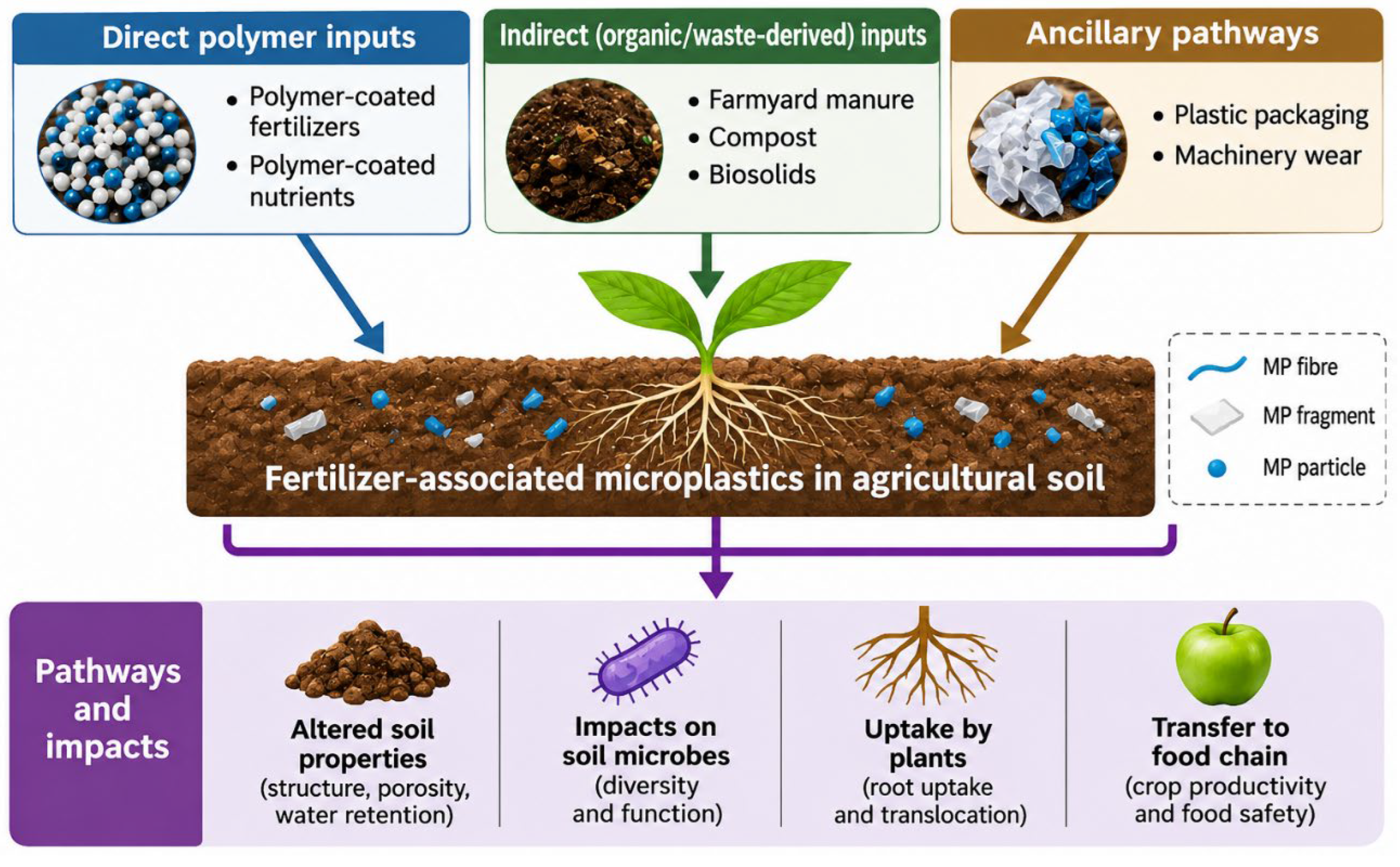
Figure 2.
UV-induced photodegradation of a P(St-co-BA-co-MMA) latex film used as a controlled-release fertilizer coating. (a) Intact microsphere-based latex film. (b) UV-irradiated film showing disruption of microsphere connections, formation of pores and defects, and detachment of microspheres. The figure illustrates a potential mechanism of coating embrittlement and secondary-particle formation under sunlight exposure; it does not represent the universal or dominant degradation pathway for fertilizer coatings incorporated below the soil surface (adapted from [18], with permission; Copyright 2017 Wiley).
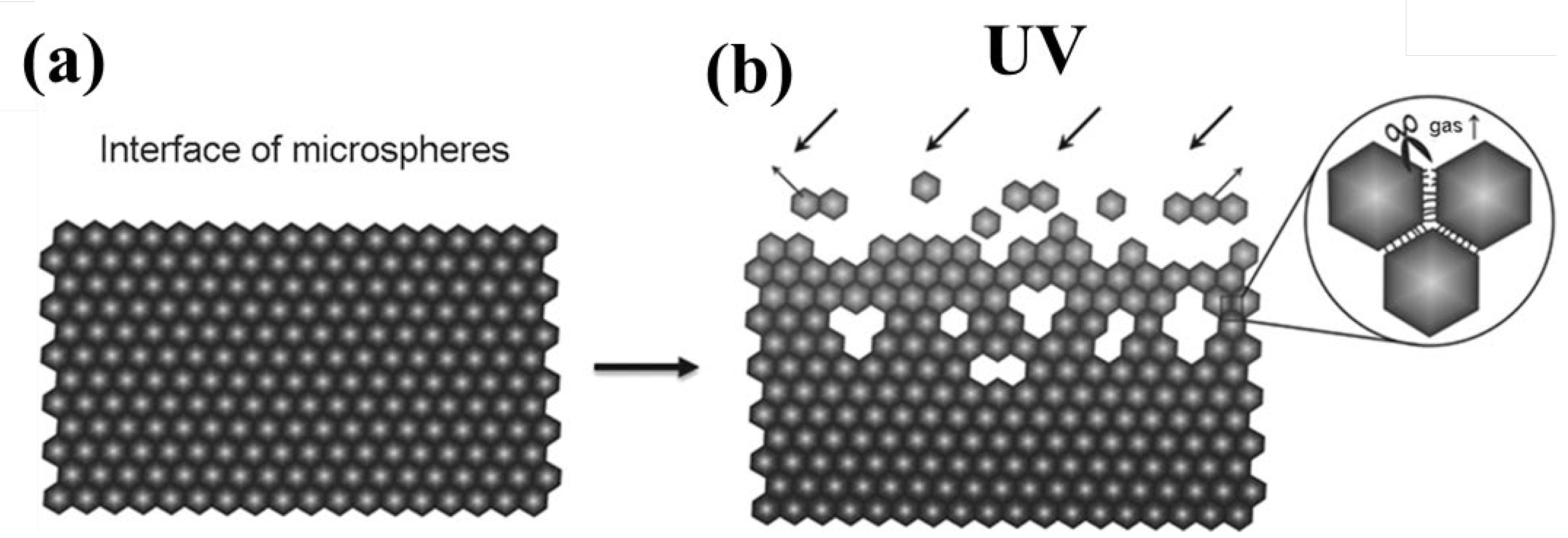
Figure 3.
Scanning electron microscopy images of microplastics prepared from polyurethane-coated fertilizer material, PU, (a), and polyethylene-polycarbonate-coated fertilizer material, PE-PC, (b). Both materials occur as irregular flake-like particles with heterogeneous surfaces; fractures are particularly evident in the PE-PC particles. Because the particles were produced by grinding coating materials before the exposure experiment, the images characterise the prepared experimental particles and should not be interpreted as direct evidence of long-term soil weathering. Reproduced from Li et al. (2025), with permission. [7].
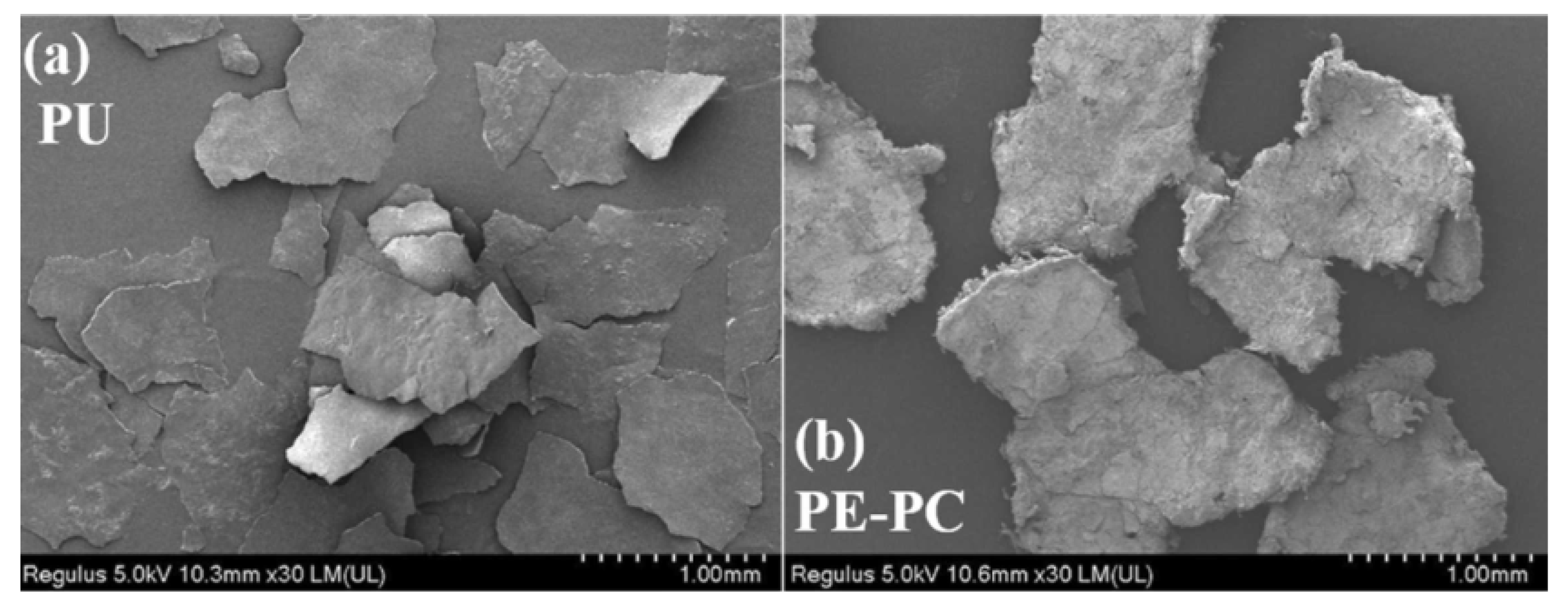

Table 1.
Summary of reported fertilizer-associated microplastics and relevant agricultural baseline evidence across different regions.
Table 1.
Summary of reported fertilizer-associated microplastics and relevant agricultural baseline evidence across different regions.
| Region/Country | Fertilizer-related source or study context | Reported MP abundance | Dominant Characteristics | Main finding and interpretation | Ref. |
|---|---|---|---|---|---|
| China (Beijing) | Facility-agriculture soils; organic fertilizer and irrigation water assessed as potential sources | items kg-1 at 0 to 10 cm; 630.6 ± 47.0items kg-1 at 10 to 20 cm; 445.3 ± 47.0items kg-1 at 20 to 30 cm | Fibres accounted for 72.2% of particles; polypropylene and polyethylene were dominant polymers | MP abundance declined with depth. Source modelling identified organic fertilizer and irrigation water as the principal contributors in the surveyed Beijing facility-agriculture soils. Mulching history, irrigation method, and organic-fertilizer application amount also influenced soil MP accumulation. This evidence is site-specific and does not exclude other agricultural sources. | [20] |
| China (Long-term fertilization) | Agricultural soils receiving pig-manure compost, chicken-manure compost, or sewage-sludge compost for 12 years | 368.88 ± 207.97 items kg-1 (range: 90–910) | Fibres, 70.94%; fragments, 25.25%; 1 to 2 mm particles, 39.96%; major materials included rayon, polypropylene, polyester, and polyethylene | Long-term organic-fertilizer application increased soil MP abundance by 16.67% to 71.67%, depending on amendment type and application rate. The study provides controlled field evidence that repeated organic-amendment use can increase soil MP burdens. The reported ecological-risk category is an index-based screening result, not direct evidence of ecological damage. | [33] |
| China, nationwide | Commercial organic fertilizers sampled across 22 provincial regions | to 2.88 × 10⁵items kg-1 | Particles smaller than 100 μm represented 76.53%; films and fragments were common; chlorinated polyethylene, polyurethane, polyethylene, and polypropylene were detected | Direct product-level evidence that commercial organic fertilizers can contain substantial MP loads. The authors estimated potential cumulative inputs to orchard soil under repeated use; these estimates should be presented as modelled inputs rather than observed field accumulation | [34] |
| Germany, southeast farmland | Agricultural soils with no known application of MP-containing fertilizers | 0.34 ± 0.36 items kg-1; 206 macroplastics ha-1 | PE dominant; films and fragments | Baseline evidence showing that agricultural soils can contain macroplastics and MPs even without known fertilizer-derived MP inputs. The study does not demonstrate a fertilizer effect, but it highlights the importance of baseline sampling and matched controls in fertilizer-source attribution studies. | [30] |
| Germany | Green-waste compost, biowaste compost, sewage-sludge compost, sewage sludge, digestates, and animal-based fertilizers | Reported as particle number, plastic mass, and plastic surface area per application area, rather than a directly comparable items kg-1 value | Plastic particles were the most frequent visible impurity. Particle number generally increased from green-waste compost to biowaste compost, sewage-sludge compost, and sewage sludge | Visible plastic was found in most examined organic fertilizers. Sewage-sludge compost had the greatest plastic mass and surface area per application area. No visible impurities were detected in the analysed digested pig slurry, chicken manure, or mixed digestate. This study supports product-specific assessment rather than treating all organic fertilizers as equally contaminated | [35] |
| Bangladesh | Commercial organic fertilizers | 1,529.62 ± 420.2 items kg-1 (range: 433–3466 items kg-1) | Fibres were dominant; 0.5 to 1 mm particles were common; nylon, HDPE, LDPE, and ABS were identified | Marketed organic fertilizers contained diverse MPs and can act as direct delivery vectors to agricultural land. Polymer-based hazard categories reported by the authors are screening indicators and should not be interpreted as direct evidence of field-scale ecological harm. | [31] |
| United Kingdom, nationwide survey | Agricultural soils assessed across systems with and without plastic crop covers | 1320–8190 particles kg-1 (mean: 3680 ± 129.1) | Mixed MP assemblages | Agricultural soils contained MPs across the survey. Plastic crop covers were associated with higher MP abundance, demonstrating that agriplastic use can strongly influence background soil contamination. This study cannot isolate the fertilizer contribution without fertilizer-product data or treatment controls. | [32] |
| UK (Plastic crop covers + fertilizers) | Agricultural soils under plastic crop covers compared with uncovered soils | MP abundance was 175.8% higher in covered soils | Mixed MP assemblages | Plastic crop covers were associated with substantially higher soil MP abundance. This result reinforces the need to account for agriplastic use when estimating fertilizer-associated MP contributions in agricultural soils. | [5] |
| United Kingdom, Broadbalk long-term experiment | Archived soils from farmyard-manure, mineral-fertilizer, and unamended plots, sampled over 1966 to 2022 | MP concentrations increased significantly over time in all treatments; the farmyard-manure and mineral-fertilizer plots had significantly higher concentrations than unamended plots | Historical accumulation of mixed MPs | Fertilized soils accumulated MPs at higher rates than the unamended control. Farmyard manure and mineral-fertilizer treatments differed significantly from the Nil treatment, but not from one another. The study provides strong long-term evidence that both organic and inorganic fertilization practices contribute to soil MP loads above background concentrations, although diffuse inputs cannot be completely excluded. | [32] |
| Switzerland | Liquid and solid digestates applied in a field experiment established in 2018 | Digestate: median 16,000 particles kg-1, range 10,600 to 54,000 particles kg-1; digestate-treated soil: median 6,400 particles kg-1 , range 800 to 33,800 particles kg-1 ; control soil: median 7,100 particles kg-1 | Polypropylene, polyethylene, and polyamide were identified; particle-size and polymer profiles differed between digestates and soils | Digestate was a measurable MP input, but high baseline soil contamination obscured a clear treatment effect. Modelled digestate contributions represented only 0.9% to 4.0% of total soil MP stocks during the study period. This is an important demonstration that product contamination does not always produce a detectable field-scale signal against variable background contamination. | [13] |
| Japan, coastal environments adjacent to rice cultivation | Polymer-coated fertilizer microcapsules transported from paddy fields during irrigation | 77 to 1,471 particles m-2 during non-irrigation periods; 9,423 to 74,869 particles m-2 during irrigation periods | Approximately 90% of MPs were fertilizer-derived microcapsules; more than 90% were polyethylene-based | MP abundance increased strongly during the irrigation season, supporting hydrological transfer of fertilizer microcapsules from rice-growing areas to coastal environments. Weather and hydrodynamic conditions influenced land-to-sea transport. | [8] |
| Japan (19 paddy fields) | Residual microcapsules from polymer-coated fertilizers in paddy soils | 6–369 mg kg-1 (mean 144 mg kg-1) | Predominantly polyethylene-based microcapsules containing talc; particles showed surface cracking; elevated concentrations occurred near drainage outlets | Coated-fertilizer microcapsules were detected in all surveyed paddy fields, demonstrating widespread accumulation of residual coating particles after nutrient release. Their distinctive morphology and composition provide comparatively strong source attribution to polymer-coated fertilizers. | [9] |
| Japan (Ishikawa River, 2021–2022) | Riverine transport of polymer-coated fertilizer microcapsules from paddy-field catchments | 0.0–783.2 mg m-³ (median 18.8 mg m-³) | Fertilizer-derived microcapsules; seasonal concentration peaks | Microcapsule concentrations showed pronounced April to May peaks, up to 110-fold short-term variability, and higher daytime concentrations. The findings indicate rapid and episodic transport from paddy fields to river systems, with dynamics not explained by river discharge alone. | [36] |
| Japan (38 paddy fields) | Field-scale accumulation and runoff of polymer-coated fertilizer microcapsules | 2–482 mg/m² (runoff); total discharge 17–6,291 t; soil accumulation ~75,623 t | Distinct polymer-coated fertilizer microcapsules | Between 61% and 100% of seasonal microcapsule runoff occurred between puddling and rice transplanting. Runoff varied with water-management practice, wind direction, and wind speed. The study shows that most residues are retained in fields, while a smaller but important fraction is exported during hydrologically active management periods. | [15] |
Note: Reported MP concentrations are not directly comparable across studies because sampling depth, matrix, extraction protocol, density-separation medium, digestion procedure, polymer-identification method, particle-size detection limit, and reporting unit differ. “Risk” or “hazard” categories are study-specific index outputs and do not demonstrate field-scale ecological effects. Fertilizer attribution is strongest where particles were measured directly in fertilizer products, where treated and control soils were compared, or where distinctive polymer-coated fertilizer microcapsules were identified.
Table 2.
Evidence strength and key uncertainties for fertilizer-associated microplastic pathways and outcomes.
Table 2.
Evidence strength and key uncertainties for fertilizer-associated microplastic pathways and outcomes.
| Process or pathway | Current evidence | Confidence | Main uncertainty | Representative references |
|---|---|---|---|---|
| Release from polymer-coated fertilizers | Laboratory studies demonstrate coating cracking, fragmentation, and MP generation; Japanese paddy-field studies identify characteristic coating microcapsules in soil, runoff, rivers, and coastal environments. | High | Product-specific release rates, long-term field fragmentation, and ultimate fate across coating chemistries remain poorly quantified. | [8,9,10,15] |
| Input through manure, compost, biosolids, digestate, and recycled fertilizers | MPs have been measured directly in organic fertilizers, composts, digestates, and biosolids; long-term amendment studies report increased soil MP burdens. | High for input occurrence; moderate for field source attribution | Separating amendment-derived particles from background soil MPs and other agricultural plastic sources. | [3,13,33] |
| Input from fertilizer packaging and application equipment | Plausible route through bags, liners, bulk handling, spreaders, and irrigation or fertigation equipment. | Low | Direct measurements of particle generation, emission rates, and contribution to soil MP stocks are scarce. | [5,20]. These studies demonstrate multiple agricultural MP sources but do not quantify packaging or equipment emissions specifically. |
| Retention, vertical redistribution, and off-site export | Soil-column studies, paddy-field observations, runoff measurements, and river monitoring demonstrate transport potential. | Moderate | Multi-year mass balances and the relative importance of tillage, bioturbation, preferential flow, erosion, drainage, and runoff. | [9,15,36] |
| Transformation and degradation of coating residues | Controlled soil studies show microbial colonization, polymer-specific surface alteration, mass loss, and fragmentation. | Moderate | Extent of complete mineralization, rates of secondary micro- and nanoplastic generation, and transformation-product fate under field conditions. | [10,18,19] |
| Effects on soil chemistry, microbes, and co-contaminant behaviour | Fertilizer-specific experiments show changes in pH, dissolved organic carbon, Fe-related processes, microbial communities, enzyme activities, and Cd availability. | Moderate | Relevance at environmentally realistic concentrations, effects in uncontaminated soils, and responses to aged formulation-specific particles. | [7,27,37] |
| Effects on plant establishment and crop performance | Tomato experiments report early germination inhibition after exposure to PU and PE-PC coating-derived MPs; broader MP studies report variable effects on root growth and plant traits. | Low to moderate | Field-realistic exposures, crop yield effects, mechanism of response, and separation of particle effects from additive or nutrient-release effects. | [7,14,38] |
| Plant uptake and translocation | Controlled studies show uptake of sufficiently small micro- and nanoplastics by crop plants. | Moderate for generic particles; low for fertilizer-specific attribution | Direct tracing from a characterised fertilizer product through soil into roots, shoots, and edible tissues under field conditions. | [14,38] |
| Food-chain exposure attributable to fertilizers | No robust field study has directly linked a fertilizer-derived MP source to contamination of edible crop tissues or human exposure. | Low | Source-specific particle tracing, realistic exposure conditions, particle internalisation, and the contribution of fertilizer-derived MPs relative to other agricultural sources. | [7,14,38]. These studies provide mechanistic or experimental context, rather than direct fertilizer-to-food-chain evidence. |
| Environmental benefit of biodegradable or bio-based coatings | Materials studies demonstrate promising nutrient-release performance and candidate soil biodegradability. | Moderate | Soil-relevant mineralization, persistence of residual micro- and nanoplastics, formulation-additive toxicity, scalability, cost, and long-term field performance. | [19,28,44,45,48] |
Note: References are representative examples rather than an exhaustive bibliography. Confidence ratings reflect the strength of evidence for the stated pathway, not the magnitude of environmental risk. “High” confidence indicates repeated direct observations or strong source-specific evidence; “moderate” confidence indicates consistent but mainly experimental, site-specific, or partially source-resolved evidence; and “low” confidence indicates plausible pathways with limited direct quantification. Generic microplastic studies are used only where fertilizer-specific evidence is unavailable and are identified accordingly.
Disclaimer/Publisher’s Note: The statements, opinions and data contained in all publications are solely those of the individual author(s) and contributor(s) and not of MDPI and/or the editor(s). MDPI and/or the editor(s) disclaim responsibility for any injury to people or property resulting from any ideas, methods, instructions or products referred to in the content. |
© 2026 by the authors. Licensee MDPI, Basel, Switzerland. This article is an open access article distributed under the terms and conditions of the Creative Commons Attribution (CC BY) license (http://creativecommons.org/licenses/by/4.0/).
Copyright: This open access article is published under a Creative Commons CC BY 4.0 license, which permit the free download, distribution, and reuse, provided that the author and preprint are cited in any reuse.