

Submitted:
17 November 2026
Posted:
19 November 2026
You are already at the latest version
Abstract
The northern regions of Pakistan, especially Gilgit-Baltistan, are highly exposed to climate change due to unstable glacial systems and socioeconomic reliance on climate-sensitive industries such as agriculture. Glacial Lake Outburst Flood (GLOF) is the most risky of these hazards. Despite efforts through the NCCP and the GLOF II project, climate data, local regulations, and capacity remain severely deficient. This study estimates the perception of climatic hazards. We led a comparative study in Haramush Valley (GLOF-vulnerable) and Gilgit Valley in District Gilgit. We collected data through household surveys (N=30 per site) based on Yamane’s formula, key informant interviews, and focus group discussions. Pearson's chi-square test and descriptive statistics were used to examine quantitative data within the sustainable livelihood approach. Findings show that perceptions of risk and adaptive behaviors differ between the two areas. People living near a GLOF-vulnerable site identify deforestation as the cause of climate change, while those near a non-GLOF location blame vehicle emissions. Compared to the non-GLOF area, the GLOF location experienced more frequent floods. Most GLOF community members see a greater risk of GLOFs, although their readiness remains low. Communities affected by GLOF were impacted in terms of agriculture and means of subsistence. However, both groups showed strong interest in using science and indigenous knowledge for monitoring. In conclusion, glacial hazard vulnerability strongly shapes risk perceptions and adaptation, while institutions and policies do little to support vulnerable locations. This study highlights the need for an efficient early warning system, disaster preparedness, adaptive measures, and water resource management.
Keywords:
climate change
; community perception
; adaptation strategies
; GLOF
; non-GLOF
; Gilgit-Baltistan
1. Introduction
Climate change is one of the most significant environmental problems in the world’s high mountains. Due to its fragile ecosystem, extensive glacier coverage, and dependence on climate-dependent sectors including agriculture and natural resources, northern Pakistan, particularly Gilgit-Baltistan, has become increasingly vulnerable. Climate disasters have severely affected lives, infrastructure, biodiversity, and food security through flash floods, glacial lake outburst floods (GLOFs), landslides, avalanches, and shifting rainfall patterns (Ali et al., 2023; Baig et al., 2021).
Local communities must adapt to changing climatic conditions. This can help vulnerable communities adapt to climate change impacts. (Omerkhil et al., 2020). Perceptions of climate change vary according to social, geographical, and economic conditions, making local knowledge essential for developing effective adaptation policies (Arbuckle et al., 2013; Vijhani et al., 2023; van Wesenbeeck et al., 2016).
The INFORM Global Risk Index ranked Pakistan among South Asia’s most climate-vulnerable countries. Gilgit-Baltistan is particularly vulnerable because of its large number of glaciers (more than 7,000), the Himalayas, Karakoram, and Hindu Kush mountain ranges. It serves as Pakistan’s water tower, supplying the nation with freshwater necessary for hydroelectric power production, irrigation, and general water supply (Sohail et al., 2022).
In general, climate change increases glacier instability and, as a result, the risk of floods, landslides, avalanches, and permafrost degradation, even with the Karakoram anomaly theory of glacier stability and growth (Sattar et al., 2022; Shabbir et al., 2023). These climatic changes threaten agricultural production, biodiversity, water security, infrastructure, and community livings throughout Gilgit-Baltistan.
The United Nations Framework Convention on Climate Change (UNFCCC, 1992) defines climate change as changes in the statistical characteristics of the climate that are ascribed to both anthropogenic and natural processes that affect the composition of the atmosphere. Deforestation, altered land use, industrialization, and greenhouse gas emissions are examples of anthropogenic activities that have accelerated glacier melting and increased climate catastrophes. As a result, adaptation is now a crucial component of sustainable development. Adaptation modifies human and environmental systems to reduce their susceptibility to climate change.
Community-based adaptation emphasizes community members actively contributing to climate change solutions by integrating scientific and local knowledge (CBA7, 2013). Moreover, many studies have examined climate change in Pakistan, but most have not focused on community perceptions and climate change adaptation. Therefore, this study compares community perspectives, the effects of climate change, and adaptation strategies in the Gilgit Valley (not GLOF-prone) and the Haramush Valley (GLOF-prone) in District Gilgit. These findings can inform climate disaster-reduction policies and help develop area-based adaptation programs.
Recent research indicates that warming, altered precipitation patterns, melting glaciers, and climate-related risks are affecting mountain communities. Farmers’ perceptions of warmer, longer summers, shorter winters, altered rainfall patterns, water scarcity, low crop yields, and other factors in Nepal largely agreed with meteorological observations (Baul et al., 2013). Likewise, in the Hindu Kush Himalayan region (HKH), communities have adopted some changes (Tiwari et al., 2014; Paudel et al., 2020).
Climate change has increased people’s vulnerability in Gilgit-Baltistan to floods, landslides, droughts, glacial lake outburst floods (GLOFs), and glacier melt (Ahmed et al., 2023; Gioli et al., 2012). Local communities have adopted adaptation measures such as diversifying crops, agreeing on water-sharing, protecting irrigation channels, planting trees, diversifying livelihoods, and migrating (Gioli et al., 2012; Tuladhar et al., 2023; Hussain, 2024). However, the lack of institutional support, finance, and technical know-how often hinders such adaptation efforts (Tiwari et al., 2014).
Several policies, such as the GLOF-II Project and Pakistan’s NCCP, encourage adaptation by implementing early warning systems, promoting sustainable water management, and reducing disaster risks (Qazlbash et al., 2021). However, research still reveals notable gaps in community participation, institution building, disaster management, and climate information, particularly in mountainous regions prone to hazards (Riaz et al., 2024; Ullah et al., 2024). Previous literature has also pointed out the importance of integrating scientific information with indigenous knowledge for better climate change adaptation planning and resilience building (Pepin et al., 2022; Saidaliyeva et al., 2024).
Limited literature compares community attitudes and adaptation measures in GLOF and non-GLOF regions, even as research on climate change in Gilgit-Baltistan increases. This study addresses that gap by comparing community attitudes, climate change impacts, and adaptation measures in Gilgit Valley (non-GLOF) and Haramush Valley (GLOF-prone).
Problem Statement
District Gilgit faces ongoing climate change challenges, including rising temperatures, altered rainfall patterns, glacier melt, and flooding. These threats have affected inhabitants’ livelihoods, as well as forests, agricultural areas, infrastructure, and water supplies. Additionally, ongoing energy shortages in the region have prompted firewood chopping and deforestation. Therefore, it becomes crucial to understand the attitudes and adaptation methods in both GLOF-affected and non-GLOF areas.
Objectives
- To gauge perceptions of climate change impacts and risk in District Gilgit across GLOF and non-GLOF sites, and compare differences between the two sites.
- To explore community adaptation measures in GLOF-prone and non-GLOF locations in District Gilgit and assess how these measures support resilience to climate change.
2. Methodology
2.1. Target Area
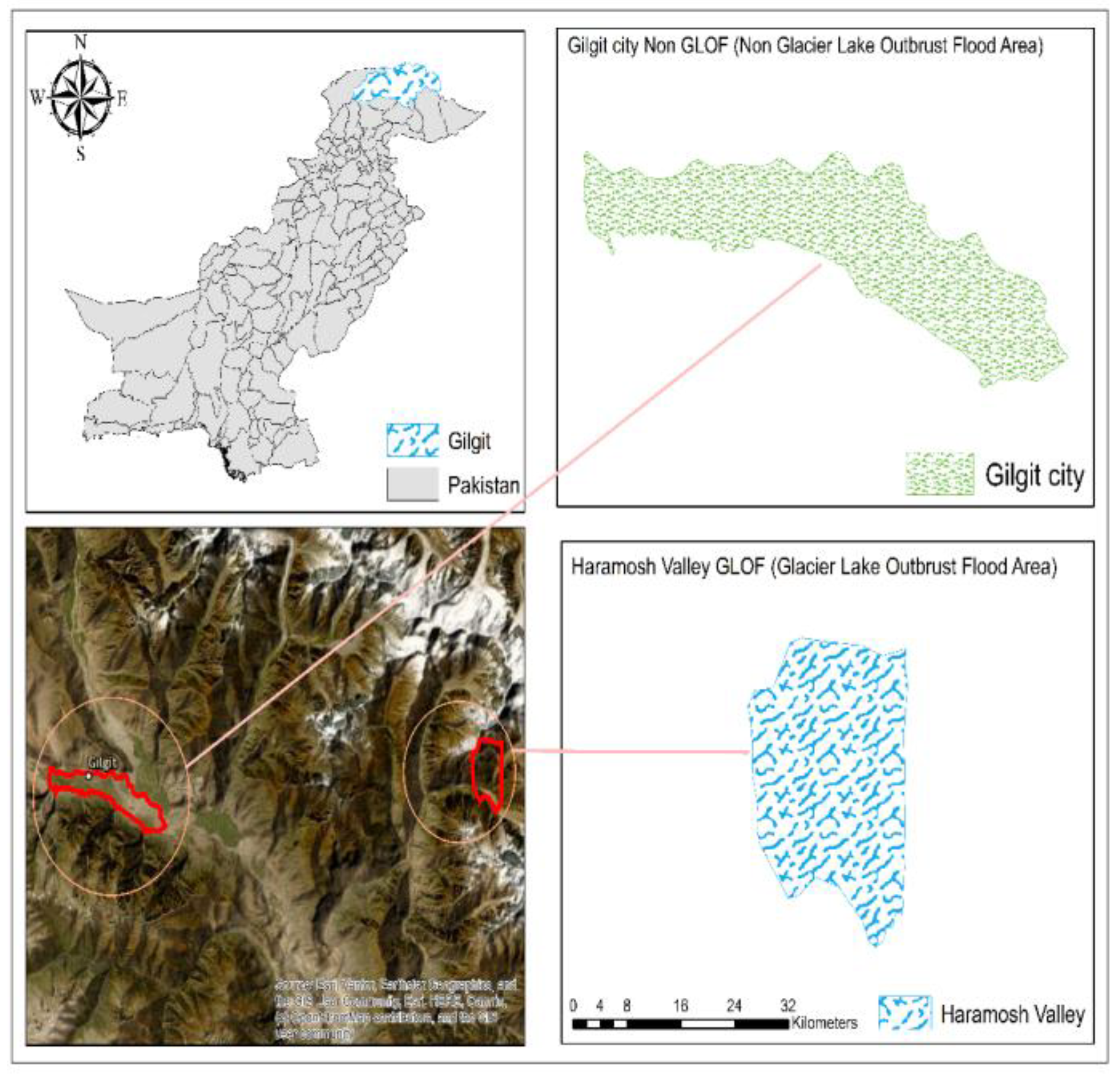
Gilgit-Baltistan, the northern areas of Pakistan, has a population of approximately 1.71 million and an area of 72,496 km2. Within Gilgit-Baltistan, District Gilgit covers about 4,208 km² and has a total population of 324,552, according to national digital census indices (PBS, 2023). The region is ecologically fragile and is suffering direct consequences of climate change (Ali et al., 2022). Elevation ranges from 1,500 to 3,000 meters above sea level. Spectacular landscapes and unique climatic conditions characterize the district.
This study was conducted in both GLOF and non-GLOF sites within District Gilgit:
· GLOF Sites: Haramush Valley
· Non-GLOF Sites: Gilgit Valley
This study shows how community perception and adaptation strategies are differ and in GLOF sites which are directly affected by glacial lake outburst floods and those not directly exposed (non-GLOF sites).
The survey and documentation for the case study was conducted in March 2026.
Figure 3.
1: Land cover map of the study area.
2.2. Research Design and Sampling
In order to investigate community views and adaptation strategies regarding climate change and GLOF threats, a mixed-methods research design integrated quantitative and qualitative data. The following were included in the research design:
1. Quantitative Data: Structured questionnaire-based household surveys.
2. Qualitative Data: Focus groups, key informant interviews, and semi-structured interviews.
The mixed-methods technique offers both breadth and depth in comprehending the study problem and permits triangulation of data sources (Creswell & Plano Clark, 2017).
Respondents were chosen at random for in-home interviews using a random sample technique based on Yamane’s (1967) formula for quantitative sampling:
Where:
n is the sample size.
N is the population size.
e is the margin of error (0.05 for a 95% confidence level).
Based on population distribution, the sample was divided equally between the two valleys that were chosen.
Purposive sampling was employed for the qualitative components in order to find key informants who can offer rich, contextual insights into attitudes toward climate change and measures for adaptation. Snowball sampling was also employed because it is effective for reaching populations that are difficult to reach and especially helpful for qualitative research (Naderifar, Goli & Ghaljaie, 2017).
Key respondents included:
Members of the local community from a variety of socioeconomic backgrounds, experts (doctors, engineers, teachers, professors), leaders from village communities and social activists, members of local agricultural cooperatives, government officials, and representatives of non-governmental organizations were the study’s main respondents.
2.3. Data Collection Methods
Key informant interviews, focus groups, semi-structured interviews, and household surveys were the methods used for gathering primary data. A standardized questionnaire was distributed to the representatives of households. The questionnaire consisted of the following subjects:
- Demographic data
- The people’s attitude towards GLOF hazard in Gilgit District
- The impact of GLOF on the environment.
- Observed changes in temperature and precipitation in the last ten years.
- Knowledge of how the community views GLOF
- Adaptation strategy to combat climate change
- Government and non-governmental organization’s awareness of climate initiatives in GLOF and non-GLOF settings are compared and contrasted
The suggested interviews were developed after a thorough review of the literature (Babugura, 2010; Bakuwa, 2015; Brechin & Bhandari, 2011; Guenther et al., 2018; Neville, 2010). A semi-structured format allowed sufficient freedom and inquiry into issues that arose.
The FGD checklist was followed in conducting the discussions, with probing when needed. A similar approach works well in remote rural locations, allowing us to explore the impact of the local culture on the community’s view (Hagaman & Wutich, 2017; McIntosh & Morse, 2015).
To gather information on institutional responses and policies related to climate change and GLOF risk, interviews were conducted with experts, community development leaders, and authorities.
The following secondary sources provided this information:
The Meteorological Department of Pakistan (PMD)
Disaster Management Authorities at the National and Provincial Levels
Relevant international organizations and NGOs
Published research papers and journals
2.4. Data Gathering Methods and Ethical Considerations
Data collection was conducted in March to coincide with favorable weather conditions in the region
The research team translated data gathering tools into Sheena, the local language, to address potential language barriers. To obtain reliable and accurate responses, interviews and conversations were conducted in the participants’ preferred language. Answers were recorded in English for analysis.
Every participant was made aware of the study in advance.
2.5. Data Analysis
Descriptive statistics (frequencies, percentages, means, and standard deviations), inferential statistics, and comparison analysis for GLOF and non-GLOF sites were used to analyze the quantitative data collected via structured questionnaires.
Thematic analysis was used to understand perceptions and experiences, content analysis was used to find patterns and themes, and framework analysis that adheres to the Sustainable Livelihood Approach was used to analyze qualitative data (Ellis, 2000).
To fully comprehend the following, the study combined quantitative and qualitative findings using triangulation:
1. To measure the perceptions between GLOF communities and non-GLOF communities
2. Determining what influences the use of adaptive techniques
3. How institutional assistance contributes to community resilience
4. Policy implications for mountainous areas’ adaptation to climate change
Some of the methodological limitations encountered were inaccessibility of distant mountainous regions, language and cultural issues, recall bias in self-reported data, and seasonal limitations of fieldwork. To overcome these constraints, the study made use of local research assistants, cross-method data gathering, research instrument piloting, and establishing connections with local people through local organizations.
3. Results and Discussion
This section presents the empirical results and comments about the primary data collected from District Gilgit. An analysis aligned with the study’s two primary goals compares two distinct socio-ecological regions: a GLOF-sensitive area (n = 30) and a non-GLOF-susceptible area (n = 30). The study measures and compares how the two regions perceive the risks and effects of climate change and discusses adaptation strategies.
GLOF Risk Perceptions
Perceptions of climate change impacts and risks in District Gilgit differ between GLOF and non-GLOF communities. The two microclimate regions differ significantly in their perceptions of environmental degradation. In the GLOF-prone region, more respondents (63.33%) cited deforestation as the primary reason for climate vulnerability, followed by ignorance (30.00%). Increasing land use (13.33%) and industrialization (16.67%) are the secondary drivers. In the non-GLOF region, automobiles account for 53.33% of environmental changes, followed by fast industrialization (36.66%) and deforestation (36.66%). Ignorance accounts for just 13.33%.
These variations show that deforestation directly affects populations in the glacier danger area, leading to soil erosion and slope instability. Conversely, in the other area, market expansion and automobile emissions are connected to environmental changes.
The study aligns with Butt et al. (2025), who found that 94.44% of UIB agreed that land-use changes contribute to soil erosion and landslide risk. It also aligns with Faheem and Yaseen’s (2025) study, which shows that local communities in the Himalayas are slowly recognizing authentic local factors and unexpected environmental changes based on their geographic locations.

Table 3.
1 Socio-economic status of respondents in GLOF and Non-GLOF sites (n=60).
| Indicators | Classification | GLOF(Haramosh,n=30) | GLOF(%) | Non-GLOF (Gilgit,n=30) | Non-GLOF(%) |
|---|---|---|---|---|---|
| Gender | Male | 25 | 83.3 | 18 | 60.0 |
| Female | 5 | 16.7 | 12 | 40.0 | |
| Age | <18 | 0 | 0.0 | 1 | 3.3 |
| 18-32 | 19 | 63.3 | 19 | 63.3 | |
| 33-47 | 10 | 33.3 | 9 | 30.0 | |
| >47 | 1 | 3.3 | 1 | 3.3 | |
| Household size | <7 | 3 | 10.0 | 10 | 33.3 |
| 7_10 | 18 | 60.0 | 15 | 50.0 | |
| 11_15 | 7 | 23.3 | 5 | 16.7 | |
| >15 | 2 | 6.7 | 0 | 0.0 | |
| Source of income | Agriculture | 9 | 30.0 | 7 | 23.3 |
| Business | 11 | 36.7 | 8 | 26.7 | |
| Government job | 5 | 16.7 | 10 | 33.3 | |
| Forest trees | 5 | 16.7 | 5 | 16.7 | |
| Education level | Graduate | 21 | 70.0 | 17 | 56.7 |
| Intermediate | 8 | 26.7 | 7 | 23.3 | |
| Matriculation | 1 | 3.3 | 6 | 20.0 |
Factors affecting climate change risk perceptions
3.1. Public Awareness and Perception of Causes of Climate Change
Respondents also observed climate change effects differently at both sites over the past ten years. In GLOF regions, 34% of respondents agreed that flooding has increased over the past ten years, 27% agreed that agricultural output has decreased, 14% stated that water supplies have been lost, and 7% reported increased livestock mortality. In non-GLOF sites, 36% agreed that crop yield has decreased over the past ten years, 13% agreed that water supplies have been lost, 6% agreed that flooding has increased, and 6% reported an increase in livestock deaths.
These direct losses align with Ahmed et al. (2023), who stated that Gilgit-Baltistan’s unique ecological vulnerability directly leads to physical hazards. Tuladhar et al. (2023) also document crop loss and water-resource loss, and their field study shows that climate change-induced water alteration is severely affecting agricultural and livestock productivity in Gilgit-Baltistan. This also relates to Gioli et al. (2012), who described that glacier melt greatly worsens seasonal drought and flood extremes, directly affecting mountain livelihoods.
3.2. Effects of Climate Change in the Last 10 Years
There is widespread agreement about regional warming in relation to the localized weather changes over the previous ten years; reports of precipitation vary somewhat. At the GLOF-prone site, 53.33% of respondents report higher temperatures, 6.67% report more rainfall, and 3.33% report less rainfall.
At the non-GLOF site, 33.33% report more rainfall, 16.67% report less rainfall, and 40.00% report warmer conditions. Because rising air temperatures directly contribute to thermal forcing in high-altitude glaciers, it is crucial to consider increased warming in the GLOF-prone region. Thus, cryosphere melt and moraine-dammed lakes pose a direct threat due to microclimatic warming. Increased rainfall variability in the non-GLOF area suggests wider, unpredictable shifts in the monsoon and westerlies in the Gilgit River basin.
Community perceptions of rising temperatures align closely with Pepin et al. (2022) on elevation-dependent warming trends in high mountain regions. Differences in rainfall perception (random and site-specific patterns) strongly support Khan et al. (2022a), who documented large-scale precipitation variability in Gilgit-Baltistan, and mirror Baul et al. (2013), where farmers observed changing monsoon cycles with rising temperature.
3.3. Weather Changes in the Last 10 Years
There is a widespread agreement about regional warming in relation to the localized weather changes over the previous ten years; reports of precipitation vary somewhat. At the GLOF-prone site, 53.33% of respondents report higher temperatures, 6.67% report more rainfall, and 3.33% report less rainfall.
At the non-GLOF site, 33.33% report more rainfall, 16.67% report less rainfall, and 40.00% report warmer conditions. Because rising air temperature directly contributes to thermal forcing in high-altitude glaciers, it is crucial to consider the increased warming in the GLOF-prone region.
Table 3.
2 Descriptive results of factors affecting climate and GLOF.
| Categories | Response set | n/30 | Percentage(G) | n/30 | Percentage(N-G) |
|---|---|---|---|---|---|
| Causes of climate change | Deforestation | 19 | 63 | 11 | 37 |
| Lack of awareness | 11 | 37 | 4 | 13 | |
| Automobiles | 4 | 13 | 16 | 53 | |
| Rapid Industrialization | 5 | 17 | 11 | 37 | |
| Impact of climate change in the last 10 years | Reduce crop yield | 8 | 27 | 11 | 37 |
| Increase flooding | 10 | 33 | 2 | 7 | |
| Livestock death | 2 | 7 | 2 | 7 | |
| Loss of water Sources | 4 | 13 | 13 | 43 | |
| Weather changes in the last decade | Hotter | 16 | 53 | 12 | 40 |
| Colder | 3 | 10 | 1 | 3 | |
| More rainfall | 2 | 7 | 10 | 33 | |
| less rainfall | 1 | 3 | 5 | 17 | |
| Extreme weather events | Once a year | 9 | 30 | 10 | 33 |
| Several times a year | 7 | 23 | 5 | 17 | |
| Every 2 to 4 years | 1 | 3 | 8 | 27 | |
| Rarely | 5 | 17 | 2 | 7 | |
| Uncertain | 0 | 0 | 5 | 17 | |
| Increasing global risk | Agree | 9 | 30 | 7 | 23 |
| Strongly agree | 11 | 37 | 1 | 3 | |
| Disagree | 1 | 3 | 9 | 30 | |
| Strongly disagree | 1 | 3 | 13 | 43 | |
| Uncertain | 0 | 0 | 0 | 0 | |
| Observed changes in nearby glaciers | New lake formation | 10 | 33 | 9 | 30 |
| Retreating glaciers | 15 | 50 | 16 | 53 | |
| Reduce snow cover | 5 | 17 | 3 | 10 | |
| Rarely | 1 | 3 | 2 | 7 | |
| Uncertain | 0 | 0 | 0 | 0 | |
| Effect of agriculture and livelihood | Increased | 3 | 10 | 12 | 40 |
| Decreased | 16 | 53 | 5 | 17 | |
| Slightly changed | 5 | 17 | 12 | 40 | |
| Moderately changed | 5 | 17 | 1 | 3 | |
| Water availability changes | Increased | 5 | 17 | 7 | 23 |
| Decreased | 14 | 47 | 16 | 53 | |
| No changed | 1 | 3 | 4 | 13 | |
| Neutral | 2 | 7 | 3 | 10 | |
| Response to water shortage | Storage | 6 | 20 | 5 | 17 |
| Reduce crop yield | 11 | 37 | 14 | 47 | |
| Changed crop | 1 | 3 | 6 | 20 | |
| No action | 4 | 13 | 5 | 17 | |
| Climate change increases conflict over local resources | High | 13 | 43.3 | 11 | 36.7 |
| Moderate | 8 | 26.7 | 13 | 43.3 | |
| Low | 4 | 13.3 | 4 | 13.3 | |
| None | 2 | 6.7 | 2 | 6.7 |
Community Adaptation Measures and Resilience Building
Traditional and Structural Adaptation Techniques
In both GLOF and non-GLOF communities, traditional adaptation techniques include water canals, terrace agriculture, and gravity pipelines (Kuhl’s). The GLOF community also relies on structural adaptations, such as expanded foundations, early warning systems, protective walls and structures, and home relocation, in addition to the conventional adaptation techniques mentioned above. The GLOF community also uses afforestation on unstable slopes. The aforementioned soft and structural adaptation techniques align with the adaptation tactics identified by Hussain and Khan (2024) and Tuladhar et al. (2023).
Early Warning Systems and Disaster Training
Although the GLOF community relied heavily on early warning systems, institutional support and disaster readiness were comparatively poor compared with the non-GLOF community. In the non-GLOF group, NGO and government training was comparatively high. The GLOF community viewed disaster management assistance more negatively, and the obstacles to adaptation included inadequate funding, a lack of technical know-how, a lack of awareness, and poor governance. These results support Butt et al. (2025), Hussain and Khan (2024), Riaz et al. (2024), Fahim & Yaseen (2025), and Tiwari et al. (2014).
Disaster Governance and Local Evaluation of Adaptation Barriers:
This institutional gap is reinforced by how the state and civil society organizations assess authorities’ disaster response. The two locations evaluated disaster interventions differently, and the GLOF community expressed greater dissatisfaction with the disaster management governance system. Regarding obstacles to adapting to climate change, the GLOF area faced inadequate funding, limited technical skills, low awareness, and poor governance. In contrast, nearly all obstacles in the Non-GLOF region stemmed from economic problems and inadequate governance. Riaz et al. (2024) claim that local administrative units are severely constrained by a lack of technical capabilities, financial limitations, and empirical baseline measures, which aligns with your findings on deficiencies in technical and institutional capacities in the GLOF region.
Socio-economic Resilience: Social Inclusion and Financial Preparation
The two valleys’ financial ability to withstand potential shocks varies significantly. Because of its infrastructure, savings, and lending activities, the non-GLOF site has greater financial capacity than the GLOF site.
Their willingness to contribute to adaptations
The non-GLOF site is comparatively more willing to contribute to adaptation than the GLOF site.
Women and Youth Involvement in Adaptation Planning
According to the GLOF Site, women and young people make a small but significant contribution to climate change adaptation through planning. The Non-GLOF Site clearly shows significantly higher levels of participation, ranging from moderate to high. This crucial pattern supports the findings of Kaganzi et al. (2021), who discovered that socio-economic variables, wealth, and asset liquidity determine the technological ability to adapt to climate change. The GLOF sample’s exclusion of women and young people is consistent with Gioli et al. (2012).
Integration of Scientific vs Indigenous Knowledge
Despite the challenges listed above, strong community support for integrating knowledge systems to increase future resilience is clear. The GLOF Site supports scientific monitoring, while the Non-GLOF Site supports scientific knowledge integration.
Regarding the Long-Term Solutions for Reducing Climate Change
The GLOF community sees opportunities in infrastructure development, tree planting, and community planning. The Non-GLOF community holds that better agriculture and sufficient infrastructure are essential for physical and financial sustainability. Decision-makers must seize the chance to combine science with traditional wisdom. People in Gilgit district’s mountainous areas have realized that while traditional indices can help, climate change is so widespread that it cannot be managed without contemporary monitoring methods and technologies. This result is consistent with Butt et al. (2025), who argued that risk management in high mountains should build an early warning and communication system by incorporating local knowledge and participation.
Taken Steps to Mitigate GLOF Risk (GLOF Specific)
Early warning systems and home foundations are two common mitigation measures that individuals in GLOF-affected areas have tried but found insufficient. To mitigate GLOFs, the neighborhood uses early warning systems, protective barriers, housing foundations, and relocation.
GLOF-Specific Adaptation Techniques
Improved irrigation, afforestation, and migration to non-GLOF areas are some of the adaptation tactics used by the GLOF area community. Adaptation techniques are still unknown to certain persons.
Table 3.
3Presents the cleaned frequencies and percentages for all available response options.
| Category | Response set | Count/30 | Percentage (GLOF) | c/30 | Percentage(non-GLOF) |
|---|---|---|---|---|---|
| Traditional adaptation changes | water channels | 15 | 50.0 | 18 | 60.0 |
| terrace forming | 10 | 33.3 | 7 | 23.3 | |
| local forecasting | 3 | 10.0 | 2 | 6.7 | |
| no changes | 2 | 6.7 | 3 | 10.0 | |
| Early warning systems effectiveness and availability | very effective | 11 | 36.7 | 11 | 36.7 |
| not effective | 5 | 16.7 | 9 | 30.0 | |
| somewhat functional | 14 | 46.7 | 10 | 33.3 | |
| Receive training on climate risk management | NGO | 10 | 33.3 | 11 | 36.7 |
| government | 1 | 3.3 | 8 | 26.7 | |
| both | 3 | 10.0 | 4 | 13.3 | |
| none | 16 | 53.3 | 7 | 23.3 | |
| Rate disaster management support | excellent | 3 | 10.0 | 6 | 20.0 |
| good | 4 | 13.3 | 7 | 23.3 | |
| average | 11 | 36.7 | 14 | 46.7 | |
| poor governance | 12 | 40.0 | 3 | 10.0 | |
| Adaptation barriers | lack of funds | 12 | 40.0 | 14 | 46.7 |
| lack of awareness | 5 | 16.7 | 7 | 23.3 | |
| poor governance | 3 | 10.0 | 7 | 23.3 | |
| lack of technical knowledge | 10 | 33.3 | 2 | 6.7 | |
| Financial preparation for hazards | saving | 2 | 6.7 | 5 | 16.7 |
| investment in infrastructure | 9 | 30.0 | 13 | 43.3 | |
| loan | 2 | 6.7 | 3 | 10.0 | |
| none | 17 | 56.7 | 9 | 30.0 | |
| Contributions for adaptations | very likely | 7 | 23.3 | 9 | 30.0 |
| unlikely | 10 | 33.3 | 5 | 16.7 | |
| likely | 9 | 30.0 | 16 | 53.3 | |
| none | 3 | 10.0 | 0 | 0.0 | |
| Women and youth involvement | high | 3 | 10.0 | 9 | 30.0 |
| moderately | 13 | 43.3 | 14 | 46.7 | |
| very little | 14 | 46.7 | 7 | 23.3 | |
| Integrating indigenous vs scientific knowledge | strongly agree | 18 | 60.0 | 9 | 30.0 |
| agree | 5 | 16.7 | 14 | 46.7 | |
| disagree | 2 | 6.7 | 4 | 13.3 | |
| neutral | 5 | 16.7 | 3 | 10.0 | |
| Long-term solutions | strong infrastructure | 7 | 23.3 | 13 | 43.3 |
| tree plantation | 8 | 26.7 | 8 | 26.7 | |
| relocation | 5 | 16.7 | 4 | 13.3 | |
| community planning | 10 | 33.3 | 5 | 16.7 | |
| Taken steps to mitigate GLOF risk | early warning systems | 11 | 36.7 | 20 | 66.7 |
| barriers | 6 | 20.0 | 5 | 16.7 | |
| raised house foundations | 9 | 30.0 | 2 | 6.7 | |
| relocation | 4 | 13.3 | 3 | 10.0 |
Results
We used Pearson’s Chi-Square Test of Independence. To determine whether community perceptions differed significantly between GLOF and Non-GLOF communities in District Gilgit
Group 1: GLOF communities (n = 30)
Group 2: Non-GLOF communities (n = 30)
Null Hypothesis(H₀)
There is no significant association between community type (GLOF and non-GLOF) and respondents’ perceptions of climate change.
Alternative Hypothesis (H₁)
There is a significant association between community type (GLOF and non-GLOF) and respondents’ perceptions of climate change.
Formula
Where:
- = Observed frequency
- E = Expected frequency
Expected frequency:
Table 3.
4Pearson’s Chi-square Test of Independence comparing GLOF (n = 30) versus Non-GLOF (n = 30) communities.
Table 3.
4Pearson’s Chi-square Test of Independence comparing GLOF (n = 30) versus Non-GLOF (n = 30) communities.
| Variable | chi-square value | df | p value | interpretation |
|---|---|---|---|---|
| Causes of climate change | 14.75 | 3 | 0.002 | significant |
| Effects of climate change in the last 10 years | 10.32 | 3 | 0.016 | significant |
| Weather changes in the last 10 years | 8.98 | 3 | 0.0295 | significant |
| Frequency of Extreme Weather Events | 11.14 | 4 | 0.025 | significant |
| Perceived increase in GLOF risk | 24.62 | 3 | <0.001 | highly significant |
| Observed Changes in Nearby Glaciers | 0.90 | 3 | 0.825 | not significant |
| Effect of Agriculture and Livelihood | 16.69 | 3 | 0.001 | significant |
| Water Availability Changes | 1.26 | 3 | 0.737 | not significant |
| Response to Water Shortage | 2.97 | 3 | 0.396 | not significant |
| Traditional adaptation changes | 1.2 | 3 | 0.752 | not significant |
| Early warning effectiveness | 1.81 | 2 | 0.405 | not significant |
| Training on climate risk | 9.16 | 3 | 0.027 | significant |
| Disaster management support | 7.58 | 3 | 0.056 | marginal |
| Adaptation barriers | 7.42 | 3 | 0.060 | marginal |
| Financial preparation | 4.67 | 3 | 0.197 | not significant |
| Contribution to adaptation | 6.86 | 3 | 0.076 | not significant |
| Women/youth involvement | 5.37 | 2 | 0.068 | marginal |
| Indigenous vs scientific knowledge | 8.43 | 3 | 0.038 | significant |
| Long-term solutions | 3.58 | 3 | 0.311 | not significant |
| Steps taken to mitigate GLOF risk | 7.38 | 3 | 0.063 | marginal |
Interpretation by Research Theme
A Pearson’s Chi-square test of independence examined whether community perceptions differed between GLOF and non-GLOF communities in District Gilgit. Significant associations were found for perceptions of the causes of climate change, χ²(3, N = 60) = 14.76, p = .002; the perceived effects of climate change during the last ten years, χ²(3, N = 60) = 10.33, p = .016; and perceived weather changes during the last ten years, χ²(3, N = 60) = 8.98, p = .030. These results indicate that GLOF exposure significantly influences community perceptions of climate change and environmental change.
Significant associations were found for the perceived frequency of extreme weather events, χ²(4, N = 60) = 11.15, p = .025, and the perception that GLOF risk is increasing, χ²(3, N = 60) = 24.62, p < .001. No significant association was observed for perceived changes in nearby glaciers, χ²(3, N = 60) = 0.90, p = .825. These findings suggest that direct exposure to GLOF hazards influences perceptions of climate-related risks, while observations of glacier change remain similar across the two community types. We found a significant association between perceived effects of climate change on agriculture and livelihood and community type, χ²(3, N = 60) = 16.70, p = .001. No significant associations were observed for perceived changes in water availability, χ²(3, N = 60) = 1.27, p = .737, or community responses to water shortages, χ²(3, N = 60) = 2.97, p = .396. These results indicate that GLOF exposure significantly influences perceptions of agricultural and livelihood impacts but has limited influence on perceptions of water availability and responses to water shortages.
Regarding changes in adaptation techniques, there was no notable difference between the GLOF community and the non-GLOF community (χ² = 1.20, p = 0.752). Early warning systems were similarly effective in both communities (χ² = 1.81, p = 0.405). The two communities differed in their level of training on climate risk management (χ² = 9.16, p = 0.027). This difference was not statistically significant at the conventional 0.05 level (χ² = 7.58, p = 0.056). The groups did not differ significantly in their perception of barriers to adaptation (χ² = 7.42, p = 0.060). Regarding the community’s financial preparedness for climate-related risks, the groups did not differ (χ² = 4.67, p = 0.197). There was no statistically significant difference in perceptions of their contribution to adaptation (χ² = 6.86, p = 0.076). There was no statistically significant difference at the 5% level in the opinions about women and youth participation (χ² = 5.37, p = 0.068). Integration of Indigenous and scientific knowledge differed significantly between GLOF and non-GLOF communities (χ² = 8.43, p = 0.038). Regarding long-term adaptation strategies, we found no observable difference between the two communities (χ² = 3.58, p = 0.311). The difference at the 5% level of significance was trivial and insignificant (χ² = 7.30, p = 0.063).
Conclusion
Based on respondents’ responses, GLOF and non-GLOF groups differ in their perspectives on climate change, its effects, and adaptations. While those from the non-GLOF community were more likely to name cars as a reason for climate change, individuals from the GLOF-prone area were more likely to blame deforestation and a lack of public awareness. While non-GLOF respondents faced the loss of water sources, GLOF respondents were more likely to endure flooding.
The findings suggest that local exposure strongly shapes perceptions of climate-change hazards. Because of flood risk, glacier changes, inadequate institutions, and limited disaster training, communities in GLOF-prone areas seem more vulnerable. However, non-GLOF communities face water scarcity and use different agricultural approaches.
Both communities use traditional kuhls, terracing, tree planting, early warning systems, and structural adaptations. However, the GLOF community needs better governance, financial and technical support, and disaster preparedness. Mountain communities in District Gilgit can become resilient to climate change by marrying scientific observation with indigenous knowledge.
Limitations
The study has some limitations. The dataset was aggregated; therefore, respondent-level modeling was not possible. Some questions allowed multiple responses; therefore, percentages may not sum to 100%. Fisher’s exact test was preferred because some expected cell counts were small.
The results cannot be generalized to all people in District Gilgit because the sample size was limited to 30 families per location. Since the information was collected during a limited period (March 1–15, 2026), seasonal changes in community attitudes might have been missed. Translation of research instruments into the Shina language may have caused slight differences in interpretation. Respondents were asked to recall changes during the last 10 years; therefore, recall bias might have occurred. Limited access to families also challenged data collection.
Policy and Research Recommendations
- Strengthen community awareness programs in both GLOF and non-GLOF areas.
- Prioritize flood preparedness and early warning systems in GLOF-exposed villages.
- Improve water resource management and water storage interventions in non-GLOF communities reporting water-source loss.
- Integrate indigenous adaptation knowledge with formal disaster risk management planning.
- Collect respondent-level data in future surveys to allow regression, reliability testing, and stronger causal interpretation.
- Improve the training program for disaster risk management in the GLOF area, as 53.33% of the people stated that they never received any training, while only 23.33% did in the non-GLOF area.
- Improve the effectiveness of current warning systems in the GLOF area.
- Provide GLOF families with financial tools such as insurance, microloans, and subsidies.
- Improve the technical capacity of the GLOF community.
- Improve governance and disaster relief performance at the GLOF site.
- Focus on the participation of youth and women in adaptation planning.
- Introduce practical adaptation measures such as protective walls, early warning systems, and raised housing foundations in GLOF-prone areas.
- Encourage afforestation on unstable slopes as an adaptive response.
- For the non-GLOF community, encourage crop diversification and reduction of crop area.
- For the GLOF community, encourage proactive agricultural adaptation responses.
- Reinforce and institutionalize the use of traditional water channels (kuhls) through technical support and maintenance services, which are used by both communities (50.00% GLOF and 60.00% non-GLOF).
- Build on the existing willingness of the community to integrate indigenous and scientific knowledge.
References
- Ahmed, S., Asif, M., & Khan, N. (2023). Policy analysis of climate change impacts in Gilgit-Baltistan—Frontiers in Climate, 5, Article 1527694.
- Ali, A., Ali, G., Shah, G. M., Shah, A., Karim, R., Joshi, S., Ali, K., & Khan, B. (2022). Factors shaping the economics of land use change in Gilgit-Baltistan, Pakistan. GeoJournal, 87, 3951–3966. [CrossRef]
- Arbuckle, J. G., Morton, L. W., & Hobbs, J. (2013). Farmers’ beliefs and concerns about climate change. Climatic Change, 118(3), 551–563.
- Babugura, A. A. (2010). Gender and climate change: South Africa case study. Heinrich Böll Stiftung Southern Africa, Cape Town.
- Baig, S. U., Baig, M. H. A., & Ashraf, M. (2021). Spatiotemporal analysis of climate change and its impact on water resources and agricultural practices in Gilgit-Baltistan, Pakistan. Environmental Monitoring and Assessment, 193(8), 512.
- Bakuwa, R. C. (2015). Methodological approaches to assessing community perceptions of environmental hazards. Journal of Environmental Studies and Sciences, 5(3), 312–324.
- Baul, T., Atique Ullah, K., Tiwari, K., & McDonald, M. (2013). People’s local knowledge of climate change. Indian Journal of Traditional Knowledge, 12(4), 585–595.
- Brechin, S. R., & Bhandari, M. (2011). Perceptions of climate change worldwide. Wiley Interdisciplinary Reviews: Climate Change, 2(6), 871–885.
- Butt, A. Q., Shangguan, D., Banerjee, A., Farooq, R., Wang, R., Afzal, M., & Khan, A. A. (2025). Assessing societal perceptions and adaptive responses to GLOF and related hazards in the Upper Indus Basin, Pakistan. Discover Applied Sciences, 7, 152. [CrossRef]
- CBA7. (2013). 7th International Conference on Community-Based Adaptation to Climate Change: Mainstreaming CBA into national and local planning. International Institute for Environment and Development (IIED), Dhaka, Bangladesh.
- Creswell, J. W., & Plano Clark, V. L. (2017). Designing and conducting mixed methods research (3rd ed.). Sage.
- Ellis, F. (2000). Rural livelihoods and diversity in developing countries. Oxford University Press.
- Faheem, M., & Yaseen, M. (2025). Local climate drivers and community perception of environmental change across mountain ecosystems in the Western Himalayas. Environment, Development and Sustainability, 27(2), 4105–4122.
- Gioli, G., Khan, T., & Scheffran, J. (2012). Gender and environmental migration. Mountain Research and Development.
- Guenther, L., Bischoff, J., & Weber, A. (2018). Assessing climate change perceptions and adaptation barriers through structured questionnaires in rural communities. Environmental Communication, 12(6), 789–804.
- Hagaman, A. K., & Wutich, A. (2017). How many interviews are enough? Field Methods, 29(1), 23–41.
- Hussain, A., & Khan, M. (2024). Living with glacial hazards: Structural adaptation and community resilience around Shishper glacier, Hunza Valley. Disaster Prevention and Management, 33(2), 145–159.
- Khan, R., Ahmed, Z., & Hussain, S. (2022a). Rainfall patterns in Gilgit-Baltistan. Climate Dynamics, 58(2), 789–802.
- McIntosh, M. J., & Morse, J. M. (2015). Semi-structured interviews. Global Qualitative Nursing Research, 2, 1–12.
- Naderifar, M., Goli, H., & Ghaljaie, F. (2017). Snowball sampling. Strides in Development of Medical Education, 14(3).
- Neville, C. (2010). The Complete Guide to Referencing and Avoiding Plagiarism (2nd ed.). Open University Press, McGraw-Hill.
- Omerkhil, N., Chand, T., Valente, D., Alatalo, J. M., & Pandey, R. (2020). Climate vulnerability. Ecological Indicators, 110, 105863.
- Paudel, B., Zhang, Y. L., Yan, J. J., Rai, R., & Li, X. C. (2020). Farmers’ perceptions of climate change and agricultural adaptation strategies in the Hindu Kush Himalayan region. Land Use Policy, 95, 104615.
- PBS. (2023). 7th Population and Housing Census 2023: Digital Census Results. Pakistan Bureau of Statistics, Government of Pakistan, Islamabad.
- Pepin, N. C., Arnone, E., Gobiet, A., et al. (2022). Climate change in the mountains. Reviews of Geophysics, 60(1), 601–606.
- Qazlbash, A., Raza, H., & Shah, S. (2021). Climate policy in Gilgit-Baltistan. Policy Studies, 27(3), 345–360.
- Riaz, M., Ahmed, S., & Khan, N. (2024). Climate data challenges. Climate Research, 76(3), 345–358.
- Saidaliyeva, Z., Ivanov, V., & Zhao, C. (2024). Combining indigenous knowledge with glaciological observations for climate risk monitoring in Central and South Asian high mountains. Regional Environmental Change, 24(1), 28.
- Sattar, A., Goswami, A., & Kulkarni, A. V. (2022). Glacier dynamics and Karakoram Anomaly: Hydro-climatic drivers and future outburst flood risks in High Mountain Asia—Remote Sensing of Environment, 271, 112910.
- Shabbir, M. W., Ahmad, B., & Ali, S. (2023). Permafrost degradation and associated geohazards in the Karakoram region under warming climate scenarios. Geomorphology, 422, 108540.
- Sohail, M., Khan, A., & Ahmad, I. (2022). Water resources of Northern Pakistan under changing climate: Vulnerabilities and adaptation strategies in Gilgit-Baltistan. Journal of Mountain Science, 19(5), 1340–1355.
- Tiwari, K., Rayamajhi, S., Rokharel, R., & Balla, M. (2014). Climate adaptation in the Nepal Himalaya. International Journal of Multidisciplinary and Current Research.
- Tuladhar, S., et al. (2023). Water–agriculture–livelihood linkages. Frontiers in Sustainable Food Systems, 6, 1012363.
- Ullah, S., Farooq, M., & Rahman, A. (2024). Evaluating institutional gaps and community preparedness in GLOF-prone mountain valleys of Pakistan. International Journal of Disaster Risk Reduction, 101, 104230.
- UNFCCC. (1992). United Nations Framework Convention on Climate Change. United Nations, General Assembly, FCCC/INFORM/139, New York.
- Van Wesenbeeck, B. K., Buisman, T. C., van der Miles, M. J., & de Vries, M. B. (2016). Nature-based solutions for coastal and riverine flood risk reduction: Local perceptions and adaptation strategies. Environmental Science & Policy, 66, 120–130.
- Vijhani, A., Sharma, R., & Kumar, P. (2023). Integrating local perceptions and scientific knowledge for climate change adaptation in high-altitude mountain ecosystems: Climate Risk Management, 39, 100482.
- Yamane, T. (1967). Statistics: An introductory analysis (2nd ed.). Harper & Row.
Disclaimer/Publisher’s Note: The statements, opinions and data contained in all publications are solely those of the individual author(s) and contributor(s) and not of MDPI and/or the editor(s). MDPI and/or the editor(s) disclaim responsibility for any injury to people or property resulting from any ideas, methods, instructions or products referred to in the content. |
© 2026 by the authors. Licensee MDPI, Basel, Switzerland. This article is an open access article distributed under the terms and conditions of the Creative Commons Attribution (CC BY) license (http://creativecommons.org/licenses/by/4.0/).
Copyright: This open access article is published under a Creative Commons CC BY 4.0 license, which permit the free download, distribution, and reuse, provided that the author and preprint are cited in any reuse.