

Submitted:
17 November 2026
Posted:
19 November 2026
You are already at the latest version
Abstract
Setting process parameters in polymer processing (injection moulding, extrusion, blow moulding, thermoforming, compression moulding and material extrusion additive manufacturing) is a multi-objective, non-linear and noisy problem. It remains a common method of solution in industry by trial and error by the operator. This paper reviews the artificial intelligence (AI) and metaheuristic methods that have been applied to automate and enhance that task, in a critical way. It introduces four families of methods: statistical design of experiments (Taguchi methods, response surface methodology and analysis of variance) as a base to compare; data-driven surrogate models, such as artificial neural networks, support vector regression and Gaussian process regression; population-based metaheuristics, including genetic algorithms, particle swarm optimisation, simulated annealing and NSGA-II; and emerging approaches, including Bayesian optimisation, adaptive design of experiments, deep reinforcement learning, soft sensing and physics-informed learning. The methods are compared on data requirements, handling of multiple objectives, suitability for real-time use, interpretability and industrial maturity. The review shows that most of the hybrid surrogate–metaheuristic frameworks are proposed and tested on simulation data or a single part geometry, with the hybrid surrogate–metaheuristic frameworks being the dominant ones in the literature. Very few studies compare the common ‘ANN plus GA’ pattern to less complex options and many studies fail to consider noise, uncertainty, and transfer between machines. Sample efficiency, online adaptation: mostly laboratory scale, Bayesian optimisation and reinforcement learning. The paper also considers what is required to implement these optimisation and industrial-context studies in resource-poor manufacturing, based on recent studies in Zimbabwe. It advocates for energy-based goals, low-cost sensors, and operator-centred design and investment in skills. A research agenda on benchmark datasets, uncertainty-aware and transferable models, closed-loop self-optimising systems and fair comparison protocols concludes the review.
Keywords:
polymer processing
; injection moulding
; extrusion
; process parameter optimisation
; artificial neural networks
; genetic algorithm
; particle swarm optimisation
; Bayesian optimisation
; reinforcement learning
; metaheuristics
I. Introduction
Thermoplastic and thermoset raw materials are transformed into parts and semi-finished products in polymer processing. It is the largest manufacturing activity in volume. Extrusion is the most significant technology in polymer processing industry [1] while injection moulding is the most popular process for manufacturing complex and exact plastic components on a large scale [2]. In all these processes, the quality of the product, cycle time, consumption of energy and materials are dependent on a set of process parameters. These factors are also known as melt and mould temperatures, injection speed, packing pressure and packing time, and cooling time, in injection moulding. These are barrel temperature profile, screw speed and haul-off rate, in extrusion. These parameters are non-linearly related to the outputs, coupled, material variable, machine wear and ambient conditions.
These parameters are still largely set by trial and error and operator experience by the industry [3,4]. Such dependence is described in the early reviews and its trend to systematic methods is recorded: knowledge-based systems, statistical design of experiments, and more recently, neural networks and evolutionary algorithms [3,4,5]. In the last 20 years, this research has developed to a vast body of literature, where the model of the process is linked with an optimisation method [6,7,8]. More recently, monitoring, prediction, classification and control [9] and real-time and online optimisation [2,10] have become areas of growing interest for machine learning (ML) methods.
Several reviews exist. Optimisation of extrusion and moulding technologies were discussed by Gaspar-Cunha, Covas and Sikora [7,8]. They noted that many process modelling routines are typically underutilized in order to solve actual processing problems [8]. Fernandes et al. [6] reviewed the modelling and optimisation of injection moulding and Selvaraj et al. [9] reviewed ML models in IM machines. Such reviews primarily list studies based on the process/algorithm. Less critically evaluate the evidence: how the methods are benchmarked, if the results are transferable from simulation to the shop floor, and if the increased complexity of AI is worth the effort over properly designed statistical experiments. The need for resources in such environments as sub Saharian Africa in terms of deployment has also received little attention.
This review addresses those gaps with four questions:
- • RQ1: What characterises process parameter optimisation problems in the main polymer processes?
- • RQ2: Which modelling and optimisation methods (statistical, AI and metaheuristic) are used, and what are their strengths and weaknesses?
- • RQ3: How well is the evidence for these methods established, in terms of benchmarking, validation and industrial transfer?
- • RQ4: What barriers and research needs remain, including for manufacturers in developing economies?
The paper's contributions are as follows: (i) a structured taxonomy linking polymer process characteristics to suitable methods; (ii) a critical comparison of statistical, surrogate, metaheuristic and emerging AI approaches; (iii) a discussion of methodological weaknesses in the literature and (iv) an implementation perspective that draws from recent Zimbabwean studies on machining optimisation, agility, safety, design, and higher-education reform [11,12,13,14,15,16]. The review method is detailed in Section II. In Section III the nature of the optimisation problem is described. Sections IV through VI cover foundations of modelling, metaheuristics and emerging AI. The critical comparison is presented in Section VII. The discussion of implementation is in Section VIII. Section IX presents a research agenda and Section X concludes.
II. Review Method
This is a critical narrative review supported by a structured literature search. A full systematic review with meta-analysis is not appropriate here. The studies use different processes, parts, materials, objectives and performance measures, so a pooled quantitative comparison would be misleading.
A. Search and Selection
B. Inclusion Criteria and Critical Appraisal
Two groups of non-polymer studies were deliberately included. Taguchi-based optimisation of honing and wood planing for surface quality and energy use [11,12] shows the statistical methods that most polymer studies build on, applied in a local industrial context. Studies of manufacturing agility [13], human factors in workplace safety [14], computational design of renewable energy hardware [15] and higher-education restructuring [16] inform the implementation analysis in Section VIII.

Table 1.
Inclusion criteria and appraisal questions.
| Aspect | Included | Appraisal question applied |
|---|---|---|
| Processes | Injection, extrusion, blow, compression and thermoforming moulding; material extrusion AM | Is the process and material clearly specified? |
| Methods | Statistical DOE, ML surrogates, metaheuristics, Bayesian optimisation, RL, hybrids | Is the method described well enough to reproduce? |
| Data source | Simulation (CAE), physical experiments, production data | Is the model validated on physical parts? |
| Benchmarking | Any | Is the method compared against a credible baseline? |
| Objectives | Quality, cycle time, energy, cost, material | Are trade-offs handled explicitly (e.g., Pareto front)? |
| Context studies | Machining optimisation and industrial-context studies from Zimbabwe | Do they inform transfer to resource-constrained settings? |
III. Characteristics of the Optimisation Problem
A. Processes, Parameters and Objectives
Table 2 summarises the main processes. Despite their differences, they share a common structure. A small to moderate number of continuous decision variables (typically 4 to 10) drives several competing quality and productivity objectives through a non-linear, noisy and partly hidden process.
Gaspar-Cunha et al. reviewed how these problems are set up: the nature of the objective function, the optimisation algorithm and the process-modelling approach [8]. Their review of extrusion covered single and twin-screw extruders, extrusion dies and calibrators [7]. In material extrusion additive manufacturing, the parameter space adds geometric variables such as raster angle and build orientation [17].
B. Features That Make the Problem Hard
Five features shape which methods are suitable.
- 1)
- 2)
- Expensive evaluations. Each physical trial consumes material, machine time and labour, and each high-fidelity CAE simulation can take minutes to hours. Experimental budgets are small, which favours sample-efficient methods [2].
- 3)
- Noise and drift. Material batches, moisture, ambient temperature and machine wear change the response over time. A setting that is optimal today may not be optimal next month.
- 4)
- Constraints. Machine limits (maximum clamping force, injection pressure), material degradation temperatures and safety limits bound the feasible region.
- 5)
- Limited observability. Key quality attributes, such as internal stress, melt homogeneity or degree of cure, cannot be measured online. This motivates soft sensors [19].
IV. Modelling Foundations
Every optimisation method needs a way to evaluate candidate settings. Four sources are used: direct physical experiments, statistical models fitted to designed experiments, physics-based CAE simulation, and data-driven surrogate models.
A. Statistical Design of Experiments
In industry, design of experiments (DOE) continues to be the most popular systematic technique, and the base of most AI investigations [5,20]. Screening is done using full and fractional factorial. Taguchi orthogonal arrays are used to investigate many factors in a few runs and are based on signal-to-noise (S/N) ratios for finding robust settings. Usually, quadratic models are used for optimization via response surface methodology (RSM) using central composite design (CCD) or Box–Behnken design (BBD). Analysis of variance (ANOVA) reveals the factors that are important.
The same tool kit is employed during machining. Tayisepi et al. have used the Taguchi L16 array, ANOVA and S/N main-effects analysis to optimise the dry honing of cast-iron cylinder liners. The spindle speed and the radius of the tool path were the most influential factors of power, energy and surface roughness, and optimal spindle speed and tool path radius were verified on validation runs [11]. The same method was adopted in a comparative study of planing pine, saligna and teak. This effect of depth of cut and number of cutting knives was different for each species and the regression model achieved a coefficient of determination of 85.07% [12]. These studies illustrate the power and boundaries of DOE. It can be used easily, is interpretable, and it is efficient for industrial engineers. It is, however, constrained to fit the optimum at the test levels and its lower-order models might not be able to detect strong non-linearity. Many hybrid AI studies start with just this sort of Taguchi or RSM dataset and then fit a more flexible model to these same points [2,21].
B. Physics-Based Simulation
In computer-aided engineering (CAE), filling, packing, cooling, shrinkage and warpage phenomenon in injection moulding and flow, heat transfer and mixing phenomenon in extrusion are simulated. There is considerable use of simulation based optimisation [7,8]. Process modelling is the foundation of both optimisation and scale up in extrusion [1]. CAE has no material usage and offers thousands of virtual trials. Has two drawbacks. First, the material data and the boundary conditions used in simulations are frequently not well-known and therefore the simulated optimum can differ from the real machine. Third, the time required to run high fidelity runs is too slow for use in an optimiser which requires many thousands of evaluations. This trade-off is observed in the other uses of CFD. In a study conducted by Muyambo et al. the design of a slipstream wind-turbine was evaluated by CFD and aerodynamic analysis and prototyping [15]. These analyses are very useful for design purposes but very expensive to run inside an optimisation loop without a surrogate.
C. Data-Driven Surrogate Models
Surrogate models learn an approximate input–output map from a modest number of experiments or simulations. The optimiser can then query them at almost no cost.
- • Artificial neural networks (ANNs). Feed-forward networks are the most common surrogate in injection-moulding studies, used for warpage, shrinkage, part weight and defect prediction [9,21,22,23]. They capture strong non-linearity but need more data than polynomial models and are sensitive to architecture and training choices.
- • Support vector regression, radial basis functions and ensembles. These are used where data are scarce or where robustness to noise matters. Comparative studies often find small differences in accuracy between well-tuned surrogates.
- • Case-based and knowledge-based systems. Earlier work encoded operator expertise as rules or retrieved past solutions for similar parts [3]. These approaches are now less common but remain useful for initial settings.
A recurring issue is that surrogate accuracy is reported on held-out samples drawn from the same design space and machine. This says little about performance on a new mould, material grade or machine.
D. Physics-Informed and Hybrid Models
Physics-informed neural networks integrate governing equations into the prediction loss, forcing predictions to follow known physics [26]. Grey-box models involve a simplified physical model in conjunction with data corrections. Both methods are appealing in the polymer processing industry, where conservation laws and rheological models are well known, but not fast enough or accurate enough to be used stand-alone. As an example of process knowledge combined with data to make an estimate of an unmeasured quality variable in real time, Abeykoon's soft sensor for the die melt temperature profile in extrusion is cited [19]. Applications of physics-informed learning to process parameter optimisation in polymer processing are still limited.
V. Metaheuristic Optimisation
Metaheuristics are general-purpose search strategies that need only objective values, not gradients. They are well suited to non-convex, multi-modal and constrained problems. In polymer processing they almost always search a surrogate or a simulation model rather than the physical process, because they need hundreds to thousands of evaluations.
A. Main Algorithms
- • Genetic algorithms (GAs) evolve a population of candidate settings through selection, crossover and mutation [27]. GAs are the most frequently used metaheuristic in the reviewed literature. The ANN–GA combination is the dominant hybrid: an ANN trained on DOE or simulation data, searched by a GA. This has been applied to warpage minimisation [21,22], to multi-objective injection-moulding settings [23,28] and to defect reduction [29].
- • Particle swarm optimisation (PSO) moves a swarm of particles towards the best positions found by each particle and by the swarm [30]. PSO has few parameters and converges quickly on continuous problems. It is often reported to perform comparably to GA in injection-moulding studies, including the combined use of ANN, GA and PSO for blush defect reduction [29].
- • Simulated annealing (SA) accepts worse solutions with a decreasing probability to escape local optima [31]. It is used less often than GA and PSO but appears in hybrid and comparison studies.
- • Multi-objective evolutionary algorithms, especially NSGA-II [32], return a Pareto front of non-dominated settings rather than a single point. Zhao et al. combined an improved efficient global optimisation algorithm with NSGA-II to optimise injection-moulding parameters for several objectives [18]. Gaspar-Cunha's group has used multi-objective evolutionary algorithms extensively for extrusion and moulding [7,8]. Cheng et al. combined soft computing with a variable-complexity method for multi-objective moulding optimisation [33].
- • Other nature-inspired algorithms, such as ant colony, artificial bee colony, firefly and grey wolf optimisers, appear increasingly often, usually in single-case studies.
B. General Frameworks
Dang proposed general frameworks for optimising injection-moulding parameters. These link the choice of approach to whether evaluations come from direct simulation or from a surrogate, and whether the problem has one objective or several [34]. Fernandes et al. similarly separated modelling choices from optimisation choices [6]. Figure 1 synthesises the workflow common to most reviewed studies, extended with the online loop that recent work is adding.
C. Applications Across Processes
Injection moulding is by far the most studied process. Typical studies use a Taguchi or RSM design on CAE simulations or physical trials, train an ANN or Kriging surrogate, and search it with GA, PSO or NSGA-II to minimise warpage, shrinkage or cycle time [18,21,23,25]. Studies such as Kurtaran et al. worked on real parts, in their case a bus ceiling lamp base, but validation is usually limited to a few confirmation runs [22]. Defect-specific studies, such as blush reduction, show how ML can target appearance defects that are hard to simulate [29].
Extrusion optimisation has developed along a different path. Here, the evaluation tool is usually a global process model of the extruder that predicts output, melt temperature, power and mixing from screw geometry and operating conditions. Nastaj and Wilczyński reviewed optimisation and scale-up based on process simulation with genetic algorithms. They noted a lack of optimisation studies for counter-rotating twin-screw extrusion and of simulation-based scale-up studies for some extruder types [1]. Gaspar-Cunha et al. reviewed multi-objective optimisation of single and twin-screw extruders, dies and calibrators [7]. Unlike injection moulding, ML surrogates and online optimisation are still rare in extrusion, even though the process is continuous and well suited to real-time control. Soft sensors for melt temperature [19] are an important exception.
Blow moulding and thermoforming optimisation concentrates on the thickness distribution of the parison or sheet. Wall thickness is controlled by many spatially distributed variables, which makes evolutionary multi-objective methods attractive [8].
Compression moulding of thermosets and rubber has received far less attention. Its optimisation couples cure kinetics with heat transfer and, at the production level, with mould changeover and press scheduling. This is a clear gap for process-level AI studies.
Material extrusion additive manufacturing shares the thermal physics of extrusion but adds geometric parameters. Mohamed et al. reviewed parameter optimisation in fused deposition modelling. Their review covered how layer thickness, raster angle and width, air gap and build orientation affect mechanical properties, accuracy and surface quality, and the experimental and computational methods used to optimise them [17].
D. Critique of Metaheuristic Practice
Three concerns arise directly from the algorithmic literature. First, the no free lunch theorems teach us that there is no algorithm that does better than any other algorithm on the average over all problems [35]. Any claims about a new algorithm being "better" have to be associated with a particular problem class and fairly judged. Second, Sörensen objected to the proliferation of "novel" algorithms based on the metaphor of searching for "needles in a haystack" that do not offer much beyond a re-labeling of the search mechanisms [36]. A few studies are published for polymer processing that implement such algorithms without demonstrating any improvement over an algorithm that has been carefully tuned on the GA, PSO, or even a dense grid search over the surrogate. Thirdly, if the surrogate is inexpensive and the problem contains only 4-6 variables, the selection of the metaheuristic is likely to be less significant, than the accuracy of the surrogate. The optimum of the model that has been passed to an optimiser. So if the model is incorrect, the more sophisticated optimiser will just get the wrong answer with greater accuracy.
VI. Emerging AI Approaches
A. Bayesian Optimisation and Adaptive Design of Experiments
Bayesian optimisation (BO) is a framework that uses a probabilistic surrogate, typically a Gaussian process, to choose the next experiment to perform by maximizing an acquisition function that balances exploration and exploitation [37]. It is tailored to the polymer-processing situation; an objective that is very expensive to evaluate and is contained within a black box. Gao and Wang used sequential sampling of a Kriging model in early surrogate-based simulations to minimize warpage with fewer simulations [25]. Kariminejad et al. have created what they call the first experimental Bayesian adaptive DOE for injection moulding. It implemented process and sensor data to optimise part quality and cycle time in real time for an industrial process [2]. They adopted this strategy based on the outcomes of the earlier experiments to determine the subsequent experiment, and evaluated the technique with the standard DOE optimisation and with the NSGA-II technique [2]. Jung et al. have come up with a multi-objective BO framework with Gaussian Process regression and a hypervolume-based acquisition function. They used it to make trade-offs, for example between cycle time and deflection after ejection, and to contrast it with a generative inverse-design network [38].
BO's advantages are sample efficiency and uncertainty estimates provided by BO. The drawbacks are that conventional GP methods are not scalable to a large number of variables or large datasets and that results can vary based on the kernel and acquisition function.
B. Reinforcement Learning
Reinforcement learning (RL) considers the problem of parameter adjustment as a problem of making decisions sequentially. The agent monitors the process status, selects parameter settings and is awarded a reward depending on quality and cost [39]. RL is learning a policy and thus can respond to disturbances without performing a full optimisation. The reward of the deep RL framework proposed by Kim et al. for real-time injection-moulding optimisation took into consideration product quality and profitability. Resin, mould wear, and electricity cost based on time of use were taken as the profit function [10]. Soft actor-critic and proximal policy optimisation agents were trained offline, using surrogate models trained from production data obtained from an instrumented test bed.An instrumented test bed was used to obtain performance data for training the surrogate models, which were then used to train soft actor-critic and proximal policy optimisation agents offline. They reported that the performance of its economic measures were similar to a GA with up to 135 times faster inference, thus providing it with the ability to be used in real time [10].
The primary drawback of RL is the requirement for large amounts of data, the danger of performing unsafe tests on real machines, and reliance on the accuracy of the simulator or surrogate on which it is trained. In practice these push RL towards training in simulation, followed by cautious transfer.
C. Soft Sensing, Online Monitoring and Transfer Learning
Online optimisation requires the knowledge of the state of the process. Soft sensors are a type that uses common signals to measure quality variables that are difficult to measure. These can include melt temperature profiles measured at the extrusion die [19] or part weight or dimensions in injection moulding [9]. Transfer learning utilizes knowledge from one machine, mould or material to help lower the amount of information required for another [40]. If AI techniques are to evolve beyond the range of one-off, one machine studies featured in the literature, such reuse is crucial. Explainable-AI methods can provide insights into the parameters that most influence a prediction, for example using the SHAP method [41]. These are useful for helping to gain confidence in and validate the recommendations made by ML for these process help engineers.
VII. Critical Comparison
Table 3 compares the method families on the criteria that matter most for industrial use. The ratings are qualitative and based on the reviewed evidence.
Six findings emerge from the comparison.
- Hybrid surrogate–metaheuristic frameworks dominate, but benchmarking is weak.
The ANN–GA pattern is found in 20 years of work [21,22,23,28] and [29]. Numerous studies have only been compared to the original DOE setting or the recommended setting in the CAE software. Very few compare to a sound baseline like a well-fitted RSM model, or a GPR surrogate or a straightforward grid search across the same data. The benefit of more sophisticated AI systems is not always substantiated without these comparisons.
- 2.
- Simulation-only validation is common.
Many studies are based on an optimisation of a CAE simulation and have not validated on physical parts, or if they have made use of one or two parts for validation. There is a major drawback of the simulation to reality gap, as some data for materials is uncertain. This is in line with the fact that modelling routines tend to be used in an inefficient manner on real processing problems [8].
- 3.
- Single-part, single-machine scope limits generality.
The majority of studies optimize one aspect of geometry in one machine, and with one material grade. The transfer between moulds, machines and grades is not usually tested, but is required by industry [40].
- 4.
- Noise and uncertainty are usually ignored.
The majority of studies only yield a single deterministic optimum. The initial application of Taguchi's S/N ratio [11,12,20] was robust optimisation (the ability to find good settings for the parameters when they vary). It is this objective that is sometimes neglected when studies are shifted to ANN–GA frameworks. This is more naturally handled by uncertainty-aware methods like GPR and BO [24,37].
- 5.
- Sample efficiency and online adaptation are the new frontier.
Two drawbacks of the classical paradigm are large experimental budget and static optima, which are overcome by Bayesian adaptive DOE [2] and by deep RL [10]. They are both still demonstrated on a laboratory or test-bed scale and their industrial robustness has yet to be proven.
- 6.
- Objective formulation is often under-examined.
Numerous studies composite objectives into a sum of weighted objectives or a desirability function and report one solution. The outcome is very dependent on the weights, which are often not substantiated. The trade-off is made explicit in Pareto-based methods [18,32] and then a setting is chosen from the front by the engineer. The same problem arises when designing rewards for real-time methods: the RL agent of Kim et al. minimised an explicit profit function, thus exposing the trade-off in terms of money [10]. It is common practice to report the total front (economic basis of the weights).
The principle point is that the problem requires fit-for-purpose solutions, not the most complicated ones. A screening design and then RSM or BO may be the method of choice for a new part on a budget. When the product is mature, the production data can be used with value by ML surrogates and multi-objective optimisation. For processes that drift, online methods (soft sensors, adaptive DOE, RL) are needed.
VIII. Implementation in Resource-Constrained Manufacturing
Most of the reviewed literature comes from well-equipped laboratories and plants in Europe, East Asia and North America. Deploying these methods elsewhere raises additional issues. Recent Zimbabwean studies by the author's group and collaborators show what they are.
Energy as a primary objective.
In many developing countries, energy cost and supply reliability is an acute limitation. The energy consumption of the machining process depends significantly on the choice of the parameters for honing and wood-planning studies, this is due to rising energy costs, environmental regulation and limitation of generation capacity [11,12]. The reason for the study of the slipstream wind turbine was due to the intermittent and unreliable power supply [15]. Similarly, polymer processing is energy intensive, by heating, plasticising and cooling. Specific energy consumption should therefore be considered as an objective and not an afterthought for optimisation studies. If the electricity price or supply varies over time, which is directly relevant to the social setting where the electricity is consumed, then the time-varying electricity prices as introduced by Kim et al. [10] should be included in the reward function.
Agility and frequent changeovers.
The situation of agile maturity in Zimbabwean manufacturers is still a long way off with markets that are still volatile and competition coming from cheap imports as reported by Muhla et al. [13]. Agility for polymer processors is the ability to come up with good settings rapidly for each new mould, material or order. This encourages sample efficient approaches (BO, transfer learning) as well as re-usable knowledge over those that require a large new DOE for every product.
Legacy equipment and low-cost sensing.
There are many plants around the world that still operate with the aged machines without a modern expensive sensing and data logging system; and also many plants that still use the outdated machines, which have been associated with workplace accidents as quoted by [14]. AI methods that rely on the availability of rich machine data which can be directly used. A feasible approach is to begin with the DOE and S/N methods which local engineers are already using [11,12]. Such sensors can be supplemented by inexpensive retro-fitted sensors (temperatures, pressures, power meters) and soft sensors which estimate quality based on the available signals [19].
Operator-centred design and safety.
The study conducted by Muhla et al. [14] indicated training, ergonomic design and safety culture have significant impact on accident occurrence in manufacturing units in Zimbabwe. If a change in the machine parameters is to be made by an AI system, it needs to be understood and trusted by the operators, and must not be able to violate safety limits. Explainable recommendations [41] and clear operators interfaces and staged automation (advise before automation, limit automation) are thus essential to be adopted.
Skills and education.
The study conducted by Muhla et al. [14] indicated training, ergonomic design and safety culture have significant impact on accident occurrence in manufacturing units in Zimbabwe. If a change in the machine parameters is to be made by an AI system, it needs to be understood and trusted by the operators, and must not be able to violate safety limits. Explainable recommendations [41] and clear operators interfaces and staged automation (advise before automation, limit automation) are thus essential to be adopted.
IX. Research Gaps and Future Directions
The critical review points to seven priorities.
- 1)
- Open benchmark datasets and problems. The field lacks shared datasets and test problems with physical validation data. Open benchmarks across injection moulding and extrusion would allow fair comparison of algorithms, as benchmark suites have done in evolutionary computation.
- 2)
- Fair comparison protocols. Studies should report the experimental budget, compare against strong baselines (RSM, GPR, BO, grid search), use repeated runs with statistical tests, and validate on physical parts. Following the critique of metaphor-based algorithms [36], new algorithms should be justified by their mechanism, not their metaphor.
- 3)
- 4)
- 5)
- 6)
- 7)
X. Conclusion
This review critically analyzed the artificial intelligence and metaheuristic methods of process parameter optimization in polymer processing. Most AI studies are still based on the industrial standard statistical DOE and Taguchi and RSM methods, and the data source. The best hybrid frameworks that combine ANN or Kriging surrogates with GA, PSO or NSGA-II are capable of solving multi-objective and non-linear problems, and are widely used in the research literature. However their evidence base is limited in terms of benchmarking, they use simulation and don't look at uncertainties or the scope is only a single case. Sample efficiency is provided by Bayesian optimisation and adaptive DOE. The soft sensing and reinforcement learning provide real-time adaptation and are in an early stage of industrial validation.
For manufacturers in resource-constrained settings, the most promising path builds on existing DOE capability. That means adding energy-aware objectives, low-cost sensing and sample-efficient AI, designing for operators and safety, and investing in engineering education. Future research should prioritise open benchmarks, fair comparisons, robust and transferable models, and closed-loop self-optimising systems validated on real machines.
References
- Nastaj; Wilczyński, K. Optimization and scale-up for polymer extrusion. Polymers 2021, vol. 13(no. 10), Art. no. 1547. [Google Scholar] [CrossRef] [PubMed]
- Kariminejad, M.; et al. Single and multi-objective real-time optimisation of an industrial injection moulding process via a Bayesian adaptive design of experiment approach. Sci. Rep. 2024, vol. 14. [Google Scholar] [CrossRef] [PubMed]
- Mok, S. L.; Kwong, C. K.; Lau, W. S. Review of research in the determination of process parameters for plastic injection molding. Adv. Polym. Technol. 1999, vol. 18(no. 3), 225–236. [Google Scholar] [CrossRef]
- Chen, Z.; Turng, L.-S. A review of current developments in process and quality control for injection molding. Adv. Polym. Technol. 2005, vol. 24(no. 3), 165–182. [Google Scholar] [CrossRef]
- Kashyap, S.; Datta, D. Process parameter optimization of plastic injection molding: A review. Int. J. Plast. Technol. 2015, vol. 19(no. 1), 1–18. [Google Scholar] [CrossRef]
- Fernandes, C.; Pontes, A. J.; Viana, J. C.; Gaspar-Cunha, A. Modeling and optimization of the injection-molding process: A review. Adv. Polym. Technol. 2018, vol. 37(no. 2), 429–449. [Google Scholar] [CrossRef]
- Gaspar-Cunha, A.; Covas, J. A.; Sikora, J. Optimization of polymer processing: A review (Part I—Extrusion). Materials 2022, vol. 15(no. 1), Art. no. 384. [Google Scholar] [CrossRef] [PubMed]
- Gaspar-Cunha, A.; Covas, J. A.; Sikora, J. Optimization of polymer processing: A review (Part II—Molding technologies). Materials 2022, vol. 15(no. 3), Art. no. 1138. [Google Scholar] [CrossRef] [PubMed]
- Selvaraj, S. K.; et al. A review on machine learning models in injection molding machines. Adv. Mater. Sci. Eng. 2022, vol. 2022, Art.(no. 1949061). [Google Scholar] [CrossRef]
- Kim, J.-Y.; Yu, J.; Kim, H.; Ryu, S. DRL-based injection molding process parameter optimization for adaptive and profitable production. arXiv 2025, arXiv:2505.10988. [Google Scholar]
- Tayisepi, N.; Mugwagwa, L.; Mnkandla, A. N.; Mapindu, I.; Muhla, T. M. Experimental investigation and simultaneous optimisation of honing parameters of dry cast iron cylinder relining sleeves of motor vehicle engine blocks for surface finish and energy use. Comput. Eng. Phys. Model. 2024, vol. 7(no. 4), 88–103. [Google Scholar] [CrossRef]
- Tayisepi, N.; Svosve, R.; Tigere, G.; Mnkandla, A. N.; Mapindu, I. Comparative optimisation of the cutting parameters for surface quality and energy efficiency during the machining manufacturing of teak, saligna and pine wood materials. J. Eng. Res. Rep. 2023, vol. 25(no. 11), 73–87. [Google Scholar] [CrossRef]
- Muhla, T.; Mapindu, I.; Munyau, M.; Mashava, D.; Mhlanga, S.; Goriwondo, W. Agility as a strategy in Zimbabwean manufacturing industries. Zimb. J. Sci. Technol. 2023, vol. 18, 1–11. [Google Scholar]
- Muhla, T.; Kanyemba, G.; Mapindu, I.; Chinguwo, N.; Mashava, D.; Goriwondo, W. Enhancing safety in Zimbabwean manufacturing industry: The role of human factors engineering in reducing workplace accidents. Open Access Res. J. Sci. Technol. 2025, vol. 13(no. 2), 19–30. [Google Scholar] [CrossRef]
- Muyambo, R. D.; Muhla, T.; Kanyemba, G.; Mashava, D.; Munhuwamambo, G.; Mapindu, I. Design and development of a vertical axis wind turbine for slip stream energy harvesting. Glob. J. Eng. Technol. Adv. 2025, vol. 23(no. 3), 10–20. [Google Scholar] [CrossRef]
- Chingozha, M. P.; Ruvengo, L.; Mapindu, I.; Shava, G. Restructuring higher education to achieve quality and innovation, a review of literature. J. Curr. Eng. Technol. 2022, vol. 4(no. 1). [Google Scholar]
- Mohamed, O. A.; Masood, S. H.; Bhowmik, J. L. Optimization of fused deposition modeling process parameters: A review of current research and future prospects. Adv. Manuf. 2015, vol. 3(no. 1), 42–53. [Google Scholar] [CrossRef]
- Zhao, J.; Cheng, G.; Ruan, S.; Li, Z. Multi-objective optimization design of injection molding process parameters based on the improved efficient global optimization algorithm and non-dominated sorting-based genetic algorithm. Int. J. Adv. Manuf. Technol. 2015, vol. 78, 1813–1826. [Google Scholar] [CrossRef]
- Abeykoon, C. A novel soft sensor for real-time monitoring of the die melt temperature profile in polymer extrusion. IEEE Trans. Ind. Electron. 2014, vol. 61(no. 12), 7113–7123. [Google Scholar] [CrossRef]
- D. C. Montgomery, Design and Analysis of Experiments, 9th ed.; Wiley: Hoboken, NJ, USA, 2017.
- Ozcelik, B.; Erzurumlu, T. Comparison of the warpage optimization in the plastic injection molding using ANOVA, neural network model and genetic algorithm. J. Mater. Process. Technol. 2006, vol. 171(no. 3), 437–445. [Google Scholar] [CrossRef]
- Kurtaran, H.; Ozcelik, B.; Erzurumlu, T. Warpage optimization of a bus ceiling lamp base using neural network model and genetic algorithm. J. Mater. Process. Technol. 2005, vol. 169(no. 2), 314–319. [Google Scholar] [CrossRef]
- Shen, C.; Wang, L.; Li, Q. Optimization of injection molding process parameters using combination of artificial neural network and genetic algorithm method. J. Mater. Process. Technol. 2007, vol. 183(nos. 2–3), 412–418. [Google Scholar] [CrossRef]
- Rasmussen, C. E.; Williams, C. K. I. Gaussian Processes for Machine Learning; MIT Press: Cambridge, MA, USA, 2006. [Google Scholar]
- Gao, Y.; Wang, X. Surrogate-based process optimization for reducing warpage in injection molding. J. Mater. Process. Technol. 2009, vol. 209(no. 3), 1302–1309. [Google Scholar] [CrossRef]
- Raissi, M.; Perdikaris, P.; Karniadakis, G. E. Physics-informed neural networks: A deep learning framework for solving forward and inverse problems involving nonlinear partial differential equations. J. Comput. Phys. 2019, vol. 378, 686–707. [Google Scholar] [CrossRef]
- J. H. Holl. Adapt. Nat. Artif. Syst. 1975. [CrossRef]
- Chen, W.-C.; Fu, G.-L.; Tai, P.-H.; Deng, W.-J. Process parameter optimization for MIMO plastic injection molding via soft computing. Expert Syst. Appl. 2009, vol. 36(no. 2), 1114–1122. [Google Scholar] [CrossRef]
- Mollaei Ardestani, A.; et al. Application of machine learning for prediction and process optimization—Case study of blush defect in plastic injection molding. Appl. Sci. 2023, vol. 13(no. 4), Art. no. 2617. [Google Scholar] [CrossRef]
- Kennedy, J.; Eberhart, R. Particle swarm optimization. Proc. IEEE Int. Conf. Neural Netw. (ICNN), Perth, WA, Australia, 1995; vol. 4, pp. 1942–1948. [Google Scholar]
- Kirkpatrick, S.; Gelatt, C. D.; Vecchi, M. P. Optimization by simulated annealing. Science 1983, vol. 220(no. 4598), 671–680. [Google Scholar] [CrossRef] [PubMed]
- Deb, K.; Pratap, A.; Agarwal, S.; Meyarivan, T. A fast and elitist multiobjective genetic algorithm: NSGA-II. IEEE Trans. Evol. Comput. 2002, vol. 6(no. 2), 182–197. [Google Scholar] [CrossRef]
- Cheng, J.; Liu, Z.; Tan, J. Multiobjective optimization of injection molding parameters based on soft computing and variable complexity method. Int. J. Adv. Manuf. Technol. 2013, vol. 66(nos. 5–8), 907–916. [Google Scholar] [CrossRef]
- Dang, X.-P. General frameworks for optimization of plastic injection molding process parameters. Simul. Model. Pract. Theory 2014, vol. 41, 15–27. [Google Scholar] [CrossRef]
- Wolpert, D. H.; Macready, W. G. No free lunch theorems for optimization. IEEE Trans. Evol. Comput. 1997, vol. 1(no. 1), 67–82. [Google Scholar] [CrossRef]
- Sörensen, K. Metaheuristics—the metaphor exposed. Int. Trans. Oper. Res. 2015, vol. 22(no. 1), 3–18. [Google Scholar] [CrossRef]
- Shahriari, B.; Swersky, K.; Wang, Z.; Adams, R. P.; de Freitas, N. Taking the human out of the loop: A review of Bayesian optimization. Proc. IEEE 2016, vol. 104(no. 1), 148–175. [Google Scholar] [CrossRef]
- Jung, J.; Park, K.; Cho, B.; Park, J.; Ryu, S. Optimization of injection molding process using multi-objective Bayesian optimization and constrained generative inverse design networks. J. Intell. Manuf. 2023, vol. 34(no. 8), 3623–3636. [Google Scholar] [CrossRef]
- Sutton, R. S.; Barto, A. G. Reinforcement Learning: An Introduction, 2nd ed.; MIT Press: Cambridge, MA, USA, 2018. [Google Scholar]
- Pan, S. J.; Yang, Q. A survey on transfer learning. IEEE Trans. Knowl. Data Eng. 2010, vol. 22(no. 10), 1345–1359. [Google Scholar] [CrossRef]
- Lundberg, S. M.; Lee, S.-I. A unified approach to interpreting model predictions. Adv. Neural Inf. Process. Syst. 30 (NeurIPS) 2017, 4765–4774. [Google Scholar]
Figure 1.
Generic workflow for AI- and metaheuristic-based process parameter optimisation in polymer processing, synthesised from [2,6,8,10,34]. The offline loop (top) covers most of the literature. The online loop (bottom) is still mostly at laboratory scale.
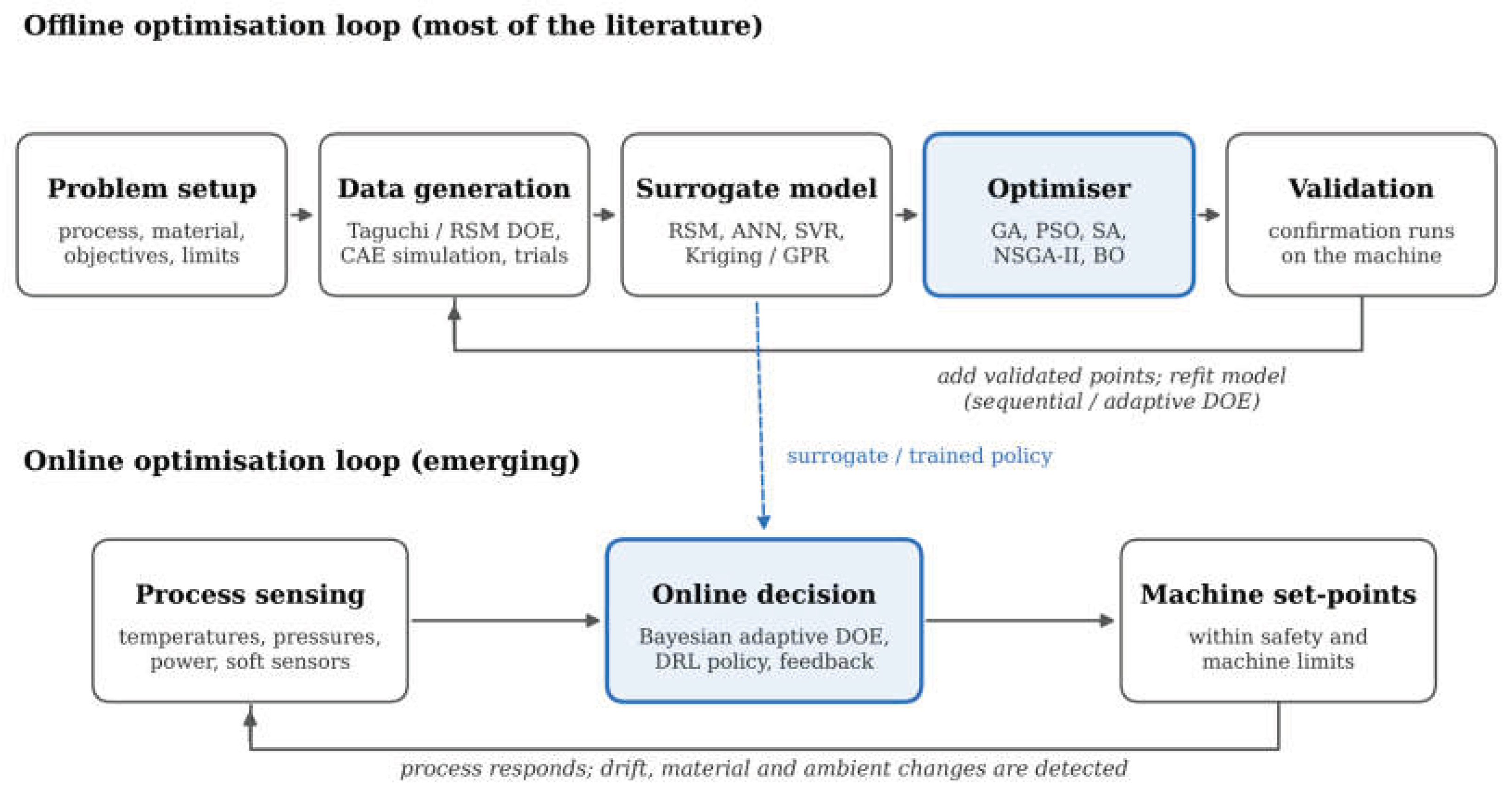
Table 2.
Typical decision variables and objectives in polymer processing optimisation.
| Process | Typical decision variables | Typical objectives |
|---|---|---|
| Injection moulding | Melt and mould temperature, injection speed and pressure, packing pressure and time, cooling time | Warpage, volumetric shrinkage, sink marks, weld lines, part weight, cycle time, clamping force |
| Single and twin-screw extrusion | Barrel temperature profile, screw speed, feed rate, screw geometry | Output, melt temperature and homogeneity, mixing, specific energy, dimensional stability |
| Blow moulding | Parison thickness profile, blow pressure, mould temperature | Wall thickness distribution, material use, cycle time |
| Thermoforming | Sheet heating profile, forming pressure or vacuum, plug speed | Wall thickness uniformity, cycle time |
| Compression moulding | Mould temperature, pressure, cure time, charge placement | Degree of cure, porosity, cycle time, flash |
| Material extrusion AM (FDM) | Layer thickness, raster angle and width, infill, build orientation, nozzle temperature | Strength, dimensional accuracy, surface roughness, build time |
Table 3.
Comparison of method families for polymer process parameter optimisation.
| Method family | Data need | Multi-objective handling | Real-time suitability | Interpretability | Industrial maturity |
|---|---|---|---|---|---|
| Taguchi / RSM / ANOVA | Low (9–30 runs) | Weak (desirability, weighted S/N) | Offline only | High | High |
| CAE simulation + direct search | Very high simulation cost | Moderate | Offline only | Moderate | Moderate |
| ANN surrogate + GA/PSO | Moderate (tens to hundreds of runs) | Good with weighting or NSGA-II | Offline; fast re-optimisation possible | Low | Moderate (common in research) |
| Kriging/GPR + NSGA-II | Low to moderate | Good (Pareto front) | Offline | Moderate | Moderate |
| Bayesian optimisation / adaptive DOE | Low (sequential) | Good with multi-objective BO | Near real-time between cycles | Moderate | Emerging |
| Deep reinforcement learning | High (simulation or surrogate) | Through reward design | Real-time | Low | Experimental |
| Soft sensors + feedback control | Moderate (historical data) | Limited | Real-time | Moderate | Emerging |
Disclaimer/Publisher’s Note: The statements, opinions and data contained in all publications are solely those of the individual author(s) and contributor(s) and not of MDPI and/or the editor(s). MDPI and/or the editor(s) disclaim responsibility for any injury to people or property resulting from any ideas, methods, instructions or products referred to in the content. |
© 2026 by the authors. Licensee MDPI, Basel, Switzerland. This article is an open access article distributed under the terms and conditions of the Creative Commons Attribution (CC BY) license (http://creativecommons.org/licenses/by/4.0/).
Copyright: This open access article is published under a Creative Commons CC BY 4.0 license, which permit the free download, distribution, and reuse, provided that the author and preprint are cited in any reuse.