

Submitted:
17 November 2026
Posted:
19 November 2026
You are already at the latest version
Abstract
We study inverse percolation on square, triangular, and honeycomb lattices by irreversibly removing tortuous k-mers from initially fully occupied substrates. Monte Carlo simulations and finite-size scaling are used to determine the inverse percolation threshold, θc,k, and characterize the critical behavior. The dependence of θc,k on the k-mer length is strongly substrate-dependent. On the honeycomb lattice, the threshold exhibits a nonmonotonic behavior, reaching a minimum at k=8, whereas on the square lattice the minimum occurs at k=4. In contrast, the threshold increases monotonically with k on the triangular lattice. This trend suggests that the minimum shifts toward shorter objects as the coordination number increases, eventually disappearing for the triangular lattice. The relative ordering of the three thresholds changes at large k, indicating that lattice robustness cannot be inferred from coordination number alone. Comparison with previously reported results for linear k-mers on square and triangular lattices further reveals that the geometry of the removed objects affects the evolution of connectivity and the location of the percolation threshold. The reported critical exponents ν, β and γ are consistent with standard two-dimensional percolation, suggesting that tortuous removal shifts the transition threshold without changing its universality class.
Keywords:
percolation
; self-avoiding walk
; tortuous k-mers
; random sequential adsorption
; finite-size scaling
; critical phenomena
1. Introduction
Percolation theory is a paradigmatic model for the study of connectivity in disordered media, with applications ranging from fluid flow in porous materials to epidemic spreading [1,2,3,4,5]. In its simplest formulation, the percolation phase transition is studied through the random and independent occupation or removal of the components of a system. However, real physical systems often exhibit structured or correlated disorder, in which the occupation or removal process follows specific spatial rules, constraints, or underlying dynamics [6,7].
Among the various frameworks developed to address correlated disorder, here we focus on inverse percolation [8], which provides a natural framework for modeling progressive dilution processes in fully occupied systems. The term inverse refers to the fact that, instead of studying how connectivity emerges as extended objects are deposited on an initially empty surface, the mechanism consists of removing extended objects from an initially fully occupied surface. The systematic removal of extended objects captures essential features of polymer degradation mechanisms [9] and targeted attack protocols in complex network architectures [10,11,12], where the spatial organization of the damage process affects the loss of connectivity.
Within the inverse percolation framework, the system starts from a fully occupied and therefore fully connected lattice. Dilution proceeds through the sequential and irreversible removal of extended objects composed of k occupied sites, referred to as k-mers. Previous studies considered the removal of straight rigid k-mers from square and triangular lattices [8,13]. In both geometries, the inverse percolation threshold was found to depend nonmonotonically on the object length. After an initial increase, the threshold reaches a maximum at an intermediate value of k and subsequently decreases toward a finite asymptotic value for long rods. The position of this maximum depends on the substrate geometry, occurring at for the square lattice and at for the triangular lattice.
In previous models, however, the removed objects were constrained to be linear k-mers, namely rigid rods occupying k consecutive sites along a lattice direction. In the present work, we relax this geometric restriction by considering tortuousk-mers, whose geometry is generated by self-avoiding walks (SAWs). A SAW is a non-self-intersecting lattice path and therefore provides a natural minimal representation of an extended object subject to excluded-volume constraints [14,15,16]. SAWs have been extensively used to describe flexible chains, excluded-volume effects, and configurational randomness in polymer physics and soft-matter systems [14,15,16,17,18,19,20]. More specific variants and applications have also been considered in the context of polymer adsorption, semiflexible chains, heterogeneous substrates, disordered environments, and protein-like chain models [21,22,23,24,25]. In this context, SAW-generated k-mers provide a natural representation of tortuous extended objects whose geometry is neither point-like nor restricted to a straight line. This choice allows us to investigate how the tortuosity of the removed object, rather than only its length, affects the loss of connectivity in regular lattices.
The removal process follows a variant of the Random Sequential Adsorption (RSA) protocol [26,27]. A tortuous k-mer is randomly generated and irreversibly removed from the lattice if all the sites belonging to its path are currently occupied. Otherwise, the trial object is rejected and a new one is generated. Repeating this procedure leads to a monotonic reduction of the occupied-site concentration and a corresponding increase in the hole concentration . A central question is to determine the critical concentration at which the occupied sites no longer form a spanning cluster across the lattice. This transition defines the inverse percolation threshold , namely the critical occupied-site concentration at which global connectivity disappears during the dilution process.
We investigate this transition on two-dimensional square, triangular and honeycomb lattices. In contrast to linear k-mers, which remove sites along a single lattice direction, tortuous k-mers can bend and explore different local directions. Consequently, they produce irregular damage patterns and introduce spatial correlations over a characteristic scale determined by the size and geometry of the removed object. This mechanism differs substantially from classical uncorrelated site percolation and provides a direct way to assess the role played by the morphology of extended damage.
Related models have been proposed in the study of enzyme-induced gel degradation, in which an enzyme follows a random trajectory and cleaves a polymeric network as it diffuses through the medium [9,28]. In such systems, the geometric and statistical properties of the damaging path influence the fragmentation dynamics of the network. More broadly, the effects of spatially correlated removal on percolation behavior have been investigated in models of targeted attacks on complex networks [10,11,12] and in correlated site-percolation problems associated with sites visited, or not visited, by random walks [29,30,31].
The aim of the present work is therefore to determine how allowing the removed object to bend and explore multiple lattice directions modifies the inverse percolation threshold and the associated critical behavior. We analyze the dependence of the inverse jamming and percolation thresholds on the k-mer size and on the connectivity of the underlying lattice. The results are compared with those previously obtained for linear k-mers, and finite-size scaling is used to determine whether the correlations introduced by tortuous damage paths alter the universality class of the transition. In this way, the present study extends the inverse-percolation framework from rigid and directionally constrained objects to flexible, self-avoiding removal patterns.
The rest of the paper is organized as follows. In Section 2, we introduce the lattice model, the generation and removal protocol for tortuous k-mers, and the main definitions and observables used in the simulations. In Section 3, we present the inverse jamming and percolation thresholds, analyze their dependence on the k-mer size and the lattice geometry, compare the results with those obtained for linear k-mers, and discuss the finite-size scaling analysis and critical exponents. Finally, the main conclusions are summarized in Section 4.
2. Materials and Methods
2.1. Lattice Model and Removal Protocol
The substrate is represented by a square, triangular or honeycomb lattice of adsorptive sites, with periodic boundary conditions. The introduction of periodic boundary conditions allows us to avoid edge effects and better emulate bulk behavior in the thermodynamic limit.
Each lattice site can be either occupied by a single particle or remain empty (hole). The concentrations of occupied and empty sites are denoted by and , respectively. Occupied nearest-neighbor sites form connected structures called clusters. The spatial distribution of these clusters determines the probability of forming a spanning (“infinite”) cluster, i.e., one that connects opposite sides of the lattice in the limit of .
Initially, all lattice sites are occupied (, ), and the system is therefore fully connected. The lattice is then progressively diluted by removing groups of k occupied sites at a time. Each removed object is a tortuous k-mer generated as a self-avoiding walk (SAW) [14]: starting from a randomly selected occupied site, the object grows step by step by choosing nearest-neighbor sites that have not been previously visited by the same walk. The trial object is accepted and removed only if all its k sites are occupied; otherwise, the trial is rejected and a new object is generated. Thus, the dilution process is sequential, random, and irreversible, in close analogy with a Random Sequential Adsorption (RSA) process [26,27].
The SAW constraint ensures that a tortuous k-mer cannot cross itself. In the present inverse problem, this constraint means that each removed site belongs only once to the same object, producing extended but non-self-intersecting damage patterns. This property makes SAWs a natural representation of flexible extended objects with excluded-volume constraints, such as polymer chains or degradation trajectories in polymeric networks [9,15,16,17,18,19]. In contrast to linear k-mers, which remove sites along a single lattice direction, tortuous k-mers can bend and explore different local directions. As a result, they generate irregular holes and introduce spatial correlations in the diluted lattice. Figure 1 illustrates representative configurations of tortuous tetramers () on the honeycomb, square and triangular lattices.
As mentioned above, the main idea of the inverse percolation problem consists in finding the maximum concentration of occupied sites for which the connectivity is lost. This critical value, denoted as the inverse percolation threshold, indicates a well-defined geometrical phase transition. For , the system contains an infinite cluster of occupied sites spanning the lattice, whereas for only finite disconnected clusters remain.
The protocol followed to study the removal of SAW objects can be established as follows:
i) We begin with the lattice completely filled and, therefore, fully connected.
ii) An occupied site on the lattice is selected at random, and a self-avoiding walk (SAW) of steps is generated, starting from that site.
iii) If any of the k sites in the SAW have already been emptied, the walk is discarded, and the process returns to step ii).
iv) Conversely, if all k sites associated with the SAW are occupied, they are then emptied, and the process continues to the next step.
v) At this stage, the coverage —or the number of sites remaining to be removed— is updated. In steps iii) and iv), a counter for attempts and a counter for successes are also updated each time an attempt is made to remove a new SAW.
vi) The ratio of the number of successes to the number of attempts is used as a stopping condition by comparing it against a threshold, typically between 0.1 and 0.01. It has been verified that this threshold is sufficient to obtain curves as a function of coverage, which allow for the analysis of the inverse percolation transition.
vii) Finally, the process continues from step ii) until the condition in step vi) is met.
The computational algorithm implementing the removal protocol described above is publicly available in the GitHub repository.
2.2. Jamming Coverage
When extended objects are deposited on a lattice following a RSA scheme, the process inevitably leads to a blocked configuration. In this state, although some sites remain empty, their geometry and neighborhood do not allow accommodation of further objects. This final and blocked configuration is known as the jamming state, and the corresponding fraction of occupied sites is called the jamming coverage. The jamming coverage depends on both the size of the deposited objects and the underlying lattice geometry [26,27,32,33,34,35].
In the context of inverse percolation, where structured objects are sequentially removed from the lattice, an analogous concept arises. Here, the lattice is not fully emptied, yet no additional objects can be removed. This state, referred to as the inverse jamming state, represents the complement of the jamming state in the direct RSA process [8,13].
In previous work by the authors, the jamming threshold for the standard RSA problem, denoted , was evaluated for tortuous k-mers on honeycomb, square, and triangular lattices [35]. As it is standard in the literature [33,34], the simulation data were fitted to the function (). In the case of tortuous k-mers, the dependence of the jamming coverage on k was well described by the fitting function [35],
where the value of A represents the limit concentration by infinitely long k-mers , and depends on the connectivity of the lattice. Here, (honeycomb lattice), (square lattice), and (triangular lattice).
During the dilution process in the original lattice, the fraction of empty sites (holes) varies between 0 and (), while the fraction of occupied sites decreases from 1 to , where . In the limit of large values of k, these asymptotic values are (honeycomb), (square), and (triangular).
With the parameter space thus defined, the percolation properties of the diluted system can be systematically investigated.
2.3. Inverse Percolation Threshold
The inverse percolation threshold, denoted as , represents the critical concentration of occupied sites at which the system undergoes a geometric phase transition from a percolating to a non-percolating state. In our model, this threshold corresponds to the occupied-site concentration at which global connectivity is lost as tortuous k-mers are progressively removed from an initially fully occupied lattice.
To determine with high precision, we employ finite-size scaling analysis based on the behavior of the percolation probability , which represents the probability that a lattice percolates at the concentration after the removal of SAWs of size k. X denotes the wrapping criterion considered under periodic boundary conditions [36,37]. The function is defined as
where is the total number of independent realizations and is the number of realizations containing a percolating cluster according to criterion X. Here, we consider three wrapping criteria: , corresponding to the probability of finding a cluster that wraps around the system in at least one lattice direction; , corresponding to the probability of finding a cluster that wraps around the system in all mutually perpendicular lattice directions; and , defined as the arithmetic mean of these two probabilities, =.
Near the critical point, the percolation probability satisfies the finite-size scaling form
where is the correlation-length exponent and is the scaling function associated with criterion X. Because is dimensionless, its leading contribution at is independent of L. Consequently, the curves for different system sizes intersect in the vicinity of the critical coverage. Small discrepancies among the finite-size crossing points arise from corrections to scaling and diminish as the thermodynamic limit is approached. As shown below in Figure 2(a), the three criteria U, A, and I yield consistent estimates of .
The percolation threshold can also be estimated from the finite-size scaling of the largest clusters. Let and denote the fractions of occupied sites belonging to the largest and second-largest clusters, respectively. Close to the critical point, both quantities obey the same leading size dependence,
where denotes the finite-size scaling function associated with the ith largest cluster.
At the critical point, , the argument of the scaling function vanishes, and therefore
Since the same size-dependent factor appears for both clusters, it cancels in their ratio:
Consequently, becomes asymptotically independent of L at the critical point. The intersection of the curves obtained for different system sizes thus provides an alternative crossing-point estimate of the percolation threshold [38]. This method does not require prior knowledge of the critical exponents and is particularly useful when the crossings of the percolation-probability curves are broadened or exhibit finite-size shifts.
A third independent method for determining involves considering the fourth-order cumulant—or Binder cumulant [39]—which utilizes the second and fourth moments of the order parameter :
This dimensionless quantity, calculated for different system sizes, also exhibits a crossing point that allows for an independent estimate of the percolation transition’s critical points.
For the three methods employed (the intersection of the percolation probability curves, the crossing of the curves, and the crossing of the curves), the statistical uncertainties in the estimates of were determined following the standard procedure commonly used in finite-size percolation analyses [40]. Specifically, we identify the interval spanned by the crossing points of the curves corresponding to different system sizes. Since finite-size effects generally prevent all curves from intersecting at a single mathematical point, the midpoint of this interval is taken as the estimated critical coverage , while half its width is used as the associated uncertainty.
Thus, we have at our disposal three independent methods for estimating the critical coverage , implemented using two fully independent computational codes. As an illustrative example, Figure 2 shows the determination of the inverse percolation threshold for tortuous k-mers of length on the square lattice. The analysis of the percolation probabilities, the crossing of the curves, and the crossing of the curves yield the consistent estimates , , and , respectively. The percolation-probability analysis was performed only for the square and triangular lattices, for which the corresponding codes had already been developed within our group. These codes were used to validate the new and techniques, together with their implementation in a new computational code. The results obtained with all three methods were consistent, with the estimated thresholds agreeing within statistical uncertainties. Since evaluating the percolation probabilities for multiple system sizes is computationally more demanding, this method was used only for . For , was determined exclusively from the crossings of the and curves. The two estimates were practically indistinguishable; therefore, the values obtained using these two methods were adopted for the results presented in the following section. For , the reported thresholds were calculated by averaging the estimates from all three methods.
In all three analyses, averages were computed over a set of independent samples, numerically generated for different values of k and system size L. Specifically, we considered –6 with –640, –12 with –200, and with –80. These simulations required a computational effort close to the limits of our available computational resources.
3. Results and Discussion
Figure 3 shows the inverse percolation threshold as a function of the tortuous k-mer length k for the honeycomb, square, and triangular lattices. The numerical values are compiled in Table 1. For short objects, the thresholds are clearly separated according to the local coordination of the substrate. For instance, at we obtain for the triangular lattice (), for the square lattice (), and for the honeycomb lattice (). Since the dilution process starts from , a smaller value of implies that a larger fraction of sites, , must be removed before global connectivity is lost. Thus, for short tortuous k-mers, the triangular lattice is the most robust against removal, followed by the square and honeycomb lattices.
The dependence of on k also varies markedly with the substrate. On the honeycomb lattice, which has coordination number , the threshold exhibits a nonmonotonic behavior, reaching a minimum at . A similar nonmonotonic dependence occurs on the square lattice (), but the minimum is shifted to . In contrast, on the triangular lattice (), increases monotonically over the entire range investigated, with no minimum observed. These results reveal a systematic trend: as the coordination number increases from to , the minimum shifts toward shorter k-mers, while for the nonmonotonic behavior disappears. This trend suggests that the dependence of the threshold on object length results from a competition between substrate connectivity and the geometrical constraints governing the removal of tortuous objects.
Despite the differences observed for short k-mers, the relative ordering of the thresholds changes as k increases. The three curves progressively converge and cross within the range , reversing the relative robustness of the three lattices against removal. Beyond this crossover, the honeycomb lattice is the most robust, followed by the square and triangular lattices. This behavior indicates that the effect of lattice geometry cannot be characterized by the coordination number alone. Rather, the inverse percolation threshold reflects a competition between the local connectivity of the substrate and the number and shape of the tortuous configurations available to the removed objects. In particular, the distinct dependence of on k for the three lattices shows that increasing substrate connectivity does not simply shift the threshold in a uniform manner, but can also modify the qualitative form of its dependence on object length.
A possible interpretation of this crossover behavior is based on the competition between substrate connectivity and the configurational freedom of the removed objects. A larger coordination number provides more alternative paths for the occupied cluster, which tends to increase robustness. At the same time, it also provides a larger number of possible continuations for a self-avoiding walk, increasing the diversity of tortuous removal patterns. For short k-mers, the threshold appears to be mainly controlled by local lattice connectivity. As k increases, however, the removed objects extend over several lattice spacings, explore multiple directions, and generate increasingly irregular damage patterns. Under these conditions, the shape of the removed regions becomes as important as the local coordination of individual sites, leading to crossings between the threshold curves.
The relevance of the object geometry in the process becomes clearer when the results for tortuous k-mers are compared with those previously obtained for linear k-mers in [8,13] for the square and triangular lattices. This comparison is restricted to these two substrates because inverse percolation induced by the removal of linear k-mers on the honeycomb lattice has not yet been investigated in the literature. As can be seen in Figure 4, the threshold associated with linear k-mers exhibits a nonmonotonic dependence on k: it reaches a maximum at an intermediate length and subsequently decreases. For tortuous k-mers, the behavior of depends on the lattice: the threshold is nonmonotonic on the square lattice, with a minimum at , whereas it increases monotonically on the triangular lattice over the range investigated. In both cases, increases throughout the large-k range investigated. Consequently, the tortuous-k-mer threshold approaches and eventually exceeds the corresponding linear-k-mer value. This comparison indicates that the observed increase is not simply a consequence of removing more sites in each event, but is associated with the spatial organization of the removed sites. From a robustness perspective, the removal of linear k-mers is less effective than the one for tortuous k-mers. For linear k-mers, increasing k strongly reduces the probability of finding k consecutive occupied sites along a lattice direction. The removal process therefore becomes increasingly blocked as dilution proceeds, and global connectivity is lost only after a larger fraction of sites has been removed, corresponding to a lower value of (this is, the percolation thresholds decreases for large k). Tortuous k-mers can change direction and follow irregular sequences of occupied sites. This allows the dilution process to continue through configurations in which linear objects of the same length can no longer be removed, leading to connectivity loss at higher occupied-site concentrations. Thus, rigidity favors early blocking, whereas tortuosity preserves accessible removal paths and reduces the robustness of the lattice.
The relationship between the inverse percolation threshold and the inverse jamming coverage provides additional insights. First, the behavior of the curves in Figure 3, together with the dependence of the inverse jamming threshold on k discussed in Section 2.2, shows that connectivity is lost at an occupied fraction considerably larger than the inverse jamming coverage. Thus, the system becomes nonpercolating well before the removal process reaches its jamming limit, indicating that the loss of global connectivity does not require the maximum dilution attainable under the removal constraints.
Second, a comparison of the inverse jamming and percolation thresholds as functions of k further reveals a fundamental difference between the two processes. For the three lattice geometries considered, the inverse jamming curves exhibit the same functional dependence on k and differ only in their constant terms, as follows from Eq. (1). This behavior indicates that the jamming threshold is determined by the underlying lattice geometry, with the relative ordering of the thresholds remaining unchanged as k varies. In contrast, the percolation threshold curves cross one another, showing that their relative ordering depends on k and cannot be explained solely by the lattice geometry or its coordination number. This behavior suggests that percolation is governed by a more complex interplay between lattice geometry and the global organization of the damage pattern.
The static critical exponents , , and were determined from the finite-size scaling behavior of the percolation probability, the order parameter, and the susceptibility. For all values of k and substrate lattices considered, the estimates are consistent, within statistical uncertainties, with the exact exponents of ordinary two-dimensional random percolation, , , and [1]. These results indicate that, although the removal of tortuous k-mers shifts the percolation threshold and introduces spatial correlations, it does not alter the universality class of the transition. As an illustrative example, the Supplementary Information presents a detailed finite-size scaling analysis for on square and triangular lattices.
This behavior contrasts with the enzyme-driven gel degradation model introduced by Abete et al. [9], also known as Pacman percolation, in which diffusing agents progressively digest the gel network, generating dynamical correlations that can affect the percolation process. In the present model, the random selection of the starting positions of the removed objects may limit the spatial extent of the induced correlations, allowing the system to retain the critical behavior of ordinary percolation.
4. Conclusions
In this work, we investigated inverse percolation induced by the irreversible removal of tortuous k-mers from initially fully occupied square, triangular, and honeycomb lattices. We determined the inverse percolation threshold as a function of the k-mer length and examined how the substrate geometry affects the loss of global connectivity. The dependence of the threshold on k differs qualitatively among the three lattices. On the honeycomb lattice (), the threshold exhibits a nonmonotonic behavior, with a minimum at . On the square lattice (), the minimum occurs at , whereas on the triangular lattice () the threshold increases monotonically over the range investigated. This trend suggests that the minimum shifts toward shorter k-mers as the coordination number increases and disappears for the triangular lattice. These findings show that substrate connectivity influences not only the magnitude of the inverse percolation threshold but also its dependence on the length of the removed objects. For relatively short k-mers (), the triangular lattice has the lowest inverse percolation threshold, followed by the square and honeycomb lattices. Since a lower threshold means that the system remains percolating down to a smaller occupied-site fraction, the triangular lattice is the most robust against removal in this range. As k increases, the three threshold curves approach one another and cross within the range . For larger k-mers (), the relative ordering is reversed: the honeycomb lattice becomes the most robust, followed by the square and triangular lattices. This reversal demonstrates that robustness cannot be inferred from the coordination number alone, but rather results from the interplay between local connectivity and the geometrical constraints governing the removal of tortuous objects.
Comparison with previously reported results for linear k-mers on square and triangular lattices further highlights the role of object geometry. Whereas linear k-mers exhibit a nonmonotonic dependence of the threshold on k on both substrates, tortuous k-mers display different trends: a minimum followed by an increase on the square lattice and a monotonic increase on the triangular lattice. The ability of tortuous objects to follow irregular paths changes the configurations accessible during removal and, consequently, the evolution of the occupied network.
For the cases analyzed, the critical exponents are consistent with the standard values of the two-dimensional percolation universality class: , , and . This finding indicates that the spatial correlations introduced by finite tortuous k-mer removal shift the location of the transition but do not alter the universality class. In other words, the microscopic damage rule strongly affects the threshold, but the critical behavior at large scales remains governed by the standard two-dimensional percolation fixed point.
These results are relevant beyond the specific lattice model considered here. The removal of tortuous extended objects may be interpreted as a simplified description of degradation processes in polymeric gels, hydrogel networks, porous media, or composite materials, where damage propagates along irregular paths rather than through independent point-like failures. The present model suggests that the tortuosity of degradation paths can significantly reduce the resilience of a connected medium. Future work could extend this approach to off-lattice geometries, three-dimensional substrates, mixtures of linear and tortuous objects, or biased self-avoiding walks designed to mimic anisotropic fracture and directed degradation processes.
Supplementary Materials
The following supporting information can be downloaded at the website of this paper posted on Preprints.org.
Author Contributions
Conceptualization, L.S.R., P.M.P. and A.J.R.-P.; methodology, L.S.R. and P.M.P.; software, L.S.R. and P.M.P.; validation, L.S.R., P.M.P. and A.J.R.-P.; formal analysis, L.S.R., P.M.P. and A.J.R.-P.; investigation, L.S.R., P.M.P. and A.J.R.-P.; writing—original draft preparation, L.S.R., P.M.P. and A.J.R.-P.; writing—review and editing, L.S.R., P.M.P. and A.J.R.-P.. All authors have read and agreed to the published version of the manuscript.
Funding
This research was supported in part by CONICET (Argentina) under Project No. PIP 11220220100238CO and Universidad Nacional de San Luis (Argentina) under Project 03-2526. The numerical work was performed using the BACO parallel cluster located at Instituto de Física Aplicada, Universidad Nacional de San Luis—CONICET, San Luis, Argentina.
Institutional Review Board Statement
Not applicable.
Informed Consent Statement
Not applicable.
Data Availability Statement
The data supporting the findings of this study are available from the corresponding authors upon reasonable request. The removal protocol source code is available in the GitHub repository at https://github.com/mapasi/RSA_SAWs_inverse_percolation.
Conflicts of Interest
The authors declare no conflicts of interest.
References
- Stauffer, D.; Aharony, A. Introduction to Percolation Theory; Taylor & Francis: London, 2003. [Google Scholar]
- Feshanjerdi, M.; Masoudi, A. A.; Grassberger, P.; Ebrahimi, M. Aftermath epidemics: Percolation on the sites visited by generalized random walks. Phys. Rev. E 2023, 108, 024312. [Google Scholar] [CrossRef]
- Broadbent, S. R.; Hammersley, J. M. Math. Proc. Camb. Philos. Soc. 1957, 53, 629.
- Grassberger, P. On the critical behavior of the general epidemic process and dynamical percolation. Math. Biosci. 1983, 63, 157. [Google Scholar] [CrossRef]
- Saberi, A. A. Recent advances in percolation theory and its applications. Phys. Rep. 2015, 578, 1–32. [Google Scholar] [CrossRef]
- M. Sahimi, Applications of Percolation Theory; Taylor & Francis: London, 1994. [Google Scholar]
- Bollobás, B.; Riordan, O. Percolation; Cambridge University Press: New York, 2006. [Google Scholar]
- Ramirez, L. S.; Centres, P. M.; A. J. Ramirez-Pastor, J. Stat. Mech. 2015; p. P09003.
- Abete, T.; de Candia, A.; Lairez, D.; Coniglio, A. Percolation model for enzyme gel degradation. Phys. Rev. Lett. 2004, 93, 228301. [Google Scholar] [CrossRef]
- Gallos, L. K.; Cohen, R.; Argyrakis, P.; Bunde, A.; Havlin, S. Stability and topology of scale-free networks under attack and defense strategies. Phys. Rev. Lett. 2005, 94(18), 188701. [Google Scholar] [CrossRef]
- Braunstein, A.; Dall’Asta, L.; Semerjian, G.; Zdeborová, L. Network dismantling. Proc. Natl. Acad. Sci. 2016, 201605083. [Google Scholar] [CrossRef]
- Callaway, D. S.; Newman, M. E. J.; Strogatz, S. H.; Watts, D. J. Network robustness and fragility: Percolation on random graphs. Phys. Rev. Lett. 2000, 85(25), 5468. [Google Scholar] [CrossRef]
- Ramirez, L. S.; Centres, P. M.; A. J. Ramirez-Pastor, J. Stat. Mech. 2017; p. 113204.
- Binder, K. (Ed.) Monte Carlo and Molecular Dynamics Simulations in Polymer Science; Oxford University Press: New York, 1995. [Google Scholar]
- N. Madras and G. Slade, The Self-Avoiding Walk; Birkhäuser, Boston, 1993.
- Slade, G. The self-avoiding walk: A brief survey. Surv. Stoch. Process. 2011, 4, 181. [Google Scholar] [CrossRef]
- de Gennes, P. G. Scaling Concepts in Polymer Physics; Cornell University Press, 1979. [Google Scholar]
- Rubinstein, M. R. H. Colby, Polymer Physics; Oxford University Press: Oxford, UK, 2003. [Google Scholar]
- Rubin, R. J. The excluded volume effect in polymer chains and the analogous random walk problem. J. Chem. Phys. 1952, 20, 1940–1945. [Google Scholar] [CrossRef]
- Ottinger, H. C. Stochastic Processes in Polymeric Fluids; Springer Science & Business Media: Berlin, Germany, 2012. [Google Scholar]
- Dewey, T. G. Statistical mechanics of protein sequences. Phys. Rev. E 1999, 60, 4652–4658. [Google Scholar] [CrossRef]
- Zivic, I.; Elezovic-Hadzic, S.; Milosevic, S. Semiflexible polymer chains on the square lattice: Numerical study of critical exponents. Phys. Rev. E 2018, 98. [Google Scholar] [CrossRef]
- Yang, Q. H.; Yang, X.; Luo, M. B. Adsorption of polymer chains on heterogeneous surfaces with random adsorption sites. Polymer 2019, 180. [Google Scholar] [CrossRef]
- Parreno, O.; Ramos, P. M.; Karayiannis, N. Ch.; Laso, M. Polymers 2020, 12(4), 799.
- C. Monthus, Random Walks and Polymers in the Presence of Quenched Disorder. Lett. Math. Phys. 2006, 78, 207. [Google Scholar] [CrossRef]
- Feder, J.; Theoret, J. Biol. 1980, 87, 237.
- Evans, J. W. Rev. Mod. Phys. 1993, 65, 1281.
- de Gennes, P.-G. On a relation between percolation theory and the elasticity of gels. J. Phys. Lett. 1976, 37, 1–2. [Google Scholar] [CrossRef]
- Federbush, A.; Kantor, Y. Percolation perspective on sites not visited by a random walk in two dimensions. Phys. Rev. E 2021, 103, 032137. [Google Scholar] [CrossRef]
- Levi, R. H.; Kantor, Y. Critical exponents of correlated percolation of sites not visited by a random walk. Phys. Rev. E 2024, 110(2), 024116. [Google Scholar] [CrossRef]
- Grassberger, P. Conductivity exponent and backbone dimension in 2D percolation. Physica A 1999, 262, 251–263. [Google Scholar] [CrossRef]
- Kondrat, G.; Pȩkalski, A. Phys. Rev. E 2001, 63, 051108.
- Bonnier, B.; Hontebeyrie, M.; Leroyer, Y.; Meyers, C.; Pommiers, E. Phys. Rev. E 1994, 49, 305.
- Perino, E. J.; Matoz-Fernandez, D. A.; Pasinetti, P. M.; A. J. Ramirez-Pastor, J. 2017; p. 073206.
- Ramirez, L. S.; Pasinetti, P. M.; Ramirez-Pastor, A. J. Phys. Rev. E 2023, 107, 064106.
- Yonezawa, F.; Sakamoto, S.; Hori, M. Phys. Rev. B 1989, 40, 636.
- Yonezawa, F.; Sakamoto, S.; Hori, M. Phys. Rev. B 1989, 40, 650.
- Almeira, N.; Billoni, O. V.; Perotti, J. I. Phys. Rev. E 2020, 101, 012306.
- Binder, K. Rep. Prog. Phys. 1997, 60, 487.
- De La Cruz Feliz, N. M.; Pimentel, F. M. L.; De La Cruz Félix, N.; Ramirez-Pastor, A. J. Phys. Rev. E 2024, 109, 034107.
Figure 1.
Available configurations for tortuous tetramers () adsorbed on (a) honeycomb lattices, (b) square lattices, and (c) triangular lattices.
Figure 1.
Available configurations for tortuous tetramers () adsorbed on (a) honeycomb lattices, (b) square lattices, and (c) triangular lattices.
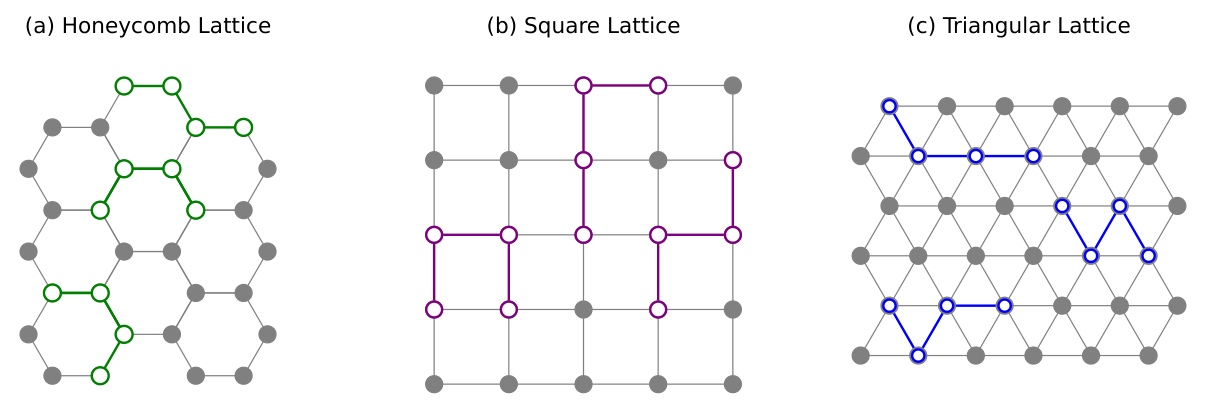
Figure 2.
Determination of the inverse percolation threshold for the square lattice. (a) Wrapping probabilities for the same system, where , A, and I denote the different wrapping criteria. Black, red, and blue curves correspond to , , and , respectively. Different symbols indicate different system sizes: squares (), circles (), triangles (), and diamonds (). Their common crossing yields . (b) Ratio between the sizes of the largest and second-largest occupied clusters, , as a function of the occupied-site concentration for the same system sizes as in part (a). The curves become approximately size independent at the critical point, and their crossing gives . (c) Binder cumulant as a function of the occupied-site concentration for the same system sizes as in parts (a) and (b). The common crossing point provides an independent estimate of the critical threshold, . Vertical dashed lines indicate the threshold estimated with each method. In all panels, the removed objects are tortuous k-mers of length . Solid lines are intended solely as guides to the eye.
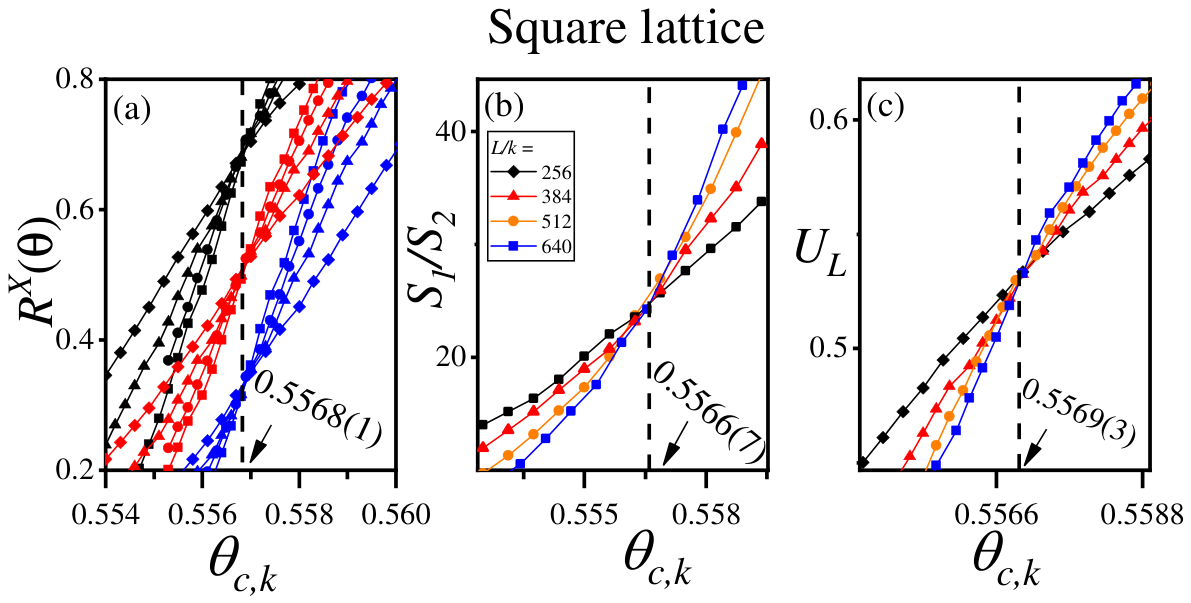
Figure 3.
Inverse percolation threshold as a function of the tortuous k-mer length k for the square, triangular, and honeycomb lattices. Squares, triangles, and hexagons correspond to the square, triangular, and honeycomb lattices, respectively. Error bars indicate the statistical uncertainty of the estimated thresholds; however, they are smaller than the size of the symbols and are therefore not visible.
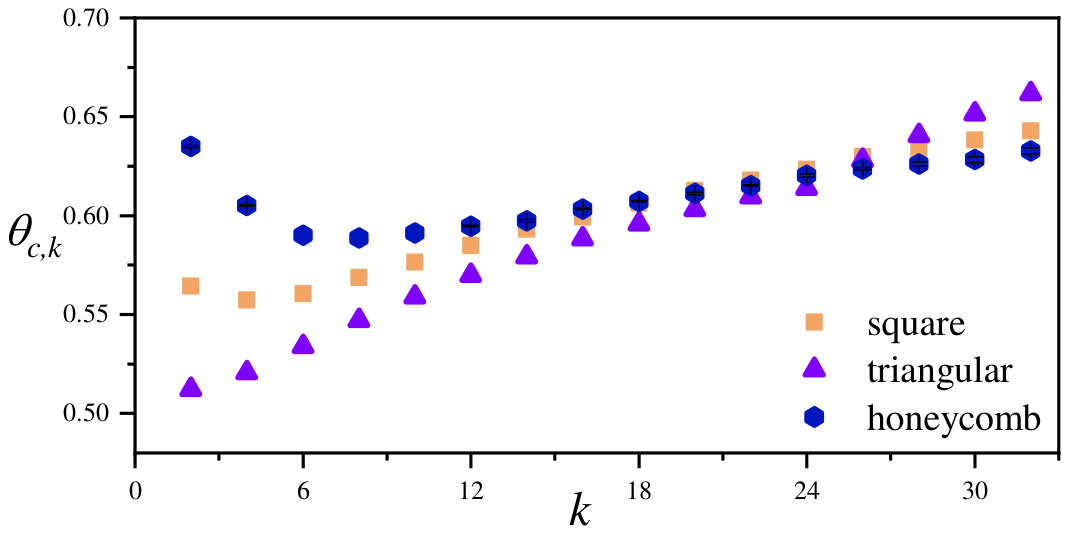
Figure 4.
Inverse percolation threshold as a function of the k-mer length k for the (a) triangular and (b) square lattices. Dark filled symbols correspond to the results previously reported for linear k-mers [8,13], whereas light open symbols represent the results obtained in the present work for tortuous k-mers. Lines are included as guides to the eye.
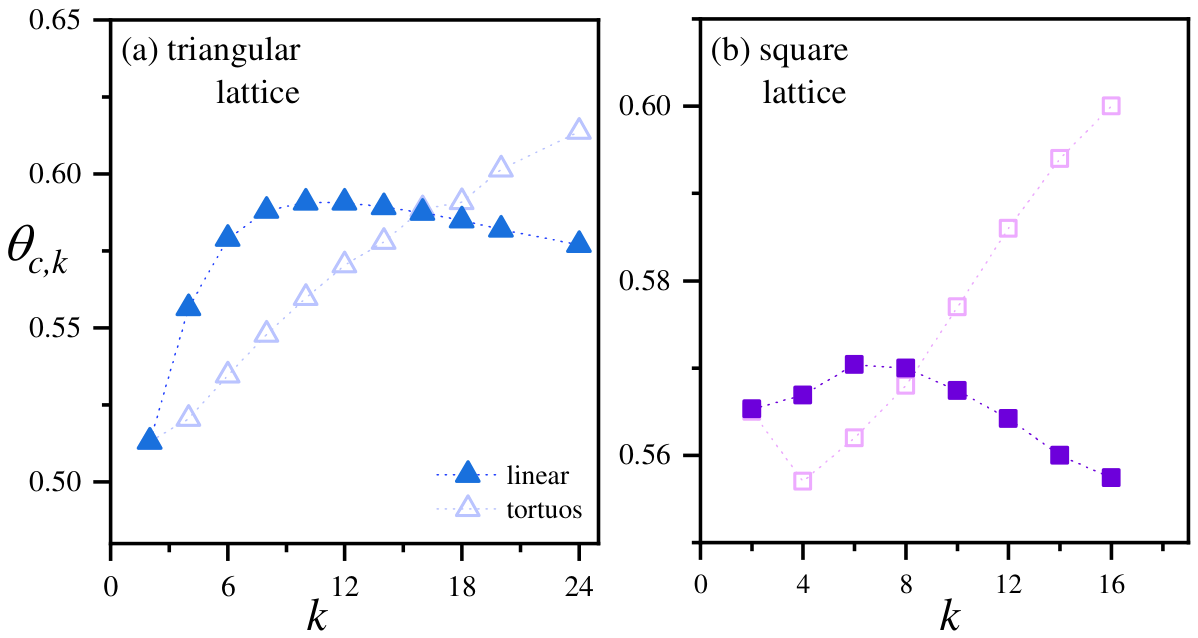

Table 1.
Inverse percolation thresholds for tortuous k-mers on square, triangular, and honeycomb lattices as a function of k. Parentheses indicate the uncertainty in the last reported decimal places, where available.
Table 1.
Inverse percolation thresholds for tortuous k-mers on square, triangular, and honeycomb lattices as a function of k. Parentheses indicate the uncertainty in the last reported decimal places, where available.
| k | Square | Triangular | Honeycomb | k | Square | Triangular | Honeycomb |
|---|---|---|---|---|---|---|---|
| 2 | 0.5653(9) | 0.5121(3) | 0.6350(6) | 18 | 0.6061(2) | 0.5957(2) | 0.6073(3) |
| 4 | 0.5568(5) | 0.5205(3) | 0.6052(4) | 20 | 0.6127(1) | 0.6032(3) | 0.6112(5) |
| 6 | 0.5609(4) | 0.5338(2) | 0.5902(2) | 22 | 0.6179(1) | 0.6096(4) | 0.6153(3) |
| 8 | 0.5693(5) | 0.5471(3) | 0.5887(2) | 24 | 0.6235(1) | 0.6138(2) | 0.6203(8) |
| 10 | 0.5767(3) | 0.5588(2) | 0.5912(2) | 26 | 0.6293(4) | 0.6279(5) | 0.6237(6) |
| 12 | 0.5851(2) | 0.5698(4) | 0.5947(4) | 28 | 0.6332(1) | 0.6406(2) | 0.6261(9) |
| 14 | 0.5931(1) | 0.5791(5) | 0.5975(6) | 30 | 0.6383(1) | 0.6513(3) | 0.6283(14) |
| 16 | 0.5995(3) | 0.5882(5) | 0.6034(4) | 32 | 0.6433(5) | 0.6618(6) | 0.6327(16) |
Disclaimer/Publisher’s Note: The statements, opinions and data contained in all publications are solely those of the individual author(s) and contributor(s) and not of MDPI and/or the editor(s). MDPI and/or the editor(s) disclaim responsibility for any injury to people or property resulting from any ideas, methods, instructions or products referred to in the content. |
© 2026 by the authors. Licensee MDPI, Basel, Switzerland. This article is an open access article distributed under the terms and conditions of the Creative Commons Attribution (CC BY) license.
Copyright: This open access article is published under a Creative Commons CC BY 4.0 license, which permit the free download, distribution, and reuse, provided that the author and preprint are cited in any reuse.