
Submitted:
15 November 2026
Posted:
18 November 2026
You are already at the latest version
Abstract
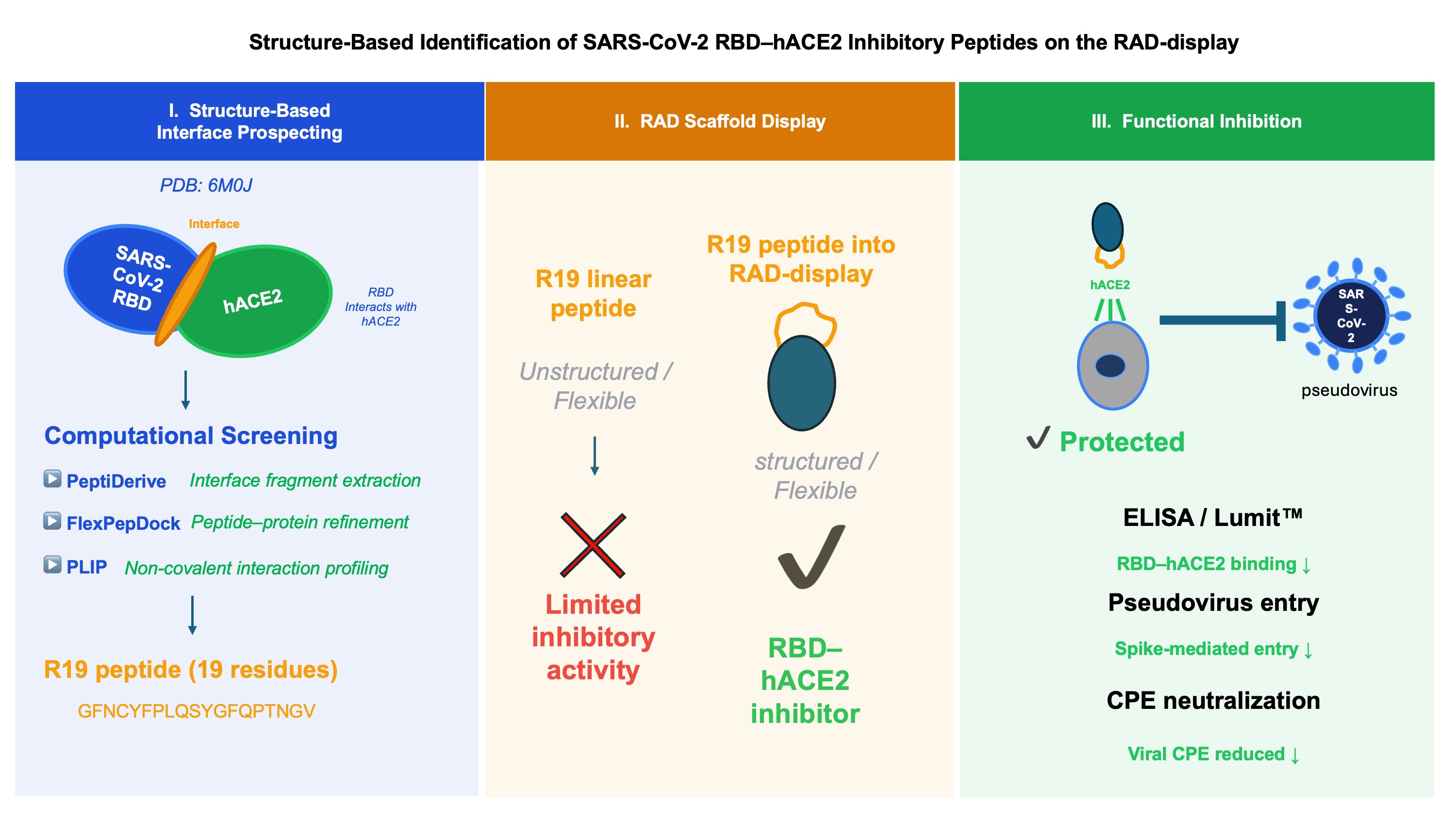
The interaction between the receptor-binding domain (RBD) of the SARS-CoV-2 Spike protein and human angiotensin-converting enzyme 2 (hACE2) is a key molecular event in viral entry and an attractive target for the identification of antiviral compounds, including inhibitory peptides. Here, we identified peptide motifs derived from the RBD–hACE2 interface using a structure-based method and examined their functional activity when presented within the Pyrococcus furiosus RAD scaffold (RAD-display). Candidate peptides derived from both RBD and hACE2 were selected initially by computational analyses of the crystallographic complex, cloned and expressed as RAD-display constructs. Functional activities were evaluated by ELISA, Lumit™ luminescence assay, pseudovirus entry inhibition, and cytopathic-effect-based infection neutralization assays with the parental SARS-CoV-2 lineage. Peptides derived from RBD showed superior performance compared with peptides derived from hACE2. In particular, the RAD_R19 construct consistently showed RBD–hACE2 inhibitory effects reducing pseudoviruses and virus-mediated cytopathic effects. Together, these findings identify R19 as a promising native RBD-derived inhibitory motif whose functional activity was demonstrated when presented within the RAD scaffold. In the context of previous studies showing limited inhibitory activity of closely related native linear RBM peptides, our results further suggest that the molecular context of peptide presentation is an important determinant of inhibitory behavior.
Keywords:
SARS-CoV-2
; Spike protein
; receptor-binding domain
; hACE2
; inhibitory peptides
; RAD-display
; peptide design
; pseudovirus
; neutralization assay
Copyright: This open access article is published under a Creative Commons CC BY 4.0 license, which permit the free download, distribution, and reuse, provided that the author and preprint are cited in any reuse.