
Submitted:
17 November 2026
Posted:
18 November 2026
You are already at the latest version
Abstract
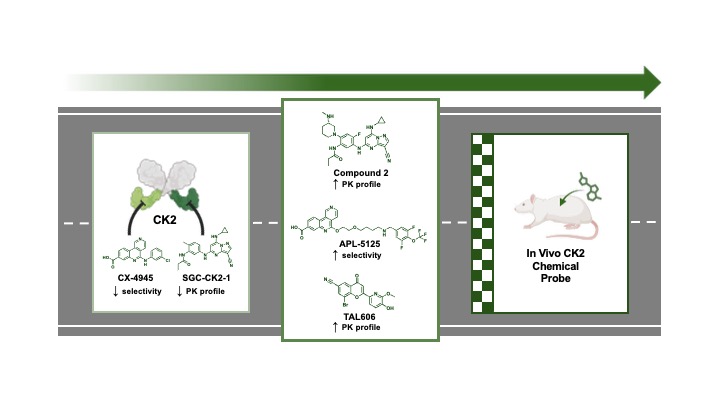
The complexity of casein kinase 2 (CK2/CSNK2; encoded by CSNK2A1, CSNK2A2, and CSNK2B) and its regulatory roles across numerous cellular pathways both underscores its broad therapeutic potential and complicates efforts to define the contexts in which CK2 inhibition may be clinically beneficial. Accordingly, the development of high-quality chemical probes remains essential for elucidating CK2 biology. Since 2023, substantial progress has been made toward identifying potent, selective, and pharmacologically relevant CK2 inhibitors. Here, we summarize recent advances in ATP-competitive CK2 inhibitor development, with particular emphasis on cellular activity, kinome-wide selectivity, pharmacokinetic properties, and suitability for in vivo studies. We discuss the optimization of established monovalent chemotypes, including the pyrazolo[1,5-a]pyrimidine scaffold exemplified by SGC-CK2-1, as well as emerging scaffolds and bivalent inhibitor derivatives. Among the inhibitors discussed, APL-5125 has notably progressed toward an in vivo CK2 probe based on its single-digit nanomolar potency, excellent kinome-wide selectivity, and favorable in vivo properties that have supported its advancement into Phase 1/2 clinical trials. We conclude by outlining future directions for probe-enabled interrogation of CK2 biology.
Keywords:
protein kinase CK2
; CSNK2A1
; CSNK2A2
; chemical probe
; pyrazolopyrimidine
; flavone
; orthosteric
; bivalent
Copyright: This open access article is published under a Creative Commons CC BY 4.0 license, which permit the free download, distribution, and reuse, provided that the author and preprint are cited in any reuse.