
Submitted:
17 November 2026
Posted:
18 November 2026
You are already at the latest version
Abstract
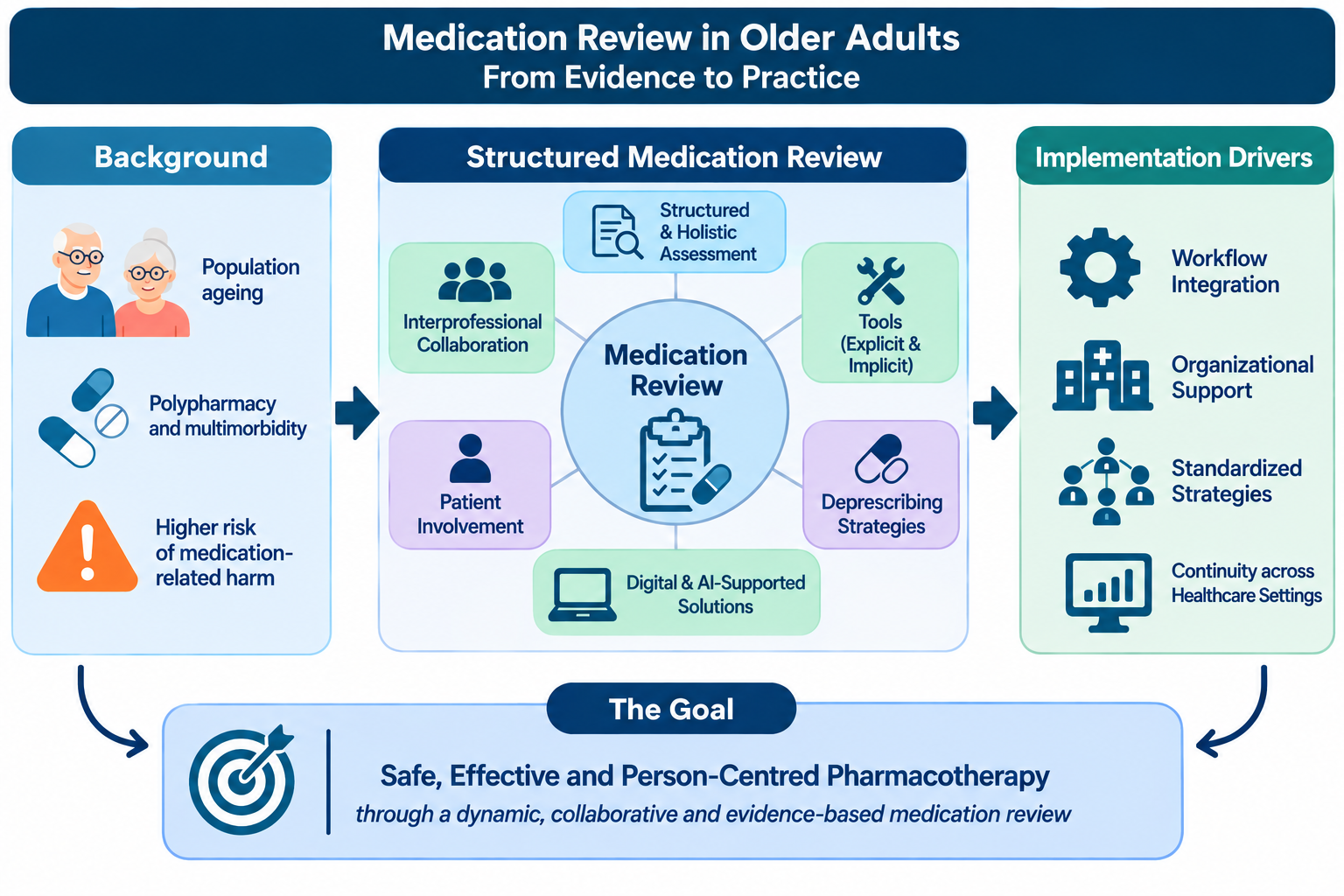
Background: Population ageing, prevalence of multimorbidity, polypharmacy and frailty considerably increase the complexity of pharmacological treatment in older adults and the risk of medication-related harm. Medication review (MR) represents a key strategy to assess treatment appropriateness, support medication optimization and identify opportunities for deprescribing. However, its implementation in routine clinical practice remains heterogeneous and inconsistent. Methods: A narrative review was conducted focusing on MR conceptual framework, assessment and deprescribing tools, interprofessional collaboration, implementation strategies, and emerging artificial intelligence (AI)-supported technologies across different healthcare settings. Relevant literature was identified through searches on PubMed, Google Scholar and Scopus, complemented by reference-list screening and citation tracking. Recent literature was prioritized, while seminal publications and guidelines were retained when relevant to the development of key concepts. Results: MR encompasses different approaches, ranging from structured medication assessment to comprehensive holistic processes incorporating clinical judgement and shared decision-making. Explicit and implicit tools can support the identification of potentially inappropriate medications and other drug-related problems, while deprescribing approaches facilitate the reassessment and discontinuation of unnecessary medications. Evidence also highlights the importance of pharmacists and interprofessional collaboration, patient involvement, workflow integration, and organizational support for successful implementation. Digital and AI-based approaches, including electronic health record-integrated clinical decision support systems, may further support medication optimization. Conclusions: MR should be considered a dynamic and collaborative process rather than a one-time assessment of medication lists. Future efforts should focus on its sustainable integration into routine care, continuity across healthcare settings, standardized implementation strategies, and the validation of digital tools that complement clinical judgement.
Keywords:
medication review
; older adults
; polypharmacy
; multimorbidity
; deprescribing
; frailty
; interprofessional collaboration
; implementation
; artificial intelligence
Copyright: This open access article is published under a Creative Commons CC BY 4.0 license, which permit the free download, distribution, and reuse, provided that the author and preprint are cited in any reuse.