
Submitted:
17 November 2026
Posted:
18 November 2026
You are already at the latest version
Abstract
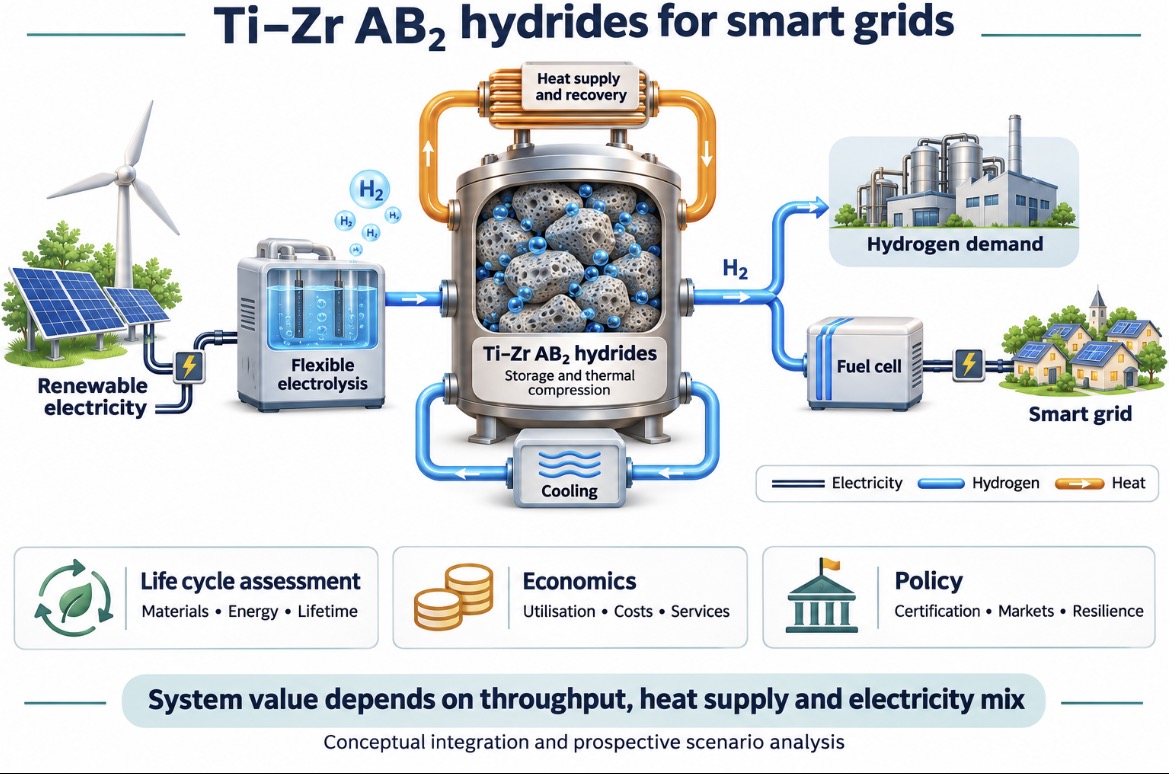
Smart grids can integrate metal hydride hydrogen storage with flexible electrolysis, local heat networks and dispatchable generation, but the economic and environmental value depends on the service provided. Long cycling life can reduce the environmental burden of metal hydride systems only when the installed material delivers substantial hydrogen throughput and when thermal management remains efficient. This paper critically examines the Ti–Zr AB2 alloy preprint of Li and colleagues and develops a prospective life cycle screening model that links alloy durability, usable capacity, utilisation and operating energy. Reported capacity retention near 99% after 20,000 cycles is promising, but equilibrium capacity measured at 25 °C is not equivalent to delivered capacity under a specified pressure and temperature duty. A transparent scenario calculation uses an assumed working capacity of 0.0171 kg H2 per kg alloy, 80% utilisation and 99.5% mean capacity retention. An illustrative embodied burden of 20 kg CO2e per kg alloy becomes 0.073 kg CO2e per kg H2 at 20,000 cycles, compared with 0.490 kg CO2e at 3,000 cycles. These are conditional calculations, not measured footprints. Adding assumed auxiliary electricity and useful heat gives 0.363 kg CO2e per kg H2 for an electrified heat case and 1.213 kg CO2e for a fossil heat case. The analysis identifies thermal integration and realised throughput as decisive parameters and specifies the inventory needed for a complete, independently reviewable assessment. The analysis is extended to smart-grid integration, including illustrative electricity-to-hydrogen-to-electricity calculations, discounted cost assessment, market participation and European policy. It proposes evaluating hydrides as one component of a coordinated electricity–hydrogen–heat system rather than inferring grid value from alloy endurance alone.
Keywords:
smart grids
; Ti–Zr AB2 hydrides
; hydrogen storage
; thermal compression
; life cycle assessment
; technoeconomic analysis
; energy policy
; sector coupling
Copyright: This open access article is published under a Creative Commons CC BY 4.0 license, which permit the free download, distribution, and reuse, provided that the author and preprint are cited in any reuse.