
Submitted:
17 November 2026
Posted:
18 November 2026
You are already at the latest version
Abstract
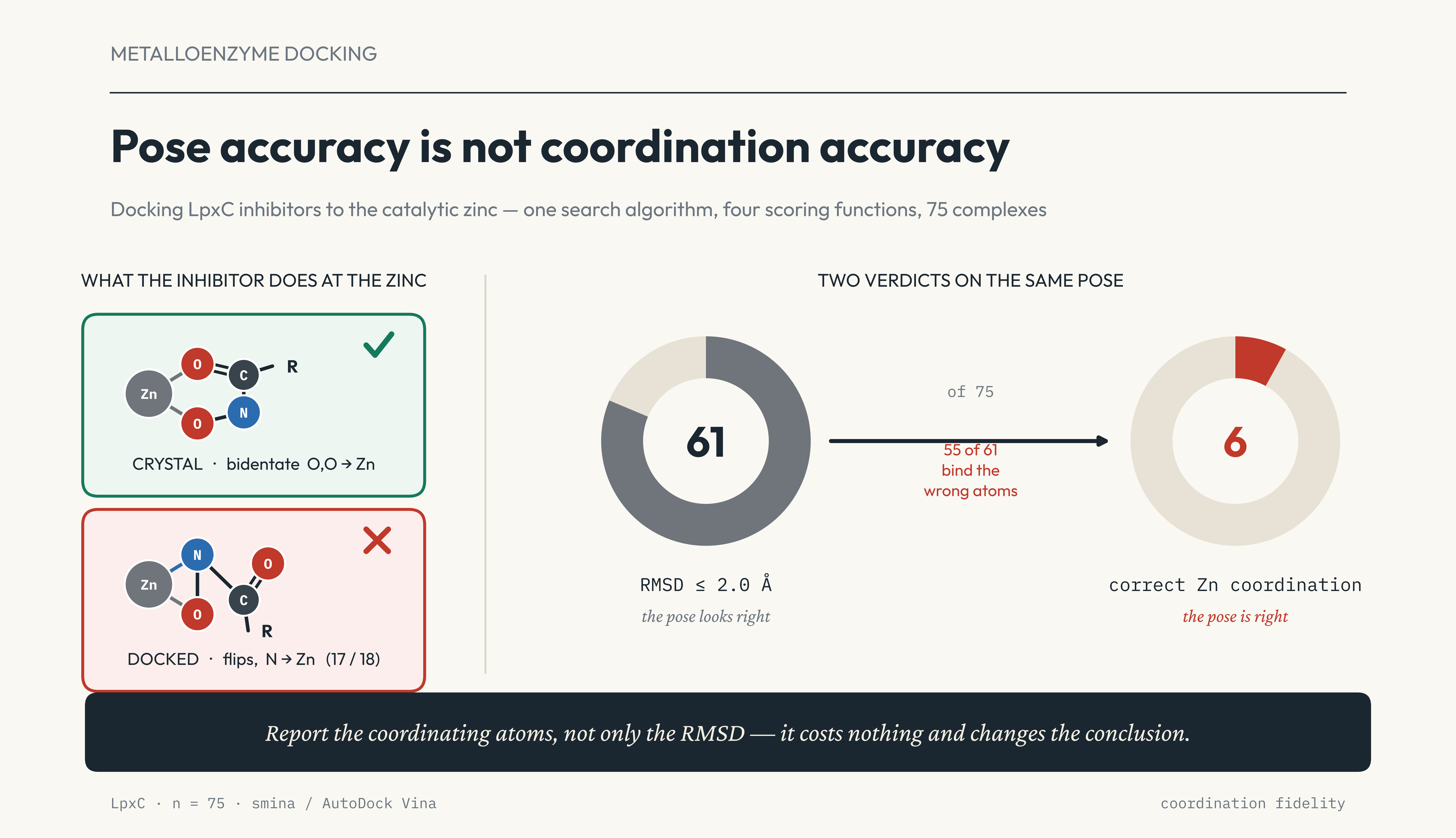
Docking accuracy for metalloenzymes is usually assessed by the percentage of ligands redocked within 2.0 Å of the crystal structure. Assessing docking accuracy for a zinc metalloenzyme may not be adequate. We redocked 75 LpxC-inhibitor complexes using one docking program and four scoring functions and assessed ligand conformations using three criteria: heavy-atom RMSD compared with the crystal structure, number of identical ligand donor atoms coordinated to catalytic zinc in the crystal structure, and total number of ligand donor atoms coordinated to catalytic zinc in the crystal structure. The three criteria are not highly correlated. Correlations are lowest for the scoring function with the highest percentage of ligands redocked within 2.0 Å of the crystal structure. AutoDock Vina redocked 61 of 75 LpxC-inhibitor complexes within 2.0 Å of the crystal structure, the highest percentage of any scoring function tested, and 6 of 75 LpxC-inhibitor complexes with the same zinc-binding donor atoms as in the crystal structure; 55 of 61 complexes redocked within 2.0 Å of the crystal structure had different donor atoms bound to catalytic zinc. A score function that depends only on the metal donor’s number, not its type, ranks poses with incorrect metal coordination highly. In the configuration without a metal-specific term, four fifths of the poses credited by the donor-count criterion place the wrong atoms on the zinc. All but one of 18 tested poses with incorrect metal coordination had an incorrect orientation of the hydroxamate head group, with the nitrogen directed toward zinc. The failure is one of ranking rather than sampling: increasing the search effort fourfold did not change the top-ranked pose, yet a correctly coordinated pose was already present in the ensemble for 69 of 75 complexes. In 428 registered cross-docking tests, the chemical identity of the metal-binding group affected docking success. The hydroxamate head group correctly modeled crystallographic coordination in 58.5% of cross-docking tests, and other head groups correctly modeled it in 12.9% or fewer of cross-docking tests. Simple, cost-free steps can be taken to include correct metal coordination in benchmarks for metalloprotein docking.
Keywords:
LpxC
; metalloenzyme docking
; zinc coordination
; scoring function
; cross-docking
; docking benchmark
; hydroxamate
1. Introduction
LpxC is the first committed and rate-limiting enzyme in lipid A biosynthesis. Its function is to remove acetyl groups from UDP-3-O-acyl-N-acetylglucosamine [1]. Lipid A is a structural component of the outer membrane of Gram-negative bacteria and essential for bacterial survival. LpxC is a conserved protein present in many Gram-negative pathogens but not in humans. These properties make LpxC an attractive drug target for treating Gram-negative infections [2].
Catalysis by LpxC involves a single zinc ion in a cleft on the LpxC active site surface, ligated by two histidine and one aspartate residues [2]. Kinetic and structural studies and mutagenesis experiments indicate that a water molecule ligated to zinc serves as the nucleophile in LpxC catalysis, and Glu78 and His265 serve general acid-base catalysis roles [3]. Effective LpxC inhibitors identified to date bind and replace the catalytic water molecule and bind directly to zinc. Hydroxamic acids are a common class of LpxC inhibitors. These compounds bind to zinc through a bidentate O,O interaction and have been developed for use as antibacterial agents [4,5].
ACHN-975, an LpxC inhibitor, reached phase 1 clinical trials. Development of ACHN-975 was halted because no follow-up compounds with a sufficient therapeutic window were developed [6]. Other limitations of hydroxamates include mutagenic potential, documented since the early 1980s, and rapid metabolic clearance [7]. To address these limitations, researchers developed other chelating agents. Researchers discovered that 2-hydroxymethyl imidazoles could serve as zinc-binding groups with a nitrogen atom and developed TP0586532 as a drug candidate [8,9,10]. A 2008 review of LpxC noted discrepancies in the number of ligands bound in the active site of LpxC in different crystal structures, four or five, and urged further research [11].
The metal-binding site is not a secondary feature of these complexes. It is the pharmacophore, and the donor atoms of the metal-binding site are a major target for optimization of this chemotype. A wrong in silico model of LpxC-inhibitor interactions that does not correctly model the metal-binding site is a wrong model of a major feature of LpxC-inhibitor interactions.
Docking is a standard method for this type of research and has been performed independently by multiple investigators on the same target. Hydroxamate compounds and other compounds are common targets for medication design using docking methods [4,5,12,13,14,15,16]. Discovery chemistry applications of docking include screening large libraries of compounds in the active site of an enzyme target: 74,500 compounds docked into a homology model of Acinetobacter baumannii LpxC [17], 59,000 indole derivatives docked into Salmonella LpxC [18], 505 plant alkaloids [19], and recently the docking poses of phenotypically active compounds [20]. Other applications that use docking results include building quantitative structure-activity models [21] and subtractive genomic methods to identify enzyme targets and other compounds that can be docked into an enzyme target [22].
In the cited literature, details of how the coordinating group interacts with the metal are given. Metal binding interactions are described in several literature sources, including a paper by Zuo et al. that describes zinc binding to amino acids His78, His237, and Asp241 and a water molecule, as well as water exchange in the active site [21]. Overall, metal binding is not an issue in the cited literature.
What was published is one statistic, the proportion of ligands redocked with an RMSD of 2.0 Å or less compared to the crystal structure. The limitations of this statistic are discussed. PoseBusters software was used to find issues with poses within the 2.0-Å RMSD limit and other chemical and physical issues and to develop eighteen chemical and physical pose-validation tests, including in and between molecule steric clashes [23]. Chemical and physical tests for inorganic cofactors do not test for coordination of metal ions. Two PoseBusters tests for inorganic cofactors test for distance and volume overlap between inorganic cofactors; these tests can find overlaps but not coordination of metal ions.
Methods papers on metalloproteins offer strategies to address these problems. AutoDock4Zn has a tetrahedral dummy atom that can be used to dock to zinc-binding sites with a zinc-specific energy function [24]. GM-DockZn docks ligands to a geometric grid in seven common zinc-binding modes observed in zinc proteins [25]. The GM-DockZn paper describes a strategy for assessing docking results similar to the one we used in our benchmark, one in which the coordination number and coordinating atoms are considered, not merely RMSD, when evaluating a docked conformation.
Two questions remain unanswered for the target. One is a technical question. A specialized metal-binding program can be used to predict binding of zinc. There is no information about the results of applying a common scoring function to an LpxC inhibitor. The other is a basic question. Measuring coordination by donor atom count can yield different results than measuring coordination by donor atom type. There is no information about differences in the ranking of methods as measured by donor atom count versus donor atom type.
We redocked 75 LpxC inhibitor complexes whose correct coordination was reported in a previous publication [26] with one docking program and four scoring functions. We measured redocking and coordination accuracy using two different criteria for coordination accuracy. We identified five causes of redocking inaccuracy: search, scoring, ionization state, program, and target selection. We tested additional features of the AutoDock4Zn protocol, including the use of a zinc potential, in a third redocking experiment that was conducted differently from the other two. All aggregate analyzes were replicated with a different random seed. We also conducted a pilot study of 428 prospective cross-docking experiments.
Four studies are described. Accuracy in reproducing binding pose does not correlate with zinc coordination accuracy, and the weakest correlation was observed for the free-energy function with the highest accuracy according to other measures: vina reproduced binding pose in 61 of 75 crystal structures within 2.0 Å and zinc coordination in six crystal structures but incorrectly reproduced zinc coordination in 55 of its 61 RMSD-passing poses. Revising the zinc coordination definition had a major impact on results for map-based docking methods, including crediting 22 complexes using a donor-count criterion in the plain AutoDock4 configuration, with incorrect zinc coordination in 18 of those 22 cases.
The issue is identification, not sampling. The top-docked pose was one of the poses in the ensemble for 69 of 75 complexes and the best-scoring pose for 41 of 75 complexes. Increasing computational resources for docking by a factor of 4 did not change the top-docked pose. For cross-docking experiments, metal-binding chemistry influenced the results. Hydroxamate compounds reproduced the crystallographic coordination in 58.5% of the time, while other chemical classes reproduced it less than 12.9% of the time. These results are significant because other chemical classes of interest are being pursued as alternatives to hydroxamates and have poor performance.
2. Results
2.1. Pose Accuracy and Coordination Fidelity do Not Agree
Redocking performance was measured in three ways: the fraction of redocked structures with top-ranked models that have a symmetry-corrected heavy-atom RMSD of less than or equal to 2.0 Å from the crystal structure; the fraction of redocked structures with top-ranked models that have the same number of 2.5 Å or closer ligand donor-catalytic zinc atom contacts as in the crystal structure; and the fraction of redocked structures with top-ranked models that bind the zinc atom with the same atoms, after accounting for permutations of ligand atoms that would not be considered errors because the donors are chemically identical.
The third of the three criteria is applied by GM-DockZn [25] and includes the number and type of donors. The second criterion is listed alongside the third because the difference between the two criteria is reported as one of the outcomes. There is a logical relationship between the second and third criteria: If the type of donors is right, then the number of donors must be right. Of the 75 complexes tested, no pose was identified in any test run that met the second donor criterion but not the third. Therefore, comparisons between the second and third criteria are actually comparisons of the number of incorrect poses that appear correct, and they are presented this way.

Table 1.
Top rank pose; 75 complexed proteins; all neutral ligands; one search algorithm used with four different scoring functions. Parentheses contain the 95% Wilson confidence limits. The last two columns indicate how many times there was disagreement between the RMSD criterion and the identity criterion for both directions.
Table 1.
Top rank pose; 75 complexed proteins; all neutral ligands; one search algorithm used with four different scoring functions. Parentheses contain the 95% Wilson confidence limits. The last two columns indicate how many times there was disagreement between the RMSD criterion and the identity criterion for both directions.
| Scoring Function | RMSD ≤ 2.0 Å | Donor count correct | Donor identify correct | RMSD passes,zinc wrong | Zinc right,RMSD fails |
|---|---|---|---|---|---|
| ad4_scoring | 35/75,46.7%(35.8-57.8) | 0/75,0%(0-4.9) | 0/75,0%(0-4.9) | 35/35 | 0/0 |
| dkoes_scoring | 45/75,60.0%(48.7-70.3) | 44/75,58.7%(47.4-69.1) | 41/75,54.7%(43.4-65.4) | 11/45 | 7/41 |
| vina | 61/75,81.3%(71.1-88.5) | 8/75,10.7%(5.5-19.7) | 6/75,8.0%(3.7-16.4) | 55/61 | 0/6 |
| vinardo | 56/75,74.7%(63.8-83.1) | 36/75,48.0%(37.1-59.1) | 30/75,40.0%(29.7-51.3) | 31/56 | 5/30 |
Because the four functions were applied to the same 75 complexes, paired tests were performed to compare them using McNemar’s exact test. Six p-values were adjusted for multiple comparisons using the Holm-Bonferroni procedure (Section 4.11).Four of six paired-test comparisons were significant after adjustment; two were not. The comparison of dkoes_scoring and vinardo (41 and 30 complexes solved, with 23 solved by dkoes_scoring alone and 12 solved by vinardo alone) was not significant before or after adjustment (p = 0.09). The comparison of ad4_scoring and vina was significant before but not after adjustment; the p-value for this comparison was greater than the adjusted significance level of 0.025 for the Holm procedure. No clear ordering could be determined for either pair of functions. vina had lower scores than those of both dkoes_scoring and vinardo (p ≤ 3 × 10⁻⁶ in both cases); the low score for ad4_scoring compared with the others was due to the 0 out of 75 complexes solved by ad4_scoring, with a Wilson confidence interval of [0, 4.9%].
Disagreement works both ways, though in fewer cases and not in more. Seven out of 41 targets dkoes_scoring predicts correctly using the identity criterion have worse-than-2.0-Å structures: 3U1Y, 3.97 Å; 6DUI, 3.35 Å; 7PZS, 2.81 Å; 7PKM, 2.69 Å; 4LCH, 2.34 Å; 5U39, 2.33 Å; 7DEL, 2.13 Å. Five out of 30 targets correctly predicted by vinardo have worse-than-2.0-Å structures: 2.65, 2.46, 2.36, 2.23, and 2.05 Å for 5U39, 5U86, 4OKG, 10RY, and 4U3D, respectively, binding predictions correctly predict coordination with a zinc ion but worse-than-2.0-Å-resolution structures, with two cases more than 1 Å worse. Neither criterion is a subset of the other, and correct zinc coordination does not predict overall accuracy or the reverse. No targets with this characteristic are predicted correctly by either vina or ad4_scoring, in part because these programs do not predict correct zinc coordination very often.
Table 2.
Complex credits assigned based on the count criterion that were denied by the identity criterion.
Table 2.
Complex credits assigned based on the count criterion that were denied by the identity criterion.
| run | Count criterion | Identify criterion | Wrongly credited | Share of apparent successes |
|---|---|---|---|---|
| Vina 1.2.7+ plain AD4 maps | 22/75 | 4/75 | 18 | 82% |
| Vina 1.2.7+AD4Zn maps | 30/75 | 14/75 | 16 | 53% |
| Vina 1.2.7 + AD4Zn maps,anionic | 21/75 | 15/75 | 6 | 29% |
| Smina vinardo | 36/75 | 30/75 | 6 | 17% |
| Smina vina | 8/75 | 6/75 | 2 | 25% |
| Smina dkoes_scoring | 44/5 | 41/75 | 3 | 7% |
| Smina ad4_scoring | 0/75 | 0/75 | 0 | - |
In smina runs, metal binding errors include two to six incorrect metal ligands per run. In other runs, metal binding errors are much more common, and four-fifths of apparent successes of plain AutoDock4 runs and one-half of apparent successes of AutoDock4Zn runs have incorrect metal ligands. General issues with the number criterion affect all map-based methods, as described in (Section 2.2).Specific issues with the number criterion, described in detail in (Section 2.2), also explain the reversal of trends in (Section 2.3) when more stringent criteria are applied.
The same ranking holds for all poses in the ensemble as for the best pose. The same poses are found in the ensemble for 69 of 75 complexes with the dkoes_scoring score (92.0%, 83.6-96.3), 43 of 75 complexes with the vinardo score (57.3%, 46.1-67.9), 12 of 75 complexes with the vina score (16.0%, 9.4-25.9), and 0 of 75 complexes with the ad4_scoring score (0%, 0-4.9).Figure 1 places the two criteria side by side for all four scoring functions.
2.2. The Failure has a Characteristic Shape: The Hydroxamate binds backwards
Poses that satisfy the number requirement but not the identity requirement are not random errors. Clustering the poses based on the identities of the matched atoms, OO for two oxygen atoms and NO for a nitrogen and an oxygen atom, reveals a regular pattern.
Table 3.
Poses with highest scores which have the right quantity of donor atoms on the zinc but the incorrect ones.
Table 3.
Poses with highest scores which have the right quantity of donor atoms on the zinc but the incorrect ones.
| run | Such poses | Crystal 00 → pose NO | OTHER |
|---|---|---|---|
| Vina 1.2.7+plain AD4 maps | 18 | 17 | 1(0 →0) |
| Vina 1.2.7+AD4Zn maps | 16 | 16 | 0 |
| Smina,exhaustiveness 16 | 11 | 7 | 2(NO →00),1(N →0),1(0 →0) |
| Smina,exhaustiveness64 | 8 | 5 | 1 each (N →O,NO →00,0 →0) |
A hydroxamate ligand coordinates a divalent metal ion through two oxygen atoms in a coplanar five-membered ring held at a fixed angle by a C-N-O linkage. In conformations with OO → NO rearrangements, one oxygen remains coordinated to the metal ion, with the nitrogen facing the metal ion. Both conformations have the same coordination numbers and may be considered successful based on coordination number.
Table 4.
Representative cases from the plain-AD4 run, all hydroxamates.
| structure | Crystallographic donors | Docked donors |
|---|---|---|
| 3P3E | O0,O3 | N25,O26 |
| 3P76 | O3,O5 | N29,O30 |
| 3PS1 | O9,O12 | N26,O27 |
| 3PS3 | O0,O3 | N26,O27 |
| 3U1Y | O23,O27 | N28,O29 |
| 4MQY | O0,O3 | N27,O28 |
| 5N8C | O16,O19 | N33,O34 |
| 5UPG | O22,O23 | N16,O17 |
In grid experiments, the same error occurs almost universally: 17 of 18 experiments without the zinc potential and all 16 experiments with it. In smina experiments, the same error is the most frequent error but not the only error; other errors involve models with nitrogen-chelating head groups docked through two oxygens. The zinc-specific potential does not prevent backward binding.** There are 17 backward complexes without the zinc-specific potential and 16 with it; the potential only increases the total number of fully correct complexes from 4 to 14 and the number of complexes that reach the correct donor count from 22 to 30. The zinc-specific potential changes some fully incorrect complexes into correct or backward complexes but does not reduce backward binding. This qualification is related to the documentation of the AutoDock4Zn protocol. It can help improve docking accuracy, as described in Section 2.3. It cannot fix structural problems that result in conformations similar to those described in this post.
2.3. Separating the Contribution of the Zinc-Specific Potential from the Contribution of the Program
The AutoDock4 energy function is applied in two ways in these experiments. There are two differences between the two applications of the AutoDock4 energy function. One recommended approach for applying the zinc pseudo-atom and other AutoDock4 pair terms is to use AutoGrid and AutoDock Vina with the zinc term in the AutoDock4Zn protocol; one recommended approach for applying the AutoDock4 energy function without the zinc term is to use smina, a program that implements the function internally and does not use grids. Results from the two recommended approaches cannot be compared to assess the effect of the zinc term due to other differences between the programs.
A third point removes the confound. Vina 1.2.7 was run against plain AutoDock4 maps generated by the same AutoGrid version from the same receptors—no zinc pseudo-atom, no `AD4Zn.dat` parameter file, no `nbp_r_eps` entries—with identical box, seed, exhaustiveness and pose count. The three points differ in one variable at a time:
| point | program | Zinc-specific potential |
| A | Smina (November 2017 build,Vina 1.1.2 lineage) | absent |
| B | Autodock Vina 1.2.7,plain AD4 maps | absent |
| C | Autodock Vina 1.2.7,AD4Zn maps | present |
The difference between B and A represents the treatment and implementation effects of the program; the difference between C and B represents the effect of zinc potential.
Table 5.
Top-ranked pose, 75 complexes.
| Point | RMSD ≤ 2.0 Å | Donor count | Donor identify | Correct pose anywhere in ensemble |
|---|---|---|---|---|
| A-smina ad4_scoring | 35/75 | 0/75 | 0/75 | 0/75 |
| B-Vina 1.2.7,plain AD4 | 51/75 | 22/75 | 4/75 | 11/75 |
| C-Vina 1.2.7,AD4Zn | 56/75 | 30/75 | 14/75 | 30/75 |
| C’-as C,anionic ligands | 37/75 | 21/75 | 15/75 | 33/75 |
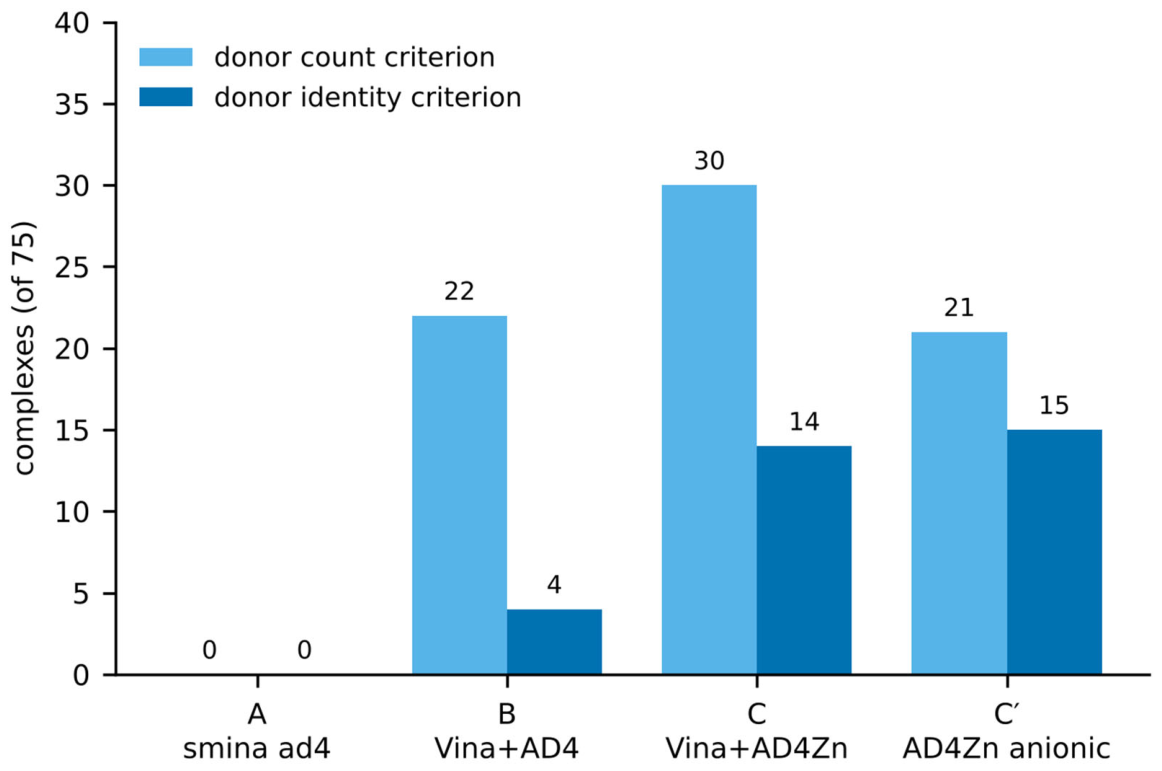
Under the identity criterion, 14 complexes show improvement from A to C, with 4 improvements (29%) due to the new scoring program and 10 improvements (71%) due to the new zinc score. For pose ensembles, 30 complexes show improvement from A to C, with 11 improvements (37%) due to the new scoring program and 19 improvements (63%) due to the new zinc score.
The same decomposition for the count test can be reversed. For the count test, 30 shared complexes improve by 30%, with 22 (73%) improvements due to the program and 8 (27%) improvements due to zinc refinement. A reversal of the count test is observed and explained. Of 22 complexes for which the run without a zinc-refined map correctly identified the number of donor atoms for the metal ion, the run without a zinc-refined map correctly identified the donor atoms in only 4 complexes. The other 18 complexes have the reversed hydroxamate errors described in (Section 2.2).Other complexes with incorrect coordination chemistry are rewarded in the count test by a model that does not include a zinc term. Both forms of decomposition are described in this source. The comparison is made to show the difference. An analysis approach that does not distinguish between individual donors will always provide an underestimate of what a metal-specific potential contributes; here, it is underestimated by a factor of approximately 2.5.
Point A is the AutoDock4 scoring function in smina. Point B is the AutoDock Vina 1.2.7 scoring function with AutoDock4 maps. Point C is AutoDock Vina 1.2.7 with AutoDock4Zn maps. Points A and B differ in one respect, and points B and C differ in another. With donor count as the measure, AutoDock Vina has higher predictive value than smina at point C. With donor type as the measure, having a zinc potential has higher predictive value than using AutoDock Vina at point C. The switch in predictive value gives the solution.
Figure 2.
The three-point decomposition under both coordination criteria. Point A is the AutoDock4 energy model as implemented in smina, point B is AutoDock Vina 1.2.7 against plain AutoDock4 maps, and point C is the same program against AutoDock4Zn maps; consecutive points differ in one variable. Under the donor count criterion the improvement from A to C is attributed mainly to the change of program, and under the donor identity criterion mainly to the zinc potential. The inversion is the result.
Figure 2.
The three-point decomposition under both coordination criteria. Point A is the AutoDock4 energy model as implemented in smina, point B is AutoDock Vina 1.2.7 against plain AutoDock4 maps, and point C is the same program against AutoDock4Zn maps; consecutive points differ in one variable. Under the donor count criterion the improvement from A to C is attributed mainly to the change of program, and under the donor identity criterion mainly to the zinc potential. The inversion is the result.
The benefit of adding a zinc potential is shown in another result that is not due to differences in ensemble size. There were 712 poses in the AD4Zn simulation and 1,143 poses in the original simulation, indicating smaller ensembles for the AD4Zn simulation. But 30 protein-ligand complexes had correct poses in the AD4Zn simulation, and 11 had correct poses in the original simulation. The zinc potential narrows the search towards the correct region. What zinc inhibition does not do is solve the issue discussed in (Section 2.2).The number of top-ranked returned items to original places does not differ greatly, 17 without zinc inhibition and 16 with zinc inhibition.
2.4. The AutoDock4 Scoring Fumction as Implemented in Smina Neither Generates Nor Recognises the Correct Coordination
Point A from the previous section is zero for all measures in this section. Consider splitting the result into two parts for different policy reasons, as the two parts are based on different evidence. It does not successfully predict zinc coordination Of 75 examples, none of the top-scoring or other structures proposed by ad4_scoring matched the zinc coordination seen in the crystal structure. Similar results were seen for both levels of exhaustiveness tested, 16 and 64, and for both neutral and hydroximate ligands. Raising the level of exhaustiveness fourfold resulted in predictions of nearly twice as many different binding modes per complex, from 5.8 to 10.3, with no matches to the zinc coordination of the crystal structure.
The dkoes_scoring pose ensembles contain correctly aligned poses for 72 of 75 complexes. Rescoring and reranking pose ensembles identified correctly aligned top-ranked poses for 52 of 75 complexes with dkoes_scoring and 48 of 75 complexes with vinardo, but only 6 of 75 complexes with ad4_scoring. Rescoring the vinardo ensembles identified correctly aligned top-ranked poses for 2 of 75 complexes.
The second example is better evidence against the energy function model than the first because it does not use a sample. The correct configuration is part of the file. The energy function assigns a lower energy to the correct configuration than to other incorrect configurations. Nothing that could explain the first result could explain the second result.
A note on the differences between rescoring and docking. This note is included directly here for full disclosure. Different rankings were observed for some of the same sets of complexes as those used in the original docking study: 52 of 39 complexes originally docked by dkoes_scoring and 33 of 31 complexes originally docked by vinardo could be redocked. Total affinities determined during docking include additional local optimization steps not included in the calculation performed by the --score_only command-line option of these programs. Affinities and scores for the same structure may not be the same. Rescoring results are compared to the diagonal of the affinity matrix rather than the original docking order to correct for this discrepancy. Potential absolute benefits of rescoring are not considered here. Other comparisons of interest, such as 6 versus 52 total complexes for a given ensemble and rescoring program, are not impacted.
2.5. Quadrupling the Search Effort Does not Improve the Top-Ranked Pose
Each complex was redocked a second time at exhaustiveness 64 with all other settings, including seed, box, and receptor and ligand structures, unchanged from the initial docking. The control experiment generated 40 poses per complex, twice as many as in the initial experiment. The num_modes setting affects the number of poses reported but not the number generated; analyzes reported here use the top 20 poses from both experiments.
Table 6.
Effect of search effort.
| Scoring function | Top pose,exh16→64 | Ensemble,exh 16→64 | Distinct modes per complex |
|---|---|---|---|
| ad4_scoring | 0/75 →0/75 | 0/75→0/75 | 5.8→10.3 |
| Dkoes_scoring | 41/75→39/75 | 69/75→72/75 | 19.9→20.0 |
| vina | 6/75→7/75 | 12/75→13/75 | 16.3→18.8 |
| vinardo | 30/75→31/75 | 43/75→53/75 | 12.1/16.2 |
The additional search doesn’t produce wasted effort; the four functions each show more variation in their mode distributions. A correctly coordinated pose appears in the ensemble for three of the functions in more complexes with additional search than without it, for a total of 14 complexes. The top pose is not always the best-ranked pose for those three functions. There is no change in the accuracy of the top pose across the four functions, and accuracy declines slightly for two of the functions. General guidelines to improve docking performance for this target and metric do not hold. Ensembles created using this method perform better. Assignments of relative scores do not propagate the improvement.
ad4_scoring is an outlier for both criteria. It is helpful to note the ad4_scoring outlier because it has nearly twice as many unique poses as other runs and none of the poses are correctly superimposed at either search depth.
2.6. Rescoring Does not Recover the Correct Pose
If the bottleneck is ranking rather than sampling, rescoring an existing ensemble with a different function and re-ranking it should move correct poses to the top. The ensembles from the exhaustiveness-64 run were rescored with each of the four functions using `smina --score_only`, which evaluates supplied coordinates without further docking.
Table 7.
The table below lists all of the complexes where the best-ranked pose (after rescoring) meets the identity condition. The bold entries represent the diagonal: each complex’s ensemble was rescored using the same function that created the ensemble.
Table 7.
The table below lists all of the complexes where the best-ranked pose (after rescoring) meets the identity condition. The bold entries represent the diagonal: each complex’s ensemble was rescored using the same function that created the ensemble.
| ensemble from | rescored by vina | by vinardo | by ad4_scoring | by dkoes_scoring |
| vinardo | 26 | 33 | 2 | 34 |
| dkoes_scoring | 30 | 48 | 6 | 52 |
No off-diagonal score is substantially higher than its associated diagonal score. Using vinardo to rescore ensembles generated by dkoes_scoring gives 48 correct and 52 incorrect predictions relative to dkoes_scoring, and using dkoes_scoring to rescore ensembles generated by vinardo gives 34 correct and 33 incorrect predictions relative to vinardo. The correct binding mode is present in the ensemble for most complexes, and none of the four scoring functions correctly predicts the binding mode for any complex.
The diagnosis in (Section 5.2) is flawed. It isn’t the use of a function for coordination that’s flawed, it’s the fact that none of the functions described here reliably coordinates behavior in every situation and fails to do so in others.A note about the absolute scores. Calculating new scores for complexes that were docked using the same function did not reproduce the docking order; 52 out of 39 complexes originally docked in order were recovered using dkoes_scoring. Calculated scores after docking include postdocking refinement, while scores calculated using --score_only do not, so the reported coordinates are in a different order for the same complexes. Comparisons made in this answer, shown on the diagonal, are not true scoring improvements. The fact that 52 complexes were recovered from an ensemble of structures using one function and 6 were recovered using a different function is not impacted by this note.
2.7. Correcting the Ligand Ionisation state Does not Rescue the Result
Hydroxamic acids form chelates with divalent metal ions via their negatively charged hydroxamate derivatives. Uncharged ligand analogs predicted by valence theory that would not chelate metal ions were prepared. Both charged and uncharged ligands were prepared. Fifty of the 75 compounds carried a chelating N-OH group that is lost upon chelation. Those compounds were prepared in their charged forms: 48 of 49 hydroxamate ligands and two N-hydroxyformamides. The other 25 compounds (including pyrrolidine amides, imidazoles, amino-amide fragments, and hydroxypyrimidinones) did not contain a chelating N-OH group and were used as prepared. Compound 8E4A, a hydroxamate, was not deprotonated in preparation and was tested in its uncharged form with other anionic ligands.
Table 8.
Identity criterion, top-ranked pose, by ligand ionisation state.
| Scoring function/run | neutral | Anionic |
|---|---|---|
| ad4_scoring | 0/75 | 0/75 |
| dkoes_scoring | 41/75 | 24/75 |
| vina | 6/75 | 5/75 |
| vinardo | 30/75 | 23/75 |
| Vina 1.2.7 + AD4Zn | 14/75 | 15/75 |
The answer depends on the program. On AD4Zn maps, the deprotonated compound has higher scores, 15 and 14, and similar results on the ensemble, 33 and 30. On smina, the neutral compound has higher scores under all scoring functions for which either compound had any correct poses.
Earlier studies of other metalloenzymes showed improved docking without protonation: Zhong et al. for matrix metalloproteinases [49]; Buccheri et al. for histone deacetylases [50]. The results of this study neither contradict nor generalize earlier studies. With the protein in this study, docking results with and without protonation were similar, and differences varied with the docking program used but not with chemical factors.
What the comparison suggests is that the errors noted in sections 2.1-2.4 are not caused by errors in protonation state. Neither protonation state results in any correctly predicted coordination of ad4_scoring.
2.8. The Outcome Depends on Which Structure of the Target is Used
Six ligands are common to multiple structures in the data set, appearing in 15 total structures: 3P3 appears in four structures, C90 appears in three structures, and 7PX, A5F, GVR, and ZH2 appear in two structures each. Sets of ligands that appear in multiple structures for a given protein can be used to assess consistency in docking outcomes using different protein structures.
Table 9.
Consistency across structures of the same ligand.
| Run/function | All fail | All succeed | mixed |
|---|---|---|---|
| Exh 16 dkoes_scoring | 0 | 3 | 3 |
| Exh 16 vinardo | 1 | 0 | 5 |
| Exh 64 dkoes_scoring | 0 | 2 | 4 |
| Exh 64 vinardo | 1 | 0 | 5 |
| Vina 1.2.7+ Ad4Zn | 3 | 0 | 3 |
vinardo and AD4Zn protocols fail to predict correct binding modes for all ligands in the set. dkoes_scoring predicts correct binding modes for all ligands in three of six classes; at an exhaustiveness of 64, it predicts correct binding modes for two of six classes. The range of dkoes_scoring scores reflects variation between random seeds, as described in (Section 2.10) AD4Zn protocol results were generated for a single random seed; AD4Zn protocol results should be interpreted accordingly. Constant scores for ad4_scoring and plain-map reflect failures to predict correct binding modes for all ligands in all classes.
Two qualifications. First, there are orthologs in all six groups, and other LpxC orthologs have sequence variations and other differences in the active site, so it was not surprising to find some differences. Second, there are only a few different groups.
One example in the input set has no restraints. PDBs 5U39 and 5VWM are Pseudomonas aeruginosa LpxC with C90, a ligand, at 1.75 and 1.80 Å resolution, with the same coordination around the metal as in the crystal structures, including two oxygens from the ligand that coordinate to the metal. Poses generated by vinardo for 5U39 and 5VWM include correct bidentate and monodentate binding to the metal, with distances of 2.17 and 2.33 Å between the ligand oxygens and the metal in 5U39 and 3.64 Å between the other oxygen and the metal in 5VWM. The metal-bound pose for 5U39 satisfies the coordination criterion but not the RMSD criterion, with a heavy-atom RMSD of 2.65 Å (Section 2.1); differences between the two poses arise from differences in binding to the metal of interest. Similar differences are observed for AD4Zn maps and vina at an exhaustiveness of 64; dkoes_scoring poses are correct for both targets. Differences are observed for both seeds, indicating that seed noise is not a factor.
There is a large difference, the 3.64 Å distance is well outside the range of typical coordination distances and has nothing to do with species, ligand, binding mode or resolution. The difference is caused by the method used.
(Section 2.9) examines the same question at larger scale by docking each inhibitor into the other receptors of its coordination-motif group.
2.9. Cross-Docking
Self-docking overlays the ligand with its own solved structure. This is not standard docking practice for chemical compounds, which are instead docked into other structures. Cross-docking more closely resembles real-world docking conditions, and the reference structure for ligands in cross-docking studies is the ligand’s structure in the crystal, that is, identity matches rather than RMSD. RMSD measures of cross-docked ligand structures are based on superposition and their errors, the average and maximum local Cα RMSDs among superpositions in this study are 0.39 and 1.14 Å, respectively. The coordination match is measured against the zinc in the target receptor structure and is not influenced by superposition.
The design was preplanned before analysis: Pairs of molecules with one member from each small group and a preplanned random sample of 300 pairs of P. aeruginosa molecules (seed 20261025), for a total of 428 pairs. Parameters for docking were identical to those used in the main analysis. Analysis of the 428 pairs included 75 targets and cluster bootstrapping of ligands.
Success rate decreases, and the cluster bootstrap test finds a difference between functions with decreasing success rates and one without. At top pose, using identity as a criterion, vinardo’s success rate decreases from 40.5% self-docking to 17.5%, a 23.0-percentage-point decrease, with a 95% confidence interval of [12.1, 34.2]. Dkoes_scoring’s success rate decreases from 55.4% to 42.1%, a 13.3-percentage-point decrease, with a non-zero confidence interval of [1.2, 25.3] that is close to zero; dkoes_scoring shows a statistically significant decrease but an imprecisely estimated size of decrease. Vina’s success rate decreases from 8.1% self-docking to 4.4%, a decrease with a confidence interval of [−2.4, 10.4] that includes zero; with six self-docking successes, no significant decrease in vina’s success rate is detected or reported. Ad4_scoring’s success rate is zero in both conditions; there is no decrease, and a confidence interval of [0, 0] gives no information. Self-docking performance metrics for analysis were reported for 74 ligands that are ligand donors in the cross-docking test set. These metrics are slightly different from those in Table 1 because the numerators are identical. Lower self-docking performance metrics are not artifacts of particularly difficult structures. Of the correctly self-docked donor-receptor pairs, a subset of the correctly self-docked pairs, dkoes_scoring correctly predicts the crystallographic coordination for 61.4% of 153 pairs, and vinardo correctly predicts coordination for 26.1% of 69 pairs. Overall failure rates for solvable ligand-receptor pairs are 38.6% for dkoes_scoring and 73.9% for vinardo.
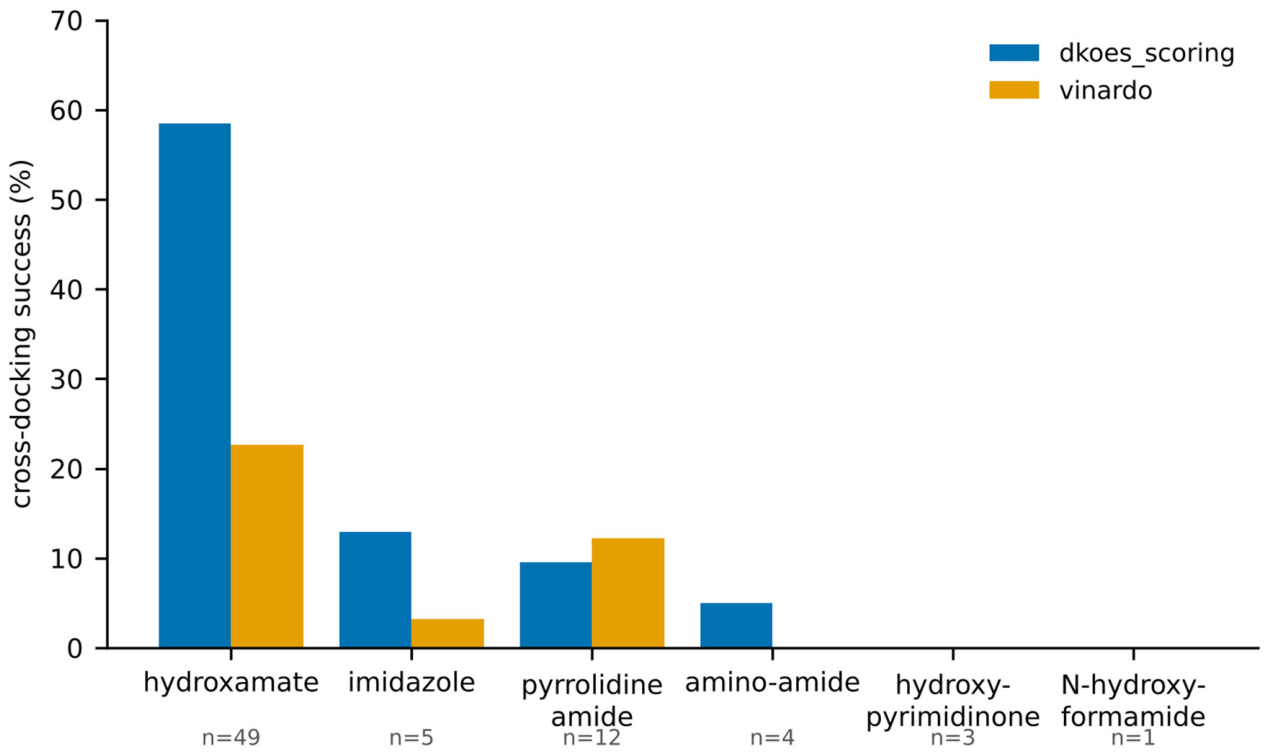
Factors that influence success include the type of metal-binding functional group in a ligand. Hydroxamate ligands have success rates of 58.5% among 287 ligand-metal ion pairs when scored with dkoes_scoring, compared to 12.9% for imidazoles, 9.5% for pyrrolidine amides, 5.0% for amino-amides, and 0% for three hydroxypyrimidinones and two N-hydroxyformamides. When scored with vinardo, success rates for hydroxamate ligands are much higher than those of other ligand types: 22.6% for hydroxamates, 12.2% for pyrrolidine amides, 3.2% for imidazoles, and 0% for other types. Success rates vary widely between species for nonhydroxamate ligands and are unlikely to be reliable for such a small number of compounds; both scoring methods show a general trend of greater success for hydroxamate ligands. Variations in success by species do not explain the different success rates, hydroxamate ligands have a success rate of 47.9% among 167 ligand-metal protein pairs from P. aeruginosa and other ligands have a success rate of 9.0% among 133 pairs from P. aeruginosa. The scoring methods were developed using compounds with hydroxamates bound to metal ions; other types of ligands are less likely to resemble their crystal structures [26].
Figure 3.
Cross-docking rates by metal-binding head group chemical class, among scoring functions that dock ligands to themselves. Error bars represent the percentage of 428 pre-registered pairs in which the highest-scoring docking pose agrees with the ligand’s coordination geometry in the crystal structure; error bars show 95% confidence intervals estimated using bootstrap resampling over individual ligands, not pairs. There are 49, 5, 12, 4, 3, and 1 ligand clusters in the classes shown; three and one ligand clusters contribute to the confidence intervals for the hydroxypyrimidinone and N-hydroxyformamide classes; these intervals carry no information.
Figure 3.
Cross-docking rates by metal-binding head group chemical class, among scoring functions that dock ligands to themselves. Error bars represent the percentage of 428 pre-registered pairs in which the highest-scoring docking pose agrees with the ligand’s coordination geometry in the crystal structure; error bars show 95% confidence intervals estimated using bootstrap resampling over individual ligands, not pairs. There are 49, 5, 12, 4, 3, and 1 ligand clusters in the classes shown; three and one ligand clusters contribute to the confidence intervals for the hydroxypyrimidinone and N-hydroxyformamide classes; these intervals carry no information.
On the receptor side, each receptor in a group was either successful or unsuccessful, not each group of receptors. Successes for individual receptors in all groups ranged from 0 to 100 percent, with a median per-receptor success rate of 85.7 percent in groups containing Aquifex aeolicus and Escherichia coli/Yersinia enterocolitica protein receptors and 50.0 percent among the 55 P. aeruginosa receptors. Eight receptors had zero successes in all four scoring functions. Three receptors (4IS9, 6I48, 8E4A) had zero successes with their own ligand and were poor structures; the other five (10RY, 7CI4, 7CI9, 7CIC, 7CIE) docked and had zero successes with vinardo both with their own ligand and with ligands from other receptors in the database, individual receptor failures described in Section 2.8, observed on a larger scale here.
Differences in motif classes are reported in terms of pair percentages but not otherwise analyzed. Possible reasons. Differences in chemotype between motif classes, all eight known A. aeolicus ligands are hydroxamates, while 33 of 58 P. aeruginosa ligands are hydroxamates. Restricting the analysis to hydroxamates raises the P. aeruginosa pair percentage from 30.7% to 47.9%, narrowing but not closing the gap. Perhaps the more important reason is that the pairs are not independent statistical observations, there are 56 A. aeolicus pairs among eight structures and 72 E. coli pairs among nine structures. Median and range of success rates per receptor are comparable for A. aeolicus and E. coli, with the ranges spanning almost the whole interval, suggesting that some of the differences among motif classes may actually reflect differences among structures.
One negative result is reported because the same result would have been classified as a mechanism if the test had not been conducted. Mean test results for pairs of hydroxamates show a positive association between binding site similarity and test results, the success rate among pairs with Cα-RMSD of 0.3 Å or less for binding sites is 68.8%, compared with 49.0% for more distant binding sites. Binding site similarity shows no or inverse association with success rate within motif groups, 78.6% versus 89.3% in A. aeolicus; 81.2% versus 46.9% in E. coli; and 45.9% versus 50.0% in P. aeruginosa. The overall positive association is probably a statistical artifact caused by differences among motif groups; most pairs with similar binding sites belong to the group with the highest success rate. Binding site similarity is not confirmed as a mechanism.
2.10. Seed Variability
The main tests were rerun with a new random seed but otherwise the same parameters. Qualitative results were about the same; the best scores for the identity scoring metric dkoes_scoring were 41 out of 75 for the first round and 42 out of 75 for the second round; best scores for vinardo were 30 and 28; best scores for vina were 6 and 8; and best scores for ad4_scoring were 0 in both rounds. Findings in this paper should be taken with a margin of error of about two structures.
Individual predictions contributing to collective outcomes are more affected by seed selection. Results under the dkoes_scoring package differ for 11 of 75 structures with two different seeds, one net difference between the two seeds. Results under the Vina and vinardo packages differ for four of the 75 structures. No differences were found for the 75 structures using the ad4_scoring package; see Section 2.4. The issue with the ad4_scoring package is not related to the seed, exhaustiveness, protonation state, or scoring configuration.
Statistics calculated using docking scores for individual structures may overestimate variability in docking outcomes. The number of repeated-ligand sets with all members correctly docked using dkoes_scoring increases from three to five between the two seeds, and the total number of structures in repeated-ligand sets differs by one between the two seeds. Outcomes from a single docking run may seem less variable than they actually are. Findings in the form “structure X is docked correctly by function Y” from a single docking run should be interpreted with caution. The vinardo score of zero repeated-ligand sets is the same for both seeds.
2.11. The Coordination–Ranking Gap Persists in a Zinc-Specific Docking Method
To test whether the separation between pose generation and pose ranking is peculiar to the AutoDock/Vina/smina family, the analysis was repeated with GM-DockZn [25], a geometry-matching program written specifically for zinc proteins that samples ligand poses directly around the ideal zinc-coordination positions and uses a docking engine independent of the one used above. GM-DockZn was applied to the same crystallographic complexes, with ligands parameterised under GAFF with AM1-BCC charges and the catalytic zinc retained in the receptor, and its poses were scored with the same donor-identity criterion used throughout (Section 4.8). Of the 75 inhibitors, 60 could be parameterised; the remaining 15 contain nitrile, alkyne, bromine or fused-heteroaromatic groups for which GM-DockZn’s bundled parameters are undefined (Table S5). The comparison is therefore reported on the 60 common complexes, and the per-function rates quoted here are recomputed on this same set.
Across the 60 complexes, GM-DockZn placed the correct coordinating atoms in 15% of its top-ranked poses (9/60) under the donor-identity criterion, while a correctly coordinated pose was present in its output ensemble for 80% (48/60). The gap between sampling and ranking that characterises the general-purpose scoring functions is therefore reproduced by a coordination-specialised engine: the correct geometry is generated but not ranked first. Coordination specialisation conferred no ranking advantage—GM-DockZn’s top-pose fidelity (15%) was below that of dkoes_scoring (58%) and vinardo (38%), comparable to vina (8%), with ad4_scoring at 0% on the same set (Figure 4; Table S4). A program built around zinc-coordination geometry therefore did not rank the correct coordination more reliably than a conventional scoring function. This reinforces that coordination fidelity is a ranking problem (Section 3.3) that is not resolved either by a general-purpose scorer or by a zinc-specific docking method, and that it must be assessed explicitly rather than inferred from pose-level RMSD or from the use of a zinc-aware tool.
3. Discussion
3.1. Heavy-Atom RMSD is not a Sufficient Criterion for Metalloprotein Docking
The four scoring functions can be ranked differently when using different criteria, and the rankings are significantly different. When we use RMSD ≤ 2.0 Å, vina produces 61 of the 75 crystallographic poses; this is the largest number among all the four scoring functions. Using the identity criterion, vina produces six crystallographic zinc coordination. Fifty-five of the 61 geometrically correct poses produced by vina coordinate the metal with the incorrect atom. If we were to use a benchmark that only reports RMSD, we would choose the scoring function that is least capable of describing the zinc-protein interactions for a zinc enzyme. And the literature reported on this particular target reports precisely that quantity.
The second coordination condition is not the same as the first one; however, its differences from the first coordination conditions are systematic rather than random. Since having equal sets implies having the same size, the identity criterion is a subset of the count criterion. Therefore, all disagreements will be in only one direction. This means that if a pose has the correct number of donor atoms and is accepted by the count criterion, but the donor atoms are not the right ones, then the bias toward accepting incorrect poses will be maximized at the point when the chemical correctness is at its lowest. When using plain AD4 maps in the Vina 1.2.7 run, 22 of 75 structures were accepted using the count criterion and 4 structures were accepted using the identity criterion. There was an eighteen structure difference between these two conditions, meaning that four fifths of the structures accepted by the count criterion were chemically incorrect. Using dkoes_scoring (the most accurate scoring function), the difference was three. As a result, when using the count criterion to evaluate poses, it creates a systematic bias as opposed to random errors. It will favor those poses that are chemically incorrect, and evaluations based upon it will favor those poses.
Nor does coordination fidelity represent a proxy for pose accuracy. The disparity also exists in the reverse direction; however, it is less common (though still significant) than what has been shown above: seven of the 41 complexes evaluated by dkoes_scoring using the identity criteria were found to be outside of 2.0 Å, two of those seven were outside of 3.0 Å, and five of the 30 evaluated by vinardo were also found to be outside of 2.0 Å. Neither metric encompasses the other; therefore, the correct conclusion is not that one metric can substitute for another but rather that any metalloprotein benchmark that reports only one metric is reporting an incorrect assessment. Both metrics should be included in the table along with the discordances associated with both directions.
3.2. The Failure is Chemically Specific, and a Zinc-Aware Potential Corrects it Only in Part
When both count and identity criteria are satisfied, structures are usually very similar. The hydroxamate moiety usually changes conformation to form a bond between the nitrogen and metal ion, rather than a hydroxamate oxygen atom, that is, 17 of 18 complexes in the nonmetal flat AD4 simulation and all 16 of 16 complexes in the AD4Zn simulation, versus 7 of 11 and 5 of 8 complexes in smina simulations. Mapping methods tend to generate one incorrect structure instead of multiple incorrect structures. This indicates issues with scoring functions, not sampling methods.
The chemistry of the situation accounts for the incorrect prediction. A hydroxamate ligand binds to a divalent metal ion through two oxygen atoms in a five-membered planar ring system. In the reverse hydroxamate conformation, binding to the metal ion is no longer twofold, and the nitrogen atom of the hydroxamate occupies a position similar to that of one of the original oxygen atoms but is a less effective zinc-binding group. Molecular modeling methods based on force fields that represent interactions between a charged metal ion and other atoms as attractive forces that depend on distance cannot distinguish easily between the two conformations. Differences between them are mainly due to variations in electronic structure.
Replacing standard AD4 electrostatics with AD4Zn, an approach that models electrostatics using a tetrahedral model at the zinc site, results in 14 rather than 4 of 75 structures meeting identity criteria. Assessment of benefits shows that 29%, or four structures, of the benefits of AD4Zn over smina ad4_scoring come from the scoring function and 71%, or 10 structures, from zinc-specific electrostatics. Most of the benefits of using AD4Zn come from zinc-specific electrostatics, and comparisons with smina ad4_scoring are valid. Assessments based on counting criteria suggest the opposite, with 73% of the benefits of AD4Zn over smina ad4_scoring coming from the engine because 17 of the 18 structures meeting counting criteria only with standard AD4 maps are inverted hydroxamates. Evaluations using a counting method might underestimate the benefits of zinc-specific electrostatics for this target by a factor of about 2.5.
The degree of improvement provided by the AD4Zn correction is known. The AD4Zn correction fails to fix the hydroxamate inversion error in 16 of the 75 test structures and moves additional structures to the correct or fully corrected geometry (Section 2.2). Geometry-related factors that affect preferential coordination of oxygen and nitrogen donor atoms cannot explain the remaining hydroxamate inversion error, which occurs in the same structures in which preferential coordination of oxygen and nitrogen donor atoms is important.
3.3. The Bottleneck is Pose Ranking, not Pose Generation
Three lines of evidence point to scoring issues, not poor sampling, as the root causes of problems. Increasing exhaustiveness from 16 to 64, a fourfold increase in compute resources, results in at most a single docked structure difference in the top-scoring pose for any function (in score terms, ad4_scoring 0 → 0, dkoes_scoring 41 → 39, vina 6 → 7, vinardo 30 → 31) and an additional 14 docked structures with at least one correctly predicted docked pose. More docked structures with correct predictions are sampled but less frequently selected. Increasing exhaustiveness is unlikely to help address problems like those noted here.
The best example is ad4_scoring, which yields no well-coordinated structure, either for individual structures or ensembles, in any protonation state and at any parameter setting, for 75 complexes (Section 2.4). By giving structures, you prevent lack of a well-coordinated structure from being due to insufficient sampling. At least 72 of 75 dkoes_scoring ensembles include a well-coordinated structure, ranked highest by ad4_scoring for six complexes. At least two of 75 vinardo_scoring ensembles include a well-coordinated structure, ranked highest by ad4_scoring for two complexes. The well-coordinated structure is present in the input file and incorrectly rejected by ad4_scoring. This reveals information about the energy function, not sampling.
Rescoring does not recover the loss. Neither scorer can be proven to have better or worse poses on the diagonal than the other, vinardo reached 48 against the dkoes_scoring diagonal of 52, and dkoes_scoring reached 34 against the vinardo diagonal of 33. Poorly ranked poses of one scorer cannot be improved using the other scorer. Another key finding from this test that should be reported separately is that the diagonal does not have the same pose rankings as the original docking run, dkoes_scoring gave 52 structures on rescoring against 39 at docking. The same program and coordinates produced different pose rankings with and without local minimization, as performed by the docking program and the --score_only option. Pose rankings are sensitive in these programs more than they are in other comparisons reported here. Other studies relying on docking pose rankings as related to scoring function properties may have design flaws.
3.4. Cross-Docking and Seed Replication Change What a Benchmark Number Means
Self-docking places the ligand back in the original structure. Self-docking is not a feature of docking software. The Vinardo success rate falls from 40.5% to 17.5% in cross-docking, a decrease of 23.0 percentage points with a 95% bootstrap confidence interval of [12.1, 34.2]. The dkoes_scoring success rate falls from 55.4% to 42.1% in cross-docking, a decrease of 13.3 percentage points with a bootstrap confidence interval of [1.2, 25.3] that just misses zero. We can conclude that the success rate has fallen but cannot say by how much. The confidence interval for Vina includes zero, and we make no claim about a decrease in success rate. A self-docking success rate of six means we can make no claim about the success of vina in self-docking. The Ad4_scoring success rate is zero in both self-docking and cross-docking, so there is no decrease to measure. Inferences about the data show that, for the two methods with some success in self-docking, most or all of that success is lost in cross-docking.
The failed cases in the fall dataset are not caused by difficult molecules. For 153 ligand-receptor pairs with known structures for both molecules, the success rates with the dkoes_scoring and vinardo methods are 61.4% and 26.1%, respectively, for 69 pairs. The actual failure rates for ligands and receptors with known structures are 38.6% and 73.9%, respectively, and these are additional real-world failure rates that cannot be evaluated using redocking tests.
The factor influencing outcomes on the ligand side is the head group that binds metals. According to the dkoes_scoring function, hydroxamates were successful in 58.5% of 287 pairs, while other groups tested included imidazoles (12.9% successful), pyrrolidine amides (9.5% successful), amino-amide fragments (5.0% successful), and hydroxypyrimidinones and N-hydroxyformamides (0% successful). Other functions tested, including vinardo, show similar patterns, with 22.6% success for hydroxamates and 12.2% or less success for other groups, though the rankings of other groups vary. For P. aeruginosa, hydroxamate pairs were successful in 47.9% of 167 pairs tested, while non-hydroxamate pairs were successful in 9.0% of 133 pairs tested, showing that species differences do not explain the patterns seen. These functions were parameterised on chemical space in which hydroxamate-zinc interactions are common, and the classes that fail have coordination geometries that depart from them. Applications of these results to high-throughput screening include the finding that compounds of high interest to metalloenzyme drug discovery programs, those outside the crowded hydroxamate chemotype, are poorly characterized by these functions.
For receptors, it is important to consider individual receptors, not families. Docking success rates for individual receptors within a receptor family vary from 0% to 100%. Five receptors that can be docked to themselves in a self-docking experiment cannot be docked to any receptor in a cross-docking experiment. Choice of a crystal structure for docking is an experimental consideration, not a variable, and virtual screening of other receptors using a randomly chosen crystal structure as a target will reproduce the observed effects without reporting them.
Seed replicates yield information not available from other approaches involving single runs on different structures. Average scores across seed replicates show very little difference among methods cited in this work: dkoes_scoring scored 41 and 42 out of 75 for two seeds, vinardo scored 30 and 28 out of 75 for the two seeds, and vina scored 6 and 8 out of 75 for the two seeds. Scores for single runs on different structures show large variation: dkoes_scoring produced conflicting docking results for 11 out of 75 structures and an overall score difference of 1 for the two seeds. Scores calculated from single-run docking results for individual structures increase, rather than decrease, apparent variation and the number of correct results for repeated ligand groups from 3 to 5 for dkoes_scoring. Statements like “structure X is docked correctly by function Y” based on single-run docking results for a single structure should be taken with caution, and other measures based on single runs of an algorithm should be taken with even greater caution. AD4Zn was run with a single seed. Measures reported in (Section 2.8) and (Section 2.10) using this protocol do not have an estimate of variation and should be interpreted accordingly.
One negative control should be added to the table because it would have appeared as a mechanism elsewhere. Binding site similarity for hydroxamate pairs is generally correlated with success, 68.8% of pairs with a backbone RMSD of 0.3 Å or less are successful, while 49.0% of pairs with a greater RMSD are successful. Binding site similarity is not correlated with success for specific motifs and is negatively correlated with success for one motif pair, 78.6% and 89.3% success, respectively, for A. aeolicus; 81.2% and 46.9% for E. coli; and 45.9% and 50.0% for P. aeruginosa. The overall correlation is false and driven by differences between motif groups, most low-RMSD pairs belong to the most successful motif group. Binding site similarity is not established as an explanation, and differences in success between motif groups are not explained.
3.5. Limitations
The set is a family of enzymes, and the sizes discussed in this paper are specific to LpxC and LpxC inhibitors. Other method development considerations and recommendations, such as reporting both coordination identity and RMSD results and addressing the issue of ranking, and noting that benchmarking between cross-docking and seed replication may not be directly comparable, likely apply to other 2-His-1-carboxylate zinc-binding sites but have not been studied and should be reported as hypotheses.
Receptors were assumed to be static, avoiding induced conformational changes in the receptors used in cross-docking experiments and making the failures reported there an upper bound in that respect. Binding data for compounds were not available, preventing any conclusions from these experiments other than comparisons of structure and chemistry between the compounds and preventing comparisons of potency between compounds.
Three limitations are related to computational methods. The smina software is derived from AutoDock Vina 1.1.2. The parameter specifications in Section 2.3 were added to differentiate smina from software lacking zinc parameter specifications but do not bring smina up to date. No more than one random seed was tested for AD4Zn. Other protocols were not run with a third random seed. Standard deviations and other statistical measures were calculated using only two random seeds. A cross-docking experiment tested 300 out of 3306 possible ligand combinations in the largest motif group. The experimental design for the cross-docking experiment was in place before testing; however, it remains a sample, and the tested ligand combinations are not independent measures. Statistical techniques used in analysis of cross-docking experiments include cluster-based bootstrapping across ligands.
The major sources of error are physical, not related to force field artifacts. All four properties in this study are classical and unpolarizable and do not include electron donation or changes in ligand basicity on coordination. One of the properties needed to differentiate ligands according to the identity criterion, zinc binding by two similar ligands, includes electronic effects that cannot be modeled from scratch in a classical force field. Electronic corrections to the metal, as in AD4Zn, can help predict zinc binding without modeling electronic effects in ligand binding, consistent with the results in (Section 2.2) on remaining errors and limitations for this approach. More substantial gains in predicting zinc complex properties will likely come from polarizable or quantum mechanical modeling of the first coordination sphere around zinc; this study’s results suggest that ranking will benefit most from such modeling. Predicted poses for zinc complexes are typically accurate.
4. Materials and Methods
4.1. Structure Set and Reference Geometry
The 75 LpxC-inhibitor complexes reported in this paper are the same as those reported in another paper [26]. Information in this paper is consistent with information in the other paper. The other paper searched the Protein Data Bank [27,28] three ways using the search tool on the RCSB Protein Data Bank website [29] for full-text matches to the term “LpxC,” matches to Enzyme Commission number 3.5.1.108, and matches to the macromolecule name “acetylglucosamine deacetylase.” A total of 112, 102, and 112 hits was found in the three searches in the other paper, and 102 identical hits were found in all three searches in the other paper. The 10 additional full-text matches included myosin, tyrosyl-tRNA synthetase, frataxin, and other proteins that cite LpxC in the reference list but are not LpxC. The 10 additional macromolecule name matches included 10 peptidoglycan N-acetylglucosamine deacetylases, a different protein. All 20 of these additional hits were excluded because they were not LpxC. There were no false hits to the EC number. Three search methods were used in the other paper to avoid missing LpxC and to verify that the same LpxC hits were found with all three methods.
Four criteria were used to select structures. Experimentally determined structures by X-ray crystallography at a resolution better than 2.5 Å were selected. Zinc-containing structures were selected. Structures were required to contain a nonpolymeric ligand with at least ten heavy atoms in contact with a zinc ion. Apo forms were excluded. The third criterion was evaluated using structural data, rather than component names, because the Chemical Component Dictionary [30] contains information about ligand chemistry but not about the spatial relationship between ligands and metal ions, and because three definitions in this set are themselves in error (Section 4.2). Heavy-atom counts and distances between ligands and zinc ions were calculated for each potential structure. No structures closely met the contact criterion; the final set is robust to variations in the contact distance cutoff, the distance between ligands and zinc ions in the final set ranged from 1.87 to 2.39 Å, while the closest large ligand in unselected structures had a distance of 6.08 Å from the nearest zinc ion, or a difference of 3.7 Å between groups. Heavy-atom requirements and resolution cutoffs are common for docking benchmark curation [31].
Of 102 potential records, 75 were eligible under all four criteria. The reasons other records were excluded are listed in Table 10. The entry-level inventory of the 75 included complexes is presented in Supplementary Table S1; the grounds for the 27 exclusions are summarised in Table 10.
Three of the exclusions need some explanation. The deposited structures for 6MO4, 6MO5 and 6MOD contain a magnesium ion at the active site instead of a zinc ion, even though the enzyme is a zinc-dependent deacetylase and was reported to be one [32]. These three structures meet all other requirements; however, the presence of magnesium is likely due to the crystallization conditions used to grow the crystals and does not indicate the state of the enzyme in its resting form. They were therefore excluded, as the objective of this work was to evaluate how well a docking program can reproduce the correct zinc coordination environment, and a magnesium-binding site does not provide this. Resolution values for the remaining 75 structures ranged from 1.21 to 2.49 Å (mean = 1.89 Å). This study ended on October 25th, 2026, after the most recent addition to the data set (10RY) had been made available on August 19th, 2026.
The reference geometry (against which all docking poses are evaluated) for each of the complexes—i.e., which ligand atoms coordinate with the catalytic zinc in each complex and at what distance—was obtained from the companion paper [26]. In that paper, the coordination sphere was determined using the coordinates deposited in the PDB, within a 2.8 Å search radius. Donors within 2.5 Å of the metal defined the reference coordination set used in this study.
4.2. Receptor and Ligand Preparation
Coordinate files were obtained in mmCIF format and parsed using gemmi 0.7.5 [33]. All hydrogen atoms were removed; the identification of which chains were polymers, which residues were ligands, and which residues were solvents, were identified based on the information provided in the coordinate files themselves, as opposed to using the deposited annotations. A single script was used to divide each file into three separate output files: a PDB file containing the receptor, an SDF file containing the ligand, and a JSON file containing the docking box. Scripts are available as part of the data package (see Section 4.12).
The Chemical Component Dictionary (CCD) [30] contains three components that contain the wrong metal-binding group: ZH4 in 3PS2, L53 in 3PS3, and 2CW in 4MQY are described as acyl nitroso instead of hydroxamate. This was brought to the attention of the wwPDB via pdb-deposit-help #896256 on October 23, 2026. The bond orders from the CCD dictate how hybridization, protonation states, and formal charges are determined when preparing ligands for docking. Therefore, the three complexes were prepared with the corrected CCD descriptions. If the original CCD descriptions had been utilized, then the three ligands would have been docked as neutral acyl nitroso compounds, which cannot form the bidentate chelates seen in the crystal structures.
The receptors were prepared by converting them into PDBQT format using the program prepare_receptor from the ADFRsuite [34]. Partial charges for each of the atoms in each receptor were calculated using the Gasteiger method. Each prepared receptor file was verified for two criteria: (1) whether all of the partial charges for the receptor were zero; and (2) whether the zinc ion was still included in the receptor file after preparation. Both criteria were met for all 75 of the files. This type of verification is atypical, but it was used here because we experienced an earlier preparation with another program where all of the partial charges were zero in all of the prepared receptor files. When this occurs, the electrostatic term of the AutoGrid map is disabled, but there is no indication that anything is wrong (i.e., no error message) and any run based upon these files will be invalid, yet there are no outward indications that the run is invalid. This check is very inexpensive to perform and the problem it identifies is very subtle, thus making it worth performing.
Ligands were converted to PDBQT using Meeko [35]. Each ligand was prepared in two ionisation states: the neutral form generated using standard valence rules; and a form where the metal-binding group carries a negative charge because hydroxamic acids chelate divalent metals as deprotonated hydroximate. Of the 75 ligands, 50 were deprotonated and 25 were not. The deprotonated subset is composed of the ligands whose metal-binding group has an N-OH proton: 48 of the 49 hydroxamates and both N-hydroxyformamides. The head-group classification of the companion study [26] classified 49 structures as hydroxamates and two as N-hydroxyformamides, thus the two counts are based on chemistry rather than class label, which is the consistency check needed. A single hydroxamate, 8E4A, was not deprotonated by the preparation script and therefore entered the anionic run unchanged. The location of the charge was verified rather than assumed: in each of the 50 deprotonated ligands the negative formal charge sits on an oxygen bonded to nitrogen, which is the hydroxamate or N-hydroxyformamide N-O- and not a hydroxyl located elsewhere in the molecule. Ligand UFX in 8E4A contained an aliphatic hydroxyl in addition to its hydroxamate, and the preparation left the molecule neutral rather than selecting between the two potential charge sites.
4.3. Alternate Conformations and the Reference Pose
The model deposited had different possible configurations. Before writing out the receptor and ligand files, we selected only one of those configurations. We used the same rule that we did in our other research [26]. That was to select the configuration with the most likely configuration (occupancy), and if there were multiple configurations that had equal likelihoods then we would use the average B factor to determine which configuration to keep. Our selection method was not purely aesthetic. If we had allowed prepare_receptor to use its default method of selecting the configuration that appears first in the file, we would have created a structure that differs from the one measured in the companion study. If so, then both articles would be discussing different sets of coordinates.
For the 75 proteins evaluated, the two algorithms chosen identify alternative conformations for 218 amino-acid residues in 44 proteins; none of the remaining 31 proteins were affected by the selection algorithm. None of the different amino-acid residues identified by either algorithm lie within the primary coordination sphere of the zinc atom, nor do they fall within 4.9 Å of the zinc atom. The closest different residue identified by either algorithm is Ser63 of 8E4A which is located 4.96 Å away from the zinc atom. The average (median) distance between a different residue identified by either algorithm and the zinc atom is 15.6 Å. Therefore, the choice of algorithm will not alter any protein-related properties reported in this study. This measurement was performed so that we can support our assertion that the choice of algorithm has no effect on any property related to the protein reported in this study.
The inhibitor in 5UPG was modeled in two conformations (80% and 20% occupancy) with a total RMSD of 1.28 Å. This RMSD was primarily found in the fluorophenyl ring which is about 10-12 Å away from the metal ion. There were very small differences in the head groups of the two models, with RMSDs ranging from 0.09-0.19 Å. Since redocking studies are evaluated based on a cutoff value of 2.0 Å, and the two potential reference conformations had an RMSD difference of 1.28 Å, it is possible for a docked pose to meet the criterion for evaluation as “success” against one reference model but not meet the criteria for evaluation as “success” against the other. For example, if a docked pose is 1.5 Å from the model with 80% occupancy, then it will be 2.3 Å from the model with 20% occupancy. Therefore, if we evaluate whether or not a docked pose meets the criteria for evaluation as “success,” our conclusion will depend on which model the preparation software selects as the reference model. To eliminate this ambiguity and ensure consistency across both of our redocking experiments, the preparation script copied the coordinates, occupancies and B-factors of the model with the largest occupancy onto the model with the smallest occupancy, and deleted the alternative models. Therefore, there were no longer alternative models available for the preparation software to select as reference models, and we evaluated both of our redocking experiments against the same reference model. The operation relabeled altlocs and did not affect any atomic position.
4.4. Primary Docking Protocol
The initial implementation of the study utilized smina [36], an extension of AutoDock Vina 1.1.2 [37], which maintains Vina’s search algorithm but allows the user to select their own scoring function separate from the algorithm. This distinction is what led us to use smina; if we had evaluated four different software packages, each would have its own search algorithm, file handling methods, and box definition. By evaluating four different scoring functions using the same sampling method (smina), we are able to examine how the different scoring functions affect performance. We evaluated the following four scoring functions: vina [37], vinardo [38], ad4_scoring (AutoDock4 semi-empirical free energy force field [39,40], no grid maps) and dkoes_scoring [36].Each of the complexes was docked using the Exhaustiveness parameter of 16, resulting in 20 poses being retained. The search space used during docking was defined based upon the preparation data for each specific structure. This research utilized a Random Seed value of 20261008 and requested 40 CPUs per run. All runs carried out in this study have been listed in Table 11.
4.5. Search-Effort Control
In addition to being re-docked at an exhaustive level of 64 using the same parameters, the control runs had 40 poses per complex compared to 20 for the original runs. Therefore, the results obtained from these two sets of runs are not directly comparable; a larger number of poses (i.e., 40) provides more chances to identify a valid pose than does a smaller number of poses (i.e., 20). As a result, any observed difference in performance may be due to the size of the pose ensemble rather than to the amount of search effort. Since num_modes only removes poses after they have been found and does not change the search process itself, keeping the first 20 poses of the 40 is equivalent to asking for only 20 from the beginning. Therefore, all comparisons made between the two search options will be based on the first 20 poses of each, and the results presented in Section 2.5 were calculated based on those results.
4.6. Grid-Based Protocols and the Separation of Engine from Zinc Potential
The AutoDock4 energy model was achieved through two different methods in this paper, and these methods differed from each other in two ways at the same time. One method, the AutoDock4Zn protocol [24], was used to generate AutoGrid maps containing a zinc pseudo-atom with its related pair potentials, and then dock using those maps with AutoDock Vina 1.2.7 [35]. The other method, the AutoDock4 energy model without a metal-specific term, was used through smina. Smina implements the same function internally and does not read any maps. Comparing only these two methods would cause the effects of the zinc potential to be confused with the differences between the programs.
The last point eliminates the confounding factor. We ran AutoDock Vina 1.2.7 against standard AutoDock4 map(s)—created with the same AutoGrid version and receptor(s)—but without a zinc pseudo-atom, no AD4Zn.dat parameter file, and no nbp_r_eps values—in the same manner as we did the AD4Zn runs. Therefore, the three data points listed in Table 11 differ by exactly one variable per comparison: the difference between B and A indicates which program was used and how it implemented the energy function, whereas the difference between C and B represents the addition of the zinc potential. Since both coordination criteria result in conflicting results and represent findings in their own right, we report the decompositions based upon each criterion in Section 2.3.
AutoGrid version 4.2.7 was used to create the grid maps. Each time the job script was run, it checked to make sure that the version being used was AutoGrid version 4.2.7. If the version was anything other than AutoGrid version 4.2.7, the job would abort. This verification process was implemented because a previous series of runs using AutoGrid version 4.2.6 were reported as being completed using AutoGrid version 4.2.7. There is no way for us to know if there was a version mismatch during those runs as there is no record of what version was used in the output files.
The AutoDock4Zn protocol requires a grid parameter file with 6 nbp_r_eps lines that create the pseudo-atom potential of the zinc. Since the generator provided with the AutoDock4Zn protocol uses MolKit and AutoDockTools (neither were present in our computing environment), we created a generator that generates the exact same six lines from the original grid parameter file. We also created a generator that will produce the plain-AutoDock4 file needed for Point B. All of these generators are included in the data package so that the generated parameter files can be reproduced and compared to the originals.
4.7. Rescoring
To separate the creation of a correct pose from the evaluation of those poses, the pose ensembles created from the exhaustiveness-64 run were re-evaluated with each of the four scoring functions using smina --score_only (which evaluates given coordinates without additional searching or localized optimization), and the ensembles were then re-ranked based upon the new scores. A 4x4 matrix representing the results is shown in Section 2.6; the diagonal elements of this matrix represent ensembles re-ranked with the same scoring function that was used to generate them.
One attribute of the method must be documented since this will restrict the applications of the rescoring results. Rescoring an ensemble with its original generating function will not result in a ranking similar to that achieved when performing docking: the affinity value reported from a docking run is generated after each pose undergoes a local refinement; however, the --score_only command generates a score based on the coordinates as provided. Therefore, the same function will order the same coordinates in different ways when using the two different methods. For these reasons, all comparisons in Section 2.6 are based upon the diagonal of the matrix and not upon the original docking rank, and there are no claims being made regarding the overall value of rescoring.
4.8. Evaluation Criteria
One continuous quantity and two binary criteria were computed for every pose.
Pose RMSD. The heavy atoms of each docked structure were superimposed upon those of each crystallographic structure and the RMSD (root-mean-square-deviation) of each superimposition was calculated. The RMSD calculation takes into account intramolecular symmetry: Since atoms that are chemically identical can potentially switch positions, the RMSD calculation minimized the RMSD value across all automorphism of each chemical compound. This ensures that a rotation of a phenyl ring is not viewed as a displacement. RDKit [41] was used to perform the RMSD calculations. Each docked structure was considered correct if it had an RMSD value less than or equal to 2.0 Å, which is the standard threshold for correctness in the field of molecular docking [31].
The count criterion involves comparing the number of ligand donor atoms placed by a pose within 2.5 Å from the catalytic zinc to the corresponding number of ligand donor atoms in the crystal structure. Both numbers use the same definition (ligand nitrogen, oxygen and sulfur atoms within 2.5 Å from the metal). A pose meets this requirement if these two counts are the same.
The identification of criteria. In addition to being applied to every position and every crystal structure reference, the total number of ligand N, O, and S atoms located within 2.5 Å of the zinc were extracted. A given position met the criterion if, using an atom-to-atom correspondence between the position-derived ligand molecule and the crystal-structure-derived ligand molecule, the sets of ligand N, O, and S atoms in each set of ligand molecules were identical. No pre-defined mapping existed; rather, any chemically equivalent donor (e.g., both oxygen atoms of a carboxylate group) could potentially be substituted for one another. Therefore, all possible admissible correspondences (mappings) were identified using the RDKit function GetSubstructMatches with the option uniquify=False, and a position was accepted as long as at least one of those correspondences generated identical sets of ligand N, O, and S atoms in both sets of ligand molecules. GM-DockZn [25] used this definition of the primary criterion for its study and, as we discuss below, this primary criterion is the one that addresses the central question of this study: does the model produce the same chemical interaction with the metal?
Logic tells us that the two coordination criteria are hierarchically related; i.e., set equality implies set cardinality equality. Therefore, all poses that meet the identity criterion will meet the count criterion. However, we checked our empirical results to protect ourselves from implementation errors, and none of the poses in the 75 complexes, regardless of protocol, met the identity criterion but failed to meet the count criterion. Since the disagreement between the two criteria is unidirectional, we should report it as a count rather than a paired statistical test. A paired statistical test would assume that disagreements could occur in both directions. Instead, we report the difference as a count: the number of complexes accepted by the count criterion and rejected by the identity criterion. In other words, we count how many models were given credit for positioning the correct number of donor atoms but were rejected because they bound through incorrect atoms.
As an alternative to computing the two measures per complex, they were computed per complex instead of per pose. The pose ensemble measure is based upon applying the identity criterion to all of the 20 retained poses and then recording the complex as being “positive” if any pose within the ensemble met the criterion. This measure distinguishes between what the search produced and what the scoring function ranked as the best. The number of distinct modes represents how many poses were actually produced for each complex. This number is typically smaller than the number of poses requested if the search was unable to produce enough poses that could be distinguished by more than smina’s pose-redundancy filter, which was set to its default value of 1.0 Å RMSD (--min_rmsd_filter).
The implementation of the identity criterion should be discussed since the quantity being measured depends heavily upon how this is implemented. Prior to the implementation of the substructure-matching algorithm described previously, dkoes_scoring was assumed to meet the identity criterion when comparing atom indices of the docked molecule to those of the crystallographic reference. However, these two sets of atom indices are not equivalent; therefore, the assumption that they are led to a false result, with dkoes_scoring appearing to meet the identity criterion in only 5 of 75 complexes (as opposed to 41 using the substructure-matching algorithm). This constitutes an eightfold discrepancy which is greater than all effects documented within this study, and is due to index conventions as opposed to chemical factors. It is documented here as any identity criterion based on atom indices would produce a hidden reduction in performance without generating a warning message.
4.9. Cross-Docking
Cross-docking involves docking the ligand from one structure to the receptor from another structure. Pairs were treated as distinct pairs: the ligand from A docked to the receptor from B and the ligand from B docked to the receptor from A are two distinct pairs because the ligands and docking sites differed between the two structures.
A cross-docked pose was evaluated against the observed binding in the ligand’s native crystal structure. The purpose of cross-docking is to determine if a method will produce a ligand’s characteristic metal-binding chemistry at a homologous but foreign site; therefore, the reference used to evaluate cross-docking comes from the structure the ligand was solved in, not from the structure that provided the receptor. The identity criteria defined in Section 4.8 were applied to this reference, and distance measurements were taken to the zinc of the target receptor (which is where the pose actually binds).
The RMSD is not reported for cross-docked poses. The RMSD can only be calculated when there is a reference structure (or structures) used for the comparison, and because the RMSD measures the deviation of one structure from another, it will combine the error in the pose with the error in the superposition in such a manner that the two errors are indistinguishable; consequently, the RMSD does not reflect how accurate the pose is. On the other hand, the coordination criteria are free of this problem because each pose is compared directly to the receptor’s zinc, and there are no superpositions. Nonetheless, we did measure the superpositions for another reason: to show that the paired sites were structurally similar, so that if a coordination failed, then it would not be due to a significant difference in their structure. We used gemmi [33] to compute the superpositions.
The active site for every structure was defined as all amino acids with at least one atom less than or equal to 12.0 Å from the catalytic zinc, and the alignment (superposition) was made based on the Cα atoms of the shared amino acids in both members of a pair of structures. These amino acids were identified by crystallographic residue numbers; between 59 and 66 Cα atoms were included in every fit, with a median value of 63, and if a pair of structures had fewer than 20 amino acids in common, it was excluded from consideration. The alignments were specifically local, as opposed to global, because these structures exhibit domain movements, and the property of interest is the relationship of the metal environment. On average, across 428 pairs of structures, the local Cα deviation is 0.39 Å and can be up to 1.14 Å, and on average, across 428 pairs of structures, the deviation in position of the two zinc atoms is 0.19 Å and can be up to 0.68 Å. For comparison purposes, the global Cα deviation was calculated for each entire polymer. It is significantly higher, on average, at 0.86 Å and can be as high as 4.69 Å. The difference between these two values provides information: although there is domain motion between these structures, the active sites still align well enough to have a maximum deviation of 1.14 Å, indicating that the pairs are comparable at the level of the active site even when they may not be comparable at the level of the overall fold.
The restriction of pair-wise comparisons to those having the same coordination motif was made for two reasons. One reason was that if a failure in coordination occurred when comparing pairs across different motifs, it could not be determined if the failure was due to the methodology being used or if it resulted from differences in the sequences and/or numbering systems that exist across different motifs. Another reason for restricting pair-wise comparisons to structures that share the same coordination motif is that the above-described diagnostic for superimposition cannot be computed at all across different motifs. This is because establishing a relationship between two active sites in the diagnostic involves using the same crystallographic residue number, which is only present in structures that share the same coordination motif and does not exist in structures that have different coordination motifs. Motif groups were created based on crystallographic residue numbering and not based on the organism annotation. The reason for this creation of motif groups using crystallographic residue numbering instead of organism annotations is because there is no consistency in how the organism annotation field is completed by users while crystallographic residue numbering can be extracted directly from the coordinate data. Three distinct groups were formed: His78/His237/Asp241 (58 structures); His79/His238/Asp242 (9 structures); and His74/His226/Asp230 (8 structures). Every structure analyzed fell into one of these three groups.
Complete enumeration within each group (8x7 + 9x8 + 58x57) would result in a total of 3434 ordered pairs and, for all 4 scoring functions, 13736 docking simulations. This number of docking simulations exceeded our allowed resource allocation. As such, the study design was finalized, documented, and dated on October 25, 2026 prior to performing the first cross-docking simulation; thereby preventing us from choosing the study sample based upon the results. The finalized study sample contains all 56 ordered pairs from the eight-structure group; all 72 ordered pairs from the nine-structure group; and 300 ordered pairs selected at random from the remaining 3306 ordered pairs from the 58-structure group using numpy.random.default_rng [42] with seed 20261025. This selection process produced a total of 428 ordered pairs and 1712 docking simulations. All docking simulation parameters were identical to the parameters used in the initial runs. A copy of the pre-registration documentation is provided in Supplementary Table S3.
4.10. Seed Replication
Because smina is derived from AutoDock Vina 1.1.2, both of the primary runs were carried out with the same settings except for the seed (seed 20261009) and the number of threads used. Exhaustiveness level 16 means that 16 threads are used regardless of the 40 cores requested. Thus, the thread count was consistent across both primary runs and only the seed was different between the two primary runs. It was essential to note these differences so that we could relate the difference described in Section 2.10 to the seed.
The AutoDock4Zn protocol used only one seed. As such, the figures derived from this run (i.e., those in Section 2.8 and Section 2.10) do not provide an estimate of variability. Where appropriate, these figures are designated as being based on a single run. A third seed was not run.
4.11. Statistical Analysis
All of these four scoring functions were evaluated using the same 75 complexes, therefore each comparison can be made at the level of each complex. McNemar’s exact test [43] was used to compare the scoring functions; this method uses only those complexes where there is disagreement (i.e., discordance) between the two scoring functions. An unpaired test such as Fisher’s exact test would ignore the fact that the evaluations are based upon the same set of complexes and therefore would not be appropriate for this analysis. Six possible pairwise comparisons can be made from the 75 complexes, thus the p-values from each comparison were adjusted using the Holm-Bonferroni procedure. Of the six pairwise comparisons, four remain statistically significant after the p-value adjustment. There are two comparisons that did not show statistical significance after the p-value adjustment. The first is the comparison between ad4_scoring and vina which is based upon six complexes that disagreed. The unadjusted p-value for this comparison is 0.031 and the adjusted threshold value is 0.025. The second is the comparison between dkoes_scoring and vinardo which was not statistically significant prior to the p-value adjustment. Since there is no clear indication as to which of the two least accurate scoring functions is more accurate than the other, we cannot state that one is more accurate than the other. However, this does not affect the conclusion regarding ad4_scoring because it was evaluated based upon 0 out of 75 complexes and has a Wilson interval of [0, 4.9%] rather than being evaluated based upon a pairwise comparison.
The proportion is reported using 95% Wilson score intervals (44), which stay inside [0,1] even if there are no successes or failures in the data. This is important for this study: the “zero” of 75 complexes evaluated using the “ad4_scoring” method has an interval of [0,4.9%]. Therefore, the failure of the “ad4_scoring” function can be described as a quantitative upper bound, rather than just being called “zero”.
The 428 cross-docking pairs do not represent independent observations, because they have been derived from 75 structures. If we treat each pair as an independent observation, our confidence intervals will be too narrow relative to what the data can support. We are reporting the pooled cross-docking proportions using cluster-based bootstrap confidence intervals [45] (where the resampling unit is the unit of dependency—i.e., ligand). We used 10,000 resamples of the ligands with replacement using seed 20261025. When comparing chemotype classes, we compared them at the structure level instead of the pair level: a success rate was calculated for each ligand, and then we compared the success rates across the different chemotype classes using a two-sided Mann-Whitney U test [46], with rank-biserial correlation as the measure of effect size.
Resampling on the level of the ligand increases the size of the interval, and we will describe the effects, not just how we made it. If a cluster bootstrap confidence interval for a difference contains zero, then that difference cannot be said to exist using the scoring function. At the time of describing the difference, we state this in the body of the paper. The analysis of data was completed using both SciPy [47] and NumPy [42]. Data was organized into tables by using pandas [48].
4.12. Software, Environment and Data Availability
The calculations were completed on the TRUBA ARF cluster using SLURM, which provided 40 cores per calculation. At the time of the calculation being completed, the software available for use was recorded since a user’s environment will change once they install additional software. This list of available software is included as part of the data set. Table 12 contains information about what version of software was utilized during the calculations.
The companion study’s crystallographic analysis [26] used a different version of python, pandas, and numpy than the current study. The studies have been reported as being separate rather than combined, because if they had been reported as one combined list it would suggest that both sets of results came from the same computer.
The coordinate files, prepared receptors and ligands, all docking outputs, the analysis scripts, the grid parameter file generators, the pre-registration record of the cross-docking design, and the captured environment listings are deposited in Zenodo with DOI 10.5281/zenodo.23881600. The 75 PDB accession codes, the 27 excluded files along with the reason for each exclusion, the reference coordination sets, and the cross-docking pre-registration are presented in Supplementary Tables S1-S3.
5. Conclusions
Docking is generally evaluated using one measure: the RMSD of the heavy-atom positions from the predicted pose to the crystallographic pose. For a zinc-dependent enzyme (metalloenzyme), this measure is inadequate. When examining 75 different LpxC-inhibitor complexes, the scoring function that correctly identified the crystallographic pose most frequently—in 61 out of 75 instances—accurately predicted the coordination of zinc in only six instances. Of those 55 instances where the scoring function predicted a geometrically correct pose, the scoring function positioned incorrect atoms around the zinc. Therefore, if a benchmarking study only used RMSD as a evaluation metric for the scoring function, then the study would recommend, for this particular target, the scoring function that was least successful at describing the interactions upon which the series of inhibitors were designed. Adding the coordinating atoms to the RMSD measurement does not cost anything, yet results in a different conclusion.
In addition to how the score of the coordination is determined, the scoring criteria used to assess whether a pose has identified the appropriate number of donor atoms can be very different than a criterion which determines if those atoms are actually located in the proper position. The scoring methods differ in only one respect: the former gives credit for the correct number of donor atoms being present, even though they may be bound via incorrect means. When no metal-specific term is included in the configuration, 80% of the poses that appear successful using the former method will be found wanting based on this distinction. This discrepancy can also occur in reverse, although less freque
The errors were not random. When the number of correctly identified atoms was correct and the identity of those atoms was incorrect, the hydroxamate head group had rotated its nitrogen atom toward the metal in 17 of 18 cases where there was no zinc specific potential and 16 of 16 cases when there was a zinc specific potential. Applying the zinc specific potential moved 10 additional structures into the fully correct answer, however the inverted mode remained in place, as would be expected from a geometric constraint applied to the coordination polyhedron; i.e., it cannot distinguish between oxygen donors and nitrogen donors based upon their chemical properties.
The issue is that there are too many poses to rank (i.e., search), and not enough poses to produce a correct pose. Three different ways of demonstrating this have been identified. When we quad-fold the search space, we find that the additional poses will include a correct pose for each of the 14 new structures that were added to our dataset. Furthermore, if we change the pose that was ranked highest by our original algorithm, then we cannot change the pose that would be ranked highest by our new algorithm by more than one position. AutoDock4, as implemented in smina, ranks a correct pose as being the most likely pose in only six out of the 72 complex datasets where another function had already produced a correct pose in its ensemble. Additionally, rescoring with a different function does not lead to any improvements in rescoring with the generating function. Therefore, the correct pose is being generated and discarded.
Two other findings relate to how the benchmark numbers should be interpreted. If you dock every ligand in turn against all of the different structures that have the same coordination motif as your target structure, you will see a drop in success rates by 23 percent for one of your two usable functions and by 13 percent for the other. This drop in success rate continues even after you restrict the comparisons to only those pairs where both the ligand and receptor are each solved correctly in isolation. While the overall success rate remains relatively stable (to approximately two structures per random seed) the individual structure assessments below the overall success rate are anything but stable. One of your functions changed its decision regarding 11 out of 75 structures while only changing its overall assessment by 1 structure. Therefore, a single docking simulation cannot provide an accurate estimate of the amount of knowledge available concerning the success rate of a given method; nor can any conclusions be drawn based upon only a single simulation concerning the ability of a given method to correctly predict the binding mode of a specific complex
Three examples of cheap, simple experiments can be used as part of practice. When evaluating performance of a docking method, the evaluation should include the coordination atoms as well as RMSD. An additional random number seed should be used to run the same experiment again prior to making any claims regarding the results for a single complex. If you plan on using your method to dock new compounds into a known structure, you should evaluate this situation (as opposed to evaluating a redocking situation), since there is a significant difference between these two scenarios, i.e., greater than 20%. The results obtained with respect to method development demonstrate where future efforts may be rewarded. In general, sampling successfully identifies the appropriate coordination environment for many of the complexes evaluated here; however, the energy model does not adequately identify the appropriate coordination environment, nor does it effectively distinguish between two chemically identical donor groups—both of which bind to the metal—on an electronic basis. A classical non-polarizable potential cannot differentiate among the alternative electronic configurations available to a donor group based on first principle considerations alone, and the remaining error after a geometric correction at the metal defines the upper limit of such corrections. Overall, the best opportunity to incorporate either a polarizable or quantum mechanical description of the first coordination sphere is at the ranking stage as opposed to at the generation of poses.
Supplementary Materials
The following supporting information can be downloaded at the website of this paper posted on Preprints.org: Table S1, entry-level inventory of the 75 included LpxC–inhibitor complexes (the grounds for the 27 exclusions are summarised in Table 10 of the main text); Table S2, the reference coordination set and head-group classification for each of the 75 complexes; Table S3, the pre-registration record of the cross-docking design, dated 25 October 2026; Note S1, protocol development and audits, including the alternate-conformation audit, the receptor-charge check and the earlier atom-index implementation of the identity criterion.
Author Contributions
Conceptualisation, methodology, software, validation, formal analysis, investigation, data curation, writing (original draft and revision) and visualisation were carried out by İ.B. The author has read and agreed to the published version of the manuscript.:.
Funding
This research received no external funding.
Institutional Review Board Statement
Not applicable.
Informed Consent Statement
Not applicable.
Data Availability Statement
All coordinate files, prepared receptors and ligands, docking outputs, analysis scripts, grid parameter file generators, the pre-registration record of the cross-docking design and the captured environment listings are openly available in Zenodo at https://doi.org/10.5281/zenodo.23881600. The crystallographic structures analysed are available from the Protein Data Bank under the accession codes listed in Table S1.
Acknowledgments
The numerical calculations reported in this paper were fully performed at TÜBİTAK ULAKBİM, High Performance and Grid Computing Center (TRUBA resources).
Conflicts of Interest
The author declares no conflict of interest.
Use of Artificial Intelligence
During the preparation of this work, the author used Claude (Anthropic) to edit the English of the manuscript, to review analysis code, to assist with writing plotting and table-formatting scripts, and to check bibliographic references. No generative AI tool was used to design the study, run the calculations, or generate or analyse the data. All computations, numerical results, figure content and scientific interpretations were produced and verified by the author, who takes full responsibility for the content of this publication.
References
- Raetz, C.R.H.; Whitfield, C. Lipopolysaccharide endotoxins. Annu. Rev. Biochem. 2002, 71, 635–700. [Google Scholar] [CrossRef] [PubMed]
- Whittington, D.A.; Rusche, K.M.; Shin, H.; Fierke, C.A.; Christianson, D.W. Crystal structure of LpxC, a zinc-dependent deacetylase essential for endotoxin biosynthesis. Proc. Natl. Acad. Sci. USA 2003, 100, 8146–8150. [Google Scholar] [CrossRef] [PubMed]
- Hernick, M.; Gennadios, H.A.; Whittington, D.A.; Rusche, K.M.; Christianson, D.W.; Fierke, C.A. UDP-3-O-((R)-3-hydroxymyristoyl)-N-acetylglucosamine deacetylase functions through a general acid–base catalyst pair mechanism. J. Biol. Chem. 2005, 280, 16969–16978. [Google Scholar] [CrossRef] [PubMed]
- Szermerski, M.; Melesina, J.; Wichapong, K.; Löppenberg, M.; Jose, J.; Sippl, W.; Holl, R. Synthesis, biological evaluation and molecular docking studies of benzyloxyacetohydroxamic acids as LpxC inhibitors. Bioorg. Med. Chem. 2014, 22, 1016–1028. [Google Scholar] [CrossRef] [PubMed]
- Mielniczuk, S.; Hoff, K.; Baselious, F.; et al. Development of fragment-based inhibitors of the bacterial deacetylase LpxC with low nanomolar activity. J. Med. Chem. 2024, 67, 17363–17391. [Google Scholar] [CrossRef] [PubMed]
- Krause, K.M.; Haglund, C.M.; Hebner, C.; et al. Potent LpxC inhibitors with in vitro activity against multidrug-resistant Pseudomonas aeruginosa. Antimicrob. Agents Chemother. 2019, 63, e00977-19. [Google Scholar] [CrossRef] [PubMed]
- Frühauf, A.; Meyer-Almes, F.-J. Non-hydroxamate zinc-binding groups as warheads for histone deacetylases. Molecules 2021, 26, 5151. [Google Scholar] [CrossRef] [PubMed]
- Ushiyama, F.; Takashima, H.; Matsuda, Y.; et al. Lead optimization of 2-hydroxymethyl imidazoles as non-hydroxamate LpxC inhibitors: discovery of TP0586532. Bioorg. Med. Chem. 2020, 30, 115964. [Google Scholar] [CrossRef] [PubMed]
- Fujita, K.; Takata, I.; Yoshida, I.; Okumura, H.; Otake, K.; Takashima, H.; Sugiyama, H. TP0586532, a non-hydroxamate LpxC inhibitor, has in vitro and in vivo antibacterial activities against Enterobacteriaceae. J. Antibiot. 2022, 75, 98–107. [Google Scholar] [CrossRef] [PubMed]
- Fujita, K.; Takata, I.; Yoshida, I.; Takashima, H.; Sugiyama, H. TP0586532, a non-hydroxamate LpxC inhibitor, reduces LPS release and IL-6 production both in vitro and in vivo. J. Antibiot. 2022, 75, 136–145. [Google Scholar] [CrossRef] [PubMed]
- Zhou, P.; Barb, A.W. Mechanism and inhibition of LpxC: an essential zinc-dependent deacetylase of bacterial lipid A synthesis. Curr. Pharm. Biotechnol. 2008, 9, 9–15. [Google Scholar] [CrossRef] [PubMed]
- Dreger, A.; Kharwb, O.; Agoglitta, O.; Bülbül, E.F.; Melesina, J.; Sippl, W.; Holl, R. Chiral pool synthesis, biological evaluation and molecular docking studies of C-furanosidic LpxC inhibitors. ChemMedChem 2019, 14, 871–886. [Google Scholar] [CrossRef] [PubMed]
- Kalinin, D.V.; Agoglitta, O.; Van de Vyver, H.; et al. Proline-based hydroxamates targeting the zinc-dependent deacetylase LpxC: synthesis, antibacterial properties, and docking studies. Bioorg. Med. Chem. 2019, 27, 1997–2018. [Google Scholar] [CrossRef] [PubMed]
- Dreger, A.; Hoff, K.; Agoglitta, O.; et al. Antibacterial activity of xylose-derived LpxC inhibitors: synthesis, biological evaluation and molecular docking studies. Bioorg. Chem. 2020, 107, 104603. [Google Scholar] [CrossRef] [PubMed]
- Wimmer, S.; Hoff, K.; Martin, B.; et al. Synthesis, biological evaluation, and molecular docking studies of aldotetronic acid-based LpxC inhibitors. Bioorg. Chem. 2022, 131, 106331. [Google Scholar] [CrossRef] [PubMed]
- Hoff, K.; Mielniczuk, S.; Agoglitta, O.; et al. Synthesis and biological evaluation of triazolyl-substituted benzyloxyacetohydroxamic acids as LpxC inhibitors. Bioorg. Med. Chem. 2020, 28, 115529. [Google Scholar] [CrossRef] [PubMed]
- Zoghlami, M.; Oueslati, M.; Basharat, Z.; Sadfi-Zouaoui, N.; Messaoudi, A. Inhibitor assessment against the LpxC enzyme of antibiotic-resistant Acinetobacter baumannii using virtual screening, dynamics simulation, and in vitro assays. Mol. Inform. 2023, 42, e2200061. [Google Scholar] [CrossRef] [PubMed]
- Pal, S.K.; Kumar, S. Indole-based LpxC inhibitors for Salmonella: rational drug discovery through in silico screening. 3 Biotech 2023, 13, 281. [Google Scholar] [CrossRef] [PubMed]
- Roy, R.; Gahatraj, I.; Sharma, A.; et al. Potentials of cepharanthine and tomatidine as novel LpxC and TLR4 inhibitors to mitigate gut-mediated inflammation in Parkinson’s disease. 3 Biotech 2025, 15, 215. [Google Scholar] [CrossRef] [PubMed]
- Lee, R.; Kim, J.; Lee, C.; Kim, I.; Eoh, H.; Lee, W. Development of LpxC inhibitors based on the mechanism of action of colistin. ACS Infect. Dis. 2026, 12, 438–446. [Google Scholar] [CrossRef] [PubMed]
- Zuo, K.; Liang, L.; Du, W.; Sun, X.; Liu, W.; Gou, X.; Wan, H.; Hu, J. 3D-QSAR, molecular docking and molecular dynamics simulation of Pseudomonas aeruginosa LpxC inhibitors. Int. J. Mol. Sci. 2017, 18, 761. [Google Scholar] [CrossRef] [PubMed]
- Ahmad, S.; Navid, A.; Akhtar, A.S.; Azam, S.S.; Wadood, A.; Pérez-Sánchez, H. Subtractive genomics, molecular docking and molecular dynamics simulation revealed LpxC as a potential drug target against multi-drug resistant Klebsiella pneumoniae. Interdiscip. Sci. 2019, 11, 508–526. [Google Scholar] [CrossRef] [PubMed]
- Buttenschoen, M.; Morris, G.M.; Deane, C.M. PoseBusters: AI-based docking methods fail to generate physically valid poses or generalise to novel sequences. Chem. Sci. 2024, 15, 3130–3139. [Google Scholar] [CrossRef] [PubMed]
- Santos-Martins, D.; Forli, S.; Ramos, M.J.; Olson, A.J. AutoDock4Zn: an improved AutoDock force field for small-molecule docking to zinc metalloproteins. J. Chem. Inf. Model. 2014, 54, 2371–2379. [Google Scholar] [CrossRef] [PubMed]
- Wang, K.; Lyu, N.; Diao, H.; Jin, S.; Zeng, T.; Zhou, Y.; Wu, R. GM-DockZn: a geometry matching-based docking algorithm for zinc proteins. Bioinformatics 2020, 36, 4004–4011. [Google Scholar] [CrossRef] [PubMed]
- Bayıl, İ. Companion crystallographic study of the 75 LpxC–inhibitor complexes defining the reference zinc-coordination geometry. Manuscript in preparation, 2026. The reference coordination set used in the present work is provided in Supplementary Table S2 and in the Zenodo deposit (https://doi.org/10.5281/zenodo.23881600), so the reference geometry is independently verifiable from the deposited PDB structures. [PubMed]
- Berman, H.M.; Westbrook, J.; Feng, Z.; Gilliland, G.; Bhat, T.N.; Weissig, H.; Shindyalov, I.N.; Bourne, P.E. The Protein Data Bank. Nucleic Acids Res. 2000, 28, 235–242. [Google Scholar] [CrossRef] [PubMed]
- Vallat, B.; Rose, Y.; Piehl, D.W.; et al. RCSB Protein Data Bank: delivering integrative structures alongside experimental structures and computed structure models. Nucleic Acids Res. 2026, 54, D489–D498. [Google Scholar] [CrossRef] [PubMed]
- Rose, Y.; Brown, R.; Voigt, M.; et al. RCSB Protein Data Bank: next-generation advanced search for exploration of experimental structures and computed structure models. Protein Sci. 2026, 35, e70731. [Google Scholar] [CrossRef] [PubMed]
- Westbrook, J.D.; Shao, C.; Feng, Z.; Zhuravleva, M.; Velankar, S.; Young, J. The chemical component dictionary: complete descriptions of constituent molecules in experimentally determined 3D macromolecules in the Protein Data Bank. Bioinformatics 2015, 31, 1274–1278. [Google Scholar] [CrossRef] [PubMed]
- Hartshorn, M.J.; Verdonk, M.L.; Chessari, G.; Brewerton, S.C.; Mooij, W.T.M.; Mortenson, P.N.; Murray, C.W. Diverse, high-quality test set for the validation of protein–ligand docking performance. J. Med. Chem. 2007, 50, 726–741. [Google Scholar] [CrossRef] [PubMed]
- Cohen, F.; Aggen, J.B.; Andrews, L.D.; et al. Optimization of LpxC inhibitors for antibacterial activity and cardiovascular safety. ChemMedChem 2019, 14, 1560–1572. [Google Scholar] [CrossRef] [PubMed]
- Wojdyr, M. GEMMI: a library for structural biology. J. Open Source Softw. 2022, 7, 4200. [Google Scholar] [CrossRef]
- Ravindranath, P.A.; Forli, S.; Goodsell, D.S.; Olson, A.J.; Sanner, M.F. AutoDockFR: advances in protein–ligand docking with explicitly specified binding site flexibility. PLoS Comput. Biol. 2015, 11, e1004586. [Google Scholar] [CrossRef] [PubMed]
- Eberhardt, J.; Santos-Martins, D.; Tillack, A.F.; Forli, S. AutoDock Vina 1.2.0: new docking methods, expanded force field, and Python bindings. J. Chem. Inf. Model. 2021, 61, 3891–3898. [Google Scholar] [CrossRef] [PubMed]
- Koes, D.R.; Baumgartner, M.P.; Camacho, C.J. Lessons learned in empirical scoring with smina from the CSAR 2011 benchmarking exercise. J. Chem. Inf. Model. 2013, 53, 1893–1904. [Google Scholar] [CrossRef] [PubMed]
- Trott, O.; Olson, A.J. AutoDock Vina: improving the speed and accuracy of docking with a new scoring function, efficient optimization, and multithreading. J. Comput. Chem. 2010, 31, 455–461. [Google Scholar] [CrossRef] [PubMed]
- Quiroga, R.; Villarreal, M.A. Vinardo: a scoring function based on AutoDock Vina improves scoring, docking, and virtual screening. PLoS ONE 2016, 11, e0155183. [Google Scholar] [CrossRef] [PubMed]
- Huey, R.; Morris, G.M.; Olson, A.J.; Goodsell, D.S. A semiempirical free energy force field with charge-based desolvation. J. Comput. Chem. 2007, 28, 1145–1152. [Google Scholar] [CrossRef] [PubMed]
- Morris, G.M.; Huey, R.; Lindstrom, W.; Sanner, M.F.; Belew, R.K.; Goodsell, D.S.; Olson, A.J. AutoDock4 and AutoDockTools4: automated docking with selective receptor flexibility. J. Comput. Chem. 2009, 30, 2785–2791. [Google Scholar] [CrossRef] [PubMed]
- Landrum, G. RDKit: Open-Source Cheminformatics. Available online: https://www.rdkit.org (accessed on 1 November 2026).
- Harris, C.R.; Millman, K.J.; van der Walt, S.J.; et al. Array programming with NumPy. Nature 2020, 585, 357–362. [Google Scholar] [CrossRef] [PubMed]
- McNemar, Q. Note on the sampling error of the difference between correlated proportions or percentages. Psychometrika 1947, 12, 153–157. [Google Scholar] [CrossRef] [PubMed]
- Wilson, E.B. Probable inference, the law of succession, and statistical inference. J. Am. Stat. Assoc. 1927, 22, 209–212. [Google Scholar] [CrossRef]
- Field, C.A.; Welsh, A.H. Bootstrapping clustered data. J. R. Stat. Soc. Ser. B 2007, 69, 369–390. [Google Scholar] [CrossRef]
- Mann, H.B.; Whitney, D.R. On a test of whether one of two random variables is stochastically larger than the other. Ann. Math. Stat. 1947, 18, 50–60. [Google Scholar] [CrossRef]
- Virtanen, P.; Gommers, R.; Oliphant, T.E.; et al. SciPy 1.0: fundamental algorithms for scientific computing in Python. Nat. Methods 2020, 17, 261–272. [Google Scholar] [CrossRef] [PubMed]
- McKinney, W. Data structures for statistical computing in Python. In Proceedings of the 9th Python in Science Conference, Austin, TX, USA, 28 June–3 July 2010; pp. 56–61. [Google Scholar] [CrossRef]
- Zhong, H.; Wees, M.A.; Faure, T.D.; Carrillo, C.; Arbiser, J.; Bowen, J.P. The impact of ionization states of matrix metalloproteinase inhibitors on docking-based inhibitor design. ACS Med. Chem. Lett. 2011, 2, 455–460. [Google Scholar] [CrossRef] [PubMed]
- Buccheri, R.; Coco, A.; Pasquinucci, L.; Amata, E.; Marrazzo, A.; Rescifina, A. Enhancing HDAC inhibitor screening: addressing zinc parameterization and ligand protonation in docking studies. Int. J. Mol. Sci. 2025, 26, 850. [Google Scholar] [CrossRef] [PubMed]
Figure 1.
Agreement between the RMSD criterion and the coordination identity criterion for the top-ranked pose of each of the 75 complexes under four scoring functions. Each bar partitions the 75 complexes into the four possible combinations of the two criteria. The orange segment counts poses that satisfy the conventional 2.0 Å threshold while placing the wrong atoms on the catalytic zinc, and the blue segment counts the converse. Neither criterion contains the other.
Figure 1.
Agreement between the RMSD criterion and the coordination identity criterion for the top-ranked pose of each of the 75 complexes under four scoring functions. Each bar partitions the 75 complexes into the four possible combinations of the two criteria. The orange segment counts poses that satisfy the conventional 2.0 Å threshold while placing the wrong atoms on the catalytic zinc, and the blue segment counts the converse. Neither criterion contains the other.
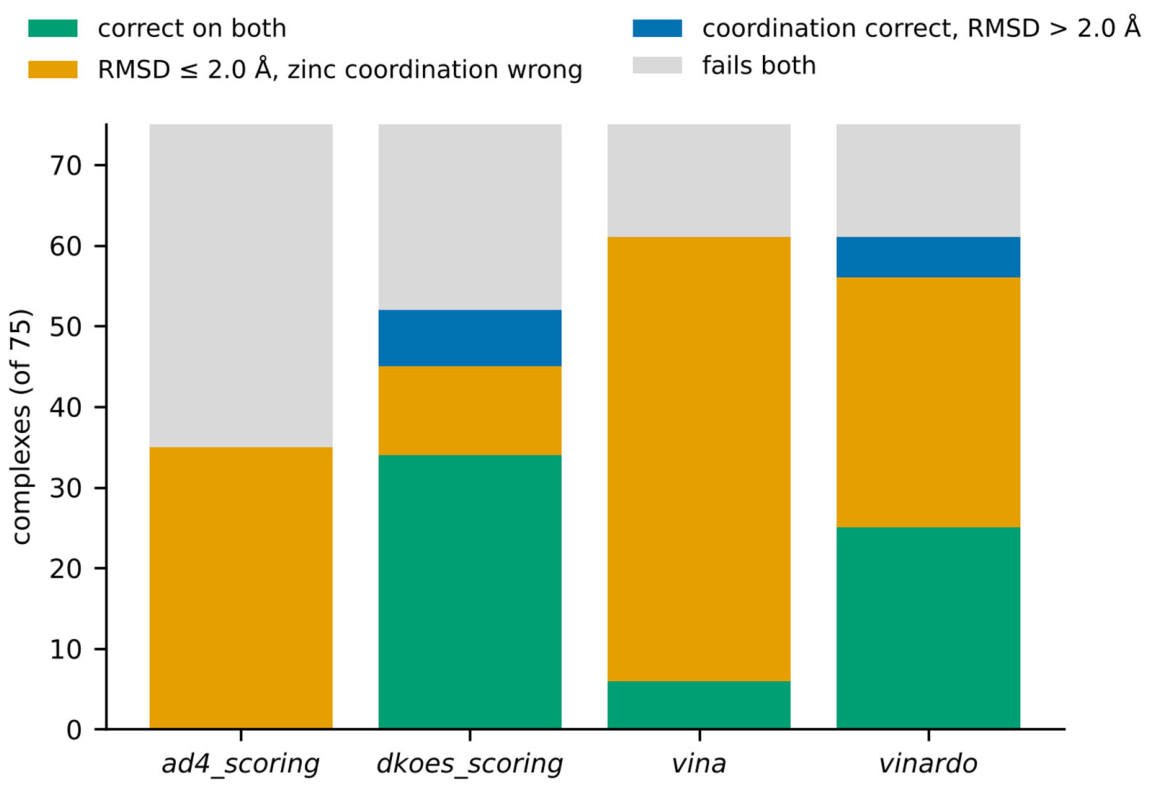
Figure 4.
Zinc-coordination fidelity across docking methods on the 60 complexes common to all methods, under the donor-identity criterion. Dark bars, correct coordination in the top-ranked pose; light bars, correct coordination in the best of all generated poses. GM-DockZn (highlighted) ranks the correct coordination in only 15% of top poses, below the best conventional scoring function (dkoes_scoring, 58%), although a correct pose is present in its ensemble for 80% of complexes.
Figure 4.
Zinc-coordination fidelity across docking methods on the 60 complexes common to all methods, under the donor-identity criterion. Dark bars, correct coordination in the top-ranked pose; light bars, correct coordination in the best of all generated poses. GM-DockZn (highlighted) ranks the correct coordination in only 15% of top poses, below the best conventional scoring function (dkoes_scoring, 58%), although a correct pose is present in its ensemble for 80% of complexes.
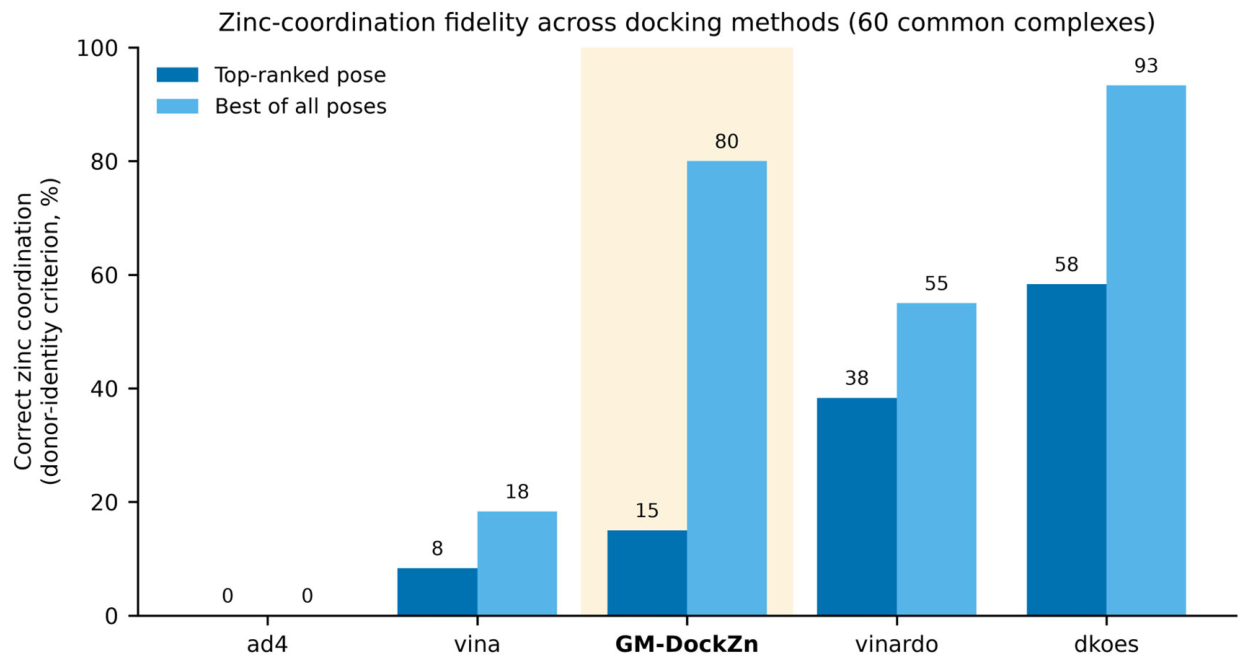
Table 10.
Grounds for exclusion of the 27 candiate entries that did not enter the set.
| Ground for exclusion | entries |
|---|---|
| Resolution worse than 2.5 Å | 9 |
| Determined by NMR or cry-electron microscopy | 6 |
| Ligand is a fatty acid rather than a designed inhibitor | 4 |
| Natural substrate bound | 2 |
| No zinc ion present | 3 |
| The only ligand is an additive remote from the metal | 3 |
Table 11.
Docking runs conducted in this study. Runs A-C’ represent the three-part decomposition of Section 4.6, with run A being a subset of the first run (the ad4_scoring part) and therefore not an independent calculation.
Table 11.
Docking runs conducted in this study. Runs A-C’ represent the three-part decomposition of Section 4.6, with run A being a subset of the first run (the ad4_scoring part) and therefore not an independent calculation.
| label | program | Scoring function or maps | Exh. | poses | seed |
|---|---|---|---|---|---|
| primary | smina | Vina,vinardo,ad4_scoring,dkoes_scoring | 16 | 20 | 20261008 |
| Primary,anionic | smina | The same four | 16 | 20 | 20261008 |
| Seed replicate | smina | The same four | 16 | 20 | 20261009 |
| Search control | smina | The same four | 64 | 40 | 20261008 |
| A | smina | Ad4_scoring | 16 | 20 | 20261008 |
| B | Vina 1.2.7 | Plain AD4 maps | 16 | 20 | 20261008 |
| C | Vina 1.2.7 | AD4Zn maps | 16 | 20 | 20261008 |
| C’ | Vina 1.2.7 | AD4Zn maps | 16 | 20 | 20261008 |
| Cross-docking | smina | The same four | |||
| Rescoring | Smina-score only | The same four |
Table 12.
Software versions.
| component | version | Used for |
|---|---|---|
| Python | 3.11.17 | |
| smina | Build of 9 November 2017(AutoDock Vina 1.1.2 lineage) | four scoring functions under one search algorithm |
| Autodock Vina | 1.2.7 | map-based scoring: AD4Zn and the engine control |
| AutoGrid | 4.2.7.x.2019-07-11 | AD4Zn and plain AD4 grid maps |
| ADFRsuite | Build 5,28 October 2019 | prepare_receptor, Gasteiger charges |
| Meeko | 0.8.0 | ligand conversion to PDBQT |
| RDKit | 2024.09.6 | bond orders, protonation, symmetry-corrected RMSD, substructure matching |
| Gemmi | 0.7.5 | mmCIF parsing, entity assignment, active-site superposition |
| NumPy | 2.4.6 | Sampling,bootsrap |
| SciPy | 1.17.1 | Mann-Whitney U,McNemar’s |
| pandas | 3.0.6 | tables |
| Matplotlib | 3.11.2 | figures |
Disclaimer/Publisher’s Note: The statements, opinions and data contained in all publications are solely those of the individual author(s) and contributor(s) and not of MDPI and/or the editor(s). MDPI and/or the editor(s) disclaim responsibility for any injury to people or property resulting from any ideas, methods, instructions or products referred to in the content. |
© 2026 by the authors. Licensee MDPI, Basel, Switzerland. This article is an open access article distributed under the terms and conditions of the Creative Commons Attribution (CC BY) license (http://creativecommons.org/licenses/by/4.0/).
Copyright: This open access article is published under a Creative Commons CC BY 4.0 license, which permit the free download, distribution, and reuse, provided that the author and preprint are cited in any reuse.