

Submitted:
17 November 2026
Posted:
18 November 2026
You are already at the latest version
Abstract
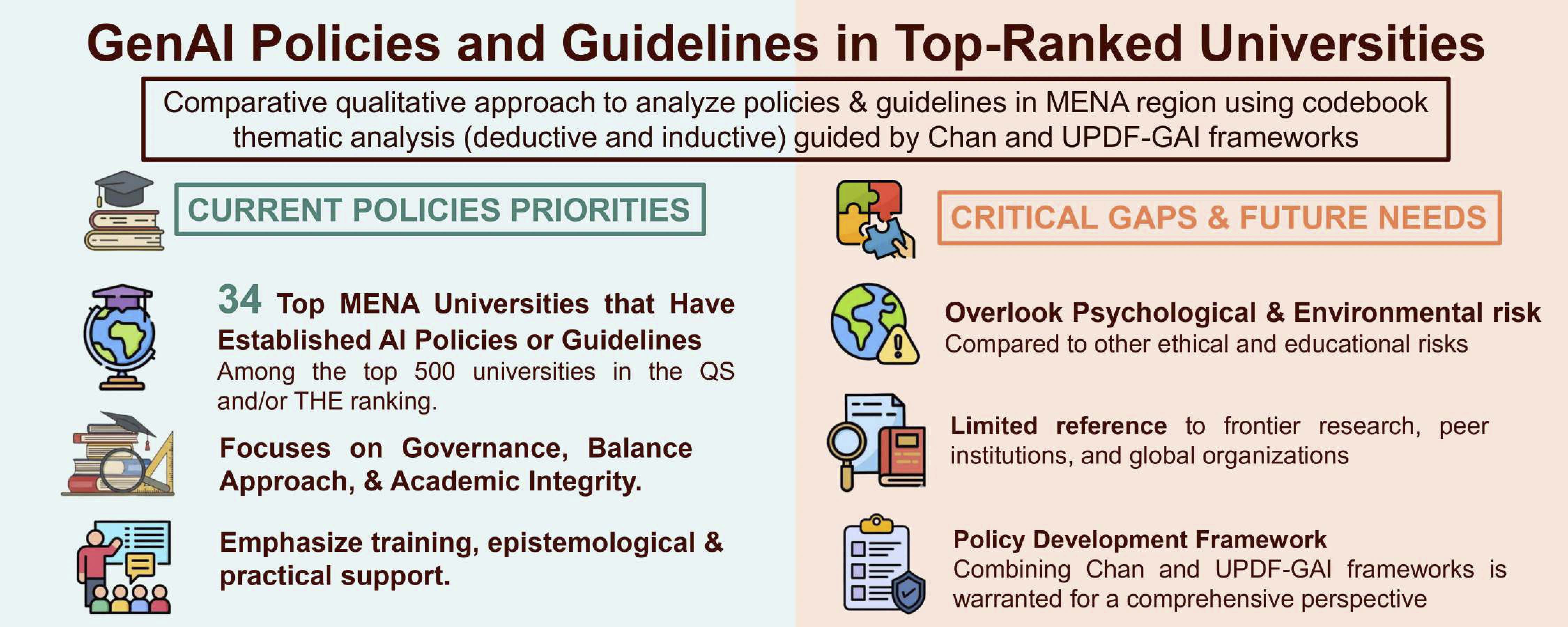
The prevalence and scope of generative artificial intelligence policies and frameworks among universities in the Middle East and North Africa (MENA) region remain underexplored, with equivocal alignment of international guidelines to regional context. This study aims to explore, map, and analyze AI policies and guidelines within top-ranking universities in the MENA region. A comparative qualitative analysis of AI policies and guidelines from the top 500 universities (QS and THE) in the MENA region was conducted using NVivo-assisted codebook thematic analysis, combining inductive coding and deductive coding guided by Chan and UPDF-GAI frameworks. Across the MENA region, 34 universities had established AI policy and/or guidelines. The predominant themes were governing and attributing AI use, encouraging balanced approach, and providing training, epistemological, and practical support. However, few institutions incorporated stakeholders or adopted from research, peer institutions, and global organizations in policy development. Similarly, environmental and psychological risks were underrepresented compared to ethical and educational concerns. While Chan and UPDF-GAI frameworks demonstrated overlapping priorities, combining their application provides a comprehensive perspective. The findings provide a foundation for policymakers to develop national education strategies, and for universities to establish and implement contextually grounded GenAI policies that follow best-practice approaches.
Keywords:
generative artificial intelligence
; higher education
; institutional policy
; MENA region
; framework
; QS universities ranking
; times higher education
1. Introduction
Artificial intelligence is machines and computers that mimic and simulate human behavior, starting from developing a perception, learning, drawing inferences, analyzing, and making decisions, in addition to performing tasks by processing data and identifying patterns.(Duan et al., 2019; Panch et al., 2018; Topol, 2019) Traditional AI encompasses 6 main subfields: Machine Learning (ML), Artificial Neural Network (ANN), Deep Learning (DL), Natural Language Processing (NLP), computer vision, and cognitive computing.(Khan, 2024) However, Generative Artificial Intelligence (GenAI) such as Large Language Model (LLM) has evolved from traditional AI, by integrating both DL and NLP, while training on and being trained on numerous datasets to generate new, novel content in the form of text, music, videos, and images.(Ferrara, 2024; Lv, 2023; Masters et al., 2024; Patino et al., 2024) The release of ChatGPT in late 2022, with its ability to respond to natural language prompts, has enabled non-technical individuals to harness the capabilities of GenAI. (Yan et al., 2024) Advancement in AI technology has led to transformative changes in the education system, affecting pedagogical strategies, learning methodology, and assessment approaches. (Francis et al., 2025) Integrating GenAI in higher education can minimize workload by automating administrative tasks and curriculum development. (Li & Jan) In addition to providing adaptive personalized learning and real-time feedback.(Mimoudi, 2025) However, GenAI is associated with various challenges, including academic misconduct, data privacy and security concerns, algorithm bias, copyright infringement, and environmental risks.(Bahroun et al., 2023; Hosseini et al., 2025; Mellado, 2024) In addition to the potential impact on student independence, creativity, and critical thinking.(Mellado, 2024) The fast-evolving nature of this technology, alongside the high prominence in academic circles, caught universities off guard,(Gravett, 2026; Ullah et al., 2024) with institutional governance lagging behind implementation.(Malomo et al., 2025) Such advancement necessitates higher education institutions to develop policies and guidelines to ensure ethical and responsible use of GenAI technologies.(Ullah et al., 2024)
Policy can be defined, according to the Centers for Disease Control and Prevention, as the “law, regulation, procedure, administrative action, incentive, or voluntary practice of governments and other institutions”.(Definition of Policy, 2024) While the Canadian Heritage Information Network (CHIN) elaborated on the role of the policy by describing it as “ a set of statements of principles, values, and intent that outlines expectations and provides a basis for consistent decision-making and resource allocation in respect to a specific issue”.(Hallinger, 1986) In alignment with these definitions, universities view policy as a governing framework that provides vision, support, and assistance to the university community.(Austin; Policy Definitions) Within the context of AI, a study that aimed to develop an AI policy framework highlighted five key justifications supporting the necessity for universities to develop AI policies. Firstly, AI policies are needed to build the knowledge and skills to prepare students for the workplace that involves AI use. Additionally, it equips students to participate in AI development and implementation to play an active role in their society. Furthermore, educating students about AI principles, such as ethical consideration, bias, and academic consequences, is essential to maintain academic integrity and prevent plagiarism. Moreover, AI policies prepare competent graduates who use AI responsibly and ethically. On top of that, the recent transition from traditional to generative AI introduces both potential benefits and risks to the education system, emphasizing the importance of a new AI policy that provides guidance aligned with contemporary development.(Chan, 2023)
Despite the ongoing demand to establish AI policies, the current landscape reflects a gap between current practice and regulation, with the majority of institutions lacking a specialized policy.(Ghimire & Edwards, 2024) A survey conducted by UNESCO in October 2025 revealed that only 19% of institutions have established an AI policy, while 42% reported that guidelines are still being developed.(UNESCO survey: Two-thirds of higher education institutions have or are developing guidance on AI use, 2025) The absence of AI policies in higher education leads to a governance vacuum and poses ethical challenges for academic stakeholders.(Islam, 2025) Similarly, ambiguous and unclear policies also pose a challenge, as it results in different perspectives, inconsistent interpretations, and contribute to anxiety and inequality in matters that require standardization, such as assessment.(Tsao, 2025) Institutional AI policies are viewed as general, confusing, and outdated, which contributes to policy violations. For example, the faculty of education and psychology in the University of Oulu reported 17 violation cases in 2025, 58% pertained to undisclosed or unauthorized use of AI.(Oulu) Such limitations in AI policies foster student dependence on social norms rather than the established university regulations.(Fu et al., 2026) Furthermore, multiple reports revealed low awareness among students regarding their institution’s AI policy.(Khrisat, 2025; Ou & Stöhr, 2023)
To fill the gap and guide the adoption of GenAI in higher education, multiple international organizations led the development of guiding principles and integration frameworks. UNESCO has published several reports since 2023, including the first guideline for GenAI in education and research,(UNESCO, 2023a) general and region-specific reports about AI integration in higher education,(UNESCO, 2023b, 2025) and AI competencies frameworks for students and educators.(UNESCO, 2024a, 2024b) Other international organizations have also had notable contributions, with the European Union developing guideline emphasizing ethical adoption (European Commission: Directorate-General for Education & Culture, 2026) and OCED providing evidence-based integration strategies.(OECD, 2026) Such international guides provide a foundation for policy development, yet local policies are still necessary to adapt these recommendations to the specific pedagogical needs of higher education, with particular consideration to the local context.(Luo, 2024; UNESCO, 2023a) This is because, alongside their focus on general educational contexts, AI ethical governance frameworks have largely emerged from the Global North; thus, they tend to reflect its priorities, values, and epistemological foundation. The European Union AI framework, for example, positions transparency, fairness, and accountability, which are the European perspective of ethics, as global norms. These principles are driven by a procedural orientation, which focuses on measurable processes of accountability and bias minimization, often at the expense of concerns related to social and distributive justice.(Brown et al., 2026) Such limitation has catalyzed the Arab League Educational, Cultural, and Scientific Organization (ALESCO) to develop a regionally specific framework that seeks to maximize the benefits of integrating AI in education while safeguarding the cultural privacy of Arab communities. (Jemni et al., 2025)
A growing body of literature has explored and analyzed institutional policies governing the use of AI in education. Prior studies demonstrate variation in scope, with some investigating policies at the country level, such as the US (37), Canada (38), and South Africa (39), while others focus on specific institutional groups (e.g., the Russell Group) (Atkinson-Toal & Guo, 2024). Furthermore, to enhance generalizability, other literature selects top universities based on global ranking system such as QS(Luo, 2024) and Times Higher Education.(Moorhouse et al., 2023) Although many studies have investigated institutional AI policies, higher educational institutions in the Middle East and North Africa (MENA) region remain underrepresented in the literature. Across the available evidence, only one study included a university from the MENA region (The American University in Cairo), as part of its analysis of 40 leading universities representing six global regions (e.g., Asia, Africa, Europe)(Jin et al., 2025) Furthermore, Arab academic institutions have the lowest contribution rate (8%) among in the UNESCO 2025 survey that explores AI policies development in academic institutions.(UNESCO survey: Two-thirds of higher education institutions have or are developing guidance on AI use, 2025).
Higher education institutions in MENA region exhibit several unique characteristics derived by internationalization, linguistic diversity, and historical legacy. These factors vary across MENA countries, with internationalization being prominent in Qatar and the UAE. Another distinct feature in addition to the branches of international universities, is the presence of many national universities that align with foreign models of education, such as the American system, European system, or a combination.(Bhandari, 2011) Moreover, the language of instruction differs significantly between the countries, involving Arabic, French, English, or a combination of multiple languages.(Bhandari, 2011; Elyas et al., 2023) In the analysis of AI policies, the selection of the analytical lens is essential because frameworks differ in their conceptual orientation and interpretation. For example, although Hallinger’s framework is well established in educational policy analysis, it primarily focuses on instructional leadership and school-level implementation.(Hallinger, 1986) While the analytical framework provides valuable guidance in term of shaping institutional vision, managing educational practice and fostering a positive learning environment,(Ng Foo Seong, 2019) it does not account for the pedagogical and governance implications of GenAI integration in the education system. Likewise, several frameworks have been developed precisely for higher education to ensure responsible AI use, encompassing different principles such as accountability, privacy, diversity, and transparency.(Papagiannidis et al., 2025) Nonetheless, the focus on broad ethical principles may overlook the necessity of capacity building and pedagogical transformation that are specific to the higher education context. Multiple frameworks are available to assist higher educational institutions in integrating GenAI by providing universities with a practical guide to develop their institutional policy. In addition to promoting ethical and responsible use by ensuring the alignment of action with the policy and defining the responsibilities of each stakeholder. (Chan, 2023; Li et al., 2025) Chan 2023 proposed AI Ecological Education Policy Framework for AI integration in teaching and learning in universities. The framework was developed based on stakeholders’ input from Hong Kong Universities and consists of three dimensions: Pedagogical, Governance, and Operational.(Chan, 2023) Another study developed the University Policy Development Framework for GAI (UPDF-GAI), which is an adaptation of the Technology Acceptance Model (TAM). The new framework was developed by incorporating psychological, organizational, and institutional factors to better represent policymakers’ decisions regarding AI integration.(Li et al., 2025) This study employs Chan and UPDF-GAI frameworks as an analytical lens to provide a structured and multi-dimensional examination of AI policies issued by higher education institutions.
Despite the growing development of institutional AI policies and the expanding body of literature analyzing them, a notable gap remains in the exploration and evaluation of AI policies established by institutions in the MENA region. This issue is further compounded by the underrepresentation of the region in the international reports and the limited applicability of global guiding efforts within the regional context. On top of that, the national AI strategies, where available, primarily adopt a soft law approach, resulting in ambiguous guidance for academic institutions regarding AI governance and implementation. (Aggoun, Canadian Institute for Middle East and Gulf Studies/2025; Principles and Guidelines for Ethical Use of Artificial Intelligence, 2024; The UAE Charter for the Development and Use of Artificial Intelligence, 2024)
This study aims to:
- -
- To examine the prevalence of institutional AI policies and guidelines within leading universities across the MENA region.
- -
- To conduct systematic mapping and comparative analysis of AI policies and guidelines developed by higher education institutions across the MENA region.
2. Materials and Methods
This is a policy mapping study that adopts a comparative qualitative approach to explore and analyze institutional AI policies, procedures and guidelines across leading universities in the MENA region. Qualitative methodology is followed to capture the complexity of the educational context.(Creswell & Poth, 2016) Policies, which are the mandatory statements, are often accompanied by procedures that outline the steps necessary to reinforce the policy. In comparison, guidelines offer advisory recommendations, interpretive guidance, best practices, instructions, and frameworks. (Polytechnic)
2.1. Data Collection
Several definitions are available regarding the countries comprising the MENA region; for the purpose of this study, the UNICEF definition was adopted, which includes 20 countries: Algeria, Bahrain, Djibouti, Egypt, Iraq, Jordan, Kuwait, Lebanon, Libya, Morocco, Oman, Qatar, Saudi Arabia, State of Palestine, Sudan, Syrian Arab Republic, Tunisia, United Arab Emirates, Yemen. (Middle East and North Africa country factsheets, 2024) To ensure robustness and comprehensive identification of top universities in MENA region, Quacquarelli Symonds (QS) ranking 2025 and Times Higher Education (THE)-World University Rankings 2025 were utilized. Both rankings were adopted as they differ in the assessment indicators and criteria; despite that, they are widely recognized by governments and policymakers in evaluating the higher education system. (Wen et al., 2023) The university was included if it was ranked among the top 500 higher educational institutions worldwide by either ranking (QS or THE). The detailed inclusion and exclusion criteria are presented in Table 1. Following that, search was conducted on the institution’s official website of the identified universities using the following terms in Arabic and English: “artificial intelligence or AI or generative artificial intelligence or generative AI or GenAI or GAI or ChatGPT” combined with either “policy or guide or guideline or procedure”. A manual search of AI policies was conducted on the “policies and procedures” page in each university website. In addition, supplementary searches were conducted in Google by combining each university name with the same pre-specified terms (used to search in the institutional website), to address the challenges associated with navigation difficulty and search limitation in some websites. All searches were conducted in Arabic and English, aligning with the languages of all MENA institution websites, except for Iran institutions. An initial search was conducted in June 2025, and the search was repeated in January 2026 to ensure the inclusion of the newly developed and most updated policies. During each period, the search was conducted twice with a two-week interval to ensure search reliability. Institutions with no identified policy or guideline were contacted via email to confirm availability. All identified documents were analyzed in their originally published language (no translation was performed) to ensure accurate interpretation and consideration of latent expression, given the research team fluency in both languages.
2.2. Data Analysis
In this study, codebook thematic analysis is employed, which enables the identification and analysis of themes and patterns in the policies. Codebook thematic analysis demonstrates a qualitative pragmatism approach where a structured codebook or coding frame, such as a matrix, template, or framework, is used for theme development. Additionally, new themes can be developed inductively throughout the process of data familiarization and analysis. Codebook thematic analysis aligns with several principles of reflexive thematic analysis, particularly the contextual nature of knowledge and the acknowledgment of researcher subjectivity.(Braun & Clarke, 2021) The analytical process was informed by the six phases proposed by Braun and Clarke, with adaptation to align with the codebook thematic analysis approach.(Braun & Clarke, 2021)Coding was mainly deductive guided by two frameworks (Chan 2023 and UPDF-GAI), inductive coding was also employed to capture emerging themes throughout the analysis. Codes were generated iteratively with continuous refinement throughout the analytical process. To enable cross-case comparison, the identified themes across institutional policies were visualized to convey prevalence. Recording the theme occurrence was done for descriptive purposes only, with no formal statistical analysis. Data analysis was conducted in NVivo®15 software by MB, a pharmacist, researcher and a PhD candidate in Health Profession Education. Throughout the data collection and analysis process, the authors (MB, BM, AS) met frequently to discuss code generation, theme development, and data interpretation, as BM and AS are academic leaders with extensive experience in policy development and research in health profession education and qualitative studies.
Several measures were implemented to ensure the quality and trustworthiness of the study, including credibility, dependability, confirmability, and transferability. A reflective diary was maintained by MB to document the underlying thought process during the data analysis and interpretation phase (available upon request from the corresponding author), while all the stages of the research process were peer-reviewed by BM and AS. Moreover, the paper presents a comprehensive description of the research team’s expertise, the employed methodology, and the emerging findings. The Standards for Reporting Qualitative Research (SRQR) was employed to enhance reporting quality.
2.3. Frameworks Guiding Analysis
Two frameworks, Chan 2023 and UPDF-GAI, were adopted to guide the analysis process. The AI Ecological Education Policy Framework, developed by Chan from the findings of a mixed-method study, consists of ten key areas categorized under three dimensions (pedagogical, ethical, and operational), with each dimension assigned to a designated stakeholder. The Pedagogical dimension concerns leveraging AI to enhance learning and teaching outcomes, while the governmental aspect addresses AI-related concerns, including accountability, security, and privacy. In contemporary, operational dimensions focus on practical aspects such as monitoring implementation and providing support. To analyze the policies, the dimensions were considered as themes, while the ten key areas were assigned as corresponding subthemes. On the other hand, the UPDF-GAI framework was developed through a comparative analysis of over 100 top universities in the US, China, and Japan, representing a global benchmark that is specifically applicable to the heterogeneous status of universities in the MENA region. UPDF-GAI consists of six pillars: perceived usefulness and ease of use, perceived risk, facilitating conditions, social influence, and self-efficacy.
3. Results
The results are organized in two main sections, where section one provides an overview of the prevalence of AI policies with a summary of the baseline characteristics of the identified documents. The second section begins with a direct comparison between the two frameworks utilized in the analysis. Following that, by discussing the deductively identified theme starting with those identified by Chan frameworks and subsequently those derived from the UPDF-GAI framework. Inductively generated themes will be presented as well to outline dimensions not captured by either framework.
3.1. Overview of Policy Availability
50 universities (including branches of international universities) were classified among the top 500 universities in the MENA region based on the QS and THE university ranking scale. Of these, 34 institutions (68%) have established AI policy and/ or guidelines, with half originating from national universities (34%), whereas the others were branches of international universities (34%)(Figure 1). However, only 33 institutions were included in the analysis as access to the Mohammed VI Polytechnic University policy was restricted to “view only” which prevented copying or printing the document. Relevant documents were identified through various institutional platforms such as the official policy and procedure webpage, library guide, innovation center, and center for teaching and learning, while some were received via email. The baseline characteristics of the identified documents, including the publication language, number of retrieved documents, and issuing department, are presented in Supplemantary material 2.
3.2. Thematic Findings
In general, eight themes were identified deductively derived from Chan 2023 and UPDF-GAI frameworks, in addition to three themes identified inductively, which are represented in Table 2. Table 3 compares the two frameworks by discussing the overlapping concepts. Additionally, the exact themes and subthemes mentioned by each university are mapped in the policy analysis matrix (supplementary material 1) and visualized in Figure 2.
3.2.1. Chan 2023 Identified Themes
Governance Dimension
Understanding, identifying, and preventing academic misconduct and ethical dilemmas
Academic misconduct and ethical concerns were consistently reported across all institutions. The majority define academic misconduct as submitting work generated by GenAI as their own without proper authorization or acknowledgment. Zayed University included the inappropriate use of AI- generated images and ideas as a form of plagiarism as well. While it was mainly correlated to plagiarism, some provide clear criteria for other forms of academic misconduct, such as using AI to fabricate data or references, or using it in assignments or exams without prior approval and without appropriate attribution. Violation of academic integrity was not limited to student use, as King Saud policy stated that faculty members might contribute to academic misconduct if GenAI was utilized to provide false citations, whereas Sultan Qaboos, Georgetown, and RCSI extended the definition to researchers as well.
Using GenAI in a way that breaches academic integrity can undermine the development of knowledge and skills necessary for future careers, such as problem-solving. In addition, such practice compromises the authenticity of the assessment process and consequently affects the judgment regarding the attainment of the prespecified learning outcomes. In research, it might result in article retraction, which impacts the researcher’s reputation. In addition to creating an inequitable advantage to students who utilize AI, submitting AI-generated content for grading and feedback is an “unfair act” that burdens faculty with work that does not represent the student’s actual ability.
Several factors contributed to the tendency to utilize GenAI in assessment and assignments, including the free access of GenAI, last-minute crises, and overlapping academic demands. To address assessment-related pressure, HERIOT-WATT encourages students to seek support from faculty, learning team, library, and wellbeing services for guidance in managing the task without resorting to academic misconduct.
Approaches to minimize plagiarism include encouraging students to write their original draft and then using GenAI for refinement only, paraphrasing the AI-generated output, and verifying with a plagiarism detection tool before submission. Another technical strategy involves restricting GenAI from responding to homework-related inquiries; nevertheless, its effectiveness remains debatable, given that using specific long and sophisticated prompts (jailbreaks) can bypass these safeguards. Only half of the policies specified the accepted and prohibited use of GenAI in their institutions, and while the specific recommendations differ, many universities permit the use of GenAI for brainstorming, analyzing data, drafting emails, writing enhancement, and troubleshooting software. In addition to utilizing the tool for studying purposes, such as explaining difficult concepts, generating practice questions, role-playing, and creating a study schedule. Faculty can use the tool to prepare educational material, innovative teaching strategies, formative assessment, and self-development. New York University in UAE was the only institution to discuss the acceptability of AI voice-over tools, AI-generated music, and the artistic field. While the AI voice-over tool for training video was permissible, the generation of voice that mimics any of the university community or guests is considered misleading. Other universities prohibit the use of GenAI in the development of basic knowledge as well as in summative evaluation to ensure the integrity of the grading process. Texas A&M recommends using GenAI for proofreading with specific restrictions such as preventing language translation, summarizing the text to comply with the word limit, and checking the accuracy of the written information. On the other hand, King Abdulaziz strictly prohibits using GenAI in sensitive administrative tasks that require specialized expertise, such as hiring, termination, and financially related decisions.
Beyond defining acceptable and prohibited use, only 14 institutions developed procedures for detecting and handling violations and suspected cases. Whereas some institutions treat cases involving AI use under the general violation of the student code of conduct, others provide a distinct guide and action plan. AFG with Aberdeen developed a matrix that assists faculty to evaluate the potential use of GenAI in an assessment task, accompanied by a detailed action plan, which includes convening an investigational panel. Students are further informed of the required steps in suspected cases, which include claiming authorship by providing early drafts and engaging in discussion to demonstrate understanding and level of knowledge. On the other hand, the American University of Cairo developed a three-phase guide of 10 measures that aims to prevent, discover, and respond to AI misuse through decision-making and action. The policy further emphasized maintaining “humanity and caution” in decision-making, with the necessity to confirm suspicion with multiple indicators.
Addressing governance of AI: data privacy, transparency, accountability, and security
Overall, 31 universities have reported or recommended at least one form of AI governance, including privacy and security measures, transparency, accountability, and addressing ethical concerns. As AI-related concerns will be comprehensively discussed in the “Perceived risk” theme, this section focuses on institutional governance initiatives, risk mitigation recommendations, and safe practice approaches. Several key points were consistently reported across the policies, such as avoiding sharing confidential, personal, and sensitive data with GenAI tools. This includes student work, unpublished research, and lecture materials unless permitted by the responsible bodies and with the consent of the related parties to protect privacy and intellectual properties. Georgetown, New York, Cornell, and Prince Sultan institutions highlighted that personally identifiable information should be handled in accordance with international and federal regulations, such as GDPR, HIPAA, and FERPA. Generally, all universities in KSA are required to comply with the national data protection law, while King Khalid University additionally emphasizes counseling the data management office if sharing personal information with GenAI located outside the kingdom is warranted. Heriot-Watt University requires a data protection impact assessment for GenAI tools before permitting their use to ensure the protection of students’ rights and personal data. Students and staff need to review the terms and conditions of each GenAI tool, particularly those with regard to data privacy, security, and the reuse policy of the input data. This is of great importance as some tools do not provide a clear answer regarding data anonymization and the intended use of the collected data. Some universities limit the integration to approved GenAI tools only, particularly those covered under institutional enterprise agreements (e.g. Copilot, Gemini, and NotebookLM), whereas other tools require a specific permission request. In addition, GenAI tools should be treated as a public platform by limiting the input of any personal and sensitive data, and initiatives such as a data classification tool to categorize data sensitivity can inform decision-making.
On the other hand, approaches to ensure data security vary between institutions, but with noticeable overlaps with privacy measures. Distinct recommendations involve limiting the use of GenAI to within internal secured server or via an approved encrypted cloud only. In addition to anonymizing data by a designated steward before uploading, it to the licensed GenAI tool, ensuring human review to minimize data leakage, and maintaining a record of the access log for auditing purposes. Texas A&M emphasizes that it is the responsibility of the AI system owner and custodian to ensure that it remains safe, reliable, and can be terminated in case of losing human control.
In terms of accountability, all users, including students, staff, and researchers, are responsible for their work regardless of the GenAI tool used. All the stakeholders are accountable for ensuring that the generated content is accurate, represents their original thinking, and is free from bias and other ethical concerns. In the context of research, this is reflected in acknowledging GenAI use without upholding authorship credit regardless of its contribution level, as accountability remains with the researcher. In addition, users should be able to interpret and rationalize all GenAI decisions with appropriate revision, oversight, and record-keeping. The University of Jordan highlighted that accountability encompasses the institution’s authority to take disciplinary action in cases where the submitted work violates university regulations. On the other hand, King Khalid University indicated that accountability involves developing mechanisms to evaluate the impact of GenAI tools on the academic community and to ensure the attainment of learning objectives.
Transparency, which is an essential aspect in AI governance, varies across universities. Some universities emphasized that the university is responsible for providing a comprehensive explanation of the GenAI algorithm, its role, and its impact on the education process. This is to be accompanied by involving the stakeholders in the ongoing decision to ensure transparent decision-making and AI integration. While others encourage instructors to provide a clear rationale for students, justifying the decision behind allowing or banning AI use in their assessment, which serves as a role model of transparent decision-making. Justification was also made on the institutional level, where the American University of Cairo mentioned a clear stepwise rationale behind discouraging the use of the AI detection tool. On the other hand, Hamad Bin Khalifa University evaluates and rates the accessibility of the available GenAI platform using the FAST (Function, Appearance, Structure, Text Equivalents) assessment methodology. Similarly, Murdoch University established a “Library Generative AI working group” where they developed an assessment rubric to evaluate the available GenAI tools’ alignment with the university’s requirements, including their functionality, accessibility, technical features, ethical concerns, and privacy measures. Texas A&M builds further on this by encouraging each university to evaluate AI tools and share the assessment on a publicly accessible database, fostering knowledge sharing across academic institutions.
Attributing AI technologies
Across most institutional policies, explicit disclosure of GenAI use is consistently encouraged as a core of transparency, academic integrity, and honesty. Hamad Bin Khalifa University emphasized its importance in facilitating ethical use, ensuring fair evaluation, prompting trust, and advocating accountability. In addition, acknowledging AI use facilitates engagement with both the utilized tool and the generated output, thereby fostering critical thinking and creating opportunities for new teaching and learning approaches. Although the majority encourage attribution of GenAI use in general, only five universities explicitly require the faculty to acknowledge the use in teaching material. Such an approach helps prevent students from incorrectly anticipating that the content is entirely AI-generated. In addition, it provides a model that supports students to learn how to engage with GenAI tools and leverage their potential in their field. On the contrary, two universities, AFG with Aberdeen and the University of Birmingham, highlighted the need to acknowledge that AI was not used by stating “No content generated by a GenAI tool(s) has been used in this assignment”. King Abdulaziz University encourages that disclosing the use of AI needs to be accompanied by stating the associated challenges. Various acknowledgment strategies are adopted across the institutions, with citing GenAI following common citation style (e.g. APA MLA) being the most prevalent approach. Other strategies encompass writing a deceleration statement, attaching the conversation with LLM, documenting the prompts, and submitting a declaration form. Some universities requested further information, including justifying the use of GenAI, explaining how the generated content was reviewed, edited, and verified, and reflecting on the integration experience. American University of Beirut and HBKU reference some of the publisher acknowledgment guidelines that researchers are encouraged to follow in planning for publication.
Ensuring equity in access to AI technologies
Across the analyzed policies, the concept of equity in relation to GenAI was reflected in several forms in relation to access and use of AI, including access to paid AI tools, supporting resources, and educational materials. Equitable access to GenAI tools is essential to create an equal education environment and does not contribute to generating or exacerbating disparities among students. The institutions emphasize that the integration of GenAI should be fair and inclusive, regardless of the students’ financial status or technical knowledge. Several institutions provide a subscription to certain GenAI tools (e.g., Gemini, Copilot, NotebookLM, ScopusAI) to their faculty and students that can be accessed using the university account. When GenAI is to be integrated in class, the faculty should ensure that all students have “equal access to AI tools”. While Virginia Commonwealth University highlights the faculty’s responsibility in confirming the GenAI tool accessibility before permitting its use, it assigns the students the task of notifying the faculty if the advised tool is not freely available or readily accessible. Nevertheless, King Saud University focuses on promoting an equal opportunity to build AI literacy, consistent with the University of Birmingham, which provides an annual compulsory introduction to GenAI for all registered students. On the other hand, inequity was also identified, as Georgetown University “does not have a campus-wide license for an AI tool, although various colleges, departments, and programs are supporting relevant tools for their faculty”. Similarly, geographical restrictions can impose inequity, such as at New York University, where free access to NotebookLM is available across all NYU branches except NYU Shanghai, due to China’s restrictions on Google services.
Pedagogical Dimension
Rethinking assessment and examination
In the context of GenAI, the assessment is highly shifting toward prioritizing authentic strategies, the process of learning over product, and higher-order learning outcomes. Universities suggest many redesigned approaches to preserve the authenticity of assessment and ensure the development of students’ knowledge and skills, including critical thinking. To design/ redesign an assignment in the context of GenAI integration, several universities, such as American University of Cairo and Georgetown University, provide a step-by-step guide to decide on the appropriate strategy. One of the strategies is contextualizing and personalizing assessments to include personal experiences, real-life cases, and course-specific content, which strengthens the assessment relevance and reduces the chance of AI-generated content to meet the evaluation criteria. Other forms of assessment can assess skill application beyond text generation, such as oral presentation, debates, and group discussion. Likewise, prioritizing processes over product includes many strategies, such as peer review, reflection, scaffolding, and self-assessment. However, the American University of Cairo highlighted that such an approach requires readdressing the skills and knowledge being assessed and developing an updated rubric that communicates the change to the student. Despite that, only five universities emphasize the necessity to update the rubric and evaluation criteria in the context of GenAi integration. On the other hand, utilizing GenAI to grade assignments was minimally addressed by only the Lebanese American University, which recommends that only approved GenAI tools might be used, although any other tools will require prior approval from the department chair and dean.
Encouraging a balanced approach to AI adoption
Across the policies, GenAI tools were viewed as a supportive aiding tool rather than a substitute in learning, research, and administrative tasks. In addition, it consistently encourages balancing the benefits and limitations associated with GenAI integration in the education system. Although the universities acknowledge that GenAI can improve idea generation, summarization, creativity, and writing, the output can be false, misleading, or biased. A prominent recommendation is to utilize GenAI as a supportive tool, such as a “learning aid” and “research assistant,” not a shortcut. Students are permitted to use GenAi for brainstorming, but they are required to ensure that their work represents their knowledge, voice, analysis, and argument. Such a balanced approach can improve students’ critical thinking and decision-making by actively engaging with the GenAI output, emphasizing that it should not substitute analytical thinking and problem-solving skills. King Saud University emphasizes the role of faculty to educate and monitor students to ensure balanced integration. King Abdulaziz University promotes faculty awareness regarding GenAI benefits and limitations, while recognizing that GenAI can automate many tasks, human factors remain essential in other domains. Additionally, Virginia Commonwealth University argues that GenAI cannot replace teachers as they lack core human traits such as wisdom, critical judgment, and social skills. Additionally, only the American University of Sharjah and Prince Sultan University highlight the psychological health and encourage students to seek help from “real people” for concerns related to psychological wellbeing, faith, finance and major life decisions, where GenAI tools are not fully equipped to serve the consultation role.
Lack of balance in the use of GenAI may lead to over-reliance, impacting academic integrity and undermining knowledge and skills development. University of Strathclyde mentions that over-reliance on GenAI can lead to future challenges, as the currently free GenAI tools could become paid, which will hinder student learning and development. Furthermore, Birmingham University fears that over-reliance can constrain students’ independent thinking and reduce their ability to critique GenAI answers or search for alternative solutions. Cairo University recommends self-reading and communicating with colleagues and faculty to solve the problem of over-reliance. While Sultan Qaboos University highlights that instructors are usually familiar with their students’ writing styles, they are thus capable of detecting over-reliance cases.
Developing students’ holistic competencies/ generic skills
This subtheme is structured around two concepts: the competencies required to effectively and ethically use GenAI tools, such as digital skills and critical thinking skills. In addition to competencies that might be impeded by AI tools, such as leadership and teamwork. The American University of Cairo encourages faculty to develop students’ critical thinking skills by discussing the strengths and limitations of GenAI in academic and professional contexts, modelling responsible use, and improving their ability to evaluate the GenAI content credibility and data privacy concerns. While Hamad Bin Khalifa University developed 22 prompts that the students can utilize to enhance their critical thinking, including “find the hidden bias in my work,” “force me to clarify my key terms,” and “generate and challenge counterarguments”. The University of Birmingham provides an alternative approach, where the Academic Skills Center develops an introduction to critical thinking courses that help students acquire competency. On the other hand, King Abdulaziz University states its responsibility in promoting digital literacy among the university community, to empower them with the basics of continuous learning and future career with AI integration. While the University of Birmingham supports undergraduate and graduate students in developing digital skills, Virginia Commonwealth University integrates digital citizenship in the Standards of Learning strands. The second part of the subtheme concerns developing skills that might be undermined by GenAI tools. While no specific details were provided on developing such skills, Carnegie University emphasizes the importance of “developing human cognitive, social, and emotional skills”.
Preparing students for an AI-driven workplace
As per Chan’s 2023 framework, this subtheme includes teaching students responsible use of AI, developing curricula that build knowledge and skills, and introducing AI tools commonly used in the workplace. However, only concepts related to building knowledge and skills for effective GenAI use in the workplace were involved in this section, as other information was addressed in other pedagogical-related subthemes. Cairo and Manchester Universities highlighted how the use of GenAI in education influences students’ future careers, as “employers predict AI skills will be among the most valuable by 2030”. Furthermore. Texas A&M mentions that students utilize GenAI, equipping them with skills necessary for “tech -driven workforce,” including utilizing GenAI for data analysis and problem solving. In general, universities encourage instructors to guide students on using GenAI tools effectively and ethically to enhance workplace readiness. Curtin University advises students to identify the skills necessary in their future workplace, and to make informed decisions about when to develop the skills by themselves and when to depend on GenAI tools to complete the task. On the other hand, King Khalid and Texas A&M Universities recommend a GenAI integration strategy where students are required to utilize GenAI tools to perform tasks relevant to their future career.
Operational Dimension
Providing training and support for teachers, staff, and students in AI literacy
A total of 30 institutions highlighted the necessity of enhancing AI literacy through training and support, driven by the widespread availability, rapid development, and expanding integration of GenAI tools in education. Thus, AI literacy is needed to build decision-making capacity and ensure harnessing the benefits of GenAI tools with responsible, ethical, and critical integration in education and the future workplace. Faculty should play a critical role in enhancing student AI literacy by offering education and support across multiple domains. One key aspect is developing their understanding regarding GenAI capabilities, limitations, ethical concerns, and influence on their learning and skill acquisition. Following that with directing students to a balanced utilization approach, where GenAI is used as a learning tool, not a “shortcut” to achieve the intended learning outcomes. King Khalid University recommended integrating AI concepts into the curriculum to provide a structured and comprehensive education that aims to enhance student understanding regarding GenAI technologies. In addition, developing ethical AI literacy is necessary to enable informed decision-making in using GenAI with critical recognition of the associated bias and influence on society and environment. As part of ethical awareness, students and faculty are encouraged to develop familiarity with and deepen their understanding of the institution’s AI policies. Some institutions made the guide more engaging by designing an interactive canvas course, such in Bermingham University. On the other hand, Virginia Commonwealth University advises faculty to discuss the honor code with students and their parents to cultivate a culture of academic integrity.
At the institutional level, many universities have developed and implemented courses, training sessions, and workshops to build AI literacy for students, faculty, and staff. Although the majority provide a record of previous workshops and schedules for ongoing and future efforts, a limited number of institutions highlighted the necessity of training without actual implementation. The nature, scope, and organizer of training sessions and workshops differ between the institutions. While all aim to enhance AI literacy, such as enhancing faculty and students’ confidence in utilizing GenAI effectively and ethically in education, some were designed to provide specialized knowledge. Training session focused on a particular topic such as GenAI use for semantic communication, GenAI in research and finding dissemination, and critical thinking in the GenAI era, AI for image generation and job hunting, and creating course material using GenAI. Training sessions and workshops were mainly delivered by the library and learning and teaching centers, with the majority targeting students and faculty. Despite that, Texas A&M highlighted the necessity to train procurement officers, while Virginia Commonwealth University extended it to include regulatory bodies and families. On the other hand, few institutions encourage the entire university community (e.g., administrators, technicians) to attend training sessions. The delivered training also differs in duration, while King Khalid University offers a 10-hour training program, the American University in Cairo has conducted an intensive program including workshops, activities, and consultations over a period of 10 days. Additionally, Georgetown and King Abdulaziz Universities encourage booking workshops for the department from the responsible center (e.g., University Development Center). On the other hand, some universities did not establish internal training sessions and instead directed users to programs offered by other academic institutions (e.g. Harvard and Purdue Universities).
As for courses, while some developed their courses, others referred stakeholders to Coursera, LinkedIn and My Great Learning, while Zayed University recommends a prompt engineering course provided by ChatGPT. The American University in Cairo and Texas A&M established a critical AI literacy module for all freshman students, which faculty can request to integrate it into their courses. While the American University of Sharjah course focuses on fostering AI use in research, the Cornell University canvas course was designed to help students reflect on their personal values and learning goals of integrating AI in their lectures. The courses level was specified (beginner, intermediate, advanced) by RCSI only, while Birmingham is the only institution to present an interactive course co-developed in collaboration with students. However, despite all the developed courses and the recognized importance of AI literacy, training courses were mandatory at Texas A&M and King Khalid University. Aside from courses and workshops, many universities recommend videos, podcasts, and reading materials to improve AI literacy. While not specific to AI literacy, two universities support developing a customized AI tool (Texas A&M and Wollongong).
Monitoring and evaluating AI implementation
Under this subtheme, the institutional policies demonstrated a strong focus on continuous evaluation, documentation, and dissemination of GenAI application cases, along with the institutions’ efforts to monitor and evaluate how GenAI is being integrated in education. This is crucial to ensure consistent implementation by the academic staff in the educational classroom and facilitate ongoing modification framed by GenAI advancement and institutional good practice development. Cairo University, for example, encourages conducting regular reviews to ensure that GenAI use achieves the desired learning outcome and aligns with ethical and technical standards. University of Birmingham mentions that “implementation of generative AI should be considered, and regularly reviewed, at program, school, and College levels, with reporting taking place to School and College Education Committees”.
Virginia Commonwealth University in the other hand, provided further details implying that the State Council of Higher Education for Virginia (SCHEV) and the Virginia Department of Education (VDOEC) need to meet every month to assess GenAI implementation best practice, associated barriers, and required support. To promote effective utilization of GenAI in teaching and learning, many universities share internal implementation experience and case studies. For instance, Texas A&M has a “Faculty Use Cases Collection” where faculty can explore real examples of how GenAI is being integrated to improve learning, assessment, and engagement across different disciplines. Similarly, Virginia Commonwealth University mentions “Spotlight success stories where AI is being used well in schools or higher education institutions, serving as a resource bank”. Virginia, alongside AFG with Aberdeen, encourages faculty to contribute their GenAI integration cases in a “GenAI Use Case Summary Form” and “Generative Artificial Intelligence Case Study Form” respectively, to discover community priorities and requirements. Additionally, many policies state their evaluation mechanism and quality assurance methods that include “periodic review of approved GenAI tools,” “faculty oversight,” and “regular audit” in Prince Sultan University. In the American University of Sharjah, instructors are encouraged to continuously assess the use of GenAI in their course, documenting their evaluation at the end of the course using the “Course Assessment Report (CAR) / Course Evaluation (CE)”. New York University also mentions that the AI features in the library databases are periodically assessed, considering their rapid development. King Abdulaziz University further encourages staff to continuously evaluate the GenAi tools they use, ensure alignment with institutional objectives and job alignment, as well as identify strategies to improve functionality and accuracy.
3.2.2. UPDF Identified Themes
Facilitating condition
Epistemological factors
UPDF-GAI framework defined epistemological support as “helping faculty, staff, and students to understand, acquire, and critically evaluate knowledge about GenAI, fostering critical thinking and reflective application in teaching and learning”. Across the analyzed documents, foundational aspects, such as AI definition, subtypes, and mechanisms, were consistently highlighted to support knowledge development within the institution community. The presented knowledge includes explaining the difference between traditional and GenAI models, comparing the models (e.g. machine learning, large language model, diffusion model), and discussing the limitations of AI with technical justification. HBKU cited an AI term glossary issued by the University of Warwick, underscoring the importance of building knowledge of commonly used AI terminology. Texas A&M provides a full section that introduces terminologies, essential tools, ethical implications, and the application of GenAI in practice. Heriot-Watt University encourages stakeholders to develop an informed understanding of GenAI, moving beyond media narratives to a critical assessment of their influence on teaching and learning. To facilitate knowledge evaluation and reflective decision-making, some universities provided a decision tree, while others suggested reflective questions.
Moving from conceptual to procedural support, fewer than half of the universities sought to improve student knowledge and skills in prompt engineering to ensure effective and efficient use of GenAI tools. Such support includes explaining the concept and rationale behind prompt engineering and providing ready-to-use prompt templates. Virginia University emphasized the approach as it enhances the output accuracy and reliability, reduces usage time, saves resources, supports responsible and ethical use, and develops users as critical thinkers. Some universities adopted published frameworks, such as CLEAR, CIDI, OPRO, and PREPARE frameworks, while others developed a practical guide for students and educators. Some guides encouraged students to critically assess and actively reflect on the generated output and modify the prompt iteratively. On the other hand, other directs students to use GenAI to evaluate and judge their critical thinking skills, such as “challenge my assumption”, “find the hidden bias in my work”, and “construct an alternative argument against my work”. Aside from the prompt templates, frameworks, and guides, Cornell University recommends users browse prompt libraries available online or request them directly from the AI tool to ensure efficient and effective use of AI.
Universities also introduce the stakeholders to the available AI tools in the market, recommend certain tools for each specific purpose, and provides a list of allowed and prohibited tools in the university. Enhancing student knowledge in this area is crucial to help them select and use the most suitable tool for their intended purpose. The university’s attempts to rationalize decisions behind favoring certain tools over others influence students to think critically and make informed decisions when selecting alternative tools. AFG, for example, mentioned that in case of using other than the institutionally approved GenAI tool, staff and students should select the right tool and evaluate the “safety and appropriateness” of their intended use. New York University, on the other hand, indicated that it is the researcher’s responsibility to assess and select the appropriate tool. To evaluate GenAI applications, the university developed an evaluation tool with 9 criteria, including accuracy, relevance of data, and ethical considerations. One key recommendation about AI tools is the consideration of Arabic GenAI in the institutional recommendation list, such as “JAIS”, which indicates alignment with regional linguistic and cultural context. Following the recommendation of AI tools, some institutions encourage educators to “familiarize themselves with AI tools to understand its capabilities” before actual integration in the classroom.
Practical support
Practical support was classified as a tangible resource, which includes developing instructional material, subscribing to GenAI tools, and establishing a support service. Training workshops and courses are a fundamental component, outlined previously under Chan framework and thus will not be restated here. Practical guide and instructional materials ranged significantly between the institutions. For example, Georgetown developed a guide to “build your own GPT” and another on how to use GenAI as a coach for dialogue writing. The American University of Sharjah shared a guide from Elon University that encompasses GenAI usage experience from more than 100 students and 35 educators around the world. Curtin University established a guide to enhance AI learning competencies, with another concise document to support students with limited time availability. Furthermore, the university developed a set of checkpoints that direct students to ensure informed decision-making regarding the use of AI, utilizing the tool responsibly, and evaluating the output to represent students’ ideas and thoughts. Hamad Bin Khalifa University refers to it as “Best Practice for Using AI,” which outlines using AI as a specialized tool in different areas, such as writing, literature review, data analysis, and visualization. As the majority of the guides were directed to students, some were generated to support faculty in integrating GenAI in teaching and learning, such as at Lebanese American University.
In terms of financial support, Copilot, Gemini, Notebook, and Scopus AI were among the most reported tools that universities granted their communities free access to. Some universities provide a subscription to the Blackboard Ultra tool, which includes an integrated AI tool to assist faculty in curriculum design and assessment. Zayed University library also provides free access to Primo Research Assistant, which can be used by students and researchers to enhance the efficiency of literature review. Other practical factors is provision of a support system where the universities encourage contacting and counselling the department responsible for any inquiries related to GenAI. Such support departments include Student Learning Services, Library, Center for Academic Development, and Center for New Design/Digital Learning. Aside from seeking assistance, these centers promote stakeholders’ engagement in sharing their feedback regarding GenAI integration and the established GenAI guidance.
Policy support
As institutional issued documents, including policy, guide, and statement were included in this study, thus all policies and guidelines were coded deductively and inductively across the themes. Thus, only policies provided from external sources and guidelines or frameworks developed internally were coded under this subtheme, accounting for 17 universities. The guidelines and policies cited from external sources were primarily derived from UNESCO. Australian universities, such as Curtin, cited Australia’s Artificial Intelligence Ethics Principles and other governmental policies, such as the Western Australian Government Artificial Intelligence Policy. On the other hand, the University of Manchester incorporated the UK government policy and the Russell Group Five Principles. Nevertheless, American universities in the MENA region encourage students to read the “Student Guide to AI” issued by Elon University. Retrieving policy from external organizations was limited, indicating an internal developmental and advancement effort. Furthermore, many of the universities have established a specialized internal guideline that fosters GenAI integration in research, administration, thesis and dissertation, AI literacy, and to foster advancement in teaching and learning. Others focus on promoting responsible and ethical use of GenAI, in addition to detecting unauthorized and inappropriate utilization.
Perceived risk
Security and Intellectual Property risk
Both data security and privacy concerns were coded under this subtheme to ensure consistency, as many institutions use them interchangeably. Data privacy was commonly reported across institutional documents. Concerns include utilizing user data in model training and sharing it with third parties involving other users, which might breach privacy and confidentiality. Incorporating spoken data into the AI poses a similar risk, where the AI can use the same real voice to generate unlimited audio and records. Furthermore, once the data enters the database, tracking, monitoring, and deleting it pose significant difficulties. On the other hand, AI may weaken the university system, making it vulnerable to various attacks, which poses a serious security concern. The lack of standardized protocols for AI security and privacy is one of the major contributing factors. King Khalid universities classify the AI tools that store and process data outside the country as a possible threat to privacy and security, likely linked to a lack of compliance to national data protection requirements. To ensure data protection, universities recommended against sharing sensitive information such as student data and unpublished studies and discouraged asking students to use GenAI tools that require sharing personal data. Georgetown Universities emphasize on the need to collaborate with the Information Service in case of developing a new AI to ensure maintaining privacy and security. Texas A&M emphasized to researchers to contribute to policy and ethical guideline development and implementation with regulatory bodies.
Copyright and intellectual property were also one of the main concerns of using GenAI tools in education, especially in the absence of AI-tailored legislation. This challenge is amplified by the ongoing reliance on the old patent protection law, such as “Copyright, Designs and Patent Act 1998” that does not address the emerging applications, such as image, song and even code generation using LLM without appropriate acknowledgment. Curtin University, for example, mentioned that training GenAI models often involves utilizing data without prior permission from the copyright owner, which is ambiguous as to whether it violates the Australian copyright law or not. University of Strathclyde highlighted that it is uncertain if GenAI-generated images are susceptible to UK copyright protection law, whether the authorship right belongs to the AI developing company or the users themselves from law perspective. In the other hand, some GenAI tools preserve all output right to the user such as Notion AI and Midjourney, thereby requiring users to review the terms and conditions of each AI tool in advance. Another recommended approach is university-approved GenAI tools such as Microsoft 365 Copilot that ensure protecting privacy, security, and copyright by not incorporating data in the model training. In addition, all users should seek permission from the copyright holders and appropriately acknowledge and attribute any generated work using AI.
Ethical and legal risk
This subtheme consists of 3 main sub-sections, including plagiarism, legal risk and inaccurate and false information concerns. As plagiarism was discussed previously (Section 3.2.1 Chan theme- Governance Dimension- academic misconduct and ethical dimension), this section will focus on the other legal and ethical risks. Legal concerns were identified in 4 documents, in which the universities mentioned the uncertainty regarding the legal implications of GenAI use due to the weak and outdated regulations. Curtin University highlighted the fact that the strict Australian law indicates that no AI tool was trained on local data. While King Khalid University is concerned that the use of GenAI might breach funder terms and conditions if funding is received from external bodies, which result in legal violations.
On the other hand, confidently generating inaccurate or false information is a major concern in the education field, commonly referred to as “hallucination,” which can present in textual, visual, and auditory content. Several key factors may contribute to hallucination, which include the inherited predictive nature, trained on outdated data, limited accessibility to restricted resources, and untrusted resources citation, which contribute to disseminating “conspiracy theories.” Other human factors, such as Inaccurate and misleading prompts, can also result in fabricated output. Limited capacity to maintain cohesion across longer text and inability to perform higher-order tasks might result in a text with “canned words, phrases, and sentences” or output with no clear answer. To mitigate such risk, users are advised to use appropriate prompts with continuous refinement, critically evaluate the output, and verify it via cross-referencing trusted resources. Alternative GenAI tools such as Notebook LM are associated with lower hallucination risk, supporting their adoption by many institutions as a recommended tool.
Social and cultural risk
Bias and discrimination associated with GenAI were always connected to the data used to train the model and thus classified as “inherited”, resulting in dismissing specific voices and perspectives, such as Western views. Bias is problematic as it can solidify existing social bias and exaggerate specific viewpoints over others; this effect can disseminate misinformation and distort public narrative. The American University of Sharjah further classifies it as explicit, implicit, and confirmation bias that differ based on the belief system. University of Cairo and King Khalid University highlighted that bias and discrimination may pose a threat to academic integrity, research quality, and affect a researcher’s reputation. Several mitigation plans were proposed to mitigate the bias risk, including modifying the prompt to “counteract stereotypes”, reviewing the outputs, using a reliable dataset to train and test the AI model, and performing a regular audit. King Abdulaziz University emphasizes the educator’s responsibility to ensure that the generated outputs are devoid from linguistic, religious, and cognitive bias. On the other hand, while control of speech was one of the main subthemes in UPDF-GAI framework, only two universities mentioned it, with American University of Sharjah describing it as creating an “echo chambers” that influence user beliefs and opinions. Curtin and Manchester Universities highlighted that GenAI’s impact might be on a larger scale to encompass the university community and society due to clashing values and goals.
Psychological risk
Furthermore, the AI divide is another limitation as AI can generate content consisting of misleading representations of minorities, individuals with disabilities, or those with cognitive diseases. Another issue is the accessibility constraint that reinforces inequality, such as limited availability of screen reader support, inadequate color contrast, and keyboard navigation issues. Hamad Bin Khalifa University stated that while ChatGPT has moderate accessibility problems that can be overcome by providing more support to disabled students, other GenAI, such as Claude, Perplexity, and DALLE, pose a serious accessibility problem. Using GenAI tools, especially with students with disabilities, could encompass a different type of inequity, where such students may over-rely on GenAI to fulfill their needs, placing them in an unfavorable position to prove their adherence to academic integrity. Another scenario of the AI divide is unequal access due to financial factors, where some students might be able to utilize a more advanced model compared to their colleagues. Another psychological risk is over-reliance, which is a critical concern in academic institutions; only policies that mention it as a perceived risk were coded under this theme. Over-reliance is concerning as it impacts developing critical thinking skills, originality, creativity, and willingness to socialize with peers and instructors. Recommendations to overcome over-reliance behavior are coded under the pedagogical dimension in the Chan framework.
Environmental risk
GenAI’s environmental impact appears to be a noticeable concern in a third of the analyzed documents. Utilization of GenAI imposes a significant environmental footprint due to the intensive consumption of water and electricity. To decrease the “digital carbon footprint,” writing a clear prompt to avoid repeating queries, and planning the desired output to minimize the variety of generalized output (text, image, video) are advisable. In addition to saving the generated image, to avoid multiple generations of the same inquiry. The majority of universities encourage responsible utilization of GenAI with informed decision making that take inconsideration environmental impact and promotes the selection of eco-friendly GenAI tools. On the other hand, King Khalid University supports students and faculty to employ GenAI to foster research of environmental sustainability solutions. Furthermore, it recommends evaluating the GenAI tools that might benefit social and environmental problems, such as assessing environmental impact, improving quality of life, and supporting sustainability.
Educational risk
GenAI presents a substantial challenge to academic and research integrity due to its ability to “highly mimic human-created outputs”. In addition, the origin of the produced data is another concern, as education relies exclusively on evidence-based and trusted resources to ensure accurate information. GenAI tools are classified as “black box” as following the algorithm or the scheme of the output generation process is not possible, resulting in trust issues and accountability concerns. The integration of GenAI in education has its own limitations, as it can lead to plagiarism, “circumvent learning and assessment”, and hinder knowledge and skills development. Detecting GenAI tools has been discussed in various sections in this paper; however, one of the main features of GenAI output is that it “lacks personal touch” and human “critical thinking ability”. From another perspective, Texas A&M discussed that GenAI integration in administrative tasks might worsen the existing failure in the current institutional system.
Perceived Usefulness and Perceived Ease of Use
Content Creation and Editing
Many universities view the GenAI tool as a valuable resource that can assist in generating text and multimedia, summarizing information, and modifying writing. GenAI tools can create textual content, including course outlines, study material, and assignment drafts, in addition to generating multimedia such as video, images, and music. Furthermore, it improves the overall writing by enhancing fluency, clarity, coherence, and academic tone while maintaining the writer’s voice. In addition to assisting non-native speakers by improving their writing style and correcting grammatical errors. GenAI tools can also break down large volume of content, enabling students to grasp key information more efficiently. To support memorization, the condensed material can then be converted into mind maps or flashcards, which ease information retention.
Support for creativity and innovation
Institutions view GenAI as a tool that can support innovation and creative thinking by enabling users to explore new ideas and refine their existing ones. It is framed as a resource for brainstorming, generating creative ideas, and providing an alternative way to approach tasks or problems, especially in the early stages of research and academic work. GenAI can be used also to produce an innovative output such as new learning activity, multimedia or visual content with emphasizing balanced utilization of AI as a catalyst of innovation not a final output.
Efficiency Enhancement and Automation
GenAI is consistently presented as a tool that enhances efficiency by automating or accelerating routine academic, research, and administrative tasks, thereby sparing time for higher-order thinking and analysis. A key area is supporting research and literature processes University of Sharjah, for example, highlights that AI tools can “efficiently scan vast databases,” summarize findings, identify research gaps, and synthesize academic literature, reducing the need for exhaustive manual searching. Another major area is data analysis, where GenAI improves productivity by assisting with coding, debugging, troubleshooting, creating spreadsheets, and interpreting data. Automation of routine academic tasks is another major advantage, which contribute to time savings and improved workflow efficiency. HBKU emphasizes AI’s role in automating citation management, summarizing long notes and adapting the learning material format based on the student preference such as converting the reading material into audio files, where they can listen to while performing other tasks.
Personalization and assistive function
The analyzed documents mention various areas in which GenAI can provide personalized assistance. Firstly, AI can serve as a research assistant that is capable to perform all tasks starting from idea generation, literature gap identification, methodological design, PICO question formulation, data analysis, and report generation. In addition, GenAI can provide personalized and adaptive learning by tailoring the content, aiding students with different accessibility needs, linguistic background and educational level.
Social Influence
Frontier research, Local authorities, Global organization, Peers
Policies and guidelines cite and adapt from primary literature in various educational contexts, including assessment, course materials, critical thinking, personalization, research, AI detection tools, and AI literacy. As for global organizations, institutions refer to the European Union, OECD, UNESCO, Arab League Educational, Cultural and Scientific Organization (ALECSO), International Organization for Standardization ISO/IEC, Commonwealth Grants Rules and Principles, and the Russell Group. While the local authorities depend on the college and country, to illustrate, Cornell aligns with US Department of Education, while Curtin follows Australian authorities, including publications from the Department of the Premier and Cabinet, Office of Digital Government, Department of the Premier and Cabinet, Office of Digital Government, and State Records Office of Western Australia. In addition, KSA universities such as King Fahad and King Abdulaziz universities are informed by the Saudi Data & AI Authority (SADAIA) and the National eLearning Center. The influences of peer effects were evident in the analyzed documents, with some universities adopting principles aligned with their university group. For example, the University of Birmingham follows the Russell Group, while American universities (e.g. Sharjah and Lebanon) cited the practical guide issued by Elon University and the American Association of Colleges & Universities (AAC&U). Other universities adopt frameworks, courses, and syllabus policy templates from various institutions, including the University of Massachusetts, University College London, and the University of Warwick. Despite not being specified in the theme, some universities reference expert opinions, faculty experiences from the same institution, and regulatory bodies such as the National Institute of Standards and Technology (NIST).
Self-efficacy
Instructor as a gatekeeper
Autonomy was evident in the analyzed documents that three universities allow colleges, departments, and academic programs to flexibly adopt and modify the policies according to their specific need. Texas A&M, for example, mentions “allowing individual member institutions and agencies the flexibility to develop rules to address specific organizational needs and contexts”. The majority of policies delegate the decision to whether to integrate GenAI in the course to the course instructor, while the clarity of such discretion varies across the policies. Some provide a clear authority statement, such as Cornell University, “faculty and instructors can choose to prohibit, to allow with attribution, or to encourage generative AI use”. While other policies provide less explicit direction, such as the University of Sharjah policy, which mentions “You may use AI to enhance the clarity and expression of your writing, as long as it’s permitted by your examiner”, yet there is no direct discretion for instructors. While the University of Birmingham delegates the decision authority to the faculty members, in collaboration with “Year or Program Directors and Head of Education”. Nine universities support faculty in the decision-making process of integrating GenAI in their courses through the provision of guiding principles, frameworks, and practical tools. American University of Cairo, for example, encourages faculty to determine the extent of GenAI use in assessment, explore methods to detect violations, and to clearly communicate instructions to the students. On the other hand, Cornell University generated a guiding principle highlighting the necessity of faculty judgment, maintaining the relationship between educator and student, and ensuring balanced integration. Similarly, the Lebanese American University and Heriot-Watt provide a set of questions that assist faculty in choosing the appropriate GenAI tool, which maintains student privacy and supports achieving learning outcomes. Hamad Bin Khalifa University suggests the AI Assessment Scale (AIAS), which defines five integration levels that inform how AI can be applied in learning and assessment.
Adaptive policy
Across 21 universities, GenAI policies and guidelines are recognized as adaptive and subject to future revision in response to rapid technological advancement, including accessibility and subscription processes. While other institutions perform ongoing revisions to ensure alignment with the most recent best practice standards and governance rules. Curtin University, for example, reviews its AI policy annually or sooner if major regulatory changes occur, in contrast to other policies that are reviewed on a five-year cycle. AFG with Aberdeen states that its policies and guidelines are updated regularly, with explicit documentation of the last revision date. King Abdulaziz University also emphasizes the continuous evaluation of other policies related to the learning and education process, and that might be affected by GenAI integration, such as learning and assessment regulation and code of conduct.
Stakeholders’ feedback
Only eight universities emphasize regularly modifying policies via active engagement with the university community, especially faculty members. For instance, the American University of Cairo and AFG with Aberdeen encourage stakeholders to share suggestions and feedback regarding the policy via a communication channel. While Prince Sultan mentions that the “Teaching and Learning Centers will invite regular feedback from the university community on the policy effectiveness,” to inform policy refinement. Cornell University implies a strategic and multi-stakeholder approach by establishing the Administrative AI Task Force, which is responsible for evaluating institutional policies, identifying gaps, and proposing revisions. Kind Abdulaziz University initiated a structured, phased roadmap for GenAI policy adoption and implementation across the university. This includes inviting academic leaders to review and evaluate the AI policy content, assess its relevance, and suggest potential enhancements. In addition to conducting college council meetings to promote discussion of the AI policy, encourage feedback, and facilitate adoption.
3.2.3. Inductive Themes
Promoting academic integrity
Communicating clear instructions and expectations
A dominant recommendation to ensure the maintenance of academic integrity and responsible use to explicitly communicate AI policies, expectations, and usage instructions. The instruction should include what is permitted, to what extent, and under which conditions. Further discussion with students is necessary to explore their perspective and ensure a common understanding of ethical and appropriate use of GenAI. Institutions highlighted that academic integrity highly depended on disseminating instructions, as if the instructions is not clearly communicated, detecting and managing cases of academic violation becomes highly difficult. This highlights the importance of communication as a source of holding students accountable for their usage of GenAI tools.
Furthermore, students are continuously encouraged to seek clarification from their instructor or course director to ensure alignment with course regulations and university policies and procedures. This is specifically of importance in assessment and assignment, and students should never assume a default permission without verification. The University of Birmingham, for example, mentioned that unless explicitly stated, students should assume that the use of GenAI is not permitted. The policies also emphasized that many instructors might prohibit the use of GenAI in some assessments, and others might prohibit its use in all assessments. While it is the instructor’s responsibility to communicate instructions, it is also the student’s role to clarify and verify to ensure not committing academic violations.
Defining stakeholders’ responsibilities
The analyzed policies reflect that universities distributed the role and responsibilities among diverse stakeholders, including students, faculty, administrators, and academic leadership. This demonstrates a shared approach in governing the use of GenAI tools in the education system, in which each group plays a distinct role that complements the others.
Students are the primary players in the academic integrity process, where they are continuously advised to ensure their use is authorized, adhere to academic integrity criteria, reflect their thinking, with output verification, and appropriate attribution. Faculty are also encouraged to utilize the tool without breaching academic integrity, but their great responsibilities lie in developing a course guide, communicating instruction and expectations, and providing guidance and training to students on how to utilize GenAI tools. Institutional leaders, such as deans and department leaders, support academic integrity by monitoring policy dissemination, providing training opportunities, and establishing compliance strategies. Despite the clear distributed structure of stakeholders’ responsibilities, the findings identified a notable imbalance; while the responsibilities are shared, ultimate accountability remains with the students.
Strategies to maintain academic integrity:
Universities adopt a wide range of procedural and pedagogical approaches to ensure academic integrity in the context of integrating GenAI. Such strategies include structured guidance and ethical engagement practices with ensuring transparency in the usage of GenAI.
One of the key strategies is the necessity of documentation and transparent use of GenAI. The American University of Beirut, for example, obligates researchers to provide a full documentation, including when and which AI tools are used with specifying the model. In addition, the researcher needs to attach the used prompts and the generated output to ensure reproducibility and integrity of the research process. Lebanese American University similarly encourages researchers to maintain the interaction log with the AI tool and maintain the manuscript drafts to preserve authorship right. As for students, Khalifa University recommends that students record the platform use, the prompt, and the received response.
Another strategy is saving the original drafts of the proposed work to prove that the work is generated by the student himself and represents evidence of knowledge and skill enhancement. Several institutions encouraged keeping drafts, notes, and all the modified versions of the assignment to support originality. The University of Wollongong highlighted the necessity of such an approach to demonstrate the development steps of the assessment and prevent any suspicion of academic misconduct.
Encourage critical evaluation of GenAI outputs
Critical evaluation and skeptical review
Throughout all policies and guidelines, there is consistent enforcement to actively engage with the output generated by critically evaluating and criticizing it. This is because GenAI is perceived as providing misinformation with confidence, which might result in passive acceptance of all the generated information. Curtin University, for example, emphasizes the fact that it lacks the ability to perform high-order thinking tasks or fact-checking, and thus users are advised to “keep a critical mindset”. Sultan Qaboos likewise highlighted that any generated output must be carefully read, understood, and then critically evaluated before relying on the answer.
Verification and cross-referencing with trusted sources
A dominant recommendation to ensure effective use of GenAI by minimizing the risk of hallucination is to verify the output with external, credible, trusted resources in the related discipline. Although universities recognize the benefits of using a GenAI tool as a starting point in enhancing the efficiency of search and saving time, such a source of information is discouraged without external verification. American University of Beirut encourages GenAI users to “verify rigorously” across trusted resources. Moreover, many universities report the ability of GenAI to provide a false citation, thus verifying the provided resources using the library and scholars’ platforms.
Human judgment and oversight
This theme highlighted the necessity to evaluate the generated output to maintain “human in the loop”. American University of Beirut stresses that “human oversight must guide all critical decisions”. Curtin University further justifies the necessity to ensure input accuracy and ethical use. Following the revision, users are also responsible for validating, modifying, accepting, or rejecting the recommendations generated.
Course-level integration of GenAI
Deciding integration strategies
As mentioned in the self-efficacy theme, instructors are in control of deciding the approach and level of GenAI integration within their courses. Determining the approach should be an informed decision-making process guided by the learning outcomes, type of assessment, and the intended value of GenAI integration. While all the recommended spectrum mainly consists of three-tier approaches, the level of permission differs across the universities. Georgetown and Cornell universities’ strategies consist of prohibiting the use, allowing with attribution, or encouraging and actively integrating GenAI. Ling Khalid University follows the same classification with employing a color-coded scheme, where red implies complete prohibition, yellow allows GenAI to be used as a supportive tool, and green indicates a full adoption of GenAI as a learning tool where the use is included in the evaluation. Similarly, other institutions follow a consistent classification as “prohibition”, “conditional use”, where GenAI is allowed in certain assignments/parts of assignments, or “open”, where GenAI is generally permitted. On the other hand, the American University in Cairo classifies the “limited” use into three subcategories: “disallowed except in specific task”, “disallowed except for preliminary or explanatory use”, and “Disallowed except when permission obtained.” Additionally, the university allows using GenAI with attribution, and, in specific cases decided by the instructor, GenAI can be integrated without disclosure. Following the approach, instructors need to specify the permitted level of integration of GenAI, with Lebanese American University, for instance, adopting the Bill Barnum’s spectrum that consist of three tiers (low, medium and high). Aside from specifying the approach and level of integration, universities emphasize the importance of providing a rationale for the chosen strategy. New York University, for example, states that faculty are expected to provide a rationale behind their decision, and “to be explicit about the value expected of any given assignment.
Develop course policy/syllabus
As instructors have the discretion to specify the approach and extent of GenAI integration in their courses, they are responsible for establishing a course-level policy that governs its use and updating the syllabus accordingly. This is specifically important, as directing students on appropriate use and communicating decisions are the core of transparency and academic integrity. The developed policies should clearly communicate the expectation regarding how, when, which, and to what extent GenAI can be used, while some universities encourage incorporating an acceptable use percentage as well. Furthermore, ethical concerns associated with GenAI, such as bias and copyright, should be discussed, encouraging a balanced approach and appropriate attribution. In addition to highlighting GenAI’s tendency to generate inaccurate answers and thus directing students to critically evaluate and verify the output. Students also need to be aware of plagiarism criteria, mitigation strategies, and the consequences associated with academic integrity violations. Sharing examples of effective integration of GenAI in assessment and assignment is encouraged to facilitate student understanding. To support educators in developing course policy and updating the syllabus, several institutions provide templates and sample statements to be adapted to a specific course context.
4. Discussion
This study aims to explore and analyze policies and guiding documents issued by leading universities in the MENA region regarding GenAI use in education. Across the MENA region, policies and guidelines from 33 local and branches of international universities were analyzed using Chan 2023 and UPDF-GAI, following a deductive and inductive codebook thematic approach. Since neither framework appeared to be comprehensive when applied independently, two complementary frameworks were utilized to enable a holistic analytical approach. The UPDF-GAI framework, for example, concerns policy development and revision process, along with exploring the university’s position in terms of the provided support and perceived benefit and risk associated with GenAI integration. While the Chan 2023 framework focuses more on the practical and ethical aspects, such as educational refinement and governmental strategies.
None of the utilized frameworks explicitly encourages academic integrity, despite it being the core of the education system, (Bretag, 2016) therefore it was developed as an indicative theme. Although Chan 2023 framework involves “understanding, identifying, and preventing academic misconduct” as a core subtheme under the governance dimension, academic integrity by definition is distinct from academic misconduct. Academic integrity encompasses honesty, accurate reporting, and appropriate attribution of information, in contrast to misconduct that is associated with fabrication, plagiarism, and dishonesty.(Davis, 2023) Nevertheless, a study that utilized the Chan framework to analyze AI policies issued by the Russell Group presented both concepts under the overarching theme of “academic integrity”.(Atkinson-Toal & Guo, 2024) Despite that, literature emphasizes the importance of prioritizing the concept of “academic integrity” in policies to provide positive guidance that motivates good practice, which is commonly ignored when discussing misconduct.(Pritchard, 1993) Thus, to prevent conceptual conflating, academic integrity and misconduct need to be addressed as opposite but related concepts rather than grouping misconduct under the umbrella of integrity.(Dineen & Goff, 2024)
Concerning academic misconduct, many universities highlighted the prohibited and acceptable GenAI use scenarios, but only half developed a clear procedure to detect and handle violations. Developing procedures to handle violations and educating students about the university’s academic integrity expectations is essential to promote fairness and equity.(Eaton, 2024) Importantly, no policies have discussed that academic misconduct might be secondary to minimal instructions, poor communication, or limited support from the academic leaders. Thus, faculty are encouraged to ensure that students develop an equal understanding of the institution’s policy and procedure, particularly those more susceptible to academic violations, to support the maintenance of academic integrity.(Eaton, 2024)
Regarding AI governance, a limited number of institutions differentiate between “privacy” and “security” with many using the terms interchangeably. Although Chan’s 2023 framework includes both terms, UPDF-GAI mentions only data security as a possible risk of GenAI integration. On the other hand, a study suggested that AI concerns classified under privacy issues are indeed a security-related problem.(Elliott & Soifer, 2022) (Toney et al., 2024)Thus, clear differentiation is important to enable GenAI companies to address and explain such concerns(Elliott & Soifer, 2022) and to help institutions develop appropriate risk-oriented governance strategies.(Wirtz et al., 2022) Similarly, although Chan’s (2023) framework recognizes only “accountability” within AI governance, the policies often treat it as interchangeable with “responsibility”. Responsibility refers to the obligation to execute an agreed task, encompassing ownership of its completion and depending on individual talents. Accountability, on the other hand, indicates accepting the positive and negative consequences of the performed task;(Vest et al., 2023) therefore, each term was coded independently. Furthermore, “citing and referencing the relevant institution policy” was considered a subset of AI governance, despite not being specified in Chan framework. This is supported by multiple studies that consider policy development as a key component of AI governance. (Barus et al., 2025; Batool et al., 2025) Additionally, institutional initiatives to ensure fairness and intellectual properties associated with AI used were coded under the same subtheme, as they represent core components of ethical and responsible integration.(Batool et al., 2025; Picht & Thouvenin, 2023) Cumulatively, these findings revealed that the current AI policies operate at a conceptual granularity, which is consistent with a study that reported discrepancies in AI terminologies following the analysis of 32,000 AI-related policies and research(Toney et al., 2024)
In terms of ensuring equity in access to AI tools, one of the examples provided in Chan framework is the university’s responsibility to ensure equal access to AI detector tools. However, the vast majority of universities recommend against utilizing such tools to detect plagiarism due to the associated limitations. This is justifiable, taking into consideration that the Chan framework was issued in 2023, while many of the reports assessing the effectiveness of GenAI detector tools emerged in 2025.(Deep et al., 2025; Erol et al., 2025) Although ensuring equal integration of GenAI in education is crucial, 30% of institutions miss the equity point. This is in line with a gap found in GenAI policies from institutions around the world regarding providing equal access to GenAI tools.(Jin et al., 2025) In addition, although equity was addressed in the remaining policies, the rationale was discussed only minimally. GenAI might create a digital divide, including unequal literacy skills and access to technology or reinforce existing bias. (Gabriel, 2024) Moreover, a study revealed that GenAI tools struggle with processing Arabic dialect and On the other hand, institutions view GenAI as a tool that promotes equal education and ensures inclusiveness, especially with students with disabilities and learning difficulties, which is consistent with various literature.(Gabriel, 2024; Kelley et al., 2025) To harness GenAI’s positive influence on equity and minimize worsening disparities, the education program needs to be redesigned through a multidisciplinary collaborative effort, with the involvement of stakeholders’ perceptions, including students and educators, in all GenAI integration phases.(Kelley et al., 2025)
Balanced approaches in integrating GenAI were consistently reported by the majority of the institutions, supported by studies that proposed it as a core practice to ensure equity and academic integrity.(Francis et al., 2025; Gabriel, 2024) Additionally, discouraging over-reliance was frequently reported as a way to ensure a balanced approach. However, only two universities (American University of Sharjah and Prince Sultan University) recommend against relying on GenAI for psychological consultation, faith, and major life decisions. A study from Brown University raised serious concerns regarding the use of ChatGPT and other GenAI tools for psychological advice, particularly reinforcing harmful beliefs, providing deceptive empathy that resembles health care with no real understanding, and failing to handle crises.(Iftikhar et al., 2025) Moreover, a study reported that human generated advise outperform ChatGPT in personal matters,(Osborne & Bailey, 2025) thus, students should be directed to the appropriate support channel, including the psychological and advisory center.(Chan, 2025) Furthermore, only Cairo University provides a strategy to counteract over-reliance behavior on GenAI tools, such as reading books and socialization. AI Ethics and Effects in Engineering and Research Committee at Microsoft published a literature review about over-reliance mitigation strategies, such as employing cognitive forcing functions (CFFs) that enhance user analytical thinking and providing real-time feedback that evaluates the user interaction with the GenAI tool.(Passi, 2022)
Developing students’ holistic competencies/ generic skills is one of the subthemes under the pedagogical dimension in the Chan framework. It concerns developing skills necessary to use GenAI ethically and effectively, and competencies that might be undermined by GenAI, such as “leadership”, “creativity”, and “teamwork”. The subtheme encompasses two broad concepts: the first part overlaps with “training and support in AI literacy” and “Epistemological condition,” subthemes, and thus is coded elsewhere. On the other hand, building skills that might be affected by AI integration, such as leadership and problem-solving, were largely overlooked in institutional policies, with a brief and superficial explanation, except for critical thinking. Skills affected by AI integration might differ based on the educational level; for example, the adoption of AI in early education years might hinder cognitive and emotional development, while in higher education, it affects deeper conceptual learning and the ability to think independently. (Hasan, 2025) Although Chan framework proposed leadership as one of the skills that might be impeded by AI integration, a study indicated that while AI acts as an efficient leader, it lacks emotional engagement and interpersonal interaction, and thus a hybrid approach (human and AI) is favorable to balance benefits and drawbacks.(Lochner et al., 2025) Furthermore, in contrast to Chan framework, literature suggests that AI integration has a positive influence on teamwork competency as it promotes a balanced interaction in an interprofessional team and enhances interaction dynamics if used as an active player.(Dell’Acqua, 2025) In addition, utilizing GenAI in Project-Based Learning (PBL) to provide real-time empathetic feedback improved team collaboration, student satisfaction, and attainment of learning outcomes.(Farshad & Fortin, 2025)
Although most universities provide training and support to improve AI literacy, only one institution specifies and offers different course levels (e.g. beginner, intermediate, and advanced). Gradual, structured knowledge development from basic to advanced, with accounting for current students’ knowledge and skills, is supported by Bloom’s Taxonomy(Bloom, 1956) and Vygotsky’s theory.(Vygotsky, 1978) Such an example is an AI literacy framework that provides three knowledge and skills development levels (foundation, intermediate, and advanced), with each level building on the prior one.(Zary, 2025) Furthermore, monitoring GenAI implementation was also missed in nearly half of the institutions, despite its fundamental role in ensuring effective and ethical integration of GenAI and identifying areas for future improvements.(Chan, 2023) This is consistent with other studies where continuous evaluation and monitoring were stated by a limited number of policies, highlighting concerns about the long-term sustainability and scalability of GenAI integration.(Jin et al., 2025)
Literature suggests that many universities in the MENA region are involved in the policy borrowing process, which is often perceived as a strategy to enhance educational, economical and societal outcomes. Despite that, the phenomenon has been criticized for disregarding cultural and contextual variation, which potentially impedes successful integration, compromises fidelity to intended objectives, and erodes local tradition and knowledge system.(Chaaban et al., 2025) Although explicit references to peer universities were not prominent in the analyzed policies, the similarity in the prevalence of identified themes between national and branches of international universities suggests potential policy borrowing practices. This is further reflected by the international university branches that adopt the main campus regulations without local contextualization.
5. Recommendations
Based on the study findings, regional bodies, such as ALECSO, are encouraged to coordinate a benchmarking exercise for GenAI integration across the MENA region. Every country in the MENA region should establish its national strategy regarding GenAI integration and utilization in different sectors. This is to be followed by developing a national-level alignment framework by the ministries of higher education across the MENA region to translate national strategies into institutional policy expectations. In the academic institution level future efforts should focus on establishing a cross-unit AI committee who are responsible for revising GenAI policies, monitoring implementation, and conducting regular updates, which is consistent with the recommendation provided by another study that analyzed GenAI policies as well.(Jin et al., 2025) Additionally, universities need to establish discipline-specific procedures and guidelines that account for the knowledge and skills unique to each discipline to ensure student competency for the future workplace. Furthermore, training and support should be provided to all university stakeholders to ensure effective and responsible use across the institution. Collaboration with other academic institutions is also recommended for sharing expertise, adopting effective strategies, and keeping updated with the advancement in GenAI integration. Future research should extend beyond the analysis of policies and guidelines to investigate implementation in practice and evaluate effectiveness, thereby fostering context-specific adaptation. Conducting qualitative studies could also provide a deeper insight into how policymakers interpret and translate international policies and guidelines. Another area for future research is identifying technical and contextual determinants that might affect GenAI integration, following that with proactive evaluation of various mitigation and enhancement strategies.
6. Strengths and Limitations
This study is the first to explore AI policies and documents in the MENA region issued by top-ranking local or branches of international universities. Furthermore, all documents, including policies, procedures, guidelines, and statements, were included and analyzed fully to ensure a comprehensive understanding of the institution’s position and initiatives. The study also provides a structured comparison of two distinct AI policy frameworks, allowing universities to develop and adapt their policies in accordance with the frameworks’ criteria. However, a couple of limitations need to be addressed, including the focus on top-ranking universities, which might not represent the reality of the MENA region. Many universities in the MENA region are well-established with strong reputations, despite not being classified as top-ranking universities according to global ranking systems.(UNIRANKS 2026 | Top Universities in Arab World by Region – Regional Academic Leaders, 2026) Nevertheless, many of these institutions have established AI policies, such as the Imam Abdulrahman bin Faisal University and the United Arab Emirates University. In addition to favoring larger research-intensive institutions and overlooking regional and specialized institutions, ranking systems are criticized for subjectivity and lack of transparency in the evaluation process.(Badiuzzaman, 2025; Kayyali, 2023) Moreover, they often fail to capture the complex multidimensional nature of higher institutions by representing them as a single quantitative score or rank. As the rank can lead to a misleading institutional quality, ranking systems can influence institutional priorities to focus on ranking-related metrics at the expense of teaching excellence and community contribution.(Kayyali, 2023) Consequently, the growing reliance on global ranking systems has reinforced institutional isomorphism and incentivized universities to align with the Anglo- American research university model.(Anafinova, 2020) Based on that, the inclusion criteria might have been skewed towards a specific cluster of universities that fit the ranking parameter, which might overlook francophone, small national, or specialized institutions. To address some of these limitations, two ranking systems, QS and THE, were utilized, as both provide publicly available evaluation criteria and employ distinct assessment methodologies,(Moustafa, 2025) aiming to enhance the inclusivity of academic institutions. Beyond the considerations associated with ranking systems, several other limitations should be acknowledged. First, the study relied on publicly available AI documents, while content restricted to internal institutional users was excluded. Furthermore, GenAI is a rapidly evolving field, especially with the emerging efforts of AI governance; newly developed or updated policies and guidelines published after the data collection period may not be reflected in the findings of this study. Additionally, the distinction between policy and guideline was not always clear; ultimately, determining if the statement is a recommendation or a mandatory requirement becomes difficult. Furthermore, university-issued documents were, in many cases, hard to locate as many of them were published by a distinct education or AI center rather than within the official policy section, which may reflect limited policy visibility and inconsistencies in dissemination practices across institutions. Finally, although Chan framework assigned each dimension to a specific stakeholder, the analysis did not adhere strictly to these predefined roles to maintain consistency, as many institutions provide general recommendations without clear determinations.
7. Conclusions
This study is the first study that explores, maps, and analyzes GenAI policies and guiding principles in the top-ranking universities, according to QS and THE rankings, in the MENA region. The majority of institutions (68%) have established documents to guide and govern the use of GenAI in learning, research, and, to a lesser extent in administration. Finding reveals a consistent understanding of GenAI opportunities and challenges, evident by encouraging stakeholders to adopt a balanced integration approach to leverage GenAI benefits. Despite shared concerns around privacy and academic integrity, institutions provide several mitigation and precautionary strategies to ensure effective and ethical use, including proper attribution of AI use. Notably, the least reported themes were monitoring and evaluating GenAI integration, recognizing psychological and environmental risk, updating institutional policy, and involving stakeholders’ perception in the adapted strategies, indicating a prominent gap. Both Chan and UPDF-GAI frameworks serve as valid guidance for institutional policy development and refinement; however, neither is fully comprehensive, necessitating their joint application. For instance, although the Chan framework highlights the necessary refinements within the educational system to implement GenAI, UPDF-GAI concerns the policy development process and the institutions’ perspective regarding GenAI. Future initiatives should focus on developing national AI strategies, establishing a cross-units multidisciplinary committee, and enhancing collaboration across higher academic institutions. Research efforts should assess the long-term effectiveness and applicability of the institutional AI policies. The findings of this research can offer a foundation for higher academic institutions to develop comprehensive GenAI policies and guidelines tailored to their contextual needs. The mapped regional priorities and gaps may support policymakers in refining the governance approach and implementation strategies.
Supplementary Materials
The following supporting information can be downloaded at the website of this paper posted on Preprints.org. Supplementary material 1: Policy mapping matrix (the matrix represents the prevalence of all the deductive themes in the analyzed documents) Supplementary material 2: Baseline characteristics (provide a summary of the analyzed documents characteristics, including language, number of documents, and issuing authority).
Abbreviations
The following abbreviations are used in this manuscript:
| GenAI | Generative Artificial Intelligence |
| MENA | Middle East and North Africa |
| UPDF-GAI | University Policy Development Framework for Generative Artificial Intelligence |
References
- Aggoun, W. The Significance of AI Policies and Regulations on Fostering a Sustainable Educational Landscape in the Middle East. In CIMEGS–SEJ (Socio-Economic Journal); Original work published; Canadian Institute for Middle East and Gulf Studies, 2025; Volume 1, pp. 111–127. [Google Scholar]
- Anafinova, S. The role of rankings in higher education policy: Coercive and normative isomorphism in Kazakhstani higher education. International Journal of Educational Development 2020, 78, 102246. [Google Scholar] [CrossRef]
- Atkinson-Toal, A.; Guo, C. Generative Artificial Intelligence (AI) Education Policies of UK Universities. Enhancing Teaching and Learning in Higher Education 2024, 2, 70–94. [Google Scholar] [CrossRef]
- Austin, T. U. o. T. a. Policy vs Procedure; The University of Texas at Austin, October. Available online: https://compliance.utexas.edu/policy/policy-vs-procedure.
- Badiuzzaman, M. Unpacking the metrics: a critical analysis of the 2025 QS World University Rankings using Australian university data [Brief Research Report]. Frontiers in Education 2025, 10–2025. [Google Scholar] [CrossRef]
- Bahroun, Z.; Anane, C.; Ahmed, V.; Zacca, A. Transforming Education: A Comprehensive Review of Generative Artificial Intelligence in Educational Settings through Bibliometric and Content Analysis [Review]. Sustainability (Switzerland) 2023, 15(17), 12983. [Google Scholar] [CrossRef]
- Barus, O. P.; Hidayanto, A. N.; Handri, E. Y.; Sensuse, D. I.; Yaiprasert, C. Shaping generative AI governance in higher education: Insights from student perception. International Journal of Educational Research Open 2025, 8, 100452. [Google Scholar] [CrossRef]
- Batool, A.; Zowghi, D.; Bano, M. AI governance: a systematic literature review. AI and Ethics 2025, 5(3), 3265–3279. [Google Scholar] [CrossRef]
- Bhandari, R.; El-Amine, A. Classifying Higher Education Institution in the Middle East and North Africa: A pilot study. In New York: NY Institute of International Education; 2011. [Google Scholar]
- Bloom, B. Taxonomy of Educational Objectives: The Classification of Educational Goals Handbook I: Cognitive Domain; 1956. [Google Scholar]
- Braun, V.; Clarke, V. One size fits all? What counts as quality practice in (reflexive) thematic analysis? Qualitative Research in Psychology 2021, 18(3), 328–352. [Google Scholar] [CrossRef]
- Bretag, T. Handbook of Academic Integrity; 2016. [Google Scholar] [CrossRef]
- Brown, V.; Larasati, R.; Kwarteng, J.; Farrell, T. Understanding AI and power: situated perspectives from Global North and South practitioners. AI & SOCIETY 2026, 41(4), 3981–3996. [Google Scholar] [CrossRef] [PubMed]
- Chaaban, Y.; Al’Abri, K.; Romanowski, M. H. The challenges of policy borrowing: Exploring education faculty professional agency and CAEP accreditation in Oman and Qatar. Power and Education 2025, 17577438241312608. [Google Scholar] [CrossRef]
- Chan, C. K. AI as the Therapist: Student Insights on the Challenges of Using Generative AI for School Mental Health Frameworks. Behavioral Sciences 2025, 15(3), 287. [Google Scholar] [CrossRef] [PubMed]
- Chan, C. K. Y. A comprehensive AI policy education framework for university teaching and learning. International Journal of Educational Technology in Higher Education 2023, 20(1), 38. [Google Scholar] [CrossRef]
- Creswell, J. W.; Poth, C. N. Qualitative Inquiry and Research Design: Choosing Among Five Approaches; SAGE Publications, 2016. [Google Scholar]
- Davis, A. Academic integrity in the time of contradictions. Cogent Education 2023, 10(2), 2289307. [Google Scholar] [CrossRef]
- Deep, P. D.; Edgington, W. D.; Ghosh, N.; Rahaman, M. S. Evaluating the Effectiveness and Ethical Implications of AI Detection Tools in Higher Education. Information 2025, 16(10), 905. [Google Scholar] [CrossRef]
- Definition of Policy CDC: POLARIS. 2024. Available online: https://www.cdc.gov/polaris/php/policy-resources-trainings/definition-of-policy.html.
- Dell’Acqua, F.; Ayoubi, C.; Lifshitz, H.; Sadun, R.; Mollick, E.; Mollick, L.; Han, Y.; Goldman, J.; Nair, H.; Taub, S.; Lakhani, K. The Cybernetic Teammate: a field experiment on generative AI reshaping teamwork and expertise. SSRN Electronic Journal 2025. [Google Scholar] [CrossRef]
- Dineen, K.; Goff, L. Two sides of the same coin: a taxonomy of academic integrity and impropriety using intellectual virtues and vices. Assessment & Evaluation in Higher Education 2024, 49(7), 935–947. [Google Scholar] [CrossRef]
- Duan, Y.; Edwards, J. S.; Dwivedi, Y. K. Artificial intelligence for decision making in the era of Big Data–evolution, challenges and research agenda. International journal of information management 2019, 48, 63–71. [Google Scholar] [CrossRef]
- Eaton, S. E. Future-proofing integrity in the age of artificial intelligence and neurotechnology: prioritizing human rights, dignity, and equity. International Journal for Educational Integrity 2024, 20(1), 21. [Google Scholar] [CrossRef]
- Elliott, D.; Soifer, E. AI Technologies, Privacy, and Security. Front Artif Intell 2022, 5, 826737. [Google Scholar] [CrossRef] [PubMed]
- Elyas, T.; Atar, C.; Curle, S.; Rafi, A. S. M. Editorial: English medium instruction in the Middle East and North Africa [Editorial]. Frontiers in Psychology 2023, 14–2023. [Google Scholar] [CrossRef] [PubMed]
- Erol, G.; Ergen, A.; Gülşen Erol, B.; Kaya Ergen, Ş.; Bora, T. S.; Çölgeçen, A. D.; Araz, B.; Şahin, C.; Bostancı, G.; Kılıç, İ.; Macit, Z. B.; Sevgi, U. T.; Güngör, A. Can we trust academic AI detective? Accuracy and limitations of AI-output detectors. Acta Neurochir (Wien) 2025, 167(1), 214. [Google Scholar] [CrossRef] [PubMed]
- European Commission: Directorate-General for Education; Y. S; Culture. Guidelines on the ethical use of artificial intelligence and data in teaching and learning for educators; 2026. [Google Scholar] [CrossRef]
- Farshad, S.; Fortin, C. AI-driven feedback for improving teamwork and learning in collaborative engineering design. Proceedings of the Design Society 2025, 5, 459–467. [Google Scholar] [CrossRef]
- Ferrara, E. GenAI against humanity: nefarious applications of generative artificial intelligence and large language models. Journal of Computational Social Science 2024, 7(1), 549–569. [Google Scholar] [CrossRef]
- Francis, N. J.; Jones, S.; Smith, D. P. Generative AI in Higher Education: Balancing Innovation and Integrity [Review]. British Journal of Biomedical Science 2025, 81–2024. [Google Scholar] [CrossRef] [PubMed]
- Fu, Y.; Lin, Y.; Wang, Y.; Tran, S.; Hiniker, A. “Everyone’s using it, but no one is allowed to talk about it”: College Students’ Experiences Navigating the Higher Education Environment in a Generative AI World. In arXiv; Cornell University, 2026. [Google Scholar] [CrossRef]
- Gabriel, S. Generative AI and Educational (In)Equity. International Conference on AI Research 2024, 4, 133–142. [Google Scholar] [CrossRef]
- Ghimire, A.; Edwards, J. From Guidelines to Governance: A Study of AI Policies in Education; Artificial Intelligence in Education. Posters and Late Breaking Results, Workshops and Tutorials, Industry and Innovation Tracks, Practitioners, Doctoral Consortium and Blue Sky, 2024. [Google Scholar]
- Gravett, K. Affective economies of AI in digitalised higher education; Higher Education, 2026. [Google Scholar] [CrossRef]
- Hallinger, P.; Murphy, J. Instructional leadership in effective schools; ERIC, 1986. [Google Scholar]
- Hasan, M. K. How AI quietly undermines the joy and effort of learning: a call for rebalancing education in the digital age. Ann Med Surg (Lond) 2025, 87(8), 4693–4694. [Google Scholar] [CrossRef] [PubMed]
- Hosseini, M.; Gao, P.; Vivas-Valencia, C. A social-environmental impact perspective of generative artificial intelligence. Environmental Science and Ecotechnology 2025, 23, 100520. [Google Scholar] [CrossRef]
- Iftikhar, Z.; Xiao, A.; Ransom, S.; Huang, J.; Suresh, H. How LLM Counselors Violate Ethical Standards in Mental Health Practice: A Practitioner-Informed Framework. Proceedings of the AAAI/ACM Conference on AI, Ethics, and Society 2025, 8(2), 1311–1323. [Google Scholar] [CrossRef]
- Islam, M. S. Policy Vacuum in an AI Era: Exploring the Urgent Need for AI Policy in Higher Education in Bangladesh. In Preprints; Preprints., 2025. [Google Scholar]
- Jemni, M.; Marrakchi, M.; Darwish, A. ALECSO Charter on Artificial Intelligence Ethics, 2025.
- Jin, Y.; Yan, L.; Echeverria, V.; Gašević, D.; Martinez-Maldonado, R. Generative AI in higher education: A global perspective of institutional adoption policies and guidelines. Computers and Education: Artificial Intelligence 2025, 8, 100348. [Google Scholar] [CrossRef]
- Kayyali, M. Critiques and Limitations of University Rankings. 2023, 2, 1–25. [Google Scholar]
- Kelley, C.; Nixon, N.; Fusco, J.; Lipsmeyer, L.; Walker, E. Special issue on equity of artificial intelligence in higher education. Journal of Computing in Higher Education 2025, 37(4), 1331–1336. [Google Scholar] [CrossRef]
- Khan, A. AI Subfields. In Artificial Intelligence: A Guide for Everyone; Springer Nature Switzerland, 2024; pp. 179–195. [Google Scholar] [CrossRef]
- Khrisat, Z. The Impact of Generative AI on Academic Integrity and Student Engagement in Higher Education: A Mixed-Methods Study. Research Square 2025. [Google Scholar] [CrossRef] [PubMed]
- Li, E. Y.; Jan, A. Impact of artificial intelligence (AI) in enhancing productivity and Impact of artificial intelligence (AI) in enhancing productivity and reducing stress among students reducing stress among students.
- Li, M.; Xie, Q.; Enkhtur, A.; Meng, S.; Chen, L.; Yamamoto, B.; Cheng, F.; Murakami, M. A Framework for Developing University Policies on Generative AI Governance: A Cross-national Comparative Study. In arXiv; Cornell University, 2025. [Google Scholar] [CrossRef]
- Lochner, E.; Schmoll, R.; Kaiser, S. Less human, less positive? How AI involvement in leadership shapes employees’ affective well-being across different supervisor decisions. Computers in Human Behavior: Artificial Humans 2025, 6, 100239. [Google Scholar] [CrossRef]
- Luo, J. A critical review of GenAI policies in higher education assessment: a call to reconsider the “originality” of students’ work. Assessment & Evaluation in Higher Education 2024, 49(5), 651–664. [Google Scholar] [CrossRef]
- Lv, Z. Generative artificial intelligence in the metaverse era. Cognitive Robotics 2023, 3, 208–217. [Google Scholar] [CrossRef]
- Malomo, O.; Adekoya, A.; Donald, A.; Eyob, E.; Omojokun, E.; Mummalaneni, V.; Garuba, M. AI as asset and liability: A dual-use dilemma in higher education and the SPARKE Framework for institutional AI governance. Online Journal of Applied Knowledge Management 2025, 13, 57. [Google Scholar] [CrossRef]
- Masters, K.; Herrmann-Werner, A.; Festl-Wietek, T.; Taylor, D. Preparing for Artificial General Intelligence (AGI) in Health Professions Education: AMEE Guide No. 172. Medical Teacher 2024, 46(10), 1258–1271. [Google Scholar] [CrossRef] [PubMed]
- Mellado, R. Risks of Generative Artificial Intelligence in Higher Education: A critical perspective. International Journal of Advances in Engineering and Management 2024, 6(9), 226–238. [Google Scholar] [CrossRef]
- Middle East and North Africa country factsheets; UNICEF, 2024. Available online: https://www.unicef.org/mena/middle-east-and-north-africa-country-factsheets.
- Mimoudi, A. Generative AI to bridge the educational divide: Personalized learning and challenges. Social Sciences & Humanities Open 2025, 12, 102140. [Google Scholar] [CrossRef]
- Moorhouse, B. L.; Yeo, M. A.; Wan, Y. Generative AI tools and assessment: Guidelines of the world’s top-ranking universities. Computers and Education Open 2023, 5, 100151. [Google Scholar] [CrossRef]
- Moustafa, K. University rankings: Time to reconsider. Bioimpacts 2025, 15, 30290. [Google Scholar] [CrossRef] [PubMed]
- Ng Foo Seong, D. Instructional Leadership. In Instructional Leadership and Leadership for Learning in Schools: Understanding Theories of Leading; Townsend, T., Ed.; Springer International Publishing, 2019; pp. 15–48. [Google Scholar] [CrossRef]
- OECD. OECD Digital Education Outlook 2026: Exploring Effective Uses of Generative AI in Education; OECD Publishing, 2026. [Google Scholar]
- Osborne, M. R.; Bailey, E. R. Me vs. the machine? Subjective evaluations of human- and AI-generated advice. Scientific reports 2025, 15(1), 3980. [Google Scholar] [CrossRef] [PubMed]
- Ou, A. W.; Stöhr, C. Chatbots and other AI for learning: A survey of use and views among university students in Sweden. In Chalmers Studies in Communication and Learning in Higher Education; 2023. [Google Scholar]
- Oulu, U. o. AI-related misconduct shows in student works – individual serious cases have been reported in faculties. 2026. Available online: https://www.oulu.fi/en/news/ai-related-misconduct-shows-student-works-individual-serious-cases-have-been-reported-faculties.
- Panch, T.; Szolovits, P.; Atun, R. Artificial intelligence, machine learning and health systems. J Glob Health 2018, 8(2), 020303. [Google Scholar] [CrossRef] [PubMed]
- Papagiannidis, E.; Mikalef, P.; Conboy, K. Responsible artificial intelligence governance: A review and research framework. The Journal of Strategic Information Systems 2025, 34(2), 101885. [Google Scholar] [CrossRef]
- Passi, S.; Vorvoreanu, M. Overreliance on AI: Literature review. 2022. Available online: https://www.microsoft.com/en-us/research/wp-content/uploads/2022/06/Aether-Overreliance-on-AI-Review-Final-6.21.22.pdf.
- Patino, G.; Amiel, J.; Brown, M.; Lypson, M.; Chan, T. The Promise and Perils of Artificial Intelligence in Health Professions Education Practice and Scholarship. In Academic medicine; journal of the Association of American Medical Colleges, 2024. [Google Scholar] [CrossRef] [PubMed]
- Picht, P. G.; Thouvenin, F. AI and IP: Theory to Policy and Back Again – Policy and Research Recommendations at the Intersection of Artificial Intelligence and Intellectual Property. IIC - International Review of Intellectual Property and Competition Law 2023, 54(6), 916–940. [Google Scholar] [CrossRef]
- Policy Definitions. HOWARD UNIVERSITY, Retrieved. October.
- Polytechnic, U. M. V. Policy, Standard, Procedure, and Guideline; University Mohammed VI Polytechnic, 26 January 2026; Available online: https://policy.um6p.ma/knowledgebase/policy-standard-procedure-and-guideline/.
- Principles and Guidelines for Ethical Use of Artificial Intelligence; Ministry of Information and Communications Technology, 2024. Available online: https://www.mcit.gov.qa/wp-content/uploads/sites/4/2025/04/AI-Guidelines-_-En.pdf?csrt=5818954097072277596.
- Pritchard, I. A. Integrity versus misconduct: learning the difference between right and wrong. Academic Medicine 1993, 68(9), S67–S71. [Google Scholar] [CrossRef]
- Toney, A.; Curlee, K.; Probasco, E. Trust Issues: Discrepancies in Trustworthy AI Keywords Use in Policy and Research. In Proceedings of the 2024 ACM Conference on Fairness, Accountability, and Transparency, Rio de Janeiro, Brazil; 2024. [Google Scholar] [CrossRef]
- Topol, E. J. High-performance medicine: the convergence of human and artificial intelligence. Nat Med 2019, 25(1), 44–56. [Google Scholar] [CrossRef] [PubMed]
- Tsao, J. Trajectories of AI policy in higher education: Interpretations, discourses, and enactments of students and teachers. Computers and Education: Artificial Intelligence 2025, 9, 100496. [Google Scholar] [CrossRef]
- The UAE Charter for the Development and Use of Artificial Intelligence Minister of State for Artificial Intellifence. 2024. Available online: https://uaelegislation.gov.ae/en/policy/details/the-uae-charter-for-the-development-and-use-of-artificial-intelligence.
- Ullah, M.; Bin Naeem, S.; Kamel Boulos, M. N. Assessing the Guidelines on the Use of Generative Artificial Intelligence Tools in Universities: A Survey of the World’s Top 50 Universities. Big Data and Cognitive Computing 2024, 8(12), 194. [Google Scholar] [CrossRef]
- UNESCO. Guidance for generative AI in education and research; 2023a. [Google Scholar]
- UNESCO. Harnessing the Era of Artificial Intelligence in Higher Education: A Primer for Higher Education Stakeholders; 2023b. [Google Scholar]
- UNESCO. AI competency framework for students, 2024a.
- UNESCO. AI competency framework for teachers, 2024b.
- UNESCO. Digital leap in East Asia: a regional synthesis on higher education transformation, 2025.
- UNESCO survey: Two-thirds of higher education institutions have or are developing guidance on AI use; UNESCO, 2025. Available online: https://www.unesco.org/en/articles/unesco-survey-two-thirds-higher-education-institutions-have-or-are-developing-guidance-ai-use.
- UNIRANKS 2026 | Top Universities in Arab World by Region – Regional Academic Leaders. 2026. Available online: https://www.uniranks.com/ranking/top-regional/arab-world.
- Vest, T.; Musch, K.; Tyler, L.; Ivey, M. Differentiating between accountability and responsibility. American Journal of Health-System Pharmacy 2023, 80. [Google Scholar] [CrossRef] [PubMed]
- Vygotsky, L. S. Mind in Society; 1978. [Google Scholar]
- Development of Higher Psychological Processes; Harvard University Press. [CrossRef]
- Wen, Y.; Zhao, X.; Li, X.; Zang, Y. Explaining the Paradox of World University Rankings in China: Higher Education Sustainability Analysis with Sentiment Analysis and LDA Topic Modeling. Sustainability 2023, 15(6), 5003. [Google Scholar] [CrossRef]
- Wirtz, B. W.; Weyerer, J. C.; Kehl, I. Governance of artificial intelligence: A risk and guideline-based integrative framework. Government Information Quarterly 2022, 39(4), 101685. [Google Scholar] [CrossRef]
- Yan, L.; Sha, L.; Zhao, L.; Li, Y.; Martinez-Maldonado, R.; Chen, G.; Li, X.; Jin, Y.; Gašević, D. Practical and ethical challenges of large language models in education: A systematic scoping review. British Journal of Educational Technology 2024, 55(1), 90–112. [Google Scholar] [CrossRef]
- Zary, N. AI Literacy Framework (ALiF): A Comprehensive Approach to Developing AI Competencies in Educational and Healthcare Settings. In Preprints; Preprints., 2025. [Google Scholar]
Figure 1.
Prevalence of AI policies and guidelines.
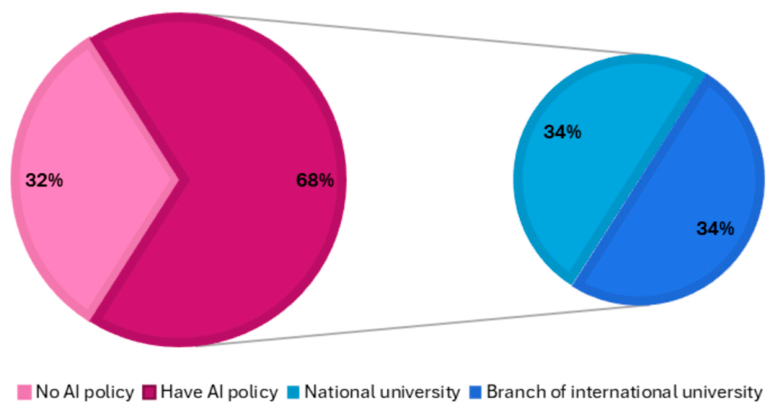
Figure 2.
Visualization of themes and subthemes across each country.
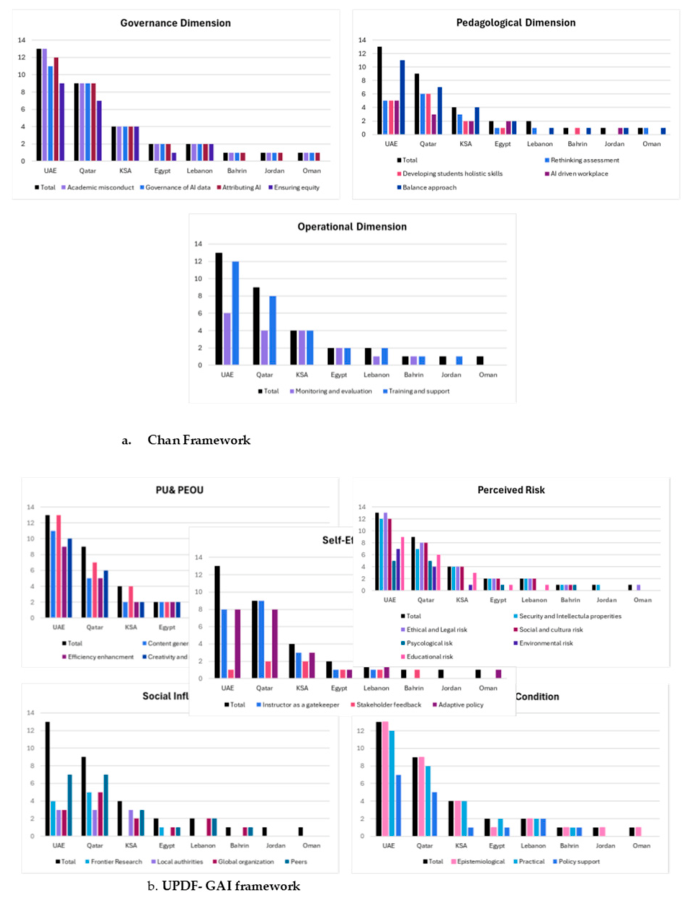

Table 1.
Inclusion and exclusion criteria.
| Inclusion Criteria | Exclusion Criteria |
|---|---|
| Publicly available documents | Documents that are restricted to internal access |
| Official statement, policy, procedure, guide, guideline, communication, memos | Unofficial documents (e.g. drafts) |
| Issued at the university level or by a specific college, department, or center | Training courses and blogs |
| All publications, for any purpose such as teaching, learning, administration, and research | External organizational or institutional policies or guidelines, unless clearly adopted by the institution |
Table 2.
Themes and subthemes identified inductively and deductively.
| Theme | Sub-themes |
|---|---|
| Chan 2023 framework (Deductive) | |
| Governance Dimension | Understanding, identifying, and preventing academic misconduct and ethical dilemmas Addressing governance of AI: data privacy, transparency, accountability, and security Attributing AI technologies Ensuring equity in access to AI |
| Pedogeological Dimension | Rethinking assessments and examinations Developing students’ holistic competencies/generic skills Preparing students for the AI-driven workplace Encouraging a balanced approach to AI adoption |
| Operational dimension | Monitoring and evaluating AI implementation Providing training and support for teachers, staff, and students in AI literacy |
| UPDF-GAI (Deductive) | |
| Perceived Usefulness (PU) & Perceived Ease of Use (PEOU) | Content generation and edition. Personalization and assistive function Efficiency enhancement and automation Support for creativity and innovation |
| Perceived risk | Security and Intellectual Property Risks Data Security Copyright infringement Ethical and legal risk Plagiarism False or inaccurate information Legal risks Social and cultural risk Bias and discrimination Control of speech and thought Psychological risk Over-reliance of AI AI divide Environmental risk Educational risk |
| Social Influence | Frontier research Local Authorities Global organization Peers |
| Facilitating conditions to adopt GenAI | Epistemological Practical Policy support |
| Self-efficacy | Instructor as a gatekeeper Stakeholder feedback Adaptive policy |
| Inductive | |
| Promote academic integrity | Communicating clear instructions and expectations Defining stakeholders’ responsibilities Strategies to maintain academic integrity |
| Encourage Critical Evaluation of GenAI output | Critical evaluation and skeptical review Verification and cross-referencing with trusted sources Human judgment and oversight |
| Course-level integration of GenAI | Deciding integration strategies Develop course policy/syllabus |
Table 3.
Overlapping themes/subthemes between Chan and UPDF frameworks.
| Chan 2023 | UPDF-GAI | Comments |
|---|---|---|
| Governance Dimension: Understanding, identifying, and preventing academic misconduct and ethical dilemmas |
Perceived risk: plagiarism, educational risk |
Similarity in “Identifying” the risk where academic misconduct can be classified as plagiarism or an educational risk, based on the context. |
| Governance Dimension: Addressing governance of AI: data privacy, transparency, accountability, and security |
Perceived risk: data security |
Data coded under Data privacy and security in Chan was also coded under data security in UPDF-GAI |
| Operational Dimension: Providing training and support in AI literacy |
Facilitating conditions: Practical support | UPDF-GAI practical support is more comprehensive and includes other forms of support |
| Pedogeological Dimension: Developing students’ holistic competencies/ generic skills |
Facilitating conditions: Epistemological | Educating students and developing AI literacy and digital skills were coded under UPDF-GAI, while critical thinking and other skills impeded by AI were coded under Chan subtheme |
Disclaimer/Publisher’s Note: The statements, opinions and data contained in all publications are solely those of the individual author(s) and contributor(s) and not of MDPI and/or the editor(s). MDPI and/or the editor(s) disclaim responsibility for any injury to people or property resulting from any ideas, methods, instructions or products referred to in the content. |
© 2026 by the authors. Licensee MDPI, Basel, Switzerland. This article is an open access article distributed under the terms and conditions of the Creative Commons Attribution (CC BY) license (http://creativecommons.org/licenses/by/4.0/).
Copyright: This open access article is published under a Creative Commons CC BY 4.0 license, which permit the free download, distribution, and reuse, provided that the author and preprint are cited in any reuse.