

Submitted:
17 November 2026
Posted:
18 November 2026
You are already at the latest version
Abstract
As manufacturers strive for optimisation with real-time closed-loop processes, digital twins (DTs) are emerging from the concept phase and becoming reality. There are, however, a number of differences between the two types: discrete manufacturing (job shops, assembly, and machining) versus continuous or process manufacturing (chemicals, petrochemicals, pharmaceuticals, polymers), and only a few reviews compare the two. Following the PRISMA 2020 guidelines, a systematic review of the architectures, enabling technologies and implementation barriers for real-time process optimisation is presented in both processes. The review categorizes DTs as digital model, digital shadow, and digital twin with regard to their level of integration, and as physics-based, data-driven, and hybrid with respect to modelling approach. It then outlines the key elements of architectural layers required to close the optimisation loop and identifies the top enablers: industrial IoT, edge and cloud computing, interoperability standards, simulation and machine learning. Discrete-manufacturing DTs focus on scheduling, machining parameter control and line balancing. DTs are divided into continuous-process DTs, which aim for soft sensing, model predictive control and energy optimisation, with physics complexity and legacy control systems slowing the adoption. In both fields, numerous “twins” have been reported that are actually “digital shadows” without automatic feedback to the physical asset. The paper focuses specifically on barriers in developing economies, drawing on data from the Zimbabwean manufacturing sector such as obsolete technology, unreliable power, lack of skills, lack of capital, and slow technology uptake. It illustrates how the existing research in offline optimisation (Taguchi-based optimisation of machining process, CFD-based design) can be a stepping stone for DT-based optimisation. Finally, the paper outlines a research agenda on: low-cost and modular DT architectures, hybrid modelling, human-centric twins, and standardised DT maturity assessment.
Keywords:
digital twin
; process optimisation
; discrete manufacturing
; process industry
; cyber-physical systems
; Industry 4.0
; implementation barriers
; developing economies
; systematic review
I. Introduction
The manufacturers are dealing with fluctuating orders, increasing energy prices, stricter environmental regulations and increased pressure on a cost–quality balance. Optimization of the process has been performed offline in the past. These experiments are conducted by engineers, regression or response surface models are fitted and optimum parameters are programmed into the machine. Such parameters are then maintained constant for the next study. That is in stable conditions but it will not cope with tool wear, raw material variations, environmental changes or new orders. The digital twin (DT) is a new paradigm where a virtual version of a physical asset, process or system is continually updated using real-time data, with decisions made in the virtual world that are then reflected in the real world in real time [1,2].
Grieves first introduced the idea of product life cycle management that involved a physical product, a virtual representation of the product and the data connection between them [1]. With the advent of low cost sensors, cloud and edge computing, and machine learning, DT research has expanded significantly in the manufacturing sector since around 2017, paving the way for the Industrial Internet of Things (IIoT) [2,3,4]. There are several general reviews that are available. Kritzinger et al. [5] categorised the DTs according to the integration of the data. Tao et al. surveyed the existing literature on the industry [2]. Jones et al. characterised the DT concept [6]. Liu et al. [3] analyzed concepts, technologies and applications. Cimino et al. conducted a review of applications used in manufacturing [7]. Leng et al. [8] presented a review of the design of the smart manufacturing system based on DT. Perno et al. conducted a systematic review of enablers and barriers in the process industry, finding that there is something scattered and immature in the literature [9]. Chen et al. conducted a review on DT in drug and biopharmaceutical industries [10].
Three gaps remain. Most of the reviews in the first address discrete manufacturing (parts made one at a time, counted, e.g., machining, assembly and job shops) and the second address continuous manufacturing (materials processed in a flow, e.g., chemicals, refining, pharmaceuticals and polymer extrusion). Very few compare the two, the time constants differ, sensing and control architecture is different and it is difficult to model. Secondly, there is a lack of reviews that concentrate on real-time process optimisation, that is, DTs that make use of the DT to alter the process parameters, not only to observe or monitor the process. Third, almost all evidence concerning implementation barriers is in high income settings. Little is known about adoption where equipment is old, power is unreliable and capital is scarce, as is common in sub-Saharan Africa [11,12,13].
This review addresses these gaps with four research questions:
- RQ1: How are DTs for real-time process optimisation defined and classified, and how mature are reported implementations?
- RQ2: What architectures are used to close the optimisation loop in discrete and continuous manufacturing?
- RQ3: Which enabling technologies make real-time DT optimisation possible, and how does their role differ between the two domains?
- RQ4: What barriers limit implementation, particularly in developing economies, and what research is needed to overcome them?
The paper’s contributions are: (i) Comparative synthesis of DT-based optimisation for both the discrete and continuous manufacturing sectors; (ii) A reference architecture for closed-loop optimisation; (iii) Barriers classification – including developing economy cases based on recent studies in Zimbabwe [11,12,13,14,15]; (iv) Research agenda. A method is described in Section II. Definitions and maturity is covered in section III. Architectures and enablers are discussed in sections IV and V. Applications are subject to review in Section VI. Barriers are analysed in Section VII. Section VIII is a section of gaps and future directions and Section IX is a conclusion.
II. Review Methodology
The review follows the PRISMA 2020 statement for systematic reviews [16]. The protocol has four stages: identification, screening, eligibility assessment and synthesis.
A. Data Sources and Search Strategy
The main databases used are Scopus and Web of Science Core Collection with IEEE Xplore and ScienceDirect added for engineering-specific content. The search period is from January, 2015 to October, 2026. This range begins just before the dramatic manufacturing DT publications [2,5] begin the upward trend. Studies that were not retrieved by the database strings were identified using backward and forward citation searching (snowballing) of key reviews [2,3,4,5,6,7,8,9,10]. To avoid database bias, regional journals which were not indexed in African Journals Online and Google Scholar were also searched. This is how the Zimbabwean studies [11,12,13,14,15] were included.
B. Eligibility Criteria

Table 1.
Eligibility criteria.
| Criterion | Inclusion | Exclusion |
|---|---|---|
| Domain | Discrete or continuous manufacturing processes and systems | Construction, healthcare, smart cities, aerospace in-service (except where methods transfer directly) |
| Focus | DT used for process or system optimisation, control, scheduling or decision support | DT used only for product design or visualisation, with no process link |
| Evidence | Peer-reviewed journal articles, conference papers in indexed proceedings, international standards | Editorials, white papers (except seminal [1]), patents, non-English texts |
| Barrier studies | Empirical or review studies of DT or Industry 4.0 adoption barriers | Opinion pieces without data |
| Optimisation baselines | Experimental optimisation studies that a DT could make continuous (for developing-economy context) | Studies with no measurable process response |
C. Screening, Data Extraction and Synthesis
Titles and abstracts were independently screened by two reviewers who disagreed on titles by reading the full text which was resolved by discussion. The following data were extracted for each included study: manufacturing domain (discrete or continuous), application area, DT maturity level (Section III), modelling approach, optimisation method, communication and computing stack, validation type (simulation, laboratory, industrial) and reported barriers. The synthesis is narrative and thematic in nature due to the too much diversified nature of the studies for meta-analysis.
D. Limitations of the Method
The term “digital twin” is not consistently used. There are some studies that are simulation models or monitoring dashboards, which are classified as DTs [5,17]. The review hence involved classification of studies based on their functions, rather than on their names. Publication bias towards successful implementations would be expected to exist, particularly in case studies linked with vendors. If non-English work is excluded, industrial reports may be under-represented among Chinese, German and Francophone-African industrial reports.
III. Concepts, Definitions and Maturity
A. Definitions
No single definition is accepted, but most share three elements: a physical entity, a virtual representation, and a bidirectional data connection that keeps the two in step [1,6]. Negri et al. stress that the twin mirrors the physical system’s behaviour throughout its life, not just its geometry [18]. Tao and Zhang extended the idea from products to the whole shop floor, adding a service layer and a fused data store to the physical and virtual parts [19]. ISO 23247-1 formalises a DT framework for manufacturing. It defines observable manufacturing elements (personnel, equipment, materials, processes, facilities, environment, products) and a reference model of device, core and user entities [20].
Wright and Davidson draw a practical line between a model and a twin. A model becomes a twin only when it is continuously updated from measured data and used to make decisions about one particular physical asset [17]. This distinction matters for optimisation. A simulation built at the design stage and never updated can still find good operating points. It cannot, however, track drift, wear or disturbances, which is what makes optimisation real-time.
B. Integration Maturity
Kritzinger et al. proposed the most widely used classification, based on how data flows between the physical and virtual objects [5]. Table 2 combines this with the capability levels used in later work [21,22].
Kritzinger et al. found that most manufacturing studies they reviewed described digital models or shadows, not full twins [5]. Later reviews report the same pattern [3,7,9]. The pattern matters here. Many papers report “DT-based optimisation” where the optimisation runs on a synchronised virtual model, but a person still has to apply the result. Only a minority close the loop automatically. In this review, a study counts as real-time optimisation only if it updates the virtual model from live data and sends decisions back to the process within the process’s relevant time scale.
C. Modelling Approaches
Three modelling approaches appear across the literature [21].
- Physics-based (first-principles) models use conservation laws, kinetics, heat transfer, cutting mechanics or fluid dynamics. They extrapolate well and can be explained, but they are costly to build and slow to run. CFD analysis of a vertical axis wind turbine is one example of a high-fidelity physics model. It could serve as the core of an operational twin once linked to live wind and power data [13].
- Data-driven models (regression, neural networks, Gaussian processes, gradient boosting) learn the relationship between inputs and outputs from process data. They run quickly enough for real-time use but need large, representative datasets and extrapolate poorly. The regression models fitted in Taguchi-based machining studies are a small-scale version of this approach [14,15].
- Hybrid (grey-box) models combine the two. A physics model provides structure, and machine learning corrects its residual error or estimates unmeasured states. Hybrid models are increasingly preferred in the process industry, where pure physics models are too slow and pure data models are unsafe outside their training range [9,10,21].
Discrete-manufacturing twins mostly use discrete-event simulation for system-level questions (flow, scheduling, buffers) and data-driven or mechanistic models for machine-level questions (cutting forces, wear, surface finish). Continuous-process twins mostly use dynamic first-principles or hybrid models of unit operations such as reactors, columns, dryers and extruders.
IV. Architectures for DT-Based Process Optimisation
While these architectures have various names, they all share five complementary levels of functions operating as a closed loop system (Figure 1). Lee et al.’s 5C cyber-physical systems architecture (connection, conversion, cyber, cognition, configuration) is an early incarnation of this layered logic [23]. Lu et al. suggested a DT reference model for smart manufacturing, which has the same layers as the proposed reference model and highlighted the standardised information models in each layer [24].
A. The Five Functional Layers
- 1)
- Physical layer. This layer holds the machines, process units, materials, operators and environment, the “observable manufacturing elements” of ISO 23247 [20]. In discrete manufacturing these are CNC machines, robots, conveyors and assembly stations. In continuous manufacturing they are reactors, heat exchangers, columns, extruders and dryers, already run by a distributed control system (DCS).
- 2)
- Data acquisition and connectivity layer. Sensors, programmable logic controllers (PLCs) and existing supervisory control and data acquisition (SCADA) or DCS systems supply data. This data travels through industrial protocols such as OPC UA and MQTT to edge gateways. At the edge, signals are filtered, time-aligned and compressed. Min et al. showed that frequency alignment and time-lag correction between process variables are essential before a process-industry twin can be trained [25].
- 3)
- Virtual model layer. This layer holds the physics-based, data-driven or hybrid models of Section III-C. A model management function calibrates the models against live data, updating parameters as tool wear, fouling or catalyst decay change the process.
- 4)
- Service and optimisation layer. Here the twin does useful work: monitoring, anomaly detection, prediction, what-if simulation and optimisation. Optimisation methods range from classical mathematical programming and metaheuristics (genetic algorithms, particle swarm) to model predictive control (MPC) and deep reinforcement learning (DRL) agents trained inside the twin [26].
- 5)
- Decision and actuation layer. Optimal set-points, schedules or maintenance actions return to the physical system. In a digital shadow, a human reviews recommendations on a dashboard. In a full twin, the decisions are written directly to PLCs, the DCS or the manufacturing execution system (MES), usually within safety limits and with a human able to override.
B. Time Scales and Where Computation Runs
Where each layer’s computation is run depends on the time scale of the decision. Model and optimiser computations happen at the edge or in the controller for machine-level control loops, such as chatter suppression and regulation of the extrusion melt pressure, which require responses in the millisecond- to second-range. Shop-floor scheduling and line balancing processes take minutes to hours to complete and are cloud-based. Continuous processes typically have a long time constant (minutes to hours in a distillation column or a large kiln) and transport delays. These suit MPC based on a twin-based predictive model [10,25]. The re-planning in discrete systems is often required in response to frequent events such as machine breakdowns and rush orders, and as a result, this is where simulation-based and DRL-based re-planning are predominant [26,27].
C. Discrete Versus Continuous Architectures
The main difference between the two domains is the virtual model and the actuation layers. In discrete-manufacturing architectures, the foundation is on discrete-event simulation of the shop floor, with machine-level models. Typically the MES or the scheduler is the decision interface [19,28]. Continuous-process architectures focus on dynamic process models in conjunction with an existing DCS and advanced process control layer. The twin does not replace the existing controllers, but rather provides optimized set-points to them [9,25]. The continuous-process twins are more conservative: They cannot be bypassed with safety interlocks or validated control logic. The regulatory validation is an additional constraint in the pharmaceutical industry [10].
V. Enabling Technologies
Real-time DT optimisation depends on six groups of enabling technologies [4,21]. Table 3 summarises them and compares their role in the two domains.
A. Sensing and the Industrial Internet of Things
The twin can be as up-to-date as the information put into it. Since 2015, the cost of instrumenting machines has been reduced with low-cost sensors and by the industrial IoT, leading to an increase in DT research [2,29]. The two domains begin at a different point. Continuous plants tend to be well instrumented, as this is essential for safe operation, and the difficulty is in getting the data from historians and the DCS [9,25]. Many machines (usually small and medium businesses (SMEs)) in discrete shop applications do not include any digital interface. The first step is then to make retrofit with external sensors (current clamps, accelerometers, vision). Tayisepi et al. directly measured the spindle power and machining energy during honing and wood planing while performing the machining energy studies [14,15]. This indicates that the most important measurements to be taken on an energy-aware machining twin can be obtained using relatively simple instrumentation.
B. Interoperability and Standards
When the interoperability is present it is frequently mentioned as an enabler, and when it is not present, it is frequently mentioned as a barrier [4,9]. A machine can expose an information model and a transport without having to be specially coded for OPC UA to find out what is being exposed. MTConnect is used for machine tools. For manufacturing-specific DT reference architecture, a reference is given by ISO 23247 [20]. ISA-95 defines the manner in which a twin communicates with the MES and ERP. The studies reviewed indicate that proprietary vendor stacks are still prevalent, particularly in the process industry, and force users to rely on one vendor.
C. Computing Infrastructure
When the network fails, edge computing executes rapid operations near the machine and safeguards the operation. Cloud computing is elastic in terms of training models, running a large number of what-ifs and comparing a fleet of assets [3,4]. The approaches are most commonly used together: training and heavy simulation are done in the cloud, inference and control at the edge. In many developing economies, where the internet or power supply may be unreliable, a design that continues to operate without needing any internet or electricity is a necessity, not a choice (Section VII).
D. Modelling, Simulation and Model Updating
The virtual model is provided by simulation tools (discrete-event, multibody, FEA, CFD and process simulators). They are turned into twin components by the continuous calibration, which is the process of modifying parameters in the model in order to ensure that the model’s predictions remain consistent with the measurements. Techniques are applied such as Kalman filtering for state estimation, Bayesian updating of uncertain parameters and retraining of data-driven components periodically. Reduced-order models and surrogate models play a key role for real-time use. A CFD model that requires a few hours to solve, like turbine design [13] cannot be placed in a control loop. A surrogate trained based on its results can.
E. Artificial Intelligence and Optimisation Methods
The predictive and prescriptive power of twins is provided by machine learning [3,26]. Three patterns recur. The first, learned surrogates are used to replace slow physics models to query them thousands of times to optimise the models. Secondly, soft sensors are used to calculate values that are not measurable online like the composition of the product in a reactor or the surface roughness in the machining process. Thirdly, the twin is a safe training ground. To deploy trained DRL agents to the physical system, Xia et al. trained them in a duplicate of a manufacturing cell [26]. Gan et al. applied a DRL agent with DT to adaptively schedule in a dynamic job shop [27]. The classical design of experiments (DoE) methods are applicable. The most important parameters and the optimum point are determined by Taguchi orthogonal arrays, analysis of variance (ANOVA) and signal-to-noise analysis [14,15]. They provide the factor screening and initial models which can be further elaborated by the twin using real-time data.
F. Human Interface
The operator and the engineer must be able to see what the twin recommends, know why and be able to override it. Researchers are now adopting different perspectives of the human being, which are treated as an observed component of the system instead of a user outside the system [20]. This is in line with the Human Factors Engineering concept. Muhla et al. concluded that ergonomic design, training and safety culture are important factors in accidents at the workplace in the manufacturing industry in Zimbabwe [12]. A twin, which alters the process behaviour without the awareness of the operator, introduces new safety hazards. Safe closed-loop optimisation is therefore an enabling factor of human-centred interface design, and not an afterthought.
VI. Applications in Discrete and Continuous Manufacturing
Applications cluster into five optimisation targets: process parameters, production scheduling and control, system design and reconfiguration, energy and sustainability, and maintenance. Table 4 lists representative studies.
A. Discrete Manufacturing
Machining process parameters.
The goal of twinning is to maintain the best surface finish, dimensional accuracy, tool life and energy consumption when the conditions change. The literature of parameter optimisation reveals what can be achieved. Tayisepi et al. optimised the dry honing of cylinder sleeves made from cast iron with the help of the Taguchi L16 array, ANOVA and the S/N analysis. They determined spindle speed and tool path radius to be the most important parameters in relation to power, energy and surface roughness, and that the optimization of the parameters at the planning stage can reduce a substantial amount of energy [14]. A similar study optimized the planning of pine, saligna and teak. The effect of depth of cut and cutting knives number varied with wood species and the regression model fitted explained approximately 85% of the variance (r2 = 85.07%) [15]. Both studies result in static optimum for a given material and machine. These models would be used as starting points for a machining twin. It would then automatically check in the tools available and optimise accordingly, keeping the tools to the maximum spindle power and vibration level, while changing materials that are different (such as changing batches of timber). For companies that conduct designed experiments, this series of steps is the most viable approach to manufacturing DTs: designed experiment, model, calibrated, model continually updated.
Scheduling and shop-floor control.
The most well developed discrete application is scheduling. The twin mirrors machine states and work in progress and orders, and simulates alternative schedules when a disruption occurs [19,28]. Conventional rescheduling takes longer than the DRL agents trained in the twin can do dispatching rules or operations, and adapt to new disturbances [26,27]. Kunath and Winkler have attached a shop-floor twin to order management, whereby delivery dates are determined based on the current situation of the plant instead of a fixed plan, [31].
System design and reconfiguration.
In several objectives, Zhang et al. designed and optimized a hollow glass production line using a twin [30]. Twins also enable testing of PLC logic and robot programs on the virtual line before physically starting up the robot [26] and [33]. This is a one-to-one link of this to agility. Muhla et al. define agility as the ability to rapidly adapt to change in customer needs, and reported that Zimbabwean manufacturers are not yet at an agile stage of maturity [11]. A reconfiguration twin brings down the cost and risk of each change and makes agility more affordable.
Additive manufacturing.
Additive processes are early adopters of physics-based twins because part quality is dependent on a thermal history that is difficult to measure and expensive. Knapp et al. outlined the foundation of a twin for metal additive manufacturing, with the foundation of heat-transfer and fluid-flow models [32]. Closed-loop control of the melt pool conditions is still in a research stage.
B. Continuous Manufacturing
Petrochemical and chemical processes.
Min et al. developed a machine-learning twin of an industrial catalytic cracking unit based on data from the industrial IoT. It was capable of dealing with high dimensional data, with time lags and sampling-frequency mismatch, and with production control optimisation in an operating plant [25]. Process-industry DTs are hampered by the challenge of modelling complex physics accurately, according to Perno et al. The literature is divided and does not have a common definition [9]. In the 2025 soda ash production review of chemical industry implementations, most of the actual deployments optimise specific unit operations and use of existing process-simulation software [34].
Pharmaceutical manufacturing.
A strong demand for twins is stimulated by the need to move from batch to continuous production in the pharmaceutical sector.In the pharmaceutical sector, strong demand for twins has arisen, due to the transition from batch to continuous production. Other applications considered by Chen et al. are hybrid models of unit operations, real-time release testing, and process control in a defined design space [10]. The biggest limitation is regulatory validation of models used in control.
Polymer processing.
Extrusion and Moulding are processes that are continuous or semi-continuous, and exhibit significant non-linear coupling between product quality, screw speed, pressure and temperature. Self optimising twins based on hybrid models are a natural fit for them. But, in comparison with the machining and chemicals, there is less validated closed loop extrusion twins presented in the literature.
Energy systems within manufacturing.
Continuous systems like boilers, compressors and on-site renewable generation can be optimised for both energy and cost using twins. Muyambo et al. developed and prototyped a prototype of a vertical axis wind turbine (VAWT) capable of capturing the vehicle slipstream for charging EVs employing aerodynamic analysis, CFD and power estimation [13]. Digital models in the sense of Kritzinger [5] are these kinds of design stage models. They are connected to real-time wind speed and power data, and could form the foundation for operational twins to forecast output and schedule charging or storage.
C. Maintenance as an Optimisation Target
In both areas, twin application most frequently used in industry is maintenance [35,36]. Predictive maintenance twins predict remaining useful life, and plan interventions based on the balance of risk of downtime versus loss of production. They are added here because maintenance decisions are related to process optimisation. The operation of a process at the optimum energy or throughput level can cause higher wear. Twin optimising process parameters and maintenance at once does not mean optimizing one at the expense of the other.
D. Cross-Domain Comparison
Three contrasts emerge. First, the timescale: discrete twins are concerned with event-driven re-planning, continuous twins with smooth set point trajectories. Second, Model type: the discrete twins tend to be more data-driven, and the continuous twins more first-principles driven. Thirdly, maturity: closed loop deployment is more common in discrete scheduling, which tends to cost time if the decision is wrong, than in continuous processes, where a wrong set-point may compromise safety or an entire batch. For both areas, most reported realisations only reach the digital shadow [5,7,9].
VII. Implementation Barriers
Barriers fall into five groups: technical, data, organisational and human, economic, and contextual. The first four appear across the global literature [4,9,37]. The fifth, contextual barriers, is largely missing from that literature but dominates in developing economies [11,12,13,38,39]. Table 5 summarises them.
A. Technical and Data Barriers
The lack of accurate and quick modeling of complex physics in the process industry is the most quoted technical barrier [9]. The latter is the number and variety of assets to be modeled and integrated in the case of discrete manufacturing [3,7]. One of the frequent issues is model validation. The longer a model is allowed to operate, the more the model could deviate from the real value without anyone realizing this, unless calibration and uncertainty estimates are incorporated [17,21]. The data barriers are poor data quality, lack of context, unaligned time stamp and fragmented data [25,37]. Interoperability between machines of different makes, and between operational technology and IT systems, remains unsolved in many plants despite OPC UA and ISO 23247 [20]. Cybersecurity concerns grow once the twin can write back to controllers. A twin with actuation authority is also an attack surface.
B. Organisational, Human and Economic Barriers
Skills in process engineering, control, data science and software engineering are not commonly seen in the same person, which is essential for DT projects. In the process industry, the most important barriers found by Perno et al. were “skills” and “unclear value” and “organisation readiness” [9]. Bello et al. conducted a survey to evaluate 246 construction professionals in Nigeria. They identified four factors of barriers: technology and investment, data management and governance, project and human resources, and digital transformation [38]. The above research comes from construction, but shares much of the structure with manufacturing. Economic barriers focus on high initial investment with a future, but unknown, return. Most DT frameworks make assumptions of sufficient funds and support of IT which is a major disadvantage to SMEs.
C. Contextual Barriers in Developing Economies: Evidence from Zimbabwe
Recent Zimbabwean studies show why barriers in developing economies are of a different kind, not just a larger version of those elsewhere.
- Legacy equipment and labour-intensive methods.
The Zimbabwean manufacturers are slow to embrace new technologies and continue to employ old, labor-intensive and expensive techniques, reports Muhla et al. and is primarily attributed to economic recession [11]. The same study revealed that machinery with inadequate safety features and outdated was one of the causes of workplace accidents [12]. If there is no controller in the machine, then a twin must be retrofitted with sensing for any machine to do anything.
- Resilience before optimisation.
The agility study is based upon a survey of 20 companies, and they’re still a ways from agile maturity. They were facing volatile markets, lower import costs and the impact of COVID-19 [11]. In such a context, investment is prioritized for survival. Therefore a DT business case should demonstrate fast, tangible benefits, such as reducing energy costs or energy saving or scrap, rather than strategic benefits.
- Unreliable electricity.
One of the factors that drove the study of the turbine was the irregular and less than satisfactory supply of electricity and the over-reliance on fossil generation [13]. Unreliable power has a direct impact on twins: sensors, gateways and networks go offline, data has gaps, closed loops must fall back safely. Thus, Edge-first designs that use local storage, followed by battery backup and graceful degradation are required.
- Energy cost as an entry point.
The energy-aware optimisation is the most compelling initial use case, as energy pressures are the same. The results of the honing and wood-planing studies indicate that the choice of the parameters has a measurable influence on the energy used for the machining process [14] and [15]. It is a clear and measurable return on investment to keep energy use at its optimum through a twin.
- Safety culture and human factors.
Lack of proper training, inconsistent enforcement of safety regulations and poor ergonomics contribute to accidents [12]. Self-learning set point changes in such environments without training of the operator and with murky interfaces could increase the risk and not decrease it.
These results are consistent with a recent study on the adoption of DT in emerging economies. This review relates adoption to sustainable manufacturing performance but indicates that infrastructure, cost and skills are barriers [39]. The barriers in the developing economies are not similar in nature but are different. They do not require a scaled down version of high income designs; they call for DT architectures that are low cost, intermittent, and retrofit with low cost.
VIII. Research Gaps and Future Directions
The synthesis points to seven research directions.
- 1)
- From shadow to twin, with evidence. Most reported implementations are digital shadows [5,7,9]. Industrial studies that close the loop automatically and report measured before-and-after performance are needed. They should cover throughput, quality, energy and safety, and include the conditions under which the twin hands control back to people.
- 2)
- Standard maturity and performance metrics. Studies use “digital twin” for very different systems [6,17]. A shared assessment, building on Kritzinger’s integration levels [5] and ISO 23247 [20], would allow studies to be compared. It should rate data integration, model fidelity, update frequency, decision authority and validated benefit.
- 3)
- Hybrid modelling for continuous processes. Physics-informed machine learning, surrogate models of CFD and flowsheet models, and online parameter estimation are the most promising ways around the modelling barrier in the process industry [9,10,21]. Polymer extrusion and moulding are especially under-studied relative to their industrial importance.
- 4)
- Low-cost, retrofit and intermittency-tolerant architectures. For SMEs and developing economies, research should design and test twins built on open-source software, low-cost sensors and microcontrollers, and edge-first computing. These twins should keep working through power and network outages [13,39]. A good benchmark would be a twin deployed on legacy machines in a typical Zimbabwean or regional factory, with its full cost and return reported.
- 5)
- From designed experiments to living models. Many firms and universities already run Taguchi, response-surface and ANOVA studies on their processes [14,15]. A practical pathway would turn these static models into calibrated, self-updating twins, starting with energy-aware machining. This pathway uses existing local expertise and would lower the entry barrier.
- 6)
- Human-centric and safe twins. Industry 5.0 places the human, resilience and sustainability at the centre of manufacturing [40]. Twins should model operator workload, ergonomics and safety as well as machine states. They should also explain their recommendations, consistent with the human-factors evidence that training and ergonomic design drive safety outcomes [12].
- 7)
IX. Conclusions
This review investigated some DTs related to real-time process optimisation in both discrete and continuous manufacturing processes. It answered four questions: Definitions and maturity, Architectures, Enabling Technologies and Implementation barriers. Reported architectures converge on five layers (physical, data, model, service and decision). A complete twin closes the optimization loop automatically only and in both domains most implementations are still a digital shadow. Closed-loop scheduling and machine-level optimisation lead in discrete manufacturing, which is realised by means of discrete-event simulation and learning-based approaches. Continuous manufacturing makes more use of hybrid and first principles models that are used to inform existing control systems, and is hindered by the complexity of modeling and safety concerns. The key enablers of IOT are: Industrial IoT, standards for interoperability, edge-cloud computing, simulation and machine learning.
There are different challenges to implementation in developing economies. The evidence from Zimbabwe indicates that the degree of possible improvement is influenced by legacy equipment, power supply fluctuations, lack of skills, lack of safety culture and economic instability. Existing local strengths provide a route in. Studies on the optimisation of the machining process for energy saving can be refined into low-cost retrofit twins, as can be CFD design and human factors research. Future research should be undertaken to show closed-loop benefits in actual plants, to standardise maturity assessment, and to further develop hybrid modelling and design to provide reliable and safe operation of twins in resource-constrained applications.
References
- Grieves, M. Digital twin: Manufacturing excellence through virtual factory replication. In White Paper; 2014; pp. 1–7. [Google Scholar]
- Tao, F.; Zhang, H.; Liu, A.; Nee, A. Y. C. Digital twin in industry: State-of-the-art. IEEE Trans. Ind. Informat. 2019, vol. 15(no. 4), 2405–2415. [Google Scholar] [CrossRef]
- Liu, M.; Fang, S.; Dong, H.; Xu, C. Review of digital twin about concepts, technologies, and industrial applications. J. Manuf. Syst. 2021, vol. 58, 346–361. [Google Scholar] [CrossRef]
- Fuller; Fan, Z.; Day, C.; Barlow, C. Digital twin: Enabling technologies, challenges and open research. IEEE Access 2020, vol. 8, 108952–108971. [Google Scholar] [CrossRef]
- Kritzinger, W.; Karner, M.; Traar, G.; Henjes, J.; Sihn, W. Digital twin in manufacturing: A categorical literature review and classification. IFAC-PapersOnLine 2018, vol. 51(no. 11), 1016–1022. [Google Scholar] [CrossRef]
- Jones, D.; Snider, C.; Nassehi, A.; Yon, J.; Hicks, B. Characterising the digital twin: A systematic literature review. CIRP J. Manuf. Sci. Technol. 2020, vol. 29, 36–52. [Google Scholar] [CrossRef]
- Cimino, C.; Negri, E.; Fumagalli, L. Review of digital twin applications in manufacturing. Comput. Ind. 2019, vol. 113, Art. no. 103130. [Google Scholar] [CrossRef]
- Leng, J.; et al. Digital twins-based smart manufacturing system design in Industry 4.0: A review. J. Manuf. Syst. 2021, vol. 60, 119–137. [Google Scholar] [CrossRef]
- Perno, M.; Hvam, L.; Haug, A. Implementation of digital twins in the process industry: A systematic literature review of enablers and barriers. Comput. Ind. 2022, vol. 134, Art.(no. 103558). [Google Scholar] [CrossRef]
- Chen, Y.; Yang, O.; Sampat, C.; Bhalode, P.; Ramachandran, R.; Ierapetritou, M. Digital twins in pharmaceutical and biopharmaceutical manufacturing: A literature review. Processes 2020, vol. 8(no. 9), Art. no. 1088. [Google Scholar] [CrossRef]
- Muhla, T.; Mapindu, I.; Munyau, M.; Mashava, D.; Mhlanga, S.; Goriwondo, W. Agility as a strategy in Zimbabwean manufacturing industries. Zimb. J. Sci. Technol. 2023, vol. 18, 1–11. [Google Scholar]
- Muhla, T.; Kanyemba, G.; Mapindu, I.; Chinguwo, N.; Mashava, D.; Goriwondo, W. Enhancing safety in Zimbabwean manufacturing industry: The role of human factors engineering in reducing workplace accidents. Open Access Res. J. Sci. Technol. 2025, vol. 13(no. 2), 19–30. [Google Scholar] [CrossRef]
- Muyambo, R. D.; Muhla, T.; Kanyemba, G.; Mashava, D.; Munhuwamambo, G.; Mapindu, I. Design and development of a vertical axis wind turbine for slip stream energy harvesting. Glob. J. Eng. Technol. Adv. 2025, vol. 23(no. 3), 10–20. [Google Scholar] [CrossRef]
- Tayisepi, N.; Mugwagwa, L.; Mnkandla, A. N.; Mapindu, I.; Muhla, T. M. Experimental investigation and simultaneous optimisation of honing parameters of dry cast iron cylinder relining sleeves of motor vehicle engine blocks for surface finish and energy use. Comput. Eng. Phys. Model. 2024, vol. 7(no. 4), 88–103. [Google Scholar] [CrossRef]
- Tayisepi, N.; Svosve, R.; Tigere, G.; Mnkandla, A. N.; Mapindu, I. Comparative optimisation of the cutting parameters for surface quality and energy efficiency during the machining manufacturing of teak, saligna and pine wood materials. J. Eng. Res. Rep. 2023, vol. 25(no. 11), 73–87. [Google Scholar] [CrossRef]
- Page, M. J.; et al. The PRISMA 2020 statement: An updated guideline for reporting systematic reviews. BMJ 2021, vol. 372, Art.(no. n71). [Google Scholar] [CrossRef] [PubMed]
- Wright, L.; Davidson, S. How to tell the difference between a model and a digital twin. Adv. Model. Simul. Eng. Sci. 2020, vol. 7, Art.(no. 13). [Google Scholar] [CrossRef]
- Negri, E.; Fumagalli, L.; Macchi, M. A review of the roles of digital twin in CPS-based production systems. Procedia Manuf. 2017, vol. 11, 939–948. [Google Scholar] [CrossRef]
- Tao, F.; Zhang, M. Digital twin shop-floor: A new shop-floor paradigm towards smart manufacturing. IEEE Access 2017, vol. 5, 20418–20427. [Google Scholar] [CrossRef]
- ISO 23247-1:2021; Automation Systems and Integration—Digital Twin Framework for Manufacturing—Part 1: Overview and General Principles. International Organization for Standardization: Geneva, Switzerland, 2021.
- Rasheed, O. San; Kvamsdal, T. Digital twin: Values, challenges and enablers from a modeling perspective. IEEE Access 2020, vol. 8, 21980–22012. [Google Scholar] [CrossRef]
- VanDerHorn, E.; Mahadevan, S. Digital twin: Generalization, characterization and implementation. Decis. Support Syst. 2021, vol. 145, Art. no. 113524. [Google Scholar] [CrossRef]
- Lee, J.; Bagheri, B.; Kao, H.-A. A cyber-physical systems architecture for Industry 4.0-based manufacturing systems. Manuf. Lett. 2015, vol. 3, 18–23. [Google Scholar] [CrossRef]
- Lu, Y.; Liu, C.; Wang, K. I.-K.; Huang, H.; Xu, X. Digital twin-driven smart manufacturing: Connotation, reference model, applications and research issues. Robot. Comput.-Integr. Manuf. 2020, vol. 61, Art. no. 101837. [Google Scholar] [CrossRef]
- Min, Q.; Lu, Y.; Liu, Z.; Su, C.; Wang, B. Machine learning based digital twin framework for production optimization in petrochemical industry. Int. J. Inf. Manag. 2019, vol. 49, 502–519. [Google Scholar] [CrossRef]
- Xia, K.; et al. A digital twin to train deep reinforcement learning agent for smart manufacturing plants: Environment, interfaces and intelligence. J. Manuf. Syst. 2021, vol. 58, 210–230. [Google Scholar] [CrossRef]
- Gan, X.; et al. Digital twin-enabled adaptive scheduling strategy based on deep reinforcement learning. Sci. China Technol. Sci. 2023, vol. 66(no. 7), 1937–1951. [Google Scholar] [CrossRef]
- Zhuang, C.; Liu, J.; Xiong, H. Digital twin-based smart production management and control framework for the complex product assembly shop-floor. Int. J. Adv. Manuf. Technol. 2018, vol. 96, 1149–1163. [Google Scholar] [CrossRef]
- Qi, Q.; Tao, F. Digital twin and big data towards smart manufacturing and Industry 4.0: 360 degree comparison. IEEE Access 2018, vol. 6, 3585–3593. [Google Scholar] [CrossRef]
- Zhang, H.; Liu, Q.; Chen, X.; Zhang, D.; Leng, J. A digital twin-based approach for designing and multi-objective optimization of hollow glass production line. IEEE Access 2017, vol. 5, 26901–26911. [Google Scholar] [CrossRef]
- Kunath, M.; Winkler, H. Integrating the digital twin of the manufacturing system into a decision support system for improving the order management process. Procedia CIRP 2018, vol. 72, 225–231. [Google Scholar] [CrossRef]
- Knapp, T.; et al. Building blocks for a digital twin of additive manufacturing. Acta Mater. 2017, vol. 135, 390–399. [Google Scholar] [CrossRef]
- Uhlemann, T. H.-J.; Lehmann, C.; Steinhilper, R. The digital twin: Realizing the cyber-physical production system for Industry 4.0. Procedia CIRP 2017, vol. 61, 335–340. [Google Scholar] [CrossRef]
- Szczeblewski, S.; Gębicki, J. Digital twins implementations in the chemical industry with a focus on soda ash production: A literature review. Chem. Prod. Process Model. 2025. [Google Scholar] [CrossRef]
- Errandonea; Beltrán, S.; Arrizabalaga, S. Digital twin for maintenance: A literature review. Comput. Ind. 2020, vol. 123, Art.(no. 103316). [Google Scholar] [CrossRef]
- Jiang, Y.; Yin, S.; Li, K.; Luo, H.; Kaynak, O. Industrial applications of digital twins. Philos. Trans. R. Soc. A 2021, vol. 379(no. 2207), Art. no. 20200360. [Google Scholar] [CrossRef] [PubMed]
- Botín-Sanabria, D. M.; et al. Digital twin technology challenges and applications: A comprehensive review. Remote Sens. 2022, vol. 14(no. 6), Art. no. 1335. [Google Scholar] [CrossRef]
- Bello, O.; Olanrewaju, O. I.; Gbenga, P. O.; Khan, A. A.; Isa, R. B. Exploring the barriers to digital twin adoption in the Nigerian construction industry: A structural equation modelling approach. J. Eng. Des. Technol. 2024. [Google Scholar] [CrossRef]
- Cassius, A.; Abiji, E.; Diwa, D. O.; Egede, D. A. Digital twin technology adoption and sustainable manufacturing performance in emerging economies: A literature review. Int. J. Soc. Sci. Manag. Res. 2026, vol. 12(no. 10), 474–493. [Google Scholar] [CrossRef]
- Xu, X.; Lu, Y.; Vogel-Heuser, B.; Wang, L. Industry 4.0 and Industry 5.0—Inception, conception and perception. J. Manuf. Syst. 2021, vol. 61, 530–535. [Google Scholar] [CrossRef]
Figure 1.
Reference architecture for DT-based real-time process optimisation, synthesised from [19,20,23,24]. Live data flows down from the physical layer to the optimisation services. The return path on the right is what separates a full twin from a digital shadow.
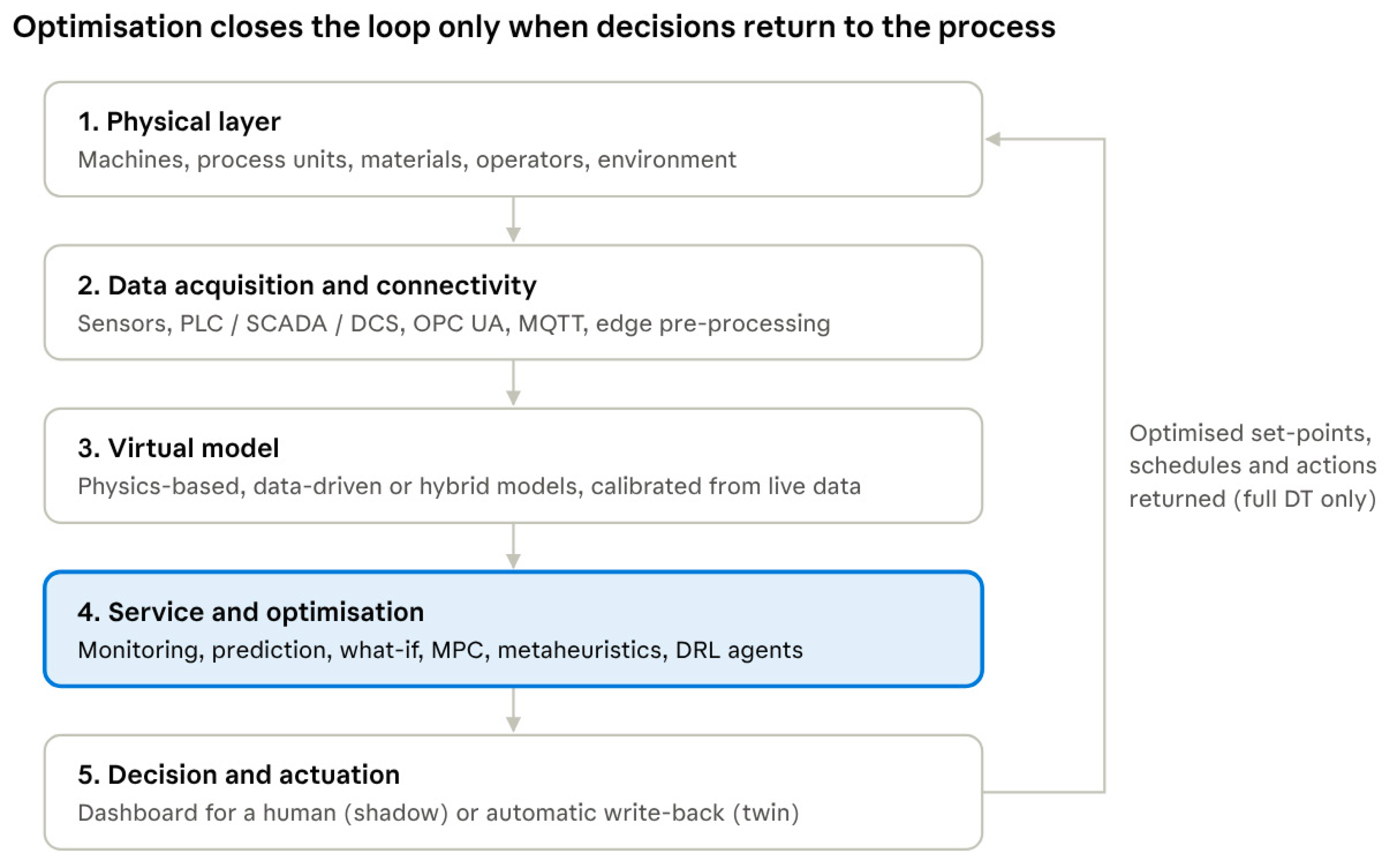
Table 2.
Digital twin maturity for process optimisation.
| Level | Data flow | Typical capability | Optimisation role |
|---|---|---|---|
| Digital model | Manual, both directions | Offline simulation, design of experiments, CFD, FEA | Finds optimum parameters once, before production |
| Digital shadow | Automatic physical-to-virtual; manual virtual-to-physical | Live monitoring, diagnostics, prediction | Recommends adjustments; a human decides |
| Digital twin | Automatic, both directions | Prescriptive and autonomous control | Changes set-points or schedules in closed loop |
| Cognitive or autonomous twin | Automatic, with learning and self-adaptation | Self-optimising, self-reconfiguring | Updates its own models and objectives |
Table 3.
Enabling technologies and their role in discrete and continuous manufacturing.
| Enabler | Function in the twin | Discrete manufacturing | Continuous manufacturing |
|---|---|---|---|
| Sensing and industrial IoT | Capture state of assets and process | Spindle power, vibration, acoustic emission, vision, RFID tracking of parts | Temperature, pressure, flow, composition analysers; often already in the DCS |
| Connectivity and interoperability | Move data between layers with shared meaning | OPC UA, MTConnect for machine tools, MQTT | OPC UA, historians, ISA-95 integration with MES/ERP |
| Edge, fog and cloud computing | Run models at the speed the decision needs | Edge for machine-level loops; cloud for scheduling | Edge or on-premises for MPC; cloud for fleet analytics |
| Modelling and simulation | Represent behaviour of the physical system | Discrete-event simulation, cutting mechanics, FEA, robot kinematics | Dynamic first-principles models, CFD, flowsheet simulators |
| Artificial intelligence and analytics | Learn, predict and optimise | Tool-wear prediction, quality classification, DRL scheduling | Soft sensors, anomaly detection, hybrid models, DRL for control |
| Visualisation and human interface | Let people understand and override the twin | 3D shop-floor views, AR for operators | Process graphics, operator advisory screens |
Table 4.
Representative DT-based optimisation studies.
| Ref. | Domain | Application | Model type | Optimisation approach | Maturity |
|---|---|---|---|---|---|
| [25] | Continuous (petrochemical) | Catalytic cracking unit production control | Data-driven (ML on IIoT data) | Model-based set-point optimisation | Shadow to twin |
| [10] | Continuous (pharma) | Continuous and batch drug manufacture | Hybrid, mechanistic | MPC, design space exploration | Model to shadow |
| [30] | Discrete (glass line) | Hollow glass production line design | Simulation + data | Multi-objective optimisation | Model to shadow |
| [26] | Discrete (cell) | Robotic manufacturing cell | Simulation (virtual commissioning) | DRL agent trained in twin | Twin (validated) |
| [27] | Discrete (job shop) | Dynamic scheduling | Simulation + learned policy | DRL adaptive scheduling | Twin (simulated) |
| [28] | Discrete (assembly) | Complex product assembly shop floor | Data + simulation | Production management and control | Shadow |
| [31] | Discrete (order management) | Order release and delivery dates | Discrete-event simulation | Decision support | Shadow |
| [32] | Discrete (additive) | Metal additive manufacturing | Physics-based (heat and fluid flow) | Prediction of build outcomes | Model |
Table 5.
Barriers to DT-based real-time optimisation.
| Category | Barrier | How it appears in developing economies |
|---|---|---|
| Technical | Modelling complexity, real-time computation, model validation | Few local suppliers able to build or maintain models |
| Technical | Legacy equipment without digital interfaces | Most plants run old machines with no controllers or sensors [11,12] |
| Data | Poor data quality, missing context, time misalignment | Little historian infrastructure; manual paper records |
| Data | Interoperability and vendor lock-in | Mixed-vintage equipment from many origins |
| Data | Cybersecurity and data ownership | Weak regulatory guidance; reliance on foreign cloud providers |
| Organisational and human | Skills gaps in data science, control and modelling | Skilled-labour emigration; limited specialised training |
| Organisational and human | Unclear business case, resistance to change | Survival focus during economic instability [11] |
| Economic | High upfront cost, uncertain return | High cost of capital, foreign-currency constraints |
| Contextual | Unreliable electricity and connectivity | Load-shedding interrupts sensing, networks and computing [13] |
| Contextual | Policy and ecosystem gaps | Limited industrial digitalisation incentives and standards bodies |
Disclaimer/Publisher’s Note: The statements, opinions and data contained in all publications are solely those of the individual author(s) and contributor(s) and not of MDPI and/or the editor(s). MDPI and/or the editor(s) disclaim responsibility for any injury to people or property resulting from any ideas, methods, instructions or products referred to in the content. |
© 2026 by the authors. Licensee MDPI, Basel, Switzerland. This article is an open access article distributed under the terms and conditions of the Creative Commons Attribution (CC BY) license (http://creativecommons.org/licenses/by/4.0/).
Copyright: This open access article is published under a Creative Commons CC BY 4.0 license, which permit the free download, distribution, and reuse, provided that the author and preprint are cited in any reuse.