
Submitted:
17 November 2026
Posted:
18 November 2026
You are already at the latest version
Abstract
Low temperature is a major environmental stressor affecting insect survival during overwintering. Sugar, polyol, and lipid metabolism are important physiological processes in cold adaptation. However, metabolic changes and associated molecular responses in Aeropus sibiricus eggs during overwintering remain poorly understood. This study investigated changes in metabolite contents and related metabolic gene expression in overwintering eggs. Soil temperatures around eggs were monitored from August to January, and egg pods were collected monthly on the 30th for subse-quent metabolite and gene expression analyses. Soluble sugars and polyols were quantified by HPLC; glycogen, triglycerides, and free fatty acids by spectrophotometry; gene expression by RT-qPCR. Soil temperatures decreased from 18.8 °C to −7.8 °C. Glycogen, glucose, and trehalose contents generally declined, along with GBE1, G6PC, and TPS expression, while TREH showed stage-specific changes. Glycerol and sorbitol contents increased continuously. GK and SDH ex-pression was higher during early overwintering and then declined. Triglyceride content and FASN expression increased significantly from August to October and then decreased. Free fatty acid content decreased significantly from October to January. These findings revealed dynamic changes in sugar, polyol, and lipid metabolism in A. sibiricus eggs and provided a basis for further inves-tigation of the metabolic regulation underlying cold adaptation.
Keywords:
grasshopper
; cold hardiness
; metabolites
; gene expression
1. Introduction
Low winter temperatures are an important environmental stressor for insects inhabiting high-latitude and -altitude regions, as it significantly affects insect population persistence, survival, and development. To improve survival during prolonged low winter temperatures, insects enter diapause to reduce metabolic activity and enhance cold hardiness [1,2]. The development of cold hardiness, however, involves complex physiological and molecular regulatory processes, including the accumulation of cryoprotectants [2,3].
Cryoprotectants such as trehalose, glycerol, and sorbitol reduce the freezing point of body fluids, maintain cellular osmotic balance, and inhibit ice crystal formation to improve survival under extremely low-temperature conditions [4]. Different insect taxa selectively accumulate different types of cryoprotectants during overwintering; for example, the diapause eggs of Bombyx mori accumulate polyols, such as glycerol and sorbitol, during the early overwintering stage, whereas the adults of Aleuroglyphus ovatus and Telenomus remus enhance cold hardiness mainly through trehalose accumulation [5,6,7]. Metabolites such as glucose and triglyceride (TG) that are involved in sugar and lipid metabolism are also important for the adaptation of insects to low-temperature environments [8,9].
These changes in sugar, polyol, and lipid metabolism during overwintering are regulated by the expression of genes that encode relevant enzymes. Specifically, genes involved in trehalose synthesis and degradation such as trehalose-6-phosphate synthase (TPS) and trehalase (TREH), as well as polyol metabolism-related genes including glycerol kinase (GK), sorbitol dehydrogenase (SDH), and lipid synthesis-related fatty acid synthase (FASN), are closely associated with the development of cold hardiness in insects [10,11,12,13,14]. In addition, genes involved in glycogen metabolism and gluconeogenesis were reported to participate in the regulation of sugar metabolism in insects and to be closely associated with energy storage and utilization. Among these genes, glycogen branching enzyme (GBE1) was involved in glycogen branching, whereas glucose-6-phosphatase (G6PC) was involved in glucose metabolism [15,16]. However, changes in the expression levels of these genes during insect overwintering and their relationships with metabolites remain unclear.
Aeropus sibiricus (Linnaeus) is a grasshopper mainly distributed in alpine grasslands above 1,500 m elevation across northern regions of China, including Inner Mongolia, Xinjiang, Gansu, Heilongjiang, and Jilin, as well as Mongolia, Siberia of Russia, and southern and central Europe [17,18,19]. It has one generation per year and overwinters this long, cold season as diapause eggs [20,21], where the cold adaptability of these eggs directly affects their survival. Low-temperature acclimation was found to reduce the supercooling point and free-water content of overwintering eggs of A. sibiricus [22]. Transcriptomic analysis of A. sibiricus eggs at different developmental stages revealed extensive transcriptional changes in genes associated with metabolism and cold-stress responses, and sugars and polyols were implicated in cold tolerance during overwintering [21,23].
The aim of this study was to characterise changes in the sugar, polyol, and lipid contents, as well as the expression of related metabolic genes (GBE1, G6PC, TPS, TREH, GK, SDH, FASN), in overwintering eggs of A. sibiricus from Hohhot, Inner Mongolia, China, and to investigate the metabolic regulation associated with overwintering adaptation. Results provide a basis for understanding the physiological mechanisms underlying cold adaptation and overwintering in A. sibiricus.
2. Materials and Methods
2.1 Insect Rearing and Collection of Overwintering Eggs
Adult A. sibiricus were collected from the alpine grassland of Maoduqin, Daqing Mountain, Hohhot, Inner Mongolia, China (111°51′1.7″E, 41°6′2.3″N; altitude 1800 m) during mid-May 2024. The collected individuals were transferred to the laboratory and maintained in rearing cages (35 cm × 35 cm × 35 cm) under long-day conditions (16L:8D) at room temperature (25 ± 0.5 °C). Fresh leaves of Leymus chinensis and Triticum aestivum were provided as food.
During the oviposition period, male and female adults were reared at a sex ratio of 1:1. A seedling pot containing loose soil was placed at the bottom of each rearing cage and used as an oviposition substrate. The soil was collected from the field site where the adult grasshoppers had been collected, sieved through a 3-mm mesh, and autoclaved to obtain homogeneous sandy soil. The soil moisture content was maintained at 20% by spraying water. Egg pods were collected daily and buried at a depth of 5 cm in seedling pots containing the same soil. The pots were then placed in a climate chamber (Model BXG-250, Boxun, China) and maintained at 25 °C under a 12L:12D photoperiod. After 30 days, overwintering eggs were obtained [20]. The autoclaved sandy soil was evenly spread outdoors to form a soil layer measuring 1 m × 1 m in area and 10 cm in thickness. An iron mesh fence was installed around the perimeter to establish an outdoor overwintering area. The overwintering eggs were buried at the center of this area at a depth of 5 cm. Soil temperature around the eggs was continuously monitored using a temperature data logger (Model HOBO MX2201, USA).
The daily average temperature was calculated and used to obtain the monthly average temperature. On the 30th of each month, a portion of the egg pods was collected for analysis. Eggs were individually separated from the egg pods, and healthy and well-developed eggs were frozen in liquid nitrogen and stored at -80 °C in an ultra-low temperature freezer for subsequent analysis.
2.2 Determination of Sugar and Polyol Content
Soluble sugars, polyols, and glycogen were extracted from five overwintering egg samples per month (10 eggs per sample) by adding 3 mL of 80% ethanol after weighing and thoroughly homogenizing using a low-temperature ultrasonic cell disruptor (Model XM-750T-D, Kunshan Xiaomei Ultrasonic Instrument Co., Ltd., China). Samples were then centrifuged (Model TD4, Shanghai Luxiangyi Centrifuge Instrument Co., Ltd., China) for 10 min (1248 × g), and the supernatant was removed for the determination of soluble sugars and polyol contents [24].
The ethanol-extracted pellets were stored at 4 °C for 24 h, followed by the addition of 3 mL of 10% trichloroacetic acid (TCA) and subsequently used for glycogen content determination using the phenol-sulfuric acid method. The samples were incubated in a 100 °C water bath for 10 min, cooled and stored at 4 °C for 48 h, centrifuged for 10 min (1699 × g), and the supernatant collected for glycogen content analysis. A 1 mL aliquot of the supernatant was placed on ice, mixed with 0.5 mL of a 6% phenol solution, and then slowly supplemented with 3 mL of concentrated sulfuric acid. After incubation in a water bath for 20 min, samples were cooled and absorbance was measured at 490 nm (Model UV-1800PC, Shanghai Aoyi Instrument Co., Ltd., China) using a spectrophotometer. A standard curve was generated using a glucose standard solution (purity ≥99.5%, Shanghai Macklin Biochemical Co., Ltd., China).
The glucose, trehalose, glycerol, and sorbitol contents were determined by high-performance liquid chromatography (HPLC). Briefly, the ethanol-extracted supernatant samples were heated in an 80 °C water bath for 20 min, cooled at 4 °C for 24 h, centrifuged, the supernatants collected and concentrated by rotary evaporation (75 °C, 170 r/min), re-dissolved in 1 mL of ultrapure water, and filtered through a membrane filter (pore size, 0.22 μm) before injection analysis. The HPLC analysis was performed using an UltiMate™ 3000 system (Thermo Fisher Scientific, USA) equipped with a refractive index detector (Model RefractoMax520, ERC, USA) and an Asahipak NH2P-504E column (4.6 × 250 mm, 5 μm, Showa Denko K.K., Japan). The mobile phase consisted of acetonitrile/ultrapure water (65:35, v/v) at a flow rate of 0.5 mL/min, the injection volume was 20 μL, and the standard curve was generated using a D-trehalose standard (Purity ≥98%, Beijing Lambolide Biotechnology Co., Ltd., China).
2.3 Determination of Triglyceride (TG) Content
The triglyceride (TG) content of three overwintering egg samples per month was determined using a TG assay kit (Model BC0625, Beijing Solarbio Science & Technology Co., Ltd., China). Once again, ten eggs were used as one sample, and after weighing, a mixture of n-heptane/isopropanol (1:1, v/v) at a ratio of 1:10 (m/v) was added to each sample. The samples were homogenized using a low-temperature ultrasonic homogenizer and centrifuged (Model FRONTIER™ 5816R, OHAUS, USA) for 10 min (4 °C, 6080 × g), whereafter the supernatant was collected and analysed following the manufacturer’s instructions. Absorbance was measured at 420 nm, and TG content was calculated based on the standard provided with the assay kit.
2.4 Determination of Free Fatty Acid (FFA) Content
The free fatty acid (FFA) content of three overwintering egg samples per month was determined using an FFA assay kit (Model BC0595, Beijing Solarbio Science & Technology Co., Ltd., China). Ten eggs were used as one sample, and after weighing, a mixture of n-heptane/anhydrous methanol/chloroform (24:1:25, v/v/v) at a ratio of 1:10 (m/v) was added to each sample. The samples were homogenized using a low-temperature ultrasonic homogenizer and centrifuged for 10 min (4 °C, 6080 × g), whereafter the supernatant was collected and analysed according to the manufacturer’s instructions. The absorbance of each reaction solution was measured at 550 nm, and anhydrous ethanol was used for blank correction, while a standard curve was generated using palmitic acid (Purity ≥ 98%, Beijing Solarbio Science & Technology Co., Ltd., China). The FFA content was calculated based on the standard curve.
2.5 Relative Gene Expression Levels
Specific primers were designed for the glycogen branching enzyme (GBE1), glucose-6-phosphatase (G6PC), trehalose-6-phosphate synthase (TPS), trehalase (TREH), glycerol kinase (GK), sorbitol dehydrogenase (SDH), fatty acid synthase (FASN), and the reference (β-actin) genes based on coding sequence information obtained from previous transcriptome analysis [25], using the online primer design platform (https://store.sangon.com/newPrimerDesign) of Sangon Biotech (China) (Table 1). Total RNA was extracted from overwintering eggs using an Animal Tissue/Cell Total RNA Extraction Kit (Model G3640, Wuhan Servicebio Technology Co., Ltd., China), with individual eggs serving as biological samples. The extracted RNA was reverse transcribed into cDNA using the PrimeScript™ FAST RT reagent kit with gDNA Eraser (Model RR092A, Beijing TaKaRa Biotechnology Co., Ltd., China). The real-time quantitative PCR (RT-qPCR) was performed using TB Green Premix Ex TaqTM II (Tli RNaseH Plus) (Model RR820A, Beijing TaKaRa Biotechnology Co., Ltd., China) on a CFX96 Touch Real-Time PCR Detection System (Model CFX96 Touch, BIO-RAD, USA), following the reaction mixture and thermal cycling conditions recommended by the manufacturer. The relative gene expression levels were quantified using samples collected in August as the calibrated control and October samples as TREH. Three biological replicates and three technical replicates were performed for each month, and relative expression levels were calculated using the 2−(ΔΔCT) method.
2.6. Statistical Analysis
The data were tested for normality and homogeneity of variances, with the overwintering period considered the single factor. Data that met the assumption of homogeneity of variances were analysed with a one-way analysis of variance (one-way ANOVA), followed by Tukey’s multiple comparison test to evaluate differences between groups. Data that did not meet the assumption of homogeneity of variances were tested with Welch’s ANOVA, followed by Dunnett’s T3 multiple comparison test. Samples with undetectable gene expression were treated as missing values and excluded from subsequent statistical analyses. Statistical significance was set at P < 0.05, with P < 0.01 indicating highly significant differences. All statistical analyses were performed in SPSS 18.0, while figures were generated using OriginPro 2024b software.
3. Results
3.1. Changes in Soil Temperature During Overwintering
The monthly mean soil temperatures during the egg overwintering period are shown in Figure 1. Soil temperatures dropped from a relatively hot 18.8 °C in August, decreasing rapidly from October to -6.4 °C and -7.8 °C in December and January, respectively. Overwintering eggs were thus exposed to low-temperature conditions from October onward, tolerating temperatures well below freezing for several months.
3.2. Changes in Glycogen Content and GBE1 Gene Expression Level
Glycogen content in overwintering eggs decreased during the overwintering period (F(5,23) = 8.65, P < 0.001) (Figure 2A). From August to October, glycogen content gradually decreased, with values of 1.37 ± 0.03 μg/g, 1.20 ± 0.03 μg/g, and 1.10 ± 0.06 μg/g, respectively. In November, glycogen content increased to 1.21 ± 0.02 μg/g, followed by a decrease to 1.12 ± 0.02 μg/g in December. The lowest glycogen content was recorded in January (1.07 ± 0.03 μg/g), which was significantly lower than that in August (P < 0.01).
Expression of the glycogen branching enzyme gene (GBE1) varied significantly during the overwintering period (Welch’s F(5, 11.91) = 26.04, P < 0.001) (Figure 2B), being significantly higher in August than in other months (P < 0.01). From September to January, GBE1 expression decreased rapidly and remained at a relatively low level, with no significant differences among months (P > 0.05).
3.3. Changes in Glucose and Trehalose Contents and Related Metabolic Gene Expression Levels
Glucose content in overwintering eggs decreased during the overwintering period (F(5,24) = 61.08, P < 0.001) (Figure 3A). Specifically, glucose contents in August, September, and October were 19.50 ± 0.72 μg/g, 21.89 ± 1.57 μg/g, and 18.71 ± 1.10 μg/g, respectively. In November, glucose content decreased significantly to 8.08 ± 1.00 μg/g (P < 0.01). Glucose content stabilised from November to January but remained low.
The trehalose trend was generally consistent with that of glucose (F(5,23) = 89.43, P < 0.001) (Figure 3A). Trehalose content was 13.03 ± 0.70 μg/g in August and increased significantly to 15.91 ± 0.62 μg/g in September, followed by a significant decrease to 13.31 ± 0.70 μg/g in October (P < 0.05). From November to January, trehalose content remained at a relatively low level, with values of 5.51 ± 0.25 μg/g, 4.73 ± 0.43 μg/g, and 4.48 ± 0.49 μg/g, respectively.
The expression level of the glucose-6-phosphatase gene (G6PC) in overwintering eggs showed a decreasing trend during overwintering (Welch’s F(5, 12.74) = 170.05, P < 0.001). (Figure 3B). The highest expression level of G6PC was recorded in August, followed by a significant decrease (P < 0.01). Expression remained at a relatively low level from September to January, with a transient increase in November.
The expression level of the trehalose-6-phosphate synthase gene (TPS) in overwintering eggs also showed a decreasing trend (Welch’s F(5, 13.32) = 110.77, P < 0.001) (Figure 3B). The highest expression level of TPS was recorded in August, followed by a significant decrease in September (P < 0.01). A transient increase was observed in October, after which expression remained at a relatively low level from November to January.
The trehalase gene (TREH) showed a stage-specific expression pattern (Welch’s F(2, 6.31) = 176.42, P < 0.001) (Figure 3B). No TREH expression signal was detected in August, September, or December (ND). The expression level in October was significantly higher than those in November and January. Only trace expression was detected in January.
3.4. Changes in Glycerol and Sorbitol Contents and Related Metabolic Gene Expression Levels
Glycerol content in overwintering eggs gradually accumulated during the overwintering period (F(5,23) = 2.71, P = 0.046) (Figure 4A). From August to October, glycerol contents were 59.02 ± 6.51 μg/g, 55.54 ± 2.78 μg/g, and 48.95 ± 6.69 μg/g, respectively, while soil temperature decreased from 18.8 °C to 5.7 °C. The lowest glycerol content was recorded in October. From November to January, glycerol content gradually increased as soil temperature decreased from 0 °C to −7.8 °C, reaching 59.29 ± 6.70 μg/g, 61.72 ± 2.20 μg/g, and 74.35 ± 4.69 μg/g, respectively. Glycerol content in January was significantly higher than that in October (P < 0.05) (Figure 4A).
During overwintering, sorbitol content showed an accumulation trend similar to that of glycerol (F(5, 17) = 19.37, P < 0.001) (Figure 4A). The sorbitol contents were relatively low in August and September (35.42 ± 2.51 μg/g and 37.12 ± 4.11 μg/g, respectively) but increased significantly to 58.73 ± 3.55 μg/g in October (P < 0.05) (soil temperature decreased to 5.7 °C). November to January revealed relatively high levels, with values of 56.64 ± 4.58 μg/g, 61.55 ± 4.11 μg/g, and 91.64 ± 6.61 μg/g, respectively.
The expression level of the glycerol kinase gene (GK) showed a decreasing trend during overwintering (Welch’s F(5, 12.80) = 15.79, P < 0.001) (Figure 4B). The highest expression level of GK was recorded in August and was significantly higher than those in other months (P < 0.01). The expression level of GK then decreased significantly in September and remained at a relatively low level from October to January, with no significant differences among months.
The expression level of the sorbitol dehydrogenase gene (SDH) was relatively high during early overwintering and then gradually decreased (Welch’s F(5, 12.56) = 7.02, P < 0.001) (Figure 4B). The highest SDH expression level was recorded in September and was significantly higher than those from October to January (P < 0.01). After October, SDH expression decreased markedly and remained at a relatively low level from November to January, with no significant differences among months.
3.5. Changes in Triglyceride and Free Fatty Acid Contents and FASN Gene Expression Level
During the overwintering period, the triglyceride (TG) content in overwintering eggs showed an increasing trend followed by a decreasing trend (F(5,12) = 38.19, P < 0.001) (Figure 5A). The TG content gradually increased from August to October, with values of 5.61 ± 0.23 mg/g, 10.37 ± 0.60 mg/g, and 13.02 ± 0.54 mg/g, respectively, and then decreased significantly to 8.28 ± 0.40 mg/g in November (P < 0.01), 9.06 ± 0.08 mg/g in December, and 8.37 ± 0.29 mg/g in January. The TG levels from November to January remained higher than those in August.
The free fatty acid (FFA) content in overwintering eggs showed a decreasing trend (F(5,12) = 39.47, P < 0.001) (Figure 5A). FFA contents in August and September were 7.50 ± 0.36 μmol/g and 7.97 ± 0.39 μmol/g, respectively, followed by a significant decrease to 5.75 ± 0.25 μmol/g in October (P < 0.05). From November to January, FFA contents were 3.72 ± 0.35 μmol/g, 2.70 ± 0.64 μmol/g, and 2.52 ± 0.04 μmol/g, respectively.
The expression level of the fatty acid synthase gene (FASN) in overwintering eggs showed a trend consistent with changes in TG content (Welch’s F(5, 13.75) = 21.23, P < 0.001) (Figure 5B). The expression level of FASN was lowest in August, increased in September, and peaked in October, being significantly higher than those in other months (P < 0.01). Thereafter, FASN expression decreased and remained at a relatively low level from November to January.
4. Discussion
Aeropus sibiricus was recognized as one of the major grasshopper species in the alpine grasslands of Eurasia. Based on geographical distribution, six geographical subspecies were previously recognized, all occurring in alpine grasslands at elevations above 1,500 m. These subspecies were subsequently consolidated into a single species [17,19]. A. sibiricus distributed in Hohhot and Xinjiang, China, egg-laying begins in mid to late June, and newly laid eggs continue to develop for approximately one month before entering diapause for overwintering. Hatching occurs from late March to early April of the following year, so the egg stage lasts for up to eight months, during which metabolism plays an important role in successful overwintering [20,21,25].
In this study, decreasing trends in both glycogen content and GBE1 expression levels were observed in the overwintering eggs of A. sibiricus during the overwintering period. Glycogen branching enzyme (GBE1) was involved in the formation of glycogen branch structures, and changes in its expression were considered potentially related to glycogen metabolism [16,26]. Therefore, changes in GBE1 expression levels were considered potentially related to the regulation of glycogen metabolism during overwintering.
During overwintering, glucose and trehalose contents in overwintering eggs showed decreasing trends, which were consistent with the expression patterns of the glucose-6-phosphatase gene (G6PC) and the trehalose-6-phosphate synthase gene (TPS), respectively, whereas the expression level of the trehalase gene (TREH) showed stage-specific changes. It has been reported that G6Pase is involved in glucose metabolism and glucose homeostasis in insects [27], and changes in its expression may be involved in gluconeogenic compensation following impaired glycogen breakdown [26]. In the present study, decreasing trends were observed in both G6PC expression and glucose content, suggesting that G6PC may be involved in the regulation of glucose metabolism and energy metabolism during overwintering. Previous studies showed that cold acclimation promoted TPS expression and trehalose accumulation in adults of Lissorhoptrus oryzophilus. Furthermore, when TPS expression was suppressed by RNA interference, no corresponding accumulation of trehalose was observed [28]. In the present study, decreasing trends were observed in both TPS expression and trehalose content during overwintering, suggesting that TPS may be involved in trehalose biosynthesis and accumulation in overwintering eggs. In addition, trehalase (TREH) activity was reported to be reduced in some overwintering insects, thereby limiting trehalose degradation [29,30]. In the present study, decreasing trends were observed in both TREH expression and trehalose content. However, the decrease in TREH expression alone did not indicate that trehalose degradation was inhibited. Trehalose content during overwintering was regulated by coordinated changes in its biosynthesis and degradation pathways [31].
During overwintering, increases in glycerol and sorbitol contents were observed, whereas decreases in the expression levels of GK and SDH were observed after October. GK was reported to be involved in glycerol metabolism in insects, and changes in its expression were closely associated with glycerol content and cold tolerance [10,32]. In addition, SDH was involved in sorbitol metabolism, and changes in its enzymatic activity were associated with dynamic changes in sorbitol content in overwintering insects [14,33]. Therefore, the decreases in GK and SDH expression observed in the present study may have been associated with adjustments in glycerol and sorbitol metabolism during overwintering.
TG content was observed to increase from August to October and decrease thereafter, whereas FFA content was higher in August and September and declined in subsequent months. Previous studies have shown that fatty acid synthase (FASN) was involved in de novo fatty acid synthesis in insects and played an important role in lipid storage during diapause preparation. Silencing FAS2 expression in Colaphellus bowringi was found to significantly reduce lipid accumulation [11]. In addition, increased expression of the fatty acid synthase gene was observed alongside enhanced lipid accumulation in Culex pipiens during diapause preparation [34]. Therefore, the consistency between changes in FASN expression and TG content observed in the present study may have reflected the involvement of FASN in the regulation of lipid reserves in overwintering eggs.
In this study, to obtain overwintering eggs at a consistent developmental stage, adults were allowed to oviposit under laboratory conditions at an altitude of 1,050 m, and the collected eggs were subsequently placed outdoors for overwintering. It should be noted that sampling was conducted in only one year and that the altitude of the overwintering site differed from that of the species’ habitat. Therefore, interannual variations and differences in environmental conditions may have affected metabolite contents and the expression levels of related genes. Future studies should combine simulated natural temperature gradients with hormonal analyses and regulatory network analyses to further elucidate the regulatory mechanisms underlying overwintering adaptation in A. sibiricus.
Author Contributions
Conceptualization, Z.W. and R.T.; investigation, Z.W. and Y.R.; data curation, Z.W. and Y.R.; formal analysis, Z.W.; visualization, Z.W.; writing—original draft preparation, Z.W.; writing—review and editing, Z.W., R.T., S.L., and Z.H.; supervision, R.T.; project administration, R.T.; funding acquisition, R.T. All authors have read and agreed to the published version of the manuscript.
Funding
This research was supported by the Natural Science Foundation of Inner Mongolia Autonomous Region (2025LHMS03058).
Data Availability Statement
The original contributions presented in this study are included in the article. Further inquiries can be directed to the corresponding author.
Acknowledgments
The authors thank Durenqiqige for providing guidance on grasshopper rearing and experimental procedures. The authors also thank the reviewers and editor for their valuable comments and suggestions.
Conflicts of Interest
The authors declare no conflicts of interest.
References
- Denlinger, D.L. Regulation of diapause. Annu. Rev. Entomol. 2002, 47, 93–122. [Google Scholar] [CrossRef]
- Teets, N.M.; Denlinger, D.L. Physiological mechanisms of seasonal and rapid cold-hardening in insects. Physiol. Entomol. 2013, 38, 105–116. [Google Scholar] [CrossRef]
- Ullah, F.; Abbas, A.; Gul, H.; Güncan, A.; Hafeez, M.; Gadratagi, B.-G.; Cicero, L.; Ramirez-Romero, R.; Desneux, N.; Li, Z.H. Insect resilience: unraveling responses and adaptations to cold temperatures. J. Pest Sci. 2024, 97, 1153–1169. [Google Scholar] [CrossRef]
- Duman, J.G. Antifreeze and ice nucleator proteins in terrestrial arthropods. Annu. Rev. Physiol. 2001, 63, 327–357. [Google Scholar] [CrossRef]
- Chino, H. Conversion of glycogen to sorbitol and glycerol in the diapause egg of the Bombyx silkworm. Nature 1957, 180, 606–607. [Google Scholar] [CrossRef]
- Zou, Y.; Xiong, W.H.; Liao, B.B.; Kou, Y.N.; Xin, T.R.; Wan, B.; Xia, B.; Zou, Z.W. Continuous improvement of cold tolerance in Aleuroglyphus ovatus is achieved through the enhancement of trehalose transport facilitated by genes encoding trehalose transporters. J. Stored Prod. Res. 2024, 106, 102277. [Google Scholar] [CrossRef]
- Chen, W.B.; Liu, H.; Li, Y.Y.; Wang, M.Q.; Mao, J.J.; Guo, Z.J.; Zhang, L.S. Trehalose accumulation contributes to enhanced cold stress tolerance in Telenomus remus, a dominant egg parasitoid of Spodoptera frugiperda. BMC Genom. 2025, 26, 825. [Google Scholar] [CrossRef]
- Teets, N.M.; Denlinger, D.L. Physiological mechanisms of seasonal and rapid cold-hardening in insects. Physiol. Entomol. 2013, 38, 105–116. [Google Scholar] [CrossRef]
- Cedden, D.; Güney, G.; Bayram, Ş.; Baldwin, D.; Coutu, C.; Hegedus, D.; Lipke, M.N.; Doğan, C.; Groves; R.L. Toprak, U. Multi-omics analysis reveals diapause-associated lipid remodeling in the fat body of Colorado potato beetle. BMC Biol. 2025, 23, 294. [Google Scholar] [CrossRef]
- Park, Y.; Kim, Y. RNA interference of glycerol biosynthesis suppresses rapid cold hardening of the beet armyworm, Spodoptera exigua. J. Exp. Biol. 2013, 216, 4196–4203. [Google Scholar] [CrossRef]
- Tan, Q.Q.; Liu, W.; Zhu, F.; Lei, C.L.; Wang, X.P. Fatty acid synthase 2 contributes to diapause preparation in a beetle by regulating lipid accumulation and stress tolerance genes expression. Sci. Rep. 2017, 7, 40509. [Google Scholar] [CrossRef]
- Tang, B.; Wang, S.; Wang, S.G.; Wang, H.J.; Zhang, J.Y.; Cui, S.Y. Invertebrate trehalose-6-phosphate synthase gene: genetic architecture, biochemistry, physiological function, and potential applications. Front. Physiol. 2018, 9, 1–13. [Google Scholar] [CrossRef]
- Gokulanathan, A.; Mo, H.H.; Park, Y. Glucose influence cold tolerance in the fall armyworm, Spodoptera frugiperda via trehalase gene expression. Sci. Rep. 2024, 14, 27334. [Google Scholar] [CrossRef]
- Chen, D.B.; Yang, D.H.; Fu, X.; Bian, H.X.; Huang, Y.P.; Liu, Y.Q.; Liu, Z.L. Dosage-dependent regulation of embryonic diapause by sorbitol dehydrogenase in the silkworm, Bombyx mori. PLoS genet. 2025, 21, e1011933. [Google Scholar] [CrossRef]
- Flowers, J.M.; Sezgin, E.; Kumagai, S.; Duvernell, D.D.; Matzkin, L.M.; Schmidt, P.S.; Eanes, W.F. Adaptive evolution of metabolic pathways in Drosophila. Mol. Biol. Evol. 2007, 24, 1347–1354. [Google Scholar] [CrossRef]
- Xu, Y.; Yang, M.F.; Sun, J.; Qian, J.; Zhang, D.H.; Sun, Y.; Ma, L.; Zhu, C.L. Glycogen branching enzyme: a novel deltamethrin resistance-associated gene from Culex pipiens pallens. J. Parasitol. Res. 2008, 103, 449–458. [Google Scholar] [CrossRef]
- Uvarov, B.P. A preliminary revision of the genus Aeropus Gistl (Gomphocerus auct. partim) (Acrid). Eos Madr. 1931, 7, 85–94. [Google Scholar]
- Yin, X.C.; Shi, J.P.; Yin, Z. A Synonymic Catalogue of Grasshoppers and Their Allies of the World; (In Chinese). China Forestry Publishing House: Beijing, China, 1995; pp. 46–49. [Google Scholar]
- Eerdun, S.; Si, H.; Tian, R.L.; Mei, H.; Badumu, C.; Hu, R. Systematic comparison of two species of genus Aeropus Gistel (Orthoptera: Gomphoceridae) from Mongolian Plateau. Pak. J. Zool. 2024, 56, 201–205. [Google Scholar] [CrossRef]
- Yan, M.Y.; He, L.Z.; Wang, H.; Yu, F.; He, L.; Yuan, L.; Liao, C.M.; Liu, Y.P.; Li, Z.W.; Ji, R.; et al. Developmental characteristics of overwintering eggs and embryos of Gomphocerus sibiricus. Pratacultural Sci. (In Chinese) 2018, 35, 1985–1993. [Google Scholar]
- Song, Y.; Huang, W.W.; Zhou, Y.; Li, Z.W.; Ji, R.; Ye, X.F. Physiological characteristics and cold tolerance of overwintering eggs in Gomphocerus sibiricus L. (Orthoptera: Acrididae). Arch. Insect Biochem. Physiol. 2021, 108, e21846. [Google Scholar] [CrossRef]
- Durenqiqige, Eerdun S; Tian, R.L.; Li, W.B.; Li, S.; Hou, Z.M. The effects of low temperature acclimation on the change in supercooling point, free water, and glycogen content, of diapausing eggs of Aeropus sibiricus (Orthoptera: Gomphoceridae). Chin. J. Appl. Entomol. (In Chinese) 2026, 63, 62–68. [Google Scholar]
- Zhao, N.; Lü, X.F.; Hu, H.X.; Song, Y.; Jiang, S.H.; Ji, R.; Ye, X.F. Comparative transcriptome analysis and screening of diapause-associated genes during the egg development of Gomphocerus sibiricus (Orthoptera: Acrididae). Acta Entomol. Sin. (In Chinese) 2022, 65, 1075–1089. [Google Scholar]
- Izumi, Y.; Anniwaer, K.; Yoshida, H.; Sonoda, S.; Fujisaki, K.; Tsumuki, H. Comparison of cold hardiness and sugar content between diapausing and nondiapausing pupae of the cotton bollworm, Helicoverpa armigera (Lepidoptera: Noctuidae). Physiol. Entomol. 2005, 30, 36–41. [Google Scholar] [CrossRef]
- Wu, Z.M.; Rui, Y.; Tian, R.L.; Hu, J.; Li, S.; Hou, Z.M. Transcriptomic analysis of photoperiodic responses in female adults of Aeropus sibiricus. Acta Agrestia Sin. (In Chinese) 2026, 34, 1–20. [Google Scholar]
- Zhou, Y.; Kang, Y.; Liu, Y.; Li, R.; Wang, D.; Yi, C.; Li, Y.; Zhang, Y.; Tian, Z.; Liu, J. Gluconeogenic compensation renders glycogen phosphorylase non-essential as an insecticidal target in Plutella xylostella. Elife 2026, 15, RP111144. [Google Scholar] [CrossRef]
- Pan, B.Y.; Li, G.Y.; Wu, Y.; Zhou, Z.S.; Zhou, M.; Li, C. Glucose Utilization in the Regulation of Chitin Synthesis in Brown Planthopper. J. Insect Sci. 2019, 19, 3. [Google Scholar] [CrossRef]
- Zhang, J.H.; Qi, L.Z.; Chen, B.Y.; Li, H.Y.; Hu, L.L.; Wang, Q.T.; Wang, S.; Xi, J.H. Trehalose-6-Phosphate Synthase Contributes to Rapid Cold Hardening in the Invasive Insect Lissorhoptrus oryzophilus (Coleoptera: Curculionidae) by Regulating Trehalose Metabolism. Insects 2023, 14, 903. [Google Scholar] [CrossRef]
- Shi, Z.K.; Liu, X.J.; Xu, Q.Y.; Qin, Z.; Wang, S.; Zhang, F.; Wang, S.G.; Tang, B. Two novel soluble trehalase genes cloned from Harmonia axyridis and regulation of the enzyme in a rapid changing temperature. Comp. Biochem. Physiol. B Biochem. Mol. Biol. 2016, 198, 10–8. [Google Scholar] [CrossRef]
- Huang, Q.T.; Zhang, G.J.; Nan, J.L.; Cheng, W.N.; Zhu-Salzman, K. Characterization of trehalose metabolic genes and corresponding enzymatic activities during diapause of Sitodiplosis mosellana. J. Insect Physiol. 2021, 135, 104324. [Google Scholar] [CrossRef]
- Lü, X.; Han, S.C.; Li, Z.G.; Li, L.Y.; Li, J. Gene characterization and enzymatic activities related to trehalose metabolism of in vitro reared Trichogramma dendrolimi Matsumura (Hymenoptera: Trichogrammatidae) under sustained cold stress. Insects 2020, 11, 767. [Google Scholar] [CrossRef]
- Cui, Y.G.; Gao, Y.Q.; Li, X.H.; Bao, Z.S.; Kabissa, J.J.; Li, D.D.; Chen, Z.Z. Glycerol kinases gene 2 enhance the cold tolerance of Chrysoperla nipponensis (Okamoto) (Neuroptera, Chrysopidae) during diapause by regulating the accumulation of glycerol. J. Econ. Entomol. 2026, 119, 802–810. [Google Scholar] [CrossRef]
- Wang, J.; Zhang, R.R.; Gao, G.Q.; Ma, M.Y.; Chen, H. Cold tolerance and silencing of three cold-tolerance genes of overwintering Chinese white pine larvae. Sci. Rep. 2016, 6, 34698. [Google Scholar] [CrossRef]
- Robich, R.M.; Denlinger, D.L. Diapause in the mosquito Culex pipiens evokes a metabolic switch from blood feeding to sugar gluttony. Proc. Natl. Acad. Sci. U.S.A. 2005, 102, 15912–7. [Google Scholar] [CrossRef]
Figure 1.
Monthly variation in mean soil temperature during the egg overwintering period of Aeropus sibiricus (August 2024–January 2025).
Figure 1.
Monthly variation in mean soil temperature during the egg overwintering period of Aeropus sibiricus (August 2024–January 2025).
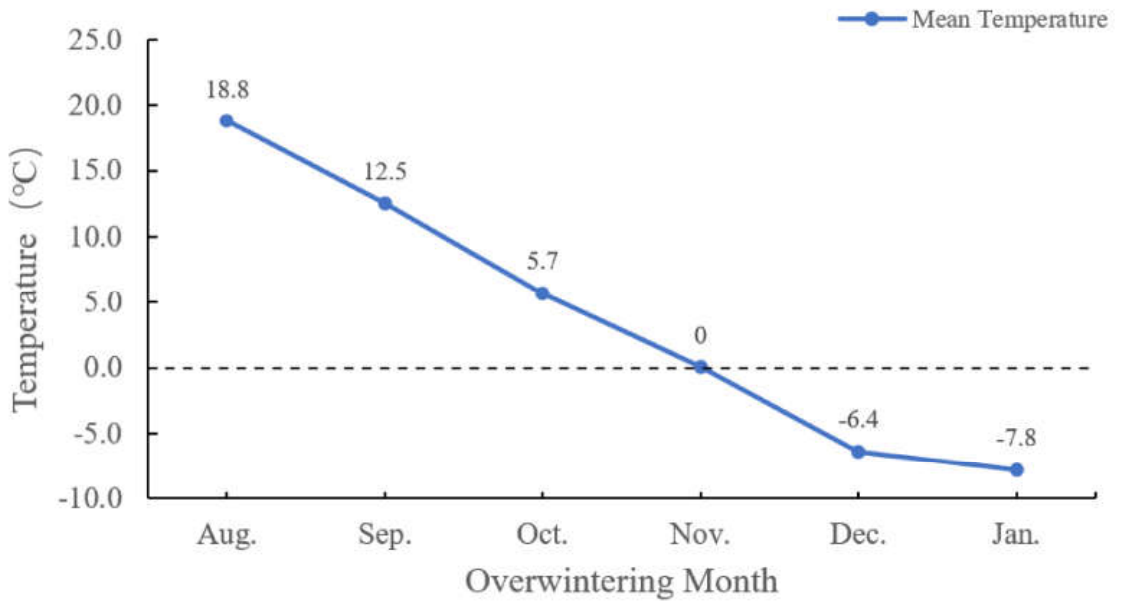
Figure 2.
(A) Changes in glycogen content in Aeropus sibiricus overwintering eggs. (B) Changes in the relative expression of GBE1 in overwintering eggs. Data are presented as mean ± SE. Different letters indicate significant differences among months (P < 0.05; Tukey’s test was used for metabolite content data, and Dunnett’s T3 test was used for gene expression data).
Figure 2.
(A) Changes in glycogen content in Aeropus sibiricus overwintering eggs. (B) Changes in the relative expression of GBE1 in overwintering eggs. Data are presented as mean ± SE. Different letters indicate significant differences among months (P < 0.05; Tukey’s test was used for metabolite content data, and Dunnett’s T3 test was used for gene expression data).
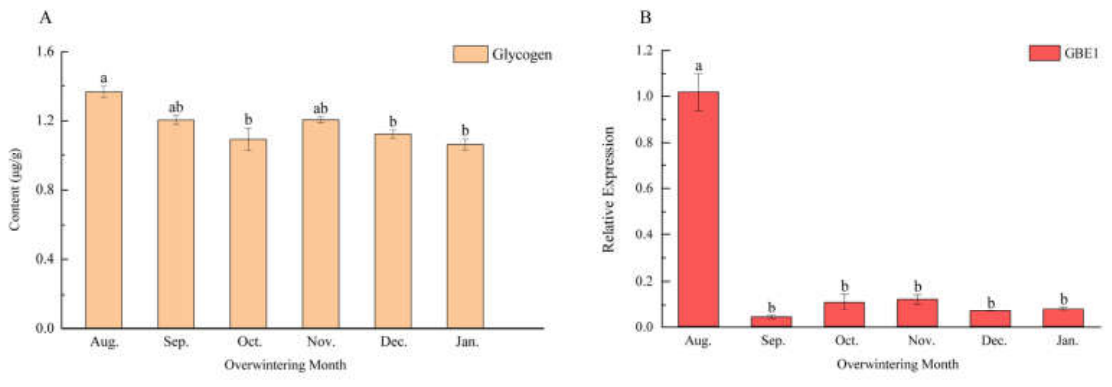
Figure 3.
(A) Changes in glucose and trehalose content in overwintering Aeropus sibiricus eggs. (B) Changes in expression of G6PC, TPS, and TREH in overwintering eggs. Data are presented as mean ± SE. Different letters indicate significant differences among months (P < 0.05; Tukey’s test was used for metabolite content data, and Dunnett’s T3 test was used for gene expression data). ND indicates that no gene expression was detected.
Figure 3.
(A) Changes in glucose and trehalose content in overwintering Aeropus sibiricus eggs. (B) Changes in expression of G6PC, TPS, and TREH in overwintering eggs. Data are presented as mean ± SE. Different letters indicate significant differences among months (P < 0.05; Tukey’s test was used for metabolite content data, and Dunnett’s T3 test was used for gene expression data). ND indicates that no gene expression was detected.
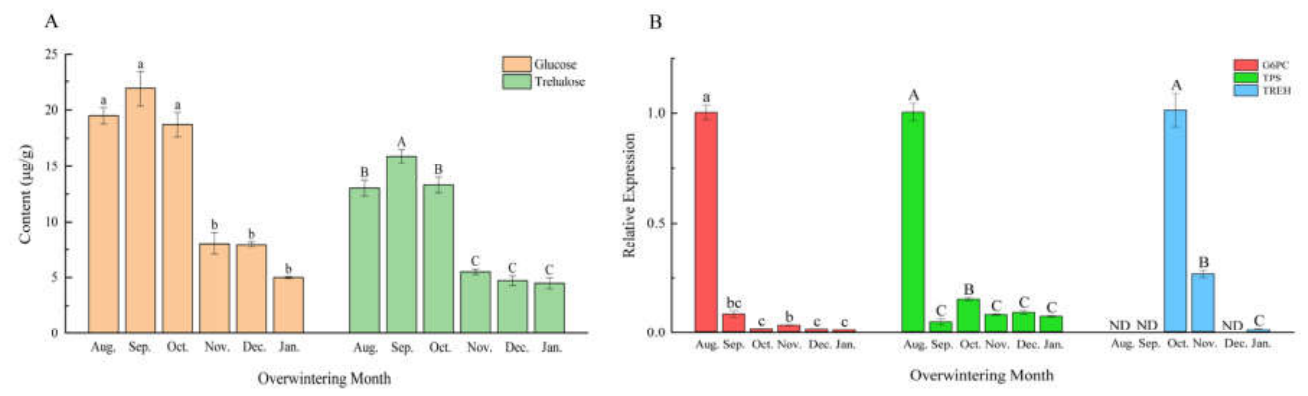
Figure 4.
(A) Changes in glycerol and sorbitol content in overwintering Aeropus sibiricus eggs. (B) Changes in the relative expression of GK and SDH in overwintering eggs. Data are presented as mean ± SE. Different letters indicate significant differences among months (P < 0.05; Tukey’s test was used for metabolite content data, and Dunnett’s T3 test was used for gene expression data).
Figure 4.
(A) Changes in glycerol and sorbitol content in overwintering Aeropus sibiricus eggs. (B) Changes in the relative expression of GK and SDH in overwintering eggs. Data are presented as mean ± SE. Different letters indicate significant differences among months (P < 0.05; Tukey’s test was used for metabolite content data, and Dunnett’s T3 test was used for gene expression data).
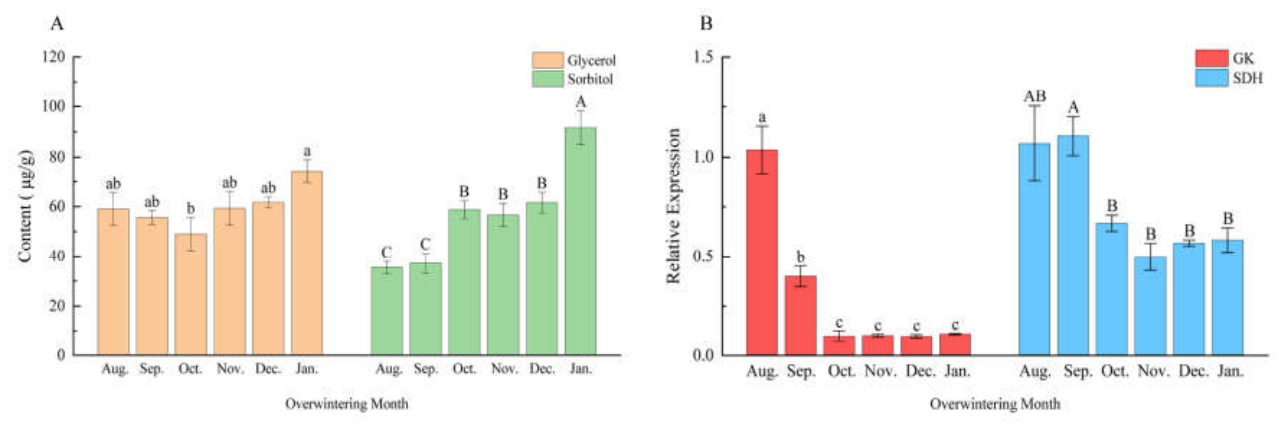
Figure 5.
(A) Changes in triglyceride and free fatty acid contents in overwintering Aeropus sibiricus eggs. (B) changes in relative expression levels of the FASN gene in overwintering eggs. Data are presented as mean ± SE. Different letters indicate significant differences among months (P < 0.05; Tukey’s test was used for metabolite content data, and Dunnett’s T3 test was used for gene expression data).
Figure 5.
(A) Changes in triglyceride and free fatty acid contents in overwintering Aeropus sibiricus eggs. (B) changes in relative expression levels of the FASN gene in overwintering eggs. Data are presented as mean ± SE. Different letters indicate significant differences among months (P < 0.05; Tukey’s test was used for metabolite content data, and Dunnett’s T3 test was used for gene expression data).
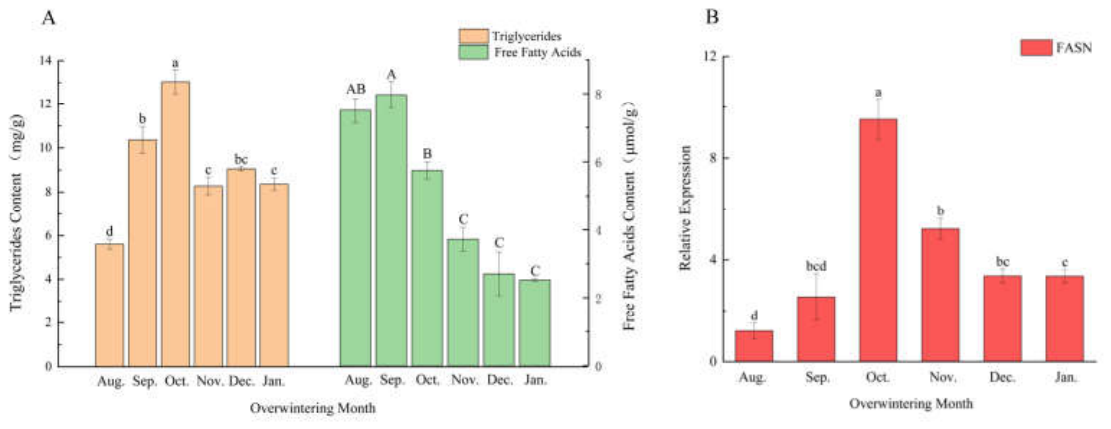

Table 1.
Primers designed and used to determine the relative gene expression levels of overwintering eggs of Aeropus sibiricus.
Table 1.
Primers designed and used to determine the relative gene expression levels of overwintering eggs of Aeropus sibiricus.
| Gene name | Sequence |
| GBE1 | F: TGGTGCCCAAGGTGAAAGTCTG R: GCGTGAGTATGGAAAATGGGAGTTAC |
| G6PC | F: TTTGCGACTGTTGTTCCCTTACCC R: TTGTTGTTGCATTTGAGCCACAGC |
| TPS | F: CCGGCCGTTGGAGTAGTATC R: GGCTGGCCAGGTATTCACTT |
| TREH | F: CAAATGACGGAAATCTGTCTAAC R: CTGATTCCTGCTTACTTTGTTTAG |
| GK | F: ATGACATGGCTGCCGTAACA R: AAATGGCTGACAGCTCCTCC |
| SDH | F: AAGGGACACATTGGCAGCTTTATTG R: CGACAGGGCACACCAGGTTC |
| FASN | F: CAGTGACCCGCAGAAGTTCT R: CAAAACGCCGTGTAACAGCA |
| β-actin | F: AAGGCATCAGGGTGTGATGG R: GCCACCCTAAGCTCGTTGTA |
Disclaimer/Publisher’s Note: The statements, opinions and data contained in all publications are solely those of the individual author(s) and contributor(s) and not of MDPI and/or the editor(s). MDPI and/or the editor(s) disclaim responsibility for any injury to people or property resulting from any ideas, methods, instructions or products referred to in the content. |
© 2026 by the authors. Licensee MDPI, Basel, Switzerland. This article is an open access article distributed under the terms and conditions of the Creative Commons Attribution (CC BY) license.
Copyright: This open access article is published under a Creative Commons CC BY 4.0 license, which permit the free download, distribution, and reuse, provided that the author and preprint are cited in any reuse.