

Submitted:
16 November 2026
Posted:
18 November 2026
You are already at the latest version
Abstract
An animal expresses one behavioral system at a time, and the rules that decide which system gains the body act over seconds, hours and days. Dynamic Archetypal Coordination (DAC) is proposed here as a circuit-level hypothesis about how conserved behavioral systems trade access to the body. A comparator with a no-action option sorts manipulations by two measurements: a term common to all systems changes the frequency of no action and leaves the ratio between active behaviors fixed, whereas a system-specific term changes that ratio. Three update rules, READ, WRITE and SWITCH, specify how an executed act changes the terms of the next decision; each is written as an explicit update and located at identified neurons in Drosophila melanogaster and in mice or rats. Circuit data show that competing systems are coordinated in three ways within overlapping hypothalamic or protocerebral nuclei: graded activity of the same cells, largely separate subpopulations and directed inhibition between populations. In each case the architecture persists and access changes. Sleep pressure is evaluated as the leading candidate for a common term. Current data show a general rise in arousal threshold together with system-specific effects, so the coupling of sleep to each system becomes a quantity to measure. Durable writing of contest outcomes occurs under identified conditions of repetition, hormonal state and post-experience sleep. Extension to the remaining systems of the Systema Behavorum is outlined as future work. Every statement carries an evidence tag, and each claim is paired with a discriminating experiment.
Keywords:
action selection
; behavioral systems
; Drosophila
; hypothalamus
; sleep
; neuroendocrinology
; internal state
1. Introduction
An animal performs one behavior at a time. A courting male fruit fly becomes progressively harder to interrupt with a visual threat as courtship advances (Cazalé-Debat et al., 2024). A female rat contacted by a male two weeks after parturition retrieves a pup instead of adopting lordosis (Rahman and Zorumski, 2026b). In both animals the circuitry for the suppressed behavior remains in place. What changes is which behavioral system gains access to the body.
The ARCH framework describes the readiness of each conserved behavioral system as the product of architecture (A), drive (D), context (C) and a permissive field (Φ), with expression when the product crosses a threshold (Rahman et al., 2025). The same work proposed ten conserved behavioral systems, the Systema Behavorum: Navigia (exploration and goal seeking), Theromata (caregiving and social soothing), Phobon (vigilance and threat response), Agonix (competition and dominance), Venex (mating and attraction), Sacrifex (symbolic sacrifice and devotion), Thumos (pride and recognition), Imitati (imitation and cultural learning), Hedonix (pleasure and play) and Alligantia (coalition and belonging). A theory of arbitration among these systems followed (Rahman, 2026b).
Three empirical lines have since constrained that theory. Socially controlled sex change in clownfish separates a capacity present throughout male life from access granted when the dominant female is removed (Rahman, 2026a). In female rodents, lordosis and maternal care are both released at endocrine levels far below those conventionally required when sensory stimulation is strong, and pregnancy and lactation silence receptivity through different limiting terms (Rahman and Zorumski, 2026b). In filial imprinting, an encoding layer with its own permissive term separates the expression of a behavior from the durable writing of its substrate, through a sequence of opening, writing and reading (Rahman, 2026c).
This paper states Dynamic Archetypal Coordination (DAC) at the level of circuits and makes four claims. Behavioral systems are coordinated by changing access to persistent architectures (Claim 1). Executed acts update the next decision through three identified rules (Claim 2). Sleep pressure contains a component common to all systems (Claim 3). Contest outcomes are written into later thresholds when specified conditions hold (Claim 4). Section 7 outlines how the same rule would extend to the remaining Systema systems. Venex, the mating and attraction system, serves as the reference system, because it has identified circuits in both insects and mammals; each coordination analyzed here sets Venex against Phobon, Theromata or Agonix.
Each statement carries one of three tags: [E], established by manipulation in the cited primary literature; [R], supported by reanalysis of deposited data or by simulation, with code and derived results archived (Rahman, 2026d) or supplied with this paper; [P], proposed here, with a specified test. Mathematical consequences of the model are stated as such. Section 8 collects the tests.
2. The Coordination Rule
2.1. Readiness and the Comparator
Each system i has readiness
where βi is the coupling of system i to the common term Φ, wi is a written offset (Section 2.3) and ai is access set by a stored state (Section 2.3). A comparator selects one system or no action. The no-action option has readiness θ. Because only ratios of readiness enter the choice, every readiness can be divided by θ; the no-action weight then equals exp(ln 1/σ) = 1. Selection follows a softmax with temperature σ, the reduced form of noisy winner-take-all competition (Redgrave et al., 1999; Mysore and Kothari, 2020):
ln Ri = βi ln Φ + ln Ai + ln Di + ln Ci + wi + ln ai
P(i) = exp(ln Ri/σ) / [1 + Σj exp(ln Rj/σ)]
Under this normalization a change in θ is equivalent to a change of opposite sign in every ln Ri. Figure 1 summarizes the model.
2.2. Classifying Manipulations by Two Measurements
The ratio of any two systems is P(i)/P(j) = exp[(ln Ri − ln Rj)/σ]. A manipulation that changes ln Φ by Δ changes this log ratio by (βi − βj)Δ/σ and changes the probability of no action, P(none) = 1/[1 + Σj exp(ln Rj/σ)], whenever the βj are nonzero. Two consequences follow from the algebra alone. First, when couplings are equal, a common term leaves the ratio unchanged and appears only in the frequency of no action. Second, a change in θ, or any equal additive change in log readiness across systems, produces the same pattern; the two measurements therefore identify a common term without identifying its mechanism. A manipulation that changes the ratio acts on a term that differs between systems (Rahman and Zorumski, 2026b).
Measuring both quantities estimates the coupling differences βi − βj directly. Equal coupling is thus a hypothesis with a test, and unequal coupling is a measurable departure from it. In simulations at the size of published fly experiments, a dietary effect on a common term was recovered from the full likelihood (r = 0.83) and was unrecoverable when only the allocation among executed acts was used (r = −0.10) [R]; frequency of no action must therefore be recorded for the classification to work.
2.3. Update Rules
The executed act at updates one term for the next decision, which makes coordination recursive. Three update rules are distinguished by the variable they change and by its timescale. READ changes drive, a variable inside the decision circuit:
with κi < 0 for satiety, κi > 0 for escalation and recovery toward a set point Di0 with time constant τD. WRITE changes a persistent offset, gated by writability ΦN (0 ≤ ΦN ≤ 1) (Rahman, 2026c):
where g(ot) is a signed function of the outcome of the act and η a learning rate. SWITCH depletes a stored state S that lies outside the decision circuit, is created or transferred by a discrete event and sets access through receivers of either sign:
Di(t+1) = Di(t) + κi·1[at = i] + [Di0 − Di(t)]Δt/τD
wi(t+1) = wi(t) + η·ΦN(t)·g(ot)·1[at = i]
S(t+1) = S(t) – ρ·1[at = j] – S(t)Δt/τS, ai = fi(S)
READ and SWITCH both deplete a quantity. They are separated operationally by where the quantity resides and by whether its kinetics can be manipulated independently of the act: the release kinetics of a SWITCH store can be altered genetically without changing the act that created it (Section 4.3) [P].
OPEN, WRITE and READ in the imprinting sense name the three phases of Eq. 4: entry into a state with high ΦN, modification of the substrate while it holds and expression of the modified substrate later (Rahman, 2026c).
3. Claim 1: Coordination by Access to Persistent Architectures
Claim. Transitions between behavioral systems reallocate access to architectures that persist. The cell-level organization of the competing systems varies: the same cells at different activity levels, largely separate subpopulations within one nucleus, or directed inhibition between populations. Access is the common element.
3.1. The Insect Hub
In Drosophila melanogaster, doublesex and fruitless specify a dimorphic population, the pC1 cluster, that integrates sensory cues with internal state. In males, the same P1 neurons promote aggression at weak activation and courtship at strong activation (Hoopfer et al., 2015; Koganezawa et al., 2016) [E]. Downstream, pCd neurons are required for the persistence of both courtship and aggression and are sufficient for neither, the profile of a shared persistent state variable rather than a selector (Jung et al., 2020) [E]. In females, the cluster is partitioned: pC1a promotes receptivity and pC1d/e promote aggression (Deutsch et al., 2020; Schretter et al., 2020) [E], and after mating the cluster relays the post-mating signal toward vaginal plate opening and egg laying (Wang et al., 2020, 2021) [E]. The same cluster participates in arbitration between mating and feeding (Cheriyamkunnel et al., 2021), mating and sleep (Chen et al., 2017; Duhart et al., 2023) and mating and escape (Cazalé-Debat et al., 2024) [E]. In the last case the decisive interaction lies upstream of the hub: late courtship silences threat detection at LC16 terminals through dopamine acting on Dop2R, and threat signals reach P1 through serotonergic neurons (Cazalé-Debat et al., 2024) [E]. Arbitration therefore occurs at several sites, including sensory input. Figure 2 maps these relationships with each link marked by evidence type.
3.2. The Mammalian Hub
In male mice (Mus musculus), bulk activation of Esr1+ neurons in the ventrolateral ventromedial hypothalamus (VMHvl) promotes mounting at low intensity and attack at high intensity (Lee et al., 2014) [E]. Imaging resolves this into largely distinct ensembles: a slow, integrating dimension of VMHvl activity appears in both mating and aggression contexts but is carried by different neurons, with about 8% overlap (Nair et al., 2023) [E], and on-manifold optogenetic perturbation confirms that the integrating dimension is causal (Vinograd et al., 2024) [E]. Mounting with and without ultrasonic vocalization is encoded by minimally overlapping cells, and medial preoptic area (MPOA) and VMHvl inhibit each other at the terminal level, so that MPOA activation converts attack into mounting (Karigo et al., 2021) [E]. In female mice, transcriptomically distinct Esr1+/Npy2r− cells promote mating and Npy2r+ cells promote aggression; in lactating dams, male cues raise the responses of the aggression cells and leave the mating cells unchanged (Liu et al., 2022) [E]. Cckar-expressing VMHvl cells restore receptivity in nonreceptive females without producing the lordosis posture itself (Yin et al., 2022) [E]. Galanin-expressing MPOA neurons form projection-defined pools that control separable components of care (Wu et al., 2014; Kohl et al., 2018) [E], and reciprocal inhibition between MPOA and bed nucleus of the stria terminalis neurons balances care against infanticide (Mei et al., 2023) [E]. In common marmosets (Callithrix jacchus), suppressing one preoptic subregion disrupts infant care in both sexes and abolishes male sexual behavior (Kurachi et al., 2025) [E]. Figure 3 maps these relationships, with species given for each element.
3.3. Overlap and Competition Are Different Measurements
Anatomical overlap establishes that systems are represented in the same nucleus; competition requires that activating or inhibiting one system changes the expression of another. The cases above meet the second standard at four sites: P1 activation level (Hoopfer et al., 2015), MPOA–VMHvl terminals (Karigo et al., 2021), MPOA–BNST (Mei et al., 2023) and LC16 terminals (Cazalé-Debat et al., 2024) [E]. In each, the inhibition between systems scales with the state of the system that is winning. Whether competing systems draw on a single limited resource, as opposed to inhibiting one another directly, has not been tested in any of them [P].
3.4. Capacity Outlasts Access
A complete lordosis posture can be evoked by lateral hypothalamic stimulation in three-day-old rats, eleven days before the behavior appears spontaneously (Moran et al., 1983) [E]. Activation of the oviDN egg-laying neurons is equally potent in virgin and mated Drosophila females (Wang et al., 2020) [E]. In a deposited age-by-sex-peptide experiment (Fricke et al., 2013a, 2013b), sex peptide raised egg output and suppressed remating at every age tested. Among 443 virgin females mated at 13 ages from 1 to 41 days, baseline egg output fell by 16% per 10 days, and the sex-peptide effect on egg output changed by a factor of 0.93 per 10 days (95% CI 0.83–1.05; negative binomial regression); among 366 previously mated females tested at six ages, the factor was 0.96 (0.80–1.13). For remating, the age × sex-peptide odds ratio was 1.26 per 10 days (0.74–2.12; logistic regression). At 33–41 days, 8–17% of females mated to SP+ males remated against 24–50% of those mated to SP0 males [R]. Access persists into old age while capacity declines; the intervals are compatible with moderate age-dependent change in access and exclude its loss.
Falsifier. A behavioral transition that requires circuitry to be constructed or eliminated, rather than recruited, falsifies Claim 1.
4. Claim 2: Three Update Rules Carry Coordination Across Timescales
Claim. Coordination is carried forward in time by at least three act-dependent update rules (Eqs. 3–5), each located at identified neurons in both taxa (Table 1). Other forms of state change exist and are listed in Section 4.4.
4.1. READ: Execution Shifts Drive
A moving overhead shadow that elicits escape early in fly courtship is ignored late, as dopaminergic PPM1/2 activity ramps with abdomen bending and suppresses LC16 visual projection neurons through Dop2R (Cazalé-Debat et al., 2024) [E]. Fitted to the 274 deposited wild-type males of that study, a slow time-dependent term was required (ΔBIC 43). Placing it on the two drives with opposite signs was favored over confining it to the threat pathway (ΔBIC 6.9), because defensive behavior also fell with courtship time in males never threatened [R]; model specifications, likelihoods and comparisons are in the archived code (Rahman, 2026d). Across copulations, mating drive in males is reduced by each mating by a roughly constant amount, reaches maximal satiety after three to six matings and recovers to about half overnight, through a recurrent NPF–pCd loop that also primes a slower CREB2-dependent satiety layer (Zhang et al., 2016, 2019) [E]: κ < 0 in Eq. 3. Each prior mating desensitizes D2 receptors in copulation decision neurons (Miner et al., 2025) [E], and within a copulation declining dopamine lengthens the window over which threat signals are integrated (Gautham et al., 2024) [E]. In male mice, VMHvl activity along an integrating dimension, whose time constant greatly exceeds those of the other dimensions, builds with escalating aggression, and the time constant predicts the fraction of time spent attacking (Nair et al., 2023) [E]: κ > 0.
In ovariectomized rats, vaginocervical stimulation recruits progestin receptor without its ligand within tens of minutes (Auger et al., 1997) [E], and brief vaginal stimulation produces lordosis responsiveness within 10 s that lasts more than three hours (Rodriguez-Sierra et al., 1977) [E]. In both taxa, executing or receiving the act changes the drive on which the next decision is made.
4.2. WRITE: Execution Leaves a Trace That Is Read Later
A male fruit fly rejected by a mated female courts less on later encounters (Siegel and Hall, 1979). Dopaminergic aSP13 neurons potentiate transmission from mushroom-body γ neurons (MBγ) to M6 output neurons, and M6 feeds back onto aSP13 (Keleman et al., 2012; Zhao et al., 2018) [E]. In the published group data, blocking M6 at training or at test each removed about 80% of the learned suppression, and placing M6 in reading only was rejected by 19.8 BIC units [R]. Activating M6 suppressed courtship equally in naive and trained males, whereas activating MBγ suppressed it more after training, which locates the write upstream of a read path that works regardless of experience [R]. Long-term memory requires reactivation of aSP13 dopaminergic neurons during sleep 7–10 h after training (Dag et al., 2019) [E], a direct case of a writability window.
With estradiol every fourth day, naive female rats become progressively more receptive while experienced females plateau, an effect reversed by arcuate Arc knockdown (Christensen et al., 2015) [E]. Virgin rats exposed to pups become maternal over days, and the change is not carried in blood (Terkel and Rosenblatt, 1971) [E]. A female's own rearing sets estrogen-inducible preoptic oxytocin receptor and with it the induction of maternal behavior (Champagne et al., 2001) [E].
4.3. SWITCH: Execution Depletes a Stored State That Sets Access
Sex peptide transferred at mating binds sperm and is released gradually, extending the post-mating response to about a week (Peng et al., 2005) [E]. Females mated to males whose sex peptide cannot bind sperm regain receptivity by about four days instead of remaining unreceptive for up to ten (Sitnik et al., 2016) [E]; the store's kinetics thus change without any change in the mating act, which separates SWITCH from READ. Because eggs use stored sperm, egg laying depletes the store that sustains the state licensing egg laying [P]. The state is read by receivers of opposite sign: receptivity falls and egg laying rises (Wang et al., 2020, 2021) [E]. Sex peptide acting on head targets lowers receptivity without inducing egg laying, and acting on trunk targets raises egg laying without changing receptivity (Nallasivan et al., 2026) [E], which separates the two receivers anatomically.
In rats, progesterone facilitates lordosis and then downregulates its own receptor, producing a refractoriness that persists through low-estradiol pregnancy (Blaustein and Wade, 1977) [E]. During lactation, suckling sustains prolactin, estradiol stays low and the receptor is not re-induced. Pregnancy and lactation therefore silence the same behavior through different limiting terms, the receptor substrate in pregnancy and drive in lactation (Rahman and Zorumski, 2026b); the mechanisms are established and the term assignment is proposed [P].
4.4. State Changes Outside the Three Rules
Three classes of state change are documented that Eqs. 3–5 do not capture as written. Changes that the act does not cause: in female mice, the VMHvl integrating dimension appears and disappears across the estrous cycle (Liu et al., 2024) [E]. Elapsed-time clocks within an act: CaMKII activity in four corazonin neurons times a roughly 6-min copulation and gates the response to threat within it (Thornquist et al., 2020) [E]. Self-priming: mating drive activity primes the slower satiety layer that later lowers it, coupling READ to a durable change (Zhang et al., 2019) [E]. The first is an input to the model rather than an update; the second and third may be sub-cases of READ with a second state variable or a fourth rule [P].
Test. A coordination effect that cannot be written as Eq. 3, 4 or 5, or a combination of them, adds a rule to the model; Section 4.4 lists the present candidates.
5. Claim 3: Sleep Pressure Contains a Component Common to All Systems
Claim. Sleep pressure enters every behavioral system with positive coupling, so that rising sleep pressure raises the frequency of no action. Equal coupling across systems, the strong form in which sleep cancels from the choice between systems, is a hypothesis with a direct test. Current data reject equal coupling for some pairs of systems and leave the common component in place.
Evidence for a common component. Fly sleep is defined in part by an elevated arousal threshold, a reduced response to stimuli of many kinds (Shaw et al., 2000; Hendricks et al., 2000) [E]. Across seven Drosophila species spanning about 50 million years, the circadian timing of sleep and its stratification into light and deep stages with different arousal thresholds are conserved, whereas homeostatic rebound after deprivation is not (Joyce et al., 2024) [E]. Sleep-deprived flies respond less to odors overall (French et al., 2021) [E]. Sleep deprivation suppresses aggression (Kayser et al., 2015) and male courtship (Chen et al., 2017; Machado et al., 2017) [E].
Evidence for system-specific coupling. Sleep deprivation suppresses fly aggression with other social behaviors reported unaffected, through octopaminergic signaling, and an octopamine agonist restores fighting (Kayser et al., 2015) [E]. Increased sleep need suppresses male courtship through P1 neurons and leaves female sexual behavior unaffected (Chen et al., 2017) [E]. The probability that a sleeping fly wakes depends on the stimulus: aversive odors wake flies more than attractive ones, and starved flies respond selectively more to food odors (French et al., 2021) [E]. The coupling also runs in reverse: sexual arousal, or female pheromone alone, dissipates sleep pressure built up by deprivation (Beckwith et al., 2017) [E]; P1 arousal suppresses sleep through DN1 clock neurons (Chen et al., 2017) [E]; female pC1 neurons suppress sleep by inhibiting dorsal fan-shaped body neurons (Duhart et al., 2023) [E]; and sex peptide reduces female daytime sleep through SPSN–SAG neurons (Garbe et al., 2016) [E]. In male rats, four days of paradoxical sleep deprivation induces genital reflexes, to different degrees across five strains (Andersen et al., 2006) [E]; the deprivation method also imposes stress. In each case the measured quantity is one behavior; no study has measured the ratio between two active behaviors under sleep deprivation, which is the measurement Eq. 2 requires.
Hunger occupies a different position. Satiety tyramine excites P1 and inhibits feeding neurons, and hunger reverses the balance (Cheriyamkunnel et al., 2021) [E]. Sugar-induced insulin inhibits P1 (Zhang et al., 2022) [E]. A gut hormone suppresses feeding and promotes courtship through distinct neurons (Lin et al., 2022) [E]. In females, hunger-activated octopaminergic neurons inhibit pC1 through GABAergic LH421 interneurons and lower receptivity (Sun et al., 2023) [E]. Each changes the ratio between feeding and mating, which places hunger as a competing drive. Sleep lost to starvation produces no homeostatic rebound, unlike sleep lost to mechanical deprivation (Keene et al., 2010; Shafer and Keene, 2021) [E]; that a competing system winning against the no-action option leaves the sleep homeostat uncharged is proposed [P]. In mice, hunger and hormonal state together gate infant-directed aggression (Cao et al., 2025) [E].
In rodents, a GABAA receptor gate in the ventral tegmental area lowers the stimulation required for lordosis with no such effect from adjacent sites (Frye and Vongher, 1999) [E]; that is a local permissive term. Neurosteroid potentiation of δ-subunit GABAA receptors that carry tonic inhibition varies with the ovarian cycle (Maguire et al., 2005) and is a candidate cellular route to a common term [P]. Because the sign of such potentiation is set by site, a common term is defined at the comparator, by its effect on the frequency of no action, rather than by a single molecule.
Test and falsifier. In the courtship–threat assay, mechanical sleep deprivation with drive and context held fixed estimates βcourtship − βdefense from the change in their ratio and the common component from the change in no action. Claim 3 fails if sleep pressure leaves the frequency of no action unchanged while changing the ratio, that is, if sleep acts on one system only.
6. Claim 4: Contest Outcomes Are Written into Later Thresholds Under Specified Conditions
Claim. An executed contest leaves a durable change in later readiness when writability is open (Eq. 4). Writability depends on repetition, hormonal state and an uninterrupted consolidation window. DAC, the hypothesis that coordination history accumulates over a lifetime as a recursive imprint on each behavioral system, is the long-run consequence of Eq. 4 [P].
Evidence for conditional writing. In male Drosophila melanogaster (Canton-S), a single fight shifts later fighting for minutes to hours and leaves no trace at one day; five spaced losses produce a one-day loser effect that is gone by two days and requires protein synthesis, whereas five spaced wins leave no lasting effect (Trannoy et al., 2016) [E]. Aggression raised by social isolation in flies reverses with group housing (Wang et al., 2008) [E]. In male mice, five days of resident–intruder experience raise aggression for months through long-term potentiation at a hippocampal input to VMHvl Esr1+ neurons; about a quarter of males show neither the behavioral change nor the potentiation, and testosterone restores both (Stagkourakis et al., 2020) [E]. Ensemble separation for male and female conspecifics in VMHvl forms after a single social encounter, persists for months and requires executed interaction (Remedios et al., 2017) [E]. In courtship conditioning, membrane ecdysteroid signaling through DopEcR (Srivastava et al., 2005) and nuclear receptor signaling contribute to different phases of memory (Ishimoto et al., 2013) [E], and long-term memory requires post-training sleep (Dag et al., 2019) [E]. In rodents, mating history sets the rise of receptivity and rearing sets the induction of care (Christensen et al., 2015; Champagne et al., 2001) [E], and juvenile isolation is associated with an altered neurosteroid trajectory across pregnancy and with reduced nursing (Pisu et al., 2017) [association]. In filial imprinting, a transient permissive episode opened by thyroid hormone leaves a substrate that persists after the gate closes (Rahman, 2026c).
These cases supply the variables of Eq. 4: the outcome function g differs in sign and size for wins and losses, η·ΦN is near zero for single encounters in flies and for a subset of male mice, and testosterone or post-training sleep raises it.
Writability test. 20-hydroxyecdysone fed immediately before conditioning restores memory in ecdysone-deficient males (Ishimoto et al., 2013) [E]. Whether the steroid acts during writing or at the test is untested. Feeding the hormone before conditioning in one group and before the test in another separates the two; knocking down the ecdysone importer, required for steroid uptake into cells and into the brain (Okamoto et al., 2018; Okamoto and Yamanaka, 2020), separates action at membrane DopEcR from action at the nuclear receptor [P].
Predicted signature. Eq. 4 changes an offset and leaves the form of integration unchanged (Rahman and Zorumski, 2026b). The test is a stimulus–response or stimulation–response curve measured in the same animals before and after experience: a parallel shift supports Eq. 4, a change in slope or form does not. Existing data give such curves in naive animals only (Lee et al., 2014), so the signature is a prediction [P].
7. Scope and Extensions to the Remaining Systems
Four systems, Venex, Phobon, Agonix and Theromata, have identified circuits and causal evidence of coordination with one another in at least one species (Section 3 and Section 4). The other six systems of the Systema Behavorum are outside the evidence base of this paper; Table 2 lists, for each, the substrate identified so far and the experiment that would bring it under the same rule. For Imitati, female mate-copying memory in Drosophila melanogaster requires the cAMP pathway gene rutabaga in mushroom-body neurons (Nöbel et al., 2025) [E], which supplies a write site; whether copied preferences compete with Venex for access is untested. For Hedonix, play and tickling responses in rats map to the lateral columns of the rostral periaqueductal gray (Gloveli et al., 2023) [E]; for Navigia, a zona incerta circuit drives investigatory and novelty-seeking behavior in mice (Ahmadlou et al., 2021) [E]. For Alligantia, two preoptic populations in mice are active during social isolation and social rebound and drive social need and social satiety (Liu et al., 2025) [E]. Coordination of these systems with the four core systems is proposed [P]. Thumos and Sacrifex lack an operational definition at the circuit level in a nonhuman species and are listed for completeness.
8. Predictions and Tests
(1) Crossing test in the fly. The deposited courtship–threat data include LC16-silenced males and males in which OvAbg neurons, which drive abdomen bending, were silenced. If silencing the defensive pathway releases courtship above its baseline, arbitration is external to the competing systems; if not, it occurs within a shared substrate. In the reanalysis, blocking bending lowered courtship drive rather than raising defensive readiness [R].
(2) Sleep-coupling test. Mechanical sleep deprivation in the courtship–threat assay, with no action scored, estimates the common component from the change in no action and βcourtship − βdefense from the change in ratio (Section 5). The sample size should be set to bound the coupling difference within a prespecified equivalence margin.
(3) Hunger test. Starvation in the same assay should change the ratio between courtship and feeding, with no requirement that the frequency of no action change.
(4) Writability test. 20-hydroxyecdysone before conditioning restores courtship memory in ecdysone-deficient males; the same hormone before the test alone does not; the restoration fails with DopEcR knocked down in the mushroom body.
(5) Threshold-shift test. Stimulation–response curves for VMHvl Esr1+ neurons in male mice, measured before and after resident–intruder experience, should shift in parallel (Eq. 4).
(6) SWITCH test in the female fly. Varying the sperm-binding of sex peptide (Sitnik et al., 2016) should change the duration of reduced receptivity and raised egg laying in proportion, with mating behavior unchanged; oviDN activation in females mated to spermless males measures activation gain with access held at the level of mated females.
(7) Crossing test in the rodent. Silencing the mating population and measuring care, and the reverse, in lactating dams and in postpartum estrus, when both systems approach threshold (Rahman and Zorumski, 2026b).
(8) Equivalence test for access with age. A replication of Fricke et al. (2013b) powered to bound the age × sex-peptide interaction within a prespecified margin would convert the present interval estimates (Section 3.4) into a test of constant access.
9. Relation to Other Accounts
Circuit motifs for action selection, namely race models, feed-forward inhibition, reciprocal inhibition, centralized inhibition and central hubs, describe how one winner is chosen at a given moment (Mysore and Kothari, 2020; Day and Rezaval, 2026). DAC adds a rule that sorts manipulations into those acting on all systems and those acting on one, three update rules that carry each contest into the next and a write layer that turns contests into history. Line-attractor models of hypothalamic state supply the dynamics for one READ variable (Nair et al., 2023; Vinograd et al., 2024; Liu et al., 2024). Average-reward accounts in which tonic dopamine sets vigor across all actions (Niv et al., 2007) are the closest formal precedent for a common term. Affective-systems accounts individuate systems by the states their activation produces (Panksepp, 1998); DAC concerns which existing system gains access. Hierarchical ethological models place systems at levels of a control hierarchy (Tinbergen, 1951); DAC places them on overlapping substrate with a common term that spans them.
10. Conclusion
Behavioral systems take turns. The turn is decided by access to persistent architectures, carried forward by update rules that act over seconds to months, scaled by a common term whose coupling to each system can be measured and, under specified conditions, written into later thresholds. The fly and the rodent supply identified neurons for each element in at least one system, and deposited data already decide several of the predictions. The remaining predictions are stated with the experiments that decide them.
Supplementary Materials
The following supporting information can be downloaded at the website of this paper posted on Preprints.org.
Funding
This research did not receive any specific grant from funding agencies in the public, commercial or not-for-profit sectors.
Conflicts of Interest
The author declares no competing financial interests or personal relationships that could have appeared to influence the work reported in this paper.
Data and Code Availability
No new data were generated. Results tagged [R] come from reanalysis of deposited data from Cazalé-Debat et al. (2024) and Fricke et al. (2013a) and of published tables from Zhao et al. (2018); code and derived results are archived at Zenodo (Rahman, 2026d). The interval estimates in Section 3.4 were computed for this paper from the Fricke et al. (2013a) deposit; the script is supplied as Supplementary File S1. Figure scripts are available from the author.
Declaration of Generative AI and AI-Assisted Technologies in the Manuscript Preparation Process
During the preparation of this work the author (TR) used Claude Opus 5.5 (Anthropic), accessed through claude.ai, as a research and writing assistant: to locate and summarize sources, to draft and revise prose, to check arithmetic and to write the analysis and plotting code supplied with the paper. The author specified every claim and analysis, read the cited sources, verified quoted values and takes full responsibility for the content. No image-generation model was used.
References
- Aguilar-Moreno, A.; Ortiz, J.; Concha, L.; Alcauter, S.; Paredes, R.G. Brain circuits activated by female sexual behavior evaluated by manganese enhanced magnetic resonance imaging. PLoS ONE 2022, 17, e0272271. [Google Scholar] [CrossRef]
- Ahmadlou, M.; Houba, J.H.W.; van Vierbergen, J.F.M.; Giannouli, M.; Gimenez, G.-A.; van Weeghel, C.; Darbanfouladi, M.; Shirazi, M.Y.; Dziubek, J.; Kacem, M.; de Winter, F.; Heimel, J.A. A cell type-specific cortico-subcortical brain circuit for investigatory and novelty-seeking behavior. Science 2021, 372, eabe9681. [Google Scholar] [CrossRef]
- Andersen, M.L.; Antunes, I.B.; Tufik, S. Effects of paradoxical sleep deprivation on genital reflexes in five rat strains. Horm. Behav. 2006, 49, 173–180. [Google Scholar] [CrossRef]
- Auger, A.P.; Moffatt, C.A.; Blaustein, J.D. Progesterone-independent activation of rat brain progestin receptors by reproductive stimuli. Endocrinology 1997, 138, 511–514. [Google Scholar] [CrossRef]
- Beckwith, E.J.; Geissmann, Q.; French, A.S.; Gilestro, G.F. Regulation of sleep homeostasis by sexual arousal. eLife 2017, 6, e27445. [Google Scholar] [CrossRef]
- Blaustein, J.D.; Wade, G.N. Sequential inhibition of sexual behavior by progesterone in female rats: comparison with a synthetic antiestrogen. J. Comp. Physiol. Psychol. 1977, 91, 752–760. [Google Scholar] [CrossRef]
- Brown, R.S.E.; Aoki, M.; Ladyman, S.R.; Phillipps, H.R.; Wyatt, A.; Boehm, U.; Grattan, D.R. Prolactin action in the medial preoptic area is necessary for postpartum maternal nursing behavior. Proc. Natl. Acad. Sci. U.S.A. 2017, 114, 10779–10784. [Google Scholar] [CrossRef]
- Cao, M.; Ammari, R.; Chen, M.X.; Wai, P.; Jamieson, B.B.; Liang, S.; Husain, B.F.A.; Sahni, A.; Legrave, N.; Salgarella, I.; MacRae, J.; Strom, M.; Kohl, J. Integration of hunger and hormonal state gates infant-directed aggression. Nature 2025, 648, 138–145. [Google Scholar] [CrossRef]
- Cazalé-Debat, L.; Scheunemann, L.; Day, M.; Fernandez-d.V. Alquicira, T.; Dimtsi, A.; Zhang, Y.; Blackburn, L.A.; Ballardini, C.; Greenin-Whitehead, K.; Reynolds, E.; Lin, A.C.; Owald, D.; Rezaval, C. Mating proximity blinds threat perception. Nature 2024, 634, 635–643. [Google Scholar] [CrossRef]
- Champagne, F.; Diorio, J.; Sharma, S.; Meaney, M.J. Naturally occurring variations in maternal behavior in the rat are associated with differences in estrogen-inducible central oxytocin receptors. Proc. Natl. Acad. Sci. U.S.A. 2001, 98, 12736–12741. [Google Scholar] [CrossRef]
- Chen, D.; Sitaraman, D.; Chen, N.; Jin, X.; Han, C.; Chen, J.; Sun, M.; Baker, B.S.; Nitabach, M.N.; Pan, Y. Genetic and neuronal mechanisms governing the sex-specific interaction between sleep and sexual behaviors in Drosophila. Nat. Commun. 2017, 8, 154. [Google Scholar] [CrossRef]
- Cheriyamkunnel, S.J.; Rose, S.; Jacob, P.F.; Blackburn, L.A.; Glasgow, S.; Moorse, J.; Winstanley, M.; Moynihan, P.J.; Waddell, S.; Rezaval, C. A neuronal mechanism controlling the choice between feeding and sexual behaviors in Drosophila. Curr. Biol. 2021, 31, 4231–4245.e4. [Google Scholar] [CrossRef]
- Christensen, A.; Dewing, P.; Micevych, P. Immediate early gene activity-regulated cytoskeletal-associated protein regulates estradiol-induced lordosis behavior in female rats. J. Neurosci. Res. 2015, 93, 67–74. [Google Scholar] [CrossRef]
- Concas, A.; Mostallino, M.C.; Porcu, P.; Follesa, P.; Barbaccia, M.L.; Trabucchi, M.; Purdy, R.H.; Grisenti, P.; Biggio, G. Role of brain allopregnanolone in the plasticity of γ-aminobutyric acid type A receptor in rat brain during pregnancy and after delivery. Proc. Natl. Acad. Sci. U.S.A. 1998, 95, 13284–13289. [Google Scholar] [CrossRef]
- Dag, U.; Lei, Z.; Le, J.Q.; Wong, A.; Bushey, D.; Keleman, K. Neuronal reactivation during post-learning sleep consolidates long-term memory in Drosophila. eLife 2019, 8, e42786. [Google Scholar] [CrossRef]
- Day, M.; Rezaval, C. Neural basis of sexually dimorphic decision-making. Curr. Opin. Neurobiol. 2026, 96, 103146. [Google Scholar] [CrossRef]
- Deutsch, D.; Pacheco, D.; Encarnacion-Rivera, L.; Pereira, T.; Fathy, R.; Clemens, J.; Girardin, C.; Calhoun, A.; Ireland, E.; Burke, A.; et al. The neural basis for a persistent internal state in Drosophila females. eLife 2020, 9, e59502. [Google Scholar] [CrossRef]
- Duhart, J.M.; Buchler, J.R.; Inami, S.; Kennedy, K.J.; Jenny, B.P.; Afonso, D.J.S.; Koh, K. Modulation and neural correlates of postmating sleep plasticity in Drosophila females. Curr. Biol. 2023, 33, 2702–2716.e3. [Google Scholar] [CrossRef]
- French, A.S.; Geissmann, Q.; Beckwith, E.J.; Gilestro, G.F. Sensory processing during sleep in Drosophila melanogaster. Nature 2021, 598, 479–482. [Google Scholar] [CrossRef]
- Fricke, C.; Green, D.; Mills, W.E.; Chapman, T. Data from: Age-dependent female responses to a male ejaculate signal alter demographic opportunities for selection [dataset]. Dryad 2013a. [Google Scholar] [CrossRef]
- Fricke, C.; Green, D.; Mills, W.E.; Chapman, T. Age-dependent female responses to a male ejaculate signal alter demographic opportunities for selection. Proc. R. Soc. B 2013b, 280, 20130428. [Google Scholar] [CrossRef]
- Frye, C.A.; Vongher, J.M. GABAA, D1, and D5, but not progestin receptor, antagonist and anti-sense oligonucleotide infusions to the ventral tegmental area of cycling rats and hamsters attenuate lordosis. Behav. Brain Res. 1999, 103, 23–34. [Google Scholar] [CrossRef]
- Garbe, D.S.; Vigderman, A.S.; Moscato, E.; Dove, A.E.; Vecsey, C.G.; Kayser, M.S.; Sehgal, A. Changes in female Drosophila sleep following mating are mediated by SPSN-SAG neurons. J. Biol. Rhythm. 2016, 31, 551–567. [Google Scholar] [CrossRef]
- Gautham, A.K.; Miner, L.E.; Franco, M.N.; Thornquist, S.C.; Crickmore, M.A. Dopamine biases decisions by limiting temporal integration. Nature 2024, 632, 850–857. [Google Scholar] [CrossRef]
- Gloveli, N.; Simonnet, J.; Tang, W.; Concha-Miranda, M.; Maier, E.; Dvorzhak, A.; Schmitz, D.; Brecht, M. Play and tickling responses map to the lateral columns of the rat periaqueductal gray. Neuron 2023, 111, 3041–3052.e7. [Google Scholar] [CrossRef]
- Hendricks, J.C.; Finn, S.M.; Panckeri, K.A.; Chavkin, J.; Williams, J.A.; Sehgal, A.; Pack, A.I. Rest in Drosophila is a sleep-like state. Neuron 2000, 25, 129–138. [Google Scholar] [CrossRef]
- Hoopfer, E.D.; Jung, Y.; Inagaki, H.K.; Rubin, G.M.; Anderson, D.J. P1 interneurons promote a persistent internal state that enhances inter-male aggression in Drosophila. eLife 2015, 4, e11346. [Google Scholar] [CrossRef]
- Ishimoto, H.; Wang, Z.; Rao, Y.; Wu, C.-F.; Kitamoto, T. A novel role for ecdysone in Drosophila conditioned behavior: linking GPCR-mediated non-canonical steroid action to cAMP signaling in the adult brain. PLoS Genet. 2013, 9, e1003843. [Google Scholar] [CrossRef]
- Joyce, M.; Falconio, F.A.; Blackhurst, L.; Prieto-Godino, L.; French, A.S.; Gilestro, G.F. Divergent evolution of sleep in Drosophila species. Nat. Commun. 2024, 15, 5091. [Google Scholar] [CrossRef]
- Jung, Y.; Kennedy, A.; Chiu, H.; Mohammad, F.; Claridge-Chang, A.; Anderson, D.J. Neurons that function within an integrator to promote a persistent behavioral state in Drosophila. Neuron 2020, 105, 322–333.e5. [Google Scholar] [CrossRef]
- Karigo, T.; Kennedy, A.; Yang, B.; Liu, M.; Tai, D.; Wahle, I.A.; Anderson, D.J. Distinct hypothalamic control of same- and opposite-sex mounting behaviour in mice. Nature 2021, 589, 258–263. [Google Scholar] [CrossRef]
- Kayser, M.S.; Mainwaring, B.; Yue, Z.; Sehgal, A. Sleep deprivation suppresses aggression in Drosophila. eLife 2015, 4, e07643. [Google Scholar] [CrossRef]
- Keene, A.C.; Duboue, E.R.; McDonald, D.M.; Dus, M.; Suh, G.S.B.; Waddell, S.; Blau, J. Clock and cycle limit starvation-induced sleep loss in Drosophila. Curr. Biol. 2010, 20, 1209–1215. [Google Scholar] [CrossRef]
- Keleman, K.; Vrontou, E.; Krüttner, S.; Yu, J.Y.; Kurtovic-Kozaric, A.; Dickson, B.J. Dopamine neurons modulate pheromone responses in Drosophila courtship learning. Nature 2012, 489, 145–149. [Google Scholar] [CrossRef]
- Koganezawa, M.; Kimura, K.-i.; Yamamoto, D. The neural circuitry that functions as a switch for courtship versus aggression in Drosophila males. Curr. Biol. 2016, 26, 1395–1403. [Google Scholar] [CrossRef]
- Kohl, J.; Babayan, B.M.; Rubinstein, N.D.; Autry, A.E.; Marin-Rodriguez, B.; Kapoor, V.; Miyamishi, K.; Zweifel, L.S.; Luo, L.; Uchida, N.; Dulac, C. Functional circuit architecture underlying parental behaviour. Nature 2018, 556, 326–331. [Google Scholar] [CrossRef]
- Kurachi, T.; Shinozuka, K.; Yoshihara, C.; Yano-Nashimoto, S.; Murayama, A.Y.; Hata, J.; Okano, H.; Saito, A.; Kuroda, K.O. Behavioral competition between infant care and sexual behavior in male but not female common marmosets. Neurosci. Res. 2025, 216, 104900. [Google Scholar] [CrossRef]
- Lee, H.; Kim, D.-W.; Remedios, R.; Anthony, T.E.; Chang, A.; Madisen, L.; Zeng, H.; Anderson, D.J. Scalable control of mounting and attack by Esr1+ neurons in the ventromedial hypothalamus. Nature 2014, 509, 627–632. [Google Scholar] [CrossRef]
- Lin, H.H.; Kuang, M.C.; Hossain, I.; Xuan, Y.; Beebe, L.; Shepherd, A.K.; Rolandi, M.; Wang, J.W. A nutrient-specific gut hormone arbitrates between courtship and feeding. Nature 2022, 602, 632–638. [Google Scholar] [CrossRef]
- Liu, M.; Kim, D.-W.; Zeng, H.; Anderson, D.J. Make war not love: the neural substrate underlying a state-dependent switch in female social behavior. Neuron 2022, 110, 841–856. [Google Scholar] [CrossRef]
- Liu, M.; Nair, A.; Coria, N.; Linderman, S.W.; Anderson, D.J. Encoding of female mating dynamics by a hypothalamic line attractor. Nature 2024, 634, 901–909. [Google Scholar] [CrossRef]
- Liu, D.; Rahman, M.; Johnson, A.; Amo, R.; Tsutsui-Kimura, I.; Sullivan, Z.A.; Pena, N.; Talay, M.; Logeman, B.L.; Finkbeiner, S.; Qian, L.; Choi, S.; Capo-Battaglia, A.; Abdus-Saboor, I.; Ginty, D.D.; Uchida, N.; Watabe-Uchida, M.; Dulac, C. A hypothalamic circuit underlying the dynamic control of social homeostasis. Nature 2025, 640, 1000–1010. [Google Scholar] [CrossRef]
- Machado, D.R.; Afonso, D.J.S.; Kenny, A.R.; Öztürk-Çolak, A.; Moscato, E.H.; Mainwaring, B.; Kayser, M.; Koh, K. Identification of octopaminergic neurons that modulate sleep suppression by male sex drive. eLife 2017, 6, e23130. [Google Scholar] [CrossRef]
- Maguire, J.L.; Stell, B.M.; Rafizadeh, M.; Mody, I. Ovarian cycle-linked changes in GABAA receptors mediating tonic inhibition alter seizure susceptibility and anxiety. Nat. Neurosci. 2005, 8, 797–804. [Google Scholar] [CrossRef]
- Mei, L.; Yan, R.; Yin, L.; Sullivan, R.M.; Lin, D. Antagonistic circuits mediating infanticide and maternal care in female mice. Nature 2023, 618, 1006–1016. [Google Scholar] [CrossRef]
- Miner, L.E.; Gautham, A.K.; Crickmore, M.A. Behavioral devaluation by local resistance to dopamine. Nat. Neurosci. 2025, 28, 2493–2501. [Google Scholar] [CrossRef]
- Moran, T.H.; Schwartz, G.J.; Blass, E.M. Organized behavioral responses to lateral hypothalamic electrical stimulation in infant rats. Dev. Brain Res. 1983, 7, 197–204. [Google Scholar]
- Mysore, S.P.; Kothari, N.B. Mechanisms of competitive selection: a canonical neural circuit framework. eLife 2020, 9, e51473. [Google Scholar] [CrossRef]
- Nair, A.; Karigo, T.; Yang, B.; Ganguli, S.; Schnitzer, M.J.; Linderman, S.W.; Anderson, D.J.; Kennedy, A. An approximate line attractor in the hypothalamus encodes an aggressive state. Cell 2023, 186, 178–193.e15. [Google Scholar] [CrossRef]
- Nallasivan, M.P.; Singh, D.N.D.; Saleh, M.S.R.S.; Soller, M. Sex-peptide targets distinct higher order processing neurons in the brain to induce the female post-mating response. eLife 2026, 13, RP98283. [Google Scholar] [CrossRef]
- Niv, Y.; Daw, N.D.; Joel, D.; Dayan, P. Tonic dopamine: opportunity costs and the control of response vigor. Psychopharmacology 2007, 191, 507–520. [Google Scholar] [CrossRef]
- Nöbel, S.; Danchin, E.; Isabel, G. Long-term social memory of mate copying in Drosophila melanogaster is localized in mushroom bodies. Sci. Rep. 2025, 15, 5262. [Google Scholar] [CrossRef]
- Okamoto, N.; Yamanaka, N. Steroid hormone entry into the brain requires a membrane transporter in Drosophila. Curr. Biol. 2020, 30, 359–366.e3. [Google Scholar] [CrossRef]
- Okamoto, N.; Viswanatha, R.; Bittar, R.; Li, Z.; Haga-Yamanaka, S.; Perrimon, N.; Yamanaka, N. A membrane transporter is required for steroid hormone uptake in Drosophila. Dev. Cell 2018, 47, 294–305.e7. [Google Scholar] [CrossRef]
- Panksepp, J. Affective Neuroscience: The Foundations of Human and Animal Emotions; Oxford University Press: New York, 1998. [Google Scholar]
- Peng, J.; Chen, S.; Büsser, S.; Liu, H.; Honegger, T.; Kubli, E. Gradual release of sperm bound sex-peptide controls female postmating behavior in Drosophila. Curr. Biol. 2005, 15, 207–213. [Google Scholar] [CrossRef]
- Pisu, M.G.; Boero, G.; Biggio, F.; Garau, A.; Corda, D.; Congiu, M.; Concas, A.; Porcu, P.; Serra, M. Juvenile social isolation affects maternal care in rats: involvement of allopregnanolone. Psychopharmacology 2017, 234, 2587–2596. [Google Scholar] [CrossRef]
- Rahman, T. Sex change in clownfish as an ARCH-governed biological decision. Horm. Behav. 2026a, 180, 105907. [Google Scholar] [CrossRef]
- Rahman, T.; Zorumski, C.F. ARCH × Φ: sterols and the evolution of gated biological execution. BioSystems 2026a, 265, 105812. [Google Scholar] [CrossRef]
- Rahman, T. One behavior at a time: arbitration, gating, and the architecture of behavioral choice. 2026b. [Google Scholar] [CrossRef]
- Rahman, T.; Zorumski, C.F. Access, not capacity: neuroendocrine threshold gating of mating and maternal behavior. Front. Neuroendocrinol. 2026b, 83, 101290. [Google Scholar] [CrossRef]
- Rahman, T. How transient experience produces durable commitment: a recursive execution–encoding architecture for filial imprinting. Horm. Behav. 2026c, 185, 105999. [Google Scholar] [CrossRef]
- Rahman, T. Read, write, switch: code and derived results [software]. Zenodo 2026d. [Google Scholar] [CrossRef]
- Rahman, T.; Zorumski, C.F.; Meloy, J.R. The ARCH model: a neuroevolutionary framework for behavioral execution. Front. Psychiatry 2025, 16, 1669530. [Google Scholar] [CrossRef]
- Redgrave, P.; Prescott, T.J.; Gurney, K. The basal ganglia: a vertebrate solution to the selection problem? Neuroscience 1999, 89, 1009–1023. [Google Scholar] [CrossRef]
- Remedios, R.; Kennedy, A.; Zelikowsky, M.; Grewe, B.F.; Schnitzer, M.J.; Anderson, D.J. Social behaviour shapes hypothalamic neural ensemble representations of conspecific sex. Nature 2017, 550, 388–392. [Google Scholar] [CrossRef]
- Rodriguez-Sierra, J.F.; Crowley, W.R.; Komisaruk, B.R. Induction of lordosis responsiveness by vaginal stimulation in rats is independent of anterior or posterior pituitary hormones. Horm. Behav. 1977, 8, 348–355. [Google Scholar] [CrossRef]
- Schretter, C.E.; Aso, Y.; Robie, A.A.; Dreher, M.; Dolan, M.J.; Chen, N.; Ito, M.; Yang, T.; Parekh, R.; Branson, K.M.; Rubin, G.M. Cell types and neuronal circuitry underlying female aggression in Drosophila. eLife 2020, 9, e58942. [Google Scholar] [CrossRef]
- Shafer, O.T.; Keene, A.C. The regulation of Drosophila sleep. Curr. Biol. 2021, 31, R38–R49. [Google Scholar] [CrossRef]
- Shaw, P.J.; Cirelli, C.; Greenspan, R.J.; Tononi, G. Correlates of sleep and waking in Drosophila melanogaster. Science 2000, 287, 1834–1837. [Google Scholar] [CrossRef]
- Siegel, R.W.; Hall, J.C. Conditioned responses in courtship behavior of normal and mutant Drosophila. Proc. Natl. Acad. Sci. U.S.A. 1979, 76, 3430–3434. [Google Scholar] [CrossRef]
- Sitnik, J.L.; Gligorov, D.; Maeda, R.K.; Karch, F.; Wolfner, M.F. The female post-mating response requires genes expressed in the secondary cells of the male accessory gland in Drosophila melanogaster. Genetics 2016, 202, 1029–1041. [Google Scholar] [CrossRef]
- Srivastava, D.P.; Yu, E.J.; Kennedy, K.; Chatwin, H.; Reale, V.; Hamon, M.; Smith, T.; Evans, P.D. Rapid, nongenomic responses to ecdysteroids and catecholamines mediated by a novel Drosophila G-protein-coupled receptor. J. Neurosci. 2005, 25, 6145–6155. [Google Scholar] [CrossRef]
- Stagkourakis, S.; Spigolon, G.; Liu, G.; Anderson, D.J. Experience-dependent plasticity in an innate social behavior is mediated by hypothalamic LTP. Proc. Natl. Acad. Sci. U.S.A. 2020, 117, 25789–25799. [Google Scholar] [CrossRef]
- Sun, M.; Ma, M.; Deng, B.; Li, N.; Peng, Q.; Pan, Y. A neural pathway underlying hunger modulation of sexual receptivity in Drosophila females. Cell Rep. 2023, 42, 113243. [Google Scholar] [CrossRef]
- Terkel, J.; Rosenblatt, J.S. Aspects of nonhormonal maternal behavior in the rat. Horm. Behav. 1971, 2, 161–171. [Google Scholar] [CrossRef]
- Thornquist, S.C.; Langer, K.; Zhang, S.X.; Rogulja, D.; Crickmore, M.A. CaMKII measures the passage of time to coordinate behavior and motivational state. Neuron 2020, 105, 334–345.e9. [Google Scholar] [CrossRef]
- Tinbergen, N. The Study of Instinct; Clarendon Press: Oxford, 1951. [Google Scholar]
- Trannoy, S.; Penn, J.; Lucey, K.; Popovic, D.; Kravitz, E.A. Short and long-lasting behavioral consequences of agonistic encounters between male Drosophila melanogaster. Proc. Natl. Acad. Sci. U.S.A. 2016, 113, 4818–4823. [Google Scholar] [CrossRef]
- Vinograd, A.; Nair, A.; Kim, J.H.; Linderman, S.W.; Anderson, D.J. Causal evidence of a line attractor encoding an affective state. Nature 2024, 634, 910–918. [Google Scholar] [CrossRef]
- Wang, L.; Dankert, H.; Perona, P.; Anderson, D.J. A common genetic target for environmental and heritable influences on aggressiveness in Drosophila. Proc. Natl. Acad. Sci. U.S.A. 2008, 105, 5657–5663. [Google Scholar] [CrossRef]
- Wang, F.; Wang, K.; Forknall, N.; Patrick, C.; Yang, T.; Parekh, R.; Bock, D.; Dickson, B.J. Neural circuitry linking mating and egg laying in Drosophila females. Nature 2020, 579, 101–105. [Google Scholar] [CrossRef]
- Wang, K.; Wang, F.; Forknall, N.; Yang, T.; Patrick, C.; Parekh, R.; Dickson, B.J. Neural circuit mechanisms of sexual receptivity in Drosophila females. Nature 2021, 589, 577–581. [Google Scholar] [CrossRef]
- Wu, Z.; Autry, A.E.; Bergan, J.F.; Watabe-Uchida, M.; Dulac, C.G. Galanin neurons in the medial preoptic area govern parental behaviour. Nature 2014, 509, 325–330. [Google Scholar] [CrossRef]
- Yin, L.; Hashikawa, K.; Hashikawa, Y.; Osakada, T.; Lischinsky, J.E.; Diaz, V.; Lin, D. VMHvlCckar cells dynamically control female sexual behaviors over reproductive cycle. Neuron 2022, 110, 3000–3017. [Google Scholar] [CrossRef]
- Zhang, S.X.; Rogulja, D.; Crickmore, M.A. Dopaminergic circuitry underlying mating drive. Neuron 2016, 91, 168–181. [Google Scholar] [CrossRef]
- Zhang, S.X.; Rogulja, D.; Crickmore, M.A. Recurrent circuitry sustains Drosophila courtship drive while priming itself for satiety. Curr. Biol. 2019, 29, 3216–3228.e9. [Google Scholar] [CrossRef]
- Zhang, L.; Guo, X.; Zhang, W. Nutrients and pheromones promote insulin release to inhibit courtship drive. Sci. Adv. 2022, 8, eabl6121. [Google Scholar] [CrossRef]
- Zhao, X.; Lenek, D.; Dag, U.; Dickson, B.J.; Keleman, K. Persistent activity in a recurrent circuit underlies courtship memory in Drosophila. eLife 2018, 7, e31425. [Google Scholar] [CrossRef]
Figure 1.
Dynamic Archetypal Coordination. Conserved behavioral systems (Venex, Phobon, Agonix and Theromata shown) are represented in overlapping substrate; each has readiness R = Φ·A·D·C, and a comparator selects one system or no action. Sleep and arousal are the candidate common term Φ; with equal coupling it would appear only in the frequency of no action, and measured couplings βi differ between some systems (Section 5). Hunger is a competing need that changes the ratio between systems. The executed act feeds back through three update rules: READ shifts drive (Eq. 3); WRITE leaves an offset read on later occasions, gated by writability ΦN (Eq. 4); SWITCH depletes a stored state that sets access (Eq. 5). Arrow widths illustrate relative readiness and are not data. Figure generated by code written with AI assistance (see Declaration).
Figure 1.
Dynamic Archetypal Coordination. Conserved behavioral systems (Venex, Phobon, Agonix and Theromata shown) are represented in overlapping substrate; each has readiness R = Φ·A·D·C, and a comparator selects one system or no action. Sleep and arousal are the candidate common term Φ; with equal coupling it would appear only in the frequency of no action, and measured couplings βi differ between some systems (Section 5). Hunger is a competing need that changes the ratio between systems. The executed act feeds back through three update rules: READ shifts drive (Eq. 3); WRITE leaves an offset read on later occasions, gated by writability ΦN (Eq. 4); SWITCH depletes a stored state that sets access (Eq. 5). Arrow widths illustrate relative readiness and are not data. Figure generated by code written with AI assistance (see Declaration).
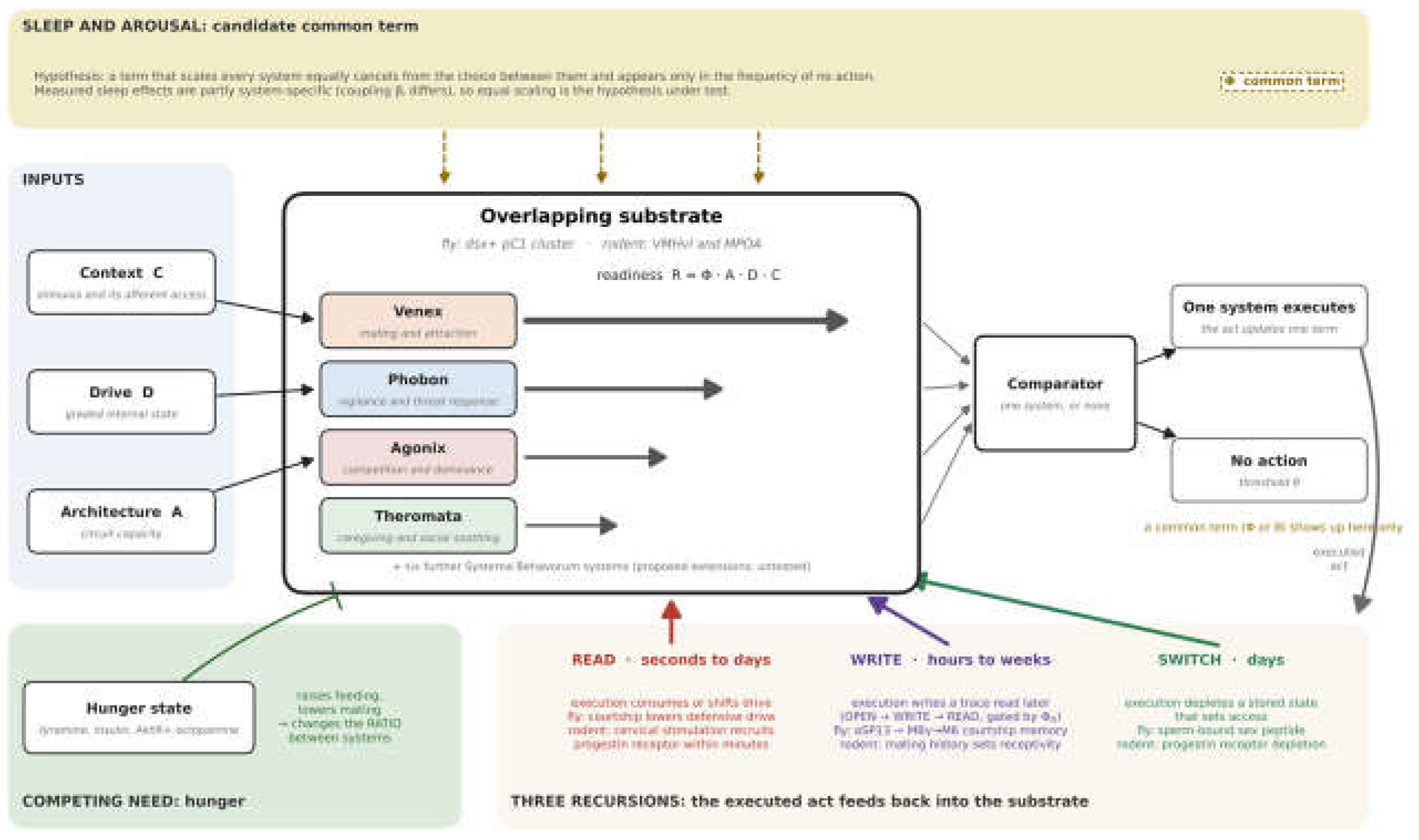
Figure 2.
The insect hub. Circuit map of Drosophila melanogaster courtship versus defense (Case 1), courtship memory (Case 2) and the female post-mating switch (Case 3) on the doublesex-expressing pC1 cluster, with sleep across the top and hunger along the bottom. Solid links are established by manipulation in the cited primary sources; dashed elements are proposed or untested; term tags are assignments proposed here. Male and female circuits are drawn on one hub for comparison and come from different animals; in males courtship and aggression share P1 cells, whereas in females they occupy separate pC1 subtypes. Figure generated by code written with AI assistance (see Declaration).
Figure 2.
The insect hub. Circuit map of Drosophila melanogaster courtship versus defense (Case 1), courtship memory (Case 2) and the female post-mating switch (Case 3) on the doublesex-expressing pC1 cluster, with sleep across the top and hunger along the bottom. Solid links are established by manipulation in the cited primary sources; dashed elements are proposed or untested; term tags are assignments proposed here. Male and female circuits are drawn on one hub for comparison and come from different animals; in males courtship and aggression share P1 cells, whereas in females they occupy separate pC1 subtypes. Figure generated by code written with AI assistance (see Declaration).
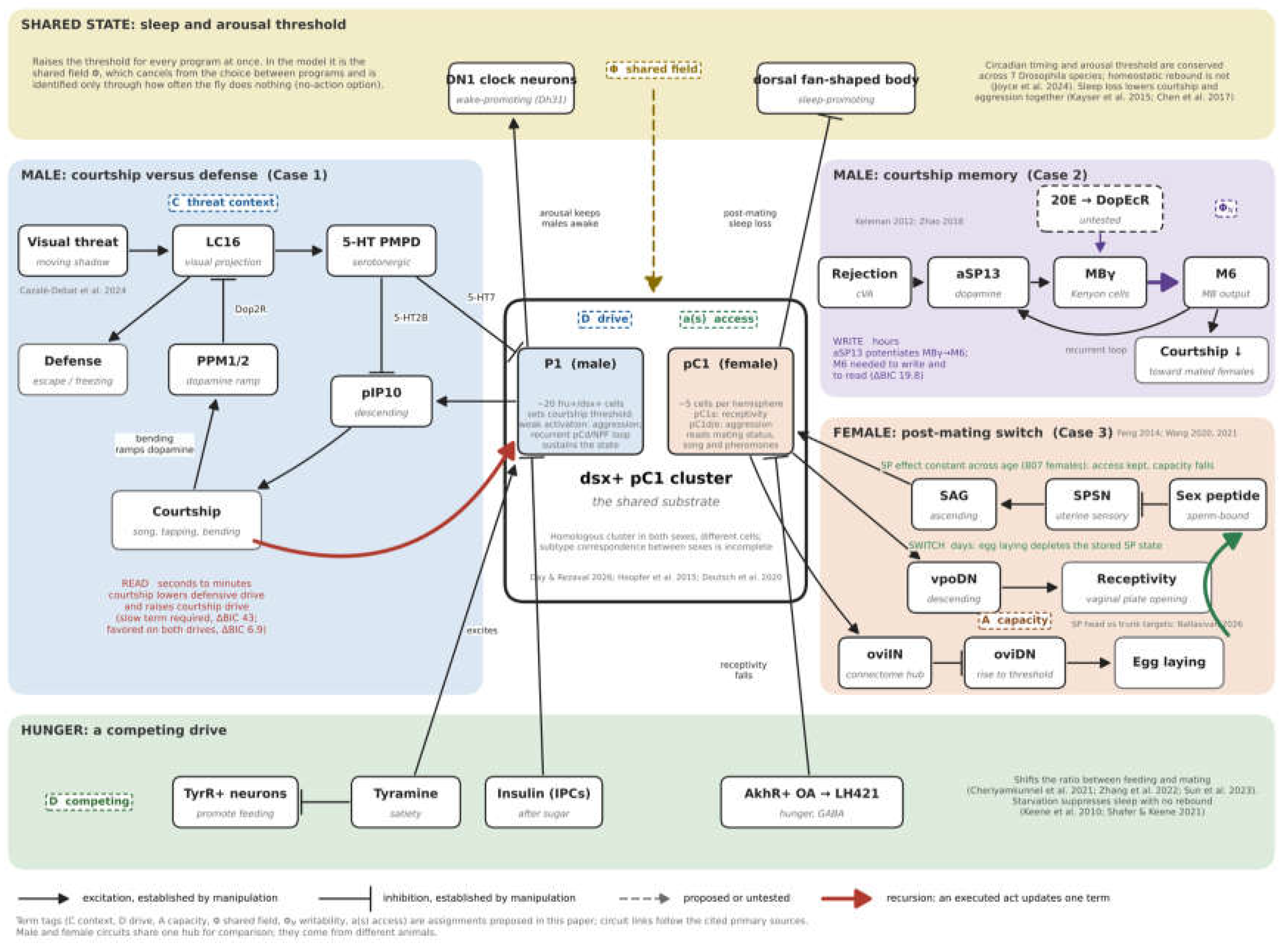
Figure 3.
The mammalian hub. Circuit map of lordosis (Venex), caregiving (Theromata) and aggression (Agonix) in female rodents on overlapping hypothalamic substrate of VMHvl and MPOA, after Rahman and Zorumski (2026b) and its primary sources (Aguilar-Moreno et al., 2022; Blaustein and Wade, 1977; Brown et al., 2017; Champagne et al., 2001; Concas et al., 1998). Within VMHvl, mating and aggression are carried by largely separate cell populations. Species are given for each element and data are not pooled across species. Read, write and switch updates are marked in color. Figure generated by code written with AI assistance (see Declaration).
Figure 3.
The mammalian hub. Circuit map of lordosis (Venex), caregiving (Theromata) and aggression (Agonix) in female rodents on overlapping hypothalamic substrate of VMHvl and MPOA, after Rahman and Zorumski (2026b) and its primary sources (Aguilar-Moreno et al., 2022; Blaustein and Wade, 1977; Brown et al., 2017; Champagne et al., 2001; Concas et al., 1998). Within VMHvl, mating and aggression are carried by largely separate cell populations. Species are given for each element and data are not pooled across species. Read, write and switch updates are marked in color. Figure generated by code written with AI assistance (see Declaration).
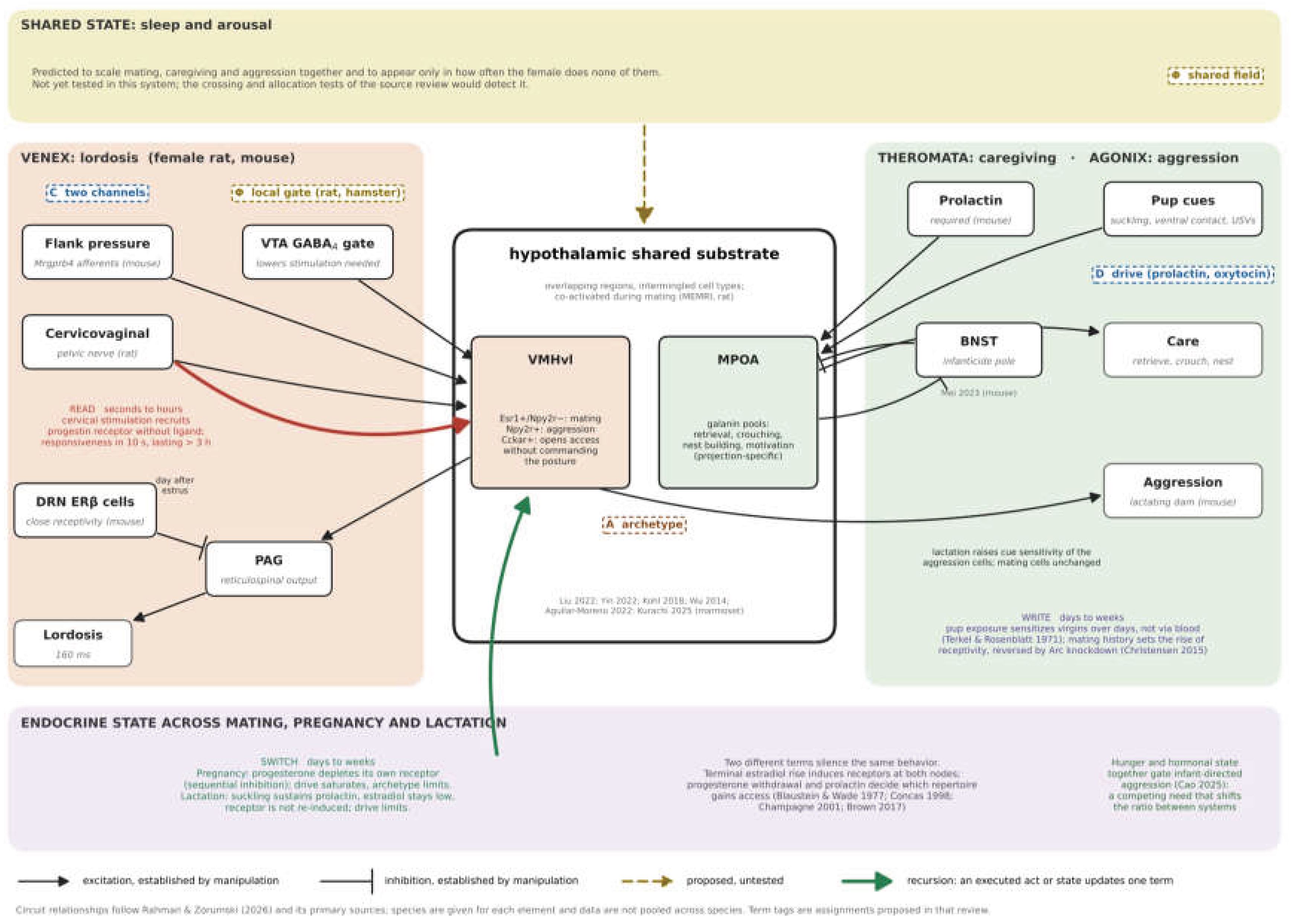

Table 1.
The three update rules in the fly and the rodent. [E], established by manipulation; [R], supported by reanalysis; [P], proposed.
Table 1.
The three update rules in the fly and the rodent. [E], established by manipulation; [R], supported by reanalysis; [P], proposed.
| Rule | Variable updated | Timescale | Fly (D. melanogaster) | Rodent (rat, mouse) |
|---|---|---|---|---|
| READ (Eq. 3) | Drive Di, inside the decision circuit | Seconds to days | PPM1/2 dopamine ramp → LC16 (Dop2R) [E]; slow term on both drives [R]; per-mating drive decrement and overnight partial recovery via NPF–pCd loop [E]; D2 desensitization [E] | Slow VMHvl integrating dimension builds with aggression (mouse) [E]; vaginocervical stimulation recruits progestin receptor within minutes (rat) [E] |
| WRITE (Eq. 4) | Offset wi, gated by ΦN | Hours to months | aSP13 → MBγ→M6, recurrent [E]; M6 at write and read [R]; sleep-dependent consolidation [E]; loser effect after repeated losses [E]; DopEcR writability [P] | Hippocampal → VMHvl LTP after aggression experience, testosterone-gated (mouse) [E]; Arc-dependent rise of receptivity (rat) [E]; rearing sets oxytocin receptor (rat) [E] |
| SWITCH (Eq. 5) | Stored state S setting access ai, outside the circuit | Days | Sperm-bound sex peptide → SPSN–SAG–pC1 → vpoDN and oviDN [E]; release kinetics set duration [E]; depletion by egg laying [P]; access persists with age [R] | Progestin receptor depletion in pregnancy (rat) [E]; prolactin holds drive low in lactation; two limiting terms [P] |
Table 2.
The ten systems of the Systema Behavorum. Glosses follow Rahman et al. (2025). [E], identified by manipulation; [P], proposed. Rows below the line are extensions outside the evidence base of this paper.
Table 2.
The ten systems of the Systema Behavorum. Glosses follow Rahman et al. (2025). [E], identified by manipulation; [P], proposed. Rows below the line are extensions outside the evidence base of this paper.
| System | Gloss | Identified substrate | Coordination with core systems | Discriminating test |
|---|---|---|---|---|
| Venex | Mating and attraction | Fly P1/pC1a; mouse VMHvl Esr1+/Npy2r− and Cckar+ [E] | With Phobon, Agonix, Theromata [E] | Crossing test; sleep-coupling test |
| Phobon | Vigilance and threat response | Fly LC16 → serotonergic input to P1 [E] | With Venex at LC16 terminals [E] | Defense in unthreatened males under Dop2R and bending manipulations |
| Agonix | Competition and dominance | Fly weak P1 activation, female pC1d/e [E]; mouse VMHvl Npy2r+ and aggression ensemble [E] | With Venex via MPOA–VMHvl inhibition (mouse) [E] | Threshold-shift test after experience |
| Theromata | Caregiving and social soothing | Mouse MPOA galanin pools, MPOA–BNST inhibition [E]; marmoset preoptic subregion [E] | With Venex and infanticide [E] | Crossing test across the care–mating boundary |
| Imitati | Imitation and cultural learning | Fly mate-copying memory, mushroom bodies, rutabaga [E] | Untested [P] | Copied preference versus Venex readiness under timed writability block |
| Hedonix | Pleasure and play | Rat lateral rostral periaqueductal gray (play, tickling) [E] | Untested [P] | Play versus fighting ratio under sleep deprivation (rat) |
| Navigia | Exploration and goal seeking | Mouse zona incerta circuit for investigation and novelty seeking [E] | Untested [P] | Exploration versus courtship ratio under sleep and hunger manipulations |
| Alligantia | Coalition and belonging | Mouse preoptic populations for social need and social satiety [E] | Untested [P] | Social-satiety activation and mating, care and aggression thresholds |
| Thumos | Pride and recognition | No circuit-level definition adopted here [P] | Untested [P] | Operational definition required first |
| Sacrifex | Symbolic sacrifice and devotion | Proposed composite of Theromata and Alligantia [P] | Untested [P] | Operational definition required first |
Disclaimer/Publisher’s Note: The statements, opinions and data contained in all publications are solely those of the individual author(s) and contributor(s) and not of MDPI and/or the editor(s). MDPI and/or the editor(s) disclaim responsibility for any injury to people or property resulting from any ideas, methods, instructions or products referred to in the content. |
© 2026 by the authors. Licensee MDPI, Basel, Switzerland. This article is an open access article distributed under the terms and conditions of the Creative Commons Attribution (CC BY) license (http://creativecommons.org/licenses/by/4.0/).
Copyright: This open access article is published under a Creative Commons CC BY 4.0 license, which permit the free download, distribution, and reuse, provided that the author and preprint are cited in any reuse.