
Submitted:
16 November 2026
Posted:
18 November 2026
You are already at the latest version
Abstract
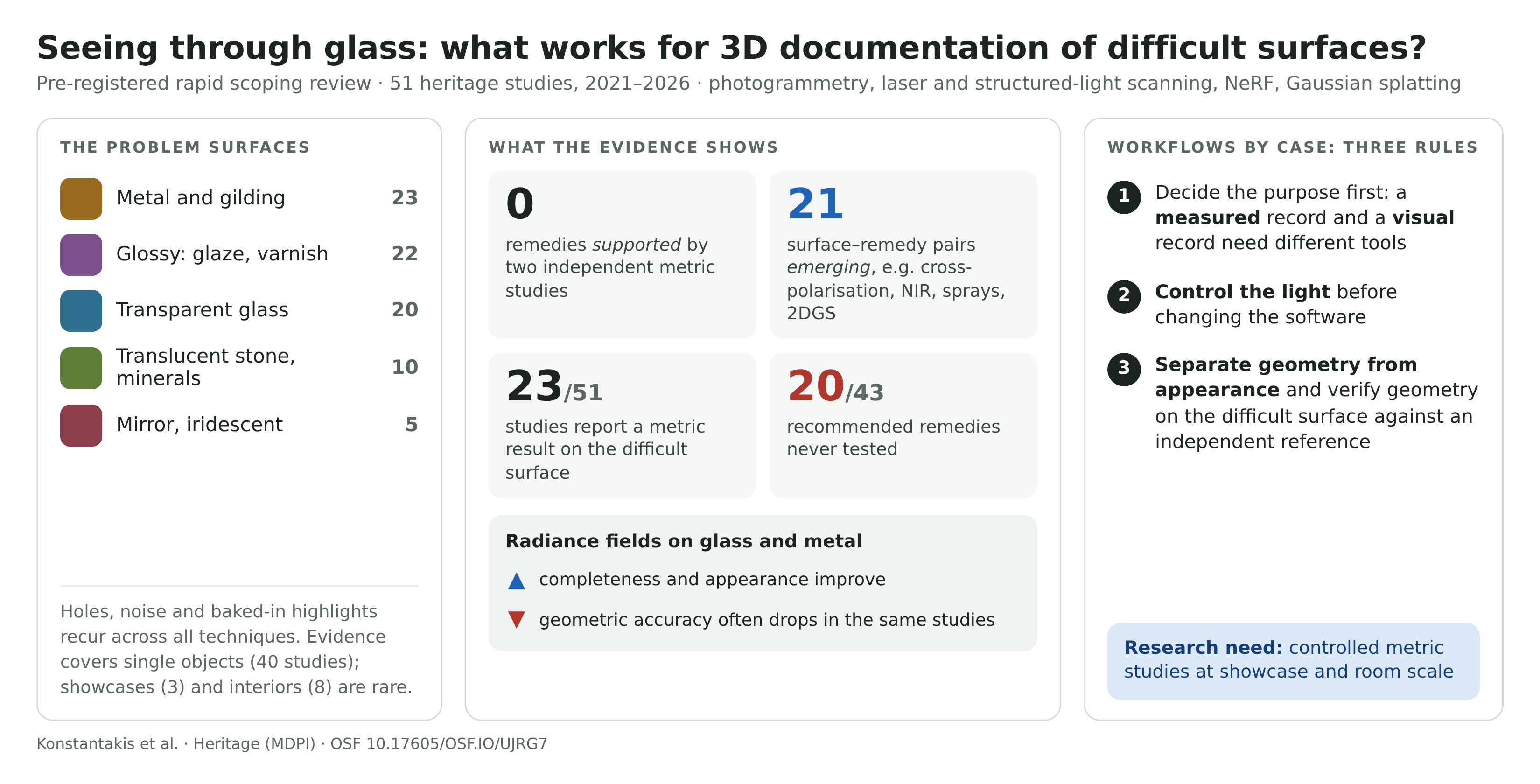
Glass showcases, gilding, polished metal, glazes and translucent stone defeat the assumptions of photogrammetry and laser scanning. Learning-based radiance fields such as NeRF and 3D Gaussian Splatting render these materials convincingly, but whether they also measure them reliably is unclear. We conducted a pre-registered rapid scoping review (OSF: 10.17605/OSF.IO/UJRG7) of heritage studies published in 2021–2026. Of 771 records, screened with AI assistance and checked by blind re-screening (κ = 0.81), 51 studies were included. Evidence concentrates on single objects (40 studies); showcases (3) and interiors (8) are rarely addressed. Holes, noise and baked-in highlights recur across techniques, yet most remedies are applied without comparison, and fewer than half of the studies (23) report a metric result for the difficult surface. Under pre-registered evidence labels, no remedy was supported; cross-polarisation, controlled lighting, near-infrared imaging, multi-exposure, sprays, 2D Gaussian Splatting and radiometric correction were emerging for specific surfaces. Radiance fields increased completeness on glass but often reduced geometric accuracy, and 20 of 43 recommended remedies were never tested. We translate the evidence into workflows by case that combine sensors and separate geometry from appearance, and identify controlled metric studies at showcase and room scale as the main research need.
Keywords:
cultural heritage
; 3D documentation
; photogrammetry
; laser scanning
; Gaussian splatting
; NeRF
; transparent surfaces
; reflective surfaces
; museum showcases
; scoping review
1. Introduction
Three-dimensional documentation is now routine in museums and at heritage sites, but its two workhorses rest on assumptions that many heritage materials violate. Image-based reconstruction (structure from motion and multi-view stereo) assumes that a surface point looks the same from every viewpoint, so that it can be matched across images. Active range sensing (terrestrial, mobile and handheld laser scanning, phone LiDAR and structured light) assumes that the emitted light returns diffusely from the first surface it meets. Transparent, reflective, specular, metallic, iridescent, translucent and glossy surfaces break one or both assumptions. Glass transmits and refracts light and mirrors the room around it; polished metal and glazes return highlights that move with the viewer; translucent stone and agate scatter light below the surface. The results are familiar to anyone who has scanned a museum gallery: holes, noise, mirrored "ghost" geometry behind showcase panes, highlights baked into textures and images that refuse to align.
These materials are not marginal in heritage. Glass vessels and stained glass, gilded altarpieces, bronze sculpture, glazed ceramics, lacquerware and polished marble are core collection types, and the showcase that protects an object is itself a sheet of glass between the object and the sensor. Protective glazing over excavated remains, mirror rooms and reflective modern installations bring the same problem to interiors and sites. At the same time, the usual workshop remedies are often unavailable: conservators restrict or forbid matting sprays, showcases cannot always be opened, lighting may be fixed and fragile objects cannot be handled freely.
Radiance-field methods have changed the conversation. Neural Radiance Fields (NeRF) [1] and 3D Gaussian Splatting (3DGS) [2] represent view-dependent appearance explicitly and can render reflections and transparency convincingly, and 2D Gaussian Splatting (2DGS) [3] targets more accurate surface geometry. Heritage applications have multiplied since 2023, and workflows that combine photogrammetry with Gaussian splatting are being proposed [4]. Whether convincing appearance comes with reliable geometry on difficult surfaces, however, is a separate question, and it matters most to institutions that need measurements, not only images.
Guidance on these questions is scattered across conservation science, photogrammetry, computer vision and digital heritage, and most studies examine a single object, sensor or remedy. To our knowledge, no review has mapped the recent heritage evidence on difficult surfaces across techniques, remedies and spatial scales, or asked how strong that evidence is.
This paper addresses that gap with a rapid scoping review of studies published from 2021 to 2026. It asks which failure modes are reported for each technique (RQ1), which acquisition, processing and learning-based mitigations are used and with what outcome (RQ2), whether results are evaluated metrically or only visually (RQ3), how the evidence is distributed across spatial scale, surface type and documentation purpose (RQ4), and which practice can be recommended for each combination, with what strength of evidence (RQ5). A sixth, exploratory question added after registration asks whether the remedies that studies recommend but do not test are taken up and tested in later work (RQ6). The synthesis is turned into an evidence-labelled decision map and into practical workflows by case, stating for each situation which remedy, or which combination of remedies, the evidence supports (Section 4).
2. Materials and Methods
2.1. Design and Registration
We conducted a rapid scoping review following JBI guidance for scoping reviews [5] and report it according to PRISMA-ScR [6]. Rapid-review adaptations [7] were declared in advance: a 2021–2026 window, free open bibliographic sources, and a single human reviewer supported by AI-assisted screening with a reliability check. The protocol was registered on OSF before screening began (https://doi.org/10.17605/OSF.IO/UJRG7), after the searches had been run.
2.2. Eligibility Criteria
Eligible studies concerned tangible cultural heritage (movable objects, museum showcases and galleries, historic buildings and interiors, monuments and archaeological sites, including museum natural-history collections) and reported 3D documentation or reconstruction with photogrammetry/SfM-MVS, laser scanning, structured light or radiance-field methods, in which transparent, reflective, specular, metallic, iridescent, translucent or glossy surfaces were a stated difficulty or an explicit object of study, with a problem, mitigation or result about them. We excluded material studies without 3D capture (E1); studies in which difficult surfaces were incidental or which addressed rendering only (E2); non-heritage studies (E3); abstracts, posters, slides and deliverables (E4); duplicate reports (E5); reviews (E6, used for snowballing); and non-English reports or reports outside 2021–2026 (E7). Studies stating a heritage purpose but testing modern stand-in objects that simulate museum exhibits were included and flagged. Methods tested only on non-heritage objects were not charted and are cited as technical background.
2.3. Information Sources and Search
OpenAlex (Boolean search of titles and abstracts), Crossref (120 heritage × surface × technique query triplets, followed by the same Boolean applied locally) and arXiv (Boolean search of abstracts) were searched on 3–4 November 2026. Three term blocks were combined with AND: heritage (e.g., museum, cultural heritage, archaeological, artefact, monument, showcase, vitrine), surface (e.g., transparent, glass, glazed, reflective, specular, glossy, mirror, metallic, iridescent, translucent, non-Lambertian) and technique (e.g., photogrammetry, structure from motion, laser scanning, LiDAR, structured light, 3D reconstruction, Gaussian splatting, neural radiance, NeRF, point cloud). Exact strings, scripts and logs are archived with the registration. Backward and forward citation searches of the 46 studies included at that point and the 15 retrieved reviews (five reports retrieved later were not used as seeds) were run in OpenAlex on 5 November 2026. Because many citation records lack abstracts in OpenAlex, the three-block Boolean was relaxed for these records: candidates new to the review and published in 2021–2026 were screened if their title or abstract contained a surface term together with a heritage or technique term.
2.4. Selection
Records were deduplicated by DOI and then by normalised title. A rule-based pre-filter removed records in which any term block was absent from title and abstract. Titles and abstracts were screened with AI assistance (Claude, Anthropic): each record received include, unsure or exclude, an exclusion code, a confidence level and a one-line reason. Title and abstract decisions were not individually confirmed by a human reviewer; instead, their reliability was assessed by blind re-screening (below), and unsure records were passed to full-text assessment. Three clarifying rules agreed at this stage (natural-history museum collections eligible; rendering-only studies excluded; radiance-field studies without a stated heritage context treated as technical background) were applied to all records. An independent, blind AI screening of a random 20% sample (n = 99; seed recorded) agreed with the first-pass decisions in 98.0% of records (Cohen’s = 0.88) and with the final decisions (pass to full text vs exclude) in 97.0% ( = 0.81), above the pre-specified threshold of 0.6. All full-text eligibility decisions (n = 72) were checked by the first author. Studies authored by members of the review team were assessed with the same criteria; two were retrieved, one was included.
2.5. Data Charting
A charting form was piloted on five studies and revised (version 1.0) before full charting. For each study we charted the heritage context (object, spatial scale, setting, stated constraints), surface type, techniques, reported problems, mitigations at acquisition, processing and learning level with their outcomes, evaluation design (none, qualitative, metric; reference and metrics), documentation purpose, and, for radiance-field studies, appearance and geometric completeness and accuracy relative to a named baseline. Values not reported were charted as such and never inferred; page locations were recorded. Coding rules clarified during charting were logged and applied retrospectively to all studies in a final harmonisation pass. Charting was performed with AI support and checked by the first author. As registered, a random 20% sample of included studies (n = 11; seed 20261109) was re-charted against the full texts for 12 key fields (127 field checks): 2 values were wrong (1.6%; surface and scale, one each) and 3 were incomplete without changing a code; no field exceeded the pre-specified 10% error rate that would have triggered re-checking all studies. The two errors and one unsupported outcome code were corrected before synthesis.
2.6. Synthesis
We report descriptive statistics and an evidence map of surface type × spatial scale × technique. Failure modes and mitigations were synthesised thematically by technique, and radiance-field methods separately for appearance and geometry. We assigned the pre-registered evidence labels: Supported (at least two included studies with metric evaluation report the mitigation as effective), Emerging (one such study, or at least two studies with qualitative evaluation only reporting it as effective) or Gap (no included study). Three operational choices, made before the labels were computed and reported here as deviations, were needed. (i) Labels were computed per surface group × mitigation, because cells defined by scale × surface × purpose were too sparse; scale and purpose are used to organise the decision map. (ii) Partial effects (for example, more complete but less accurate geometry) were not counted as effective. (iii) Combinations with some evidence that fell short of Emerging (a single qualitative study, partial effect only, no effect, or application without comparison) are labelled Insufficient, a category the registered scheme did not anticipate. A study’s outcome was assigned to all surface groups it tested unless the full text showed that a remedy targeted one surface only. A sensitivity check without preprints was planned. One registered component, an illustrative application, was not carried out; the deviation is documented in the registration update.
RQ6 was added after registration and is reported as exploratory. For each surface group, we listed the coded remedies that included studies applied without comparison or recommended for future work, and checked whether any included study tested the same remedy on the same surface group (effective, partial or not effective). Same-group follow-up studies (same first author) were traced as a second view, and forward citations of included studies (works citing them up to 5 November 2026) were checked for tests of the same remedies.
3. Results
3.1. Search and Selection
The searches identified 771 records (OpenAlex 661, Crossref 44, arXiv 66). After removing 128 duplicates and 146 records that lacked one of the three term blocks, 497 titles and abstracts were screened and 422 excluded, mostly because they did not concern heritage (208) or mentioned difficult surfaces only incidentally (154); 11 were excluded by the three clarifying rules. Of 75 reports sought, 3 could not be used (2 not retrieved, 1 preprint of an included journal article); for one further preprint the published journal version was assessed. Of 72 reports assessed in full text, 21 were excluded (E2 10, E4 5, E3 4, E1 1, E7 1). Citation searching identified 1,892 records (1,570 backward, 322 forward); after removing 37 already identified and 855 outside 2021–2026, 1,000 were filtered and 50 screened by title and abstract. Two were sought in full text but could not be retrieved, so no study was added from citation searching. In total, 51 studies were included (Figure 1). Eleven methods studies without a heritage context or without 3D capture were retained as technical background.
3.2. Characteristics of the Evidence
The evidence is recent and growing: 28 of the 51 studies were published in 2025–2026, and radiance-field methods appear from 2023 onwards (Figure 2). Thirty-three studies are journal articles, 17 conference papers and one a book chapter; Italy is the most frequent stated case location (13). Photogrammetry is by far the most common technique (41 studies), followed by structured light, 3D Gaussian Splatting and NeRF (11 each) and terrestrial laser scanning (6), counts that include use as reference data; 2DGS, CT, handheld laser triangulation, conoscopic holography and optical projection tomography appear in one to three studies each.
Metal and gilding (23 studies), glossy surfaces (22) and transparent glass (20) dominate; translucent materials (10) and mirrors or iridescent surfaces (5) are rare. Evidence is concentrated on single objects (40 studies). Only three studies address a showcase, eight a room or interior, seven a building and three a site (Figure 3). Fewer than half of the studies (24) treat the difficult surface as a primary topic; in the others it is one finding among several. Twenty-three studies state at least one practical constraint, most often limited access or time (13), handling restrictions (10) and a prohibition on sprays (8); for painted pottery, for example, spray was ruled out and cross-polarised lighting was presented as the conservation-safe alternative [8]. Two large natural-history collections relied on cross-polarised photogrammetry for metallic, transparent and translucent minerals without testing it against a control [9,10].
Twenty-three studies report a metric result specific to the difficult surface; the others rely on visual assessment or report only scene-level numbers. Reference data vary widely: a photogrammetric model is the reference in eight studies, structured light in four, laser scanning in two and a metrology arm or CT in a few, while several studies compare against an uncorrected scan, a fitted plane or held-out images. Thirty-three of the 51 studies contain at least one internal reporting inconsistency (for example, figures contradicting tables or unstated units), which limits how far their numbers can be compared.
3.3. Failure Modes (RQ1)
Three failure modes recur across techniques: missing data and holes (24 studies), noise (24) and texture artefacts from baked-in highlights (24); alignment failure (9) and surface deformation (9) are less frequent. Ghost geometry, refraction offsets and floating artefacts are reported in two to three studies each. The mechanisms differ by technique and surface:
- Photogrammetry fails at image matching. Moving highlights on glossy and metallic surfaces break correspondences, so images do not align (only 4 of 36 images aligned on a glossy ceramic without mitigation [11]) or dense matching produces noisy, deformed surfaces [12,13,14]. On transparent glass, completeness collapses: 17% of a glass bottle’s surface [15] and 32–48% of a glass window [16]; a glass-and-vinyl installation was reconstructed only partially, with holes and wrong colour [17], and lacquerware and fossils lost their translucent or semi-glossy parts [18,19]. Imaging specimens through glass jars adds refraction at the glass–fluid interface and internal reflections [20].
- Laser scanning and structured light fail at the return signal. Gilding and polished marble produce noise and false points in terrestrial scans [21], and glazing and anodised frames produce high surface noise [22]; mirror-polished metal overexposes or loses tracking [14,23]; translucent marble and agate produce subsurface scattering that biases surfaces inwards by about 5 mm (up to 8 mm in one area) (marble [24]) or 0.03–0.46 mm (agate [25]).
3.4. Mitigations and Their Outcomes (RQ2)
Figure 4 summarises the mitigations and their reported outcomes. The most striking pattern is the gap between recommendation and test. Controlled or diffuse lighting is used or recommended in 20 studies but shown effective in only four, all qualitatively; cross-polarisation is used or recommended in 13 studies and compared with an unpolarised condition in three, one with a geometric metric [11], one with a colour-difference metric [28] and one qualitatively [29]. Most mitigations are applied without any comparison.
Where comparisons exist, or where practice has converged without a formal comparison, they point to four families of remedies:
- Optical control at acquisition. Cross-polarised photogrammetry removes baked-in highlights from texture on glazes and gilding [28,29]. On a glossy ceramic, cross-polarisation with HDR blending and a projected noise pattern each restored image alignment (36 of 36 images, against 4 without mitigation), and their combination gave 38% more tie points than the pattern alone [11]. Near-infrared imaging reduced specular noise on varnished wood and improved repeatability (SD 0.12 to 0.07 mm), although agreement with the reference barely changed [30]. On mirror-polished daguerreotypes, scanning at two laser powers reduced invalid measurements below 1% [31].
- Surface treatment. A vanishing scanning spray made glass, metal and porcelain scannable with structured light, with a mean pre/post deviation of 0.57 mm and no residue [32]. Where sprays were forbidden, a soap solution devised by conservators was brushed on a gilded artwork [33]; talc made a clear acrylic logo scannable but misrepresented its texture [23]. Two of these three studies used stand-in objects.
- Sensor choice. Several studies solved the problem by changing sensor rather than settings: a blue-line laser on a metrology arm for anodised aluminium (RMSE 0.21–0.50 mm against archival drawings [22]), handheld laser triangulation with external tracking for a gem-set chalice [25], micro-CT for translucent lithics [34], and optical projection tomography in air for thin glass cups (mean error 0.5–1.5 mm against 2.2–5.6 mm for NeRF and 3.1–10.4 mm for photogrammetry [35]).
- Processing. Manual editing and masking are widespread but rarely evaluated. Exceptions are mask-based levelling of laser-penetration artefacts on agate (residual deviation about 0.07 mm [25]) and zonal radiometric correction against colorimeter readings on a gilded polychrome sculpture (RGB error reduced by 65% [36]).
3.5. Radiance Fields: Appearance Versus Geometry
Twelve studies compared radiance-field methods with a baseline and reported an outcome on a difficult surface (two further studies reported scene-level results only), eleven of them with conventional photogrammetry or a textured mesh and one with other NeRF variants (Table 1). Geometric completeness improved in seven of eight comparisons, six of them on glass or mirrors and one on glazed ceramics [37]: NeRF covered 85% of a glass window against 32–48% for multi-view stereo [16] and 99.98% of a glass ceiling [38]; 3DGS and 2DGS covered 99.6% and 96.4% of a glass bottle against 17% for photogrammetry [15]. On reflective bronze, by contrast, NeRF and 3DGS produced far sparser and less accurate models than photogrammetry [39]. Accuracy was worse in five of eight comparisons: the NeRF window and ceiling contained 34.2% and 52.7% outliers [16,38], and 3DGS on reflective ceramics had more outliers and took 36 times longer than photogrammetry [37]. On the glass bottle, both Gaussian methods had a lower RMSE than photogrammetry (about 1.2 mm against 1.6 mm), with 2DGS giving the best balance of completeness and accuracy [15]. Appearance was reported as better or mixed, mostly from visual inspection [21,40,41,42]; on a bronze lectern, for example, NeRF reproduced reflections that the photogrammetric model rendered matte [43], and several studies used radiance fields only for their visual advantage on glass, water or polished inlays while cautioning against using their geometry [44,45,46]. One gallery-scale NeRF study reported scene-level gains from reflection- and transmission-aware sampling, but no surface-specific results [47]. Polarimetric cues can separate highlight edges from geometric edges without changing the reconstruction [48]. On glass vessels, the 3DGS settings that gave the best-looking renders were not the most accurate [26].
3.6. Evidence Labels and Decision Map (RQ4, RQ5)
Under the pre-registered rules, no mitigation reaches Supported for any surface group: no remedy has been shown effective with a metric evaluation in two or more independent heritage studies. Twenty-one surface–mitigation combinations are Emerging (Table S2). For glossy surfaces they are cross-polarisation, HDR blending and pattern projection [11,28], near-infrared imaging [30], vanishing spray [32] and zonal radiometric correction [36]; for metal and gilding, cross-polarisation and lighting control (qualitative evidence only) [28,29,33], multi-exposure acquisition and pixel binning [31], spray [32], radiometric correction [36] and manual editing [12,49]; for transparent glass, 2DGS [15], neural surface reconstruction with calibrated poses [50] and spray [32]; for translucent materials, mask-based correction of laser penetration [25]. Radiance fields on glass reach only Insufficient (mostly partial effects): they improve completeness and degrade accuracy in the same studies. No combination for mirrors or iridescent surfaces is Emerging. No preprints met the inclusion criteria, so the planned sensitivity analysis without preprints did not change any label. Section 4 turns these findings into workflows by case, with a decision map by surface, scale and purpose (Table 2).
3.7. From Recommendation to Test (RQ6, Exploratory)
Across surface groups, included studies recommended or applied without comparison 43 distinct remedy–surface combinations. Twenty-three of them were tested in at least one included study, and 13 were shown effective somewhere, mostly for glossy and metallic surfaces (Table S3). The remedies recommended most often for the most difficult materials remain untested: cross-polarisation for transparent glass is recommended or applied without comparison in six studies [9,10,26,41,42,50] and was never tested; controlled lighting for translucent materials (five studies) and all four remedies proposed for mirrors and iridescent surfaces were never tested either. Only one of seven remedy–surface combinations proposed for translucent materials was tested.
Follow-up studies by the same groups show the same pattern. One group moved from a glass bottle to glazed ceramics while staying with Gaussian-splatting methods [15,37]; another compared NeRF with multi-view stereo on a glass window and then on a glass ceiling, with similar outlier problems [16,38]; a third recommended cross-polarisation and sprays for mineral specimens and, in later work, turned to 3DGS rather than testing them [9,10,42]. In each case the next study changed the reconstruction method rather than testing the acquisition remedy proposed earlier. Forward citations confirmed the pattern: of the 322 works citing the included studies or the seed reviews, none tested cross-polarisation, lighting control or any other acquisition remedy on heritage glass, mirrors or translucent materials; the closest was a NeRF workflow for public sculptures that masked reflections during training, a processing rather than acquisition remedy (according to its abstract; the full text could not be retrieved).

Table 1.
Radiance-field methods compared with a baseline on difficult surfaces (n = 12; baseline photogrammetry or textured mesh except [51], NeRF variants). (q) = qualitative evidence only; – = not reported.
Table 1.
Radiance-field methods compared with a baseline on difficult surfaces (n = 12; baseline photogrammetry or textured mesh except [51], NeRF variants). (q) = qualitative evidence only; – = not reported.
| Study | Surface | Method vs baseline | Appearance | Completeness | Accuracy |
|---|---|---|---|---|---|
| Croce et al. [40] | Mirror, metal, glass | NeRF vs MVS | mixed (q) | better (q) | worse (q) |
| Maté-González et al. [39] | Bronze | NeRF, 3DGS vs MVS | – | worse | worse (q) |
| Carmeliti et al. [41] | Glass | NeRF, 3DGS vs MVS | mixed (q) | better (q) | – |
| Wang et al. [51] | Glass cover | RAS-NeRF vs NeRF variants | mixed | – | better (q) |
| Billi et al. [15] | Glass | 3DGS, 2DGS vs MVS | – | better | better RMSE, more artefacts (3DGS) |
| Kenely et al. [21] | Gilding, marble | 3DGS vs textured mesh | mixed (q) | – | – |
| Croce et al. [43] | Bronze | NeRF vs MVS | better (q) | – | – |
| Murtiyoso et al. [16] | Glass, mirror | NeRF vs MVS | – | better | worse |
| Billi et al. [37] | Glazed ceramics | 3DGS (MILo) vs MVS | – | better (q) | worse |
| Apopei [42] | Minerals | 3DGS vs textured mesh | better (q) | – | – |
| Murtiyoso et al. [38] | Glass ceiling | NeRF vs MVS | – | better | worse |
| Stavroulakis et al. [35] | Glass | NeRF vs MVS | – | better (q) | better |
Table 2.
Decision map for 3D documentation of difficult surfaces in heritage. Labels (Section 2.6): Emerging = one study with a metric result showing the remedy effective, or at least two qualitative studies; Insufficient = one qualitative study, partial effect only, not effective, or applied without comparison; Gap = no included study. No option reached Supported. Scale and purpose are assigned from the studies’ settings; labels refer to surface × remedy.
| Surface | Scale | Purpose: measurement | Purpose: visualisation |
|---|---|---|---|
| Transparent glass | Object | Do not rely on photogrammetry alone. On objects that may be treated (stand-ins, replicas): vanishing spray + structured light (Emerging [32]). Otherwise 2DGS (Emerging [15]) or neural surface reconstruction with calibrated camera poses (Emerging [50]) — both shown on modern stand-in objects only; optical projection tomography in air for thin-walled vessels (Insufficient, one metric study with partial effect [35]). Verify geometry against a reference. | 3DGS (Insufficient: better appearance, partial geometry [15,26,41,42]; not effective in [50]); tune for appearance separately from geometry, since the best-looking settings were not the most accurate [26]. |
| Transparent glass | Showcase, room | Laser-scan the opaque parts (plinths, frames, walls) and model panes parametrically as planes checked against drawings (Gap). NeRF increases completeness of glass but with 34–53% outliers: not for measurement [16,38]. | NeRF/3DGS; reflection-aware NeRF for objects behind glass covers (Insufficient [51]). Cross-polarisation for showcases (Insufficient: recommended, untested). |
| Metal and gilding | Object | Cross-polarised photogrammetry (Emerging, qualitative [28,29]); controlled lighting (Emerging, qualitative [29,33]); multi-exposure acquisition (Emerging [31]); spray only where permitted (Emerging [32]). Where geometry matters most, change sensor: laser on a metrology arm [22] or handheld laser with external tracking [25] (Insufficient: single studies). | Cross-polarised diffuse texture plus a specular map from unpolarised–polarised differencing [28], or empirically fitted specular maps from flash photography [52]; zonal radiometric correction against colorimeter values (Emerging [36]); NeRF for reflective appearance (Insufficient: single qualitative study [43]). |
| Metal and gilding | Room, building | TLS–photogrammetry fusion with image grading and manual cleaning (Insufficient [21]); robust registration for gilded scans (Insufficient [53]). | 3DGS renders gilding convincingly at distance but breaks down close up (Insufficient [21]). |
| Glossy (glaze, varnish, polish) | Object | Cross-polarisation with HDR blending and projected pattern (Emerging [11,28]); near-infrared imaging for varnish (Emerging [30]); spray where permitted (Emerging [32]). Adding images or overlap did not help (Insufficient: not effective [54]). | Cross-polarised texture (Emerging [11,28]); polariser on the lens for residual highlights (Insufficient [55]). |
| Glossy | Room | Photogrammetry was more accurate and 36× faster than 3DGS on reflective ceramics (one metric study [37]). | 3DGS for view-dependent gloss (Insufficient: partial [21,37]). |
| Translucent (marble, agate, minerals, lithics) | Object | Choose the scanner: subsurface bias up to ~5 mm differed by scanner model [24] (Insufficient); mask-based correction of laser penetration (Emerging [25]); micro-CT for small translucent lithics (Insufficient: untested [34]). | 3DGS for translucency (Insufficient [42]). |
| Mirror, iridescent | Any | No remedy reaches Emerging; photogrammetry fails on mirror surfaces [56]. NeRF is more complete than photogrammetry on mirrors but with high outlier rates [16,40]. | 3DGS for iridescence (Insufficient [42]); physically based material maps (Insufficient: untested [9]). |
4. From Evidence to Practice: Workflows by Case
This section turns the synthesis into guidance for practitioners. It separates two kinds of advice. Remedies with an evidence label (Section 2.6) come from the included studies. Steps marked untested are recommendations made in the literature, or standard practice, that no included study evaluated on the surface in question; they are given because a practitioner has to act, not because they are proven. To show how often each option has worked, we give in brackets the number of included studies that reported the remedy effective on that surface out of those that tested it (for example, 2/3); these counts are small and describe the published record, not a probability of success (Table 3). Figure 5 summarises the route from case to workflow, and Table 2 gives the detail by surface, scale and purpose.
4.1. Three Questions before Capture
Three questions decide most of the workflow. What is the record for? A measured record (for conservation, design or monitoring) and a visual record (for communication, teaching or virtual visits) need different tools, and on difficult surfaces one model rarely serves both (Section 3.5). May the surface or object be touched? Sprays, powders and tape are the most effective single remedies for structured light [32], but they are often forbidden [8,33], and showcases may not be opened. At what scale? Almost all tested remedies were tested on single objects; for showcases, rooms and glazed building elements the evidence is thin or absent (Figure 3), and the guidance below relies more on combination and verification than on any single tested remedy.
4.2. Workflows by Case
Case 1 – A glass object that may be treated. Where a conservator allows a temporary vanishing spray, or a replica or stand-in can be used, spray the object and capture it with structured light (Emerging, 1/1 [32]; mean pre/post deviation 0.57 mm). Photogrammetry alone should not be used: on a glass bottle it covered only 17% of the surface [15].
Case 2 – A glass object that may not be treated. For a measured record, use 2D Gaussian Splatting (Emerging, 1/2 [15,26]) or neural surface reconstruction from photographs with accurately calibrated camera poses (Emerging, 1/1 [50]); both were shown on modern stand-ins, or, for thin-walled vessels, optical projection tomography in air (Insufficient [35]). Combine with an independent check of a few dimensions (callipers, a sprayed replica or CT), because each method has been validated on very few objects. For a visual record, 3D Gaussian Splatting gives the most convincing appearance, but it was fully effective in only 1 of 5 studies that tested it on glass [42], with partial results in three, typically better completeness and worse accuracy [15,26,41], and not effective in one [50]; NeRF behaved similarly (0/6, six partial); tune it for appearance and do not reuse its geometry for measurement [26].
Case 3 – Objects behind glass that cannot be removed. Only one included study tested a remedy for objects behind a glass cover, in software (reflection-aware NeRF, Insufficient [51]); no acquisition remedy was tested (Gap). The recommended practice is cross-polarised or controlled lighting (cross-polarisation untested on glass, although recommended or applied without comparison in six studies; controlled lighting 0/1, partial), shooting close and as perpendicular to the pane as possible, and masking the pane in processing; reflection-aware radiance fields address the same problem in software (Insufficient [51]). Imaging through curved glass, such as specimen jars, adds refraction and should be treated as a separate distortion [20]. Report the result as a record through glass, not as a measurement of the object.
Case 4 – Showcases, glazed floors and glass ceilings within an interior. Here the glass is part of the documentation target and no single sensor records it reliably. A combined workflow is needed: (i) capture the opaque structure (walls, plinths, frames, supports) with terrestrial laser scanning or photogrammetry; (ii) model the panes as planes fitted to the well-captured frames and supports, and check them against drawings or tape measurements (untested; no included study evaluated plane-modelled panes against a reference, although two measured glass windows or ceilings reconstructed by multi-view stereo and NeRF [16,38]); (iii) train a radiance field on the same photographs to carry the appearance of the glass (Insufficient: NeRF increased the completeness of a glass window and a glass ceiling but with 34–53% outliers [16,38]); and (iv) deliver two products, a measured model and a visual model, rather than one, as several studies already do when they use radiance fields only for their visual advantage on glass and polished surfaces [44,45,46] or fuse laser geometry with photographic texture [21], an approach others recommend [14].
Case 5 – Metal and gilding. For a single object, use cross-polarised photogrammetry (Emerging, 2/2, qualitative [28,29]) under controlled lighting (2/3 [29,33]; not effective in [12]) and multi-exposure acquisition for mirror-polished parts (Emerging, 1/1 [31]). Where geometry matters most, change the sensor: a laser on a metrology arm [22] or a handheld laser with external tracking [25] (Insufficient: single studies). Combine active-sensor geometry with a cross-polarised diffuse texture and, if the appearance of the metal matters, a specular map from polarised–unpolarised differencing [28]; correct colour against measured reference values where possible (Emerging [36]). At room and building scale, laser scanning fused with photogrammetry and manual cleaning is the reported practice (Insufficient [21,53]); Gaussian splatting renders gilding convincingly at a distance but not close up [21], and NeRF reproduced the reflections of a bronze lectern that photogrammetry rendered matte (NeRF on metal: 1/3 effective; Insufficient [43]); neither replaces a measured geometry.
Case 6 – Glossy glazes and varnishes. Use cross-polarisation (Emerging, 2/2 [11,28]), with HDR blending and a projected pattern where alignment fails (1/1 each [11]), and near-infrared imaging for varnished surfaces (Emerging [30]). Adding images or overlap does not solve the problem (0/1 [54]). For glossy surfaces at room scale, photogrammetry remained more accurate and much faster than 3D Gaussian Splatting in the one comparison available [37]; use splatting for view-dependent gloss in the visual record.
Case 7 – Translucent stone and minerals. Subsurface scattering biases laser and structured-light surfaces inwards, by about 5 mm (up to 8 mm in one area) on marble, and the bias depends on the scanner [24]. Choose and test the scanner on the material first; apply mask-based correction of penetration artefacts where documented (Emerging, 1/2 [17,25]); consider CT or micro-CT for small objects (untested [34]); use radiance fields only for appearance (Insufficient [42]).
Case 8 – Mirrors and iridescent surfaces. No remedy reaches Emerging. In a hall of mirrors, photogrammetry failed to detect the mirror surfaces, and artificial light was avoided to prevent glare [56]; the acquisition remedies recommended for these surfaces (cross-polarisation, controlled lighting, sprays) were never tested on them. Treat mirror-like and iridescent elements as Case 4 treats glass: capture the frames and supports, model the reflective surface geometrically, and use a radiance field for appearance; NeRF fills mirrors more completely than photogrammetry but with high outlier rates (0/2 effective, both partial [16,40]); 3DGS rendered iridescent minerals convincingly in the one study that tried it (1/1, qualitative [42]). Physically based material maps are proposed but untested [9].
4.3. A General Combined Workflow
Across cases, the evidence supports the same pattern: separate geometry from appearance and verify the geometry on the difficult surface itself. In practice this means: (1) state the purpose and the accuracy needed; (2) capture opaque parts with the most reliable sensor for the material; (3) control the light at acquisition (cross-polarisation, wavelength, exposure) before trying software fixes; (4) model transparent and mirror-like elements that no sensor records reliably; (5) use radiance fields, trained on the same images, for appearance; (6) check the difficult surface against an independent reference and report a number for it; and (7) deliver the measured and the visual models as separate products with their limits stated. Radiance fields are optimised for the viewpoints they were trained on: studies report floaters and spurious geometry in regions poorly covered by images [26,42] and renderings that hold at a distance but break down close up [21]. Practitioners should therefore plan image positions for the views that the final product will offer (for example, overhead views for a plan-like presentation of a room) and should not expect a radiance field to be reliable from viewpoints that no image covered.
4.4. What to Report
Because fewer than half of the studies report a number for the difficult surface and 33 of 51 contain internal inconsistencies (Section 3.2), we suggest a minimum: the surface type and its extent; the constraints that applied (handling, sprays, showcase access, lighting); the remedy and whether it was compared with a condition without it; the reference data and their own accuracy; and completeness, accuracy and outlier rate computed on the difficult surface, not only on the whole scene.
5. Discussion
5.1. What the Evidence Shows
Four findings stand out. First, the problem is well described but poorly tested. Holes, noise and baked-in highlights are reported across techniques and materials, but most remedies are applied without a with/without comparison, and fewer than half of the studies (23 of 51) report a number for the difficult surface. Under transparent, pre-registered criteria, no remedy for any surface type is supported by two independent metric studies. The most common recommendations of the field are better supported on some surfaces than others: cross-polarisation is Emerging for glossy and metallic surfaces and lighting control for metallic surfaces, but on glass, translucent stone and mirrors they are recommended without having been tested.
Second, radiance fields change the failure mode rather than removing it. On glass and mirrors, NeRF and 3DGS fill what photogrammetry leaves empty and render glass, gilding and iridescence far more convincingly, but the added geometry is often wrong: outlier rates of 34–53% on glass were reported, and on bronze and glazed ceramics photogrammetry remained more accurate. 2DGS and neural surface methods narrow this gap on single glass objects, but the positive results come from one study each, on modern stand-ins. For heritage practice the implication is a division of labour: radiance fields for appearance and communication, geometry from a sensor or method whose accuracy on the surface has been verified.
Third, the field rarely closes its own loops. Remedies are proposed in discussion sections and future-work statements, but only about half of the remedy–surface combinations proposed in the included studies (23 of 43) were tested anywhere in the corpus, and none of those proposed for glass with cross-polarisation, for translucent stone with lighting control or for mirrors. Follow-up studies by the same groups tended to switch to a newer reconstruction method, typically Gaussian splatting, instead of testing the acquisition remedy they had proposed. New methods thus arrive faster than old recommendations are checked.
Fourth, the evidence does not cover the spaces where heritage professionals most often meet glass. Forty of the 51 studies concern single objects, typically under laboratory control; showcases appear in three, and none measures a showcase pane against a reference. Yet in galleries the glass is part of the documentation target, objects cannot leave their cases, sprays and tape are not allowed and lighting is fixed. Under these constraints, the remedies that work best on single objects are often unavailable, which is why the workflows in Section 4 rely on combining sensors and on modelling rather than measuring the glass.
5.2. Implications for Practice
The workflows in Section 4 can be condensed into three rules of thumb. Decide the purpose first: a measured record and a convincing visualisation need different tools, and on difficult surfaces one model rarely serves both. Change the light before changing the software: cross-polarisation, wavelength choice and multi-exposure address the cause at acquisition and are compatible with no-contact constraints. And for transparent or mirror-like elements of interiors, model rather than measure: fit planes to well-captured frames and supports, verify them against drawings or tape measurements, and let radiance fields carry the appearance. Whatever is chosen, studies should report a number for the difficult surface itself, against a stated reference.
5.3. Implications for Research
The gaps are specific. (i) Controlled comparisons of the most recommended remedies, especially cross-polarisation, on glass and mirrors, with metric outcomes. (ii) Studies at showcase and room scale, measuring panes and objects behind glass against independent references. (iii) Shared benchmark objects and reference data for heritage glass and metal, so that results become comparable; the frequent use of a photogrammetric model as "ground truth" and the high rate of reporting inconsistencies (33 of 51 studies) show how far the field is from this. (iv) Radiance-field studies that report geometric accuracy and outliers on the difficult surface, not only scene-level image metrics. (v) Segmentation of glass and reflective regions as a pre-processing step: only one included study used it, although it fits naturally with masking-based workflows. Methods developed outside heritage are natural candidates for such tests: reflection- and refraction-aware radiance fields [57,58], specular-aware refinement of Gaussian splats [59], Gaussian-splatting orthophotos that suppress reflective artefacts [60], removal of glass-induced artefacts from LiDAR point clouds [61], and benchmarks of NeRF on transparent and metallic objects [62]. Single-image generative 3D models have also been tried on museum glass [63], but they infer rather than capture geometry and cannot replace documentation. (vi) Hybrid workflows in which laser or structured-light geometry constrains a radiance field: fusion of active-sensor geometry with image-based appearance is recommended in several studies [14,27,40], but no included study tested whether laser data used as the starting geometry of a radiance field, or as a reference to prune floaters on opaque surfaces, improves the result; because the sensor that supplies the geometry is the one that fails on glass, such studies should report glass zones separately. (vii) Capture designed for the intended viewing: no included study evaluated how far a radiance field of an interior can be viewed away from the image positions, although this decides whether it can serve as an explorable model or only as a guided visualisation.
5.4. Limitations
This is a rapid scoping review. Searching free bibliographic sources rather than Scopus and Web of Science, limiting the window to 2021–2026 and the language to English may have missed relevant studies, particularly conference papers and practice reports. Screening and charting used AI assistance with a single human reviewer. Title and abstract decisions were not individually confirmed by that reviewer and rest on the AI screening and on blind re-screening, which showed high agreement with the final decisions ( = 0.81); full-text decisions were checked by the first author. Charting was checked against the full texts in a random 20% sample rather than by a second human charter; the error rate was low (1.6%), but with 11 studies per field one further error would have exceeded the 10% threshold for surface and scale. Two reports from the database searches and two from citation searching could not be retrieved. Many studies report qualitative results or contain internal inconsistencies, so the evidence labels describe the strength of the published evidence, not the true effectiveness of the remedies. Two studies by members of the review team were assessed; one was included. The workflows in Section 4 combine labelled evidence with untested recommendations, which are marked as such; the latter should be read as hypotheses to be tested.
6. Conclusions
Transparent, reflective and translucent surfaces remain one of the hardest problems in heritage 3D documentation, and the recent literature describes their failure modes well but tests remedies rarely. Across 51 studies from 2021–2026, no remedy reached the pre-registered threshold for supported evidence, and the spaces where glass matters most in museums, showcases and galleries, are almost absent. Radiance-field methods fill the gaps that photogrammetry leaves and render difficult materials convincingly, but their geometry on those materials is often unreliable; they are best used for appearance, alongside a verified geometric record. The decision map proposed here gives practitioners a starting point by surface, scale and purpose, and the evidence labels show where controlled, metric studies, above all at showcase and room scale, are most needed.
Supplementary Materials
The following supporting information can be downloaded at the website of this paper posted on Preprints.org. Search strings and logs, scripts, screening decisions with reasons, the charting form (v1.0), coding conventions, the harmonised charting table and the evidence-label computation are available on OSF (https://osf.io/mtvbx). File S1: Interactive workflow finder (HTML; select surface, scale, purpose and handling constraints to see the recommended workflow and the published record of each remedy). Table S1: Included studies and charted data. Table S2: Evidence labels by surface group and mitigation. Table S3: Remedies recommended versus tested (RQ6). PRISMA-ScR checklist.
Author Contributions
Conceptualization, M.K. and P.P.; methodology, M.K.; investigation, M.K., E.I., N.G., P.D., A.K., K.C. and V.G.; data curation, M.K.; formal analysis, M.K.; validation, E.I., N.G., P.D., A.K., K.C., V.G. and P.P.; writing—original draft preparation, M.K.; writing—review and editing, all authors; project administration, M.K.; supervision, P.P. All authors have read and agreed to the published version of the manuscript.
Funding
This research received no external funding.
Institutional Review Board Statement
Not applicable.
Informed Consent Statement
Not applicable.
Data Availability Statement
The data supporting this review (search logs and scripts, screening and full-text decisions, charted data, evidence labels and analysis scripts) are openly available on OSF at https://osf.io/mtvbx. The protocol is registered at https://doi.org/10.17605/OSF.IO/UJRG7.
Acknowledgments
During the preparation of this study, the authors used Claude (Anthropic; versions available in November 2026) for title/abstract screening and blind re-screening, support in full-text data charting and its verification, writing the analysis scripts, and drafting and language editing of the text, under the procedures pre-registered on OSF. All full-text eligibility decisions were checked by the first author, and the reliability of screening and charting was assessed on random 20% samples. The authors have reviewed and edited the output and take full responsibility for the content of this publication.
Conflicts of Interest
The authors declare no conflicts of interest. Two retrieved studies were co-authored by members of the review team (M.K. and E.I.); both were assessed with the same criteria as all other studies.
Abbreviations
The following abbreviations are used in this manuscript:
| 2DGS | 2D Gaussian Splatting |
| 3DGS | 3D Gaussian Splatting |
| CT | Computed tomography |
| HDR | High dynamic range |
| MVS | Multi-view stereo |
| NeRF | Neural Radiance Fields |
| OSF | Open Science Framework |
| PRISMA-ScR | PRISMA extension for Scoping Reviews |
| SfM | Structure from motion |
| SL | Structured light |
| TLS | Terrestrial laser scanning |
Appendix A
Table A1.
Included studies (n = 51). Photo = photogrammetry; SL = structured light; (ref) = reference only; M = metric result on the difficult surface, Q = qualitative only.
Table A1.
Included studies (n = 51). Photo = photogrammetry; SL = structured light; (ref) = reference only; M = metric result on the difficult surface, Q = qualitative only.
| Study | Object | Surface | Scale | Techniques | Eval. |
| Amer et al. (2024) [56] | Hall of Mirrors, Haveli Mian Sultan, Lahore | mirror | ROOM | Photo | Q |
| Apollonio et al. (2025) [49] | Amici catadioptric microscope and gilded panel, museum collections, Bologna | metal | OBJ | Photo, photometric stereo | Q |
| Apopei (2024) [10] | 915 rock and mineral specimens of the ’Grigore Cobălcescu’ Museum of Mineralogy… | transparent, translucent, metal | OBJ | Photo | Q |
| Apopei (2025) [42] | Geology museum collection | transparent, translucent, metal, iridescent | OBJ, SHOW | Photo, 3DGS | Q |
| Apopei et al. (2021) [9] | Mineral and rock specimens of the Museum of Mineralogy and Petrography ’Grigore… | metal, transparent, translucent, glossy, iridescent | OBJ | Photo | Q |
| Bezzi et al. (2026) [64] | Similaun mummy (Otzi the Iceman) with protective ice layer and wet skin | ice, wet skin | OBJ | Photo, CT | Q |
| Billi et al. (2025) [15] | Contemporary transparent glass bottle (Mario Luca Giusti ’bona’ bottle) used as… | transparent | OBJ | Photo, 3DGS, 2DGS | M |
| Billi et al. (2026) [37] | Winter garden of Sarreguemines Earthenware Museum | glossy | OBJ, ROOM | Photo, 3DGS, TLS (ref) | M |
| Brown et al. (2024) [52] | Museum collection objects (painting, sculpture) for specular texture maps | specular (material NR) | OBJ | Photo | Q |
| Carmeliti et al. (2026) [41] | Gypsum Venus sculpture | transparent | OBJ, BLDG | Photo, NeRF, 3DGS | Q |
| Catalano et al. (2021) [33] | Gold-coated ceramic artwork ’Il Libro d’Oro del Terzo Paradiso’ | metal | OBJ | Photo | M |
| Chiabrando et al. (2026) [44] | Reggia di Venaria Reale | glossy | OBJ | Photo, 3DGS | Q |
| Cioli and Gattuso (2025) [65] | Suits of armour, Stibbert Museum, Florence; stand-in helmet | metal | OBJ | Photo, handheld laser | Q |
| Clini et al. (2023) [11] | White glossy, texture-less ceramic statuette (testa di moro, Sicilian tradition) | glossy | OBJ | Photo, SL (ref) | M |
| Conti et al. (2022) [24] | Marble ambon by Giovanni Pisano, Sant’Andrea church, Pistoia | translucent, glossy | OBJ | TLS, Photo | M |
| Croce et al. (2024) [40] | Five multi-scale cases | mirror, metal, transparent, water | OBJ, BLDG | Photo, NeRF | Q |
| Croce et al. (2024) [43] | Bronze eagle lectern; Canova statue (pilot) | metal | OBJ | Photo, NeRF | Q |
| Fernández et al. (2024) [17] | Daniel Buren installation ’Incubé’ (2015) | transparent, translucent | BLDG | Photo | Q |
| Forys et al. (2023) [53] | Interiors of Wilanow Palace (Museum of King Jan III’s Palace, Warsaw) | metal, glossy | ROOM | SL | M |
| Frost et al. (2023) [28] | Historic Environment Scotland collection items | glossy, metal | OBJ | Photo | M |
| Göldner et al. (2022) [34] | Protoaurignacian lithic bladelets and blades, Fumane Cave | translucent, glossy | OBJ | CT, SL | Q |
| Hu et al. (2026) [27] | Maqiao Old Street, Shanghai | glossy, white lime-wash | SITE, BLDG | Photo, 3DGS | Q |
| Iakovaki et al. (2026) [19] | Medium-scale paleontological specimens | glossy, translucent | OBJ | SL, Photo | Q |
| Kenely et al. (2026) [21] | St John’s Co-Cathedral, Valletta (UNESCO WHS) | metal, glossy | ROOM, BLDG | Photo, TLS, 3DGS | Q |
| Kim et al. (2025) [32] | Vanishing scanning sprays tested on copper, porcelain and glass specimens and… | metal, glossy, transparent | OBJ | SL | M |
| Kowalik et al. (2025) [14] | Six everyday stand-in objects simulating museum exhibits | glossy, metal | OBJ | Photo, SL, CT | M |
| Kutlu et al. (2025) [50] | Transparent SLA-printed test objects | transparent | OBJ | NeRF, neural SDF, 3DGS | M |
| Lang et al. (2025) [8] | Greek painted pottery | glossy | OBJ | Photo | Q |
| Lanzara et al. (2022) [12] | Late-17th-c. silver altar frontal (258x104x22 cm) with silver-plated brass… | metal | OBJ | Photo | Q |
| Maté-González et al. (2025) [39] | Three bronze horse-shaped fibulae | metal | OBJ | Photo, NeRF, 3DGS, CMM (ref) | M |
| Medici et al. (2026) [26] | Two Modern-Age glass artefacts NV-1405 (cup with empty inner volume) and S-7571… | transparent | OBJ | Photo (ref), 3DGS, 2DGS | M |
| Murtiyoso et al. (2023) [16] | Historic interiors | transparent, mirror | ROOM | Photo, NeRF, TLS (ref) | M |
| Murtiyoso et al. (2024) [38] | Main hall of Warsaw University of Technology with glass ceiling (’Hall’) | transparent | ROOM | Photo, NeRF, Vis-MVSNet, TLS (ref) | M |
| Nguyen et al. (2023) [18] | Traditional lacquer art object (tall bottle-shaped lacquerware) | glossy, translucent | OBJ | Photo | Q |
| Niquet-Herrero et al. (2026) [25] | Holy Chalice of Valencia Cathedral | translucent, metal, gemstones, pearls | OBJ | handheld laser | M |
| Pei et al. (2026) [47] | 10 art-gallery exhibition areas | transparent, translucent, metal, glossy | ROOM, SHOW | NeRF, SL (ref) | Q |
| Perfetti et al. (2024) [29] | Roman gilded bronze head MR353 (portrait, 3rd c. AD), Santa Giulia Museum,… | metal | OBJ | Photo | Q |
| Porcu et al. (2026) [54] | Laboratory mock-ups of heritage materials | glossy | OBJ | Photo, laser microprofilometer (ref) | M |
| Quintero et al. (2024) [31] | Two 19th-century daguerreotypes (Ag-Cu plates 519mini and 534), recto and… | metal | OBJ | conoscopic holography | M |
| Rajaram et al. (2023) [20] | 10 ’wet’ pathology specimens (Osler aortic aneurysms, 1876-1884) in original… | transparent, preservative fluid | OBJ | Photo | Q |
| Saadatseresht et al. (2026) [48] | Darius statue/bust (replica-type cultural heritage statue) with shallow reliefs | glossy | OBJ | Photo, polarimetric capture | Q |
| Stavroulakis et al. (2023) [35] | Contemporary thin-walled glass cups (2 liqueur glasses, 1 wine glass) as… | transparent | OBJ | OPT, Photo, NeRF, SL (ref) | M |
| Unnikrishnan et al. (2025) [55] | Durium cardboard phonograph discs | glossy | OBJ | Photo, THz imaging | Q |
| Varol et al. (2026) [13] | Three Louvre sculptures | metal | OBJ | Photo | M |
| Vasiljevic et al. (2025) [46] | Katolicka Porta square (Novi Sad) with Roman Catholic Church of the Name of… | transparent | BLDG, SITE | NeRF | Q |
| Vico-García et al. (2025) [36] | Saint Catherine of Alexandria, Neo-Baroque polychrome wooden sculpture | glossy, metal | OBJ | SL, Photo | M |
| Wang et al. (2025) [51] | Artefacts behind glass covers/showcases | transparent | SHOW | NeRF | M |
| Webb et al. (2023) [30] | Carved, varnished, stained and painted walnut sculpture ’Coyote and Turtle’… | glossy | OBJ | Photo, SL (ref) | M |
| Williams et al. (2024) [23] | Stand-in Teesside University logos (130 x 150 mm) in MDF, metal, modelling foam… | metal, transparent, glossy, black/dark | OBJ | SL | Q |
| Yu et al. (2026) [45] | Aula-library urban block, TU Delft campus | transparent, water | SITE, BLDG | Photo, MLS, 3DGS, ALS (ref) | Q |
| Çapar et al. (2026) [22] | Anodised aluminium window and sash frames (with glazing) of Munich Central… | metal, transparent | OBJ, ROOM | TLS, Photo, handheld laser | M |
References
- Mildenhall, B.; Srinivasan, P.P.; Tancik, M.; Barron, J.T.; Ramamoorthi, R.; Ng, R. NeRF: Representing Scenes as Neural Radiance Fields for View Synthesis. Commun. ACM 2022, 65, 99–106. [Google Scholar] [CrossRef]
- Kerbl, B.; Kopanas, G.; Leimkühler, T.; Drettakis, G. 3D Gaussian Splatting for Real-Time Radiance Field Rendering. ACM Trans. Graph. 2023, 42, 139. [Google Scholar] [CrossRef]
- Huang, B.; Yu, Z.; Chen, A.; Geiger, A.; Gao, S. 2D Gaussian Splatting for Geometrically Accurate Radiance Fields. In Proceedings of SIGGRAPH 2024 Conference Papers; ACM: New York, NY, USA, 2024. [Google Scholar] [CrossRef]
- Remondino, F.; Farella, E. M.; Bertolasi, G.; Rigon, S.; Qin, R. Combining Photogrammetry and Gaussian Splatting. Int. Arch. Photogramm. Remote Sens. Spat. Inf. Sci. 2026, XLIX-B2-2026, 1363–1370. [Google Scholar] [CrossRef]
- Peters, M.D.J.; Marnie, C.; Tricco, A.C.; Pollock, D.; Munn, Z.; Alexander, L.; McInerney, P.; Godfrey, C.M.; Khalil, H. Updated Methodological Guidance for the Conduct of Scoping Reviews. JBI Evid. Synth. 2020, 18, 2119–2126. [Google Scholar] [CrossRef] [PubMed]
- Tricco, A.C.; Lillie, E.; Zarin, W.; O’Brien, K.K.; Colquhoun, H.; Levac, D.; et al. PRISMA Extension for Scoping Reviews (PRISMA-ScR): Checklist and Explanation. Ann. Intern. Med. 2018, 169, 467–473. [Google Scholar] [CrossRef] [PubMed]
- Garritty, C.; Gartlehner, G.; Nussbaumer-Streit, B.; King, V.J.; Hamel, C.; Kamel, C.; Affengruber, L.; Stevens, A. Cochrane Rapid Reviews Methods Group Offers Evidence-Informed Guidance to Conduct Rapid Reviews. J. Clin. Epidemiol. 2021, 130, 13–22. [Google Scholar] [CrossRef] [PubMed]
- Lang, M.; Kluge, P.; Günzel, A. From Furtwängler to Photogrammetry. Stud. Digit. Herit. 2025, 9, 340–382. [Google Scholar] [CrossRef]
- Apopei, A. I.; Buzgar, N.; Buzatu, A.; Maftei, A. E.; Apostoae, L. Digital 3d models of minerals and rocks in a nutshell: enhancing scientific, learning, and cultural heritage environments in geosciences by using cross-polarized light photogrammetry. Carpathian J. Earth Environ. Sci. 2021, 16, 237–249. [Google Scholar] [CrossRef]
- Apopei, A. I. Towards Mineralogy 4.0? Atlas of 3D Rocks and Minerals: Digitally Archiving Interactive and Immersive 3D Data of Rocks and Minerals. Minerals 2024, 14, 1196. [Google Scholar] [CrossRef]
- Clini, P.; Nespeca, R.; Angeloni, R.; D’Alessio, M.; Mandolini, M. Combining Pattern Projection and Cross Polarization to Enhance 3D Reconstruction of Featureless Reflective Surfaces. Int. Arch. Photogramm. Remote Sens. Spat. Inf. Sci. 2023, XLVIII-M-2-2023, 427–432. [Google Scholar] [CrossRef]
- Lanzara, E.; Catello, D.; Casciello, M. Scan to HBIM for Complex Reflective Metal Artefacts. 3D Digitisation and Restoration. Int. Arch. Photogramm. Remote Sens. Spat. Inf. Sci. 2022, XLVIII-2/W1-2022, 121–128. [Google Scholar] [CrossRef]
- Varol, F.; Dündar, Y.; Aksu, H. S. 3D Modeling of Cultural Heritage Elements Displayed in a Museum Environment Using Close-Range Photogrammetry: The Louvre Museum Example. Mersin Photogramm. J. 2026, 8, 81–94. [Google Scholar] [CrossRef]
- Kowalik, M. P.; Pelowski, F.; Lipowiecki, I. Test and comparison of different digitalization techniques for objects with surfaces difficult to scan. Adv. Sci. Technol. Res. J. 2025, 19, 1–15. [Google Scholar] [CrossRef] [PubMed]
- Billi, D.; Caroti, G.; Piemonte, A. Metric Error Assessment Regarding Geometric 3D Reconstruction of Transparent Surfaces via SfM Enhanced by 2D and 3D Gaussian Splatting. Sensors 2025, 25, 4410. [Google Scholar] [CrossRef] [PubMed]
- Murtiyoso, A.; Markiewicz, J.; Karwel, A. K.; Kot, P. Investigation on the Use of NeRF for Heritage 3D Dense Reconstruction for Interior Spaces. Int. Arch. Photogramm. Remote Sens. Spat. Inf. Sci. 2023, XLVIII-1/W3-2023, 115–121. [Google Scholar] [CrossRef]
- Fernández León, D.; Royo Naranjo, M.L. Documentation and conservation of contemporary heritage. Daniel Buren’s installation at Centre Pompidou Málaga (Spain). International Conference on Heritage, Digital Technologies and Tourism Management (HEDIT). 2024. [Google Scholar] [CrossRef]
- Nguyen, H. S.; Ho Hoang, K. D.; Huynh, C. D.; Ma, Q. P.; Mesicek, J. 3d technologies for intangible cultural heritage preservation: creating 3d models of lacquer art through photogrammetry. MM Sci. J. 2023. [Google Scholar] [CrossRef]
- Iakovaki, E.; Konstantakis, M.; Giaourtsakis, I.; Rentoumi, E.; Protopapas, D.; Psarras, C.; et al. When Reality Meets Practice: Challenges and Pitfalls in 3D Digitization Using Structured Light Scanning and Photogrammetry in Cultural Heritage. Information 2026, 17, 237. [Google Scholar] [CrossRef]
- Rajaram, A.; Fiset, P. O.; Fraser, R. Photogrammetry of “Wet” Pathology Museum Specimens: A Pilot Project. Collect. A J. Mus. Arch. Prof. 2023, 19, 536–552. [Google Scholar] [CrossRef]
- Kenely, M.; Bugeja, M.; Grima, A.; Pullicino, P.; Pullicino, M.; Seychell, D. Large-Scale Photogrammetric Documentation of St. John’s Co-Cathedral: A Workflow for Cultural Heritage Preservation. Proc. ACM Comput. Graph. Interact. Tech. 2026, 9, 1–17. [Google Scholar] [CrossRef]
- Çapar, T.; Grom, R. S.; Putz, A. W. Digital Investigation of Modern Building Elements: A Case Study on Facade Details of Munich’s to be Demolished Main Building of the Central Station. RILEM Bookseries 2026, 739–751. [Google Scholar] [CrossRef]
- Williams, R.; Thompson, T.; Orr, C.; Taylor, G. Developing a 3D strategy: Pipelines and recommendations for 3D structured light scanning of archaeological artefacts. Digit. Appl. Archaeol. Cult. Herit. 2024, 33, e00338. [Google Scholar] [CrossRef]
- Conti, A.; Fiorini, L.; Tucci, G. The Ambon of Sant’Andrea in Pistoia: A Comparison between Laser Scanner and Photogrammetric Digitization of Marble Surfaces. Int. Arch. Photogramm. Remote Sens. Spat. Inf. Sci. 2022, XLVI-2/W1-2022, 159–166. [Google Scholar] [CrossRef]
- Niquet-Herrero, N. D.; Kröner, S.; Valcárcel-Andrés, J.; Mas-Barberà, X. Metrological 3D documentation of the Holy Chalice of Valencia Cathedral: Quantitative geometry for cultural heritage research. J. Cult. Herit. 2026, 80, 197–207. [Google Scholar] [CrossRef]
- Medici, M.; Sterpin, A.; Settimo, S.; Bevilacqua, M.; Bertolasi, G.; Rigon, S.; et al. Modelling Transparent Surfaces in Heritage Artefacts with Gaussian Splatting. Int. Arch. Photogramm. Remote Sens. Spat. Inf. Sci. 2026, XLIX-B2-2026, 869–876. [Google Scholar] [CrossRef]
- Hu, J.; Jiang, Z.; Zhang, Y. Digital regeneration of historical buildings using UAV photogrammetry and 3D Gaussian splatting for metaverse environments. npj Herit. Sci. 2026, 14, 457. [Google Scholar] [CrossRef]
- Frost, A.; Mirashrafi, S.; Sánchez, C. M.; Vacas-Madrid, D.; Millan, E. R.; Wilson, L. Digital Documentation of Reflective Objects: A Cross-Polarised Photogrammetry Workflow for Complex Materials. 3D Research Challenges in Cultural Heritage III. In Lecture Notes in Computer Science 13125; Ioannides, M., Patias, P., Eds.; Springer, 2023; pp. 131–155. [Google Scholar] [CrossRef]
- Perfetti, L.; Vassena, G. P. M.; Morandini, F.; Fassi, F. Photogrammetric digitisation of a bronze head – Surveying inside and outside for thickness measurement. Int. Arch. Photogramm. Remote Sens. Spat. Inf. Sci. 2024, XLVIII-2/W8-2024, 357–364. [Google Scholar] [CrossRef]
- Webb, E. K.; Robson, S.; Evans, R.; O’Connor, A. Wavelength Selection Using a Modified Camera to Improve Image-Based 3D Reconstruction of Heritage Objects. J. Am. Inst. Conserv. 2023, 62, 111–128. [Google Scholar] [CrossRef]
- Quintero Balbas, D.; Pezzati, L.; Cattaneo, B.; Righetti, V.; Striova, J. 3D scanning of daguerreotypes. J. Phys. Photonics 2024, 6, 035001. [Google Scholar] [CrossRef]
- Kim, H. J.; Kim, M. J.; Choi, S. Y.; Oh, J. E.; Lee, S. O. A Study on the Prevention of Specular Reflections in 3D Scanning of Glossy Artifacts. ISPRS Ann. Photogramm. Remote Sens. Spat. Inf. Sci. 2025, X-M-2-2025, 157–163. [Google Scholar] [CrossRef]
- Catalano, C.E.; Brunetto, E.; Mortara, M.; Pizzi, C. Challenges in the Digitisation of a High-reflective Artwork. Eurographics Workshop on Graphics and Cultural Heritage (GCH 2021). In The Eurographics Association; Chalmers, A., Hulusic, V., Eds.; 2021. [Google Scholar] [CrossRef]
- Göldner, D.; Karakostis, F. A.; Falcucci, A. Practical and technical aspects for the 3D scanning of lithic artefacts using micro-computed tomography techniques and laser light scanners for subsequent geometric morphometric analysis. Introducing the StyroStone protocol. PLoS ONE 2022, 17, e0267163. [Google Scholar] [CrossRef] [PubMed]
- Stavroulakis, P. I.; Ganetsos, T.; Zabulis, X. Large Scale Optical Projection Tomography without the Use of Refractive-Index-Matching Liquid. Sensors 2023, 23, 9814. [Google Scholar] [CrossRef] [PubMed]
- Vico-García, D.; Pérez-García, J. L.; Gómez-López, J. M.; Mozas-Calvache, A. T. Proposal of Radiometric Correction for the In-Situ Modelling of Polychrome Religious Carvings. Int. Arch. Photogramm. Remote Sens. Spat. Inf. Sci. 2025, XLVIII-M-9-2025, 1563–1569. [Google Scholar] [CrossRef]
- Billi, D.; Delasse, C.; Murtiyoso, A.; Macher, H.; Grussenmeyer, P.; Caroti, G.; et al. 3D Meshing of Challenging Surfaces using Gaussian Splatting. Int. Arch. Photogramm. Remote Sens. Spat. Inf. Sci. 2026, XLIX-B2-2026, 801–808. [Google Scholar] [CrossRef]
- Murtiyoso, A.; Markiewicz, J.; Karwel, A. K.; Grussenmeyer, P.; Kot, P. Comparison of State-of-the-Art Multi-View Stereo Solutions for Close Range Heritage Documentation. Int. Arch. Photogramm. Remote Sens. Spat. Inf. Sci. 2024, XLVIII-2/W4-2024, 317–323. [Google Scholar] [CrossRef]
- Maté-González, M. Á.; Yali, R.; Rodríguez-Hernández, J.; González-González, E.; Aguirre de Mata, J. Comparison of NeRF- and SfM-Based Methods for Point Cloud Reconstruction for Small-Sized Archaeological Artifacts. Remote Sens. 2025, 17, 2535. [Google Scholar] [CrossRef]
- Croce, V.; Forleo, G.; Billi, D.; Bevilacqua, M. G.; Piemonte, A.; Caroti, G. Neural Radiance Fields (NeRF) for Multi-Scale 3D Modeling of Cultural Heritage Artifacts. Int. Arch. Photogramm. Remote Sens. Spat. Inf. Sci. 2024, XLVIII-2/W4-2024, 165–171. [Google Scholar] [CrossRef]
- Carmeliti, M.; Marziali, S. A comparative evaluation of 3D reconstruction with photogrammetry, NeRFs and 3D Gaussian Splatting in Cultura Heritage Restoration. Int. Arch. Photogramm. Remote Sens. Spat. Inf. Sci. 2026, XLVIII-2/W12-2026, 89–96. [Google Scholar] [CrossRef]
- Apopei, A. I. 3D Gaussian Splatting in Geosciences: A Novel High-Fidelity Approach for Digitizing Geoheritage from Minerals to Immersive Virtual Tours. Geosciences 2025, 15, 373. [Google Scholar] [CrossRef]
- Croce, V.; Billi, D.; Caroti, G.; Piemonte, A.; De Luca, L.; Véron, P. Comparative Assessment of Neural Radiance Fields and Photogrammetry in Digital Heritage: Impact of Varying Image Conditions on 3D Reconstruction. Remote Sens. 2024, 16, 301. [Google Scholar] [CrossRef]
- Chiabrando, F.; Lingua, A. M.; Martino, A.; Matrone, F.; Spadaro, A. AI-Driven 3D reconstruction and quality assessment for Cultural Heritage: first results from the HERITALISE project. Int. Arch. Photogramm. Remote Sens. Spat. Inf. Sci. 2026, XLIX-B2-2026, 809–817. [Google Scholar] [CrossRef]
- Yu, Y.; Wang, Z.; Zhang, G.; van Oosterom, P.; Verbree, E.; Nijhuis, S.; et al. Smart point cloud–guided 3D gaussian splatting for urban modeling and data-driven analysis. Sustain. Cities Soc. 2026, 149, 107753. [Google Scholar] [CrossRef]
- Vasiljević, I.; Kuzmanović, N.; Draganić, A.; Silađi, M.; Obradović, M.; Obradović, R. Leveraging NeRF for Cultural Heritage Preservation: A Case Study of the Katolička Porta in Novi Sad. Electronics 2025, 14, 3785. [Google Scholar] [CrossRef]
- Pei, X. P. 3D Reconstruction Technology of Virtual Art Museum Integrating Neural Radiation Field. Adv. Electromagn. 2026, 15, 5846–5860. [Google Scholar] [CrossRef]
- Saadatseresht, M.; Arefi, H.; Torkamandi, F. Photogrammetry–Polarimetry Fusion for 3D Structural Edge Extraction and Physics-Guided Classification. J. Sens. Actuator Netw. 2026, 15, 33. [Google Scholar] [CrossRef]
- Apollonio, F. I.; Zannoni, M.; Fantini, F.; Garagnani, S.; Barbieri, L. Accurate Visualization and Interaction of 3D Models Belonging to Museums’ Collection: From the Acquisition to the Digital Kiosk. J. Comput. Cult. Herit. 2025, 18, 1–25. [Google Scholar] [CrossRef]
- Kutlu, H.; Brucker, F.; Kallendrusch, B.; Neumann, K. A.; Schneider, M. E.; Santos, P.; et al. Autonomous Image-based Scanning Pipeline for 3d Digitization of Transparent Objects Using Scene Representation in the Cultural Heritage Domain. J. Comput. Cult. Herit. 2025. [Google Scholar] [CrossRef]
- Wang, Y.; Sui, D.; Li, Y.; Li, Y.; Guo, M. RAS-NeRF for novel view synthesis of complex reflective artifacts. npj Herit. Sci. 2025, 13, 161. [Google Scholar] [CrossRef]
- Brown, L.; Walbridge, C.; Tetzlaff, M. Kintsugi 3D: An Empirically-based Photogrammetry Production Pipeline. Arch. Conf. 2024, 21, 76–80. [Google Scholar] [CrossRef]
- Foryś, P.; Sitnik, R.; Markiewicz, J.; Bunsch, E. Fast adaptive multimodal feature registration (FAMFR): an effective high-resolution point clouds registration workflow for cultural heritage interiors. Herit. Sci. 2023, 11, 190. [Google Scholar] [CrossRef]
- Porcu, D.; Vannini, E.; Dal Fovo, A.; Galeotti, M.; Fontana, R. Dino-Lite Micro-Photogrammetry: A Versatile Tool for Multi-Material Applications in Cultural Heritage. Heritage 2026, 9, 285. [Google Scholar] [CrossRef]
- Unnikrishnan, S.; D’Aleo, L.; Ranzi, C.; Ioele, M.; Macro, N.; Missori, M. Structural properties of 19th century phonograph discs by photogrammetry and terahertz imaging. J. Cult. Herit. 2025, 73, 434–442. [Google Scholar] [CrossRef]
- Amer, K.; Naqvi, Z.; Shahjahan, M. Highlighting the Significance of Digital Techniques in Conservation using Photogrammetry: A Case Study of a Hall of Mirrors in Mian Sultan’s Haveli, Lahore, Pakistan. J. Archit. Built Environ. Res. (JABER) 2024, 1. [Google Scholar] [CrossRef]
- Kim, W.; Fukiage, T.; Oishi, T. REF2-NeRF: Reflection and Refraction aware Neural Radiance Field. 2024 IEEE/RSJ Int. Conf. Intell. Robot. Syst. (IROS) 2024, 7196–7203. [Google Scholar] [CrossRef]
- Barreiro, A.; Marí, R.; Redondo, R.; Haro, G.; Bosch, C. ShinyNeRF: Digitizing Anisotropic Appearance in Neural Radiance Fields. arXiv 2025. [Google Scholar] [CrossRef]
- Xiao, L.; Luo, B. Specular-Region-Aware Post-Refinement of Gaussian Splatting for Glazed Ceramic Surface Reconstruction. Adv. Transdiscipl. Eng. 2026. [Google Scholar] [CrossRef]
- Previtali, M.; Barazzetti, L.; Roncoroni, F. Orthophoto generation with gaussian splatting: mitigating reflective surface artifacts in imagery from low-cost sensors. Int. Arch. Photogramm. Remote Sens. Spat. Inf. Sci. 2024, XLVIII-2/W8-2024, 371–378. [Google Scholar] [CrossRef]
- Fong, T. S.; Yan, W. Y. Signs on glasses: LiDAR data voids, hotspot effect, and reflection artifacts. Autom. Constr. 2025, 169, 105877. [Google Scholar] [CrossRef]
- Remondino, F.; Karami, A.; Yan, Z.; Mazzacca, G.; Rigon, S.; Qin, R. A Critical Analysis of NeRF-Based 3D Reconstruction. Remote Sens. 2023, 15, 3585. [Google Scholar] [CrossRef]
- Farella, E. M.; Rigon, S.; Bertolasi, G.; Remondino, F. Evaluating Generative AI for Museum Artifacts Documentation. Int. Arch. Photogramm. Remote Sens. Spat. Inf. Sci. 2026, XLIX-B2-2026, 833–840. [Google Scholar] [CrossRef]
- Bezzi, L.; Bezzi, A.; Gietl, R.; Moraes, C.; Vallazza, E.; Guareschi, E. E.; et al. Preserving the Past: The 3D Documentation of Ötzi, the Iceman Mummy, and Its Archaeological Context. Heritage 2026, 9, 339. [Google Scholar] [CrossRef]
- Cioli, F.; Gattuso, G. Fashion as Armour: Reinterpreting Protection through Cultural Heritage and Innovation. Fash. Highlight 2025, 106–117. [Google Scholar] [CrossRef]
Figure 1.
PRISMA-ScR flow diagram of the selection process.
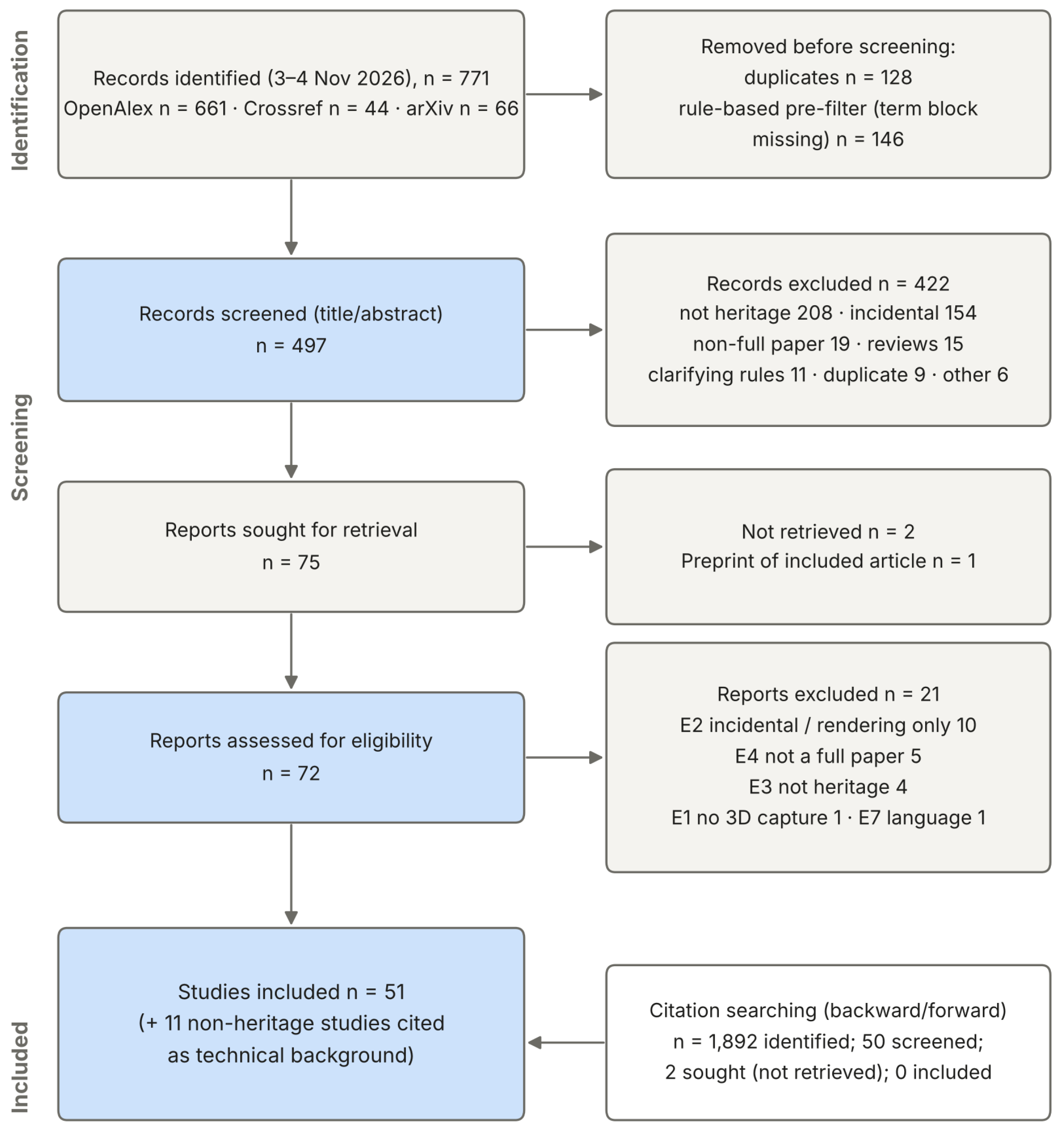
Figure 2.
Included studies by year of publication and technique family (2026: until 4 November).
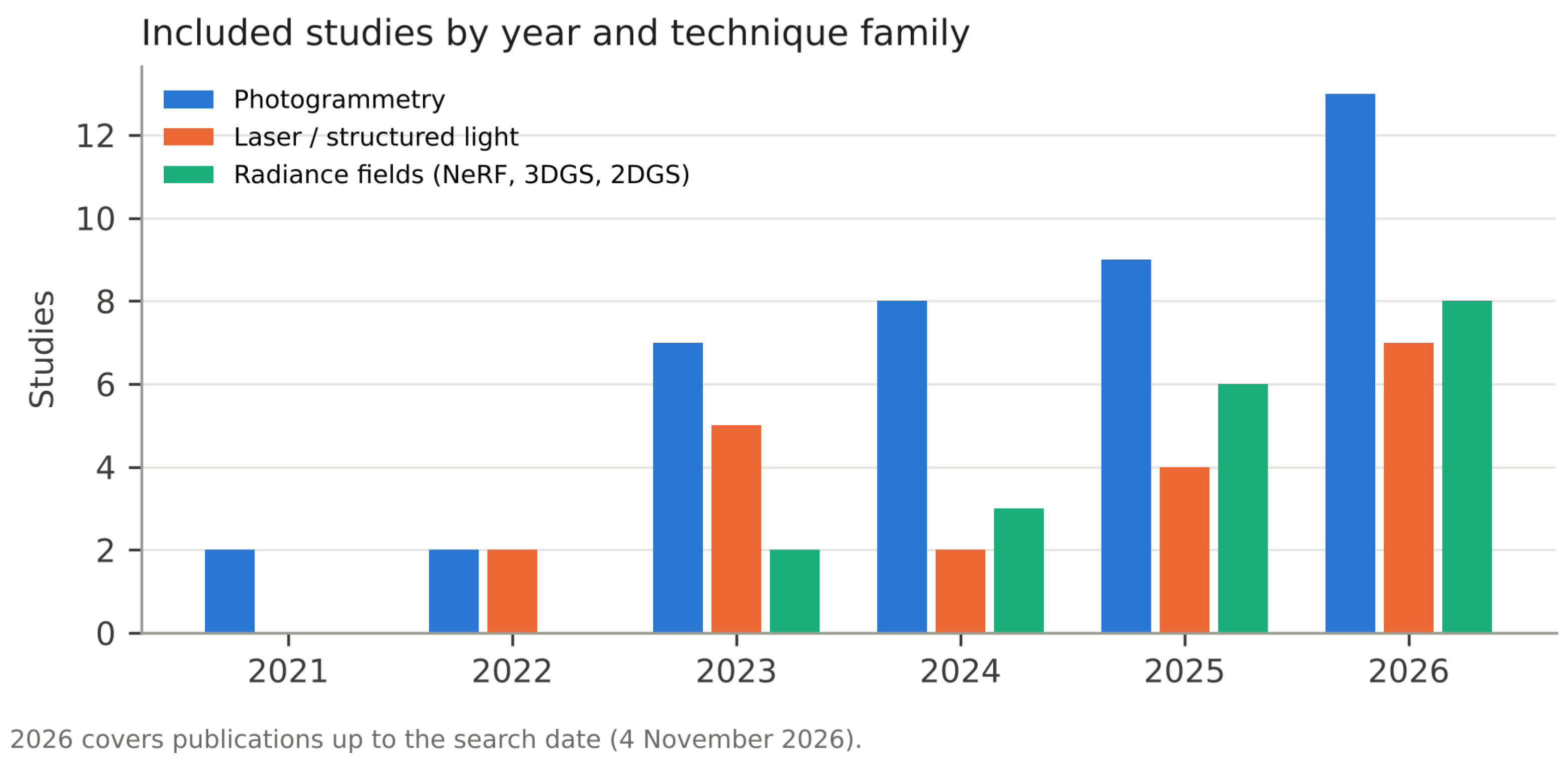
Figure 3.
Evidence map: included studies by surface type and spatial scale, with the number of studies reporting a metric result on the difficult surface.
Figure 3.
Evidence map: included studies by surface type and spatial scale, with the number of studies reporting a metric result on the difficult surface.
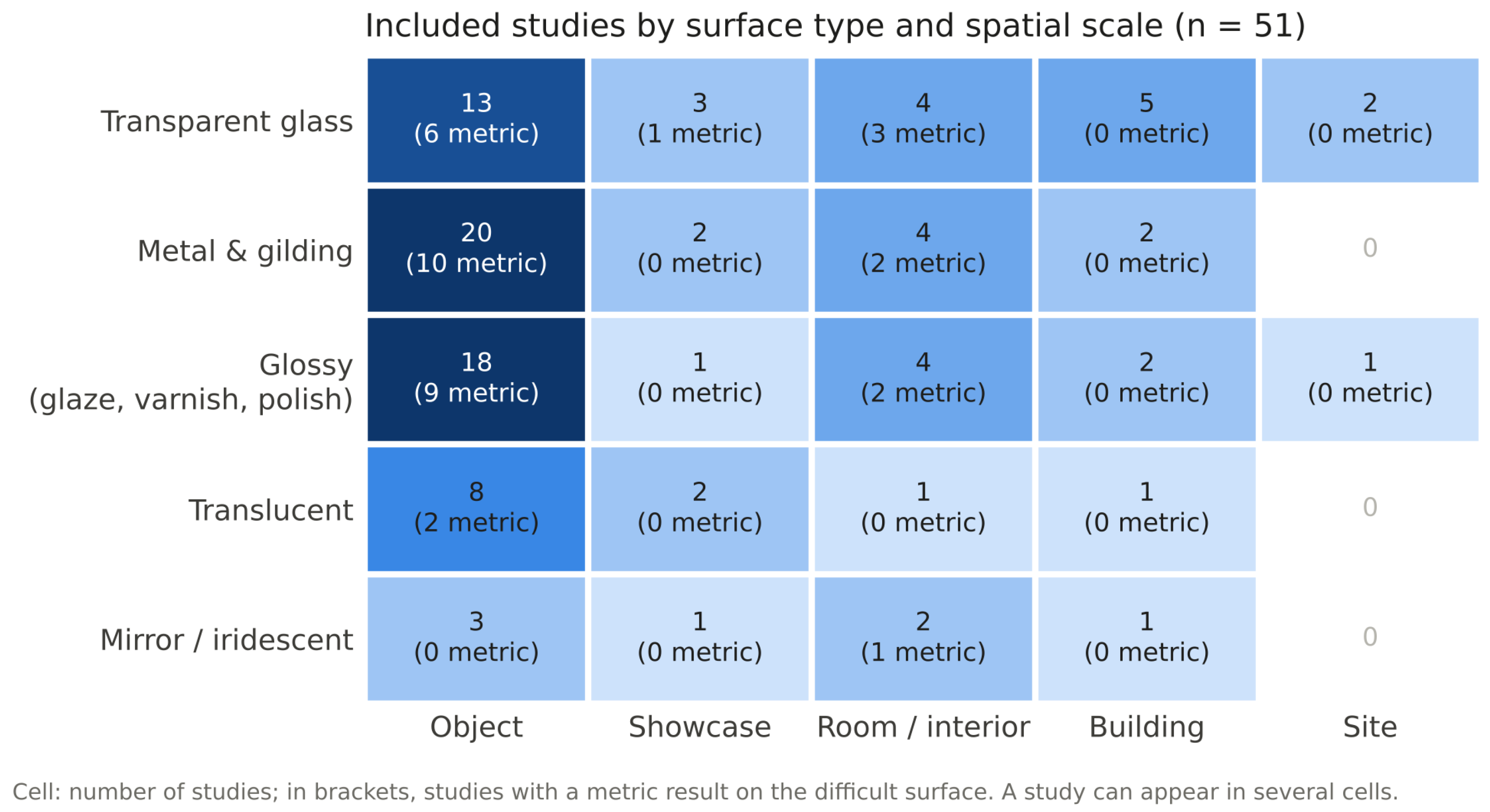
Figure 4.
Mitigations used or recommended in the included studies and their reported outcome on the difficult surface. Joint mitigations are counted under each component; a study is counted once per mitigation and outcome.
Figure 4.
Mitigations used or recommended in the included studies and their reported outcome on the difficult surface. Joint mitigations are counted under each component; a study is counted once per mitigation and outcome.
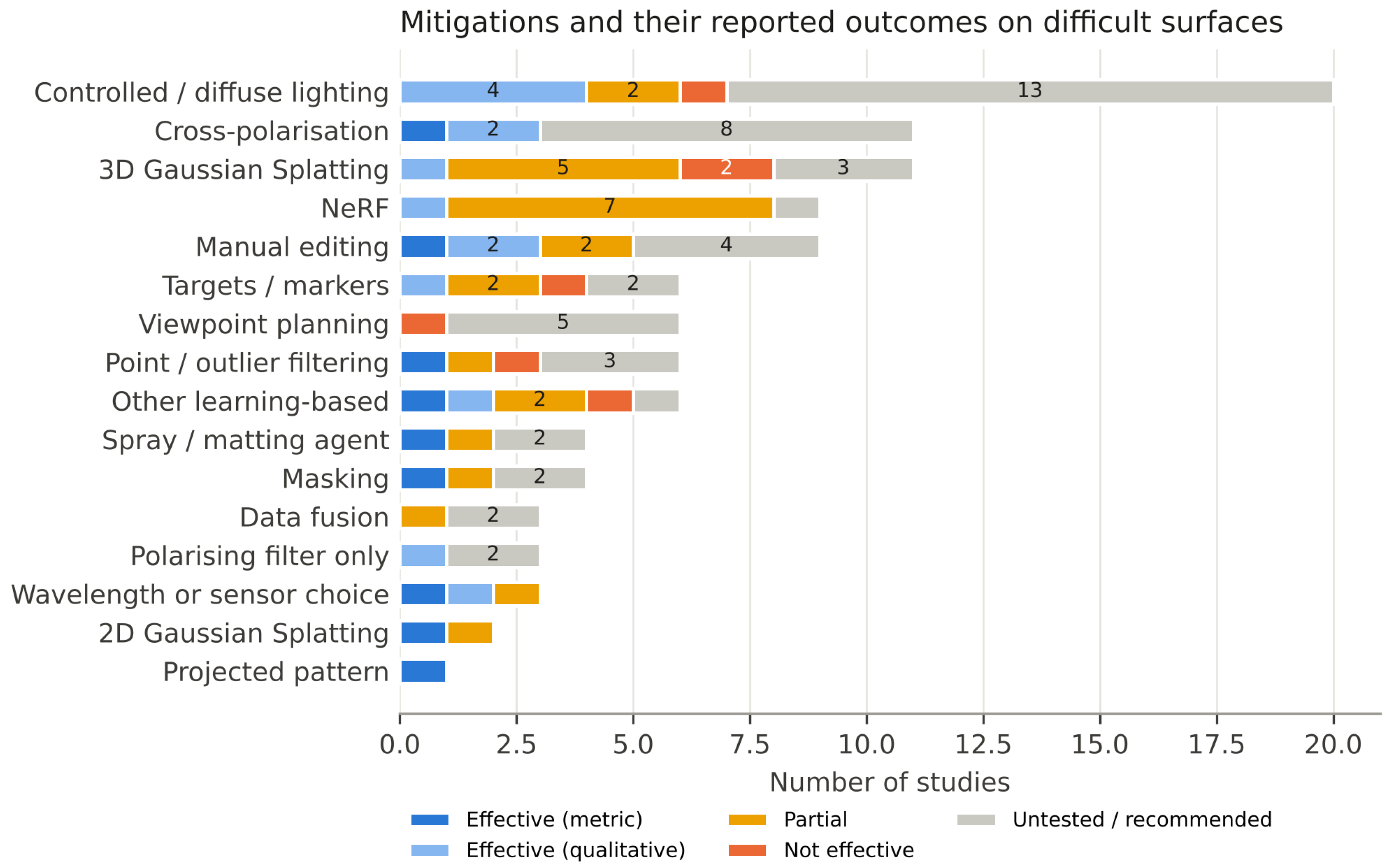
Figure 5.
Workflows by case for difficult surfaces in heritage 3D documentation. For each situation: the recommended workflow, the evidence label of its main option (Section 2.6) and the published record of each remedy on that surface group: filled dot = study reporting it effective, half dot = partial effect, open red dot = not effective, dotted circle = recommended or applied without comparison but never tested (Table 3). Details in Section 4 and Table 2.
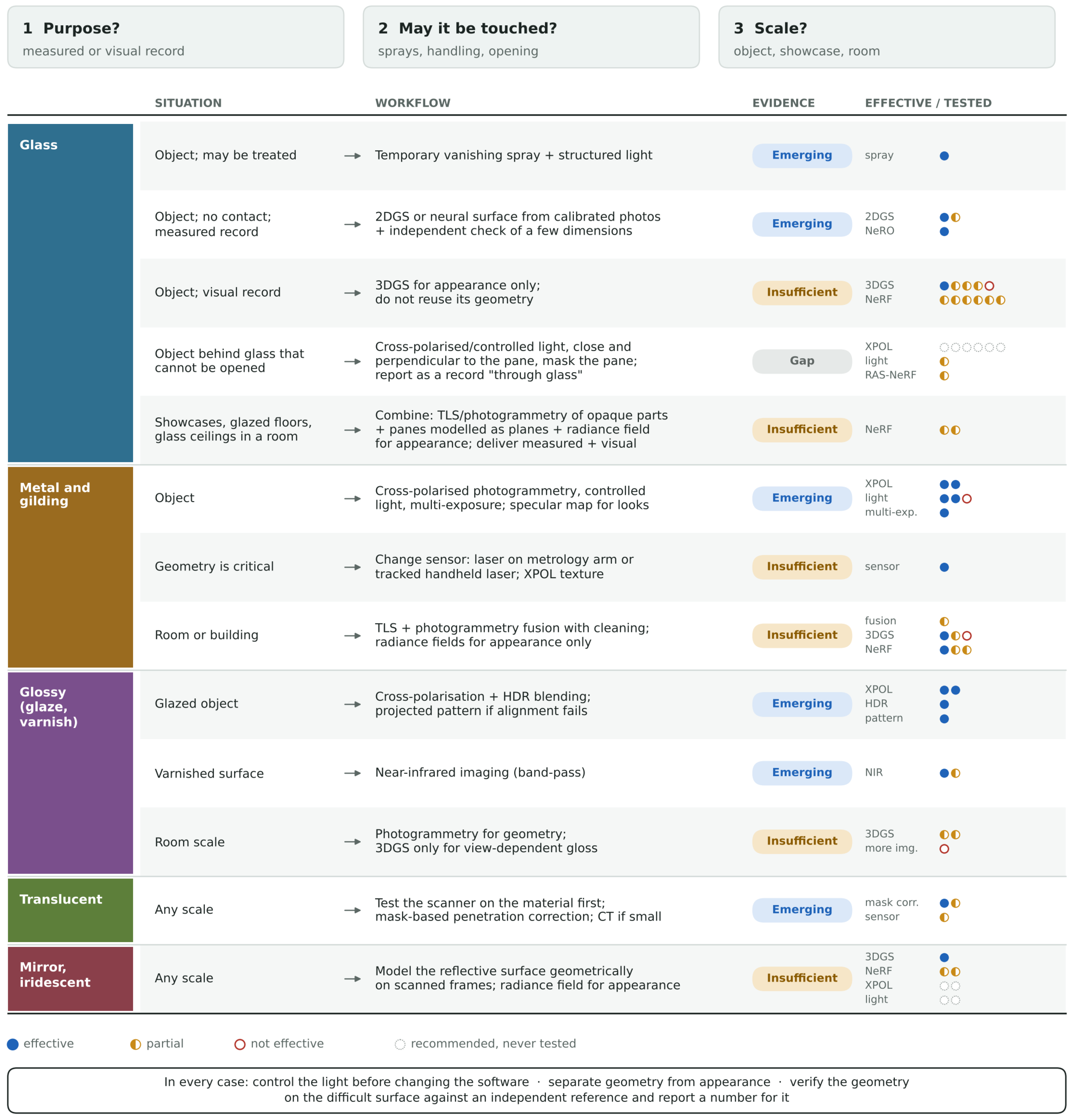
Table 3.
How often each remedy worked when it was tested: studies reporting the remedy effective on that surface group / studies that tested it (effective, partial or not effective). In brackets, further studies that applied it without comparison or recommended it; untested (n) = recommended or applied in n studies but never tested; ·= not reported. Small counts describe the published record, not a probability of success.
| Remedy | Glass | Metal/ gilding | Glossy | Translucent | Mirror/ iridescent |
|---|---|---|---|---|---|
| Temporary spray | 1/1 (+1) | 1/1 (+1) | 1/1 (+1) | untested (1) | untested (1) |
| Cross-polarisation | untested (6) | 2/2 (+3) | 2/2 (+2) | untested (3) | untested (2) |
| Controlled lighting | 0/1 (+3) | 2/3 (+6) | 1/1 (+7) | untested (5) | untested (2) |
| HDR / multi-exposure | · | 1/1 (+1) | 1/1 | · | · |
| Projected pattern | · | · | 1/1 | · | · |
| Wavelength / sensor choice | 1/1 | 1/1 | 1/2 | 0/1 | · |
| Radiometric correction | · | 1/1 | 1/1 | · | · |
| Masking | 0/1 (+2) | 1/1 | 1/1 | · | · |
| Manual/mask correction | 0/2 | 2/2 (+3) | untested (3) | 1/2 | · |
| More images / view planning | untested (1) | untested (5) | 0/1 | · | · |
| NeRF | 0/6 (+1) | 1/3 | · | · | 0/2 |
| 3DGS | 1/5 (+1) | 1/3 | 0/2 (+2) | 1/1 | 1/1 |
| 2DGS | 1/2 | · | · | · | · |
| Neural surface (NeRO) | 1/1 | · | · | · | · |
Disclaimer/Publisher’s Note: The statements, opinions and data contained in all publications are solely those of the individual author(s) and contributor(s) and not of MDPI and/or the editor(s). MDPI and/or the editor(s) disclaim responsibility for any injury to people or property resulting from any ideas, methods, instructions or products referred to in the content. |
© 2026 by the authors. Licensee MDPI, Basel, Switzerland. This article is an open access article distributed under the terms and conditions of the Creative Commons Attribution (CC BY) license (http://creativecommons.org/licenses/by/4.0/).
Copyright: This open access article is published under a Creative Commons CC BY 4.0 license, which permit the free download, distribution, and reuse, provided that the author and preprint are cited in any reuse.