

Submitted:
25 November 2026
Posted:
26 November 2026
You are already at the latest version
Abstract
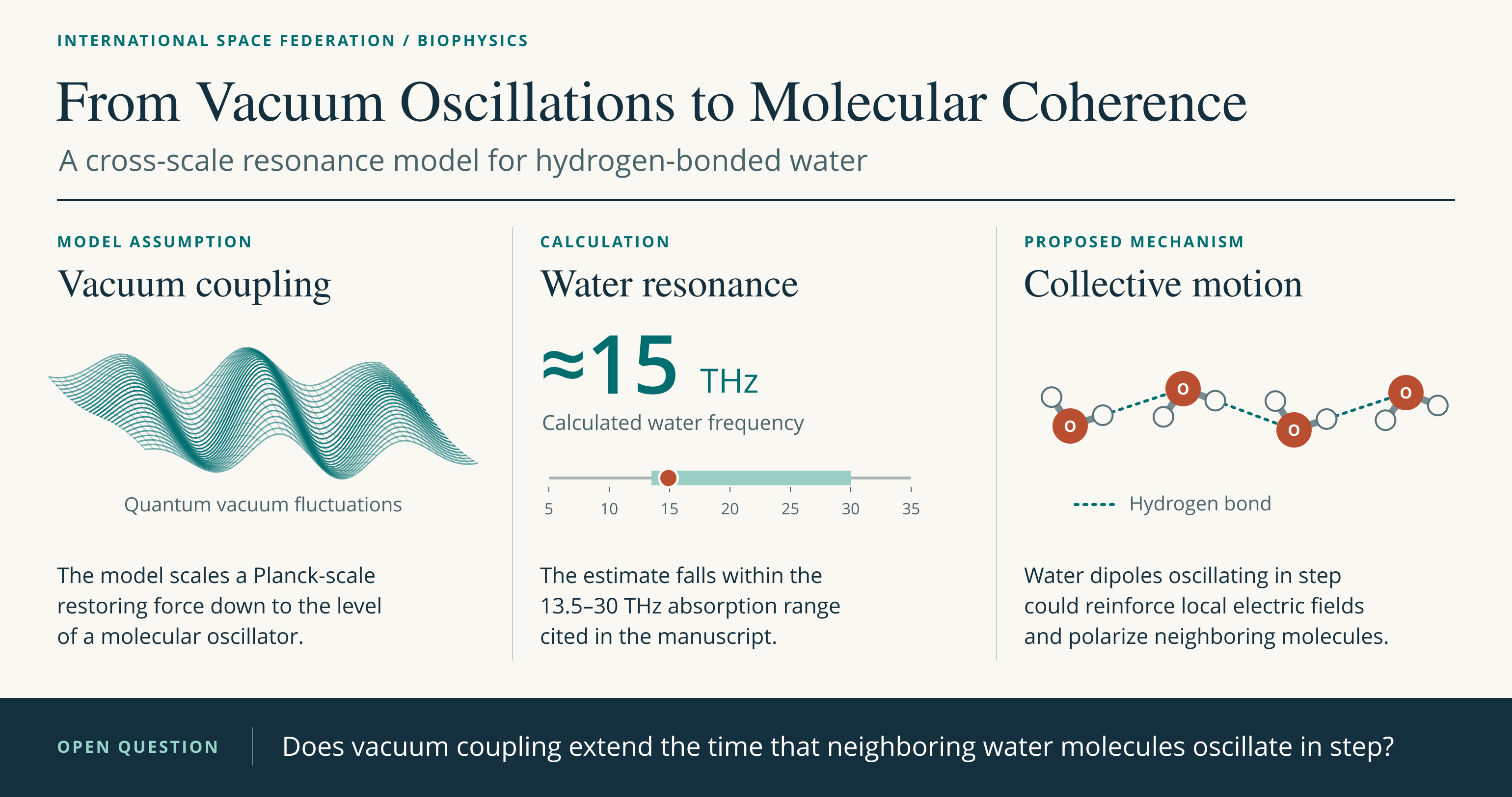
We identify a cross-scale trend in the harmonic oscillations of material systems that is sourced in the organizational dynamics of the quantum vacuum at the Planck scale. Systems that match this cross-scale resonance are often closely associated with biological organization. We identify a Planck-scale stiffness, kl (force per unit displacement), which is key in the resonance match of material systems across scale to the universal interaction rate of quantum harmonic oscillators at the Planck scale. We propose a criterion for resonance matching: when normal modes at a given scale are harmonically related to components of the vacuum spectrum and to modes at adjacent scales, quantum vacuum fluctuations (QVF) may modify the equilibrium correlations and linear response of those modes through polarization → field → polarization feedback. We employ liquid water as the primary case study. The O-H librational manifold provides a receptive channel for QVF-mediated modulation, strengthening hydrogen-bond networks and stabilizing coherence domains, especially in interfacial and nano-confined environments relevant to biology. This positions water as a quantum medium that transduces vacuum-seeded coherence (vacuum correlations) into functional organization central to life, with implications for proton conduction/chemiosmosis, hydration-shell dynamics, and cytoskeletal electromechanics. By identifying QVF—through kl—as the ideal resonance-match and by showing how water realizes this coupling, we provide a coherent route from vacuum-level interactions to biophysical order.
Keywords:
cross-scale resonance
; quantum vacuum fluctuations
; Planck spring constant
; nested harmonic oscillators
; water O–H vibrations
; coherence domains
; hydrogen-bond network
; effective polarizability
; bioenergetics
Copyright: This open access article is published under a Creative Commons CC BY 4.0 license, which permit the free download, distribution, and reuse, provided that the author and preprint are cited in any reuse.