

Submitted:
16 November 2026
Posted:
17 November 2026
You are already at the latest version
Abstract
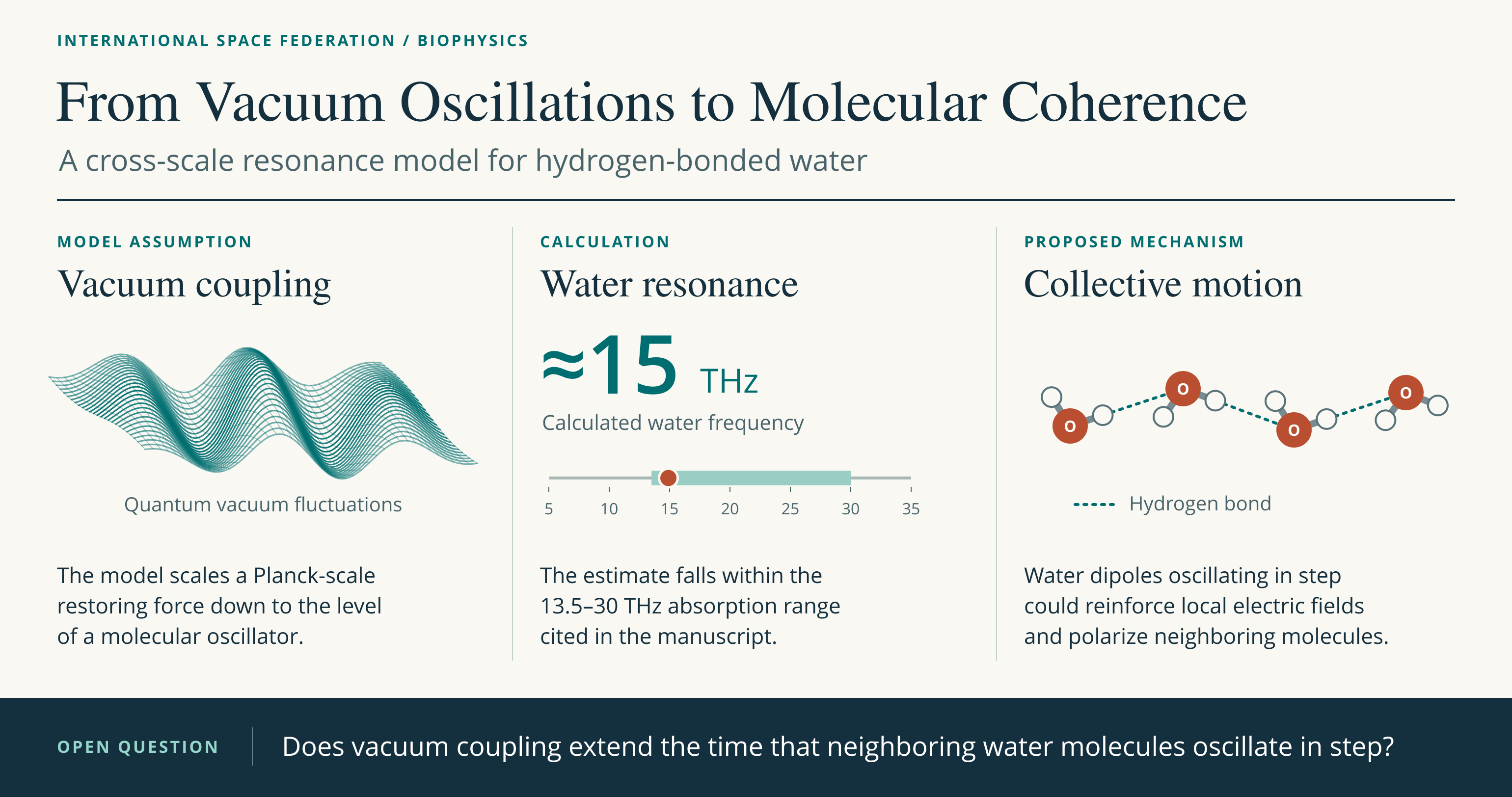
We propose a cross-scale resonance framework in which quantum vacuum fluctuations (QVF) are the source of energy driving material oscillators from micro to macro scales augmenting collective behaviors via increased coherent phase synchronization and strengthened dipolar correlations. In this view, the vacuum field supplies a universal restoring interaction characterized by a Planck-origin spring constant kl (a force active over distance), which—after scale-dependent screening—manifests as the familiar repertoire of intermolecular forces (hydrogen bonding, dipole–dipole, van der Waals). Material systems are therefore modeled as nested, coupled harmonic oscillators whose effective stiffness and intrinsic frequencies emerge from QVF-driven coupling across discrete scaling domains. We derive conditions under which cross-scale resonance arises: when normal modes at a given scale are harmonically related to components of the vacuum spectrum and to modes at adjacent scales, QVF acts as a broadband pump that selectively reinforces those modes through polarization → field → polarization feedback. We employ liquid water as the primary case study. The O–H vibrational manifold—with particular leverage of the antisymmetric stretch—provides a receptive channel for QVF-mediated gain, strengthening hydrogen-bond networks and stabilizing coherence domains, especially in interfacial and nano-confined environments relevant to biology. This positions water as a quantum medium that transduces vacuum-seeded coherence into functional organization central to life, with implications for proton conduction/chemiosmosis, hydration-shell dynamics, and cytoskeletal electromechanics. By identifying QVF—through kl —as the universal driver of oscillator behavior and showing how water realizes this coupling, we provide a coherent route from vacuum-level interactions to biophysical order.
Keywords:
cross-scale resonance
; quantum vacuum fluctuations
; Planck spring constant
; nested harmonic oscillators
; water O–H vibrations
; coherence domains
; hydrogen-bond network
; effective polarizability
; bioenergetics
Copyright: This open access article is published under a Creative Commons CC BY 4.0 license, which permit the free download, distribution, and reuse, provided that the author and preprint are cited in any reuse.