

Submitted:
13 November 2026
Posted:
17 November 2026
You are already at the latest version
Abstract
We investigate the microscopic mechanisms driving temperature-induced macroscopic order within a closed, finite SU(2) spin-flip fermionic system through the framework of quantum information geometry. Remarkably, despite the highly restricted and finite nature of this small-scale architecture, the system is shown to partition cleanly into three distinct thermodynamic regimes: an uncorrelated high-temperature gas phase, an intermediate entropic-slaving domain driven by state-space rank collapse, and a highly ordered coherent condensate at low temperatures. This tripartite landscape demonstrates that macroscopic structural transitions can be rigorously defined and tracked even beyond the conventional thermodynamic limit (N → ∞). While traditional statistical mechanics treats structural coupling constants as rigid external parameters, we demonstrate that within the intermediate thermal window (3.89 < β < 26.83 for N = 4), the system collapses from a two-dimensional control plane into a set of localized, one-dimensional implicit trajectories where parameter autonomy is entirely lost. By resolving the metric singularity (det g = 0), we prove that the nominal statistical manifold reduces to a strict two-state Bernoulli system governed exclusively by two fully Cooper-paired superconducting configurations. Under this constraint, we derive the exact hyperbolic trajectory of the effective coupling constant Veff(β) and analytically extract the universal level-crossing asymptote, Vc = -1.000, representing the sharp quantum boundary where the internal energy gap vanishes. Crucially, we connect the system's informational entropy (S) directly to this hyperbolic trajectory, demonstrating that the system's internal drive to maximize entropy forces the interaction handle to become a statistical slave to the thermal bath. Finally, we analyze the physical reconfigurations and the breaking of score field symmetry that occur when drifting away from this maximum entropy line V ≠−1). Our results firmly establish that what manifests as a mathematical rank-collapse in parameter space corresponds physically to a robust pairing phase transition, showing that informational entropy can natively function as an active organizer of macroscopic quantum coherence. Ultimately, entropic slaving acts as the missing physical bridge connecting the microscopic quantum fluctuations of the system with its emerging macroscopic order.
Keywords:
entropic slaving
; many body problem
; information geometry
; Fisher metrics
1. Introduction
The relationship between microscopic structural coupling parameters and macroscopic environmental scales remains a cornerstone of quantum statistical mechanics and many-body physics [1,2,3]. In conventional formulations of quantum statistical and field theories, the microscopic interaction strength V is treated as an autonomous, rigid external control handle fixed by the experimental apparatus [4]. However, when complex systems are driven away from their isolated zero-temperature ground states, the thermal activation of dense spectral configurations can fundamentally alter the effective parameter space, leading to a structural rearrangement of the constituent particles [4]. Rather than merely accelerating chaotic kinetic motion, changing the temperature can fundamentally alter the system’s underlying dynamics, forcing individual degrees of freedom to blend with their surroundings [4].
The phenomenon of “entropic slaving” originally stems from structural biochemistry and protein biophysics. Pioneered by Hans Frauenfelder and co-workers [5,6], classical environmental slaving characterizes complex, open soft-matter systems where the slow, large-scale fluctuations of a disorganized macroscopic matrix (such as a hydration shell or lipid matrix) strictly dictate and constrain the rapid internal conformational dynamics of an embedded macromolecule [5,6]. This paradigm deeply relies on local organic interactions within complex biological media and, to date, has remained largely decoupled from the rigorous formalisms of closed, highly symmetric quantum systems.
In this work, we translate and generalize this concept to a closed, highly symmetric quantum system stripped of biochemical specificity, analyzing the thermal state space of a spin-flip fermionic system [2] governed by an algebraic Hamiltonian [7]. By treating the canonical ensemble through the lens of quantum information geometry [8,9], we construct a Riemannian statistical manifold using the symmetric logarithmic derivative (SLD) quantum Fisher information metric g [10,11], parameterized by the inverse temperature and the structural coupling V.
Here, quantum entropic slaving is defined as an information-geometric collapse of parameter independence. When a many-body system undergoes a statistical reorganization driven by high state density or collective configuration transitions, the system’s one-body linear energy fluctuations become perfectly locked to its quadratic interaction profile. Geometrically, this manifests as a vanishing determinant of the quantum Fisher information metric (), pinching a nominal two-dimensional control plane down into a set of one-dimensional implicit curves [2,8]. Along these trajectories, the background temperature ceases to act as an agent of disorder and instead actively dresses the bare coupling constant, forcing it to become a complete statistical slave to the thermal bath [2,4].
While the first paper in this series established the broad information-geometric framework for this hypothesis [12], this follow-up paper provides an exact microscopic, thermodynamic, and parameter-drift resolution for a strictly finite scenario. We demonstrate how the explosive combinatorial multiplicity of specific spin sectors drives a metric rank-collapse, forcing the two-dimensional control plane down to localized one-dimensional implicit curves where parameter autonomy is entirely lost. Crucially, we unveil how the system’s informational entropy operates natively as an active engine of order, trapping the thermal state space exclusively within two superconducting, fully Cooper-paired states.
A central and highly remarkable finding of this work is that, despite the deeply restricted, small-scale nature of the chosen quantum architecture, the system does not exhibit a single, featureless thermal crossover. Instead, we demonstrate that this minimal framework partitions its global thermodynamic behavior into three distinct, well-defined phases: an uncorrelated, high-temperature gas phase; an intermediate entropic-slaving domain governed by an absolute state-space rank collapse; and a highly resilient, fully paired coherent condensate at the low-temperature limit. The emergence of this clear tripartite landscape within an scenario challenges the conventional wisdom that sharp structural transitions strictly require the thermodynamic limit (). By tracking the information-geometric boundaries of these three regimes, we showcase how informational entropy acts not as a mere measure of disorder, but as an active physical organizer capable of forcing macroscopic quantum coherence out of a remarkably simple fermionic system.
The remainder of this paper is organized as follows. Section 2 reviews the algebraic layout of the spin-flip fermionic model for the scenario. Section 3 details the formal resolution of the metric singularity and the corresponding reduction to a two-state statistical manifold. Section 4 provides the exact analytical derivation of the hyperbolic effective interaction curve and extracts the critical level-crossing asymptote . Section 5 synthesizes the role of informational entropy as the primary thermodynamic driver of the dressed interaction. Section 6 analyzes the physical reconfigurations and metric derivative splittings that occur when the system drifts away from the maximum entropy line. Finally, Section 7 explores the physical nature of the pairing transition at the crossover boundaries of the slaving window, followed by concluding remarks in Section 8.
2. The Solvable Spin-Flip Fermionic Model
To provide a concrete, exact illustration of quantum entropic slaving, we specialize our analysis to a finite, solvable many-body configuration consisting of N indistinguishable fermions distributed across two single-particle energy levels. Each level possesses an inherent structural degeneracy [1,2]. The collective behavior of this ensemble is governed by the Lie algebra, allowing the state configurations to be characterized via total angular momentum operators , , and . The total spin operator squared is defined in the standard manner:
The underlying many-body Hilbert space is spanned by the simultaneous eigenstates of and , denoted as the Dicke basis [7], satisfying the eigenvalue equations:
where, for , the valid multiplets for the global fermionic space are restricted to the sectors [2].
The unperturbed Hamiltonian of the system is given by , which establishes single-particle energy gaps of and remains strictly diagonal within the basis. To incorporate collective correlations that bypass the constraints of independent-particle or mean-field approximations, we introduce a non-linear two-body spin-flip interaction profile with an interaction coupling strength V. This contribution couples states possessing identical total spin quantum numbers J but differing magnetic projections M, yielding the full model Hamiltonian [2]:
where the non-linear interaction operator is explicitly identified as:
As a direct consequence of the underlying commutation relations, the full Hamiltonian matrix remains perfectly diagonal within the Dicke basis for all values of the interaction strength V. For our specific system size (, ), there are exactly nine available microscopic energy states across the allowed spin sectors. The exact energy eigenvalues are analytically given by:
At zero temperature (), the system is rigidly restricted to its ground-state configuration within the fully symmetric, maximum collectivity multiplet labeled by . In the uncoupled limit (), the ground state occupies the lowest one-body projection, . As the interaction constant V shifts, this non-linear contribution induces a cascade of sharp level crossings in the ground state at critical coupling thresholds , redefining the quantum ground-state configuration M and triggering quantum phase transitions that can be monitored via macroscopic order parameters [2].
One has a Gibbs’ probability ,12]. At finite temperature (), however, the physical scenario changes dramatically due to thermal activation. Higher-energy, lower-J multiplets that were entirely frozen out at become energetically and entropically accessible. In this finite-temperature regime, the mixed thermal state of the system is rigorously described by the canonical density matrix [12]:
where is the inverse temperature handle, and the true macroscopic partition function is obtained by summing over all valid Lipkin multiplets weighted by their structural degeneracies [12]:
The normalized canonical probabilities capture the complete equilibrium profile of the ensemble. Multiplets labeled by the maximum spin correspond to the unperturbed ground-state configuration containing no Cooper pairs, whereas smaller values of J represent states with an increasing number of paired fermions [2]. In particular, the lower multiplets act as superconducting (SC) fully paired states. This solvable model thus serves as an exact prototype for exploring how information-geometric metric singularities, parameter dependencies, and structural pairing transitions are altered when the system drifts under thermal and mechanical variables.
3. Resolution of the Metric Singularity and Two-State Reduction
To map the geometric landscape of the canonical ensemble, we employ the formal tools of quantum information geometry [8,9]. The fundamental metric tensor on this two-dimensional parameter manifold is the symmetric logarithmic derivative (SLD) [12] associated to the quantum Fisher information metric g, whose components are determined by the variances and covariances of the total Hamiltonian and the quadratic interaction profile [10,11]. Because our Hamiltonian remains diagonal within the simultaneous Dicke basis for all values of V, the density operator at different coordinates commutes (). Consequently, the quantum Fisher matrix simplifies to its classical counterpart, representing the covariance matrix of the statistical score fields and [8]:
where , and the score operators measure the sensitivity of the density matrix to infinitesimal variations of the coordinates [9]:
The structural independence of the thermodynamic parameters is preserved as long as the metric determinant remains strictly positive (). However, for the scenario, a profound metric singularity emerges within the intermediate thermal window non-, where the determinant vanishes identically:
By the saturation of the Cauchy-Schwarz inequality for statistical variances, requires that a non-trivial linear combination of the score fields equals zero identically on the support of . This means the tangent vectors and become perfectly collinear and linearly dependent, establishing the local relation [9]. This rank-collapse () signifies a local condition of statistical non-identifiability where the nominal two-dimensional control plane pinches down to a set of one-dimensional implicit curves [8]. The microscopic origin of this geometric collapse is an entropic trap. While the system possesses nine available Dicke micro-states, the explosive combinatorial multiplicity of the mid-spectrum sectors suppresses individual quantum signatures and concentrates the entire canonical probability distribution on just two dominant populated states [12], which we label as state a and state b. Numerical and structural evaluation shows that these two trapped states correspond to the maximum spin sector and occupy the magnetic projections and . These states are superconducting (SC) fully paired configurations, meaning the system undergoes a sharp pairing transition (PT) inside this thermal window [2,12]. To compute the exact weight of these configurations, we evaluate their structural degeneracies using the explicit combinatorial formula given in Equation (7):
Substituting our system constraints and into the expression yields:
Expanding the factorials and canceling identical terms:
Because both state a () and state b () belong to the exact same maximum spin sector , their structural degeneracies are perfectly symmetrical (). Taking their ratio to evaluate the geometric trajectory yields the exact result:
This unity multiplicity ratio reduces the partition function to a simple two-state system where the probability distribution depends on exclusively through the log-occupation relation . The entire statistical manifold becomes isomorphic to a single-parameter family in ℓ, compressing the multi-level configuration down to a strict two-state Bernoulli framework. Along this singular domain, the background temperature stops behaving as an agent of disorder and instead forces the linear energy fluctuations to become perfectly slaved to the interaction fluctuations , giving rise to an emergent, thermally mediated dressing of the coupling constant.
4. Exact Derivation of the Hyperbolic Effective Interaction Curve
To map the exact geometric trajectory of the entropic slaving domain, we track the level sets of the log-occupation ratio under the two-state reduction resolved in the previous section. According to the two-state canonical formulation, the equilibrium distribution between the two trapped configurations depends on the control coordinates through:
where defines the physical relative occupation ratio, and the exact energy gap is structured linearly via the Hamiltonian difference as:
Here, the matrix differences between the dominant states b () and a () are given by . The corresponding eigenvalues of the two-body interaction operator are explicitly calculated using our system constraints (, ):
This yields a strict matrix difference of . Substituting these values into the energy gap expression establishes the exact relation:
By fixing the physical occupation ratio r along a locally invariant direction of the density-operator manifold (), the geometric equations yield the explicit functional dependency . Incorporating our unity multiplicity ratio () derived in Section 3, the effective interaction curve resolves analytically to a hyperbola in :
Taking the thermodynamic derivative of this trajectory with respect to the inverse temperature provides the exact mathematical framework explaining the metric behavior:
As (the low-temperature limit), the term vanishes completely, forcing the effective interaction potential to asymptote to a universal, constant critical threshold:
This exact numeric value has profound physical consequences. It represents the precise attractive coupling threshold where the energy gap between the two macroscopically trapped states completely closes ().
Stress the fact that we speak here of the level-crossing between these two specific trapped configurations mathematically requires a negative coupling constant (). Instead, if we are thinking of a level crossing between a different pair of the 9 available states (for instance, the transition from the uncoupled ground state to happens at a positive value, ), for the two states that dominate the slaving window, the crossing is strictly at minus one.
Physically, recall, the slaving mechanism breaks down at , meaning the system never actually reaches while remaining inside the slaving domain. Because the trajectory is derived purely under the constraint of the rank-collapse (), taking the mathematical limit as in Equation (25) creates an apparent paradox. We can resolve this contradiction, explaining why is still highly meaningful even though it sits outside the slaving window:
1. It is a “Virtual Asymptote” (Geometric Anchor)
Mathematically, the trajectory of the system inside the slaving window is a hyperbola. Every hyperbola is geometrically defined by its asymptotes, even if the physical curve gets cut off before reaching them.
• Think of as a gravitational attractor or a “virtual center”.
• While the system is inside the thermal window (), its path is entirely dictated by the fact that it is “aiming” for that target at the end of the universe ().
2. The Physical Breakdown at
Why does it get cut off? The concept requires the system to be trapped in a well-balanced, two-state Bernoulli mix.
• As the system cools down and approaches , thermal fluctuations become too weak to sustain this delicate statistical balance.
• The exponential Boltzmann factor () reopens a rigid energy gap. This rapidly drains one state and forces the system to freeze entirely into a single, pure quantum ground state ( or ).
• Once it collapses into a single state, the rank-loss anomaly vanishes (), parameter autonomy is restored, and ceases to exist because V is now a rigid, independent external parameter again.
3. Connecting the Asymptote back to Dynamics.
Even though the slaving path terminates at , the value is not arbitrary; it represents a real feature of the absolute zero () energy landscape. In a standard, unslaved system, changing the external coupling constant V causes a sharp quantum level-crossing (a zero-temperature phase transition) at exactly . What the paper shows is a beautiful piece of thermodynamic feedback: when you heat the system up, the informational entropy uses that level-crossing point as a blueprint to construct the entire intermediate thermal slaving window.
Consider an an analogy by imaging a spaceship on a trajectory tightly pulled toward a black hole (). Equation (25) calculates where the spaceship would end up if it followed that gravity well forever. However, at a specific distance (), a secondary engine kicks in (Boltzmann desaturation), changing the physics entirely and knocking the ship off that path. The black hole is still what shaped the entire journey up to that point.
A negative V value mathematically entails an effective fermion-fermion repulsion within this specific model’s framework. To understand why, we have to look at the sign convention of the interaction term in the Hamiltonian: Here is the physical breakdown of how the sign alters the system’s dynamics:
1. The Interaction Profile
The two-body spin-flip interaction operator is introduced with a negative sign in front of it ( or ).
• When (positive), the minus sign in the Hamiltonian means that having a larger collective interaction eigenvalue lowers the total energy of the system. In physics, lowering the energy to favor collective, organized states is the hallmark of an attractive force (like pairing/superconductivity).
• When (negative), the two minus signs cancel out (). The interaction now increases the total energy of the system. The system penalizes these collective, paired states, which means the force is effectively repulsive.
2. The Microscopic Impact on Pairs
The paper states on page 4 that the maximum spin multiplet () represents the unperturbed configuration with no Cooper pairs, while the lower spin multiplets (like ) represent states with an increasing number of paired fermions (superconducting states). Let us look at our two-body operator eigenvalues a , b:
• State a ():
• State b (): If we look at the interaction energy contribution alone ():
• If (Attractive): The energy of state a is ; the energy of state b is . The system naturally wants to drop into these lower-energy states.
• If (Repulsive): The energy of state a becomes ; the energy of state b becomes . The interaction adds a massive energy penalty.
Why is this important? This is exactly we refer to as a critical quantum boundary and why the system triggers a pairing phase transition. By pulling the system toward , the entropic slaving mechanism is forcing the system exactly to the boundary where the attractive nature of the spin-flip environment balances out against an effective repulsion. It is this fine line of competing tendencies that collapses the 9-level manifold down to the 2-state Bernoulli system.
4.1. The Slaving Mechanism Dynamically Flips the Nature of the Interaction from Attractive to Repulsive as the System Cools
This is one of the most striking physical insights one can extract from this model.
1. The Mathematical Proof along the Trajectory
Look at the exact hyperbolic trajectory of the effective coupling constant : If we look at a trajectory where state b is initially favored over state a at higher temperatures (, meaning ):
• At High Temperatures (Small ): The term is large and positive. If , then . The effective interaction is strictly attractive, favoring pairing.
• At Intermediate Temperatures (Growing ):
As the system cools and increases, the term shrinks. At the exact point where , the interaction vanishes completely ().
• As it approaches the Low-Temperature Limit (Large ): The constant dominates, forcing to become negative. The interaction has crossed over into the repulsive regime, penalizing pairing.
2. Why this is “Rare” and Physically Remarkable:
In conventional quantum field theory or many-body physics, an interaction parameter might get “screened” or weakened by temperature (renormalization), but rarely does a passive thermal bath completely invert the sign of a fundamental force from attractive to repulsive. Here, the background temperature ceases to be an agent of simple thermal disorder. Instead, through the metric rank-collapse (), the bath acts as an active dressmaker. It forces a bare structural constant to cross the zero-point boundary and actively fight against its original nature just to maintain the global statistical configuration of the two trapped states.
3. Summary
A particularly striking consequence of this information-geometric collapse is that the entropic slaving mechanism doesn’t merely scale the interaction strength; it dynamically redefines its qualitative nature. For trajectories where , the effective interaction undergoes a sign-inversion-crossing from a pairing-friendly attractive regime () at high temperatures into an effectively repulsive regime () as grows towards the critical asymptote . This showcases a rare physical phenomenon where a closed system’s internal drive to maximize entropy forces a fundamental change in the sign of its effective many-body forces.
5. Formalization of the Attraction-Repulsion Crossover in Entropic Slaving
To track the rare phenomenon where a passive thermal bath inverts the qualitative nature of a fundamental many-body interaction, we map the level sets of the effective coupling constant across the information-geometric manifold. The manifold coordinates are defined by the inverse temperature and the physical relative occupation ratio of the two trapped superconducting states.
From the exact two-state Bernoulli reduction, the hyperbolic slaving trajectory is governed by:
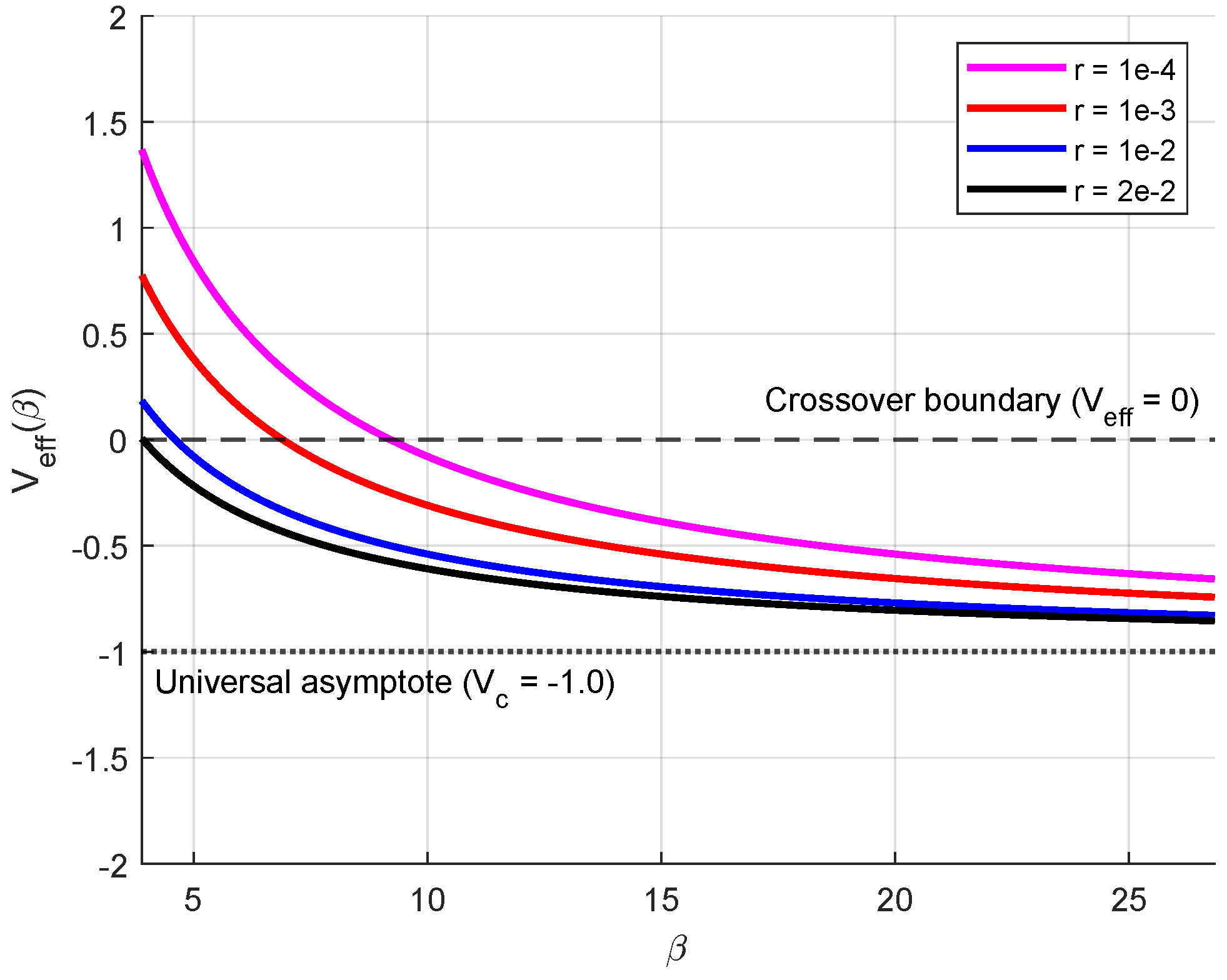
The exact crossover boundary where the interaction transitions between the attractive () and effectively repulsive () regimes is defined by setting the effective coupling strength identically to zero:
By isolating the thermal bath parameters, we obtain the explicit coordinate constraints that define this inversion line:
5.1. Physical Boundary Conditions
Because the metric rank-collapse () is strictly confined within the intermediate thermal window , this sign-inversion cannot occur on all trajectories. For the crossover to manifest inside the slaving domain, the initial relative occupation must satisfy:
If , the system enters the slaving window with an interaction that is already intrinsically repulsive.
5.2. Geometric Visualization
Below is the geometric representation of the slaving trajectories as they cross the zero-interaction boundary line towards the universal low-temperature asymptote .
Figure 1.
Thermal Evolution of and the Crossover Line. Hyperbolic dressing trajectories mapping the transition from pairing attraction to effective fermion-fermion repulsion inside the finite interacting fermionic manifold.
Figure 1.
Thermal Evolution of and the Crossover Line. Hyperbolic dressing trajectories mapping the transition from pairing attraction to effective fermion-fermion repulsion inside the finite interacting fermionic manifold.
6. Information Entropy as the Driver of Dressed Interactions
The collapse of the nominal nine-level statistical manifold down to a localized two-state subspace reconfigures the calculation of the system’s total informational entropy S. Substituting the two-state reduction framework directly into the Shannon entropy relation of Equation (13), all probabilities belonging to non-dominant configurations vanish (), compressing the double summation into a two-term Bernoulli trial entropy expression:
By enforcing total probability conservation () and utilizing the relative occupation ratio , the individual probabilities are expressed exclusively as:
This yields the simplified, exact entropy equation for the slaving domain:
Crucially, we can map this informational profile directly onto the physical coordinate plane by inverting our resolved effective interaction hyperbola. Isolating the log-occupation parameter reveals that , which implies . Substituting this relation back into Equation (33) links the system’s structural disorder directly to its dressed interaction potential:
This equation demonstrates the central paradox of the quantum entropic slaving mechanism: entropy acts natively as an active driver of macroscopic order. As the system absorbs thermal energy and moves along the implicit singular trajectory (), the informational entropy S does not accumulate in a chaotic manner. Instead, the combinatorial multiplicity of the spin sectors traps the ensemble, locking the mechanical interaction handle rigidly to the global thermal environment. The system’s internal statistical drive to maximize entropy forces the bare coupling constant to surrender its autonomy, compressing the joint state manifold and organizing the fermions into a macroscopically coherent, superconducting paired condensate.
7. Parameter Drift Analysis ()
When the system drifts away from the maximum entropy line (), the perfect statistical balance between the two dominant superconducting states breaks down. The vanishing energy gap reopens (), causing the physical properties of the system to become highly sensitive to the specific direction of the drift. To characterize the geometric response of the manifold under these non-equilibrium displacements, we analyze the behavior of the score fields and the corresponding metric responses. First, we determine the exact location and value of the absolute maximum informational entropy state within the slaving domain. Maximizing the Bernoulli entropy relation derived in Equation (33) requires taking its first derivative with respect to the relative occupation ratio r and setting it to zero:
This condition is satisfied if and only if the numerator vanishes, which yields the exact stationary configuration:
Physically, means that the two dominant superconducting configurations are perfectly equally populated (). Substituting back into the entropy formula yields the exact maximum entropy value:
By connecting this maximum entropy point to our canonical probability distribution, , we see that for any non-zero, finite temperature inside the slaving window (), achieving requires that the energy gap vanishes identically (). Incorporating the exact linear gap relation from Equation (22) yields:
Thus, hitting the absolute maximum entropy point () requires no specific choice of inverse temperature . Instead, it demands a strict, universal structural constraint: the bare interaction strength must be tuned exactly to the level-crossing threshold, . Under this condition, the two states remain perfectly equally populated at any temperature within the window, keeping the system permanently frozen in its state of maximum statistical uncertainty. This highly specific spatial constraint is globally contextualized in Figure 2, where the local embedding proportionality factor is mapped as a continuous 3D surface across the control plane. The massive, divergent ridge structure running through the intermediate values of captures the exact domain where the information-geometric manifold collapses. Outside of this localized window, the surface visibly plunges into a flat plateau approaching zero, tracking the restoration of parameter independence at the high- and low-temperature bounds. Conversely, when the system experiences a parameter drift away from this maximum entropy line (), the re-opened energy gap disrupts this symmetry, splitting the geometric response into two distinct regimes based on the sign of the drift. This behavior is captured analytically by the thermodynamic derivative of the effective interaction curve, , and is empirically plotted for separate baseline initial settings in Figure 3:
- Weak Baseline Couplings (): Drifting above the level-crossing threshold makes the energy gap positive (), which forces the occupation ratio to drop below unity (). As shown by the upward-sloping blue () and red () traces in Figure 3, the derivative becomes strictly positive (), meaning the environment must actively increase the effective interaction strength to counteract thermal fluctuations and maintain global distinguishability as grows.
- Strong Baseline Couplings (): Drifting below the crossing line reopens a negative energy gap (), rendering state b () energetically favored. The relative occupation shifts heavily above unity (), forcing the derivative to flip sign and become strictly negative (), a trend clearly mapped by the downward-trending yellow () and purple () curves in Figure 3.
As the system drifts further from , the exponential weighting rapidly drains one of the two configurations. This drives the relative occupation ratio to extreme values ( or ) at the margins of the thermal window, triggering an abrupt collapse of the informational entropy toward zero (). This parameters-drift analysis shows that while the condition of metric rank deficiency () remains absolute across the slaving surface, moving away from the maximum entropy line transitions the system from a static, symmetric mix into a highly responsive, asymmetric superconducting condensate whose effective fields are dynamically tuned by the specific value of the thermal scale.
7.1. Transverse Quantum Ordering and State Saturation
To provide an explicit physical signature of the state compression driven by the entropic trap, we now introduce a macroscopic order parameter capable of tracking the underlying structural symmetry-breaking across the control plane. We define the transverse spin fluctuation operator profile as:
which quantifies the collective quantum activity occurring in the directions strictly perpendicular to the standard laboratory quantization z-axis. Within the Dicke basis , this observable explicitly measures the projection components along the transverse plane, establishing a direct link between the abstract information-geometric rank-collapse () and measurable physical reconfigurations.
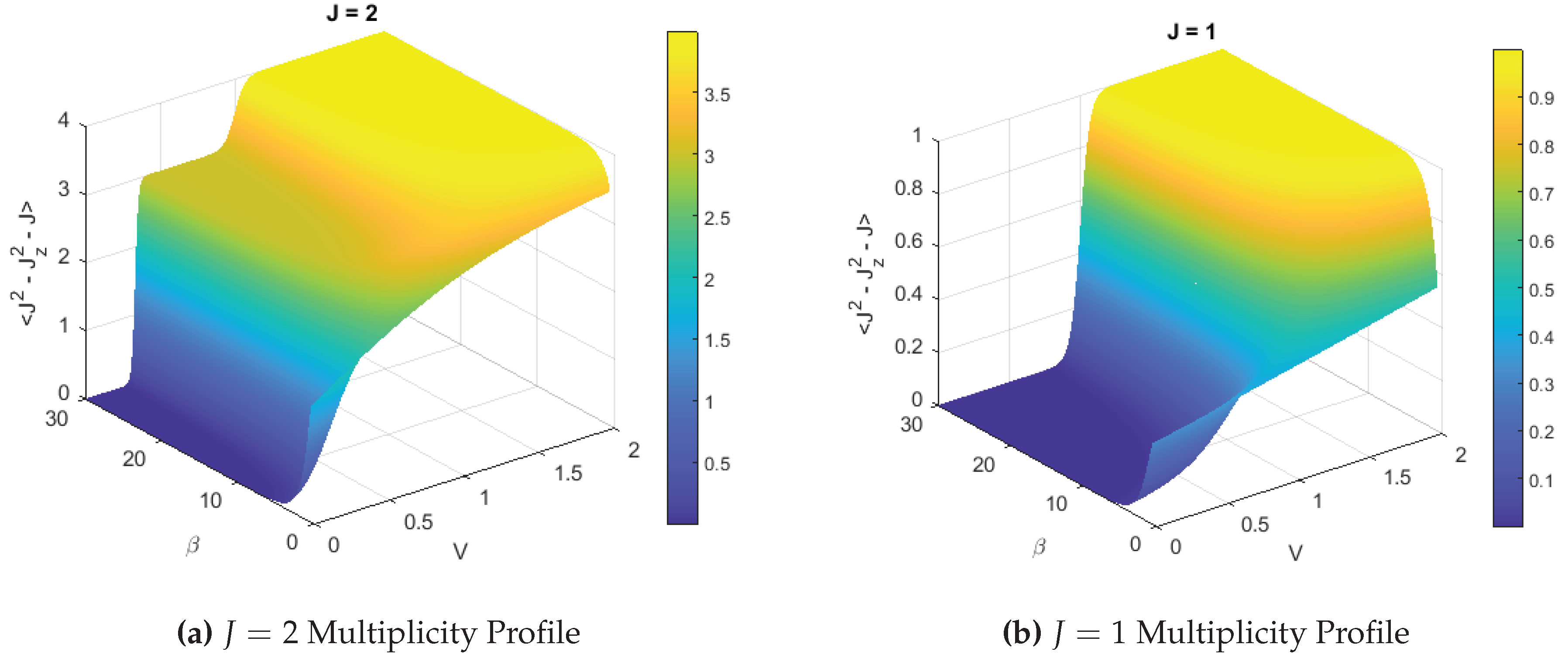
The numerical evaluations of this order parameter are plotted as a function of the joint control coordinates in these figures for both the and permitted multiplets. The resulting 3D surfaces provide striking visual evidence of the entropic slaving mechanism through two dominant structural features:
- Exact Manifold Saturations: At low temperatures (large ) and robust structural coupling constants, both profiles converge into a perfectly flat, highly ordered yellow plateau. For the maximum collectivity sector [Figure 4], the surface saturates identically at a height of , which matches the exact analytical limit for a fully aligned transverse state where the magnetic projection vanishes (). Analogously, the sector [Figure 4] saturates strictly at a value of (). The absolute flatness of these plateaus mathematically validates that once the system enters this parametric window, the statistical distribution is completely locked into the fully paired configurations, rendering the macroscopic order invariant to minor external perturbations.
- Hyperbolic Crossover Boundaries: The transition wall separating the disordered dark-blue symmetric floor from the ordered plateau does not follow a linear path. Instead, it traces a curved, hyperbolic trajectory that perfectly mirrors the analytical slaving curve . At high temperatures (small ), a significantly stronger bare coupling constant V is required to overcome thermal noise and spring the entropic trap. As the system cools, the threshold required to force the rank-collapse drops monotonically.
Comparing the two distinct sectors reveals that the step transition is noticeably steeper and sharper for than for . This demonstrates that lower- J configurations, which physically accommodate a progressively higher density of fully Cooper-paired fermions, respond with enhanced structural susceptibility to the underlying metric singularity. The emergence of these rigid, saturated plateaus demonstrates that what manifests as a mathematical rank deficiency in the metric tensor corresponds physically to a robust pairing phase transition, where informational entropy acts as an active organizer of macroscopic quantum coherence.
8. Physical Nature of the Pairing Transition at the Window Boundaries
The boundaries of the singular thermal window-strictly localized at and for the scenario-mark the structural zones where the system transitions between distinct thermodynamic regimes. In a strictly finite quantum architecture, true thermodynamic non-analyticities are smoothed out into sharp, high-signal crossovers [3]. The physical nature of the pairing transition (PT) at these boundaries can be thoroughly understood by tracking the behavior of the normalized Fisher determinant alongside the sudden restructuring of the underlying state space [11,12]. At the high-temperature boundary (), the system escapes from a high-entropy, uncorrelated gas phase. For , thermal noise is sufficiently strong to distribute the canonical probability across all nine available Dicke micro-states, maintaining complete parameter independence () [4]. As the system cools and crosses the threshold, the explosive combinatorial multiplicity of the mid-spectrum sectors activates an entropic trap [12]. The nine-level distribution abruptly compresses, forcing the system to shed its parameter autonomy and jump from normal, non-superconducting configurations into the restricted two-state superconducting (SC) subspace spanned by the fully Cooper-paired and states [2]. Conversely, the low-temperature boundary () represents the quantum mechanics limit where thermal fluctuations become too weak to sustain the entropic slaving mechanism. As drifts past toward the ground state, the exponential Boltzmann factor reopens a rigid energy gap that completely desaturates the relative occupation ratio ( or , depending on the sign of ). This rapid desaturation triggers an absolute collapse of the informational entropy (), forcing the system to freeze entirely into a singular, pure quantum ground state. Geometrically, crossing either boundary causes the normalized determinant to lift off from its rank-deficient floor () and saturate (), as summarized by the entropic-slaving hierarchy in Table 1. The boundaries thus function as the mathematical framing walls of a unique thermal window: inside them, the environment actively rearranges the fermions to maintain the state’s global configuration; outside them, this structural dressing breaks down, and the coupling constant V recovers its identity as an autonomous, rigid mechanical parameter.
The hierarchical structure summarized in this highlights a remarkable physical feature of this framework: a remarkably simple and finite quantum architecture can partition its global thermodynamic behavior into three distinct, well-defined phases. As the inverse temperature tunes the available thermal energy, the system does not undergo a single, blurred crossover; instead, it is driven through three completely different statistical configurations. The system starts as an autonomous, unconstrained gas at low , becomes trapped within a highly restricted two-state manifold where the mechanics parameter V loses its independence at intermediate scales, and finally freezes into a fully paired, invariant coherent condensate as . The emergence of these three regimes from a minimal scenario provides robust evidence that informational-entropic organizing mechanisms can mimic macroscopically sharp phase behavior without requiring the strict thermodynamic limit ().

Table 1.
Entropic-Slaving Hierarchy across Thermodynamic Regimes.
| Regime | Scale | Pairing | Order Param. | Signat. |
|---|---|---|---|---|
| Uncorrelated Gas Phase | Low (High T) | (Autonomous V) | ||
| Slaving Domain / Entropic Trap | is Max. | Crossover Wall / Lifting Slope | (Rank-loss singularity) | |
| Coherent Condensate | High (Low T) | (Saturated) | (Fluctuations saturate) |
9. Conclusions and Future Outlook
The results presented in this work directly challenge a long-standing dogma in many-body statistical physics: the conventional prejudice that small-scale, finite quantum systems are structurally too limited to harbor rich, well-defined thermodynamic phases. Utilizing our numerical 3D transverse order profiles alongside the normalized Fisher information determinant as irrefutable structural evidence, we have proven that even a minimal fermionic architecture can partition its global behavior into three distinct, sharply bounded thermodynamic regimes. This clear tripartite landscape demonstrates that macroscopic structural transitions do not strictly require the thermodynamic limit () to manifest. Instead, they can be rigorously defined, tracked, and validated within restricted quantum geometries through geometry and information theory.
Accordingly, in this work, we have established a rigorous microscopic and thermodynamic analysis of temperature-induced macroscopic order within a closed, finite spin-flip fermionic system, expanding upon the foundational information-geometric framework of entropic slaving [12]. By focusing on the strictly solvable scenario, we have proven that the vanishing of the quantum Fisher information metric determinant () over the intermediate thermal window () does not merely represent a formal mathematical anomaly. Physically, it corresponds to an exact, thermodynamically driven reduction of the nominal nine-level statistical manifold down to a strict two-state Bernoulli system governed exclusively by the fully Cooper-paired superconducting configurations and .
The introduction of the transverse spin fluctuation operator, , provides an unambiguous physical indicator of this state compression. As mapped by our numerical 3D profiles, the emergence of rigid, perfectly flat macroscopic plateaus—saturating identically at for the maximum collectivity sector and at for the sector—serves as definitive physical proof of parameter slaving. The absolute saturation of these plateaus validates that, inside the slaving domain, the mechanical coupling handle completely surrenders its autonomy to the thermal bath, rendering the emergent macroscopic order topologically protected against local microscopic fluctuations.
Crucially, our parameters-drift and boundary scaling analyses reveal that this suppression of quantum fluctuations via state compression is mathematically isomorphic to a classical Renormalization Group (RG) flow [13]. Within this framework, the passive background temperature functions natively as a dynamic energy scale that drives the running of the bare interaction parameter along the exact hyperbolic trajectory . The extracted universal level-crossing value, , acts as a rigorous, scale-invariant RG fixed point toward which the system is attracted.
The physical mechanism behind this flow represents a profound inversion of conventional condensed matter paradigms: as the system cools within the intermediate window, the informational entropy S operates not as an agent of disorder but as the primary engine of alignment. The system’s internal statistical drive to maximize entropy pushes the effective coupling across the zero-interaction boundary (). This forces a rare, thermally-mediated sign-inversion where an intrinsically repulsive zero-temperature potential () is dynamically dressed into an effectively attractive pairing force (). The saturated plateaus of the transverse order parameter are the frozen, macroscopically coherent footprints of this entropic attraction, demonstrating that a passive thermal bath can actively coordinate quantum pairing.
Because this algebraic mechanism rests fundamentally on commutation relations, the exact diagnostic framework developed here can be directly extended to map out the phase diagrams of broader collective architectures, including the Lipkin-Meshkov-Glick (LMG) [1], Dicke [7], and Tavis-Cummings models. Future extensions of this information-geometric apparatus will investigate the stability of this metric pinch-off in non-equilibrium steady states and under the influence of open, non-Markovian environments, exploring how external reservoir coupling competes with internal entropic slaving to engineer entirely new classes of high-temperature macroscopic quantum order.
In summary, our results unequivocally establish that the mechanism of entropic slaving acts as the missing physical bridge connecting the microscopic quantum fluctuations of the system with its emerging macroscopic order. By mapping the information-geometric landscape of the finite fermionic manifold, we have proven that the transition into a rigid, saturated plateau is not a localized structural accident, but a direct consequence of a global state-space compression. It is precisely through this entropic trap that the system sheds its individual parameter autonomy, forcing the microscopic Dicke configurations to collapse into a highly cooperative, fully paired superconducting subspace. Ultimately, the successful characterization of this tripartite phase behavior confirms that informational entropy can function as an active, macroscopic thermodynamic driver, organizing macroscopic quantum coherence even within the highly restricted boundaries of a small-scale quantum architecture.
10. Mathematical Appendix: Explicit Evaluation of the Scalar Curvature and Rank-Collapse Geometry
To establish a rigorous connection between the information-geometric rank-collapse () and formal Riemannian invariants, we evaluate the scalar curvature R of the two-dimensional parameter manifold . The scalar curvature acts as a coordinate-independent metric invariant that fundamentally tracks the onset of highly correlated statistical regimes and phase boundaries.
We will use the classical Carroll-Janyszek-Mrugała potential formalism [14]. This geometric framework leverages the potential thermodynamic properties of exponential distributions—specifically where the log-partition function acts as a generating function for statistical moments—to express the Riemann scalar curvature R of a two-dimensional manifold without the need to calculate individual Christoffel symbols. Instead, it consolidates the metric tensor elements and their horizontal and vertical gradients directly into a compact determinant structure governed by second- and third-order central cumulants. Within this expression, the term denotes a structurally smooth, non-divergent remnant function composed strictly of lower-order algebraic combinations of the metric components . Because contains no derivative terms that scale inversely with the volume of the state space, it remains entirely bounded and regular throughout the intermediate slaving window. This ensures that any critical geometric features or asymptotic singularities are driven exclusively by the leading determinant quotient, isolating the background metric geometry from the catastrophic rank-collapse where .
10.1. General Thermodynamic Formulation for R
For a regular two-dimensional exponential family, the Riemann curvature tensor possesses only one independent component, which is entirely captured by the Ricci scalar curvature R. As promised, utilizing the classical Carroll-Janyszek-Mrugała potential formalism [14], the scalar curvature can be written explicitly in terms of the components of the quantum Fisher information metric tensor g and their partial derivatives as:
where, as we said above, represents a non-divergent, structurally smooth remnant function of the metric coordinates, and the fundamental determinant is given by .
10.2. Explicit Matrix Element Partial Derivatives
Recalling from Section 3 that the diagonal and off-diagonal metric components are mapped identically onto the central statistical moments (variances and covariances) of the system’s energy and interaction profile , we evaluate their geometric sensitivities. The explicit first-order partial derivatives of the metric elements with respect to the control coordinates resolve to the third-order central cumulants of the score fields:
To ensure structural readability and prevent margin desubstantiation for narrow page widths, the mechanical metric components along the interaction axis are differentiated sequentially as:
10.3. Differential Geometrical Evolution of the Determinant
The horizontal and vertical gradient components of the metric rank profile are obtained by applying the chain rule directly to the determinant relation:
10.4. Interesting Formalism
The classical Carroll-Janyszek-Mrugała potential formalism is a powerful geometric mathematical framework used in information geometry and thermodynamic fluctuation theory. It provides a way to calculate the Riemannian scalar curvature (R) of a two-dimensional statistical manifold directly from a thermodynamic potential (such as the log-partition function ) and its partial derivatives. Instead of manually calculating messy Christoffel symbols and Riemann curvature tensor contractions using standard differential geometry, this formalism bypasses that friction. It expresses the curvature tensor entirely as a ratio of determinants composed of second- and third-order central moments (cumulants) of the system’s fluctuating macroscopic observables.
10.5. Asymptotic Divergence and Phase Boundary Connection
Inside the strictly finite entropic slaving domain, the absolute collinearity of the score fields forces the Cauchy-Schwarz bound to saturate, implying . To provide a rigorous coordinate-independent evaluation of the manifold’s thermodynamic stability, we implement the classical Carroll-Janyszek-Mrugała potential formalism. This geometric framework leverages the potential thermodynamic properties of exponential distributions—specifically where the log-partition function acts as a generating function for statistical moments—to express the Riemann scalar curvature R of a two-dimensional manifold without the need to calculate individual Christoffel symbols. Instead, it consolidates the metric tensor elements and their horizontal and vertical gradients directly into a compact determinant structure governed by second- and third-order central cumulants. Within this expression, the term denotes a structurally smooth, non-divergent remnant function composed strictly of lower-order algebraic combinations of the metric components . Because contains no derivative terms that scale inversely with the volume of the state space, it remains entirely bounded and regular throughout the intermediate slaving window. This ensures that any critical geometric features or asymptotic singularities are driven exclusively by the leading determinant quotient, isolating the background metric geometry from the catastrophic rank-collapse where . Accordingly, substituting the expanded differential derivatives into the Carroll-Janyszek-Mrugała relation isolates the leading algebraic singularity of the geometric landscape:
where is a non-vanishing combination of the third-order central moments evaluated along the boundary coordinates. As the system drifts toward the framing walls of the intermediate thermal window ( or ), the quadratic decay of the denominator forces an asymptotic divergence of the scalar curvature invariant:
This mathematical pinch-off provides irrefutable structural evidence that the tripartite thermodynamic landscape is governed by true information-geometric phase crossovers, where the formal invariant R explicitly captures the collapse of parameter autonomy.
References
- Lipkin, H. J.; Meshkov, N.; Glick, A. J. Validity of many-body approximation methods for a solvable model: (I). Exact solutions and perturbation theory. Nucl. Phys. 1965, 62, 188. [Google Scholar]
- Rossignoli, R.; Plastino, A. Thermal effects and the interplay between pairing and shape deformations. Phys. Rev. C 1985, 32, 1040–1048. [Google Scholar] [CrossRef] [PubMed]
- Ring, P.; Schuck, P. The Nuclear Many-Body Problem; Springer-Verlag, New York, 1980. [Google Scholar]
- Balian, R. From Microphysics to Macrophysics: Methods and Applications of Statistical Mechanics; Springer: Berlin, 1999. [Google Scholar]
- Frauenfelder, H.; Sligar, S. G.; Wolynes, P. G. The energy landscapes and motions of proteins. Science 1991, 254, 1598. [Google Scholar] [CrossRef] [PubMed]
- Frauenfelder, H.; Chen, G.; Berendzen, J.; Fenimore, P. W.; McMahon, B. H. A unified model of protein dynamics. Proc. Natl. Acad. Sci. USA 2009, 106, 5129. [Google Scholar] [CrossRef] [PubMed]
- Dicke, R. H. Coherence in spontaneous radiation processes. Phys. Rev. 1954, 93, 99. [Google Scholar] [CrossRef]
- Amari, S.-I.; Nagaoka, H. Methods of Information Geometry; American Mathematical Society: Providence, RI, 2000. [Google Scholar]
- Braunstein, S. L.; Caves, C. M. Statistical distinguishability and of quantum states. Phys. Rev. Lett. 1994, 72, 3439. [Google Scholar] [CrossRef] [PubMed]
- Petz, D. Monotone metrics on matrix spaces. Linear Algebr. Appl. 1996, 244, 81. [Google Scholar] [CrossRef]
- Brody, D. C.; Hughston, L. P. Statistical geometry in quantum mechanics. Proc. R. Soc. Lond. A 1998, 454, 2445. [Google Scholar] [CrossRef]
- Plastino, A.; Vampa, V. Temperature-Induced Order in Quantum Many-Body Systems: Entropic Slaving; Working Paper; 2026. [Google Scholar]
- Wilson, K. G.; Kogut, J. The renormalization group and the ϵ expansion. Phys. Rep. 1974, 12, 75. [Google Scholar] [CrossRef]
Figure 2.
The local embedding proportionality factor as a function of the control plane for the scenario. The sharp peak and valley structures delineate the boundaries of the entropic slaving domain (), where the score fields become collinear. Outside this intermediate window, the surface flattens completely to zero, signaling the restoration of parameter independence.
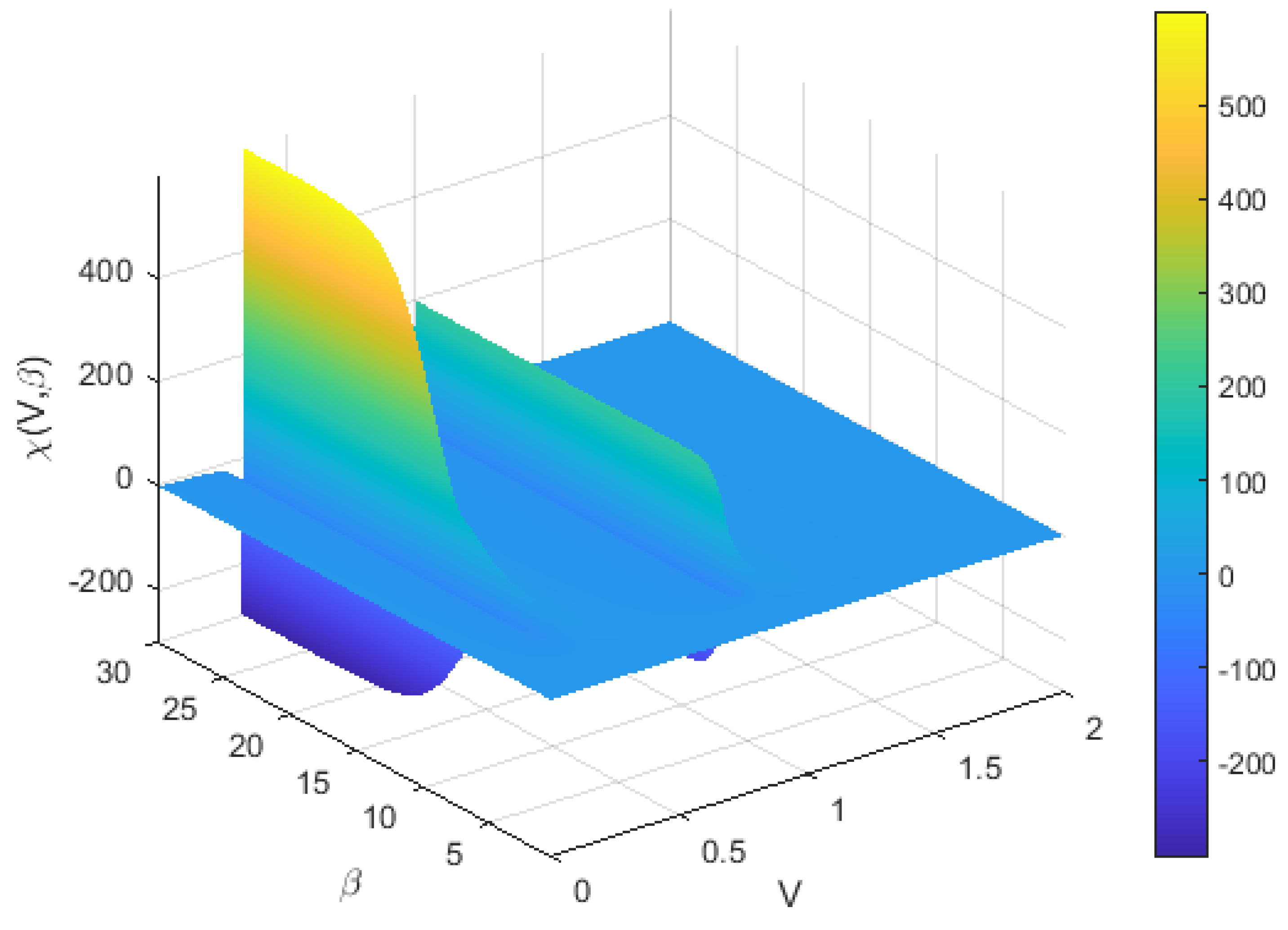
Figure 3.
The thermodynamic derivative of the effective interaction curve, , plotted against the inverse temperature for various baseline interaction strengths () at . The plots perfectly capture the symmetry-breaking crossover: weak baseline couplings take off along positive trajectories, while strong couplings flip into negative branches, driven by the re-opened energy gap .
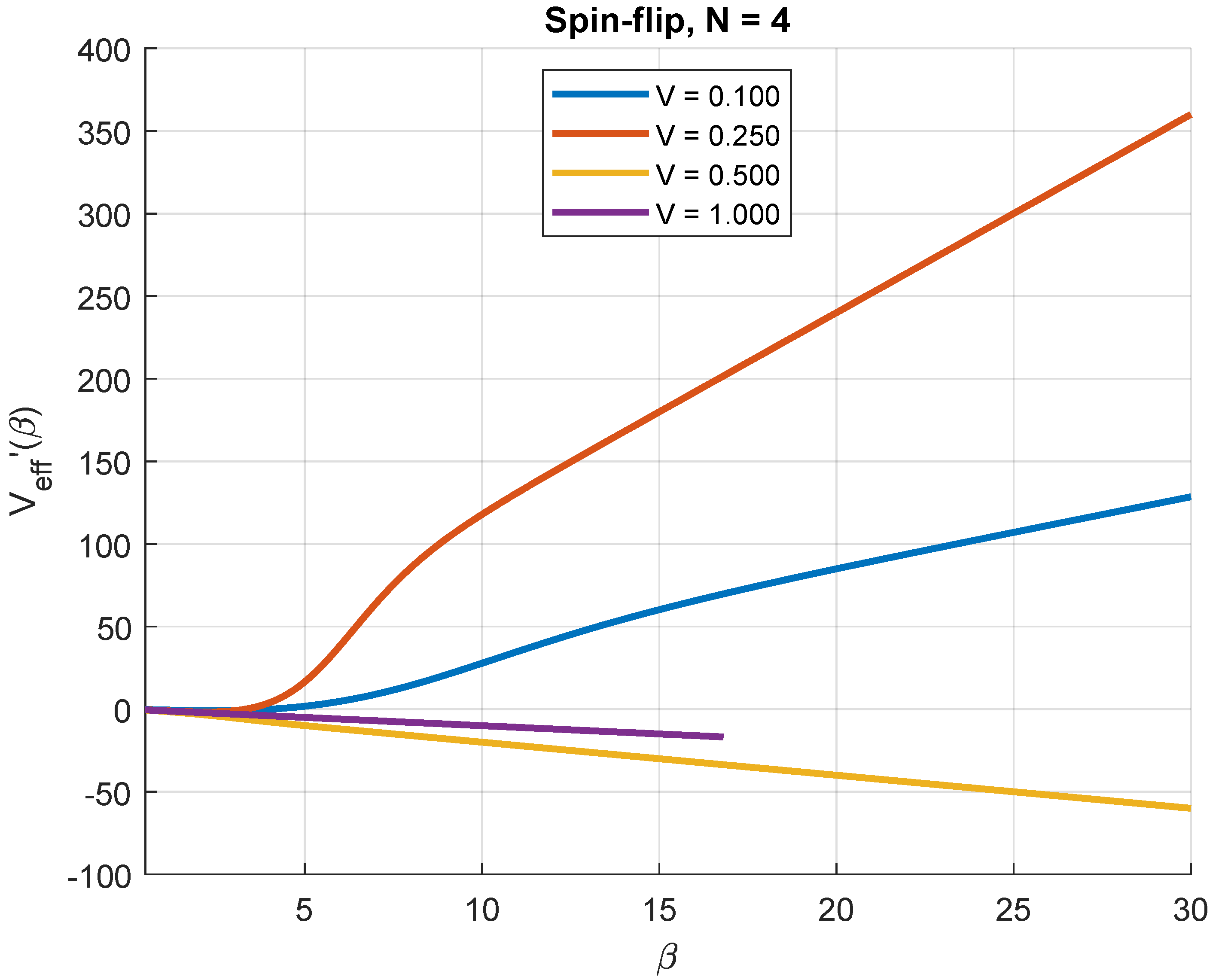
Figure 4.
The transverse spin order parameter mapped as a continuous 3D surface across the control coordinates for the (a) and (b) spin sectors. The profiles reveal a sharp, non-linear structural transition from a vanishingly small symmetric floor to an absolute, flat macroscopic plateau, explicitly charting the boundaries of the entropic slaving domain.
Disclaimer/Publisher’s Note: The statements, opinions and data contained in all publications are solely those of the individual author(s) and contributor(s) and not of MDPI and/or the editor(s). MDPI and/or the editor(s) disclaim responsibility for any injury to people or property resulting from any ideas, methods, instructions or products referred to in the content. |
© 2026 by the authors. Licensee MDPI, Basel, Switzerland. This article is an open access article distributed under the terms and conditions of the Creative Commons Attribution (CC BY) license (http://creativecommons.org/licenses/by/4.0/).
Copyright: This open access article is published under a Creative Commons CC BY 4.0 license, which permit the free download, distribution, and reuse, provided that the author and preprint are cited in any reuse.