

Submitted:
14 November 2026
Posted:
17 November 2026
You are already at the latest version
Abstract
Climate change poses severe challenges for Small Island Developing States (SIDS), particularly in coastal tourism areas like Tonga, where rising sea levels, coastline erosion, extreme weather, and ecosystem degradation threaten social, economic, and environmental systems. Understanding stakeholder perspectives is vital for effective climate policy and resilience. This qualitative case study examines climate change impacts and adaptation in Tonga from two perspectives: government ministries and tourism businesses. Specifically, it aims to (1) understand how stakeholders engage with and evaluate climate responses, (2) assess their knowledge of climate impacts and adaptation approaches, and (3) explore future adaptation priorities. We analyzed semi-structured interviews with government officials and tourism operators using thematic and co-occurrence matrix analyses in NVivo. Findings reveal that government stakeholders prioritize policy implementation, inter-ministerial coordination, and community awareness campaigns, whereas tourism stakeholders focus on daily operations, sustainability, and practical adaptation. While both groups value collaboration, they face shared barriers in financing, implementation, and technical expertise. Both emphasize the need for capacity building, ongoing awareness, and attracting climate-resilient investments. Ultimately, effective adaptation in Tonga requires stronger public-private cooperation, better integration of national policies with local initiatives, and sustained investment in institutional and community resilience.
Keywords:
climate change adaptation
; coastal tourism
; stakeholder perceptions
; qualitative research
; thematic analysis
; climate policy
; resilience
1. Introduction
Climate change poses a major challenge to Small Island Developing States (SIDS) due to their vulnerability to rising sea levels, coastal erosion, extreme weather, and ecosystem damage. These effects endanger livelihoods, infrastructure, food security, and economic growth, particularly in countries that depend on coastal tourism and natural resources (IPCC, 2023; Nurse et al., 2014; Mycoo et al., 2022). Tourism is at risk because it relies heavily on marine biodiversity, climate attractions, and coastal ecosystems, and threats have increased; governments, businesses, and communities have shifted their focus to effective adaptation strategies (Scott, Hall, & Gossling, 2012; Becken & John, 2007).
Tonga is one of the Pacific Island countries that is most vulnerable to climate change. Recent climate disasters, including tropical cyclones, coastal floods, and sea level rise, have highlighted the nation’s vulnerability to environmental risks and the need for long-term adaptation planning (Tonga, 2016; IPCC, 2023; Bank, 2021). The Government of Tonga has established several national policies and frameworks, including the Tonga Climate Change Policy (TCCP), the Joint Action Plan on Climate Change and Disaster Risk Management (JNAP), and the Nationally Determined Contributions (NDCs). These frameworks provide strategies for strengthening climate action and resilience through policy integration and sustainable development. However, financial limitations and capacity constraints remain challenges (Betzold, 2015; Robinson, 2015). Adapting to climate change is a multi-stakeholder process that requires concerted efforts by corporations, governments, communities, and development partners (Adger, 2003; Moser & Ekstrom, 2010; UNDP, 2004).
While tourism businesses contribute by implementing operational adaptation measures, investing in resilient infrastructure, and adopting sustainable practices, governments play an important role in policy formulation, regulation, and coordination (Becken & John, 2007; Scott, Hall, & Gossling, 2012). However, stakeholders’ desire to engage in adaptation activities is as important to adaptation success as policy frameworks (Grothmann & Patt, 2003; Adger, Huq, & Torok, 2001). Few studies have examined how different stakeholder groups view climate change impacts and adaptation within Tonga’s tourism industry, even though earlier research has examined climate change susceptibility and adaptation in Pacific Island nations (Mycoo et al., 2022; Robinson, 2015).
Existing research has focused primarily on environmental vulnerability, disaster risk reduction, or community resilience, with limited attention given to comparing the perspectives of government agencies and tourism businesses (Betzold, 2015; Nalau, Preston, & Maloney, 2015). Understanding these perspectives matters because differences in institutional responsibilities, knowledge, and adaptive capacity can shape how effectively climate change policies are implemented (Moser & Ekstrom, 2010).
2. Methodology
2.1. Research Design
To investigate stakeholder perspectives on the effects of climate change and adaptation in Tonga, this study used a qualitative case study design. A qualitative approach was chosen to provide a thorough understanding of participants’ experiences, perceptions, and interpretations of climate change and adaptation methods within their institutional and business contexts. The case study method was suitable because it allowed for a thorough analysis of climate adaptation in the unique environmental and socioeconomic context of Tonga.
2.2. Study Area
The study was conducted in the Kingdom of Tonga, a South Pacific Small Island Developing State (SIDS) highly susceptible to climate change. Sea level rise, coastal erosion, tropical cyclones, storm surges, and shifting rainfall patterns increasingly threaten Tonga, significantly affecting coastal populations and the tourism industry. The study focused on stakeholders from government ministries and tourism businesses engaged in climate change adaptation and tourism management.
2.3. Sampling
Purposive sampling was utilized to identify people with first-hand knowledge and expertise in managing tourism and adapting to climate change. Participants were selected from two stakeholder groups:
- Environment, Tourism, Agriculture, and Fisheries are among the government ministries that were chosen for this study.
- My sample size includes the outer islands of Vava’u, Ha’apai, and ‘Eua. I intended to interview twenty government officials.
- Tourism-related businesses that operate in coastal regions, such as lodging providers, tour operators, and other tourism-related industries.
Using the same method I used to include the outer islands, I aimed to interview thirty-five tourism businesses, as detailed in the table below. Purposive sampling ensured participants had the necessary knowledge and real-world experience to meet the study’s goals.
Sampling Size

Table 1.
Tourism Businesses Sample Size.
Tourism Businesses
| Tongatapu | Vava’u | Ha’apai | ‘Eua | Total |
| 15 | 10 | 5 | 5 | 35 |
Table 2.
Government Ministries Sample Size.
Government Ministries
| Government Ministries | Tongatapu | Vava’u | Ha’apai | ‘Eua | Total |
| Tourism | 1 | 1 | 1 | 1 | 4 |
| Agriculture | 1 | 1 | 1 | 1 | 4 |
| Climate Change | 1 | 1 | 1 | 1 | 4 |
| Environment | 1 | 1 | 1 | 1 | 4 |
| Fisheries | 1 | 1 | 1 | 1 | 4 |
| Total | 5 | 5 | 5 | 5 | 20 |
2.4. Data Collection
Semi-structured interviews were used to gather data, allowing participants to share their viewpoints and experiences while maintaining consistency across interviews. Three main research questions the survey has focused on:
- How do stakeholders engage with, respond to, and evaluate the effectiveness of climate change policy measures?
- What is the level of stakeholders’ awareness on climate change impacts and adaptation measures within their business and Ministries?
- How do stakeholders envision and plan for future adaptation strategies to climate change?
Depending on participant availability, interviews were conducted in person. With participant’s informed consent, audio recordings of the interviews were made. Interviews were conducted partially in Tongan and English, depending on the interviewee’s preferences. All interviews conducted in Tongan were later translated into English for analysis. The survey was conducted partially in February 2025 and in October to November 2025.
2.5. Data Analysis
Interview transcripts were analyzed using thematic analysis, proposed by Braun & Clarke (2006). The transcripts were imported into NVivo qualitative data analysis software to enable systematic coding and data structuring. Throughout the analysis, the coding framework was iteratively refined, built inductively from participant responses. I analyzed themes to identify parallels and discrepancies between the viewpoints of government and tourism industry stakeholders.
I also chose to use matrix coding queries to examine the interconnections between the themes and the stakeholder groups. I also chose bubble charts to compare prominence among stakeholder groups based on the co-occurrence frequencies obtained.
3. Literature Review
Focusing on tourism, stakeholder involvement, policy implementation, awareness, and adaptive capacity, this chapter examines literature on climate change vulnerability and adaptation in Small Island Developing States. Before discussing the consequences for tourism-dependent economies, it first examines the unique climate risks SIDS face. It then examines Tonga’s climate policy framework, discusses adaptation as a multi-stakeholder process, and assesses the connection between practical adaptive capacity and stakeholder awareness. The chapter concludes by identifying the study’s research gaps.
3.1. Climate Change and Small Island Developing States
Climate change and its impacts on small island developing states have cost them more than they ever expected. Even though their contribution to global gas emission is small but they suffer a lot and they are amongst the most sensitive and vulnerable to climate change. Not only affected their livelihoods, but environmentally and economically as well.
Sea level rise, coastal erosion, saline intrusion, ocean warming, coral bleaching, altered rainfall patterns, drought, flooding, and increasingly severe extreme weather events are some of the physical effects on SIDS. Poverty, ecological degradation, poorly planned coastal development, inadequate infrastructure, and reliance on imported resources are development factors that interact with these risks. Therefore, exposure to environmental dangers is not the only factor that determines climate vulnerability. It is also shaped by how well businesses, communities, and organizations anticipate, respond to, and recover from climate-change-driven disruptions (Kelman & West, 2009; Nurse et al., 2014; Thomas et al., 2020).
According to Thomas et al. (2020), despite their significant natural, cultural, and economic diversity, SIDS share several climatic vulnerabilities. Rising ocean temperatures and acidification put pressure on coral reefs and fisheries, while sea-level rise threatens communities, highways, airports, tourism facilities, freshwater supplies, and cultural monuments. Because individuals and businesses with fewer resources can’t relocate, remodel buildings, obtain insurance, or adapt as easily, climate change may further widen existing socioeconomic disparities.
According to Kelman & West (2009), island topography is neither a clear-cut nor an inevitable cause of SIDS risk. Institutional inadequacies, political marginalization, resource inequality, and development decisions increase climate-related risks. This approach distinguishes between the hazards themselves and the underlying factors that shape whether climate threats become disasters. It also suggests that adaptation must address structural development challenges rather than focus only on physical safety measures.
Recent studies by Robinson (2020) have claimed that SIDS adaptation has increased significantly. He also notes the ongoing deficiencies in local implementation, monitoring, institutional learning, long-term adaptation efficacy, and locally led adaptation.
At the regional level, the Framework for Resilient Development in the Pacific promotes low-carbon development, disaster risk reduction, and climate change adaptation. It recognizes that resilience requires governance, communication, partnerships, funding, expertise, and continuous participation from governments, businesses, civil society, development partners, and communities. The framework also highlights the significance of strengthening local capacity and placing affected people at the center of decision-making, particularly women, young people, older people, and people with disabilities (SPC, Pacific Community et al., 2016).
Tonga is known for its vulnerability to climate change. Coastal areas are the most affected regions in terms of tropical cyclones, sea level rise, erosion, and coastal flooding. According to Tonga’s Third National Communication, the nation’s vulnerability stems primarily from its small size, geography, scarce resources, and socioeconomic circumstances (MEIDECC, 2019).
According to the World Bank’s climate risk profile, future climate change is likely to affect food security, water resources, livelihoods, infrastructure, agriculture, ecosystems, and tourism. It also notes that societal vulnerability and adaptation capacity, including access to financial resources, technology, information, and institutional support, will determine the effects of climate risks (Group, 2021). Therefore, physical exposure alone cannot account for Tonga’s vulnerability. The institutional and stakeholder interactions that influence adaptation must also be considered.
3.2. Climate Change Impacts on Tourism
Beyond its economic significance, tourism is highly sensitive to climate. Climate affects seasonality, biodiversity, water availability, transportation accessibility, infrastructural dependability, tourist comfort, and the quality of natural attractions. According to Scott, Hall, & Gossling (2012), climate change affects tourism through governmental responses to greenhouse gas emissions, indirect changes to ecosystems and landscapes, direct changes in temperature and weather, and broader socioeconomic shifts in visitor demand.
Tourism industry in SIDS focuses on coastal settings and nature-based experiences, the sector is mostly vulnerable. Key elements of the tourism product include beaches, coral reefs, marine life, and scenery. Additionally, hotels, resorts, dining establishments, roadways, wharves, airports, and tourism services are often located near shorelines. Therefore, sea-level rise and coastal erosion can harm both tourism businesses’ physical assets and the environmental resources essential to a destination’s competitiveness.
Tourism in the Pacific is susceptible to economic shocks, biodiversity loss, severe weather, sea-level rise, and changing marine habitats (Wolf et al., 2021). The authors highlight a complicated connection: while tourism itself contributes to greenhouse gas emissions, particularly through aircraft, islands that depend heavily on tourists are especially vulnerable to climate change. They support more comprehensive integration of sustainability into tourism development, emissions reduction, climate-resilient planning, and economic diversification.
Infrastructure damage, higher maintenance costs, water and electricity disruptions, beach loss, coral bleaching, and transportation system degradation are among the ways climate change might affect the tourism supply. By altering traveller’s opinions of a destination’s safety, appeal, comfort, and accessibility, it can also affect demand. According to Viner & Agnew (1999) and Scott, Hall, & Gossling (2012), shifting weather patterns may change travel seasons and shift traveller demand between locations. However, even when physical changes happen gradually, highly dependent island economies may face major economic repercussions because tourists can easily switch destinations.
In Tonga, where the tourism industry depends heavily on natural beauty, coastal settings, marine biodiversity, cultural heritage, and activities like whale watching, diving, snorkelling, boating, kayaking, and beach recreation, these concerns are especially significant. Coastal erosion and rising sea levels endanger the quantity and quality of beach space, as well as the locations of beachfront houses and cruise infrastructure, according to the World Bank. Storms may disrupt the nation’s sun, sea, and sand tourism industry, while drought may further strain its already scarce freshwater supplies (Bank, 2021).
As MEIDECC (2019) states, the tourism sector holds considerable economic promise but remains highly susceptible to climate change impacts. Many beach and coastal tourism establishments are situated in areas prone to ecological damage, erosion, flooding, and storm surges. The report highlights that environmental degradation can negatively influence business activities and visitor interest, as tourism depends significantly on the state of the coastal environment.
There were recent crises that demonstrated these flaws. Tonga’s Tourism Crises Impacts Assessment examined the combined effects of Tropical Cyclone Harold, the COVID-19 border closure, and the Hunga Tonga–Hunga Haʻapai eruption and tsunami. Based on responses from 76 tourism-related businesses, the review found significant injury, disruption, and income loss across the industry. The assessment shows that tourism businesses facing recurrent shocks have insufficient financial and recovery capacity, even though the pandemic and volcano eruption are not directly related to climate change. To create a resilient, sustainable, and inclusive future, the report suggests restoring viable businesses, rebuilding public and private tourism infrastructure using resilient materials, restoring service quality and market confidence, and resetting tourism policy. The advice to “build back better” is especially pertinent to climate change since it is anticipated that natural disasters, extreme weather, and sea level rise would pose ongoing dangers to tourism investments. (Tourism, 2022).
Stronger building regulations, moving away from highly exposed shorelines, restoring coastal ecosystems, conserving water, renewable energy, insurance, emergency preparation, business continuity plans, a variety of tourism products, better climate information, and collaboration between companies and government agencies are some examples of how tourism can adapt to climate change. Implementation, however, depends on tourist operators’ understanding of the risks, access to resources, trust in public institutions, and perceptions of the operational and financial viability of adaptation investments.
3.3. Climate Change Adaptation and Stakeholder Engagement
The term “climate change adaptation” refers to modifications to human or natural systems that reduce harm, control hazards, or seize new opportunities; according to Smith & Wandel (2006), exposure, sensitivity, and adaptive capacity all influence adaptation. Adaptation can take many forms, including formal government policy, planned infrastructure investment, ecosystem management, community practices, and independent changes made by homes and companies.
Adaptation is more than technical. It involves decisions about acceptable risk, responsibilities, resources, priorities, and how costs and benefits are allocated. Stakeholder engagement is essential to successful and fair adaptation because these decisions affect different groups in different ways. Stakeholders include national and local governments, corporations, communities, civil society organizations, researchers, traditional leaders, vulnerable groups, funders, and regional organizations.
Adaptation is an iterative process embedded in national development, according to Lim & Spanger-Siengfried’s (2005) Adaptation Policy Framework. Its core principles include addressing both current and future climate variability, evaluating adaptation within the broader development context, working across numerous institutional and spatial scales, and incorporating stakeholders throughout assessment and implementation. This approach recognizes that adaptation methods are more likely to be justified and sustainable when they connect to current objectives and are supported by the people responsible for implementing them.
Stakeholder involvement can enhance the relevance, validity, equality, and sustainability of adaptation initiatives in developing nations (Sherman & Ford, 2014). Stronger community involvement helped projects function better by enabling adaptation strategies to draw on local expertise and address local needs. However, the quality of involvement varied greatly. In several instances, stakeholders did not share control over project design and execution; instead, they were informed or consulted only after significant decisions had been made.
Because participation can range from passive information exchange to active co-production and shared decision-making, this distinction is crucial. Consultation alone does not always ensure meaningful engagement. Stakeholders may attend workshops but lack the knowledge, power, time, resources, or opportunity to affect outcomes. As a result, adaptation programs may seem collaborative, but they remain institutionally top-down.
According to Gardner et al. (2009), engagement design should consider the goals of the adaptation process, stakeholder traits, available resources, and the level of influence participants are expected to exert. Effective participation requires clear goals, appropriate representation, open communication, and ongoing involvement. For complex, long-term climate risks, one-time meetings are rarely enough.
The Pacific regional framework reflects these ideas, stating that government, communities, businesses, funders, and regional organizations must actively and consistently participate in resilient development. It pushes governments to create inclusive and multi-sectoral systems; encourage decentralized planning; provide private companies with incentives; enhance access to risk information; and create favorable conditions for public-private collaborations (SPC, 2016).
Government and tourism businesses play different but complementary roles in Tonga and require substantial involvement. Government ministries manage national policies, regulations, climate data, disaster management, funding coordination, environmental protection, and public infrastructure. Tourism companies make daily operational decisions on workforce, investment, emergency preparedness, energy and water use, building upkeep, and environmental management.
A policy-implementation gap can result from a lack of cooperation among these parties. Without a clear understanding of the real-world challenges small tourism businesses face, government organizations may develop national strategies that do not fit local needs. On the other hand, companies might implement discrete coping strategies without connecting them to government assistance or national adaptation initiatives. Therefore, effective adaptation requires ongoing communication, clearly defined roles, accessible information, and channels for firms to engage in planning and policy review.
3.4. Climate Change Policies in Tonga
Tonga has created a comprehensive policy framework for disaster risk and climate change. Tonga’s Nationally Determined Contributions, the Joint National Action Plan on Climate Change and Disaster Risk Management, the Initial, Second, and Third National Communications under the United Nations Framework Convention on Climate Change, the Tonga Climate Change Policy, and more extensive regional commitments under the Framework for Resilient Development in the Pacific are some of the key tools.
The 2005 Initial National Communication provided an early national evaluation of greenhouse gas emissions, susceptibility, and adaptation. It listed coastal regions, water resources, agriculture, fishing, infrastructure, tourism, and health as susceptible sectors. Additionally, it recorded early awareness initiatives such as stakeholder consultations, media campaigns, educational materials, and workshops (Tonga G. o., 2005)
National climate assessments and capacity-building initiatives were enhanced under the Second National Communication. The report described technical training in greenhouse gas inventories, adaptation modeling, vulnerability assessment, mangrove restoration, and climate communication. Awareness-raising initiatives included school visits, community seminars, radio and television shows, instructional materials, youth activities, and planting trees along the coast. These programs show that Tonga’s climate response has always included awareness and technological capability (Tonga G. o., 2012).
The national goal of “A Resilient Tonga by 2035” was stated in the 2016 Tonga Climate Change Policy. Its goals include mainstreaming resilience in planning and policy, enhancing research and data management, bolstering response capability, implementing resilience-building initiatives, expanding financial access, and strengthening regional and global cooperation. The policy takes a national perspective, acknowledging that the climate-change ministry cannot provide resilience on its own (Tonga G. O., 2016).
JNAP 2, which covers 2018–2028, operationalizes this plan by integrating disaster-risk management with climate change adaptation. Resilient coastal development, infrastructure, tourism, water security, ecosystems, early warning systems, awareness, institutional capacity, data, funding, and monitoring are among its top goals. Tonga’s NDC review summarises the JNAP 2 aims, including resilient tourism and tourism infrastructure, resilient coastal ecosystems, increased public knowledge, and enhanced climate services. JNAP 2 acknowledges that law, policy, planning, and government decision-making must incorporate climate factors to implement it successfully. It calls for quantifiable indicators, revitalizing the JNAP Secretariat, establishing monitoring and evaluation systems, and strengthening national coordinating bodies (Tonga G. o., 2018; Tonga G. o., 2015).
The Paris Agreement and national climate action are linked through Tonga’s Nationally Determined Contributions. The NDC process has emphasized mitigation, especially energy efficiency and renewable energy, but adaptation has grown in importance. Top adaptation concerns include coastal protection, resilient infrastructure, water security, forestry, ecosystems, disaster preparedness, and increased awareness and capacity. Nonetheless, the NDC evaluation points out flaws in the measurability and intelligibility of several adaptation objectives. To assess progress, it notes that several JNAP objectives need more precise, measurable indicators. It also emphasizes the need to strengthen coordination of development financing, data collection, monitoring, communication, and information access (Tonga G. O., 2015).
During the NDC review, stakeholder discussions revealed practical obstacles, including insufficient financing and resources, law enforcement, low awareness, lack of technical skills, institutional challenges, disputes among resource users, and poor coordination. Such suggestion including enabling measures include closer institutional cooperation, technical support, frequent monitoring and assessment, and stronger enforcement. Together, Tonga’s policies provide a comparatively thorough strategic basis. They acknowledge that key elements of resilience include tourism, infrastructure, ecosystems, awareness, finance, governance, and stakeholder participation. Therefore, the primary issue is not just the lack of policy. The challenge is translating policy goals into coordinated, sufficiently funded, quantifiable, and long-lasting action across communities, corporations, and government (Tonga G. O., 2015).
3.5. Stakeholder Awareness and Adaptive Capacity
Awareness and adaptive capacity are two separate but connected ideas. The word “awareness” describes knowledge and comprehension of climate change, including its causes, effects, dangers, and remedies. Adaptive capacity is the capacity of individuals or groups to predict climate hazards, adapt, learn from mistakes, and recover from disruption (Smit & Wandel, 2006).
Even if a stakeholder is aware of climate change, they may lack the institutional support or means to act. However, an organization may have financial or technological resources but not use them effectively because it does not acknowledge or prioritize climate risks. As a result, awareness contributes significantly to adaptive ability but is not enough on its own.
According to Marshall et al. (2013), Australian farmers’ awareness of climate change was positively correlated with their capacity for adaptation. Individuals aware of the dangers posed by climate change were more likely to consider adaptation and demonstrate readiness for change. However, social networks, financial circumstances, career identity, psychological flexibility, and the anticipated consequences of changing present routines also influenced adaptive capacity.
O’Keeffe et al. (2016) reported comparable results when they examined commercial seaports in Ireland and found that although stakeholders often had a basic understanding of climate change, they knew little about its implications and adaptation strategies. This gap between general awareness and operational understanding is especially relevant to the travel and tourism sector. Business owners may believe that cyclones, coastal erosion, or changing weather affect tourism if they are unaware of anticipated risks, available adaptation options, government regulations, or the financial benefits of taking preventive action.
Adaptive capacity operates on multiple levels. Capacity may exist at one level yet be restricted at another, according to Engle & Clarvis (2012). For example, a national government may have access to technical climate knowledge that local businesses lack. High costs, uncertain land arrangements, limited credit, or unclear building rules may prevent a tourism operator from improving a facility, even if they want to. The efficiency of adaptation thus depends on how national institutions, local organizations, communities, and businesses allocate resources, authority, knowledge, and responsibility.
Adaptive capability often depends on several elements, including financial resources, access to technology, skills, climatic knowledge, leadership, institutional flexibility, social networks, prior disaster experience, insurance availability, organizational learning, and stakeholder trust. These problems in SIDS are exacerbated by small markets, costly transportation, a shortage of staff, reliance on outside funding, and restricted access to specialized knowledge.
Tonga’s policy writings often acknowledge these challenges. The Third National Communication tallies a number of problems, such as a shortage of skilled labor, financial constraints, dependence on donations, poor construction, poor infrastructure governance, and the separation of responsibilities among several sectors. These restrictions may make it challenging to successfully implement policy commitments and expertise (MEIDECC, 2019).
Tonga has simultaneously made investments in institutional coordination, community programming, technical training, awareness campaigns, and climate modeling. Determining whether these initiatives have resulted in consistent knowledge and practical capacity among the parties responsible for tourist adaptation is the difficult part. Tourism firms may not always receive location-specific risk information, technical advice, financial support, or explicit implementation instructions from national awareness campaigns.
The ability of tourism businesses to adapt also varies greatly. Bigger companies might have easier access to worldwide networks, backup utilities, professional guidance, insurance, and funding. Small, locally held businesses may have little capital on hand and prioritize their immediate survival. Instead of investing in more costly resilient designs, these companies might use readily available materials to repair damage after a storm or other disturbance. Their decisions may result from institutional and financial constraints rather than a lack of awareness.
Formal responsibilities and real capacity may also differ for government agencies. Despite their knowledge of climate policy, officials are constrained by a lack of staff, project-based funding, conflicting mandates, incomplete data, and inadequate monitoring systems. This means that, rather than treating government and tourist stakeholders as a unified stakeholder group, awareness and adaptive capacity must be examined independently.
4. Results
4.1. Text-Mining Analysis
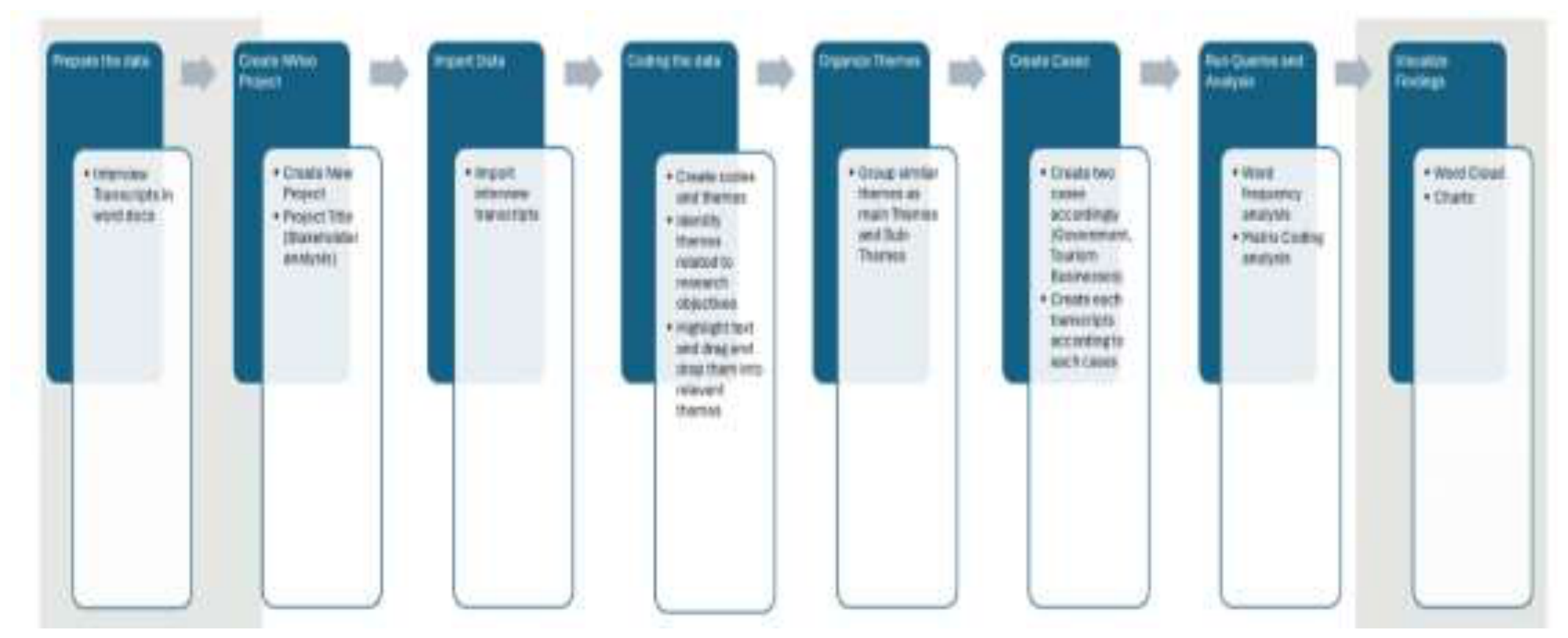
Researchers widely use this method to analyze qualitative survey results, and my methodology is based on it, which is why I chose to use it for my analysis. The figure below shows the detailed methods that were used.
First, I recorded the interviews and later transcribed them into Word documents. Next, I created codes and themes and identified them in relation to my research objectives. Using NVivo, we identified several themes for each research objective. We also grouped the themes into main themes and sub-themes, if needed.
To compare two different stakeholders, we classified all the samples into two categories: tourism businesses and government ministries.
The first analysis was the word frequency analysis. This analysis shows the word cloud and identifies the most frequently mentioned words. Finally, we also did the matrix coding analysis. This method cross-tabulates the two stakeholder categories, revealing intersection patterns, comparisons, and relationships. From there, we can analyze and visualize the findings.
Figure 1.
Detailed methods used in text mining. Source: Author
4.2. Themes
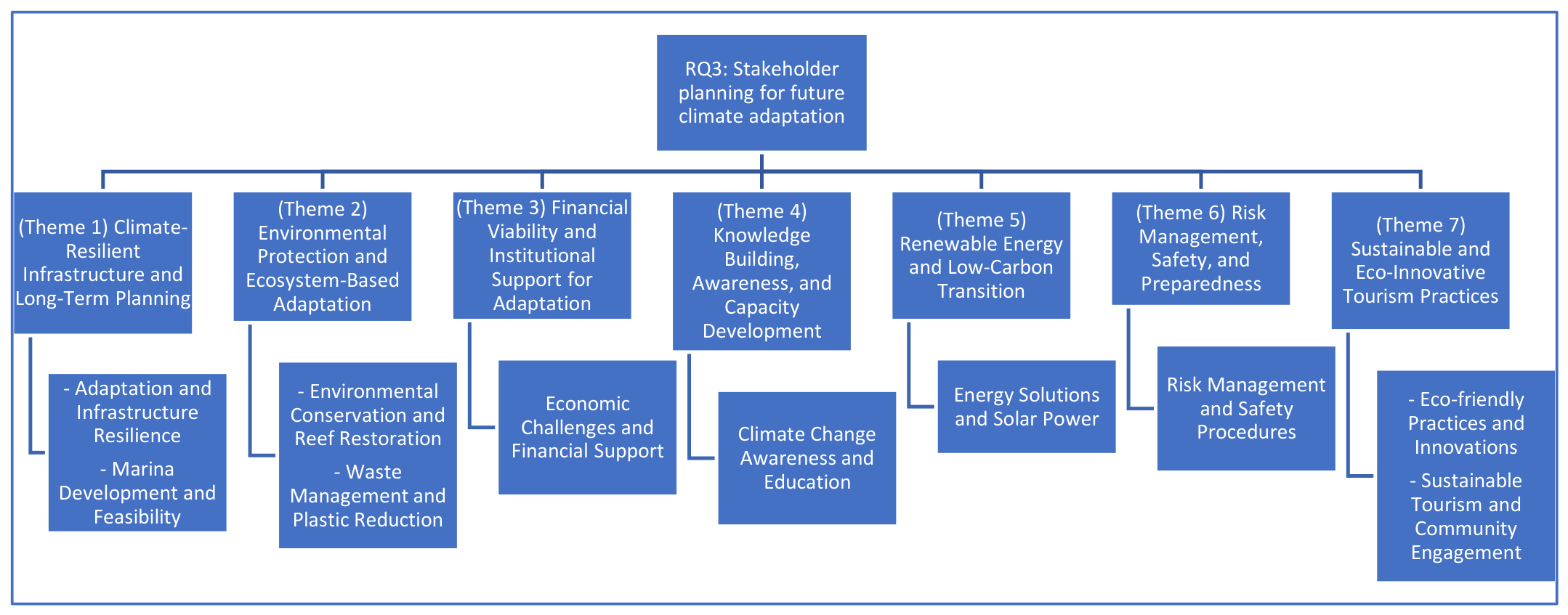
The figures below show the themes for each research question.
Figure 2.
Themes for Research Question 1.
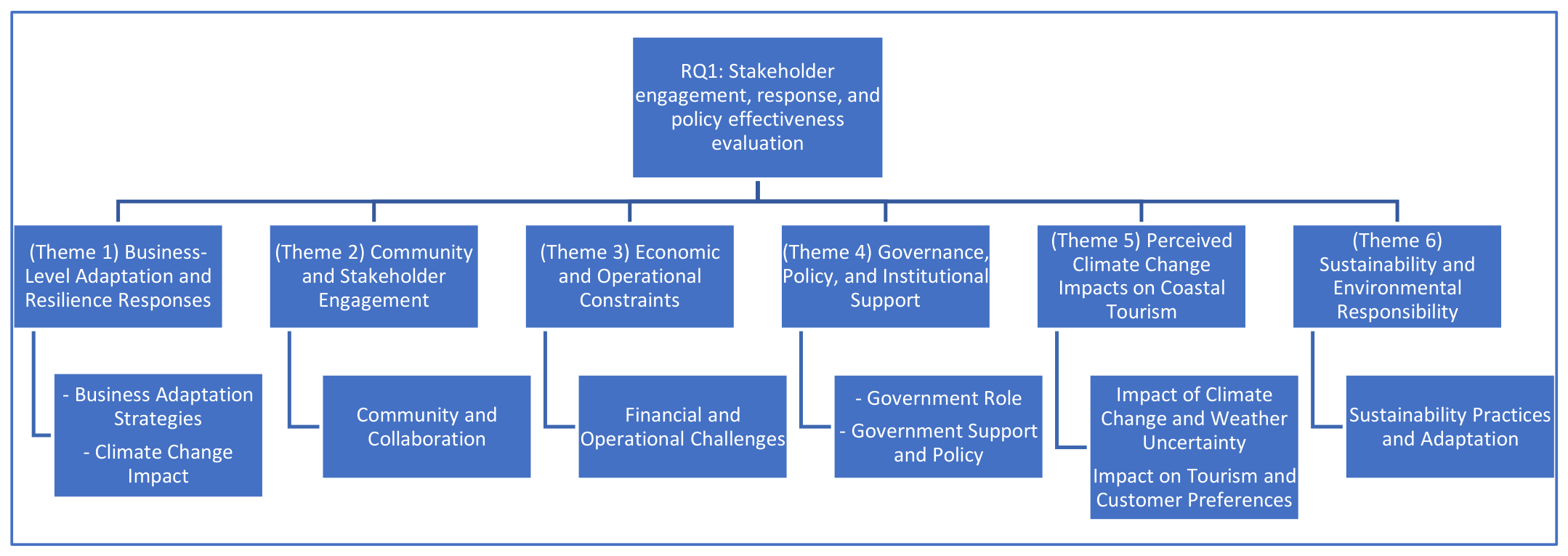
Figure 3.
Themes for Research Question 2.
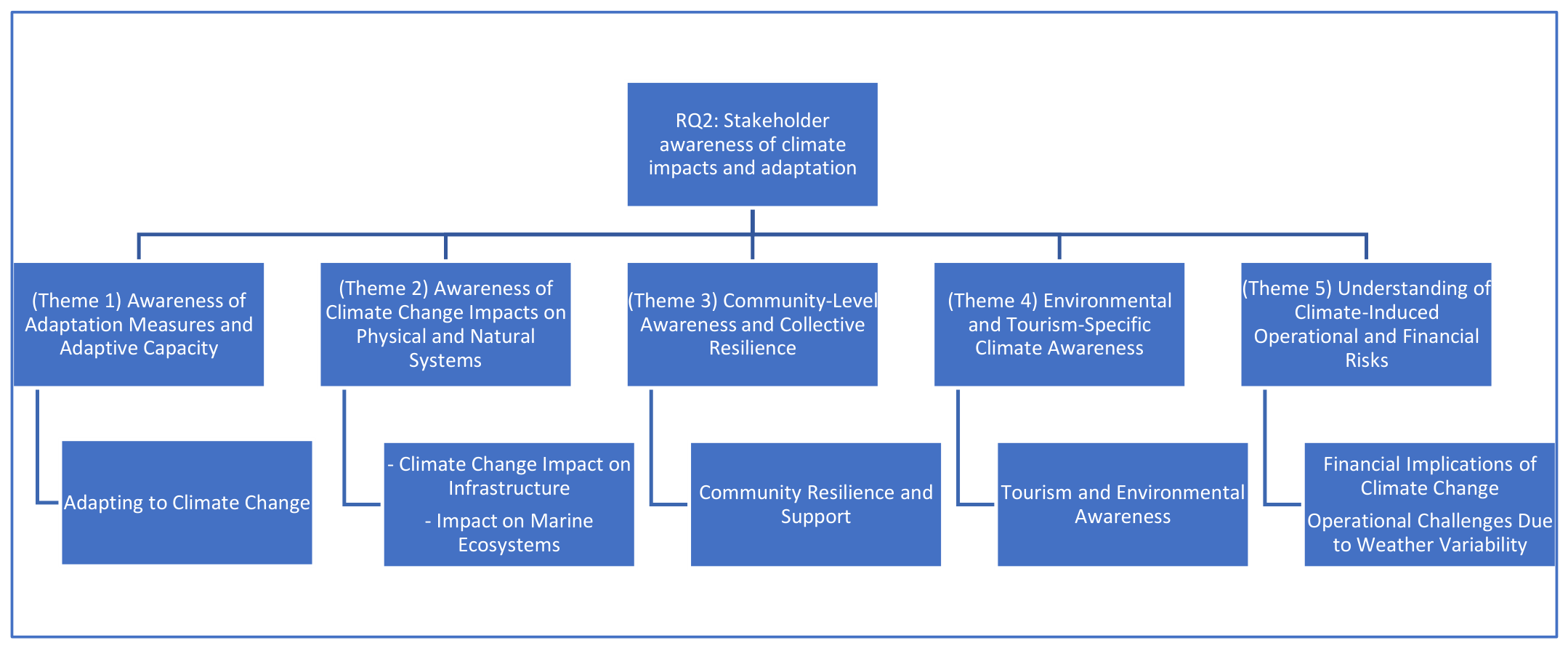
Figure 4.
Themes for Research Question 3. Source: Author.
4.3. Word Cloud
The figures below indicate the word cloud frequencies for each research question.
RQ1- How do stakeholders engage with, respond to, and evaluate the effectiveness of climate change policy measures?
Figure 5.
Word cloud for Research Question 1. Source: Author.
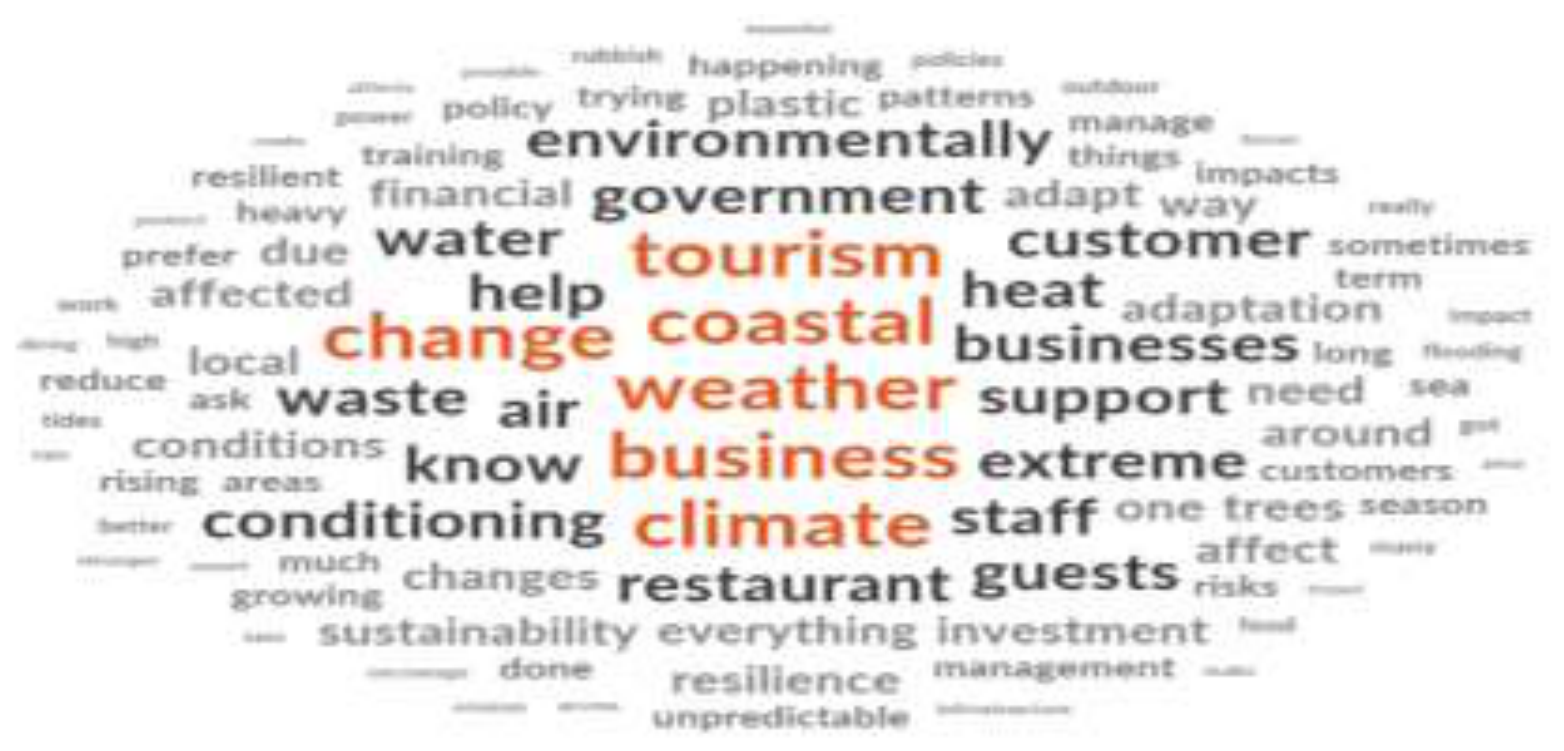
The word cloud shows that weather is the most frequent word in most participants’ responses to Research Question 1 (97 counts), followed by coastal (82 counts), business (81 counts), tourism (71 counts), and climate (70 counts). The frequency gap shows that tourism business stakeholders engage with and evaluate policy through immediate, tangible experiences, as they frequently discussed weather conditions and patterns. Also, the high frequency of coastal indicates that stakeholder engagement is heavily bound to geography and vulnerability.
RQ2 - What is the level of stakeholders’ awareness and understanding of climate change impacts and adaptation measures within their business and Ministries?
Figure 6.
Word cloud for Research Question 2. Source: Author.
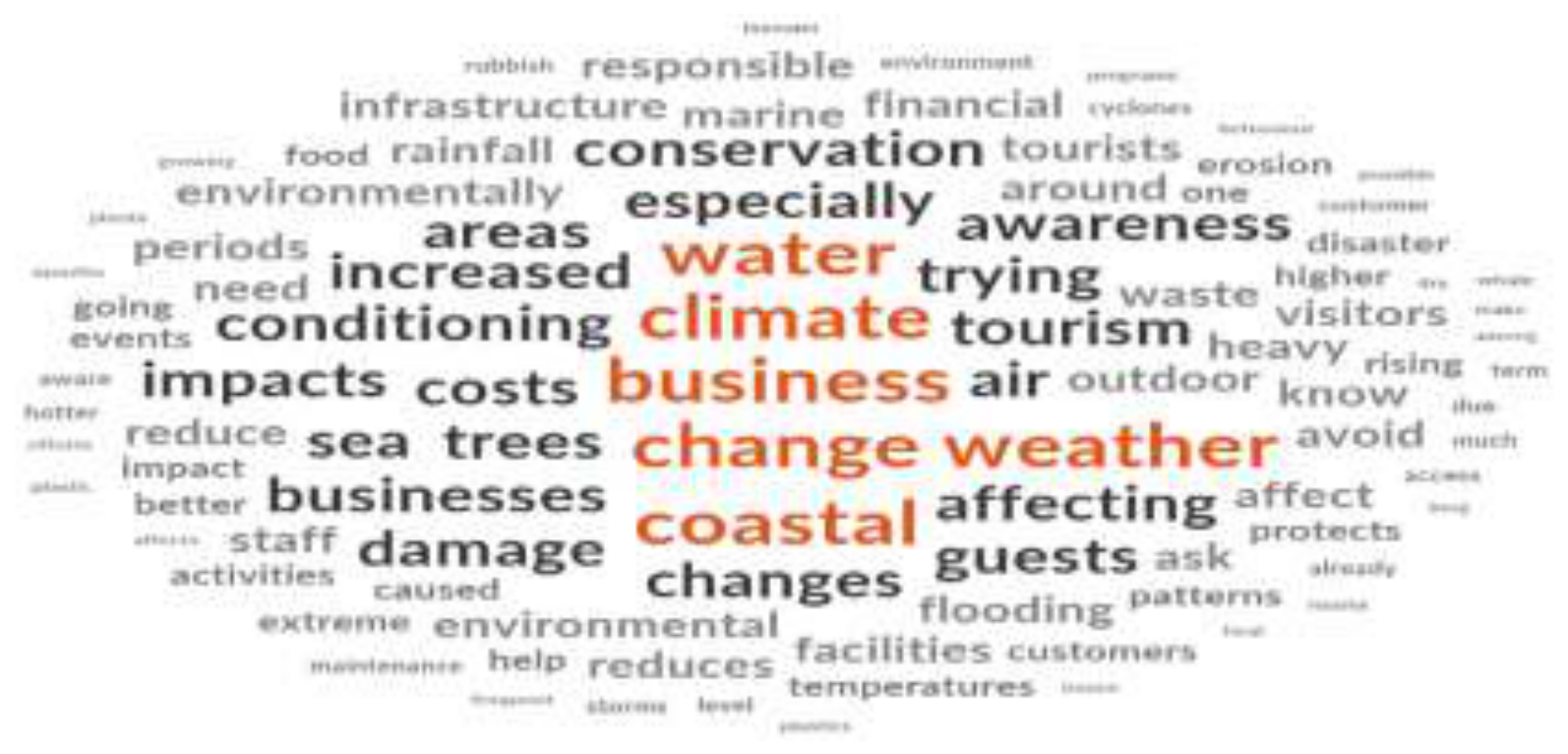
As shown in this word cloud, business is the most frequent word (49 counts), followed by climate (46 counts), change (44 counts), water (37 counts), coastal (30 counts), and weather (22 counts). These results show that stakeholders understand the impacts of climate change, as they discuss climate, coastal, water, weather, and change. Stakeholders also understand both the impacts and the adaptive measures. However, other words appeared, such as tourism (21 counts), costs (19 counts), trees (19 counts), and awareness (15 counts); these relate to stakeholders’ awareness.
RQ3 - How do stakeholders visualize and plan for future adaptation strategies as a response to climate change?
Figure 7.
Word cloud for Research Question 3. Source: Author.
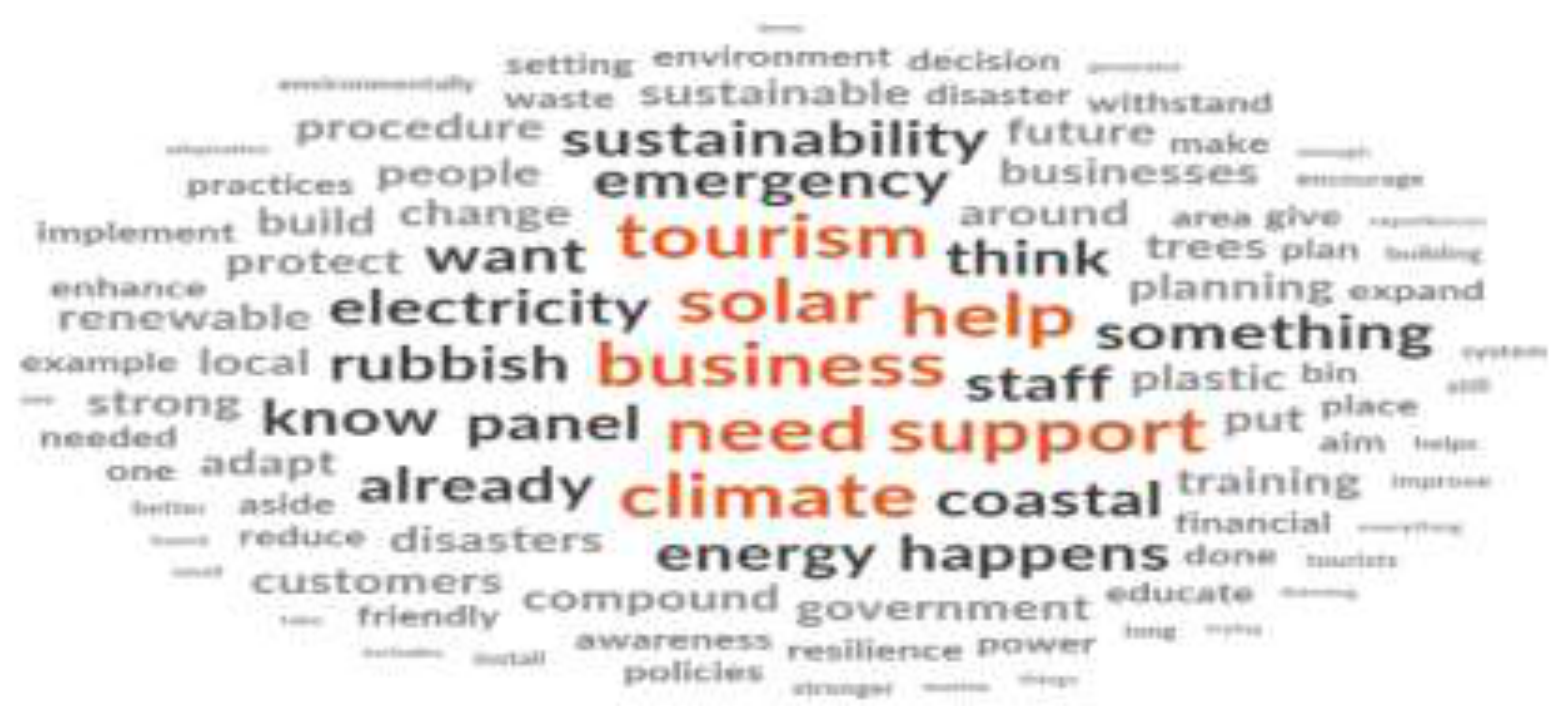
The word cloud above shows that business is the most frequent word (42 counts), followed by solar (39 counts), need (37 counts), tourism (35 counts), help (32 counts), climate (26 counts), and support (26 counts). This shows how stakeholders envision the future, where they need help and support not only for the tourism business but also for the government. The mention of solar panels, sustainability, and coastal areas highlights key points for future adaptation measures.
4.4. Matrix Coding Analysis
The two basic technical stakeholder groups mentioned earlier and the word counts belonging to eighteen main themes were cross-tabulated, resulting in the graph below.
Figure 8.
Co-occurrence Matrix. Source: Author.
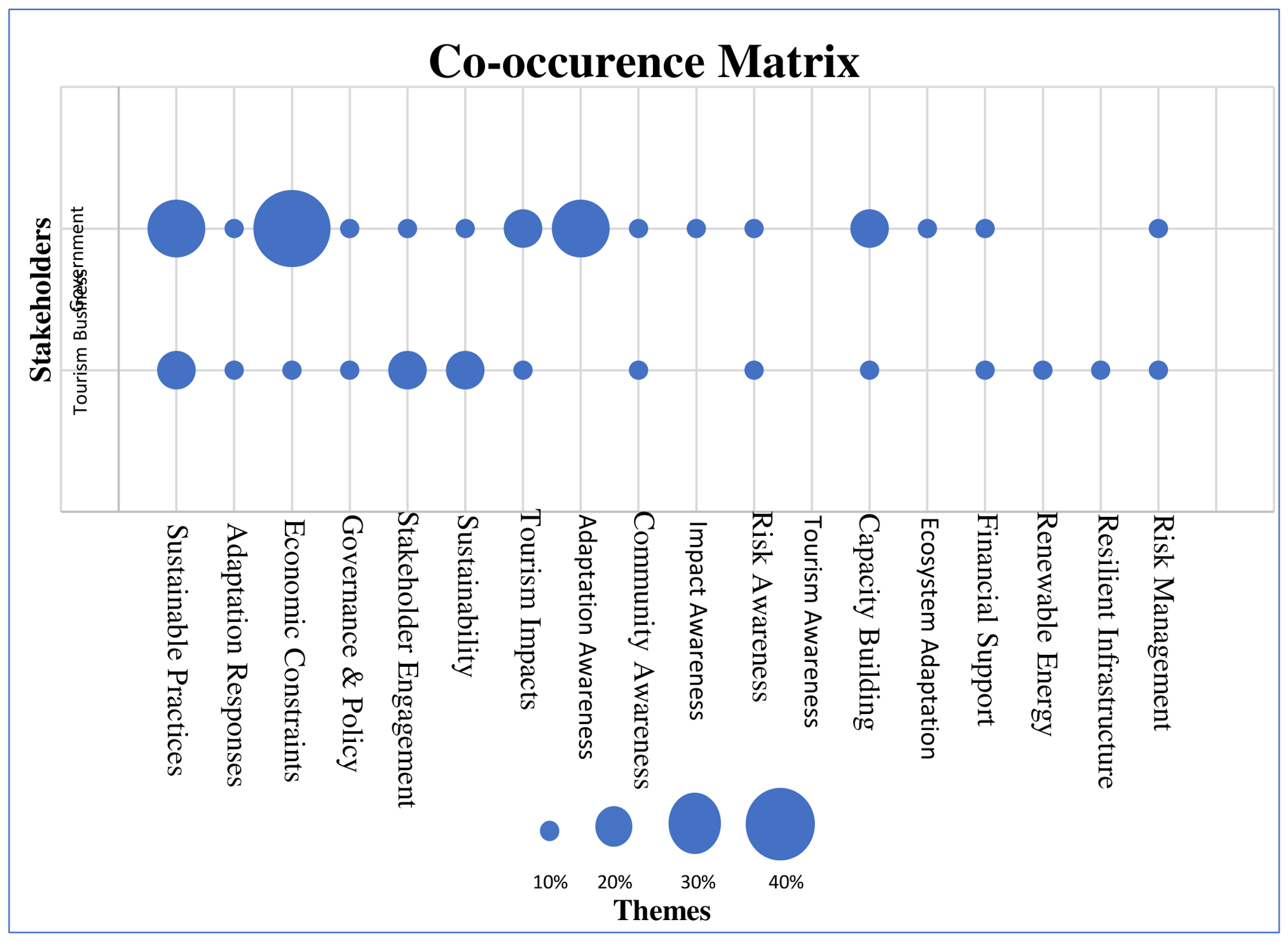
The graph shows that Government stakeholders have the largest bubble size in the matrix, with Economic Constraint themes at 40%, Sustainable practice and Adaptation awareness at 30%, and Tourism impacts and Capacity building at 20%. In contrast, Tourism Business stakeholders show smaller bubble sizes, with Sustainable practice, Stakeholder Engagement, and Sustainability at 20% and the other themes at 10%. This shows how highly focused Government is on the financial limitations and economic impacts of climate change.
Nevertheless, a Chi-Square test of independence was used to determine whether the thematic differences between government officials and tourism businesses were statistically significant or due to chance.
Table 3.
Chi-square Test.
| Theme | Difference between observed and expected value (Government) | Difference between observed and expected value (Business) | X2 Statistic | Chi.Square Test Result |
Interpretation |
|---|---|---|---|---|---|
| Adaptation Responses | -2.55795 | 2.55795 | 0.600029 | 0.438567 | Not Statistically Significant |
| Economic Constraints | 2.05121 | -2.05121 | 1.446905 | 0.229025 | Not Statistically Significant |
| Governance & Policy | -8.44474 | 8.44474 | 5.659389 | 0.017362 | Statistically Significant |
| Stakeholder Engagement | -1.07278 | 1.07278 | 0.215872 | 0.642204 | Not Statistically Significant |
| Sustainability | 10.45283 | -10.4528 | 16.10311 | 5.99856E-05 | Highest Statistically Significant |
| Tourism Impacts | 6.27763 | -6.27763 | 6.254862 | 0.012385 | Statistically Significant |
| Adaptation Awareness | -5.78437 | 5.78437 | 4.453996 | 0.03482 | Statistically Significant |
| Community Awareness | -5.89757 | 5.89757 | 5.980472 | 0.014465 | Statistically Significant |
| Impact Awareness | 0.57682 | -0.57682 | 0.076279 | 0.782404 | Not Statistically Significant |
| Risk Awareness | 0.70081 | -0.70081 | 0.253343 | 0.614731 | Not Statistically Significant |
| Tourism Awareness | -0.36119 | 0.36119 | 0.041411 | 0.838746 | Not Statistically Significant |
| Capacity Building | -0.53639 | 0.53639 | 0.107936 | 0.742507 | Not Statistically Significant |
| Ecosystem Adaptation | -0.30997 | 0.30997 | 0.01586 | 0.899782 | Not Statistically Significant |
| Financial Support | -0.94879 | 0.94879 | 0.309568 | 0.577945 | Not Statistically Significant |
| Renewable Energy | 3.52561 | -3.52561 | 8.54902 | 0.003457 | Statistically Significant |
| Resilient Infrastructure | 1.87601 | -1.87601 | 1.452348 | 0.228152 | Not Statistically Significant |
| Risk Management | 1.70081 | -1.70081 | 1.492179 | 0.221879 | Not Statistically Significant |
| Sustainable Practices | -1.24798 | 1.24798 | 0.321354 | 0.570795 | Not Statistically Significant |
Source: Author.
The table below shows stakeholders’ perspectives and key differences in approach, based on the chi-square test of independence. As highlighted above, I will interpret these results, as the p-values are important to consider. This indicates that the differences between the government and tourism businesses are unlikely to have occurred by chance.
Table 4.
Sustainability.
| Government | Tourism Business | Key Difference | |
| Waste Management | Promote sustainability through environmental regulations, recycling systems, waste management policies, and enforcement. | Reduce plastic use, recycle waste, compost organic waste, and implement waste reduction in daily operations. | Governments manage waste through regulation and policy, while businesses manage it through daily operations. |
| Sustainable Tourism |
Promote sustainable tourism through policies, inspections, certification, and awareness programs. | Deliver eco-friendly tourism experiences through environmentally responsible products, services, and operational practices. | The government promotes sustainable tourism through policy, while businesses implement it through their practices. |
| Environmental Conservation |
Conduct tree planting, ecosystem restoration, no-plastic campaigns, and conservation programs. | Eco-friendly operations, wildlife conservation, and environmentally conscious business practices help protect natural resources. | Businesses participate through site-level conservation initiatives, while the government concentrates on large-scale conservation measures. |
| Climate Adaptation |
Encourage sustainability through grants, tax incentives, climate funds, and adaptation policies. | Improve business resilience through stronger infrastructure, renewable energy, resource efficiency, and emergency preparedness. | Government supports adaptation through policies and incentives, while businesses implement practical adaptation measures. |
Source: Author.
Both government stakeholders and tourism businesses view sustainability as a key approach for adapting to climate change. Government stakeholders emphasize policies, environmental governance, and conservation programs, while tourism businesses focus on implementing sustainable practices in their daily operations. This demonstrates that sustainability is viewed from both strategic and operational perspectives.
Table 5.
Governance & Policy.
| Government | Tourism Business | Key Difference | |
| Climate Policy and Frameworks |
Focus on developing and implementing national climate policies and frameworks (e.g., TCCP, JNAP II, NDCs, Fisheries Management Plan, National Forest Policy). | Acknowledge government policies but show less knowledge of their specifics and more concern about how they are actually implemented. | Businesses emphasize practical results and policy implementation more than the government emphasizes policy formation and strategic planning. |
| Government Support and Funding |
To improve climate adaptation and resilience, support climate funding, grants, tax exemptions, duty reductions, and financial incentives. | Seek greater financial assistance, easier access to climate funds, grants, technical support, and practical assistance for adaptation activities. | Governments focus on providing funding mechanisms, while businesses focus on the accessibility and adequacy of government support. |
| Institutional Coordination |
Emphasize collaboration among ministries, NGOs, development partners, local governments, and communities to coordinate climate change initiatives. | Demand better coordination, more frequent interaction, and clearer communication between government agencies and travel-related enterprises. | While businesses prioritize government responsiveness and stakeholder involvement, the government emphasizes inter-agency collaboration. |
| Climate Adaptation Planning |
Prioritize disaster risk reduction, ecological restoration, long-term adaptation planning, coastal resilience, and regulatory actions. | Give realistic adaptation strategies, including staff training, operational resilience, infrastructure upgrades, and business continuity planning, top priority. | Businesses prioritize quick, practical adaptation, whereas the government takes a strategic, long-term planning approach. |
| Policy Implementation and Capacity Building |
To promote policy implementation, encourage awareness campaigns, training sessions, inspections, standards, and institutional capacity. | To implement adaptation measures, request additional hands-on training, technical guidance, on-site support, and frequent capacity building initiatives. | Businesses seek practical skills, technical support, and implementation aid, while the government focuses on institutional capacity and policy delivery. |
Source: Author.
Although they have different goals, both stakeholder groups agree that governance and policy are crucial to adapting to climate change. While tourism firms prioritize policy implementation, practical support, and enhanced government response, government players concentrate on policy creation, institutional coordination, and long-term planning. These results emphasize the need to close the gap between developing strategic policies and applying them.
Table 6.
Tourism Impacts.
| Government | Tourism Business | Key Difference | |
| Operational Impacts |
Focus on how climate change disrupts the tourism sector through transport interruptions, reduced tourism activities, infrastructure damage, and destination accessibility. | They focus on canceled bookings, business interruptions, unpredictable seasons, increased operating costs, infrastructure damage, and reduced revenue. | While firms face daily operating disruptions, the government looks at sector-wide operational implications. |
| Infrastructure Impacts |
Emphasize the resilience of roads, ports, airports, coastal protection, and public tourism facilities. | Emphasize damage to accommodation, restaurants, boats, jetties, utilities, and other tourism assets requiring costly repairs. | Government prioritizes public infrastructure resilience, while businesses focus on protecting private tourism infrastructure. |
| Disaster Recovery |
Focus on national recovery planning, disaster response, resilience programs, and long-term recovery strategies. | Focus on restoring business operations, maintaining customer confidence, and recovering revenue after disasters. | Businesses prioritize business recovery and continuity, whereas the government prioritizes sector recovery and resilience planning. |
| Climate Risk and Visitor Behavior |
Focus on climate risk assessments, preparedness, hazard management, and the implications of climate change for tourism destinations. | Report shifts in traveler behavior, such as heightened weather-related anxiety, flexible reservation choices, shorter tours, and a desire for safer experiences. | Government concentrates on risk and how tourism locations are affected by climate change. Tourism businesses focus on visitor behavior and preferences to improve their experience. |
| Tourism Development and Resilience |
Focus on strengthening the tourism sector’s long-term resilience and sustainability through planning and policy. | Focus on sustaining profitability, adapting business models, managing rising operational costs, and maintaining competitiveness. | While businesses concentrate on business sustainability and economic resilience, the government takes a long-term approach to tourism development. |
Source: Author.
Both stakeholder groups acknowledge climate change’s significant impact on tourism. Government stakeholders prioritize the sector’s resilience, infrastructure, and long-term sustainable development. In contrast, tourism businesses highlight changes in visitor behavior, financial harm, and operational challenges. These differences highlight each group’s distinct operational and strategic priorities.
Table 7.
Community Awareness.
| Government Stakeholders | Tourism Business Stakeholders | Key Difference | |
| Public Awareness Programs |
Conduct climate change awareness campaigns through schools, villages, Climate Change Week, workshops, village competitions, and public outreach programs. | Raise climate change awareness by educating tourists, employees, and visitors on environmental protection, marine conservation, and sustainable tourism practices. | Government focuses on community-wide awareness programs, whereas businesses focus on customer and employee awareness. |
| Community Engagement |
Encourage participation through tree planting, recycling campaigns, waste management initiatives, and partnerships with villages, NGOs, and community organizations. | Participate in community clean-up campaigns, conservation projects, and local environmental initiatives alongside communities and government agencies. | The government organizes and leads community engagement, while businesses participate and contribute to local initiatives. |
| Behavioral Change |
Encourage communities to adopt sustainable practices, improve waste management, and support climate adaptation to foster environmental responsibility. | Encourage tourists, staff, and customers to practice reducing waste and conserve natural resources. | While businesses promote responsible behavior among their customers and employees, the government focuses on changing community behavior. |
| Capacity Building and Education |
Provide training courses, public awareness campaigns, school instruction, and seminars to improve people’s understanding of and ability to adapt to climate change. | Increase consumer education, operational experience, staff training, and involvement in environmental workshops to raise understanding of climate change. | Businesses develop awareness through operational experience and firsthand learning, while the government offers formal education and capacity-building programs. |
| Stakeholder Collaboration | Promote collaboration among ministries, NGOs, schools, communities, and development partners to strengthen climate awareness nationwide. | Collaborate with tourism associations, researchers, conservation organizations, local communities, and neighboring businesses to improve climate awareness and share knowledge. | Government promotes multi-sector collaboration at the national and community levels, while businesses focus on industry partnerships and local collaboration. |
Source: Author.
Both stakeholder groups agree that increasing community awareness is key to enhancing climate change adaptation efforts. Government actors emphasize public education, awareness campaigns, and stakeholder engagement, while tourism businesses focus on educating employees, tourists, and local communities through tangible environmental initiatives. These insights show that successful climate awareness initiatives depend on strong institutional leadership and active involvement from the tourism sector.
5. Discussion
The discussion begins with the word-cloud findings, followed by an examination of the themes linked to each research question. These findings are then contextualized within the wider literature on SIDS, tourism adaptation, stakeholder participation, climate policy implementation, and adaptive capacity. Finally, I will discuss the findings from the co-occurrence matrix and the chi. square test of independence.
5.1. Discussion of the Word-Cloud Findings
One tourism business participant mentioned the overall pattern represented in the word cloud, stating:
“Climate change has turned what was once a stable coastal business into one that requires constant adjustment and higher financial risk.”
This analysis shows an overview of the themes in the stakeholder discussions. With the frequently mentioned words including climate, tourism, business, impacts and support. These concepts suggest that the two stakeholders view climate change not only as an environmental issue but as a matter to improve governance and economic growth.
Weather, coastal conditions, communities, businesses, and government are frequently mentioned, which is consistent with previous studies on SIDS vulnerability. Because most infrastructure, population, economic activity, and tourism amenities are along the coast, small island states are especially vulnerable. Their reliance on climate-sensitive industries, low financial resources, small economic bases, geographic isolation, and institutional difficulties all increase their susceptibility. Therefore, organizations’, communities ‘, and enterprises’ capacity to anticipate, respond to, and recover from climate-related disturbances contributes to climate vulnerability in addition to physical exposure (Kelman & West, 2009; Nurse et al., 2014; Thomas et al., 2020).
The focus on tourism-related terms also highlights Tonga’s tourism industry’s vulnerability to climate change. Clear weather, marine habitats, beaches, biodiversity, transportation, infrastructure, and visitor perceptions of safety and attraction all play a significant role in tourism. Research shows that weather variability, environmental harm, policy changes, and shifts in traveler tastes and destination choices are all ways climate change affects tourism (Scott, Hall, & Gossling, 2012). Because important tourism activities, including whale watching, diving, boating, coastal accommodation, beach enjoyment, and marine tourism, directly depend on healthy coastal and ocean ecosystems, these problems are especially important in Tonga.
According to the word-cloud results, individuals typically comprehend adaptation in terms of concrete actions rather than abstract climate science. Stakeholders frequently mentioned infrastructure, trash management, trees, finance, awareness, support, training, safety, and cooperation. This supports Smit & Wandel’s (2006) assertion that exposure, sensitivity, and adaptive capacity all shape adaptation, which can occur through public policies, infrastructure projects, ecosystem management, community initiatives, or individual decisions by households and enterprises.
Thus, the word clouds offer an initial indication of a wider gap in policy practices. While tourism operators understand adaptation through operational exposure and practical survival, government stakeholders see it in terms of plans, initiatives, and institutional functions. This suggests the groups focus on different facets of the same adaptation challenge rather than holding divergent views.
5.2. Discussion of Research Question One
How do stakeholders engage with, respond to, and evaluate the effectiveness of climate change policy measures?
The findings show that stakeholder involvement in climate change policy varies and is strongly influenced by institutional roles. Government actors reported participating through national policies, ministry plans, climate funds, community programs, environmental projects, disaster response efforts, awareness campaigns, and inter-agency collaboration. Conversely, tourism businesses engaged with climate policy through practical adaptations, environmental initiatives, community involvement, and by seeking financial, technical, or infrastructural support.
5.2.1. Governance and Policy
Government stakeholders discussed governance and policy much more often than tourism businesses. This is expected, as government ministries create national strategies, coordinate implementation, manage climate finance, raise public awareness, and incorporate climate considerations into sectoral plans. Government participants mentioned the Tonga Climate Change Policy, the Joint National Action Plan (JNAP), Nationally Determined Contributions, sector-specific policies, forestry strategies, fisheries management measures, and institutional work programs as frameworks. This aligns with Tonga’s formal policy framework, which provides a thorough basis for initiatives aimed at climate resilience. “A Resilient Tonga by 2035” is the goal of the Tonga Climate Change Policy, and JNAP 2 encourages integrating disaster risk management and climate adaptation across sectors such as infrastructure, tourism, ecosystems, water security, awareness, governance, finance, and monitoring.
This result emphasizes that Tonga’s primary governance problem is not merely the absence of climate legislation, but rather successfully transforming policy promises into long-term, well-funded, coordinated, and measured measures. As mentioned by one of the participants,
“The process is very slow. We have been working here and have asked for things to help us out, but we were being told off. So, how can we move forward if that is the process and the way we deal with government? They need to do more and act accordingly.”
The study of Tonga’s NDC identified similar challenges to successful implementation, including inadequate funding, a lack of technical knowledge, a lack of enforcement, coordination problems, poor monitoring, and low awareness.
5.2.2. Stakeholder Engagement and Collaboration
Both stakeholder groups agreed that cooperation is essential. The government cited partnerships among ministries, communities, NGOs, schools, funders, regional organizations, and corporations. Tourist operators also strongly emphasized collaborating with local communities, government organizations, conservation groups, researchers, tourism associations, and other companies. As one tourism business noted, collaboration is essential to their work.
“We collaborate with local businesses and community groups to share information and improve preparedness. These partnerships enable early sharing of weather warnings, joint planning, and mutual support during climate-related disruptions.”
The results show that stakeholder engagement is mostly consultative rather than fully participatory. Government entities frequently highlighted workshops, meetings, awareness activities, inspections, and community initiatives. In contrast, tourism companies often said they needed opportunities to influence decisions that affect their operations, as well as greater direct involvement, ongoing communication, and on-site interaction.
This supports Sherman & Ford’s (2014) assertion that incorporating stakeholders can improve adaptation programs’ relevance, equity, and sustainability, particularly when local knowledge is incorporated. However, involvement varies because stakeholders may be informed or consulted without a say in program design, financing priorities, or implementation choices. One government participant emphasized the importance of the local community and said,
“Sometimes the community knows more about the island, and that’s their land, and we have to cooperate with them.”
5.2.3. Adaptation Responses
Government stakeholders discussed coastal protection, tree planting, mangrove restoration, water tanks, resilient infrastructure, public awareness campaigns, disaster response, fisheries management, agroforestry, mixed cropping, and climate funds as adaptation options. Meanwhile, tourism-related businesses focused on adaptation strategies such as repairing infrastructure, building more robust structures, offering flexible scheduling, sourcing from alternative suppliers, improving safety equipment, cutting waste, implementing renewable energy, training staff, preparing for emergencies, and diversifying their business operations. The tourism business participant also quoted,
“We have reinforced vulnerable structures, improved drainage, and raised outdoor facilities where possible. Regular maintenance is now a priority to prevent damage from saltwater and humidity. We also adjust booking policies during cyclone season and prepare emergency plans for guests.”
One important finding is that many company changes are incremental and reactive. Companies often change only in response to incidents such as cyclones, flooding, erosion, excessive heat, supply shortages, or infrastructure damage. Similarly, other government institutions acknowledged that, rather than taking initiative and preparing in advance, they often respond to crises.
The results show that Tonga is adapting, but primarily incrementally, in a dispersed way, and driven by post-disaster recovery, individual initiatives, financial availability, or pressing needs. This limits the transition from transient coping mechanisms to long-term, sustainable resilience.
5.2.4. Economic and Operational Constraints
Financial and operational limitations were the primary factors stakeholders used to assess adaptation effectiveness. Budget constraints, staffing shortages, dependence on donors, insufficient equipment, and difficulties conducting awareness, monitoring, research, and implementation operations were among the problems that government ministries had to deal with. Tourism businesses also noted high adaptation costs, limited financing options, rising maintenance costs, damaged infrastructure, rising gasoline prices, supply disruptions, insurance issues, and lower revenue, as they quoted,
“Renovation and maintenance may happen every month, and the cost is massive. I do not know how we are still surviving.”
These results are constant with previous research emphasizing financial resources as a crucial component of adaptive capacity. For stakeholders to implement costly solutions like drainage, emergency equipment, water systems, renewable energy, robust boats, coastal protection, or structural reinforcement, awareness alone is insufficient. Because of limited access to finance, credit, insurance, and technical support, small, locally held enterprises may understand the risks but prioritize immediate survival.
“Adapting has been difficult due to limited financial resources. Strengthening coastal infrastructure, improving drainage, and raising building foundations require significant investment.”
The results imply that economic limitations are essential, not merely incidental to policy effectiveness. Although climate policies may be theoretically valid, their effectiveness depends on whether companies and government organizations have the resources, expertise, tools, and institutional support needed to implement them successfully.
5.2.5. Sustainability and Environmental Responsibility
Compared to government stakeholders, tourism enterprises mentioned sustainability far more frequently. They suggested reducing plastics, composting, gardening, procuring locally, reusing towels, using eco-friendly items, conserving energy, embracing solar power, minimizing trash, conserving water, and encouraging eco-tourism. Government stakeholders, meanwhile, focused on sustainability through waste management, public awareness campaigns, tree-planting programs, environmental regulations, tourism standards, and incentives.
Shifting market expectations may also drive businesses’ focus on sustainability. One tourism participant mentioned this: “Sustainability helps protect the environment on which our business depends.” Eco-friendly housing, conservation activities, local products, less plastic use, and ethical wildlife encounters are now top priorities for environmentally conscious travellers. As a result, several travel agencies view climate change as both a challenge and an opportunity to gain experience in eco-tourism, educational initiatives, conservation partnerships, and low-carbon practices.
Businesses claim many voluntary, small-scale sustainability initiatives. Composting, recycling, reusing towels, and gardening are good, but they cannot replace larger investments in public services, energy systems, transportation reliability, coastal planning, and resilient infrastructure. Therefore, businesses need broader institutional and infrastructure improvements to strengthen sustainability at the business level.
5.2.6. Tourism Impacts
Compared to government stakeholders, tourism businesses demonstrated a more precise and thorough understanding of how climate change affects tourism. Cancellations, property damage, changing seasons, erratic weather, choppy seas, shifts in visitor behavior, decreased revenue, higher maintenance costs, supply chain problems, infrastructure interruptions, and concerns about the state of natural attractions were highlighted by P8:
“High tides and coastal erosion now reach areas that were previously safe, sometimes damaging walkways, fences, and beachfront facilities.”
These results align with Scott, Hall, and Gossling (2012), who argue that climate change affects tourism through direct climatic changes, environmental consequences, policy changes, and shifts in visitor behavior. Due to heat, storms, safety concerns, damaged ecosystems, and uncertainty, tourists may change when, where, or how they travel.
In general, government stakeholders discussed these effects more broadly, including public services, infrastructure damage, national disasters, and sector recovery. Tourism companies, by contrast, focused on pressing issues such as cash flow, reservations, client satisfaction, employee scheduling, and corporate survival. This distinction explains the strong correlation between references to tourist impacts and stakeholder groups.
5.3. Discussion of Research Question Two
What is the level of stakeholders’ awareness and their understanding of climate change impacts and adaptation measures?
The results show that both stakeholder groups are aware of climate change, but their understanding differs in breadth and depth. Government stakeholders understood climate policies, environmental effects, national agendas, adaptation initiatives, and institutional roles. Drawing on their experiences with weather unpredictability, coastline changes, infrastructure damage, economic disruptions, and shifts in consumer behavior, tourism enterprises demonstrated practical knowledge.
5.3.1. Adaptation Awareness
Compared with tourism businesses, government stakeholders participated more often in conversations about adaptation awareness. They cited policy frameworks, climate funds, ecological restoration, public awareness, water security, coastal protection, fisheries management, agriculture, disaster preparedness, and monitoring as areas of expertise. They also visit communities and schools to raise awareness. One of the participants mentioned,
“We visit schools and do some awareness programs... so that students can read them and know more about the issue of climate change.”
Repairs, strengthened infrastructure, renewable energy, waste reduction, flexible booking alternatives, emergency readiness, staff training, and service diversification are just a few practical initiatives the tourism industry could adopt immediately to support adaptation. Although their awareness was useful, it often did not align with national policies or receive official financial support.
This divide mirrors O’Keeffe et al. (2016), who found that while stakeholders may have basic awareness of climate change, they may not fully understand sector-specific impacts, institutional duties, and suitable adaptation strategies. Although tourism operators in Tonga were aware of climate-change hazards, they were not always familiar with national policy frameworks, climate finance processes, or long-term adaptation plans.
5.3.2. Impact and Risk Awareness
Participant eight stated that “Changes in weather patterns, rising sea levels, and declining marine ecosystem health are already affecting visitor experiences.” Both stakeholder groups recognized these issues; however, awareness differed by sector and area. Compared to agriculture, transportation, fishing, or health, some government participants believed that tourism was less affected. In contrast, tourism businesses reported significant direct effects.
This variation shows how institutional responsibility, geography, work experience, and exposure all affect climate awareness. An agriculture official may prioritize crop output and drought, whereas a fisheries official might concentrate on coral reefs and fish distribution. Meanwhile, a travel agency might focus on reservations, patron behavior, or damaged lodging. As a result, climate change knowledge varies across industries.
5.3.3. Community Awareness
Government stakeholders discussed initiatives such as school visits, community workshops, climate change weeks, village competitions, tree planting, clean-up activities, radio programs, and waste campaigns. These efforts show that public awareness has long been part of Tonga’s climate strategy. Additionally, Tonga’s Initial and Second National Communications recorded similar activities, including workshops, media campaigns, school programs, educational materials, coastal planting, and technical training. As one participant noted,
“We usually call a meeting with stakeholders, and from there, they take responsibility for running their own meetings in their respective villages and communities.”
Nonetheless, several government participants questioned whether these initiatives promoted enduring public knowledge. Some noted that awareness campaigns were inconsistent, often focused on yearly climate events, or failed to reach outer islands regularly. Others noted that communities seemed less interested in understanding the underlying environmental problems and more eager to obtain climate financing.
This research highlights the difference between true climate literacy and exposure to information. People do not necessarily understand climate dangers, policy roles, or adaptation solutions just because they attend a training or awareness event. The literature also distinguishes active learning and engagement from passive communication. Genuine awareness requires ongoing participation, relevant examples, feedback, direct demonstrations, and opportunities to put what they learn into practice.
By educating employees, clients, and tourists about trash reduction, whale protection, environmental behavior, and responsible tourism, tourism businesses helped to raise awareness. Their efforts were less formal, but because they were part of regular tourism operations, they may have had an impact.
5.3.4. Awareness and Adaptive Capacity
One key conclusion is that awareness alone did not necessarily lead to effective adaptation. Although many participants were aware of climate change’s effects, they often lacked the funding, technical expertise, information, tools, or government support needed to act.
As some participants from the outer islands noted, they really need the government to roll out training opportunities, especially for their staff.
“We need training. Here on the island, we hardly get the opportunity to attend training.”
This shows a gap in decision-making, as opportunities were not rolled out equally to everyone.
5.4. Discussion of Research Question Three
How do stakeholders envision and plan for future adaptation strategies?
Despite different priorities, both stakeholder groups anticipated a more robust, sustainable future. Government stakeholders focused on improving policy, organizing institutions, strengthening community resilience, safeguarding ecosystems, conducting research, monitoring, building public infrastructure, and securing funding for climate change. Tourism enterprises prioritized resilient buildings, renewable energy, water and waste management, emergency preparedness, product diversification, employee training, and direct government support.
5.4.1. Resilient Infrastructure and Long-Term Planning
Infrastructure is now a top concern for the future. Government participants covered roads, drainage, coastal protection, construction codes, evacuation routes, bridges, water systems, and resilient public facilities. Tourism-related businesses prioritized improving lodging, boats, roofing, drainage, generators, water storage, and operational facilities.
This study is also aligned with other studies that infrastructure is a major driver of tourism. Those coastal areas are often hosting hotels, restaurants and attractions, hence tourism are at risk but requires several requirements including building standards, resilient materials, coastal ecosystem restoration and business continuity planning. As the participant noted:
“Strengthening coastal infrastructure, improving drainage, and raising building foundations require significant investment.”
Small operators cannot manage roads, ports, airports, coastal erosion, and energy networks independently. As a result, future adaptation will require coordinated efforts between private-sector investment and public infrastructure development.
5.4.2. Ecosystem-Based Adaptation
Government representatives discussed initiatives such as mangrove planting, forestry, coral restoration, tree planting, sustainable fisheries, agroforestry, and coastal protection. Since beaches, reefs, marine life, landscapes, and biodiversity are essential to their tourism offerings, tourism businesses also valued environmental conservation. As mentioned, “We are pushing with the program of planting one million trees.” This means that they prioritize this campaign.
These results support ecosystem-based adaptation as a successful tactic to reduce climate risks while preserving livelihoods and tourism resources. Reefs, mangroves, woodlands, and coastal vegetation sustain fisheries, reduce erosion, provide shade, protect wildlife, and increase a resort’s appeal. This strategy also aligns with the Framework for Resilient Development in the Pacific, which promotes partnerships, low-carbon growth, integrated adaptation, disaster risk reduction, and community involvement.
However, infrastructure growth must be coordinated with ecosystem-based adaptation. Mangrove planting and natural ecosystems may occasionally clash with sea walls, roadways, or other infrastructure projects, according to a government participant. This highlights how crucial it is for several ministries to prepare together to prevent one adaptation strategy from undermining another.
5.4.3. Financial and Institutional Support
“Financial assistance is a must. As you all know, operating a guest house may seem like an easy business, but it comes with a lot of expenses.”
As stated, financial support is a key issue; therefore, both stakeholder groups emphasized it as crucial to future adaptation. Government organizations concentrate on grants, international financing, donor collaborations, and climate funds. Businesses also demanded greater access to subsidies, technical help, tax breaks, money, and support for renewable energy and resilient infrastructure.
This result aligns with Tonga’s policy framework, which emphasizes key enabling variables: funding, institutional capacity, data, monitoring, and coordination. However, reliance on outside funding may lead to project-specific, transient, or uneven adaptation initiatives. Furthermore, compared to the main island, distant islands may encounter delays and have limited access.
An improved system will need simpler application procedures, clear eligibility rules, technical assistance for small enterprises, decentralized access, and oversight to ensure financing reaches vulnerable operators. Climate finance may be formally accessible but unattainable without these adjustments.
5.4.4. Capacity Building and Knowledge Development
Future adaptation planning will depend on staff development, public awareness, technical training, climate data, research, and monitoring. While businesses demanded practical on-site training and guidance, government players emphasized the need for enhanced institutional capacity and scientific evidence.
Beyond basic awareness training, capacity building must focus on sector-specific, practical initiatives. Repeated training should be available locally, linked to business choices, and supported by aftercare. One participant stated,
“We still need workshops and awareness programs for our people to encourage them.”
5.4.5. Renewable Energy and Low-Carbon Transition
Compared with government participation, tourism businesses mentioned renewable energy more often. They aim for a better Tonga, as mentioned:
“We also aim to build resilience and explore renewable energy options.”
They view energy efficiency and solar power as ways to reduce electricity costs, increase reliability, improve resilience, and lower environmental impact. This result aligns with research that advocates more thorough integration of sustainability and emissions reduction in Pacific tourism. According to Wolf et al. (2021), island tourism contributes to emissions, particularly through transportation and energy use, and is vulnerable to climate change. Renewable energy can therefore help achieve both adaptation and mitigation objectives.
Initial costs, financial availability, equipment availability, technical maintenance, and institutional incentives affect adoption. Government measures such as duty exemptions, incentives, standards, and technical support could accelerate small tourism firms’ transition to low-carbon practices.
5.4.6. Risk Management and Preparedness
Beyond highlighting the importance of emergency planning, safety protocols, climate monitoring, resilient technology, evacuation tactics, and business continuity, both groups anticipated greater uncertainty.
The literature on tourism adaptation highlights several key responses, including early warning systems, insurance, emergency planning, flexible operations, diversified products, and business continuity plans. In Tonga, preparedness is especially crucial because tourism businesses are vulnerable to climate-related hazards and other shocks, including volcanic activity, tsunamis, transport disruptions, and pandemics.
The findings indicate that future risk management should embrace an all-hazards strategy. While not every crisis stems from climate change, existing preparedness measures such as emergency communication, financial reserves, backup utilities, evacuation plans, flexible bookings, resilient infrastructure, and diversified markets can enhance overall business resilience, as mentioned by the participants:
“We adjust booking policies during cyclone season and prepare emergency plans for guests.”
5.5. Discussion of the Stakeholder Comparison and Chi-Square Results
Chi-square analysis found a substantial correlation between theme frequency and stakeholder group (χ2 (17) = 53.3, p < .001). Governance and policy, sustainability, the effects of tourism, awareness of adaptability, community awareness, and renewable energy differed significantly.
These results support the notion that stakeholder roles shape views on climate change adaptation. Reflecting their professional responsibilities, government leaders spoke more frequently about governance, policy, adaptation knowledge, and community participation. By contrast, because these elements directly affect operational costs, sustainability, tourist demand, and future viability, tourism businesses focused more on sustainability, tourism impacts, and renewable energy.
It is incorrect to interpret the statistical disparities as proof that one group is more concerned about climate change than the other. Rather, they represent many kinds of duty and expertise. Business knowledge is more operational, experiential, and practical than government knowledge, which is typically institutional, strategic, and policy oriented.
This result is consistent with previous studies on multi-level adaptation. Effective climate resilience requires national policies, financing, laws, public infrastructure, and scientific data. But it also requires community involvement, practical experimentation, contributions from the business sector, and local knowledge. An implementation gap might result from a weakness at any level.
The significant governance gap highlights the distance between actual company experience and policy formation. Differences in renewable energy and sustainability show that some companies are already using realistic, reasonably priced adaptation strategies. The disparity in tourism impacts shows how climate change directly affects businesses through sudden losses and disruptions. While tourism operators typically have more localized, experiential knowledge, government stakeholders are more active with official programs, as seen by differences in adaptation understanding and community awareness.
5.6. Overall Discussion
This study finds that Tonga has a well-developed policy framework, a high level of understanding of climate change, and readily available stakeholder willingness to adapt. However, many implementation obstacles remain. The main problem is the fractured relationship between policy, finance, institutional coordination, local knowledge, and on-the-ground action, not a lack of policies or adaptation initiatives.
Policies are being developed, initiatives are being coordinated, climate finance is being sought, and environmental and community projects are being started by government agencies. Meanwhile, tourism-related firms are adapting through repairs, waste reduction, renewable energy adoption, increased operational flexibility, customer engagement, and environmental policies. However, these initiatives are often reactive, poorly coordinated, constrained by inconsistent resource availability, and focused on short-term objectives.
The results emphasize that adaptation must address both physical hazards and underlying development challenges, consistent with the broader SIDS literature. Improving climate resilience in Tonga’s tourism industry requires stronger public-private collaboration, easier access to funding, infrastructure upgrades, sustained awareness, realistic capacity-building initiatives, clearer institutional roles, improved monitoring, and the integration of local business insights into national planning.
Ultimately, the study shows that awareness alone is insufficient. To translate knowledge into lasting action, stakeholders need institutional, technical, financial, and infrastructure resources. To develop a coastal tourism industry that is resilient to future climate threats, environmentally sustainable, and commercially successful, Tonga must close this gap.
6. Conclusions
To summarize the findings in relation to the three research questions and existing literature on climate change adaptation, tourism vulnerability, stakeholder engagement, awareness, and adaptive capacity. It reveals that both government stakeholders and tourism businesses view climate change as a significant threat to Tonga’s coastal tourism. Nevertheless, their perspectives vary by institutional role and practical experience.
Government stakeholders often addressed climate change through policy formation, institutional coordination, public awareness campaigns, climate finance, environmental management, and strategic long-term planning. However, tourism businesses focused more on short-term operational impacts, financial challenges, infrastructure damage, sustainability programs, renewable energy adoption, guest behavior, and business continuity. The chi-square analysis corroborated these differences, revealing significant distinctions between the two groups in areas such as governance and policy, sustainability, tourism impacts, awareness of adaptation strategies, community participation, and renewable energy use.
The results show that, despite differences in comprehension, both groups had a comparatively high level of awareness of climate change. Tourist companies have more practical, experience-based knowledge, while government stakeholders typically have a more comprehensive, strategy- and policy-oriented viewpoint. However, because both groups face institutional, technological, financial, and infrastructure obstacles, this understanding does not always result in successful adaptation.
The study found that the gap between policy development and practical implementation is a major obstacle. Although Tonga has developed important climate policies and adaptation plans, inadequate finance, poor coordination, weak monitoring, limited technical expertise, and limited access to support, particularly for small enterprises and outer islands, hamper their performance. Though many of these initiatives are currently modest, reactive, and dependent on individual resources, some tourism-related firms are taking initiative-taking measures.
Overall, the results demonstrate that effective climate adaptation requires more than just awareness campaigns and policy documents. The government, tourism companies, communities, NGOs, development partners, and scholars must continue to work together. To increase Tonga’s coastal tourism resilience, essential components include improved communication, accessible financial support, durable infrastructure, targeted training, ecosystem conservation, renewable energy solutions, and regionally specific adaptation techniques.
The chapter concludes that although Tonga’s stakeholders are ready to adjust, constraints limit their ability to do so. Building a tourism sector that is economically sound, environmentally sustainable, and able to weather future climatic challenges will require bridging the gap between strategic policy and practical execution.
Data Availability Statement
The data used in this study includes information from human participants and is not publicly available. De-identified data supporting the findings may be obtained from the corresponding author upon request where necessary, subject to appropriate approval.
Conflicts of Interest
This manuscript is an original work of the authors, has not been published before, and is not being considered for publication anywhere. All authors have approved the manuscript and concur with its submission to the journal. No conflicts of interest to be disclosed.
Abbreviations
These abbreviations were used in this manuscript:
| SIDs | Small Island Developing States |
| TCCP | Tonga Climate Change Policy |
| JNAP | Joint National Action Plan |
| NDCs | Nationally Determined Contributions |
References
- (SPC) Pacific Community; (SPREP) Secretariat of the Pacific Regional Environment Programme; (PIFS) Pacific Islands Forum Secretariat; (UNDP) United Nations Development Programme; (UNISDR) United Nations Office for Disaster Risk Reduction. Framework for Resilient Development in the Pacific: An Integrated Approach to Address Climate Change and Disaster Risk Management [FRDP] 2017 – 2030; Pacific Community (SPC): Suva, Fiji, 2016. [Google Scholar]
- Adger, N.; Huq, S.; Torok, S. Adaptation to Climate Change: Setting the Agenda for Development Policy and Research; London, 2001. [Google Scholar]
- Adger, W. N. Social Capital, Collective Action, and Adaptation to Climate Change. Econ. Geogr. 2003, 79(4), 387–404. Available online: http://www.clarku.edu/econgeograph. [CrossRef]
- Bank, W. Climate Risk Country Profile, Tonga; 2021. [Google Scholar]
- Becken, S.; John, E. H. Tourism and Climate Change. Risks and Opportunities; Channel View Publication: Ontario, Canada, USA, 2007. [Google Scholar]
- Betzold, C. Adapting to climate change in small island developing states. In Climate Justice in Interdisciplinary Research; Huggel, M. O.-H. Christian, Ed.; 2015; pp. 481–489. [Google Scholar] [CrossRef]
- Braun, V.; Clarke, V. Using thematic analysis in psychology. Qual. Res. Psychol. 2006, 3(2), 77–101. [Google Scholar] [CrossRef]
- Engle, N. L.; Clarvis, M. H. Adaptive capacity and its assessment. Glob. Environ. Change 2012, 22(1), 282–283. [Google Scholar]
- Gardner, J.; Dowd, A.-M.; Mason, C.; Ashworth, P. A framework for stakeholder engagement on climate adaptation; Commonwealth Scientific and Industrial Research Organization (CSIRO)., 2009; Available online: http://www.csiro.au/resources/CAF-working-papers.html.
- Grothmann, T.; Patt, A. ADAPTIVE CAPACITY AND HUMAN COGNITION. In Potsdam Institute for Climate Impact Research, Department of Global Change and Social Systems; Potsdam Institute for Climate Impact Research: Potsdam, Germany, 2003. [Google Scholar]
- Group, W. B. Climate Risk Country Profile: Tonga; The World Bank Group: Washington, DC, 2021. [Google Scholar]
- IPCC. Summary for Policymakers. In Climate Change 2023: Synthesis Report. Contribution of Working Groups I, II and III to the Sixth Assessment Report of the Intergovernmental Panel on Climate Change.; IPCC: Geneva, Switzerland, 2023. [Google Scholar] [CrossRef]
- Kelman, I.; West, J. J. Climate Change and Small Island Developing States: A Critical Review. Ecol. Environ. Anthropol. 2009, 5(1). [Google Scholar]
- Lim, B.; Spanger-Siengfried, E. ADAPTATION POLICY FRAMEWORKS FOR CLIMATE CHANGE: DEVELOPING STRATEGIES, POLICIES AND MEASURES; Ian, B., Elizabeth, M., Saleemul, H., Eds.; Cambridge University Press, 2005. [Google Scholar]
- Marshall, N. A.; Park, P.; Howden, S. M.; Dowd, A. B.; Jakku, E. S. Climate change awareness is associated with enhanced adaptive capacity. Agric. Syst. 2013, 117, 30–34. [Google Scholar] [CrossRef]
- Ministry of Meteorology; Energy; Information; Disaster Management; Environment; Climate Change and Communications; MEIDECC. Third National Communication on Climate Change Report; In response to its obligations under the United Nations Framework Convention on Climate Change; MEIDECC: Nuku’alofa, Tonga, 2019. [Google Scholar]
- Moser, S. C.; Ekstrom, J. A. A framework to diagnose barriers to climate change adaptation; Kasperson, R. E., Ed.; Proceedings of the National Academy of Sciences, 2010. [Google Scholar] [CrossRef] [PubMed]
- Mycoo, M.; Wairiu, M.; Campbell, D.; Duvat, V.; Golbuu, Y.; Maharaj, S.; Warrick, O. Small Islands. IPCC WGII Sixth Assessment Report. 2022. Available online: https://hal.science/hal-03704367v1.
- Nalau, J.; Preston, B. L.; Maloney, M. C. Is adaptation a local responsibility? Environ. Policy 2015, 89–98. [Google Scholar] [CrossRef]
- Nurse, L. A.; McLean, R. F.; Agard, J.; Briguglio, L. P.; Duvat-Magnan, I.; Pelesikoti, N.; Webb, A. Small islands. In: Climate Change 2014: Impacts, Adaptation, and Vulnerability. Part B: Regional Aspects. Contribution of Working Group II to the Fifth Assessment Report of the Intergovernmental Panel on Climate Change. In L. A. Nurse, R. F. McLean, J. Agard, L. P. Briguglio, I. Duvat-Magnan, N. Pelesikoti,... A. Webb, Small islands. In Climate Change 2014: Impacts, Adaptation, and Vulnerability. Part B: Regional Aspects. Contribution of Working Group II to the Fifth Assessment Report of the Intergovernmental Panel on Climate Change.; Cambridge University Press: United Kingdom and New York, NY, USA, 2014; pp. 1613–1654. [Google Scholar]
- O’Keeffe, J. M.; Cummins, V.; Devoy, R. J.; Lyons, D.; Gault, J. Stakeholder awareness of climate adaptation in the commercial seaport sector: A case study from Ireland. Mar. Policy 2016, 74, 152–159. [Google Scholar]
- Robinson, S.-a. Climate change adaptation trends in small island developing states. In Mitigation and Adaptation Strategies for Global Change; 2015; pp. 669–691. [Google Scholar] [CrossRef]
- Robinson, S.-a. Climate change adaptation in SIDS: A systematic review of the literature pre and post the IPCC Fifth Assessment Report. In WIRES Climate Change; 2020; pp. 1–21. [Google Scholar] [CrossRef]
- Scott, D.; Hall, M. C.; Gossling, S. Tourism and Climate Change. Impacts, adaptation and mitigation; Routledge: Canada, USA, 2012. [Google Scholar]
- Sherman, M. H.; Ford, J. Stakeholder engagement in adaptation interventions: an evaluation of projects in developing nations. Clim. Policy 2014, 14(3), 417–441. [Google Scholar] [CrossRef]
- Smit, B.; Wandel, J. Adaptation, adaptive capacity and vulnerability. Glob. Environ. Change 2006, 16(3), 282–292. [Google Scholar] [CrossRef]
- Smith, B.; Wandel, J. Adaptation, adaptive capacity and vulnerability. Glob. Environ. Change 2006, 16(3), 282–292. [Google Scholar] [CrossRef]
- Thomas, A.; Baptiste, A.; Martyr-Koller, R.; Pringle, P.; Rhiney, K. Climate change and Small Island Developing States (SIDS): A review. Annu. Rev. Environ. Resour. Annu. Rev. 2020, 45, 1–27. [Google Scholar] [CrossRef]
- Tonga, G. O. Kingdom of Tonga’s Initial National Communication; Climate Change Enabling Activity Project, Department of Environment: Nuku’alofa, Tonga, 2005. [Google Scholar]
- Tonga, G. O. Second National Communication; Second National Communication on Climate Change Project, Ministry of Environment and Climate Change: Nuku’alofa, Tonga, 2012. [Google Scholar]
- Tonga, G. O. Tonga Nationally Determined Contributions Review Report; Department of Climate Change: Nuku’alofa, Tonga, 2015. [Google Scholar]
- Tonga, G. o. Tonga Climate Change Policy. In MEIDECC, Department of Climate Change; Government of Tonga and European Union: Nuku’alofa, 2016. [Google Scholar]
- Tonga, G. o. Joint National Action Plan on Climate Change and Disaster Risk Management (JNAP 2) 2018-2018. In MEIDECC, Department of Climate Change; Government of Tonga: Nuku’alofa, 2018. [Google Scholar]
- Tourism, M. O. TONGA TOURISM CRISES IMPACTS ASSESSMENT REPORT; Ministry of Tourism: Nuku’alofa, Tonga, 2022. [Google Scholar]
- UNDP. Adaptation Policy Frameworks for Climate Change: Developing Strategies, Policies and Measures; Lim, B., Spanger-Siegfried, E., Eds.; CAMBRIDGE UNIVERSITY PRESS: Cambridge, UK, 2004; Available online: http://www.cambridge.org/.
- Viner, D.; Agnew, M. Climate Change and Its Impacts on Tourism; Climatic Research Unit: Norwich, UK, 1999. [Google Scholar]
- Wolf, F.; Filho, W. L.; Singh, P.; Scherle, N.; Reiser, D.; Telesford, J.; Kovaleva, M. Influences of Climate Change on Tourism Development in Small Pacific Island States. MDPI Sustain. 2021, 13(16). [Google Scholar] [CrossRef]
Disclaimer/Publisher’s Note: The statements, opinions and data contained in all publications are solely those of the individual author(s) and contributor(s) and not of MDPI and/or the editor(s). MDPI and/or the editor(s) disclaim responsibility for any injury to people or property resulting from any ideas, methods, instructions or products referred to in the content. |
© 2026 by the authors. Licensee MDPI, Basel, Switzerland. This article is an open access article distributed under the terms and conditions of the Creative Commons Attribution (CC BY) license (http://creativecommons.org/licenses/by/4.0/).
Copyright: This open access article is published under a Creative Commons CC BY 4.0 license, which permit the free download, distribution, and reuse, provided that the author and preprint are cited in any reuse.