
Submitted:
17 November 2026
Posted:
17 November 2026
You are already at the latest version
Abstract
In recent years, Indigenous communities in Colombia have begun to demand the return of archaeological goods that were extracted from their territories by archaeological missions. This case study examines the restitution of archaeological objects to the Kogui community of Teykú (Pueblito Chairama), a village located within Tayrona National Natural Park on the Caribbean coast of Colombia. The objects analysed are tumas—small polished quartz stones—which were removed during excavations funded by the Colombian government in the 1940s and held for decades in the archaeological collection of the Universidad del Magdalena. Drawing on a collaborative ethnography conducted with Kogui traditional authorities, we reconstruct the three phases of the restitution process: the identification of the collection, the selection of the goods to be returned, and the ceremonies of return to the territory. We analyse how archaeological research practices come into conflict with local ontologies that understand these materialities as living beings and relatives, so that restitution implies re-establishing kinship relations rather than merely transferring objects. The case contributes to the global debate on the management of archaeological collections in times of decolonisation, revealing the tensions between national heritage law and Indigenous claims in Latin America.
Keywords:
restitution
; repatriation
; archaeological heritage
; Indigenous peoples
; Kogui
; Sierra Nevada de Santa Marta
; collaborative ethnography
; tumas
; Colombia
1. Introduction
For some years now, Indigenous communities in Colombia have begun to demand the return of archaeological goods that were extracted from their territories by archaeological missions. This situation is not exclusive to Colombia; however, the Colombian case can contribute to the global discussion on what it means to manage archaeological collections in times of decolonisation. To illustrate this case, we focus on the Koguis, an Indigenous community that has traditionally inhabited the north of Colombia. In this case study, we centre on the restitution of archaeological goods that were extracted during archaeological missions funded by the Colombian government in the 1940s. On that occasion, archaeological excavations were carried out in what is today Tayrona National Natural Park (Figure 1), currently one of the major tourist attractions of the Colombian Caribbean. In this case study, we analyse the process that began with the identification of the collections extracted in the 1940s, how the request for their return took place and, finally, how these objects were returned to the territory. Within this workflow, we analyse how archaeological research processes come into conflict with local ontologies that give these materialities a particular valuation.
2. Literature Review
In the literature that has been written recently on the restitution of archaeological goods, some authors such as B. Candia [1] have emphasised the conceptual differences related to the various meanings of restitution processes. For Candia, restitution is a process in which a community receives archaeological materials, usually from museums or official institutions. Restitution, in this sense, differs from repatriation, in which certain archaeological goods are returned from a collecting country to a country of origin [2]. What Candia highlights is that, at present, from certain feminist perspectives, there is talk of rematriation [3], a term that nuances the fact that these materialities must be understood beyond their character as objects, recognising in these materialities gender and kinship affiliations. Thus, for some experts, return processes imply not only that certain beings return, but relatives. Hence the talk of the repatriation of grandfathers and grandmothers [4].
We could say that the processes of returning so-called archaeological materialities have some interesting precedents, such as the Native American Graves Protection and Repatriation Act—NAGPRA—[5], which has served as a reference framework for understanding how, in the 1990s, processes aimed at transforming the relations between ethnic communities, the State and museographic institutions began. NAGPRA showed a trend that we can now recognise, namely that restitution processes of human remains and archaeological objects began in countries belonging to the Commonwealth (Australia, United States, Canada, New Zealand), and the Anglo-Saxon legal tradition undoubtedly made these dynamics evolve more quickly in these settings [6]. However, in the Latin American context, the dynamics have been uneven. A quick survey finds, for the Argentine case, the Río Cuarto Declaration of 2005 [7]. This declaration was an agreement between Indigenous communities and archaeologists based on the premise of preventing certain sacred objects, as well as human bodies, from being exhibited. This agreement ran against national legislations such as law 25.571/2001, which states that archaeological goods are the property of the Argentine nation. In the Chilean case, the Atacama region has been the scenario of interesting experiments in which the Atacameño communities have made it possible to understand how the Andean cultural heritage determines the routes of repatriation within a specific national context [8]. In the Chilean case, the demands of the native communities of Rapa Nui, which have historically confronted the colonialism promoted by the Chilean state, should also be highlighted [9]. In the Colombian case, the antecedents have somewhat more historical depth. Since the 1980s, the Misak Indigenous people of southwestern Colombia began a research process that meant that some archaeological objects were not extracted from the territory. With some archaeological materials collected within formal research directed by the archaeologist Martha Urdaneta and with the accompaniment of the anthropologist Luis Vasco [10], a history group was formed. This history group began to elaborate theories about what the past meant from the local perspective. Thus, the idea became popular that history among the Misak involves walking [11], in contrast to the history proper to the Western tradition, where the emphasis is placed on events that can be understood through abstraction. Together with the Misak, other ethnic communities such as the Nasa have initiated processes of restitution of archaeological goods. As documented by C. Gnecco and C. Hernández [12], these processes are not only oriented towards the return of objects; there is also the intention to question the epistemology that governs the Nation-State and its strategies of patrimonialisation of archaeological goods. Thus, it is not only a matter of demanding restitution, but also of questioning the logics embedded in traditional archaeology and museology. At this point, it must be said that some restitution processes have allowed the configuration of theoretical proposals that think of archaeology as a discipline in charge not of the past but of the future [13,14], which we could situate as a kind of archaeological current that has emerged from Latin America [15,16].
3. Materials and Methods
The present case study takes as its reference the process of restitution of lithic pieces that were returned by the Universidad del Magdalena to the Kogui community located in the village of Teykú, which is currently found within Tayrona National Natural Park (Figure 1). This park is located a few kilometres north of the city of Santa Marta, in the department of Magdalena, Colombia. The process of restitution of these objects began in early 2025, when several authorities of the Kogui people sent a communication to the Universidad del Magdalena requesting a visit to the university’s archaeological collection. This communication was made through officials of Parques Nacionales (National Natural Parks of Colombia), who were in charge of sending the emails requesting the aforementioned visit. After the communication was received, an estimated date was agreed so that the Kogui authorities could come and identify the archaeological materials that had been taken from the village known as Teykú. It should be clarified that this place is a kind of reference point within Kogui cosmology. The site is considered a source from which these objects/people who are the tumas spread out. It is undoubtedly one of the main places within the Kogui sacred geography [17]. To carry out this restitution process, a collaborative ethnography [18] was proposed. From the point of view of collaboration, anthropological work does not involve making a representation of social facts, according to the classic perspective of sociology [19]. On the contrary, the premise was that it is possible to construct the ethnographic situations or facts jointly. In this sense, at least three phases were proposed to achieve the restitution. In the first phase, working tables were set up to listen to the requests of the Kogui authorities. In the second phase, consultation facilities were provided so that these authorities could make a selection of the archaeological goods that were to be restituted. Finally, once the archaeological goods were identified, a delivery date was scheduled. Within these processes, the Indigenous peoples of the north of Colombia argue that among the materials that can return to the territory are the lithics, which are direct connectors with the main forces of creation. This is unlike archaeological ceramics, which are considered to have lost their vitality [20]. This research was carried out within the framework of the project “Etnografía de un paisaje viviente: hacia una arqueología indígena kogui” (Ethnography of a Living Landscape: Towards a Kogui Indigenous Archaeology), funded by the Universidad del Magdalena under the Fonciencias 2025 call.
Regarding the first phase, we can say that it was accompanied by Parques Naturales. In this way, the officials of Parques Naturales supported the Kogui traditional authorities so that they could travel from their places of residence, which are located in the upper parts of the Sierra Nevada de Santa Marta. Although it might be thought that this was a minor matter, it involved considerable effort, since it was necessary to arrange a visit date with these people. Given that most of the knowledge-holders (sabedores) who were to make the visit do not use electronic devices such as mobile phones, and given that in their places of origin there is no mobile phone or internet signal, all the arrangements had to be made by visiting the villages where they were found. It should be noted that making these visits requires delicate management of mobility through these mountainous areas, because they are not only the residence of these Indigenous communities, but also areas where the historic Colombian armed conflict has taken place [21].
The second phase involved something simpler: allowing the traditional Kogui authorities to visit the archaeological collection. On this occasion, small polished quartz pieces called tumas were laid out on a table (Figure 2). This was done because the translators of the Indigenous knowledge-holders had mentioned that the only objects they wished to be restituted were the tumas. As was stated during that visit, the ceramic vessels had lost their lives, so it was not necessary for them to return to the territory. During the 2010s, restitution processes of archaeological goods had already taken place [20], and it had been stated, on that occasion, that ceramic objects were not liable to be restituted because, having been removed from their original contexts, they had lost their vital connection. However, some political leaders stated, during the restitution process, that it would be desirable to make another visit to assess which ceramic vessels could, eventually, be requested in restitution. In any case, this is something that will have to be discussed in the future.
Finally, the third phase involved agreeing on a date to travel from Santa Marta to Teykú, which is the name of the village where the tumas would have their first approach to the territory. As was mentioned during phase two, it was necessary to prepare the territory to let it know that the tumas were going to return. On the part of the Koguis, this involved holding celebrations the night before, when ceremonial dances were performed. During the delivery, it was necessary for one of the main authorities to give a welcome speech. Once the materials were restituted, the first person from the community who was able to touch them was a girl. The reason for this was that the girl’s purity would allow the first stage of the decontamination of the materials. As has been documented for the central Andes [22], archaeological stones and ceramics are considered agents, beings with lives of their own. This occurs in the Sierra Nevada de Santa Marta. In this sense, the processes of restitution of these objects do not necessarily involve a transfer of objects that must be housed in new spaces. Quite the opposite: this involves processes of reincorporation, almost processes of re-education, since these objects, having remained outside the territory for so long, need to relearn the local culture, and it is necessary for them to recognise what their function within the community is.
During the process of restitution of the tumas, one of the most important events was the celebration of one of the Kogui dances. These dances are difficult to witness when one does not belong to the community [23]. In any case, at the restitution ceremony held at the end of November 2025, one of these dances was performed, which are supposed to allow the mythical beings to become incarnate in the ceremony, and thus the fusion of diverse temporalities is made possible: the mythical, which is sacred, and the everyday, which would be profane. Once the dance was celebrated, temporality split and we entered a sacred or mythical phase. Once the tumas were unpacked from their containers, the main authority, locally called the “mamo”, gave a speech in the Kogui language. This speech was recorded and given to Kogui translators, who produced a version in Spanish, which was later translated into English for this manuscript.
The mamo says:
…so…those who lived here…left…and now it is the appointed time for their return…so they had to meet each other again. Now, if they were to ask me personally…I would say that, then, a representative of them must be appointed, as their father; look, they are small in size. Now, a small one is handed to one of them, and they will teach him how to make pagamentos with them.
Then, in the same way, they have asked for their return and they have returned…now, from an understanding reached with the younger brothers, it must be said that this is how it has to be.
They have returned to their place of origin, to the place where they grew up; around here, searching among the very few that exist, there are some brothers similar to them; they have returned to where their mother is…now then, as the four sacred sites that we are, it is our duty to come and begin to take care of them, but that responsibility will not be ours any more, the old ones, the grown people, but the little ones will have that responsibility. Since we have become corrupted (spiritually) in many ways.
That is why today we would make the delivery to the children, so that they take care of them, so that they speak for them, after the many years in which they were held, with sadness.
Now, I see it in this way: then, from the four sacred sites as well…they will see it in the same way…we also see it like this: you are born from him and, although one grows, you will always need him.
So now, I myself have seen this with my own eyes, and I can say “I have now realised that my mother was like this, of this form”, and when they arrive at their own home it will be even better.
Through the consultation, he says, each of these is designated their functions, and it is they themselves who will mediate for those who still remained there, said the consultation, and we have now seen the reality; now we see it here, the four peoples being here, Kogui brothers we, Arhuacos, Wiwas and Kankuamos, we have seen this physically and we are glad. If we were to set out to identify each one of these elements, we would perhaps reach the conclusion of who each one belongs to. But now, together, the four ethnic groups have come here to see this and to receive them; simply to say that we are grateful.
Now, the little ones are the ones who will receive them in order to look after them, and I also say that I agree with that. This is the place where they grew up; it does not matter where they are from. So this is what I can say.
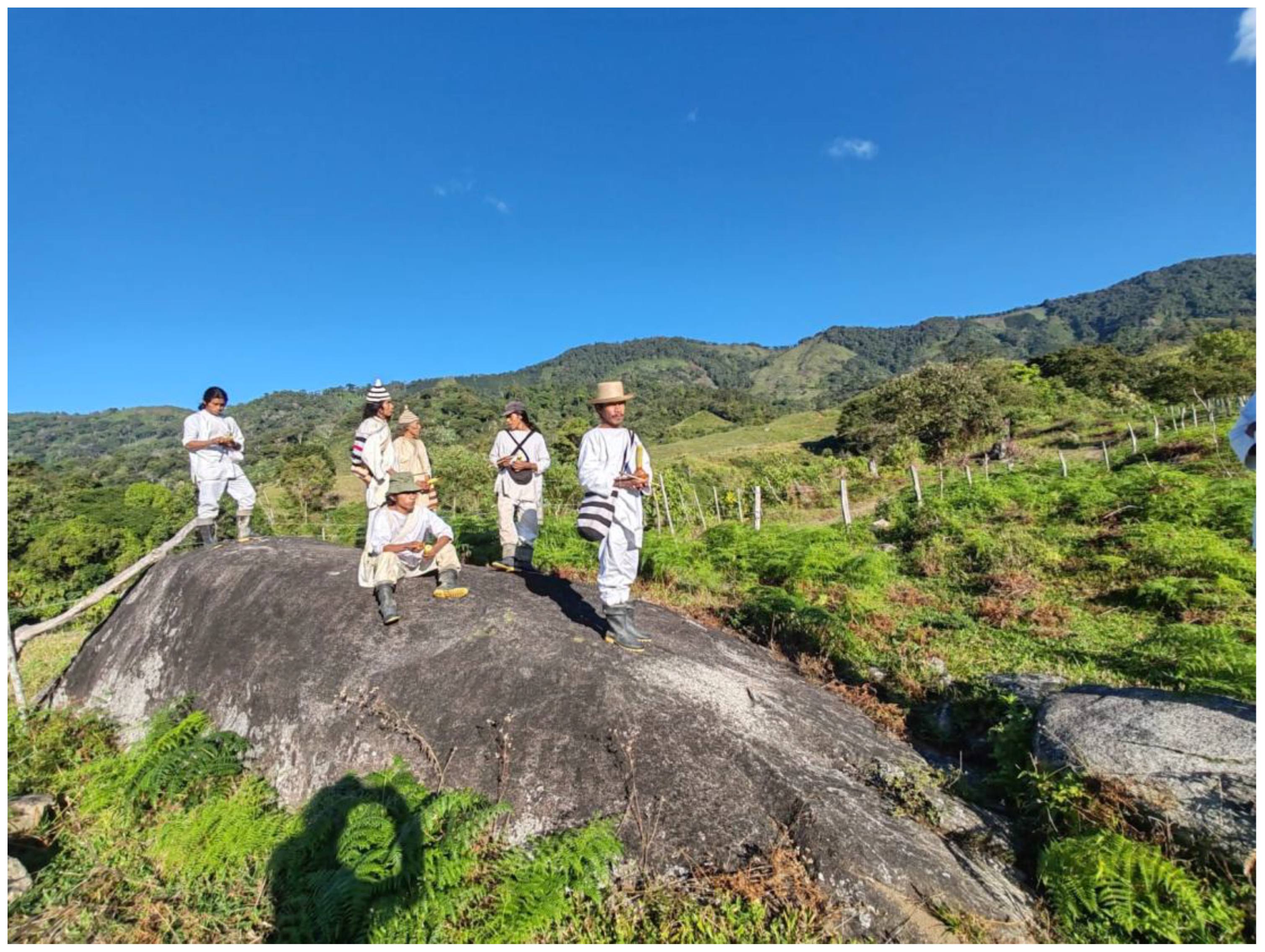
In addition to having listened to the Kogui authority of Teykú, who was in charge of giving the welcome speech to the tumas, in January 2026 we visited one of the highest Kogui authorities, the mamo José Awigui. With him, we made visits to sacred sites located in the upper parts of the Sierra Nevada de Santa Marta (Figure 3). Since the mamos can only be interviewed in places where it is possible to speak, a tour of various sacred sites was made. The idea was to learn what his vision was of what is called, from the Western tradition, archaeological objects.
According to José Awigui:
In our cosmovision, those objects cannot be touched. They have been there since the world was created, and some of them were left ancestrally for their use. Only those who use them in the nujué (ceremonial house) can handle them; those that are underground, those golds, must remain there. That is what I say: according to our cosmovision, gold is cursed; that is how we see it. Nobody can touch it. If you want to have gold, you must purify yourself in order to do so, because those that have been sown are already prayed over for a specific purpose.
Every thing was given by the Creator; that is why we see them in this way, from our own perspective. Everything has an end and a purpose, and it must remain that way. With those objects, just as they were buried, a connection and a balance is established: as in the sky, on the earth and in the last corner of the world. They maintain that connection.
Now, the objects that were delivered do come from generation to generation in order to fulfil a specific function, management and utility; it is not a matter of taking something and simply carrying it away. That is why it is said that it is similar to a mamo; hence we call it similar to Mamalúa (mother). That represents the mamos. It was buried, we do not know when, and it is a bird, because it represents the spiritual father of that bird: Ñiuba (objects made by goldsmiths), those are gold.
That is why the mamos say that the imbalance, the change in nature, climate change, is already beginning. It is not only produced by logging; the effect is not generated only by that, but also by the alteration of the natural beings. We no longer know how it is taken or how it is made; not any more. Only the julá (tumas)—which we do not manufacture either—is sanctified. These are found only in the vicinity of Don Diego; in that basin they are cleansed or sanctified, that is, purified. It is the ones from there that are used.
In contrast, in this region, many of these objects appear in some streams. They cannot be touched or taken away. The mamos say that they are acquired spiritually and that the objects appear in that region. Currently, only those julá are used; whatever is not from Teyuna (known archaeologically as Ciudad Perdida, the Lost City) cannot be used.
4. Results
In the restitution processes of objects that are currently being carried out, at least for the cases documented in South America, it is evident that the objects are considered part of the networks of kinship. From this point of view, what is desired is not that things return, but relatives [8]. This then leads us to understand that what archaeology does, seen from the point of view of the original peoples, is to break the system of relations where the objects play roles that are associated with the maintenance of life, social relations and the relations of humans with nature [24]. Archaeology is configured as a force that generates processes of rupture of a fabric that is locally conceived as a balanced network. In this sense, restitution implies a process of reconstruction of the equilibriums. When the tumas arrived at Teykú, the first thing the mamo says is that “a representative must be appointed” who will be like their “father”. In this way, the main task is to re-establish the kinship relations so that what was an archaeological object ceases to be one. He then says that the tuma, which is small, must pass to another small one, who will learn to make the pagamento. The pagamento is a ritual form in which the Indigenous peoples of the Sierra Nevada de Santa Marta give thanks for life [25]. The mamo also says that the tumas have returned to their “place of origin”, where they “grew up”, where there are “brothers similar to them”. In this return, a responsibility is generated that does not belong to the old ones but to the young, who will have to take care of these beings. That is, restitution generates a generational handover that is accompanied by obligations that the young will have to fulfil. Something striking about the mamo’s speech is that he states that these objects were held and that they were sad, and that he realised “that my mother was like this”. This makes it evident that the restitution of tumas is a process through which people of a certain age, older adults, can approach objects that were taken from the territory at the beginning of the twentieth century. Given this situation, it was very likely that these people had never seen certain tumas, and restitution therefore allows that reunion.
When analysing what the mamo Awigui mentions, it is clear that the tumas are objects on which certain prohibitions fall. They are objects that “cannot be touched”. An interesting element that Awigui points out is that these objects have been there since “the world was created”, that is, they are not objects that are recognised as made by human beings. Here a digression must be made to point out that it is not that the Koguis do not know that these objects were made by people. What becomes manifest is that when these people made them, one of the deities in charge of granting these objects to humans became embodied in them. As has been documented, in Kogui rituals the use of masks [23] does not mean that the subject who is masked imitates a deity, but that the deity becomes incarnate in the masked person. Although we cannot enter into a discussion of the play of masks that takes place in the Amerindian communities, there is a recognition that the human plane is determined by beings that are on other planes or in connection with other planes, as is the case of the tumas. Thus, the vicissitudes of existence—the seeking of food, the resolving of conflicts, the caring for the harvests and the herds—are things that must be negotiated with these other planes, and hence the importance of the tumas, of knowing where to offer them, at what times and through which people. The essence of existence, then, emerges when the subject encounters a plane that goes beyond everyday life, and that plane is achieved through the use of masks [26] and tumas [27]. Another interesting element of what Awigui points out is the meaning that gold has for the Indigenous communities of the Sierra Nevada de Santa Marta. Gold is a highly lethal agent, and its encounter in the subsoil must be avoided. Gold has a function in terms of facilitating connections, so that this vision goes beyond the idea that pre-Hispanic goldwork has a political function [28]. From the point of view of the Indigenous peoples, the religious sense of goldwork prevails over the political dimension that considers these goods as elite goods. Like the mamo of Teykú, Awigui considers the tumas as Mamalúa and, in this sense, recognises that the tumas represent the beginning of the lineages. Together with the Mamalúa, there is also talk of Ñiuba, which are objects related to the birds. The ethnographic research carried out with Kogui communities has made it possible to establish that birds, such as hummingbirds or birds of prey, are associated with the first beings that brought plants such as tobacco or coca leaf to the humans. These plants are fundamental because with them the human lineage was founded [29]. Finally, from Awigui’s account we can infer that there is a zonification of materials. He tells us that the julá of the Don Diego river area are sacralised and that those that come from Teyuna can be used. These materials—their use, their finding—involve great responsibility. This clearly contrasts with the commerce that exists around the tumas. Some individuals look for tumas in certain sanctuaries and sell them in some shops frequented by tourists. This goes against the whole policy that is immersed in these ritual processes, which unite human beings with the tumas.
5. Discussion
It is clear that, for the case of Latin America, the restitution of so-called archaeological goods is a process that is not exempt from tensions [30]. The main obstacle faced by restitution processes has to do with the fact that in Latin America, especially in countries such as Argentina or Colombia, what is called archaeological goods is supposed to be the property of the nation. Usually, the archaeological heritage is considered a resource that must be managed within the framework of contract archaeology projects [31]. Even for some academics, within the state spheres the only field where archaeology can make contributions, at least for the Latin American case, is in the spaces of preventive archaeology [32,33].
Given that in the Colombian case the archaeological objects are considered to belong to the State, some restitution processes of archaeological goods carried out by state institutions such as the Instituto Colombiano de Antropología e Historia—ICANH, for its acronym in Spanish—have created instruments such as the so-called special custody (tenencia especial) [34]. This figure means that, just as a museum can be a holder of archaeological goods, the Koguis themselves can be so. In practice, this means that the State continues to be the possessor of these goods; only, in the cases of restitution of archaeological pieces, such as that of the tumas, the communities may reserve the right to decide whether these objects are exhibited or whether people from outside the community are allowed to see them.
Another element that we must take into account is that Indigenous communities, such as the Koguis, are not only demanding that certain objects return to their communities, as in the case of the tumas, but they are also asking for lands to be returned to them [35,36]. It would be a poor understanding of contemporary Kogui politics to claim that the problem is reduced to certain objects. It should be understood that a restitution of the lost equilibriums is being proposed, not only because of activities of extraction of objects, but also because of territorial dispossession.
6. Conclusions
At present, the processes of repatriation, restitution or return of so-called archaeological objects to Indigenous communities in Colombia are emerging with great interest. Although we cannot speak of a restitution policy promoted by the Colombian State, it is possible to appreciate that there have been some cases that tell us that this dynamic, which has global referents, is not necessarily an anomaly in Colombia. Within this process, at least three things can be concluded. The first is that the processes of restitution of lithic pieces, as in the case of the Koguis, involve re-establishing relations with subjects from whom the communities were separated. That is, restitution involves a particular ontological relation with these materialities, which entails epistemological principles other than those with which the State and archaeology operate [37,38,39]. On another level, the restitution processes challenge the legal heritage framework of the Colombian State. Given that for this State the archaeological heritage belongs to the nation, another thing that we can conclude is that in Colombia the restitution processes are taking place within provisional legal frameworks such as that of the special custody. That is, the current regulations do not contemplate the return of archaeological objects under specific legal figures that regulate these ends in particular. Finally, the processes of restitution of archaeological goods do not take place in a vacuum. These restitutions also involve other parallel processes that have to do with the return of lands or reparations in general that allow a return to conditions that were altered in the framework of the armed conflict that Colombia has experienced for several decades.
Author Contributions
Conceptualization, Wilhelm Londoño Díaz.; investigation (fieldwork research), Alfonso Manuel López Díaz and Wilhelm Londoño Díaz.; methodology, Alfonso Manuel López Días and Wilhelm Londoño Díaz.; writing—original draft preparation, Wilhelm Londoño Díaz; writing—review and editing, Alfonso Manuel López Díaz. and Wilhelm Londoño Díaz. All authors have read and agreed to the published version of the manuscript.
Funding
This research was conducted within the framework of the project “Etnografía de un paisaje viviente: hacia una arqueología indígena kogui” (Ethnography of a Living Landscape: Towards a Kogui Indigenous Archaeology), funded by the Universidad del Magdalena under the Fonciencias 2025 call.
Data Availability Statement
The data presented in this study are available on request from the corresponding author. Due to the ethical commitments made with the Kogui traditional authorities, the recordings and transcripts of the speeches and ceremonies cannot be shared publicly.
Acknowledgments
We thank the Kogui traditional authorities of Teykú and the mamo José Awigui for their generosity and their teachings, as well as Parques Nacionales Naturales de Colombia for their accompaniment of the restitution process. We also thank the editors of the journal Heritage for the opportunity to publish this work.
Conflicts of Interest
The authors declare no conflicts of interest.
References
- Candia, B. Las creencias andinas sobre los/las ancestros/as, los conceptos asociados a ellos y el porqué de su repatriación. Memorias disidentes Revista de estudios críticos del patrimonio archivos y memorias 2025, 2, 107–127. [Google Scholar] [CrossRef]
- Senen-Guirado, J.-A. La Restitución Del Patrimonio Arqueológico a Sus Países de Origen. Un Debate Que Continúa Latente. Cuad. De Arqueol. De La Univ. De Navar. 2023, 31, 115–130. [Google Scholar] [CrossRef]
- el-Gawad, H.A. Respect, Recognition, and Rematriation; 2025; pp. 57–73. [Google Scholar]
- Galeguillos, W. Repatriación de los abuelos desde el Museo del Indígena Americano a la Comunidad Atacameña de Chiu Chiu. Memorias disidentes Revista de estudios críticos del patrimonio archivos y memorias 2025, 2, 240–241. [Google Scholar] [CrossRef]
- Graham, M. NAGPRA (Native American Graves Protection and Repatriation Act, 1990). Int. Encycl. Anthropol. 2018, 1–2. [Google Scholar]
- Stutz, L.N. Claims to the Past. A Critical View of the Arguments Driving Repatriation of Cultural Heritage and Their Role in Contemporary Identity Politics. J. Interv. Statebuilding 2013, 7, 170–195. [Google Scholar] [CrossRef]
- Squires, K.; Roberts, C.A.; Sardi, M.L.; Márquez-Grant, N. Ética, Bioarqueología y Publicaciones Científicas: Un Estudio de Caso. Run. Arch. Para. Las Cienc. Del Hombre 2022, 43, 245–264. [Google Scholar] [CrossRef]
- Ayala, P.; Candia, B.; Ogalde, C.; Aguilar, C.; Espíndola, C.; Varela, C.; Segovia, W.E.S.; Cárdenas, U.; Brito, S.; Araya, J.; et al. Procesos de repatriación, pueblos indígenas y arqueología: el caso atacameño. Boletín De La Soc. Chil. De Arqueol. 2023, 117–148. [Google Scholar] [CrossRef]
- Arthur, J. Repatriation in Rapa Nui, Ka Haka Hoki Mai Te Mana Tupuna; 2020; pp. 220–237. [Google Scholar]
- Haber, A.F. Decolonizing Archaeological Thought in South America. Annu. Rev. Anthropol. 2016, 45, 469–485. [Google Scholar] [CrossRef]
- Gélvez, M.V.R. El camino del caracol como proceso de construcción y reconstrucción de memoria del Pueblo Misak en Bogotá, Universidad Nacional de La Plata; 2023. [Google Scholar]
- Gnecco, C.; Hernández, C. History and Its Discontents. Curr. Anthropol. 2008, 49, 439–466. [Google Scholar] [CrossRef] [PubMed]
- Gnecco, C. DE LA ARQUEOLOGÍA DEL PASADO A LA ARQUEOLOGÍA DEL FUTURO: ANOTACIONES SOBRE MULTICULTURALISMO Y MULTIVOCALIDAD. In Dialnet (Universidad de la Rioja); 2011. [Google Scholar] [CrossRef]
- Londoño, W. Diseñar el pasado y arqueologizar el diseño. La. Tadeo Dearte 2012, 8, 100–109. [Google Scholar] [CrossRef]
- Ayala, P. Arqueologias indigenas: uma mirada desde el Sur. Rev. Do Mus. De Arqueol. E Etnol. 2020, 26–31. [Google Scholar] [CrossRef]
- Acuto, F.A. Reflexiones Para Una Arqueología Activista En América Latina Contemporánea. Antípoda Rev. De Antropol. Y Arqueol. 2024, 55–78. [Google Scholar] [CrossRef]
- Londoño, W. Teykú and the New Controversy. In Routledge eBooks; Routledge, 2020; pp. 124–145. [Google Scholar]
- Rappaport, J. Beyond Participant Observation: Collaborative Ethnography as Theoretical Innovation. Collab. Anthropol. 2008, 1, 1–31. [Google Scholar] [CrossRef]
- Rafanell, I. Durkheim’s Social Facts and the Performative Model: Reconsidering the Objective Nature of Social Phenomena 2016, 59–76.
- Londoño, W. ESPÍRITUS EN PRISIÓN: UNA ETNOGRAFÍA DEL MUSEO NACIONAL DE COLOMBIA. Chungara 2012, 44, 733–745. [Google Scholar] [CrossRef]
- Rodríguez-Navarro, G.E. Sacred Natural Sites in Zones of Armed Conflicts: The Sierra Nevada de Santa Marta in Colombia. In Cambridge University Press eBooks; Cambridge University Press, 2012; pp. 152–164. [Google Scholar]
- Borrero, A.G. Equialtervalentes: el diseño es el otro. La. Tadeo Dearte 2023, 8. [Google Scholar] [CrossRef]
- Bedoya, S.F.; Mujica, J.S.Z. Máscaras Koguis En La Comprensión De La Organización Social Indígena: Aportes Desde El Archivo De La Unión de Seglares Misioneros. Boletín De Antropol. 2025, 40. [Google Scholar] [CrossRef]
- Haber, A.F. Fiori di Antofalla: Relazionalità, estetica e mondo territoriale nella Puna di Catamarca. Confluenze 2025, 17, 309–324. [Google Scholar] [CrossRef] [PubMed]
- Witte, F.P. La estructura que sostiene la vida: alimento e intercambio entre los kogi. Tabula Rasa 2020, 101–129. [Google Scholar] [CrossRef]
- Geertz, C. Negara; Princeton University Press, 1981. [Google Scholar]
- Mogollón-González, D.-R.; Serrano, J.F.M.; Cáceres, R.G.A. Creación y pensamiento en la Sierra Nevada de Santa Marta. Aproximaciones filosóficas a los poporos. ENTRAMADO 2023, 20. [Google Scholar] [CrossRef]
- Uceda, S.; Rengifo, C. La especialización del trabajo: teoría y arqueología. El caso de los orfebres Mochicas. Bull. De l’Institut Français d’études Andin. 2006, 149–185. [Google Scholar] [CrossRef]
- Reichel-Dolmatoff, G. Templos Kogi. Introducción al simbolismo y a la astronomía del espacio sagrado. Rev. Colomb. De Antropol. 1975, 19, 199–245. [Google Scholar] [CrossRef]
- Londoño, W. Cultural Heritage Management and Indigenous People in the North of Colombia: Back to the Ancestors’ Landscape; 2020. [Google Scholar]
- Estrada, S.R. La Gestión Del Patrimonio Arqueológico Después De La Arqueología Preventiva, Estudio de Caso En El Museo Arqueológico Nueva Esperanza (MANE). Arqueol. Y Patrim. 2025, 5, 3162. [Google Scholar] [CrossRef]
- Londoño, W. Arqueología por contrato y nuevos contratos arqueológicos. Jangwa Pana 2016, 15, 117. [Google Scholar] [CrossRef]
- Gnecco, C. Development and Disciplinary Complicity: Contract Archaeology in South America Under the Critical Gaze. Annu. Rev. Anthropol. 2018, 47, 279–293. [Google Scholar] [CrossRef]
- Guzmán, M.J.H. Volver a la tierra. Estudio de un caso de restitución de patrimonio arqueológico en Colombia. Arqueol. Y Patrim. 2023, 2, 95–118. [Google Scholar] [CrossRef]
- Rodríguez, D.R. Consensos, conflictos y ambigüedades en torno al territorio: exploración etnohistórica de la lengüeta, Sierra Nevada de Santa Marta. Maguaré 2018, 32, 171–204. [Google Scholar] [CrossRef]
- Ulloa, A. The Politics of Autonomy of Indigenous Peoples of the Sierra Nevada de Santa Marta, Colombia: A Process of Relational Indigenous Autonomy. Lat. Am. Caribb. Ethn. Stud. 2011, 6, 79–107. [Google Scholar] [CrossRef]
- Gnecco, C. Regulaciones patrimoniales y conflictos ontológicos. Rev. D. Arqueol. De Ponent 2020, 261–273. [Google Scholar] [CrossRef]
- Ávila, C.Á.; Palladino, L. Casa de Piedra: equívocos y conflictos territoriales por un sitio sagrado y patrimonial comechingón en la provincia de Córdoba. Rev. Del Mus. De Antropol. 2023, 259–274. [Google Scholar] [CrossRef]
- Pérez, P.C. Decolonial Knowledge in Practice: A Mestiza Reflection on Sentipensar in Indigenous Nasa Epistemologies. Front. Sociol. 2025, 10, 1605618. [Google Scholar] [CrossRef] [PubMed]
Figure 1.
Location of Teykú (Pueblito Chairama) within Tayrona National Natural Park, on the northern foothills of the Sierra Nevada de Santa Marta, Colombian Caribbean. Elevation data: Mapzen/AWS Terrain Tiles; protected area boundary: © OpenStreetMap contributors (ODbL). Coordinate system: WGS 84.
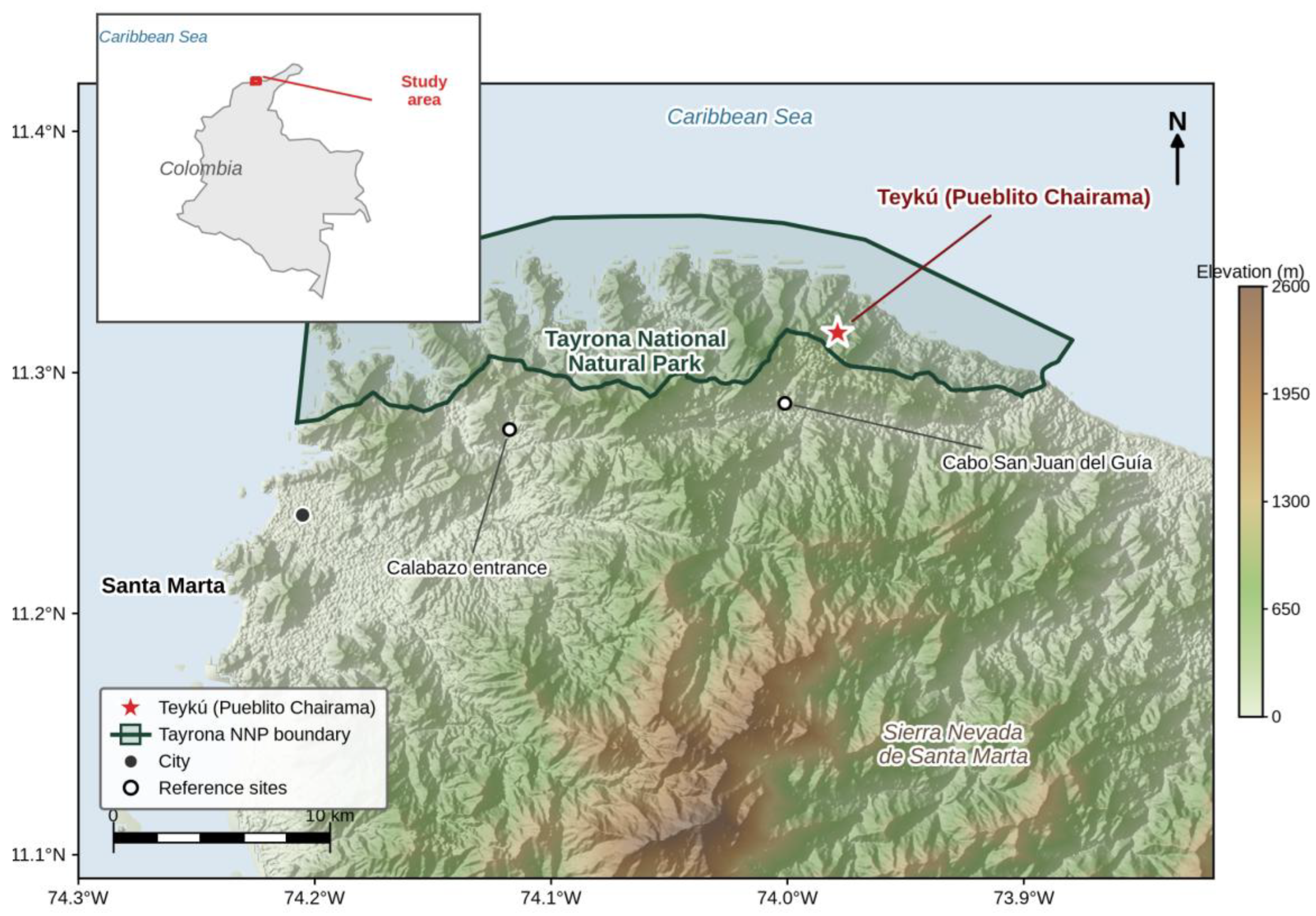
Figure 2.
Tumas (polished quartz stones) in the hands of a member of the Kogui community, Sierra Nevada de Santa Marta.
Figure 2.
Tumas (polished quartz stones) in the hands of a member of the Kogui community, Sierra Nevada de Santa Marta.
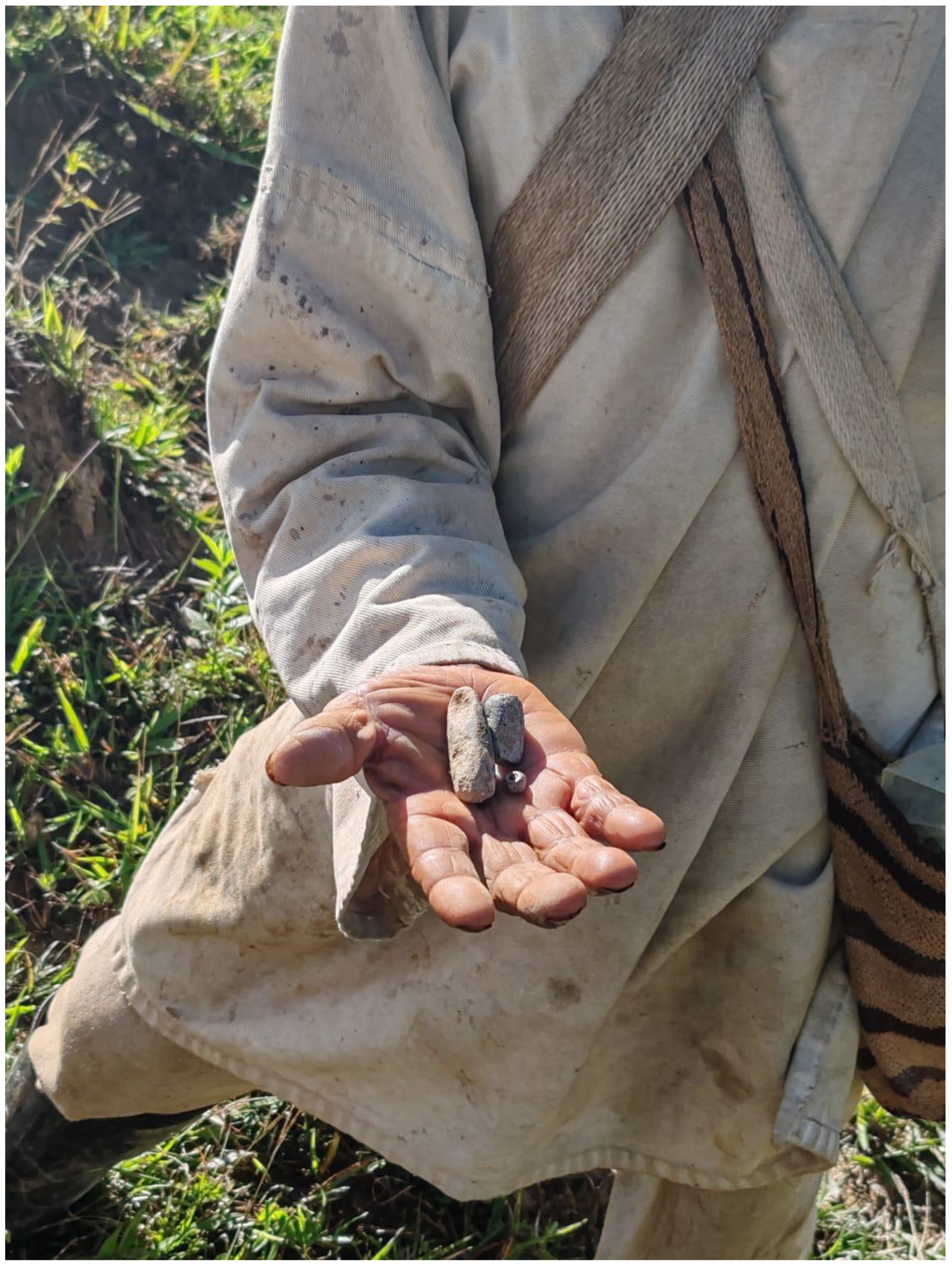
Figure 3.
The research team with Kogui traditional authorities at the mesa del sol (Mukuakuitshi misa), a Kogui sacred site in the Sierra Nevada de Santa Marta.
Figure 3.
The research team with Kogui traditional authorities at the mesa del sol (Mukuakuitshi misa), a Kogui sacred site in the Sierra Nevada de Santa Marta.
Disclaimer/Publisher’s Note: The statements, opinions and data contained in all publications are solely those of the individual author(s) and contributor(s) and not of MDPI and/or the editor(s). MDPI and/or the editor(s) disclaim responsibility for any injury to people or property resulting from any ideas, methods, instructions or products referred to in the content. |
© 2026 by the authors. Licensee MDPI, Basel, Switzerland. This article is an open access article distributed under the terms and conditions of the Creative Commons Attribution (CC BY) license (http://creativecommons.org/licenses/by/4.0/).
Copyright: This open access article is published under a Creative Commons CC BY 4.0 license, which permit the free download, distribution, and reuse, provided that the author and preprint are cited in any reuse.