

Submitted:
15 November 2026
Posted:
17 November 2026
You are already at the latest version
Abstract
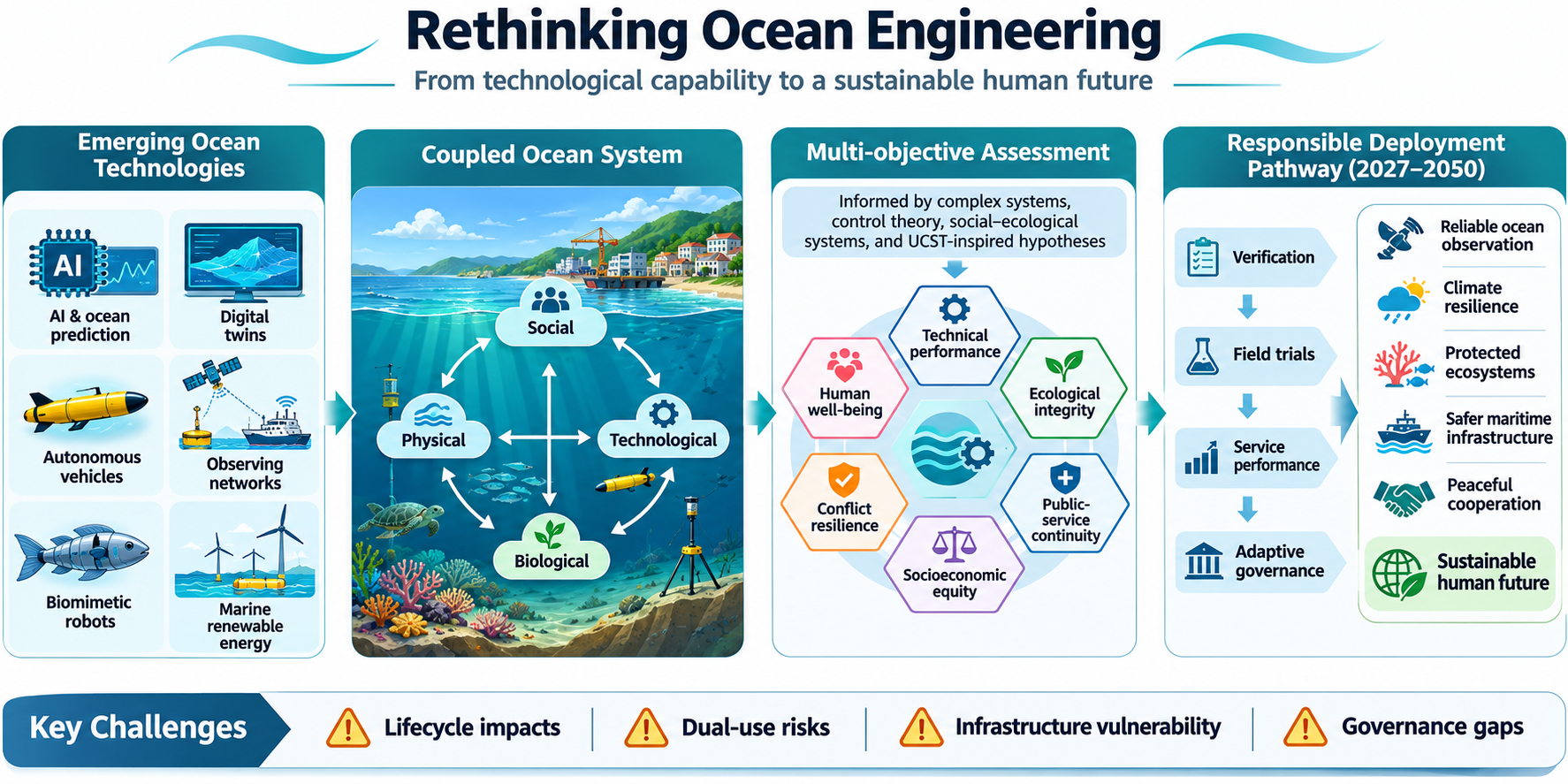
Ocean engineering is commonly assessed through technical capability, operational performance, and emerging applications. Yet technical progress does not necessarily produce public benefit: the same capabilities may support scientific discovery and environmental protection while enabling surveillance, coercion, ecological disruption, or strategic competition. This review asks how ocean engineering should be evaluated in relation to the long-term sustainability of human civilization. It develops a systems perspective that treats ocean engineering as part of an interconnected physical, biological, technological, and social system. Drawing on complex-systems science, control theory, social–ecological research, and selected hypotheses inspired by Unified Complex Systems Theory (UCST), it examines emerging technologies and the conditions for responsible deployment. The review identifies issues often underrepresented in technology-centred assessments: cross-scale interactions, lifecycle and distributional consequences, dual-use risks, threats to civilian maritime infrastructure, and governance of rapidly evolving technologies. It proposes a constrained, multi-objective assessment framework that evaluates technical performance alongside ecological integrity, continuity of public services, socioeconomic equity, conflict resilience, and human well-being. Applications considered include persistent ocean observation, low-disturbance biomimetic robotics, climate-resilient coastal warning systems, and resilient maritime infrastructure. A 2027–2050 research and governance roadmap emphasizes independent verification, reproducible evidence, international cooperation, and explicit criteria for advancing, restricting, or withholding deployment. UCST is treated as a developing research proposal, not an established replacement for existing theories; its contribution depends on independently testable explanatory or practical gains. The central argument is that ocean engineering should be judged not simply by what technology can achieve, but by whether its capabilities and applications contribute to a peaceful and sustainable human future.
Keywords:
ocean engineering
; sustainable human civilization
; systems thinking
; technological responsibility
; complex systems
; social–ecological–engineering systems
; resilience
; dual-use technology
; responsible innovation
1. Introduction: Technological Power and the Human Sustainability Challenge
The central premise of this review is that technical sophistication is not, by itself, a reliable measure of social progress. An underwater vehicle may reach extraordinary depths yet contribute little to public knowledge if its data remain inaccessible, irreproducible, or disconnected from decisions. A port may operate efficiently under normal conditions yet prove fragile when energy, cyber systems, and maritime access fail simultaneously. A project may generate private returns while transferring habitat disturbance, emissions, or occupational risks to communities and future generations. The appropriate unit of evaluation is therefore the end-to-end service system and its consequences—not the device or performance indicator in isolation [1,2,3,4].
This question is particularly consequential in the ocean, where physical dynamics, biological systems, infrastructure, and transboundary uses are tightly coupled. Ocean warming alters stratification, marine heatwaves, oxygen availability, and coastal hazards, affecting ecosystems as well as the reliability requirements of observing and protection systems. Engineering determines what can be measured and which interventions are feasible; political and institutional choices shape whether those capabilities are used for protection, extraction, competition, or cooperation. The resulting feedback is not necessarily beneficial: the same advance may improve climate warnings while also enabling surveillance, coercion, or military advantage. Assessment must therefore consider purpose, context, and downstream effects alongside technical performance [5,6].
This review adopts a critical, purposive narrative approach; it is not presented as a systematic review or meta-analysis. It brings together (i) peer-reviewed evidence on ocean science and engineering; (ii) foundational research on complex systems, resilience, and social–ecological governance; (iii) relevant institutional and legal frameworks; and (iv) explicitly provisional hypotheses inspired by Unified Complex Systems Theory (UCST) [7,8]. Its purpose is not to estimate a pooled effect, but to identify conceptual blind spots, develop a common assessment framework, and formulate testable research questions. Throughout, the review distinguishes established observations and methods from emerging capabilities, normative commitments, and new hypotheses. The desirability of peaceful and sustainable development is a normative proposition; whether a particular technology or policy improves measurable outcomes is an empirical question that requires testing.
The 2027–2050 horizon is a conditional planning window, not a forecast. The review rejects the assumption that algorithms alone will remove biological, energetic, organizational, or political bottlenecks. Deployment also depends on verification, site-specific hydrodynamics, long-term ecological monitoring, maintainability, cybersecurity, data stewardship, financing, and the participation of affected communities. The question is therefore not only which technologies should be advanced, but also which applications should be redesigned, constrained, deferred, or discontinued when foreseeable harms cannot be reduced to acceptable levels. Such decisions require transparent evidence and legitimate public processes, not unilateral judgments by engineers.
The ocean links planetary climate regulation, biodiversity, food systems, maritime trade, energy infrastructure, coastal settlements, and human security. Ocean science and engineering therefore extend beyond the design of vehicles, structures, and instruments. They also concern the reliability of an interconnected life-support system and the well-being of the communities that depend on it. This broader perspective becomes increasingly important as emerging technologies reshape how societies observe and intervene in the marine environment.
Ocean technology is moving from episodic ship-based sampling and isolated underwater operations toward integrated satellite–in situ observations, persistent robotic fleets, large-scale simulation, and machine-learning-enabled prediction. Autonomous platforms can collect measurements with limited direct supervision; digital twins can support prediction and scenario analysis; and intelligent control can extend mission endurance. Yet technical capability alone says little about purpose, beneficiaries, environmental footprint, or the distribution of risk. These outcomes are shaped by choices that cross disciplinary and institutional boundaries.
The urgency is evident in recent climate observations. The World Meteorological Organization reported that 2025 was approximately 1.43 °C warmer than the 1850–1900 mean and that ocean heat content continued to reach record levels [9]. The IPCC has assessed substantial and increasing risks from sea-level rise and compound coastal hazards [10]. Ocean observations consequently provide a public good with immediate implications for climate services, disaster response, and ecosystem management. Yet the 2025 Global Ocean Observing System (GOOS) status assessment identified uneven coverage, fragile networks, and dependence on a limited number of contributors [11]. The opportunity for technological progress thus coexists with a persistent collective-action problem.
The United Nations Decade of Ocean Science for Sustainable Development identifies resilient and equitable ocean economies, climate solutions, community resilience, sustained observations, digital representations, and inclusive access among its priorities [12]. These priorities express a central normative distinction: scientific capability is a means; a healthier ocean and a more secure human future are ends. International security concerns and technological competition complicate this relationship, while AI creates opportunities for safer operations and changes occupational tasks and skill requirements. These tensions call for analysis grounded in evidence rather than rhetoric.
Against this background, the review addresses four questions. (1) Which emerging ocean-engineering capabilities may transform marine systems over the next two or three decades, and what constrains their deployment? (2) How can a coupled physical–biological–technological–social perspective improve assessment of their system-wide consequences? (3) Can UCST-inspired concepts of active–passive interaction and organizational maintenance add falsifiable explanatory or decision-making value beyond established control theory, complex adaptive systems, and social–ecological frameworks? (4) How should research institutions, funders, regulators, and operators distinguish technologies that merit development from those requiring safeguards, restrictions, or non-deployment because their expected consequences conflict with human and ecological sustainability?
The remainder of the paper is organized as follows. Sections 2 and 3 trace the development of ocean engineering and assess emerging technologies, their opportunities, limitations, and deployment challenges. Section 4 develops a coupled physical–biological–technological–social framework, and Section 5 examines whether a UCST-inspired perspective can make an additional contribution through explicit comparisons, testable propositions, and falsification criteria. Section 6 considers implications for climate resilience, ecological integrity, and human well-being. Section 7 examines geopolitical competition, collective action, maritime security, and civilizational risk, and introduces a framework for assessing technology pathways against broader societal objectives. Section 8 sets out a research and deployment roadmap for 2027–2050, including common evaluation metrics, flagship demonstrators, model-validation procedures, and requirements for reproducible evidence. Section 9 draws the arguments together and considers what it means to place human well-being, peaceful cooperation, and civilizational sustainability at the center of scientific and engineering development.
2. From Ocean Exploration to Intelligent and Responsible Ocean Systems
The shift from exploration toward utilization and stewardship should not be read as a linear sequence or as a reason to undervalue exploration. High-quality bathymetry, physical observations, sampling, and structural engineering remain essential to discovery, safety, and conservation. What changes is the criterion of success. An expedition may succeed by producing reliable measurements; a sustainable ocean service must repeatedly turn trustworthy evidence into accountable decisions without degrading the ecological and institutional conditions on which it depends. The guiding question therefore becomes not simply “What can this technology do?” but “What legitimate need does it serve, for whom, at what total cost, and with what safeguards?”
Human-occupied submersibles and remotely operated underwater vehicles remain necessary where direct intervention, sampling fidelity, or emergency response is required. Autonomous underwater vehicles add mobility and coverage; gliders extend endurance at low power; benthic stations can provide long-term local time series; satellites deliver broad synoptic context but cannot observe every subsurface variable directly. The future ocean-observing network should therefore be designed as a heterogeneous, coordinated system in which different platforms provide complementary observational capabilities. No single platform can meet all requirements across spatial and temporal scales, ocean depths, and operational conditions. The Intelligent Swift Ocean Observing System illustrates this approach through the integration of unmanned aerial, surface, and underwater vehicles [13]. Complementing this engineering perspective, network-design methods provide a systematic basis for allocating observational resources and configuring autonomous observing networks to improve spatial coverage and representativeness [14]. Accordingly, mission planning should evaluate combinations of platforms at the network level, considering spatial coverage, measurement accuracy, vertical resolution, maintenance requirements, communication constraints, energy consumption, and environmental disturbance, rather than ranking individual devices in isolation.
Many central ocean measurements are global public goods in the practical sense that their scientific value rises when observations are interoperable and shared across institutions and national borders. Data withholding, incompatible standards, and unstable funding make observational capability fragile even where hardware is advanced. This connects ocean engineering to commons governance: explicit agreements are needed concerning quality control, equitable access, maintenance obligations, safety and legitimate restrictions on sensitive information. The aspiration of ocean stewardship is not a universal demand for unrestricted disclosure, but a framework for maximizing public value under justified security, privacy and conservation constraints.
Marine engineering has advanced by overcoming formidable physical constraints, including hydrostatic pressure, seawater corrosion, wave and current loading, limited acoustic communication, navigation without satellite signals, and uncertain weather windows. Crewed submersibles, remotely operated and autonomous vehicles, moorings, and floats have progressively expanded access to the deep ocean. This engineering foundation remains indispensable: autonomy cannot compensate for inadequate structural integrity, insufficient energy reserves, or poor system reliability.
Exploration, utilization, and stewardship provide a useful way to organize ocean-engineering objectives. Exploration expands knowledge of marine processes and resources; utilization supports transportation, aquaculture, energy supply, and other economic activities; stewardship sustains the environmental conditions and institutional capacities on which future generations depend. These functions coexist. The distinction broadens the objectives of engineering rather than proposing a universal chronology or implying that exploitation must precede conservation.
Conventional project appraisal typically describes mission success through measures such as depth rating, endurance, payload, measurement error, availability, and lifecycle cost. These indicators remain essential, but they are not sufficient. A mission may meet every technical target yet fail as a public service if its data never reach a warning system, its equipment disturbs a sensitive habitat, its maintenance cannot be funded, or affected communities are excluded from decisions. Evaluation should therefore follow the full chain—from purpose and design through manufacture, deployment, operation, maintenance, and decommissioning—and examine how benefits and harms are distributed.
The emerging trend of ocean engineering should not be simply the development of more intelligent machines. It is the integration of vehicles, instruments, data systems, institutions, and users into long-duration services governed by continuous feedback. This integration creates new opportunities, but it also introduces additional failure modes. It therefore requires human oversight, credible evidence on environmental effects, reliable sensing and communication, cyber-physical assurance, and governance arrangements capable of managing consequences across jurisdictions.
Three distinctions guide the analysis that follows. First, capability is not purpose: autonomy describes how a system operates, not whether its objective is legitimate. Second, aggregate benefit is not equitable benefit: a project may increase total output while concentrating gains and shifting risks to vulnerable groups. Third, risk reduction is not risk elimination: resilient design can reduce the consequences of accidents or attacks, but it cannot replace diplomacy, law, accountable governance, or social consent. These distinctions allow engineering excellence to be recognized without assuming that every technically feasible application is socially desirable.
3. Emerging Technologies: Opportunities, Limitations and Deployment Pathways
Technology assessments can be misleading when laboratory prototypes, commercial claims, validated tools, and continuously operated safety-critical services are treated as equivalent. An AI model trained on historical imagery, for example, may fail when seasonal changes in turbidity alter its inputs. A vehicle with impressive nominal endurance may deliver little operational value once servicing, biofouling, calibration, and recovery costs are included. A marine renewable-energy device may perform well under selected sea-state conditions without meeting broader lifecycle or ecological requirements. These examples show why isolated performance indicators cannot, on their own, establish technological readiness.
A more complete assessment of readiness should distinguish four related dimensions: technical maturity, evidence quality, operational and service maturity, and governance maturity. The first asks whether the technology functions as intended; the second, whether that performance is supported by reliable evidence; the third, whether the system can be sustained under real operating conditions; and the fourth, whether appropriate institutional, safety, and environmental arrangements support its deployment. Progress in one dimension does not necessarily imply progress in the others.
A common verification framework can provide a consistent basis for evaluating emerging technologies. It should include five complementary stages: (1) physical or computational modeling with explicit assumptions and validity limits; (2) calibration and validation against independent measurements; (3) controlled stress testing under environmental and operational perturbations; (4) prospective field trials using predefined performance metrics; and (5) service-level audits of availability, unintended consequences, maintenance needs, and the distribution of costs and benefits. Comparisons should use reference systems selected in advance. Machine-learning methods, for example, should be tested against conventional algorithms and competitive physical or hybrid models; biomimetic robots against mature conventional propulsion platforms; and emerging sensor arrays against established reference instruments rather than uncalibrated proxies.
Table 1 applies these principles to six major areas of emerging ocean-engineering technology. It summarizes potential contributions, the maturity and limitations of the available evidence, and the additional evidence needed to support responsible deployment. Rather than assigning a single readiness level to each technology category, the table distinguishes demonstrated technical capabilities from the broader conditions required for sustained operation.
Table 1 highlights a distinction that is central to this review: technical capability does not establish deployment readiness. The practical value of an emerging technology depends on its ability to operate reliably, integrate with existing infrastructure, and deliver measurable benefits throughout its lifecycle. AI-based prediction, for example, should be judged not only by statistical accuracy but also by its effect on decisions under uncertainty. Autonomous vehicles and heterogeneous observing networks should likewise be assessed at the mission or network level, taking account of energy use, maintenance, data continuity, and recovery—not simply the specifications of individual platforms.
The same standard applies to claims of sustainability. Labels such as “green,” “intelligent,” and “autonomous” do not demonstrate environmental or operational superiority. Such claims require a clearly defined system boundary, an appropriate reference case, and independently verified outcomes. The assessment should include the effects of materials, manufacturing, deployment, maintenance, and decommissioning, not only the immediate benefits of the technology.
Ocean engineering should therefore move beyond technology-centered innovation toward evidence-based, mission-oriented, and lifecycle-informed deployment. This shift requires engineering validation to be considered alongside operational experience, environmental assessment, and institutional governance. Together, these provide a sounder basis for deciding not only whether a technology works, but also whether it should be deployed, under what conditions, and with what long-term consequences.
3.1. Artificial Intelligence, Prediction and Ocean Digital Twins
Evidence on digital twins in maritime engineering distinguishes aspiration from verified deployment: Madusanka et al. synthesize architecture and applications [15], Bi et al. describe monitoring of port terminals [16], while Jeon and Theotokatos define validation, verification and robustness requirements for marine-engine twins [17]. These studies justify attention to uncertainty and operational evidence rather than the assumption that any model labeled 'digital twin' is trustworthy.
Data assimilation, machine learning and digital twins are related but distinct. Assimilation updates state estimates using observations and model dynamics; statistical learning may approximate relationships, generate surrogates or estimate error structures; a digital twin implies an operational link between a physical system and a maintained computational representation. Calling a static simulation a twin obscures the need for data pipelines, recalibration, model versioning and explicit uncertainty. For high-stakes early warning, probabilistic calibration, missed-event costs and spatial equity can be more important than average predictive accuracy alone.
Physical consistency should be evaluated rather than presumed. Models may violate mass balance or become unreliable outside the observed training distribution, especially during rare compound extremes. Promising developments include hybrid physical–statistical models, uncertainty-aware ensembles, anomaly monitoring, adaptive sensor placement, and accountable human-in-the-loop decision support. The governance question is whether enhanced prediction changes exposure, preparedness and losses in practice. A forecast delivered too late, in an inaccessible format, or without trusted local response capacity may have negligible societal effect despite excellent numerical skill.
Artificial intelligence is increasingly useful for pattern detection, sensor fusion, anomaly recognition, model emulation, vehicle planning and probabilistic forecasting. Data-driven methods can supplement, but not replace without justification, physical principles, conservation constraints and uncertainty quantification. Marine environments shift across seasons and regions; datasets are often sparse, biased toward accessible regions and subject to sensor drift. An accurate hindcast is not necessarily a reliable forecast under out-of-distribution conditions. Lifecycle assessment of AI infrastructure is also becoming more formalized, including ITU-T (International Telecommunication Union – Telecommunication Standardization Sector) guidance on environmental-impact assessment [21].
Digital twins are best understood as operationally linked, evolving representations connecting observations, models, uncertainty estimates and decisions. Their scientific worth depends on traceable assimilation, model error characterization, interoperability and validation against independent observations. A digital representation that does not propagate uncertainty or allow users to interrogate competing assumptions risks promoting unwarranted confidence. The integration of autonomous observation into digital twins is a promising but demanding area [15].
Priority research should examine hybrid physics–machine learning frameworks, decision-aware uncertainty metrics, reproducible data pipelines and the ability of forecasts to improve real-world actions. Digital twins for marine ecosystems and disaster preparedness should also document what is not observed and whose decisions the model is designed to support.
3.2. Autonomous Underwater Vehicles and Cooperative Robotics
Beyond platform development, reliable ocean observation also depends on enabling technologies for underwater localization, sensing, and communication. Underwater localization is particularly important for autonomous vehicle navigation, seabed mapping, docking, and cooperative missions, because satellite-based positioning is generally unavailable underwater and acoustic positioning is affected by environmental variability and propagation uncertainty. Wu et al. [22] reviewed the principal approaches and challenges associated with underwater robot localization in confined environments, including inertial navigation, dead reckoning, simultaneous localization and mapping (SLAM), and multi-sensor fusion. Complementary developments in maritime sensing have also been reviewed by Briguglio and Crupi [23], who examined sensor technologies supporting safer and more sustainable maritime mobility. At the network level, Shi et al. [24] proposed a lightweight security framework for underwater wireless acoustic networks, addressing node authentication, data protection, and the detection of malicious nodes under resource-constrained operating conditions. These studies highlight that the performance of future ocean-observing systems will depend not only on individual platform capabilities but also on reliable positioning, sensing, secure communication, and information integration across distributed marine assets. Nevertheless, substantial challenges remain in achieving long-range communication, energy-efficient networking, robust localization, and sustained operation in complex ocean environments.
Classical remote robotics and glider studies already establish autonomous missions under constrained communication and energy supplies [18,19,20]. The novel challenge for a sustainable ocean service is independently demonstrated long-term operating reliability, field maintenance, and reduced lifecycle ecological costs rather than autonomy as a label.
Control architectures range from low-level stabilization and waypoint tracking to supervisory planning and adaptive scientific sampling. Robust, adaptive and model-predictive control each provide established methods for coping with uncertainty, actuator constraints and changing operating conditions. Learning-based policies offer additional flexibility but require defensible safety envelopes, fallback modes and carefully designed verification under distribution shifts. A self-directed mission is not synonymous with independent moral or social agency: the vehicle objective, accepted risks and appropriate data uses originate within human technical and institutional arrangements.
Cooperative underwater robotics introduces resource-allocation and communication constraints absent from simple single-vehicle benchmarks. Acoustic bandwidth is limited, latencies can be variable, multipath propagation distorts signals, and positioning errors accumulate without external references. Multi-agent benefits depend on whether network coordination achieves more useful independent measurements than well-designed asynchronous missions. Research comparisons should report area coverage, uncertainty reduction, communication burden, retrieval success, noise footprint and energy per validated datum, not only the number of vehicles deployed.
Autonomous underwater vehicles, gliders, and surface platforms can extend spatial and temporal coverage and reduce reliance on crewed expeditions for suitable tasks. Cooperative fleets may add redundancy and improve response, but their performance depends on reliable localization, underwater communication, collision avoidance, coordinated planning, energy replenishment, and recovery. Systems should therefore include explicit fallback behavior for communication loss, sensor failure, or unreliable measurements.
The shift from optimizing individual vehicles to designing resilient networks changes the engineering objective. Fleet availability, repair logistics, continuity of data quality, and recovery from component failure become system-level performance measures. Persistent observation also requires more than larger batteries: it depends on efficient propulsion, low-duty-cycle sensing, feasible environmental energy harvesting, accessible servicing, and graceful degradation when components fail.
Deployment requirements should reflect mission consequences. Low-risk scientific surveys differ from operations in crowded waterways or safety-critical interventions. In all cases, increasing onboard autonomy does not remove the need for human accountability, interpretable decision processes, and cybersecurity.
3.3. Biomimetic Robots and Low-Disturbance Ecosystem Observation
Biomimetic swimming should be assessed through a portfolio of plausible advantages rather than assumed superiority. Possible benefits include maneuvering in cluttered habitats, low-speed station keeping, flexible interactions with vegetation or reefs, and reduced mechanical disturbance under specific conditions [25]. Countervailing risks include complex sealing, fin wear, difficult control identification, uncertain biological reactions and reduced payload capability. The decisive question is whether the same ecological inference can be achieved with lower disturbance at acceptable total cost.
A robust experiment can compare fish-like or turtle-inspired robots against a propeller-driven control vehicle under matched sensing resolution, task time and environmental conditions [26]. Ecological outcomes should include behavioral displacement, acoustic disturbance, sediment resuspension and recovery time, ideally measured by observers blind to vehicle type. Endurance, total carbon footprint, contamination, recovery reliability and field servicing should be included. These tests create an empirical bridge between long-term biomimetic engineering experience and the broader sustainability claims of this review.
The advantages of biomimetic platforms are mission- and environment-dependent. Conventional propellers may remain preferable where speed, energy efficiency, simplicity, or endurance is decisive. Comparative trials should therefore match payload, speed, turbulence, power consumption, and reliability, while measuring acoustic signatures and ecological disturbance.
Because morphology, sensing, control, and environmental interaction are coupled in living organisms, biomimetic platforms offer a useful setting for cross-disciplinary engineering research [26]. Field studies should test whether any reduction in disturbance persists over complete missions and across sensitive habitats, rather than relying on short demonstrations. Fish-like movement should not be equated with ecological harmlessness.
The longer-term opportunity is to develop minimally intrusive observational platforms supported by compact sensors, distributed acoustic or optical positioning, and adaptive mission planning. Their development should be accompanied by assessment of animal responses, ecosystem effects, and the ethical implications of biologically inspired data-collection methods [26].
3.4. Sensing, Miniaturization and Sustained Observations
The observing-system deficit is not simply a shortage of platforms. It includes gaps in deep-ocean, polar, coastal, oxygen, carbon and biological data; uneven geographic capacity; uncertain calibration continuity; and the operational burden of transforming heterogeneous sensor streams into decision-grade products. Low-cost devices can democratize measurement, but cheap hardware does not guarantee a stable long-term reference record. Intercomparison, traceability, antifouling performance, drift correction and transparent metadata are critical.
International monitoring systems also demonstrate the public-good nature of redundancy. If one country or institution withdraws observations, the performance of global analysis may deteriorate beyond that country's geographic footprint. Zhu and colleagues' 2026 analysis in Nature Climate Change is directly relevant to this risk [6]. Future designs should quantify graceful degradation: how much forecast confidence or heat-content accuracy is lost when a fraction of platforms, data links or archives becomes unavailable? Such questions are especially consequential under economic shocks, natural disasters or deliberate disruption.
Advances in microelectronics, acoustic instruments, chemical and optical sensors, and miniaturized sampling units make more distributed measurement architectures feasible. Miniaturization alone, however, does not ensure sustained and calibrated observations. Biofouling, pressure tolerance, calibration stability, sensor selectivity, reference standards, telemetry, and recoverability often determine the useful lifetime of a sensor.
GOOS reports that observation coverage and sustained investment remain uneven [11]. The practical challenge is to move from successful instrument demonstrations to continuously maintained observing services. These services require standardized metadata, open or appropriately shared access, international coordination, and stable operating budgets. Networks should be assessed by their coverage of essential variables, data latency, uncertainty, longevity, and demonstrated use in climate or safety decisions.
A systems-engineering priority is to make satellites, Argo-class profiling systems, gliders, moorings, ships, coastal stations, and autonomous platforms interoperable. Network design should maximize the marginal value of information for scientific inference and societal services, rather than simply increasing the number of deployed instruments.
3.5. Marine Energy, Materials and Infrastructure
Marine decarbonization involves coupled equipment and infrastructure pathways: electrification of short-route operations, lower-carbon fuels for appropriate vessel classes, offshore renewable electricity, improved energy conversion, port power systems and logistics optimization. Every option has unresolved lifecycle impacts and deployment constraints. Offshore infrastructure can affect marine habitats, fishing access and navigation, while new fuel supply chains introduce safety and energy-efficiency questions. The relevant unit is life-cycle service, not isolated laboratory conversion efficiency.
New materials, coatings and structural health monitoring contribute through lower maintenance demands and earlier detection of unsafe deterioration. However, condition monitoring systems require verified sensor placement, damage progression models and actionable inspection protocols. An AI fault detector that increases false alarms can create expensive and risky interventions; one that misses rare degradation can worsen catastrophic losses. Engineers should test total-risk reduction including environmental and occupational externalities.
Offshore wind, tidal and wave energy, hybrid power systems, and improved energy storage may help decarbonize maritime operations and power distributed observing systems. Their viability depends on local resource conditions, grid connections, ecological sensitivities, and maintenance requirements. Materials research—including corrosion resistance, antifouling surfaces, composites, structural health monitoring, and repair—also has direct implications for reliability and lifecycle impact.
Engineering assessments should compare energy yield, embodied emissions, seabed and habitat effects, navigational impacts, occupational safety, recyclability, and end-of-life responsibilities. Climate benefits should be evaluated across the full system boundary, including logistics vessels, manufacturing, and replacement cycles. Nature-based coastal defenses and conventional structures may be complementary options rather than mutually exclusive alternatives.
Across these technology families, a critical research gap lies not necessarily in the absence of technological components, but in the lack of verified evidence linking component-level performance to sustained public benefit. Each proposed advance should therefore be evaluated against a meaningful counterfactual: what outcomes would be achieved through a simpler, less resource-intensive, more repairable, or institutionally better-supported alternative? Such comparisons help guard against technological solutionism and recognize that the most appropriate innovation may involve a different design, a more limited scale of deployment, or even a decision not to deploy. More fundamentally, however, the performance and consequences of ocean technologies cannot be adequately understood in isolation. They depend on interactions with the ocean's physical processes, biological systems, and the societal institutions and activities through which technologies are developed, deployed, and governed. This broader perspective provides the rationale for examining the ocean as a coupled physical–biological–technological–social system in the following chapter.
4. The Ocean as a Coupled Physical–Biological–Technological–Social System
The conceptual framing draws on established research on ecological resilience and adaptive cycles [1,27,28], social–ecological governance [2,29,30], planetary boundaries [3,4,31], and human pressures on marine ecosystems [32,33,34,35,36]. Collectively, these research traditions motivate an integrated analytical perspective in which physical processes, biological systems, technological interventions, and societal activities are treated as interconnected domains. Figure 1 translates this perspective into a four-domain framework for ocean science and engineering. These established bodies of research provide the conceptual foundations for examining cross-domain interactions; they do not, by themselves, demonstrate the superiority of UCST over existing physical, ecological, or social theories.
Figure 1 presents the four domains as an analytical decomposition of an interconnected ocean system, not as mutually exclusive categories or successive levels in a fixed hierarchy. The physical domain includes ocean circulation, geohazards, energetics, and chemical transport; the biological domain encompasses populations, habitats, biodiversity, and organism-level adaptation; the technological domain includes observation platforms, infrastructure, prediction, and engineering control; and the societal domain covers firms, coastal communities, governance institutions, and international relations.
Interactions among the four domains are reciprocal and context-dependent. Ocean warming, for example, can alter ecosystem structure and biodiversity, while ecosystem change can affect coastal protection and resource availability. Engineering infrastructure may modify habitats and environmental conditions; ecological constraints and regulatory decisions, in turn, shape where and how technologies are developed and deployed. Public expectations, economic incentives, and international governance also influence engineering priorities and design requirements. The framework thus treats ocean science and engineering as an integrated endeavor involving natural processes, technological capabilities, and human societies.
Complex adaptive systems research emphasizes heterogeneous interactions, nonlinearity, feedback, adaptation, and path dependence. Social–ecological systems research adds institutions, shared-resource dilemmas, rights, and power asymmetries. Neither perspective can be reduced to classical control engineering, although each can be coupled with control models for specific applications. Coastal adaptation, for example, depends on physical hazards, adaptive infrastructure, and the capacity of communities and institutions to anticipate and respond. Ostrom’s institutional framework [2] and more recent work on transformative ocean governance [30] provide important comparators for the UCST-inspired approach.
Cross-scale causal claims require particular care. A system-level measure of ecosystem organization is not, by itself, evidence of an independent fundamental physical force. Organism-level goal-directed behavior can be represented operationally through feedback control and metabolic expenditure without resolving philosophical questions about phenomenal consciousness. Likewise, a governance system may prioritize safety without implying that the ocean itself possesses intention. Accordingly, this review uses “agency” in a graded, operational sense and reserves claims about irreducible mind for separate research requiring independent evidence.
Resilience theory explains how systems persist, change, and adapt under disturbance [1]. Social–ecological systems research shows how resources, actors, institutions, and outcomes are linked through feedback rather than simple one-way chains [2]. Planetary-boundaries research places human activity within explicit Earth-system constraints [3]. Together, these established approaches provide a foundation for connecting marine engineering with broader questions of sustainable development.
For the purposes of this review, the ocean system is represented through four interacting analytical domains: P, physical ocean and geophysical dynamics; B, living ecological systems; T, engineered technologies and infrastructure; and S, social decisions, institutions, and the distribution of benefits. This decomposition does not imply that every process belongs exclusively to one domain. Its value depends on whether it improves explanation and prediction for the problem being studied.
A general open-system representation is dX/dt = F(X, U, Z, t) + W, where X = [P, B, T, S] denotes the selected system states, U represents interventions and operating controls, Z denotes exogenous forcing, and W captures unresolved dynamics and uncertainty. The function F represents dependencies and feedback among the domains. For example, ocean warming may alter ecosystem composition, which affects fisheries and economic decisions; those decisions may then change investment in observation and local environmental pressures, feeding back into physical and biological conditions.
Causal explanation should be distinguished from normative judgment. Social objectives are selected, contested, and negotiated by individuals and institutions; they cannot be derived directly from fluid equations or optimized by an autonomous machine unless objectives, rights, and constraints have first been specified. Engineering models can estimate consequences and expose trade-offs, but they cannot independently determine the appropriate distribution of risks or define what constitutes a flourishing society. This review therefore distinguishes human agency, machine autonomy, biological adaptation, and political goal-setting, while recognizing that these processes interact. More fundamentally, in complex systems involving human beings, an adequate explanatory framework must account not only for structural constraints and observable interactions but also for the intentions, decisions, and purposeful interventions of individual actors. These actors do not exert equal influence: their capacity to shape system trajectories depends on their institutional positions, authority, resources, and relationships with other actors. For example, decisions made by political leaders such as US President Donald Trump, Russian President Vladimir Putin, and Ukrainian President Volodymyr Zelenskyy can have consequences extending far beyond national boundaries, affecting international security, economic stability, environmental protection, and the long-term sustainability of human civilization. Such influences cannot be fully represented by models that treat human behaviour solely as an external disturbance or an aggregate response to structural conditions. UCST seeks to address this explanatory dimension by incorporating the active intentions and interventions of system participants into the analysis of complex-system dynamics, while examining how these actions are enabled, constrained, and modified by the surrounding system.
The framework also supports nested system boundaries. A coastal early-warning project, for example, can be examined at the device level, across the observation-to-forecast chain, and at the level of community response. Different failures dominate at each level: a buoy may function perfectly while the warning never reaches residents at risk. When the intended outcome is public safety, the relevant engineering unit is therefore the end-to-end service.
5. A UCST-Inspired Perspective on Active Ocean Engineering
Unified Complex Systems Theory (UCST) is considered here as a developing research proposal that seeks to distinguish externally imposed passive effects from internally human-regulated, environment-coupled active processes [7,8]. This review does not treat UCST as a validated replacement for fluid mechanics, thermodynamics, ecology, or modern control theory. Instead, it asks a narrower question: can selected UCST-inspired concepts improve the explanation, prediction, or design of ocean-engineering systems when compared fairly with established alternatives? The relevant standard is demonstrable incremental value, not the breadth of the theory's conceptual scope.
For a marine vehicle or coupled bio-engineered subsystem, a generic mechanical form can be written as , where q denotes generalized coordinates, E the environment, z internal states, b organizational or boundary variables, Qdrv a proposed categorization of internal active drive arising from the participation of human actors within the system. It represents internally generated intentions, motivations, decisions, and purposeful interventions. Its magnitude and direction may vary among individuals and institutions. And u an engineered control input deliberately introduced by an external controller or engineering intervention to influence system behaviour. It is a specified control variable rather than an internally generated human intention. Every right-hand-side term must be dimensionally defined, physically measured or bounded, and prevented from double counting energy already contained in thrusters, batteries, chemical metabolism or hydrodynamic reactions. Without those conditions, this expression is a bookkeeping proposal rather than a new law.
A second useful representation tracks organization through dΩ/dt = Rbuild + Rrepair − Rdamage − Rdecay. Here Ω should be an operationally defined and reproducible measure, not an unconstrained synonym for life or complexity. For an autonomous sensor network, organization might be the fraction of independently calibrated nodes maintaining functional connectivity; for an ecosystem, it might involve defined network or functional measures whose limitations are stated. The decomposition can motivate maintenance-aware optimization, but empirical predictions must be compared with reliability engineering and ecosystem resilience baselines.
Four explanatory traditions should be compared on equal terms. Classical control theory predicts state and tracking performance under specified objectives; complex adaptive systems theory studies emergence, feedback and adaptation; social–ecological systems frameworks connect ecological dynamics to institutions, livelihoods and power; UCST-inspired work asks whether active/passive distinctions, explicit organization maintenance and the origin of goals add useful structure. No hierarchy should be assumed in advance. Additional UCST variables must be operationally defined, energy-consistent, identifiable and tested out of sample; otherwise they risk renaming familiar control or reliability concepts.
A strong evaluation would pre-register three nested comparisons: (A) a conventional physics-and-control model, (B) the same model augmented with measured maintenance or organizational state variables, and (C) a UCST-inspired active-drive model with separately estimated and causally identifiable components. Out-of-sample prediction, parameter identifiability, intervention invariance, energy closure and sensitivity to alternative Ω measures should all be assessed. If model C adds no stable advantage, the claim of incremental explanatory value should be rejected in that context. This explicit exit criterion protects the scientific credibility of the proposal.
A potentially important application of Model C concerns the disruptions to maritime security and infrastructure in the Red Sea. Such events illustrate how decisions made by political and military leaders can generate consequences that propagate across multiple interconnected systems. Decisions concerning negotiation, escalation, or the use of military force may influence whether critical maritime infrastructure and commercial shipping routes are exposed to attack or disruption. The resulting consequences can extend well beyond the immediate conflict zone, affecting civilian populations through disruptions to essential supplies and economic activities, imposing additional costs and risks on international shipping, and increasing environmental pressures through rerouting, additional fuel consumption, and potential damage to marine and coastal environments. A conventional physical-and-control model can represent the resulting disturbances and their propagation, while an organizationally augmented model may incorporate institutional capacity, maintenance conditions, and response mechanisms. However, these approaches may not adequately capture the endogenous intentions and strategic decisions of the actors whose choices contribute to the emergence and escalation of such events. Model C may offer an additional analytical capability by representing these decisions through separately specified components of internal active drive (Qdrv), while accounting for the institutional constraints, interactions among actors, and external control interventions that shape their effects. For example, a counterfactual analysis could compare alternative negotiation and escalation pathways to examine how different decisions might alter the probability of attacks, the resilience of maritime infrastructure, the continuity of shipping services, and the resulting socioeconomic and environmental consequences. Such an analysis would not assume that negotiation necessarily guarantees the prevention of attacks; rather, it would test whether explicitly modelling actor-specific intentions and decisions improves the explanation and prediction of alternative system trajectories. This example illustrates a potential area in which Model C could provide incremental explanatory value, provided that its active-drive variables can be operationalized, independently identified, and empirically validated.
The broader UCST research program proposes a distinction between passive interactions and internally organized, goal-directed active processes [7]. Because parts of this program remain unvalidated, the present review distinguishes established active-matter physics, conventional feedback control, biological agency, and UCST-specific hypotheses. Autonomous robots do not demonstrate a new fundamental force, just as a useful systems decomposition does not establish a particular ontology.
At the engineering level, the most productive interpretation is functional: an active system monitors relevant conditions, selects actions in light of goals or constraints, draws on available resources, and adjusts to disturbances. Existing nonlinear dynamics, control theory, reinforcement learning, and decision theory can represent much of this behavior. A UCST-inspired model becomes scientifically additive only if it identifies a novel cross-scale coupling, produces a discriminating quantitative prediction, or explains persistence and organizational maintenance more effectively than relevant alternatives.
A possible reduced-order representation is . Here, q denotes mechanical coordinates, Qpass denotes passive responses, Qdrv denotes a proposed environment-coupled drive, and uA denotes an action command selected by the control architecture using internal state z and sensing b. This is a modeling template, not an experimentally established universal law. Unless Qdrv can be distinguished operationally from familiar actuation and energy conversion, it changes the notation rather than the physical content.
A complementary maintenance variable, Ω, may represent a measurable organizational property at a specified scale—for example, functional connectivity among operational sensor-network nodes, system redundancy, or ecosystem structural integrity. Its balance is written as dΩ/dt = Rbuild + Rrepair − Rdamage − Rdecay. This representation is useful only if Ω and each rate are defined independently and can be estimated from data. An undifferentiated scalar should not be assumed to capture the full complexity of a living ecosystem or social institution.
An engineering design problem can be formulated as the search for Pareto-efficient operating policies u(t) and governance decisions g(t) across the objectives J = (Jtechnical, Jecological, Jresilience, Jwellbeing, Jequity), subject to physical, environmental, fiscal, rights-based, and safety constraints C(X,u,g) ≤ 0. No scientific procedure uniquely determines the weights assigned to human values. Trade-offs therefore require transparent deliberation, stakeholder participation, and sensitivity analysis. Optimization can clarify the consequences of choices, but it cannot replace legitimate processes for deciding the ends.
Three hypotheses could distinguish a useful UCST-inspired research program from a relabeling of established concepts. H1: maintenance-aware policies that include independently measured organizational state predict long-mission reliability better than policies using only conventional battery, fault, and navigation states. H2: multilevel controllers that jointly represent ecological feedback and vehicle states reduce measured ecological disturbance without compromising predefined observation quality. H3: incorporating human-goal alignment into the full system model improves societal service outcomes relative to device-only optimization under matched resource constraints. Each hypothesis is open to rejection; none requires acceptance of disputed claims about consciousness or mind–body ontology.
A broader UCST account may propose deeper ontological distinctions, including a mind–body framework. Such propositions are not required to establish the engineering contributions examined here and should not be presented as empirically established explanations of ocean phenomena. Their scientific relevance must be assessed through explicit predictions, comparison with alternative models, and independent tests. Figure 2 compares four analytical perspectives—control theory, complex adaptive systems, social–ecological systems, and the UCST-inspired proposal—in terms of their explanatory questions, conceptual emphases, and empirical evaluation criteria. The purpose is not to rank the perspectives or claim that UCST supersedes existing theories, but to identify where it might generate additional, distinguishable, and falsifiable engineering hypotheses.
Figure 2 summarizes the established contributions and possible complementary roles of the four perspectives. Control theory provides rigorous methods for modeling, predicting, and regulating system behavior. Complex adaptive systems research addresses nonlinear interaction and emergence, while social–ecological systems research examines reciprocal relationships between human activities and environmental processes. The UCST-inspired proposal asks whether explicit representations of subject agency, active effects, system constraints, and cross-domain feedback add explanatory or predictive value in selected engineering problems. That contribution must be demonstrated, not assumed. A fair comparison should establish whether the UCST-inspired model generates predictions that differ from existing approaches, whether its proposed mechanisms can be identified independently, and whether any improvement persists in out-of-sample tests and under alternative model specifications. If predictions are indistinguishable or the additional mechanisms cannot be identified, a claim of superior explanatory performance is unwarranted.
5.1. What Is Genuinely New: Definition, Comparators and Limits
Theoretical novelty requires a demanding standard. Classical feedback and optimal control already address reference tracking, disturbance rejection, state estimation, and adaptive policy selection. Active-matter physics describes nonequilibrium systems composed of energy-consuming constituents; it is not synonymous with agency, subjective experience, or normative goals. Complex adaptive systems (CAS) research examines feedback, heterogeneous interactions, emergence, and learning. Social–ecological systems (SES) research explicitly addresses institutions, stakeholders, common-pool governance, and ecosystem services. UCST cannot claim novelty simply by renaming elements already represented in these traditions. An additional contribution is defensible only if an independently operationalized organizational or internal-drive variable produces out-of-sample predictions that comparably flexible established models cannot reproduce [1,2,3,4,27,28,31,37,38,39,40,41,42].
For this review, an engineering-level active response is defined narrowly as the context-dependent, internally regulated allocation of stored or harvested energy that changes a system’s state in response to sensed conditions. This operational definition implies neither an immaterial energy source nor consciousness in machines, and it does not violate established conservation laws. UCST also discusses mind and foundational consciousness, but those ontological hypotheses are outside the empirical scope of this engineering review: the marine-robot experiments considered here cannot validate them. The present analysis therefore focuses on engineering-level propositions and reserves the metaphysical questions for separate research.
5.2. State Variables and Nested Benchmark Models
For vehicle i, define xi(t) as physical state (position, velocity, attitude, thermal and battery states), ei(t) as observed environmental drivers, bi(t) as a measured internal resource budget, zi(t) as a proposed organization/maintenance state, ui(t) as commanded actuators and mi(t) as measurable mission outcomes. Observations yi = h(xi,ei)+εi are generated with calibrated uncertainty. Candidate organization indicators zi include independently measured fault-recovery time, remaining useful life, controller degradation, repair backlog, modular redundancy and energy reserve; the latent variable may not be inferred from the same success metric it is designed to predict.
Baseline B0 (passive/physics): . Baseline B1 (modern feedback): u=π(y,history,objective), . Baseline B2 (adaptive control/POMDP): bt=P(xt|y1:t,u1:t-1), ut=π*(bt,et), with energy and risk constraints. Baseline B3 (SES/CAS coupling): ecological and institutional states coevolve with engineering actions under explicitly specified interaction networks. Candidate U1 (UCST-inspired engineering extension): , where g is a constrained, measured, energy-budgeted feedback term. The central test is whether U1 adds reproducible, parsimonious predictive information beyond B0–B3, not whether the additional term can always be fitted after the event.
A resource ledger is mandatory:
, where is the Rate of change of stored energy, Pharvest is Power obtained from external energy sources; Pactuation is Power consumed by actuators and propulsion, Psensing is Power consumed by sensors and measurement systems, Pcommunications is Power consumed by communication systems, Pmaintenance is Power required for onboard computing, thermal regulation and system maintenance, Ploss is Other energy losses, such as conversion inefficiency and leakage. All terms have units of watts (J/s). If the fitted 'active drive' requires an energy input larger than the measured resource balance allows, the engineering UCST model fails that experiment. Model complexity is penalized using held-out likelihood, normalized prediction error, calibration, and information criteria; marginal fit improvements on training data do not constitute a meaningful discovery.
5.3. Three Preregistered Propositions and Withdrawal Criteria
The preceding sections have outlined possible applications of a UCST-inspired perspective to complex marine engineering systems. A broader framework, however, does not automatically yield better explanations or engineering solutions. Its scientific and practical value must be established through comparisons with existing approaches under clearly specified conditions. The central question is whether the proposed framework introduces variables, identifies interactions, or generates predictions that established engineering, ecological, and governance models cannot adequately capture.
To address this requirement, three propositions are formulated for prospective empirical evaluation. They correspond to three potentially distinctive contributions of the UCST-inspired approach: (1) the predictive value of organizational properties beyond conventional engineering state variables; (2) the contribution of feedback mechanisms connecting physical, ecological, engineering, and institutional processes across different scales; and (3) the implications of explicitly incorporating human goals and societal benefits into engineering optimization. These propositions are deliberately framed as testable hypotheses rather than established conclusions.
Each proposition specifies a hypothesis, a relevant comparison, a research design, and explicit withdrawal criteria. These comparisons should be preregistered before data collection or outcome analysis and should use common datasets, equivalent information budgets, and independently defined performance metrics wherever possible. This discipline matters because an apparent gain may result from additional inputs, greater model complexity, or more extensive data—not from a genuinely new theoretical contribution.
Proposition 1 (P1): Organizational properties add predictive value beyond conventional engineering variables.
Long-duration marine robotic missions often involve multiple interacting subsystems, including energy supply, sensing, communication, actuation, navigation, and maintenance. Their performance cannot always be adequately characterized by the condition of individual components considered separately. Organizational relationships among these subsystems may influence how disturbances propagate, how resources are redistributed, and whether the overall mission can continue under changing environmental conditions.
From a UCST perspective, this raises a specific empirical question: does an independently measurable organizational variable, denoted by z, provide additional predictive information about mission-level performance beyond that already contained in conventional engineering state variables? Here, z must be operationally defined and measured independently of the outcomes it is intended to predict. It should not simply serve as a composite label for information already included in the comparator models.
The corresponding hypothesis is that incorporating z improves out-of-sample predictions of four mission-level outcomes: mission survival probability, recovery time following disturbances, cumulative energy expenditure, and post-disturbance performance. The comparison should include physically equivalent adaptive controllers that do not use z, as well as contemporary reliability and survival-analysis models. The experimental design should employ randomized, matched engineering modules exposed to predefined disturbances, with observations collected across multiple mission sites and prospective holdout periods.
The proposition would receive provisional support only if the improvement is practically meaningful, reproducible across independent sites, and robust to differences in model complexity and available information. Conversely, the proposition should be withdrawn if no meaningful improvement is found in preregistered out-of-sample predictive performance, or if the same improvement can be reproduced simply by adding ordinary measurable engineering state variables to the B2 baseline model. In the latter case, the apparent contribution would represent an improvement in conventional engineering modeling rather than evidence for a distinct organizational contribution of UCST.
Proposition 2 (P2): Cross-scale feedback provides transferable predictive and explanatory value.
Marine engineering systems do not operate independently of their surrounding environments. Their activities may affect physical processes, ecological conditions, resource availability, and human uses of marine spaces. These effects may, in turn, influence subsequent engineering operations, environmental management decisions, and the long-term viability of the missions themselves. Such interactions can generate feedback loops that extend beyond the boundaries of individual engineering platforms or ecological subsystems.
Existing approaches have already made substantial progress in addressing parts of this problem. Social–ecological systems (SES) frameworks examine interactions between human societies and ecological systems; network resilience models investigate disturbance propagation and recovery; and engineering digital twins represent the behavior and interactions of engineered assets. The potential contribution of UCST is therefore not simply to combine these approaches under a broader conceptual label. Rather, it is to examine whether explicitly representing the coupled feedback among physical, ecological, engineering, and institutional processes produces more transferable predictions or better intervention outcomes.
The hypothesis is that a coupled model incorporating these cross-scale interactions can predict ecosystem disturbance and continuity of ecosystem services more accurately than the strongest relevant modular SES or engineering digital-twin baseline, given equivalent data availability and comparable model-complexity budgets.
A suitable research design would involve matched marine observation deployments in which engineering activities and associated disturbances are monitored alongside acoustic exposure, habitat responses, ecological recovery, and patterns of community use. Measurements should be collected and evaluated by independent research teams. The analysis should distinguish predictive performance from causal identification: a model that forecasts ecological change accurately does not necessarily identify the mechanisms responsible for that change.
The proposition should be considered supported only if improvements in external validity, causal calibration, or intervention outcomes can be replicated across independent deployments. It should be withdrawn if no reproducible improvement is demonstrated. In particular, if an existing SES model or engineering digital twin achieves equivalent performance under the same evaluation conditions, there is no empirical basis for claiming that the UCST formulation is superior. Such a result would not invalidate the usefulness of cross-scale modeling; it would indicate that the proposed theoretical integration has not yet demonstrated additional explanatory or predictive value.
Proposition 3 (P3): Explicit alignment with human goals changes the engineering efficiency frontier.
Conventional marine engineering optimization often focuses on clearly measurable technical objectives, such as energy efficiency, operational reliability, sensing accuracy, mission duration, or lifecycle cost. These objectives are essential, but they do not necessarily capture the full value of an engineering system to society. For example, an autonomous marine observation network may achieve high technical performance while imposing unacceptable ecological disturbance, creating unequal distributions of benefits and costs, or reducing opportunities for public access and participation.
A UCST-inspired perspective places human goals within the broader system of engineering objectives and constraints. This suggests that the evaluation of marine technologies should extend beyond technical performance to consider biodiversity impacts, continuity of public services, employment transitions, and the distribution of benefits and burdens among affected communities. The central question is whether explicitly incorporating these considerations changes the solutions that are selected and the public benefits ultimately achieved.
The hypothesis is that, under specified ecological and fiscal constraints, an optimization framework that explicitly incorporates these human and societal objectives can achieve greater overall public benefit than conventional optimization based on a limited set of technical performance indicators.
The comparison should include established multiobjective optimization, life-cycle assessment, robust optimization, and stakeholder-informed SES governance. A prospective evaluation should use the same available technology options, budget constraints, ecological thresholds, and independently elicited community preferences across the competing approaches. Evaluation should consider not only predicted benefits but also their actual implementation costs, distributional consequences, and long-term performance.
The proposition should be withdrawn if the UCST framing provides no incremental predictive or decision-making value over existing multiobjective methods, or if its predicted advantages disappear or reverse once distributional impacts and implementation costs are properly accounted for. Importantly, P3 concerns the architecture of engineering decision-making and the explicit treatment of human goals. It is not evidence for the existence of a distinctive physical force or a new physical mechanism. Its contribution, if demonstrated, would lie in improving how competing engineering objectives, societal priorities, and system-level constraints are represented and evaluated.
Taken together, these three propositions provide a progressive empirical assessment of the proposed UCST contribution. P1 examines whether organizational properties improve predictions at the engineering-system level; P2 investigates whether cross-scale feedback improves the representation of coupled marine systems; and P3 evaluates whether incorporating human goals changes engineering decisions and their societal outcomes. They address different levels of analysis and should therefore be evaluated independently rather than treated as a single indivisible claim.
The resulting evidence may support some propositions while challenging or failing to distinguish others. Such differentiated outcomes are scientifically meaningful. The purpose of preregistration and explicit withdrawal criteria is precisely to prevent the framework from being protected against unfavorable evidence through retrospective reinterpretation. UCST-inspired marine engineering should therefore be regarded as a developing research program whose additional value must be demonstrated through reproducible comparisons with established theories and methods, rather than assumed from its broader theoretical scope.
5.4. A Fair Theory Comparison: Explanatory Reach Versus Added Assumptions
The four approaches address overlapping but non-identical questions. Control theory provides rigorous tools for state estimation, feedback, and performance regulation when objectives and system boundaries can be specified. Complex adaptive systems theory addresses emergence, adaptation, heterogeneity, and nonlinear interaction. Social–ecological systems research brings institutions, power, equity, and ecological thresholds into the analysis. The UCST-inspired perspective asks whether explicit representations of organization maintenance, active resource allocation, and the formation of goals add explanatory or decision value in particular engineering contexts. None of these approaches should be presumed superior. The comparison must instead establish whether UCST-inspired variables are independently measurable, whether they generate predictions that differ from those of the strongest relevant baselines, and whether any advantage survives out-of-sample testing without disproportionate increases in model complexity.
The three propositions define a deliberately limited route from theoretical proposal to engineering evidence: P1 tests the predictive contribution of independently measured organizational properties; P2 tests whether cross-scale feedback improves transferable explanation or prediction; and P3 tests whether explicitly representing human goals changes decisions and societal outcomes. These are separable claims, and evidence may support one while failing to support another. The following sections broaden the assessment from model performance to the ecological, social, and institutional outcomes against which ocean-engineering applications should ultimately be judged.
6. Marine Engineering for Climate Resilience, Ecological Integrity and Human Well-Being
Research on marine climate exposure documents ocean warming, marine heatwaves, and rising coastal risks [5,6,9,10,11,43,44,45,46,47,48,49,50,51,52]. Research on fisheries and ocean food systems shows how ecological change and governance affect livelihoods [34,35,53,54,55,56,57,58,59,60]. Taken together, this evidence supports a portfolio approach to marine carbon sequestration and ecosystem restoration: both are context-dependent interventions whose benefits and limitations require evaluation, not automatic assumptions of effectiveness.
Climate resilience requires more than hazard maps. The full service chain includes detection, calibrated forecasting, institutional interpretation, accessible communication, feasible protective action, infrastructure continuity and post-event learning. A defensible outcome measure is the reduction in avoidable harm relative to a credible counterfactual at comparable cost, with uncertainty and distributional effects reported. Interventions should be evaluated under compound events and changing climate baselines, because historical return periods may no longer represent future exposure [10].
Ecological protection requires distinguishing observation of a biological system from measurable benefit to it. Higher-resolution surveillance of a reef or fishery can produce knowledge without restoring habitat, reducing destructive extraction or correcting inequitable access. Responsible interventions should specify ecological endpoints, acceptable side effects, local participation, monitoring duration and stop rules for detected harm. The governance gaps identified for novel marine–climate interventions illustrate why technical promise cannot substitute for broader ecological, cultural and institutional assessment [61,62].
Blue-economy employment presents both opportunities and transition risks. Automation may substitute for certain routine inspection, monitoring and vessel operations while creating demand for data stewardship, ecological field science, instrument servicing, safety assurance and human-machine supervision. The net employment effect depends on industry structure, wage institutions, skills, geography and the distribution of gains. Rather than claim a universal positive or negative outcome, engineering projects should report training requirements, labor exposure, job-quality indicators and affected-community participation. Benefit-sharing should be measured rather than inferred from aggregate output.
Three research settings can translate these broader objectives into practical tests. A persistent observing network in an underserved region can be assessed in terms of information gaps, calibration continuity, and equitable data access. A biomimetic ecological-observation program can compare disturbance and total mission costs with those of conventional platforms. A coastal early-warning program can test forecast performance alongside warning receipt, evacuation feasibility, and avoided losses. Together, these studies span technology, ecology, and public outcomes, and can reveal when improved machines do—and do not—produce broader societal benefits.
Ocean-oriented public infrastructure is especially valuable when it turns climate and hazard information into usable services. Ocean warming, marine heatwaves, coastal inundation, harmful algal blooms, extreme storms, and compound disruptions create scientific and management challenges that require sustained observations and reliable decision pathways. IPCC assessments emphasize that coastal adaptation depends on physical exposure, ecological change, and social vulnerability together [10]. Engineering should therefore connect sensing and forecasting with preparedness, accessible communication, and institutional response.
Persistent ocean-observing systems offer one practical testbed. Funding decisions should reward not only sensor numbers or nominal coverage, but also continuity, calibration quality, uncertainty characterization, contribution to forecasts, and demonstrated decision utility. Where security and privacy permit, open-data practices can increase the value of investments across borders. GOOS highlights the fragility of sustained observing capacity and the need for coordinated support [11]; a durable operating model is as important as a successful prototype.
A second testbed is low-disturbance robotic monitoring in ecologically sensitive areas. The objective is to obtain reliable information while minimizing avoidable behavioral and physical impacts. Field comparisons should account for season, target organism, ambient sound, habitat, visibility, and survey intensity. Mission value should combine the quality of ecological information with the cost and disturbance involved in obtaining it, rather than relying on distance traveled per unit of energy alone.
A third testbed links ocean observations and AI-enabled forecasts to coastal disaster response. Forecast calibration, lead time, and detection performance are important technical measures, but resilience ultimately depends on whether warnings reach people, institutions act, and vulnerable groups can respond. Community engagement and transparent procedures are therefore integral to evaluation. Digital exclusion, unequal access to evacuation transport, and unclear lines of responsibility can undermine even highly accurate predictions.
Human well-being also depends on the quality and distribution of employment. The International Labour Organization estimates that approximately one-quarter of global employment is in occupations with some exposure to generative AI, while noting that task transformation is more likely than immediate wholesale job replacement [63]. In maritime industries, AI may change navigation support, design, data annotation, condition monitoring, and port logistics. Workforce training, new safety responsibilities, and participatory deployment should accompany automation rather than be treated as afterthoughts.
Across these applications, outcomes emerge from linked technical and institutional processes. A technological advance creates public value only when those processes function under real-world constraints. A sophisticated but poorly maintained platform, for example, may deliver less societal benefit than a simpler, repairable system supported by local expertise.
7. Global Competition, Collective Action and Civilizational Risk
Global maritime climate and governance commitments provide a normative and institutional baseline, not proof that commitments are uniformly implemented [12,64,65,66,67]. Empirical shipping studies indicate that geopolitical disruption can alter routes and emissions [68,69,70]. The central argument here is not that engineering can solve war, but that conflict-related disruption should be treated as a material risk to civilian life, marine environments, shared scientific infrastructure and the continuity of essential services.
An adequate account of marine engineering safety now must include intentional harm as a distinct source of disruption. Conventional reliability treats hazards such as fatigue, collision, extreme loading, equipment failure and operator error. Deliberate attacks on vessels, ports, offshore installations, cables or energy corridors create adversarial, adaptive and potentially cascading threats. They can cause direct loss of life, pollution and structural damage, but also secondary impacts through rerouting, insurance costs, longer voyages, interruptions of critical supplies, restricted scientific access and degraded marine monitoring. In this review, armed conflict is treated as an external threat to civilian safety and global environmental stewardship, not as a legitimate engineering objective.
Empirical attribution is essential. A 2025 Communications Earth & Environment study identified shifts in shipping CO2 emissions associated with the Russia–Ukraine war and Red Sea disruption, including increased emissions on routes near the Cape of Good Hope [68]. These observations support a limited but important conclusion: geopolitical conflict can change the geography and environmental consequences of maritime operations. They do not prove that any one political or economic decision mechanically caused all observed emissions. Variation in demand, weather, fuel mix and concurrent constraints must be considered. Nevertheless, the causal pathway—physical insecurity, rerouting, altered fuel consumption—is concrete enough to integrate into maritime system models.
At the infrastructure level, a port functions as a tightly coupled cyber–physical and social system. Ship traffic, pilots, terminal cranes, energy, roads, customs, communications, workers and emergency medical resources interact. Attacks or threats can disable multiple dependencies at once and can divert maintenance and climate-adaptation resources toward immediate recovery. Offshore wind farms, platforms, subsea telecommunications cables and monitoring stations have different vulnerabilities and legal protection regimes; a generic one-size-fits-all threat score is inappropriate. The engineering priority for civilian systems is proportionate prevention, passive protection where lawful, redundancy, recovery plans, emergency environmental containment and continuity of life-saving services.
Figure 3 illustrates how an intended attack on a civilian port may trigger cascading consequences across interconnected cyber–physical–social systems. Disruption of critical nodes, such as port operations, navigation, energy supply, communications, or cargo handling, may propagate through interdependent infrastructure, affecting logistics, worker safety, emergency medical services, and environmental protection. The consequences may extend beyond the port to offshore platforms, wind farms, subsea telecommunications cables, and ocean-monitoring systems, each of which has distinct vulnerabilities and legal protection requirements. Importantly, the resulting recovery effort may divert resources from routine maintenance and long-term climate adaptation, further undermining system resilience and the continuity of essential public services. The figure highlights why port security should be addressed through a system-level approach emphasizing proportionate protection, redundancy, emergency preparedness, and rapid recovery.
The proposition that preventing and ending armed conflict is essential to long-term ocean sustainability has both normative and empirical dimensions. Normatively, peaceful dispute resolution and protection of civilians are fundamental commitments. Empirically, reduced conflict exposure may improve maritime service continuity, scientific exchange and the availability of institutional capacity for climate adaptation; these effects require evidence and may vary by context. Peace alone does not guarantee equitable governance or ecological recovery, and engineering alone cannot deliver peace. This review therefore treats conflict prevention as a wider political, diplomatic and legal responsibility while identifying measurable pathways through which conflict undermines ocean services.
Peace is not equivalent to the elimination of legitimate safety capabilities or emergency preparedness. States have security responsibilities, and civilian infrastructure also faces piracy, organized crime, accidents and natural hazards. The relevant design goal is to reduce the probability and severity of violence affecting civilians and the marine environment, strengthen lawful de-escalation and cooperation, and increase the resilience of indispensable shared services. International maritime safety institutions, humanitarian law, safety-of-navigation measures and independent environmental monitoring can contribute without asking engineering journals to adjudicate particular territorial disputes.
The global resource-allocation dimension is analytically important but should avoid crude counterfactuals. Military expenditures cannot automatically be converted into available ocean research budgets: legal mandates, national security risks, workforce structures and transition costs matter. A defensible study might compare marginal investments under specified institutional constraints: one additional billion dollars devoted to resilient global observing, clean port infrastructure or coastal warnings versus alternative uses, with explicit treatment of uncertainty, distributional effects and spillovers. The central question is not rhetorical arithmetic but whether current coordination arrangements efficiently protect long-horizon global public goods.
AI adds another form of dual-use tension. Advanced sensing, autonomy and navigation can improve rescue operations, scientific measurement and efficient logistics; similar technological components may also enable surveillance or coercion. Responsible governance should therefore assess both civilian benefit and misuse risk, documenting authorization, auditing mechanisms and protection of research personnel and affected populations. Such safeguards are not obstacles to innovation; for safety-critical ocean networks they can be prerequisites for international trust and durable deployment.
A formal threat–service model can represent service continuity S(t) as a function of physical assets, communication integrity, logistical access, governance responses and threat exposure. One can then evaluate a recovery metric R = ∫[Sbaseline(t)−Sdisrupted(t)]dt over a defined incident interval, with appropriate units and error bounds. The integral captures lost service, not necessarily economic loss or human harm, which should be reported separately. In this way, conflict risk becomes quantifiable within resilience engineering while its moral implications remain explicit.
Ocean technologies create both opportunities and responsibilities. Maritime autonomy, remote sensing, communications, and AI are often dual-use: the same underlying capabilities may support scientific observation, search and rescue, environmental enforcement, or military operations. It would be inaccurate to assume that all defense investment is wasteful; states face genuine security challenges, and some capabilities developed for defense can have civilian applications. At the same time, strategic competition can deepen distrust, restrict information sharing, and divert resources from cooperative responses to climate and disaster risks.
The Stockholm International Peace Research Institute estimated global military expenditure at USD 2.887 trillion in 2025 [67]. This figure indicates the scale of security-related resource mobilization, but it does not show that the same funds could be transferred directly to ocean science. Budget structures, institutional mandates, and security requirements differ. A more defensible research question is whether specified cooperative investments in ocean observation, disaster preparedness, and decarbonization generate net social value once realistic security and implementation constraints are considered.
A complex-systems interpretation emphasizes the tension between locally rational decisions and collective outcomes. Under uncertainty, each actor may prioritize near-term security, competitive advantage or economic output. Together these choices can maintain inadequate investment in shared information and long-term resilience. Similar dynamics appear in data withholding, fragmented technical standards and uneven distribution of climate-observation capacity. This tension invites analysis through public-goods theory, game theory and social–ecological governance, not simplistic attribution of bad intentions to named leaders.
Three tensions organize this discussion. The capability–outcome tension arises when technical capabilities expand faster than demonstrable progress in solving shared problems. The security–cooperation tension emerges when investments intended to protect individual actors undermine the trust required for shared environmental security. The productivity–well-being tension occurs when automation gains are not accompanied by inclusive access, transition support, or social protection. None is universal; comparative research should establish when these tensions arise and which institutional arrangements can mitigate them.
The ocean can be a particularly productive site for cooperation because measurements have broad scientific benefits and environmental processes cross political boundaries. Shared standards, reciprocal scientific access, multinational observation infrastructure and well-governed data exchanges can produce benefits that are difficult for isolated projects to deliver. Cooperation must nevertheless respect legitimate security, sovereignty, privacy and biodiversity concerns. The future challenge is to develop mechanisms that enable appropriate shared goods without denying these constraints.
At the civilizational scale, the concern is not that present trends allow a specific trajectory of societal collapse to be predicted. Rather, increasingly tight interdependence among powerful technologies, environmental pressures, economic activity, and social institutions may amplify systemic vulnerabilities when coordination and resilience are inadequate. This has direct implications for ocean engineering: technical performance cannot be assessed independently of ecological sustainability, social consequences, and long-term resource constraints. Figure 4 illustrates the conceptual trade-offs involved in designing ocean services with multiple objectives. Its curve represents a hypothetical trade-off frontier, and its points represent illustrative design alternatives—not measured outcomes. The figure emphasizes that gains in one performance dimension may entail costs in another, and that the technically most efficient option is not necessarily the most desirable from a societal perspective. The design task is therefore to identify defensible balances among operational effectiveness, environmental protection, resource efficiency, and public benefit, while making safety constraints explicit and verifiable.
7.1. A Causal Chain, Not a Rhetorical Analogy
Conflict-related maritime risk is modelled as a set of event exposures, not as a single binary label. Let Apt encode independently documented attacks or credible threats affecting port or maritime corridor p at time t (event intensity, location, target class and duration), and let Wpt represent conflict intensity and coercive interruptions. Engineering mediators Mpt comprise voyage diversion distance, vessel transit time, infrastructure outage, safety restrictions, crew replacement, insurance changes, survey cancellation and response-system damage. Environmental outcomes Ept include fuel-related CO2, pollutant release, habitat disturbance and observational gaps. Human-well-being outcomes Hpt include casualties, supply availability, employment security, household exposure to price shocks and access to risk warnings. The hypothesized directional pathways are A/W→M→E→H and A/W→M→H, with interaction from adaptation investment R and institutional response G. These are hypotheses requiring estimation, not universal deterministic arrows [66,68,71].
A separate direct pathway A/W→H captures injuries, trauma, displacement and immediate loss of livelihoods. Feedback paths H→G→R→M acknowledge that community response and governance affect subsequent vulnerability. The 'end hot wars' premise is normative and conditional: peaceful settlement and protection of civilian maritime infrastructure are basic enabling conditions for sustained investment, but peace alone does not guarantee equitable governance or ecological restoration. Conversely, appropriate defensive engineering can reduce immediate risk even when conflicts persist. This distinction prevents the empirical model from treating peace as either a sufficient cause or an experimentally manipulable treatment.
7.2. Estimands, Counterfactuals and Research Designs
The primary event-study estimand is the average treatment effect on exposed port–months (ATT): E[Ypt(1)−Ypt(0)|Apt=1], where Y may be operational uptime, voyage CO2, delivered cargo, service delay or recorded injuries. Potential outcomes Y(1) and Y(0) cannot both be observed, and exposure is generally nonrandom. For individual voyages, specify an analogous route-voyage estimand and predefine whether the outcome is total fuel, emissions per delivered tonne, or spill probability. This prevents misleading claims: regional emissions can fall during a blockade because trade collapses, even while global emissions rise due to diversion.
Recommended designs include staggered difference-in-differences with treatment timing and heterogeneous effects explicitly handled; synthetic controls for heavily disrupted port systems; interrupted time series combined with unaffected but comparable corridors; and event-level hazard models for attack-related losses. Mechanism analysis can combine automatic identification system (AIS) tracks, port calls, remote sensing, bunker consumption, vessel classes, International Maritime Organization (IMO) incident records, verified conflict-event geocoding and United Nations Conference on Trade and Development (UNCTAD) trade information. Triangulation with satellite imagery and independent port logs is essential because intentional AIS shutdown, sanctions, security reporting bias and insurance-related reporting create nonrandom missingness.
A defensible adjustment set includes seasonal weather, fuel prices, commodity prices, macroeconomic demand, fleet composition, vessel size, sanctions and trade restrictions, canal drought, port labor actions, pandemic recovery and pre-event route trends. Some variables, notably sanctions or insurance premiums, may themselves be mediators of conflict and must not be indiscriminately controlled away. Pretrend tests, placebo dates, negative-control routes, sensitivity to spillovers and displacement, and bounded outcomes under missing AIS data are mandatory. As one supporting natural experiment, Xu et al. quantify Black Sea spatial shipping emission changes after the 2022 war; these are observed associations and do not establish that every emission change was solely caused by conflict [68]. A second study applies explicit causal inference to geopolitical risks and stated shipping decarbonization preferences, providing a complementary but not interchangeable outcome [70].
7.3. Four Measurable Mechanisms and Competing Explanations
Security-related disruptions can affect ocean systems through several connected pathways. Their consequences extend beyond immediate infrastructure damage or interruptions to maritime operations: they may propagate through transport networks, energy use, environmental monitoring, supply chains, and access to essential goods and services. Four mechanisms are distinguished below to make these pathways measurable and open to empirical assessment.
Mechanism A: Security-to-reliability. Exposure to attacks or credible security threats may undermine the operational reliability of maritime infrastructure even when physical damage does not occur. Increased protection requirements, route uncertainty, inspection delays and operational restrictions can raise operating costs, increase voyage cancellations and extend recovery periods. Relevant indicators include port-days lost, vessel cancellation frequency, logistics lead-time variability, critical-service outage duration and, where appropriate, fatalities and injuries. The principal competing explanations include extreme weather events, labor shortages, maintenance backlogs and changes in maritime demand. Empirical analysis must therefore distinguish security-related disruption from these other sources of operational unreliability.
Mechanism B: Security-to-environment. Security disruptions may also affect the environmental performance of maritime transport and associated infrastructure. Route diversions, reduced operating efficiency and accelerated replacement or recovery operations can increase fuel consumption and CO2 emissions per tonne of cargo delivered. Physical damage to vessels, fuel facilities or hazardous-material storage may additionally increase the risks of oil spills, chemical releases and marine debris. Appropriate indicators include fuel consumption and CO2 emissions per tonne-kilometre or tonne delivered, estimated pollutant releases, spill frequency and affected habitat area. Competing explanations include changes in commodity composition, energy prices, vessel efficiency, fleet renewal and broader changes in shipping demand. Both direct environmental impacts and emissions displaced to alternative routes should be considered to avoid misleading conclusions based solely on local improvements.
Mechanism C: Security-to-observation. Ocean observation systems depend on the continuous operation of research vessels, autonomous platforms, communication networks, subsea cables and monitoring stations. Security-related restrictions or infrastructure disruptions may reduce sampling frequency, interrupt data transmission, limit geographical coverage and delay the detection of environmental hazards. These effects can weaken the evidence base for marine environmental management and reduce the effectiveness of early-warning systems. Relevant indicators include observation-days lost, sampling coverage, data availability, transmission latency, monitoring-station downtime and the proportion of planned observations successfully completed. However, similar degradation may result from pre-existing funding constraints, instrument failures, maintenance limitations or adverse weather. These factors must be independently recorded to identify the additional contribution of security-related disturbances.
Mechanism D: Security-to-welfare. Maritime infrastructure disruptions can generate socioeconomic consequences well beyond the directly affected ports and shipping companies. Delays in essential goods, food, fuel and humanitarian shipments may increase transport costs, raise consumer prices and reduce the availability of critical supplies. Importantly, these effects are unlikely to be distributed equally. Households with lower incomes, geographically isolated communities and populations highly dependent on maritime trade may experience disproportionately large welfare losses. Relevant indicators include changes in commodity prices, delivery delays, supply shortages, household expenditure burdens and the distribution of losses across income groups and regions. Competing explanations include general inflation, inland transport bottlenecks, changes in trade policy and fluctuations in international commodity markets. The analysis should therefore distinguish the direct and indirect effects of maritime disruption from wider macroeconomic developments.
The four mechanisms are separated here for analytical clarity, but they may operate simultaneously and reinforce one another. A port disruption, for example, may increase transport emissions, interrupt ocean observations, and delay essential supplies. The combined consequences should therefore be assessed both at the level of individual assets and across the wider system.
A rigorous assessment should address three further issues. First, each mechanism needs clearly defined units, consistent system boundaries, and an identifiable counterfactual. Second, local gains must be distinguished from system-wide benefits: a port may maintain revenue while distributional outcomes deteriorate, and a route may reduce local emissions while shifting environmental burdens elsewhere. Third, analysis should identify who bears the costs and who receives the benefits, report uncertainty, and account for interactions among the mechanisms.
Causal conclusions must remain conditional on data quality and research-design validity. If conflict events cannot be independently verified, the parallel-trend assumption for a difference-in-differences design is violated, or cross-route spillovers cannot be identified adequately, results should be reported as descriptive associations rather than causal effects. This qualification prevents all observed changes from being attributed automatically to security-related disruption and keeps the proposed mechanisms open to scrutiny.
7.4. A Counterfactual Portfolio for Peaceful Maritime Stewardship
The preceding analysis identifies pathways through which security-related disruptions may undermine maritime reliability, environmental performance, ocean observation, and societal welfare. The next question is whether alternative investment and governance strategies could reduce these vulnerabilities while strengthening the capacity of ocean systems to provide sustainable public services. This section therefore compares portfolios of infrastructure and governance measures rather than treating protective technologies in isolation.
Four scenarios are considered. S0 (Business as Usual) represents the continuation of existing infrastructure conditions, investment priorities and governance arrangements, providing the baseline against which alternative strategies are evaluated. S1 (Infrastructure Resilience) introduces enhanced physical and cyber protection, redundant critical services, emergency response capacity and more effective inspection and repair systems, while holding the assumed external security environment at its baseline level. Its purpose is to assess the benefits of improving infrastructure resilience independently of changes in conflict exposure. S2 (Cooperative Maritime Security) builds on S1 by adding enhanced international maritime deconfliction, cooperation in protecting civilian navigation, information sharing, incident communication and coordination of emergency response. This scenario examines whether institutional cooperation can complement engineering measures in reducing risks to civilian maritime activities. S3 (Integrated Peaceful Maritime Stewardship) extends S2 through cooperative ocean observation, interoperable environmental data networks, cross-regional infrastructure coordination and equitable investment in technical training and local capacity. It seeks to evaluate the additional benefits of integrating maritime safety, environmental sustainability and inclusive socioeconomic development.
All four scenarios should be evaluated over identical time horizons, fiscal constraints and system boundaries. Performance should be assessed using a multidimensional loss vector comprising casualties, infrastructure outage days, lifecycle greenhouse-gas emissions, habitat damage, public expenditure and distributional harm. These dimensions should be reported separately rather than collapsed into a single social-value score, because different stakeholders may assign different weights to human safety, environmental protection, economic efficiency and social equity. Multi-objective optimization can then identify Pareto-efficient solutions, while sensitivity analysis and robust optimization can examine their performance under alternative assumptions about conflict exposure, environmental disturbances, resource constraints and institutional cooperation. Particular attention should be paid to worst-case outcomes and the distribution of risks and benefits across regions and population groups.
The interpretation of these comparisons requires an important methodological qualification. The occurrence, intensity and cessation of armed conflict cannot be randomly assigned as experimental treatments. Consequently, the projected benefits of S2 and S3 cannot be presented as experimentally established causal effects. They should instead be understood as conditional scenario comparisons based on explicitly stated assumptions, transparent parameter estimates and sensitivity tests. Where historical observations permit, individual components of the scenarios may be evaluated using quasi-experimental or comparative methods, but the broader effects of international cooperation and conflict reduction must remain subject to appropriate uncertainty qualifications.
The counterfactual portfolio links the paper’s ethical orientation to assessable engineering objectives. It does not assume that ocean engineering can prevent armed conflict or that any particular political arrangement will necessarily produce sustainable outcomes. Rather, it proposes that reducing threats to civilian maritime infrastructure and strengthening cooperative technical and institutional capacity may widen the range of feasible options for reliable, environmentally responsible, and equitable ocean services. This proposition should be assessed through measurable changes in infrastructure vulnerability, service continuity, environmental performance, and governance. Conflict prevention remains a political, diplomatic, legal, and security responsibility beyond the remit of engineering alone; the engineering contribution is to provide reliable evidence, resilient infrastructure, and technically credible options that support peaceful cooperation and long-term ocean stewardship.
7.5. A Civilization-Aligned Screening Framework for Technology Pathways
The claim that technology should serve a sustainable civilization calls for a decision procedure, not merely a statement of values. We propose a civilization-aligned technology assessment (CATA) framework to complement—not replace—engineering design review, life-cycle assessment, environmental impact assessment, human-rights due diligence, and formal safety assessment. Its unit of analysis is the complete application pathway: purpose, design, enabling infrastructure, deployment context, users, affected populations, foreseeable misuse, maintenance, and end-of-life treatment. CATA should be applied early enough to inform research priorities and revisited when capabilities, contexts, or evidence change.
CATA poses five questions. (1) Legitimate purpose: does the intended use address a clearly stated public or defensible social need, and are less harmful alternatives available? (2) Whole-system consequences: what are the direct, indirect, cumulative, and lifecycle effects on climate, ecosystems, public safety, and essential services? (3) Distribution: who benefits, who bears the risks, and can affected communities participate meaningfully? (4) Misuse and escalation: could the capability facilitate coercion, indiscriminate harm, destabilizing competition, or attacks on civilian infrastructure, and can these pathways be credibly constrained? (5) Governance and reversibility: are monitoring, accountability, independent audit, incident reporting, remedy, and shutdown mechanisms available, and can deployment be reversed if harm emerges? These questions are consistent with established responsible-innovation and AI-ethics principles, including proportionality, do no harm, sustainability, human oversight, and impact assessment [72,73].
The outcome should not be reduced to a single weighted score that allows severe harm in one domain to be offset by marginal gains in another. Instead, CATA yields four decision classes: advance when evidence supports substantial public value and risks are manageable; advance conditionally when benefits are plausible but require staged trials, monitoring, or enforceable safeguards; restrict, pause, or impose a moratorium when credible severe harms remain uncontrolled or evidence is inadequate for irreversible deployment; and discontinue or prohibit a pathway when its foreseeable purpose or effects are incompatible with fundamental rights, civilian protection, ecological limits, or applicable law and no credible mitigation is available. The legal authority for restriction varies by technology and jurisdiction. CATA is an assessment logic, not a substitute for law or democratic decision-making.
These classes apply to specific applications, not to entire scientific fields. The same capability may be beneficial in one context and unacceptable in another. Underwater autonomy for habitat monitoring, for example, differs in purpose and risk from autonomy used for unaccountable coercive action. AI may strengthen hazard warnings or amplify surveillance and disinformation; marine energy may reduce emissions while causing unacceptable local ecological harm if poorly sited. Assessment should therefore focus on the combination of capability, purpose, and context, with decisions revised as independent evidence accumulates.
An explicit precautionary rule is warranted when potential harms are catastrophic, irreversible, or imposed on people who cannot meaningfully consent. In such cases, a lack of evidence of harm is not evidence of safety. The burden of justification should increase with the severity, irreversibility, and geographic reach of potential harm, while remaining proportionate to the evidence and avoiding a blanket presumption against innovation. Withholding deployment can be a rational, revisable outcome of responsible science.
The framework should also be audited for institutional capture. Developers and funders possess relevant technical expertise, but may have financial, strategic, or reputational interests. Where consequences extend beyond a developer’s control, assessment should involve independent reviewers, affected communities, environmental scientists, safety professionals, and public-interest institutions. Published rationales, uncertainty ranges, dissenting assessments, and post-deployment review are necessary to make the framework accountable rather than merely aspirational.
7.6. A Research and Deployment Roadmap, 2027–2050
Each proposed advance should be treated as an intervention in a causal chain: technical capability changes the information available or the way operations are performed; organizations interpret that change; users and institutions respond; and ecological and social outcomes follow. A break anywhere in this chain can nullify an apparent technical gain. Better storm forecasts may not reduce losses if warnings are inaccessible; a lower-cost AUV may not improve monitoring if calibration and maintenance are unfunded; and more efficient propulsion may not reduce total emissions if route changes or rebound demand offset the gain. Research plans should therefore state the intended public contribution, plausible adverse pathways, and conditions that would warrant pausing development.
Figure 5 presents a four-stage roadmap for the responsible development and scaling of ocean-service systems. Stage 1 (2027–2030) establishes transparent technical, environmental, and socioeconomic baselines and compares UCST-inspired approaches with established models and competing theories. Stage 2 (2030–2035) advances to multisite field trials, performance validation, and independent safety assessment. Stage 3 (2035–2042) tests service-level reliability, ecological performance, and broader public benefits, including local and system-wide effects. Stage 4 (2042–2050) considers responsible network scaling, supported by independent public-benefit audits, long-term financing, and adaptive governance. The transitions are governed by evidence-based decision gates, not calendar dates alone. Progression should depend on predefined criteria, adequate environmental safeguards, meaningful local participation, and reliable financing. This staged approach is intended to prevent premature scaling and keep technological development accountable to environmental sustainability and long-term public value.
8. Research Implementation and Scientific Validation
Figure 5 sets out the proposed temporal and strategic direction for developing sustainable ocean-service systems. A roadmap, however, cannot by itself establish scientific validity or justify deployment. Implementation requires clear evaluation principles, representative demonstrators, comparative tests of competing explanations, and reproducible procedures for assessing technical, ecological, and societal outcomes. This chapter develops that implementation framework.
The research program has three complementary objectives. First, it establishes common criteria for comparing technologies and system architectures on equivalent terms. Second, it identifies three flagship demonstrators through which the systems perspective can be tested in practical marine applications. Third, it specifies comparative protocols, preregistration requirements, and data-governance arrangements so that claims of improved performance or public value can be evaluated independently.
The program does not assume that autonomous, biomimetic, or UCST-inspired systems will outperform established alternatives. Any claimed advantage must be demonstrated through prospective comparisons, appropriate counterfactuals, and explicit conditions under which it would be rejected.
8.1. Evaluation Architecture and Common Principles
Evaluation should extend beyond the conventional performance of individual platforms. A vehicle may achieve high navigation accuracy or low energy consumption yet fail to deliver useful observations, reliable services, or acceptable ecological outcomes. Likewise, greater technical efficiency does not necessarily reduce total environmental impact or distribute societal benefits equitably.
A common evaluation architecture should distinguish four complementary dimensions: technical performance, ecological sustainability, social value and governance, and theoretical explanatory validity.
Technical performance should be evaluated using indicators such as verified mission availability, calibrated observation quality, useful information obtained per unit of lifecycle energy and cost, operational reliability, maintenance requirements, fault distributions, safe recovery rates and decision-making latency. For distributed autonomous systems, evaluation should focus on network-level performance, including observation continuity, communication reliability, coverage and the consequences of individual platform failures.
Ecological sustainability should be assessed against clearly justified environmental baselines. Relevant indicators may include acoustic disturbance, sediment resuspension, habitat effects, emissions across the complete lifecycle, and ecosystem recovery following operational disturbance. Both mission-level impacts and cumulative effects should be considered, with independent environmental observations wherever feasible.
Social value and governance should be assessed through measurable improvements in environmental warning accessibility, disaster preparedness, continuity of essential services, workforce development, distribution of benefits and costs, stakeholder participation and institutional accountability. Claims of improved public value should be supported by independently collected evidence rather than inferred from technical performance alone.
Theoretical explanatory validity concerns whether additional UCST-inspired variables, relationships, or system representations improve prediction, explanation, or decision-making beyond established engineering, control, ecological, and social–ecological models. Any improvement should be demonstrated using common datasets, comparable information budgets, and appropriate controls for model complexity.
These four dimensions should be reported separately rather than collapsed into a composite score that could conceal important trade-offs. Multi-objective evaluation, Pareto-frontier analysis, uncertainty characterization, and explicit reporting of constraint violations offer more transparent ways to compare alternatives. A severe safety risk, unacceptable ecological impact, or violation of fundamental rights should not be offset by improvement in another performance indicator.
The same principles should govern the entire research program. Technical readiness must be distinguished from evidence readiness, service readiness, and governance readiness. Success in a controlled experiment does not, by itself, establish suitability for long-term deployment.
8.2. Three Flagship Research Demonstrators
Three flagship demonstrators are proposed to translate the broader research framework into concrete and independently assessable marine applications. They address complementary challenges in ocean observation, ecological monitoring and coastal resilience.
Flagship A: International Persistent Ocean Observation
The first demonstrator would establish an international, persistent ocean-observation network in an underserved marine region. It would integrate autonomous underwater vehicles, unmanned surface platforms, fixed observation stations, interoperable measurement systems and maintainable data services.
The research should begin with clearly defined observation requirements and user needs. Autonomous platforms should be compared with conventional research-vessel surveys and fixed-station observations, taking account of spatial coverage, temporal continuity, measurement accuracy, energy consumption, communication availability and lifecycle maintenance costs.
The principal research question is whether a coordinated autonomous network can provide more useful and reliable environmental information than conventional episodic sampling under comparable resource constraints. Its success should be evaluated through independently audited observation continuity, calibrated data quality and demonstrable improvements in environmental forecasting or decision-making. A larger volume of collected data alone should not be treated as evidence of greater scientific or societal value.
Flagship B: Biomimetic Ecological Observation
The second demonstrator would investigate the potential of fish-like or turtle-inspired underwater vehicles for ecological observation. Such platforms may offer advantages in maneuverability, low-disturbance movement and access to sensitive marine habitats, but these advantages should be treated as research hypotheses rather than established properties [26].
The experimental program should compare biomimetic vehicles with conventional underwater platforms under matched mission requirements and environmental conditions. Relevant measurements should include acoustic signatures, animal behavioral responses, sediment disturbance, observation success, energy consumption, reliability and maintenance requirements.
Particular attention should be given to the distinction between visual or hydrodynamic resemblance to marine organisms and demonstrably reduced ecological disturbance. A biomimetic vehicle should only be considered environmentally preferable if independent observations establish meaningful improvements across relevant ecological indicators without compromising mission effectiveness or introducing other unacceptable impacts.
Flagship C: Coastal Resilience and Community-Centered Marine Services
The third demonstrator would integrate ocean observations, uncertainty-aware environmental forecasts, accessible warning channels and community emergency-response systems to improve coastal resilience.
Unlike conventional forecasting studies that primarily evaluate prediction accuracy, this demonstrator would examine whether improved environmental information actually changes preparedness, response decisions and resulting losses. Evaluation should therefore extend from observation and forecasting to information accessibility, institutional response and community outcomes.
Comparative studies should examine warning coverage, response time, evacuation preparedness, avoided harm and the distribution of benefits among different population groups. Local participation, institutional coordination and the accessibility of information to vulnerable communities should form part of the system boundary.
Together, the three demonstrators address complementary requirements for sustainable ocean services: persistent environmental information, ecologically responsible observation technologies, and the translation of scientific knowledge into tangible public benefits.
8.3. Testable Claims and Comparative Evaluation
The three demonstrators provide practical settings in which broader claims about ocean technology and UCST-inspired systems can be tested. To avoid treating novelty or theoretical integration as evidence of superiority, each claim must be compared with an appropriate established alternative and assessed against explicit outcomes and potential refutation criteria.
Table 3 summarizes five proposed research claims, their baseline comparators, primary evaluation outcomes and conditions under which the proposed advantages would not be supported.
The five claims address distinct levels of the research program. The first two concern the comparative performance of emerging marine technologies; the third tests whether a UCST-inspired representation adds explanatory or predictive value; the fourth examines the relationship between maritime security and continuity of civilian services, complementing Section 7.3; and the fifth asks whether system-level decision-making improves societal outcomes beyond conventional technical optimization.
The claims should be evaluated independently. Evidence supporting the advantages of autonomous observation, for example, would not automatically establish the validity of a broader UCST theoretical proposition. Similarly, an improvement in public-value optimization would not demonstrate the existence of a new physical mechanism.
Ultimately, a theoretical framework should be judged by whether it changes predictions, improves empirical explanation, or leads to demonstrably better decisions in situations where established approaches are insufficient.
8.4. Reproducible Research, Model Competition and Preregistration
Each flagship demonstrator and associated comparative study should follow a common reproducible-research protocol. Before data collection or outcome analysis, teams should specify the system boundary, research question, observable state variables, causal assumptions, baseline models, evaluation datasets, and criteria for accepting or rejecting proposed additional mechanisms.
Particular care is needed when distinguishing conventional engineering variables from additional UCST-inspired variables. Any proposed new variable should have an independently established operational definition, measurement procedure, and relationship to existing variables. Otherwise, an apparent improvement may simply reflect the addition of information rather than evidence of a genuinely new explanatory mechanism.
The preregistration protocol should specify:
- The research question, target population or system, and intended application.
- The system boundary and relevant environmental and institutional conditions.
- The baseline comparator and competing theoretical explanations.
- The proposed additional variables, mechanisms and causal relationships.
- The primary and secondary outcome measures and their measurement procedures.
- The experimental or observational design, sample size and statistical power.
- The treatment of uncertainty, missing observations and potential confounding factors.
- The environmental safeguards, safety requirements and distributional outcomes.
- The minimum effect size or performance improvement required for practical relevance.
- The acceptance, rejection and withdrawal criteria.
Where feasible, teams should share datasets, analytical code, and executable evaluation protocols. Independent researchers should be able to reproduce the principal comparisons without relying solely on information supplied by technology developers or proponents of the theoretical model.
For high-consequence marine applications, the protocol should additionally address dual-use risks, responsible access controls, independent oversight and incident-response arrangements. Sensitive operational information, exploitable infrastructure vulnerabilities and personal information should not be disclosed merely in the name of open science.
Evidence for a proposed active–passive coupling or other UCST-inspired mechanism should require a reproducible improvement in prediction, explanation or intervention performance beyond conventional models. Reinterpreting an existing engineering relationship using UCST terminology is not sufficient evidence of theoretical advancement.
8.5. Evidence Synthesis, Data Governance and Research Accountability
This paper is a critical, structured narrative review accompanied by a proposed research and methods agenda; it is not a completed systematic review or meta-analysis. Its evidential basis comprises four categories:
(i) Peer-reviewed empirical research in marine engineering, ocean observation and ocean science;
(ii) Peer-reviewed theoretical and methodological contributions in complex-systems science, control theory, ecological resilience and governance;
(iii) Reports and technical assessments from relevant intergovernmental and international organizations; and
(iv) Original UCST-inspired propositions and research hypotheses that have yet to receive independent empirical validation.
This distinction helps prevent proposed theoretical interpretations from being presented as established empirical findings. Technology readiness should likewise be discussed in relation to a specific application and operating environment, rather than treated as a universally transferable property or a quantitatively verified status.
Future systematic updates should search major bibliographic databases, including Web of Science, Scopus, and Crossref, as well as relevant journal and institutional records. To support reproducibility, authors should document search dates and strategies, inclusion and exclusion criteria, duplicate screening, evidence appraisal, and bibliographic exports.
A minimum data package should accompany major empirical studies. For the peace–safety–sustainability research discussed in Chapter 7, this should include a dated and verifiable event ledger, AIS-processing protocols, maritime corridor definitions, emissions estimation methods, model specifications, excluded observations and risk-of-bias assessments, subject to applicable legal and security restrictions.
For autonomous and biomimetic robotic experiments, the corresponding data package should include mission specifications, sensor calibration records, environmental conditions, energy-accounting methods, maintenance records, failure logs, recovery outcomes and predefined evaluation criteria.
Data governance must balance reproducibility with protection of people, infrastructure, and sensitive marine environments. Crew-level personal information, live operational vulnerabilities, exploitable port-security details, and sensitive geolocation data should not be released publicly. Where unrestricted sharing would create unacceptable risks, appropriately anonymized datasets, reproducible aggregate statistics, and independent external evaluation are preferable.
Scientific openness should not come at the expense of operational safety, individual privacy, or responsible marine governance.
8.6. Linking Research Evidence to Roadmap Decisions
The research program in this chapter provides the empirical basis for implementing the staged roadmap in Figure 5. The two components serve different purposes: the roadmap sets out the proposed sequence of development and decision gates, while the evaluation framework specifies the evidence required to pass each gate.
The first gate requires transparent baselines, comparable benchmarks, and reproducible evaluation protocols. The second requires successful field trials, demonstrated operational reliability, and satisfactory safety and environmental assessments. The third requires evidence that technical capabilities translate into sustained service performance, acceptable ecological outcomes, and measurable public benefits. The final gate concerns responsible network scaling and requires independent public-benefit audits, credible long-term financing, local participation, and effective adaptive governance.
These gates are not automatic milestones tied to particular years. Failure to meet a criterion should lead to further investigation, redesign, restricted application, or postponement—not automatic progression. Nor should success in one demonstrator be generalized to other technologies, environments, or institutional settings without appropriate validation.
The research program’s principal contribution would be to establish a rigorous, reproducible link between advances in ocean technology and measurable ecological and human outcomes. Its value should be judged not by the number of technologies deployed or the scale of infrastructure built, but by whether these systems provide more reliable, environmentally responsible, and socially beneficial ocean services than available alternatives.
9. Conclusions: Technology Must Serve Life and Humanity
The central argument of this review is that technological capability must be assessed in relation to societal purpose. Ocean engineering can observe, predict, transport, extract resources, protect marine environments, and transform how people interact with the ocean. None of these capabilities is beneficial simply because it is technically achievable. Better device-level performance may coexist with ecological degradation, unequal access, greater security vulnerabilities, or concentrated technological and economic power. Assessment must therefore extend beyond individual technologies to encompass intended purpose, lifecycle consequences, institutional use, and the distribution of benefits and harms. This broader boundary does not displace engineering rigor; it extends that rigor to the systems and societies that technologies are intended to serve.
The discussion of maritime security and peaceful ocean stewardship shows why ocean engineering must also be understood in its international and societal context. Armed conflict, attacks on civilian shipping, and disruption of marine infrastructure can affect human safety, environmental protection, scientific observation, supply chains, and essential public services. As Section 7 explains, these effects may propagate through interconnected physical, ecological, technological, and social systems, extending well beyond the immediate damage to individual assets. The engineering response should strengthen civilian protection, infrastructure redundancy, emergency recovery, environmental containment, and continuity of essential services, while supporting—not substituting for—political, diplomatic, and legal efforts to prevent and resolve conflict.
The potential contribution of UCST is more specific and more conditional. Section 5 formulates three propositions: whether independently measured organizational properties improve mission-level prediction (P1); whether explicit cross-scale feedback adds transferable explanatory or predictive value (P2); and whether incorporating human goals changes engineering choices and societal outcomes (P3). These propositions do not establish the theory's validity; they define the evidence required to assess it. Their tests must use competing models, common data, independently defined variables, preregistered procedures, and explicit withdrawal criteria. Support for one proposition would not automatically validate the others, while failure to outperform established approaches would require the corresponding claim to be narrowed or withdrawn. This conditional position is central to the review: UCST is a research program to be evaluated, not a conclusion to be assumed. The same evidential discipline applies to the broader civilization-aligned framework, whose value depends on whether it improves research priorities, exposes consequential trade-offs, and supports more accountable engineering decisions.
Over the next two or three decades, persistent ocean observation, autonomous and biomimetic platforms, environmental forecasting, marine energy systems, and AI-enabled operations may advance substantially. Their contribution to humanity will depend not only on technical capability, but also on reliability, ecological performance, safety, legitimate goal-setting, equitable access, and institutional accountability. Figure 5 outlines a pathway from transparent baselines and cross-theory benchmarks to field validation, service-level and ecological evidence, and responsible network scaling supported by independent public-benefit assessment. These stages are evidence-based decision gates, not predetermined deployment deadlines. Applications should advance only when relevant technical, environmental, and societal criteria have been met; otherwise, they should be redesigned, restricted, or deferred.
This review makes three connected contributions. First, it presents a coupled physical–biological–technological–social perspective for understanding ocean engineering as part of a wider complex system. Second, it outlines a provisional UCST-inspired research program, supported by flagship demonstrators, comparative hypotheses, and reproducible validation procedures. Third, it proposes a civilization-aligned assessment framework that connects technical performance with ecological sustainability, human welfare, security, and intergenerational responsibility. These contributions build on established work in resilience theory, social–ecological systems, lifecycle assessment, formal safety assessment, and responsible-technology governance. They do not imply that one framework can resolve political conflicts, determine societal values, or replace established disciplinary methods. Rather, they provide a basis for examining how technical interventions interact with wider system conditions, who benefits, who bears the costs, and when an application should be modified, restricted, or discontinued.
Ultimately, ocean engineering should be judged not only by what technologies can do, but by what they enable societies to achieve—and by their consequences for ecosystems, communities, and future generations. The same principle applies beyond the ocean, including to artificial intelligence, energy, biotechnology, infrastructure, and public governance. Scientific freedom and technological innovation remain essential to human progress; technical feasibility, however, is not proof of social desirability or moral legitimacy. Development should proceed when credible evidence indicates that benefits outweigh risks under enforceable safeguards; it should be constrained when foreseeable harms require stronger protection; and it should be withheld or discontinued when severe harms cannot be adequately mitigated. The measure of progress is therefore not technical capability alone, but our collective capacity to sustain life, preserve peace, protect human dignity, and secure shared well-being.
Author Contributions
Conceptualization, W.C.; writing—original draft preparation, W.C.; writing—review and editing, W.C. The author has read and agreed to the published version of the manuscript.
Funding
This research was funded by the Scientific Research Funding Project of Westlake University (WU2026WF004).
Institutional Review Board Statement
Not applicable.
Informed Consent Statement
Not applicable.
Data Availability Statement
No new data were created or analyzed in this review.
Acknowledgments
During the preparation of this manuscript, the author used ChatGPT (GPT-6) developed by OpenAI for the purposes of English-language editing, organization, literature-oriented drafting assistance, and readability improvement. The author has reviewed and edited the output and take full responsibility for the content of this publication.
Conflicts of Interest
The author is a Guest Editor of the Special Issue “Feature Reviews in Marine Science and Engineering—State of the Art, Emerging Trends and Future Perspectives,” to which this manuscript is submitted. The author will not be involved in the editorial handling or decision-making for this manuscript. The funder had no role in the conception or preparation of the manuscript, the interpretation of the literature, or the decision to submit the work for publication.
Abbreviations
The following abbreviations are used in this manuscript:
| AI | Artificial Intelligence |
| AIS | Automatic Identification System |
| CAS | Complex Adaptive Systems |
| CATA | Civilization-Aligned Technology Assessment |
| GOOS | Global Ocean Observing System |
| IMO | International Maritime Organization |
| ITU-T | International Telecommunication Union – Telecommunication Standardization Sector |
| POMDP | Partially Observable Markov Decision Process |
| SES | Social–Ecological Systems |
| UCST | Unified Complex Systems Theory |
| UNCTAD | United Nations Conference on Trade and Development |
References
- Holling, C.S. Resilience and Stability of Ecological Systems. Annu. Rev. Ecol. Syst. 1973, 4(1), 1–23. [Google Scholar] [CrossRef]
- Ostrom, E. A General Framework for Analyzing Sustainability of Social-Ecological Systems. Science 2009, 325(5939), 419–422. [Google Scholar] [CrossRef] [PubMed]
- Rockström, J.; et al. A Safe Operating Space for Humanity. Nature 2009, 461(7263), 472–475. [Google Scholar] [CrossRef] [PubMed]
- Richardson, K.; Steffen, W.; Lucht, W.; et al. Earth beyond six of nine planetary boundaries. Sci. Adv. 2023, 9(37), eadh2458. [Google Scholar] [CrossRef] [PubMed]
- England, M.H.; Li, Z.; Huguenin, M.F.; Kiss, A.E.; Sen Gupta, A.; Holmes, R.M.; Rahmstorf, S. Drivers of the extreme North Atlantic marine heatwave during 2023. Nature 2025, 642, 636–643. [Google Scholar] [CrossRef] [PubMed]
- Zhu, Y.; Cheng, L.; Trenberth, K.E.; Abraham, J.P.; Speich, S.; Zhu, J. Critical dependence of global ocean heat monitoring on the ocean observing system. Nat. Clim. Change 2026, 16, 657–660. [Google Scholar] [CrossRef]
- Cui, W.C.; Li, R.; Pan, L.L. Unified Complex Systems Theory (UCST): Resolving materialist dilemmas through dualist ontology and active force. Eur. J. Appl. Sci. 2025, 13(5), 517–545. [Google Scholar] [CrossRef]
- Cui, W. Perspective from Unified Complex Systems Theory: Rethinking ocean science, technology and engineering for Earth’s sustainable future. Ocean 2026. [Google Scholar] [CrossRef]
- WMO. State of the Global Climate 2025. 2026. Available online: https://wmo.int/publication-series/state-of-global-climate/state-of-global-climate-2025.
- IPCC. Climate Change 2022: Impacts, Adaptation and Vulnerability; Cambridge University Press, 2022; Available online: https://www.ipcc.ch/report/ar6/wg2/.
- Intergovernmental Oceanographic Commission of UNESCO. Global Ocean Observing System Status Report 2025; UNESCO: Paris; IOC-UNESCO, 2025; Available online: https://goosocean.org/.
- United Nations. UN Decade of Ocean Science for Sustainable Development, Ocean Decade Challenges. Available online: https://oceandecade.org/challenges/.
- Dong, C.; Chen, D.; Wang, D.; Xu, W.; Lian, T.; Dai, S.; Zhang, Y.; Zheng, C. Intelligent Swift Ocean Observing System. Ocean-Land-Atmos. Res. 2023, 2, Article 0022. [Google Scholar] [CrossRef]
- Byrne, D.; Polton, J.; Ribeiro, J.; Fernand, L.; Holt, J. Designing a Large-Scale Autonomous Observing Network: A Set Theory Approach. Front. Mar. Sci. 2022, 9, 879003. [Google Scholar] [CrossRef]
- Madusanka, N.S.; Fan, Y.; Yang, S.; Xiang, X. Digital Twin in the Maritime Domain: A Review and Emerging Trends. J. Mar. Sci. Eng. 2023, 11(5), 1021. [Google Scholar] [CrossRef]
- Bi, J.; Wang, P.; Zhang, W.; Bao, K.; Qin, L. Research on the Construction of a Digital Twin System for the Long-Term Service Monitoring of Port Terminals. J. Mar. Sci. Eng. 2024, 12(7), 1215. [Google Scholar] [CrossRef]
- Jeon, J.; Theotokatos, G. A Framework to Assure the Trustworthiness of Physical Model-Based Digital Twins for Marine Engines. J. Mar. Sci. Eng. 2024, 12(4), 595. [Google Scholar] [CrossRef]
- Bellingham, J.G.; Rajan, K. Robotics in Remote and Hostile Environments. Science 2007, 318(5853), 1098–1102. [Google Scholar] [CrossRef] [PubMed]
- Rudnick, D.L.; Davis, R.E.; Eriksen, C.C.; Fratantoni, D.M.; Perry, M.J. Underwater Gliders for Ocean Research. Mar. Technol. Soc. J. 2004, 38(2), 73–84. [Google Scholar] [CrossRef]
- Fossen, T.I. Handbook of Marine Craft Hydrodynamics and Motion Control, 2nd edn; John Wiley & Sons Ltd: Chichester, UK, 2021; Available online: https://www.wiley.com/en-us/Handbook+of+Marine+Craft+Hydrodynamics+and+Motion+Control%2C+2nd+Edition-p-9781119575054ISBN 978-1-119-57505-4; DOI 10.1002/9781119575016.
- International Telecommunication Union. Guidelines for Assessing the Environmental Impact of Artificial Intelligence Systems; ITU: Geneva, 2026; Available online: https://handle.itu.int/11.1002/1000/16642.
- Wu, H.; Chen, Y.; Yang, Q.; Yan, B.; Yang, X. A Review of Underwater Robot Localization in Confined Spaces. J. Mar. Sci. Eng. 2024, 12(3), 428. [Google Scholar] [CrossRef]
- Briguglio, G.; Crupi, V. Review on Sensors for Sustainable and Safe Maritime Mobility. J. Mar. Sci. Eng. 2024, 12(2), 353. [Google Scholar] [CrossRef]
- Shi, J.; Wu, J.; Zhao, Z.; Qi, X.; Zhang, W. A Lightweight Secure Scheme for Underwater Wireless Acoustic Network. J. Mar. Sci. Eng. 2024, 12(5), 831. [Google Scholar] [CrossRef]
- Sun, B.; Li, W.; Wang, Z.; Zhu, Y.; He, Q.; Guan, X.; Dai, G.; Yuan, D.; Li, A.; Cui, W.C.; et al. Recent progress in modeling and control of bio-inspired fish robots. J. Mar. Sci. Eng. 2022, 10(6), 773. [Google Scholar] [CrossRef]
- Shao, X.; Yang, J.; Sawan, M.; Cui, W. Bridging biology and robotics: Advancing submersible technology from robotic to live-fish models. Acad. Eng. 2025, 2. [Google Scholar] [CrossRef]
- Folke, C. Resilience: The emergence of a perspective for social–ecological systems analysis. Glob. Environ. Change 2006, 16(3), 253–267. [Google Scholar] [CrossRef]
- Walker, B.; Holling, C.S.; Carpenter, S.R.; Kinzig, A. Resilience, adaptability and transformability in social–ecological systems. Ecol. Soc. 2004, 9(2), 5. Available online: https://www.ecologyandsociety.org/vol9/iss2/art5/. [CrossRef]
- Lubell, M.; Morrison, T.H. Institutional navigation for polycentric sustainability governance. Nat. Sustain. 2021, 4(8), 664–671. [Google Scholar] [CrossRef]
- Lombard, A.T.; Clifford-Holmes, J.; Goodall, V.; et al. Principles for transformative ocean governance. Nat. Sustain. 2023, 6(12), 1587–1599. [Google Scholar] [CrossRef]
- Steffen, W.; Richardson, K.; Rockström, J.; Cornell, S.E.; Fetzer, I.; Bennett, E.M.; Biggs, R.; Carpenter, S.R.; de Vries, W.; de Wit, C.A.; et al. Planetary boundaries: Guiding human development on a changing planet. Science 2015, 347(6223), 1259855. [Google Scholar] [CrossRef] [PubMed]
- Halpern, B.S.; Walbridge, S.; Selkoe, K.A.; et al. A Global Map of Human Impact on Marine Ecosystems. Science 2008, 319(5865), 948–952. [Google Scholar] [CrossRef] [PubMed]
- Halpern, B.S.; Frazier, M.; Afflerbach, J.; Lowndes, J.S.; Micheli, F.; O'Hara, C.; Scarborough, C.; Selkoe, K.A. Recent pace of change in human impact on the world's ocean. Sci. Rep. 2019, 9(1), 11609. [Google Scholar] [CrossRef] [PubMed]
- Costello, C.; Cao, L.; Gelcich, S.; et al. The future of food from the sea. Nature 2020, 588(7836), 95–100. [Google Scholar] [CrossRef] [PubMed]
- Sala, E.; Mayorga, J.; Bradley, D.; et al. Protecting the global ocean for biodiversity, food and climate. Nature 2021, 592(7854), 397–402. [Google Scholar] [CrossRef] [PubMed]
- Pörtner, H.-O.; Scholes, R.J.; Arneth, A.; Barnes, D.K.A.; Burrows, M.T.; Diamond, S.E.; Duarte, C.M.; Kiessling, W.; Leadley, P.; Managi, S.; et al. Overcoming the coupled climate and biodiversity crises and their societal impacts. Science 2023, 380(6642), eabl4881. [Google Scholar] [CrossRef] [PubMed]
- Levin, S.A. The Problem of Pattern and Scale in Ecology: The Robert H. MacArthur Award Lecture. Ecology 1992, 73(6), 1943–1967. [Google Scholar] [CrossRef]
- Holland, J.H. Complex Adaptive Systems. Daedalus 1992, 121(1), 17–30. Available online: https://www.jstor.org/stable/20025416.
- Prigogine, I.; Stengers, I. Order Out of Chaos: Man’s New Dialogue with Nature; Bantam, 1984; Available online: https://books.google.com/.
- Anderson, P.W. More Is Different: Broken Symmetry and the Nature of the Hierarchical Structure of Science. Science 1972, 177(4047), 393–396. [Google Scholar] [CrossRef] [PubMed]
- Scheffer, M.; Bascompte, J.; Brock, W.A.; Brovkin, V.; Carpenter, S.R.; Dakos, V.; Held, H.; van Nes, E.H.; Rietkerk, M.; Sugihara, G. Early-warning signals for critical transitions. Nature 2009, 461(7260), 53–59. [Google Scholar] [CrossRef] [PubMed]
- Lenton, T.M.; Held, H.; Kriegler, E.; Hall, J.W.; Lucht, W.; Rahmstorf, S.; Schellnhuber, H.J. Tipping elements in the Earth's climate system. Proc. Natl. Acad. Sci. 2008, 105(6), 1786–1793. [Google Scholar] [CrossRef] [PubMed]
- Bao, S.; Pan, Y.; Li, Y.; Wang, H.; Du, J.; Cheng, L. Ocean heat content in 2025. Nat. Rev. Earth Environ. 2026, 7, 206–208. [Google Scholar] [CrossRef]
- Lee, C.; Song, H.; Choi, Y.; Cho, A.; Marshall, J. Observed multi-decadal increase in the surface ocean's thermal inertia. Nat. Clim. Change 2025, 15, 308–314. [Google Scholar] [CrossRef]
- Farchadi, N.; McDonnell, L.H.; Ryan, S.; Lewison, R.L.; Braun, C.D. Marine heatwaves are in the eye of the beholder. Nat. Clim. Change 2025, 15, 236–239. [Google Scholar] [CrossRef]
- Font, E. Autonomous underwater gliders to observe the ocean. Nat. Rev. Earth Environ. 2024, 5, 610. [Google Scholar] [CrossRef]
- Heimdal, T.H.; McKinley, G.A. The importance of adding unbiased Argo observations to the ocean carbon observing system. Sci. Rep. 2024, 14, 19763. [Google Scholar] [CrossRef] [PubMed]
- Gou, R.; Wolf, K.K.E.; Hoppe, C.J.M.; Wu, L.; Lohmann, G. The changing nature of future Arctic marine heatwaves and its potential impacts on the ecosystem. Nat. Clim. Change 2025, 15(2), 162–170. [Google Scholar] [CrossRef]
- Nardi, R.U.; Mazzini, P.L.F.; Walter, R.K. Climate change and variability drive increasing exposure of marine heatwaves across US estuaries. Sci. Rep. 2025, 15, 7831. [Google Scholar] [CrossRef] [PubMed]
- Kulp, S.A.; Strauss, B.H. New elevation data triple estimates of global vulnerability to sea-level rise and coastal flooding. Nat. Commun. 2019, 10, 4844. [Google Scholar] [CrossRef] [PubMed]
- Oppenheimer, M.; Glavovic, B.C.; Hinkel, J.; Van de Wal, R.; Magnan, A.K.; et al. Sea Level Rise and Implications for Low-Lying Islands, Coasts and Communities. In IPCC Special Report on the Ocean and Cryosphere in a Changing Climate (SROCC), Chapter 4; IPCC/Cambridge University Press, 2019; Available online: https://www.ipcc.ch/srocc/chapter/chapter-4-sea-level-rise-and-implications-for-low-lying-islands-coasts-and-communities/.
- Krause-Jensen, D.; Duarte, C.M. Substantial role of macroalgae in marine carbon sequestration. Nat. Geosci. 2016, 9(10), 737–742. [Google Scholar] [CrossRef]
- Pershing, A.J.; Alexander, M.A.; Hernandez, C.M.; Kerr, L.A.; Le Bris, A.; Mills, K.E.; Nye, J.A.; Record, N.R.; Scannell, H.A.; Scott, J.D.; et al. Slow adaptation in the face of rapid warming leads to collapse of the Gulf of Maine cod fishery. Science 2015, 350(6262), 809–812. [Google Scholar] [CrossRef] [PubMed]
- Free, C.M.; Thorson, J.T.; Pinsky, M.L.; Oken, K.L.; Wiedenmann, J.; Jensen, O.P. Impacts of historical warming on marine fisheries production. Science 2019, 363(6430), 979–983. [Google Scholar] [CrossRef] [PubMed]
- Worm, B.; Hilborn, R.; Baum, J.K.; et al. Rebuilding Global Fisheries. Science 2009, 325(5940), 578–585. [Google Scholar] [CrossRef] [PubMed]
- Pecl, G.T.; Araújo, M.B.; Bell, J.D.; et al. Biodiversity redistribution under climate change: Impacts on ecosystems and human well-being. Science 2017, 355(6332), eaai9214. [Google Scholar] [CrossRef] [PubMed]
- Pinsky, M.L.; Reygondeau, G.; Caddell, R.; Palacios-Abrantes, J.; Spijkers, J.; Cheung, W.W.L. Preparing ocean governance for species on the move. Science 2018, 360(6394), 1189–1191. [Google Scholar] [CrossRef] [PubMed]
- Hoegh-Guldberg, O.; Caldeira, K.; Chopin, T.; et al. The Ocean as a Solution to Climate Change: Five Opportunities for Action; World Resources Institute: Washington, DC, 2019; Available online: https://oceanpanel.org/publication/the-ocean-as-a-solution-to-climate-change-five-opportunities-for-action/.
- Kroodsma, D.A.; Mayorga, J.; Hochberg, T.; Miller, N.A.; Boerder, K.; Ferretti, F.; Wilson, A.; Bergman, B.; White, T.D.; Block, B.A.; et al. Tracking the global footprint of fisheries. Science 2018, 359(6378), 904–908. [Google Scholar] [CrossRef] [PubMed]
- Watson, R.A.; Cheung, W.W.L.; Anticamara, J.A.; Sumaila, U.R.; Zeller, D.; Pauly, D. Global marine yield halved as fishing intensity redoubles. Fish. Fish. 2013, 14(4), 493–503. [Google Scholar] [CrossRef]
- Ogier, E.M.; Pecl, G.T.; Hughes, T.; Lawless, S.; Layton, C.; Nash, K.L.; Morrison, T.H. Novel marine-climate interventions hampered by low consensus and governance preparedness. Nat. Clim. Change 2025a, 15(4), 375–384. [Google Scholar] [CrossRef]
- Ogier, E.M.; Pecl, G.T.; Hughes, T.; Lawless, S.; Layton, C.; Nash, K.L.; Morrison, T.H. Enhance responsible governance to match the scale and pace of marine–climate interventions. Nat. Clim. Change 2025b, 15(4), 356–357. [Google Scholar] [CrossRef]
- Gmyrek, P.; Berg, J.; Kamiński, K.; Konopczyński, F.; Ładna, A.; Nafradi, B.; Rosłaniec, K.; Troszyński, M. Generative AI and Jobs: A Refined Global Index of Occupational Exposure. In ILO Working Paper No. 140.; International Labour Organization: Geneva, 2025. [Google Scholar] [CrossRef]
- United Nations. Transforming our World: The 2030 Agenda for Sustainable Development. Resolution A/RES/70/1, adopted 25 September 2015; United Nations: New York, 2015; Available online: https://sdgs.un.org/2030agenda.
- International Maritime Organization. 2023 IMO Strategy on Reduction of GHG Emissions from Ships. Resolution MEPC.377 (80), adopted 7 July 2023 at MEPC 80; IMO: London, 2023; Available online: https://www.imo.org/en/OurWork/Environment/Pages/2023-IMO-Strategy-on-Reduction-of-GHG-Emissions-from-Ships.aspx.
- UNCTAD. Review of Maritime Transport 2024: Navigating Maritime Chokepoints; United Nations Conference on Trade and Development: Geneva, 2024; Available online: https://unctad.org/publication/review-maritime-transport-2024.
- Stockholm International Peace Research Institute (SIPRI). Trends in World Military Expenditure, 2025. In SIPRI Fact Sheet; 27 April 2026; Available online: https://www.sipri.org/sites/default/files/2026-04/2604_milex_2025.pdf.
- Xu, Y.; Zhao, P.; Kang, T.; Qin, K. Russia–Ukraine war has altered the pattern of carbon dioxide emissions from shipping in the Black Sea region. Commun. Earth Environ. 2025, 6, 558. [Google Scholar] [CrossRef]
- Zhao, P.; Li, Y.; Zhang, C.; Kang, T.; He, Z.; Huang, G.; Zhang, S.; Zhang, X.; Xu, Y.; Kong, W. Arctic Sea Route access reshapes global shipping carbon emissions. Nat. Commun. 2025a, 16, 8431. [Google Scholar] [CrossRef] [PubMed]
- Zhao, P.; Ma, T.; Zhao, T.; Xiao, R.; Kang, T. Geopolitical risks impede global shipping decarbonization progress. Commun. Earth Environ. 2025b, 6(1), 835. [Google Scholar] [CrossRef]
- United Nations. United Nations Convention on the Law of the Sea; Adopted at Montego Bay, United Nations: New York, 10 December 1982; Available online: https://www.un.org/depts/los/convention_agreements/texts/unclos/unclos_e.pdf.
- UNESCO. Recommendation on the Ethics of Artificial Intelligence; United Nations Educational, Scientific and Cultural Organization: Paris, 2022; Available online: https://www.unesco.org/en/legal-affairs/recommendation-ethics-artificial-intelligence.
- United Nations. Pact for the Future. Resolution A/RES/79/1, adopted by the General Assembly on 22 September 2024; United Nations: New York, 2024; Available online: https://www.un.org/sites/un2.un.org/files/sotf-pact_for_the_future_adopted.pdf.
Figure 1.
A coupled four-domain framework for ocean science and engineering.
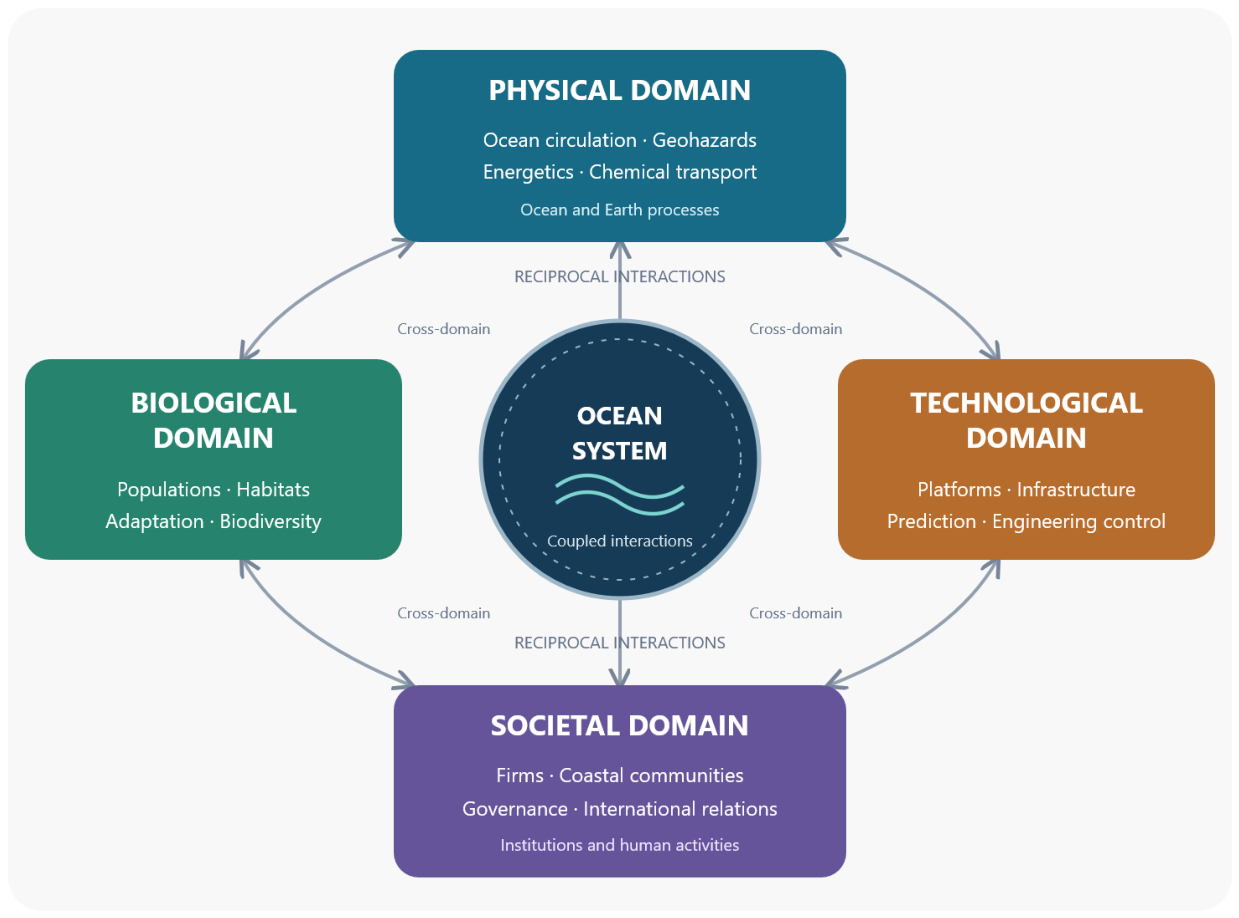
Figure 2.
Comparison of four analytical perspectives on complex engineering systems and their empirical evaluation criteria.
Figure 2.
Comparison of four analytical perspectives on complex engineering systems and their empirical evaluation criteria.
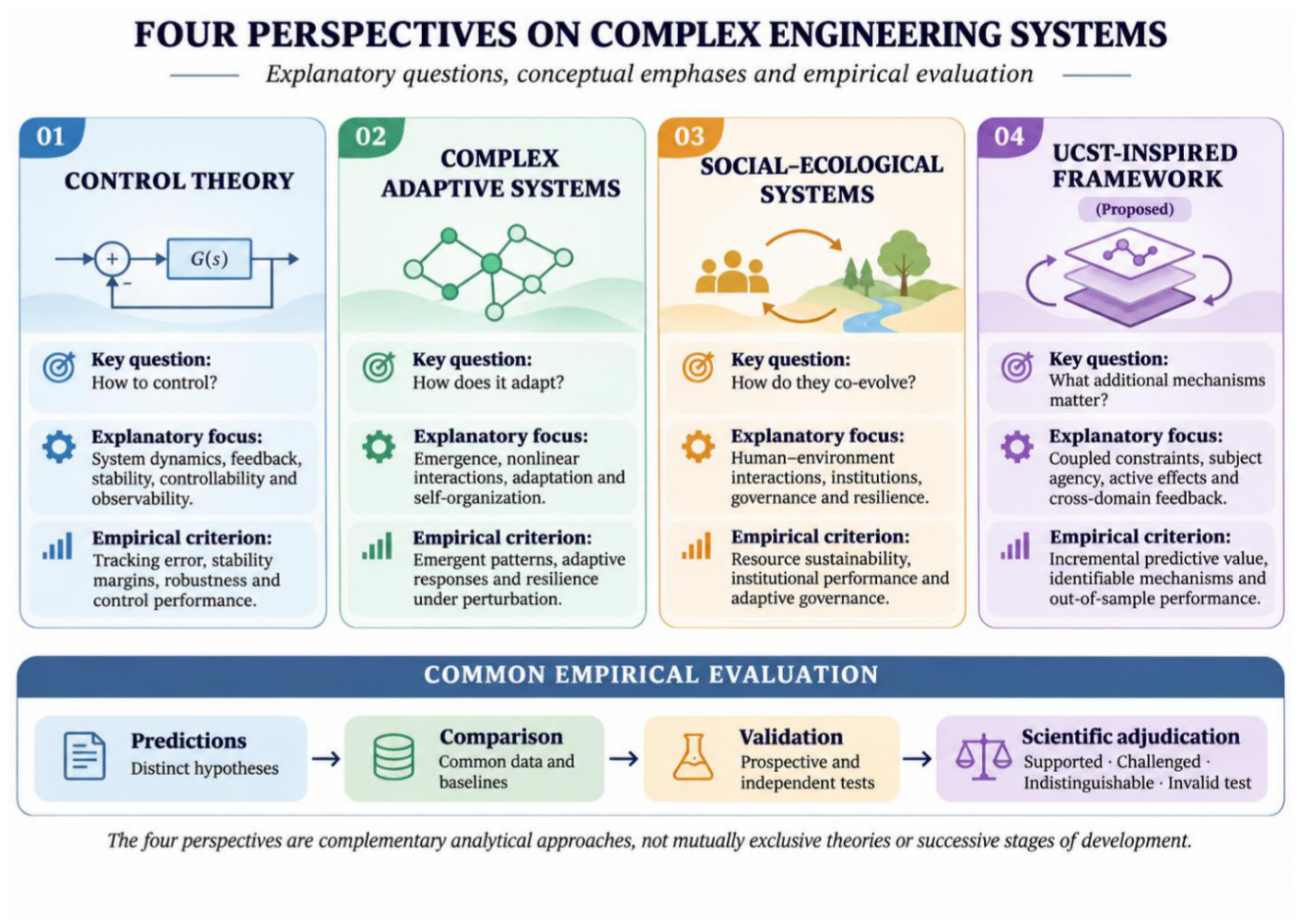
Figure 3.
Illustration of a civilian port system under intended attack and its potential consequences.
Figure 3.
Illustration of a civilian port system under intended attack and its potential consequences.
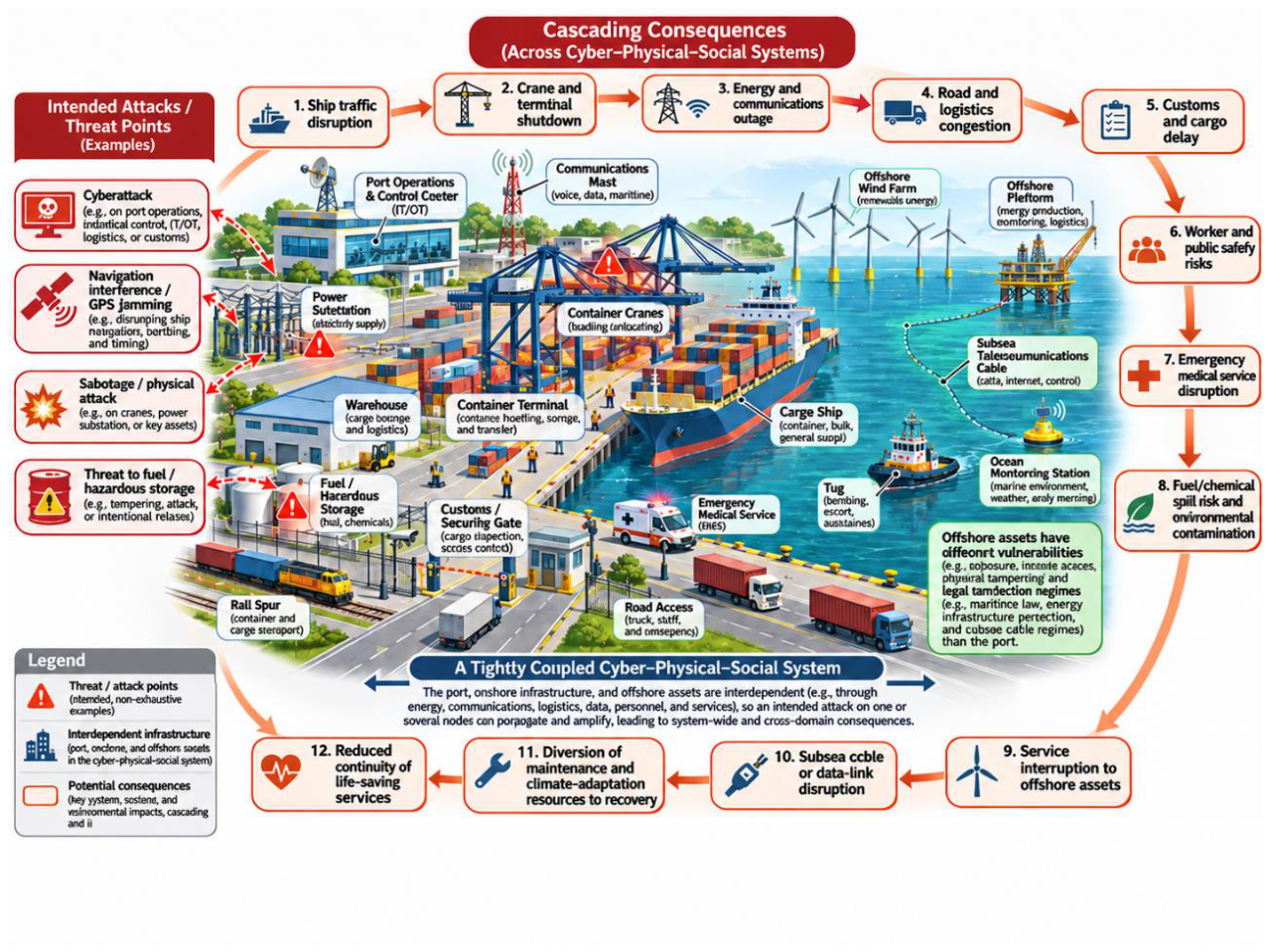
Figure 4.
Conceptual illustration of multi-objective trade-offs in ocean service design. The points and curve represent illustrative design alternatives and a hypothetical trade-off frontier, respectively; they are conceptual examples rather than measured data.
Figure 4.
Conceptual illustration of multi-objective trade-offs in ocean service design. The points and curve represent illustrative design alternatives and a hypothetical trade-off frontier, respectively; they are conceptual examples rather than measured data.
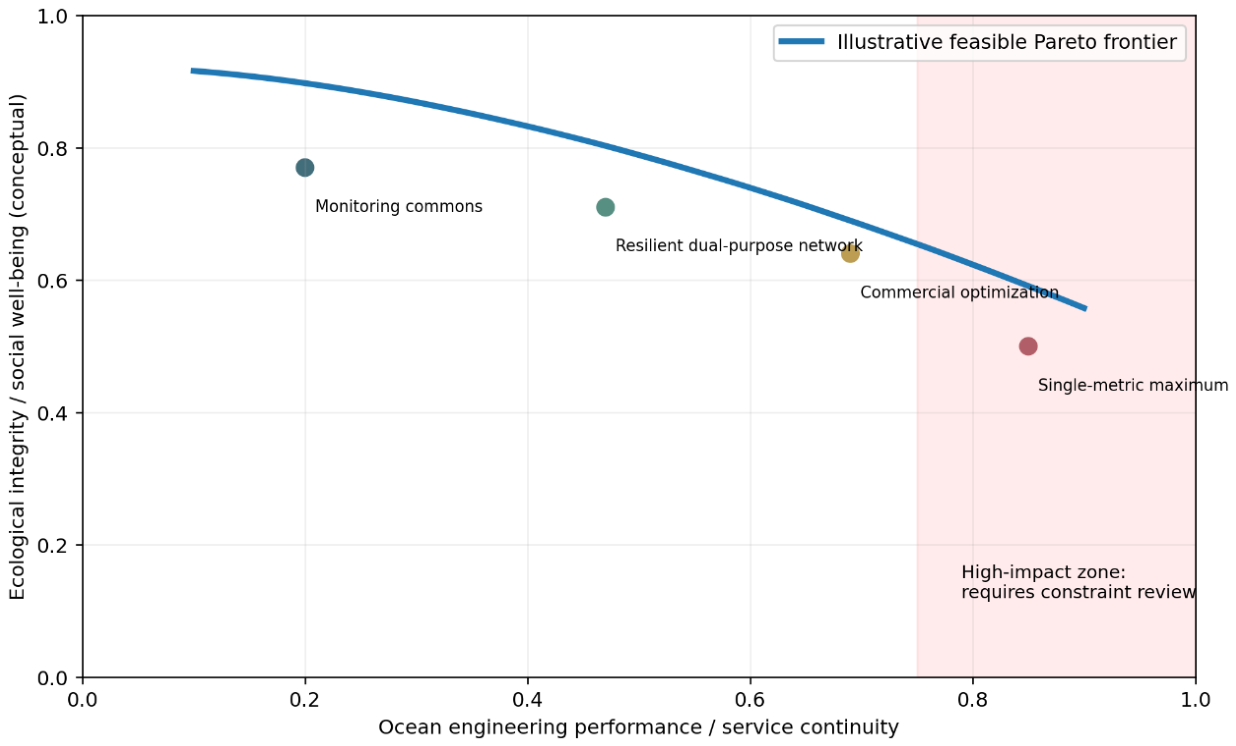
Figure 5.
Proposed staged roadmap for the responsible development and scaling of ocean-service systems, illustrating four development stages and their evidence-based decision gates (2027–2050).
Figure 5.
Proposed staged roadmap for the responsible development and scaling of ocean-service systems, illustrating four development stages and their evidence-based decision gates (2027–2050).
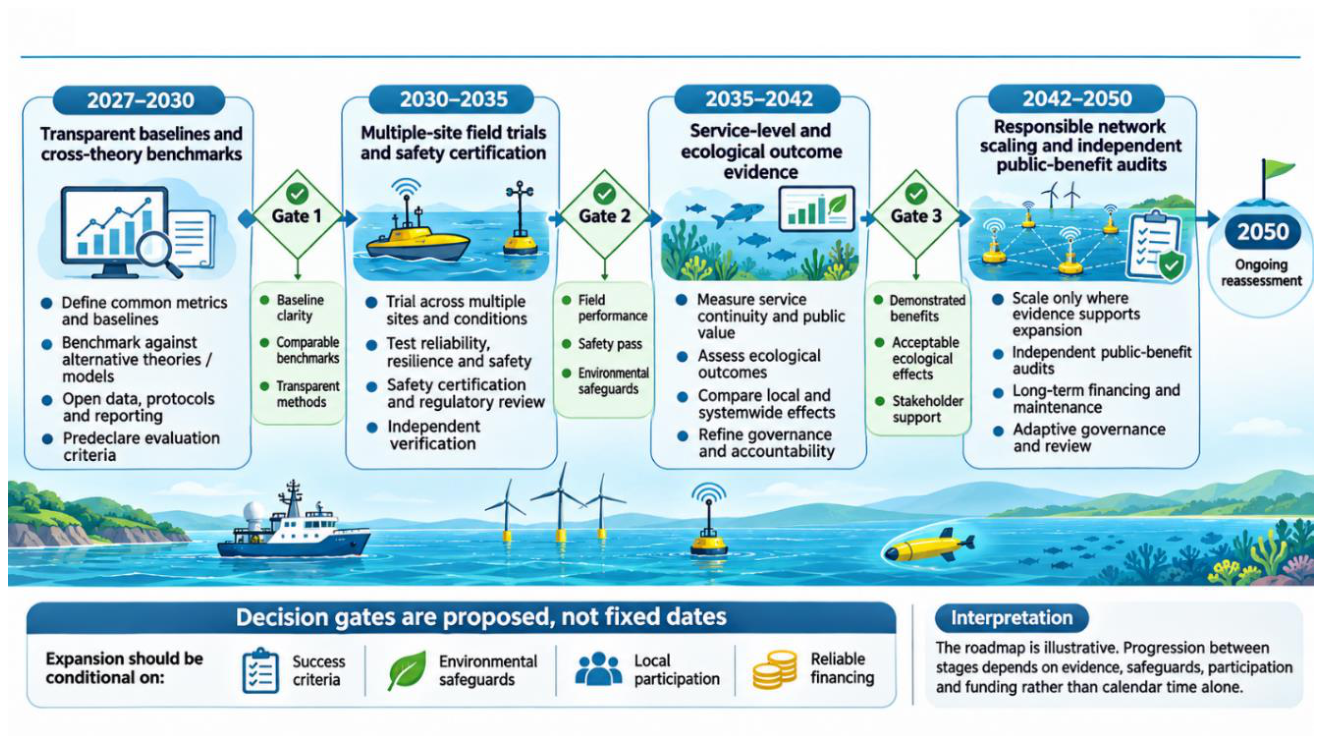

Table 1.
Emerging ocean engineering technologies: opportunities, evidence maturity, limitations, and requirements for responsible deployment.
Table 1.
Emerging ocean engineering technologies: opportunities, evidence maturity, limitations, and requirements for responsible deployment.
| Technology area | Potential benefits and applications | Evidence maturity and principal limitations | Evidence required for responsible deployment |
| Artificial intelligence and ocean prediction | Automated data analysis, multi-source sensor fusion, anomaly detection, improved forecasting, and adaptive mission planning. | Performance has been demonstrated in selected datasets and applications. However, generalization may be constrained by sparse observations, sensor drift, environmental variability, and out-of-distribution conditions. | Independent field validation; comparison with physical and hybrid models; uncertainty calibration; assessment of false alarms and missed events; and demonstrated improvements in operational decision-making. |
| Ocean digital twins | Integration of observations, physical models, simulations, and operational data to support system monitoring, scenario analysis, and decision-making. | Capabilities range from offline simulations to operationally connected systems. Data synchronization, model validity, interoperability, uncertainty propagation, and continuous updating remain important challenges [15,16,17]. | Verified data exchange with physical systems; independent model validation; documented update frequency and uncertainty; demonstrated decision-making value; and cybersecurity and lifecycle maintenance arrangements. |
| Autonomous underwater vehicles, gliders, and cooperative marine robotics | Extended observation coverage, reduced dependence on crewed operations, adaptive sampling, and coordinated multi-vehicle missions. | Established capabilities exist for selected missions, but endurance, localization, underwater communication, recovery, maintenance, and fleet coordination remain mission-dependent [18,19,20]. | Representative sea trials; reliable recovery and fault tolerance; energy and maintenance accounting; validated network-level performance; and safety and cybersecurity assurance. |
| Heterogeneous ocean-observing networks | Integration of satellites, research vessels, floats, moorings, surface vehicles, aerial platforms, and underwater vehicles to improve observational coverage, continuity, and information availability. | Complementary platforms provide different spatial, temporal, and vertical coverage. Overall network performance depends on interoperability, cross-platform calibration, resource allocation, data integration, and sustained funding [11,13,14]. | Cross-platform calibration; quantified information gain; resilience to node and communication failures; transparent data-quality assessment; equitable access to observations; and long-term operational support. |
| Biomimetic and low-disturbance marine robots | Improved maneuverability in complex habitats and potentially reduced acoustic or physical disturbance during ecological observation and monitoring. | Advantages are platform- and environment-specific. Propulsion efficiency, payload capacity, mechanical complexity, reliability, and actual biological responses require comparative field evidence. | Matched comparisons with conventional platforms; measured ecological disturbance and recovery; lifecycle energy and material assessments; and demonstrated operational reliability and retrieval capability. |
| Marine renewable energy, advanced materials, and offshore infrastructure | Lower-carbon maritime operations, renewable energy supply, improved structural durability, reduced maintenance requirements, and advanced structural health monitoring. | Benefits depend on geographical location, operating conditions, supply chains, infrastructure integration, and service life. Local performance improvements do not necessarily establish net lifecycle sustainability. | Full lifecycle assessment; independently verified performance and reliability data; evaluation of habitat and seabed impacts, emissions, occupational safety, recyclability, and end-of-life management. |
Note: This table provides a qualitative synthesis for research prioritization rather than a formal technology-readiness-level assessment. Evidence maturity varies with the specific application, operating environment, and deployment scale. The identified evidence requirements are proposed evaluation criteria, not claims that all listed technologies have already satisfied them.
Table 3.
Testable claims, comparative baselines, evaluation outcomes and potential refutation criteria for the proposed ocean-service research program.
Table 3.
Testable claims, comparative baselines, evaluation outcomes and potential refutation criteria for the proposed ocean-service research program.
| Research claim | Baseline comparator | Primary evaluation outcomes | Potential refutation |
| 1. Autonomous observation networks improve performance over episodic sampling. | Matched research-vessel surveys and fixed-station observation systems under comparable resource constraints. | Calibrated information quality, spatial and temporal coverage, observation continuity and lifecycle cost per useful datum. | No meaningful improvement after accounting for energy consumption, maintenance, communication failures and lifecycle costs. |
| 2. Biomimetic vehicles reduce ecological disturbance. | Conventional underwater vehicles performing equivalent missions in matched habitats and environmental conditions. | Animal behavioral responses, acoustic exposure, sediment disturbance, observation success, energy consumption and reliability. | Ecological disturbance is equivalent or greater, or any environmental improvement is offset by poorer mission performance or other adverse impacts. |
| 3. UCST-inspired variables provide additional explanatory or predictive value. | Established physical models, robust control approaches, reliability models and maintenance models using comparable information. | Prospective predictive log-scores, RMSE, calibration, intervention accuracy and out-of-sample performance. | No stable, reproducible improvement beyond conventional models after controlling for additional variables and model complexity. |
| 4. Cooperative maritime security measures improve civilian service continuity. | Comparable port operations, maritime routes and observation periods under appropriately matched security and operating conditions. | Incident-associated service availability, route diversions, restoration time, casualty risk and continuity of essential maritime services. | No attributable improvement after accounting for weather, economic conditions, operational changes and other confounding factors. |
| 5. Public-value optimization improves societal outcomes over conventional technical optimization. | Conventional engineering optimization and established multi-objective decision methods under equivalent budget and technical constraints. | Service outcomes, environmental impacts, distribution of benefits and costs, and independently assessed public value. | No incremental decision benefit, or improvements are accompanied by unacceptable ecological impacts or distributional consequences. |
Disclaimer/Publisher’s Note: The statements, opinions and data contained in all publications are solely those of the individual author(s) and contributor(s) and not of MDPI and/or the editor(s). MDPI and/or the editor(s) disclaim responsibility for any injury to people or property resulting from any ideas, methods, instructions or products referred to in the content. |
© 2026 by the author. Licensee MDPI, Basel, Switzerland. This article is an open access article distributed under the terms and conditions of the Creative Commons Attribution (CC BY) license.
Copyright: This open access article is published under a Creative Commons CC BY 4.0 license, which permit the free download, distribution, and reuse, provided that the author and preprint are cited in any reuse.