

Submitted:
15 November 2026
Posted:
17 November 2026
You are already at the latest version
Abstract
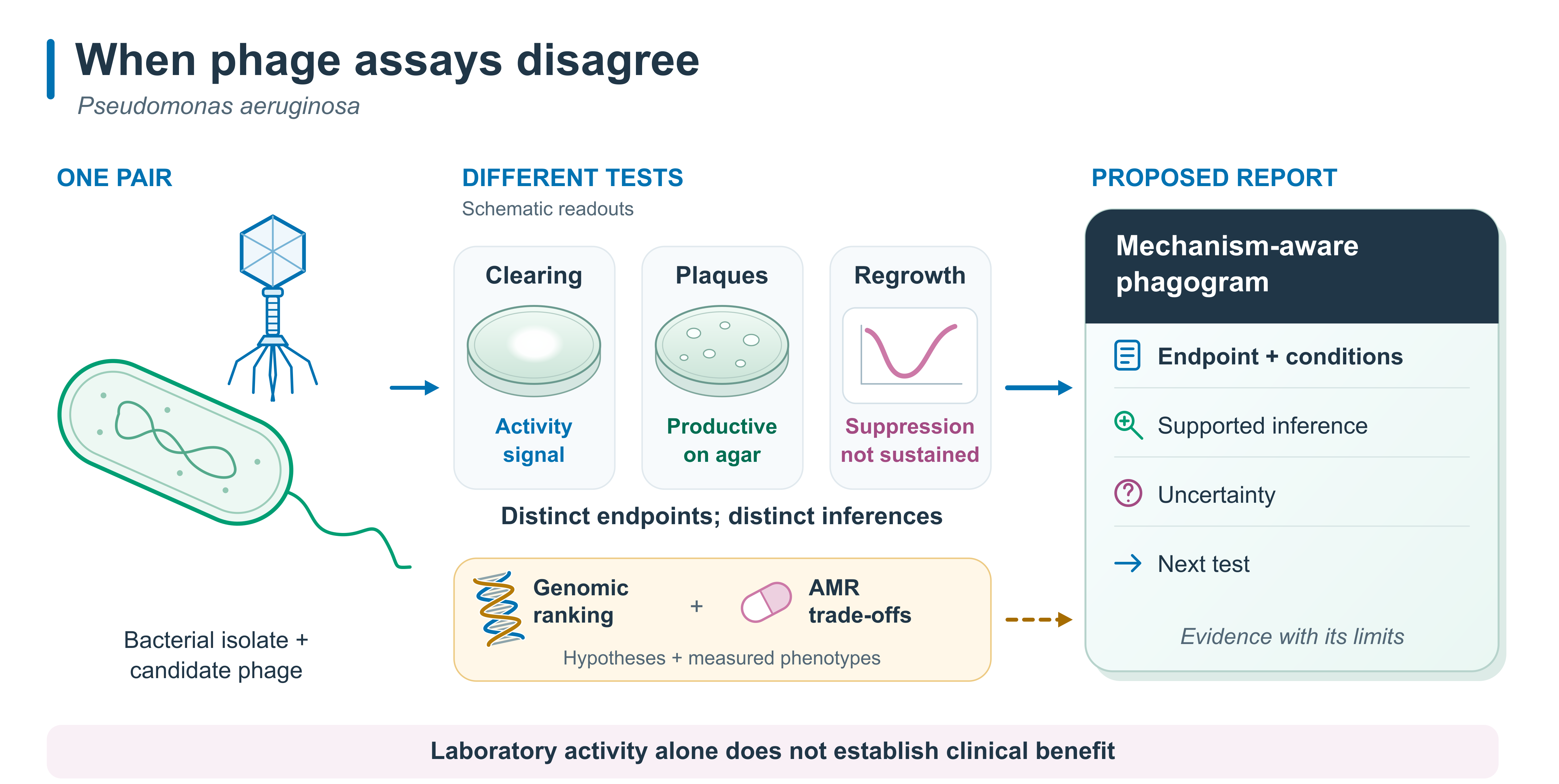
Phage susceptibility tests can disagree because clearing, infectious progeny and sustained bacterial suppression measure different events. For Pseudomonas aeruginosa, these differences complicate candidate selection and the interpretation of antimicrobial-resistance trade-offs. This critical review synthesises mechanistic, assay-comparison, clinical and predictive evidence published mainly in 2020–2026. We distinguish molecular infection, population response and clinical translation, mapping common assay signals to the conclusions they support and the confirmatory measurements they require. Recent paired plaque–liquid comparisons demonstrate both achievable agreement and protocol-dependent discordance, without establishing outcome-linked clinical breakpoints. Receptor compatibility remains conditional on surface state, entry, intracellular defence and physiology. Phage resistance can alter antibiotic susceptibility in either direction; between-isolate co-resistance and selected collateral sensitivity answer different questions. Genomic and transcriptomic approaches extend candidate ranking and stage inference, but their claims remain bounded by label definition, species, data partitioning and external validation. We propose an endpoint-specific phage activity report that preserves assay conditions, productive-infection evidence, suppression, regrowth and prediction provenance. This framework uses disagreement to guide confirmation and mechanistic investigation while keeping laboratory activity distinct from treatment benefit.
Keywords:
Pseudomonas aeruginosa
; bacteriophage
; phage susceptibility testing
; phagogram
; antimicrobial resistance
; host prediction
; machine learning
1. Introduction
The term phagogram invites a useful comparison with the antibiogram: expose a patient’s isolate to candidate agents, classify activity and select treatment. For antibiotics, interpretation depends on a defined method, a quantitative or categorical endpoint, quality control and a clinically justified interpretive breakpoint. Phage susceptibility testing (PST) lacks equivalent, widely validated interpretive criteria. A clear spot, a plaque, a high efficiency of plating (EOP), a decrease in optical density and a favourable patient course do not measure the same event. Yet they are frequently compressed into the same words—susceptible, active or effective—as if they were interchangeable observations of a single, consistently defined susceptibility phenotype [1,2,3,4].
This compression is especially consequential for Pseudomonas aeruginosa. The species combines extensive strain-level diversity with mutable surface structures, biofilm growth, condition-dependent physiology, prophages and a large repertoire of intracellular anti-phage systems. The same isolate can therefore adsorb a phage without supporting productive replication, form plaques on one medium but regrow in liquid culture, or appear susceptible in planktonic testing while a structured population persists. Conversely, a modest plaque phenotype may underestimate useful population suppression in combination with an antibiotic or host immunity. The clinical problem is not simply whether a phage “works”; it is which part of the infection process was observed, under which conditions, and whether that observation supports inference in the therapeutic setting [5,6,7].
Interlaboratory comparisons and clinical laboratory frameworks have documented variation in inoculum, agar, medium, incubation, reference strain and endpoint interpretation [1,4,8]. The 2026 European Committee on Antimicrobial Susceptibility Testing (EUCAST) position paper sets out a route towards reference methodology, while the September consensus guideline on personalised bacteriophage therapy addresses clinical governance and testing [9,10]. These initiatives support methodological harmonisation, although universally outcome-validated PST breakpoints remain unavailable. The resulting distinction between analytical comparability and prediction of treatment benefit is central to the interpretation of a phagogram.
At the same time, the inputs to a future phagogram are expanding. Receptor-aware cocktails, directed evolution, synthetic genome assembly, genomic surveys of bacterial defence, transcriptomic profiling and machine learning (ML) models are being investigated as complementary inputs to candidate selection [5,11,12,13,14,15,16]. Their interpretation requires a distinction between predicted compatibility, demonstrated infection and clinical utility. A receptor prediction provides a hypothesis about attachment, whereas the contribution of a defence locus depends on its expression and activity against the candidate phage. Likewise, a high area under the receiver-operating characteristic curve (AUROC) within a development dataset establishes neither external predictive performance nor clinical utility. Molecular and genomic information can prioritise hypotheses, but the endpoint and validation domain still determine what has been learned.
Antimicrobial-resistance (AMR) trade-offs introduce a further distinction between immediate bacterial suppression and the evolutionary consequences of treatment. Resistance to a phage that uses an efflux component, pilus or other virulence-associated surface structure may reduce fitness, virulence or antibiotic resistance. This idea underpins phage steering [17,18]. However, selection can reach multiple genetic and phenotypic solutions, and a phage–antibiotic combination can suppress bacteria even when no heritable resensitisation occurs. Immediate pharmacodynamic interaction, evolutionary collateral sensitivity and durable change after removal of phage pressure are three different claims. Treating all three as “synergy” conceals the evidence required to distinguish them.
We therefore ask: what can each PST or gewnomic observation support about molecular infection, population response and clinical translation? We organise the answer around three levels of evidence, distinguishing the molecular infection trajectory, the bacterial population response and translation to the treatment setting. Within this framework, assay discordance can identify an unresolved biological question, while genomic information can prioritise the candidates and measurements needed to investigate it.
Existing reviews describe PST methods and the barriers to biofilm therapy [3,19]. We extend that discussion by relating the inferential reach of individual assay signals to molecular barriers, population dynamics, AMR trade-offs and model validation. The resulting phage activity report is proposed as an expert framework for evaluation; its intended contribution is to make the evidence supporting a selection decision explicit, rather than to establish a consensus standard or a validated clinical decision rule.
2. Scope and Critical-Review Approach
This critical narrative Review focuses on evidence published from 1 January 2020 to 14 November 2026, retaining earlier foundational studies where they define an assay or mechanistic claim. The initial searches ended on 22 August 2026 and were followed by targeted checks on 5 October and an update through 14 November. We used first online publication dates to establish temporal eligibility. The dated queries and retrieval limitations are reported in Supplementary Table S5.
The update combined PubMed and Europe PMC discovery, SciSpace semantic searches, primary publisher and PMC records, citation chaining, and direct bioRxiv version/publication-linkage queries. Semantic summaries supported discovery; retained article-specific claims were checked against full texts and available supplementary material. Before extracting study counts, we distinguished assay labels, biological replicates, selected derivatives and external validation sets. DOI-registry records, source versions and linked corrections were checked separately from the fit between a cited statement and its source. Primary locators and qualifications for the mapped evidence are provided in Supplementary Table S1–S4.
We prioritised studies with separately reportable P. aeruginosa data relevant to PST interpretation, infection barriers, population or AMR outcomes, or strain-level predictive evaluation. Studies with paired endpoints, resistant-derivative phenotyping, longitudinal observations or informative null results were especially relevant. Standards and reviews supplied context. Cross-species examples are explicitly qualified. The Howell benchmark uses Escherichia coli and Gordonia phages, while the new external wet-laboratory test of GenoPHI uses E. coli; neither supplies an externally validated P. aeruginosa prediction estimate [20,21].
We use four inference labels throughout. Directly observed means that the assay physically observes the named construct, such as released infective particles during a one-step-growth experiment. Successful traversal implied but not localised means that a downstream result requires an upstream event but does not identify its rate or the point at which unsuccessful infections failed. Conditional or proxy inference denotes a signal that can be consistent with the construct only under specified protocol assumptions and may arise through several mechanisms, such as spot clearing, adenosine triphosphate (ATP) release or net optical-density reduction. Not supported means that the assay does not justify a claim about that construct. Free-phage depletion supports only apparent attachment unless decay, aggregation, non-specific sorption and reversible binding have been addressed; direct attachment requires a paired validated cell-associated measurement. The resulting nested evidence architecture is summarised in Figure 1.
3. Why the Assay Is Not the Phenotype
3.1. Clearing, Plaques and EOP Answer Different Questions
The spot assay is attractive because it is fast, inexpensive and visually intuitive. A clearing zone can result from productive infection, but it can also reflect lysis from without at high local particle density, non-replicative killing, diffusion of lytic enzymes or other preparation-associated effects. The observation directly establishes clearing under the stated conditions; it does not by itself establish serial propagation. Dilution series and plaque isolation reduce ambiguity, but reporting a spot result as a binary host-range label still embeds the chosen titre, lawn state, agar composition, incubation time and reader judgement [3].
Plaque formation is stronger evidence for completion of the infection cycle because a visible plaque generally requires repeated rounds of infection and local spread. Even here, the endpoint is composite. Plaque number and morphology integrate adsorption, intracellular replication, burst, diffusion and bacterial growth. A small or turbid plaque does not localise the limiting step, and failure to plaque can occur even when adsorption or killing is measurable. EOP adds a reference-host comparison: it is the ratio of infectious titres, expressed in plaque-forming units (PFU) per unit volume, measured with the same phage suspension on the test isolate and a reference host. It is therefore a relative laboratory quantity rather than an intrinsic property of the test pair. Its value changes when the denominator host, plating protocol or threshold changes. The categories “high,” “low” and “inefficient” are not portable unless their threshold and reference host are reported [3,4].
Recent methodological developments improve throughput while retaining plaque formation as the measured endpoint. Paranos and colleagues described a single-layer spot assay intended to increase throughput while retaining plaque-based quantification [22]. Its advantage is operational: fewer steps and easier enumeration for multidrug-resistant Gram-negative pathogens. Skusa and colleagues likewise explored a disk-like format analogous to routine antibiotic testing [8]. Analogous geometry does not create analogous breakpoints. Before a zone diameter can guide treatment, a reference method, reproducibility targets, quality-control strains, endpoint-specific thresholds and clinical outcome correlations are required.
An October interlaboratory Disk-PST study demonstrates that selected systems can achieve useful reproducibility [23]. Its experimental panel comprised E. coli and Staphylococcus epidermidis, so its agreement estimates cannot be transferred to P. aeruginosa. It supports the feasibility of standardising a defined assay and panel, while leaving species breadth and clinical interpretation open.
3.2. Adsorption, Entry and Progeny Production Localise Failure
Stage-specific assays become valuable when common screens disagree. Adsorption is often assessed by loss of recoverable free phage over time. After suitable controls, depletion can support an apparent attachment difference; it does not by itself identify the cause or establish irreversible attachment or genome entry. Decay, aggregation, non-specific sorption and reversible binding remain alternatives. A validated cell-associated measurement can add more direct evidence. Genome-entry assays move the boundary downstream only when extracellular and surface-bound genomes are excluded; they still do not establish intracellular takeover or infectious progeny.
Amplification assays, one-step growth and burst measurements provide stronger evidence for productive infection. Released infective progeny are directly counted, while latent period and burst size summarise the kinetics under the particular host and medium. These experiments imply successful attachment, entry and intracellular replication in the productive fraction, but they do not quantify each upstream transition unless paired with stage-specific measurements. The distinction between average burst among infected cells and population-level amplification is also important when only a fraction of cells is permissive.
Mechanistic localisation changes the next experiment. Apparent adsorption without amplification first requires confirmation of irreversible attachment and genome delivery; only then does it prioritise intracellular defence, prophage-mediated exclusion, abortive infection or a physiological block. Poor adsorption focuses attention on receptor presence, allelic variation, masking by capsule or alginate, lipopolysaccharide (LPS) state, pili and environmental regulation. Amplification with later population regrowth instead points towards resistant subpopulations, phenotypic heterogeneity, inadequate exposure or rapid ecological rescue. A binary phagogram erases all three patterns even though they imply different cocktail and combination strategies.
3.3. Liquid Killing and Biofilm Assays Measure Population Response
Optical density (OD), respirometry, calorimetry, luminescence and viable-count trajectories are often described as rapid PST. Their strength is temporal resolution of the bacterial population. Interpretation is limited because the net signal combines bacterial growth, lysis, debris, metabolic state, phage amplification and selection. Optical density can remain elevated after loss of viability; metabolic signals can change without proportional killing; and a favourable early area under the curve can be followed by regrowth. Consequently, the time horizon, inoculum, multiplicity of infection or input ratio, medium, mixing, replicates and regrowth rule are part of the result, not incidental protocol detail.
Parmar and colleagues compared two liquid high-throughput methods and illustrated that agreement depends on endpoint definition and timing [24]. Bayat and colleagues developed an ATP-bioluminescence platform for rapid target identification, with conventional confirmation including EOP and culture measurements [25]. The platform demonstrates how a lysis-associated proxy can accelerate screening; its small P. aeruginosa validation subset does not establish a species-wide clinical breakpoint. Rieper and colleagues paired plaque-based and automated planktonic-killing information across 141 P. aeruginosa strains and 25 phages, a design well suited to studying assay discordance [26]. Together, these studies support endpoint-specific calibration of rapid signals against the selection decision they are intended to inform.
Two further comparisons sharpen this distinction. Chalhoub and colleagues evaluated an ATP lysis-proxy prototype against plaque-derived EOP, including 66 P. aeruginosa pairs from three phages and 22 strains [27]. Their prospective urine demonstration involved other species, and the overall multispecies concordance is not a Pseudomonas-specific validation estimate. Koscianski and colleagues subsequently compared plaque and respiration-based liquid testing using matched inocula and stocks on 508 longitudinal or morphotype isolate records from a cystic-fibrosis trial [28]. Four individual phages give 2,032 isolate-record–phage pairs, with 508 cocktail tests counted separately. The isolates are not established independent strains. For the cocktail, agreement rose from 81% initially to 90% after selectively repeating discordant tests. The initial and repeat-assisted estimates describe different testing procedures, and susceptible agreement also depended on which assay was the comparator. The study did not evaluate association with treatment response. It demonstrates achievable method agreement under defined rules, without making either endpoint a clinical reference standard.
Biofilm assays add spatial structure, extracellular matrix, gradients and slow-growing cells. Biomass staining, metabolic activity, microscopy and viable burden are non-equivalent outcomes. A decrease in biomass may not equal bacterial killing, while unchanged biomass can coexist with a reduction in viable cells. The age and architecture of the biofilm, matrix composition, dosing sequence, exposure time and recovery after treatment must be described. Directed evolution in the relevant ecological state can improve performance: Kunisch and colleagues trained a four-phage mixture against biofilms using eight P. aeruginosa strains, then constructed a resistance-adapted two-phage cocktail [12]. Host-spectrum and biofilm outcomes therefore concern distinct stages of the study, rather than a single unchanged cocktail. The study illustrates the dependence of laboratory adaptation on the selection environment, while preserving the distinction between biofilm outcomes and planktonic EOP.
3.4. Reference methods, reproducibility and interpretive thresholds
A reference method has three separable roles. It provides a technically reproducible measurement, enables comparison across laboratories and provides the basis for a clinically interpretable threshold. The first role does not automatically deliver the third. Replicate agreement within one laboratory can coexist with systematic shifts between laboratories if agar depth, divalent cations, growth phase, incubation atmosphere or phage stock composition differ. A clinically useful programme therefore needs shared reference materials, defined quality-control ranges and external-quality assessment before it can evaluate outcome-linked categories.
The consensus guideline and professional initiatives provide organisational support for this work [10,29]. The European Society of Clinical Microbiology and Infectious Diseases (ESCMID) Study Group for Non-traditional Antibacterial Therapy (ESGNTA) lists guideline development and an academic-centre network among its aims. The published consensus guideline calls for harmonised testing and correlation with clinical outcomes. Consensus guidance, analytical validation and outcome-linked interpretation remain distinct achievements; none implies endorsement of our proposed matrix.
For phages, the propagation and reference hosts introduce additional sources of variation. The propagation host can affect particle composition, host-derived modifications and apparent titre, while reference-host EOP fixes the denominator to a particular permissive background. Stocks should be characterised for identity, purity and infective titre; genome review status should state the sequence-screening criteria used, including lysogeny, virulence and antimicrobial-resistance features. Where a laboratory uses a rapid population assay as the primary screen, a reference method should specify how an indeterminate or discordant result is confirmed. “No activity” should not combine technical failure, inadequate exposure, absent plaques and rapid regrowth.
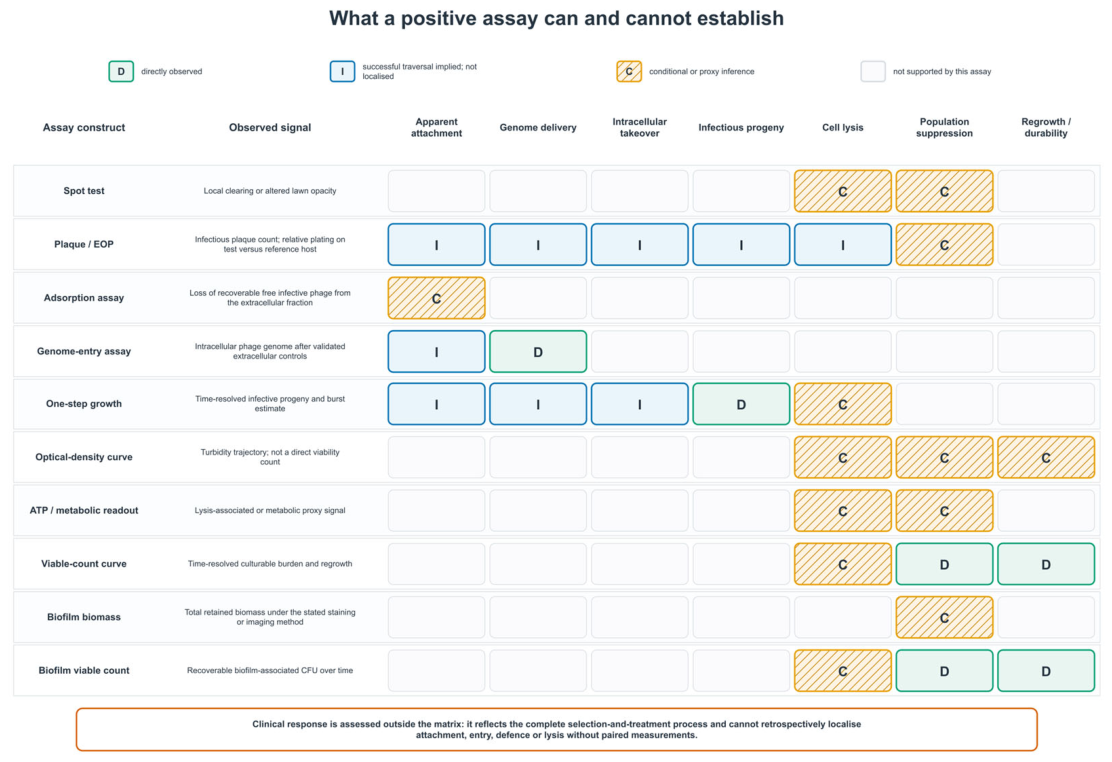
Breakpoints will ultimately require a defined intended use. A threshold optimised to exclude inactive phages from a large library may favour sensitivity, whereas confirmation of a clinical candidate requires high confidence in productive infection and population activity. Infection site, dosing route and combination therapy may change the decision-relevant exposure scenario. Until outcome-linked thresholds are validated, laboratories should report quantitative or ordinal endpoint-specific results with an interpretive comment. The EUCAST position paper places these methodological prerequisites before categorical harmonisation [9]. Figure 2 is a representative, non-exhaustive inferential boundary map, not a data-completeness matrix. Its 42 empty cells among 70 combinations state what an assay alone cannot support; they are not missing extractions. Direct intracellular measurements, including validated phage transcription or genome-replication assays, lie outside this matrix of commonly used PST and population-response assays. Supplementary Table S2 provides the assay-specific rationale, sources and confirmatory measurements.
Definitions and minimum reporting context for the same assay constructs are provided in Table 1.
Figure 2.
Representative, non-exhaustive, protocol-conditioned assay-to-inference matrix for obligately lytic or virulent therapeutic phages. D denotes a directly observed construct, I denotes successful traversal that is implied but not localised, and C denotes a conditional or proxy inference. The 42 empty cells among 70 stage cells mark constructs unsupported by the assay alone; they are inferential guidance, not missing data. Population suppression and temporal regrowth are separate columns. Validated intracellular transcription or genome-replication measurements can directly interrogate post-entry biology but are outside this selected set of commonly used assays. PST, phage susceptibility testing; ATP, adenosine triphosphate; EOP, efficiency of plating; CFU, colony-forming units. The observed-signal column states the raw measurement; confirmatory tests and source locators are retained in Supplementary File S1 (Table S2).
Figure 2.
Representative, non-exhaustive, protocol-conditioned assay-to-inference matrix for obligately lytic or virulent therapeutic phages. D denotes a directly observed construct, I denotes successful traversal that is implied but not localised, and C denotes a conditional or proxy inference. The 42 empty cells among 70 stage cells mark constructs unsupported by the assay alone; they are inferential guidance, not missing data. Population suppression and temporal regrowth are separate columns. Validated intracellular transcription or genome-replication measurements can directly interrogate post-entry biology but are outside this selected set of commonly used assays. PST, phage susceptibility testing; ATP, adenosine triphosphate; EOP, efficiency of plating; CFU, colony-forming units. The observed-signal column states the raw measurement; confirmatory tests and source locators are retained in Supplementary File S1 (Table S2).
4. Three Layers of a Predictive Phagogram
4.1. Layer 1: Molecular Infection Is a Sequence of Conditional Transitions
A productive infection is a sequence of conditional transitions: cell access, reversible and irreversible attachment, genome delivery, intracellular takeover, replication, assembly, release of infectious progeny and infection of new cells. Failure at different stages requires different interventions, while a downstream positive result does not quantify every upstream transition. A plaque confirms that some lineages completed the cycle; it does not reveal whether adsorption was slow, intracellular survival rare or burst small.
The “encounter” step must be distinguished from adsorption. In a well-mixed microplate, phage and bacterium may encounter one another frequently; in sputum, a wound, a device-associated biofilm or poorly perfused tissue, viscosity, matrix binding, spatial separation and clearance alter access before receptor binding begins. Laboratory adsorption rates measured under mixing are thus molecular parameters conditional on exposure. Clinical delivery belongs in Layer 3 even though it changes the apparent success of Layer 1.
4.1.1. Surface Compatibility Is Dynamic
P. aeruginosa phages use diverse surface structures, including lipopolysaccharide moieties, type IV pili and outer-membrane proteins. Receptor identity can create an evolutionary constraint relevant to treatment when the same structure contributes to virulence or antibiotic resistance. However, a receptor gene in a genome does not guarantee the relevant molecular state. Allelic sequence, glycosylation, LPS biosynthesis, phase variation, pilus extension, capsule or alginate masking and environment-dependent expression can all alter access. A receptor prediction should therefore be reported with its evidential basis: experimentally validated for the exact phage, inferred from a close relative, or predicted from sequence/structure.
Recent studies show both the value and the limits of receptor-aware design. Kim and colleagues used cross-resistance patterns to define receptor-complementary groups and construct broad phage–antibiotic combinations against a panel that included 153 clinical P. aeruginosa isolates and eight phages [11]. The rationale is to reduce shared escape routes among cocktail members. The measured combination outcomes concern population coverage and resistance suppression, rather than demonstrating inherited antibiotic resensitisation in every escape mutant. Fujiki and colleagues reported a cocktail containing a dual-receptor Phikzvirus that suppressed resistance evolution [30], while work on the DEV phage implicated the essential outer-membrane protein LptD as a secondary adsorption receptor [31]. These strategies raise the evolutionary cost of escape, but essentiality of a receptor does not eliminate masking, quantitative expression changes or post-entry defence.
Tail fibre and receptor-binding protein (RBP) studies add molecular resolution [32,33], and training can alter this interface. Lin and colleagues linked coevolutionary training of phage pap17 to host-range expansion, tail-fibre changes and retained stability and lytic activity; their study did not test biofilm-directed adaptation [34]. Meneses and colleagues instead connected tail-fibre and baseplate mutations in a biofilm-adapted Pbunavirus to faster adsorption, recognition of truncated LPS variants, higher EOP, improved colony-forming unit (CFU) reduction in relevant media and activity in a three-dimensional lung model [6]. Host-range breadth across 45 clinical isolates did not expand, so better adsorption or state-specific efficacy was not equivalent to broader binary host range. Sui and colleagues linked O-antigen heterogeneity to adsorption, progeny production and pleiotropic phenotypes across a 31-isolate panel [35]. Their gtaB-associated changes reduced motility and acute virulence but increased biofilm formation. These observations illustrate that changes in phage activity can coexist with altered virulence and biofilm phenotypes. Post-adsorption discordance nevertheless requires further localisation before it can be attributed to intracellular defence. Host range remains a joint property of phage genotype, bacterial genotype, physiological state and assay environment; engineered or trained phages still require renewed safety, stability and intended-panel testing.
4.1.2. Post-Entry Defence Breaks Receptor-Only Prediction
Once the genome enters, the bacterial cell can restrict, degrade, abort or otherwise disrupt infection. Defence systems span classical restriction–modification and CRISPR–Cas as well as a rapidly expanding set of innate and abortive mechanisms. Prophage-encoded exclusion and superinfection systems add another layer. Costa and colleagues combined comparative genomics with genetic validation to show accumulation and functional effects of defence systems in phage-resistant P. aeruginosa strains [5]. Yee and colleagues characterised END nucleases that target multiple phages with modified genomes, providing a causal example of a post-entry block that cannot be inferred from receptor compatibility alone [36]. Washizaki and colleagues showed that six phenotypically distinct PAO1 variants from one laboratory stock differed in PP7 susceptibility through pilus-associated variation and lasR-linked Pf6 replication that interfered with PP7 [37]. A 2026 preprint from Yee, Banta and colleagues used clinical Pbunavirus systems to show that receptor masking and intracellular barriers can occur in different isolates even when the conserved core-LPS receptor is present; engineering a tail fibre or an anti-defence locus bypassed some, but not all, barriers [38]. These studies support stage-resolved interpretation while showing that even a nominal strain identifier does not guarantee a stable receptor or prophage state.
Defence prediction is limited by incomplete catalogues, uncertain locus activity and incompletely annotated phage counter-defence. A detected locus may be partial, silenced, condition-dependent or ineffective against the candidate, while an active anti-defence can invert its expected effect. Models should therefore represent receptor, defence and anti-defence evidence separately and permit interactions rather than converting defensome counts into a universal resistance score.
New discovery methods expand the catalogue while also helping to localise infection failure. A component-modularity survey nominated more than 500 candidate defence systems and experimentally validated three of five selected systems in a P. aeruginosa PAO1 background [39]. Candidate counts are not validated-system counts or strain–phage interaction denominators. Microscopy and infection assays placed two validated systems at different early intracellular transitions: Dionysus interfered with the formation or persistence of a functional DNA-containing early phage infection compartment, whereas Ophion prevented progression to a phage nucleus. The underlying biochemical mechanisms remained unresolved. These observations show why an apparently compatible host surface cannot establish productive infection, while remaining specific to the tested systems and phage panel.
Synthetic genome assembly provides a complementary means of investigating phage function. Sikkema and colleagues reported a Golden Gate system for assembling a P. aeruginosa phiKMV-like phage genome [13]. Programmable assembly makes targeted modification and mechanistic testing more tractable. The recovery of an engineered phage establishes technical feasibility, whereas therapeutic evaluation additionally requires evidence on activity in the intended isolate panel, genomic stability, manufacturing and safety. A phage activity report should identify which of these properties has been examined.
4.2. Layer 2: Population Suppression Is More than Productive Infection
Molecular permissiveness is necessary for conventional lytic amplification but does not determine the whole population trajectory. At a fixed input, early killing depends on the susceptible fraction, adsorption and latent-period kinetics; later dynamics depend on phage amplification, bacterial growth, resistant mutants, transient phenotypic states and resource conditions. Regrowth is therefore not merely noise. Its timing and composition can distinguish inadequate initial activity from rapid selection, spatial refuge or reversible tolerance.
A population assay should report the time course or prespecified summaries: viable-burden reduction, time to nadir, duration below threshold, regrowth and endpoint burden. Optical density requires viable-count confirmation when the claim concerns killing. Regrown isolates should be tested for stable resistance, adsorption, growth cost and cocktail cross-resistance. Receptor escape favours receptor-diverse phages, a post-entry block motivates anti-defence-aware selection, and transient tolerance suggests altered exposure or physiological state.
Clinical isolates can contain subpopulations differing in receptor expression, prophage state or growth. In structured communities, susceptible surface cells may shield deeper cells, while matrix and lysis products alter diffusion. Biofilm “eradication” should therefore require absence below a defined recovery limit; biomass or metabolic reduction is insufficient. Incomplete eradication can still be useful if phage facilitates antibiotic or immune clearance, but the endpoint must match that intended role.
Winkler and colleagues provide a recent illustration of why a susceptible label is too coarse. They compared one phage across five clinical P. aeruginosa isolates using infection dynamics, genomic information and transcriptomic response, finding strain-associated differences in efficacy and response [14]. The small design is mechanistically informative but not a validated prediction model. The relevant implication is that isolates supporting infection can nevertheless differ in subsequent infection dynamics and population response. The next generation of datasets should pair such depth with broader strain–phage matrices rather than treating breadth and mechanism as competing aims.
A September preprint by Wilms and Gurney infers infection timing from single-cell transcriptomes of Luz19-infected PAO1 and separately examines coinfection with Luz19 and LKD16 [40]. Its classification task concerns early versus later infection in the sampled systems, rather than susceptibility prediction for a new clinical strain. External clinical validation and generalisation across independent strain or phage groups were not established. Such methods could describe heterogeneity after entry, but stage classification, strain matching and causal localisation remain separate claims.
4.3. Layer 3: Clinical Translation and Validation
Clinical response integrates delivery, local chemistry, immunity, bacterial compartmentalisation, co-administered antibiotics and evolution. Immune clearance of phage, immune cooperation, source control, surgery and concomitant care further complicate attribution. An unfavourable outcome therefore does not automatically falsify an in-vitro phagogram, and a favourable outcome does not validate a particular PST threshold.
Clinical evidence becomes informative when it is time-resolved and linked to matched isolates. Luong and colleagues analysed longitudinal bacterial, phage, antibiotic and immune measurements in a single human P. aeruginosa infection treated with two phages, supporting an account of ecological partitioning and cooperation between phage and antibiotic [7]. Repeated within-patient sampling allowed the authors to relate laboratory measurements to the treatment course. Its single-case design cannot estimate response probability or validate a universal selection rule. A bespoke phage–antibiotic report in refractory mediastinitis and vascular-graft infection likewise establishes feasibility and generates mechanistic hypotheses but remains confounded by co-interventions [41]. Engeman and colleagues evaluated combination activity in an isolate panel and a mouse wound model, providing a distinct preclinical level of evidence [42].
Recent longitudinal reports further separate symptom control from eradication. Arya and colleagues followed a single P. aeruginosa prosthetic-joint infection over two years, observing symptom control without microbiological eradication [43]. Its plaque, growth-inhibition and biofilm-biomass measurements answer different questions. In the November PHAGEFORCE cohort, three cases involving P. aeruginosa, including one polymicrobial infection, had different outcomes: two remission classifications and one recurrence [44]. These are descriptive case outcomes, not a species-specific efficacy estimate. Antibiotics and surgery accompanied treatment, controls were unmatched, and the full-cohort remission proportion pooled species. EOP-informed selection and follow-up make the reports informative for translation, but do not validate an EOP threshold or permit attribution of outcome to phages alone.
The clinical layer is a translation and validation domain requiring the treated isolate and time point, infection site, phage identity, dose and route, available recovery or pharmacokinetic data, co-interventions, microbiological and clinical outcomes, and post-treatment isolates. A model trained on in-vitro pair labels is not clinically validated until candidate selection and performance are evaluated prospectively in this domain.
5. AMR Trade-Offs: Distinguish Steering, Combination Effects and Durability
Phage steering is most plausible when resistance requires alteration of a bacterial feature with another clinically relevant function. In the widely cited OMKO1 system, susceptibility depended on the outer-membrane efflux component OprM and selected escape was associated with altered efflux and restored antibiotic susceptibility [17]. This supports an efflux-associated receptor dependency and escape route in the tested system, not a universal single-receptor mechanism: additional surface determinants can contribute to attachment, and escape need not be limited to loss of OprM. Other resistance routes can impair virulence-associated functions and reduce motility, colonisation, virulence or fitness [45]. A later narrative review highlighted phage-induced large chromosomal deletions as a distinct route that can restore antibiotic susceptibility, while emphasising the translational uncertainties of deliberately exploiting that route [46]. These findings justify deliberate receptor and selection-pressure hypotheses. They do not establish a general law that phage resistance reverses AMR.
Work from 2020–2023 established this conditionality before the recent mechanistic expansion. Gurney and colleagues followed OMKO1-associated antibiotic-susceptibility changes across serial transfer and a Galleria model, but the study did not resolve a single receptor mechanism [47]. Xuan and colleagues linked resistance of one PAO1 variant to reduced adsorption and increased sensitivity to gentamicin and polymyxin B, while many concurrent genomic changes limited causal attribution [48]. Castledine and colleagues found rapid resistance and reduced virulence in matched in-vivo and in-vitro evolution, yet biofilm responses differed by environment [45]. These studies made route, background and ecological state part of the claim rather than nuisance variation.
At least four claims must be separated. Pharmacodynamic interaction asks whether simultaneous or sequential phage and antibiotic exposure produces greater population suppression than expected under a specified null model. Evolutionary steering asks whether resistance selected by the phage causes a heritable change in antibiotic susceptibility, virulence or fitness. Suppression of resistance asks whether a combination reduces the probability or expansion of escape. Durability asks whether the altered phenotype persists after phage pressure is withdrawn and under clinically relevant conditions. Each requires a different design.
García-Cruz and colleagues selected resistance to two lytic phage variants and characterised adsorption, growth, virulence and antibiotic susceptibility in PA14 and two clinical strains [49]. Their data support route- and strain-specific trade-offs rather than universal antibiotic resensitisation: phenotypic direction varied across bacterial backgrounds and drugs. The study is especially valuable because it links resistant-mutant phenotyping to mechanistic tests and a virulence model. It also shows why a heatmap of minimum inhibitory concentration (MIC) changes cannot be generalised without the selected phage, resistance mechanism, comparator and replicate lineage.
A different question is whether naturally sampled resistant isolates tend to resist both treatment classes. Rodden and colleagues’ September preprint compared three phages across 55 clinical isolates, giving 165 screening pairs, against antibiotic-susceptibility information for 11 drugs [50]. Average phage and antibiotic resistance were positively associated after phylogenetic adjustment. This between-isolate association does not negate collateral sensitivity selected within a lineage. Phages and antibiotics were tested separately, so it cannot establish combination synergy. A second longitudinal-isolate preprint found no consistent direction of phage-susceptibility change after treatment-emergent ceftolozane–tazobactam resistance [51]. Together, these observational data argue against using an AMR label as a proxy phagogram or assuming a universal inverse relationship.
Kim and colleagues used receptor complementarity, phage combinations and antibiotics to broaden population coverage and reduce resistance [11]. Kunisch and colleagues exploited costs observed during biofilm-directed evolution [12]. Tran and colleagues recovered 128 resistant colonies from one ancestral PAO1–PO4 pair, representing 28 unique mutations across 16 pilus-related genes; all tested resistant isolates lost twitching motility, yet one short pilD duplication reverted after removal of phage pressure [52]. These 128 colonies represent samples from one originating system; they must not be counted as independent phage–strain pairs.
Gomaa and colleagues characterised three Henu5-resistant derivatives from one ancestral system, linking pilQ/pilR-associated resistance to antibiotic-susceptibility, transcriptomic, fitness and animal phenotypes [53]. Separate selection lineages were not established, and derivative R6 had increased amikacin and ciprofloxacin MICs, contrasting with more favourable changes in other derivatives. Mutation-specific causality remained unresolved. Çiftçi and colleagues examined five clinical isolates after short-term phage exposure and after withdrawal of pressure, observing shifts towards both increased and decreased susceptibility [54]. These were categorical disc-diffusion changes, rather than measured MIC effect sizes or proof of a heritable resistance mechanism. These studies support a conditional strategy: choose a receptor or ecological pressure for a plausible reason, then measure independent trajectories and their durability. They do not justify pooling MIC shifts across unrelated receptors, strains, antibiotics and exposure schedules.
Phage–antibiotic interaction should also be distinguished from collateral sensitivity. A combination may succeed because the antibiotic slows bacterial growth, changes receptor expression, alters cell morphology, suppresses resistant cells or partitions activity across subpopulations. The same drug can enhance, antagonise or have little effect depending on concentration and timing [42,55,56,57]. Ferran and colleagues, for example, used clinically simulated exposure in a hollow-fibre model to suppress resistant populations; that result supports schedule-dependent combination activity, not inherited resensitisation [55]. Omwega and colleagues used a defined interaction model to compare all ten three-member combinations formed from five selected phages, then tested leading cocktails in planktonic, biofilm and Galleria settings [58]. This is systematic cocktail optimisation, not evidence of a heritable antibiotic trade-off. Claims of synergy should state the null model, dose matrix, order and timing; a greater reduction than either monotherapy is not automatically synergy. Claims of resensitisation require standardised antimicrobial susceptibility testing (AST) with the applicable guideline, breakpoint or MIC distribution, preferably before and after phage selection and again after passage without phage.
Han and colleagues connected sequence-dependent combination activity to phage-selected subpopulations and increased beta-lactam permeability in an extensively drug-resistant clinical isolate; the hollow-fibre proof of concept used a separate PAO1 system [59]. The clinical-isolate and PAO1 experiments therefore constitute separate preclinical systems.
Yang and colleagues examined one clinical isolate, ZS-PA-35, with the O-antigen-dependent phage phipa10 and three antibiotics [60]. Optical-density suppression, infectious phage yield and Galleria survival gave different rankings across drugs and time points; some meropenem combinations showed late regrowth despite early suppression. Lower phage yield did not preclude improved survival, but the levofloxacin combination did not significantly outperform antibiotic monotherapy by the reported log-rank comparison. Combinations added during biofilm formation and treatments of preformed biofilms also answered different questions: none of the latter combinations produced a significant additional reduction in attached biomass beyond monotherapy. Biomass was not a viable-count endpoint. Selected-isolate AST changes were bidirectional: the authors reported increased piperacillin–tazobactam susceptibility but decreased susceptibility to aztreonam, and to meropenem in the meropenem-selected group.
These findings support separate reporting of amplification, population response, biofilm state, AST and host outcome. They establish neither a class-wide synergy rule nor a durable, universal collateral-sensitivity phenotype.
The translational significance of steering depends on the distribution of evolutionary outcomes as well as their average. Parallel selection may produce receptor loss in some lineages, intracellular defence in others and mixed or transient phenotypes in the remainder. A cocktail can redirect that distribution by requiring simultaneous escape from distinct receptors, but it can also select a broad post-entry mechanism that protects against several phages. Sequencing one endpoint clone is therefore inadequate. Studies should phenotype multiple independent lineages, quantify the frequency of major routes, test cross-resistance to all cocktail members and link genotype to adsorption, amplification and AST. Where steering is intended, the desired collateral phenotype should be included as a prespecified endpoint rather than selected post hoc from a large antibiotic panel. Table 2 separates the required experimental contrasts, and Table 3 links them to study examples within the same evidence framework.
6. Genome-Guided Selection: Useful Priors, Demanding Validation
AMR-informed cocktail design and genome-guided ranking are complementary selection inputs. Neither replaces phenotypic PST, and both inherit the endpoint definitions and validation limits of the evidence used to construct them.
6.1. Predict the Correct Label
Genomic prediction can address several distinct tasks: identify the likely bacterial species or strain group infected by a phage; rank candidate phages for a new isolate; predict a particular assay result for a strain–phage pair; or explain a measured interaction through receptors and defence. These tasks should not share an undifferentiated “host prediction” label. Species-level assignment is useful for discovery and biosurveillance but too coarse for personalised therapy. Strain-level selection requires labels measured at strain level, and the definition of a negative pair becomes decisive.
An untested pair is not a negative pair. A spot-negative pair under one condition is not equivalent to a plaque-negative, amplification-negative or liquid-killing-negative pair. Models trained on heterogeneous literature labels may learn laboratory conventions, phylogeny or sampling design rather than infection biology. The target label should therefore include assay, threshold, condition and time. When multiple endpoints exist, multi-task or hierarchical models can preserve them rather than forcing them into one binary outcome. A prediction intended to inform selection could therefore report separate estimates for plaque formation, amplification and durable population suppression, together with uncertainty for the new strain lineage.
Negative-pair construction and data splitting govern whether performance is credible. Randomly separating rows from the same dense interaction matrix can place nearly identical bacterial strains, related phages or observations sharing the same strain–phage pair in training and test sets. The reported performance then answers interpolation within a familiar panel, not selection for a new hospital isolate or phage lineage. Stronger evaluation leaves out bacterial lineages, phage clusters, laboratories or time periods. A decision-relevant test is prospective evaluation: freeze the model, receive previously unseen isolates and candidates, make ranked predictions, and then perform blinded PST.
Cross-species evaluations illustrate the evaluation problem but must remain labelled. Howell and colleagues benchmarked computational host-range tools using experimentally characterised E. coli and Gordonia phages, reporting limitations in precision and sensitivity [20]. That work cannot supply P. aeruginosa effect estimates. Boeckaerts and colleagues developed strain-level prediction for Klebsiella [61]. Yang and colleagues used SpikeHunter to identify tailspike proteins and their associations with bacterial polysaccharides across Enterobacterales genomes [62].
Gaborieau and colleagues measured 38,688 interactions between 96 phages and 403 Escherichia strains, then evaluated phage-specific prediction with phylogenetically grouped cross-validation [63]. All observations from each bacterial strain remained in the same partition. Their genome-based recommender also underwent laboratory testing on 100 previously unseen pathogenic E. coli isolates with three-phage cocktails drawn from the profiled library. This is external bacterial-panel evidence, rather than clinical validation or a test on novel phages. The interaction label was derived from plaques or clearing across a concentration series, so a positive label did not uniformly establish productive infection. These studies distinguish protein annotation, inferred receptor association and measured strain-level assay prediction. The biological features and calibrated probabilities must be re-established for P. aeruginosa.
6.2. Receptors, Defence and Anti-Defence Should Be Represented as Interacting Evidence
Sequence similarity, k-mer composition, CRISPR spacers, prophage signals and co-occurrence can identify broad host associations. Therapeutic strain-level selection demands more mechanistic features. RBP annotation identifies candidate binding proteins rather than a validated phage–strain interaction; Boeckaerts and colleagues explicitly addressed inconsistent protein annotation [64]. Functional work on T7 and structural work on T4 provide cross-species examples of sequence–function and receptor-binding complexity [65,66]. A bacterial receptor feature should distinguish presence, allelic state, predicted structural compatibility and measured expression or phenotype. Defence features should record system completeness and evidence of activity. Anti-defence features should be linked to their molecular target where known.
The biological contribution of these feature groups depends on their interactions. Receptor compatibility becomes irrelevant if phage and bacterium do not encounter one another; a defence system matters only after entry; an anti-defence matters only if it counters the active barrier; and all may be modified by physiological state. Models can encode this hierarchy through structured interactions or stage-specific submodels. Even a conventional model benefits from reporting ablation analyses: receptor-only, defence-only, anti-defence-only, phylogeny-only and combined performance. A combined model with performance close to a phylogenetic baseline may be useful for interpolation but offers limited mechanistic support.
Interpretability should also be local. A global association between an LPS locus and susceptibility does not show that it explains a particular prediction. For a candidate pair, the output should identify the supporting and opposing evidence, the training neighbourhood and uncertainty. The appropriate confirmatory test follows from that explanation. Predicted receptor mismatch calls for adsorption testing; predicted intracellular defence despite receptor compatibility calls for amplification or molecular entry/replication testing; uncertain population suppression calls for a time-resolved killing and regrowth assay. This is how prediction reduces experimental burden without claiming to replace PST.
6.3. How the Field Changed from 2020 to 2026
The 2020–2023 period established the methodological and evolutionary problems that later technologies address. Gurney, Engeman, Xuan, Ferran, Castledine, Holger and colleagues separated evolutionary steering, contemporaneous combination effects, resistance suppression and context-dependent fitness costs [42,45,47,48,55,56]. Skusa and colleagues tested a diagnostic single-disk format, while the three-centre study by Parmar and colleagues showed that within-method repeatability did not guarantee agreement between laboratories or between liquid and plaque endpoints [4,8]. Coevolutionary training also linked a tail-fibre substitution to restored adsorption and delayed resistance in a joint phage application [67]. These studies shifted the field from asking whether a phage is active to asking which endpoint, evolutionary route and validation context support the label.
From 2024 onward, the feasible resolution and scale expanded. Assay studies increased throughput and compared plaque, metabolic and population endpoints [22,24,25,26]. Mechanistic and engineering studies resolved receptor use, adsorption, LPS masking, intracellular defence, within-strain microevolution and programmable assembly [5,6,13,34,35,36,37,38]. Trade-off and combination studies improved receptor-aware design, tested phenotype durability and formalised cocktail optimisation [11,49,52,53,54,58]. Multi-omic studies connected infection dynamics to strain-specific molecular responses without yet establishing predictive validation [14]. Figure 3 maps 45 curated anchors, including the update through November 2026. It separates surface from post-entry evidence, trade-offs from contemporaneous combinations, prediction from associative multi-omics, and additional experimental panels, external predictive tests, and animal and human evidence settings.
Two 2026 preprints provide complementary P. aeruginosa strain-level prediction datasets. Piya and colleagues report a complete matrix of 95 phages by 99 P. aeruginosa strains, comprising 96 clinical isolates and three laboratory references, corresponding to 9,405 unique pairs [15]. The Methods define positivity as a mean spot score of at least 1 over two biological replicates, while adjacent statistical text also describes collapsing non-zero scores; this wording difference should be resolved before reusing the labels. The reported matrix contained 3,132 positive pairs (33.3%). Phage inputs ranged from approximately 103 to 2 × 10⁹ PFU, so this label combines phage-specific titre or exposure with biological susceptibility and does not establish productive infection.
Under 20 repeated nested evaluations, each holding out 10% of strains, GenoPHI achieved pooled AUROC 0.81 and area under the precision–recall curve (AUPRC) 0.64. These values did not exceed the curated deployable baseline (0.82/0.67) and trailed a non-deployable marginal reference (0.88/0.79); median per-strain AUROC was 0.86 for both GenoPHI and the degree-only reference [15]. These results support held-out-strain ranking within the profiled phage library, without demonstrating superiority over the curated baseline or prospective clinical generalisation.
A model-ranked, diversity-constrained cocktail was tested against a target-informed classical-genetics comparator in a single PAO1 mouse-wound proof of concept. Escape-mutant screening informed the comparator, not the ML arm. PAO1 was excluded from model feature selection and training. This supports a held-out-target preclinical comparison, not prospective clinical utility [15].
Vaitekenas and colleagues integrated receptor-binding, defence and anti-defence features across 29 phages and 88 isolates, including two P. paraeruginosa outgroups [16]. The inspected v2, posted 9 March 2026, reports 15,312 measurements from 2,552 panel pairs at two titres with three biological replicates. The two outgroups were excluded from defence-system matrices; the final ML-eligible pair denominator is not clearly reported and should not be assumed to equal 2,552. Spot-derived minimum lytic concentration (MLC) was binarised. CatBoost evaluation used repeated stratified 85:15 pair splits without reported strain- or phage-grouped holdout. The Discussion places selection of 94 features after an 85% training split. It remains unclear whether filtering was independently repeated within every split; the reported ordering alone does not establish pre-split leakage. Familiar strains and phages can nevertheless occur in both partitions. Mean AUROC was 0.875 and average precision 0.87; Results and Figure 6 give slightly different AUROC confidence summaries. These are internal discrimination results, without demonstrated independent clinical transport or calibration.
The two preprints address related but distinct methodological questions. Piya and colleagues emphasise a complete matrix, strain-held-out evaluation and candidate ranking, whereas Vaitekenas and colleagues emphasise genomic determinants across receptor, defence and anti-defence layers. Together they provide complementary datasets for strain-level prediction beyond species assignment. Their shared limitation is transportability. A model can exploit familiar phages, lineages or pair structure in a local collection, and a binary label based on a spot-derived assay may not predict amplification, biofilm response or clinical delivery. A multi-centre prospective evaluation with locked endpoints and model versions would test whether these results generalise to the intended selection setting. Their label definitions and evaluation designs are compared in Table 4, and their performance and applicability limits in Table 5.
The September GenoPHI methods paper by Noonan and colleagues is a separate publication, not the journal version of Piya’s preprint [21]. Its P. aeruginosa analysis contains 23 phages by 19 hosts, or 437 liquid-assay pairs; reported AUROC 0.745 and Matthews correlation coefficient 0.326 concern that dataset. A Brier score of 0.221 quantifies probability error but does not replace calibration analysis. The new external experiment used 52 previously unseen E. coli phages against 25 familiar ECOR hosts. Of 1,300 assayed pairs, 1,240 remained after ambiguous results were excluded, giving AUROC 0.84; EOP was measured for 240 pairs. This advances prediction for new phages, but organism, host familiarity, exclusions and partial productive-infection confirmation delimit its reach. It does not externally validate a Pseudomonas clinical matching rule.

Table 4.
Model card, part 1: empirical labels, denominators and evaluation design for the two 2026 prediction preprints. NR means not reported in the inspected version, not assumed absent. MLC, minimum lytic concentration; PFU, plaque-forming units; CI, confidence interval; AUROC, area under the receiver-operating characteristic curve; AUPRC, area under the precision–recall curve; MCC, Matthews correlation coefficient.
Table 4.
Model card, part 1: empirical labels, denominators and evaluation design for the two 2026 prediction preprints. NR means not reported in the inspected version, not assumed absent. MLC, minimum lytic concentration; PFU, plaque-forming units; CI, confidence interval; AUROC, area under the receiver-operating characteristic curve; AUPRC, area under the precision–recall curve; MCC, Matthews correlation coefficient.
| Model-card item | Piya et al. [15] | Vaitekenas et al. [16] |
| Empirical label | Spot clearance scored 0/1/2; mean of two biological replicates; Methods threshold mean ≥1, adjacent statistical wording differs; phage input approximately 103–2 × 10⁹ PFU. Productive infection not established | Spot-derived MLC at 108 and 106 PFU/mL; pair called lytic when MLC >1 |
| Unique pairs and positive prevalence | 9,405 unique pairs; 3,132 positive (33.3%) | 2,552 full-panel pairs; outgroups excluded from defence matrices; final ML pair denominator and positive prevalence NR |
| Repeat aggregation | Two biological replicates averaged before binarisation | Three biological replicates at two titres; pair-level MLC consistency reported, but aggregation rule for discordant replicates is unclear |
| Bacterial/phage split unit | 20 repeated nested strain-based evaluations; 10% of strains excluded from feature selection, training and tuning; phages not held out | Repeated stratified 85:15 pair split; no grouped strain or phage holdout reported |
| Phylogenetic leakage control | Strain holdout and novelty analyses reduce bacterial-row leakage; related-lineage and familiar-phage transport remain possible | No phylogenetically grouped split reported; same strains and phages can occur across train/test pairs; v2 describes training-first filtering but repeat-wise nesting is unclear |
Table 5.
Model card, part 2: performance, applicability and validation for the two 2026 prediction preprints. ML, machine learning; HDBSCAN, hierarchical density-based spatial clustering of applications with noise. Versions and source qualifications are provided in Supplementary Table S4.
Table 5.
Model card, part 2: performance, applicability and validation for the two 2026 prediction preprints. ML, machine learning; HDBSCAN, hierarchical density-based spatial clustering of applications with noise. Versions and source qualifications are provided in Supplementary Table S4.
| Model-card item | Piya et al. [15] | Vaitekenas et al. [16] |
| Discrimination | GenoPHI pooled AUROC/AUPRC 0.81/0.64; curated deployable baseline 0.82/0.67; non-deployable marginal reference 0.88/0.79; median per-strain AUROC 0.86 for GenoPHI and degree-only reference | Text: mean AUROC 0.875 (95% CI 0.846–0.906), average precision 0.87 and F1 0.79; Figure 6 caption: mean AUROC 0.880 (95% CI 0.845–0.913) |
| Confidence intervals | Model-level confidence intervals NR | Bootstrap AUROC CI reported; internal text/figure discrepancy requires reconciliation |
| Calibration / Brier score | NR | NR |
| Applicability domain | 99 strains (96 clinical isolates and three references), 95 phages from 20 genera; transport outside the collection and assay is untested | 88-isolate panel including two P. paraeruginosa outgroups and 29 phages; laboratory spot-MLC domain only |
| External, prospective or in-vivo validation | PAO1 excluded from model training for one murine-wound proof of concept; ML cocktail used genomic ranking and HDBSCAN diversity constraints; escape-mutant screening informed the classical-genetics comparator; no clinical validation | No independent external, prospective, in-vivo or clinical validation reported |
6.4. Performance Must Be Reported for the Intended Decision
AUROC can remain high in an imbalanced dataset even when precision for active candidates is inadequate. AUPRC summarises precision and recall across decision thresholds and should be interpreted in relation to the prevalence of positive pairs. Sensitivity, specificity, positive predictive value and negative predictive value should be reported at prespecified thresholds [68]. For candidate ranking, top-k hit rate and enrichment over an explicit baseline may be more relevant to the intended decision. If a model score is interpreted as a probability, calibration should be examined using calibration curves and appropriate calibration estimates [69]. A Brier score provides complementary information on overall probability error. Confidence intervals should account for clustering by strain and phage.
The cost of errors is asymmetric and context-dependent. A false positive wastes laboratory and clinical time and could select an inactive phage. A false negative may discard a useful candidate from a scarce library. Screening models may therefore prioritise sensitivity and then confirm high-ranked pairs, while a clinical candidate-confirmation decision requires high positive predictive value. The evaluation should account for library size, testing time, available alternatives and the required turnaround. A single threshold cannot serve discovery, screening and clinical release.
External validation should be progressively harder. First, use held-out bacterial lineages and phage clusters within the same laboratory. Second, test a temporally or geographically distinct panel under the same reference assay. Third, exchange blinded isolates and phages across laboratories. Fourth, evaluate locked rankings prospectively with multiple endpoints. Clinical validation then asks whether the ranked-and-confirmed process improves turnaround, candidate yield or outcome compared with current laboratory practice. Claims of clinical utility require evidence that the selection procedure improves a clinically relevant outcome or workflow, beyond retrospective discrimination alone.
7. A Tiered Reporting and Validation Framework
The immediate reporting need is to preserve the measured construct, conditions and supporting evidence within a format compatible with routine PST. We therefore propose two tiers (Table 6). The core clinical activity report contains identity, provenance, the directly observed assay construct, essential conditions, quantitative or ordinal outcome, regrowth where measured and an interpretive limitation. Conditional extensions add mechanistic localisation, AMR or combination evidence, and prediction metadata when discordance, cocktail design, steering or model-assisted selection makes them relevant. This is an evidence-derived expert proposal, not a validated clinical workflow or an EUCAST-endorsed or international consensus standard.
The core identity and provenance fields prevent sample ambiguity. The bacterial isolate should have a stable identifier, source, collection time and species-confirmation method; the phage should have a stable identifier, provenance, propagation host, titre method and genome review status with stated lysogeny, virulence and AMR-screening criteria. The core assay construct fields define what was observed and under which protocol. They should report initial PFU/mL, initial CFU/mL and nominal input ratio separately, alongside medium, temperature, mixing or agar, timing, replicates, controls, reference host and decision threshold. The raw or minimally processed trajectory should be retained when the endpoint is temporal.
The conditional mechanism extension records receptor evidence, masking or surface state, adsorption, irreversible attachment or genome entry where available, amplification, defence, anti-defence, prophage and resistant-regrowth phenotype. It becomes valuable for discordant assays or cocktail design. The conditional population, AMR and combination extension records viable burden, regrowth, biofilm model, antibiotics, dose and sequence, resistant derivatives and durability after withdrawal. The conditional prediction and validation extension records label definition, feature provenance, negative-pair construction, split strategy, metrics, calibration, applicability domain, locked model version and the confirmatory test.
Table 6.
Tiered reporting framework for a mechanism-aware phagogram. The core tier was designed to remain compatible with routine reporting; conditional extensions are triggered by discordance or a mechanistic, AMR, cocktail or predictive decision. The framework is an expert proposal and has not been prospectively validated.
Table 6.
Tiered reporting framework for a mechanism-aware phagogram. The core tier was designed to remain compatible with routine reporting; conditional extensions are triggered by discordance or a mechanistic, AMR, cocktail or predictive decision. The framework is an expert proposal and has not been prospectively validated.
| Tier and module | Required or conditional fields | Why it changes interpretation |
| Core: identity and provenance | Stable isolate/phage IDs; clinical source and time; species confirmation; propagation host; titre method; genome review status and explicit sequence-screen criteria | Prevents pair and version ambiguity; exposes propagation-host effects without implying that sequence review proves safety |
| Core: activity assay and report | Named direct endpoint; initial PFU/mL; initial CFU/mL; nominal input ratio; medium; temperature; geometry/mixing; time; replicates; controls; reference host; threshold; quantitative/ordinal outcome; regrowth when measured; limitation statement | Makes the clinical report reproducible without implying that clearing, plaques, amplification and population response are interchangeable |
| Conditional extension: mechanistic localisation | Receptor evidence tier; masking/state; adsorption; irreversible attachment or entry; amplification; defence/anti-defence; prophage; regrowth isolates | Converts discordance into a testable barrier hypothesis |
| Conditional extension: population, AMR and combination | Viable trajectory; regrowth rule; biofilm model; antibiotic concentration/order; AST guideline; independent lineages; withdrawal durability | Separates immediate combination effects from inherited and persistent trade-offs |
| Conditional extension: prediction and validation | Empirical label; unique-pair denominator; repeat aggregation; negative construction; grouped split; AUROC/AUPRC; threshold metrics; calibration; external/prospective test; model version | Prevents leakage, denominator inflation and clinical overclaiming |
In this framework, the primary assay is selected for its intended use, and evidence of productive infection is interpreted alongside population suppression and regrowth. Biofilm findings require a model relevant to the infection context, while discordant results justify additional mechanistic investigation. Cocktail and combination assessments contribute separate information about cross-resistance, joint activity and the persistence of selected phenotypes. Genome-guided ranking can inform candidate prioritisation before testing and the interpretation of subsequent discordance. The report should retain these distinctions even when a routine workflow uses only a subset of the possible measurements.
The implications can be illustrated by two hypothetical assay patterns. If a validated cell-associated measurement supports attachment but the phage produces no plaques and does not amplify, the report should record that direct attachment result, the failed productive endpoints and an unresolved barrier after attachment. If only supernatant depletion was measured, the wording should remain “conditional apparent attachment”. Further localisation is needed to distinguish failed entry from an intracellular block. If a phage forms plaques yet a liquid culture regrows rapidly, productive infection is established under plaque conditions, but durable population suppression is not. The next questions concern the susceptible fraction, resistant-regrowth isolates, input and amplification kinetics, not receptor identity alone.
This division of evidence supports selective use of additional measurements: broad screening can identify candidates, productive-infection assays can resolve ambiguous clearing, and mechanistic measurements can be reserved for discordant or otherwise consequential pairs.
A clinical report could display several states rather than one category: productive under reference-like plaque conditions, population suppression observed, regrowth detected, biofilm evidence available, mechanism supported, and prediction inside or outside its applicability domain. A brief comment should state the conditions and unresolved risks; categorical simplification should await validated breakpoints.
8. Limitations and Research Priorities
The review design limits the conclusions that can be drawn from the selected literature. It is not based on completed duplicate screening of all records returned by every database, and it cannot provide PRISMA (Preferred Reporting Items for Systematic Reviews and Meta-Analyses) denominators or unbiased prevalence estimates. The recent source map is curated around advances relevant to the framework rather than an exhaustive census. Some 2026 evidence is available only as preprints, and metadata or conclusions may change after peer review.
The proposed inference matrix simplifies biology. Infection stages overlap in time, assay implementations differ, and “direct” measurement can still be affected by technical error. The framework does not provide clinical breakpoints, regulatory release criteria or a validated quality score. It also focuses on P. aeruginosa; receptor biology, defence repertoires and feasible assays differ across bacterial species. Cross-species methodological examples were labelled and not treated as organism-specific evidence.
The principal methodological priority is a multi-centre reference-method programme that defines reproducibility before interpretive breakpoints, consistent with the EUCAST roadmap [9]. Benchmark panels should contain genetically and phenotypically diverse clinical isolates, well-characterised phages and shared reference materials. Datasets should pair plaque, amplification and population trajectories for the same strain–phage pairs, so endpoint discordance becomes a modelling target rather than undocumented noise. Prospective prediction challenges should leave out bacterial lineages, phage clusters and laboratories while reporting calibration and top-k utility. Clinical studies should preserve serial isolates and measure exposure, co-treatment and within-host evolution so that failure of delivery can be distinguished from failure of molecular infection.
For AMR claims, the corresponding priority is to separate the consequences of phage selection from concurrent treatment effects. Studies should begin with an explicit causal diagram linking receptor, phage-resistance route, antibiotic mechanism, fitness and environment. Multiple independently evolved lineages and control-passaged bacteria are essential because one striking mutant can misrepresent the accessible evolutionary distribution. Standardised AST, genetic complementation where feasible and passage after withdrawal of phage pressure should become routine. These designs are needed to determine the conditions under which a selected collateral phenotype is reproducible and persists after withdrawal of phage pressure.
These evaluations also require data infrastructure that preserves failed and indeterminate tests, because collections enriched for active phages can inflate prediction performance. Tested and structurally missing pairs should be explicit, while versioned genomes, assemblies, protocols and trajectories should be linked by stable identifiers for reproducible re-analysis and prospective benchmarking.
9. Conclusions
A phagogram should specify the biological outcome measured, the conditions under which it was observed and the inference that the result supports. Clearing, productive infection, population suppression and clinical response represent related but distinct levels of evidence; their interpretation cannot be reduced to an antibiotic-style susceptibility category before the relevant criteria have been validated.
Our framework treats assay discordance as information, links likely failure stages to confirmatory tests and uses genome-guided prediction to prioritise candidates and hypotheses while making the requirements for further validation explicit. Receptor-aware cocktails, directed evolution, intracellular-defence discovery, synthetic engineering, multi-omics and larger interaction matrices make this timely, but do not remove the need for empirical testing.
For P. aeruginosa, the most defensible near-term output is therefore an endpoint-specific evidence profile: productive infection under defined conditions, population suppression and regrowth, mechanism where known, combination and durability evidence where relevant, and prediction provenance. Its purpose is to make the basis and limitations of a selection decision explicit. A simpler categorical interpretation would become defensible when reference methods, calibrated models and prospective clinical associations support the intended decision.
Supplementary Materials
Supplementary File S1 (Excel; Supplementary_Materials.xlsx) con-tains five supporting tables. Table S1 describes the selected studies, endpoints, count definitions and limitations. Table S2 provides the assay-inference rationale for Figure 2, and Table S3 gives the construct coding and model settings for Figure 3. Table S4 records the inspected preprint versions and their qualifications; Table S5 lists the dated search-update queries. The Contents worksheet provides navigation and the essential coding definitions.
Author Contributions
Conceptualisation, methodology, investigation and writing—original draft preparation, A.A.P.; writing—review and editing, project administration and supervision, O.V.S.; supervision, funding acquisition and resources, D.A.L.
Funding
This research was funded by Russian Science Foundation, project 24-15-20022 (https://rscf.ru/project/24-15-20022/), and by Saint Petersburg Science Foundation, project 24-15-20022.
Institutional Review Board Statement
Not applicable. This Review analyses published literature and contains no new human or animal research.
Informed Consent Statement
Not applicable.
Data Availability Statement
The data supporting this Review are provided in the Supplementary Materials (Supplementary File S1).
Conflicts of Interest
The authors declare no conflicts of interest.
Abbreviations
The following abbreviations are used in this Review:
| AMR | Antimicrobial resistance. |
| AST | Antimicrobial susceptibility testing. |
| ATP | Adenosine triphosphate. |
| AUROC | Area under the receiver-operating characteristic curve. |
| AUPRC | Area under the precision–recall curve. |
| CF | Cystic fibrosis. |
| CFU | Colony-forming units. |
| CI | Confidence interval. |
| EOP | Efficiency of plating. |
| ESGNTA | ESCMID Study Group for Non-traditional Antibacterial Therapy. |
| ESCMID | European Society of Clinical Microbiology and Infectious Diseases. |
| EUCAST | European Committee on Antimicrobial Susceptibility Testing. |
| HDBSCAN | Hierarchical density-based spatial clustering of applications with noise. |
| LPS | Lipopolysaccharide. |
| MCC | Matthews correlation coefficient. |
| MIC | Minimum inhibitory concentration. |
| ML | Machine learning. |
| MLC | Minimum lytic concentration. |
| NA | Not applicable. |
| NR | Not reported or not recoverable. |
| OD | Optical density. |
| PFU | Plaque-forming units. |
| PRISMA | Preferred Reporting Items for Systematic Reviews and Meta-Analyses. |
| PST | Phage susceptibility testing. |
| RBP | Receptor-binding protein. |
References
- Gelman, D.; Yerushalmy, O.; Alkalay-Oren, S.; Rakov, C.; Ben-Porat, S.; Khalifa, L.; Adler, K.; Abdalrhman, M.; Coppenhagen-Glazer, S.; Aslam, S.; et al. Clinical Phage Microbiology: a suggested framework and recommendations for the in-vitro matching steps of phage therapy. Lancet Microbe 2021, 2, e555–e563. [Google Scholar] [CrossRef] [PubMed]
- Yerushalmy, O.; Braunstein, R.; Alkalay-Oren, S.; Rimon, A.; Coppenhagn-Glazer, S.; Onallah, H.; Nir-Paz, R.; Hazan, R. Towards Standardization of Phage Susceptibility Testing: The Israeli Phage Therapy Center ‘Clinical Phage Microbiology’—A Pipeline Proposal. Clin. Infect. Dis. 2023, 77, S337–S351. [Google Scholar] [CrossRef] [PubMed]
- Kolenda, C.; Jourdan, J.; Roussel-Gaillard, T.; Medina, M.; Laurent, F. Phage susceptibility testing methods or ‘phagograms’: where do we stand and where should we go? J. Antimicrob. Chemother. 2024, 79, 2742–2749. [Google Scholar] [CrossRef] [PubMed]
- Parmar, K.; Komarow, L.; Ellison, D.W.; Filippov, A.A.; Nikolich, M.P.; Fackler, J.R.; Lee, M.; Nair, A.; Agrawal, P.; Tamma, P.D.; et al. Interlaboratory comparison of Pseudomonas aeruginosa phage susceptibility testing. J. Clin. Microbiol. 2023, 61, e00614–23. [Google Scholar] [CrossRef] [PubMed]
- Costa, A.R.; den Berg, D.F. van; Esser, J.Q.; Muralidharan, A.; den Bossche, H. van; Bonilla, B.E.; der Steen, B.A. van; Haagsma, A.C.; Fluit, A.C.; Nobrega, F.L.; et al. Accumulation of defense systems in phage-resistant strains of Pseudomonas aeruginosa. Sci. Adv. 2024, 10, eadj0341. [Google Scholar] [CrossRef] [PubMed]
- Meneses, L.; Valentová, L.; Santos, S.B.; Erdmann, J.; Crabbé, A.; Plevka, P.; Häussler, S.; Pires, D.P.; Coenye, T.; Azeredo, J. Directed evolution of phages in biofilms enhances Pseudomonas aeruginosa control through improved lipopolysaccharide recognition. Nat. Commun. 2025, 16, 10219. [Google Scholar] [CrossRef] [PubMed]
- Luong, T.; Kharrat, L.; Champagne-Jorgensen, K.; Melendez, J.A.; Pride, D.; Conrad, D.J.; Roach, D.R. Ecological partitioning enables phage–antibiotic cooperation in a human Pseudomonas infection. Nat. Commun. 2026, 17, 2615. [Google Scholar] [CrossRef] [PubMed]
- Skusa, R.; Groß, J.; Kohlen, J.; Schafmayer, C.; Ekat, K.; Podbielski, A.; Warnke, P. Proof-of-Concept Standardized Approach Using a Single-Disk Method Analogous to Antibiotic Disk Diffusion Assays for Routine Phage Susceptibility Testing in Diagnostic Laboratories. Appl. Environ. Microbiol. 2022, 88, e00309–22. [Google Scholar] [CrossRef] [PubMed]
- Classen, A.Y.; Clokie, M.R.J.; Giske, C.G.; Paz, R.N.; Pirnay, J.-P.; Resch, G.; Laurent, F. EUCAST Phage Susceptibility Testing Subcommittee Towards a reference methodology for bacteriophage susceptibility testing – position paper of the EUCAST Phage Susceptibility Testing Subcommittee. Clin. Microbiol. Infect. 2026, 32, 1817–1822. [Google Scholar] [CrossRef] [PubMed]
- Würstle, S.; Lieberknecht-Jouy, S.C.; Düchting, A.; Lößner, H.; Ceyssens, P.-J.; Pirnay, J.-P.; de Jode, M.; McCallin, S.; Leitner, L.; Willy, C.; et al. A consensus-based guideline for personalized bacteriophage therapy. Nat. Med. 2026, 32, 3578–3594. [Google Scholar] [CrossRef] [PubMed]
- Kim, M.K.; Chen, Q.; Echterhof, A.; Pennetzdorfer, N.; McBride, R.C.; Banaei, N.; Burgener, E.B.; Milla, C.E.; Bollyky, P.L. A blueprint for broadly effective bacteriophage-antibiotic cocktails against bacterial infections. Nat. Commun. 2024, 15, 9987. [Google Scholar] [CrossRef] [PubMed]
- Kunisch, F.; Campobasso, C.; Wagemans, J.; Yildirim, S.; Chan, B.K.; Schaudinn, C.; Lavigne, R.; Turner, P.E.; Raschke, M.J.; Trampuz, A.; et al. Targeting Pseudomonas aeruginosa biofilm with an evolutionary trained bacteriophage cocktail exploiting phage resistance trade-offs. Nat. Commun. 2024, 15, 8572. [Google Scholar] [CrossRef] [PubMed]
- Sikkema, A.P.; Kortright, K.E.; Selvakumar, H.; Antani, J.; Chan, B.K.; Davidson, M.; Hopkins, M.; Newman, B.; Potapov, V.; Silva-Valenzuela, C.A.; et al. A fully synthetic Golden Gate assembly system for engineering a Pseudomonas aeruginosa phiKMV-like phage. Proc. Natl. Acad. Sci. 2026, 123, e2525963123. [Google Scholar] [CrossRef] [PubMed]
- Winkler, C.; Huang, W.; Sanders, T.; Peng, X.; Khan Mirzaei, M.; Deng, L. Strain-level molecular and infection traits are associated with differences in phage efficacy against Pseudomonas aeruginosa. Sci. Rep. 2026, 16, 26054. [Google Scholar] [CrossRef] [PubMed]
- Piya, D.; Noonan, A.J.C.; Selvakumar, H.; Alayouni, M.; Koderi Valappil, S.; Maucourt, F.; Murray, I.; Svab, M.; Bousliman, C.; Heidenblut, M.; et al. Comprehensive interaction profiling and machine learning prediction of bacteriophage infectivity across clinically diverse Pseudomonas aeruginosa. bioRxiv 2026. [Google Scholar] [CrossRef]
- Vaitekenas, A.; Malajczuk, C.J.; Mantjani, L.; Carr, P.G.; Iszatt, J.J.; Ng, R.N.; Montgomery, S.T.; Karpievitch, Y.; Stick, S.M.; Kicic, A. Genomic Determinants of Phage Activity Against Pseudomonas aeruginosa: Roles of Receptors, Defence Systems, and Anti-Defences. bioRxiv 2026. [Google Scholar] [CrossRef]
- Chan, B.K.; Sistrom, M.; Wertz, J.E.; Kortright, K.E.; Narayan, D.; Turner, P.E. Phage selection restores antibiotic sensitivity in MDR Pseudomonas aeruginosa. Sci. Rep. 2016, 6, 26717. [Google Scholar] [CrossRef] [PubMed]
- Oromí-Bosch, A.; Antani, J.D.; Turner, P.E. Developing Phage Therapy That Overcomes the Evolution of Bacterial Resistance. Annu. Rev. Virol. 2023, 10, 503–524. [Google Scholar] [CrossRef] [PubMed]
- Xu, Q.; Liu, S.; Xi, J. Phage therapy against Pseudomonas aeruginosa biofilm infections: challenges and advanced strategies. Front. Microbiol. 2026, 17, 1899503. [Google Scholar] [CrossRef] [PubMed]
- Howell, A.A.; Versoza, C.J.; Pfeifer, S.P. Computational host range prediction—The good, the bad, and the ugly. Virus Evol. 2024, 10, vead083. [Google Scholar] [CrossRef] [PubMed]
- Noonan, A.J.C.; Moriniere, L.; Rivera-López, E.O.; Patel, K.; Pena, M.; Svab, M.; Kazakov, A.; Deutschbauer, A.; Dudley, E.G.; Mutalik, V.K.; et al. Phylogeny-agnostic strain-level prediction of phage–host interactions from genomes using machine learning. Nat. Microbiol. 2026, 11, 2778–2793. [Google Scholar] [CrossRef] [PubMed]
- Paranos, P.; Pournaras, S.; Meletiadis, J. A single-layer spot assay for easy, fast, and high-throughput quantitation of phages against multidrug-resistant Gram-negative pathogens. J. Clin. Microbiol. 2024, 62, e00743–24. [Google Scholar] [CrossRef] [PubMed]
- Ekat, K.; Scharnagl, L.; Hahn, A.; Deinhardt-Emmer, S.; Trimborn, A.; Landtag, J.; Wietzke, M.; Elias, J.; Lestin-Bernstein, F.; Splettstoesser, W.; et al. Toward routine implementation of phage testing: an inter-laboratory comparison of a disk-based susceptibility testing (Disk-PST). J. Clin. Microbiol. 2026, 64, e00029–26. [Google Scholar] [CrossRef] [PubMed]
- Parmar, K.; Fackler, J.R.; Rivas, Z.; Mandrekar, J.; Greenwood-Quaintance, K.E.; Patel, R. A comparison of phage susceptibility testing with two liquid high-throughput methods. Front. Microbiol. 2024, 15, 1386245. [Google Scholar] [CrossRef] [PubMed]
- Bayat, F.; Hilal, A.; Thirugnanasampanthar, M.; Tremblay, D.; Filipe, C.D.M.; Moineau, S.; Didar, T.F.; Hosseinidoust, Z. High throughput platform technology for rapid target identification in personalized phage therapy. Nat. Commun. 2024, 15, 5626. [Google Scholar] [CrossRef] [PubMed]
- Rieper, F.; Wittmann, J.; Bunk, B.; Spröer, C.; Häfner, M.; Willy, C.; Müsken, M.; Ziehr, H.; Korf, I.H.E.; Jahn, D. Systematic bacteriophage selection for the lysis of multiple Pseudomonas aeruginosa strains. Front. Cell. Infect. Microbiol. 2025, 15, 1597009. [Google Scholar] [CrossRef] [PubMed]
- Chalhoub, H.; Daubie, V.; Dahma, H.; Blasdel, B.; Tytgat, I.; Quintens, J.; Vandenberg, O.; Hallin, M. Rapid phage susceptibility determination using a semi-automated bioluminescent ATP assay. Microbiol. Spectr. 2026, 14, e00782–26. [Google Scholar] [CrossRef] [PubMed]
- Koscianski, C.A.; Shao, W.; Komarow, L.; Parmar, K.; Greenwood-Quaintance, K.E.; Souli, M.; Nikolich, M.P.; Filippov, A.A.; Schooley, R.T.; Evans, S.R.; et al. Comparative plaque- and liquid-based phage susceptibility testing of Pseudomonas aeruginosa isolates in a cystic fibrosis randomized clinical trial. J. Clin. Microbiol. 2026, 64, e00875–26. [Google Scholar] [CrossRef] [PubMed]
- European Society of Clinical Microbiology and Infectious Diseases ESCMID Study Group for Non-traditional Antibacterial Therapy (ESGNTA). Available online: https://www.escmid.org/esgnta/ (accessed on 14 November 2026).
- Fujiki, J.; Tamamura, K.; Nakamura, K.; Nakamura, T.; Sakata, Y.; Kimura, N.; Ono, S.; Kojima, N.; Inaba-Hasegawa, K.; Sasaki, M.; et al. Phage cocktails containing a dual-receptor Phikzvirus suppress resistance evolution in Pseudomonas aeruginosa. Appl. Environ. Microbiol. 2026, 92, e02095–25. [Google Scholar] [CrossRef] [PubMed]
- Nieto Noblecia, J.; Bellis, N.F.; Antichi, C.A.; Aminian, S.; Forti, F.; Falchi, F.A.; Sposato, D.; Imperi, F.; Cingolani, G.; Briani, F. Pseudomonas aeruginosa DEV phage exploits the essential LptD outer membrane protein as receptor for adsorption. mBio 2026, 17, e03561–25. [Google Scholar] [CrossRef] [PubMed]
- Le, S.; He, X.; Tan, Y.; Huang, G.; Zhang, L.; Lux, R.; Shi, W.; Hu, F. Mapping the Tail Fiber as the Receptor Binding Protein Responsible for Differential Host Specificity of Pseudomonas aeruginosa Bacteriophages PaP1 and JG004. PLoS ONE 2013, 8, e68562. [Google Scholar] [CrossRef] [PubMed]
- Zalewska, A.; Jurczak-Kurek, A.; Kwiatek, M.; Myung, H.; Górniak, M. Insights into the molecular determinants of host specificity in Pseudomonas aeruginosa-infecting phages: a structural and functional analysis of tail fibre proteins. BMC Biol. 2025, 23, 342. [Google Scholar] [CrossRef] [PubMed]
- Lin, Z.; Duan, X.; Wan, X.; Han, S.; Ji, L.; Zeng, Y.; Shen, J.; Lu, H. Coevolutionary phage training expands phage host range: Driven by tail fiber mutations in Pseudomonas aeruginosa lytic phage? Microbiol. Res. 2025, 301, 128315. [Google Scholar] [CrossRef] [PubMed]
- Sui, B.; Li, X.; Wang, L.; Xu, Y.; Hou, Y.; Khan, M.S.I.; Li, N.; Tan, D. Intra-strain and inter-strain heterogeneity shape phage-host interactions and phenotypic adaptation in Pseudomonas aeruginosa. Appl. Environ. Microbiol. 2026, 92, e00050–26. [Google Scholar] [CrossRef] [PubMed]
- Yee, W.-X.; Lee, Y.-J.; Makarova, K.S.; Klein, T.A.; Wirganowicz, A.; Gabagat, A.E.; Liu, M.; Csörgő, B.; Koonin, E.V.; Weigele, P.R.; et al. END nucleases are antiphage defence systems targeting multiple phages with modified genomes. Nat. Microbiol. 2026, 11, 2336–2348. [Google Scholar] [CrossRef] [PubMed]
- Washizaki, A.; Pramono, A.K.; Sakiyama, A.; Inaba-Hasegawa, K.; Mitsunaka, S.; Ando, H. Intra-strain genomic microevolution and phage resistance in Pseudomonas aeruginosa PAO1 laboratory isolates. Microbiol. Spectr. 2026, 14, e03299–25. [Google Scholar] [CrossRef] [PubMed]
- Yee, W.-X.; Banta, A.B.; Ward, R.D.; Musunuri, S.; Liu, M.; Huiting, E.; Gordeeva, J.; Letham, S.C.; Bharat, T.A.M.; Peters, J.M.; et al. Intracellular barriers and receptor masking limit success of a Pseudomonas aeruginosa clinical phage family. bioRxiv 2026. [Google Scholar] [CrossRef] [PubMed]
- den Berg, D.F. van; Costa, A.R.; Esser, J.Q.; Muralidharan, A.; den Bossche, H. van; Fierlier, D.; Fomenkov, A.; Wu, R.; Wei, J.; Weigele, P.R.; et al. Discovery of phage defense systems through component modularity networks. Cell Host Microbe 2026, 34, 2084–2098.e6. [Google Scholar] [CrossRef] [PubMed]
- Wilms, H.; Gurney, J. Robust Inference of Phage-Host Infection Dynamics from Sparse Single-Cell Transcriptomics Profiles in Pseudomonas aeruginosa. bioRxiv 2026. [Google Scholar] [CrossRef]
- Chung, S.J.; Liu, Y.; Thong, S.; Zhong, Y.; Chong, Z.S.; Lim, Z.; Tan, S.; Yeo, J.H.; Koh, M.G.; Chua, N.G.S.; et al. Timely bespoke phage-antibiotic combination to treat refractory Pseudomonas aeruginosa mediastinitis and vascular graft infection. Nat. Commun. 2026, 17, 1385. [Google Scholar] [CrossRef] [PubMed]
- Engeman, E.; Freyberger, H.R.; Corey, B.W.; Ward, A.M.; He, Y.; Nikolich, M.P.; Filippov, A.A.; Tyner, S.D.; Jacobs, A.C. Synergistic Killing and Re-Sensitization of Pseudomonas aeruginosa to Antibiotics by Phage-Antibiotic Combination Treatment. Pharmaceuticals 2021, 14, 184. [Google Scholar] [CrossRef] [PubMed]
- Arya, R.; Ma, D.; Rempuszewski, J.J.; Sadaka, N.M.; Frear, A.J.; Knapick, B.; Parker, D.M.; Cooper, V.S.; Van Tyne, D.; Shah, N.B.; et al. Chronic suppression of a multidrug-resistant Pseudomonas aeruginosa in prosthetic joint infection using personalized bacteriophage treatment. Nat. Commun. 2026, 17, 9281. [Google Scholar] [CrossRef] [PubMed]
- Bessems, L.; Sykora, L.; Depypere, M.; Debaveye, Y.; Spriet, I.; Devolder, D.; De Munter, P.; Henckaerts, L.; Vles, G.; Wafa, H.; et al. Personalized adjunctive phage therapy for difficult-to-treat musculoskeletal infections. Nat. Commun. 2026. [Google Scholar] [CrossRef]
- Castledine, M.; Padfield, D.; Sierocinski, P.; Soria Pascual, J.; Hughes, A.; Mäkinen, L.; Friman, V.-P.; Pirnay, J.-P.; Merabishvili, M.; de Vos, D.; et al. Parallel evolution of Pseudomonas aeruginosa phage resistance and virulence loss in response to phage treatment in vivo and in vitro. eLife 2022, 11, e73679. [Google Scholar] [CrossRef] [PubMed]
- Fujiki, J.; Nakamura, K.; Ishiguro, Y.; Iwano, H. Using phage to drive selections toward restoring antibiotic sensitivity in Pseudomonas aeruginosa via chromosomal deletions. Front. Microbiol. 2024, 15, 1401234. [Google Scholar] [CrossRef] [PubMed]
- Gurney, J.; Pradier, L.; Griffin, J.S.; Gougat-Barbera, C.; Chan, B.K.; Turner, P.E.; Kaltz, O.; Hochberg, M.E. Phage steering of antibiotic-resistance evolution in the bacterial pathogen, Pseudomonas aeruginosa. Evol. Med. Public Health 2020, 2020, 148–157. [Google Scholar] [CrossRef] [PubMed]
- Xuan, G.; Lin, H.; Kong, J.; Wang, J. Phage Resistance Evolution Induces the Sensitivity of Specific Antibiotics in Pseudomonas aeruginosa PAO1. Microbiol. Spectr. 2022, 10, e01356–22. [Google Scholar] [CrossRef] [PubMed]
- García-Cruz, J.C.; Rebollar-Juarez, X.; Limones-Martinez, A.; Santos-Lopez, C.S.; Toya, S.; Maeda, T.; Ceapă, C.D.; Blasco, L.; Tomás, M.; Díaz-Velásquez, C.E.; et al. Resistance against two lytic phage variants attenuates virulence and antibiotic resistance in Pseudomonas aeruginosa. Front. Cell. Infect. Microbiol. 2024, 13, 1280265. [Google Scholar] [CrossRef] [PubMed]
- Rodden, A.L.; Targ, R.W.; Flamholz, Z.N.; Bollyky, P.L.; Sacher, J.C. Bacteriophage and Antibiotic Resistance Are Positively Associated across a Phylogenetically Diverse Set of Clinical Pseudomonas aeruginosa Isolates. bioRxiv 2026. [Google Scholar] [CrossRef] [PubMed]
- Wallace, N.R.; DiDonato, R.L.; Jackson, B.A.; Kline, E.G.; Squires, K.M.; Dorazio, A.J.; Shields, R.K.; Van Tyne, D. Variable phage susceptibility of Pseudomonas aeruginosa from patients with and without cystic fibrosis following treatment-emergent resistance to ceftolozane-tazobactam. bioRxiv 2026. [Google Scholar] [CrossRef] [PubMed]
- Tran, V.N.; Harvey, H.; Lahane, T.S.; Burrows, L.L. The repertoire of resistance mutations selected by a Pseudomonas aeruginosa type IV pilus-targeting lytic bacteriophage. mBio 2026, 17, e00243–26. [Google Scholar] [CrossRef] [PubMed]
- Gomaa, S.E.; Shen, J.; Li, J.; Liu, Y.; Ma, C.; Li, Q.; Qi, G.; Teng, T. Isolation of a Novel Lytic Pseudomonas aeruginosa Phage Henu5 and Fitness Costs of Phage-Driven Resistance. Microb. Biotechnol. 2026, 19, e70389. [Google Scholar] [CrossRef] [PubMed]
- Çiftçi, N.; Şeşen, Ö.; Kor, G.; Özer, Z.; Vural, U.; Çelik, Z.; Çilkız, M.; Kılıç, İ.H. Short-Term Bacteriophage Exposure Is Associated with Shifts in Antibiotic Susceptibility Profiles of Clinical Pseudomonas aeruginosa. Microorganisms 2026, 14, 1585. [Google Scholar] [CrossRef] [PubMed]
- Ferran, A.A.; Lacroix, M.Z.; Gourbeyre, O.; Huesca, A.; Gaborieau, B.; Debarbieux, L.; Bousquet-Mélou, A. The Selection of Antibiotic- and Bacteriophage-Resistant Pseudomonas aeruginosa Is Prevented by Their Combination. Microbiol. Spectr. 2022, 10, e02874–22. [Google Scholar] [CrossRef] [PubMed]
- Holger, D.J.; El Ghali, A.; Bhutani, N.; Lev, K.L.; Stamper, K.; Kebriaei, R.; Kunz Coyne, A.J.; Morrisette, T.; Shah, R.; Alexander, J.; et al. Phage-antibiotic combinations against multidrug-resistant Pseudomonas aeruginosa in in vitro static and dynamic biofilm models. Antimicrob. Agents Chemother. 2023, 67, e00578–23. [Google Scholar] [CrossRef] [PubMed]
- Kovacs, C.J.; Rapp, E.M.; Rankin, W.R.; McKenzie, S.M.; Brasko, B.K.; Hebert, K.E.; Bachert, B.A.; Kick, A.R.; Burpo, F.J.; Barnhill, J.C. Combinations of Bacteriophage Are Efficacious against Multidrug-Resistant Pseudomonas aeruginosa and Enhance Sensitivity to Carbapenem Antibiotics. Viruses 2024, 16, 1000. [Google Scholar] [CrossRef] [PubMed]
- Omwega, M.T.; Gachoya, M.; Nyasinga, J.; Georges, M.; Kigen, C.; Kamanyi, K.; Nyamweya, S.; Odoyo, E.; Musila, L. Systematic combinatorial optimization of three-phage cocktails against multidrug-resistant Pseudomonas aeruginosa. Microbiol. Spectr. 2026, 14, e04096–25. [Google Scholar] [CrossRef] [PubMed]
- Han, C.; Patel, K.; Gao, H.; Sanborn, J.T.; Nguyen, T.D.; Klem, J.F.; Ho, B.M.; Kenney, P.D.; Zhao, Y.; Wood, T.D.; et al. Phage-first treatment results in subpopulation-driven collateral sensitivity to beta-lactams in an extensively drug-resistant Pseudomonas aeruginosa. Antimicrob. Agents Chemother. 2026, 70, e00048–26. [Google Scholar] [CrossRef] [PubMed]
- Yang, Y.; Wu, Y.; Chen, Z.; Li, N.; Li, D.; Zhu, B.; Jin, W.; Wang, K.; Cheng, Z.; Pan, J.; et al. Antibiotic class shapes O-antigen-dependent phage outcomes in a clinical Pseudomonas aeruginosa isolate. Appl. Environ. Microbiol. 2026, e01675–26. [Google Scholar] [CrossRef] [PubMed]
- Boeckaerts, D.; Stock, M.; Ferriol-González, C.; Oteo-Iglesias, J.; Sanjuán, R.; Domingo-Calap, P.; De Baets, B.; Briers, Y. Prediction of Klebsiella phage-host specificity at the strain level. Nat. Commun. 2024, 15, 4355. [Google Scholar] [CrossRef] [PubMed]
- Yang, Y.; Dufault-Thompson, K.; Yan, W.; Cai, T.; Xie, L.; Jiang, X. Large-scale genomic survey with deep learning-based method reveals strain-level phage specificity determinants. GigaScience 2024, 13, giae017. [Google Scholar] [CrossRef] [PubMed]
- Gaborieau, B.; Vaysset, H.; Tesson, F.; Charachon, I.; Dib, N.; Bernier, J.; Dequidt, T.; Georjon, H.; Clermont, O.; Hersen, P.; et al. Prediction of strain level phage–host interactions across the Escherichia genus using only genomic information. Nat. Microbiol. 2024, 9, 2847–2861. [Google Scholar] [CrossRef] [PubMed]
- Boeckaerts, D.; Stock, M.; De Baets, B.; Briers, Y. Identification of Phage Receptor-Binding Protein Sequences with Hidden Markov Models and an Extreme Gradient Boosting Classifier. Viruses 2022, 14, 1329. [Google Scholar] [CrossRef] [PubMed]
- Huss, P.; Meger, A.; Leander, M.; Nishikawa, K.; Raman, S. Mapping the functional landscape of the receptor binding domain of T7 bacteriophage by deep mutational scanning. eLife 2021, 10, e63775. [Google Scholar] [CrossRef] [PubMed]
- Islam, M.Z.; Fokine, A.; Mahalingam, M.; Zhang, Z.; Garcia-Doval, C.; van Raaij, M.J.; Rossmann, M.G.; Rao, V.B. Molecular anatomy of the receptor binding module of a bacteriophage long tail fiber. PLoS Pathog. 2019, 15, e1008193. [Google Scholar] [CrossRef] [PubMed]
- Wang, M.; Wei, J.; Jiang, L.; Jiang, L.; Zhang, J.; He, X.; Ren, Y.; Wang, Z.; Sun, Y.; Wang, Z. Coevolutionary phage training and Joint application delays the emergence of phage resistance in Pseudomonas aeruginosa. Virus Evol. 2023, 9, vead067. [Google Scholar] [CrossRef] [PubMed]
- Saito, T.; Rehmsmeier, M. The Precision-Recall Plot Is More Informative Than the ROC Plot When Evaluating Binary Classifiers on Imbalanced Datasets. PLoS ONE 2015, 10, e0118432. [Google Scholar] [CrossRef] [PubMed]
- Van Calster, B.; McLernon, D.J.; van Smeden, M.; Wynants, L.; Steyerberg, E.W. Topic Group ‘Evaluating diagnostic tests and prediction models’ of the STRATOS initiative Calibration: The Achilles Heel of Predictive Analytics. BMC Med. 2019, 17, 230. [Google Scholar] [CrossRef] [PubMed]
Figure 1.
A mechanism-aware phagogram represented as three nested levels of evidence. Solid blue arrows carry measured evidence from infection-cycle assays, population assays and clinical outcomes to their corresponding levels. The dashed orange arrow represents a genomic hypothesis to test, the dashed purple loop represents survivor feedback, and the downward arrow synthesises the evidence into an endpoint-specific phage activity report. Nested boxes indicate scope, not a deterministic pipeline. No arrow implies that a single assay or feature is sufficient for clinical success. PST, phage susceptibility testing; EOP, efficiency of plating; AMR, antimicrobial resistance; AST, antimicrobial susceptibility testing; ML, machine learning.
Figure 1.
A mechanism-aware phagogram represented as three nested levels of evidence. Solid blue arrows carry measured evidence from infection-cycle assays, population assays and clinical outcomes to their corresponding levels. The dashed orange arrow represents a genomic hypothesis to test, the dashed purple loop represents survivor feedback, and the downward arrow synthesises the evidence into an endpoint-specific phage activity report. Nested boxes indicate scope, not a deterministic pipeline. No arrow implies that a single assay or feature is sufficient for clinical success. PST, phage susceptibility testing; EOP, efficiency of plating; AMR, antimicrobial resistance; AST, antimicrobial susceptibility testing; ML, machine learning.
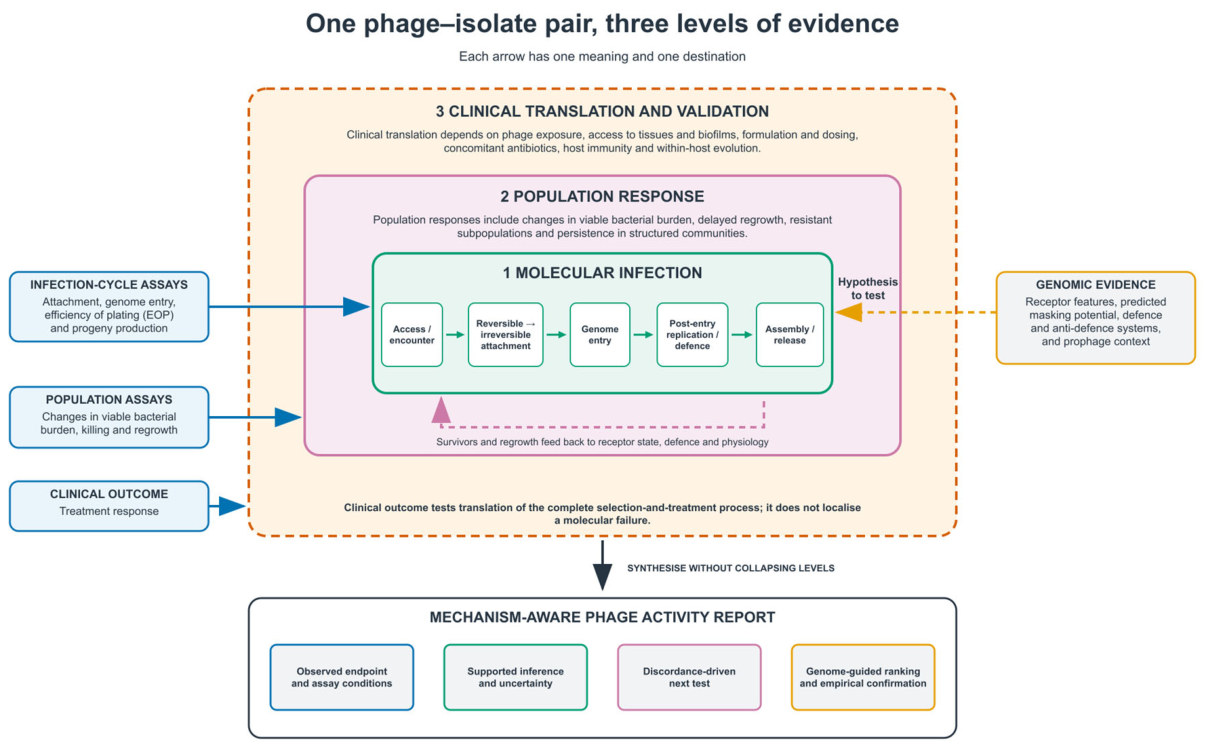
Figure 3.
Evidence across 45 selected sources from 2020–2026, including six preprints. Coloured dots denote addressed constructs, including indirect associations. Neutral squares denote additional experimental panels; diamonds denote external predictive tests. Mus musculus, Galleria mellonella larva, Caenorhabditis elegans and Homo sapiens pictograms identify settings, which include virulence assays and do not establish clinical validation. Pair bases retain distinct units and must not be pooled; selected colonies and engineered derivatives are not independent clinical pairs. Gaborieau and Howell are cross-species context. Gaborieau’s 38,688 Escherichia pairs exclude the separate 100-isolate E. coli cocktail test. Noonan’s external test concerns E. coli; its displayed 437 P. aeruginosa pairs are internal. Supplementary Table S1 and Table S3 provide definitions, locators and qualifications. AMR, antimicrobial resistance; PST, phage susceptibility testing; AST, antimicrobial susceptibility testing; EOP, efficiency of plating; CFU, colony-forming units; MIC, minimum inhibitory concentration; MLC, minimum lytic concentration; ATP, adenosine triphosphate; OD, optical density; NR, not reported or recoverable; NA, not applicable; CF, cystic fibrosis; Pae, Pseudomonas aeruginosa.
Figure 3.
Evidence across 45 selected sources from 2020–2026, including six preprints. Coloured dots denote addressed constructs, including indirect associations. Neutral squares denote additional experimental panels; diamonds denote external predictive tests. Mus musculus, Galleria mellonella larva, Caenorhabditis elegans and Homo sapiens pictograms identify settings, which include virulence assays and do not establish clinical validation. Pair bases retain distinct units and must not be pooled; selected colonies and engineered derivatives are not independent clinical pairs. Gaborieau and Howell are cross-species context. Gaborieau’s 38,688 Escherichia pairs exclude the separate 100-isolate E. coli cocktail test. Noonan’s external test concerns E. coli; its displayed 437 P. aeruginosa pairs are internal. Supplementary Table S1 and Table S3 provide definitions, locators and qualifications. AMR, antimicrobial resistance; PST, phage susceptibility testing; AST, antimicrobial susceptibility testing; EOP, efficiency of plating; CFU, colony-forming units; MIC, minimum inhibitory concentration; MLC, minimum lytic concentration; ATP, adenosine triphosphate; OD, optical density; NR, not reported or recoverable; NA, not applicable; CF, cystic fibrosis; Pae, Pseudomonas aeruginosa.
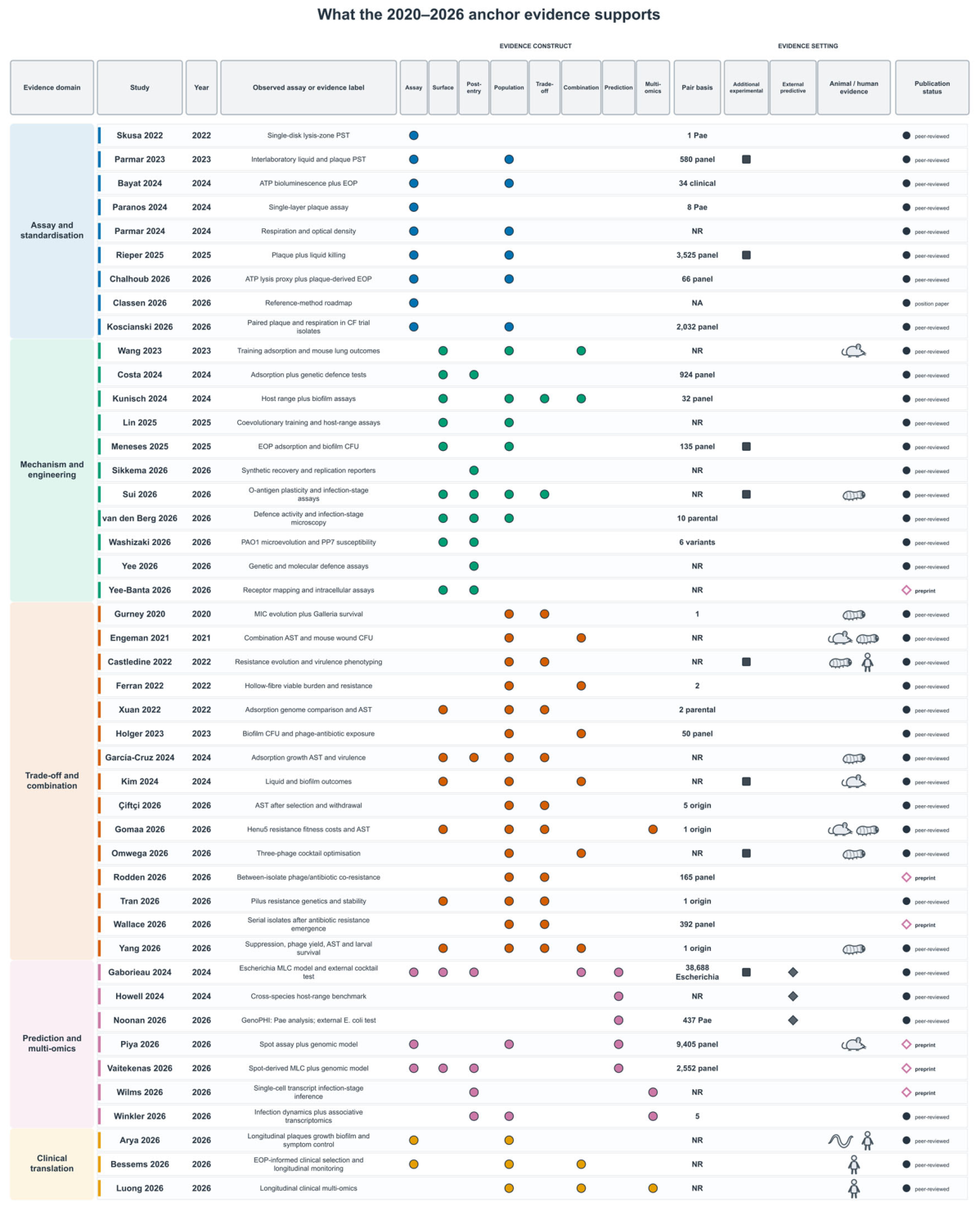
Table 1.
PFU, plaque-forming units; CFU, colony-forming units; EOP, efficiency of plating. Assays should be named by their directly measured construct. Inferential reach depends on the protocol and cannot be upgraded by applying a binary susceptible/resistant label.
Table 1.
PFU, plaque-forming units; CFU, colony-forming units; EOP, efficiency of plating. Assays should be named by their directly measured construct. Inferential reach depends on the protocol and cannot be upgraded by applying a binary susceptible/resistant label.
| Assay or endpoint | Direct construct | What may be inferred | Principal non-specificity | Minimum context |
| Spot clearing | Local clearing at stated input | No infection-stage inference without dilution and preparation controls; screening activity only | Lysis from without, enzymes, non-productive effects | Phage titre, dilution series, lawn state, medium, time, lysate controls |
| Plaque / EOP | Infectious plaques; relative plating efficiency | Completion of repeated infection cycles in plaque-forming fraction | Reference-host denominator, diffusion, threshold | Reference host, PFU, replicates, threshold, plaque morphology |
| Adsorption | Loss of recoverable free infective phage, or validated cell association | Apparent attachment is conditional for supernatant-depletion assays | Decay, aggregation, non-specific sorption and reversible binding; no proof of entry | Time course, decay and sorption controls, paired cell-associated measure where available |
| Genome entry | Operationally defined intracellular phage genome | Attachment and delivery when extracellular and surface-bound DNA are excluded | Implementation-dependent; no proof of takeover or progeny | Entry definition, extracellular-DNA control, timing, normalisation |
| One-step growth / amplification | Released infectious progeny when infective particles are counted | Productive infection in the measured permissive fraction | “Amplification” without separation of input particles is less specific; averages heterogeneous cells | Initial PFU/mL and CFU/mL, nominal input ratio, removal of unadsorbed input, latent period, burst definition, recovery method |
| Liquid killing / regrowth | Time-resolved population trajectory | Net suppression; regrowth only when the trajectory and rule permit it | Growth, debris, metabolism, resistance and amplification are conflated | Initial PFU/mL and CFU/mL, nominal input ratio, medium, duration, replicates, regrowth rule |
| Biofilm population assay | Named biomass, viability or metabolic outcome | State-specific population response | Outcome depends on biofilm model and readout | Biofilm age, matrix/model, dosing sequence, exposure and recovery |
Table 2.
Claims about phage steering require different experiments. Combination efficacy, inherited collateral sensitivity, suppression of escape and durability should not be merged into a single “synergy” outcome.
Table 2.
Claims about phage steering require different experiments. Combination efficacy, inherited collateral sensitivity, suppression of escape and durability should not be merged into a single “synergy” outcome.
| Claim | Required comparison | Essential design features | Interpretation limit |
| Phage–antibiotic interaction | Combination versus both monotherapies under a stated null | Dose matrix, timing/order, replicates, viable burden and regrowth | Does not prove inherited change |
| Evolutionary steering | Independent phage-selected lineages versus ancestral and control-passaged bacteria | Resistance confirmation, mechanism, AST/MIC, fitness or virulence phenotype | Applies to observed routes, strains and drugs |
| Resistance suppression | Escape frequency or resistant burden with cocktail/combination versus comparator | Adequate population size, receptor diversity, longitudinal sampling | May reflect ecological suppression rather than a fitness trade-off |
| Durability | Selected phenotype before and after passage without phage | Multiple lineages, defined withdrawal period, genotype and phenotype | Short-term persistence is not clinical stability |
Table 3.
Study-level examples show that AMR, fitness, resistance suppression and durability are supported by different designs. The table is illustrative rather than a pooled effect synthesis.
Table 3.
Study-level examples show that AMR, fitness, resistance suppression and durability are supported by different designs. The table is illustrative rather than a pooled effect synthesis.
| Study and system | Selection or combination design | Supported trade-off or population claim | Durability or validation | Principal limit |
| Chan et al., OMKO1 [17] | Phage selection through an OprM-dependent infection route | Efflux-associated escape was linked to increased antibiotic susceptibility in the tested backgrounds | Mechanistic receptor-dependency and susceptibility testing | Does not establish a universal single-receptor mechanism or universal resensitisation |
| Gurney et al. [47] | OMKO1 serial transfer with three antibiotics and a Galleria experiment | Antibiotic-susceptibility change persisted under continued coevolutionary exposure and was observed in vivo | Ten transfers (approximately 70 generations in controls) under continued phage exposure, plus an in-vivo host model; withdrawal durability was not tested | One PAO1 background; receptor mechanism was not resolved |
| Xuan et al. [48] | A phage-resistant PAO1 variant tested for adsorption, genotype and AST | Reduced adsorption accompanied sensitisation to gentamicin and polymyxin B | Orthogonal adsorption and genomic characterisation | One variant with many mutations; causality and drug breadth remain limited |
| Ferran et al. [55] | Phages and ciprofloxacin in a hollow-fibre infection model | Scheduled combination suppressed resistant populations | Clinically simulated exposure profiles | Population interaction, not inherited collateral sensitivity |
| García-Cruz et al. [49] | Resistant derivatives from two phage variants in PA14 and two clinical strains | Virulence and AST changes differed by phage, strain and drug | Adsorption, growth, AST and Galleria phenotyping | Three bacterial backgrounds and selected routes |
| Kim et al. [11] | Receptor-complementary phages combined with antibiotics | Broad population coverage and resistance suppression | Clinical-isolate, biofilm and wound-model evidence | Combination efficacy is not an inherited collateral phenotype |
| Kunisch et al. [12] | Biofilm-directed training and resistance-adapted cocktail | Host-spectrum and biofilm-performance changes with an escape-cost strategy | Repeated laboratory biofilm evolution | Training ecology and panel are proof of concept |
| Tran et al. [52] | 128 colonies selected by a type IV pilus-targeting phage | Diverse pilus-system escape routes lost twitching motility; one pilD duplication reverted | Passage after removal of phage pressure | One ancestral strain and one selecting phage; no general AST claim |
| Çiftçi et al. [54] | Five clinical isolates exposed to one phage, followed by withdrawal | Bidirectional categorical disc-diffusion AST changes were retested after release from selection | Longitudinal laboratory phenotype | Short duration and strain/exposure specificity |
| Gomaa et al. [53] | Three Henu5-resistant mutants derived from one ancestral pair | Type IV pilus-associated resistance accompanied antibiotic-susceptibility and fitness changes in the tested derivatives | Genetics, transcriptomics, larvae and mouse phenotyping | One ancestral system; R6 had adverse MIC changes; independent selection lineages and mutation-specific causality unestablished |
| Omwega et al. [58] | Ten three-phage combinations compared after selection from a larger candidate set | Defined-model cocktail interactions, biofilm activity and resistance suppression | Clinical-isolate panel and Galleria validation | Preclinical combination optimisation, not an inherited AMR trade-off |
| Yang et al. [60] | One phipa10–ZS-PA-35 system with three antibiotic combinations and selected derivatives | Suppression, infectious yield, selected-isolate MICs and larval survival depended on drug and endpoint | OD and phage recovery, AST, biofilm-biomass assays and Galleria survival | No additional preformed-biofilm biomass benefit; bidirectional AST changes; no withdrawal-durability test |
Disclaimer/Publisher’s Note: The statements, opinions and data contained in all publications are solely those of the individual author(s) and contributor(s) and not of MDPI and/or the editor(s). MDPI and/or the editor(s) disclaim responsibility for any injury to people or property resulting from any ideas, methods, instructions or products referred to in the content. |
© 2026 by the authors. Licensee MDPI, Basel, Switzerland. This article is an open access article distributed under the terms and conditions of the Creative Commons Attribution (CC BY) license (http://creativecommons.org/licenses/by/4.0/).
Copyright: This open access article is published under a Creative Commons CC BY 4.0 license, which permit the free download, distribution, and reuse, provided that the author and preprint are cited in any reuse.