

Submitted:
14 November 2026
Posted:
16 November 2026
You are already at the latest version
Abstract
Urban climate governance requires actor coordination, integration of distributed knowledge, and iterative revision of public action. Municipal communication is identified as relational infrastructure that can delineate climate governance, assign public responsibilities for its management, and shape conditions for acceptance or rejection of environmental policies. Its conceptualization in specialized climate action literature is asymmetrical in relation to governance, participation, and sustainability as an established core. A non-exhaustive, theoretically oriented conceptual review guided by a problematizing logic compares the treatment of communication across four academic traditions: climate and collaborative governance; participation, coproduction, and deliberation; climate change communication; and collaborative planning and interpretive approaches. A communication model for adaptive urban climate governance, conceived as an institutional configuration, is developed through mechanisms including social problem translation, institutional coordination, and legitimation. Its dimensions (integration, continuity, connectivity, reciprocity, accessibility, contestability, and linkage to decision-making) condition communicative governance capacity. The model connects mechanisms with an analytical sequence and its scope conditions, incorporating a loop of strategic orientation, interaction, implementation and participation, feedback, and learning for institutional readjustment and climate policy adaptation. The proposal enables examination of communicative configurations that may contribute to adaptive and procedurally legitimate urban climate governance, without attributing automatic effects on effectiveness to them.
Keywords:
urban climate governance
; municipal communication
; relational infrastructure
; communicative governance capacity
; citizen participation
; legitimation
; institutional learning
; adaptive governance
1. Introduction
The management of climate governance takes place in contexts of conflict, polarization, and contestation over the legitimacy of public action. Despite the broad scientific consensus, the formulation and implementation of climate policies are shaped by dynamics of misinformation, competing interpretive frames, and strategies of contestation promoted by actors with divergent interests [1]. In this context, communication cannot be understood solely as a channel for transmitting information and mobilizing people, but rather as a relational infrastructure in which the contours of the problem are delineated, public responsibilities are assigned, and the conditions for the acceptance or rejection of environmental policies are shaped. In this sense, communication plays a role both in constructing the public problem and in establishing the conditions necessary to articulate mechanisms of participatory governance [2,3,4,5].
This dynamic is particularly relevant in urban settings, as cities concentrate climate change impacts, powers to intervene, and opportunities for institutional experimentation. The literature has shown that local governments play an increasingly important role in climate adaptation and mitigation, articulating governance arrangements that combine interinstitutional coordination and the participation of different social actors with dynamics of interaction, learning, and the joint development of capacity through the coproduction of knowledge [6,7].
In the field of urban sustainability, this participatory approach has made it possible to analyze how cities address complex problems through flexible institutional configurations and processes of socio-environmental transformation [8,9,10]. The involvement of social actors is associated with greater legitimacy, the incorporation of situated knowledge into decision-making, and deliberative processes intended to strengthen the legitimacy of environmental policies [11]. However, the literature has also highlighted persistent limitations related to power inequalities, biases in representation, and symbolic uses of participation that do not substantively alter public decisions [12,13].
In addition to the formal distribution of powers, local climate action raises a question of relational management. Municipal governments must take on climate objectives, coordinate units and levels of government, mobilize scientific and situated knowledge, and justify decisions whose uncertainty, costs, and benefits are unevenly distributed. Legal authority, resources, and institutional architecture delimit political and administrative management; at the same time, their exercise depends on relationships capable of connecting strategies, their implementation, and the review of policies and their development through actions. The manifest gap between emergency declarations, effective responsibilities, and available resources illustrates that the strategic orientation of climate action acquires transformative capacity only when it is linked to organizational and social processes that can sustain it over time [14,15].
In urban climate governance, relational management cuts across municipal departments, territorial scales, social organizations, and economic actors, and is conditioned by powers, resources, and distributive conflicts [9,14]. In this sense, participation and coproduction as processes allow us to broaden the focus by recognizing the role of citizens and organizations of different kinds, which contribute situated knowledge, resources, and evaluative criteria that complement those of the administration [16,17,18].
Despite the interaction, deliberation, and social involvement that characterize participatory governance, communication occupies a secondary analytical position. In much of the research analyzed, it appears to be associated exclusively with instrumental functions such as disseminating information, raising awareness, or supporting participatory processes, without constituting an autonomous theoretical dimension. This omission is significant given that collaborative governance processes depend on dynamics of interpretation, negotiation, and consensus-building that are themselves communicative processes.
The climate communication literature has shown that interpretive frames influence risk perception, support for policies, and the formation of public controversies around climate change [3,19]. Nevertheless, these contributions have largely developed separately from governance studies, producing a significant disconnect between two fields that analyze interdependent dimensions of the same phenomenon. This mismatch is not merely descriptive but conceptual. The participatory governance of urban sustainability has been built on three extensively developed dimensions (governance, participation, and sustainability) while communication remains an implicit infrastructure, rarely treated as an object of analysis. Consequently, institutional coordination and social involvement tend to be explained without systematic attention to the communicative processes through which climate problems are rendered intelligible, policies are justified, and actors construct positions around them.
The municipal sphere is a particularly relevant level at which to examine this tension between participatory governance and communication. At the intersection of expert knowledge, political priorities, administrative routines, sectoral departments, social organizations, citizens, and territorial experiences, communication, as a relational infrastructure, constitutes a component of dialogue, argumentation, and interpretation in participation and coproduction processes. It serves to disseminate information on risks, objectives, and measures; raise awareness and mobilize through frames and values; and support outreach and the facilitation of participatory processes across the formulation, implementation, evaluation, and review of environmental policies.
The theoretical gap identified consists in the underspecification of the processes through which actors involved in urban climate governance construct sufficiently shared interpretations, translate scientific, administrative, and situated knowledge, align expectations and responsibilities, connect participation and decision-making, publicly justify their choices, process proposals, and incorporate feedback. When municipal communicative action is subsumed under dialogue, trust, or collaboration, theory identifies relational dynamics and outcomes but does not develop the pathways that turn interaction into learning and institutional adaptation.
This limitation has analytical consequences: dialogue, trust, and collaboration can be described as the outcome of coherent and responsive relationships without analyzing the practices that sustain or erode them; and learning can be invoked as an adaptive attribute, although it is identifiable only when feedback is interpreted and modifies routines, criteria, instruments, or frameworks for institutional adaptation. Analyzing these shifts makes it possible to formulate relationships between participatory governance and communication without attributing absolute effects, which also depend on authority, resources, power, and the political context, among other factors.
The research question is formulated as follows: How does the urban climate governance literature conceptualize municipal communication, and what implications does its treatment have for understanding the processes of translation, coordination, and legitimation that sustain local climate action? The answer is developed through a conceptual review guided by problematization and oriented toward middle-range theory. The study makes three contributions: (1) it reconstructs the asymmetry between an established explanatory core and a fragmented treatment of communication; (2) it defines communication as relational infrastructure and differentiates it from the communicative capacity implicit in governance; and (3) it formulates a mechanism-based model that leads to a conditioned analytical sequence and proposes communicative learning outcomes to contribute to the study of communication in adaptive urban climate governance.
2. Methodological Strategy: Design of the Conceptual Review and Its Analytical Procedure
The article develops a non-exhaustive, theoretically oriented conceptual review guided by a problematizing logic. This design is appropriate when related bodies of literature share relational problems but organize their concepts around different units and purposes. A problematizing review does not seek to consolidate consensus by accumulating studies; rather, it interrogates assumptions that constrain explanation and reconstructs alternative conceptual relationships [20]. In this case, problematization examines what is lost when communication is treated solely as dissemination, awareness-raising, or operational support, and whether that reduction moves away from mechanisms of translation, coordination, and legitimation relevant to achieving institutional learning outcomes.
The contribution is oriented toward middle-range theory. This entails constructing concepts and relationships that are sufficiently abstract to be transferable across municipal contexts, but delimited by mechanisms and conditions that allow their refinement and testing. Middle-range theory connects problems, processes, and consequences without claiming to provide a universal explanation of governance [21,22], enabling the design of a theoretical-conceptual model that specifies constructs, how they relate, why those relationships matter, and under what conditions they may vary [23]. The proposal represents an analytical architecture open to cumulative refinement.
This methodological strategy serves the purpose of a review oriented toward conceptual development rather than aggregation, exhaustive mapping, or the estimation of frequencies. The literature was assembled progressively through exploratory and conceptually oriented searches in Web of Science, iterative selection of seminal and specialized contributions, and cross-reference tracking. Selection was guided by relevance to the research question, suitability for characterizing the conceptual traditions mobilized, and explanatory usefulness for specifying the relationships between governance, participation, sustainability, and communication.
The comparison of academic contributions was organized around four traditions: (1) climate and collaborative governance, which addresses architectures of interdependence, authority, and joint action; (2) participation, coproduction, and deliberation, which examine citizen involvement, knowledge, and democratic authority; (3) climate change communication, which analyzes information, frames, specific publics, and commitments; and (4) collaborative planning and interpretive approaches, which study the discursive constitution of problems and agreements. Sustainability and climate action operate across all four traditions as a cross-cutting substantive problem, a normative horizon, and a conflict of transformation.
The analytical procedure was organized into four related operations: (1) problematization interrogated the tendency to treat communication as dissemination, awareness-raising, or operational support and examined the explanatory loss that this reduction could produce; (2) comparative delimitation contrasted the research question, the unit of analysis, and the role of communication across the four academic traditions; (3) synthesis oriented toward relevant mechanisms identified underspecified communicative processes—translation, coordination, and legitimation; and (4) theoretical articulation defined the construct, distinguished between infrastructure and communicative capacity (relevant mechanisms), and identified its dimensions, scope conditions, and proximate outcomes.
Three problematizing questions organized these four operations and remained subordinate to the main research question: the first examined how explanatory work is distributed among governance, participation, and sustainability; the second, what positions communication occupies and which functions remain implicit; and the third, what reconstruction would make it possible to integrate them into an infrastructure without turning communication into an equivalent or totalizing dimension. These questions functioned as rules for comparative reading: they do not constitute additional research questions and do not purport to represent all internal variations within the four traditions identified.
Conceptual construction combined differentiation, integration, and specification. Differentiation separated infrastructure, governance mechanisms as communicative capacity, and learning outcomes; integration connected contributions distributed across the literature; and specification formulated relationships with observable conditions and interruptions. These operations are characteristic of conceptual articles that reorganize existing knowledge to open up new explanations [24,25]. General review typologies were used only to distinguish the purpose of conceptual development from other designs [26,27], following criteria of conceptual discipline applicable to model development [28,29,30].
The outcomes derived from the procedure are a comparative matrix of the treatment of communication, a proposed definition of relational infrastructure, a model structured around mechanisms, dimensions, sequence, and conditioning factors, four theoretical-analytical propositions, and an agenda for future testing. The development of these outcomes was guided by the criteria of internal coherence, differentiation from related concepts, parsimony, explanatory usefulness, traceability between the problem and the proposal, and capacity to guide subsequent research. These criteria do not replace empirical validation. They make it possible to delimit the conceptual consistency and generative capacity of the proposal, as well as to identify which relationships require operationalization and which claims must remain contingent.
3. Communicative Asymmetry in Urban Climate Governance
3.1. Governance, Participation, and Sustainability as an Established Core for Climate Action
Collaborative governance explains how public and non-public actors acquire the capacity for joint action when none controls the relevant resources alone. In this context, Ansell and Gash [6] place structured interaction, trust, and commitment at the center of the development of collaboration, while Emerson et al. [7] articulate shared motivation, procedural capacity, and collaborative action. In the climate field, multilevel configurations and urban networks add problems of scale, fragmentation, and institutional transformation, including the specific relationships between citizens and municipalities [8,9,13,14]. This tradition identifies decisive relational outcomes but usually treats them at an aggregate level that does not facilitate analysis of the communicative practices through which they are produced.
Participation introduces distributed knowledge and raises the question of who holds authority during the process. Coproduction highlights the complementarity between public and citizen capacities [18], while participatory designs vary according to who participates, how reasons are exchanged, and what authority accompanies the process [17]. Warnings about symbolic participation show that formal access can coexist with control over the agenda, unequal resources, or predetermined decisions [12,31].
Sustainability and climate action organize the content and direction of transformation, while urban transitions involve changes in technologies, practices, infrastructures, the distribution of costs, and criteria of justice. They therefore cannot be reduced to mere procedural coordination [10]. Climate resilience and adaptation require the integration of heterogeneous forms of knowledge and the management of levels of uncertainty, but also decisions between alternatives with distributive effects [32].
Urban climate action is also a particularly demanding case for this relational architecture because it combines uncertainty about trajectories and effects, interdependence among sectors and scales, the contested distribution of costs and benefits, time horizons that extend beyond ordinary decision-making cycles, and the need to revise action as knowledge and implementation conditions change [9,14,33]. This combination highlights the problems of translation, coordination, justification, and feedback in climate policy, and urban governance concentrates with particular intensity the conditions under which a relational infrastructure may be analytically relevant.
Systemic approaches shift attention from isolated forums to circulation among multiple deliberative and decision-making spaces [11,34,35].
The systematic review by Lorenz Fontolan et al. [36], focused on the literature published on climate governance and urban planning between 2020 and 2025, identifies a thematic structure dominated by urban governance and sustainable development, adaptation and nature-based solutions, risk, vulnerability and participation, territorial planning, mitigation, and environmental policy. Although its restriction to urban planning does not in itself permit inferences about the position of communication across the literature as a whole, its findings corroborate the recent centrality of problems of institutional coordination, adaptation, participation, and sectoral integration around which the reconstruction of the asymmetry between governance, participation, and sustainability, and the treatment of communication for climate action, is organized.
3.2. Treatment of Communication in the Identified Traditions
In the scientific literature analyzed, communication appears as a term for information about risks, objectives, and measures; support for outreach and the facilitation of participatory processes; awareness-raising and mobilization through frames and values; or a constitutive component of dialogue, argumentation, and interpretation. These positions are not symmetrical. The first three tend to locate communication in bounded episodes or functions, while the fourth makes it possible to analyze how meanings and courses of action are produced relationally. In the traditions examined, however, none of these positions by itself articulates a meso-organizational level within public administration at which organizational structures, routines and procedures, the distribution of responsibilities, available resources, organizational culture, coordination mechanisms, decision-making processes, relationships between departments or units, external interfaces, public responses, and feedback into decisions are continuously connected.
The first position is transmissive-informational. Communication consists in disseminating objectives, risks, measures, and recommendations from institutions or experts to defined publics. This position fulfills a basic function of availability and orientation, but offers limited resources for analyzing reinterpretation, response, or the incorporation of situated knowledge. When more information is presumed to lead to understanding or support, exposure, intelligibility, and recognition are conflated [13,14]. Transmission may be necessary, although it does not in itself specify reciprocity or feedback into decision-making.
The second position is participatory-facilitative. Communication appears as outreach, exchange, facilitation, deliberation, or reporting back within participatory arrangements. This position makes it possible to observe that participation depends on modes of communication and rules of authority, and that inclusion is not equivalent to mere presence [17,37]. Recent literature on environmental communication and deliberation reinforces the need to connect knowledge production, public argument, and governance [38]. A limitation arises when the forum is taken as a self-sufficient unit and the circulation of contributions into administrative routines and decision-making spaces remains less specified.
The third position is interpretive-mobilizing. Climate change communication research has shown that frames, values, identities, and perceptions of efficacy influence the public construction of the problem and forms of engagement [3,4,39,40]. Frame analysis provides precise tools for examining attributions of responsibility, uncertainty, and alternatives for action [19]. Its contribution focuses mainly on messages, meanings, publics, and mobilization; its connection with interdepartmental routines, administrative responsibilities, and policy review requires a further shift toward the meso-organizational level.
The fourth position is constitutive-relational. Collaborative planning and interpretive approaches consider problems, identities, and courses of action to be produced through interpretation, argumentation, and the negotiation of meanings [2,41,42,43,44,45,46]. Dialogue acts not only as a channel but also as part of the formation of agreements, controversies, and criteria for action. Its development focuses on the discursive and interpretive constitution of public action.

Table 1.
Comparative treatment of communication in the identified traditions.
| Tradition | Main explanatory problem | Role attributed to communication | Limitation in relation to the problem analyzed |
|
(1) Climate and collaborative governance Ansell and Gash [6]; Emerson et al. [7]; Bulkeley and Betsill [14]; Evers and Schmid [13] |
Interdependence, authority, resources, scales, and joint action. | Transmissive-informational: a condition for interaction, trust, and coordination; sometimes institutional dissemination. | Translation, alignment, and recurrent interfaces remain less specified. |
|
(2) Participation, coproduction, and deliberation Arnstein [31]; Ostrom [18]; Fung [17]; Mansbridge et al. [35] |
Actor involvement, distributed knowledge, inclusion, and authority. | Participatory-facilitative: outreach, exchange, facilitation, deliberation, and reporting back. | Circulation from forums to administrative routines and decision-making may remain unclear. |
|
(3) Climate change communication Nisbet [3]; Moser [4]; Schäfer and O’Neill [19]; Vujić et al. [47]; Mačiulienė et al. [48] |
Information, frames, risk, values, publics, engagement, and mobilization. | Interpretive-mobilizing: its central object is identified with messages, framing, narratives, reception, and engagement. | Although recent studies advance toward the urban and municipal scale, integration among external communication, internal routines, and decision-making circuits remains less developed. |
|
(4) Collaborative planning and interpretive approaches Healey [43]; Fischer [44]; Innes and Booher [46]; Hajer and Wagenaar [45]; Hajer and Versteeg [2] |
Discursive constitution of problems, agreements, and courses of action. | Constitutive-relational: interpretation, argumentation, negotiation of meanings, and coordination. | The specification of municipal organizational arrangements, continuity, and feedback into decisions remains less elaborated. |
Source: authors’ own elaboration.
The four positions of communication do not form an evolutionary scale, since an administration may combine transmissive information, participatory facilitation, mobilization, and relational interpretation according to the issue and the stage of the policy cycle. The comparison identifies a tendency to distribute communication among partial functions or implicit concepts. More recent literature indicates, however, that these positions may change. On the one hand, problems of translation between climate knowledge and urban planning have been identified, as have persistent disconnects between policymakers and citizens in different countries [47]. On the other hand, Mačiulienė et al. [48] treat municipal communication on institutional adaptation as a distinct empirical object by analyzing the public communication channels of all 60 Lithuanian municipalities and citizens’ perceptions. Both studies show growing attention to communication within local climate action. At the same time, their focus remains primarily on communication between groups of actors, public strategies, channels, information, and engagement. This development does not, however, eliminate the gap identified in the research, since the conceptualization of a meso-organizational and relational infrastructure connecting external communication, internal routines, authority, feedback, and the review of public action remains very underdeveloped.
Figure 1 synthesizes the diagnosis and represents analytical functions for governance, participation, and sustainability, situating the identified theoretical traditions and their explicit or partial connections with the treatment of communication.
This figure relates the four reviewed traditions to the identified communicative positions, taking governance, participation, and sustainability as the central core for climate action, with specific and distinct analytical functions. Solid lines represent explicit associations; dashed lines represent partial or inferred connections. Climate and collaborative governance is implicitly linked to a transmissive-informational position and also to a constitutive-relational position. This association is justified, on the one hand, by outreach and reporting back on the results of joint interaction, which allow a transmissive-informational component to be inferred; on the other, by exchange in a context in which problems and consensus about them are constructed, allowing a second, constitutive-relational dimension to be identified. Participation, coproduction, and deliberation explicitly develop a participatory communicative function that facilitates inclusion, the generation of knowledge, dialogue, and the negotiation of meanings from the perspective of participatory democratic authority. Climate communication is expressly linked to the transmissive-informational and interpretive-mobilizing positions through mobilization strategies tied to information and framing. Finally, collaborative planning and interpretive approaches develop the constitutive-relational position through the discursive construction of problems and agreements. The connections established express non-exclusive conceptual intersections based on communicative functions or positions whose integration into policy management for urban climate action is specified only sparsely or insufficiently in the literature.
4. Municipal Communication as Relational Infrastructure for Climate Governance
4.1. Definition, Delimitation, and Dimensions of Relational Infrastructure
Municipal communication’s relational infrastructure is defined as the institutional configuration of procedures, routines, interfaces, responsibilities, resources, and practices intended to sustain, with varying degrees of continuity, the dissemination of knowledge, coordination among actors, and the justification and contestation of climate decisions throughout the local policy cycle.
Infrastructure is the organized and relatively stable foundation that connects units, actors, and stages of the policy cycle [49], while communicative governance capacity is identified with the mechanisms for disseminating information, coordinating and articulating participation, managing disagreements, sustaining legitimation, and incorporating feedback. Formal infrastructure can exist without effective capacity when communication channels are inactive, unidirectional, or lack authority. Temporary capacities can also emerge during a crisis or consultation without becoming institutionalized in lasting routines. The existence of communication channels therefore guarantees neither reciprocity, coordination among actors, nor institutional learning.
Collaborative governance provides a broad relational context in which to situate communication for climate action as a specific infrastructure. The proposal expands the scope of analysis and formulates this relational infrastructure as a meso-organizational construct for analyzing translation, coordination, legitimation, and also its adaptation to urban climate governance through seven dimensions that condition the communicative governance capacity that may be adopted: its degree of institutional integration, temporal continuity, cross-cutting connectivity, reciprocity, accessibility, contestability, and linkage to decision-making.
The construct is specified through these dimensions, which are not introduced as an independent normative list but derived analytically from the discontinuities identified and the differential contributions of the traditions examined: integration, continuity, and connectivity specify the organizational problem of sustaining relationships among units, actors, and stages of the policy cycle; reciprocity, accessibility, and contestability develop the relational and democratic problem of how contributions circulate, are understood, and can be challenged; and linkage to decision-making specifies the connection between exchange, authority, and review. Taken together, the seven dimensions bring the theoretical reconstruction of the asymmetry of urban climate communication to the meso-organizational level without constituting a cumulative scale.
Institutional integration, temporal continuity, and cross-cutting connectivity are identified as structural dimensions: integration prevents climate communication from being restricted to a single centralized issuing unit; continuity situates implementation over the long term, beyond isolated campaigns and consultations, generating accumulation in municipal action; and connectivity links departments, levels of government, expert knowledge, social actors, and territorial experiences.
Reciprocity, accessibility, and contestability, in turn, emerge as relational and democratic dimensions: reciprocity entails the capacity to listen, record, respond, and report back, not merely to issue messages. Accessibility is not reduced to formal availability but concerns the cognitive, linguistic, technological, and organizational conditions that allow information to be understood and used; contestability designates the institutional possibility of questioning reasons, raising objections, and receiving high-quality responses from the infrastructure. The unequal distribution of communicative resources can constrain all three dimensions.
The seventh dimension is linkage to decision-making: communicative exchange between the institution and citizens becomes particularly relevant to governance when connected to the formulation, implementation, evaluation, or review of climate policies. This connection can take different degrees: a contribution may inform a decision, modify a procedure, or change a priority; however, not all reporting back implies direct influence. Relational infrastructure makes it possible to trace the process and analyze when authority is absent, responsibilities are diffuse, or communication is limited to a simple process of dissemination and feedback without altering municipal action.
4.2. Mechanisms and Conditions of Relational Infrastructure
Conceptualizing municipal communication as relational governance infrastructure entails articulating relationships among institutions, social actors, and socio-environmental problems, thereby shaping the mechanisms and conditions under which interaction among them occurs.
The social translation of complex climate action problems is the first mechanism through which issues characterized by high technical uncertainty are transformed into socially intelligible meanings. It is identified as reciprocal mediation among scientific, administrative, and situated knowledge [4,44]. This entails simplifying projections for non-expert publics, grounding scenarios in specific municipal territories, explaining legal and budgetary constraints, and allowing experiences of vulnerability, mobility, housing, or the use of space to reformulate administrative categories so that they can be properly addressed. Reciprocity, moreover, prevents local knowledge from being treated as a subsequent illustration of an already defined problem.
Coordination among actors in contexts of collaborative governance, in which climate communication structures processes of negotiation, exchange, and learning [6,7], makes it possible to align expectations, responsibilities, timing, and dependencies. Communicative coordination includes clarifying who decides, implements, and responds; how to maintain interdepartmental circuits; how to synchronize scales; and how to make commitments and constraints visible. Its immediate outcome is operational or interpretive alignment, although not necessarily a sustained capacity for joint action.
Legitimation through deliberation and participation processes that sustain collective action in contexts of plural interests [34] is particularly relevant at the local level, where the distance between climate ambition and effective implementation capacity depends not only on legitimation processes but also on coordination and public commitment [15]. Communication helps ensure that decisions can be understood, their criteria and consequences can be justified, those affected can challenge them, and the institution responds to those consequences in a traceable and transparent manner [50].
The phases describe stages of the process, while integration, continuity, connectivity, reciprocity, accessibility, contestability, and linkage to decision-making make it possible to identify how the mechanisms as communicative capacity—translation, coordination, and legitimation—develop and can operate at different moments and simultaneously. Translation intervenes both in the initial definition of the problem and in the interpretation of contributions; coordination connects actors, responsibilities, and response circuits; and legitimation runs through the explanation of objectives, the discussion of alternatives, and the justification of decisions. The sequence therefore specifies how these mechanisms can unfold and where they may be interrupted.
The three mechanisms reinforce one another but may also enter into tension: the social translation of complex problems facilitates coordination among actors and institutions but can close off alternatives if it normalizes a single definition or scope of the problem. Coordination maintains the continuity of public policies on climate action but can constrain public action through the autonomy of administrative units. Legitimation links decision-making with collective participation but can become rhetorical when those decisions are predetermined.
Authority, resources, power, fragmentation, polarization and conflict, political commitment, incentives to learn, and the capacity to incorporate contributions appear in this context as conditions implicit in communication as relational governance infrastructure.
4.3. Analytical Sequence of the Infrastructure and Communicative Function
The proposed analytical sequence comprises four related phases: strategic orientation; interaction, implementation, and participation; feedback and learning; and readjustment. These phases make it possible to reconstruct the pathway through which social problems, knowledge, and demands associated with urban climate action can be connected to institutional interpretation and the review of public policies. Their differentiation is analytical: it does not describe a necessarily linear succession or presume that completing one phase guarantees the development of the next. Processes can overlap, move backward, or be interrupted, while their outcomes can modify the initial orientation in an iterative cycle. This recursive reading is consistent with collaborative governance approaches that connect dynamics of collaboration, joint action, and adaptation without reducing them to an automatic sequence of outcomes [7].
The first phase (strategic orientation) encompasses the institutional definition of the climate problem, the formulation of priorities, and the identification of responsibilities, resources, and room for intervention. Its communicative function is transmissive-informational and constitutive-relational, since it consists in making objectives intelligible and making explicit the reasons, uncertainties, and constraints that delimit municipal action. The construction of the problem forms part of public controversy and can be modified through the confrontation of expert knowledge, administrative categories, and territorial experiences [2,44]. Strategic orientation must therefore also be examined in terms of its openness to reformulation and its connection with effective capacities for action, avoiding the equation of the declaration of climate commitments with their integration into municipal management [15].
The second phase (interaction, implementation, and participation) encompasses interdepartmental and multi-actor exchanges through which interpretations are compared, knowledge is incorporated, and expectations and responsibilities are negotiated. Reciprocal translation and coordination are particularly relevant here, since communication must allow both the understanding of institutional criteria and the introduction of experiences capable of challenging them. The participatory-facilitative and interpretive-mobilizing functions are thus identified. Participation is one form of involvement within this phase, but it neither exhausts interaction nor equates to all communicative activity. As Fung [17] shows, participatory designs must be differentiated according to who intervenes, how communication unfolds, and how exchange is connected to public authority.
The third phase (feedback) designates the return of information about proposals, decisions, and implementation experiences. It includes demands, objections, situated knowledge, and assessments of the effects of municipal action. For these contributions to inform institutional review, they require procedures for recording and forwarding them and assigning responsibilities. Public reporting back informs those who have participated about how their contributions were treated, the responses adopted, and the reasons for them. The transmissive-informational and constitutive-relational functions thus appear. The analytical relevance lies in reconstructing the connections between spaces of exchange and administrative and decision-making spaces, in keeping with the systemic perspective on deliberation, which shifts attention from isolated forums to relationships among the different parts of the system [35].
The fourth phase (learning and readjustment) comprises two distinct operations. Learning entails interpreting feedback and reviewing institutional knowledge, assumptions, or criteria; readjustment entails translating that review into modifications to priorities, procedures, instruments, or forms of implementation. Both the interpretive-mobilizing and the constitutive-relational functions are therefore identified.
4.4. Communication Model as Relational Infrastructure for Adaptive Urban Climate Governance
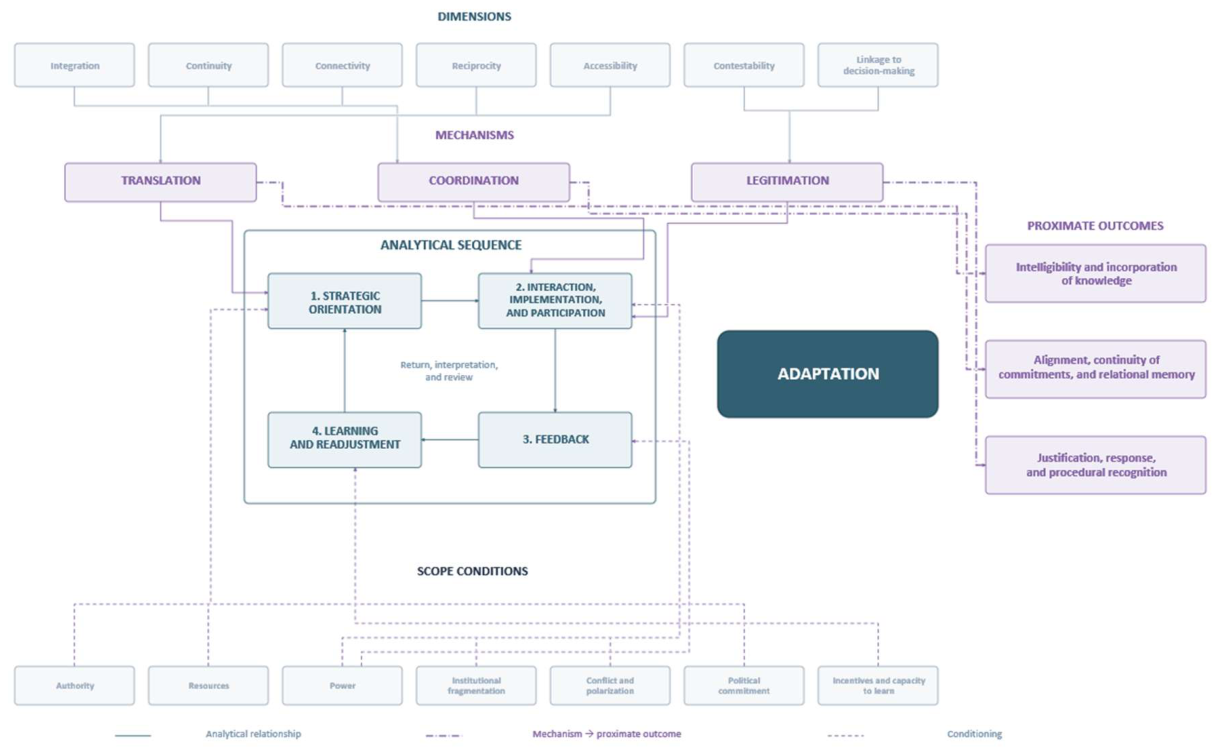
The adaptive governance literature emphasizes the articulation of diverse knowledge, networks, and institutional learning environments as part of capacities for organizational renewal [51,52]. The model developed (Figure 2) proposes this relationship to obtain communicative outcomes and specifies it from a meso-organizational perspective, in which contributions reach actors and spaces with authority to consider them and implement changes. Within the model, institutional adaptation is identified when information and contributions return to spaces with the capacity to review decisions, priorities, procedures, or implementation.
Figure 2 presents a model of communicative relational infrastructure that connects municipal strategic climate orientation with interaction, feedback, and institutional review for learning. To interpret it, five elements should be distinguished: dimensions describe the infrastructure; mechanisms explain the processes it can sustain; the sequence shows their pathway; scope conditions modulate their operation; and proximate outcomes express their possible contributions.
The connections between dimensions and mechanisms reflect three problems: the need to sustain organizational relationships, make knowledge understandable and exchangeable, and justify decisions that can be challenged.
The translation of social problems concerning climate action is linked to two dimensions: reciprocity (understanding of the problem is constructed through two-way exchanges, the institution explains its criteria, and social experiences can reformulate them) and accessibility (knowledge can be incorporated into exchange only if people can understand it and contribute their own experiences, overcoming cognitive, linguistic, technological, or organizational barriers).
Coordination is linked to integration (the incorporation of communication into municipal routines and responsibilities, which makes it possible to connect units and actions), continuity (the recurrence of exchanges that help sustain commitments, responsibilities, and knowledge beyond a one-off campaign or consultation), and connectivity (links among departments, scales, and actors that allow information to be transferred and dependencies among their actions to be recognized).
Finally, legitimation is related to contestability (when institutional justification acquires procedural relevance because its reasons can be challenged and objections receive a response) and linkage to decision-making (by helping connect explanation and exchange with the institutional consideration of contributions; otherwise, legitimation can be reduced to mere rhetorical justification).
The model also represents strong relationships between the mechanisms and the planned analytical sequence: formulation of the climate problem (through the translation mechanism) requires scientific knowledge, administrative criteria, and territorial experiences to be brought into relation. This mediation can modify how risks, priorities, and alternatives are understood and consequently condition the design and orientation of the strategy. Exchange in processes of interaction, implementation, and participation, meanwhile, must be organized to identify who intervenes, who decides, who implements, and who responds, as well as the timing and dependencies among actions (coordination). During this process of exchange and implementation, decisions must be explained, their criteria can be discussed, and those affected must have opportunities to raise objections (legitimation).
Each mechanism is connected to one of three proximate communicative learning outcomes because these are close to the communicative processes analyzed but are not equivalent to climate effectiveness, general legitimacy, or consolidated institutional adaptation: the translation of social problems for climate action can produce intelligibility and the incorporation of knowledge (mediation between languages and experiences can improve understanding of the problem and allow knowledge initially external to the administration to be considered by administrative officials); coordination allows alignment, continuity of commitments, and relational memory (clarification of responsibilities and recurring exchanges can sustain commitments and preserve knowledge of previous agreements, disagreements, and experiences); and finally, legitimation entails justification, response, and procedural recognition (the explanation of reasons and response to objections can help people recognize that their contributions have received traceable and identifiable institutional treatment).
As regards the relationships between the phases of the analytical sequence and scope conditions, strategic orientation is linked to political commitment, since political backing influences the priority given to climate action and the openness of its objectives to review. In interaction, implementation, and participation, power influences who intervenes, what knowledge is recognized, and which contributions receive attention; institutional fragmentation, understood as separation among units, powers, and circuits, can hinder exchange and coordinated implementation; and conflict and polarization can give rise to controversies that condition the exchange of reasons, negotiation, and commitments. In the feedback phase, power again appears as a scope condition affecting the contributions and guidelines conveyed to the learning and readjustment phase. In that phase, authority is relevant because the interpretation of a contribution needs to reach actors with the powers to consider and implement changes; resources are needed to review procedures or actions (time, personnel, knowledge, and material means) as are consistent incentives to review communicative practices and the capacity to learn.
The connections in the model represent selected analytical relationships that are neither exclusive nor sufficient, since they depend on the specific characteristics of local contexts and municipal institutions. Mechanisms can operate in several phases, and scope conditions can modulate the cycle as a whole. Proximate outcomes are contingent and do not automatically imply institutional adaptation or climate effectiveness.
On the basis of this relational infrastructure in a recursive cycle externally conditioned and exposed to distributed interruptions, four propositions are established that express examinable theoretical-analytical relationships, not tested hypotheses. Their symmetry makes it possible to compare mechanisms, proximate outcomes, and conditions without assuming causal sufficiency. The empirical agenda necessary to operationalize them is developed in the discussion section.
Proposition 1.
Translation: reciprocal interfaces among scientific, administrative, and situated knowledge should produce greater shared intelligibility and incorporation of distributed knowledge than segmented and partial dissemination.
Proposition 2.
Coordination: recurrent, cross-cutting communicative arrangements connected to decision-making routines should produce greater alignment of responsibilities, continuity of commitments, and capacity for joint action than episodic arrangements.
Proposition 3.
Legitimation: comprehensibility, public justification, contestability, and response should contribute more to procedural legitimacy than transparency without reciprocity, response, or connection to decision-making.
Proposition 4.
Adaptability: feedback that is recorded, interpreted, and connected to actors with authority should produce greater capacity for review and readjustment than interaction without feedback into decision-making. This fourth proposition connects learning and readjustment, as central components of adaptive governance, with the specific contribution of the model developed: the communicative traceability of the knowledge and experiences generated toward spaces with authority [51,52].
Learning can be analytically distinguished by its scope: at an operational level it modifies formats, timing, or implementation procedures; at a programmatic level it alters instruments, priorities, or the distribution of responsibilities; and at a deep level it reviews the frameworks through which the institution defines the problem, recognizes publics, or evaluates evidence. Adaptability is the capacity of urban climate governance mechanisms to review interpretations, priorities, procedures, or forms of implementation in response to feedback, learning, and adjustment.
5. Discussion
Trust, shared motivation, learning, and the capacity for joint action are relevant to the governance of interdependent problems [6,7]. This contribution does not seek to demonstrate that communication is relevant to collaboration among actors, something already implicit in much of the literature, but to break it down into more specific and analytically observable processes in the context of adaptive urban climate action. Translation, coordination, and legitimation function as sequential mechanisms, and relational infrastructure specifies the meso-organizational foundation that allows them to unfold.
The mechanisms describe processes, as communicative capacities, that connect dimensions, conditions, and proximate outcomes, understood as relational or organizational changes that precede final consequences. The theoretical contribution lies in specifying an intermediate architecture that connects organizational configurations, mechanisms, and proximate outcomes under explicit scope conditions. This hierarchy allows more discriminating explanations of possible interruptions in the model: an infrastructure may enable translation without producing legitimacy, or generate internal alignment without incorporating distributed knowledge. Consequently, effectiveness for climate action remains conditioned by substantive decisions, resources, and contexts that extend beyond communication.
The relevance of this approach is evident in recent research on cocreation, collaborative governance, and municipal climate implementation. Drawing on the experience of the CLEVER Cities project in London, Bradley and Mahmoud [16] analyze cocreation strategies aimed at addressing distrust, participation fatigue, and weak community structures. Their contribution highlights the importance of information exchange, evolving roles, and trust-building for establishing sustained collaborative relationships. Drawing on ethnographic work for the government of Los Angeles, Kaplan Weinger [53] shows how institutional fragmentation, changing mandates, and bureaucratic constraints make it necessary to sustain action through informal coordination, relational practices, and contingent arrangements among actors, resources, and responsibilities. This type of evidence reinforces the need to analyze not only plans and formal structures but also the relational organization through which climate capacity is deployed in the everyday practice of local administrations. Both contributions reinforce the need to analyze, alongside plans and formal structures, the communicative processes and relational organization through which the capacity for climate action is constructed, deployed, or blocked in relationships between local administrations and the actors involved.
5.1. From Climate Communication to Municipal Relational Infrastructure
Climate communication has developed tools for studying messages, frames, risks, publics, and mobilization [4,19,40]. The proposed shift connects these contributions with institutional routines and interfaces. Municipal communication for climate action is conceptualized as a cross-cutting meso-organizational infrastructure, not as an exclusive competence of the communication department or an auxiliary technique of participation. Its analytical unit includes integral relationships among communicative processes, governance, participation, urban sustainability, and administrative procedures.
This meso-organizational level allows us to explain why appropriate messages may have little organizational impact and why intensive citizen participation may not alter government climate action. Relational infrastructure connects the public organization with citizens through participation in the climate policy cycle.
5.2. Feedback, Learning, and Adaptive Capacity
Adaptive governance is identified with the institutional capacity to review interpretations, priorities, procedures, or implementation. In the literature analyzed, learning, institutional flexibility, and multilevel articulation appear as relevant capacities, without being attributed to a single process [51,52]. Thus, in urban climate governance, different communicative pathways are embedded in broad cross-cutting and multi-actor capacities conditioned by resources and institutional transformation [33].
The climate specificity of the model therefore lies less in the exclusivity of its mechanisms than in the configuration of the problem to which they are applied. Translation, coordination, and legitimation can operate in other areas of public policy, but in urban climate action they must do so simultaneously under uncertainty, sectoral interdependence, distributive conflict, and extended time horizons. This combination makes the capacity to maintain feedback and review circuits a central problem of governance and, at the same time, delimits the scope of the proposal: its transfer to other fields should be examined where comparable conditions occur.
The interruptions described show why the loop is not automatic: there can be listening without recording, recording without interpretation, interpretation without response, reporting back without influence, localized learning without organizational change, or operational readjustment without programmatic review. Each discontinuity poses a different evidentiary question. Adaptability is demonstrated neither by a consultation nor by an institutional declaration that learning has occurred, but by traceable relationships among contributions, interpretation, and modification.
5.3. Limitations and Research Agenda
The main analytical implication is that the evaluation of municipal communication should not be limited to campaigns, content, digital presence, channels, or participant numbers. The model proposes examining configurations of integration, continuity, connectivity, reciprocity, accessibility, contestability, and linkage to decision-making. This change of perspective makes it possible to distinguish communicative activity, as an organizational capacity, from infrastructure and to observe whether the arrangements connect departments, actors, and the public climate action policy cycle.
The article has five main limitations: (1) it is a conceptual construction without empirical testing; (2) the selection of literature is not exhaustive and depends on specific influential traditions; (3) the model has not been operationalized; (4) the differentiation among infrastructure, capacity, mechanisms, and outcomes must be demonstrated empirically; and (5) the reconstruction privileges the municipal level and may require adjustments for metropolitan or multilevel relationships. These limitations restrict causal and comparative inferences but make explicit the steps necessary to assess the proposal.
The first future task is conceptual validation: the observability of the seven dimensions, the existence of distinguishable configurations, and the gap between formal infrastructure and deployed communicative capacity must be tested. It must also be examined whether translation, coordination, and legitimation can be separated empirically and whether proximate outcomes can be identified without conflating them with adaptation or final effectiveness. Indicator development must preserve the relational nature of the proposed construct and not reduce it to counts of channels or activities. The second task is to analyze mechanisms and sequences. Comparative studies, documentary analysis, organizational interviews, process tracing, longitudinal analysis, network analysis, and the traceability of contributions can reconstruct how the communicative process is established from an interface through to a decision. Configurational designs would allow combinations of dimensions and conditions to be compared without assuming additive effects. Evidence must address changes in problem definitions, responsibilities, routines, instruments, and frameworks, as well as outcomes reported by actors.
A critical agenda must include institutional capture, rhetorical legitimation, inequalities of access, and selective learning. It must also compare municipal trajectories, resources, fragmentation, territorial scales, and power relations. The model offers criteria for formulating these comparisons but requires cumulative refinement before it can support general recommendations.
6. Conclusions
The urban climate governance literature conceptualizes municipal communication as information, awareness-raising, support for participation, or an implicit component of dialogue, deliberation, and trust-building. The problem is not its absence but the underspecification of the processes that connect knowledge, interaction, and action. The reconstruction shows that the frameworks examined explain institutional architecture, actor involvement, and substantive orientation but articulate the communicative pathways of coordination, participation, and legitimation unevenly.
Relational infrastructure is defined as a variable institutional configuration of arrangements, routines, interfaces, responsibilities, resources, and practices intended to sustain translation, coordination, justification, and contestation throughout the local policy cycle. Its degree of integration, continuity, connectivity, reciprocity, accessibility, contestability, and linkage to decision-making conditions communicative governance capacity.
Legitimation is not equivalent to procedural legitimacy, just as communication is not equivalent to participation. Feedback designates information that returns; learning, its interpretation and incorporation; and readjustment, a change in action. Adaptation requires these operations to reach spaces with authority. Authority, resources, power, fragmentation, polarization and conflict, political commitment, incentives to learn, and the capacity to incorporate contributions condition which forms of knowledge and contestation complete that pathway through the communicative infrastructure of urban climate governance.
The contribution of the model is to shift the question from whether communication matters to a more specific one: which organizational configurations and mechanisms make it possible to explain intelligibility and the incorporation of knowledge; alignment, continuity of commitments, and relational memory; and justification, response, and procedural recognition as communicative outcomes, and when these remain limited to dissemination, consultation, or justification without influence. Its usefulness will depend on demonstrating that the dimensions vary among municipalities, that the mechanisms can be traced, and that proximate outcomes can be distinguished from final consequences conditioned by multiple factors. The architecture can thus be refuted or refined through cumulative comparison of configurations. By specifying mechanisms, dimensions, conditions, and the analytical sequence, the article situates municipal communication within the analysis of urban capacities to respond to climate pressure, institutional complexity, and citizens’ democratic demands.
Author Contributions
Conceptualization, C.C.-A.; methodology, M.-Á.M.-P.; investigation (literature search), M.-Á.M.-P. and C.O.G.; formal analysis, C.C.-A. and M.-Á.M.-P.; writing - original draft preparation, C.C.-A., M.-Á.M.-P. and C.O.G.; writing - review and editing, C.C.-A. and C.O.G.; visualization, C.C.-A. All authors have read and agreed to the submitted version of the manuscript.
Funding
This work was supported by the Spanish National Institute of Public Administration (INAP) under its 2025 Competitive Research Projects Programme through the project CivicCOM-LAB: Prototype of a Citizen Observatory for the Evaluation and Improvement of Public Communication in Local Administrations (project reference: CIVIC). The principal investigator of the project is Conchi Campillo-Alhama.
Data Availability Statement
No new empirical data were collected or generated for this conceptual article. The published works analyzed are identified in the reference list. No separate dataset was generated for this study.
Acknowledgments
During the preparation of this manuscript, ChatGPT (OpenAI) was used to produce an initial English translation of the Spanish manuscript, prior to professional review by a human editor, and to assist in the preparation of the figures. The authors have approved the submitted version and take full responsibility for its content.
Conflicts of Interest
The authors declare no conflicts of interest.
References
- Lewandowsky, S.; Ecker, U.K.H.; Cook, J. Beyond misinformation: Understanding and coping with the “post-truth” era. J. Appl. Res. Mem. Cogn. 2017, 6(4), 353–369. [Google Scholar] [CrossRef]
- Hajer, M.A.; Versteeg, W. A decade of discourse analysis of environmental politics: Achievements, challenges, perspectives. J. Environ. Policy Plan. 2005, 7(3), 175–184. [Google Scholar] [CrossRef]
- Nisbet, M.C. Communicating climate change: Why frames matter for public engagement. Environ. Sci. Policy Sustain. Dev. 2009, 51(2), 12–23. [Google Scholar] [CrossRef]
- Moser, S.C. Communicating climate change: History, challenges, process and future directions. WIREs Clim. Change 2010, 1(1), 31–53. [Google Scholar] [CrossRef]
- Ghiani-Beltrán, L.; Gómez-Martín, M.B. The influence of public knowledge on the use of urban infrastructure for adaptation to climate change: The case of climate shelters in Barcelona. Urban Sci. 2025, 9(11), 452. [Google Scholar] [CrossRef]
- Ansell, C.; Gash, A. Collaborative governance in theory and practice. J. Public Adm. Res. Theory 2008, 18(4), 543–571. [Google Scholar] [CrossRef]
- Emerson, K.; Nabatchi, T.; Balogh, S. An integrative framework for collaborative governance. J. Public Adm. Res. Theory 2012, 22(1), 1–29. [Google Scholar] [CrossRef]
- Brink, E.; Wamsler, C. Collaborative governance for climate change adaptation: Mapping citizen-municipality interactions. Environ. Policy Gov. 2018, 28(2), 82–97. [Google Scholar] [CrossRef]
- Patterson, J.; Schulz, K.; Vervoort, J.; van der Hel, S.; Widerberg, O.; Adler, C.; Hurlbert, M.; Anderton, K.; Sethi, M.; Barau, A. Exploring the governance and politics of transformations towards sustainability. Environ. Innov. Soc. Transit. 2017, 24, 1–16. [Google Scholar] [CrossRef]
- Frantzeskaki, N.; Hölscher, K.; Bach, M.; Avelino, F. (Eds.) Co-creating sustainable urban futures: A primer on applying transition management in cities; Springer, 2018. [Google Scholar] [CrossRef]
- Bäckstrand, K.; Khan, J.; Kronsell, A.; Lövbrand, E. (Eds.) Environmental politics and deliberative democracy: Examining the promise of new modes of governance; Edward Elgar Publishing, 2010. [Google Scholar]
- Cooke, B.; Kothari, U. (Eds.) Participation: The new tyranny? Zed Books, 2001. [Google Scholar]
- Evers, A.; Schmid, V. Local climate governance: Towards more interactive practices and settings? Volunt. Int. J. Volunt. Nonprofit Organ. 2025, 36(1), 113–124. [Google Scholar] [CrossRef]
- Bulkeley, H.; Betsill, M.M. Revisiting the urban politics of climate change. Environ. Politics 2013, 22(1), 136–154. [Google Scholar] [CrossRef]
- Howarth, C.; Lane, M.; Fankhauser, S. What next for local government climate emergency declarations? The gap between rhetoric and action. Clim. Change 2021, 167(3–4), 27. [Google Scholar] [CrossRef] [PubMed]
- Bradley, S.; Mahmoud, I.H. Strategies for co-creation and co-governance in urban contexts: Building trust in local communities with limited social structures. Urban Sci. 2024, 8(1), 9. [Google Scholar] [CrossRef]
- Fung, A. Varieties of participation in complex governance. Public Adm. Rev. 2006, 66(S1), 66–75. [Google Scholar] [CrossRef]
- Ostrom, E. Crossing the great divide: Coproduction, synergy, and development. World Dev. 1996, 24(6), 1073–1087. [Google Scholar] [CrossRef]
- Schäfer, M.S.; O'Neill, S. Frame analysis in climate change communication. In Oxford Research Encyclopedia of Climate Science; von Storch, H., Ed.; Oxford University Press, 2017. [Google Scholar] [CrossRef]
- Alvesson, M.; Sandberg, J. The problematizing review: A counterpoint to Elsbach and Van Knippenberg’s argument for integrative reviews. J. Manag. Stud. 2020, 57(6), 1290–1304. [Google Scholar] [CrossRef]
- Hedström, P.; Udehn, L. Analytical sociology and theories of the middle range. In The Oxford handbook of analytical sociology; Hedström, P., Bearman, P., Eds.; Oxford University Press, 2009; pp. 25–50. [Google Scholar] [CrossRef]
- Hedström, P.; Ylikoski, P. Causal mechanisms in the social sciences. Annu. Rev. Sociol. 2010, 36, 49–67. [Google Scholar] [CrossRef]
- Whetten, D.A. What constitutes a theoretical contribution? Acad. Manag. Rev. 1989, 14(4), 490–495. [Google Scholar] [CrossRef]
- MacInnis, D.J. A framework for conceptual contributions in marketing. J. Mark. 2011, 75(4), 136–154. [Google Scholar] [CrossRef]
- Jaakkola, E. Designing conceptual articles: Four approaches. AMS Rev. 2020, 10, 18–26. [Google Scholar] [CrossRef]
- Grant, M.J.; Booth, A. A typology of reviews: An analysis of 14 review types and associated methodologies. Health Inf. Libr. J. 2009, 26(2), 91–108. [Google Scholar] [CrossRef] [PubMed]
- Snyder, H. Literature review as a research methodology: An overview and guidelines. J. Bus. Res. 2019, 104, 333–339. [Google Scholar] [CrossRef]
- Weick, K.E. Theory construction as disciplined imagination. Acad. Manag. Rev. 1989, 14(4), 516–531. [Google Scholar] [CrossRef]
- Meredith, J. Theory building through conceptual methods. Int. J. Oper. Prod. Manag. 1993, 13(5), 3–11. [Google Scholar] [CrossRef]
- Cornelissen, J. Editor’s comments: Developing propositions, a process model, or a typology? Addressing the challenges of writing theory without a boilerplate. Acad. Manag. Rev. 2017, 42(1), 1–9. [Google Scholar] [CrossRef]
- Arnstein, S.R. A ladder of citizen participation. J. Am. Inst. Plan. 1969, 35(4), 216–224. [Google Scholar] [CrossRef]
- Aldunce, P.; Beilin, R.; Handmer, J.; Howden, M. Stakeholder participation in building resilience to disasters in a changing climate. Environ. Hazards 2016, 15(1), 58–73. [Google Scholar] [CrossRef]
- Hölscher, K.; Frantzeskaki, N.; Loorbach, D. Steering transformations under climate change: Capacities for transformative climate governance and the case of Rotterdam, the Netherlands. Reg. Environ. Change 2019, 19(3), 791–805. [Google Scholar] [CrossRef]
- Dryzek, J.S. Deliberative democracy and beyond: Liberals, critics, contestations; Oxford University Press, 2000. [Google Scholar]
- Mansbridge, J.; Bohman, J.; Chambers, S.; Christiano, T.; Fung, A.; Parkinson, J.; Thompson, D.F.; Warren, M.E. A systemic approach to deliberative democracy. In Deliberative systems: Deliberative democracy at the large scale; Parkinson, J., Mansbridge, J., Eds.; Cambridge University Press, 2012; pp. 1–26. [Google Scholar] [CrossRef]
- Lorenz Fontolan, B.; Jorge, S.; Gonçalves, J. Urban climate governance and urban planning: A systematic review of recent literature (2020–2025). Sustainability 2026, 18(5), 2362. [Google Scholar] [CrossRef]
- Wagenaar, H. Governance, complexity, and democratic participation: How citizens and public officials harness the complexities of neighborhood decline. Am. Rev. Public Adm. 2007, 37(1), 17–50. [Google Scholar] [CrossRef]
- Erbaugh, J.T.; Chang, C.H.; Masuda, Y.J.; Ribot, J. Communication and deliberation for environmental governance. Annu. Rev. Environ. Resour. 2024, 49, 367–393. [Google Scholar] [CrossRef]
- Moser, S.C.; Dilling, L. (Eds.) Creating a climate for change: Communicating climate change and facilitating social change; Cambridge University Press, 2007. [Google Scholar] [CrossRef]
- Corner, A.; Markowitz, E.; Pidgeon, N. Public engagement with climate change: The role of human values. WIREs Clim. Change 2014, 5(3), 411–422. [Google Scholar] [CrossRef]
- Fischer, F.; Forester, J. (Eds.) The argumentative turn in policy analysis and planning; Duke University Press, 1993. [Google Scholar]
- Hajer, M.A. The politics of environmental discourse: Ecological modernization and the policy process; Oxford University Press, 1995. [Google Scholar]
- Healey, P. Collaborative planning: Shaping places in fragmented societies; Macmillan Press, 1997. [Google Scholar]
- Fischer, F. Reframing public policy: Discursive politics and deliberative practices; Oxford University Press, 2003. [Google Scholar]
- Hajer, M.A.; Wagenaar, H. (Eds.) Deliberative policy analysis: Understanding governance in the network society; Cambridge University Press, 2003. [Google Scholar] [CrossRef]
- Innes, J.E.; Booher, D.E. Collaborative policymaking: Governance through dialogue. In Deliberative policy analysis: Understanding governance in the network society; Hajer, M.A., Wagenaar, H., Eds.; Cambridge University Press, 2003; pp. 33–59. [Google Scholar] [CrossRef]
- Vujić, I.; Lenzholzer, S.; Carsjens, G.J.; Brown, R.D.; Tavares, S.G. Communicating urban climate: An international overview. City Environ. Interact. 2025, 28, 100248. [Google Scholar] [CrossRef]
- Mačiulienė, M.; Skaržauskienė, A.; Kovaitė, K.; Šūmakaris, P. Enhancing municipal climate adaptation: Evaluating communication strategies in Lithuanian cities. Urban Transit. 2026, 5, 100027. [Google Scholar] [CrossRef]
- Campillo-Alhama, C.; Mateo-Perez, M.-Á. Inclusive communication observatories: A model for participatory evaluation and age-friendly governance. Politics Gov. 2026, 14, 12275. [Google Scholar] [CrossRef]
- Zhao, B.; Cheng, S.; Schiff, K.J.; Kim, Y. Digital transparency and citizen participation: Evidence from the online crowdsourcing platform of the City of Sacramento. Gov. Inf. Q. 2023, 40(4), 101868. [Google Scholar] [CrossRef]
- Folke, C.; Hahn, T.; Olsson, P.; Norberg, J. Adaptive governance of social-ecological systems. Annu. Rev. Environ. Resour. 2005, 30, 441–473. [Google Scholar] [CrossRef]
- Chaffin, B.C.; Gosnell, H.; Cosens, B.A. A decade of adaptive governance scholarship: Synthesis and future directions. Ecol. Soc. 2014, 19(3), 56. [Google Scholar] [CrossRef]
- Kaplan Weinger, B. Overcoming the implementation gap: Everyday barriers and enablers of urban climate governance. Front. Sustain. Cities 2026, 8, 1656615. [Google Scholar] [CrossRef]
Figure 1.
Explanatory core, theoretical traditions, and treatment of communication for climate action. Source: authors’ own elaboration.
Figure 1.
Explanatory core, theoretical traditions, and treatment of communication for climate action. Source: authors’ own elaboration.
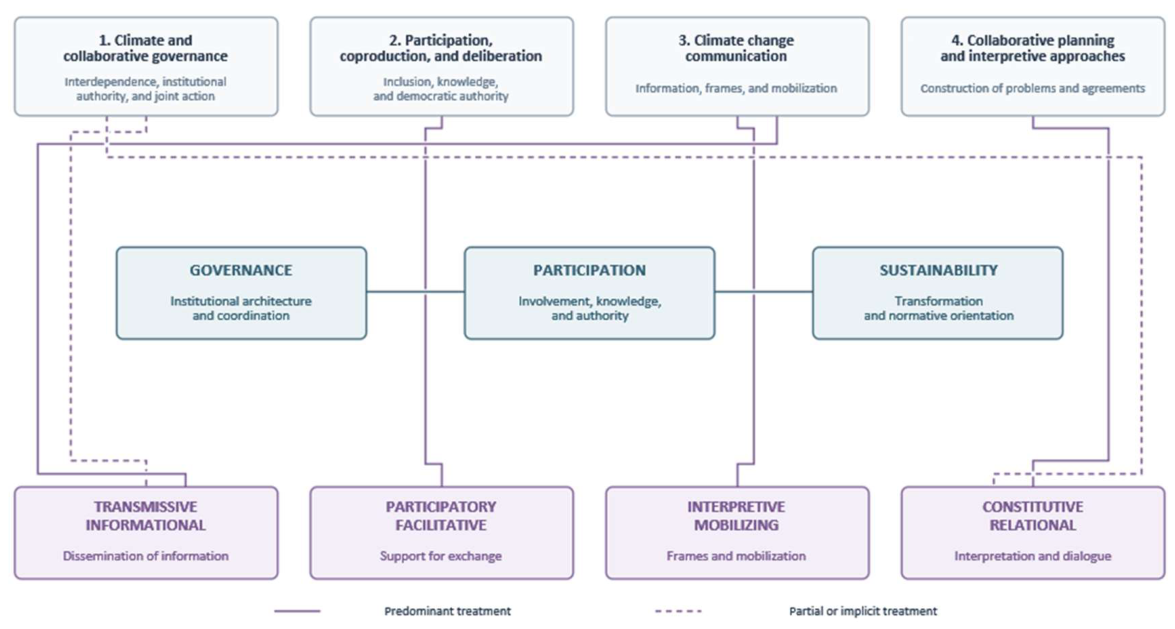
Figure 2.
Communication model for adaptive urban climate governance. Source: authors’ own elaboration.The analytical sequence constitutes the core of the figure and is established as an iterative process: from the strategic orientation of social problems, it moves to interaction, implementation, and participation, where objectives and priorities are translated into relationships and the development of specific actions. In this transition, responsibilities are made explicit, interpretations are compared, and the knowledge of the actors involved is incorporated; interaction, implementation, and participation lead to feedback, with exchanges and implementation experience generating information about needs, difficulties, effects, disagreements, and possible alternatives. This information must be recorded and conveyed so that it can be used institutionally; feedback leads to learning and readjustment, since the information received needs interpretation and learning entails reviewing knowledge, assumptions, or criteria; readjustment entails introducing changes to procedures, instruments, priorities, or forms of implementation. When the reviews conducted during the learning and readjustment phase are carried forward into a new strategic orientation phase, the process returns to the definition of the problem and the organization of climate action, facilitating change in operational aspects and reaching broader priorities and frameworks to propose a new pathway in municipal climate action policies. This return, interpretation, and review focuses attention on the fact that institutional adaptive capacity depends on what each local administration does with the information that returns to the beginning of the iterative cycle and with the proximate outcomes obtained.
Disclaimer/Publisher’s Note: The statements, opinions and data contained in all publications are solely those of the individual author(s) and contributor(s) and not of MDPI and/or the editor(s). MDPI and/or the editor(s) disclaim responsibility for any injury to people or property resulting from any ideas, methods, instructions or products referred to in the content. |
© 2026 by the authors. Licensee MDPI, Basel, Switzerland. This article is an open access article distributed under the terms and conditions of the Creative Commons Attribution (CC BY) license (http://creativecommons.org/licenses/by/4.0/).
Copyright: This open access article is published under a Creative Commons CC BY 4.0 license, which permit the free download, distribution, and reuse, provided that the author and preprint are cited in any reuse.