
Submitted:
13 November 2026
Posted:
16 November 2026
You are already at the latest version
Abstract
Drought stress is a major constraint on cotton (Gossypium hirsutum L.) production in arid regions. Hydrogen-rich water (HRW) has been reported to mitigate abiotic stress, but its field-level effects on antioxidant dynamics, ion homeostasis, and yield formation remain poorly documented. A field experiment was conducted in Aksu, southern Xinjiang, China, with three treatments: rain-fed control without spray (A), tap-water irrigation with purified-water foliar spray (B), and HRW irrigation (May–June) combined with HRW foliar spray (September) (C). Leaf samples were collected at 0, 3, 6, 12, and 24 h after spraying for antioxidant enzyme activities, malondialdehyde (MDA), proline, H2O2, and chlorophyll, and at 0, 12, and 24 h for water-soluble Na+ and K+. HRW treatment markedly increased peroxidase (POD) activity at 6–12 h (peak 3363.3 U g-1 FW at 12 h; P < 0.05 vs. A) and maintained a numerically higher leaf K+/Na+ ratio at 12 h (3.71) compared with A (3.42) and B (2.46). Although Na+ accumulated at 24 h in all treatments, C maintained the highest absolute K+ concentration (12.27 g kg-1 DW). These physiological improvements were associated with a higher boll number per plant (60.2 vs. 21.4 in A), higher seed cotton yield per plant (138.0 vs. 70.0 g), and a higher lint yield per plant (70.0 vs. 34.7 g). HVI analysis showed that fiber length and uniformity in C were numerically higher than in A, while breaking strength remained comparable, indicating that the yield gain did not compromise fiber quality. Our results suggest that HRW alleviates drought stress in cotton by enhancing antioxidant defense and preserving K+ homeostasis during the boll-setting stage, thereby improving boll retention and lint yield. However, because the spray carrier differed between treatments, the specific contribution of dissolved H2 cannot be fully isolated in this design.
Keywords:
hydrogen-rich water
; drought stress
; Gossypium hirsutum
; antioxidant defense
; K⁺/Na⁺ homeo-stasis
; boll retention
; lint yield
; fiber quality
1. Introduction
Cotton is a vital fiber crop globally, with arid and semi-arid regions such as Xinjiang, China, accounting for a large share of production (Zhou et al., 2022). These regions face dual challenges of water scarcity and soil salinization, which induce osmotic stress and ion toxicity through excessive Na⁺ accumulation, ultimately reducing boll retention, yield, and fiber quality (Zhang et al., 2021; Abdelraheem et al., 2019; Ma et al., 2021). Waterlogging and drought, as the two extremes of water stress, both impair cotton growth and lint yield (Bange et al., 2004; Zhang et al., 2016), highlighting the need for management strategies that improve water-use efficiency and ion balance under variable moisture conditions.
Plants respond to drought and salinity through a coordinated antioxidant defense system, including superoxide dismutase (SOD), peroxidase (POD), and catalase (CAT), which scavenge reactive oxygen species (ROS) and limit membrane lipid peroxidation (Apel & Hirt, 2004; Gill & Tuteja, 2010; Hasanuzzaman et al., 2020). In cotton, salt and drought stresses disrupt ion homeostasis and induce oxidative damage, and K+ application can partially restore salt tolerance by regulating root transcriptomic and metabolic responses (Ju et al., 2023; Guo et al., 2020; Qamer et al., 2021). Maintaining a high K⁺/Na⁺ ratio is therefore a key physiological target for stress mitigation in cotton (Wang et al., 2022; Li et al., 2022a).
Hydrogen gas (H₂) has recently emerged as a novel, eco-friendly signaling molecule in plants. Molecular hydrogen can mitigate a range of abiotic stresses, including salinity, heavy metals, and drought, and is increasingly considered a valuable addition to agricultural practice (Zulfiqar et al., 2021; Hancock et al., 2022). HRW is prepared by different methods (e.g., ammonia borane, magnesium hydride, nanobubble technology) has been shown to enhance tolerance to salinity, drought, and cadmium in rapeseed, alfalfa, rice, and Arabidopsis (Zhao et al., 2021; Su et al., 2018; Xu et al., 2013; Xie et al., 2014; Zhang et al., 2024). In cotton, HRW irrigation at the squaring stage has been reported to improve growth and physiological characteristics under field conditions (Long et al., 2025), and hydrogen nanobubble irrigation has been shown to enhance tomato fruit antioxidant potential (He et al., 2024) and lettuce salt tolerance (Wang et al., 2025a).
However, most studies on HRW in cotton focus on short-term physiological responses in controlled environments. The effects of HRW on the dynamic regulation of Na⁺/K⁺ homeostasis during the boll-setting stage, the temporal pattern of antioxidant enzyme activation after foliar spraying, and the final yield components and fiber quality under field drought conditions remain largely unexplored.
Therefore, this study hypothesizes that coupled HRW application (irrigation plus foliar spray) can activate the antioxidant system and preserve leaf K+ homeostasis, thereby improving boll retention, lint yield, and fiber quality under drought stress. The objectives were to: (1) characterize the temporal dynamics of antioxidant enzymes, MDA, proline, H₂O₂, and chlorophyll after spraying; (2) quantify the dynamic changes in leaf Na⁺, K⁺, and the K⁺/Na⁺ ratio; and (3) evaluate the responses of boll number, boll weight, lint yield, and HVI fiber quality to HRW application. We explicitly note that the present study focuses on leaf-level physiology, yield components, and fiber quality; soil chemical properties were not analyzed here and will be addressed in a follow-up study.
2. Results
3.1. Temporal Dynamics of Antioxidant Enzymes and Oxidative Stress
The temporal patterns of CAT, POD, and SOD activities are shown in Table 1. POD activity in treatment C increased rapidly after spraying, reaching 2227.1 ± 1034.6 U g⁻¹ FW at 6 h and peaking at 3363.3 ± 1766.6 U g⁻¹ FW at 12 h, which was significantly higher than in A (1097.6 ± 569.8 U g⁻¹ FW; P < 0.05) at the same time point. At 24 h, POD activity in C remained high (3034.5 ± 581.0 U g⁻¹ FW), whereas A declined to 662.7 ± 228.5 U g⁻¹ FW. The treatment × time interaction was significant for CAT (F₈,₄₅ = 2.86, P = 0.012), but not for POD (F₈,₄₅ = 1.18, P = 0.334), SOD (F₈,₄₅ = 1.23, P = 0.302), MDA (F₈,₄₅ = 1.11, P = 0.375), PRO (F₈,₄₅ = 1.09, P = 0.388), or H₂O₂ (F₈,₄₅ = 2.06, P = 0.060).
SOD activity showed a different pattern. In A, SOD increased at 12 h (2712.8 ± 1493.3 U g⁻¹ FW) and then declined at 24 h (1254.9 ± 498.6 U g⁻¹ FW). In C, SOD remained elevated at 24 h (2295.8 ± 764.6 U g⁻¹ FW), suggesting a more sustained antioxidant response. CAT activity did not show a consistent treatment effect across time points (Table 1); the corresponding P values are provided in Table S1.
MDA content increased gradually in A from 27.70 ± 4.28 nmol g⁻¹ FW at 0 h to 35.41 ± 5.27 nmol g⁻¹ FW at 12 h, indicating progressive membrane lipid peroxidation under drought. In C, MDA remained relatively stable at 12 h (33.49 ± 3.70 nmol g⁻¹ FW) but increased at 24 h (36.29 ± 2.30 nmol g⁻¹ FW), coinciding with Na⁺ accumulation. H₂O₂ in A rose at 12 h (3.06 ± 1.35 μmol g⁻¹ FW) and 24 h (3.29 ± 0.80 μmol g⁻¹ FW), whereas C maintained lower H₂O₂ levels at 12 h (1.88 ± 0.41 μmol g⁻¹ FW).
Chlorophyll a, chlorophyll b, and total chlorophyll were higher in B and C than in A across most time points (Table S1). At 12 h, total chlorophyll was 1.70 ± 0.19 mg g⁻¹ FW in C, compared with 1.14 ± 0.13 mg g⁻¹ FW in A.
The temporal dynamics of POD activity are further visualized in Figure 1.
3.2. Leaf Na⁺, K⁺, and K⁺/Na⁺ Homeostasis
Leaf ion dynamics are presented in Table 2. At 0 h, C exhibited a higher K+ concentration (10.61 ± 2.45 g kg⁻¹ DW) than A (8.25 ± 0.56 g kg⁻¹ DW) and B (7.69 ± 0.83 g kg⁻¹ DW). At 12 h after spraying, C maintained the highest K⁺/Na⁺ ratio (3.71 ± 0.62), compared with A (3.42 ± 0.13) and B (2.46 ± 0.31). The absolute K⁺ concentration in C at 12 h reached 11.75 ± 2.95 g kg⁻¹ DW, the highest among all treatments.
The dynamic changes in the leaf K⁺/Na⁺ ratio across the three treatments are shown in Figure 2.
At 24 h, Na+ accumulated in all treatments due to intense field evaporation. C showed the highest Na⁺ concentration (5.00 ± 0.07 g kg⁻¹ DW), and its K⁺/Na⁺ ratio declined to 2.45 ± 0.52. The very small standard deviation of Na⁺ in C at 24 h (0.07 g kg⁻¹ DW) compared with other treatments (0.25–0.79 g kg⁻¹ DW) reflects an unusually homogeneous set of four replicates; the raw values were re-checked and retained. Nevertheless, the absolute K⁺ concentration in C remained the highest (12.27 ± 2.60 g kg⁻¹ DW), indicating that HRW preserved K⁺ retention even when Na⁺ accumulation occurred.
3.3. Yield Components and Lint Yield
HRW application substantially improved boll retention and lint yield (Table 3). The total boll number per five plants was 301 in C, compared with 122 in B and 107 in A, corresponding to 60.2, 24.4, and 21.4 bolls per plant, respectively. Seed cotton yield per plant was 138.0 g in C, 92.0 g in B, and 70.0 g in A. Lint percentage was 50.7% in C, 45.6% in B, and 49.6% in A. Consequently, lint yield per plant reached 70.0 g in C, compared with 42.0 g in B and 34.7 g in A.
Boll weight, calculated from harvested bolls, was 7.42 g in C, 7.08 g in B, and 6.60 g in A. The higher boll number in C was accompanied by a slight increase in boll weight, indicating that HRW improved both boll retention and boll development. However, the number of harvested bolls was lower than the total boll number in all treatments (93/301 in C, 65/122 in B, 53/107 in A), reflecting late-season boll abortion or immaturity. Therefore, the yield advantage of HRW is primarily attributable to improved retention of early-season bolls rather than to an increase in the total number of harvestable bolls per se, and “bolls per plant” should be interpreted as retained bolls rather than harvestable bolls.
3.4. Fiber Quality
HVI fiber quality parameters are presented in Table 4. HRW treatment (C) showed numerically higher upper half mean length (33.4 mm), uniformity index (88.3%), and reflectance (Rd, 80.2%), compared with A (32.6 mm, 87.1%, and 78.3%, respectively) and B (32.8 mm, 88.1%, and 78.7%, respectively). Micronaire values were similar among treatments (5.0–5.2), within the optimal range for cotton fiber maturity. Breaking strength was highest in A (32.4 cN/tex), followed by C (32.0 cN/tex) and B (31.9 cN/tex), with only minor differences among treatments. Because these are technical repeats from a single composite sample per treatment, no statistical inference can be drawn; the values are presented for descriptive purposes only. Overall, the HRW-induced increase in boll retention and lint yield did not appear to compromise fiber length, uniformity, or maturity.
3. Discussion
3.1. HRW Enhances the Antioxidant Defense System
The most notable result of this study was the rapid and sustained increase in POD activity in HRW-treated cotton. POD activity in C reached 3363.3 U g⁻¹ FW at 12 h, approximately threefold that of A at the same time point. Although the treatment × time interaction was not statistically significant for POD (F₈,₄₅ = 1.18, P = 0.334), the within-time-point comparisons showed that POD activity in C was significantly higher than in A at 6, 12, and 24 h (Duncan’s test, P < 0.05; Table 1). This suggests that the HRW effect on POD was consistent in direction across time points, even though the magnitude of the treatment difference varied. This temporal pattern suggests that HRW may function as a signal that primes the enzymatic ROS-scavenging machinery within hours of application. Similar activation of antioxidant enzymes by H₂ has been reported in other plant species. For example, HRW application reduced leaf MDA and H₂O₂ while elevating SOD, POD, and CAT activities in Solanum nigrum grown on Cd–As co-contaminated soil (Guo et al., 2025); HRW prepared by ammonia borane enhanced rapeseed tolerance to salinity, drought, or cadmium (Zhao et al., 2021); and H₂ treatment protected against cell death and senescence induced by oxidative damage (Han et al., 2017). Zulfiqar et al. (2021) and Hancock et al. (2022) summarized that H₂ can mitigate salinity, heavy-metal, and drought stresses in plants and extend postharvest quality, respectively. In non-plant systems, HRW has been shown to activate the Nrf2/ARE antioxidant pathway and to reduce MDA while increasing SOD activity (Li et al., 2019), suggesting a conserved redox-regulatory mechanism that may also operate in cotton. The concurrent reduction in H₂O₂ accumulation at 12 h (1.88 vs. 3.06 μmol g⁻¹ FW in A) supports the view that the POD burst was functionally effective in limiting oxidative load.
The sustained SOD activity in C at 24 h (2295.8 U g⁻¹ FW) further indicates that HRW extends the window of antioxidant protection beyond the initial POD burst. This two-phase response—rapid POD activation followed by sustained SOD activity—may explain why chlorophyll content remained higher in C than in A throughout the sampling period, consistent with the preservative effects of H₂ on photosynthetic pigments and postharvest quality reported in lily bulbs, strawberries, and blueberries (Zhang et al., 2023; Jin et al., 2023; Jin et al., 2024).
3.2. K⁺/Na⁺ Homeostasis and Boll Retention
Leaf K⁺/Na⁺ ratio peaked at 12 h in C (3.71), numerically higher than in B (2.46). This pattern is consistent with the possibility that H₂ signaling may upregulate K⁺ transporters and Na⁺ exclusion mechanisms, such as SOS1 and HKT1 (Wu et al., 2019; Xiao et al., 2025). In Arabidopsis, H₂ enhances salt tolerance by modulating H₂O₂-mediated redox and ion homeostasis (Xiao et al., 2025), and in cucumber, H₂S alleviates salinity stress by maintaining Na⁺/K⁺ balance (Jiang et al., 2019). In cotton, potassium application regulates salt tolerance through transcriptomic and metabolomic reprogramming in roots (Ju et al., 2023), and silicon application ameliorates salt stress by modulating antioxidant systems and ion homeostasis (Li et al., 2022a). However, because no gene expression or protein data were collected in this study, the SOS1/HKT1 interpretation remains speculative and should be tested in future work.
Potassium is the primary osmoticum driving fiber cell expansion and is also essential for cellulose synthesis; thus, the preservation of K⁺ under drought stress may have direct implications for lint yield. Notably, although Na⁺ accumulated at 24 h in C (5.00 g kg⁻¹ DW), the absolute K⁺ concentration remained the highest among all treatments (12.27 g kg⁻¹ DW). This suggests that HRW does not prevent Na⁺ influx under severe evaporative demand but rather maintains a higher K⁺ pool that buffers the K⁺/Na⁺ ratio. The decline in K⁺/Na⁺ ratio at 24 h should therefore be interpreted as a transient consequence of field evaporation rather than a failure of HRW.
3.3. From Physiology to Yield and Fiber Quality
The yield data reveal a clear pattern: HRW primarily increased boll number per plant (60.2 vs. 21.4 in A), while boll weight increased only modestly (7.42 vs. 6.60 g). This indicates that HRW promoted boll retention rather than individual boll enlargement. The higher lint percentage in C (50.7%) compared with B (45.6%) further suggests that HRW improved lint partitioning within the boll. Similar improvements in plant growth and yield by H₂-based irrigation have been reported in strawberry (Li et al., 2022) and tomato (He et al., 2024), supporting the view that H₂-based treatments can act on both vegetative growth and reproductive output.
The combination of higher boll number and higher lint percentage resulted in a lint yield per plant of 70.0 g in C, approximately double that of A (34.7 g). Importantly, HVI analysis showed that fiber length (33.4 mm) and uniformity (88.3%) in C were numerically higher than in A, while breaking strength remained comparable (32.0 vs. 32.4 cN/tex). Because HVI values were technical repeats without biological replication, these differences should be interpreted cautiously. Nevertheless, the data suggest that the yield gain was achieved without an obvious penalty in fiber quality, which is agronomically meaningful and supports further evaluation of HRW as a low-cost, eco-friendly strategy for cotton production in drought-prone regions (Zhou et al., 2022; Zhang et al., 2022a).
3.4. Limitations and Future Directions
Several limitations should be acknowledged. First, the field experiment was conducted in a single site and season; multi-year and multi-location trials are needed to confirm the generality of the results. Second, the spray carrier differed between B (purified water) and C (HRW), and the design therefore cannot fully separate the effect of dissolved H₂ from that of the spray carrier itself. A degassed-HRW control should be included in future studies to isolate the H₂-specific effect (Zhang et al., 2022b). Third, the molecular mechanisms underlying HRW-induced K⁺ retention (e.g.,SOS1/HKT1 expression) were not measured and should be addressed in future work. Fourth, soil chemical properties were not analyzed in the present study; linking root-zone chemistry to the observed leaf-level responses is an important direction for follow-up research. Fifth, the HVI data are based on technical repeats from composite samples, and biological replication of fiber quality traits is needed in future trials. Finally, although HRW has shown antioxidant and anti-inflammatory benefits in a range of animal and clinical settings (Zhang et al., 2025; Du et al., 2020; Qiu et al., 2020), translating these findings to field crops requires caution because dose, delivery, and environmental context differ substantially between systems. Future work should therefore combine field trials with molecular and physiological measurements to establish a mechanistic basis for H₂-based crop management in arid cotton systems.
4. Materials and Methods
4.1. Experimental Site and Design
The field experiment was conducted in 2026 in Aksu, southern Xinjiang, China (41°14′N, 80°12′E). The soil is classified as sandy loam with moderate salinity (initial EC 1.2 dS m-1). Cotton (Gossypium hirsutum cv. Chuangmian 509; supplied by Xinjiang Shengshi Jinfeng Seed Industry Co., Ltd., China) was sown in April at a density of 2 × 10⁵ plants ha-1. Three treatments were established in a randomized complete block design with three blocks and three replicate plots (10 m² each, 2.0 m × 5.0 m) per treatment. Treatments were randomized within each block.
Treatment A (Control): rain-fed, no irrigation and no foliar spray. This treatment represents an extreme drought scenario rather than local farmer practice, which is typically irrigated. Total growing-season rainfall at the site was 48.9 mm.
Treatment B: tap-water irrigation and purified-water foliar spray, serving as a spray-volume and leaf-wetting control.
Treatment C (HRW): HRW irrigation applied in May and June, and HRW foliar spray applied in early September.
HRW was prepared using a commercial hydrogen-rich water generator. The dissolved hydrogen concentration was monitored using a combination of a dissolved hydrogen concentration test reagent and a hydrogen measuring pen (Seo et al., 2012), maintaining a dissolved H₂ concentration of 0.8–1.2 mg L-1. Foliar spray was applied at 11:00 using a pressure sprayer at 50 mL per plant. Commercial purified water (C’estbon; Na⁺ 0–1 mg/L; K+, Ca2+, and Mg2+ below detection or <1 mg/L; electrical conductivity <10 μS/cm; pH 6.5–7.5) was used as the spray carrier in treatment B, serving as a spray-volume and leaf-wetting control with a negligible mineral background. We acknowledge that this design cannot fully separate the effect of dissolved H₂ from that of the spray carrier itself, and this limitation is addressed in Section 4.4.
4.2. Sampling and Measurements
Leaf sampling: Leaves (the third fully expanded from the top) were collected at 0, 3, 6, 12, and 24 h after the September spray. At each time point, four plants per treatment were sampled as independent biological replicates (n = 4); different plants were used at each time point to avoid repeated-measures confounding. Antioxidant enzyme activities (CAT, POD, SOD), MDA, proline (PRO), H2O2, and chlorophyll a/b were measured using commercial assay kits (Science Guide, Beijing, China) with a BioTek microplate reader. SOD was assayed by the nitroblue tetrazolium (NBT) photoreduction method (Sim Choi et al., 2006), POD by the guaiacol oxidation method, and CAT by the ultraviolet absorption method, following the kit instructions. Fresh leaf samples (0.1 g) were homogenized in the extraction buffer provided with each kit. Kit catalog numbers are available from the corresponding author upon request.
Ion analysis: Leaf water-soluble Na+ and K⁺ were extracted at 0, 12, and 24 h after spraying. Dried leaf powder (0.2 g) was extracted with deionized water (1:50, w/v) by shaking at 25 ℃ for 30 min, then filtered (0.45 μm), and the filtrate was analyzed by inductively coupled plasma optical emission spectrometry (ICP-OES; Thermo Fisher Scientific iCAP 7400, Waltham, MA, USA).
Yield components: At harvest, five plants per plot were selected. The total number of bolls on 20 fruiting nodes per plant was recorded. Harvested bolls were counted, seed cotton was weighed, and lint weight was obtained after ginning. Boll weight, lint percentage, seed cotton yield per plant, and lint yield per plant were calculated. We note that the number of harvested bolls was lower than the total boll number, particularly in treatment C (93 vs. 301 bolls per 5 plants), because late-season bolls did not mature before harvest; therefore, “bolls per plant” reflects boll retention, whereas “harvested bolls” reflects realized harvestable yield.
Fiber quality: Fiber samples (50 g per plot) were tested for HVI parameters according to GB/T 20392-2023 using a cotton high-volume instrument (HIV1000C, Uster Technologies, Uster, Switzerland). Color grade, reflectance (Rd), yellowness (+b), micronaire, upper half mean length, uniformity index, and breaking strength were recorded. Testing was performed at 20.9 ± 0.5 ℃ and 65.6–66.3% RH. The three test values per treatment are technical repeats from a single composite sample; therefore, no statistical comparison was performed for HVI parameters, and differences are described as numerical.
4.3. Data Analysis
Data were analyzed using SPSS 22.0 (IBM, Armonk, NY, USA). Normality (Shapiro–Wilk) and homogeneity of variance (Levene’s test) were checked before analysis. Where variances were heterogeneous (notably for POD and SOD), data were log-transformed before ANOVA; non-transformed means are presented in tables for clarity. Two-way ANOVA (treatment × time) followed by Duncan’s test (P < 0.05) was used for physiological and ion data; the treatment × time interaction was reported. One-way ANOVA followed by Duncan’s test was used for yield components. Pearson correlation was performed to evaluate relationships between leaf K+/Na+ ratio, antioxidant activities, boll number, and lint yield.
5. Conclusions
Coupled HRW irrigation and foliar application enhanced POD and SOD activities, reduced H₂O₂ accumulation, and maintained a numerically higher leaf K+/Na+ ratio at 12 h after spraying under field drought conditions. These physiological improvements were associated with higher boll retention (60.2 vs. 21.4 bolls per plant) and approximately doubled lint yield per plant (70.0 vs. 34.7 g) compared with the rain-fed control, while fiber length and uniformity were numerically improved and breaking strength remained comparable. The results suggest that HRW is a promising, eco-friendly strategy to mitigate drought stress and improve lint yield in cotton, and that K⁺/Na⁺ homeostasis during the boll-setting stage deserves further mechanistic investigation. Because the present design cannot fully isolate the H₂-specific effect, confirmatory studies with degassed-HRW controls and molecular measurements are recommended.
6. Patents
This section is not mandatory but may be added if there are patents resulting from the work reported in this manuscript.
Author Contributions
Conceptualization, L.L. and Y.Y.; methodology, L.L.X.W. and C.X.; software, X.T. and C.H.; validation, L.L., C.H. and W.W.; formal analysis, T.Z.; investigation, X.W. and W.W.; resources, Y.D.; data curation, Y.F. and X.L.; writing—original draft preparation, L.L.; writing—review and editing, C.X.; visualization, X.H. and C.N; supervision, X.F. and Y.D; project administration, L.L.; funding acquisition, L.L. All authors have read and agreed to the published version of the manuscript.
Funding
This research was funded by the Xinjiang Leading Talent Introduction Program: Talent Recruitment Project for Key Innovation Platforms (Bases) in the Field of Science and Technology, grant number XJRC-2025-KJ-YJ-CXPT-041; the Natural Science Foundation of Xinjiang Uygur Autonomous Region, grant number 2026D01C102; and the Xinjiang Institute of Science and Technology 2025 High-Level Talent Research Start-up Fund, grant number XJLG2025G004.
Data Availability Statement
We encourage all authors of articles published in MDPI journals to share their research data. In this section, please provide details regarding where data supporting reported results can be found, including links to publicly archived datasets analyzed or generated during the study. Where no new data were created, or where data are unavailable due to privacy or ethical restrictions, a statement is still required. Suggested Data Availability Statements are available in the section “MDPI Research Data Policies” at https://www.mdpi.com/ethics.
Acknowledgments
In this section, you can acknowledge any support given that is not covered by the author contribution or funding sections. This may include administrative and technical support, or donations in kind (e.g., materials used for experiments). Where GenAI has been used for purposes such as generating text, data, or graphics, or for study design, data collection, analysis, or interpretation of data, please add “During the preparation of this manuscript/study, the author(s) used [tool name, version information] for the purposes of [description of use]. The authors have reviewed and edited the output and take full responsibility for the content of this publication.”.
Conflicts of Interest
Declare conflicts of interest or state “The authors declare no conflicts of interest.” Authors must identify and declare any personal circumstances or interests that may be perceived as inappropriately influencing the representation or interpretation of reported research results. Any role of the funders in the design of the study; in the collection, analyses or interpretation of data; in the writing of the manuscript; or in the decision to publish the results must be declared in this section. If there is no role, please state “The funders had no role in the design of the study; in the collection, analyses, or interpretation of data; in the writing of the manuscript; or in the decision to publish the results”.
Abbreviations
The following abbreviations are used in this manuscript:
| CAT | catalase |
| HRW | Hydrogen-rich water |
| HVI | High Volume Instrument |
| MDA | malondialdehyde |
| POD | peroxidase |
| PRO | proline |
| SOD | superoxide dismutase |
Appendix A
Appendix A.1

Table A1.
Leaf chlorophyll a, chlorophyll b, and total chlorophyll contents (mean ± SD, n = 4) of cotton under different water treatments at 0, 3, 6, 12, and 24 h after foliar spraying.
Table A1.
Leaf chlorophyll a, chlorophyll b, and total chlorophyll contents (mean ± SD, n = 4) of cotton under different water treatments at 0, 3, 6, 12, and 24 h after foliar spraying.
| Parameter | Time (h) | A | B | C |
| Chl a (mg g⁻¹ FW) | 0 | 0.81 ± 0.07 | 1.02 ± 0.15 | 1.03 ± 0.06 |
| 3 | 0.90 ± 0.01 | 1.22 ± 0.09 | 1.19 ± 0.15 | |
| 6 | 0.93 ± 0.08 | 1.16 ± 0.12 | 1.15 ± 0.16 | |
| 12 | 0.83 ± 0.10 | 1.03 ± 0.08 | 1.20 ± 0.13 | |
| 24 | 0.93 ± 0.13 | 1.19 ± 0.09 | 1.17 ± 0.14 | |
| Chl b (mg g⁻¹ FW) | 0 | 0.28 ± 0.02 | 0.39 ± 0.09 | 0.39 ± 0.04 |
| 3 | 0.32 ± 0.02 | 0.46 ± 0.06 | 0.47 ± 0.07 | |
| 6 | 0.34 ± 0.01 | 0.44 ± 0.07 | 0.48 ± 0.10 | |
| 12 | 0.31 ± 0.03 | 0.37 ± 0.01 | 0.50 ± 0.06 | |
| 24 | 0.32 ± 0.03 | 0.44 ± 0.06 | 0.51 ± 0.07 | |
| Total Chl (mg g⁻¹ FW) | 0 | 1.09 ± 0.09 | 1.41 ± 0.24 | 1.42 ± 0.09 |
| 3 | 1.22 ± 0.02 | 1.68 ± 0.15 | 1.67 ± 0.21 | |
| 6 | 1.27 ± 0.09 | 1.60 ± 0.19 | 1.63 ± 0.23 | |
| 12 | 1.14 ± 0.13 | 1.40 ± 0.09 | 1.70 ± 0.19 | |
| 24 | 1.25 ± 0.16 | 1.63 ± 0.12 | 1.68 ± 0.21 |
Values are means ± SD (n = 4 independent biological replicates). Different lowercase letters within a row indicate significant differences among treatments (Duncan’s test, P < 0.05).
References
- Abdelraheem, A.; Esmaeili, N.; O’Connell, M.; Zhang, J. Progress and perspective on drought and salt stress tolerance in cotton. Ind. Crops Prod. 2019, 130, 118–129. [Google Scholar] [CrossRef]
- Apel, K.; Hirt, H. Reactive oxygen species: metabolism, oxidative stress, and signal transduction. Annu. Rev. Plant Biol. 2004, 55, 373–399. [Google Scholar] [CrossRef] [PubMed]
- Bange, M.P.; Milroy, S.P.; Thongbai, P. Growth and yield of cotton in response to waterlogging. Field Crops Res. 2004, 88, 129–142. [Google Scholar] [CrossRef]
- Du, D.; Zhao, L.; Shen, M.; Noda, M.; Qin, S.; Long, J.; Sun, X.; Liu, J. Hydrogen medicine: A rising star in gas medicine. Tradit. Med. Mod. Med. 2020, 3, 153. [Google Scholar] [CrossRef]
- Gill, S.S.; Tuteja, N. Reactive oxygen species and antioxidant machinery in abiotic stress tolerance in crop plants. Plant Physiol. Biochem. 2010, 48, 909–930. [Google Scholar] [CrossRef] [PubMed]
- Guo, H.; Huang, Z.; Li, M.; Hou, Z. Growth, ionic homeostasis, and physiological responses of cotton under different salt and alkali stresses. Sci. Rep. 2020, 10, 21844. [Google Scholar] [CrossRef] [PubMed]
- Guo, X.; Chen, R.; Li, H.; Li, G.; Zhao, Q.; Wang, D.; Wang, J. Micro-nano bubble hydrogen water irrigation improves the Cd tolerance of Ipomoea aquatica Forssk.: Rhizosphere micro-biotas modulation and oxidative stress alleviation. Environ. Pollut. 2025, 376, 126394. [Google Scholar] [CrossRef] [PubMed]
- Han, A.L.; Park, S.H.; Park, M.S. Hydrogen treatment protects against cell death and senescence induced by oxidative damage. J. Microbiol. Biotechnol. 2017, 27, 365–371. [Google Scholar] [CrossRef] [PubMed]
- Hancock, J.T.R.; Stratakos, A.C. Molecular hydrogen: the postharvest use in fruits, vegetables and the floriculture industry. Appl. Sci. 2022, 12, 10367. [Google Scholar] [CrossRef]
- Hasanuzzaman, M.; Bhuyan, M.H.M.B.; Zulfiqar, F.; Raza, A.; Mohsin, S.M.; Mahmud, J.A.; Fujita, M.; Fotopoulos, V. Reactive oxygen species and antioxidant defense in plants under abiotic stress: Revisiting the crucial role of a universal defense regulator. Antioxidants 2020, 9, 681. [Google Scholar] [CrossRef] [PubMed]
- He, J.; Zhou, Y.; Geilfus, C.M.; Cao, J.; Fu, D.; Baram, S.; Liu, Y.; Li, Y. Enhancing tomato fruit antioxidant potential through hydrogen nanobubble irrigation. Hortic. Res. 2024, 11, uhae111. [Google Scholar] [CrossRef] [PubMed]
- Jiang, J.-L.; Tian, Y.; Li, L.; Yu, M.; Hou, R.-P.; Ren, X.-M. H₂S alleviates salinity stress in cucumber by maintaining the Na⁺/K⁺ balance and regulating H₂S metabolism and oxidative stress response. Front. Plant Sci. 2019, 10, 678. [Google Scholar] [CrossRef] [PubMed]
- Jin, Z.; Huang, H.; Huang, H.; Li, L.; Zeng, Y.; Cheng, X.; Pathier, D.; Gan, L.; Shen, W. The delayed senescence in harvested blueberry by hydrogen-based irrigation is functionally linked to metabolic reprogramming and antioxidant machinery. Food Chem. 2024, 453, 139563. [Google Scholar] [CrossRef] [PubMed]
- Jin, Z.; Liu, Z.; Chen, G.; Li, L.; Zeng, Y.; Cheng, X.; Pathier, D.; Xu, G.; Shen, W. Molecular hydrogen-based irrigation extends strawberry shelf life by improving the synthesis of cell wall components in fruit. Postharvest Biol. Technol. 2023, 206, 112551. [Google Scholar] [CrossRef]
- Ju, F.; Pang, J.; Sun, L.; Gu, J.; Wang, Z.; Wu, X.; Ali, S.; Wang, Y.; Zhao, W.; Wang, S.; Zhou, Z.; Chen, B. Integrative transcriptomic, metabolomic and physiological analyses revealed the physiological and molecular mechanisms by which potassium regulates the salt tolerance of cotton (Gossypium hirsutum L.) roots. Ind. Crops Prod. 2023, 193, 116177. [Google Scholar] [CrossRef]
- Li, L.; Qi, Q.; Zhang, H.; Dong, Q.; Iqbal, A.; Gui, H.; Kayoumu, M.; Song, M.; Zhang, X.; Wang, X. Ameliorative effects of silicon against salt stress in Gossypium hirsutum L. Antioxidants 2022a, 11, 1520. [Google Scholar] [CrossRef] [PubMed]
- Li, L.; Wang, J.; Jiang, K.; Kuang, Y.; Zeng, Y.; Cheng, X.; Liu, Y.; Wang, S.; Shen, W. Preharvest application of hydrogen nanobubble water enhances strawberry flavor and consumer preferences. Food Chem. 2022, 377, 131953. [Google Scholar] [CrossRef] [PubMed]
- Li, L.; Liu, Y.; Wang, S.; Zou, J.; Ding, W.; Shen, W. Magnesium hydride-mediated sustainable hydrogen supply prolongs the vase life of cut carnation flowers via hydrogen sulfide. Front. Plant Sci. 2020, 11, 595376. [Google Scholar] [CrossRef] [PubMed]
- Li, W.; Nguyen, K.H.; Tran, C.D.; Watanabe, Y.; Tian, C.; Yin, X.; Li, K.; Yang, Y.; Guo, J.; Miao, Y.; Yamaguchi, S.; Tran, L.-S.P. Negative roles of strigolactone-related SMXL6, 7 and 8 proteins in drought resistance in Arabidopsis. Biomolecules 2020, 10, 607. [Google Scholar] [CrossRef] [PubMed]
- Li, Y.; Li, L.; Wang, S.; Liu, Y.; Zou, J.; Ding, W.; Du, H.; Shen, W. Magnesium hydride acts as a convenient hydrogen supply to prolong the vase life of cut roses by modulating nitric oxide synthesis. Postharvest Biol. Technol. 2021b, 177, 111526. [Google Scholar] [CrossRef]
- Li, L.; Liu, T.; Liu, L.; Li, S.; Zhang, Z.; Zhang, R.; Zhou, Y.; Liu, F. Effect of hydrogen-rich water on the Nrf2/ARE signaling pathway in rats with myocardial ischemia-reperfusion injury. J. Bioenerg. Biomembr. 2019, 51, 393–402. [Google Scholar] [CrossRef] [PubMed]
- Long, B.; Zhang, H.; Li, M. Effects of hydrogen-rich water irrigation on growth and physiological characteristics of outdoor cotton at the squaring stage. Cotton Sci. (In Chinese, with English abstract). 2025, 37, 88–95. [Google Scholar]
- Ma, Y.; Wei, Z.; Liu, J.; Liu, X.; Liu, F. Growth and physiological responses of cotton plants to salt stress. J. Agron. Crop Sci. 2021, 207, 565–576. [Google Scholar] [CrossRef]
- Qamer, Z.; Chaudhary, M.T.; Du, X.; Hinze, L.; Azhar, M.T. Review of oxidative stress and antioxidative defense mechanisms in Gossypium hirsutum L. in response to extreme abiotic conditions. J. Cotton Res. 2021, 4, 9. [Google Scholar] [CrossRef]
- Qiu, X.; Dong, K.; Guan, J.; He, J. Hydrogen attenuates radiation-induced intestinal damage by reducing oxidative stress and inflammatory response. Int. Immunopharmacol. 2020, 84, 106517. [Google Scholar] [CrossRef] [PubMed]
- Seo, T.; Kurokawa, R.; Sato, B. A convenient method for determining the concentration of hydrogen in water: use of methylene blue with colloidal platinum. Med. Gas. Res. 2012, 2, 1. [Google Scholar] [CrossRef] [PubMed]
- Sim Choi, H.; Woo Kim, J.; Cha, Y.N.; Kim, C. A quantitative nitroblue tetrazolium assay for determining intracellular superoxide anion production in phagocytic cells. J. Immunoass. Immunochem. 2006, 27, 31–44. [Google Scholar] [CrossRef] [PubMed]
- Su, J.; Zhang, Y.; Nie, Y.; Cheng, D.; Wang, R.; Hu, H.; Chen, J.; Zhang, J.; Du, Y.; Shen, W. Hydrogen-induced osmotic tolerance is associated with nitric oxide-mediated proline accumulation and reestablishment of redox balance in alfalfa seedlings. Environ. Exp. Bot. 2018, 147, 249–260. [Google Scholar] [CrossRef]
- Wang, J.; Guo, X.; Zhao, Q.; Chen, R.; Li, G.; Zhou, B.; Cheng, P. Subsurface drip irrigation with micro-nano bubble hydrogen water improves the salt tolerance of lettuce by regulating the antioxidant system and soil bacterial community. Appl. Soil Ecol. 2025a, 207, 105948. [Google Scholar] [CrossRef]
- Wang, N.; Wang, X.; Qi, Q.; Iqbal, A.; Zhang, H.; Shi, J.; Dong, Q.; Xu, Q.; Liu, X.; Gui, H.; Song, M.; Zhang, X.; Yan, G. Analysis of the effects of mepiquat chloride priming on the seedling growth-promoting in cotton under salt stress by multi-omics. Ind. Crops Prod. 2022, 186, 115296. [Google Scholar] [CrossRef]
- Wu, Q.; Su, N.N.; Cai, J.T. Hydrogen-rich water enhances cadmium tolerance in Chinese cabbage by reducing cadmium uptake and increasing antioxidant capacity. J. Plant Physiol. 2019, 232, 209–217. [Google Scholar]
- Xiao, L.; Hu, Y.; Wang, Y.; Lv, C.; Zhan, N.; Duan, H.; Su, J. Hydrogen gas enhances Arabidopsis salt tolerance by modulating hydrogen peroxide-mediated redox and ion homeostasis. Plant Sci. 2025, 352, 112356. [Google Scholar] [CrossRef] [PubMed]
- Xie, Y.; Mao, Y.; Zhang, W.; Lai, D.; Wang, Q.; Shen, W. Reactive oxygen species-dependent nitric oxide production contributes to hydrogen-promoted stomatal closure in Arabidopsis. Plant Physiol. 2014, 165, 759–773. [Google Scholar] [CrossRef] [PubMed]
- Xu, S.; Zhu, S.; Jiang, Y.; Wang, N.; Wang, R.; Shen, W.; Yang, J. Hydrogen-rich water alleviates salt stress in rice during seed germination. Plant Soil 2013, 370, 47–57. [Google Scholar] [CrossRef]
- Zhang, H.; et al. Hydrogen gas improves the postharvest quality of Lanzhou lily (Lilium davidii var. unicolor) bulbs. Plants 2023, 12, 946. [Google Scholar] [CrossRef] [PubMed]
- Zhang, J.; Wang, Q.; Wei, K.; Guo, Y.; Mu, W.; Sun, Y. Magnetic water treatment: An eco-friendly irrigation alternative to alleviate salt stress of brackish water in seed germination and early seedling growth of cotton (Gossypium hirsutum L.). Plants 2022a, 11, 1397. [Google Scholar] [CrossRef] [PubMed]
- Zhang, Y.; Fan, W.; Li, X.; Wang, W.-X.; Liu, S. Enhanced removal of free radicals by aqueous hydrogen nanobubbles and their role in oxidative stress. Environ. Sci. Technol. 2022b, 56, 15096–15107. [Google Scholar] [CrossRef] [PubMed]
- Zhang, Y.; Cheng, P.; Wang, Y.; Lu, X.; Yao, W.; Li, L.; Jiang, K.; Shen, W. The activation of autophagy by molecular hydrogen is functionally associated with osmotic tolerance in Arabidopsis. Free Radic. Biol. Med. 2024, 225, 63–74. [Google Scholar] [CrossRef] [PubMed]
- Zhang, Y.; Chen, Y.; Lu, H.; Kong, X.; Dai, J.; Li, Z.; Dong, H. Growth, lint yield and changes in physiological attributes of cotton under temporal waterlogging. Field Crops Res. 2016, 194, 83–93. [Google Scholar] [CrossRef]
- Zhang, Y.; Liu, G.; Dong, H.; Li, C. Waterlogging stress in cotton: Damage, adaptability, alleviation strategies, and mechanisms. Crop J. 2021, 9, 257–270. [Google Scholar] [CrossRef]
- Zhao, G.; Cheng, P.; Zhang, T.; Abdalmegeed, D.; Xu, S.; Shen, W. Hydrogen-rich water prepared by ammonia borane can enhance rapeseed (Brassica napus L.) seedlings tolerance against salinity, drought or cadmium. Ecotoxicol. Environ. Saf. 2021, 224, 112640. [Google Scholar] [CrossRef] [PubMed]
- Zhou, B.; Liang, C.; Chen, X.; Ye, S.; Peng, Y.; Yang, L.; Duan, M.; Wang, X. Magnetically-treated brackish water affects soil water-salt distribution and the growth of cotton with film mulch drip irrigation in Xinjiang, China. Agric. Water Manag. 2022, 263, 107487. [Google Scholar] [CrossRef]
Figure 1.
Peroxidase (POD) activity in cotton leaves at 0, 3, 6, 12, and 24 h after foliar spraying. Bars are means, error bars are SE (n = 4). Different lowercase letters within a time point indicate significant differences among treatments (Duncan’s test, P < 0.05). Treatment A: rain-fed, no spray; B: tap-water irrigation + purified-water spray; C: HRW irrigation + HRW spray.
Figure 1.
Peroxidase (POD) activity in cotton leaves at 0, 3, 6, 12, and 24 h after foliar spraying. Bars are means, error bars are SE (n = 4). Different lowercase letters within a time point indicate significant differences among treatments (Duncan’s test, P < 0.05). Treatment A: rain-fed, no spray; B: tap-water irrigation + purified-water spray; C: HRW irrigation + HRW spray.
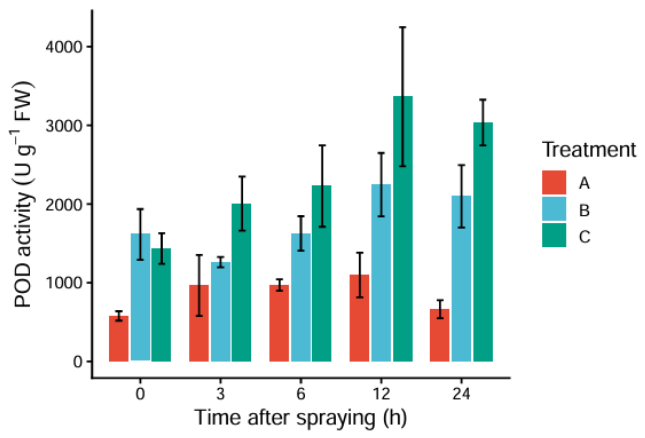
Figure 2.
Leaf K⁺/Na⁺ ratio of cotton under three water treatments at 0, 12, and 24 h after foliar spraying. Values are means ± SE (n = 4). Treatment A: rain-fed, no spray; B: tap-water irrigation + purified-water spray; C: HRW irrigation + HRW spray.
Figure 2.
Leaf K⁺/Na⁺ ratio of cotton under three water treatments at 0, 12, and 24 h after foliar spraying. Values are means ± SE (n = 4). Treatment A: rain-fed, no spray; B: tap-water irrigation + purified-water spray; C: HRW irrigation + HRW spray.
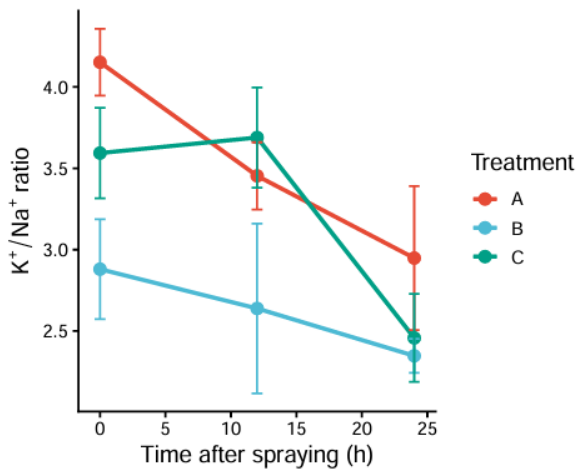
Table 1.
Leaf antioxidant enzyme activities and oxidative stress markers (mean ± SD, n = 4) of cotton under different water treatments at 0, 3, 6, 12, and 24 h after foliar spraying.
Table 1.
Leaf antioxidant enzyme activities and oxidative stress markers (mean ± SD, n = 4) of cotton under different water treatments at 0, 3, 6, 12, and 24 h after foliar spraying.
| Parameter | Time (h) | A (No irrigation, no spray) | B (Tap water + mineral water spray) | C (HRW irrigation + HRW spray) |
| CAT (μmol min⁻¹ g⁻¹ FW) | 0 | 95.91 ± 10.11 | 90.90 ± 14.80 | 118.54 ± 46.06 |
| 3 | 124.31 ± 55.48 | 79.09 ± 18.02 | 72.65 ± 14.37 | |
| 6 | 64.86 ± 5.77 | 74.39 ± 20.71 | 139.11 ± 50.12 | |
| 12 | 70.68 ± 35.92 | 69.43 ± 3.64 | 79.66 ± 16.41 | |
| 24 | 54.73 ± 13.47 | 55.28 ± 5.99 | 66.77 ± 17.44 | |
| POD (U g⁻¹ FW) | 0 | 577.71 ± 128.76 | 1612.69 ± 605.70 | 1433.65 ± 390.60 |
| 3 | 964.52 ± 787.34 | 1262.12 ± 132.12 | 2004.90 ± 704.30 | |
| 6 | 970.73 ± 146.94 | 1625.69 ± 429.90 | 2227.07 ± 1003.95 | |
| 12 | 1097.62 ± 575.29 | 2245.54 ± 864.67 | 3363.54 ± 1707.80 | |
| 24 | 662.67 ± 230.10 | 2097.89 ± 775.37 | 3034.47 ± 630.20 | |
| SOD (U g⁻¹ FW) | 0 | 1526.24 ± 1266.54 | 1015.47 ± 218.43 | 932.04 ± 339.88 |
| 3 | 1511.25 ± 222.15 | 1466.39 ± 418.50 | 1318.14 ± 167.39 | |
| 6 | 1522.08 ± 724.83 | 1610.96 ± 533.56 | 1359.10 ± 262.17 | |
| 12 | 2712.81 ± 1443.29 | 2005.85 ± 256.34 | 2123.32 ± 545.20 | |
| 24 | 1254.87 ± 508.68 | 1528.73 ± 404.22 | 2295.79 ± 761.18 | |
| MDA (nmol g⁻¹ FW) | 0 | 27.70 ± 4.27 | 25.74 ± 1.19 | 31.13 ± 2.63 |
| 3 | 29.50 ± 5.67 | 29.07 ± 1.61 | 33.28 ± 2.47 | |
| 6 | 32.96 ± 3.76 | 29.61 ± 3.50 | 35.19 ± 2.75 | |
| 12 | 35.41 ± 5.29 | 28.64 ± 4.04 | 33.50 ± 3.52 | |
| 24 | 28.39 ± 5.18 | 29.14 ± 2.28 | 36.29 ± 2.44 | |
| PRO (μg g⁻¹ FW) | 0 | 23.77 ± 3.62 | 25.19 ± 5.44 | 29.30 ± 13.01 |
| 3 | 22.60 ± 3.90 | 30.08 ± 6.14 | 26.47 ± 11.87 | |
| 6 | 21.65 ± 3.29 | 36.78 ± 10.31 | 25.99 ± 4.58 | |
| 12 | 21.32 ± 3.26 | 35.15 ± 6.79 | 34.10 ± 9.97 | |
| 24 | 22.92 ± 2.88 | 27.04 ± 3.43 | 25.71 ± 4.37 | |
| H₂O₂ (μmol g⁻¹ FW) | 0 | 1.62 ± 0.56 | 1.24 ± 0.20 | 1.34 ± 0.18 |
| 3 | 1.82 ± 0.19 | 2.08 ± 0.71 | 1.59 ± 0.25 | |
| 6 | 1.79 ± 0.21 | 1.68 ± 0.34 | 1.86 ± 0.07 | |
| 12 | 3.07 ± 1.37 | 1.87 ± 0.35 | 1.88 ± 0.41 | |
| 24 | 3.29 ± 0.80 | 1.85 ± 0.27 | 2.54 ± 0.58 |
Values are means ± SD (n = 4 independent biological replicates). CAT, catalase; POD, peroxidase; SOD, superoxide dismutase; MDA, malondialdehyde; PRO, proline. Treatment A: no irrigation and no spray; B: tap-water irrigation with mineral-water foliar spray; C: HRW irrigation with HRW foliar spray. Different lowercase letters within a row indicate significant differences among treatments at the same time point (Duncan’s test, P < 0.05).
Table 2.
Leaf water-soluble Na⁺ and K⁺ concentrations (g kg⁻¹ DW) and K⁺/Na⁺ ratio (mean ± SD, n = 4) of cotton under different water treatments at 0, 12, and 24 h after foliar spraying.
Table 2.
Leaf water-soluble Na⁺ and K⁺ concentrations (g kg⁻¹ DW) and K⁺/Na⁺ ratio (mean ± SD, n = 4) of cotton under different water treatments at 0, 12, and 24 h after foliar spraying.
| Time (h) | Treatment | Na⁺ (g kg⁻¹ DW) | K⁺ (g kg⁻¹ DW) | K⁺/Na⁺ ratio |
| 0 | A | 2.01 ± 0.28 | 8.25 ± 0.57 | 4.12 ± 0.41 |
| B | 2.73 ± 0.41 | 7.69 ± 0.84 | 2.84 ± 0.35 | |
| C | 2.98 ± 0.62 | 10.61 ± 2.42 | 3.60 ± 0.55 | |
| 12 | A | 2.48 ± 0.36 | 8.48 ± 0.90 | 3.42 ± 0.13 |
| B | 3.02 ± 0.85 | 7.42 ± 0.99 | 2.46 ± 0.31 | |
| C | 3.17 ± 0.45 | 11.75 ± 2.94 | 3.71 ± 0.62 | |
| 24 | A | 3.18 ± 0.78 | 8.87 ± 0.74 | 2.82 ± 0.43 |
| B | 3.42 ± 0.26 | 8.03 ± 1.09 | 2.35 ± 0.27 | |
| C | 5.00 ± 0.07 | 12.27 ± 2.69 | 2.45 ± 0.52 |
Values are means ± SD (n = 4 independent biological replicates). K⁺/Na⁺ ratio = K⁺ concentration / Na⁺ concentration. Different lowercase letters within a column within each time point indicate significant differences among treatments (Duncan’s test, P < 0.05).
Table 3.
Yield components and lint yield of cotton under different water treatments.
| Treatment | Total bolls per 5 plants | Bolls per plant | Harvested bolls per 5 plants | Seed cotton weight per 5 plants (g) | Seed cotton yield per plant (g plant⁻¹) | Boll weight (g boll⁻¹) | Lint weight per 5 plants (g) | Lint percentage (%) | Lint yield per plant (g plant⁻¹) |
| A (No irrigation) | 107 | 21.4 | 53 | 350 | 70 | 6.6 | 173.65 | 49.6 | 34.7 |
| B (Tap water) | 122 | 24.4 | 65 | 460 | 92 | 7.08 | 209.9 | 45.6 | 42 |
| C (HRW) | 301 | 60.2 | 93 | 690 | 138 | 7.42 | 350 | 50.7 | 70 |
Bolls per plant = total bolls per 5 plants / 5. Seed cotton yield per plant = seed cotton weight per 5 plants / 5. Boll weight = seed cotton weight / harvested bolls. Lint percentage = lint weight / seed cotton weight × 100. Lint yield per plant = seed cotton yield per plant × lint percentage. Total bolls include late-season bolls that did not mature before harvest; harvested bolls represent realized harvestable bolls. Different lowercase letters within a column indicate significant differences among treatments (Duncan’s test, P < 0.05).
Table 4.
HVI fiber quality parameters of cotton under different water treatments.
| Treatment | Color grade | Rd (%) | +b | Micronaire | Upper half mean length (mm) | Uniformity index (%) | Breaking strength (cN/tex) |
| A (No irrigation) | 31 | 78.3 | 7.5 | 5.2 | 32.6 | 87.1 | 32.4 |
| B (Tap water) | 41 | 78.7 | 7.2 | 5.1 | 32.8 | 88.1 | 31.9 |
| C (HRW) | 31 | 80.2 | 7.2 | 5.0 | 33.4 | 88.3 | 32.0 |
Values are reported values from HVI testing (GB/T 20392-2023) and represent technical repeats from a single composite sample per treatment; therefore, no statistical comparison was performed and differences are descriptive only. Rd, reflectance; +b, yellowness; Micronaire, fiber fineness and maturity; Upper half mean length, fiber length; Uniformity index, fiber length uniformity; Breaking strength, fiber strength. Color grade follows the Chinese cotton color-grade system (31 = white, 41 = light spot). Treatment A: no irrigation and no spray; B: tap-water irrigation with mineral-water foliar spray; C: HRW irrigation with HRW foliar spray.
Disclaimer/Publisher’s Note: The statements, opinions and data contained in all publications are solely those of the individual author(s) and contributor(s) and not of MDPI and/or the editor(s). MDPI and/or the editor(s) disclaim responsibility for any injury to people or property resulting from any ideas, methods, instructions or products referred to in the content. |
© 2026 by the authors. Licensee MDPI, Basel, Switzerland. This article is an open access article distributed under the terms and conditions of the Creative Commons Attribution (CC BY) license (http://creativecommons.org/licenses/by/4.0/).
Copyright: This open access article is published under a Creative Commons CC BY 4.0 license, which permit the free download, distribution, and reuse, provided that the author and preprint are cited in any reuse.