

Submitted:
14 November 2026
Posted:
16 November 2026
You are already at the latest version
Abstract
This paper presents an analytical synthesis of contemporary research fronts in public relations (PR) scholarship, drawing on recent work in leading journals (Public Relations Review, Journal of Public Relations Research, Corporate Communications: An International Journal), agenda-setting signals from disciplinary bodies (ICA, IPR, PRSA), and 2025–2026 special-issue programs. Seven interrelated research fronts are identified: (a) artificial intelligence adoption, ethics, and disciplinary disruption; (b) disinformation, trust, and organizational resilience; (c) theoretical and methodological pluralism, including de-Westernization; (d) employee communication, advocacy, and internal activism; (e) crisis spillover and contagion; (f) measurement, evaluation, and predictive analytics; and (g) bibliometric self-mapping. The analysis argues that these fronts are shaped by three macro-level forces—technological disruption, epistemic diversification, and disciplinary self-examination—and that the intersections among them constitute the field’s most promising publication spaces. Drawing on recent empirical evidence, including a 277-agency survey of AI adoption across the Arab world (Koa et al., 2025), a longitudinal analysis of 630 fact-checks of disinformation targeting organizations in Spain (Rodríguez Fernández et al., 2026), and a dedicated special issue on crisis spillover (Laufer & Wang, 2024), the synthesis shows that the field’s most successful emerging work does not abandon established PR theory but redeploys it in new empirical territories. The paper concludes with a maturity–opportunity assessment and a strategic map of research gaps to guide manuscript positioning in Q1/Q2 outlets during the 2026–2027 publication cycle.
Keywords:
public relations theory
; artificial intelligence
; disinformation
; employee advocacy
; crisis spillover
; de-Westernization
; bibliometrics
; and research agenda
1. Introduction
Public relations scholarships are undergoing a period of accelerated transformation. The discipline, whose academic foundations consolidated in the 1980s around functionalist and managerial paradigms—most influentially the four-models typology of Grunig and Hunt (1984) and the subsequent Excellence project (Grunig, 1992)—now confronts three simultaneous and mutually reinforcing pressures. The first is the technological disruption introduced by artificial intelligence (AI) and algorithmic media environments, which challenges not only the field’s practices but also its self-understanding as a fundamentally relational and human-centered discipline (Bourne, 2019; Galloway & Swiatek, 2018; Zerfass et al., 2020). What began as speculative commentary has matured into a dense empirical literature: large-scale, theory-driven adoption studies now span agency contexts in the Arab world (Koa et al., 2025), governmental and private-sector practice in the United Arab Emirates (Radwan et al., 2026), and cross-national professional surveys (Zerfass et al., 2020). The second pressure is the epistemic diversification demanded by de-Westernization debates and persistent inequalities in global knowledge production (Curran & Park, 2000; Waisbord & Mellado, 2014), which interrogates the presumed universality of the field’s dominant paradigms. The third is an intensified habit of disciplinary self-examination, visible in special-issue calls (Public Relations Review, 2025), preconference themes (International Communication Association [ICA], 2025), and a growing corpus of bibliometric self-studies enabled by mature science-mapping tools (Aria & Cuccurullo, 2017; Donthu et al., 2021; van Eck & Waltman, 2010) and exemplified by recent Scopus-based mappings of the field’s intellectual structure (Karakaya et al., 2025; Setiawan et al., 2026).
These pressures do not operate in isolation. Rather, they intersect to produce identifiable research fronts—clusters of active inquiry marked by shared constructs, converging methodological repertoires, and explicitly articulated gaps—that structure current publication opportunities in high-ranking (Q1/Q2) outlets. Understanding the architecture of these fronts is consequential for at least three audiences. For early-career researchers, it clarifies where entry barriers are low and editorial demand is high. For established scholars, it identifies where theoretical redeployment—rather than theoretical invention—can generate defensible contributions. For editors and reviewers, it offers a systematic account of how the field’s self-diagnoses (in calls, agendas, and meta-scientific studies) map onto its actual supply of published work.
The purpose of this paper is accordingly threefold. First, it synthesizes the field’s active research fronts into a coherent thematic architecture, grounded in recent empirical work, editorial signals, and association agendas. Second, it analyzes each front’s theoretical maturity, methodological repertoire, and identified gaps, drawing on the field’s established theoretical apparatus—situational crisis communication theory (SCCT; Coombs, 2007), relationship management theory (Broom et al., 1997; Ledingham, 2003), diffusion of innovations (Rogers, 2003), the technology–organization–environment (TOE) framework (Tornatzky & Fleischer, 1990), and the resilience tradition in communication scholarship (Buzzanell, 2010)—to assess where established theory is being productively redeployed and where genuinely new theorizing is required. Third, it derives a strategic map for manuscript positioning, arguing that the most defensible contributions lie not within saturated cores (such as descriptive AI-adoption surveys) but at under-theorized intersections (such as AI’s effect on PR’s relational functions, or internally focused sustainability communication).
The stakes of this mapping exercise extend beyond publication strategy. A field’s research fronts are also a portrait of its anxieties and ambitions. That PR scholarship is simultaneously absorbing a general-purpose technology, questioning its geographic and epistemic center of gravity, and turning bibliometric instruments upon itself suggests a discipline negotiating a transition from paradigmatic consolidation to reflexive pluralism—a transition with precedents in adjacent fields such as journalism studies and organizational communication, but with distinctive features rooted in PR’s dual identity as academic discipline and professional practice (Edwards, 2018; L’Etang, 2008).
The analysis proceeds as follows. Section 2 describes the review approach and its analytical dimensions. Section 3 presents the seven research fronts with supporting evidence, including an overview table (Table 1), a conceptual framework (Figure 1), and an empirical illustration from the disinformation front (Figure 2). Section 4 offers an integrative analysis, including a cross-front theoretical mapping (Table 2) and a maturity–opportunity assessment (Figure 3). Section 5 provides an analytical discussion that translates the synthesis into five strategic positioning options (Table 3), situates the findings within broader disciplinary debates, subjects the synthesis to alternative explanations and boundary conditions, and compares PR’s trajectory with that of adjacent disciplines. Section 6 concludes with limitations and a forward research agenda, and Section 7 distills the analysis into actionable recommendations.
2. Analytical Approach
This section describes how the synthesis was constructed and the terms on which its claims should be read. Because the aim is to map active research fronts rather than to review a single literature exhaustively, the approach combines breadth across sources with a consistent analytical lens. Section 2.1 identifies the three evidence streams on which the synthesis draws—recent peer-reviewed scholarship, editorial and institutional signals, and meta-scientific mappings of the field. Section 2.2 sets out the three dimensions along which each thematic cluster was assessed: theoretical grounding, methodological repertoire, and gap structure. Section 2.3 specifies the scope conditions that bind the analysis and the limitations they imply for the interpretation of its findings.
2.1. Evidence Streams
The synthesis draws on three complementary evidence streams, selected to triangulate what the field publishes, what it solicits, and what it says about itself.
The first stream comprises recent peer-reviewed articles in leading disciplinary journals, including Public Relations Review, the Journal of Public Relations Research, and Corporate Communications: An International Journal, together with adjacent outlets publishing PR-relevant work, such as Public Relations Inquiry, the Journal of Communication Management, the Journal of Contingencies and Crisis Management, Revista de Comunicación, Tripodos, and Frontiers in Communication. These journals were selected because they constitute the field’s citation core, as established in prior scientometric analyses of PR’s intellectual structure (cf. Pasadeos et al., 2010), and because their special-issue programs function as the field’s most visible demand signals. Emphasis was placed on work published or announced between 2023 and 2026, on the premise that research fronts—as distinct from established literatures—are best identified through the most recent stratum of publication activity.
The second stream consists of editorial and institutional signals: 2025–2026 special-issue calls, most prominently Public Relations Review’s call on disrupting and consolidating critical PR research (Public Relations Review, 2025); the International Communication Association’s 2025 preconference theme, “Disrupting and Consolidating Public Relations Research” (ICA, 2025); and agenda-setting reports from the Institute for Public Relations (IPR, 2025; Institute for Public Relations & Leger, 2025) and the Public Relations Society of America (PRSA). Special-issue calls merit particular analytical weight because they represent codified editorial judgments about where the field’s supply falls short of its intellectual needs; they are, in effect, published gap statements with institutional endorsement. The completed special issue on the spillover effect of crises (Laufer & Wang, 2024) demonstrates how such calls convert into concentrated bursts of publication activity.
The third stream comprises meta-scientific work—scientometric and bibliometric mappings of the field’s intellectual structure, typically executed with VOSviewer (van Eck & Waltman, 2010) or Bibliometrix (Aria & Cuccurullo, 2017) and following the methodological conventions consolidated by Donthu et al. (2021). Recent exemplars include a Scopus-based mapping of public relations management research covering 2000–2025 (Setiawan et al., 2026) and a half-century bibliometric analysis of corporate reputation research in PR (Karakaya et al., 2025). This stream is used here in a double capacity: as evidence of trends (bibliometric studies document cluster structures and thematic evolution) and as a trend in its own right (the proliferation of such studies is itself one of the seven fronts identified in Section 3).
2.2. Analytical Dimensions
Sources were organized inductively into thematic clusters, with each cluster assessed along three analytical dimensions. The first, theoretical grounding, asks which established or emergent frameworks anchor the work in each cluster—whether, for instance, AI-adoption studies rely on diffusion of innovations (Rogers, 2003) and TOE (Tornatzky & Fleischer, 1990), or whether disinformation studies import SCCT (Coombs, 2007) and resilience theory (Buzzanell, 2010). The second, methodological repertoire, identifies dominant designs (cross-sectional surveys, content analyses, case studies, bibliometric mappings) and their acknowledged limitations, particularly the field’s well-documented scarcity of longitudinal and experimental work. The third, gap structure, catalogs what editors and authors explicitly identify as missing—privileging explicit gap statements (in calls and limitation sections) over inferred ones, on the grounds that explicitly solicited gaps carry the strongest signal for publication strategy.
This tri-dimensional assessment supports the maturity–opportunity analysis presented in Section 4.2. It should be noted at the outset that the maturity and opportunity ratings are qualitative, interpretive judgments derived from the synthesis rather than quantitative bibliometric measurements; they are offered as heuristic guidance for positioning decisions, and Section 6 discusses how future iterations could operationalize them formally. All empirical anchors cited in this synthesis were verified against their published records, and complete bibliographic details, including digital object identifiers, are provided in the reference list.
2.3. Scope Conditions
Three scope conditions bound the synthesis. First, it privileges English-language journals and Global North-indexed databases—a constraint that, as Section 3.3 makes explicit, is itself a manifestation of the inequality that the de-Westernization literature critiques (Waisbord & Mellado, 2014). The inclusion of Spanish-language evidence (Rodríguez-Fernández, 2023; Rodríguez Fernández et al., 2026) and of studies conducted in Palestine, the United Arab Emirates, China, Nigeria, and Indonesia (Dong et al., 2025; Eze & Zacky-Eze, 2025; Koa et al., 2025; Radwan et al., 2026; Setiawan et al., 2026) partially mitigates, but does not remove, this bias. Second, it treats “public relations” expansively, including strategic communication, corporate communication, and organizational communication work where the focal constructs (reputation, relationships, publics, crises) are recognizably PR-theoretical. Third, it is a synthesis of research fronts, not a systematic review of any single literature; claims about individual studies are illustrative anchors rather than exhaustive evidence.
3. Seven Research Fronts in Contemporary PR Scholarship
This section presents the synthesis’s core results. Table 1 provides an overview of the seven fronts, their focal constructs, representative evidence, and principal gaps; each front is then discussed in turn, with attention to its theoretical anchoring, its strongest recent empirical exemplars, and the gap structure that defines its publication opportunities.
Two features of Table 1 deserve emphasis before the fronts are examined individually. First, the evidence column shows a marked geographic widening relative to the field’s historical center of gravity: the strongest recent anchors include studies conducted in Palestine and the wider Arab world (Koa et al., 2025), the United Arab Emirates (Radwan et al., 2026), Spain (Rodríguez Fernández et al., 2026), China (Dong et al., 2025; Wang et al., 2024), Nigeria (Eze & Zacky-Eze, 2025), and Indonesia (Setiawan et al., 2026). Second, the gap column is dominated by two recurring demands—longitudinal designs and preventive (rather than reactive) theorizing—which reappear across substantively unrelated fronts and therefore constitute field-level, not merely topic-level, deficits. Figure 1 depicts the conceptual framework that organizes the analysis: three macro-level forces structure the seven fronts, and the overlaps among fronts feed the intersectional publication spaces examined in Section 4.3.
3.1. Artificial Intelligence: Adoption, Ethics, and Disciplinary Disruption
AI has moved from a peripheral topic to the dominant research vector in PR scholarship. The trajectory is instructive: early contributions were largely speculative and horizon-scanning in character, asking what AI might mean for the profession (Galloway & Swiatek, 2018) or offering critical readings of the discourse surrounding it (Bourne, 2019). Zerfass et al. (2020) marked a transitional moment by empirically documenting the challenges and opportunities communication professionals associated with AI, finding significant gaps between the technology’s perceived relevance and organizations’ actual competencies. The current stratum of the literature has shifted markedly again: speculative commentary is being displaced by theory-driven adoption studies with formal sampling designs and inferential modeling.
The clearest exemplar is Koa et al.’s (2025) survey of 277 PR and strategic communication agencies across the Arab world, which used structural equation modeling within the TOE framework (Tornatzky & Fleischer, 1990) to test how client pressure, competitive pressure, compatibility, complexity, relative advantage, top management support, and organizational readiness shape the intention to adopt AI. The study found that client pressure, competitive pressure, relative advantage, and organizational readiness positively predict adoption, that complexity deters it, and—more subtly—that relative advantage and organizational readiness mediate the effects of environmental and organizational antecedents. Analytically, this exemplifies a broader normalization move: rather than treating AI as theoretically novel, scholars are applying established diffusion-of-innovations theory (Rogers, 2003)—with its attention to relative advantage, compatibility, complexity, trialability, and observability—and the TOE framework, which locates adoption decisions at the intersection of technological, organizational, and environmental contingencies. The theoretical consequence of this normalization is double-edged. On one hand, it integrates AI into the discipline’s existing explanatory apparatus, making findings cumulative and comparable across contexts. On the other, it risks reducing a potentially paradigm-disrupting technology to one more innovation among many, foreclosing questions about whether AI transforms—rather than merely enters—the practice it is adopted into.
A complementary qualitative strand deepens this picture. Radwan et al. (2026), drawing on semi-structured interviews with PR directors and experts in the United Arab Emirates and guided by the ability–motivation–opportunity framework, documented not only the perceived benefits of AI but also structural and cultural constraints on its integration: the scarcity of culturally and linguistically localized AI tools in the Arab region, reliance on foreign technologies misaligned with regional values, cultural preferences for personal interaction, regulatory ambiguity, and limited internal capabilities. Participants converged on the need for human oversight, effective governance, and continuous professional development—findings that translate the abstract “augmentation versus replacement” debate into concrete organizational contingencies and connect the AI front directly to the de-Westernization agenda examined in Section 3.3.
A second strand concerns AI’s dual nature as both instrument and threat. The Institute for Public Relations (2025) documents practitioners adapting simultaneously to rapidly advancing AI, evolving mis- and disinformation threats, and shifting expectations for organizational trust and transparency. The key theoretical tension in this strand is human irreplaceability: scholars and practitioners converge on the view that relationship building and trust—authentic relationships with journalists, cultural sensitivity, long-term stakeholder trust—together with creative problem-solving requiring ethical judgment, remain distinctly human capabilities that AI cannot replicate. This claim carries significant theoretical freight, because relationship cultivation is not incidental to PR theory but constitutive of it: relationship management theory positions the organization–public relationship as the field’s central dependent variable (Broom et al., 1997; Ledingham, 2003), and the Excellence tradition ties PR’s organizational value precisely to its boundary-spanning, relational function (Grunig, 1992). If AI augments or absorbs portions of that function, the field’s core theoretical commitments are directly implicated. The “augmentation versus replacement” debate is accordingly generating a productive agenda around AI–human collaboration models, algorithmic transparency disclosure norms, and AI-driven reputational-risk detection.
Yet the critical strand initiated by Bourne (2019)—which reads AI enthusiasm in PR through the lens of neoliberal professional ideology—remains comparatively thin. Few studies interrogate the labor consequences of AI adoption for junior practitioners, the epistemic risks of algorithmically mediated environmental scanning, or the accountability structures appropriate when generative systems produce organizational messaging. Fewer still are longitudinal: the literature can describe who adopts and why, but not what adoption does to agencies, roles, and relationships over time. The analytical implication is clear: the descriptive/adoption core of AI–PR research is approaching saturation, while the critical, ethics-grounded, and longitudinal periphery—especially AI’s effect on PR’s boundary-spanning and relational functions—remains open and, in current calls and agenda reports, explicitly solicited (Institute for Public Relations, 2025; Public Relations Review, 2025).
3.2. Disinformation, Trust, and Organizational Resilience
Disinformation research has migrated from a journalism and political-communication niche into a core PR concern, particularly where corporations and institutions are the targets. The broader information-disorder literature established the conceptual vocabulary—distinguishing misinformation, disinformation, and malformation (Wardle & Derakhshan, 2017) and documenting the cognitive difficulty of correcting false beliefs once established (Lewandowsky et al., 2012)—but that literature was built primarily around political actors and news ecosystems. The PR-specific question is different: what happens when organizations are the targets of coordinated falsehood, and what can strategic communication theory say about prevention, response, and recovery? The urgency of the question is not merely academic: the sixth annual IPR–Leger survey found that 70% of Americans consider deliberately misleading or biased information a major societal problem and that publics overwhelmingly expect companies and institutions—not only platforms—to act against it (Institute for Public Relations & Leger, 2025).
The strongest empirical anchor for this front is Rodríguez Fernández et al.’s (2026) longitudinal study in Revista de Comunicación, which analyzed disinformation targeting organizations in Spain through content analysis of fact-checks published by Maldita.es, EFE Verifica, Newtral, and RTVE Verifica. The sample comprised 630 fact-checks covering 2023 and the second quarters of 2024 and 2025, referring to 549 entities and generating 730 mentions of companies, institutions, and public figures (Figure 2). The findings are diagnostic for the field on four counts. First, disinformation pressure is chronic rather than episodic: its presence was constant over time, with no significant seasonal variation. Second, exposure is sectorally patterned: companies—particularly in retail and banking—were the most frequently affected organizations, while public institutions accumulated more repeated mentions per entity, making them recurrent campaign targets. Third, the phenomenon is converging with cybercrime, materializing in phishing, corporate and institutional identity impersonation, and the use of AI-based technologies such as deepfakes to lend false legitimacy to criminal activity—a convergence that binds this front to the AI front of Section 3.1. Fourth, and most consequentially for PR theory, organizational preparedness is thin: only 52.6% of the fact-checks documented any response by the affected organization, and the responses that did occur were predominantly reactive, fragmented, and concentrated on social media and corporate websites, with limited implementation of preventive strategies—a clear theory–practice gap ripe for scholarly intervention.
Related work applies established PR theory to disinformation contexts. Eze and Zacky-Eze (2025) combined situational crisis communication theory (Coombs, 2007) with resilience theory (Buzzanell, 2010) in a case-study and content-analytic design covering five multinational corporations and five political organizations, finding that multinationals employing proactive measures—real-time monitoring and transparency—achieved reductions in disinformation spread of up to 40%, and proposing a six-pronged framework integrating proactive monitoring, transparent communication, and stakeholder collaboration. The theoretical pairing is apt. SCCT supplies the response-selection logic—matching communicative strategies to attributed crisis responsibility—while resilience theory reframes disinformation not as a discrete crisis event but as a chronic environmental condition demanding adaptive capacity, anticipation, and the communicative construction of “new normals” (Buzzanell, 2010). The finding matters theoretically because SCCT was built for post hoc response; the disinformation context is forcing the crisis canon toward anticipatory theorizing, a shift with implications for the entire crisis literature (cf. Coombs, 2019). Experimental evidence points in the same direction: inoculation-style, proactive crisis strategies have been shown to protect organizations against astroturf attacks more effectively than post hoc correction (Boman & Schneider, 2021), and Lambert et al.’s (2024) interview-based study of senior communicators formalized a repertoire of “watchful waiting” strategies for minimizing and managing fake-news crises before they escalate.
A parallel and darker subtheme is emerging under the label “dark PR”: the strategic use of PR tactics to delegitimize activism or opponents. Rodríguez-Fernández (2023) provided the conceptual groundwork by explicating the terms black PR and dark PR and their relationship to disinformation-for-hire, and the theme has since been institutionalized editorially in Tripodos’s 2025 monographic issue moving from corporate activism to dark PR (Eze & Zacky-Eze, 2025). This subtheme connects the disinformation front to the field’s critical tradition (L’Etang, 2008), which has long insisted that PR’s persuasive apparatus is normatively ambivalent—available to democratic and antidemocratic projects alike. Together, these strands reposition disinformation as an organizational threat and a PR-theoretical problem rather than solely a political-communication phenomenon.
The gap structure of this front is unusually well specified. What is missing is, first, preventive theorizing and evidence—inoculation-style, pre-bunking, and monitoring strategies studied at the organizational level (Boman & Schneider, 2021; Lambert et al., 2024); and second, PR-specific longitudinal designs, particularly fact-check-based content analyses that track organizational targets and responses over time rather than sampling single crisis episodes (Rodríguez Fernández et al., 2026).
3.3. Theoretical and Methodological Pluralism and the Reflexive Turn
A striking meta-trend is the field’s active interrogation of its own theoretical foundations. Public Relations Review’s 2025 special-issue call on disrupting and consolidating critical PR research explicitly invites scholars to examine how change has unfolded in the discipline, to identify key moments and tipping points, and to assess whether change has disrupted complacent thinking or entrenched hegemonic ideas—asking directly what theoretical and methodological innovations are emerging from critical and post-critical turns in the field (Public Relations Review, 2025). The discipline has evolved considerably since its academic consolidation in the 1980s, giving rise to contrasting and sometimes conflicting approaches—from critical, socio-cultural, and interpretive perspectives (Edwards, 2018; L’Etang, 2008) to the functionalist frameworks descending from the Excellence project (Grunig, 1992)—that have sparked ongoing debate and expanded the scope of scholarship. The ICA’s 2025 preconference, “Disrupting and Consolidating Public Relations Research,” held in Denver and co-sponsored by the association’s Public Relations Division, institutionalizes this reflexive posture (ICA, 2025): the pairing of “disrupting” and “consolidating” in a single theme is itself diagnostic of a field negotiating between paradigm maintenance and paradigm critique.
Within this reflexive turn, the most consequential subcurrent is the push to de-Westernize PR theory. The de-Westernization debate entered communication studies through Curran and Park’s (2000) foundational volume and was sharpened by Waisbord and Mellado (2014), who argued that de-Westernization requires a revision of power relations in global academic knowledge production and dissemination—not merely the addition of non-Western cases to Western frameworks. Crucially, they cautioned that a prevailing adherence to Global North academic standards (publication venues, citation norms, theoretical gatekeeping) may constrain de-Westernization efforts and South–South collaboration, underscoring persistent inequalities in global knowledge production and visibility.
For PR specifically, this critique lands with particular force because the field’s dominant paradigm makes explicit universality claims: the Excellence study proposed generic principles of excellent public relations applicable across contexts, with local variation handled through specific applications (Grunig, 1992). The global PR literature has long complicated this picture, documenting how political systems, media environments, activism, and culture condition PR practice in ways that resist generic principles (Sriramesh & Verčič, 2009). The current front radicalizes that complication: rather than asking how Western theory travels, it asks what PR theory would look like if built from non-Western relational concepts—indigenous notions of relationship, obligation, and community—rather than translated into them. Editorially, this translates into growing demand for non-Western case studies, indigenous relationship-management concepts, and critical reflexivity about the universal applicability of Excellence Theory. The empirical geography of the field is already shifting in this direction—recent front-defining studies come from Palestine, the Emirates, Spain, China, Nigeria, and Indonesia (Dong et al., 2025; Eze & Zacky-Eze, 2025; Koa et al., 2025; Radwan et al., 2026; Rodríguez Fernández et al., 2026; Setiawan et al., 2026), and bibliometric evidence confirms that contributions from Asia and Africa are growing even as the United States remains the leading producer (Setiawan et al., 2026).
Two features make this front strategically distinctive. First, it is a multiplier rather than a stand-alone topic: virtually any design from any other front, executed in a non-Western context with genuine theoretical reflexivity, addresses this agenda simultaneously (a point developed in Section 4.3). Second, it carries a reflexivity requirement that distinguishes contribution from tokenism: a survey of practitioners in a Global South country that merely applies TOE or SCCT without interrogating the framework’s contextual fit adds a data point, not a de-Westernizing contribution. Radwan et al.’s (2026) finding that imported AI tools misalign with regional linguistic and cultural values illustrates what such interrogation looks like in practice: the non-Western context talks back to the theory, revealing boundary conditions that the framework’s originators did not anticipate. The editorial demand is precisely for work of this kind.
3.4. Employee Communication, Advocacy, and Internal Activism
Internal and employee communication has solidified as a mature yet still-expanding subfield. Its theoretical infrastructure is well developed: research has established internal communication’s links to transformational leadership and employee satisfaction (Men, 2014), and the employee-communication-behavior tradition has theorized employees as active communicative agents—megaphoning positive or negative information about their organizations—rather than passive message recipients (Kim & Rhee, 2011). Employee advocacy has emerged as the front’s flagship construct: reviews report that 45% of PR scholars recognize it as a priority topic for future research, even as empirical work remains comparatively underdeveloped (Dong et al., 2025; Thelen & Men, 2023). Thelen and Men’s (2023) interview study organized the drivers of advocacy into individual, group, and organizational factors and specified how internal communication—through openness, transparency, positivity, legitimacy, empowerment, and recognition—can ethically cultivate advocacy behavior; subsequent scientometric work identifies employee engagement, internal communication, and job satisfaction as the literature’s three dominant thematic clusters.
The front’s growth edges extend in three directions. The first is employee activism: employees increasingly act as internal publics who pressure their own organizations on social, political, and environmental questions, inverting the traditional managerial framing of internal communication as alignment-production. The second is the integration of transformational leadership and engagement into advocacy-building models, extended most recently to non-Western organizational settings: Dong et al. (2025), interviewing employees of a Chinese television broadcasting station, found that transformational leadership and transparent, symmetrical internal communication foster advocacy through the mediating role of engagement, while hierarchical structures and limited professional development suppress it—findings that simultaneously advance the advocacy literature and the de-Westernization agenda of Section 3.3. The third—and the most clearly gap-anchored—is internal CSR and sustainability communication, illustrated by Tao and Chao’s (2024) cross-cultural study of 1,932 employees in China, the United Kingdom, the Republic of Korea, and Japan, which demonstrated that perceived corporate greenwashing erodes employees’ pro-environmental behavior and generates ethical dilemmas that spill into broader workplace conduct. The greenwashing–employee link is theoretically rich: if employees perceive their organization’s sustainability communication as inauthentic, the consequences run through trust, identification, advocacy, and behavior—constructs at the heart of the internal-communication canon.
The most citable critique in this space concerns the external skew of sustainability and CSR communication research. The field began with a strong focus on external communication processes, since corporate communication has mainly favored relationships and interactions with external stakeholders to foster reputation and image stakeholder-facing orientation with deep roots in both stakeholder theory (Freeman, 1984) and the professionalization of sustainability communication itself (Signitzer & Prexl, 2008). Sustainability communication is consequently treated as a field of application for existing managerial concepts rather than as a demarcated field of research, missing deep dives into the organization itself. This constitutes a clearly articulated gap for internally focused sustainability communication research—particularly longitudinal, mixed-method, employee-level designs, which remain scarce. The methodological specification matters: the existing internal-communication literature is dominated by cross-sectional surveys, which cannot capture how employee perceptions of organizational authenticity evolve through repeated exposure to sustainability claims and their (non)fulfillment. Tao and Chao’s (2024) cross-cultural design demonstrates the payoff of moving beyond single-country samples; the corresponding longitudinal move has yet to be made.
3.5. Crisis Communication: Spillover Effects and Contagion
Crisis communication remains among PR’s most cited topics—and among the most cited within Public Relations Review itself—anchored by a mature theoretical canon centered on SCCT (Coombs, 2007, 2019) and enriched by rhetorical, discourse-oriented, and multivocal approaches (Frandsen & Johansen, 2017). But this canon shares a structural assumption: it is organization-centric, theorizing crises that directly impact a focal organization and the response strategies available to it.
Newer work is moving beyond single-organization crises toward contagion dynamics. The editorial signal here is unambiguous: Public Relations Review devoted a full special issue to the spillover effect of crises, defined as occurring when “events in an external organization create concern, uncertainty, or perceptions of harm for another organization,” with the guest editors noting that, despite the phenomenon’s importance, very little research addresses when and how crises spread from one organization or individual to another because the crisis literature has focused overwhelmingly on directly affected focal organizations (Laufer & Wang, 2024). The resulting collection of ten articles constitutes the first concentrated body of PR scholarship on crisis contagion. Early empirical work illustrates the front’s potential: Wang et al. (2024), in a scenario experiment on corporate misconduct in China’s automotive industry, showed that perceived crisis severity increases consumers’ perceptions of industry-wide spillover risk, that this perceived risk mediates the effect of severity on negative word of mouth, and that even a simple denial by an uninvolved competitor produces more favorable outcomes than silence—direct evidence that non-focal organizations are strategic actors in others’ crises.
The phenomenon is empirically familiar—industry-wide reputational damage following a single firm’s scandal, guilt-by-association effects across supply chains and sponsorship networks, sectoral contagion after high-profile failures—but remains theoretically underdeveloped within PR. Adjacent literatures offer building blocks: attribution theory (already central to SCCT) can be extended to category-based attributions in which publics generalize from one organization to its industry; network theory can model the relational pathways along which concern travels; and the resilience tradition (Buzzanell, 2010) can theorize how non-focal organizations anticipate and buffer contagion.
Analytically, this is the front with the highest ratio of editorial demand to existing supply: the space remains nearly empty while the invitation to fill it has been institutionally certified by a dedicated special issue (Laufer & Wang, 2024). For manuscript positioning, this asymmetry is decisive. Even modest contributions—a typology of spillover pathways, a content analysis of industry-level responses to a peer’s crisis, an experiment on category-based blame generalization extending Wang et al. (2024)—enter a space where the counterfactual literature barely exists and where the gap has been certified in advance.
3.6. Measurement, Evaluation, and Predictive Analytics
Practice-oriented but theory-relevant, predictive analytics and evaluation are gaining traction as PR shifts from reactive to anticipatory models. The evaluation tradition in PR has long documented a stubborn gap between the availability of measurement frameworks and their rigorous application in practice (Macnamara, 2018); the current front layers a new question onto that old problem: what happens to evaluation when the instruments themselves become algorithmic and predictive rather than descriptive and retrospective?
Industry–academic crossover reports emphasize that PR professionals increasingly harness predictive analytics to anticipate public sentiment, spot early signs of reputational risk, and make informed decisions ahead of time (Institute for Public Relations, 2025). This front dovetails with AI-adoption research (Section 3.1) and represents fertile ground for measurement-validity studies—for example, validating AI-sentiment tools against traditional survey and content-analysis benchmarks. The validity question is not merely technical. If organizations act preemptively on algorithmic risk signals, then the construct validity, criterion validity, and bias characteristics of those signals become matters of organizational consequence and, potentially, of ethics: a sentiment classifier that systematically misreads particular dialects, communities, or platforms will misdirect organizational attention in patterned ways. The localization deficits documented by Radwan et al. (2026)—AI tools poorly adapted to Arabic-language and regional cultural contexts—show that such bias is not hypothetical but already constrains practice outside the Anglophone core.
Such validity work would serve a double function: a methodological contribution in its own right, extending PR’s evaluation literature into the algorithmic era, and infrastructural support for the disinformation-monitoring and crisis-detection agendas of fronts 2 and 5. A field that intends to theorize anticipatory disinformation response (Eze & Zacky-Eze, 2025; Lambert et al., 2024) and spillover early-warning (Laufer & Wang, 2024) cannot do so credibly on instruments of unknown validity. In this sense, the measurement front is the quiet enabler of the field’s two most explicitly solicited empirical agendas.
3.7. Bibliometric and Meta-Scientific Self-Mapping
Finally, PR scholarship shows a growing appetite for reflexive bibliometric self-study. The genre has methodological foundations outside the field—VOSviewer for network-based science mapping (van Eck & Waltman, 2010), Bibliometrix for comprehensive scientometric workflows (Aria & Cuccurullo, 2017), and consolidated procedural guidance for conducting bibliometric analyses rigorously (Donthu et al., 2021)—and PR-specific precedents in earlier citation studies of the field’s intellectual structure (Pasadeos et al., 2010). Two recent exemplars illustrate the genre’s current scope. Setiawan et al. (2026), analyzing 81 Scopus-indexed documents on public relations management published between 2000 and 2025 with Bibliometrix and VOSviewer, found steady growth in output and citation impact, continued dominance of a small set of influential authors and core journals, U.S. leadership in production alongside rising contributions from Asia and Africa, and a co-occurrence network in which public relations interconnects with strategic communication, crisis communication, digital media, corporate social responsibility, and AI-related ethical issues—while concluding that a comprehensive understanding of the field’s intellectual structure, thematic evolution, and global research dynamics remains limited. Karakaya et al. (2025) performed a complementary long-horizon mapping of corporate reputation research in PR from 1970 to 2024, documenting the construct’s migration from peripheral concern to central organizing theme.
Two analytical observations follow. First, bibliometric self-mapping has become a recognized publishable genre in its own right, offering editors and reviewers a systematic evidence base for identifying under-theorized niches—and offering authors a comparatively low-barrier entry point into the literature, since the designs are procedurally standardized and the data infrastructure (Scopus, Web of Science) is widely accessible. Second, and more subtly, the genre functions as the field’s self-diagnostic apparatus: bibliometric studies do not merely describe the literature but actively shape subsequent gap claims, as authors cite mapping studies to justify the novelty of their niches. This recursive quality—the field citing its own self-portraits to steer its own development—is the clearest expression of the disciplinary self-examination force identified in Section 1. It also implies a quality obligation: as the genre proliferates, differentiation increasingly requires either targeted mappings of under-mapped subliteratures (spillover crisis, employee advocacy) or methodological ambition beyond descriptive cluster reporting (e.g., dynamic topic modeling, cross-database triangulation, or explicit Global South coverage analysis).
4. Integrative Analysis
Section 3 examined the seven research fronts individually. This section reads them together, asking what patterns emerge when the fronts are compared across the three analytical dimensions introduced in Section 2.2 and where, in combination, they locate the strongest publication opportunities. Section 4.1 maps the theoretical anchors in use across fronts (Table 2) and identifies a common pattern of theoretical redeployment rather than invention. Section 4.2 positions the fronts and their salient subtopics along the dimensions of maturity and publication opportunity (Figure 3), distinguishing a saturated core, an established-but-open middle band, and a high-opportunity frontier. Section 4.3 then argues that opportunity concentrates at the intersections of fronts rather than within their cores, and identifies four intersection families that constitute the field’s most promising publication spaces.
4.1. Theoretical Anchoring Across Fronts
A cross-cutting observation is that the field’s most successful emerging work does not abandon established PR theory but redeploys it in new empirical territories. AI-adoption research imports diffusion and TOE frameworks rather than inventing AI-specific theory (Koa et al., 2025); disinformation research extends SCCT and resilience theory rather than starting from scratch (Eze & Zacky-Eze, 2025); spillover experiments extend attribution logic beyond the focal organization (Wang et al., 2024); and the de-Westernization front takes Excellence Theory as its critical object, which is itself a form of theoretical engagement. Table 2 summarizes the dominant theoretical anchors per front and the direction of theoretical work each front invites.
The pattern visible in Table 2 can be stated as a general proposition: the field’s frontier work is theoretically conservative and empirically adventurous. Established frameworks are being stretched to new phenomena (AI, disinformation, contagion) rather than replaced. This has a strategic corollary developed in Section 5—reviewers at Q1/Q2 outlets reward recognizable theoretical anchoring paired with novel empirical territory far more reliably than they reward de novo theorizing—and a disciplinary corollary worth registering: the one front that demands genuinely new theoretical construction rather than redeployment is de-Westernization, which may explain both its explicit editorial solicitation and its slower empirical uptake.
4.2. Maturity–Opportunity Assessment
Figure 3 positions the research fronts (and their most salient subtopics) along two interpretive dimensions: maturity/saturation (the density of existing publications and the degree of theoretical consolidation) and publication opportunity (the strength of explicit editorial demand relative to existing supply).
Three configurations emerge. First, a saturated core: descriptive AI-adoption studies and single-organization crisis communication, where publication density is high, theoretical consolidation is advanced, and continued entry is analytically discouraged—not because such studies are unpublishable, but because their marginal contribution shrinks with each addition and they increasingly land in lower-quartile outlets. Second, an established-but-open middle band: employee advocacy, predictive analytics, and bibliometric mapping, where mature infrastructures (validated constructs, standardized procedures) coexist with clearly named gaps (Dong et al., 2025; Setiawan et al., 2026; Thelen & Men, 2023); here, the strategic requirement is precision—entering exactly at the named gap rather than the established center. Third, a high-opportunity frontier: crisis spillover, internally focused sustainability communication, PR-specific disinformation designs, de-Westernized theory-building, and critical/longitudinal AI research—all characterized by low supply and explicit editorial solicitation (Laufer & Wang, 2024; Public Relations Review, 2025).
The frontier configuration deserves a cautionary note. Low saturation lowers the bar for novelty but raises the bar for execution: with little prior literature to lean on, frontier manuscripts must do more conceptual work themselves (defining constructs, justifying designs, building measurement) and face reviewers with fewer shared expectations. The middle band, conversely, offers protective infrastructure at the cost of stricter novelty demands. The choice between them is thus partly a matter of scholarly temperament and career stage, not only of opportunity arithmetic.
4.3. Cross-Front Intersections as Publication Spaces
The most analytically important finding of this synthesis is that opportunity concentrates at the intersections of fronts rather than within their cores. Four intersection families stand out.
First, AI × crisis/measurement/ethics. AI intersects with crisis theory through AI-driven reputational-risk detection (fronts 1, 5, and 6), with measurement through the validity of algorithmic sentiment tools (fronts 1 and 6), and with ethics and critical theory through algorithmic transparency norms (front 1 and the critical wing of front 3). The convergence of disinformation with AI-enabled cybercrime documented by Rodríguez Fernández et al. (2026)—deepfake-assisted impersonation of firms and institutions—shows these intersections emerging in the empirical record, not merely in conceptual speculation. Each intersection converts a saturated topic (AI) into an open one by anchoring it in an under-supplied partner front.
Second, disinformation × resilience/critical scholarship. Disinformation intersects with resilience and crisis frameworks in the anticipatory-response agenda (fronts 2 and 5; Boman & Schneider, 2021; Eze & Zacky-Eze, 2025; Lambert et al., 2024), and, through “dark PR,” with critical scholarship on power (fronts 2 and 3; Rodríguez-Fernández, 2023)—the latter opening a distinctive space in which PR theory is applied reflexively to PR’s own weaponization.
Third, employee communication × sustainability × leadership. Employee communication intersects with sustainability research at the internally focused gap (front 4; Tao & Chao, 2024), and with leadership and engagement theory through advocacy-building studies (Dong et al., 2025; Men, 2014). The greenwashing–employee-behavior link exemplifies the compound structure: it simultaneously addresses the external-skew critique, the employee-level design gap, and (in cross-cultural designs) the de-Westernization agenda.
Fourth, and cutting across all others, de-Westernization as positioning multiplier. Because the de-Westernization agenda concerns where and how knowledge is produced rather than what topic it addresses, virtually any of the above designs, executed in a non-Western context with genuine theoretical reflexivity, addresses two solicited agendas simultaneously. The multiplier is conditional, however, on the reflexivity requirement articulated in Section 3.3: context must inform theory, not merely host data collection.
The structural reason intersections outperform cores is straightforward. A manuscript positioned within a single front competes against that front’s entire literature for novelty; a manuscript positioned at an intersection competes against the (typically tiny) literature that shares both framings, while drawing legitimacy from both fronts’ editorial demand signals. Intersections thus offer the rare combination of low competitive density and high institutional solicitation.
5. Discussion
The integrative analysis in Section 4 established where opportunity lies within and between the field’s research fronts. This section considers what follows from that finding, at two levels, before subjecting the synthesis to critical appraisal. Section 5.1 operates at the level of individual manuscripts: it translates the synthesis into five positioning strategies (Table 3), organized around the principle of gap-anchored theoretical redeployment, and addresses how these strategies may be sequenced, combined, and matched to outlets. Section 5.2 operates at the level of the discipline: it draws out three broader interpretive claims about the state of PR scholarship—the resilience of its mid-range theories, the outward migration of the unit of analysis in crisis research, and the emergence of a reflexive, meta-scientific layer that increasingly certifies the field’s own gap claims. Section 5.3 tests the synthesis against alternative explanations and specifies the boundary conditions under which its central claims hold, and Section 5.4 situates the findings in relation to adjacent disciplines that have confronted the same three forces.
5.1. Strategic Implications for Manuscript Positioning
Translating the analysis into actionable positioning guidance, five strategies emerge, summarized in Table 3. The overarching principle is gap-anchored theoretical redeployment: pair a salient topic with an established PR theory in an under-researched empirical territory and justify the niche with the field’s own bibliometric and editorial self-diagnoses.
Beyond the individual strategies, two sequencing considerations merit emphasis. First, strategy 5 can serve as a pipeline instrument: a bibliometric mapping study both constitutes a publishable output and generates the systematic gap evidence that strengthens the framing of a subsequent empirical study under strategies 1–4. A researcher entering the spillover space, for example, might first publish a targeted mapping demonstrating quantitatively that the space is empty, then cite that mapping to justify the empirical study that fills it—converting one project into two publications with mutually reinforcing framing. This is precisely the recursive dynamic identified in Section 3.7, deployed deliberately.
Second, strategies are combinable, within limits. A longitudinal, employee-level study of AI-mediated internal sustainability communication in a Global South organization would simultaneously occupy three solicited spaces (strategies 1, 2, and 4). However, authors should guard against diluting the theoretical contribution by attempting too many intersections in a single manuscript: each additional framing multiplies the literatures reviewers will expect the paper to master, and a manuscript that gestures at three agendas while advancing none will fare worse than one that decisively advances a single intersection. The practical heuristic is to select one primary intersection that carries the theoretical contribution and, at most, one secondary framing that broadens the paper’s relevance.
A final implication concerns outlet selection. The fronts differ in their journal geographies: crisis spillover and disinformation work aligns most naturally with Public Relations Review’s special-issue program (Laufer & Wang, 2024; Public Relations Review, 2025); employee-level and leadership-adjacent designs with Corporate Communications: An International Journal, the Journal of Communication Management, and management-communication outlets; theory-forward and critical work with the Journal of Public Relations Research and Public Relations Inquiry; and de-Westernization contributions with the growing set of venues explicitly soliciting Global South scholarship. Matching the manuscript’s front-intersection to the outlet’s demonstrated demand signal—ideally a live or recent call—is the cheapest available increase in acceptance probability.
5.2. Disciplinary Interpretation
Stepping back from positioning tactics, the synthesis supports three broader interpretive claims about the state of the discipline. The first concerns theoretical resilience. The consistent pattern of redeployment documented in Section 4.1 indicates that PR’s mid-range theories are proving robust to phenomena their originators never envisioned: SCCT, built for discrete post hoc crisis response (Coombs, 2007), is being stretched toward chronic, anticipatory threat environments (Eze & Zacky-Eze, 2025; Lambert et al., 2024); diffusion and TOE frameworks, developed for conventional organizational technologies (Rogers, 2003; Tornatzky & Fleischer, 1990), are absorbing a general-purpose technology with plausible paradigm-level implications (Koa et al., 2025). This extensibility is a sign of maturity, but it carries an epistemic risk that critical scholars have flagged since the field’s first encounter with AI discourse (Bourne, 2019): frameworks that assimilate everything explain transformation away. Whether AI is “an innovation like any other” is an empirical question the field has so far answered by assumption.
The second claim concerns the shifting locus of crisis. Across fronts 2 and 5, the unit of analysis is migrating outward—from the focal organization to the organizational field. Disinformation research shows organizations harmed by falsehoods they did not cause and cannot unilaterally correct (Rodríguez Fernández et al., 2026); spillover research shows organizations harmed by crises they did not experience (Laufer & Wang, 2024; Wang et al., 2024). Both literatures converge on the same theoretical demand: crisis frameworks that model inter-organizational and systemic exposure, in which reputational risk propagates through category memberships, supply chains, and platform dynamics rather than originating in the focal organization’s own conduct. This convergence suggests that what currently appear as two fronts may consolidate into a single network-level crisis paradigm within the next publication cycles.
The third claim concerns reflexivity as infrastructure. The simultaneous growth of bibliometric self-mapping (Setiawan et al., 2026; Karakaya et al., 2025), reflexive special-issue programs (Public Relations Review, 2025), and de-Westernization critique (Waisbord & Mellado, 2014) indicates that the field is building a permanent meta-scientific layer—an apparatus for observing, evaluating, and steering itself. The practical consequence documented in this synthesis is that gap claims are increasingly institutionally certified before individual authors make them: a manuscript can now cite a special-issue editorial, an association preconference, and a bibliometric mapping as convergent third-party evidence for its niche. Scholars who understand this apparatus can position work with unusual precision; scholars who ignore it compete on novelty claims that reviewers can no longer verify informally.
5.3. Alternative Explanations and Boundary Conditions
A rigorous reading of the synthesis requires asking whether its central finding—that editorial demand is explicit and unevenly matched by supply—admits explanations other than the one advanced here. Three alternatives merit consideration. The first is a selection effect in the evidence base. Special-issue calls and preconference themes are produced by a small number of editors and division officers, and the agendas they codify may reflect the intellectual preferences of a gatekeeping stratum rather than the field’s aggregate intellectual needs. On this reading, the demand signals treated in Section 2.1 as “published gap statements with institutional endorsement” would be better described as institutionally amplified preferences, and the maturity–opportunity positions in Figure 3 would measure proximity to editorial taste rather than scholarly importance. The synthesis cannot exclude this interpretation, but two features of the evidence weigh against it as a complete account: the gaps named in calls recur across independent sources (bibliometric self-studies, limitation sections of empirical articles, and industry agenda reports), and the two most insistent demands—longitudinal designs and preventive theorizing—are methodological rather than topical, which makes them difficult to attribute to any single editorial program.
The second alternative concerns the interpretation of empty spaces. The analysis treats low supply in the presence of explicit solicitation as opportunity. An equally coherent interpretation is that supply is low because the research is difficult: crisis spillover requires access to multi-organizational data and designs that can isolate contagion from common shocks; longitudinal fact-check tracking requires sustained coding infrastructure that single-investigator projects rarely command; and de-Westernized theory-building requires conceptual labor that is slow, risky, and poorly rewarded under prevailing citation norms (Waisbord & Mellado, 2014). The distinction matters for positioning advice. If a frontier is empty because it is neglected, the first entrants capture disproportionate returns; if it is empty because it is costly, entry should be conditioned on resources, collaboration, and time horizon. The cautionary note in Section 4.2—that low saturation raises the bar for execution—should therefore be read as more than a stylistic caveat. It identifies the mechanism by which frontier opportunities can convert into stalled projects, and it implies that the strategies in Table 3 are differentially accessible to differently resourced researchers.
The third alternative concerns temporal validity. Research fronts are, by construction, the most recent stratum of a literature, and recency is a noisy predictor of durability. The AI front illustrates the risk in both directions: its descriptive core moved from speculation (Galloway & Swiatek, 2018) to saturation (Koa et al., 2025) within roughly seven years, suggesting that the frontiers identified here may saturate faster than the 2026–2027 horizon assumed in Section 5.1, while other fronts—spillover in particular—could remain editorially solicited but empirically thin for an extended period if the structural barriers noted above persist. The synthesis is thus a snapshot whose shelf life is itself an empirical question, which is why Section 6 proposes longitudinal tracking of whether the solicited frontiers of 2025–2026 become the citation cores of 2028–2030.
These alternatives do not overturn the synthesis, but they specify its boundary conditions. The claim that opportunity concentrates at intersections (Section 4.3) holds most securely where the intersecting fronts carry independent demand signals and where the design requirements of the intersection are not additive in cost; it holds least securely where a single editorial program is the sole source of demand or where the intersection compounds the data-access problems of both parent fronts. The maturity–opportunity assessment should accordingly be treated as a structured hypothesis about the field’s near-term trajectory rather than as a measurement of it—an epistemic status consistent with the qualitative, interpretive basis acknowledged in Section 2.2.
5.4. Situating the Findings in Adjacent Disciplines
The three macro-level forces identified in this synthesis are not unique to public relations, and comparison with adjacent fields clarifies what is distinctive about PR’s response to them. Epistemic diversification has a longer institutional history in journalism and media studies, where the de-Westernization debate was first articulated (Curran & Park, 2000) and where a decade of subsequent work has documented how Global North publication norms constrain the circulation of alternative frameworks (Waisbord & Mellado, 2014). PR enters this debate later but with a sharper target, because its dominant paradigm advances explicit universality claims through the generic principles of the Excellence project (Grunig, 1992). The consequence is that de-Westernization in PR is less a matter of adding cases than of testing a theory, which explains why Section 3.3 emphasizes the reflexivity requirement and why the front demands new theoretical construction rather than redeployment.
The outward migration of the unit of analysis in crisis research, identified in Section 5.2 as the second interpretive claim, likewise has precedents. Organizational communication has long theorized resilience as a communicative and collective process rather than an attribute of a bounded organization (Buzzanell, 2010), and crisis scholarship with a rhetorical and multivocal orientation has already loosened the assumption of a single focal organization (Frandsen & Johansen, 2017). What the spillover and disinformation fronts add is an empirical warrant for that loosening in the specific register of organizational reputation: evidence that reputational harm propagates across category memberships (Wang et al., 2024) and that organizations are targeted by falsehoods originating outside their own conduct (Rodríguez Fernández et al., 2026). PR’s contribution to the broader turn toward networked crisis theory is therefore likely to be empirical and mid-range rather than foundational, consistent with the pattern of theoretically conservative, empirically adventurous work documented in Section 4.1.
Finally, the rise of bibliometric self-mapping mirrors a genre that matured earlier in management and information science, where consolidated procedural guidance now governs its execution (Aria & Cuccurullo, 2017; Donthu et al., 2021; van Eck & Waltman, 2010). The comparison carries a warning as well as a resource. In those fields, proliferation of descriptive mappings eventually produced diminishing returns and raised the methodological threshold for publication; the quality obligation identified in Section 3.7 anticipates the same trajectory for PR. The distinctive feature of PR’s case is the speed with which self-mapping has been incorporated into gap certification—the recursive dynamic in which the field cites its own portraits to justify its next moves. Whether that recursion strengthens cumulative knowledge or merely institutionalizes fashionable niches is, on the evidence assembled here, genuinely undetermined, and it constitutes one of the more consequential open questions that the reflexive turn has set for itself.
6. Conclusion, Limitations, and Outlook
This synthesis has argued that public relations scholarship is in a period of theoretical self-examination, technological disruption, and geographic and epistemic diversification. Seven research fronts structure the field’s current agenda, and the evidence—ranging from a 630-fact-check longitudinal disinformation study (Rodríguez Fernández et al., 2026) and a 277-agency AI-adoption survey (Koa et al., 2025) to a dedicated special issue on crisis spillover (Laufer & Wang, 2024) and reviews reporting that 45% of scholars prioritize employee advocacy (Dong et al., 2025; Thelen & Men, 2023)—indicates that editorial demand is explicit, articulate, and unevenly matched by supply. The saturated descriptive core of AI-adoption research contrasts sharply with the near-empty frontier of crisis spillover research and internally focused sustainability communication, and the de-Westernization agenda cuts across all fronts as a positioning multiplier.
The synthesis also yields a broader disciplinary observation. The pattern of theoretically conservative, empirically adventurous frontier work suggests that PR is consolidating rather than fragmenting: its established frameworks—SCCT, relationship management, diffusion theory, the evaluation tradition—are proving extensible to phenomena their originators never anticipated. The genuine test of the field’s theoretical vitality will come from the two fronts that resist redeployment: crisis spillover, which demands network-level rather than organization-centric theorizing, and de-Westernization, which demands new theory built from new epistemic locations. How the field performs at these two frontiers over the next publication cycles will indicate whether its reflexive turn produces transformation or merely commentary.
Several limitations bound these conclusions. First, the synthesis draws primarily on English-language journals and Global North-indexed databases, which is itself a manifestation of the inequality that the de-Westernization literature critiques (Waisbord & Mellado, 2014); the map presented here is therefore a map of the visible field, not the whole field. Second, the maturity–opportunity positions in Figure 3 are interpretive rather than bibliometrically measured; different analysts weighing the same signals could position subtopics differently. Third, special-issue calls, while strong demand signals, do not guarantee acceptance rates or long-term citation trajectories; editorial solicitation indicates where the field wants work, not necessarily where impact will accrue. Fourth, the front structure itself is a construction: alternative clusterings (for example, merging fronts 2 and 5 under a broadened crisis rubric, as Section 5.2 anticipates, or splitting front 3 into paradigm debate and de-Westernization) are defensible, and the seven-front architecture should be read as one coherent organization among several possible.
Future iterations of this mapping would benefit from three developments: formal bibliometric operationalization of the maturity and opportunity dimensions (e.g., publication-count growth curves against call-frequency indices, following the procedural guidance of Donthu et al., 2021); systematic inclusion of non-English and Global South outlets, which would simultaneously test and enact the de-Westernization agenda; and longitudinal tracking of whether the explicitly solicited frontiers of 2025–2026 convert into the citation cores of 2028–2030. For scholars targeting Q1/Q2 outlets in the 2026–2027 cycle, the strategic conclusion is direct: the field is not asking for more of what it has, but for established theory redeployed at explicitly named frontiers. The entry points are multiple, legitimate, and—unusually for a maturing discipline—clearly signposted by the field itself.
7. Recommendations
The findings and the discussion in Section 4 and Section 5 support a compact set of recommendations for the three audiences identified in the introduction.
For researchers, three actions follow directly from the evidence. First, prioritize the high-opportunity frontier mapped in Figure 3—crisis spillover, internally focused sustainability communication, PR-specific longitudinal disinformation designs, and critical or longitudinal AI research—and enter each through an established theoretical anchor rather than de novo theorizing, as the redeployment pattern in Table 2 indicates reviewers reward. Second, adopt the methodological forms the field explicitly lacks: longitudinal fact-check tracking on the model of Rodríguez Fernández et al. (2026), employee-level panel designs extending Tao and Chao (2024), and scenario experiments on contagion extending Wang et al. (2024). Third, where feasible, execute these designs in non-Western contexts with genuine theoretical reflexivity, allowing the context to specify boundary conditions of the imported framework (Radwan et al., 2026), thereby engaging the de-Westernization multiplier rather than merely relocating data collection.
For editors and reviewers, the synthesis recommends treating the field’s meta-scientific layer as quality infrastructure: requiring that novelty claims be argued against the existing bibliometric self-portraits (Karakaya et al., 2025; Setiawan et al., 2026), commissioning targeted mappings of the under-mapped subliteratures identified here (spillover crisis, employee advocacy), and calibrating special-issue programs toward the preventive and longitudinal designs that current calls repeatedly request but seldom receive.
For educators and reflective practitioners, the evidence counsels rebalancing professional preparation toward the field’s demonstrated deficits: anticipatory disinformation management and monitoring routines, given that barely half of targeted organizations respond at all (Rodríguez Fernández et al., 2026) and that proactive strategies measurably reduce spread (Eze & Zacky-Eze, 2025); AI governance and tool-validation literacy, given documented localization and bias constraints (Radwan et al., 2026); and internal communication capabilities that treat employees as consequential publics whose perceptions of authenticity carry behavioral consequences (Dong et al., 2025; Tao & Chao, 2024). These recommendations operationalize the paper’s central conclusion: the discipline’s most valuable near-term work lies where its own institutions have already marked the ground.
References
- Aria, M.; Cuccurullo, C. bibliometrix: An R-tool for comprehensive science mapping analysis. J. Inf. 2017, 11, 959–975. [Google Scholar] [CrossRef]
- Boman, C. D.; Schneider, E. J. Finding an antidote: Testing the use of proactive crisis strategies to protect organizations from astroturf attacks. Public Relat. Rev. 2021, 47, 102004. [Google Scholar] [CrossRef]
- Bourne, C. AI cheerleaders: Public relations, neoliberalism and artificial intelligence. Public Relat. Inq. 2019, 8, 109–125. [Google Scholar] [CrossRef]
- Broom, G. M.; Casey, S.; Ritchey, J. Toward a concept and theory of organization–public relationships. J. Public Relat. Res. 1997, 9, 83–98. [Google Scholar] [CrossRef] [PubMed]
- Buzzanell, P. M. Resilience: Talking, resisting, and imagining new normalcies into being. J. Commun. 2010, 60, 1–14. [Google Scholar] [CrossRef]
- Coombs, W. T. Protecting organization reputations during a crisis: The development and application of situational crisis communication theory. Corp. Reput. Rev. 2007, 10, 163–176. [Google Scholar] [CrossRef]
- Coombs, W. T. Ongoing crisis communication: Planning, managing, and responding, 5th ed.; Sage, 2019; ISBN 978-1-5443-3195-7. [Google Scholar]
- Curran, J.; Park, M.-J. (Eds.) De-Westernizing media studies; Routledge, 2000; ISBN 978-0-415-19395-9. [Google Scholar]
- Dong, S.; Ramli, R.; Cheah, J. L.-S. An exploration of internal communication dimensions and transformational leadership to improve employee advocacy: A study based on an employee perspective in China’s broadcasting stations. Front. Commun. 2025, 10, 1560270. [Google Scholar] [CrossRef]
- Donthu, N.; Kumar, S.; Mukherjee, D.; Pandey, N.; Lim, W. M. How to conduct a bibliometric analysis: An overview and guidelines. J. Bus. Res. 2021, 133, 285–296. [Google Scholar] [CrossRef]
- Edwards, L. Understanding public relations: Theory, culture and society; Sage, 2018; ISBN 978-1-4739-1310-3. [Google Scholar]
- Eze, U. Z.; Zacky-Eze, C. J. Combatting disinformation: Analyzing effective communication strategies and tactics for organizational resilience. Tripodos 2025, 57, 10–34. [Google Scholar] [CrossRef]
- Frandsen, F.; Johansen, W. Organizational crisis communication: A multivocal approach; Sage, 2017; ISBN 978-1-4462-9705-1. [Google Scholar]
- Freeman, R. E. Strategic management: A stakeholder approach; Pitman, 1984; ISBN 978-0-273-01913-8. [Google Scholar]
- Galloway, C.; Swiatek, L. Public relations and artificial intelligence: It’s not (just) about robots. Public Relat. Rev. 2018, 44, 734–740. [Google Scholar] [CrossRef]
- Grunig, J. E. (Ed.) Excellence in public relations and communication management; Lawrence Erlbaum Associates, 1992; ISBN 978-0-8058-0227-6. [Google Scholar]
- Grunig, J. E.; Hunt, T. Managing public relations; Holt, Rinehart and Winston, 1984; ISBN 978-0-03-058337-1. [Google Scholar]
- Institute for Public Relations. IPR top public relations insights of 2025. 2025. Available online: https://instituteforpr.org/ipr-top-pr-insights-2025/.
- Institute for Public Relations; Leger. 2025 IPR-Leger disinformation in society report . Institute for Public Relations. 2025. Available online: https://instituteforpr.org/2025-ipr-leger-disinformation-in-society-report/.
- International Communication Association. Disrupting and consolidating public relations research [Preconference]. 75th Annual ICA Conference, Denver, CO, United States, 2025, June 12; Available online: https://www.icahdq.org/mpage/preconf-2025-disrupting-pr.
- Karakaya, Ç.; Erendağ Sümer, F.; Gök Demir, Z.; Aydoğan, H.; Demir, M. Ö.; Karaduman, M.; Karaduman, S. Corporate reputation in public relations research: A bibliometric analysis of trends and themes (1970–2024). SAGE Open 2025, 15. [Google Scholar] [CrossRef]
- Kim, J.-N.; Rhee, Y. Strategic thinking about employee communication behavior (ECB) in public relations: Testing the models of megaphoning and scouting effects in Korea. J. Public Relat. Res. 2011, 23, 243–268. [Google Scholar] [CrossRef]
- Koa, M.; Naser, H. A.; Ayyoub, A. Artificial intelligence in public relations and strategic communication: Organizational, technological, and environmental determinants of adoption in agency contexts. SAGE Open 2025, 15, 21582440251389267. [Google Scholar] [CrossRef]
- Lambert, C. A.; Ewing, M. E.; Hassan, T. Watchful waiting: Public relations strategies to minimize and manage a fake news crisis. J. Commun. Manag. 2024, 28, 459–481. [Google Scholar] [CrossRef]
- Laufer, D.; Wang, Y. Editorial: Special issue on the spillover effect of crises. Public Relat. Rev. 2024, 50, 102467. [Google Scholar] [CrossRef]
- Ledingham, J. A. Explicating relationship management as a general theory of public relations. J. Public Relat. Res. 2003, 15, 181–198. [Google Scholar] [CrossRef] [PubMed]
- L’Etang, J. Public relations: Concepts, practice and critique; Sage, 2008; ISBN 978-1-4129-3047-9. [Google Scholar]
- Lewandowsky, S.; Ecker, U. K. H.; Seifert, C. M.; Schwarz, N.; Cook, J. Misinformation and its correction: Continued influence and successful debiasing. Psychol. Sci. Public Interest 2012, 13, 106–131. [Google Scholar] [CrossRef] [PubMed]
- Macnamara, J. Evaluating public communication: Exploring new models, standards, and best practice; Routledge, 2018; ISBN 978-1-138-22857-1. [Google Scholar]
- Men, L. R. Strategic internal communication: Transformational leadership, communication channels, and employee satisfaction. Manag. Commun. Q. 2014, 28, 264–284. [Google Scholar] [CrossRef]
- Pasadeos, Y.; Berger, B.; Renfro, R. B. Public relations as a maturing discipline: An update on research networks. J. Public Relat. Res. 2010, 22, 136–158. [Google Scholar] [CrossRef]
- Review, Public Relations. Disrupting and consolidating (critical) public relations research: Status and outlook [Special issue call for papers]; Elsevier, 2025; Available online: https://www.sciencedirect.com/special-issue/324129/disrupting-and-consolidating-critical-public-relations-research-status-and-outlook.
- Radwan, A. F.; Mousa, S. A.; Ayyad, K.; Abdulzaher, M. H. The integration of artificial intelligence in public relations practice in the UAE: Analyzing opportunities and challenges through the AMO theory framework. Public Relat. Inq. 2026, 15, 53–73. [Google Scholar] [CrossRef]
- Rodríguez-Fernández, L. Desinformación y relaciones públicas: Aproximación a los términos Black PR y Dark PR [Disinformation and public relations: Approach to the terms Black PR and Dark PR]. ICONO 2023, 21. [Google Scholar] [CrossRef]
- Rodríguez Fernández, L.; Robles Márquez, I.; Rodríguez de Austria Giménez de Aragón, A. M. Disinformation targeting companies and institutions and their response strategies: A longitudinal analysis of fact-checking in Spain (2023–2025). Rev. De Comun. 2026, 25, 343–362. [Google Scholar] [CrossRef]
- Rogers, E. M. Diffusion of innovations, 5th ed.; Free Press, 2003; ISBN 978-0-7432-2209-9. [Google Scholar]
- Setiawan, A.; Riyanto, Y.; Hariyati, N. Public relations management as a strategic management function: A systematic literature review and bibliometric study. Multidiscip. Rev. 2026, 9, e2026606. [Google Scholar] [CrossRef]
- Signitzer, B.; Prexl, A. Corporate sustainability communications: Aspects of theory and professionalization. J. Public Relat. Res. 2008, 20, 1–19. [Google Scholar] [CrossRef]
- Sriramesh, K.; Verčič, D. (Eds.) The global public relations handbook: Theory, research, and practice, Rev. ed.; Routledge, 2009; ISBN 978-0-415-99513-3. [Google Scholar]
- Tao, Z.; Chao, J. Unveiling the influence of corporate greenwashing on employees’ pro-environmental behavior: A cross-cultural study from China, United Kingdom, Republic of Korea, and Japan. Corp. Soc. Responsib. Environ. Manag. 2024, 31, 6103–6130. [Google Scholar] [CrossRef]
- Thelen, P. D.; Men, L. R. Commentary: The role of internal communication in fostering employee advocacy: An exploratory study. Int. J. Bus. Commun. 2023, 60, 1441–1454. [Google Scholar] [CrossRef]
- Tornatzky, L. G.; Fleischer, M. The processes of technological innovation; Lexington Books, 1990; ISBN 978-0-669-20348-6. [Google Scholar]
- van Eck, N. J.; Waltman, L. Software survey: VOSviewer, a computer program for bibliometric mapping. Scientometrics 2010, 84, 523–538. [Google Scholar] [CrossRef]
- Waisbord, S.; Mellado, C. De-westernizing communication studies: A reassessment. Commun. Theory 2014, 24, 361–372. [Google Scholar] [CrossRef]
- Wang, Y.; Laufer, D.; Ding, J. Assessing crisis spillover risks: The role of perceived severity and corporate response effectiveness in China. J. Conting. Crisis Manag. 2024, 32, e12621. [Google Scholar] [CrossRef]
- Wardle, C.; Derakhshan, H. Information disorder: Toward an interdisciplinary framework for research and policymaking (Council of Europe Report DGI(2017)09). Council of Europe. 2017. Available online: https://edoc.coe.int/en/media/7495-information-disorder-toward-an-interdisciplinary-framework-for-research-and-policy-making.html.
- Zerfass, A.; Hagelstein, J.; Tench, R. Artificial intelligence in communication management: A cross-national study on adoption and knowledge, impact, challenges and risks. J. Commun. Manag. 2020, 24, 377–389. [Google Scholar] [CrossRef]
Figure 1.
Conceptual Framework of the Analysis Note. Three macro-level forces structure seven identifiable research fronts; the intersections among fronts constitute the field’s most promising spaces for high-ranking journal contributions. Source: Authors’ elaboration.
Figure 1.
Conceptual Framework of the Analysis Note. Three macro-level forces structure seven identifiable research fronts; the intersections among fronts constitute the field’s most promising spaces for high-ranking journal contributions. Source: Authors’ elaboration.
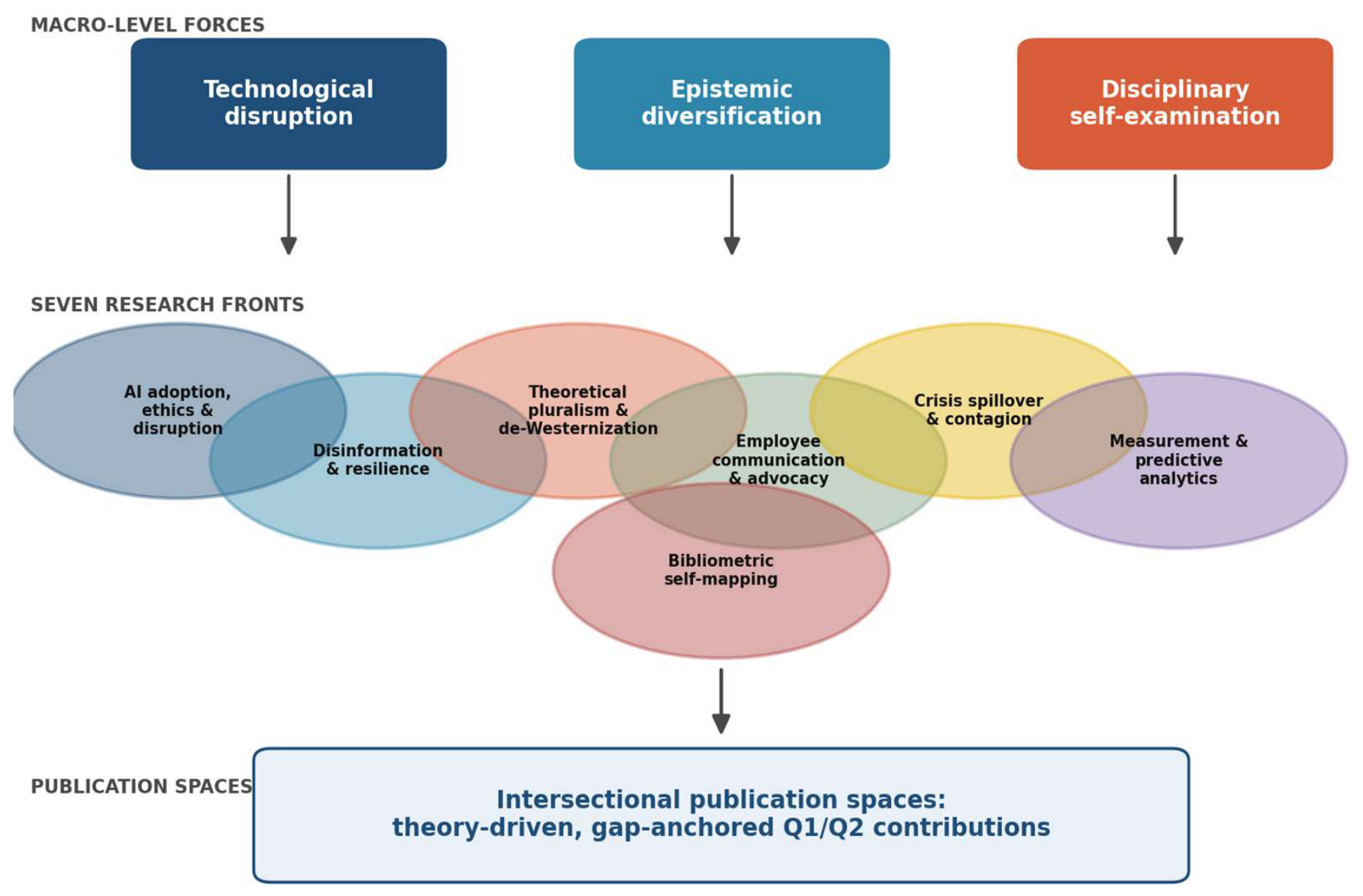
Figure 2.
Sample Composition of the Longitudinal Fact-Check Study of Disinformation Targeting Organizations in Spain (2023–2025) Note. The excess of mentions (730) over entities (549) indicates repeated targeting of some organizations, consistent with the study’s finding of reactive and fragmented organizational responses. Source: Data from Rodríguez Fernández et al. (2026); figure by the authors.
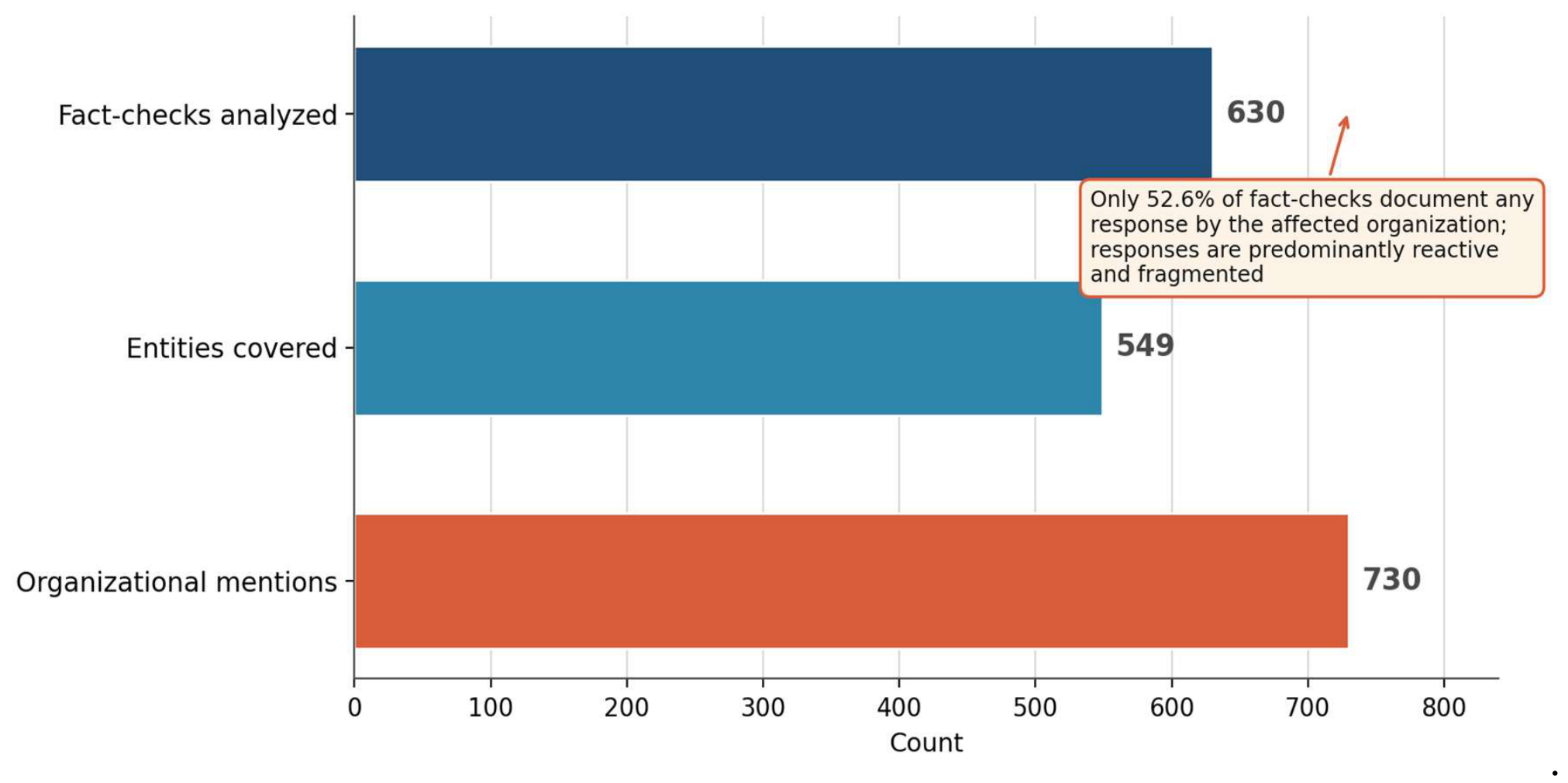
Figure 3.
Maturity–Opportunity Positioning of Research Fronts and Salient Subtopics. Note. Positions reflect the authors’ qualitative assessment derived from the synthesis (editorial demand signals, explicit gap statements, and publication density), not quantitative bibliometric measurement. Topics in the upper-left region combine low saturation with explicit editorial solicitation. Source: Authors’ elaboration.
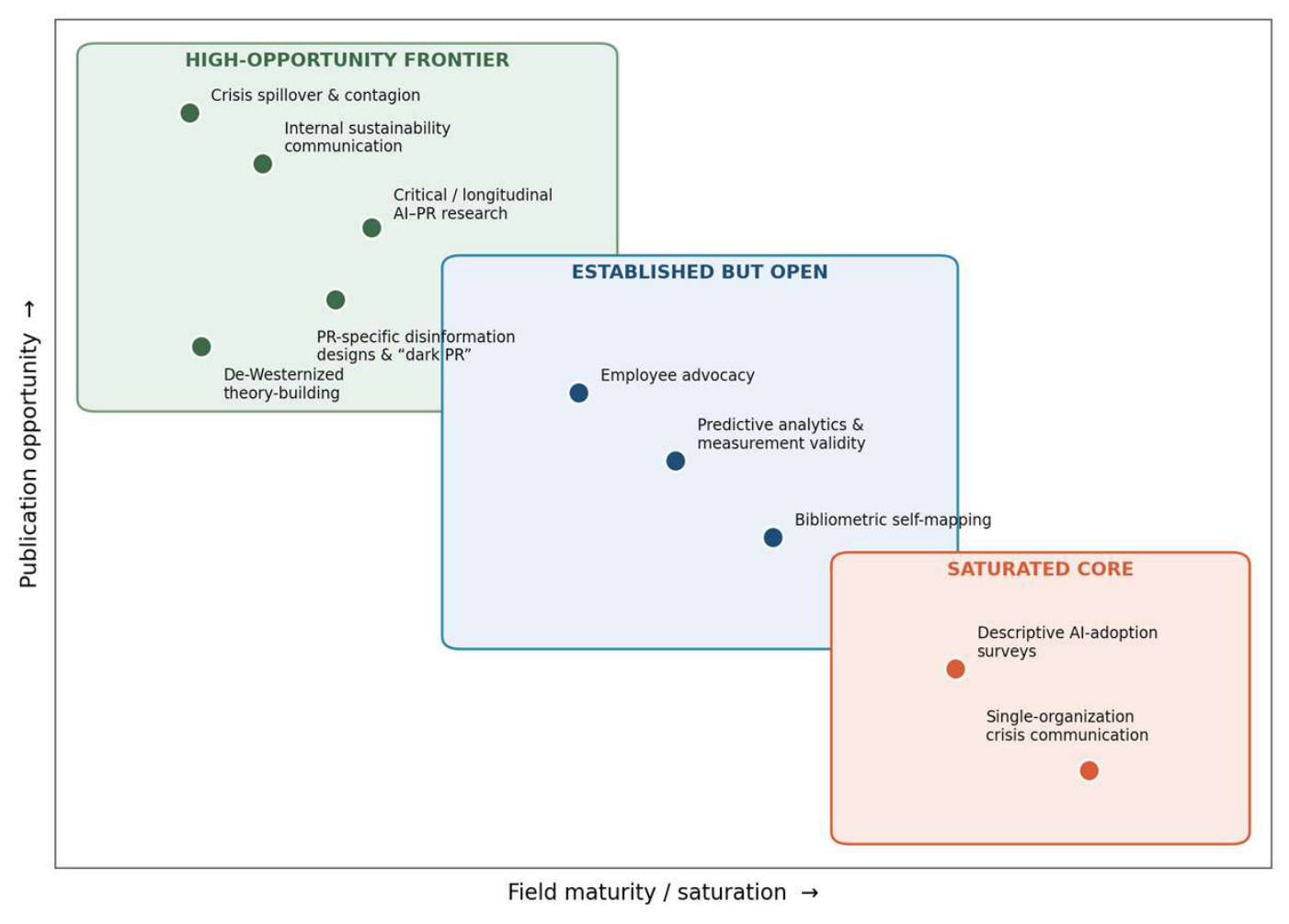

Table 1.
Overview of Contemporary Research Fronts in Public Relations Scholarship.
| Research front | Focal constructs and theoretical anchors | Representative recent evidence | Principal identified gap |
|---|---|---|---|
| 1. AI adoption, ethics, and disruption | Diffusion of innovations (Rogers, 2003); TOE framework (Tornatzky & Fleischer, 1990); augmentation vs. replacement; algorithmic transparency | 277-agency SEM survey across the Arab world (Koa et al., 2025); AMO-framed interview study in the UAE (Radwan et al., 2026); cross-national professional survey (Zerfass et al., 2020); IPR (2025) agenda report | Critical, ethics-grounded, and longitudinal studies of AI’s effect on boundary-spanning and relational functions |
| 2. Disinformation and organizational resilience | SCCT (Coombs, 2007); resilience theory (Buzzanell, 2010); fact-checking; “dark PR” | Longitudinal analysis of 630 fact-checks, 549 entities, 730 mentions in Spain (Rodríguez Fernández et al., 2026); up to 40% reduction in spread via proactive measures (Eze & Zacky-Eze, 2025) | Preventive (vs. reactive) organizational strategies; PR-specific longitudinal fact-checking designs |
| 3. Theoretical and methodological pluralism | Critical, socio-cultural, and interpretive vs. functionalist paradigms; de-Westernization (Curran & Park, 2000; Waisbord & Mellado, 2014) | PRR special-issue call on disrupting and consolidating critical PR research (Public Relations Review, 2025); ICA (2025) preconference | Non-Western case studies; indigenous relationship-management concepts; reflexivity about Excellence Theory’s universality |
| 4. Employee communication and advocacy | Employee engagement; internal communication (Men, 2014); employee advocacy (Thelen & Men, 2023); internal CSR | 45% of PR scholars flag advocacy as a priority (Dong et al., 2025; Thelen & Men, 2023); 1,932-employee cross-cultural greenwashing study (Tao & Chao, 2024) | Internally focused sustainability communication; longitudinal, mixed-method, employee-level designs |
| 5. Crisis spillover and contagion | Spillover crisis; inter-organizational contagion of concern, uncertainty, and perceived harm | Dedicated PRR special issue of ten articles (Laufer & Wang, 2024); scenario experiment on spillover risk perception in China (Wang et al., 2024) | Nearly the entire space: when, how, and through which pathways crises spread between organizations |
| 6. Measurement and predictive analytics | Anticipatory PR; sentiment prediction; reputational-risk detection (Macnamara, 2018) | Industry–academic crossover reports on predictive analytics adoption (Institute for Public Relations, 2025) | Measurement-validity studies benchmarking AI-sentiment tools against surveys and content analysis |
| 7. Bibliometric self-mapping | Intellectual structure; thematic evolution; global research dynamics (Donthu et al., 2021) | Scopus-based mapping of PR management, 2000–2025 (Setiawan et al., 2026); corporate-reputation mapping, 1970–2024 (Karakaya et al., 2025) | Comprehensive understanding of the field’s intellectual structure and global dynamics remains limited |
Note. Representative evidence is illustrative rather than exhaustive; full bibliographic details appear in the reference list. Source: Authors’ elaboration based on the synthesis of peer-reviewed studies, editorial signals, and association agendas (2023–2026).
Table 2.
Theoretical Anchoring and Direction of Theoretical Work by Research Front.
| Front | Established anchors in use | Direction of theoretical work invited |
|---|---|---|
| AI | Diffusion of innovations (Rogers, 2003); TOE framework (Tornatzky & Fleischer, 1990; Koa et al., 2025); AMO framework (Radwan et al., 2026) | From adoption description toward relational/boundary-spanning theory (Broom et al., 1997; Ledingham, 2003); ethics-grounded frameworks (Bourne, 2019) |
| Disinformation | SCCT (Coombs, 2007); resilience theory (Buzzanell, 2010); inoculation logic (Boman & Schneider, 2021) | From reactive crisis response toward preventive/anticipatory theorizing (Lambert et al., 2024); conceptualizing “dark PR” (Rodríguez-Fernández, 2023) |
| Pluralism / de-Westernization | Excellence Theory as object of critique (Grunig, 1992); critical and interpretive paradigms (Edwards, 2018; L’Etang, 2008) | Indigenous relationship-management concepts; power-aware theories of knowledge production (Waisbord & Mellado, 2014) |
| Employee communication | Engagement, internal communication, and advocacy constructs (Kim & Rhee, 2011; Men, 2014; Thelen & Men, 2023) | Internally focused sustainability communication as a demarcated field, not a managerial application (Signitzer & Prexl, 2008; Tao & Chao, 2024) |
| Crisis spillover | Crisis communication canon, organization-centric (Coombs, 2019; Frandsen & Johansen, 2017) | Inter-organizational contagion mechanisms; network-level crisis theory (Laufer & Wang, 2024; Wang et al., 2024) |
| Predictive analytics | Measurement and evaluation traditions (Macnamara, 2018) | Validity theory for algorithmic sentiment and risk indicators |
| Bibliometrics | Meta-scientific mapping conventions (Aria & Cuccurullo, 2017; Donthu et al., 2021; van Eck & Waltman, 2010) | Comprehensive modeling of intellectual structure and global research dynamics (Karakaya et al., 2025; Setiawan et al., 2026) |
Note. SCCT = situational crisis communication theory; TOE = technology–organization–environment framework. Source: Authors’ elaboration based on the cross-front synthesis in Section 3.
Table 3.
Strategic Recommendations Mapped to Fronts, Gaps, and Recommended Designs.
| # | Strategy | Front(s) leveraged | Gap addressed | Recommended design features |
|---|---|---|---|---|
| 1 | Pair AI with established PR theory rather than producing another descriptive adoption study | AI; Crisis; Measurement | Absence of critical, ethics-grounded, longitudinal AI work on relational and boundary-spanning functions | SCCT (Coombs, 2007), relationship management (Ledingham, 2003), or situational theory of publics as anchor; longitudinal or experimental designs |
| 2 | Target the internal/external sustainability communication gap | Employee communication; CSR/sustainability | External skew of sustainability communication research (Signitzer & Prexl, 2008); scarcity of employee-level designs | Longitudinal, mixed-method, employee-level; internal CSR and greenwashing-perception measures (Tao & Chao, 2024) |
| 3 | Frame disinformation as an organizational threat, not political communication | Disinformation; Crisis; Resilience | Rarity of PR-specific fact-checking and longitudinal designs; reactive-response diagnosis (Rodríguez Fernández et al., 2026) | Longitudinal fact-check content analysis; SCCT + resilience combination (Buzzanell, 2010; Coombs, 2007); preventive-strategy focus (Boman & Schneider, 2021) |
| 4 | Contribute to theoretical pluralism and de-Westernization debates | Pluralism; all fronts (multiplier) | Explicit solicitation by 2025–2026 special issues (Public Relations Review, 2025); dominance of Global North standards (Waisbord & Mellado, 2014) | Non-Western case studies; indigenous relationship-management concepts; reflexive critique of Excellence Theory (Grunig, 1992) |
| 5 | Use bibliometric/systematic review designs as low-barrier niche justification | Bibliometrics; Crisis spillover; Employee advocacy | Limited comprehensive mapping of intellectual structure (Setiawan et al., 2026); empty spillover space (Laufer & Wang, 2024) | Scopus/WoS with VOSviewer (van Eck & Waltman, 2010) or Bibliometrix (Aria & Cuccurullo, 2017), following Donthu et al. (2021); targeted mapping of spillover-crisis and advocacy literatures |
Note. Strategies are combinable within the limits discussed in Section 5.1. Source: Authors’ elaboration based on the maturity–opportunity assessment (Figure 3) and the intersection analysis (Section 4.3).
Disclaimer/Publisher’s Note: The statements, opinions and data contained in all publications are solely those of the individual author(s) and contributor(s) and not of MDPI and/or the editor(s). MDPI and/or the editor(s) disclaim responsibility for any injury to people or property resulting from any ideas, methods, instructions or products referred to in the content. |
© 2026 by the authors. Licensee MDPI, Basel, Switzerland. This article is an open access article distributed under the terms and conditions of the Creative Commons Attribution (CC BY) license (http://creativecommons.org/licenses/by/4.0/).
Copyright: This open access article is published under a Creative Commons CC BY 4.0 license, which permit the free download, distribution, and reuse, provided that the author and preprint are cited in any reuse.