

Submitted:
13 November 2026
Posted:
16 November 2026
You are already at the latest version
Abstract
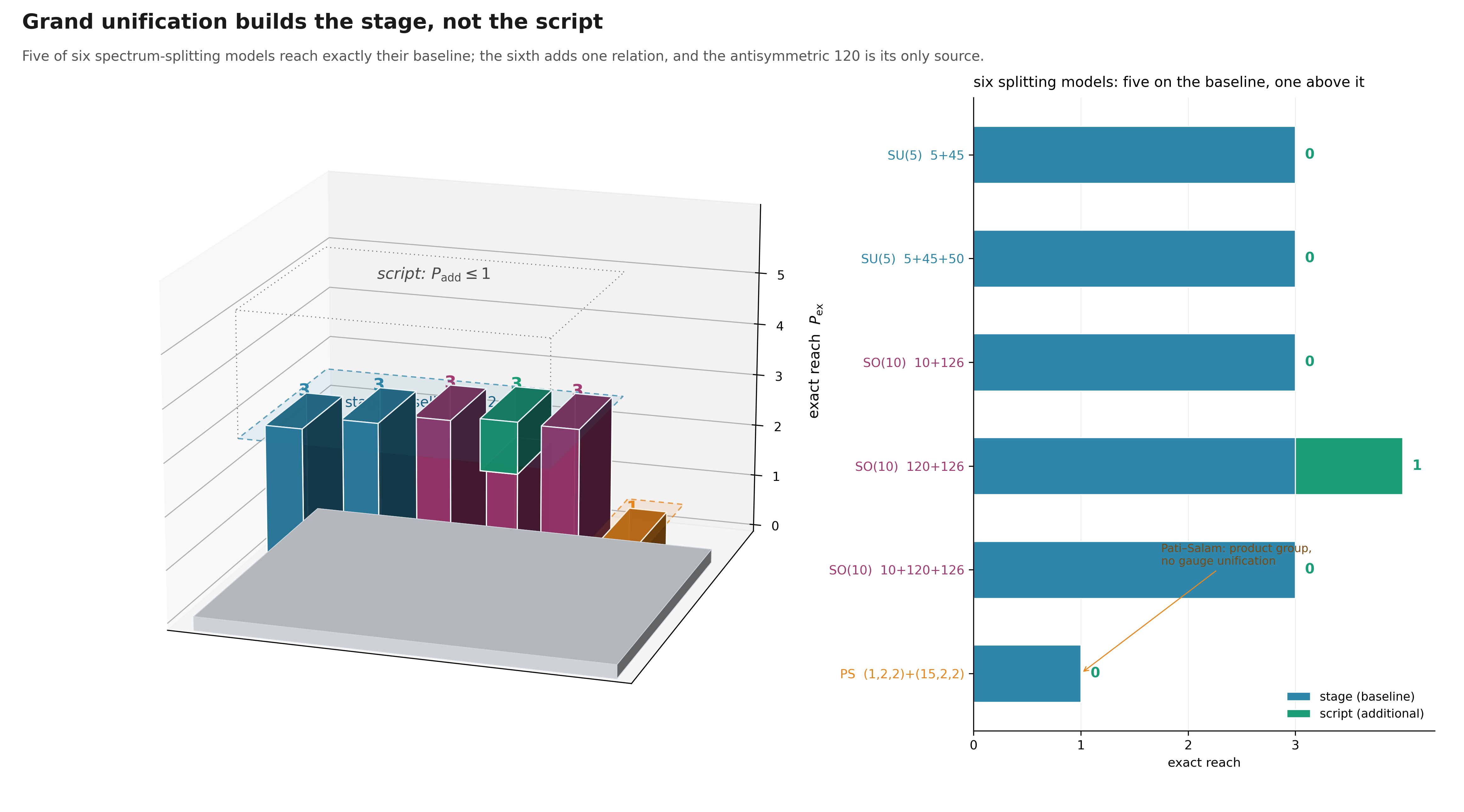
Grand unified theories are justified by the claim that a larger group explains more, but that claim has never been given a number. We define the exact reach of a unified model as the number of relations among low-energy observables that hold for every admissible choice of Yukawa matrices and vacuum expectation values, so that nothing is fitted. At the renormalisable level, for the standard Higgs contents of \( \mathrm{SU}(5) \), \( \mathrm{SO}(10) \), \( E_6 \) and Pati-Salam, the reach splits into a baseline-gauge-coupling unification and charge quantisation, three relations for a simple group and one for Pati-Salam-and a model-specific part. Across the eighteen contents that part takes only the values zero and one. It is zero for five of the six contents that do not force the down-quark and charged-lepton spectra to be proportional, and it equals one for the sixth, \( \mathrm{SO}(10) \) with \( \mathbf{120}+\mathbf{126} \). The asymmetric Yukawa coupling \( \mathbf{120} \) is the only source of any excess at all. Where it does not kill the model outright by making \( M_e=M_d^{\mathsf T} \), it fixes the charged-lepton matrix rigidly, \( M_e=-2M_d-M_d^{\mathsf T} \), and that single constraint yields a parameter-free bound, \( 1<\sum m_e^2/\sum m_d^2\le9 \), which the observed unification-scale spectrum satisfies. Contents that exceed the baseline by more than one are already excluded. The unified group fixes the stage; the flavour sector, not the group, writes the script.
Keywords:
grand unification
; predictivity
; representation theory
; Yukawa structure
; model building
1. Introduction
For fifty years unified model building has been organised around one aesthetic: a larger group explains more. explains charge quantisation; gathers a generation into a single spinor; explains it twice over [1,2,3]. The aesthetic is stated in every review [5,6] and has never been quantified.
The reason is that the natural number to report—the count of free parameters—measures how much freedom is left, not how much is determined. A model with many parameters can still make sharp statements; a model with few can make none. What is wanted is the opposite count: how many relations among observables does the structure force, for every allowed choice of the free data? That is a codimension, not a fit.
This Letter gives that number, computes it exhaustively, and finds a ceiling. The answer is best stated as a division of labour.
The group builds the stage. It decides which representations exist, why electric charge is quantised, and how the three gauge couplings meet. That is not nothing: it is the entire reason unification was believed.
The group does not write the script. Which generation is heavy, why the mixing angles take the values they do, why neutrinos are light—none of this follows from the group. It is written by the flavour sector: discrete symmetries, textures, threshold corrections, whatever one adds.
The theorem below makes the division exact, and locates the one place where the group does write a line of its own: the antisymmetric Yukawa coupling of , which contributes at most one relation to the observables—and only when it has not already destroyed the model.
2. Counting Exact Reach
Fix a group G, a breaking chain to the Standard Model, and a Higgs content H. The observables at the unification scale are the nine charged-fermion masses, the four CKM parameters and the three gauge couplings; call the set , with .
Let C be the matrix whose rows are the sectors and whose columns are the allowed Yukawa operators, with entries the Clebsch–Gordon coefficients. We adopt one convention, stated once and used throughout: the up-type and down-type vacuum expectation values of a given representation are free and independent; the down-type and charged-lepton sectors share a doublet and therefore a vacuum expectation value. A relation is exact only if it survives every admissible choice of Yukawa matrices and of vacuum expectation values.
Definition 1.
The exact reach of is the number of independent relations among the sixteen observables that hold identically on the image of the allowed operators. Write , where the baseline is the part contributed by gauge unification and charge quantisation and is the model-specific part.
The counting rules are five, and one of them carries a factor that is easy to get wrong.
| structure | relations | reason |
| 2 | one number instead of three | |
| , k fixed by the coefficients | 3 | three equal mass ratios |
| , free | 2 | three equal mass ratios are two conditions when t floats |
| 4 | three angles and one phase | |
| traceless hypercharge | 1 | charge quantisation |
The asymmetry between the second and third rows is the point. When and k is a ratio of Clebsch–Gordon coefficients, the three ratios , , are pinned to a number: three relations. When and t is , the three ratios are equal to each other but to nothing in particular: two relations, not three. A single-operator model therefore carries five mass relations, not six.
3. The Ceiling
Theorem 1.
For a renormalisable model with a standard Higgs content that does not force a proportionality between and ,
Moreover if and only if the content contains a single antisymmetric Yukawa coupling entering the d and e sectors with opposite signs, and is not transpose-degenerate.
The two halves of the theorem have different origins and are proved separately below.
Lemma 1
(Visibility). Let with all . It constrains the observables only if it forces two sectors to be proportional, or forces one to be the transpose of the other.
Proof.
If with , the spectrum of is not a function of the spectra of and : eigenvalues of a sum are not functions of the summands’ eigenvalues. The relation transmits no information to the nine mass moduli; its only content is a constraint on , which the free phases satisfy without touching any modulus. Only a proportionality, or a transpose (which equates singular values because the singular values of M and coincide), is visible. □
Lemma 2
(Dominance). If and the number of operators is at least three, the map from Yukawa and vev parameters to the sixteen observables is dominant, so no polynomial identity holds among them.
Proof.
For each independent matrix entry the equations , , form a rank-three system and are solvable; entries can be chosen independently, so every triple of the appropriate symmetry types is attained. The eigenvalue-and-mixing map is open on the locus of non-degenerate spectra. A composition with open dense image is dominant, and a dominant image cannot lie in the zero set of a non-zero polynomial. □
Lemma 3
(Residue of the ). For with the charged-lepton mass matrix is fixed by the down-type one,
an identity that contains no free parameter. Consequently (a) is symmetric, (b) there is a direction x along which , and (c) exactly one observable relation survives.
Proof.
Put symmetric and antisymmetric, so that and . Adding, and using and , gives (2) at once, hence (a). For (b): is and antisymmetric, so and some obeys ; then , (the Georgi–Jarlskog ratio [4]) and with . For (c), count parameters: S carries twelve real numbers, A six, the four complex vevs eight, for twenty-six; the redundancies are a rescaling of each representation (four), the flavour rotation , (nine), and the overall phase of (one). Twelve physical parameters against thirteen observables leave exactly one relation. □ □
The identity (2) is stronger than the linear relation noted earlier: that relation carries two vev-dependent coefficients, whereas (2) carries none. It is the statement that the 120 leaves a rigid trace: the whole charged-lepton sector is a function of the down-type sector, with no freedom left.
3.1. A Parameter-Free Prediction
Diagonalise by a congruence to a real positive diagonal D; then and . With and Hermitian and traceless,
so taking traces and using ,
Eliminating the two invariants gives the bound
which contains no fitted quantity. Over six thousand random parameter points the ratio for stays inside with no violation and spans to , while the three neighbouring contents violate it: in 80 and in 904 cases, in 3625, and with in 37 and in 634. The counts are those of a single reference run; points lying within a few per cent of either bound can fall on the other side when the random stream or the linear algebra differs, so the qualitative statement—no violation for , violations for every neighbour—is the reproducible one.
Comparing (5) with the unification-scale spectrum tabulated in Ref. [7], the ratio is for running without supersymmetric thresholds ( to over to 50), and to for the three threshold-corrected supersymmetric cases given there. Every case lies inside the window, closer to the lower edge than to the middle. Within its own conventions the model is therefore not excluded, and (5) is falsifiable: a unification-scale spectrum whose charged leptons were lighter than the down-type quarks in quadrature would refute it. Note that the lower bound is the binding one, and it is the statement that at the unification scale—precisely what exact b– unification would saturate.
4. Census and Verification
We enumerated every non-empty subset of the standard Higgs irreps of (), (), () and Pati–Salam (, ): eighteen contents. Ranks are exact rational arithmetic. Six are spectrum-splitting, twelve are excluded, and takes the values 0 and 1 across the six: five sit on their baseline, and with sits one above.
Each is a measured rank, not an assumption. The observable vector is nine singular values (the physical masses, not the moduli of eigenvalues, which differ for non-Hermitian matrices), three mixing moduli and the Jarlskog invariant; the Jacobian is taken with respect to the eighteen real entries of an antisymmetric and a symmetric Yukawa matrix together with eight real vacuum parameters, four complex ones, for twenty-six in total. The three gauge and charge-quantisation relations are counted in the baseline , so the flavour Jacobian has the remaining thirteen rows; this is why the count is rather than . Sample points with a degenerate spectrum are rejected, since the sorted-mass map is not differentiable there. The rank is constant across ten random points per model.
Two unstructured controls guard against the objection that a deficit of rank is a numerical artefact. Three general complex matrices, one feeding each sector, give rank thirteen; two general complex matrices feeding all three sectors also give thirteen. Both configurations have far more parameters than observables, so thirteen is what the machinery returns when no symmetry constrains it; the deficits of ten and twelve are therefore properties of the antisymmetric coupling and not of the Jacobian.
5. Stage, not Script
The result is easy to misread, so we state what it does and does not say.
It does not say that large groups are worthless. It says their worth is not exact reach. A larger group can make a model more natural, more economical, or more tightly constrained in ways that are approximate—b– unification is the standard example, and it is approximate precisely because it depends on a limit. Those virtues are real. They are simply not the virtue the aesthetic claims.
What the census shows is more specific, and more useful, than a blanket dismissal. Of the eighteen standard contents, five make exactly the predictions that any simple-group unification makes and nothing more; one makes one more, and the mechanism is a single object, the antisymmetric . Every content that tries to exceed this pays for it with an exact relation that the data already exclude. In other words: the group supplies the stage—which representations exist, why charge is quantised, how the couplings meet—and when it tries to write a line of dialogue, it gets at most one, and it is the line about .
The figure of merit that follows is not but per declared input—reach bought per unit of assumption. On that scoreboard every splitting model in Table 1 is tied at zero or one, and the tie is broken only by how much each must declare in order to fit the spectrum. That number is computable, it has not been computed, and it is the only scoreboard on which the question “which group?” has an answer.
Supplementary Materials
The following supporting information can be downloaded at the website of this paper posted on Preprints.org.
Declaration of Generative AI and AI-Assisted Technologies
Generative AI was used in two delimited roles. First, language editing: the prose of this Letter was polished with AI assistance, the argument and all principal equations being the authors’. Second, code support: AI was used to write and check the verification and plotting scripts, and to add comments to them. AI was not used to generate scientific conclusions, and no authorship is attributed to any AI system. The authors verified every derivation, every numerical value and every reference, and take full responsibility for the content.
Declaration of Competing Interest
The authors declare that they have no known competing financial interests or personal relationships that could have appeared to influence the work reported in this paper.
Data Availability
All numerical values quoted here are reproduced by the verification program documented in Appendix A of the Supplementary Material; no external data were used.
References
- Georgi, H.; Glashow, S. L. Unity of all elementary-particle forces. Phys. Rev. Lett. 1974, 32, 438. [Google Scholar] [CrossRef]
- Pati, J. C.; Salam, A. Lepton number as the fourth colour. Phys. Rev. D. 1974, 10, 275. [Google Scholar] [CrossRef]
- Fritzsch, H.; Minkowski, P. Unified interactions of leptons and hadrons. Ann. Phys. 1975, 93, 193. [Google Scholar] [CrossRef]
- Georgi, H.; Jarlskog, C. A new lepton–quark mass relation in a unified theory. Phys. Lett. B 1979, 86, 297. [Google Scholar] [CrossRef]
- Slansky, R. Group theory for unified model building. Phys. Rep. 1981, 79 1. [Google Scholar] [CrossRef]
- Langacker, P. Grand unified theories and proton decay. Phys. Rep. 1981, 72, 185. [Google Scholar] [CrossRef]
- Antusch, S.; Spinrath, M. Quark and lepton masses at the GUT scale including SUSY threshold corrections. Phys. Rev. D. 2008, arXiv:0804.071778, 075020. [Google Scholar] [CrossRef]

Table 1.
Exact reach at the unification scale. Upper block: the six contents that do not force a proportionality between and . Five sit on their baseline; one exceeds it by a single relation. Lower block: representatives that are excluded, either because or because the transpose forces the spectra together. Every column is shown so that each row adds up; the Pati–Salam baseline differs visibly, being a product group. The full census of eighteen contents is in the Supplementary Material.
| model | mass | CKM | gauge | charge | |||
|---|---|---|---|---|---|---|---|
| , | 3 | 0 | 0 | 2 | 1 | 0 | 3 |
| , | 3 | 0 | 0 | 2 | 1 | 0 | 3 |
| , | 3 | 0 | 0 | 2 | 1 | 0 | 3 |
| , | 3 | 0 | 0 | 2 | 1 | 0 | 3 |
| Pati–Salam, | 3 | 0 | 0 | 0 | 1 | 0 | 1 |
| , | 3 | 0 | 0 | 2 | 1 | 1 | 4 |
| , | 2 | 5 | 4 | 2 | 1 | — | 12 |
| , | 2 | 5 | 4 | 2 | 1 | — | 12 |
| Pati–Salam, | 2 | 5 | 4 | 0 | 1 | — | 10 |
| , | 2 | 3 | 0 | 2 | 1 | — | 6 |
| , | 3 | 3 | 0 | 2 | 1 | — | 6 |
Disclaimer/Publisher’s Note: The statements, opinions and data contained in all publications are solely those of the individual author(s) and contributor(s) and not of MDPI and/or the editor(s). MDPI and/or the editor(s) disclaim responsibility for any injury to people or property resulting from any ideas, methods, instructions or products referred to in the content. |
© 2026 by the authors. Licensee MDPI, Basel, Switzerland. This article is an open access article distributed under the terms and conditions of the Creative Commons Attribution (CC BY) license (http://creativecommons.org/licenses/by/4.0/).
Copyright: This open access article is published under a Creative Commons CC BY 4.0 license, which permit the free download, distribution, and reuse, provided that the author and preprint are cited in any reuse.