

Submitted:
13 November 2026
Posted:
16 November 2026
You are already at the latest version
Abstract
Battery-powered and electric rail vehicles are an emerging route to decarbonising lines where overhead electrification is uneconomic, and they move a large share of vehicle dependability onto the battery system, its thermal management and power-electronic interfaces. Digital twins (DTs) virtual representations continuously calibrated to a physical asset are widely proposed to manage such systems, yet railway-specific evidence remains thin. This narrative critical review consolidates the foundations needed to design a DT for a battery-powered rail vehicle: energy-supply architectures and railway duty characteristics, lithium-ion ageing and failure mechanisms, battery model families, data infrastructure and edge–cloud partitioning, prognostics and health management, and verification, validation and standards. A four-layer reference architecture that keeps safety-related protection on the vehicle while using the cloud for calibration and fleet analytics is proposed. The review finds that the enabling methods are mature in road-vehicle and laboratory contexts but that railway-specific validation, uncertainty-aware decision support, twin qualification criteria and demonstrated operational benefit are lacking in the literature examined. A prioritised research agenda is presented. The review is narrative rather than systematic; gaps are stated relative to the sources examined.
Keywords:
digital twin
; battery electric multiple unit
; rail vehicle
; lithium-ion battery
; prognostics and health management
; state of health
; remaining useful life
; verification and validation
; edge–cloud architecture
1. Introduction
Rail transport is among the most energy-efficient means of moving people and freight, and its decarbonisation is a stated priority of international energy policy [1]. Where catenary electrification is uneconomic, physically constrained or politically slow, vehicles that carry traction energy on board—battery electric multiple units (BEMUs), battery-equipped trams and light rail vehicles, battery-hybrid locomotives and shunting or maintenance units offer a practical route to eliminating diesel traction on partially or non-electrified lines [2,3]. The consequence for engineers is a structural shift: a large part of the vehicle’s dependability burden moves from the infrastructure to a lithium-ion battery system, its thermal management, its power-electronic interfaces and its supervisory software. These subsystems are recent, less standardised and less well characterised under railway duty than the traction equipment they replace.
In parallel, the digital twin (DT) has matured from an aerospace concept [4,5] into a broad family of architectures for monitoring, prediction and optimisation across industry [6,7,8,9]. Battery systems have become one of the most active application areas, because their state is hidden, their ageing is path-dependent and their safety margins depend on conditions that cannot be measured directly [10,11,12,13]. The convergence of these two trends battery-powered rail vehicles and battery digital twins is intuitively attractive. It is, however, only thinly documented. Digital twins have meanwhile been applied well beyond railways, including to predictive diagnostics of harsh-duty mining equipment [14], which suggests that their architecture is transferable. Railway-specific DT literature has concentrated on infrastructure assets such as turnouts and bridges [15], whereas the battery DT literature has been developed predominantly for road electric vehicles and stationary storage [13].
This review therefore pursues four objectives. First, it consolidates the technical foundations needed to design a DT for a battery-powered or electric rail vehicle: duty-cycle and architecture considerations, battery modelling, state estimation and prognostics, data infrastructure and edge–cloud partitioning. Second, it critically assesses how far results established for road vehicles transfer to railway duty and what must be re-validated. Third, it examines verification, validation, uncertainty quantification and the regulatory context, which together determine whether a twin can be trusted for safety-relevant decisions. Fourth, it derives a prioritised research agenda. The companion paper to this review addresses a complementary question—how twin-calibrated simulation can be used proactively to explore failure scenarios before they occur in service.
2. Review Approach and Scope
This is a narrative critical review rather than a PRISMA-compliant systematic review. No quantitative claims are made about the number of records screened or retained. Sources were selected for relevance, rigour and influence, prioritising (i) peer-reviewed review articles and foundational studies on digital twins, battery modelling, battery state estimation and prognostics; (ii) railway-specific studies on onboard energy storage; and (iii) standards that govern railway reliability and onboard traction batteries. Where railway-specific evidence is sparse, which is frequently the case, the review draws on road-vehicle and general prognostics literature and explicitly flags the transferability assumption involved.
Two limitations follow. First, because no systematic search protocol was executed, the absence of a topic from this paper should not be read as proof that no study exists; statements of research gaps are therefore made as gaps in the literature examined and should be re-tested through a formal systematic mapping. Second, industrial practice much of which is proprietaryis largely invisible to the open literature, so the review probably understates what operators and manufacturers have already deployed.
3. Battery-Powered and Electric Rail Vehicles: Architectures and Duty Context
3.1. Energy-Supply Architectures
Electric rail vehicles can be grouped by how traction energy reaches the powertrain. Conventional overhead-line or third-rail vehicles draw power continuously and may use onboard storage only for regeneration buffering or auxiliary functions. Battery-electric vehicles carry the full traction energy for portions of a journey and recharge at stations, depots or electrified sections. Hybrid vehicles combine a battery with another source such as a diesel generator or fuel cell [2,3]. Table 1 summarises these architectures from the perspective of reliability and twin design.
3.2. Distinctive Features of Railway Battery Duty
Railway duty differs from road duty in ways that matter for twin design. Traction power demand is shaped by timetabled stop–start patterns, gradients and regenerative braking events that can place high instantaneous current demands on the pack. Service lives are long, so degradation must be forecast over a vehicle lifecycle that is much longer than the commercial lifetime of any one battery technology, which makes replacement planning and second-life decisions part of the twin’s remit. Vehicles operate across wide climatic ranges, and charging events may be concentrated at fixed locations and times rather than distributed, which concentrates both thermal and ageing stress. Finally, railway dependability is governed by a formal RAMS (reliability, availability, maintainability and safety) lifecycle [16], and onboard lithium-ion traction batteries have their own product standard [17]. A twin intended to support safety-related or availability-related decisions must be developed with these obligations in view. These are engineering observations drawn from the standards and architecture literature rather than quantified findings.
4. Battery Failure, Ageing and Dependability Challenges
Lithium-ion ageing arises from coupled mechanisms, including growth and restructuring of the solid–electrolyte interphase, loss of active material, loss of lithium inventory, lithium plating at low temperature or high charge rate, and mechanical degradation of electrodes [18,19,20]. These mechanisms depend on temperature, state of charge, current and cycling depth, so the ageing trajectory of an individual battery depends on its own history. This path dependence is the fundamental reason a population-average reliability figure is a poor predictor for an individual railway pack, and it is the principal motivation for a vehicle-specific twin.
Safety-critical failure modes lie at the other end of the severity spectrum. Internal short circuits, abuse conditions and thermal runaway can propagate from a single cell to a module and beyond [21,22,23]. Thermal management quality strongly influences both safety and ageing [24]. Battery management systems (BMS) are responsible for state estimation, balancing, protection and communication, and their own sensing and software faults are a distinct failure category [25]. For railway use the relevant dependability question is not only whether cells fail but whether failures of cells, sensors, cooling, contactors, converters or software interact to produce an availability loss or a hazardous event; such interactions are the subject of the companion paper.
Statistical reliability tools remain foundational [26] but struggle when failures are rare, systems are new and degradation is path-dependent. Fault-tree and FMEA-type analyses [27], and systems-theoretic approaches that emphasise unsafe interactions rather than component failures [28], structure the thinking but depend on engineering judgement about failure modes and probabilities that field data cannot yet confirm for newly introduced battery rail fleets. A twin that continuously calibrates a physics-based model to the individual vehicle partially fills this evidence gap.
5. Digital Twin Concepts and Architectures
5.1. Definitions and Maturity
Early formulations defined a digital twin as a virtual representation connected to a physical product throughout its lifecycle [4,5]. Subsequent reviews show that the term is applied to a wide spectrum, from static digital models and one-way digital shadows to bidirectionally coupled twins that influence the physical asset [6,8,9]. The distinction matters for rail: only twins with an automated or semi-automated feedback path to operation or maintenance decisions realise the full value, while twins that merely visualise data are better described as monitoring dashboards. The ISO 23247 series provides a reference framework for manufacturing twins [29] and is useful as an architectural template, although it was not written for onboard vehicle applications. Rasheed et al. emphasise that the value of a twin is limited by the fidelity and validated range of its underlying models [7], and Tao and Qi argue for scalable twin ecosystems rather than one-off implementations [30].
5.2. Reference Architecture for a Rail Vehicle Battery Twin
Figure 1 proposes a four-layer architecture synthesised from the battery-twin and edge-computing literature [10,11,12,31]. The physical layer contains the pack, BMS and sensors, thermal management, converters and charging interfaces. The edge layer performs time-critical, safety-related and bandwidth-constrained functions on the vehicle, with a reduced-order model for state estimation and anomaly detection. The cloud or fleet layer hosts higher-fidelity models, degradation forecasting, calibration and retraining, and fleet-level analytics. The application layer translates twin outputs into maintenance planning, energy and charging optimisation, design feedback and what-if studies. The partitioning follows the cloud–side–end collaboration concept reported for battery management [12] and the cloud BMS twin demonstrated by Li et al. [11].
A defensible design principle is that safety-related protection functions must remain on the vehicle and must not depend on connectivity or on cloud inference. The cloud twin informs, calibrates and recommends; the onboard BMS and vehicle control retain authority over protective actions. This separation aligns with the integrity expectations of the railway RAMS lifecycle [16] and is a design recommendation of this review rather than a finding from any single cited study.
5.3. Industrial Applications of Digital Twins and Transferable Lessons
Digital twins have been adopted across several industries, and surveys identify condition monitoring, diagnosis, condition-based maintenance and design feedback as their principal sources of value [6,8,9]. Table 2 summarises representative application domains and the lesson each offers for battery-powered rail vehicles. Three observations follow. First, in aerospace, where the concept originated, twin validity is tied to continuous calibration against the individual vehicle [4,5], which is directly relevant to path-dependent battery ageing. Second, in manufacturing the emphasis has shifted from isolated models to scalable twin ecosystems [6,30]. Third, railway infrastructure owners have already used twins to support lifecycle decisions for assets such as turnouts [15], indicating that twin-based asset management is acceptable within railway engineering culture.
A further example comes from mining. A digital twin framework for predictive diagnostics of slurry pumps, developed by the present author and colleagues [14], applies the same architectural pattern—sensor data, a continuously updated asset model and diagnostic inference—to a harsh-duty rotating asset whose degradation also depends on operating history. The pattern is relevant to battery rail vehicles for the same reason: both asset classes degrade in a duty-dependent way and benefit from condition-based rather than calendar-based maintenance.
A caution is warranted when reading the industrial record. In the author’s reading of the cited surveys, reported benefits are largely demonstrated in individual case studies rather than through controlled before-after or fleet-comparison designs [8,9], so the success of twins should be read as encouraging but not yet quantified in a way that can be transferred to railway battery systems without field validation.
6. Battery Modelling Within the Twin
A battery twin rests on one or more model families, each with distinct strengths (Table 3). Equivalent-circuit models (ECMs) are computationally light and widely used for real-time state estimation, and comparative studies show that moderate-order ECMs often offer the best trade-off between accuracy and complexity [32,33]. Electrochemical models derived from porous-electrode theory [34] resolve internal variables such as lithium concentration and potential, which makes them attractive for diagnosing ageing mechanisms and for fast-charging design, at the cost of computation and parameter identifiability. Empirical and semi-empirical ageing models relate capacity and resistance growth to usage history. Data-driven models learn the mapping from measured signals to health indicators or lifetime, and hybrid or physics-informed approaches embed physical constraints in learning [35,36].
Pack-level twins must also represent cell-to-cell variability, interconnect resistance, thermal gradients and balancing, because a pack is limited by its weakest cell. Mechanism-level diagnostics such as incremental capacity analysis and differential voltage analysis can reveal loss of active material and lithium inventory [19,41], but they typically need controlled or slow-rate conditions. Railway duty offers recurring, repeatable charging events at depots or stations that may provide such conditions opportunistically; whether this can be exploited in practice is an open question for the railway context.
7. Data Infrastructure and Edge Cloud Design
The credibility of a twin is bounded by its data. Table 4 lists the principal signals and their roles. Beyond electrical and thermal measurements, railway-specific context route position, gradient, timetable, ambient conditions, charging-event metadata and maintenance history—is needed to interpret battery behaviour. Time synchronisation, sensor calibration records and data-quality flags are not optional details: a twin that cannot distinguish a degrading cell from a drifting sensor will produce misleading prognoses.
Edge computing reduces latency, preserves bandwidth and allows continued operation without connectivity [31]. In a battery twin this implies a reduced-order estimator onboard and periodic synchronisation of summarised features, not raw high-rate data, to the cloud [11,12]. Cybersecurity, data governance and operator–supplier data-ownership arrangements are practical constraints that the engineering literature reviewed here addresses only lightly and which, in the author’s judgement, deserve dedicated study before fleet-scale deployment.
8. Prognostics and Health Management Within the Twin
Prognostics and health management (PHM) is the principal value-generating function of a battery twin. Reviews of condition-based maintenance and prognostics establish the standard pipeline of data acquisition, health-indicator construction, state estimation and remaining-useful-life (RUL) prediction [42,43,44,45]. For batteries, state-of-charge estimation methods are well surveyed [46], state-of-health estimation methods are reviewed for real applications [47], and data-driven lifetime prediction has advanced rapidly [38,48]. A landmark demonstration showed that features extracted from early-cycle voltage curves can predict cycle life across a large cell dataset [37], and subsequent work has automated feature extraction and selection [49]. Closed-loop machine-learning optimisation of charging protocols further illustrates how model-guided experimentation can reduce testing burden [50]. Digital twin frameworks for predictive diagnostics have likewise been proposed for other harsh-duty industrial assets, such as slurry pumps in mining operations [14], which, like battery rail vehicles, require condition-based maintenance decisions under variable duty.
Figure 2 depicts a twin-enabled PHM workflow. Two cautions apply to its use in railway service. First, the best-known datasets and algorithms were generated under controlled laboratory cycling of cells, and their performance on packs under variable railway duty with partial and irregular cycles has not been established to the same standard; extrapolation should be treated as a hypothesis requiring field validation. Second, a point estimate of RUL is of limited value to a maintenance planner without a calibrated uncertainty bound. Recurrent networks such as LSTM [39,40] are commonly used for sequence-based health prediction, and uncertainty can be decomposed into aleatoric and epistemic components [51]. Predictive twins built on probabilistic graphical models, in which the digital state is continuously updated from data and drives decisions, offer a principled route to uncertainty-aware operation [52].
Maintenance integration deserves emphasis. A twin that predicts end of life but is not connected to maintenance scheduling, spare-pack logistics and warranty processes does not change outcomes. The decision layer should therefore be co-designed with operators, and its benefit should be demonstrated through operational indicators such as avoided in-service failures and availability, not through prediction accuracy alone.
9. Verification, Validation, Uncertainty and Standards
Verification asks whether a model is implemented correctly; validation asks whether it represents the real system for its intended use [53,54]. A battery twin intended for decision support must have a stated validity domain temperature, current, state-of-charge and ageing ranges outside which outputs are flagged as extrapolation. Uncertainty quantification propagates parameter, measurement and model-form uncertainty to the outputs [55], and global sensitivity analysis identifies which parameters merit tighter identification [56]. Because twins are updated continuously, validation is a continuing activity: re-validation triggers should be defined for firmware updates, battery replacement, route changes and sensor changes.
The regulatory landscape is evolving. EN 50126 defines the RAMS lifecycle for railway applications [16], and IEC 62928 addresses onboard lithium-ion traction batteries [17]. Neither document, as far as the author is aware, prescribes how a digital twin is to be qualified when it supports safety-relevant or availability-relevant decisions. This is a significant barrier: until acceptance criteria exist, twins will in practice be used as advisory tools. Model-based systems engineering offers a structured means of maintaining traceability between requirements, models and evidence [57].
10. Challenges and Research Agenda
Synthesising the preceding sections, Table 5 lists research gaps in the literature examined and proposes priorities. The agenda is the author’s synthesis and is intended as a set of testable directions rather than established conclusions.
11. Conclusions
Digital twins for battery-powered and electric rail vehicles combine two maturing fields, but their integration is not yet well evidenced in the literature examined. The foundations battery modelling, state estimation, prognostics, edge–cloud architectures and verification and validation (V&V) methodology are well developed in the road-vehicle and general prognostics literature. What is missing is railway-specific validation, uncertainty-aware decision support, qualification pathways and demonstrated operational benefit. A layered architecture that keeps safety-related protection onboard while exploiting cloud-based calibration and fleet analytics is a defensible design principle. The immediate priorities are instrumented pilot vehicles with open datasets, field validation of ageing and health models under railway duty, and a standards-oriented treatment of twin qualification. A formal systematic mapping, which this narrative review did not attempt, would be a valuable complement.
Author Contributions
Conceptualization, methodology, writing original draft preparation and review and editing: D.M. E.M. L.M. T.N and K.M.
Funding
This research received no external funding.
Data Availability Statement
No new data were created or analysed in this study.
Acknowledgments
The authors acknowledge institutional support from the National University of Science and Technology, Bulawayo, Zimbabwe.
Conflicts of Interest
The authors declare no conflicts of interest.
References
- International Energy Agency. The Future of Rail: Opportunities for Energy and the Environment; IEA: Paris, France, 2019. [Google Scholar]
- Fedele, E.; Iannuzzi, D.; Del Pizzo, A. Onboard energy storage in rail transport: Review of real applications and techno-economic assessments. IET Electr. Syst. Transp. 2021, 11, 279–309. [Google Scholar] [CrossRef]
- Ghaviha, N.; Campillo, J.; Bohlin, M.; Dahlquist, E. Review of Application of Energy Storage Devices in Railway Transportation. Energy Procedia 2017, 105, 4561–4568. [Google Scholar] [CrossRef]
- Glaessgen, E.; Stargel, D. The Digital Twin Paradigm for Future NASA and U.S. Air Force Vehicles. In Proceedings of the 53rd AIAA/ASME/ASCE/AHS/ASC Structures, Structural Dynamics and Materials Conference, Honolulu, HI, USA, 23–26 April 2012. AIAA 2012-1818. [Google Scholar]
- Grieves, M.; Vickers, J. Digital Twin: Mitigating Unpredictable, Undesirable Emergent Behavior in Complex Systems. In Transdisciplinary Perspectives on Complex Systems; Kahlen, F.-J., Flumerfelt, S., Alves, A., Eds.; Springer: Cham, Switzerland, 2017; pp. 85–113. [Google Scholar] [CrossRef]
- Tao, F.; Zhang, H.; Liu, A.; Nee, A.Y.C. Digital Twin in Industry: State-of-the-Art. IEEE Trans. Ind. Inform. 2019, 15, 2405–2415. [Google Scholar] [CrossRef]
- Rasheed, A.; San, O.; Kvamsdal, T. Digital Twin: Values, Challenges and Enablers from a Modeling Perspective. IEEE Access 2020, 8, 21980–22012. [Google Scholar] [CrossRef]
- Jones, D.; Snider, C.; Nassehi, A.; Yon, J.; Hicks, B. Characterising the Digital Twin: A systematic literature review. CIRP J. Manuf. Sci. Technol. 2020, 29, 36–52. [Google Scholar] [CrossRef]
- Fuller, A.; Fan, Z.; Day, C.; Barlow, C. Digital Twin: Enabling Technologies, Challenges and Open Research. IEEE Access 2020, 8, 108952–108971. [Google Scholar] [CrossRef]
- Wu, B.; Widanage, W.D.; Yang, S.; Liu, X. Battery digital twins: Perspectives on the fusion of models, data and artificial intelligence for smart battery management systems. Energy AI 2020, 1, 100016. [Google Scholar] [CrossRef]
- Li, W.; Rentemeister, M.; Badeda, J.; Jöst, D.; Schulte, D.; Sauer, D.U. Digital twin for battery systems: Cloud battery management system with online state-of-charge and state-of-health estimation. J. Energy Storage 2020, 30, 101557. [Google Scholar] [CrossRef]
- Wang, Y.; Xu, R.; Zhou, C.; Kang, X.; Chen, Z. Digital twin and cloud-side-end collaboration for intelligent battery management system. J. Manuf. Syst. 2022, 62, 124–134. [Google Scholar] [CrossRef]
- Naseri, F.; Gil, S.; Barbu, C.; Cetkin, E.; Yarimca, G.; Jensen, A.C.; Larsen, P.G.; Gomes, C. Digital twin of electric vehicle battery systems: Comprehensive review of the use cases, requirements, and platforms. Renew. Sustain. Energy Rev. 2023, 179, 113280. [Google Scholar] [CrossRef]
- Dhanda, M.; Mashava, D.; Muhla, T.M.; Ndlovu, Z.; Nkala, K.; Zuze, M.; Bhande, M.; et al. A digital twin framework for predictive slurry pump diagnostics in mining operations. Open Access Res. J. Sci. Technol. 2026, 17, 044–056. [Google Scholar] [CrossRef]
- Kaewunruen, S.; Lian, Q. Digital twin aided sustainability-based lifecycle management for railway turnout systems. J. Clean. Prod. 2019, 228, 1537–1551. [Google Scholar] [CrossRef]
- EN 50126-1:2017; Railway Applications—The Specification and Demonstration of Reliability, Availability, Maintainability and Safety (RAMS)—Part 1: Generic RAMS Process. CENELEC: Brussels, Belgium, 2017.
- IEC 62928:2017; Railway Applications—Rolling Stock—Onboard Lithium-Ion Traction Batteries. International Electrotechnical Commission: Geneva, Switzerland, 2017.
- Vetter, J.; Novák, P.; Wagner, M.R.; Veit, C.; Möller, K.-C.; Besenhard, J.O.; Winter, M.; Wohlfahrt-Mehrens, M.; Vogler, C.; Hammouche, A. Ageing mechanisms in lithium-ion batteries. J. Power Sources 2005, 147, 269–281. [Google Scholar] [CrossRef]
- Birkl, C.R.; Roberts, M.R.; McTurk, E.; Bruce, P.G.; Howey, D.A. Degradation diagnostics for lithium ion cells. J. Power Sources 2017, 341, 373–386. [Google Scholar] [CrossRef]
- Xiong, R.; Pan, Y.; Shen, W.; Li, H.; Sun, F. Lithium-ion battery aging mechanisms and diagnosis method for automotive applications: Recent advances and perspectives. Renew. Sustain. Energy Rev. 2020, 131, 110048. [Google Scholar] [CrossRef]
- Wang, Q.; Ping, P.; Zhao, X.; Chu, G.; Sun, J.; Chen, C. Thermal runaway caused fire and explosion of lithium ion battery. J. Power Sources 2012, 208, 210–224. [Google Scholar] [CrossRef]
- Feng, X.; Ouyang, M.; Liu, X.; Lu, L.; Xia, Y.; He, X. Thermal runaway mechanism of lithium ion battery for electric vehicles: A review. Energy Storage Mater. 2018, 10, 246–267. [Google Scholar] [CrossRef]
- Xiong, R.; Ma, S.; Li, H.; Sun, F.; Li, J. Toward a Safer Battery Management System: A Critical Review on Diagnosis and Prognosis of Battery Short Circuit. iScience 2020, 23, 101010. [Google Scholar] [CrossRef] [PubMed]
- Kim, J.; Oh, J.; Lee, H. Review on battery thermal management system for electric vehicles. Appl. Therm. Eng. 2019, 149, 192–212. [Google Scholar] [CrossRef]
- Hannan, M.A.; Hoque, M.M.; Hussain, A.; Yusof, Y.; Ker, P.J. State-of-the-Art and Energy Management System of Lithium-Ion Batteries in Electric Vehicle Applications: Issues and Recommendations. IEEE Access 2018, 6, 19362–19378. [Google Scholar] [CrossRef]
- Birolini, A. Reliability Engineering: Theory and Practice, 8th ed.; Springer: Berlin/Heidelberg, Germany, 2017. [Google Scholar]
- Vesely, W.E.; Goldberg, F.F.; Roberts, N.H.; Haasl, D.F. Fault Tree Handbook; NUREG-0492; U.S. Nuclear Regulatory Commission: Washington, DC, USA, 1981. [Google Scholar]
- Leveson, N.G. Engineering a Safer World: Systems Thinking Applied to Safety; MIT Press: Cambridge, MA, USA, 2011. [Google Scholar]
- ISO 23247-1:2021; Automation Systems and Integration—Digital Twin Framework for Manufacturing—Part 1: Overview and General Principles. International Organization for Standardization: Geneva, Switzerland, 2021.
- Tao, F.; Qi, Q. Make more digital twins. Nature 2019, 573, 490–491. [Google Scholar] [CrossRef] [PubMed]
- Shi, W.; Cao, J.; Zhang, Q.; Li, Y.; Xu, L. Edge Computing: Vision and Challenges. IEEE Internet Things J. 2016, 3, 637–646. [Google Scholar] [CrossRef]
- Hu, X.; Li, S.; Peng, H. A comparative study of equivalent circuit models for Li-ion batteries. J. Power Sources 2012, 198, 359–367. [Google Scholar] [CrossRef]
- Plett, G.L. Extended Kalman filtering for battery management systems of LiPB-based HEV battery packs: Part 1. Background. J. Power Sources 2004, 134, 252–261. [Google Scholar] [CrossRef]
- Doyle, M.; Fuller, T.F.; Newman, J. Modeling of Galvanostatic Charge and Discharge of the Lithium/Polymer/Insertion Cell. J. Electrochem. Soc. 1993, 140, 1526–1533. [Google Scholar] [CrossRef]
- Raissi, M.; Perdikaris, P.; Karniadakis, G.E. Physics-informed neural networks: A deep learning framework for solving forward and inverse problems involving nonlinear partial differential equations. J. Comput. Phys. 2019, 378, 686–707. [Google Scholar] [CrossRef]
- Wang, Y.; Tian, J.; Sun, Z.; Wang, L.; Xu, R.; Li, M.; Chen, Z. A comprehensive review of battery modeling and state estimation approaches for advanced battery management systems. Renew. Sustain. Energy Rev. 2020, 131, 110015. [Google Scholar] [CrossRef]
- Severson, K.A.; Attia, P.M.; Jin, N.; Perkins, N.; Jiang, B.; Yang, Z.; Chen, M.H.; Aykol, M.; Herring, P.K.; Fraggedakis, D.; et al. Data-driven prediction of battery cycle life before capacity degradation. Nat. Energy 2019, 4, 383–391. [Google Scholar] [CrossRef]
- Li, Y.; Liu, K.; Foley, A.M.; Zülke, A.; Berecibar, M.; Nanini-Maury, E.; Van Mierlo, J.; Hoster, H.E. Data-driven health estimation and lifetime prediction of lithium-ion batteries: A review. Renew. Sustain. Energy Rev. 2019, 113, 109254. [Google Scholar] [CrossRef]
- Hochreiter, S.; Schmidhuber, J. Long Short-Term Memory. Neural Comput. 1997, 9, 1735–1780. [Google Scholar] [CrossRef] [PubMed]
- Sherstinsky, A. Fundamentals of Recurrent Neural Network (RNN) and Long Short-Term Memory (LSTM) network. Phys. D Nonlinear Phenom. 2020, 404, 132306. [Google Scholar] [CrossRef]
- Dubarry, M.; Anseán, D. Best practices for incremental capacity analysis. Front. Energy Res. 2022, 10, 1023555. [Google Scholar] [CrossRef]
- Jardine, A.K.S.; Lin, D.; Banjevic, D. A review on machinery diagnostics and prognostics implementing condition-based maintenance. Mech. Syst. Signal Process. 2006, 20, 1483–1510. [Google Scholar] [CrossRef]
- Lee, J.; Wu, F.; Zhao, W.; Ghaffari, M.; Liao, L.; Siegel, D. Prognostics and health management design for rotary machinery systems—Reviews, methodology and applications. Mech. Syst. Signal Process. 2014, 42, 314–334. [Google Scholar] [CrossRef]
- Lei, Y.; Li, N.; Guo, L.; Li, N.; Yan, T.; Lin, J. Machinery health prognostics: A systematic review from data acquisition to RUL prediction. Mech. Syst. Signal Process. 2018, 104, 799–834. [Google Scholar] [CrossRef]
- Zio, E. Prognostics and Health Management (PHM): Where are we and where do we (need to) go in theory and practice. Reliab. Eng. Syst. Saf. 2022, 218, 108119. [Google Scholar] [CrossRef]
- Xiong, R.; Cao, J.; Yu, Q.; He, H.; Sun, F. Critical Review on the Battery State of Charge Estimation Methods for Electric Vehicles. IEEE Access 2018, 6, 1832–1843. [Google Scholar] [CrossRef]
- Berecibar, M.; Gandiaga, I.; Villarreal, I.; Omar, N.; Van Mierlo, J.; Van den Bossche, P. Critical review of state of health estimation methods of Li-ion batteries for real applications. Renew. Sustain. Energy Rev. 2016, 56, 572–587. [Google Scholar] [CrossRef]
- Hu, X.; Xu, L.; Lin, X.; Pecht, M. Battery Lifetime Prognostics. Joule 2020, 4, 310–346. [Google Scholar] [CrossRef]
- Greenbank, S.; Howey, D. Automated Feature Extraction and Selection for Data-Driven Models of Rapid Battery Capacity Fade and End of Life. IEEE Trans. Ind. Inform. 2022, 18, 2965–2973. [Google Scholar] [CrossRef]
- Attia, P.M.; Grover, A.; Jin, N.; Severson, K.A.; Markov, T.M.; Liao, Y.-H.; Chen, M.H.; Cheong, B.; Perkins, N.; Yang, Z.; et al. Closed-loop optimization of fast-charging protocols for batteries with machine learning. Nature 2020, 578, 397–402. [Google Scholar] [CrossRef] [PubMed]
- Kendall, A.; Gal, Y. What Uncertainties Do We Need in Bayesian Deep Learning for Computer Vision? In Proceedings of the 31st Conference on Neural Information Processing Systems (NIPS 2017), Long Beach, CA, USA, 4–9 December 2017. [Google Scholar]
- Kapteyn, M.G.; Pretorius, J.V.R.; Willcox, K.E. A probabilistic graphical model foundation for enabling predictive digital twins at scale. Nat. Comput. Sci. 2021, 1, 337–347. [Google Scholar] [CrossRef] [PubMed]
- Sargent, R.G. Verification and validation of simulation models. J. Simul. 2013, 7, 12–24. [Google Scholar] [CrossRef]
- Oberkampf, W.L.; Roy, C.J. Verification and Validation in Scientific Computing; Cambridge University Press: Cambridge, UK, 2010. [Google Scholar]
- Smith, R.C. Uncertainty Quantification: Theory, Implementation, and Applications; SIAM: Philadelphia, PA, USA, 2014. [Google Scholar]
- Saltelli, A.; Ratto, M.; Andres, T.; Campolongo, F.; Cariboni, J.; Gatelli, D.; Saisana, M.; Tarantola, S. Global Sensitivity Analysis: The Primer; Wiley: Chichester, UK, 2008. [Google Scholar]
- Madni, A.M.; Sievers, M. Model-based systems engineering: Motivation, current status, and research opportunities. Syst. Eng. 2018, 21, 172–190. [Google Scholar] [CrossRef]
- Gomes, C.; Thule, C.; Broman, D.; Larsen, P.G.; Vangheluwe, H. Co-Simulation: A Survey. ACM Comput. Surv. 2018, 51, 49. [Google Scholar]
Figure 1.
Proposed layered digital twin architecture for a battery-powered or electric rail vehicle, synthesised from the cited literature. Double-headed arrows indicate bidirectional data and command flow.
Figure 1.
Proposed layered digital twin architecture for a battery-powered or electric rail vehicle, synthesised from the cited literature. Double-headed arrows indicate bidirectional data and command flow.
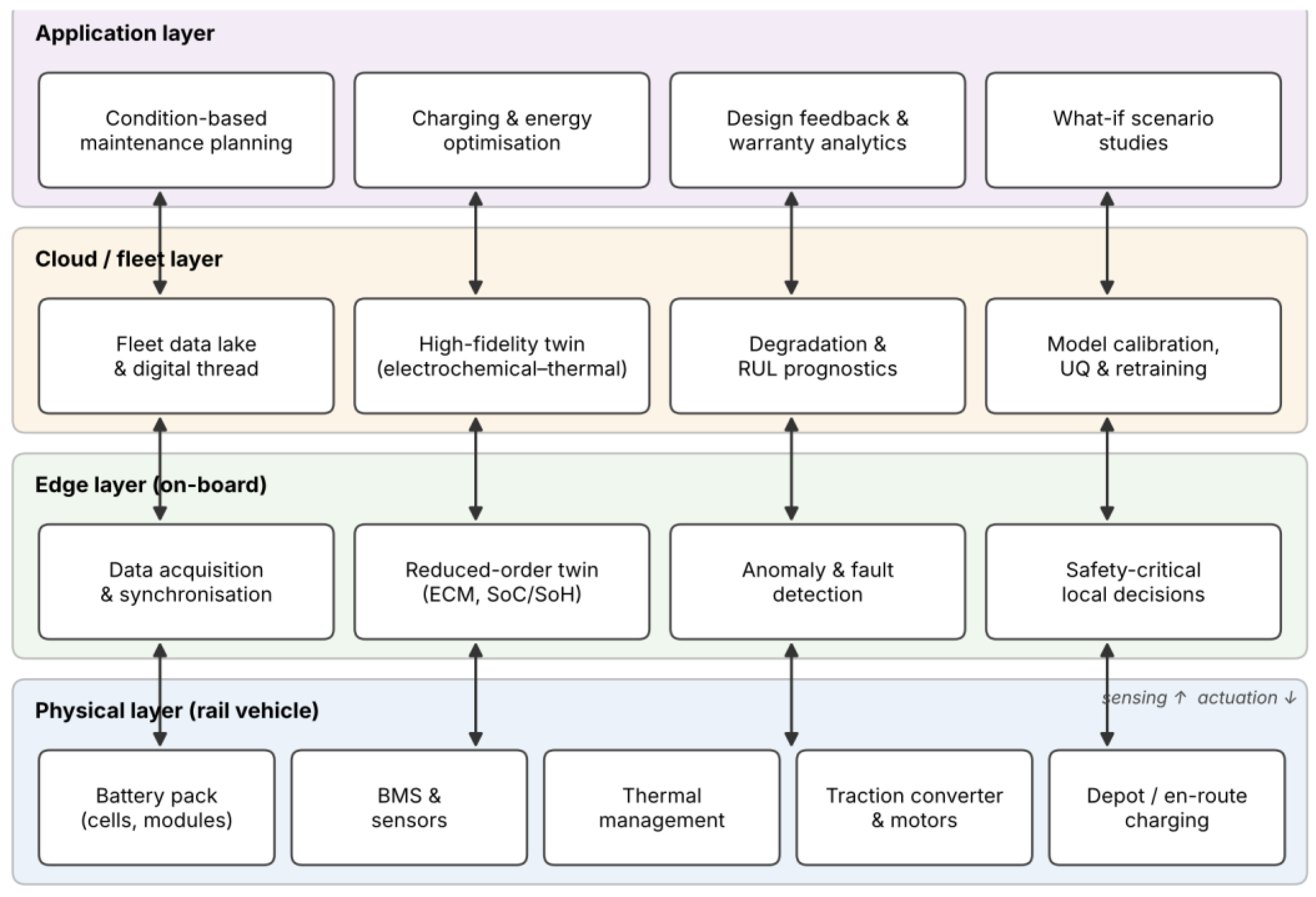
Figure 2.
Digital-twin-enabled prognostics and health management workflow for a battery-powered rail vehicle, from data acquisition to maintenance decision, with a model-recalibration loop.
Figure 2.
Digital-twin-enabled prognostics and health management workflow for a battery-powered rail vehicle, from data acquisition to maintenance decision, with a model-recalibration loop.
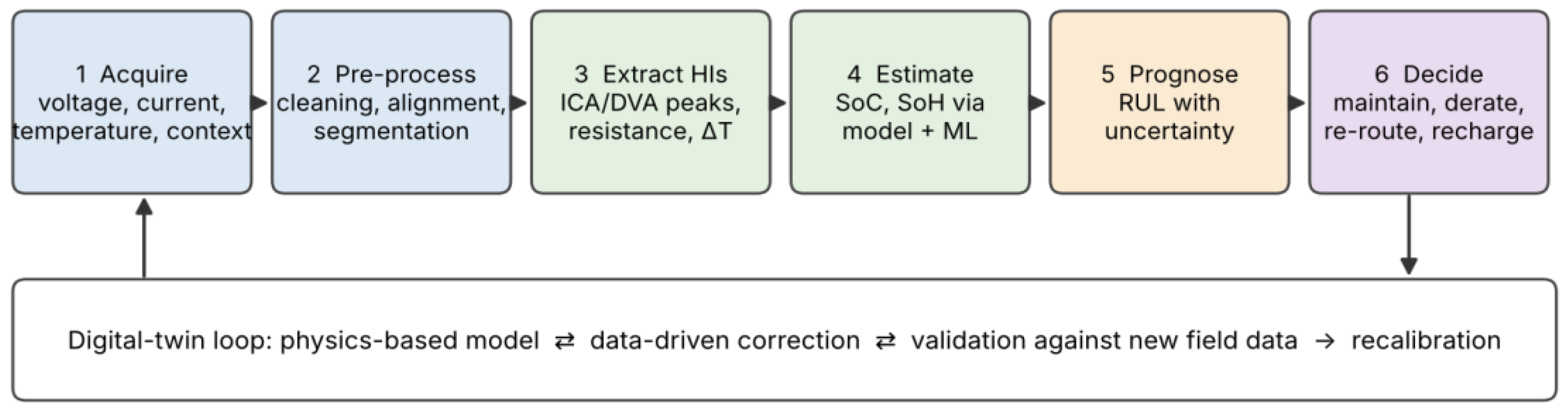

Table 1.
Traction energy architectures and their implications for digital twin design (qualitative synthesis).
Table 1.
Traction energy architectures and their implications for digital twin design (qualitative synthesis).
| Architecture | Energy source | Principal reliability concerns | Digital twin emphasis |
|---|---|---|---|
| Catenary / third-rail EMU | External supply; optional onboard buffer | Current collection, converter stress, auxiliary load faults | Power-electronic health, collector–line interaction, regeneration management |
| Battery electric multiple unit (BEMU) | Onboard battery, charged en route or at depot | Battery ageing, thermal limits, charging-interface wear, range margin | Cell- to pack-level state estimation, degradation forecasting, route-energy feasibility |
| Battery-hybrid locomotive or tram | Battery plus second source or catenary | Energy-management faults, mode-transition transients, cycling severity | Supervisory control validation, power-split optimisation, battery duty-profile tracking |
| Shunting / maintenance unit | Large onboard battery, depot charging | Irregular heavy duty, long idle periods, opportunity-charge ageing | Calendar-ageing modelling, usage-based maintenance scheduling |
Table 2.
Representative industrial application domains of digital twins and lessons for battery-powered rail vehicles.
Table 2.
Representative industrial application domains of digital twins and lessons for battery-powered rail vehicles.
| Domain | Typical twin function | Illustrative sources | Lesson for battery rail twins |
|---|---|---|---|
| Aerospace structures | Life prediction and structural health management of individual vehicles | [4,5] | Keep the twin continuously calibrated to the individual asset |
| Manufacturing | Monitoring, optimisation and scheduling | [6,30] | Favour scalable, standardised twin ecosystems over one-off models |
| Railway infrastructure | Lifecycle management of turnout systems | [15] | Twin-based lifecycle decisions are already accepted in railway practice |
| Road electric-vehicle batteries | Cloud BMS, state-of-charge and state-of-health estimation | [11,12,13] | Edge–cloud partitioning; transferability to railway duty remains untested |
| Mining rotating equipment | Predictive diagnostics of slurry pumps | [14] | Duty-dependent degradation and condition-based maintenance parallel battery systems |
Lessons are the author’s synthesis. Benefits reported in the cited studies were not independently compared in this review.
Table 3.
Battery model families and their roles in a rail vehicle digital twin.
| Model family | Strengths | Limitations | Typical role in the twin |
|---|---|---|---|
| Equivalent-circuit | Low cost; real-time capable; well suited to filtering [32,33] | Limited physical insight; parameters drift with ageing and temperature | Onboard SoC / power-capability estimation (edge) |
| Electrochemical (porous-electrode) | Internal-state resolution; mechanism-level diagnosis [34] | High computation; many parameters; identifiability difficulties | Cloud high-fidelity twin; design and fast-charge studies |
| Semi-empirical ageing | Compact; usable for lifecycle forecasting [18,19] | Validity limited to tested conditions; extrapolation risk | Lifecycle and replacement planning |
| Data-driven (e.g., regression, LSTM) | Captures complex patterns; little prior physics needed [37,38,39,40] | Data hungry; poor extrapolation; weak interpretability | SoH and RUL estimation; residual correction |
| Hybrid / physics-informed | Combines physical consistency with learning [35,36] | Methodologically immature for battery packs; added design effort | Cloud twin calibration and uncertainty-aware prediction |
Table 4.
Principal data streams for a battery-powered rail vehicle twin.
| Signal group | Examples | Purpose | Data-quality concerns |
|---|---|---|---|
| Electrical | Cell and pack voltage, current, insulation state | State estimation, resistance and capacity tracking | Sensor offset and gain drift; synchronisation across modules |
| Thermal | Cell-surface and coolant temperatures, cooling-system state | Thermal-model calibration, safety margins, ageing-stress accounting | Sparse sensor placement; lag between surface and core temperature |
| Operational context | Route position, gradient, speed, timetable, charging events | Duty-cycle reconstruction, forecasting and scenario analysis | Positioning errors; missing metadata; event labelling |
| Environmental | Ambient temperature, humidity, vibration | Stress-factor attribution, thermal boundary conditions | Representativeness of the sensor location |
| Maintenance and diagnostics | Work orders, fault codes, replacement history | Labelling failures, supervised learning, model validation | Inconsistent or free-text records; delayed entry |
Table 5.
Research gaps and proposed priorities for digital twins of battery-powered and electric rail vehicles.
Table 5.
Research gaps and proposed priorities for digital twins of battery-powered and electric rail vehicles.
| Gap | Why it matters | Proposed direction |
|---|---|---|
| Scarcity of railway-specific battery twin studies | Most battery twin evidence comes from road vehicles and laboratory cells [13] | Instrumented pilot vehicles with open, documented datasets and duty-cycle characterisation |
| Transferability of ageing and SoH models to railway duty | Partial, irregular cycling and concentrated charging differ from laboratory protocols [37,48] | Field validation campaigns; transfer-learning and domain-adaptation studies |
| Uncertainty-aware prognostics for decision-making | Point RUL estimates are hard to use in maintenance planning [51,52] | Calibrated probabilistic RUL linked to cost and availability models |
| Twin qualification and standards | Existing standards do not define twin acceptance criteria [16,17] | Qualification frameworks combining V&V evidence with RAMS lifecycle activities |
| Pack-level and system-level fidelity | Failures arise from cell, sensor, cooling, converter and software interactions | Multi-domain co-simulation twins validated against pack and vehicle data [58] |
| Data governance and cybersecurity | Fleet twins involve operator, supplier and infrastructure data | Reference data-sharing agreements; security-by-design architectures |
| Demonstrated operational benefit | Benefits are largely asserted rather than measured | Controlled before after studies using availability and failure indicators |
Disclaimer/Publisher’s Note: The statements, opinions and data contained in all publications are solely those of the individual author(s) and contributor(s) and not of MDPI and/or the editor(s). MDPI and/or the editor(s) disclaim responsibility for any injury to people or property resulting from any ideas, methods, instructions or products referred to in the content. |
© 2026 by the authors. Licensee MDPI, Basel, Switzerland. This article is an open access article distributed under the terms and conditions of the Creative Commons Attribution (CC BY) license.
Copyright: This open access article is published under a Creative Commons CC BY 4.0 license, which permit the free download, distribution, and reuse, provided that the author and preprint are cited in any reuse.