

Submitted:
13 November 2026
Posted:
16 November 2026
You are already at the latest version
Abstract
Battery-powered and electric rail vehicles move substantial dependability risk onto battery systems, thermal management, power electronics and software for which no mature fleet failure history exists. Conventional reliability methods depend on failure modes identified beforehand and calibrated by field experience that is not yet available. This critical review examines how twin-calibrated simulation can be used to explore failure possibilities proactively. The “Daydreaming Factory” a conceptual construct proposed here, not an established term is positioned against computational ideas of model-based imagination and is organised through three analytical devices: a taxonomy of virtual environments for reliability engineering, a causal-chain test from environment to reliability outcome, and a five-level evidence-maturity scale. The enabling methods are reviewed: multi-domain co-simulation, scenario generation and rare-event search, fault injection, degradation integration, and verification, validation and uncertainty quantification. A six-component reference framework with an explicit credibility layer is specified. Assessed against the sources examined, the individual methods are mature in adjacent domains, but integrated railway-specific implementations, field validation, qualification pathways and measured reliability benefits are largely absent. A research agenda and candidate performance indicators are proposed. The review is narrative rather than systematic and the framework has not been experimentally validated.
Keywords:
Daydreaming Factory
; digital twin
; battery-powered rail vehicles
; reliability engineering
; scenario generation
; fault injection
; co-simulation
; prognostics and health management
; verification and validation
1. Introduction
Battery-powered and electric rail vehicles shift a substantial share of dependability risk onto battery packs, thermal management, power electronics and supervisory software [1,2]. These subsystems are new to railway service, and no mature fleet-scale failure history yet exists against which to calibrate conventional reliability predictions. Classical tools reliability block diagrams, fault trees, FMEA and statistical life models [3,4] remain indispensable, but they depend on failure modes and probabilities that are identified before service and then adjusted by field experience. For a newly introduced technology, the interval before field experience accumulates is exactly when design decisions are most consequential and when evidence is weakest.
The practical question this paper addresses is how a manufacturer or operator can explore failure possibilities systematically before they occur in service, using models that are continuously tied to real vehicles. We use the term “Daydreaming Factory” for a class of such environments: a persistent, automated facility in which a twin-calibrated simulation of the vehicle is repeatedly “imagined” under generated operating scenarios, injected faults and projected degradation states, in order to discover failure pathways and design margins that neither requirements analysis nor limited physical testing would reveal. We stress at the outset that this term is a conceptual construct proposed in this work and in the author’s related research; it is not an established term of art in the railway or reliability literature, and its value must be judged by whether it organises existing methods into a testable programme rather than by its novelty as a label.
The paper makes four contributions. (i) It situates the concept within computational ideas of offline imagination and planning. (ii) It proposes a taxonomy of the ways virtual or facility-based environments are used to engineer reliability, a test of the causal chain from environment to reliability outcome, and an evidence-maturity scale. (iii) It reviews the enabling methods multi-domain co-simulation, scenario generation and search, fault injection, degradation integration, and credibility assessment—and their transferability to battery rail vehicles. (iv) It specifies a six-component reference framework and a research agenda. The paper complements a companion review of digital twins for battery-powered and electric rail vehicles.
2. Review Approach and Analytical Lens
The paper is a narrative critical review combined with a conceptual framework. It does not report a PRISMA-style systematic search, and no counts of screened or included records are claimed. Sources were chosen to cover the methods that a Daydreaming Factory would need to integrate: digital twins, battery and railway energy storage, prognostics, co-simulation, scenario-based testing of cyber-physical systems, fault injection, rare-event simulation, optimisation, and verification and validation. Literature on railway battery vehicles that explicitly adopts a “factory” or “virtual reliability facility” framing is, to the author’s knowledge, essentially absent; consequently the review draws on adjacent domains, principally automated-vehicle validation and general prognostics, and examines transferability.
To give the analysis discipline, three analytical devices are used. First, a taxonomy distinguishes four ways virtual environments are used for reliability engineering (Table 1). Second, a causal-chain test asks of any approach: what activity is claimed to produce what reliability outcome by what mechanism, and where is the chain closed by evidence rather than asserted? Third, a five-level evidence-maturity scale (Table 2) classifies how far an approach has progressed from proposal to in-service demonstration. These devices are the author’s analytical lens; the assessments made with them are qualitative judgements about the literature examined, and should be re-tested through a formal systematic mapping.
3. Conceptual Foundations: Imagination as an Engineering Resource
The idea of using internally generated experience to improve behaviour has a long history in computational learning. The wake–sleep algorithm trained generative models by alternating between processing real data and generating “fantasy” data [11]. The Dyna architecture integrated learning, planning and reacting by using a learned model to generate simulated experience between real interactions [12]. More recently, world-model approaches learn compact dynamics models from observations and then train controllers largely inside the learned model [13], with latent-imagination methods extending this to long-horizon behaviour learning [14]. The common principle is that a model grounded in real data can be used offline to generate experience that is cheaper, faster and safer than real interaction.
The analogy to reliability engineering is direct but must be drawn carefully. In reliability, the “agent” is the engineering organisation, the “environment” is the vehicle in service, and real interaction is costly and slow because failures take years to appear and are unacceptable when safety-relevant. A twin-calibrated simulator provides the model; scenario and fault generators provide the imagined experience; and criticality analysis provides the learning signal. The analogy also carries a warning that world-model research has made familiar: imagined experience is only as trustworthy as the model that generates it, and policies optimised against a flawed model can exploit its errors. The credibility layer of the framework (Section 9) exists for this reason.
4. Limits of Current Reliability Practice for Battery Rail Vehicles
Conventional analyses are best viewed as complementary to, not competitors of, a Daydreaming Factory (Table 3). Fault-tree analysis and FMEA enumerate failure combinations but are limited by the analyst’s imagination and by static probabilities [4]; systems-theoretic methods address unsafe interactions among components and with human or organisational factors [15]; probabilistic models and Monte Carlo methods can propagate uncertainties but need valid models [3,16]; and the railway RAMS lifecycle structures the evidence required for assurance [10].
Two structural issues motivate the proposal. The first is the rare-event problem: the failure scenarios of greatest concern occur so seldom that direct observation, or crude Monte Carlo simulation, is inefficient. In automated-vehicle validation the same difficulty has been analysed quantitatively, showing that demonstrating very low failure rates by driving alone would require impractically large exposure [19]; this has driven the development of scenario-based testing and accelerated-evaluation methods [20,21,22]. The second is the path-dependence problem: because battery ageing changes the parameters that govern behaviour, the system explored in simulation must itself evolve, so a failure that is impossible for a new pack may be likely for an aged one [23,24].
5. The Daydreaming Factory: Reference Framework
Figure 1 presents a six-component reference framework. The framework takes three inputs: operational and design data (routes, timetables, climate, configuration and standards), field data and twin state from instrumented vehicles [25,26,27], and a knowledge base of prior analyses and expert hypotheses. Inside the factory, (A) a scenario generator proposes operating and environmental conditions; (B) a multi-domain simulation core integrates electrical, thermal, mechanical and control models; (C) a degradation component evolves model parameters over the vehicle’s life; (D) a fault-injection engine perturbs cells, sensors, the BMS, cooling, converters and communications; (E) a criticality-analysis component scores outcomes and clusters failure modes; and (F) a credibility layer manages verification, validation, uncertainty and the simulation-to-reality gap. Outputs are a reliability-critical scenario library, ranked failure hypotheses, design and derating recommendations, targeted physical tests and updates to the twin.
The factory differs from a conventional simulation study in three respects. It is persistent: it runs continuously and is re-seeded as the twin updates. It is adaptive: the search over scenarios and faults is guided by results rather than fixed in advance. And it is accountable: each output is accompanied by a statement of model credibility and validity domain. Figure 2 shows the exploration loop at its centre. Taking the causal-chain test of Section 2, the claimed chain is: twin-calibrated simulation → discovery of critical scenarios and failure pathways → design change, derating or targeted test → fewer or less severe in-service failures. Each arrow requires its own evidence, and at present most links beyond the first are at maturity levels M0–M1 for railway battery applications in the sources examined by the author.
6. Multi-Domain Simulation and Co-Simulation
A battery rail vehicle is a coupled system: battery electrochemistry and heat generation, pack thermal behaviour and cooling, power-electronic conversion, traction and vehicle dynamics, supervisory control and communications. Representing these in a single monolithic model is rarely feasible, and subsystem models are typically built in different tools by different suppliers. Co-simulation, in which independently developed simulation units exchange data at coupling points, is the dominant integration approach, and its numerical, stability and synchronisation challenges are well surveyed [28]. Model-based systems engineering provides the traceability needed to link requirements, models and evidence [9].
Model fidelity must be matched to purpose. Fast reduced-order equivalent-circuit and lumped thermal models support exploration at scale [29,30]; electrochemical models [31] are reserved for conditions in which internal states drive failure, such as lithium plating at low temperature or fast charge. Surrogate models trained on high-fidelity simulations can bridge the two, at the price of additional validation [32]. A tiered-fidelity strategy screening with fast models and confirming the most critical findings with high-fidelity models or physical tests—is the pragmatic design choice, and is the recommended default of this review.
7. Scenario Generation, Search and Rare-Event Exploration
The scenario generator determines what the factory “dreams about”. Scenario-based approaches define scenarios at several abstraction levels, from functional descriptions to concrete parameterised instances [20]. For battery rail vehicles the scenario space includes route and timetable variants, passenger loading, ambient temperature, charging-infrastructure availability, degraded-mode operation, and the age and state of the pack. Table 4 compares search strategies drawn largely from the validation of automated vehicles and cyber-physical systems; their transfer to railway battery systems is plausible but has not, to the author’s knowledge, been demonstrated.
The rare-event literature offers two lessons. Crude sampling cannot cheaply establish very small failure probabilities [16,19], and search for failures (falsification) is a different task from estimation of their probability: the first seeks any failure, the second seeks calibrated likelihood. A factory should combine both, using search to find candidate failure regions and importance-sampling estimators to attach probabilities, with the model-credibility caveats of Section 9. Sensitivity analysis [36] should guide which parameters and scenario dimensions are explored.
8. Fault Injection and Degradation Integration
8.1. Fault Injection
Fault injection deliberately introduces faults to evaluate system response and has a long history in dependability research, with techniques classified by implementation level—hardware, software and simulation-based [7,8]. In a simulation-based factory, faults can be injected at cell level (internal resistance growth, capacity loss, short-circuit onset), sensor level (offset, drift, stuck values, noise), BMS and control level (logic errors, delayed commands), thermal-system level (pump or fan failure, coolant degradation), power-electronics level (converter faults) and communications level (message loss or delay). Fault models should be traceable to physical mechanisms [37,38,39] so that injected faults represent plausible rather than arbitrary perturbations.
The most valuable output is not the response to any single fault, which conventional analyses already cover, but the response to combinations and sequences. Table 5 lists illustrative interaction hypotheses that a factory is designed to test. They are hypotheses derived from engineering reasoning about the mechanisms cited, not results.
8.2. Degradation as a Dynamic State
Because the vehicle explored in simulation changes as it ages, degradation cannot be an afterthought. Ageing mechanisms depend on temperature, state of charge, current and depth of cycling [23,41], and prognostic models range from semi-empirical formulations to data-driven lifetime predictors [42,43,44]. In the factory, model parameters—capacity, resistance, thermal properties—are treated as evolving states, initialised from the twin and propagated along projected duty histories. This allows the same scenario to be explored at several life stages and permits discovery of age-conditioned failure regions. Uncertainty in the degradation trajectory should be propagated, not suppressed [45,46].
9. Credibility: Verification, Validation and the Simulation-to-Reality Gap
Everything the factory produces depends on the credibility of its models. Verification and validation of simulation models are well-established disciplines [47,48]; uncertainty quantification and global sensitivity analysis provide the means to express confidence [36,45]. Three provisions are essential. First, each model and each scenario result carries a validity domain; findings outside it are marked as extrapolation. Second, a simulation-to-reality gap register records where simulated behaviour has been compared with measurement and with what discrepancy, so that confidence in findings can be tracked and weak points targeted for physical testing. Third, exploit detection guards against search algorithms that discover modelling artefacts rather than genuine failure modes—a known hazard when optimisation is run against an imperfect model, and the counterpart of the model-exploitation problem in world-model learning [13,14].
Regulatory acceptance is a further constraint. EN 50126 structures the demonstration of RAMS for railway applications [10], and IEC 62928 addresses onboard lithium-ion traction batteries [49]. To the author’s knowledge neither prescribes how simulation-discovered failure hypotheses or twin-based evidence are to be admitted into a safety case; until such guidance exists, factory outputs would be used as design inputs and as inputs to test planning, not as substitutes for required evidence.
10. Assessment of the Evidence and Gap Analysis
Applying the causal-chain test and the maturity scale to the methods reviewed yields the qualitative assessment in Table 6. It reflects the sources examined by the author, which were selected for relevance rather than exhaustively retrieved; the maturity levels for railway battery applications specifically are therefore tentative.
Four conclusions follow from this lens. First, the individual enabling methods are well developed elsewhere; the gap lies in their integration for railway battery systems and in their validation against railway data. Second, the causal chain is mostly closed only at its first links; reliability benefits—reduced in-service failures, improved availability remain to be demonstrated, and the literature examined offers few designs for demonstrating them (for example, matched before–after or fleet-comparison studies). Third, certain concerns appear under-addressed relative to battery state estimation: charging-interface reliability, traction-energy management under fault conditions, and the organisational processes that sustain continuous reliability improvement. Fourth, the “factory” framing adds analytical value only if it is made operational—through a specified architecture, defined outputs and measurable performance indicators which is the purpose of the framework proposed here.
11. Research Agenda
We propose six priorities. (1) Build and publish an open reference simulation model of a battery rail vehicle with documented validity domains. (2) Develop physically traceable fault and degradation libraries for battery rail subsystems. (3) Adapt and benchmark scenario search and rare-event methods on that reference model, comparing discovery efficiency and probability-estimation accuracy. (4) Establish a simulation-to-reality gap protocol linking factory findings to targeted physical tests. (5) Design field studies, including matched baseline comparisons, that measure whether factory-informed design or maintenance decisions improve availability or reduce in-service failures. (6) Engage standards bodies on the admissibility of simulation-derived and twin-derived evidence within the railway RAMS lifecycle. Proposed performance indicators include the number and diversity of distinct failure pathways discovered per unit computation, the proportion of simulated findings subsequently confirmed by test or field data, the model-credibility score attached to each finding, and the operational availability and failure-rate change after factory-informed interventions.
12. Conclusions
Using twin-calibrated simulation to explore failure possibilities before they appear in service is a logical response to the evidence gap faced by new battery-powered rail vehicles. This paper has positioned the Daydreaming Factory as a conceptual construct, grounded it in computational ideas of model-based imagination, assembled the enabling methods, and specified a six-component reference framework with a credibility layer. The assessment, made relative to the sources examined, is that the enabling methods are individually mature in adjacent fields but that integrated railway-specific implementations, field validation, qualification pathways and measured reliability benefit are largely lacking. The framework presented here has not been validated experimentally; its value will be determined by whether the research agenda can close the gap between modelled and demonstrated reliability. A formal systematic mapping of the literature, which this narrative review did not undertake, is the natural next step.
Author Contributions
Conceptualization, methodology, writing original draft preparation and review and editing: D.M. E.M. T.N. K.M and T.M.
Funding
This research received no external funding.
Data Availability Statement
No new data were created or analysed in this study.
Acknowledgments
The authors acknowledge institutional support from the National University of Science and Technology, Bulawayo, Zimbabwe.
Conflicts of Interest
The authors declare no conflicts of interest.
References
- Fedele, E.; Iannuzzi, D.; Del Pizzo, A. Onboard energy storage in rail transport: Review of real applications and techno-economic assessments. IET Electr. Syst. Transp. 2021, 11, 279–309. [Google Scholar] [CrossRef]
- Ghaviha, N.; Campillo, J.; Bohlin, M.; Dahlquist, E. Review of Application of Energy Storage Devices in Railway Transportation. Energy Procedia 2017, 105, 4561–4568. [Google Scholar] [CrossRef]
- Birolini, A. Reliability Engineering: Theory and Practice, 8th ed.; Springer: Berlin/Heidelberg, Germany, 2017. [Google Scholar]
- Vesely, W.E.; Goldberg, F.F.; Roberts, N.H.; Haasl, D.F. Fault Tree Handbook; NUREG-0492; U.S. Nuclear Regulatory Commission: Washington, DC, USA, 1981. [Google Scholar]
- Tao, F.; Zhang, H.; Liu, A.; Nee, A.Y.C. Digital Twin in Industry: State-of-the-Art. IEEE Trans. Ind. Inform. 2019, 15, 2405–2415. [Google Scholar] [CrossRef]
- Jones, D.; Snider, C.; Nassehi, A.; Yon, J.; Hicks, B. Characterising the Digital Twin: A systematic literature review. CIRP J. Manuf. Sci. Technol. 2020, 29, 36–52. [Google Scholar] [CrossRef]
- Ziade, H.; Ayoubi, R.; Velazco, R. A survey on fault injection techniques. Int. Arab J. Inf. Technol. 2004, 1, 171–186. [Google Scholar]
- Hsueh, M.-C.; Tsai, T.K.; Iyer, R.K. Fault injection techniques and tools. Computer 1997, 30, 75–82. [Google Scholar] [CrossRef]
- Madni, A.M.; Sievers, M. Model-based systems engineering: Motivation, current status, and research opportunities. Syst. Eng. 2018, 21, 172–190. [Google Scholar] [CrossRef]
- EN 50126-1:2017; Railway Applications—The Specification and Demonstration of Reliability, Availability, Maintainability and Safety (RAMS)—Part 1: Generic RAMS Process. CENELEC: Brussels, Belgium, 2017.
- Hinton, G.E.; Dayan, P.; Frey, B.J.; Neal, R.M. The “wake-sleep” algorithm for unsupervised neural networks. Science 1995, 268, 1158–1161. [Google Scholar] [CrossRef]
- Sutton, R.S. Dyna, an integrated architecture for learning, planning, and reacting. ACM SIGART Bull. 1991, 2, 160–163. [Google Scholar] [CrossRef]
- Ha, D.; Schmidhuber, J. World Models. arXiv 2018, arXiv:1803.10122. [Google Scholar]
- Hafner, D.; Lillicrap, T.; Ba, J.; Norouzi, M. Dream to Control: Learning Behaviors by Latent Imagination. In Proceedings of the 8th International Conference on Learning Representations (ICLR 2020), Virtual Conference, 26 April–1 May 2020. [Google Scholar]
- Leveson, N.G. Engineering a Safer World: Systems Thinking Applied to Safety; MIT Press: Cambridge, MA, USA, 2011. [Google Scholar]
- Rubino, G.; Tuffin, B. Rare Event Simulation Using Monte Carlo Methods; Wiley: Chichester, UK, 2009. [Google Scholar]
- Zio, E. Prognostics and Health Management (PHM): Where are we and where do we (need to) go in theory and practice. Reliab. Eng. Syst. Saf. 2022, 218, 108119. [Google Scholar] [CrossRef]
- Lee, J.; Wu, F.; Zhao, W.; Ghaffari, M.; Liao, L.; Siegel, D. Prognostics and health management design for rotary machinery systems—Reviews, methodology and applications. Mech. Syst. Signal Process. 2014, 42, 314–334. [Google Scholar] [CrossRef]
- Kalra, N.; Paddock, S.M. Driving to safety: How many miles of driving would it take to demonstrate autonomous vehicle reliability? Transp. Res. Part A Policy Pract. 2016, 94, 182–193. [Google Scholar] [CrossRef]
- Menzel, T.; Bagschik, G.; Maurer, M. Scenarios for Development, Test and Validation of Automated Vehicles. In Proceedings of the 2018 IEEE Intelligent Vehicles Symposium (IV), Changshu, China, 26–30 June 2018; pp. 1821–1827. [Google Scholar]
- Zhao, D.; Lam, H.; Peng, H.; Bao, S.; LeBlanc, D.J.; Nobukawa, K.; Pan, C.S. Accelerated Evaluation of Automated Vehicles Safety in Lane-Change Scenarios Based on Importance Sampling Techniques. IEEE Trans. Intell. Transp. Syst. 2017, 18, 595–607. [Google Scholar] [CrossRef]
- Feng, S.; Feng, Y.; Yu, C.; Zhang, Y.; Liu, H.X. Testing Scenario Library Generation for Connected and Automated Vehicles, Part I: Methodology. IEEE Trans. Intell. Transp. Syst. 2021, 22, 1573–1582. [Google Scholar] [CrossRef]
- Vetter, J.; Novák, P.; Wagner, M.R.; Veit, C.; Möller, K.-C.; Besenhard, J.O.; Winter, M.; Wohlfahrt-Mehrens, M.; Vogler, C.; Hammouche, A. Ageing mechanisms in lithium-ion batteries. J. Power Sources 2005, 147, 269–281. [Google Scholar] [CrossRef]
- Xiong, R.; Pan, Y.; Shen, W.; Li, H.; Sun, F. Lithium-ion battery aging mechanisms and diagnosis method for automotive applications: Recent advances and perspectives. Renew. Sustain. Energy Rev. 2020, 131, 110048. [Google Scholar] [CrossRef]
- Wu, B.; Widanage, W.D.; Yang, S.; Liu, X. Battery digital twins: Perspectives on the fusion of models, data and artificial intelligence for smart battery management systems. Energy AI 2020, 1, 100016. [Google Scholar] [CrossRef]
- Li, W.; Rentemeister, M.; Badeda, J.; Jöst, D.; Schulte, D.; Sauer, D.U. Digital twin for battery systems: Cloud battery management system with online state-of-charge and state-of-health estimation. J. Energy Storage 2020, 30, 101557. [Google Scholar] [CrossRef]
- Naseri, F.; Gil, S.; Barbu, C.; Cetkin, E.; Yarimca, G.; Jensen, A.C.; Larsen, P.G.; Gomes, C. Digital twin of electric vehicle battery systems: Comprehensive review of the use cases, requirements, and platforms. Renew. Sustain. Energy Rev. 2023, 179, 113280. [Google Scholar] [CrossRef]
- Gomes, C.; Thule, C.; Broman, D.; Larsen, P.G.; Vangheluwe, H. Co-Simulation: A Survey. ACM Comput. Surv. 2018, 51, 49. [Google Scholar]
- Hu, X.; Li, S.; Peng, H. A comparative study of equivalent circuit models for Li-ion batteries. J. Power Sources 2012, 198, 359–367. [Google Scholar] [CrossRef]
- Plett, G.L. Extended Kalman filtering for battery management systems of LiPB-based HEV battery packs: Part 1. Background. J. Power Sources 2004, 134, 252–261. [Google Scholar] [CrossRef]
- Doyle, M.; Fuller, T.F.; Newman, J. Modeling of Galvanostatic Charge and Discharge of the Lithium/Polymer/Insertion Cell. J. Electrochem. Soc. 1993, 140, 1526–1533. [Google Scholar] [CrossRef]
- Forrester, A.; Sóbester, A.; Keane, A. Engineering Design via Surrogate Modelling: A Practical Guide; Wiley: Chichester, UK, 2008. [Google Scholar]
- Shahriari, B.; Swersky, K.; Wang, Z.; Adams, R.P.; de Freitas, N. Taking the Human Out of the Loop: A Review of Bayesian Optimization. Proc. IEEE 2016, 104, 148–175. [Google Scholar] [CrossRef]
- Deb, K.; Pratap, A.; Agarwal, S.; Meyarivan, T. A fast and elitist multiobjective genetic algorithm: NSGA-II. IEEE Trans. Evol. Comput. 2002, 6, 182–197. [Google Scholar] [CrossRef]
- Corso, A.; Moss, R.J.; Koren, M.; Lee, R.; Kochenderfer, M.J. A Survey of Algorithms for Black-Box Safety Validation of Cyber-Physical Systems. J. Artif. Intell. Res. 2021, 72, 377–428. [Google Scholar] [CrossRef]
- Saltelli, A.; Ratto, M.; Andres, T.; Campolongo, F.; Cariboni, J.; Gatelli, D.; Saisana, M.; Tarantola, S. Global Sensitivity Analysis: The Primer; Wiley: Chichester, UK, 2008. [Google Scholar]
- Xiong, R.; Ma, S.; Li, H.; Sun, F.; Li, J. Toward a Safer Battery Management System: A Critical Review on Diagnosis and Prognosis of Battery Short Circuit. iScience 2020, 23, 101010. [Google Scholar] [CrossRef]
- Feng, X.; Ouyang, M.; Liu, X.; Lu, L.; Xia, Y.; He, X. Thermal runaway mechanism of lithium ion battery for electric vehicles: A review. Energy Storage Mater. 2018, 10, 246–267. [Google Scholar] [CrossRef]
- Hannan, M.A.; Hoque, M.M.; Hussain, A.; Yusof, Y.; Ker, P.J. State-of-the-Art and Energy Management System of Lithium-Ion Batteries in Electric Vehicle Applications: Issues and Recommendations. IEEE Access 2018, 6, 19362–19378. [Google Scholar] [CrossRef]
- Kim, J.; Oh, J.; Lee, H. Review on battery thermal management system for electric vehicles. Appl. Therm. Eng. 2019, 149, 192–212. [Google Scholar] [CrossRef]
- Birkl, C.R.; Roberts, M.R.; McTurk, E.; Bruce, P.G.; Howey, D.A. Degradation diagnostics for lithium ion cells. J. Power Sources 2017, 341, 373–386. [Google Scholar] [CrossRef]
- Hu, X.; Xu, L.; Lin, X.; Pecht, M. Battery Lifetime Prognostics. Joule 2020, 4, 310–346. [Google Scholar] [CrossRef]
- Li, Y.; Liu, K.; Foley, A.M.; Zülke, A.; Berecibar, M.; Nanini-Maury, E.; Van Mierlo, J.; Hoster, H.E. Data-driven health estimation and lifetime prediction of lithium-ion batteries: A review. Renew. Sustain. Energy Rev. 2019, 113, 109254. [Google Scholar] [CrossRef]
- Severson, K.A.; Attia, P.M.; Jin, N.; Perkins, N.; Jiang, B.; Yang, Z.; Chen, M.H.; Aykol, M.; Herring, P.K.; Fraggedakis, D.; et al. Data-driven prediction of battery cycle life before capacity degradation. Nat. Energy 2019, 4, 383–391. [Google Scholar] [CrossRef]
- Smith, R.C. Uncertainty Quantification: Theory, Implementation, and Applications; SIAM: Philadelphia, PA, USA, 2014. [Google Scholar]
- Kendall, A.; Gal, Y. What Uncertainties Do We Need in Bayesian Deep Learning for Computer Vision? In Proceedings of the 31st Conference on Neural Information Processing Systems (NIPS 2017), Long Beach, CA, USA, 4–9 December 2017. [Google Scholar]
- Sargent, R.G. Verification and validation of simulation models. J. Simul. 2013, 7, 12–24. [Google Scholar] [CrossRef]
- Oberkampf, W.L.; Roy, C.J. Verification and Validation in Scientific Computing; Cambridge University Press: Cambridge, UK, 2010. [Google Scholar]
- IEC 62928:2017; Railway Applications—Rolling Stock—Onboard Lithium-Ion Traction Batteries. International Electrotechnical Commission: Geneva, Switzerland, 2017.
Figure 1.
Reference framework of the Daydreaming Factory for battery-powered rail vehicles: inputs, six internal components (A–F) and outputs.
Figure 1.
Reference framework of the Daydreaming Factory for battery-powered rail vehicles: inputs, six internal components (A–F) and outputs.
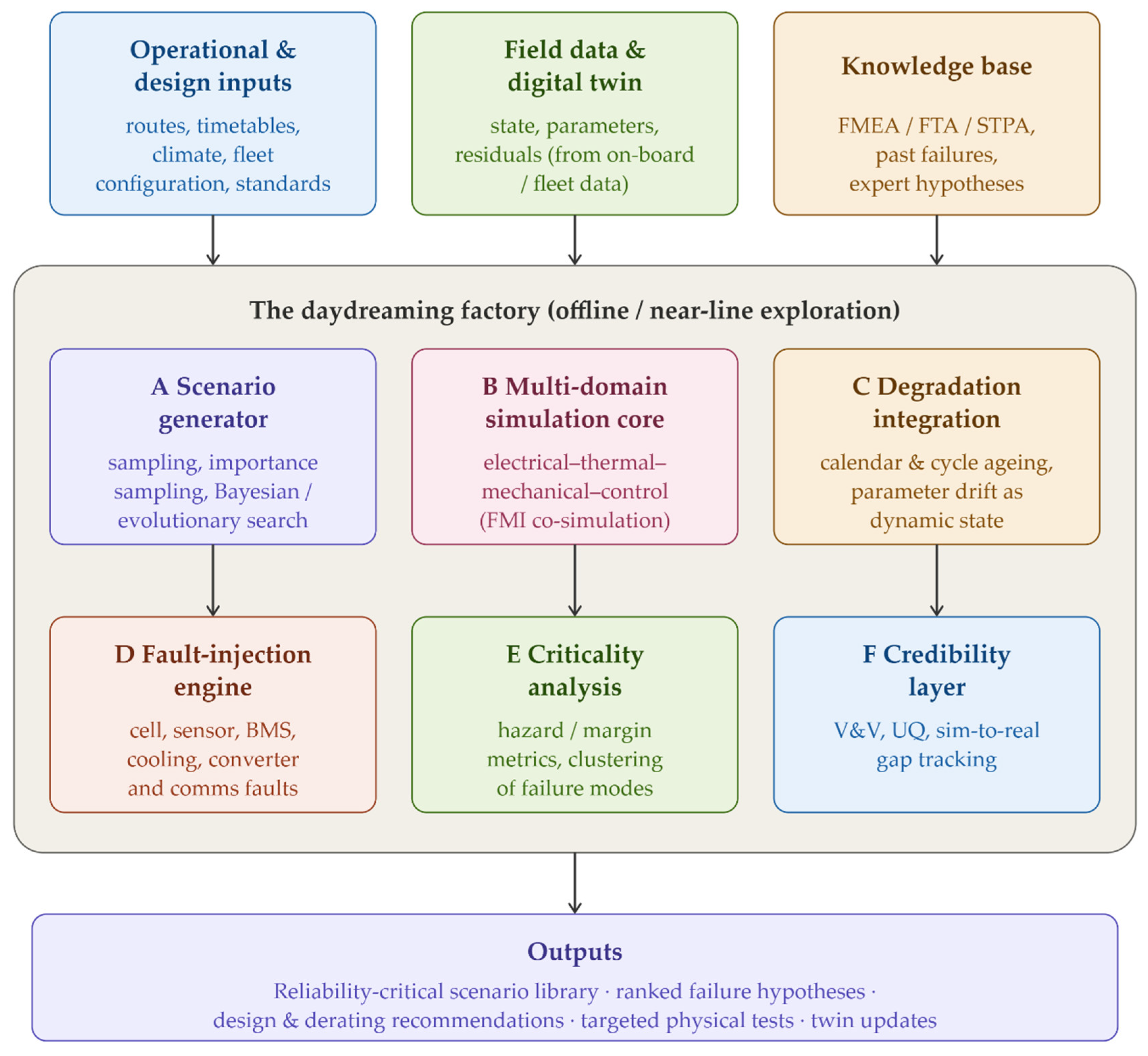
Figure 2.
Closed exploration loop of the Daydreaming Factory: scenario proposal, simulation with fault and ageing, criticality scoring and search update.
Figure 2.
Closed exploration loop of the Daydreaming Factory: scenario proposal, simulation with fault and ageing, criticality scoring and search update.
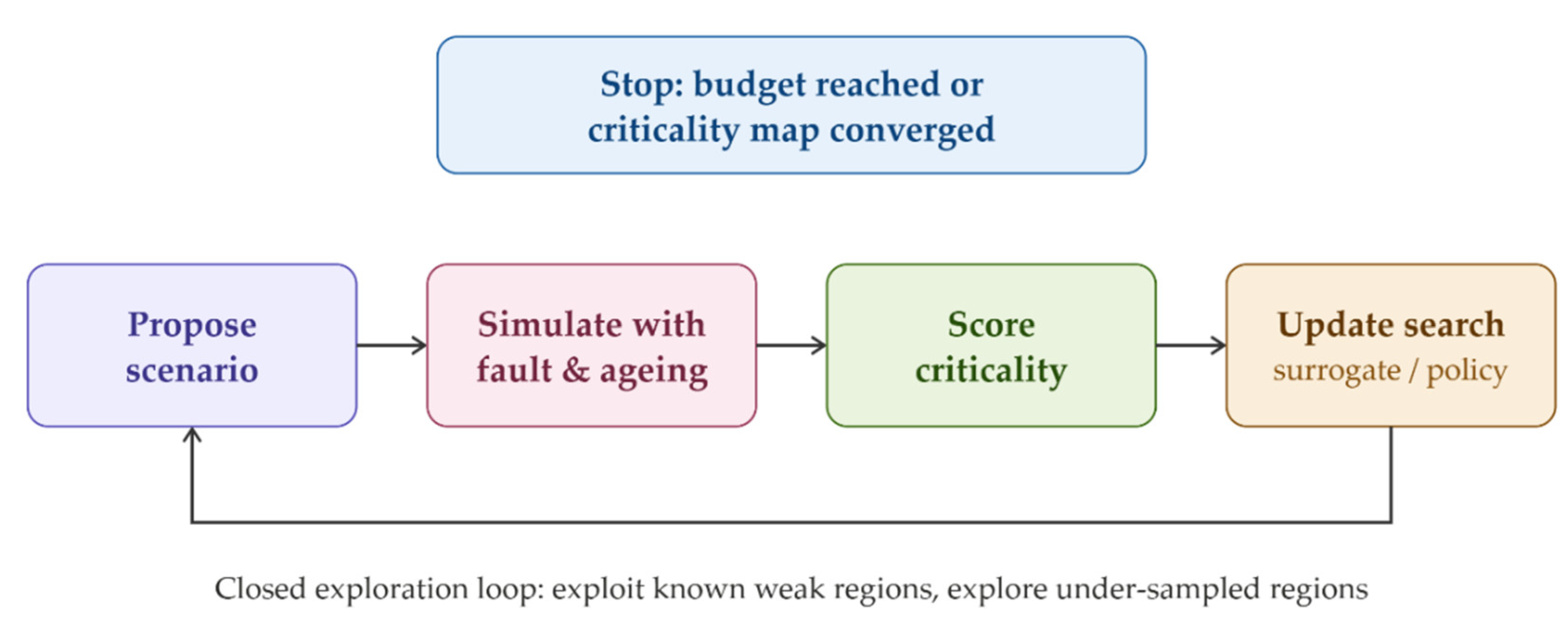

Table 1.
Taxonomy of virtual and facility-based environments for reliability engineering of rail vehicles.
Table 1.
Taxonomy of virtual and facility-based environments for reliability engineering of rail vehicles.
| Category | Description | Typical reliability outcome claimed | Principal evidence limitation |
|---|---|---|---|
| Simulation-only environments | Offline models of vehicle subsystems exercised under scripted or generated scenarios | Design-margin identification; failure-mode discovery | Validation against real failure data is often absent for new technologies |
| Digital twins coupled to assets | Models continuously calibrated with data from operating vehicles [5,6] | Early fault detection; RUL estimation; condition-based maintenance | Requires instrumented in-service vehicles and longitudinal data |
| Hardware-in-the-loop and testbeds | Physical components or controllers exercised against real-time simulated surroundings [7,8] | Controller and interface verification; fault-response validation | Limited scenario coverage; cost; representativeness of the emulated environment |
| Organisational and process frameworks | Structured programmes linking virtual work to lifecycle reliability management [9,10] | Sustained reliability growth; traceable assurance | Benefit is difficult to isolate and measure |
Classification by the author, informed by the cited literature. Categories can overlap in practice; the Daydreaming Factory is intended to integrate the first three under the fourth.
Table 2.
Evidence-maturity scale used in this review.
| Level | Label | Criterion |
|---|---|---|
| M0 | Conceptual | Proposal or architecture without implemented models or data |
| M1 | Simulation demonstration | Implemented in simulation; evaluated against simulated outcomes only |
| M2 | Laboratory validation | Compared with measured data from cells, packs or rigs under controlled conditions |
| M3 | Vehicle-level validation | Compared with data from instrumented vehicles in operation |
| M4 | Fleet-validated outcome | Reliability or availability benefit measured over a fleet and period, ideally with a baseline |
Table 3.
Established reliability methods and their limitations for newly introduced battery rail vehicles.
Table 3.
Established reliability methods and their limitations for newly introduced battery rail vehicles.
| Method | Strength | Limitation for BERVs | Complement from a Daydreaming Factory |
|---|---|---|---|
| FMEA / FTA [4] | Structured, auditable enumeration of failures | Depends on analyst-identified modes; static; weak on interactions and ageing | Automatic discovery of candidate failure combinations to test the enumeration |
| STPA-type analysis [15] | Captures unsafe control actions and interactions | Qualitative; scenario coverage relies on analyst effort | Quantitative scenario exploration around identified unsafe control actions |
| Statistical life models [3] | Rigorous with sufficient failure data | Little field data for new technology; path-dependent ageing | Synthetic degradation trajectories conditioned on vehicle-specific duty |
| Physical testing | Ground truth | Costly; slow; limited scenario coverage; hazardous for abuse cases | Prioritisation of the most informative physical tests |
| Monitoring and PHM [17,18] | Vehicle-specific, data-driven | Reactive; limited to observed conditions | Pre-emptive exploration of conditions not yet observed |
Table 4.
Scenario generation and search strategies and their suitability for a battery rail vehicle factory.
Table 4.
Scenario generation and search strategies and their suitability for a battery rail vehicle factory.
| Strategy | Principle | Suitability | Main caution |
|---|---|---|---|
| Random / Monte Carlo sampling | Sample scenarios from operational distributions [16] | Baseline; unbiased exposure estimates | Inefficient for rare events |
| Importance sampling | Bias sampling toward critical regions and reweight [16,21] | Rare-event probability estimation | Requires a good proposal distribution; weight degeneracy |
| Scenario-library generation | Construct libraries concentrating on critical cases [22] | Reusable test libraries for controllers and packs | Library validity depends on the underlying model |
| Bayesian optimisation | Surrogate-guided search for failure-inducing parameters [33] | Expensive simulators; low-dimensional spaces | Scaling to high dimensions; surrogate error |
| Evolutionary multi-objective search | Population-based exploration of trade-offs [34] | Discovering diverse failure modes | Many evaluations; sensitivity to objectives |
| Black-box safety validation | Falsification, reinforcement learning and related methods [35] | Cyber-physical control and software faults | Coverage guarantees remain limited |
Table 5.
Illustrative cross-domain failure interaction hypotheses for exploration (not established findings).
Table 5.
Illustrative cross-domain failure interaction hypotheses for exploration (not established findings).
| Interaction | Hypothesised mechanism | Exploration target |
|---|---|---|
| Cooling degradation with high-power regenerative braking | Reduced heat rejection raises cell temperature during repeated high-current events [40] | Temperature margins and derating thresholds |
| Temperature-sensor drift with aged pack | Biased temperature input to the BMS shifts protection limits as resistance grows [39] | Detectability of drift from model residuals |
| Cell-to-cell imbalance with partial charging at stations | Cumulative imbalance reduces usable capacity and stresses weaker cells [24,41] | Balancing strategy and charging-window design |
| Low-temperature charging with accumulated degradation | Increased plating propensity at low temperature [23] | Charge-rate limits conditional on temperature and age |
| Communication delay with protective-action logic | Delayed contactor or current-limit commands during transients | Control timing margins [7] |
Table 6.
Qualitative assessment of enabling capabilities against the evidence-maturity scale (tentative).
Table 6.
Qualitative assessment of enabling capabilities against the evidence-maturity scale (tentative).
| Capability | Maturity in adjacent domains | Maturity for battery rail vehicles (as examined) | Principal gap |
|---|---|---|---|
| Battery twin and state estimation | M2–M3 (road vehicles, laboratory) [25,26,27] | Largely M0–M1 | Railway-duty field validation |
| Co-simulation of multi-domain systems | Established method [28] | Few documented battery-rail applications examined | Standard model interfaces and validated subsystem models |
| Scenario generation and rare-event search | M2–M3 in automated vehicles [22,35] | M0–M1 | Transfer to energy-system failure modes |
| Fault injection in simulation | Mature in dependability research [7,8] | M1 | Physically traceable battery-system fault models |
| Degradation-aware exploration | Lifetime prediction M2 [42,44] | M0–M1 | Integration with scenario search |
| Credibility and qualification | Methods established [47,48] | M0 | Acceptance criteria within railway standards |
| Organisational integration | Frameworks described [9] | M0 | Measured reliability outcomes |
Disclaimer/Publisher’s Note: The statements, opinions and data contained in all publications are solely those of the individual author(s) and contributor(s) and not of MDPI and/or the editor(s). MDPI and/or the editor(s) disclaim responsibility for any injury to people or property resulting from any ideas, methods, instructions or products referred to in the content. |
© 2026 by the authors. Licensee MDPI, Basel, Switzerland. This article is an open access article distributed under the terms and conditions of the Creative Commons Attribution (CC BY) license (http://creativecommons.org/licenses/by/4.0/).
Copyright: This open access article is published under a Creative Commons CC BY 4.0 license, which permit the free download, distribution, and reuse, provided that the author and preprint are cited in any reuse.