

Submitted:
13 November 2026
Posted:
16 November 2026
You are already at the latest version
Abstract
We restate the operational content of Yang-Mills theory on a finite holographic substrate: a finite, timeless totality, the Carrier, whose capacity bounds the state count of every embedded observer. The observer, a Subject, is a prime shell \(\mathbb{F}_p\), and it reads colour in a unitary frame, SU(3) over its quadratic extension. We prove three main results on the finite frame. On every Subject the tensor invariants of the frame are the classical ones, built from pairings and determinants, through the degree \(2p-1\), and an explicit invariant of degree \(4p-3\) is not of that kind. On every Subject the transfer tally of the finite theory has exactly three nonzero eigenvalues, one for each of three characters, and the largest is \(p+1\) times the next, with no coupling to tune. On every Subject the products of mesons, gluons and glueballs through degree eight have as many invariants as for the compact group. The Casimir rationals of the frame agree with the colour factors measured at LEP, as those of quantum chromodynamics do. The radial ratio of the chart's wrap operator, \(1.49\), is excluded by the lattice's \(1.72(2)\). A registration of a state is a line that its frame maps to itself: the gluon has none, and the baryon, the meson and the glueball have one each. This restates confinement without deriving it. On every Subject the theory's tally at fixed boundary classes, reduced modulo \(p\), is the same for every length of its ring of plaquettes, and the tally yields no winding rate. We therefore derive no ratio of the mass gap to \(\sqrt{\sigma}\), and the lattice supplies its numeral. Every exact claim has a machine check, and the arithmetic of every theorem has an axiom-free Lean proof.
Keywords:
holographic principle
; finite field
; Yang–Mills theory
; mass gap
; confinement
; unitary frame
; strong-coupling expansion
; glueball
; finite ring cosmology
1. Introduction
Yang and Mills wrote the gauge theory of a non-abelian group in 1954 [1]. Quantised with gauge group it is quantum chromodynamics, and every quantitative test of the strong interaction rests on it. Four tests stand out: the colour factors measured in four-jet events at LEP, the running of the coupling across two orders of magnitude in energy, the hadron spectrum computed on the lattice, and the confinement of quarks and gluons. No experiment has seen a quark or a gluon in isolation. What the theory has not delivered is a proof of its own consistency as a quantum field theory on with a mass gap. The Clay Mathematics Institute states the problem as follows: prove that for any compact simple gauge group a non-trivial quantum Yang–Mills theory exists on and has a mass gap [2]. The evidence for the gap is indirect and strong. Lattice simulations find a lightest glueball at – in units of the square root of the string tension, with a spectrum above it [3,4,5]. The strong-coupling expansion of the lattice theory gives an area law wherever it converges [6,7]. Finite gauge groups serve as digitisations of in simulation, the 1080-element subgroup among them [8]; the frame of this paper is not a subgroup of the compact group but the unitary group over a finite field, and Section 2 states its correspondence with the compact group.
This paper does not address the Clay problem in its own terms. The finite ring cosmology framework holds that the universe is a finite, complete, timeless totality, the Carrier, whose cardinality is fixed by the de Sitter entropy , and that an observer is a prime shell embedded in it [9]. On that substrate the question whether a quantum field theory exists on with a gap uniform in the lattice spacing does not arise: there is no , no lattice spacing to send to zero, and no continuum limit. What the substrate does admit is the exact content of the gauge sector, the statements that make Yang–Mills theory a predictive formalism for experiment. The paper states them in the substrate’s arithmetic, proves what can be proved there, confronts two of its numbers with measurement, and records where the derivation of the gap’s value stops.
The framework’s earlier papers supply the ingredients. Colour’s triality is a relation of the Carrier, [10]. The Subject reads colour in its unitary frame, the special unitary group of a Hermitian three-form over the Subject’s quadratic extension . Three is the smallest degree at which the centre of such a frame can have order three. The frame’s torus exponents are the compact weights, and its action on the chart’s hypercubic lattice confines at strong coupling with one scale [10]. Four words of the framework recur throughout. A registration of a state is a line of the state’s space that every element of its frame maps to itself, and the residue of the state is the number of such lines; Definition 3 states both exactly.
The wrap is the frame normalisation that folds the enormous residues of the quarks into the small residues of the hadrons (Proposition 1). The chart is the continuum reading of a finite object; Section 2 says what that means. The light hadrons are registrations of the unitary frame: a baryon is the determinant invariant of three triplets, and a meson is the Hermitian contraction of a triplet and an anti-triplet [11]. The nucleon’s mass is the single scale of the gauge sector, , times the lowest eigenvalue of the chart’s relativistic wrap operator [11]. Time is the drive of the observer’s frame, a theorem of the framework’s space-time paper, and mass is a winding rate against it [10,12]. The present paper collects these results for the gauge sector, adds the exact statements they leave implicit, and confronts the whole with the data.
The reading of the mass gap is this. The gluon is a state of the unitary frame alone; it is massless, and by the framework’s rule masslessness is drive-invariance. Its residue is zero: the adjoint representation of the frame has no invariant line, and the norm-one cycle, the group of the norm-one elements of the Subject’s extension, maps no line of the shell’s plane to itself. A registration is an invariant line, so no registration singles out a gluon. The baryon, the meson and the glueball channels each have residue one, and the hadron paper’s series of registrations ends at the glueball, the singlet of two gluons. The glueball is the lightest registration with no quark constituent, and its mass in units of is a pure number whose numeral the lattice supplies. This reading restates colour confinement in the frame’s vocabulary and explains why the confinement rule has the form it has. It does not derive confinement from dynamics. On a finite lattice with the Wilson action at positive coupling the existence of a gap is a standard fact (Section 7).
The content of the problem is the ratio , a pure number whose numeral the lattice supplies, and the paper does not deliver it. Section 6 records the attempt. At the leading order of the strong-coupling expansion the frame fixes the adjoint string tension as twice the fundamental one, up to the factor : an identity between the adjoint and the fundamental plaquette coefficients (Theorem 8), used only in the regime of that expansion. It fixes nothing about the kinetic form of a two-constituent state, which the chart must supply. Every operator in the resulting family misses the lattice determinations of , the family’s radial ratio is excluded by the latest determination, and the two routes beyond the family, the short-range term and the plaquette channel, fail; all three are the chart’s. The paper declares the finite theory along the drive, on a ring of plaquettes (Definition 4), and computes its tally exactly. On every Subject the largest eigenvalue of the transfer tally belongs to one character and is times the next (Theorem 5), with no coupling to tune.
Main results. The paper has three main results. The first is the window of the frame (Theorem 9). For an odd prime of the totality the invariants of in are spanned by the tensors built from pairings and determinants through the degree . An explicit tensor of degree lies outside their span. The second is the exact spectrum of the transfer tally for every prime power , with the tally of the ring of plaquettes (Theorems 4 and 5). The amplitude is a signed sum of three characters, and the largest eigenvalue is times the next. The third is the count of the product channels through degree eight (Proposition 8). The count is the compact one on every Subject and departs from it on . The paper also states what these results do not give. On every Subject the tally at fixed boundary classes, reduced modulo , does not depend on the length of the ring. The reduced tally is an element of the Subject’s quadratic extension, and the paired weight of the tally reduces to a residue of the shell. With the same boundary link at every step, of eigenvalues in the shell, the residue of the tally moves with products of the eigenvalues of the two links, and the three multipliers of the frame have the residue 1 (Proposition 10). No ratio of the mass gap to follows.
Section 2 states the framework’s elements and the theorem outline, and it proves the multiplicities of the frame (Proposition 3). Section 3, Section 4, Section 5 and Section 6 prove the rest of the exact content and record the operator family. Section 7 confronts three numbers with measurement, records one null result, lists what the construction explains, and states what a Subject reads. Every exact claim is a row of the predicate ledger of Appendix A, decided by the framework’s ledger file in finite-field or rational arithmetic, and the arithmetic of every theorem row, its residues, window fractions and comparisons, is also proved in the framework’s Lean 4 core with no axioms; the imports and the chart’s eigenvalues are not. The chart clauses of the theorem rows marked as such, the running of the coupling, the operator values, the plaquette channel at the chart’s cells and the gap at the classical , are proved over the reals on Mathlib as well, the chart’s eigenvalue readings entering as hypotheses.
2. The Holographic Substrate and the Unitary Frame
The finite ring cosmology framework adopts the literal interpretation of the holographic principle. The entropy bounds of black holes and of the de Sitter horizon say that any observer registers finitely many states, and the framework reads this finite count as the universe itself [9]. This section states the elements of the framework the paper uses, each as a numbered statement with its citation and its row in Appendix A. Proposition 3 is proved here. Three further terms need a definition before their first use. The chart is the continuum reading of a finite object: the real numbers, operators and limits through which the laboratory reports a measurement. A chart statement is a reading, not a theorem of the substrate, and the paper says “the chart” wherever it makes one. By the horizon the paper means the horizon of observation, the boundary of what a bounded observer registers.
The Carrier, the Subject and the frame. The finite, complete, timeless totality is the Carrier . Its primary datum is its capacity S, the de Sitter entropy, and its cardinality is . An observer is a Subject, a prime shell with , whose frame is : the chronon, the origin, the unit and the drive , a primitive root [12]. The chronon is the observer’s present tick, the one temporal datum of the frame. The Carrier has no frame. It has no completed quadratic extension and no group over one, since such a structure would have more elements than the totality. A frame and an extension belong to the Subject, whose frame singles out a nonsquare and with it the extension [9]. The norm-one elements of K form the norm-one cycle of [12], a group of order . Colour is the Carrier’s: its triality is the Carrier’s relation , which needs no extension (Definition 2). The Subject reads colour in its unitary frame, the special unitary group of a Hermitian three-form over K; three is the smallest degree at which the centre of such a frame can have order three [10]. The paper writes for the unitary group of a Hermitian form over . Its smallest enumerable instance is , of order 216; the next, over , has order 6048.
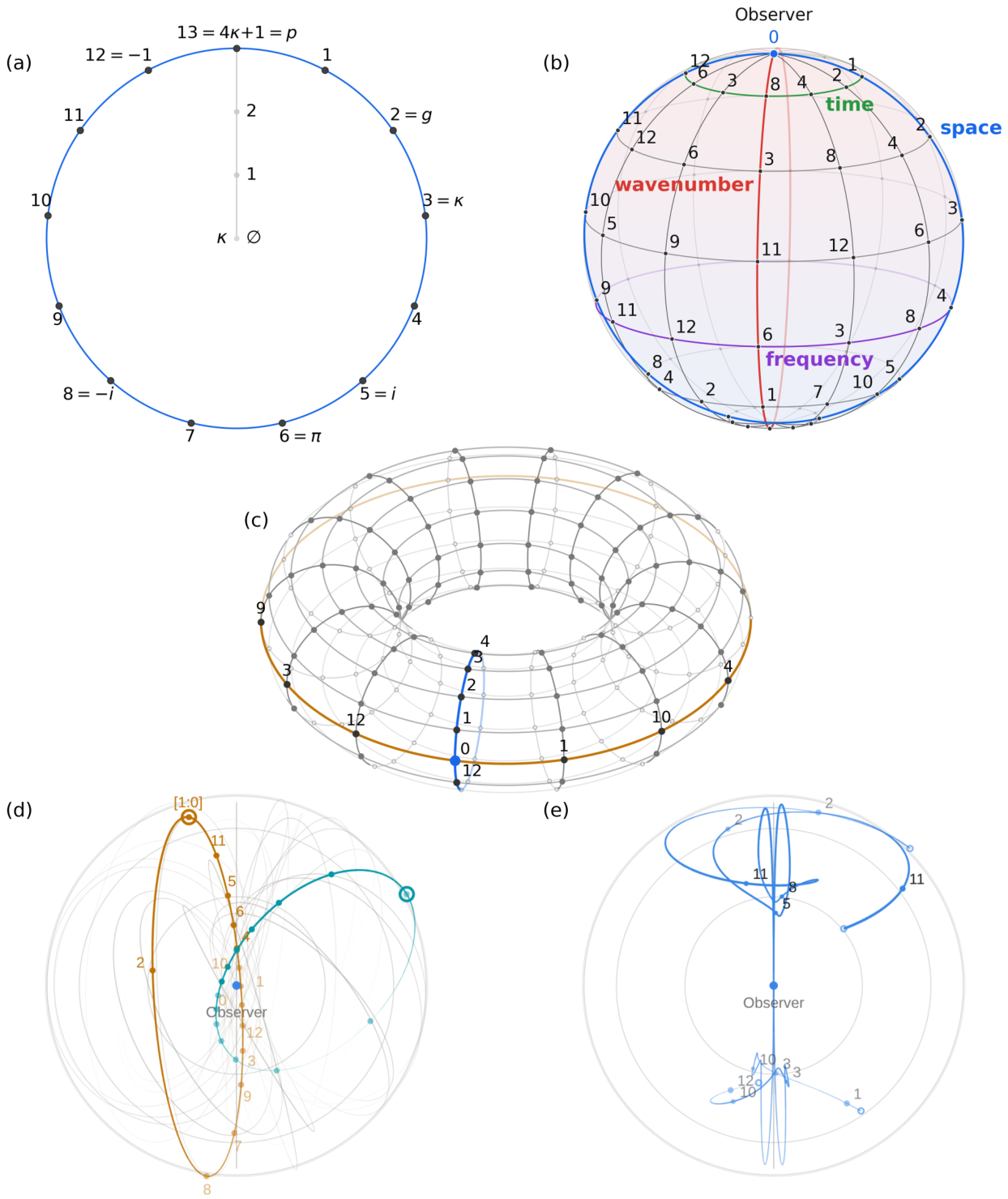
The three cycles. The frame of a Subject carries three cycles, of the consecutive orders , and [12]. The register is the cycle of the translation on the cells. The drive cycle is the split torus. The rotation is the non-split torus . It turns the directions of the frame’s line , the cells and the antipode , and it fixes none of them. The three cycles close the frame moves to the group and are its only cyclic symmetries. The group has elements, which is on the Subject 13. Figure 1 draws the three cycles on that Subject.
The register pairs with each of the other two cycles [12]. Against the drive it gives the shell, the pairs of a cell and a power of the drive. On the orbital sphere of panel (b) the shell closes at two poles, because the drive fixes two directions, the origin and the antipode. Against the rotation it gives the pairs of a register’s gap, the one direction that the register fixes, and one of its cells. Drawn as a surface in panel (c), these pairs close as a torus, because the rotation fixes no direction. The meridians of the torus are the register and its images under the rotation, and its latitudes are the orbits of the rotation.
The causal rays are the points of outside the frame’s line. Among the frame moves the stabiliser of a causal ray is the rotation, up to conjugacy. The finite sphere is the group , of the same order as the frame moves. It acts transitively on the causal rays, and there the stabiliser of a ray is the norm-one cycle. The finite sphere is therefore fibred over the causal rays with the norm-one cycle as its fibre. This is the Hopf fibration of the Subject, and its count is . The three-sphere is the declared continuum chart of the finite sphere [chart]. Panel (d) draws the fibration in the sky chart [chart]. Panel (e) draws the light cone of the Subject in the same sky, the past half inward in steps and the future half as its mirror image [chart]. The sphere, the torus and the sky are drawings, and no statement of this paper rests on the figure.
Figure 1.
The Subject with the drive and the capacity , and its three cycles, after [12]. (a) The register , with the quarter-turn 5, its negative 8, the half-period and marked. The radial axis holds the capacity. (b) The shell on the orbital sphere, with the Subject at the pole. The twelve half-meridians are the directions of the drive, and the coloured curves are the four domains of space, wavenumber, time and frequency [9]. The antipode of the pole is the direction , no cell. (c) The register against the rotation, , on a torus: the 182 pairs of a register’s gap and one of its cells. The meridians are the register and its images under the rotation, the Subject’s own blue. The latitudes are the orbits of the rotation, the origin’s amber. (d) The Hopf fibration in the sky chart [chart]. The ball is the two-sheeted chart of . The amber leaf is one fibre , the norm-one cycle, its 14 marks labelled by the thirteen cells and the antipode. The cyan leaf is a second fibre, linked with it once. (e) The light cone in the same sky at the laboratory pair [chart]. The sphere, the torus and the sky are drawing charts and are not derived.
Counts and units. The Subject is the only observer. A physical quantity has two parts [9]. The Subject holds its count, a residue of the shell read in a stated domain. Its unit is a product of the Planck length, the Planck time and the action quantum, and through units the Subject observes the Carrier. The Object is an observed system, registered relative to the Subject’s frame, and the Subject observes it through numerals. A ratio of two quantities of one domain is a pure number and belongs to the Subject’s mathematics. The absolute value of a unit is -hard: the totality decides it, and no bounded observer computes it. The ratio of the scale to the Planck energy is such a value. The numeral of a scale in MeV is a measured ratio of two readings of the Subject, and the paper imports it. Figure 2 places the quantities of this paper.
Definition 1
(The laboratory instances, ledger:A5). The laboratory instances of this paper are the Subjects , 173, 1549 in their Carriers , 30089, 2408561, together with the sweep over the 21 shells below 200. The three Carriers are congruent to 5 modulo 12 (Definition 2). The centre of a Subject’s unitary frame has order three where 3 divides , on the Subject 173 and on 12 of the 21 shells. The statements that use this centre are instantiated there, and the others on every shell. The exact checks run on the three Subjects and the sweep. On the three Carriers they decide the residue modulo 12 and the divisors that shares with the orders of the frame’s tori.
Proposition 1
(Results of the framework used here, ledger:A6). The following are results of the framework, cited and not reproved.
- (i)
- Time is the drive. That the clock of an embedded Subject is the frame’s drive is a theorem of [12]; a registered duration is a count of drive steps.
- (ii)
- Mass is a winding rate against the drive, and a massless state is a drive-invariant one [10].
- (iii)
- Confinement is the wrap: the frame normalisation that folds the Ω-hard residues of the quarks into small exact residues of the hadrons, whose masses are the one scale times dimensionless eigenvalues [11].
- (iv)
Proposition 2
(Two results of the interactions paper, ledger:A8). The following two results are cited and not reproved.
- (i)
- The character lift. For the fundamental-type representations of the finite frame and an element at distance ε from the identity, in the sense of [10], the frame’s character equals the compact group’s to order , q the order of the frame’s field [10]. The lift’s parametrisation of the elements near the identity is the interactions paper’s and is imported as it stands, and as it stands it is defective: its linear chart is not unitary over the finite field (over with and , ). Its repair is the interactions paper’s task. Nothing of this paper rests on the lift: the multiplicities rest on Proposition 3, and the Casimir rationals of Proposition 13 on the exponents of the frame’s torus.
- (ii)
- The centre. The centre of is the group of norm-one cube roots of unity, of order ; on the instance it is [10].
Proposition 3
(Multiplicities of the frame, ledger:A9). Let q be a power of a prime of the totality and . Let have the basis , and let have the dual basis . The module over K is . It has slots, and a word is a product of basis vectors, one in each slot. A pairing is the tensor on two slots of opposite type. A determinant tensor is or on three slots of one type. A pairing-and-determinant tensor is a product of pairings and determinant tensors over a partition of the slots. For let be the matrix unit. On one slot it sends to , or to , and the other basis vectors to 0. For let be the sum, over the sets of k slots, of the products of these slot operators. In the basis of the words it is a matrix of integers that does not depend on q. Let D be the integer matrix that stacks the for and . Let be the singlet multiplicity of the compact group , the constant term of its Weyl character polynomial.
- (i)
- The kernel of D modulo has dimension at least , and fixes its vectors. If , this kernel is the space of the vectors of the module that fixes.
- (ii)
- If and , this space is spanned by the pairing-and-determinant tensors, and its dimension is .
- (iii)
- If and , the frame fixes the same vectors as . The frame’s invariants therefore form a space of dimension .
Proof.
The element of sends to and to , and it fixes the other basis vectors. On the module it therefore acts as . The slot operators of commute and square to zero, so as integer matrices, for .
(i) A vector in the kernel of D modulo is fixed by every , and these elements generate . By the classical count of singlets ([13], ledger:A17), of the integer vectors that the six matrices annihilate, are independent and no more. By the identity above D annihilates every such vector, and D contains the six matrices. So of the integer vectors that D annihilates, are independent and no more. A minor of D that is nonzero modulo is a nonzero integer, so the rank of D modulo is not larger than the rank of D. Hence the kernel of D modulo has dimension at least . Let , and let fix v. Then vanishes for every . It is a polynomial in z of degree at most with more than roots, so every coefficient vanishes, and v lies in the kernel of D.
(ii) By (i) the space has dimension at least , and it contains the pairing-and-determinant tensors, which D annihilates. The automorphism of exchanges V with and the pair with . It carries the pairing-and-determinant tensors to themselves, and . So let , and put ; then . The map , for a cyclic permutation of , embeds in and commutes with . Its image is the antisymmetric tensors. This identifies the module with the image of the idempotent on , where exchanges the two slots of the i-th pair. Let L be the space of the vectors of that fixes. The fixed vectors of the module are . K contains a primitive cube root of unity , since 3 divides , and the scalar of multiplies by . So unless 3 divides r. If 3 does not divide r, the module has no fixed vector other than 0, and by (i). Let , and let be the product of n determinant tensors on the slots , , and so on.
Let be the bilinear form on for which the words are orthonormal, so that . For the map commutes with , since and . K has more than r elements. By finite Schur–Weyl duality for the special linear group, is therefore a combination of the slot permutations ([14, Corollary 4.4], with the proof of its Lemma 4.1 corrected in [15, Lemma 3.2]; ledger:A13). Let be the word . Let A be the product of the n antisymmetrisers of the triples, each the sum over the six permutations of one triple of slots. Then and . A permutation of one triple gives , so , with a power of the residue 6. Hence
Since 6 is invertible in K, L is spanned by the vectors , and the fixed vectors of the module by the vectors .
The vector has integer coordinates and is antisymmetric in each pair, so it is the image of an integer vector of the module. The embedding carries the matrices of the module to those of , which annihilate every and commute with the slot permutations. So D annihilates that integer vector. If of these vectors were independent modulo , a minor of that size would be a nonzero integer, and D would annihilate independent integer vectors. Since 2 is invertible in K, the fixed vectors form a space of dimension at most . Read in the module, each pair of slots becomes one dual slot, contracted with a determinant symbol. The identity turns a contraction of two determinant symbols into pairings. A pair inside one determinant tensor gives a pairing. A pair across two determinant tensors gives a pairing and a determinant tensor. A pair that meets earlier pairings gives pairings, or a determinant tensor when both of its slots do. By induction on the pairs, is a combination of pairing-and-determinant tensors. So these tensors span the fixed vectors.
(iii) carries the vectors that fixes to themselves, and all nondegenerate Hermitian forms on are equivalent. So the statement does not depend on the form, and we take the form , with the bar the Frobenius . Let v be an invariant of the frame. For with the matrix lies in the frame, and there are q such c. The polynomial vanishes at these q values and has degree at most , so for every k. Hence fixes v for every .
For with the matrix has determinant 1 and preserves the form, and for every there is such a . It equals , so for each of the values of . The left side is a polynomial in and , of degree at most in each. The monomials with are linearly independent functions on K, since their exponents are distinct and below . So every coefficient vanishes. The coefficients of and are and . The transposes of these matrices preserve the form as well, and they give in the same way. So for all . Since , each is invertible modulo , so the identity above gives , and v lies in the kernel of D modulo . By (i) fixes v. The frame is a subgroup of , which gives the converse. The hypothesis of (ii) holds, since . □
The paper uses degrees for the fundamental coefficient and for the adjoint one, so the inequality of (iii) holds on every laboratory Subject and on every shell of the sweep above 11; the shell 5 lies below it, and the coefficients of and have no residue there. On the instance over the integer multiplicities agree by enumeration for every (Theorem 8); the rational coefficients themselves have no residue in characteristic 2 or 3. The orders of the plaquette series that the inequality fixes are Corollary 2’s. Theorem 9 extends the equality of the counts to on a Subject. There the coordinate subgroups of the frame take the place of (iii). The theorem also brackets the first degree at which the equality fails.
Proposition 4
(Lattice gauge theory, ledger:A7). Wilson’s lattice gauge theory places group elements on the links of a hypercubic lattice and the action on its plaquettes. Its strong-coupling expansion writes the expectation of a Wilson loop of area A as at leading order in β, with the fundamental plaquette coefficient, and the chart reads the tension from as in lattice units [6,7]. The reading holds where the expansion converges.
Remark 1
(The data). Four imported data test the paper’s statements. The lattice determinations of the scalar glueball mass in units of for come by two routes (ledger:A1). The first is the route, with two inputs: , the product of [16] and [17], and , the quotient of [3] and [5]. In effect the two inputs share the value of , since the first is built from an average of values through [18] and ; they differ in the value of . The second route is the direct continuum extrapolation, , with the first scalar excitation at [5]. The routes disagree by , beyond their quoted errors, and the paper uses all three numbers. The colour factors measured at LEP in four-jet angular correlations are and , and the ratio comes from jet multiplicities [19] (ledger:A2). The strong coupling at two scales is and [20] (ledger:A3). The one-loop coefficient has the form [21,22]; the paper imports the form and derives the sign, and it imports the two-loop coefficient for one confrontation only (ledger:A4).
2.1. The Definitions
Definition 2
(Colour and the unitary frame, ledger:B5). Colour is the Carrier’s triality, the relation of the framework [10] (ledger:A18). Here 3 divides and does not divide , so no residue of the Carrier other than 1 has the cube 1, and has no root modulo Ω. A Subject reads colour in its unitary frame, the group of a Hermitian three-form over its own extension K. The type of the frame is declared from the Carrier’s relation: the cube roots of unity are not residues of the Carrier, so the frame is unitary and not linear, on every Subject. The Subject’s prime does not enter. The frame and the counts read from it, the orders of its tori and the degrees of its characters, are the Subject’s mathematics and carry no unit. The unit of the colour charge is the Carrier’s: the square of a charge has the domain of [9]. The coupling and the colour factors are pure numbers. Propositions 20 and 21 hold the falsifier of the definition: colour factors of the strong interaction other than those of a frame of degree three. No present confrontation separates the unitary frame from the linear one. The unitary type decides the centre (Proposition 7), the two cycles of Definition 5 and the gap of Corollary 1.
The laboratory Carriers 233, 30089 and 2408561 are each congruent to 5 modulo 12, and on each has no root. Write a pair of residues for with ; its norm is . The two roots are then the pairs and , and with they are three norm-one pairs of small residues. The relation is a statement about residues, and it forms no extension of the Carrier. A Subject’s own norm-one cycle holds a cube root of unity only where 3 divides (Proposition 7). On the Subjects 13 and 1549 the cube roots of unity are residues of the shell, and the frame of Definition 2 is the unitary frame there as well.
Definition 3
(Registration and residue, ledger:B1). A registration of a state by its frame is a line of the state’s representation space that every element of that frame maps to itself. The residue of the state is the number of such lines. This residue is a count without a unit, and it is not a residue of the Carrier. A state is a channel of the frame: an irreducible representation, or a product of irreducible ones whose frame-fixed subspace is a line. For the unitary frame, which has no nontrivial one-dimensional character (the paragraph below), every invariant line is a fixed line, so a space of the unitary frame whose fixed subspace has dimension d has invariant lines over ; for it is a sum of channels, not a state (Proposition 8).
The frame of the photon is the split torus of the Subject’s plane, an abelian group whose two invariant lines carry nontrivial characters and whose only fixed vector is zero: the photon’s residue is 2, counted by the rule above and not by the fixed-vector formula. The frame of a strongly interacting state is the unitary frame on the state’s representation space (Definition 2). The adjoint representation has no invariant line, so the gluon’s residue is 0; the norm-one cycle maps no line of the plane to itself either. The baryon’s residue is 1, the determinant line of of the triplet; the meson’s is 1, the singlet line of ; the glueball’s is 1, the singlet line of . The counts are theorems (Proposition 6, Theorem 1). Proposition 23 holds the falsifier of the definition: a state of residue 0 observed in isolation, a free gluon or a free quark.
The framework’s earlier papers state this rule in two forms, as a fixed-line count for the gauge bosons and as an invariant for the hadrons [11]; the single rule above yields both. For the unitary frame is perfect, so its only one-dimensional representation is the trivial one, and a line the frame maps to itself is a line it fixes pointwise. On the instance the group is solvable, with abelianisation , and the same conclusion holds over because has order 3. The invariant-line counts of Section 3 are therefore counts of fixed vectors.
Definition 4
(The finite theory, ledger:B3). The finite theory is the transfer form of lattice gauge theory on the substrate, declared along the drive, the direction of time (Proposition 1(i)). A ring of n plaquettes is n steps of the drive with the rung after the last step identified with the first, for a count n of steps, . In this definition Ω is the count of the totality itself, , and not a laboratory Carrier of Definition 1, which is smaller than the order of its frame. The drive returns after steps, so its own cycle is the ring of plaquettes. For another n the definition declares the identification.
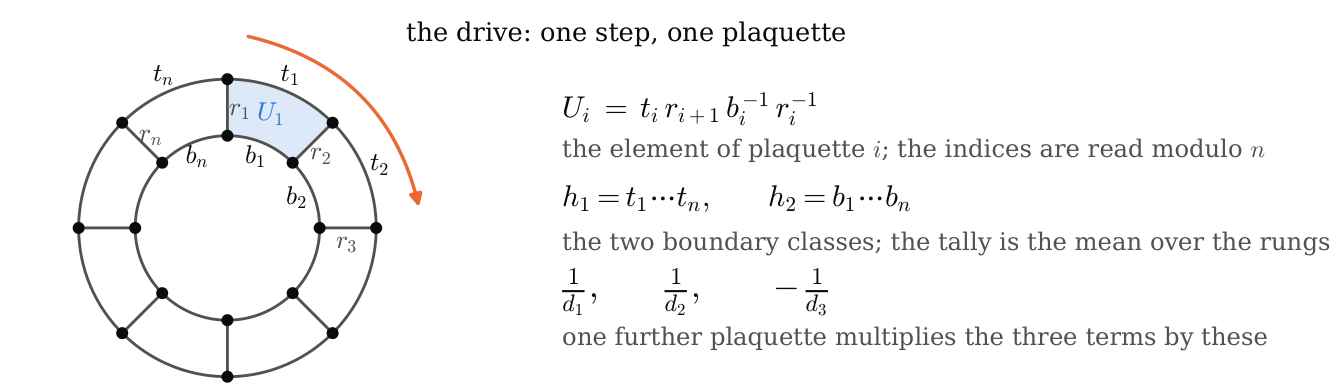
Plaquette i of the ring has two boundary links, and , and the two rungs and , with the indices read modulo n (one rung when ); Figure 3 draws the ring. A configuration assigns an element of to every link, and the element of plaquette i is . Let f be a function on G with values in the cyclotomic field of Definition 5. The frame’s mean is the value at f of the one -linear form that is invariant under the translations of G and takes the constant 1 to 1. The tally of the ring of plaquettes with given boundary links is the mean over the rungs of the configuration’s amplitude,
with w as in Definition 5 and the mean taken over every rung.
An element of the frame is a frame move. The order of the frame and the number of configurations of the rungs count frame moves. On the laboratory frames the paper computes the mean as the sum over the frame divided by the order. The prime divides the order of a Subject’s frame, so on the shell the order reads 0 and a quotient by it has no reading. A count of frame moves above Ω is the chart’s: the theory states the mean and no such count.
The theory takes the mean of products of the amplitude only, and the orthogonality relations of characters give these means with degrees of characters as denominators (ledger:A14). With the amplitude written as a sum of irreducible characters with integer coefficients, two relations suffice. Let and be two of these characters, of the degrees and , and let x and y be elements of the frame. Then and . The first says that a character acts on its own block as and on every other block as zero. The second is Schur’s lemma: the mean over r of the matrices that represent commutes with the frame, so it is the scalar . The two relations give every mean in the tally (2.1), so the theory forms no sum over the frame. The mean of the indicator of one element of the frame is the reciprocal of the order. It has no residue on the shell, and the theory forms no such mean.
The coefficients of a tally and of its paired weight are fractions whose denominators are products of degrees of characters. A fraction with b prime to is a framed rational of the Subject, read in the Subject’s arithmetic as the residue modulo . Where the degrees are prime to , as on the Subjects of Theorem 5, the theory computes each coefficient as a framed rational. Its residue is the product of the residues of its factors, and no numeral above Ω is formed.
One step of the drive is one plaquette. The transfer tally is the rule of one step: it multiplies the term of the character χ in the tally by , and its nonzero eigenvalues are these multipliers. On a laboratory frame the paper also forms the transfer tally as the operator K that acts on a function f on the frame by , the mean over y. There the trace of a step is the mean of its diagonal, and with unit boundary links . The registered quantity is the paired weight of Definition 5, formed once, after the n steps, as a function of the two boundary classes. The paired weight is an element of that the conjugation fixes, and with unit boundary links is rational and the paired weight is . On a Subject Theorem 5(iv) gives the reductions of the tally and of its paired weight. The paper declares no reading of the paired weight as a registered probability [23].
Among the distinct eigenvalues of the transfer tally, take the one of largest absolute value and the one of second largest, where each is unique, as on the frames of Theorem 5. The gap of the transfer tally is the ratio of the second to the first, a pure number. It is not the mass gap Δ of Definition 8, which is an energy. The eigenvalues are the multipliers above, with the integer coefficient of the character χ in w. The paper states this gap in lowest terms.
The chart’s constructs in the theory are the hypercubic lattice of Proposition 4, called the chart’s lattice below, with the Boltzmann weight at Wilson’s coupling of Proposition 5, the relativistic wrap operator of Definition 8 and the scale of Definition 6, with the cells that Definition 7 reads from it. The lattice supplies the ratios of the glueball masses of Remark 1 to .
Figure 3.
The ring of plaquettes of Definition 4, drawn for eight plaquettes. Plaquette i has the boundary links and and the rungs and , and the first plaquette is shaded. One step of the drive adds one plaquette. The tally is the mean over the rungs (Theorem 5).
Figure 3.
The ring of plaquettes of Definition 4, drawn for eight plaquettes. Plaquette i has the boundary links and and the rungs and , and the first plaquette is shaded. One step of the drive adds one plaquette. The tally is the mean over the rungs (Theorem 5).
Definition 5
(The spectral amplitude of a plaquette, ledger:B4). An element U of of order with has the semisimple part , where and , and the unipotent part ; the two commute. The definition uses two cycles. The first is the cycle of the units of , with a generator γ. The second is the cycle of the powers of an element C of the frame of order that has no eigenvalue in ; its powers are a maximal torus of the frame, of that order. For the frame has such an element (Proposition 9(i)). The frame has none, and there C stands for . The semisimple part has its three eigenvalues , , in , or it has none there and is conjugate in the frame to a power (Proposition 9(i)).
Let and be formal roots of unity of the two orders. They generate the cyclotomic ring , with the field of fractions . Where 3 divides the two cycles share the centre of the frame: the definition takes C with (Proposition 9(i)) and the formal roots with . The identification ι sends to . An exponent is read modulo the order of its cycle.
The spectral amplitude of U is
in the two cases, an element of . In both cases the three terms are the phases of the class of . In the first they are the images under ι of the three eigenvalues. In the second a power of C in the class of is , or (Proposition 9(ii)). The sum is the same for these three exponents, so it does not depend on the choice of k. The amplitude of U is the amplitude of . Another choice of γ and C changes every amplitude by an automorphism of the ring.
A configuration on a declared finite list of oriented plaquettes has the amplitude . A tally Z is the frame’s mean of these amplitudes over the links that are not given (Definition 4), and its paired weight is , where the bar is the inverse-phase conjugation, which inverts both roots of unity. On the elements of order prime to the amplitude is the Brauer character of the natural module in a fixed phase convention [24], and on every element it is Green’s lifting of that module, a virtual character of the frame [25,26] (Theorem 4 for , ledger:A14). The configurations of the ring of plaquettes and the registered quantity of its tally are declared in Definition 4; the boundary links are given, and no mean is taken over them.
Definition 6
(The chart’s scale on the drive, ledger:B2). A registered scale is a nonzero element w of the Subject, read in the domain of frequency: a count of phase cycles per step of the drive [9]. Its energy is the reading of that count in the Carrier’s unit. Two scales stand in the ratio of a power of the drive, , with n the drive exponent of Theorem 6. The chart reads the logarithm of a scale ratio as , for exponents within one window of the drive: exponents add modulo (Theorem 6), and a wrap of the cycle adds to the reading. The registration of a laboratory scale is the readout of [23], and this paper does not compute it.
Proposition 5
(The stiffness of the connection, ledger:A16). The following is cited and not reproved [10]. The stiffness ϑ of a gauge connection is the coefficient of its action, counted in action quanta ℏ per link per chronon. By channel unity the count is 1, and the bare coupling of the channel is . The interactions paper states this value as the canonical normalisation of the bare coupling and not as a measured coupling. Wilson’s coupling is the stiffness in another normalisation: for [6,7], so . At channel unity on the colour frame and for . With the plaquette term of Proposition 4 is for every N.
Definition 7
(The chart’s cells, ledger:B6). The cell of channel unity is the substrate’s own cell, one link and one chronon (Proposition 5). The stiffness of a coarser cell is the coupling matched at that cell’s scale, and the interactions paper classes its change from scale to scale as Ω-hard [10]. The chart reads the change by its one-loop law, in which is linear in the logarithm of a scale ratio with the slope (Proposition 21). Write , and let w be the scale of a cell (Definition 6). The one-loop law is then a law of powers,
A scale lower by the factor has W higher by the factor , a power of the drive. At channel unity . The stiffness is the chart’s logarithm of in the unit , so the cell whose scale lies n drive steps below the scale of channel unity has the stiffness
Without quarks (Proposition 14).
With the drive , which generates each of the three laboratory Subjects, one step lowers the stiffness by , and the stiffness is positive through . W reaches 1 where the scale has fallen by the transmutation ratio of the interactions paper, after steps. The one-loop law is the chart’s law at weak coupling, and its use at these cells is an extrapolation. The cells are the chart’s cells of the colour frame without quarks, and the paper does not compute which cell a laboratory lattice is.
2.2. Theorem Outline
The paper proves the following, in this order. Section 2 proves the multiplicities of the frame in finite fields (Proposition 3). Section 3 proves that the norm-one cycle has no eigenvalue in the shell and that the split torus fixes exactly two lines. The same section proves that the centre of the unitary frame has order and that the three channels of the residue series have one invariant line each on the enumerable instance. It counts the invariant lines of the product channels (Proposition 8). It then proves the finite properties of the spectral amplitude of a plaquette, its value on every element whose order the characteristic divides, on the instance its distribution and the exact spectrum of the one-plaquette transfer tally, and for every prime power the tally’s exact spectrum from the frame’s character table, with the tally of the ring of plaquettes, the gap of the transfer tally and the spectrum written in the shell’s (Corollary 1). It gives the tally of a ring whose boundary link is the same at every step (Proposition 10), and it ends with the tally of three rings on common links (Proposition 11).
Section 4 states the one -hard scale and proves the Casimir rationals, the sign and the values of the one-loop coefficient with its two rationals, and the drive exponent of every winding rate. Section 5 computes the fundamental and the adjoint plaquette coefficients to order in the stiffness of the connection, with rational coefficients, with the finite instance beside the series, proves the identity that makes the adjoint tension two fundamental tensions at leading order, and fixes the orders through which the frame’s series are built from the compact counts. The first order at which is not built from them lies between and . The section writes the two series, multiplied by 3 and by 8, on divided powers with integer coefficients and proves that a reading into the shell that respects sums and products sends the stiffness to 0 (Proposition 16). Section 6 declares the minimal wrap, enumerates the operator family it admits, records how that family fares against the lattice determinations, and records the failure of the chart’s two routes beyond it. Section 7 records four confrontations and five explanations.
3. The Unitary Frame and Its Registrations
The unitary frame acts on the Subject’s plane through its tori and on its own representation spaces through the whole group. This section decides the residues of Definition 3 on the laboratory shells and on the enumerable instance .
Proposition 6
(The norm-one cycle has no shell eigenvalue, ledger:C1). Let be a shell, ν a nonsquare of , and its quadratic extension, acting on the plane by multiplication in the basis .
- (i)
- A norm-one element with has no eigenvalue in . Hence no line of the plane is mapped to itself by every element of the norm-one cycle, the group of the norm-one elements. Its only elements with an eigenvalue in the shell are the scalars , which fix every line.
- (ii)
- The split torus, generated by , maps exactly two lines of the plane to themselves, the two coordinate lines.
Proof.
(i) The characteristic polynomial of multiplication by is , since the trace is and the norm is . Its discriminant is . For this is times a nonzero square, hence a nonsquare, and the polynomial has no root in . For the element is . (ii) The matrix maps the line through to the line through . The two lines coincide exactly when . Since has order , , and the condition is : the two coordinate lines. □
Proposition 7
(The centre of the unitary frame, ledger:C2). The order of the centre of (Proposition 2(ii)) is 3 exactly when , which for a shell is exactly . Among the laboratory Subjects 173 has the full centre , while 13 and 1549 have the trivial centre, and 12 of the 21 shells below 200 have the full centre. The triality is the Carrier’s (Definition 2): the three laboratory Carriers are congruent to 5 modulo 12, and no condition on a Subject’s prime follows. On the instance , exactly three of the 216 elements commute with every element, the scalars of norm one.
Proof.
The arithmetic is immediate: 3 divides exactly when , and with is . The laboratory values are and . Enumerating the 216 elements decides the statement on the instance. The order formula itself is the import of Proposition 2(ii). □
Theorem 1
(The residue series on the enumerable instance, ledger:C3). On the 216 elements of acting on :
- (i)
- the adjoint action fixes no nonzero traceless matrix, so the gluon’s residue is 0;
- (ii)
- the determinant is the one invariant of , and , have none, so the invariant content of the exterior algebra is and the baryon’s residue is 1;
- (iii)
- the commutants of the fundamental and of the adjoint representation are one-dimensional, so the meson’s and the glueball’s residues are 1.
The constant terms of the Weyl character polynomial give the same counts: , and , where is the singlet multiplicity of Proposition 3.
Proof.
Items (i)–(iii) are linear algebra over on the enumerated group: the fixed vectors of the adjoint action on the traceless matrices, the invariants of the exterior powers, and the commutants as the null spaces of the commutation equations. The multiplicities are integer identities on the constant terms of the Weyl polynomial. The finite-field counts agree with the multiplicities in every degree used, by the enumeration of Theorem 8. □
Theorem 1(iii) is Schur’s lemma for an absolutely irreducible representation. The glueball is the last channel of the hadron paper’s series [11], and its residue is one because the adjoint is absolutely irreducible and the frame has no nontrivial character into the field (the paragraph following Definition 3); irreducibility says nothing about channels of more constituents or about the order of their energies, and the series claims neither. The residue series, read through Definition 3, is photon 2, gluon 0, baryon 1, meson 1, glueball 1.
Proposition 8
(The product channels, ledger:C22). Let be the dimension of the subspace of that the unitary frame fixes, and that of .
- (i)
- On a frame whose characteristic is not 3, .
- (ii)
- On every Subject , , and , the numbers of characteristic 0. The fixed subspace has the dimension for two mesons, , and for three gluons, . It has for a meson and a glueball, and for two glueballs, .
- (iii)
- On a Subject a space with has invariant lines, which is 170, 29930 and 2399402 on the three Subjects. A space with has lines, and one with has . On the shell each of these counts reads 1, since divides , and a space with no fixed vector has no invariant line. The reading of the count of lines therefore decides whether the frame fixes a vector, and it does not separate a state from a sum of channels. The fixed subspace does: it is a line for a state, and here it has d independent vectors with d above one. The dimensions of item (ii) are at most 8, and every Subject reads each of them as itself.
- (iv)
- On the instance the counts are , 1, 2, 11, 92 for , so and . Two mesons have and 5 invariant lines. Three gluons have and 5461 lines, a meson and a glueball have , and two glueballs have . The instance departs from the Subjects on these spaces: their degree is above 4, and the instance’s first departure is at degree 5 (Theorem 9).
Each of these spaces is a sum of channels and not a state (Definition 3). Table 1 lists the registrations and the products.
Proof.
(i) Where 3 is invertible the trace splits into the scalars and the traceless matrices, . Expanding gives , and the binomial inversion gives the formula. (ii) By Theorem 9 the frame’s are the compact counts 1, 1, 2, 6, 23 through degree , and the degrees used are at most 8. Two mesons have , and a meson and a glueball have . (iii) The frame is perfect, so an invariant line is a fixed line, and a fixed subspace of dimension d has lines over K. (iv) The fixed vectors of are found by enumeration over . For the diagonal torus fixes 22, 170 and 1366 dimensions, the normal subgroup of order 27 fixes 8, 56 and 456 of them, and the frame fixes 1, 7 and 57. The counts follow from (i). The instance has no nontrivial character over (Theorem 1), so its invariant lines are fixed lines, of them. □

Table 1.
The registrations and the product channels. The fixed subspace has the dimension d, and the lines are the invariant lines over . The first five rows are the residue series (Definition 3, Theorem 1). The photon’s two lines carry characters and are counted by the rule of Definition 3, not by d. The last four rows are the products of Proposition 8.
| on a Subject | on | |||||
| state or product | space | frame | d | lines | d | lines |
| photon | the plane of the split torus | split torus | 0 | 2 | – | – |
| gluon | unitary | 0 | 0 | 0 | 0 | |
| baryon | unitary | 1 | 1 | 1 | 1 | |
| meson | unitary | 1 | 1 | 1 | 1 | |
| glueball | unitary | 1 | 1 | 1 | 1 | |
| two mesons | unitary | 2 | 2 | 5 | ||
| three gluons | unitary | 2 | 7 | 5461 | ||
| a meson and a glueball | unitary | 3 | 8 | 21845 | ||
| two glueballs | unitary | 8 | 57 | |||
Proposition 9
(The spectral amplitude: finite properties and the singular elements, ledger:C16). Let and let w be the spectral amplitude of Definition 5.
- (i)
- If has an eigenvalue in , it has all three there. If it has none, its order divides , and for it is conjugate in the frame to a power of C. For the frame has an element C as in Definition 5, and where 3 divides one of C and has the central power of that definition. does not depend on the exponent e.
- (ii)
- w is a class function with , and ; for a central scalar , . The reduction is the ring homomorphism of into the matrices over with and . It sends to the scalar matrix , that is, to the element of . In particular for every power : the three phases of a class of the second cycle reduce together, to one element of . A power of C in the class of is , or .
- (iii)
- If divides the order of U, then has the eigenvalues with , so with ; every unipotent element has .
- (iv)
- If 3 divides , then the frame’s mean of w (Definition 4) is 0.
Proof.
(i) Let f be the characteristic polynomial of , with coefficients in , and the polynomial whose coefficients are the q-th powers of those of f. The frame preserves the Hermitian form, so .
Suppose f has an irreducible factor of degree two or three, and let B be a matrix over with the characteristic polynomial ; in degree three and . The polynomials in B with coefficients in commute, and a nonzero one of degree below that of is an invertible matrix, since is irreducible. Every polynomial in B equals one of degree below that of , since . So a product of two of them vanishes only if a factor does, and a polynomial has no more roots among them than its degree. Raising to the power respects their sums and products and fixes the scalars. Hence , and : the scalars are the roots of , and B is not a scalar. From follows , and the q-th power of this relation is . So is a root of f. It is not a scalar: then would be a scalar root of . It is not B: that gives , and then . It is not : that gives , and only I has the q-th power I among these polynomials, so again . In degree two the roots of f are a scalar, B and , so this degree does not occur. So the degree is three, and the roots of f are , and . Their product is the determinant, so .
If f has a root in , it has no irreducible factor of degree two or three, so it has its three roots there. For the generic character table of ([27,28], ledger:A15) lists the classes of the elements with no eigenvalue in as the classes of the powers of one of them, an element of order . This element is C. Where 3 divides the power has order 3, a divisor of , so it equals its own power and is a scalar: it is or its inverse, and C or has the central power of Definition 5. In the cyclic group generated by U the element is the unique one of order dividing m with of order a power of , and every admissible e produces it.
(ii) Conjugation carries to the conjugate’s semisimple part and preserves its class; inversion inverts the eigenvalues, and ; . A central scalar has order dividing , which is prime to , so and every eigenvalue is multiplied by z. In the second case of (2.2) the inverse of lies in the class of , whose three phases are the inverses. For the element is conjugate to . Its three phases are those of times , since , and this factor is by the relation of Definition 5.
By (i) the polynomials in C commute, and a nonzero one is invertible. A root of unity among them, of an order prime to , is a root of the cyclotomic polynomial of that order. So and define homomorphisms of the two cyclotomic rings. They agree on the common central power, which is the only relation between the two formal roots, so the reduction exists. In the first case of (2.2) it sends to the sum of the three eigenvalues of times I. A power that is not a scalar has no eigenvalue a in , since is then a nonzero polynomial in C and so invertible. In the second case, by the argument of (i), the characteristic polynomial of such a power has the three roots , and among the polynomials in C. Their sum is its trace times I, and a power of C in the class of is a root of this polynomial, so it is one of the three.
For a scalar the three terms are equal, since a scalar of the frame has . A conjugate of has the same trace. For only the first case occurs. So the reduction sends to the trace of times I. In the second case by the argument of (iii). In the first is diagonalisable over , since its order is prime to and its eigenvalues lie there. Then because preserves each eigenspace of and is unipotent on it.
(iii) commutes with . So has an eigenvalue in : otherwise the matrices that commute with are the polynomials in , a nonzero one of which is invertible, and is not. preserves the eigenspaces of ; on a line a unipotent element is the identity, so some eigenvalue has multiplicity at least two. The map preserves multiplicities, by the relation between f and of (i), and two distinct eigenvalues of multiplicity two do not fit in dimension three, so , that is ; the determinant fixes the third eigenvalue as .
(iv) A central scalar of order three translates the frame. By (ii) and the invariance of the mean, with , so . □
On the Subjects the amplitude’s phases are not the Carrier’s: the order of the second cycle is prime to on each of the three laboratory pairs (157 against 232 on the Subject 13), so no element-wise reduction of phases into the Carrier’s cycle registers the amplitude of C, and its paired weight is not a rational number. What the theory registers of a tally is declared in Definition 4; it is not a property of the amplitude.
Theorem 2
(The spectral amplitude on the enumerable instance, ledger:C17). On the 216 elements of , with the image of a generator of , the amplitude takes the values 3, and on 64 elements each and 0 on 24; the 192 nonzero values come from scalar semisimple parts. The moments at , , are 8, 24 and 72, and the invariant counts of Theorem 1 at the same pairs are 1, 1 and 2. The amplitude is a virtual character of the frame with a negative coefficient ([25], Theorem 3), and the character of no representation over .
Proof.
The values and the moments are the enumeration, in the arithmetic of and . The involutions and , , are unipotent, so , while has the three eigenvalues of order dividing three and . In a representation of dimension three over an element of order two with character value 3 acts as the identity, so U and V would both act as the identity and would have character value 3. □
Theorem 3
(The transfer tally on the enumerable instance, ledger:C18). On the transfer tally K of Definition 4, the step of one plaquette formed on this frame, has the eigenvalues , , 0 and with the multiplicities 9, 36, 144 and 27. It satisfies , with and , the moment of Theorem 2. The trivial channel is annihilated, , so the tally has no normalisation by that channel, and the eigenvalue shows that K is not a positive operator.
Proof.
In the basis of the 216 elements the matrix of K has the entries . It is Hermitian for the inverse-phase conjugation, since . The matrix has its entries in , and the identity is verified in the integer arithmetic of that ring. Since , and , it is the identity of the statement. Its roots are distinct, so K is diagonalisable with eigenvalues among them, and the multiplicities are the dimensions of the kernels of , which sum to 216 and reproduce the two traces. is Proposition 9(iv), since 3 divides . □
Theorem 4
(The transfer tally on the Subjects, ledger:C19). Let be a prime power, , and let , , be the irreducible characters of degrees , and that are the first members of the three families of those degrees in the generic character table of ([27,28], ledger:A15). The spectral amplitude is the virtual character
so the frame’s means are and , and the transfer tally K of Definition 4, formed on G, has the eigenvalues
with the multiplicities , , and the remainder of .
On the Subjects the nonzero eigenvalues are , , on ; , , on ; , , on . The trivial channel is annihilated, , and K is not a positive operator.
Proof.
The amplitude is a class function: it is declared on the class of the semisimple part of U (Definition 5). The table has eight class types. On each it gives the phases of the semisimple part and the values of the three characters, as sums of roots of unity. In the list below z is the image of a central eigenvalue, a, , and are images of eigenvalues of order dividing , and b is the image of one of order dividing . On line 8 the semisimple part has no eigenvalue in , and c is a power of .
| Type | Phases | w | |||
| 1 | |||||
| 2 | z | ||||
| 3 | z | z | |||
| 4 | 0 | ||||
| 5 | a | 0 | |||
| 6 | 0 | 0 | |||
| 7 | 0 | ||||
| 8 | 0 | 0 |
On every line . On the first line this is . This proves (3.1). The first member of a family is a character of it when the family admits the parameter 1. The second family excludes the multiples of , and the third the multiples of . Both admit 1 exactly when . The three characters are therefore irreducible, and their degrees differ. None is trivial, so , and . The tally K is the convolution by w on the functions on G with values in , taken with the frame’s mean. By the table the three characters take their values in , so their isotypic blocks lie in this space. K acts on the block of as the scalar , with multiplicity , where is the coefficient 1, 1 or of in w. It is zero on the complement of the three blocks. This gives (3.2); , and the third eigenvalue is negative.
Three computations check the table and the identity. The table is checked against the enumeration of the frames and , where the spectrum of K is computed from the group itself, and by its orthogonality relations for . The identity is checked class by class on the explicit lists of classes for the prime powers . The coefficients , , and and the sum are evaluated as means over the classes, in exact integers, for . They are 1, 1, , 0 and 3. □
The instance is the exceptional frame: there the first members of the second and third families are not defined, and the full table gives , with the character of degree in place of the one of degree and the three characters of degree in place of the one of degree ; this is the spectrum of Theorem 3, and the moment 8 of Theorem 2 is . Deligne–Lusztig theory reads the decomposition (3.1) in a second way: the amplitude depends only on the semisimple part, so it is a uniform function [29,30]; its restrictions to the three maximal tori, of orders , and , are the sums of the three characters , and , which are distinct exactly when , so that the norm is (and at ), and the Deligne–Lusztig characters of the three tori give , and . The proof above uses the table alone, and the paper rests nothing on this second reading.
Theorem 5
(The tally of the ring of plaquettes and the gap of the transfer tally, ledger:C20). Let be a prime power and , the links of Definition 4 taking values in G. Let , and be the characters of Theorem 4, of the degrees , and , with the coefficients and in w.
- (i)
-
For every count n of steps of Definition 4 the tally (2.1) of the ring of n plaquettes depends on the boundary links only through the classes of and . It is a sum of three terms, one for each character:At fixed boundary classes one further plaquette therefore multiplies the three terms by , and , the nonzero eigenvalues of the transfer tally.
- (ii)
- Let g generate , the drive’s on a Subject, and let , a root of unity of order . Let be an element of G with the eigenvalues , 1 and , where ; the frame has no such k. Then , and , so that the tally of one plaquette isand on these classes the term of vanishes for every such n.
- (iii)
- , the eigenvalue belongs to the one character , and . The gap of the transfer tally is therefore , which is , and on the three Subjects. The third eigenvalue has the absolute value , and its ratio to the first is , the gap times .
- (iv)
-
Let be a Subject. The degrees are , and modulo , so each multiplier is a framed rational of the Subject with the residue 1, and every coefficient has the residue 1. The reduction of Proposition 9(ii) extends to the fractions with denominators prime to . Under this reduction the tally of the ring is therefore the same for every n,with the reduction of . The right side is the reduced tally. The reduced tally does not depend on the choice of γ and C in Definition 5. It is an element of the Subject’s quadratic extension . In the basis of Proposition 6 an element of is a pair of residues of the shell, a point of the plane. The conjugation of over the shell carries the reduced tally to the reduction of the conjugate tally. The paired weight therefore reduces to the norm of the reduced tally, a residue of the shell.On the classes of (ii) the reduced tally is itself a residue of the shell, , and the paired weight reduces to its square. For and the reduced tally is 10, 163 and 1367 on the Subjects 13, 173 and 1549. With unit boundary links it is 3. On the three Subjects 2 is a nonsquare. Let be a root of in . For , and with the eigenvalues , and the reduced tally is , which is not in the shell. The paired weight there reduces to the residue of , which is 6, 106 and 966 on the three Subjects.
Proof.
(i) By Theorem 4, , and the three characters are irreducible with values in . For irreducible characters , of G and the orthogonality relations, written with the frame’s mean, are
and they carry no order of the frame.
Expand every factor of (2.1) in the three characters. For the plaquette is , on which a character takes the value it takes on . The mean over is the second relation, which gives . For the mean over the rung , , is the first relation. It joins the plaquettes m and into one plaquette with the boundary links and , leaves one character on both, and contributes the factor . After these means the term of carries n factors and factors , and it multiplies . The mean over is the second relation and supplies the last factor . The term of is thus the product of n factors times , which is the recursion of (3.3).
(ii) By the table of Theorem 4 the elements of G with the eigenvalues , and , for with , form one class, on which , and . At the condition is , the eigenvalues are , and 1, and the three values follow. The inverse of has the same eigenvalues and lies in the same class. Equation (3.4) is (3.3) at these values and , and the term of vanishes with .
(iii) , and . The three eigenvalues are distinct, and each belongs to one character by Theorem 4.
(iv) The degrees , and are 1, 1 and modulo , and , so the three multipliers have the residue 1. The reduction of Proposition 9(ii) sends an integer prime to to a nonzero residue of the shell times I. It therefore extends to the fractions with such denominators, and it sends a product to the product of the residues. Applied to (3.3) it gives (3.5). It sends to g, which gives the value on the classes of (ii) from the three values there. The tally on these classes is fixed by the conjugation, so the paired weight is its square. The three residues at are computed in , and , where 2 generates the units. With unit boundary links , and .
Take the table of the proof of Theorem 4 at . By Proposition 9(ii) the reduction of a root of unity of its lines 1 to 7 is a scalar matrix, an element of . The reduction of a sum of line 8 is a trace, an element of . So the reduced values lie in , and so does the sum (3.5).
Another choice of and C in Definition 5 replaces every amplitude, and so the tally, by its image under an automorphism of . It replaces the reduction by its composite with the inverse automorphism and a conjugation of the matrices, so the reduced tally, a scalar, does not change. In the table the roots of unity satisfy and , since their orders divide , and and . On each line, raising every root of unity to the power therefore gives the same value of as inverting every one. Inverting is the conjugation, which gives the value at the inverse element. Raising both roots of unity to the power is an automorphism of , and the reduction turns this automorphism into the -th power, since the coefficients are integers. So for every h. The conjugate tally at is , so its reduction is the -th power of the reduction of . The -th power is the conjugation of over the shell, and the product of an element of with its conjugate is its norm, an element of .
On the three Subjects 2 generates the units, so it is a nonsquare. The class of is the class of the proof of (ii) at , where , and . The reductions of and there are and , and the values at are their conjugates, and . With the values 1 and at the sum (3.5) is , and its norm is , with the residues 6, 106 and 966 computed in the three shells. □
Corollary 1
(The spectrum in , ledger:C21). In this statement denotes the phase cycle of a Subject’s shell [9]. The relation certifies the constant, and it is -hard: the shell decides its value, as the totality decides an Ω-hard one. On each of the three Subjects
the gap of the transfer tally is , and the ratio of the third eigenvalue to the first has the absolute value . These are pure numbers of the Subject, and each is one expression on every Subject.
The two cycles of Definition 5 have the orders and . The order of a cycle is the modulus of its exponents, and it is not reduced on the shell. The second order is the expression of . As a degree is a denominator, and there the shell reduces it to 1. On the shell , which gives the residue 1 of Theorem 5(iv). The form belongs to the unitary type of the frame, which Definition 2 declares from the Carrier’s relation. The chart reads a fraction in π with the classical value of π. This reading is declared, and it gives the gap as . Table 2 lists the degrees and the ratios on the three laboratory Subjects.
Proof.
Put in the degrees of Theorem 5. Then and , and . The cycles of Definition 5 have the orders and . The gap and the third ratio are those of Theorem 5(iii). The classical lies between and , so lies between and . □
Table 2.
The transfer tally of Theorem 5 on the three laboratory Subjects: the degrees, the gap and the absolute value of the third ratio, as exact integers and fractions. The three multipliers have the residue 1 on the shell. The last line gives the expressions of Corollary 1.
Table 2.
The transfer tally of Theorem 5 on the three laboratory Subjects: the degrees, the gap and the absolute value of the third ratio, as exact integers and fractions. The three multipliers have the residue 1 on the shell. The last line gives the expressions of Corollary 1.
| q | gap | third ratio | residues on the shell | |||
| 13 | 157 | 2198 | 2352 | () | ||
| 173 | 29757 | 5177718 | 5207472 | () | ||
| 1549 | 2397853 | 3716672150 | 3719070000 | () | ||
| in |
Proposition 10
(The tally with the same boundary link at every step, ledger:C23). Let be a Subject, with G, g, ζ and the classes of and as in Theorem 5. Let t lie in the class of and b in the class of , and let every step of the ring of n plaquettes have the boundary links and . Write , and in . The length n isregularwhen and .
- (i)
- The boundary classes are those of and , and the tally is
- (ii)
-
On a regular lengthand its residue in isOne step multiplies the four moving terms by and , products of the eigenvalues of the two links. Their drive exponents are sums and differences of the exponents of the links.
- (iii)
- The lengths that are not regular are those with or . Every consecutive lengths hold of them. For the residue of the tally there is when and when , and the same holds with x and y exchanged. For it is 3 when , 1 when , and when .
- (iv)
- The residue of the tally depends on n through x and y alone. Its least period in n is , and at every multiple of P it is 3, the tally with unit boundary links. At every length the residue is with unique coefficients in , and unless divides r. Every drive exponent of the residue is therefore a sum of multiples of j and k. The expression (3.8) holds on the regular lengths only, and its five exponents need not be all of them. At every length the paired weight is the square of the tally, and P is a period of it.
- (v)
- For and on the Subject 13 the least period is 12, and Table 3 lists the residues at the lengths . The twelve coefficients are 3, 5, 11, 5, 2, 4, 11, 4, 2, 5, 11, 5, and none is 0. For the least period is 6. For the lengths that are not regular are the multiples of 3, 43 and 387 on the Subjects 13, 173 and 1549.
Proof.
(i) This is Theorem 5(i) with and , and the recursion of (3.3) gives .
(ii) The element t has three distinct eigenvalues in , so it is diagonalisable over , and is diagonalisable with the eigenvalues x, 1 and . For it lies in the class of , on which , and by Theorem 5(ii). The same holds for with k in place of j, since the inverse of lies in its class. This gives (3.7). By Theorem 5(iv) the residue is , and . The four terms are the n-th powers of and , and exponents add by Theorem 6.
(iii) exactly when . If , then is diagonalisable with every eigenvalue 1, so and , with the residues 1, 1 and . If , then is diagonalisable with the eigenvalues , and 1. On the diagonalisable elements with the eigenvalues a, a and , where and , the table of Theorem 4 gives , and . At these are q, and 0, with the residues 0, and 0. The same holds for , and each of these classes holds the inverses of its elements. The values of (iii) are the sums (3.5) of these residues: with gives , and the other cases follow in the same way. Modulo the lengths n with number , those with number , and those with both number .
(iv) The three multipliers have the residue 1 at every length, so by (ii) and (iii) the residue is a function of the pair . The pair is the n-th power of , whose order is P. So P is a period, and at its multiples both boundary classes are that of the unit and Theorem 5(iv) gives 3. The least period divides P. Suppose it were a proper divisor d. Then the residue would be 3 at every multiple of d, and these lengths give the powers of a pair of order . Among them are the powers of a pair of prime order ℓ. For item (iii) gives 1 or and not 3. For ℓ odd and it gives , which is 3 only for , and the same holds for . Otherwise with modulo ℓ, every power is regular, and for . The left side is the sum of the four powers and . Summed over these m, a power contributes when its exponent is 0 modulo ℓ and otherwise, and the first case holds for none or for two of the four. The sum is therefore or , against on the right. These differ in , since is odd and . So P is the least period.
By finite Fourier inversion on the lengths, a function of n with the period P is a unique combination of the powers with dividing r, and . At every length each character value above is an integer or a sum , which the conjugation fixes. So the conjugation fixes the tally.
(v) The residues are computed in from (ii) and (iii), and the coefficients from , where is the residue at the length n and is the inverse of 12. For the condition of (iii) is , which holds at the multiples of . □
Proposition 11
(Three rings on common links, ledger:C25). Let be a prime power, with G, , , and as in Theorem 5. Take three rings of n plaquettes on the same links . Ring f has its own boundary links and rungs , and the element of its plaquette i is . The links are common to the three rings and are no boundary. The tally of the three rings is the mean, over every rung and every common link, of the product of the amplitudes. Write , and let be the frame’s mean of .
- (i)
- The tally depends on the boundary links only through the classes of , and , and
- (ii)
-
is the number of independent invariants of the frame in the product of the three representations, and it is symmetric in its indices. With ,The mean of is .
- (iii)
- Let be a Subject, and let , and lie in the classes of , and of Theorem 5(ii). Every coefficient has the residue 1. The count is a multiple of and has the residue 0. For every n the tally has the residuein , with as in Proposition 10. The count is 2 on the Subjects 13 and 1549 and 4 on 173. For and the tally reads 6, 25 and 616 on the Subjects 13, 173 and 1549. With unit boundary links it reads 6 on every Subject.
- (iv)
- Let each ring have the same boundary link at every step, in the classes of , and for the three rings. The boundary classes are then those of the n-th powers of the three links. At every length at which the three are classes of Theorem 5(ii), the residue is (3.10) with , and . The length enters through these three exponents, modulo . On the Subject 13, for and , these lengths are 1, 5, 7 and 11 in every twelve, with the residues 6, 9, 9 and 6.
Proof.
(i) At fixed common links Theorem 5(i) gives the tally of ring f as with . The three rings have distinct rungs, so the mean over all the rungs is the product of the three sums. This product depends on the common links through B alone. The mean of a function of B over is its mean over B, by the invariance of the mean under translations. The mean of is the conjugate of , and is an integer by (ii).
(ii) The product is the character of the product of the three representations, a sum of irreducible characters with multiplicities. The mean of an irreducible character is 1 for the trivial character and 0 for every other, by the orthogonality relations of characters. So is the multiplicity of the trivial character, the number of independent invariants.
The values come from the character table of Theorem 4. The mean is a sum over the eight class types. On a type each character is a sum of at most three roots of unity, with exponents that are linear in the parameters of the type and with coefficients of degree at most 1 in q off the centre. The sum of a product of three characters over a parameter is therefore a combination of sums of the powers of one root of unity, of order , or , with the parameter times a fixed integer as the exponent. After reduction by the order this integer has absolute value at most 9 for the order , and it is with for the two other orders. For it is a multiple of the order only when it is 0, so each sum is the number of parameters or 0 by a rule that depends on q through e alone.
For each value of e the mean times the order of the frame is thus a polynomial in q for . Its degree is at most 11: the classes of a type hold at most the order of the frame, of degree 8, the three entries add at most 3, and the centre contributes the product of three degrees, of degree at most 9. The stated values times the order are polynomials of degree at most 9. The two agree at sixteen prime powers for each value of e: for at 9, 13, 16, 19, 25, 27, 31, 37, 43, 49, 61, 64, 67, 73, 79 and 81, and for at 11, 17, 23, 29, 32, 41, 47, 53, 59, 71, 83, 89, 101, 107, 113 and 125. A polynomial of degree at most 11 with sixteen zeros is zero, so they agree at every . At , 4, 5, 7 and 8 the means are computed from the table. The sum is , which is 6 for and for .
(iii) By Theorem 5(iv) every coefficient has the residue 1, and by Theorem 5(ii) the three characters take the values 1, and 0 on the class of . The terms of (3.9) that remain are those of the first two characters: one with , three with , three with and one with . The reduction gives (3.10). The centre has on the Subjects 13 and 1549 and on 173 (Proposition 7). With unit boundary links the characters take their degrees, with the residues 1, 1 and , and the tally has the residue .
(iv) The boundary links of a ring are equal, so is their n-th power, with the eigenvalues and 1 for the first ring, as in Proposition 10(i). On the Subject 13 the three powers are classes of Theorem 5(ii) when none of , and is a multiple of 12. □
The three rings are the smallest arrangement in which a link is common to three plaquettes. Their tally uses the orthogonality relations of characters, as the ring’s does, and one new set of numbers, the counts . The product of three copies of the second character has or invariants, and the shell reads that count as 0.
Equation (3.3) has the form of the chart’s character expansion of lattice gauge theory on a cylinder [31,32], here the ring of plaquettes, with the virtual character w in place of the chart’s Boltzmann weight. The gap of the transfer tally is a ratio of two integers, 1 and . On a Subject the three nonzero eigenvalues have the residue 1 (Theorem 5(iv)). The ratio of any two of them has the residue 1, whose drive exponent is 0. The Subject’s shell therefore does not register this gap, and the paper reads no drive exponent and no logarithm from it. An energy is the reading of a winding rate in the Carrier’s unit of action [9], and the paper derives no winding rate from the tally. With the same boundary link at every step, of eigenvalues in the shell, the residue of the tally moves with products of the eigenvalues of the two links, which are given with the links, and the three multipliers have the residue 1 (Proposition 10). At fixed boundary classes the reduced tally of the ring does not depend on its length. The gap is a statement about the fractions and as ratios of counts.
The transfer tally has the two ratios of Theorem 5(iii) and no further nonzero eigenvalue. In each ratio is one expression on every Subject (Corollary 1). The ratios of the glueball masses of Remark 1 to are numerals of the chart’s lattice in four dimensions, where six plaquettes meet at every link. On the ring of plaquettes a rung joins two, and one character runs around the ring, as the proof of Theorem 5(i) shows. The paper therefore sets no ratio of the transfer tally against the lattice’s masses.
The chart’s weight of Definition 4 is not an evaluation of the amplitude: a ring homomorphism sends the 24 zero amplitudes of the instance to zero, and the weight sends them to . The weight is the chart’s own declaration, and Lüscher’s positivity is a property of that declaration (Section 7); the transfer tally of Theorem 3 has no such property and need not.
4. The One Scale and the Sub-Horizon Tower
Proposition 12
(The one -hard scale, ledger:Z1). The one scale of the gauge sector, , which fixes up to a sub-horizon ratio, is Ω-hard: no bounded observer computes its absolute value, the ratio of to the Planck energy. The paper reads its numeral from the lattice, about 420–460 MeV, a measured ratio that the paper imports. Every dimensionless quantity of the sector is a sub-horizon ratio (Proposition 1(iv)).
The tower above the scale begins with the invariants of the frame itself.
Proposition 13
(The Casimir rationals, ledger:C4). The unitary frame fixes its Casimir rationals through the exponents of its torus. A torus element acts on the fundamental module with eigenvalue exponents , the discrete logarithms of its eigenvalues on the doubled cycle of the quadratic extension (Theorem 6 on K), and on the adjoint with their six differences and two zeros. The second moments of the exponents are and , so the indices stand in the ratio ; with the chart’s normalisation of the generators, , the values are , , and , and the colour factor of the three-quark singlet is , that is per pair [11]. No lift enters.
Proof.
The index is defined by ; on the torus generators it is the second moment of the exponents of R up to the one Weyl-invariant quadratic form of the exponent plane, which is for every module. The fundamental’s three exponents square to and the adjoint’s six differences to , so . The Casimir is : and . The singlet’s factor follows from with per quark. On the Subject 13 the split torus has the exponents modulo 168, a line of the exponent plane on which both forms are read: for every n, and likewise on 173 and on 1549; the ledger file forms both second moments exactly, and the Lean cells decide the identity on the three Subjects and prove it for every exponent pair. □
Proposition 14
(The window rational, ledger:C5). With the form of Remark 1 and the Casimirs of Proposition 13, takes the values 9, , , 7 for ; it is positive for every and negative for every from 17 to 200.
Proof.
is positive exactly when and equals at ; the negativity from 17 to 200 follows. □
The sign of for the matter content is what the chart calls asymptotic freedom.
The one-loop coefficient has a second form, which the paper imports beside the first. Hughes and Nielsen write it as a sum over the field species of a paramagnetic spin term and a diamagnetic charge term,
one complex scalar, one Weyl fermion and one real vector each counting once [33,34] (ledger:A12). The gauge field contributes , a Weyl fermion and a complex scalar . The paper imports the form of the sum; both of its rationals are the frame’s.
Proposition 15
(The two rationals of the one-loop coefficient, ledger:C13). The spin term is , with the generator of the rotation of the -plane on the field’s module: 0 on the scalar, 1 on the Weyl spinor and 4 on the vector. The charge term is the leading Faulhaber coefficient of the scalar loop’s midpoint sum,
whose complete cycle vanishes on the shell. With the Casimirs of Proposition 13 the sum (4.1) is , the window rational of Proposition 14.
Proof.
On the vector and , of trace . On the Weyl spinor with , which every shell has, and , of trace . The terms of (4.2) are the integers , and the sum of their squares is ; the identity is a polynomial identity in N, and at its right side is . With and the sum (4.1) reads . The ledger file checks (4.2) to and as residues on the laboratory Subjects; the Lean cell proves the traces on the Subjects, the identity for in the integers and for every as residues on 173, the vanishing at , and the species sum. □
The chart’s integral is the leading coefficient of (4.2) divided by ; the term is what the chart discards, and the complete cycle gives nothing: the third is read in the window, not summed over the shell. In Nielsen’s derivation the two rationals are the second-order coefficients of one finite sum against its integral, the sum over the Landau levels of a charged field in a constant background. The spin term is the squared Zeeman shift, and the charge term is the midpoint Euler–Maclaurin coefficient times the squared level spacing over the field energy’s half. The frame holds both coefficients exactly. The sum itself is the chart’s. What the finite theory owns is its response to a holonomy of the frame: the tally of the ring of plaquettes of Definition 4 with the holonomies of its two boundaries in given classes. The tally is a class function of each holonomy with values in the cyclotomic field , and its character expansion is exact (Theorem 5). The amplitude of a plaquette that it averages is Definition 5.
Theorem 6
(The drive exponent, ledger:C6). On every shell of the totality the powers of the drive are a permutation of the nonzero elements of the shell. Every winding rate therefore has exactly one exponent with , the discrete logarithm of w with respect to the drive, and the exponent of a product is the sum of the exponents modulo .
Proof.
A primitive root generates the cyclic group of order , which is the permutation statement; uniqueness below and additivity on products follow. □
Through Definition 6 the chart reads the logarithm of a scale ratio from the exponent of Theorem 6. The theorem is arithmetic of the shell, and the logarithm is the chart’s reading of it. The paper’s second confrontation (Proposition 21) rests on the imported one-loop form, not on the reading.
5. The Tension as a Series
The plaquette coefficient of a representation R is computed from the singlet multiplicities of Proposition 3, which the frame shares in every degree used. With the character of the triplet, , which the chart reads as , and the plaquette term of Proposition 5,
Every moment is a rational combination of multiplicities, and the quotient is taken modulo , so every coefficient is a rational. The chart reads the tension at the stiffness of a cell (Definition 7), where the expansion converges (Proposition 4); the exact content is the coefficient list.
Theorem 7
(The fundamental coefficient, ledger:C7). For , modulo ,
the coefficient of being the singlet multiplicity of divided by 6. At channel unity, , the computed terms sum to . The multiplicities entering up to agree with the frame’s by enumeration on the instance; all of them agree by Proposition 3. For the series is , and the finite instance , computed from the traces of its 24 unit quaternions, gives : the same coefficients through , the first difference .
Proof.
The multiplicities are the constant terms of the Weyl character polynomial of , exact integers. The moments and follow by the binomial expansion of , and the quotient (5.1) by division of polynomials modulo . The list is computed in rational arithmetic; the first two coefficients are the result of [10], stated there in Wilson’s coupling as . For the expectation is the average over the 24 elements, a rational function of the formal exponential , expanded as a series and compared with the series term by term. □
Corollary 2
(The series’ window, ledger:C14). The coefficient of in is built from the invariant counts of degree , and that of from degree . On a Subject the frame’s counts equal the compact ones through degree by Proposition 3 and through degree by Theorem 9, so the coefficients of the frame’s and are built from the same counts as the compact ones through and : through and on the Subject 13, beyond the computed. Below the two series have the same coefficients. From on the statement is the equality of the counts, and the paper writes no coefficient of a power . The counts of first differ at for the first degree of Theorem 9, between and , and those of no earlier than .
On the instance , where parts (ii) and (iii) of Proposition 3 do not apply, the frame’s counts agree with the compact ones through degree 4 and depart at degree 5, the count of being 4 against 3; the instance’s own series therefore depart at and : the coefficient of in its is 0 against , and that of in its is against .
Below every coefficient of either series has a value in the Subject’s arithmetic, determined by the residues of the counts (Definition 4). For the coefficient of with its denominator divides , with or 8, and these factors are units of the shell. The recursion of the quotient runs on residues and forms no numeral above Ω. The coefficients of in and of and in use counts of the degrees and , which the Subject reads as residues. From on the coefficient of contains counts divided by , and reads 0 on the shell. The paper states no reading of such a coefficient (ledger:C24). On the divided powers the series has the coefficient with an integer , which has a residue at every order (Proposition 16).
Proof.
In (5.1) the numerator’s coefficient of is and the denominator’s is . By the binomial expansion of , is a combination with positive weights of the counts of degree with , with a positive combination of the counts of degree with less , and a positive combination of the counts of degree k; the coefficient of in a quotient of power series depends on the coefficients of order at most k of both. The bound is sharp: raising every count of degree d by one leaves the coefficients of below and of below unchanged and moves the next, for every . The instance’s counts at degree 5 are computed over as in Theorem 8, the other degree-5 pairs vanishing on both sides under the centre , and the two displaced coefficients follow from (5.1) with these counts.
For the readings, and are integers, the means of the characters and . The coefficient of is therefore an integer over in the numerator and an integer over in the denominator, whose constant term is 1. The recursion of the quotient gives the coefficient of as an integer over , since divides . For the factors or 8 and are units of the shell, so the recursion runs on residues. From on the factorial carries . □
Theorem 8
(The adjoint wrap, ledger:C9). For the adjoint representation, , the coefficient of the plaquette coefficient is 0 and the coefficient is . Both identities hold on the instance over by enumeration. As power series, the product identity modulo and the quotient modulo ,
Proof.
The coefficient of the numerator of (5.1) is a multiple of : the trivial representation occurs in neither nor . The coefficient is with , so , and . The ratio is the division of the two lists; the display is its truncation modulo , the next two coefficients being and . The fixed vectors of over under a generating pair of equal the compact multiplicities for every , which decides the two identities on the instance itself. □
The theorem is the frame’s statement about the representation content of : the adjoint needs two fundamental plaquette layers, and the leading-order strong-coupling tension counts them. This is a classical result of the lattice theory [7], which the theorem states as an identity between coefficients. In the chart’s reading, with the tensions in lattice units , the identity becomes a statement about logarithms, . The ratio , evaluated on the computed terms at the chart’s cells , 9, 8, 7, 6, 5 of Definition 7, is , , , , , . At these cells the ratio is within of two and at none exactly two. Towards channel unity the orders of the computed terms disagree, and the paper states no ratio there. At strong coupling the adjoint string also acquires a perimeter term from the singlet in , so is the tension of a string that screens; the paper uses it only at the leading order the theorem certifies. Casimir scaling, , is what the lattice observes at intermediate distance [35], and Section 6 imports it (ledger:A10).
Theorem 9
(The frame’s window and its first departure, ledger:C15). Let q be a power of a prime of the totality, with its Frobenius written as a bar, the number of invariants of in over K, the compact count, and the first degree at which for some pair. The weight of a word of the tensor module is the triple of the numbers of letters less the numbers of letters , . The words, the pairing-and-determinant tensors and the matrix D are those of Proposition 3. : the conjugation of the coordinates exchanges and on the frame, where .
- (i)
- Let be an odd prime of the totality. For the frame’s invariants are the vectors that fixes, spanned by the pairing-and-determinant tensors, and .
- (ii)
- For every q, with the sum of the words of with r, s, t letters , , ,the sum over the permutations of , is an invariant of outside the span of the pairing-and-determinant tensors. With (i), for every odd prime : on the Subject 13, on 173, on 1549. By enumeration and , with and the extra invariants modulo the pairing-and-determinant span.
- (iii)
- On a Subject the coefficients of the frame’s and are built from the same counts as the compact ones through and , through and on the Subject 13; the counts of depart at , and those of no earlier than , at exactly when a pair with of degree departs, as on and .
Proof.
Every nondegenerate Hermitian form on is equivalent to the identity form, so the counts do not depend on the form, and we take the frame for the identity form: , .
(i) Step 1: the coordinate subgroup. Fix two coordinates and let . The elements of the frame that fix the third basis vector form on W. Choose with (the norm of K onto is surjective) and , and let . The semilinear map satisfies , its fixed vectors are the -span of the columns of , and an element g of commutes with F exactly when , that is, by , when : when g is unitary; and exactly when has its entries in , since B carries the -structure fixed by F. Hence .
Step 2: the fixed vectors of the coordinate subgroup. Let . For odd r the central element fixes no vector of under either or . For the symplectic form identifies W with under , so the fixed vectors of are the commutant of ; by finite Schur–Weyl duality for the special linear group [14, Corollary 4.4] (the proof of Lemma 4.1 of that paper is corrected in [15, Lemma 3.2]), since , the commutant of on is spanned by the slot permutations, the statement survives the extension of the coefficients to K (a commutant is the solution space of linear equations with coefficients in ), and the slot permutations commute with . So and fix the same vectors of , and, conjugating by B, so do and .
Step 3: from the three coordinate subgroups to . Writing and decomposes into tensor powers of W of degrees , so a frame invariant is fixed by the three coordinate copies of , which contain every elementary matrix and generate .
Step 4: the count. For the plane K has more than elements, since . Let . By Proposition 3(ii) the vectors that fixes are spanned by the pairing-and-determinant tensors and form a space of dimension . The frame is a subgroup of , so with Steps 1 to 3 the frame’s invariants are these vectors, and . Let . Then K has elements, so by Proposition 3(i) the vectors that fixes are the kernel of D modulo 3. The dimension of this kernel and the rank of the pairing-and-determinant tensors are computed at every pair of degree at most 5, and both are . The tensors lie in this kernel, since fixes them. So they span it, and the conclusion is the same. By Proposition 3(i) the frame fixes the kernel of D at each pair, for odd and even q alike, so .
(ii) Let and, for , let be the content with , of total n; the nine contents are distinct. A diagonal matrix with entries multiplies the word sum by , and the elementary matrix sends to , each target word arising from choices of the r letters that changed. In characteristic , by and , the coefficients with vanish for except at , where they are , and for except at , where they are 1; with they vanish for except at , where they are , and for except at .
Reading the four cases or not, or not,
which is the action of on in , the first factor twisted by the Frobenius of the entries, with the determinant factor trivial. Since the diagonal and the elementary matrices generate , is an injective map of -modules . On the frame the determinant is 1 and , so identifies with , and the map embeds into equivariantly. Applied to the first two factors of the frame’s invariant it gives (5.4), which is therefore an invariant. Its words have weights the permutations of . Every pairing-and-determinant tensor is supported on the words of weight , so lies outside their span.
Let . Then K has an element of order , which is above the degree . The elements and of fix only the words of weight . fixes the kernel of D (Proposition 3(i)), so this kernel is supported on those words, and lies outside it. The kernel has dimension at least , so . For and the enumeration below gives the same inequality. With (i), . On the field of two elements the counts agree through degree 4 (Theorem 8) and against 3 by the same enumeration; on the field of three elements they agree through degree 8 by the same enumeration over , and against 0; so and , and , span the excess at those pairs.
(iii) is Corollary 2’s bookkeeping with the window of (i). By the binomial expansion of X, carries every pair of degree with with positive weight, and carries every pair of degree with with positive weight and the pairs of degree k through ; no count enters below these orders. At degree some pair departs, and with it its mirror, so a pair with departs: moves at and nowhere below. moves at exactly when a pair with departs at degree , and otherwise not before , since the coefficients below use the pairs of degree at most and the pairs with of degree at most , all unchanged; at and 3 the pairs and depart and are of the first kind. □
Figure 4 draws the window and the bracket of the first departure. The dimension of the tensor module and the numbers and are counts of a Subject, and a Subject reads a count as a residue of its shell (Figure 2). The dimension is a power of 3 in the shell. At the top of the window, , it reads 3, by Fermat’s theorem. A reading keeps less than the theorem states. Part (i) is an equality of spaces: the pairing-and-determinant tensors span the frame’s invariants, so and are equal as integers. A degree of or more is not a residue of the shell. At these degrees the theorem states equalities of integers, and a Subject reads each count as a residue. On the Subject 13 the pair , of degree 14, has . Its invariants have 2574 independent vectors, and the count reads 0. Of the 117 pairs of that window with a nonzero count, 52 read 0 (ledger:C24). The reading of the count therefore decides neither that a space has no invariant nor how many independent invariants it has. The spanning set decides both, and the count of the invariant lines of a nonzero fixed space reads 1 (Proposition 8).
The invariant is the frame’s own: its words have unequal weights, which no pairing-and-determinant tensor has, equal modulo , the order of the frame’s norm-one phases. Equivalently, through , it is the image of the frame’s Hermitian pairing under the map of (ii), a map of -modules by the row identity of (ii).
Proposition 16
(The series on the shell, ledger:C26). Let and , the integers of the proof of Corollary 2, and write . On a Subject the symbol is the k-th divided power of ϑ, one of the symbols in which the series is written. From on it is not a quotient by the residue of , which is 0.
- (i)
- Every is an integer, . The recursion has no division, so it runs on residues at every order and forms no numeral above Ω. For the first eight are , and for they are .
- (ii)
- The product of two such series is the binomial convolution of their coefficients, the product of the divided-power algebra [36, Tag 07H4]. Each coefficient of a product is a finite sum. In this algebra on a Subject every series f with has . A reading of the series into the shell that respects sums and products therefore sends ϑ to 0. In this sense the series has no value at channel unity, nor at any nonzero stiffness.
Proof.
(i) Let and , with . Since , the quotient (17), taken at every order, is . The coefficient of in the product is , which gives the recursion. The and the are integers, so every is one.
(ii) In this algebra . For the -th power of is therefore times the product of the binomial coefficients , . The last of them is , and it reads 0. The case is . The binomial coefficients with read 0, so the -th power of a finite sum is the sum of the -th powers. Each coefficient of involves finitely many terms of f. So is the sum of the -th powers of the terms of f, and each is 0. In the shell the -th power of an element is the element, so such a reading sends to 0. □
The sum of the terms of the series below is a polynomial over the shell and has a value at every stiffness (Corollary 2). The quotient of the numerator and the denominator of (5.1), each summed below , has a value where its denominator is not 0. The proposition excludes none of these values and selects none. On the Subject 13 three such expressions at channel unity give three readings. The sum of the terms of below reads 6. With its two sums taken below , (5.1) reads 4. The computed terms of Theorem 7, through , sum to , which reads 5. None is a value of the series.
6. The Minimal Wrap
The glueball is a registration of the unitary frame with no quark constituent: a residue-one singlet of two residue-zero constituents (Definition 3, Theorem 1). Its mass is with a dimensionless number (Proposition 1(iii), (iv)). This section declares the operator from which [11] obtained the nucleon’s mass ratio, states what the frame fixes about it for the glueball, and records the result.
Definition 8
(The minimal wrap, ledger:C8). The candidate operator for the mass gap is declared: , an energy, with the pure number the lowest eigenvalue of the chart’s relativistic wrap operator
the one-body operator of [11] on the half-line, discretised on a grid. Its parameters are the kinetic multiplicity a and the tension parameter ϰ in units of the fundamental string tension. Both are pure numbers, and this a is not the spacing a of the chart’s lattice. The form, two massless constituents in a linear potential, is the constituent-gluon model of the chart [37]. For its lowest eigenvalue is , the nucleon’s value in [11]; with the nucleon mass 939 MeV this corresponds to MeV. Nothing in the operator is a frame object; the frame enters through ϰ (Theorem 8). The values the operator must reproduce are the determinations of Remark 1. Propositions 17 and 22 record that it does not reproduce them.
What the frame fixes. The gluon is massless, hence drive-invariant (Proposition 1(ii)), so the operator has no mass term, and that is all the frame says about the kinetic part. The form is the chart’s kinematics of a massless constituent. Whether a two-constituent registration takes the one-body form , as it does for the nucleon, or one per constituent in the centre-of-mass system, , is a question the frame does not answer. The frame does fix the tension parameter: the adjoint string tension is twice the fundamental one at leading order, up to the factor (Theorem 8), so , with and Casimir scaling as the two bounding values. The family examined is therefore , .
Proposition 17
(The operator family against the lattice, ledger:C12). By the dilation symmetry of the chart operator, , the six members of the family have , , , , , . None lies within the error of any of the determinations , , ; the nearest, the one-body member with Casimir scaling, is below the direct value.
The grid reproduces the dilation symmetry to . The nearest member, with , is below the direct value and below the upper input of the route. The one-body member with the frame’s value lies below the direct value. The two-body members with and lie 20 to above every determination, and the two-body member with coincides with the one-body member with at . A one-body operator would need , or to match the three numbers in turn, and no construction examined here produces any of these values. Two routes lead beyond the family: a short-range term between the two constituents, and the excitation of the adjoint string with no constituents at all. Both fail, and both are the chart’s.
Proposition 18
(The short-range route of the chart fails, ledger:C10). Add to the operator the short-range term of the finite Green’s function of [10], with . The cutoff , in units of , is the chart’s reading of the Green’s function’s finite value at the origin. The singular operator is bounded below exactly when [38], and the linear term does not change this; with the cutoff retained the operator is bounded below by and has a ground state at every cutoff. With the declared coupling of [11], , the term has , above both bounds, so the cutoff cannot be removed: on the grid , , , at , , , , falling as the cutoff shrinks; that the singular operator is unbounded below is Herbst’s theorem, since , and not the grid’s statement, whose spacing resolves no cutoff below .
With the coupling run by the one-loop law to the bound state’s own mass, solved self-consistently, each form has fixed points at the larger sampled cutoffs and none found at the smaller. The two-body form has , , at , , , each with a second solution lower down, and at a scan of the residual at 149 energies in finds no sign change, its maximum being at ; the scan is a sampled finding, not a theorem of no root. The one-body form has at and at , and none found at .
The landing at exactly , , inside the lattice bracket, is the cutoff’s number. Reading as one lattice cell needs , and the stiffness of the cell sets , the root of on the computed terms: at the cell and at channel unity. The lattice’s own computation at the same Wilson coupling, , gives . Channel unity is a normalisation (Proposition 5). No statement of the frame fixes the cell, and choosing it after the comparison is excluded. The route yields no frame number.
Proposition 19
(The plaquette channel of the chart fails, ledger:C11). At strong coupling the adjoint string is two fundamental plaquette layers (Theorem 8), and its excitation with no constituents is the closed fundamental loop, whose smallest instance is the plaquette. The plaquette’s channel is the state of the strong-coupling expansion. Its mass is known to order in the chart’s fundamental plaquette coefficient u [39,40] (ledger:A11),
with coefficients that are rationals of the same multiplicities as .
With the tension at leading order, , and u the sum of the computed terms of the frame’s , through (Theorem 7), at the chart’s cells (Definition 7), the ratio is , , , at the cells , 8, 7, 6, where , , , , the orders 3, 5 and 7 of the series agreeing within . At the cell the three orders give , and , above the bracket –. At , where , they give , and , and at they give , and : one order alone lies in the bracket, and not the same one. At channel unity these terms sum to , and the three orders give , and . Wilson’s coupling there is the of the lattice’s scaling region.
At the cells where the three orders agree within , to 6, the channel’s ratio exceeds 5 and is not the glueball’s; the series’ tail is not bounded, and the statement is about the computed orders. Crossing to channel unity is the chart’s crossover, which the series does not describe and no statement of the frame bridges; the known corrections to the tension series move the ratio by less than at these cells, where . The coefficients of (6.2) are the frame’s in principle, as the coefficients of Theorems 7 and 8 are, and this paper imports them.
The ratio. The ratio is a sub-horizon number, not an -hard one (Proposition 1(iv)), and the transfer matrix of lattice gauge theory on the chart’s lattice has a gap at any positive coupling (Section 7). The three routes above each fail (Figure 5, Table 4): the family misses the determinations and its radial ratio is excluded (Proposition 22), the short-range term’s number is the cutoff’s, and the plaquette channel’s series stops short of the scaling region. The three routes are the chart’s, and their failure says nothing of the finite theory. The ratio is a pure number, the ratio of two winding rates. The paper does not derive it, and the lattice supplies its numeral. The paper declares the finite theory on a ring of plaquettes (Definition 4), and the gap of its transfer tally is a different quantity (Theorem 5). The paper stakes no value for the ratio and states no hypothesis.
7. Discussion and Conclusions
Confrontations. Two numbers meet measurement and coincide with the values of quantum chromodynamics, the colour factors exactly the frame’s and the running through the imported one-loop form; one number of the chart’s operator form meets measurement and fails it. A fourth confrontation has no numeral: no state of residue 0 is observed in isolation.
Proposition 20
(The colour factors, ledger:P1). The colour factors of the strong interaction are , , , the Casimir rationals of the frame, the second moments of its torus exponents (Proposition 13). Falsifier: a measured outside beyond its error. Confrontation: LEP’s , , (Remark 1), each within one standard deviation; the abelian alternative , lies outside.
Proposition 21
(The running between laboratory scales, ledger:P2). In the chart, is linear in the logarithm of a ratio of scales between laboratory scales, with slope and the window rational of Proposition 14 on the imported form. Falsifier: a measured off the linear law beyond the imported two-loop correction. Confrontation: from the one-loop law with the thresholds to and 4 to gives and . Against the τ-decay value the one-loop number lies standard deviations below; with the imported two-loop coefficient the run gives , within one standard deviation.
The third confrontation is the chart’s, not the frame’s. The ratios of the eigenvalues of (6.1) do not depend on a or : the dilation , with turns into , so every ratio is that of .
Proposition 22
(The radial ratio of the operator form, ledger:P3). The first radial excitation of (6.1) has and the second , for every a and ϰ. The ratio is a property of the operator form of Definition 8 and of nothing in the frame, and the same operator gives it for every state the one-body wrap describes. Falsifier: a first radial ratio of such a state measured outside beyond its error; the nonrelativistic ladder gives the Airy ratio instead.
Confrontation: the determination of 1999, [3], lies within half a standard deviation of ; the continuum determination of 2020, [5], whose error combines the two in quadrature as if uncorrelated (their covariance is not published), excludes by fourteen standard deviations, and by more than ten for any correlation of the two masses, under first-order propagation of the quoted mass errors with the model ratio held fixed; its distance from the nonrelativistic is standard deviations under the same assumption and runs from to 21 with the correlation, so the comparison with the nonrelativistic ladder is not decided. The one-body wrap form fails for the glueball, and for every a and ϰ at once, since the ratio depends on neither. The nucleon’s first radial excitation, [20], lies within of : the form fits the state it was made for and not the glueball.
The fourth confrontation is a null result.
Proposition 23
(No state of residue 0 in isolation, ledger:P4). On every Subject the triplet and the adjoint of the unitary frame have no frame-invariant line, so a quark and a gluon are states of residue 0. By Definition 3 no registration singles out such a state, and it is not observed in isolation. Falsifier: a confirmed free particle that carries colour, such as a particle of fractional electric charge. Confrontation: the experiments have produced no evidence for a freely propagating quark [20] (ledger:A19).
Proof.
Let be the prime of a Subject, so . By Proposition 3(iii), with , the frame fixes dimensions of and dimension of , the pairing. Since 3 is invertible, is the sum of the pairing’s line and the adjoint, so the frame fixes no nonzero vector of the adjoint. A line that the frame maps to itself is a line that it fixes (the paragraph after Definition 3). So neither space has an invariant line. □
The proposition is the confinement rule in the form that Definition 3 gives it. It is not a derivation of confinement from dynamics, which the paper imports (Proposition 1(iii)).
Figure 6 sets the first three predictions against their data.
What the construction explains. The reading of Definition 3 explains why the confinement rule has the form it has. The following five items are its consequences, each resting on the named statements, and none is a derivation of confinement from dynamics.
- (X1)
- Why the gluon is massless yet never seen alone: the gluon is drive-invariant (Proposition 1(ii)) and its space has no frame-invariant line (Proposition 6, Theorem 1), so by Definition 3 no registration singles it out (ledger:X1).
- (X2)
- Why only colour singlets are registered: each channel of the unitary frame, a space whose frame-fixed subspace is a line, has exactly one frame-invariant line, and the hadron paper’s series of such channels ends at the glueball (Theorem 1); products whose fixed subspace is larger, two mesons or three gluons among them, are sums of channels. Proposition 8 counts their invariant lines, and the paper does not classify them further (ledger:X2).
- (X3)
- Why the sector has one scale: the sector has one -hard scale (Proposition 12); every exact quantity above it is a sub-horizon ratio from the frame (Propositions 13, 14, Theorems 6–8). The ratio is a pure number whose numeral the lattice supplies, and the candidate operator of Definition 8 does not supply it (Propositions 17 and 22, ledger:X3).
- (X4)
- Why the colour factors take the values LEP measured: they are the second moments of the unitary frame’s torus exponents (Proposition 13), and the abelian alternative lies outside the measured brackets (Proposition 20, ledger:X4).
- (X5)
- Why the finite theory needs no ultraviolet renormalisation and the continuum chart does: every tally of the finite theory is a mean over a finite frame (Definition 4), so nothing diverges; what remains is the finite matching of the substrate’s one scale to the chart’s scales, which is -hard (Proposition 12), and the chart’s counterterms are its account of that matching (ledger:X5).
The Clay problem on the substrate. On the substrate the problem of [2] does not arise: there is no and no continuum limit. On a finite lattice with the Wilson action and the weight at a positive stiffness, , the transfer matrix of Lüscher’s construction is self-adjoint and strictly positive [41,42], and its kernel has positive entries, so its largest eigenvalue is simple: the vacuum is unique and the gap above it is positive. The sign is used: with the weight of the opposite sign the kernel keeps its positive entries and its simple largest eigenvalue but is no longer a positive operator (for the two-element group with and the weights 1 and 4 give the kernel , with the eigenvalues 5 and ). Finitude alone gives neither property, and the finite theory of Definition 4 does not yield Lüscher’s kernel and need not: the chart’s kernel is its own declaration, not an evaluation of the theory’s transfer tally.
On the enumerable instance that tally is built in the frame’s arithmetic (Theorem 3): its trivial channel is annihilated and it has the eigenvalue , so it is not a positive operator, and the weight sends its zero amplitudes to ; on every Subject it has the three nonzero eigenvalues of Theorem 4, the third of them , with the trivial channel annihilated. On the ring of plaquettes of Definition 4 the paper computes the tally on the same Subjects (Theorem 5). The largest eigenvalue of the transfer tally belongs to the one character , with the multiplicity , and is times the next. On the chart’s lattice the existence of a gap is the standard fact stated above, and it removes the problem’s difficulty rather than solving it.
What a Subject reads. Theorems 4 and 5 hold for every prime power , and so on every Subject. The nonzero eigenvalues and the step of the two theorems name the degrees of three characters, and the order of the frame enters only the multiplicity of the zero eigenvalue of the operator K on a laboratory frame. The degrees are 1, 1 and modulo on every Subject. On every Subject the eigenvalues and the coefficients of the tally and of its paired weight are therefore framed rationals, computed in the arithmetic of residues modulo (Theorem 5(iv)). The residues of the three multipliers are 1, so at fixed boundary classes the reductions of the tally and of its paired weight are the same for every length of the ring. The gap is a ratio of two fractions, and its residue on the shell is 1.
A Subject reads a count as a residue of its shell (Figure 2). The squares of the degrees of the three characters, the multiplicities of the nonzero eigenvalues of the operator K, read 1, and the order of the frame reads 0. The first eigenvalue has its denominator below on every Subject. So have the expressions of the two ratios of Theorem 5(iii), and its product with .
Conclusion. The exact statements of the gauge sector have a form on the finite holographic substrate, and the paper proves them there; what it does not do is identify the finite theory’s dynamics, its transfer tally and registered quantity, with the observables of the gauge theory. The following are theorems of finite arithmetic, each with a machine check: the fixed lines of the frame’s tori, the order of its centre, and the residue series for photon, gluon, baryon, meson and glueball. So are the sign of the one-loop coefficient, the drive exponent of every winding rate and the Casimir rationals, the second moments of the frame’s torus exponents. The arithmetic of every one of these has an axiom-free proof in Lean 4, as has that of the computed coefficients and of the confrontations below. The two plaquette coefficients are computed to order in the stiffness of the connection, and the adjoint one is the square of the fundamental one at leading order, up to the factor . The frame’s tensor invariants are spanned by the pairing-and-determinant tensors through the degree , an explicit invariant lies outside their span at the degree (Theorem 9), and the product channels through degree eight have the compact counts on every Subject (Proposition 8).
Two numbers meet measurement, the colour factors of LEP, which the frame holds exactly, and the running of the coupling with the imported two-loop term; the radial ratio of the chart’s operator form fails the latest lattice determination, which excludes the one-body form for the glueball. No state of residue 0 has been observed in isolation (Proposition 23). The mass gap is read as the minimal registration of the frame without a quark constituent, a restatement of confinement that names what would refute it. Its value in units of the one scale is a pure number whose numeral the lattice supplies, and the three chart routes examined, the frame-fixed operator family, the short-range term and the plaquette channel, fail to reach it. The paper declares the finite theory along the drive and computes its tally. On every Subject the largest eigenvalue of the transfer tally is times the next, with no coupling to tune.
Appendix A. Predicate Ledger, Machine Verification and Formalisation
The main claims of the paper are machine verified in Python and formalised in Lean 4:
| 35 | Python checks (py): finitering.space/py/yangmills.html |
| 33 | Lean core axiom-free proofs (lean): finitering.space/lean/core/YangMills.html |
| 8 | Lean Mathlib-based proofs (leanML): finitering.space/lean/ml/YangMills.html |
The counts are of ledger rows. The ledger file runs 35 checks, 26 exact and 9 of the chart. It decides every theorem row in exact arithmetic on the structures the row names. A chart row reads measured and lattice numbers, declared as rationals with their errors, against the frame’s exact values. It is marked [chart], and an external datum inside a row that is not an import is marked [import]. No numeral above is formed. The Lean cells prove the arithmetic of their rows in the arithmetic of the shell and of window fractions. The python checks carry the imports, the enumerations and the chart’s eigenvalues, and the proofs of the text carry the arguments that select the numbers. The Mathlib cells restate the chart content over the reals, with the chart’s own readings as hypotheses.
Blocks follow the paper structure. A Inputs: imported and instance data; the frame’s multiplicities (Section 2). B The finite theory and its readings (Section 2.1). C The registrations, the sub-horizon tower and the tension (Section 3, Section 4, Section 5 and Section 6). X What the construction explains (Section 7). P The paper’s four predictions, with their falsifiers and their present confrontations (Section 7). Z The -hard horizon (Section 4).
Status tags:
| I | Import. A standard result, a framework result, or a measured datum used here without reproof. |
| D | Definition. A naming, a declared dictionary, or a set-up move, carrying no empirical content of its own. A definition that names a physical term names the prediction rows that hold its falsifier. A [chart] definition is a declared continuum reading. |
| T | Theorem. Proved at the statement the source column names, which also lists the rows it rests on, and machine-verified by the named check. A Lean cell proves its arithmetic in the framework’s axiom-free core, and a leanML cell names a theorem on Mathlib as well. |
| -hard. Decided by the totality; not closeable by a bounded observer; read from the chart. |
| # | Description | Status | Source |
| A. Inputs: imported and instance data; the frame’s multiplicities | |||
| A1 | The lattice determinations of for : the route with two inputs, and , and the direct continuum extrapolation with the first scalar excitation , a spread of ; (), (); the masses of , , and . | I | Rem. 1; [3,5,16,17] |
| A2 | The colour factors measured at LEP: and from the four-jet angular correlations, from the jet multiplicities. | I | Rem. 1; [19] |
| A3 | The strong coupling at two laboratory scales, and , with the thresholds , and . | I | Rem. 1; [20] |
| A4 | The one-loop coefficient and, for the confrontation of P2 only, the two-loop coefficient . The paper imports the forms; the structure of the one-loop coefficient as a sum over the field species is the import A12, and its two rationals are the frame’s (C13). | I | Rem. 1; [21,22] |
| A5 | The laboratory instances: the Subjects , 173, 1549 with their Carriers , 30089, 2408561, and the sweep over the 21 shells below 200. The three Carriers are 5 modulo 12 (A18). The unitary frame’s centre has order three where 3 divides , on the Subject 173 and 12 of the 21 shells. | D | Def. 1 |
| A6 | Four results of the framework: time is the drive (a theorem), mass is winding rate with masslessness as drive-invariance, confinement is the wrap of -hard quark residues into exact hadron residues, and the gauge sector has one -hard scale. | I | Prop. 1; [10,11,12] |
| A7 | Wilson’s lattice gauge theory: the plaquette action on the hypercubic lattice, its strong-coupling character expansion, and the area law at strong coupling, whose chart reading is the tension in lattice units, within the expansion’s convergence. | I | Prop. 4; [6,7] |
| A8 | Two results of the interactions paper: the character lift (near the identity the frame’s character equals the compact group’s, to the stated order; the lift’s parametrisation is imported as it stands and is not unitary as it stands, its repair the interactions paper’s) and the order of the centre of . | I | Prop. 2; [10] |
| A9 | The frame’s multiplicities, for q a power of a prime of the totality: fixes the kernel modulo of the matrix D, of dimension at least the compact count ; for and the pairing-and-determinant tensors span the vectors it fixes, of dimension ; for the frame fixes the same vectors (to degree 9 on Subjects above 11). | T | Prop. 3; rests on A13, A17 py:A9, lean:A9 |
| A10 | Casimir scaling of the string tension at intermediate distance, , the lattice’s observation; a bounding value of the tension parameter of C8. | I | Sec. 5; [35] |
| A11 | The channel of the strong-coupling expansion for : in the chart’s fundamental plaquette coefficient u; its coefficients are rationals of the same multiplicities as , not recomputed here. | I | Prop. 19; [39,40] |
| A12 | The one-loop coefficient as a sum over the field species of a paramagnetic spin term and a diamagnetic charge term, , one complex scalar, one Weyl fermion and one real vector each counting once. The form of the sum is imported; its two rationals are computed in C13. | I | Prop. 15; [33,34] |
| A13 | Finite Schur–Weyl duality: over a finite field with more than r elements the slot permutations span the commutant of on (Benson–Doty, Cor. 4.4). For A9, C15. | I | Prop. 3, Thm. 9; [14,15] |
| A14 | Green’s theorem: for a finite group and a representation over a finite field, the sum of roots of unity that lift the eigenvalues is a virtual character (Green 1955); the central convolution by it, taken with the group’s mean, acts on the block of an irreducible character as with multiplicity . For C19, C20. | I | Thm. 4; [25,26] |
| A15 | The generic character table of (Simpson and Frame 1973; CHEVIE): eight class types with centralizer orders and ten character families in the parameter q; verified at import by brute force at and by the orthogonality relations at nine q. For C16, C19, C20, C23, C25. | I | Thm. 4; [27,28] |
| A16 | The stiffness of the connection (the interactions paper): the coefficient of the action, counted in action quanta ℏ per link per chronon; by channel unity it is 1 and the bare coupling is , a canonical normalisation and not a measured coupling. Wilson’s coupling is : 6 on the colour frame at channel unity. The plaquette term is . | I | Prop. 5; [6,7,10] |
| A17 | The classical count of singlets: of the integer vectors of that the six matrix units , , annihilate, are independent and no more; is the constant term of the Weyl character polynomial, classically the multiplicity of the trivial representation of the compact group (Weyl’s complete reducibility and character formula). For A9. | I | Prop. 3; [Sections 6.3 and 24.3 [13] |
| A18 | The Carrier’s relation : 3 divides , so has no root modulo . It is a relation of the framework, imported from the interactions paper, which names it colour’s triality. The three laboratory Carriers satisfy it (C2). For B5. | I | Def. 2; [10] |
| A19 | The searches for free quarks: the experiments have produced no evidence for a freely propagating quark (the review of the free quark searches of the Particle Data Group). For P4. | I | Prop. 23; [20] |
| B. The finite theory and its readings | |||
| B1 | The residue of a state. A registration of a state by its frame is a line of the state’s space that every frame element maps to itself, and the residue of the state is the number of such lines, a count without a unit. The counts of the photon, the gluon and the hadrons are C1 and C3. P4 holds its falsifier. | D | Def. 3; [11] |
| B2 | [chart] The chart’s scale is read on the drive: a registered scale is a nonzero element w of the Subject, two scales differ by the power n with , and the chart’s is read as within one window of the drive (a wrap adds ). The registration is the quantum paper’s readout, not computed here. | D | Def. 6; [23] |
| B3 | The finite theory is the transfer form of lattice gauge theory along the drive: a ring of plaquettes; the tally is the frame’s mean over the rungs of the amplitudes (B4), its paired weight registered once; the gap: the transfer tally’s second eigenvalue over its first. [chart]: counts of frame moves above , the hypercubic lattice (A7), the wrap operator (C8), the scale (B2). | D | Def. 4; [10,23] |
| B4 | The spectral amplitude of a plaquette: roots of unity of orders and for two cycles, the units of and the powers of a frame element C with no eigenvalue there; sums the three phases of the class of ; a configuration’s amplitude , a tally’s paired weight . B3 declares the configurations and the registered quantity. | D | Def. 5; [24] |
| B5 | Colour is the Carrier’s triality, the relation (A18). Every Subject reads colour in its unitary frame, over its own extension. The type is declared from the relation: the cube roots of unity are not residues of the Carrier. P1 and P2 hold its falsifier, colour factors off those of a frame of degree three; no confrontation separates the unitary frame from the linear one. | D | Def. 2; [10] |
| B6 | [chart] The chart’s cells. The one-loop law (A4) is a law of powers, with . A scale n drive steps below channel unity (A16, B2) has W higher by and the stiffness . For , one step is , positive through . The running is -hard and the law an extrapolation. | D | Def. 7; [10] py:B6 |
| C. The registrations, the sub-horizon tower and the tension | |||
| C1 | The norm-one cycle has no shell eigenvalue. For every frame of the totality a norm-one element with has no eigenvalue in (its discriminant is a nonsquare), so no line of the plane is mapped to itself by every element of the cycle; the split torus fixes exactly two lines. | T | Prop. 6; rests on A5, B1 py:C1, lean:C1 |
| C2 | The centre of the unitary frame: its order is 3 exactly when . Among the Subjects 173 has it, 13 and 1549 do not, and 12 of 21 shells below 200 do; on it is found by enumeration. The three Carriers are 5 modulo 12 (A18). The Lean cell is the arithmetic of the order formula. | T | Prop. 7; rests on A5, A8, A18 py:C2, lean:C2 |
| C3 | The residue series on the instance. On the 216 elements of over (no nontrivial character over ) the adjoint action fixes no nonzero traceless matrix (gluon 0), the determinant is the one invariant of (baryon 1), and the commutants of the fundamental and the adjoint are one-dimensional (meson 1, glueball 1). | T | Thm. 1; rests on B1, C9 py:C3, lean:C3 |
| C4 | The Casimir rationals of the unitary frame from its torus exponents (C6): on the fundamental , on the adjoint their differences and two zeros; the second moments are 2 and 12 times , so and, with the chart’s normalisation , , , ; the three-quark singlet’s colour factor is . No lift enters. | T | Prop. 13; rests on B3, C6 py:C4, lean:C4, leanML:C4 |
| C5 | The window rational: takes the values 9, , , 7 for , is positive for every and negative for every from 17 to 200. | T | Prop. 14; rests on A4, C4 py:C5, lean:C5 |
| C6 | The drive exponent. On every shell of the totality the powers of the drive permute the nonzero elements: each winding rate has one exponent below , and exponents add modulo — the discrete logarithm on the shell. The ledger file decides it on the Subjects and the sweep. | T | Thm. 6; rests on A5 py:C6, lean:C6 |
| C7 | The tension’s coefficient to order : the fundamental plaquette coefficient of in the stiffness (A16) is modulo , every coefficient a rational built from the singlet multiplicities, the frame’s in the degrees used (A9); the computed terms sum to at channel unity. The instance agrees with ’s series through , first differing at . | T | Thm. 7; rests on A7, A9, A16 py:C7, lean:C7 |
| C8 | [chart] The minimal wrap, the candidate operator for the mass gap: , the lowest eigenvalue of the chart’s relativistic wrap operator with the kinetic multiplicity a and the tension parameter . Nothing in the operator is a frame object; the frame enters through (C9, A10). It must reproduce the determinations of A1; C12 and P3 record that it does not. | D | Def. 8; [11] py:C8 |
| C9 | The adjoint wrap: the adjoint plaquette coefficient has coefficient 0 and coefficient , both identities holding on by enumeration; modulo , : twice the fundamental string tension at leading order. | T | Thm. 8; rests on A9, C7 py:C9, lean:C9 |
| C10 | [chart] The short-range route of the chart fails: with the declared coupling the two-adjoint term has , above the Herbst bounds and , so the cutoff cannot be removed; with the coupling run to the bound state’s mass, fixed points , , at , , and none found at (a scan of 149 energies). | T | Prop. 18; rests on A6, C4, C8, C9 py:C10, lean:C10, leanML:C10 |
| C11 | [chart] The plaquette channel of the chart fails: with A11’s series and u the sum of through at B6’s cells, , , , for , orders within ; at : , , , the fifth alone in –; at channel unity, , , , . | T | Prop. 19; rests on A7, A11, B6, C7 py:C11, lean:C11, leanML:C11 |
| C12 | [chart] The family of C8 against the lattice: by the dilation symmetry, , , , , , for , ; none inside any determination’s error; the nearest, , , is below the direct value. | T | Prop. 17; rests on A1, A10, C8, C9 py:C12, lean:C12, leanML:C12 |
| C13 | The two rationals of the one-loop coefficient are the frame’s: the spin term is 0, 1, 4 on the scalar, the Weyl spinor and the vector; the charge term is the leading Faulhaber coefficient of the scalar loop’s midpoint sum , whose complete cycle vanishes on the shell. With C4 the species sum of A12 is (C5). | T | Prop. 15; rests on A12, C4 py:C13, lean:C13, leanML:C13 |
| C14 | The series’ window: the coefficient of uses the invariant counts of degree , that of degree , so the frame’s coefficients are built from the compact counts through , by A9 and , by C15; on the instance against 3 puts ’s at 0 and ’s at . | T | Cor. 2; rests on A9, C7, C9, C15 py:C14, lean:C14 |
| C15 | The frame’s window and first departure : for odd the frame’s invariants in are the compact ones through degree (the coordinate subgroups, A13; the count, A9, at computed), and the Frobenius tensor at lies beyond them, so : on , on ; , 9 on , . | T | Thm. 9; rests on A9, A13, C9 py:C15, lean:C15 |
| C16 | The amplitude’s finite properties: has three eigenvalues in , or none and an order dividing ; w is a class function, , for central z, and reduces to ; if divides the order of U then has eigenvalues , , so and every unipotent has ; if then (B3). | T | Prop. 9; rests on A15, B3, B4 py:C16, lean:C16 |
| C17 | The amplitude on takes the values 3, , on 64 elements each and 0 on 24; the moments at , , are 8, 24, 72, not the invariant counts 1, 1, 2 (C3); two involutions with have a product with : w is no character over . | T | Thm. 2; rests on B4, C3, C16 py:C17, lean:C17 |
| C18 | The transfer tally on the instance: on the step of one plaquette, (B3), has the eigenvalues , , 0, with multiplicities 9, 36, 144, 27 (, ); the trivial channel is annihilated, (C16), so the tally has no ratio to it; with the eigenvalue it is not a positive operator. | T | Thm. 3; rests on B3, B4, C16, C17 py:C18, lean:C18 |
| C19 | The transfer tally on the Subjects: for every prime power , on each class type of A15, (first members of the three families, A15), so the step K (B3) has the eigenvalues , , , 0 with multiplicities the squared degrees; the frame’s mean of w is 0, moment 3; K not positive. | T | Thm. 4; rests on A15, B3, B4, C16 py:C19, lean:C19 |
| C20 | On C19’s frames the ring’s tally sums three characters’ terms on the boundary classes; one plaquette multiplies each by its eigenvalue; the largest, one character’s, is times the next: the transfer tally’s gap . Modulo the eigenvalues are 1 and at fixed classes the reduced tally is the same for every length; the paired weight reduces to a residue of the shell. | T | Thm. 5; rests on A15, B3, C19 py:C20, lean:C20 |
| C21 | The spectrum in , the shell’s phase cycle, certified by and -hard: on the three Subjects , , , and the gap of the transfer tally is , a pure number, one expression on every Subject, with the residue 1 on the shell. [chart] at the classical . | T | Cor. 1; rests on C20 py:C21, lean:C21, leanML:C21 |
| C22 | The product channels: where 3 is invertible the frame fixes dimensions of . On every Subject two mesons and three gluons have and invariant lines, a meson with a glueball , two glueballs . On three gluons have and two glueballs : the instance departs beyond degree 4. | T | Prop. 8; rests on B1, C3, C15 py:C22, lean:C22 |
| C23 | The tally with the same boundary links at every step, of the eigenvalues and : the boundary classes of C20 move with the length n. On every Subject it reads at every regular length, with stated values at the others and the least period . Every exponent is a multiple of ; the three multipliers add none. | T | Prop. 10; rests on A15, C20 py:C23, lean:C23 |
| C24 | What a reading keeps of the window: the counts of C15 are equal as integers, and on the pair has independent invariants and reads 0, with 52 of the 117 nonzero counts. The coefficients of C14 below have values in the Subject’s arithmetic; from on they contain a factorial that reads 0, and the paper states no reading. | T | Cor. 2, Thm. 9; rests on B3, C14, C15 py:C24, lean:C24 |
| C25 | Three rings of n plaquettes on n common links. For every prime power the tally sums on the boundary classes with the invariant counts of the triples of characters; the mean of is 6. On every Subject, on split classes of the eigenvalues , , , it reads , , or 4. | T | Prop. 11; rests on A15, B3, C20 py:C25, lean:C25 |
| C26 | The series on the shell: with integers ( for ) from a recursion without division, on residues at every order. In the divided-power algebra on a Subject gives , so a reading that respects sums and products sends to 0; at channel unity on the truncated sum reads 6, the quotient of truncated sums 4. | T | Prop. 16; rests on C7, C9, C14 py:C26, lean:C26 |
| X. What the construction explains | |||
| X1 | Why the gluon is massless yet never seen alone: under B1 a gluon is drive-invariant (massless, A6) and its space has no frame-invariant line (C1, C3), so no registration singles it out. The row explicates the form of the confinement rule; it does not derive confinement. | T | Sec. 7 (X1); rests on A6, B1, C1, C3 py:X1, lean:X1 |
| X2 | Why only colour singlets are registered: under B1 each channel of the unitary frame, a space whose frame-fixed subspace is a line, has exactly one frame-invariant line, and the hadron paper’s series of such channels ends at the glueball (C3); products whose fixed subspace is larger are sums of channels, counted in C22. | T | Sec. 7 (X2); rests on B1, C3, C22 py:X2, lean:X2 |
| X3 | [chart] Why the sector has one scale: the gauge sector has one -hard scale, (Z1); every exact quantity of the sector is a sub-horizon ratio from the frame (C4–C7, C9); the ratio is a quantity of the chart’s lattice, which the candidate operator (C8) does not supply (C12, P3). | D | Sec. 7 (X3) |
| X4 | Why the colour factors take the values LEP measured: they are the second moments of the unitary frame’s torus exponents (C4), and the abelian alternative , lies outside the measured brackets (A2). | T | Sec. 7 (X4); rests on A2, C4 py:X4, lean:X4 |
| X5 | [chart] Why the finite theory needs no ultraviolet renormalisation and the continuum chart does: every tally of the finite theory is a mean over a finite frame (B3), so nothing diverges; the finite matching of the substrate’s one scale to the chart’s scales is -hard (Z1), and the chart’s counterterms are its account of that matching. | D | Sec. 7 (X5) |
| P. The paper’s four predictions, with their falsifiers and their present confrontations | |||
| P1 | The colour factors of the strong interaction are , , (C4). Falsifier: a measured outside beyond its error. Confrontation: LEP’s , , (A2), each within one standard deviation. | T | Prop. 20; rests on A2, B5, C4 py:P1, lean:P1 |
| P2 | [chart] Between laboratory scales is linear in with slope , the window rational (C5, A4). Falsifier: a measured off the linear law beyond the imported two-loop correction. Confrontation: one loop gives against , standard deviations below; with the imported the run gives . | T | Prop. 21; rests on A3, A4, B5, C5 py:P2, lean:P2, leanML:P2 |
| P3 | [chart] The radial ratio of the operator form: for every a and , a property of the form of C8 and of every state the one-body wrap describes. Falsifier: such a state’s first radial ratio measured off . Confrontation: (1999) agrees; (2020) excludes by ten standard deviations under first-order error propagation at any correlation: the form fails for the glueball. | T | Prop. 22; rests on A1, C8, C12 py:P3, lean:P3, leanML:P3 |
| P4 | No state of residue 0 is registered in isolation: on every Subject the triplet and the adjoint of the unitary frame have no invariant line (A9), so there is no free quark and no free gluon. Falsifier: a confirmed free particle that carries colour, such as a fractional electric charge. Confrontation: the searches for free quarks are negative (A19). | T | Prop. 23; rests on A6, A9, A19, B1, B5 py:P4, lean:P4 |
| Z. The -hard horizon | |||
| Z1 | The one scale of the gauge sector, , which fixes up to a sub-horizon ratio, is -hard: no bounded observer computes its absolute value, its ratio to the Planck energy. The paper reads its numeral from the lattice (–460 MeV [import]). Every dimensionless quantity of the sector is a sub-horizon ratio. | Prop. 12; [10,11] | |
Collecting the tags separates what a reader must grant from what is derived. Imported are the 17 rows tagged I: the lattice determinations (A1), the LEP colour factors (A2), the strong coupling at two scales (A3), the forms of the loop coefficients (A4), four results of the framework (A6), Wilson’s lattice gauge theory (A7), the character lift and the centre’s order (A8), Casimir scaling (A10), the strong-coupling series of the glueball channel (A11), the species form of the one-loop coefficient (A12), finite Schur–Weyl duality (A13), Green’s theorem on the lifting of eigenvalues (A14), the generic character table of (A15), the stiffness of the connection (A16), the classical count of singlets (A17), the Carrier’s relation (A18), and the searches for free quarks (A19).
Declared are the 10 rows tagged D: the laboratory instances (A5), registration and residue (B1), the chart’s scale on the drive (B2), the finite theory (B3), the spectral amplitude (B4), colour and the unitary frame (B5), the chart’s cells (B6), the minimal wrap (C8) and the two readings of block X (X3, X5). B1 and B5 name physical terms, and the prediction rows P1, P2 and P4 hold their falsifiers. Predicted are the four rows of block P, theorems tagged T with their falsifiers and their present confrontations: the colour factors (P1, Proposition 20), the one-loop running (P2, Proposition 21), the radial ratio of the operator form (P3, Proposition 22) and the absence of a free quark or gluon (P4, Proposition 23).
Theorems are the 33 rows tagged T (A9, C1–C7, C9–C26, X1, X2, X4, P1–P4), each decided by a check of the ledger file at the statement its source column names, and the arithmetic of all 33 also by a core Lean theorem with no axiom, and eight of them (C4, C10, C11, C12, C13, C21, P2, P3) by a theorem on Mathlib as well, the chart content of C10, C11, C12, C21, P2 and P3 over the reals, C13’s identity for a general N and C4’s for a general exponent pair; the Lean cells of C2, C5 are the arithmetic of their imported formulas, and C10–C12, P2 and P3 are chart computations, marked as such, and C21 carries one chart reading, proved on Mathlib and not in the core. The Mathlib theorem of C11 encloses each order’s value at each cell of the row in an interval of width . The declared rows B6, C8 carry a check as well. Ω-hard is the one scale (Z1). No row of this ledger is open. The ratio is a pure number whose numeral the lattice supplies, and the chart routes to it that fail are the theorems C10–C12 and P3. In all, 61 rows.
References
- Yang, C.N.; Mills, R.L. Conservation of Isotopic Spin and Isotopic Gauge Invariance. Physical Review 1954, 96, 191–195. [CrossRef]
- Jaffe, A.; Witten, E. Quantum Yang–Mills Theory. In The Millennium Prize Problems; Carlson, J.; Jaffe, A.; Wiles, A., Eds.; Clay Mathematics Institute and American Mathematical Society: Providence, 2006; pp. 129–152.
- Morningstar, C.J.; Peardon, M. The Glueball Spectrum from an Anisotropic Lattice Study. Physical Review D 1999, 60, 034509. [CrossRef]
- Lucini, B.; Teper, M.; Wenger, U. Glueballs and k-Strings in SU(N) Gauge Theories: Calculations with Improved Operators. Journal of High Energy Physics 2004, 2004, 012. [CrossRef]
- Athenodorou, A.; Teper, M. The Glueball Spectrum of SU(3) Gauge Theory in 3+1 Dimensions. Journal of High Energy Physics 2020, 2020, 172. [CrossRef]
- Wilson, K.G. Confinement of Quarks. Physical Review D 1974, 10, 2445–2459. [CrossRef]
- Kogut, J.B. An Introduction to Lattice Gauge Theory and Spin Systems. Reviews of Modern Physics 1979, 51, 659–713. [CrossRef]
- Alexandru, A.; Bedaque, P.F.; Harmalkar, S.; Lamm, H.; Lawrence, S.; Warrington, N.C. Gluon field digitization for quantum computers. Physical Review D 2019, 100, 114501. [CrossRef]
- Akhtman, Y. Dimensional Analysis over Finite Holographic Substrate. Entropy 2026, 28, 1122. [CrossRef]
- Akhtman, Y.; Voether, E. Standard-Model Interactions over Finite Relational Substrate. Preprints 2026. [CrossRef]
- Akhtman, Y.; Voether, E. Ground-State Light Hadron Spectroscopy over Finite Substrate. Preprints 2026. [CrossRef]
- Akhtman, Y. Emergent Lorentzian Space-Time over Finite Holographic Substrate. Preprints 2026. [CrossRef]
- Humphreys, J.E. Introduction to Lie Algebras and Representation Theory; Vol. 9, Graduate Texts in Mathematics, Springer: New York, 1972.
- Benson, D.; Doty, S. Schur–Weyl duality over finite fields. Archiv der Mathematik 2009, 93, 425–435. [CrossRef]
- Cruz, T. Schur–Weyl duality over commutative rings. Communications in Algebra 2019, 47, 1619–1628. [CrossRef]
- Hasenbusch, M.; Necco, S. Lattice Artefacts in SU(3) Lattice Gauge Theory with a Mixed Fundamental and Adjoint Plaquette Action. arXiv:hep-lat/0409067, Lattice 2004, 2004, [hep-lat/0409067]. Equation (7).
- Lucini, B.; Teper, M.; Wenger, U. The High Temperature Phase Transition in SU(N) Gauge Theories. Journal of High Energy Physics 2004, 2004, 061. [CrossRef]
- Necco, S. Universality and Scaling Behavior of RG Gauge Actions. Nuclear Physics B 2004, 683, 137–167. [CrossRef]
- Kluth, S. Tests of Quantum Chromo Dynamics at e+e- Colliders. Reports on Progress in Physics 2006, 69, 1771–1846. [CrossRef]
- Particle Data Group. Review of Particle Physics. Physical Review D 2024, 110, 030001. [CrossRef]
- Gross, D.J.; Wilczek, F. Ultraviolet Behavior of Non-Abelian Gauge Theories. Physical Review Letters 1973, 30, 1343–1346. [CrossRef]
- Politzer, H.D. Reliable Perturbative Results for Strong Interactions? Physical Review Letters 1973, 30, 1346–1349. [CrossRef]
- Akhtman, Y.; Voether, E. Quantum Observation over Finite Relational Substrate. Preprints 2026. [CrossRef]
- Lübeck, F. Turning weight multiplicities into Brauer characters. Journal of Algebra 2020, 558, 534–549. [CrossRef]
- Green, J.A. The characters of the finite general linear groups. Transactions of the American Mathematical Society 1955, 80, 402–447. [CrossRef]
- Quillen, D. On the cohomology and K-theory of the general linear groups over a finite field. Annals of Mathematics 1972, 96, 552–586. [CrossRef]
- Simpson, W.A.; Frame, J.S. The character tables for SL(3,q), SU(3,q2), PSL(3,q), PSU(3,q2). Canadian Journal of Mathematics 1973, 25, 486–494. [CrossRef]
- Geck, M.; Hiss, G.; Lübeck, F.; Malle, G.; Pfeiffer, G. CHEVIE – a system for computing and processing generic character tables for finite groups of Lie type, Weyl groups and Hecke algebras. Applicable Algebra in Engineering, Communication and Computing 1996, 7, 175–210. [CrossRef]
- Deligne, P.; Lusztig, G. Representations of reductive groups over finite fields. Annals of Mathematics 1976, 103, 103–161.
- Digne, F.; Michel, J. Representations of Finite Groups of Lie Type; Vol. 21, London Mathematical Society Student Texts, Cambridge University Press: Cambridge, 1991.
- Migdal, A.A. Recursion equations in gauge field theories. Soviet Physics JETP 1975, 42, 413–418. Zh. Eksp. Teor. Fiz. 69, 810–822.
- Witten, E. On quantum gauge theories in two dimensions. Communications in Mathematical Physics 1991, 141, 153–209. [CrossRef]
- Hughes, R.J. Some comments on asymptotic freedom. Physics Letters B 1980, 97, 246–248.
- Nielsen, N.K. Asymptotic freedom as a spin effect. American Journal of Physics 1981, 49, 1171–1178.
- Bali, G.S. Casimir Scaling of SU(3) Static Potentials. Physical Review D 2000, 62, 114503. [CrossRef]
- The Stacks Project Authors. The Stacks Project. https://stacks.math.columbia.edu, 2026. Divided power polynomial algebras.
- Mathieu, V.; Kochelev, N.; Vento, V. The Physics of Glueballs. International Journal of Modern Physics E 2009, 18, 1–49. [CrossRef]
- Herbst, I.W. Spectral Theory of the Operator (p2+m2)1/2-Ze2/r. Communications in Mathematical Physics 1977, 53, 285–294. [CrossRef]
- Münster, G. Strong Coupling Expansions for the Mass Gap in Lattice Gauge Theories. Nuclear Physics B 1981, 190, 439–453. Erratum: Nucl. Phys. B 200 (1982) 536; B 205 (1982) 648, . [CrossRef]
- Langelage, J.; Münster, G.; Philipsen, O. Strong coupling expansion for Yang–Mills theory at finite temperature. In Proceedings of the Proceedings of Science, LATTICE 2007, 2007, p. 201, [arXiv:hep-lat/0710.0512].
- Lüscher, M. Construction of a selfadjoint, strictly positive transfer matrix for Euclidean lattice gauge theories. Communications in Mathematical Physics 1977, 54, 283–292.
- Osterwalder, K.; Seiler, E. Gauge field theories on a lattice. Annals of Physics 1978, 110, 440–471.
Figure 2.
Numerals, counts and units. The Subject is the only observer: it holds the counts, observes the Object through numerals and observes the Carrier through units. Two moves lead from the Subject’s reading to the Carrier’s unit [9]. Re-anchoring trades the Subject’s unit and chronon for the Planck length and the Planck time, and its result is a pure number that is -hard. The crossing attaches the action quantum, as in . A reading in the chart gives a numeral. The chart’s lattice, its coupling and the logarithms of scale ratios serve that reading. The Object’s numerals are imported [import], and its hadrons are the baryon, the meson and the glueball. Each entry is a quantity of this paper.
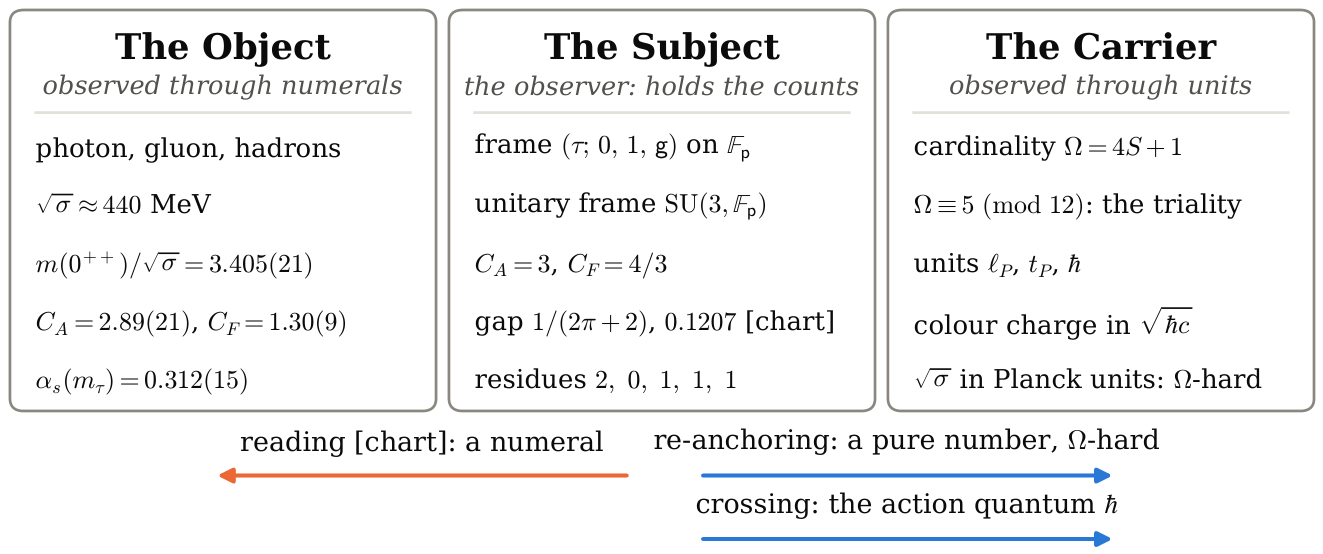
Figure 4.
The frame’s window and its first departure (Theorem 9). A bar spans the degrees at which the pairing-and-determinant tensors are known to span the frame’s invariants: proved through on the Subjects 13, 173 and 1549, and found by enumeration through 4 on and through 8 on , where the stroke at 5 marks the window of part (i). The orange stroke is the degree of the tensor . On and it coincides with the first departure , drawn as a point. On the Subjects lies in the grey bracket.
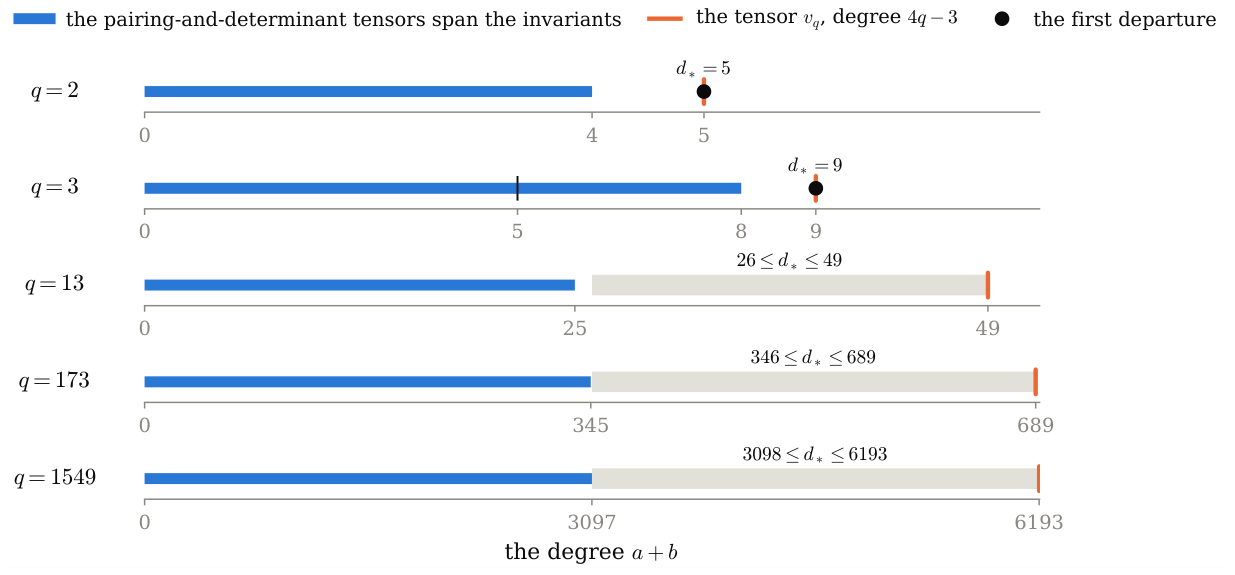
Figure 5.
The three chart routes against the lattice [chart]. The grey band spans the three lattice determinations of with their errors [import]. The ticks of the operator family are labelled by , those of the short-range term by the cutoff , and those of the plaquette channel by the chart’s cell n. At the three ticks are the orders 3, 5 and 7 of the series. No tick of the family lies within the error of a determination, the tick at is the cutoff’s choice, and the plaquette channel reaches the band only where its orders disagree.
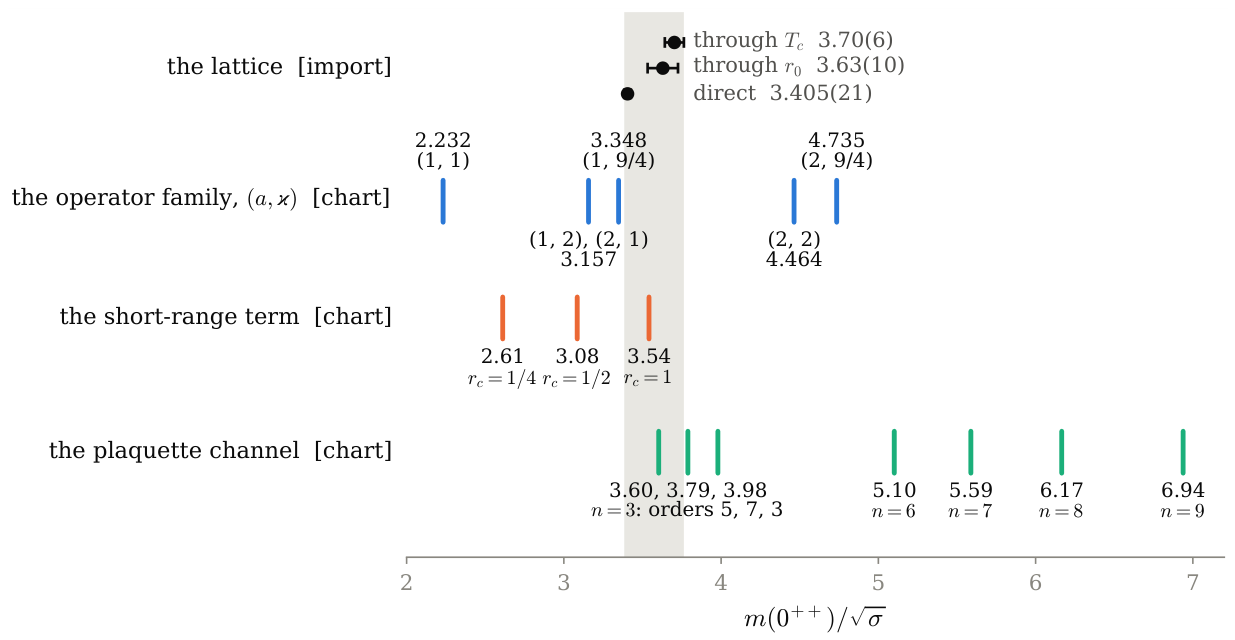
Figure 6.
The confrontations of the first three predictions. A line is the prediction, and a point is the measurement with its error [import]. (a) The colour factors against LEP (Proposition 20). (b) The coupling at [chart], at one loop and with the imported two-loop term (Proposition 21). (c) The radial ratio of the wrap operator [chart] against the lattice of 1999 and of 2020 (Proposition 22). The determination of 2020 excludes it.
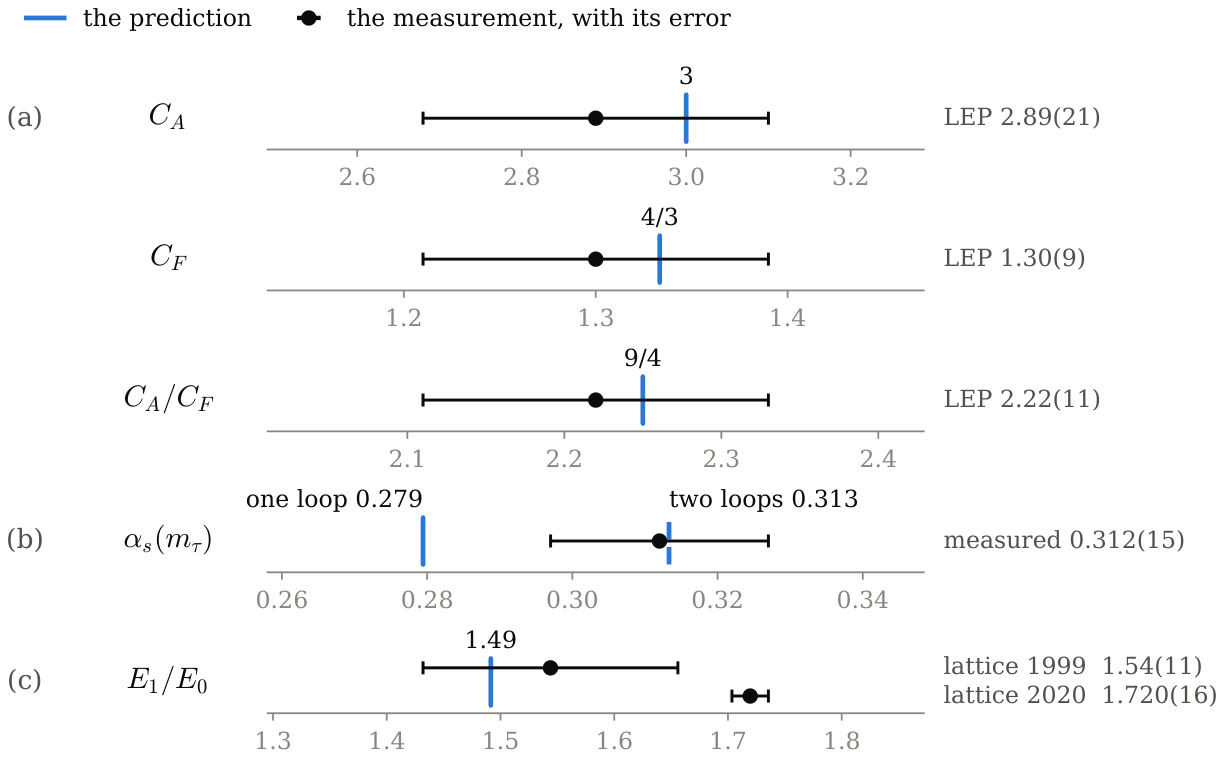
Table 3.
The tally with the same boundary link at every step on the Subject 13, for and (Proposition 10). The lengths 3, 6, 9 and 12 are not regular, and there the residue differs from the expression (3.8).
Table 3.
The tally with the same boundary link at every step on the Subject 13, for and (Proposition 10). The lengths 3, 6, 9 and 12 are not regular, and there the residue differs from the expression (3.8).
| Length n | 1 | 2 | 3 | 4 | 5 | 6 | 7 | 8 | 9 | 10 | 11 | 12 |
|---|---|---|---|---|---|---|---|---|---|---|---|---|
| Residue of the tally | 10 | 0 | 0 | 2 | 5 | 12 | 5 | 2 | 0 | 0 | 10 | 3 |
| Expression (12) | 10 | 0 | 1 | 2 | 5 | 10 | 5 | 2 | 1 | 0 | 10 | 5 |
| Residue of the paired weight | 9 | 0 | 0 | 4 | 12 | 1 | 12 | 4 | 0 | 0 | 9 | 9 |
Table 4.
The three chart routes to and the reason each fails [chart].
| route | what it yields | why it fails | row |
| the operator family | : , , , , | none lies within the error of a determination; the radial ratio is excluded by the lattice’s [import] | ledger:C12, ledger:P3 |
| the short-range term | fixed points , , at , , | the coupling lies above the bound of the singular operator, so the cutoff cannot be removed and the number is the cutoff’s | ledger:C10 |
| the plaquette channel | , , , at the cells , 8, 7, 6; , , at in the orders 3, 5, 7 | the orders agree within at the cells to 6 and differ by at , where the bracket is reached; the lattice’s scaling region [import] lies at channel unity, where the orders give , , | ledger:C11 |
Disclaimer/Publisher’s Note: The statements, opinions and data contained in all publications are solely those of the individual author(s) and contributor(s) and not of MDPI and/or the editor(s). MDPI and/or the editor(s) disclaim responsibility for any injury to people or property resulting from any ideas, methods, instructions or products referred to in the content. |
© 2026 by the authors. Licensee MDPI, Basel, Switzerland. This article is an open access article distributed under the terms and conditions of the Creative Commons Attribution (CC BY) license (http://creativecommons.org/licenses/by/4.0/).
Copyright: This open access article is published under a Creative Commons CC BY 4.0 license, which permit the free download, distribution, and reuse, provided that the author and preprint are cited in any reuse.