

Submitted:
12 November 2026
Posted:
16 November 2026
You are already at the latest version
Abstract
Fonio (Digitaria exilis and D. iburua Kippist Stapf), commonly known as white fonio, fundi, or acha, is an ancient C4 cereal crop indigenous to West Africa. Renowned as one of the fastest-maturing cereals globally (60 - 90 days), fonio exhibits extraordinary drought tolerance and an exceptional amino acid profile rich in methionine and cysteine. Transitioning from traditional open-field broadcast systems to controlled environments (screenhouses, greenhouses, and precision growth chambers) enables year-round phenotyping, speed breeding, and disease evaluation.
Keywords:
fonio
; growth chamber studies
; greenhouse management
; experimental protocols
; crop improvement
; seed testing
1. Introduction
Fonio (Digitaria exilis and D. iburua Kippist Stapf), commonly known as white fonio, fundi, or acha, is an ancient C4 cereal crop indigenous to West Africa. Renowned as one of the fastest-maturing cereals globally (60 - 90 days), fonio exhibits extraordinary drought tolerance and an exceptional amino acid profile rich in methionine and cysteine (Cruz and Béavogui, 2016). Transitioning fonio cultivation from traditional open-field broadcast systems to controlled environments (screenhouses, greenhouse, and precision growth chambers) enables year-round phenotyping, speed breeding, and disease evaluation (Adoukonou-Sagbadja et al., 2007). However, indoor success requires overcoming critical physiological constraints: like the extreme seed smallness (1,000 - grain weight approximately 0.44 - 0.60 g), high susceptibility to lodging under excess rainfall and nitrogen (up to 65% loss), and seed shattering (10 - 30% pre- and post-harvest loss) (Vall et al., 2011).
2. Controlled-Environment Facility Specifications
Facility Baseline: Sowing and cultivation require precise microclimate parameters across facility types:
2.1. Screenhouse Requirement
Cover the screenhouse with a high-density 40 - 50 mesh insect netting (0.25 - 0.30 mm aperture) to exclude aphids, thrips, and stem borers (Sesamia calamistis). Deploy 10 - 20% shade cloth only when ambient light intensity exceeds 1,800 µmol/m²/s.
2.2. Greenhouse Requirement
Temperature requirement for Greenhouse ranges from 28 - 34°C Day and 22 - 26°C Night. Maintain 60 - 70% RH during vegetative tillering, reducing to 45 - 55% during panicle emergence. Provide supplemental lighting at 400 - 600 µmol/m²/s Photosynthetic Photon Flux Density (PPFD) with photoperiod reduction from 14h to 11.5 - 12h for flower induction.
2.3. Growth Chamber Requirement
Full-spectrum LED is required in growth chamber with R:FR (Red to Far-Red ratio) ratio of 1.2 - 1.4 delivering 500 µmol/m²/s Photosynthetic Photon Flux Density. Air velocity needs to be set to 0.3 - 0.5 m/s across canopy to enhance stem structural strength (Kozai et al., 2015).

Table 2.1.
Facility Environmental Specifications.
| Facility Type | Target Temp (°C) | Target RH (%) | Target PPFD | Photoperiod | Primary Exclusion Aim |
|---|---|---|---|---|---|
| Screenhouse | Ambient (25 - 36°C) | Ambient (40 - 80%) | Full Sun / 10% Shade | Natural Short-Day | Pests, Birds, Stem Borers |
| Greenhouse | 30°C Day / 24°C Night | 60% Veg / 50% Flower | 400 - 600 µmol/m²/s | 12 - 14 Hours | Multi-Season Phenotyping |
| Growth Chamber | 28°C Day / 24°C Night | 65% Veg / 50% Flower | 500 µmol/m²/s | 11.5 - 12 Hours | Precision Physiology |
3. Substrate Agronomy, Soil Mix Formulations and Container Protocols
Fonio native adaptation to well-drained sandy soils requires lightweight, porous media in pot trials:
3.1. Substrate Physical Characteristics
Bulk density should be around 1.1 - 1.3 g/cm³, air-filled porosity >20%, and the water-holding capacity 35 - 45%. Target soil pH is set at 5.5–6.5 (optimal 6.0), Electrical Conductivity (EC) 0.5 - 1.0 dS/m.
3.2. Standard Research Mix (2:1:1)
For controlled-environment fonio production, the standard research substrate should consist of: 2-parts coarse sand or sandy-loam soil, 1-part milled peat moss or coco coir and 1-part horticultural perlite or vermiculite. This formulation provides an optimal balance between water retention, aeration, drainage, and root-zone stability while maintaining sufficient physical support for rapid root development and tillering (Poorter et al., 2012).
3.3. Container Protocols
3.3.1. Nursery Establishment Phase
Fonio seedlings should initially be established in:
72-cell plug trays
Advantages include:
- Uniform germination
- Efficient space utilization
- Reduced seed wastage
- Easier monitoring of emergence percentage
- Simplified transplant management
Each cell should be filled uniformly with the prepared substrate and lightly compacted to ensure adequate seed-to-substrate contact (Poorter et al., 2012).
3.3.2. Sowing Procedure
- Fill trays with moistened substrate.
- Place seeds at approximately 0.5 - 1.0 cm depth.
- Cover lightly with substrate.
- Mist irrigates immediately after sowing.
- Maintain substrate moisture near field capacity.
- Keep temperature between 28 - 30°C during germination.
3.3.3. Transplanting Phase
Seedlings should be transplanted when:
- Two to four true leaves have developed.
- Roots occupy most of the plug volume.
- Seedlings are approximately 5 - 10 cm tall.
3.3.4. Recommended Containers
1.5-3.0 L round plastic pots.
Table 3.1.
Container Specifications.
| Parameter | Recommendation |
|---|---|
| Volume | 1.5 - 3.0 L |
| Diameter | 15 - 18 cm |
| Depth | 15 - 20 cm |
| Drainage Holes | Minimum 4 - 6 |
| Colour | Black or dark green UV-stabilized |
(Poorter et al., 2012).
These dimensions provide sufficient root volume for complete development from transplanting through seed production while minimizing unnecessary substrate use (Poorter et al., 2012).
3.3.5. Plant Density Management
After transplanting, stands should be thinned to achieve:
40 - 50 plants m⁻² of bench area
This density provides:
- Adequate light penetration
- Improved air circulation
- Reduced disease development
- Sufficient tillering space
- Reliable biomass and yield measurements
Table 3.2.
Plant Density Recommendations.
| Density Level | Expected Outcome |
|---|---|
| <30 plants m⁻² | Underutilizations of research space |
| 40-50 plants m⁻² | Optimal experimental density |
| >60 plants m⁻² | Increased competition and crowding |
3.3.6. Bench Arrangement
For greenhouse or growth-chamber research:
- Maintain 15-20 cm spacing between pots.
- Leave access alleys between benches.
- Rotate pot positions every 7 days.
- Randomize treatment placement to minimize positional effects. (Poorter et al., 2012).
4. Growth-Stage Physiology and Environmental Requirements
4.1. Germination Stage (0-7 DAS)
4.1.1. Physiological Events
- Water uptake (imbibition)
- Embryo activation
- Radicle emergence
- Coleoptile development
Table 4.1.
Germination Stage Environmental Requirements.
| Parameter | Optimal Range |
|---|---|
| Temperature | 28 - 30°C |
| Relative Humidity | 70 - 80% |
| Substrate Moisture | Field capacity |
| Light Requirement | Not critical until emergence |
| Soil pH | 5.5 - 6.5 |
(ISTA, 2024).
4.1.2. Monitoring Parameters
Record daily:
- Emergence %
- Time to emergence
- Germination uniformity
- Seedling vigor index
4.1.3. Critical Risks That Need to Be Checked
- Waterlogging
- Salt accumulation
- Seed-borne pathogens
- Excessive drying
4.2. Seedling Stage (7-21 DAS)
4.2.1. Physiological Events
- Primary root development
- Leaf expansion
- Early photosynthesis establishment
(Kozai et al., 2015).
Table 4.2.
Seedling Stage Environmental Requirements.
| Parameter | Target |
|---|---|
| Temperature | 27 - 30°C |
| RH | 65 - 75% |
| PPFD | 300 - 400 µmol m⁻² s⁻¹ |
| Photoperiod | 12 - 14 h |
4.2.2. Parameters to Be Measured
Weekly:
- Plant height
- Number of leaves
- Chlorophyll content (SPAD)
- Root length
- Biomass accumulation
4.3. Tillering Stage (21-45 DAS)
4.3.1. Physiological Events
- Tiller production
- Root proliferation
- Increased nutrient demand (ISTA, 2024).
Table 4.3.
Tillering Stage Environmental Requirements.
| Parameter | Target |
|---|---|
| Temperature | 25 - 30°C |
| RH | 60 - 70% |
| Soil Moisture | 70 - 80% FC |
4.3.2. Research Measurements
Record:
- Tiller number plant⁻¹
- Stem diameter
- Leaf area
4.4. Booting Stage (45-60 DAS)
4.4.1. Physiological Events
- Panicle initiation
- Reproductive transition (ISTA, 2024).
Table 4.4.
Booting Stage Environmental Requirements.
| Parameter | Target |
|---|---|
| Temperature | 25 - 28°C |
| RH | 55 - 65% |
| Potassium Availability | High |
4.4.2. Key Measurements
- Days to booting
- Stem elongation rate
- Panicle initiation percentage
4.5. Flowering Stage (60-75 DAS)
4.5.1. Physiological Events
- Anthesis
- Pollination
- Fertilization
Table 4.5.
Flowering Stage Environmental Requirements.
| Parameter | Target |
|---|---|
| Temperature | 24 - 28°C |
| RH | 50 - 60% |
| Airflow | Moderate |
Note that high humidity above 85% increases disease risk while heat stress above 35°C can reduce grain set (ISTA, 2024).
4.5.2. Parameters to Be Measured
- Days to 50% flowering
- Flowering duration
- Spikelet fertility
4.6. Grain Filling Stage (75-95 DAS)
4.6.1. Physiological Events
- Carbohydrate translocation
- Grain development
Table 4.6.
Grain Filling Stage Environmental Requirements.
| Parameter | Target |
|---|---|
| Temperature | 24 - 27°C |
| RH | 50 - 60% |
| Water Stress | Avoid |
4.6.2. Measurements
- Thousand grain weight
- Grain filling period
- Above-ground biomass
4.7. Physiological Maturity Stage (95-120 DAS)
4.7.1. Indicators
- Panicle browning
- Grain hardening
- Moisture reduction
(ISTA, 2024).
Table 4.7.
Physiological Maturity Environmental Requirements.
| Parameter | Target |
|---|---|
| RH | <60% |
| Temperature | 24 - 30°C |
4.7.2. Parameters to Be Measured
- Grain moisture (%)
- Harvest index
- Final yield (ISTA, 2024).
5. Standard Operating Procedures (SOPs): Sowing, Fertigation & Anti-Lodging
5.1. Sowing Depth & Pre-Treatment
Use dry-store seeds at 35°C for 14 days or soak in 100 ppm Gibberellic Acid (GA3) solution for 12h to break dormancy. Then disinfect in 1.5% NaOCl for 5 min. Sow 2 - 3 seeds per hill at a shallow depth of 0.5 cm to 1.0 cm (depths >1.5 cm drastically suppress germination emergence). Cover with 1 - 2 mm fine vermiculite.
5.2. Irrigation SOP
Mist gently during germination to avoid displacement. Transition to sub-irrigation or drip fertigation once established (EC 0.8 - 1.2 dS/m). Reduce water supply by 50% during grain filling.
5.3. Low-Nitrogen Anti-Lodging Fertigation
Excess use of nitrogen fertilizer (>60 kg/ha N equivalent) can cause up to 65% lodging loss. Use low-N fertigation (50 ppm N, 1:2:2 N - P - K ratio). Supplement with 1.0 mM soluble potassium silicate (K2SiO3) to reinforce culm wall rigidity and prevent lodging (Kozai et al., 2015).
Table 5.1.
Growth-Stage Fertigation Schedule.
| Growth Stage | Fertigation EC (dS/m) | N-P-K Ratio | N Concentration | Irrigation Method |
|---|---|---|---|---|
| Emergence (Days 1 - 7) | 0.5 - 0.8 | 1: 1: 1 | 25 ppm N | Fine Surface Misting |
| Tillering (Days 8 - 25) |
1.0 - 1.2 | 1: 2: 2 | 50 ppm N | Bottom Sub-Irrigation / Drip |
| Flowering (Days 26 - 45) |
1.2 - 1.4 | 1: 2: 3 | 45 ppm N | Drip Fertigation (No Canopy Spray) |
| Grain Filling (Days 46 - 70) | 0.8 - 1.0 | 0: 1: 2 | 10 ppm N | Restricted Sub-Irrigation |
6. Experimental Design Protocols
6.1. Completely Randomized Design (CRD)
Suitable when environmental conditions are uniform.
6.1.1. Layout Example
T1 T3 T2 T4
T2 T1 T4 T3
T4 T2 T3 T1
(Gomez & Gomez, 1984).
6.1.2. Replications
Minimum:
- 4 replications
Recommended:
- 5-6 replications
6.2. Randomized Complete Block Design (RCBD)
When greenhouse benches or screenhouse locations differ slightly.
6.2.1. Layout Example
| Block 1 | Block 2 | Block 3 | Block 4 |
| T1 | T4 | T3 | T2 |
| T2 | T1 | T4 | T3 |
| T3 | T2 | T1 | T4 |
| T4 | T3 | T2 | T1 |
6.2.2. Blocking Factors
- Light gradient
- Temperature gradient
- Ventilation differences
6.3. Split-Plot Design
Factorial research involving:
6.3.1. Main Plot
For example,
- Water regime
6.3.2. Subplot
- Genotype
- Pathogen isolate
- Nutrient treatment
Example
Main Plot:
- Factor 1: Well-watered
- Factor 2: Moderate stress
- Factor 3: Severe stress
Subplots:
- Five fonio accessions
Table 6.1.
Replication Recommendations
| Experiment Type | Replications |
|---|---|
| Growth study | 5 |
| Pathogen screening | 5 - 8 |
| Germplasm evaluation | 4 - 6 |
| Factorial studies | ≥4 |
6.4. Pot-Randomization Procedure
6.4.1. Initial Randomization
- Assign unique pot IDs.
- Generate random positions.
- You can map the positions electronically or manually.
6.4.2. Rotational Randomization
Every 7 days:
- Rotate rows
- Rotate columns
- Rotate bench positions
This is to:
- Reduce positional bias.
- Minimize edge effects (Gomez & Gomez, 1984).
7. Crop Monitoring, Pathology & Post-Harvest Containment SOPs
7.1. Phytopathology Evaluation
7.1.1. Objective
To ensure early detection, accurate disease assessment, and consistent monitoring of pest and pathogen pressures throughout the crop cycle while maintaining high-quality experimental data and minimizing confounding effects on growth and yield evaluations (Salihu, 2026).
7.1.2. Disease Monitoring Schedule
Plants should be inspected weekly from emergence until harvest. Under growth chamber and greenhouse conditions, inspections should ideally be conducted on the same day each week to ensure standardized temporal comparisons among treatments (Agrios, 2005).
7.1.3. Inspection Focus Areas
Examine:
- Lower foliage
- Flag leaves
- Leaf sheaths
- Stem bases
- Tillers
- Developing panicles
Observations should be recorded using standardized disease assessment sheets.
7.1.4. Leaf Spot Diseases (Curvularia, Exserohilum spp.)
Typical symptoms include:
- Small brown lesions on leaves
- Necrotic streaks
- Chlorotic halos surrounding lesions
- Coalescing lesions during severe infections (Salihu, 2026).
Monitor particularly during periods of:
- Elevated humidity (>75%)
- Dense canopy formation
- Reduced air circulation
7.1.5. Dry Rot and Wilting Diseases (Colletotrichum, Fusarium, and Epicoccum spp.)
Symptoms include:
- Orange to brown pustules
- Linear lesions along leaf surfaces
- Premature senescence under severe infections
Inspect:
- Upper and lower leaf surfaces
- Leaf sheaths
- Older foliage
(Leslie & Summerell 2006; Salihu, 2026).
7.1.6. Stem Borer Monitoring
Inspect for:
- Dead hearts
- Stem tunnelling
- Frass accumulation
- Tiller collapse
- Reduced panicle formation
Sampling recommendation:
- Randomly inspect 20 plants per treatment.
- Record number of infested plants.
- Calculate infestation percentage (Agrios, 2005).
Disease Severity Assessment
Table 7.1.
Disease Severity Rating Scale.
| Score | Severity Description | Approximate Infection Level |
|---|---|---|
| 1 | No visible symptoms | 0% |
| 2 | Slight infection | 1 - 10% |
| 3 | Moderate infection | 11 - 25% |
| 4 | Severe infection | 26 - 75% |
| 5 | Very severe infection or extensive necrosis | >75% |
7.1.7. Disease Data Collection Parameters
For each experimental unit record:
- Disease incidence (%)
- Disease severity score
- Symptom type
- Date of observation
- Plant growth stage
- Treatment identification (Salihu, 2026).
Where multiple assessments are conducted, calculate:
- Disease progress rate
- Final severity
- Area Under Disease Progress Curve (AUDPC) (Salihu, 2026).
7.2. Inoculum Preparation
Fungal Pathogens
- Isolate pathogen.
- Purify culture.
- Grow on PDA.
- Incubate 5-10 days.
- Flood plates with sterile water.
- Filter through sterile muslin (Agrios, 2005).
7.3. Spore Concentration Calculation
Using a hemocytometer:
(Agrios, 2005).
Table 7.2.
Standard Screening Concentrations.
| Pathogen Type | Concentration |
|---|---|
| Foliar fungi | 10⁵ - 10⁶ spores mL⁻¹ |
| Soil fungi | 10⁴ - 10⁵ propagules g⁻¹ |
| Bacteria | 10⁸ CFU mL⁻¹ |
(Agrios, 2005).
7.4. Humidity Chamber Protocol
Table 7.3.
Post-Inoculation Conditions.
| Parameter | Target |
|---|---|
| RH | 90 - 100% |
| Duration | 24 - 48 h |
| Temperature | 25 - 28°C |
Chamber Construction
- Transparent polyethylene enclosure
- Automated humidifier
- Hygrometer logger (Agrios, 2005).
7.5. AUDPC Calculation
Area Under Disease Progress Curve:
Recommended measurement intervals:
- 7-day intervals
- Minimum 4 assessments
(Madden et al., 2017).
7.6. Statistical Analysis That Might Be Used
Step 1
7.6.1. Assumption Testing
- Shapiro-Wilk Normality Test
- Levene's test
Step 2
7.6.2. Analysis
- ANOVA
- Mixed-effects models
- Repeated measures ANOVA
Step 3
7.6.3. Mean Separation
- Tukey HSD
- Fisher LSD
Step 4
7.6.4. Multivariate Analysis
- Principal Component Analysis (PCA)
- Cluster analysis
- Correlation networks
(Piepho et al., 2003).
7.7. Shattering Containment and Harvesting
7.7.1. Objective
To maximize grain recovery, minimize losses due to natural seed shattering, and preserve harvested seed quality for research, storage, and subsequent planting (Salihu, 2026).
7.7.2. Harvest Timing
Fonio should be harvested:
60-80 days after sowing or when 85-90% of panicles have turned golden brown (Salihu, 2026).
Harvesting before physiological maturity may reduce:
- Seed viability
- Thousand-grain weight
- Germination performance
Harvesting too late can significantly increase shattering losses (Salihu, 2026).
7.7.3. Pre-Harvest Monitoring
Beginning approximately 10 days before expected maturity:
Record:
- Percentage mature panicles
- Grain color
- Grain firmness
- Moisture status
- Shattering intensity
7.7.4. Shattering Containment System
Because fonio naturally exhibits substantial seed shattering, preventive containment measures should be implemented.
7.7.5. Catch Tray Installation
Installation: Fine mesh catches trays beneath all bench arrays
Table 7.4.
Catch Tray Specifications.
| Parameter | Recommendation |
|---|---|
| Mesh size | ≤1 mm |
| Material | UV-stable polypropylene |
| Placement | Directly beneath benches |
| Inspection frequency | Every 2 - 3 days |
(Ellis et al., 1990).
7.7.6. Expected Grain Loss Recovery
Under controlled-environment conditions, catch trays can recover approximately:
10-30% of grain that would otherwise be lost through natural shattering.
Recovered seed should be:
- Collected separately.
- Cleaned with fine sieves.
- Labelled according to treatment and replicate (Ellis et al., 1990).
7.7.7. Harvest Procedure
Step 1
Label all plants before cutting.
Step 2
Record:
- Harvest date
- Treatment
- Replicate
- Phenological Stage
Step 3
Cut panicles using clean scissors or harvest shears.
Step 4
Place harvested material immediately into:
- Paper bags
- Mesh drying bags (Salihu, 2026).
Avoid plastic bags to prevent moisture accumulation.
7.7.8. Drying Protocol
Dry panicles at: 35°C
using:
- Forced-air dryers
- Climate-controlled drying rooms
- Seed-drying cabinets
Continue drying until seed moisture reaches 11% (Ellis et al., 1990).
7.7.9. Moisture Verification
Measure moisture content using:
- Digital grain moisture meter
- Laboratory oven-drying method
Table 7.5.
Storage Moisture Targets.
| Storage Type | Moisture Content |
|---|---|
| Short-term storage | 11 - 12% |
| Long-term storage | 10 - 11% |
(Ellis et al., 1990).
7.7.10. Seed Processing
Following drying:
- 7.
- Thresh panicles manually or mechanically.
- 8.
- Remove inert materials.
- 9.
- Screen using fine sieves.
- 10.
- Determine seed purity.
- 11.
- Determine thousand-grain weight (Ellis et al., 1990).
7.7.11. Seed Storage Protocol
After processing:
Store seed in:
- Airtight containers
- Aluminium foil packets
- Moisture-proof seed envelopes
Table 7.6.
Recommended Seed storage conditions.
| Parameter | Target |
|---|---|
| Temperature | 4 - 10°C |
| Relative Humidity | <40% |
| Moisture Content | 10 - 11% |
(Ellis et al., 1990).
7.7.12. Post-Harvest Biosecurity
For pathology trials:
- Remove infected residues immediately.
- Autoclave contaminated material when required.
- Disinfect benches and tools.
- Prevent pathogen carryover between experiments (Salihu, 2026).
Appendix A. Environmental Monitoring Templates
Table A1.
Daily Temperature Log.
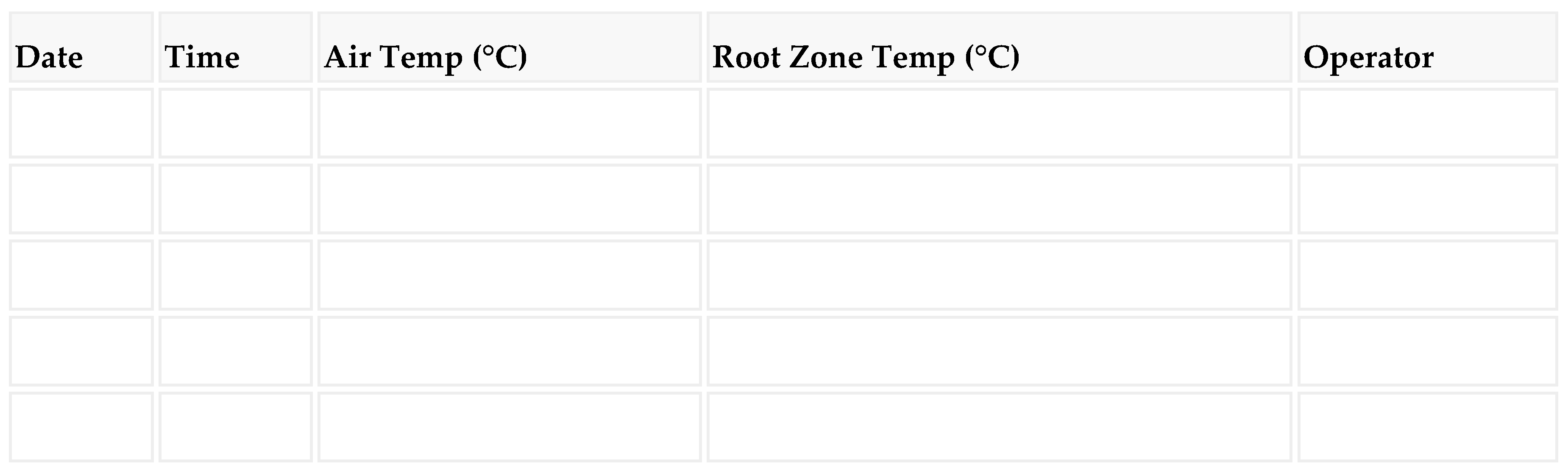
Table A2.
Relative Humidity Log.

Table A3.
Irrigation Monitoring Sheet.
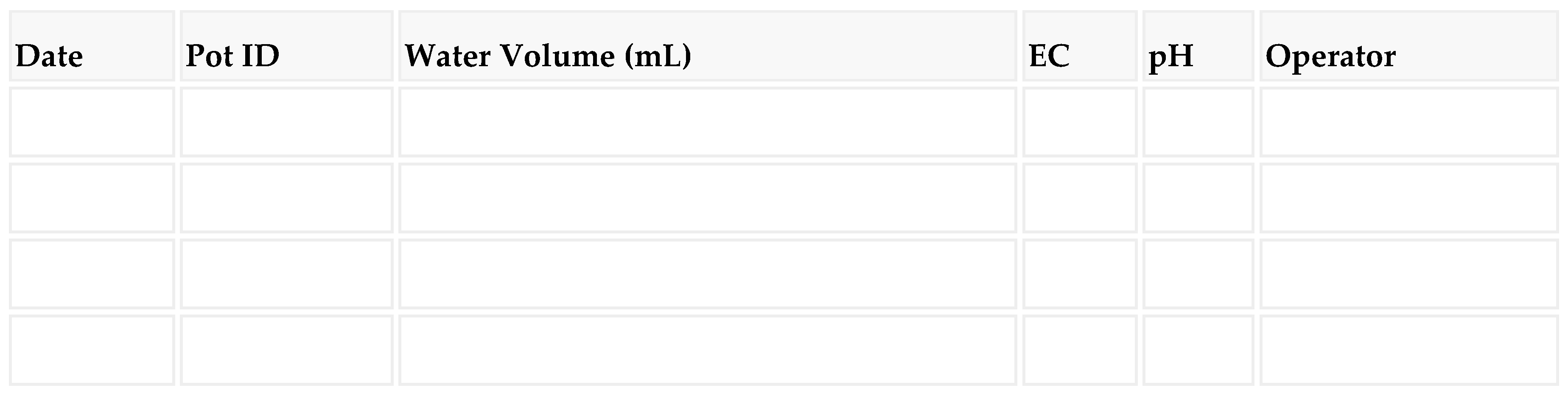
Table A4.
Disease Scoring Sheet.
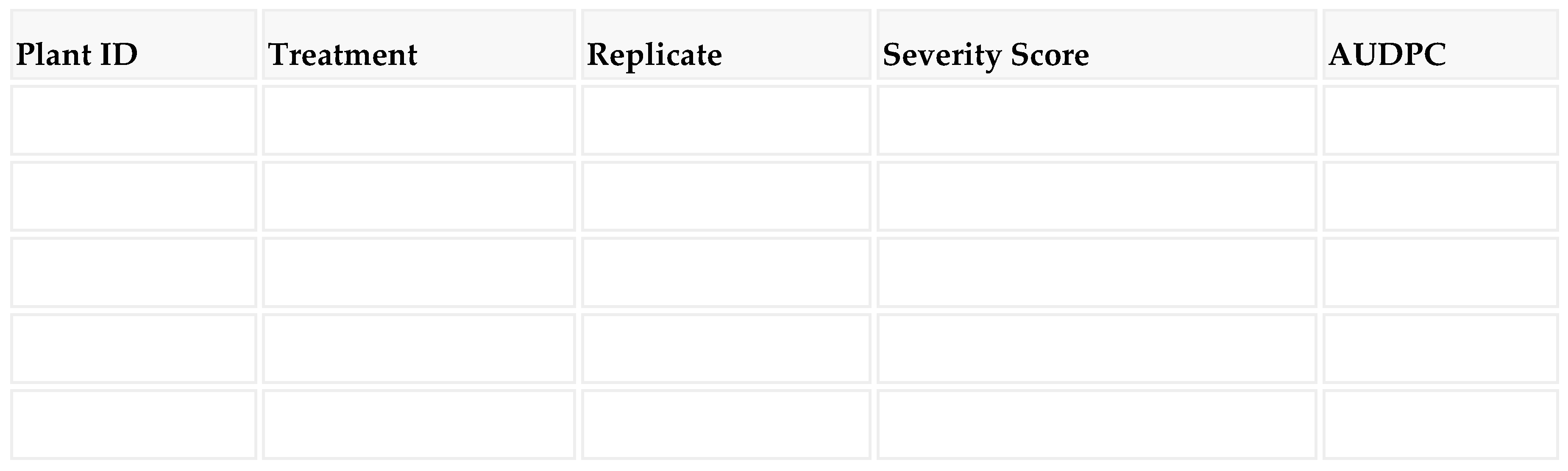
Table A5.
Growth Measurement Sheet.
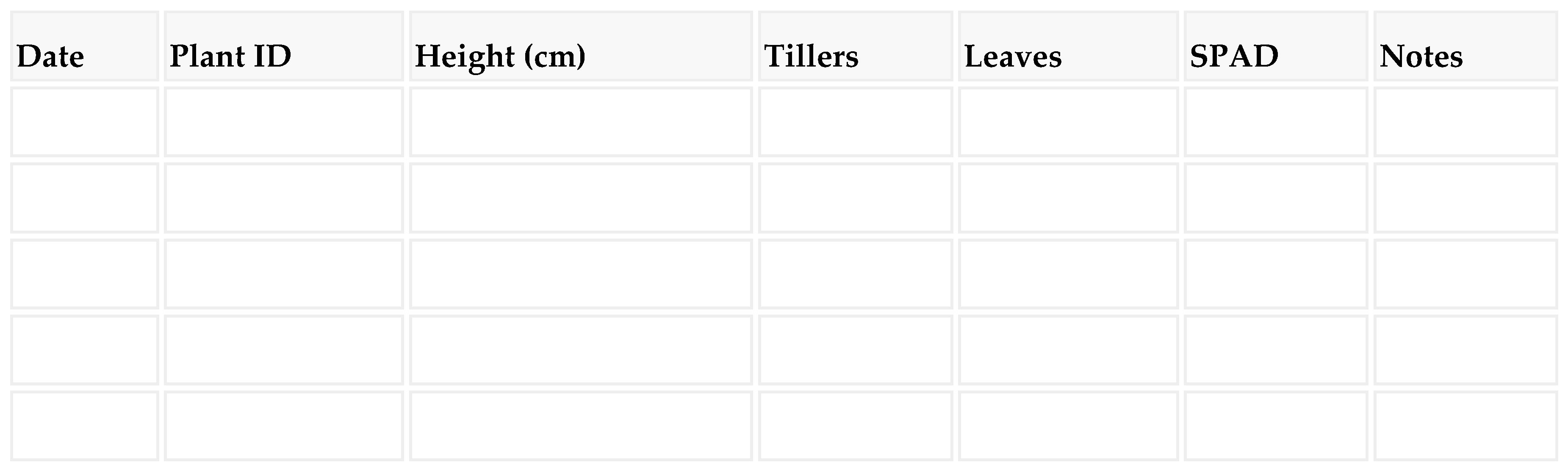
Table A6.
Weekly Environmental Audit.
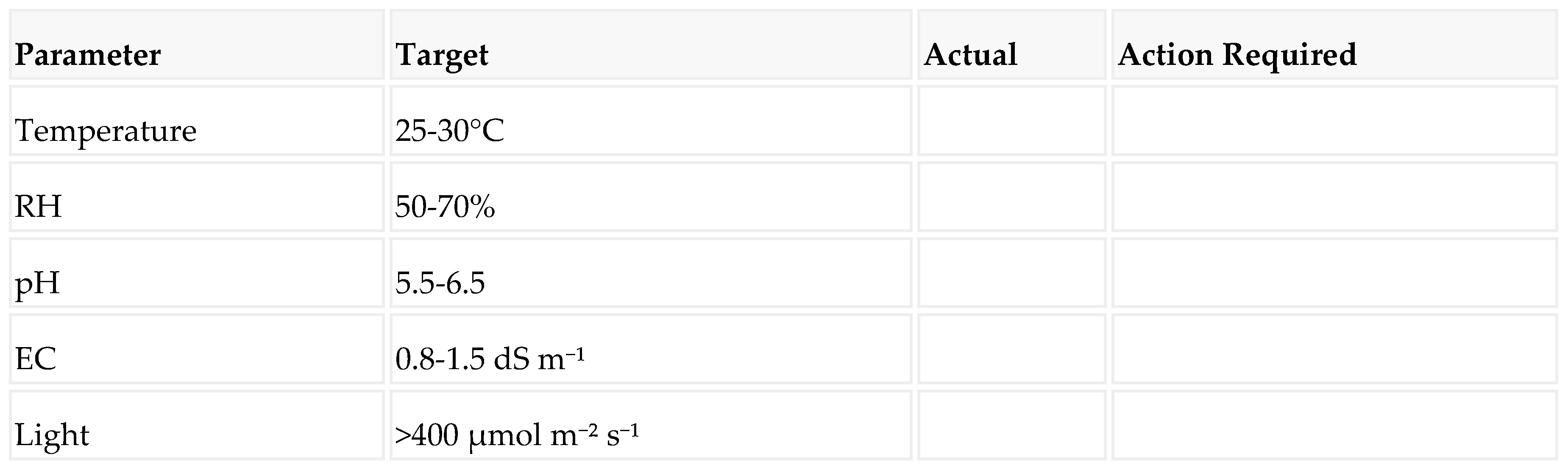
Table A7.
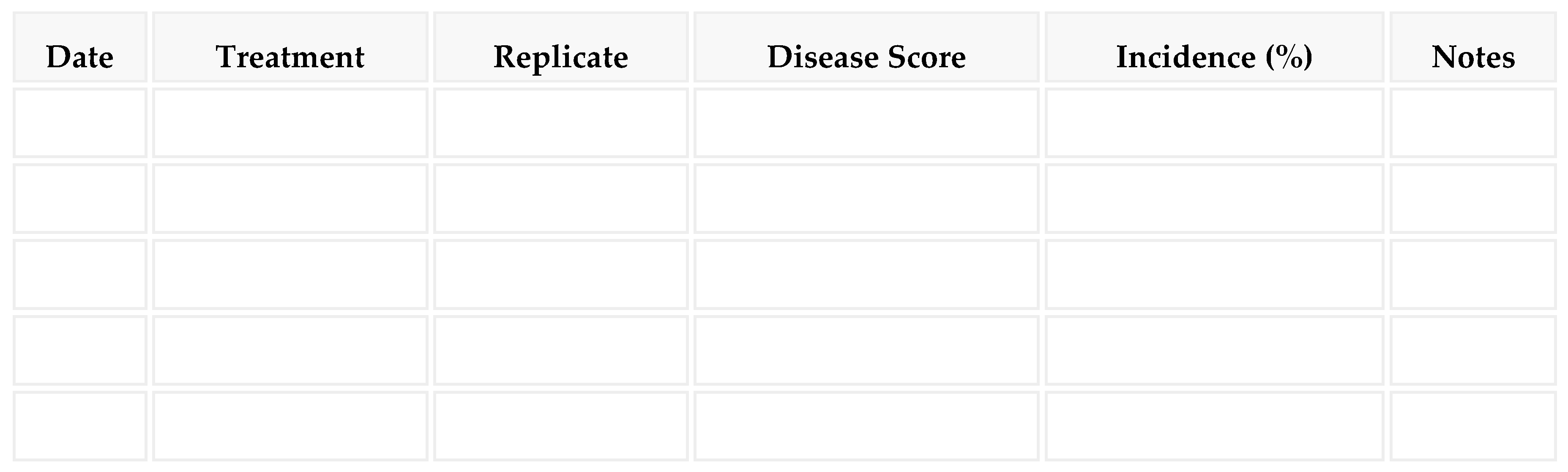
Sample Disease Monitoring Sheet.
References
- Agrios, G. N. (2005). Plant pathology (5th ed.). Elsevier Academic Press.
- Adoukonou-Sagbadja, H., Schubert, V., Dansi, A., Jovtchev, G., Meister, A., Pistrick, K., Akpagana, K., & Friedt, W. (2007). Flow cytometric analysis reveals different nuclear DNA contents in cultivated fonio (Digitaria spp.) and some wild relatives from West Africa. Plant Systematics and Evolution, 267, 163-176. [CrossRef]
- Cruz, J. F., & Béavogui, F. (2016). Fonio: An African cereal. CIRAD. https://www.cirad.fr/en/.
- Ellis, R. H., Hong, T. D., & Roberts, E. H. (1990). An intermediate category of seed storage behaviour? I. Coffee. Journal of Experimental Botany, 41(9), 1167-1174. [CrossRef]
- Gomez, K. A., & Gomez, A. A. (1984). Statistical procedures for agricultural research (2nd ed.). John Wiley & Sons.
- International Seed Testing Association. (2024). International rules for seed testing 2024. International Seed Testing Association. [CrossRef]
- Kozai, T., Niu, G., & Takagaki, M. (Eds.). (2015). Plant factory: An indoor vertical farming system for efficient quality food production. Academic Press.
- Leslie, J. F., & Summerell, B. A. (2006). The Fusarium laboratory manual. Blackwell Publishing. [CrossRef]
- Madden, L. V., Hughes, G., & van den Bosch, F. (2017). The study of plant disease epidemics. APS Press. [CrossRef]
- Piepho, H. P., Büchse, A., & Emrich, K. (2003). A hitchhiker's guide to mixed models for randomized experiments. Journal of Agronomy and Crop Science, 189(5), 310-322. [CrossRef]
- Poorter, H., Bühler, J., van Dusschoten, D., Climent, J., & Postma, J. A. (2012). Pot size matters: A meta-analysis of the effects of rooting volume on plant growth. Functional Plant Biology, 39(11), 839–850. [CrossRef]
- Salihu, S. (2026). Incidence, molecular characterization and management of fungal pathogens associated with foliar diseases of fonio (Digitaria spp.) in selected locations in Nigeria. PhD.
- Thesis. Dept of Crop Protection, Federal University of Agriculture, Abeokuta.
- Vall, E., Andrieu, N., Beavogui, F., & Sogodogo, D. (2011). Contribution of fonio (Digitaria exilis Stapf) to seasonal food security. Cahiers Agricultures, 20(4), 294-300. [CrossRef]
Disclaimer/Publisher’s Note: The statements, opinions and data contained in all publications are solely those of the individual author(s) and contributor(s) and not of MDPI and/or the editor(s). MDPI and/or the editor(s) disclaim responsibility for any injury to people or property resulting from any ideas, methods, instructions or products referred to in the content. |
© 2026 by the authors. Licensee MDPI, Basel, Switzerland. This article is an open access article distributed under the terms and conditions of the Creative Commons Attribution (CC BY) license (http://creativecommons.org/licenses/by/4.0/).
Copyright: This open access article is published under a Creative Commons CC BY 4.0 license, which permit the free download, distribution, and reuse, provided that the author and preprint are cited in any reuse.