

Submitted:
12 November 2026
Posted:
16 November 2026
You are already at the latest version
Abstract
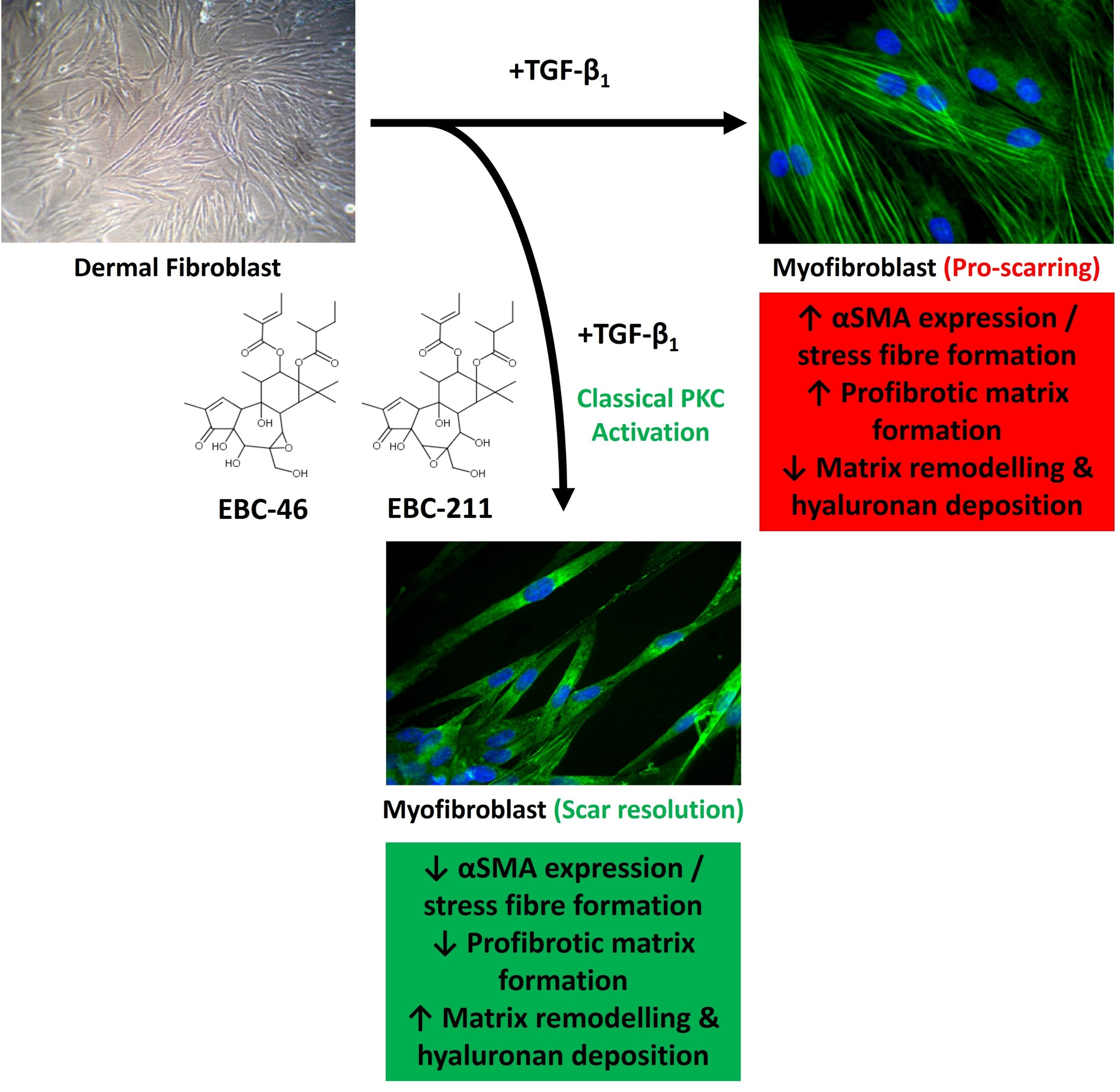
Epoxytiglianes are a novel class of diterpene esters. Prototype epoxytigliane, EBC-46 (tigilanol tiglate), possesses potent anti-cancer properties and is being developed as a human/veterinary tumor treatment. EBC-46 mediates such tumoricidal effects in part via classical protein kinase C (PKC) activation; and consistently promotes desirable wound healing outcomes at treated tumor sites, including minimal scarring. As the mechanisms underlying these anti-scarring responses are poorly understood, we investigated the effects of 1.51 nM-151 µM EBC-46 and analogue (EBC-211) on scarring responses in dermal fibroblasts and myofibroblasts. EBC-46 and EBC-211 significantly inhibited G1/S and S/G2 cell cycle transitions and fibroblast proliferation; with limited effects on migration. Both epoxytiglianes induced concentration-dependent inhibitory effects on transforming growth factor-β1 (TGF-β1)-driven fibroblast-myofibroblast differentiation at 151 nM EBC-46 and 15.1 µM EBC-211, with significantly reduced α-smooth muscle actin (αSMA) gene (ACTA2) expression and stress fiber formation. Epoxytiglianes were shown to modulate myofibroblast gene expression profiles associated with the cytoskeleton, extracellular matrix and proteolytic remodeling, in favor of scar resolution. PKC inhibitors (bisindolylmaleimide-1, GÖ6976) both attenuated epoxytigliane inhibition of myofibroblast formation. By identifying how epoxytiglianes induce minimal scarring outcomes in treated skin, we highlight the potential of epoxytiglianes as novel therapeutics for clinical situations associated with excessive dermal scarring.
Keywords:
fibroblast
; myofibroblast
; scarring
; fibrosis
; epoxytigliane
; protein kinase C
Copyright: This open access article is published under a Creative Commons CC BY 4.0 license, which permit the free download, distribution, and reuse, provided that the author and preprint are cited in any reuse.