

Submitted:
12 November 2026
Posted:
13 November 2026
You are already at the latest version
Abstract
The optimal integration of systemic therapy and comprehensive local treatment in non-oncogene-addicted de novo oligometastatic non-small cell lung cancer (NSCLC) remains uncertain. We retrospectively analysed a nationwide cohort of 107 patients with synchronous or metachronous de novo oligometastatic NSCLC treated at a single national referral centre between 2018 and 2022. All oligometastatic lesions received stereotactic body radiotherapy or stereotactic radiosurgery, while the primary tumour was definitively treated where applicable. Median follow-up was 65.2 months, median overall survival (OS) 22.6 months, and median progression-free survival (PFS) 10.1 months. On multivariable analysis, immunotherapy-based systemic treatment was associated with improved PFS versus chemotherapy-based treatment (adjusted hazard ratio [aHR] 0.46, 95% CI 0.22–0.96; p=0.038). Conventional radiotherapy ± chemotherapy to the primary tumour, compared with surgery or SBRT, was associated with worse OS (aHR 2.00, 95% CI 1.22–3.27; p=0.006) and PFS (aHR 1.99, 95% CI 1.23–3.20; p=0.005). Metastatic-lesion BED₁₀ ≥60 Gy was associated with improved PFS (aHR 0.54, 95% CI 0.34–0.84; p=0.006). These findings support further investigation of integrated systemic and comprehensive local treatment strategies in this population.
Keywords:
non-small cell lung cancer
; oligometastases
; stereotactic body radiotherapy
; immunotherapy
; local therapy
; survival
1. Introduction
Lung cancer remains one of the leading causes of cancer-related mortality worldwide. Approximately 50% of patients present with metastatic disease at the time of diagnosis, with a substantial proportion exhibiting an oligometastatic disease state [1,2]. In 1995, Hellman and Weichselbaum first introduced the concept of oligometastatic disease as a distinct clinical state, situated between localized and widely disseminated metastatic cancer, hypothesizing that this intermediate state may confer a more favourable prognosis when treated with curative or radical local approaches [3].
However, oligometastatic NSCLC is increasingly recognized as a heterogeneous clinical condition rather than a single disease entity. Contemporary classifications distinguish de novo synchronous and metachronous OMD from oligopersistent, oligoprogressive and induced limited metastatic states, reflecting differences in disease history, metastatic tempo and prior treatment exposure [4,5]. In addition, the role of local treatment appears to differ according to molecular subtype. In oncogene-driven NSCLC, particularly EGFR-mutated disease, several prospective and randomized studies have reported favourable outcomes with the integration of local therapy and targeted treatment [6,7]. In contrast, the optimal role of comprehensive local treatment remains less clearly defined in non-oncogene-addicted NSCLC treated with contemporary immunotherapy-based systemic therapy [5].
Early prospective experience in patients with synchronous de novo oligometastatic NSCLC treated radically at all known disease sites demonstrated the feasibility of this approach, but survival remained modest, with a median OS of 13.5 months, highlighting the difficulty of identifying patients with truly favourable oligometastatic biology [8]. Subsequently, randomized phase II trials in the pre-immunotherapy era evaluated local consolidative therapy in patients with limited metastatic NSCLC who had not progressed after initial systemic treatment and demonstrated improvements in PFS and, in the Gomez trial, OS [9,10]. These studies established proof of principle for integrating local and systemic therapy, although they predominantly evaluated post-induction selected populations rather than unselected patients presenting with true de novo OMD.
More recent randomized studies conducted predominantly in non-oncogene-addicted populations in the immunotherapy era have produced different results. NRG-LU002 and LONESTAR did not demonstrate a survival benefit from adding local consolidative therapy after induction systemic treatment [11,12]. In contrast to these negative randomized trials, a recent meta-analysis in driver-negative oligometastatic NSCLC found that the addition of local consolidative therapy to systemic treatment was associated with improved OS and PFS, with the benefit persisting in studies incorporating immunotherapy-based regimens [13]. This further illustrates the heterogeneity of the available evidence and suggests that differences in patient selection, disease state and treatment strategy may substantially influence outcomes. Patients presenting with de novo oligometastatic disease are not necessarily equivalent to those in whom limited metastatic disease is observed only after systemic therapy, as post-induction populations have already undergone biological selection through treatment. At present, no validated biomarker or clinical tool reliably identifies patients with truly limited metastatic biology. Recent randomized data suggest that local treatment can improve disease control in selected patients, but the extent and durability of benefit may vary across populations and treatment strategies [14]. Real-world data may therefore provide complementary information on patient selection, treatment patterns and outcomes in routine clinical practice.
Most previous studies have examined whether local consolidative therapy should be added to systemic treatment. In our cohort, comprehensive local treatment of all known disease sites was already part of the treatment strategy. We therefore focused on treatment-related factors associated with outcome, with particular emphasis on the role of contemporary systemic therapy in patients with non-oncogene-addicted de novo oligometastatic NSCLC.
2. Materials and Methods
Study Design and Participants
This single-centre retrospective cohort study included patients with non-oncogene-addicted NSCLC and de novo oligometastatic disease treated at the Institute of Oncology Ljubljana between January 2018 and December 2022. Although conducted at a single centre, the study represents a nationwide cohort, as stereotactic radiotherapy for oligometastatic NSCLC was centralized. Both synchronous and metachronous presentations were included. Oligometastatic disease was defined as a maximum of five metastases involving no more than three organs, in accordance with the ESTRO-EORTC classification [4].
Patients with synchronous oligometastatic disease were required to receive definitive local treatment to the primary tumour, consisting of surgery, chemoradiotherapy, conventional radical radiotherapy, or SBRT. Patients with metachronous oligometastatic disease were required to have a controlled primary tumour or locoregional recurrence treated with definitive local therapy. Regional nodal involvement was not considered a metastatic site. All oligometastatic lesions were treated with SBRT or SRS; surgical resection before SRS was allowed for brain metastases. SBRT/SRS was delivered in 1–8 fractions. Systemic therapy was not mandatory and consisted of chemotherapy, chemo-immunotherapy, or immunotherapy alone. Treatment-related adverse events were graded according to the Common Terminology Criteria for Adverse Events (CTCAE) v5.0 [15]. Patients were identified through the institutional database. Demographic, clinical, tumour, staging, treatment, toxicity, progression, and survival data were retrospectively extracted from medical records. Vital status was obtained from the national population registry.
Ethics
The study was conducted in accordance with the Declaration of Helsinki and was approved by the institutional review board and the ethics committee (ERIDNPVO-0096/2026). The requirement for study-specific informed consent was waived because of the retrospective study design; however, all patients had provided general written consent for the use of their clinical data for research purposes before treatment. All data were analysed in pseudonymised form.
Statistical Analysis
Statistical analyses were performed using IBM SPSS Statistics version 29. Overall survival (OS) and progression-free survival (PFS) were estimated using the Kaplan–Meier method and reported with 95% confidence intervals (CI). For patients with synchronous oligometastatic disease (sOMD), OS and PFS were calculated from the date of primary diagnosis, whereas for patients with metachronous oligometastatic disease (mOMD) they were calculated from the date of diagnosis of metastatic disease. Patients without an event were censored at the date of last follow-up. Median follow-up was estimated using the reverse Kaplan–Meier method.
Univariable Cox proportional hazards regression analyses were performed for sex, age, ECOG performance status (0–1 vs ≥2), histology (squamous-cell carcinoma vs adenocarcinoma), PD-L1 expression (<50% vs ≥50%), PET/CT staging (yes vs no), oligometastatic disease timing (synchronous vs metachronous), number of metastases (1 vs 2–5), nodal status (N0 vs N+), presence of CNS metastases (yes vs no), metastatic site, systemic therapy (none, chemotherapy-based, and immunotherapy-based), primary-tumour treatment (surgery or SBRT versus conventional radiotherapy ± chemotherapy), and metastatic-lesion BED₁₀ (<60 vs ≥60 Gy). PD-L1 analyses included 101 patients with known PD-L1 status. For multivariable analysis, a clinically selected model was used including sex, ECOG performance status, histology, systemic therapy, primary-tumour treatment, and metastatic-lesion BED₁₀. Hazard ratios (HR) with 95% CI were reported; adjusted hazard ratios (aHR) were reported for multivariable models. A two-sided p value <0.05 was considered statistically significant.
In an exploratory analysis, OS was compared between the chemotherapy-based and immunotherapy-based treatment groups with follow-up administratively censored at 60 months, using the log-rank test and univariable Cox regression.
In an exploratory subgroup analysis, the association between primary-tumour BED₁₀ and survival was evaluated among patients with sOMD who were treated non-surgically for the primary tumour. Primary-tumour BED₁₀ was analysed as a continuous variable and expressed per 10-Gy increase.
Use of Generative Artificial Intelligence
Generative artificial intelligence (ChatGPT, OpenAI) was used during manuscript preparation to assist with language editing and refinement of the text. It was not used for data generation, statistical analysis, or independent interpretation of the study results. All output was critically reviewed and edited by the authors.
3. Results
Patients
In total, 107 patients with de novo oligometastatic NSCLC were identified, of whom 53 had sOMD and 54 mOMD. Sixty-five patients (61%) had a single metastasis, while 42 (39%) had 2-5 metastases. Metastatic involvement was limited to a single organ in 91% of patients. Adenocarcinoma was the predominant histology, accounting for 72 cases (67%). Baseline patient and disease characteristics are summarized in Table 1.
Treatment
Systemic therapy was administered to 46 patients (43%); 29 received chemotherapy alone and 17 received an immunotherapy-based regimen. For analysis of primary-tumour treatment, 66 patients (62%) were classified as having undergone surgery or SBRT and 41 (38%) as having received conventional radiotherapy ± chemotherapy. All oligometastatic lesions were treated with SBRT/SRS. The median BED10 delivered to metastatic lesions was 59.5 Gy (range, 37.5–151.2 Gy), with 46 patients (43%) receiving BED10 ≥60 Gy. Treatment characteristics are summarized in Table 2.
Toxicity
Grade ≥3 treatment-related adverse events occurred in 16 patients (15.0%). The most common were cerebral radionecrosis after SRS in 7 patients and pneumonitis in 3 patients, followed by haematological and oesophageal toxicity in 2 patients each. Other severe events included urosepsis, hydrocephalus requiring ventriculoperitoneal drainage, pericarditis with impending cardiac tamponade, and a pathological L2 fracture requiring surgical stabilisation.
Survival Outcomes
At a median follow-up of 65.2 months (95% CI, 55.6–74.8), 84 patients had died and 97 had experienced disease progression or death. Median OS was 22.6 months (95% CI, 15.8–29.3), and median PFS was 10.1 months (95% CI, 8.0–12.1). Kaplan–Meier curves for OS and PFS are shown in Figure 1.
In univariable analyses, conventional radiotherapy ± chemotherapy to the primary tumour was associated with worse OS (HR 2.06, 95% CI 1.33–3.19; p=0.001) and PFS (HR 2.00, 95% CI 1.29–3.08; p=0.002). Adenocarcinoma was associated with better OS than squamous-cell carcinoma (HR 0.63, 95% CI 0.40–0.99; p=0.047). Immunotherapy-based systemic treatment was associated with improved PFS compared with chemotherapy-based treatment (HR 0.45, 95% CI 0.22–0.89; p=0.021), and metastatic-lesion BED₁₀ ≥60 Gy was associated with improved PFS (HR 0.66, 95% CI 0.43–0.99; p=0.045). Full univariable analyses are provided in Supplementary Table S1.
On multivariable analysis, conventional radiotherapy ± chemotherapy to the primary tumour, compared with surgery or SBRT, was independently associated with worse OS (adjusted HR 2.00, 95% CI 1.22–3.27; p=0.006; Figure 2A). For PFS, conventional radiotherapy ± chemotherapy was likewise associated with worse outcome (adjusted HR 1.99, 95% CI 1.23–3.20; p=0.005; Figure 2B), whereas immunotherapy-based systemic treatment was independently associated with improved PFS compared with chemotherapy-based treatment (adjusted HR 0.46, 95% CI 0.22–0.96; p=0.038). Median PFS was 21.6 months (95% CI 8.8–34.3) in patients receiving immunotherapy-based treatment, compared with 11.1 months (95% CI 6.7–15.5) with chemotherapy-based treatment and 9.0 months (95% CI 8.1–9.9) without systemic therapy (Figure 3). Metastatic-lesion BED₁₀ ≥60 Gy was also independently associated with improved PFS (adjusted HR 0.54, 95% CI 0.34–0.84; p=0.006). Multivariable Cox regression results are shown in Table 3.
In an exploratory analysis with follow-up administratively censored at 60 months, estimated 5-year OS was 47.1% with immunotherapy-based treatment and 20.7% with chemotherapy-based treatment (log-rank p=0.042). Immunotherapy-based treatment was associated with a lower hazard of death within 60 months compared with chemotherapy-based treatment (HR 0.45, 95% CI 0.21–0.99; p=0.047).
In an exploratory subgroup analysis restricted to 33 patients with synchronous oligometastatic disease who were treated non-surgically for the primary tumour, the median primary-tumour BED10 was 72.0 Gy (range, 61.6–108.0 Gy). Higher primary-tumour BED was not significantly associated with OS (HR per 10-Gy increase 0.85, 95% CI 0.56–1.29; p=0.444) or PFS (HR 0.72, 95% CI 0.48–1.07; p=0.107), although a numerical trend toward improved PFS was observed.
4. Discussion
In this nationwide real-world cohort of patients with non-oncogene-addicted de novo oligometastatic NSCLC treated with comprehensive local therapy, immunotherapy-based systemic treatment was independently associated with improved progression-free survival. In addition, treatment of the primary tumour with conventional radiotherapy ± chemotherapy, compared with surgery or SBRT, was associated with worse OS and PFS, while a metastatic-lesion BED₁₀ ≥60 Gy was independently associated with improved PFS. Together, these findings suggest that outcomes in oligometastatic NSCLC may depend not only on the use of local therapy itself, but also on its completeness and biological intensity, as well as on integration with contemporary systemic treatment.
The magnitude of the PFS difference according to systemic treatment was clinically relevant. Median PFS was 21.6 months in patients receiving immunotherapy-based treatment, compared with 11.1 months with chemotherapy-based treatment and 9.0 months in patients who received no systemic therapy. In adjusted analysis, immunotherapy-based treatment remained associated with significantly improved PFS compared with chemotherapy-based treatment. In contrast, no statistically significant OS difference was observed between these two groups (aHR 0.68, 95% CI 0.32–1.47). This should be read in light of the long follow-up in our cohort (median 65.2 months). In an exploratory analysis with follow-up censored at 60 months, 5-year OS was 47.1% with immunotherapy-based treatment and 20.7% with chemotherapy-based treatment, and immunotherapy-based treatment was associated with a lower hazard of death (HR 0.45, 95% CI 0.21–0.99). This suggests that the separation in survival between the two treatment groups was more pronounced during the first five years and attenuated with longer follow-up. However, this post hoc analysis was exploratory, unadjusted, and based on a small subgroup, and should therefore be considered hypothesis-generating.
The outcome of our cohort is consistent with contemporary reports on patients with true oligometastatic NSCLC treated with immunotherapy and local ablative therapy (LAT). Bauml et al. reported a median PFS of 19.1 months after LAT to all known disease sites followed by pembrolizumab [16], while Jongbloed et al. observed a median PFS of 19.0 months in patients with synchronous oligometastatic NSCLC treated with (chemo)-immunotherapy who subsequently underwent local radical treatment [17]. The PFS observed in our cohort is therefore comparable with these contemporary series. Importantly, whereas the study by Bauml et al. was single-arm and relied on historical controls, our cohort included contemporaneous patients treated with different systemic strategies, allowing an internal comparison within a uniformly locally treated population.
The complementary role of systemic immunotherapy and local treatment is further supported by the recent meta-analysis by Han et al., in which the survival benefit associated with local consolidative therapy persisted in studies incorporating immunotherapy-based regimens [13]. The effect on overall survival was numerically greater in immunotherapy-treated populations. More recently, a meta-analysis by Xu et al., which included only randomized trials comparing systemic therapy alone with systemic therapy plus LAT in NSCLC patients with different oligometastatic states, found no PFS or OS benefit from LAT in the overall subgroup of patients receiving immunotherapy-based treatment. A significant PFS benefit was observed only in patients with PD-L1 expression ≥1%, whereas no significant benefit was seen in PD-L1-negative patients [14].
Recent randomized trials evaluating local consolidative therapy (LCT) in non-oncogene-addicted NSCLC in the immunotherapy era have not demonstrated a consistent overall survival benefit. NRG-LU002 and LONESTAR did not demonstrate a significant improvement in survival with the addition of LCT [11,12]. However, these trials differed substantially from our study in both the disease state evaluated and the local treatment strategy. Patients were selected after systemic therapy and represented heterogeneous limited metastatic states, rather than a homogeneous population presenting with de novo oligometastatic disease. Moreover, comprehensive treatment of all macroscopic disease was not consistently required. In NRG-LU002, non-ablative hypofractionated radiotherapy of 45 Gy in 15 fractions was permitted for thoracic disease [18], whereas LONESTAR required local treatment to at least one disease site rather than eradication of all known disease.
More recently, the randomized phase II SARON trial in patients with synchronous non-oncogene-addicted oligometastatic NSCLC showed that the addition of radical radiotherapy to first-line systemic treatment significantly prolonged PFS (13.9 vs 8.9 months; HR 0.64) and markedly reduced local failure but did not improve OS (31.0 vs 28.0 months; HR 0.99) [19]. These findings highlight an important limitation of PFS as the sole endpoint for evaluating LCT. Local treatment can improve control of treated lesions and thereby delay progression, but this effect may not translate into longer survival if occult systemic disease remains the dominant determinant of outcome. The key challenge may therefore no longer be simply to establish whether local therapy can improve PFS, but to identify patients in whom an oligometastatic presentation reflects genuinely limited metastatic biology and in whom comprehensive local treatment can meaningfully alter the natural history of the disease. These patients need to be distinguished from those with more disseminated tumour biology, whose outcome is likely to depend predominantly on effective systemic therapy.
A second important finding of our study was the association between the modality of definitive treatment of the primary tumour and survival. Patients treated with conventional radiotherapy ± chemotherapy had worse OS and PFS than those treated with surgery or SBRT. This finding should not be interpreted as evidence of an intrinsic superiority of surgery or SBRT, as treatment selection is closely related to resectability, tumour burden, nodal involvement, performance status, and other prognostic factors. Rather, it suggests that the characteristics of local treatment and the ability to achieve effective definitive control of the primary tumour may be relevant within a comprehensive oligometastatic treatment strategy.
This concept is consistent with the ASTRO/ESTRO guideline, which defines definitive local therapy in oligometastatic NSCLC as comprehensive treatment of all known disease, including the primary tumour, regional nodal disease, and metastatic sites, with definitive intent [20]. The importance of treatment completeness is also supported by the recent meta-analysis by Han et al., in which treatment of all known lesions was generally associated with more favourable outcomes than partial local treatment [13]. These data support the view that, in true oligometastatic disease, the relevant question may not be simply whether local treatment is delivered, but whether all macroscopic disease is treated comprehensively and with sufficient oncological intensity.
The importance of definitive treatment of the primary tumour has also been suggested in earlier oligometastatic NSCLC literature. In a systematic review and meta-analysis of 21 studies with total of 924 patients with synchronous oligometastatic NSCLC included, Petrelli et al. found that radical thoracic radiotherapy to the primary tumour was associated with improved OS and PFS compared with no thoracic radiotherapy [21]. More specifically, Farooqi et al. demonstrated a dose–response relationship for treatment of the primary tumour, with BED₁₀ ≥75 Gy associated with improved local control, PFS and OS; BED remained independently associated with both PFS and OS in multivariable analysis [22]. Although these data largely predate the immunotherapy era and are subject to substantial selection bias, more recent evidence also supports the importance of effective control of known disease sites. In the multicentre cohort reported by Duan et al., no progression was observed in stereotactically treated lung or brain lesions, while the addition of consolidative radiotherapy to immunotherapy significantly reduced progression at initially involved sites. Nearly one-third of patients experienced disease progression through the development of new metastatic lesions at previously uninvolved sites, underscoring the complementary roles of local treatment for macroscopic disease control and systemic therapy for occult disseminated disease [23]. A similar pattern was observed in SARON, where improved local control and PFS did not translate into a reduction in new distant metastases or an OS benefit [19].
Notably, the median BED₁₀ in the study by Duan et al. was 64 Gy, which is similar to the median metastatic-lesion BED₁₀ of 59.5 Gy in our cohort. In our study, a BED₁₀ ≥60 Gy was independently associated with improved PFS, suggesting that the biological intensity of local treatment may be clinically relevant in addition to treatment completeness. This observation is consistent with current ASTRO/ESTRO recommendations, which emphasize the use of dose-fractionation schedules capable of achieving durable local control and note that higher BED₁₀ values are generally associated with improved local control [20]. However, our 60-Gy threshold should be interpreted as a cohort-specific prognostic cut-off rather than a universal treatment threshold.
Several features strengthen the relevance of our study to contemporary clinical practice. This nationwide real-world cohort was treated within a centralized stereotactic radiotherapy program, and all patients underwent comprehensive local treatment, with SBRT/SRS to all metastatic lesions and definitive treatment of the primary tumour in synchronous disease. This provides a relatively homogeneous framework for evaluating prognostic factors within a comprehensively treated population. The study period also spans the transition into the immunotherapy era, allowing comparison of systemic treatment strategies within the same local-treatment paradigm.
The main limitations are the retrospective design, inherent selection bias and limited size of the immunotherapy-treated subgroup. Because only patients who ultimately underwent comprehensive local treatment were included, patients progressing before planned local therapy were not captured. This is particularly relevant because patient selection in the immunotherapy era differed from earlier treatment periods, with a greater proportion of patients exposed to systemic therapy before local treatment and therefore subject to a different selection process. Systemic therapy and radiation dose-fractionation were heterogeneous, and the BED₁₀ threshold identified in our cohort should therefore be considered exploratory. Finally, staging was not uniform, as PET/CT was performed in approximately three-quarters of patients, although PET/CT use was not associated with OS.
5. Conclusions
In conclusion, our findings support the integration of effective systemic treatment with comprehensive local control in selected patients with de novo oligometastatic NSCLC. Immunotherapy-based treatment was associated with improved PFS, while primary-tumour treatment modality and higher metastatic-lesion BED₁₀ were also associated with outcome. However, the absence of a corresponding clear OS benefit, together with recent randomized evidence, highlights the importance of improved patient selection. Future research should focus on identifying clinical and molecular biomarkers that distinguish patients with genuinely limited metastatic biology who may derive durable benefit from comprehensive local treatment.
Supplementary Materials
The supporting information can be downloaded at the website of this paper posted on Preprints.org. Supplementary Table S1. Univariable Cox regression analyses for overall and progression-free survival.
Author Contributions
Conceptualization, E.Ć. and J.B.-H.; methodology, E.Ć. and J.B.-H.; formal analysis, E.Ć. and J.B.-H.; investigation, E.Ć., T.A. and J.B.-H.; data curation, E.Ć. and T.A.; writing—original draft preparation, E.Ć.; writing—review and editing, E.Ć. and J.B.-H.; visualization, E.Ć. and J.B.-H.; supervision, J.B.-H.; project administration, E.Ć. All authors have read and agreed to the published version of the manuscript.
Funding
This research received no specific external grant. Support was provided through the Slovenian Cancer Registry programme SLORApro (P3-0429).
Institutional Review Board Statement
The study was conducted in accordance with the Declaration of Helsinki and approved by the institutional review board and ethics committee of the Institute of Oncology Ljubljana (ERIDNPVO-0096/2026).
Informed Consent Statement
The requirement for study-specific informed consent was waived due to the retrospective nature of the study. All patients had provided general written consent for the use of their clinical data for research purposes before treatment.
Data Availability Statement
The data supporting the findings of this study are not publicly available due to patient privacy and ethical restrictions. Anonymized data may be available from the corresponding author upon reasonable request and subject to institutional approval.
Acknowledgments
During the preparation of this manuscript, the authors used ChatGPT (OpenAI) to assist with language editing and refinement of the text. All output was critically reviewed and edited by the authors.
Conflicts of Interest
The authors declare no conflicts of interest.
References
- Román-Jobacho, A.; Hernández-Miguel, M.; García-Anaya, M.J.; Gómez-Millán, J.; Medina-Carmona, J.A.; Otero-Romero, A. Oligometastatic non-small-cell lung cancer. Curr. Manag. J. Clin. Transl. Res. 2021, 7, 311. [Google Scholar] [CrossRef] [PubMed]
- Jairam, V.; Park, H.S.; Decker, R.H. Local Ablative Therapies for Oligometastatic and Oligoprogressive Non-Small Cell Lung Cancer. Cancer J. (United States) 2020, 26, 129–36. [Google Scholar] [CrossRef] [PubMed]
- Hellman, S.; Weichselbaum, R.R. Oligometastases. J. Clin. Oncol. 1995, 13, 8–10. [Google Scholar] [CrossRef] [PubMed]
- Guckenberger, M.; Lievens, Y.; Bouma, A.B.; Collette, L.; Dekker, A.; deSouza, N.M.; et al. Characterisation and classification of oligometastatic disease: a European Society for Radiotherapy and Oncology and European Organisation for Research and Treatment of Cancer consensus recommendation. Lancet Oncol. 2020, 21, e18–28. [Google Scholar] [CrossRef] [PubMed]
- O’Dwyer, N.; Palma, D.A. Treatment of oligometastatic lung cancers: new data, new drivers, new approaches. BMJ Oncol. 2026, 5, e001052. [Google Scholar] [CrossRef] [PubMed]
- Wang, X.-S.; Bai, Y.-F.; Verma, V.; Yu, R.-L.; Tian, W.; Ao, R.; et al. Randomized Trial of First-Line Tyrosine Kinase Inhibitor With or Without Radiotherapy for Synchronous Oligometastatic EGFR -Mutated Non-Small Cell Lung Cancer. JNCI J. Natl. Cancer Inst. 2022. [Google Scholar] [CrossRef] [PubMed]
- Elamin, Y.Y.; Gandhi, S.; Antonoff, M.; Gibbons, D.; Negrao, M.V.; Cascone, T.; et al. LBA72 NorthStar: A phase II randomized study of osimertinib (OSI) with or without local consolidative therapy (LCT) for metastatic EGFR-mutant non-small cell lung cancer (NSCLC). Ann. Oncol. 2025, 36, S1614. [Google Scholar] [CrossRef]
- De Ruysscher, D.; Wanders, R.; Hendriks, L.E.; van Baardwijk, A.; Reymen, B.; Houben, R.; et al. Progression-Free Survival and Overall Survival Beyond 5 Years of NSCLC Patients With Synchronous Oligometastases Treated in a Prospective Phase II Trial (NCT 01282450). J. Thorac. Oncol. 2018, 13, 1958–61. [Google Scholar] [CrossRef] [PubMed]
- Gomez, D.R.; Tang, C.; Zhang, J.; Blumenschein, G.R.; Hernandez, M.; Jack Lee, J.; et al. Local consolidative therapy vs. Maintenance therapy or observation for patients with oligometastatic non–small-cell lung cancer: Long-term results of a multi-institutional, phase II, randomized study. J. Clin. Oncol. 2019, 37, 1558–65. [Google Scholar] [CrossRef] [PubMed]
- Iyengar, P.; Wardak, Z.; Gerber, D.E.; Tumati, V.; Ahn, C.; Hughes, R.S.; et al. Consolidative radiotherapy for limited metastatic non-small-cell lung cancer: A phase 2 randomized clinical trial. In JAMA Oncol.; American Medical Association, 2018; vol. 4. [Google Scholar] [CrossRef] [PubMed]
- Iyengar, P.; Hu, C.; Gomez, D.R.; Timmerman, R.D.; Simone, C.B.; Robinson, C.G.; et al. NRG-LU002: Randomized phase II/III trial of maintenance systemic therapy versus local consolidative therapy (LCT) plus maintenance systemic therapy for limited metastatic non-small cell lung cancer (NSCLC). J. Clin. Oncol. 2024, 42, 8506–8506. [Google Scholar] [CrossRef]
- Altan, M.; Gandhi, S.; Antonoff, M.B.; Vokes, N.; Swisher, S.G.; Tran, H.T.; et al. Clinical Outcomes of the Phase III Lonestar Trial: Local Consolidation Therapy After Nivolumab Plus Ipilimumab in NSCLC. World Conf. Lung Cancer 2026, 2026. [Google Scholar]
- Han, H.; Li, L.; Park, T.; Yang, Y.; Alai, G.; Zhong, C.; et al. Efficacy and safety of local consolidative therapy combined with systemic therapy in driver-negative oligometastatic non-small cell lung cancer: a systematic review and meta-analysis. Front Oncol. 2026, 16, 1820515. [Google Scholar] [CrossRef] [PubMed]
- Xu, Y.; Liang, Y.; Gao, W.; Yang, X.; Qin, F.; Tao, Z.; et al. Local ablative therapy plus systemic treatment versus systemic therapy alone in oligometastatic non–small cell lung cancer: a systematic review and meta-analysis of randomized trials. Int. J. Clin. Oncol. 2026, 1–16. [Google Scholar] [CrossRef] [PubMed]
- Cancer Institute N. Common Terminology Criteria for Adverse Events (CTCAE) Common Terminology Criteria for Adverse Events (CTCAE) v5.0. 2017. [Google Scholar] [CrossRef] [PubMed]
- Bauml, J.M.; Mick, R.; Ciunci, C.; Aggarwal, C.; Davis, C.; Evans, T.; et al. Pembrolizumab After Completion of Locally Ablative Therapy for Oligometastatic Non-Small Cell Lung Cancer: A Phase 2 Trial. JAMA Oncol. 2019, 5, 1283–90. [Google Scholar] [CrossRef] [PubMed]
- Jongbloed, M.; Bartolomeo, V.; Steens, M.; Dursun, S.; van de Lisdonk, T.; De Ruysscher, D.K.M.; et al. Treatment outcome of patients with synchronous oligometastatic non-small cell lung cancer in the immunotherapy era: Analysis of a real-life intention-to-treat population. Eur. J. Cancer 2023, 190, 112947. [Google Scholar] [CrossRef] [PubMed]
- Iyengar, P.; Gomez, D. NRG ONCOLOGY NRG-LU002 (ClinicalTrials.gov NCT #03137771) (18-MAY-2018) MAINTENANCE SYSTEMIC THERAPY VERSUS LOCAL CONSOLIDATIVE THERAPY (LCT) PLUS MAINTENANCE SYSTEMIC THERAPY FOR LIMITED METASTATIC NON-SMALL CELL LUNG CANCER (NSCLC): A RANDOMIZED PHASE II/III TRIAL (18-MAY-2018) Principal Investigator/Radiation Oncology. n.d. [PubMed]
- McDonald, F.; Counsell, N.; Ahmad, S.; Ahmed, M.; Atherton, P.; Bates, A.; et al. Primary results of SARON: A randomised-controlled trial of consolidation radiotherapy for synchronous oligometastatic non-small cell lung cancer, ESMO 2026, abstract 2613O. Ann. Oncol. 2026. [Google Scholar]
- Iyengar, P.; All, S.; Berry, M.F.; Boike, T.P.; Bradfield, L.; Dingemans, A.M.C.; et al. Treatment of Oligometastatic Non-Small Cell Lung Cancer: An ASTRO/ESTRO Clinical Practice Guideline. Pract. Radiat. Oncol. 2023, 13, 393–412. [Google Scholar] [CrossRef] [PubMed]
- Petrelli, F.; Ghidini, A.; Cabiddu, M.; Tomasello, G.; De Stefani, A.; Bruschieri, L.; et al. Addition of radiotherapy to the primary tumour in oligometastatic NSCLC: A systematic review and meta-analysis. Lung Cancer 2018, 126, 194–200. [Google Scholar] [CrossRef] [PubMed]
- Farooqi, A.; Ludmir, E.B.; Mitchell, K.G.; Antonoff, M.B.; Tang, C.; Lee, P.; et al. Increased biologically effective dose (BED) to the primary tumor is associated with improved survival in patients with oligometastatic NSCLC. Radiother. Oncol. 2021, 163, 114–8. [Google Scholar] [CrossRef] [PubMed]
- Duan, J.; Zhu, Y.; Jiang, W.; Wang, W.; Jiang, Y.; Huang, H.; et al. Risk-Based Local Radiation Therapy in Oligometastatic Non-small Cell Lung Cancer in the Era of Immunotherapy: A Multicentric Cohort Study. Int. J. Radiat. Oncol. Biol. Phys. 2026, 124, 296–304. [Google Scholar] [CrossRef] [PubMed]
Figure 1.
Kaplan–Meier estimates of (A) overall survival and (B) progression-free survival in the overall study cohort. Tick marks indicate censored observations. Numbers at risk are shown below each panel.
Figure 1.
Kaplan–Meier estimates of (A) overall survival and (B) progression-free survival in the overall study cohort. Tick marks indicate censored observations. Numbers at risk are shown below each panel.
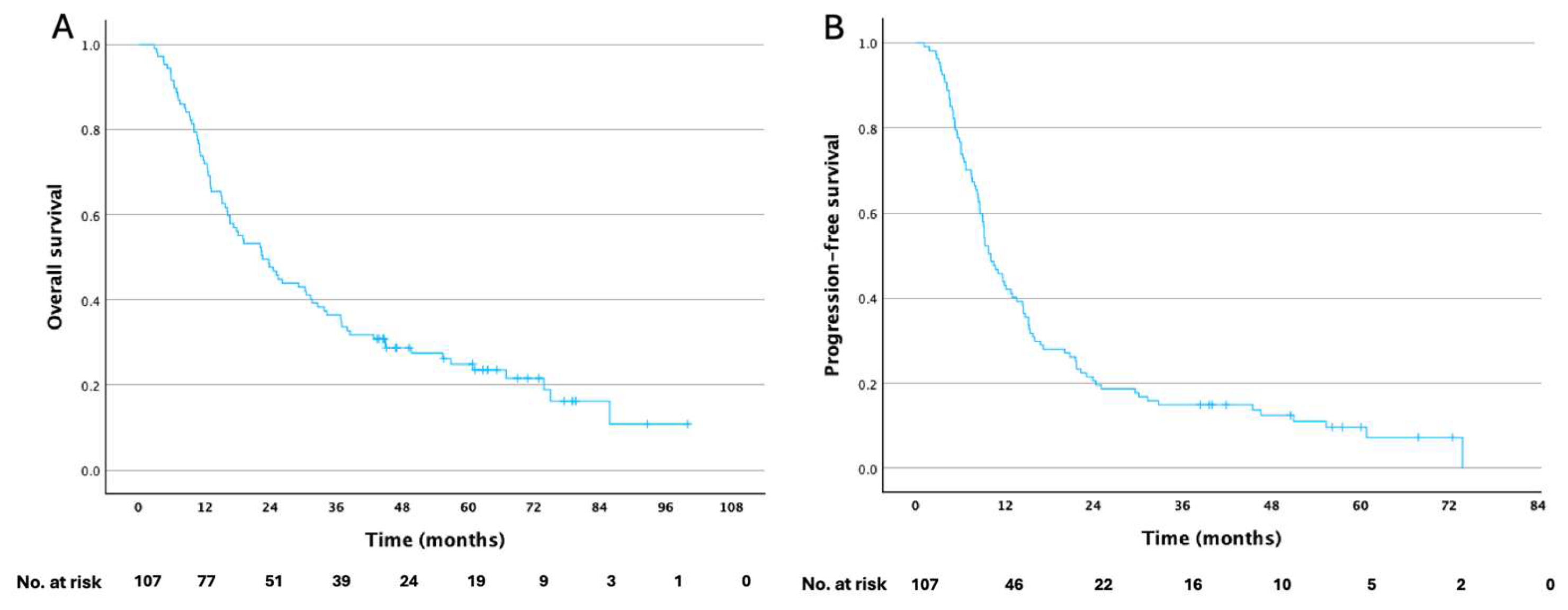
Figure 2.
Kaplan–Meier estimates of (A) overall survival and (B) progression-free survival according to primary-tumour treatment. Patients treated with surgery or SBRT are compared with those receiving conventional radiotherapy ± chemotherapy. Tick marks indicate censored observations. Numbers at risk are shown below each panel.
Figure 2.
Kaplan–Meier estimates of (A) overall survival and (B) progression-free survival according to primary-tumour treatment. Patients treated with surgery or SBRT are compared with those receiving conventional radiotherapy ± chemotherapy. Tick marks indicate censored observations. Numbers at risk are shown below each panel.
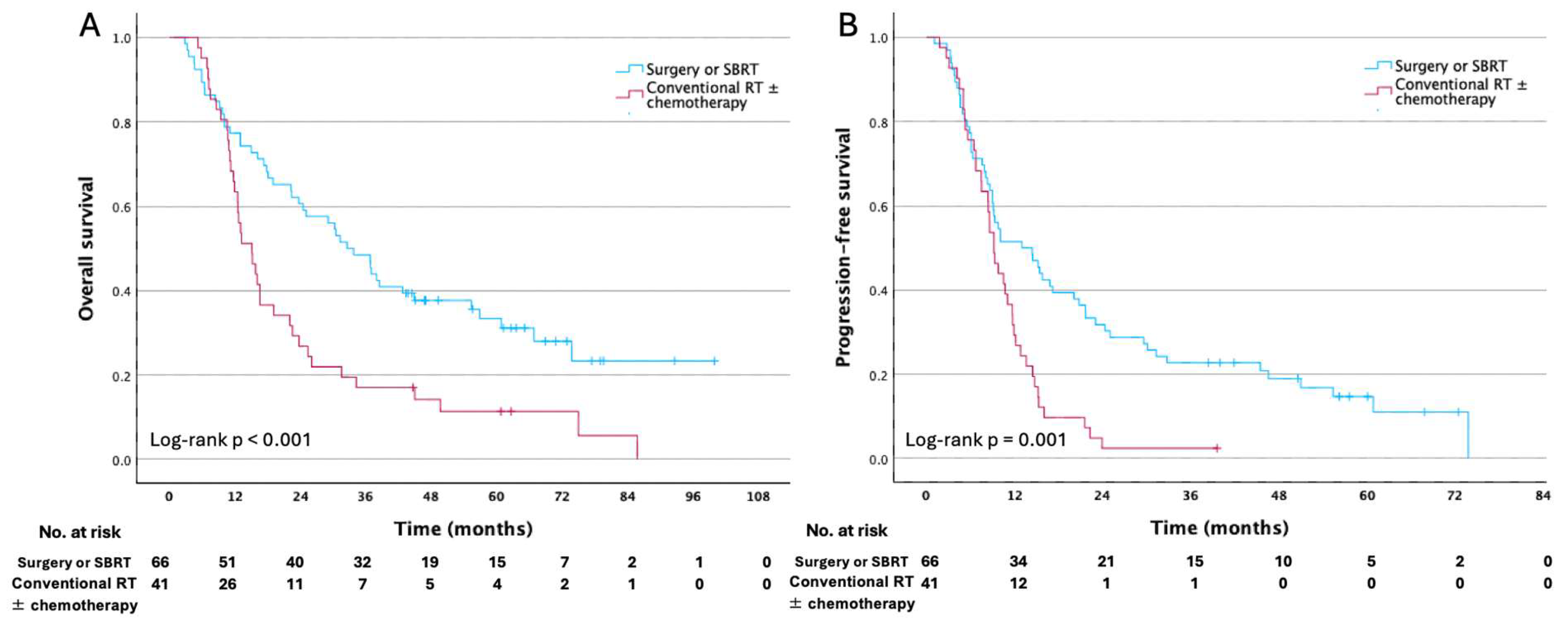
Figure 3.
Kaplan–Meier estimates of (A) overall survival and (B) progression-free survival according to systemic treatment. Patients were grouped as receiving no systemic therapy, chemotherapy-based treatment, or immunotherapy-based treatment. Tick marks indicate censored observations. Numbers at risk are shown below each panel.
Figure 3.
Kaplan–Meier estimates of (A) overall survival and (B) progression-free survival according to systemic treatment. Patients were grouped as receiving no systemic therapy, chemotherapy-based treatment, or immunotherapy-based treatment. Tick marks indicate censored observations. Numbers at risk are shown below each panel.
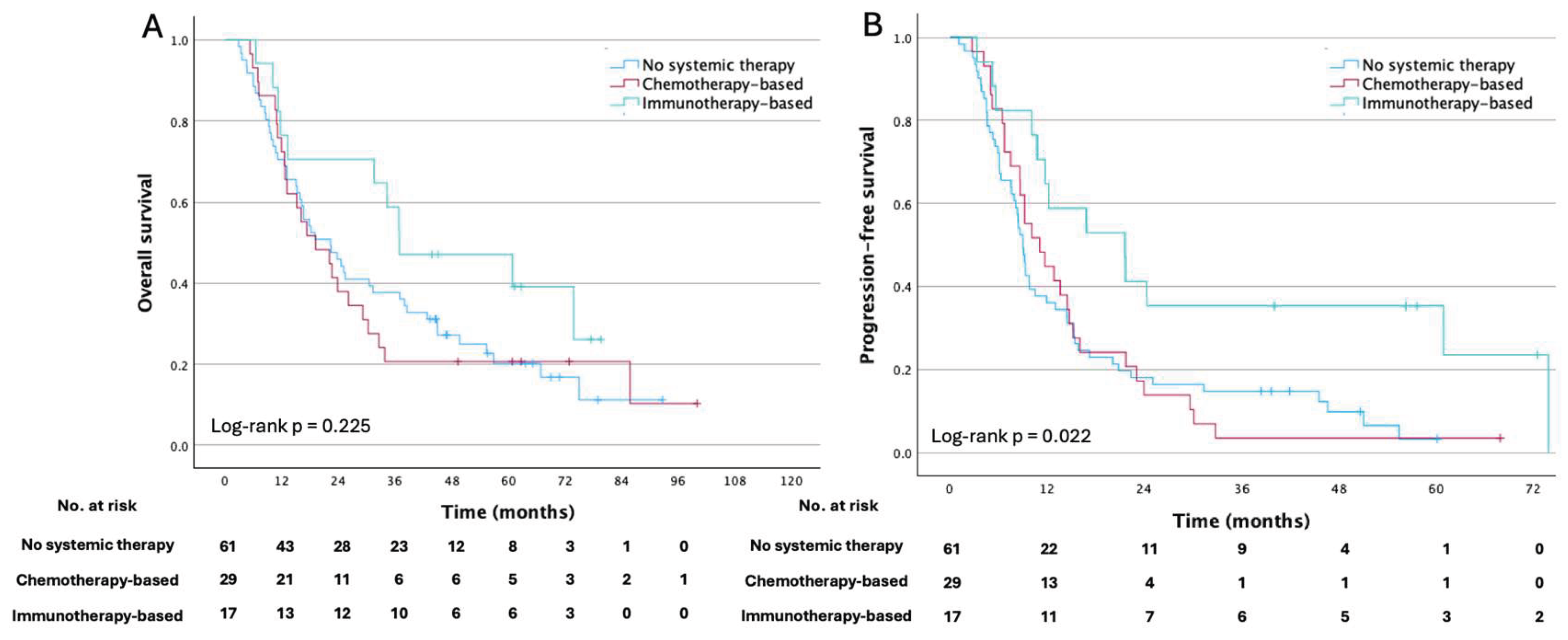

Table 1.
Patient and disease characteristics.
| Characteristic | Category | Patients, n (%) |
| Gender | Male | 68 (64%) |
| Female | 39 (36%) | |
| Age, years | Mean (SD) | 67.1 (6.99) |
| ECOG performance status | 0–1 | 79 (74%) |
| 2–3 | 28 (26%) | |
| Histology | Adenocarcinoma | 72 (67%) |
| Squamous-cell carcinoma | 35 (33%) | |
| PD-L1 expression | <50% | 76 (71%) |
| ≥50% | 25 (23%) | |
| Unknown | 6 (6%) | |
| KRAS | Mutated | 40 (37%) |
| Wild type | 67 (63%) | |
| PET/CT staging | Yes | 80 (75%) |
| No | 27 (25%) | |
| Oligometastatic disease state | Synchronous | 53 (50%) |
| Metachronous | 54 (50%) | |
| Number of metastases | 1 | 65 (61%) |
| 2–5 | 42 (39%) | |
| Metastatic sites* | Brain | 92 (51%) |
| Bone | 33 (18%) | |
| Lung | 33 (18%) | |
| Adrenal gland | 11 (6%) | |
| Non-regional lymph nodes | 4 (2%) | |
| Liver | 3 (2%) | |
| Soft tissue | 2 (1%) | |
| Thyroid gland | 1 (0.5%) |
Abbreviations: ECOG, Eastern Cooperative Oncology Group; PD-L1, programmed death-ligand 1; PET/CT, positron emission tomography/computed tomography; SD, standard deviation. * Metastatic-site data refer to individual metastatic lesions (n=179); patients could contribute more than one lesion.
Table 2.
Treatment characteristics.
| Characteristic | Category | Patients, n (%) |
| Systemic therapy | Yes | 46 (43) |
| No | 61 (57) | |
| Type of systemic therapy* | Chemotherapy only | 29 (63) |
| Chemo-immunotherapy | 13 (28) | |
| Immunotherapy alone | 4 (9) | |
| Treatment of primary tumour | Conventional radiotherapy ± chemotherapy | 41 (38) |
| Surgery or SBRT | 66 (62) | |
| SBRT/SRS of metastatic lesions | 1 fraction | 37 (35) |
| 3 fractions | 12 (11) | |
| 5 fractions | 54 (50) | |
| 8 fractions | 4 (4) | |
| BED10 to metastatic lesions | Median (range), Gy | 59.5 (37.5–151.2) |
| BED10 ≥60 Gy | 46 (43) | |
| BED10 <60 Gy | 61 (57) |
Abbreviations: BED10, biologically effective dose calculated using α/β = 10 Gy; SBRT, stereotactic body radiotherapy; SRS, stereotactic radiosurgery. *Percentages are calculated among the 46 patients who received systemic therapy.
Table 3.
Multivariable Cox regression analyses for overall and progression-free survival.
| Variable | Category | Overall survival | Progression-free survival |
| aHR (95% CI); p | aHR (95% CI); p | ||
| Sex | Male | 1.00 | 1.00 |
| Female | 0.80 (0.49–1.30); 0.361 | 0.79 (0.51–1.22); 0.286 | |
| ECOG PS | 0–1 | 1.00 | 1.00 |
| ≥2 | 1.27 (0.74–2.15); 0.385 | 0.95 (0.58–1.57); 0.836 | |
| Histology | Squamous-cell carcinoma | 1.00 | 1.00 |
| Adenocarcinoma | 0.64 (0.40–1.04); 0.071 | 0.80 (0.51–1.27); 0.345 | |
| Systemic therapy | Chemotherapy-based | 1.00 | 1.00 |
| None | 1.17 (0.66–2.07); 0.603 | 1.34 (0.79–2.25); 0.277 | |
| Immunotherapy-based | 0.68 (0.32–1.47); 0.330 | 0.46 (0.22–0.96); 0.038 | |
| Primary-tumour treatment | Surgery or SBRT | 1.00 | 1.00 |
| Conventional RT ± chemotherapy | 2.00 (1.22–3.27); 0.006 | 1.99 (1.23–3.20); 0.005 | |
| Metastatic-lesion BED₁₀ | <60 Gy | 1.00 | 1.00 |
| ≥60 Gy | 0.64 (0.40–1.02); 0.059 | 0.54 (0.34–0.84); 0.006 |
aHR, adjusted hazard ratio; CI, confidence interval; ECOG PS, Eastern Cooperative Oncology Group performance status; RT, radiotherapy; SBRT, stereotactic body radiotherapy; BED₁₀, biologically effective dose calculated using α/β = 10 Gy. Systemic therapy was entered as a 3-level categorical variable (overall p=0.310 for OS and p=0.008 for PFS). aHR = 1.00 denotes the reference category. Statistically significant results are shown in bold.
Disclaimer/Publisher’s Note: The statements, opinions and data contained in all publications are solely those of the individual author(s) and contributor(s) and not of MDPI and/or the editor(s). MDPI and/or the editor(s) disclaim responsibility for any injury to people or property resulting from any ideas, methods, instructions or products referred to in the content. |
© 2026 by the authors. Licensee MDPI, Basel, Switzerland. This article is an open access article distributed under the terms and conditions of the Creative Commons Attribution (CC BY) license (http://creativecommons.org/licenses/by/4.0/).
Copyright: This open access article is published under a Creative Commons CC BY 4.0 license, which permit the free download, distribution, and reuse, provided that the author and preprint are cited in any reuse.