
Submitted:
12 November 2026
Posted:
13 November 2026
You are already at the latest version
Abstract
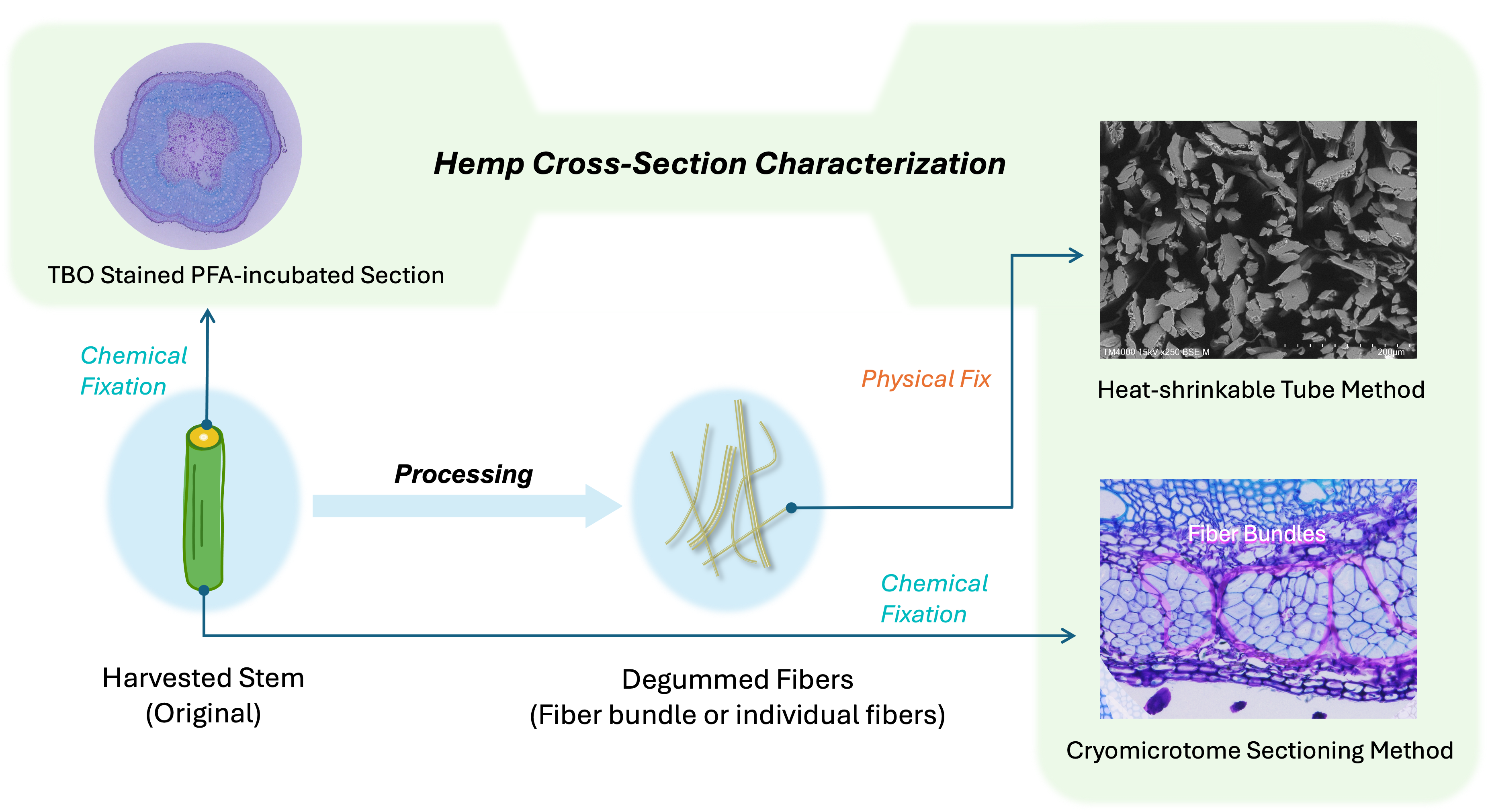
Cross-section is a critical indicator of textile fiber quality, yet evaluating this structural characteristic in bast fibers poses challenges due to naturally bundled individual fibers. Industrial hemp (Cannabis sativa L.), a typical example of bast fibers and important for textile applications, was selected for systematic cross-section investigation. Several cross-section preparation techniques were compared and tailored to monitor the physical and chemical changes of hemp fibers across key processing stages, namely, harvesting, retting (with partial manual decortication), and degumming, as natural hemp bundles separate into individual fibers. A heat-shrinkable tube method outperformed alternative cross-sectioning approaches in simplicity, efficiency, high throughput and cost, particularly for processed hemp fibers. Physical size properties were measured using image analysis software while histochemical staining techniques, using Toluidine blue O, Phloroglucinol-HCl and Calcofluor White, were applied to contrast fiber structure details and reveal changes in sample chemical composition during processing. A technique for quantifying hemp fiber cross-section involving calculating the fiber equivalent diameter was developed to compare hemp samples at different process stages. These methodologies provide practical guidance for characterizing cross-sections of diverse hemp fiber forms for quality assessment and are adaptable to adjacent material systems.
Keywords:
bast fiber
; cross-section preparation
; microscopy
; plant anatomy
; staining
Copyright: This open access article is published under a Creative Commons CC BY 4.0 license, which permit the free download, distribution, and reuse, provided that the author and preprint are cited in any reuse.