

Submitted:
12 November 2026
Posted:
13 November 2026
You are already at the latest version
Abstract
Central motor injury is often framed as a loss of cortical command, leading rehabilitation to prioritize early cortical reactivation and active task practice. This framing captures an important part of motor impairment but leaves a second problem under-specified: how injury disrupts communication among mechanical, spinal-peripheral, and supraspinal coordination layers. The Evolutionary Information Layering (EIL) framework proposes that biological coordination develops through the retention, specialization, and integration of ancestral regulatory systems rather than through their replacement. Applying EIL to neurorehabilitation, this article conceptualizes severe central motor injury as interlayer decoupling, defined here as a loss of phase-, context-, and task-appropriate conditional influence among functional layers. Three interacting disturbances are proposed: reduced reliability of descending commands, maladaptive gain from residual descending activity, and preserved but insufficiently engaged lower-layer mechanical and spinal coordination. Rehabilitation can therefore be organized as layer reweighting rather than as competition between cortical and spinal mechanisms. The therapeutic sequence is to titrate premature higher-layer demand, re-engage structured lower-layer information, and progressively reintegrate higher-level predictive control. The framework generates testable predictions concerning phase-dependent spinal modulation, proximal coordination, and task-specific cortical engagement. It also provides a theoretical basis for lower-layer-informed rehabilitation protocols without claiming that spinal circuits replace cortical function. Because most indirect evidence comes from stroke and human locomotor or spinal cord studies, application to traumatic brain injury and other central nervous system disorders should remain diagnosis-dependent.
Keywords:
Evolutionary Information Layering
; interlayer decoupling
; layer reweighting
; neurorehabilitation
; motor control
; spinal coordination
2 Southeast Surgical Hospital, Hefei, Anhui, China
1. Introduction
Central motor injury is commonly described as a disorder of cortical output. This description is justified by the importance of corticospinal pathways in selective voluntary movement and by the role of cortical networks in prediction, planning, and task adaptation (Lemon and Griffiths, 2005; Lemon, 2008; Wolpert and Ghahramani, 2000; Shadmehr and Krakauer, 2008). Yet it can become incomplete when applied to severe spastic hemiparesis. Many patients retain peripheral mechanics, proprioceptive pathways, and elements of spinal coordination, but cannot convert these retained capacities into stable functional movement.
The clinical problem is therefore not only whether cortical output can be restored. It is also whether residual higher-layer control, lower-layer sensorimotor coordination, and mechanical input can again become functionally coupled. Task-oriented training remains essential, but its effectiveness may depend on the state of the lower layers into which task demands are delivered (Krakauer, 2006; Langhorne et al., 2009). It remains an open question whether, when the lower-layer substrate is unstable, increased effort and repetition may strengthen currently available patterns of tone, co-contraction, or stereotyped synergy. This possibility motivates the model developed below rather than serving as a conclusion from prior trials.
The Evolutionary Information Layering (EIL) framework provides a way to formalize this problem. EIL proposes that biological complexity emerges through the retention, specialization, and integration of older coordination systems, rather than through simple replacement by newer systems (Hu, 2026). This article applies that principle to neurorehabilitation and develops the concept of central motor injury as interlayer decoupling.
This incompleteness has practical consequences. If central injury is treated only as a loss of cortical drive, rehabilitation naturally concentrates on effort, intention, and task repetition. If it is also treated as a disturbance of interlayer communication, additional variables become important: the temporal structure of sensory input, the stability of spinal-peripheral coordination, the dimensional complexity of the task, and the timing at which voluntary control is introduced. These variables are often present implicitly in clinical practice, but they are rarely organized under one explicit theoretical model. The present article focuses on severe motor impairment and uses stroke and human locomotor or spinal cord studies as its main evidence base; extension to traumatic brain injury and other central motor disorders should be considered provisional.
2. EIL Principles Relevant to Motor Recovery
EIL describes biological coordination as a layered informational architecture. Bioelectric gradients form the most basic layer, followed by extracellular matrix and mechanical-force systems, peripheral neuromodulatory mechanisms, and progressively integrated nervous-system control (Hu, 2026). In motor control, these layers should not be read as isolated anatomical compartments. They are functional levels through which mechanical signals, spinal reflex organization, brainstem postural control, and cortical prediction become coordinated.
Three EIL principles are directly relevant to rehabilitation. First, retention means that evolutionarily older mechanisms remain present after higher systems emerge. Vertebrate spinal locomotor circuitry and load-sensitive reflex modulation are well-established examples (Grillner and Wallén, 1985; Harkema et al., 1997; Dietz and Duysens, 2000). Second, specialization means that older mechanisms become incorporated into more complex control problems rather than remaining unchanged. Third, integration means that function depends on relationships among layers, not on the isolated strength of any one layer.
For rehabilitation, the practical questions therefore include whether mechanical input reaches spinal networks with usable timing, whether spinal output is phase-appropriate, and whether higher-layer prediction can use that output without increasing maladaptive compensation.
The term information is used here in an operational sense. A mechanical event becomes information when it changes the state or future behavior of a biological system. Rhythmic joint motion, for example, becomes informative when its timing modifies reflex gain, muscle activation, or postural organization. Cortical activity likewise has functional value when it improves coordination across the layers below it, not merely when its amplitude increases.
2.1. Operational Mapping to Motor-Control Layers
For clinical use, EIL layers require operational definitions. Layer 0 can be treated as the bioelectric background that constrains neuronal and network excitability. Layer 1 includes joint motion, muscle-tendon tension, pressure, load, and other structured mechanical signals. Layer 2 refers to the spinal-peripheral coordination interface through which afferent information is transformed into reflex and rhythmic motor output. Layer 3 includes cortical prediction, brainstem descending regulation, postural anticipation, and selective voluntary control. Layer 0 is retained here as a background constraint rather than as an independent intervention target. Layer 3 is a composite functional level; cortical prediction and brainstem descending regulation may be differentially affected after injury.
This mapping is functional rather than anatomical. Spinal networks are anatomically central, but they operate as lower-level coordination systems relative to cortical prediction. Passive joint movement can likewise act as a mechanical signal whose temporal structure may influence spinal reflex gain and muscle coordination (Capaday and Stein, 1986; Stein and Capaday, 1988; Zehr and Stein, 1999). Table 1 summarizes the proposed clinical mapping.
3. Central Motor Injury as Interlayer Decoupling
The central proposal is that severe motor impairment can be modeled as a disorder of interlayer coupling. Interlayer decoupling is defined here as a loss of phase-, context-, and task-appropriate conditional influence among functional layers. It includes both weakened useful coupling and excessive, poorly timed, or context-inappropriate residual influence. Injury therefore changes the informational relationships among layers rather than simply removing a higher controller while leaving lower controllers untouched. Three disturbances are especially relevant.
Figure 1 illustrates the difference between intact coupling, injury-related decoupling, and the proposed rehabilitation sequence. The schematic focuses on Layers 1–3 and omits the Layer 0 background for visual clarity. The model does not assume that all injuries produce the same pattern. It provides a common language for describing how different lesions can produce related clinical phenomena through distinct disturbances of interlayer communication.
3.1. Reduced Reliability of Descending Commands
Damage to cortical and corticospinal systems reduces the reliability of commands required for selective, fractionated movement (Lemon, 2008). This is most visible in distal limb control, but it also affects anticipatory postural adjustment, task sequencing, and the ability to shape lower-layer output according to context. The result is a reduction in the precision with which higher layers can specify lower-layer coordination.
This reduced reliability has a second consequence: the nervous system may still be able to generate movement, but not to select the most efficient coordination pattern for a given context. Patients may therefore appear capable under highly constrained conditions yet fail when the task requires rapid prediction, dual-task control, or adaptation to environmental change. The deficit is expressed not only in force production but also in the informational quality of control.
3.2. Maladaptive Residual Higher-Layer Gain
Residual descending activity may remain influential even when it is no longer well timed or selectively organized. In severe spasticity, attempts to recruit voluntary movement can increase diffuse activation, co-contraction, and stereotyped synergies. Spasticity involves altered spinal excitability together with disrupted descending regulation (Nielsen et al., 2007). The source of this abnormal influence may include residual cortical output, brainstem descending pathways, and altered reflex loops.
Under EIL, this pattern is described as maladaptive higher-layer gain: an excessive or poorly timed influence of residual descending activity on motor output, expressed through diffuse activation, co-contraction, stereotyped synergy, or task-inappropriate recruitment.
This interpretation provides a possible explanation for why voluntary effort is not uniformly beneficial during early severe impairment. Effort remains necessary for learning. When it is delivered through an unstable lower-layer substrate, however, it may increase the gain of the coordination pattern currently available. If that pattern is dominated by co-contraction or mass synergy, repetition can strengthen the pattern rather than improve selective control. The critical variables are therefore the timing of effort and the state of the substrate through which it acts.
3.3. Preserved But Insufficiently Engaged Lower-Layer Coordination
Lower-layer systems may retain substantial coordinating capacity even after severe central injury. Sensory and load-related input can shape stepping-like activity and spinal reflex modulation in humans (Harkema et al., 1997; Dietz and Duysens, 2000). Muscle-synergy research shows that modular organization can contribute to natural motor behavior (d’Avella et al., 2003); after stroke, these modules may be merged, simplified, or inappropriately recruited (Clark et al., 2010).
These lower layers may nevertheless remain insufficiently engaged because their inputs are unpredictable, their outputs are not integrated into posture and gait, or residual higher-layer activity interferes with phase-appropriate organization. The therapeutic bottleneck is thus a failure of appropriate coupling, not simply a loss of capacity.
The distinction between preserved capacity and accessible capacity is clinically important. A spinal network may be capable of phase modulation under one sensory condition but not express that capacity under another. A patient may be unable to step independently yet show organized muscle activation when load, posture, and rhythmic input are appropriately structured. Layer reweighting focuses on creating conditions under which preserved capacities become observable and usable.
4. Layer Reweighting as a Rehabilitation Principle
Layer reweighting follows from the preceding model. Rehabilitation should first titrate premature higher-layer demand when that demand consistently evokes maladaptive output. This means reducing selected task dimensions—such as speed, postural load, dual-task demand, or precision requirements—so that residual higher-layer control is not forced to solve a problem its lower-layer substrate cannot yet support. It does not mean suppressing cortical activity or withholding active rehabilitation.
The second step is to re-engage lower-layer coordination through structured mechanical and sensory information. Predictable joint motion, load, and proprioceptive input may provide the temporal organization needed for spinal-peripheral networks to generate more stable phase-dependent output. The third step is to reintegrate higher-layer control. As lower-layer coordination becomes more reliable, higher systems can resume prediction, task selection, and voluntary adaptation. These steps are overlapping and reversible rather than strictly linear: a patient may need renewed lower-layer stabilization when task complexity increases.
Layer reweighting is therefore a sequencing and reintegration model, not a competition between cortical and spinal mechanisms. Lower-layer engagement is proposed to create a more stable substrate on which higher-layer prediction, task selection, and voluntary adaptation can again operate. Flexible voluntary function still depends on successful higher-layer reintegration.
Layer reweighting also suggests a provisional expansion of dosage. Traditional dosage is often counted as time, repetitions, or external assistance. EIL adds the heuristic of informational dosage: two interventions with the same duration may differ in predictability, phase structure, postural demand, sensory relevance, and requirement for voluntary prediction. These variables may determine which layer receives the training signal and whether that signal can be integrated. Their relative weight requires empirical testing.
5. Clinical Implications and Testable Predictions
This framework changes how rehabilitation interventions are interpreted. The same external exercise can have different effects depending on the informational layer it primarily engages. Passive movement may be biologically meaningful if its temporal structure organizes spinal-peripheral coordination, but nonspecific if it provides no phase-relevant information. Upright task practice may promote integration when lower-layer coordination is ready, but reinforce compensation when it is not.
The model generates three conditional predictions. First, interventions that successfully re-engage lower-layer coordination should produce phase-dependent changes in reflex and muscle activity rather than nonspecific increases in activation. Second, in severely impaired patients tested under comparable task constraints, proximal postural and locomotor coordination should stabilize before distal selective control becomes efficient; earlier independent distal recovery would weaken this prediction. This sequence is consistent with the principle of reducing redundant degrees of freedom during motor learning (Bernstein, 1967; Horak, 2006), although those sources do not themselves establish the predicted time course. Third, recovery should show an early reduction in diffuse or secondary-area cortical over-recruitment followed by more focused task-specific cortical engagement.
These predictions are intentionally layer-neutral with respect to any single device or clinical protocol. They can be tested using neurophysiological, biomechanical, and cortical measures across different rehabilitation technologies.
Testing these predictions requires convergent measurement across levels of analysis. Reflex measures can test phase-dependent spinal modulation; electromyography can test synergy organization; kinematics and ground-reaction forces can test mechanical coordination; EEG, fNIRS, or transcranial magnetic stimulation can examine higher-layer engagement. Clinical scales such as the modified Ashworth Scale have known limitations as measures of the mechanisms underlying spasticity (Pandyan et al., 1999) and should not be used alone. No single measure proves layer reweighting. Convergent change across measures would provide stronger evidence than improvement on a clinical scale alone.
6. Boundaries and Limitations
The interlayer-decoupling model is a theoretical framework, not a replacement for lesion-specific diagnosis or established rehabilitation assessment. EIL layers are functional categories, not new anatomical divisions. Most indirect evidence discussed here comes from stroke and human locomotor or spinal cord studies; application to traumatic brain injury and other central motor disorders should therefore remain provisional and diagnosis-dependent. Evidence for human spinal rhythm-generating circuitry remains indirect, and alternating muscle activity can arise from several reflex and supraspinal mechanisms (Duysens and Van de Crommert, 1998; Dimitrijevic et al., 1998).
The model also does not imply that higher-layer demand should always be minimized or that early active task practice should be delayed. Excessive or prolonged reduction of active task demand may limit learning and transfer. Layer reweighting instead predicts titration of task dimensions: temporary reduction of maladaptive demand, structured lower-layer engagement, and progressive restoration of task-specific higher-layer control. These stages may overlap, and their duration and dosage require empirical study.
Finally, the framework should not be interpreted as evolutionary recapitulation. The evolutionary argument does not by itself determine treatment order. The clinical rationale for initial lower-layer engagement rests on input accessibility, postural constraint, and reduction of redundant degrees of freedom. Rehabilitation does not replay phylogeny, and layer reweighting does not claim that patients return to an ancestral state.
7. Conclusions
Severe central motor injury can be understood not only as loss of cortical command but also as a loss of phase-, context-, and task-appropriate coupling among mechanical, spinal-peripheral, and supraspinal information layers. EIL provides a theoretical basis for this interpretation by emphasizing retention, specialization, and integration. The resulting rehabilitation principle is layer reweighting: titrate premature higher-layer demand, re-engage structured lower-layer coordination, and progressively reintegrate predictive control. The framework now requires empirical tests of whether recovery tracks measurable restoration of interlayer coupling across reflex, muscular, biomechanical, and cortical measures.
Declarations
Author Contributions
D.H. conceived the framework and wrote and approved the manuscript.
Funding
The author received no specific funding for this work.
Data availability
No new datasets were generated or analyzed for this article.
Ethics
This theoretical article does not report new identifiable human participant data.
Generative AI statement
Kimi (Moonshot AI) was used to reorganize the manuscript, revise English expression, and check internal consistency. The author reviewed, verified, and approved all content and takes full responsibility for the final version.
Acknowledgments
None.
Conflicts of Interest
Dayong Hu is the inventor of the WM-CPM-H device and is affiliated with Hefei Huijia Medical Technology. No device-specific protocol, parameter, or clinical claim is discussed in this theoretical article.
References
- Bernstein, N.A. (1967). The Co-ordination and Regulation of Movements. Oxford: Pergamon Press.
- Capaday, C., and Stein, R.B. (1986). Amplitude modulation of the soleus H-reflex in the human during walking and standing. Journal of Neuroscience 6(5), 1308–1313. [CrossRef]
- Clark, D.J., Ting, L.H., Zajac, F.E., Neptune, R.R., and Kautz, S.A. (2010). Merging of healthy motor modules predicts reduced locomotor performance and muscle coordination complexity post-stroke. Journal of Neurophysiology 103(2), 844–857. [CrossRef]
- d’Avella, A., Saltiel, P., and Bizzi, E. (2003). Combinations of muscle synergies in the construction of a natural motor behavior. Nature Neuroscience 6(3), 300–308. [CrossRef]
- Dietz, V., and Duysens, J. (2000). Significance of load receptor input during locomotion: A review. Gait & Posture 11(2), 102–110. [CrossRef]
- Dimitrijevic, M.R., Gerasimenko, Y., and Pinter, M.M. (1998). Evidence for a spinal central pattern generator in humans. Annals of the New York Academy of Sciences 860, 360–376. [CrossRef]
- Duysens, J., and Van de Crommert, H.W.A.A. (1998). Neural control of locomotion; Part 1: The central pattern generator from cats to humans. Gait & Posture 7(2), 131–141. [CrossRef]
- Grillner, S., and Wallén, P. (1985). Central pattern generators for locomotion, with special reference to vertebrates. Annual Review of Neuroscience 8, 233–261. [CrossRef]
- Harkema, S.J., Hurley, S.L., Patel, U.K., Requejo, P.S., Dobkin, B.H., and Edgerton, V.R. (1997). Human lumbosacral spinal cord interprets loading during stepping. Journal of Neurophysiology 77(2), 797–811. [CrossRef]
- Horak, F.B. (2006). Postural orientation and equilibrium: What do we need to know about neural control of balance to prevent falls? Age and Ageing 35(Suppl. 2), ii7–ii11. [CrossRef]
- Hu, D. (2026). Evolutionary Information Layering: A Framework for Understanding the Emergence of Biological Coordination Across Scales. Preprints.org [Preprint]. [CrossRef]
- Krakauer, J.W. (2006). Motor learning: Its relevance to stroke recovery and neurorehabilitation. Current Opinion in Neurology 19(1), 84–90. [CrossRef]
- Langhorne, P., Coupar, F., and Pollock, A. (2009). Motor recovery after stroke: A systematic review. Lancet Neurology 8(8), 741–754. [CrossRef]
- Lemon, R.N. (2008). Descending pathways in motor control. Annual Review of Neuroscience 31, 195–218. [CrossRef]
- Lemon, R.N., and Griffiths, J. (2005). Comparing the function of the corticospinal system in different species: Organizational differences for motor specialization? Muscle & Nerve 32(3), 261–279. [CrossRef]
- Nielsen, J.B., Crone, C., and Hultborn, H. (2007). The spinal pathophysiology of spasticity—From a basic science point of view. Acta Physiologica 189(2), 171–180. [CrossRef]
- Pandyan, A.D., Johnson, G.R., Price, C.I.M., Curless, R.H., Barnes, M.P., and Rodgers, H. (1999). A review of the properties and limitations of the Ashworth and modified Ashworth Scales as measures of spasticity. Clinical Rehabilitation 13(5), 373–383. [CrossRef]
- Shadmehr, R., and Krakauer, J.W. (2008). A computational neuroanatomy for motor control. Experimental Brain Research 185(3), 359–381. [CrossRef]
- Stein, R.B., and Capaday, C. (1988). The modulation of human reflexes during functional motor tasks. Trends in Neurosciences 11(7), 328–332. [CrossRef]
- Wolpert, D.M., and Ghahramani, Z. (2000). Computational principles of movement neuroscience. Nature Neuroscience 3(Suppl.), 1212–1217. [CrossRef]
- Zehr, E.P., and Stein, R.B. (1999). What functions do reflexes serve during human locomotion? Progress in Neurobiology 58(2), 185–205. [CrossRef]
Figure 1.
Central motor injury as interlayer decoupling. In the intact system, mechanical, spinal-peripheral, and higher-level predictive layers are bidirectionally coupled. Central injury can make descending influence unreliable or maladaptively weighted and can also leave Layer 1–Layer 2 input noisy or underused. Layer-reweighting rehabilitation titrates premature higher-layer demand, re-engages lower-layer coordination, and progressively reintegrates higher-level control. Layer 0 background excitability is omitted for visual clarity; the stages shown here may overlap in practice.
Figure 1.
Central motor injury as interlayer decoupling. In the intact system, mechanical, spinal-peripheral, and higher-level predictive layers are bidirectionally coupled. Central injury can make descending influence unreliable or maladaptively weighted and can also leave Layer 1–Layer 2 input noisy or underused. Layer-reweighting rehabilitation titrates premature higher-layer demand, re-engages lower-layer coordination, and progressively reintegrates higher-level control. Layer 0 background excitability is omitted for visual clarity; the stages shown here may overlap in practice.
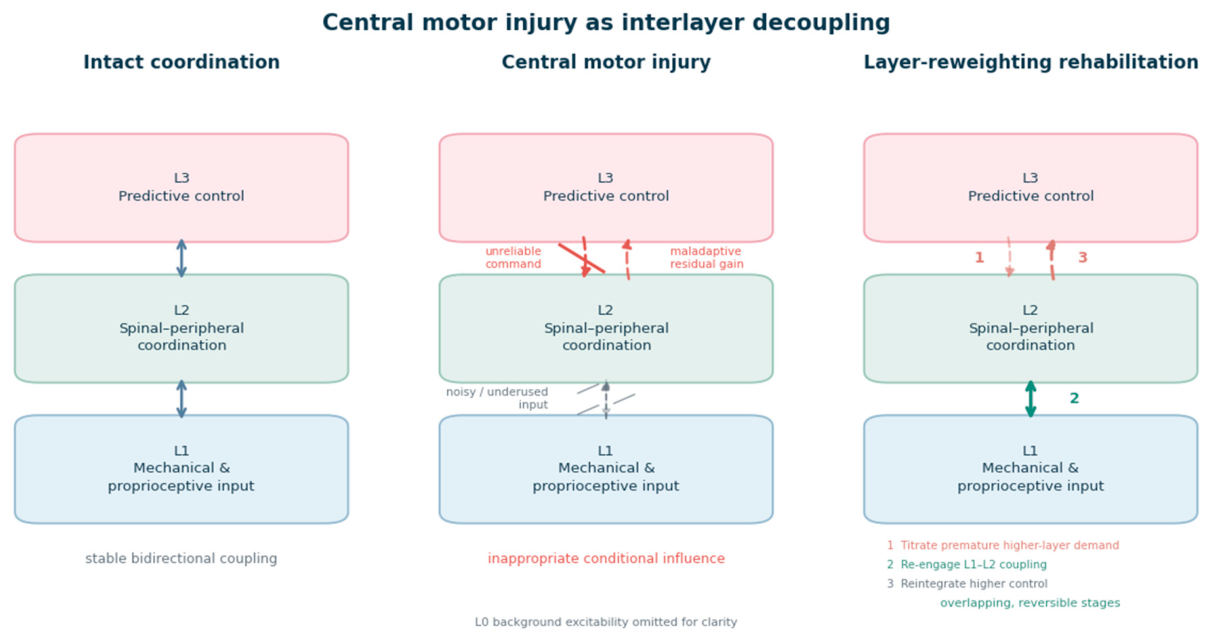

Table 1.
Operational mapping of EIL layers to motor-control functions and rehabilitation questions.
| EIL layer | Motor-control interpretation | Post-injury problem | Rehabilitation question |
| Layer 0: bioelectric background | Background neuronal and network excitability | Altered excitability and reflex thresholds | Can background excitability be treated as a moderator of intervention response? |
| Layer 1: mechanical forces | Joint motion, muscle-tendon tension, load, and pressure | Mechanical input may be absent, noisy, or poorly timed | Can structured mechanical information provide useful timing cues? |
| Layer 2: spinal-peripheral coordination | Reflex modulation and low-level rhythmic organization | Preserved capacity may be poorly engaged or phase-inappropriate | Can phase-dependent spinal modulation be restored? |
| Layer 3: integrated nervous-system control | Cortical prediction, brainstem descending regulation, anticipation, and voluntary selection | Reduced selective command reliability and/or abnormal residual descending influence | When should task complexity be titrated and task-specific control reintroduced? |
Disclaimer/Publisher’s Note: The statements, opinions and data contained in all publications are solely those of the individual author(s) and contributor(s) and not of MDPI and/or the editor(s). MDPI and/or the editor(s) disclaim responsibility for any injury to people or property resulting from any ideas, methods, instructions or products referred to in the content. |
© 2026 by the authors. Licensee MDPI, Basel, Switzerland. This article is an open access article distributed under the terms and conditions of the Creative Commons Attribution (CC BY) license (http://creativecommons.org/licenses/by/4.0/).
Copyright: This open access article is published under a Creative Commons CC BY 4.0 license, which permit the free download, distribution, and reuse, provided that the author and preprint are cited in any reuse.