
Submitted:
11 November 2026
Posted:
13 November 2026
You are already at the latest version
Abstract
Raw milk is an essential food resource in Africa, but its preservation is hampered by the lack of a cold chain and by ambient temperatures generally exceeding 25-30 °C. Traditional fermentation practices give rise to iconic products such as Lait caillé (Senegal), Nono (Nigeria, Ghana) and Pendidam (Cameroon). Based on a literature search following the PRISMA 2020 recommendations, this review analyzes the physicochemical, microbiological and sensory characteristics of these products, the screening of potential starter cultures or probiotics, and their application to improve product quality. Lactic acid bacteria and some yeasts, including Saccharomyces cerevisiae, play a central role in indigenous fermentations, contributing to acidification, flavor and texture. The dominant lactic acid bacteria include Lactiplantibacillus plantarum, Lactococcus lactis and Leuconostoc mesenteroides in Lait caillé; Lactobacillus helveticus, Limosilactobacillus fermentum and Streptococcus thermophilus in Nono; and Lactobacillus spp. and Streptococcus spp. in Pendidam. A starter consortium combining an indigenous Lactobacillus rhamnosus isolate with extraneous cultures (Lactiplantibacillus plantarum, Lacticaseibacillus casei and Lactococcus lactis) for Nono production, and the probiotic L. rhamnosus yoba 2012 in Lait caillé, illustrate promising prospects for valorizing African milk. Such initiatives could broaden the commercialization of African fermented milks and justify further research on indigenous starters and probiotics, combined with good manufacturing practices.
Keywords:
raw milk
; fermentation processing
; starter cultures
; Africa
; quality
1. Introduction
Milk and dairy products represent a major food resource, providing essential proteins, lipids, minerals, and vitamins to many populations worldwide, while also contributing significantly to international trade [1,2].
A 17% increase of African dairy production, rising from 45.5 to 53.2 million tons, was observed from 2013 to 2023, with a diversity of origin: while cow’s milk dominates (79% in 2023), goat, camel, sheep, and buffalo milk account for 21%, reflecting the richness of African dairy systems [2]. Yet, despite holding 20% of the world’s cattle population, Africa contributes only 5% of global milk production. The dairy chains in sub-Saharan Africa, organized around small-scale dairies and local marketing circuits, represents a major economic and social challenge [3,4].
Fermentation extends the shelf-life of food products and is particularly important in the absence of other conservation options such as pasteurization and cooling. In many parts of Africa, traditional fermented milks are produced using empirical knowledge passed down through generation, often without standardized hygiene measures, controlled fermentation parameters, or use of defined starter cultures [5,6]. This artisanal context introduces substantial variability in product quality and increase the risk of contamination by undesirable microorganisms such as Enterobacteria, staphylococci, yeasts and molds. When traditional fermented milk products are consumed daily and often without further heat treatment, the microbiological risks represent a significant but underdocumented public health concern [7,8].
Starter cultures can be defined as preparations with a large number of cells, either of a single type or mixture of two or more microorganisms that are added to foods in order to take advantage of the compounds or products derived from their metabolism or enzymatic activity [9]. Since starter cultures are used to perform fermentation processes in food production, its use is common practices in the food industry worldwide, explains commercialization of several products such as bioprotective cultures, starters or probiotics aimed to provide food with specific sensory and nutritional characteristics, potential health benefits and guarantee food safety [10,11,12].
The use of starter cultures appears as a technological approach applicable in the context of African dairy products to control fermentations, ensure a regulated kinetics, strengthen microbiological stability, and guarantee homogeneous quality of finished products, with the perspective of expanding their commercialization.
Numerous studies published between 2004 and 2026 have focused on the quality of traditional fermented dairy products consumed in sub-Saharan Africa and the introduction of starter cultures or probiotics for qualitative improvement and process standardization.
This review is focused on three popular and emblematic African fermented dairy products: Lait caillé (Senegal), Nono (Nigeria and Ghana) and Pendidam (Cameroon). It aims to synthesize available knowledge on their indigenous fermentation techniques, microflora, qualitative characteristics and associated hazards, as well as to inform about the selection and introduction of some starter culture or probiotic bacteria adapted to local specificities.
2. Standards and Food Safety Hazard in the Dairy Chain Value
Food-safety hazard generally refers to any biological, chemical or physical agent in a food, or condition of food with the potential to cause adverse health consequences for consumers [13].
From raw milk production through processing to the consumer, milk is exposed to several hazards, which ultimately influence the safety and quality of the final product. Governmental regulatory bodies need to set the necessary national and regional safety standards, perform inspections and put measures in place to ensure that the standards are met, including strong enforcement programs within smallholder dairy chains.
The International Dairy Federation (IDF) published general standards (IDF Standard 149A:1997) [14] of identity for fermented milks which could be briefly described as follows: “Fermented milks are prepared from milk and/or milk products (e.g., any one or combinations of whole, partially or fully skimmed, concentrated or powdered milk, buttermilk powder, concentrated or powdered whey, milk protein (such as whey proteins, whey protein concentrates, soluble milk proteins, edible casein and caseinates), cream, butter or milk fat - all of which have been manufactured from raw materials that have been at least pasteurized) by the action of specific microorganisms, which results in a reduction of the pH with and without coagulation.
Table 1, adapted from section 3.3 of the Codex Alimentarius Standard CXS 243-2003 [15], revised in 2018 and amended in 2022 and 2024, presents selected specifications depending on the sub-category of fermented dairy products.
Many countries have their own standards of identity for yogurt and other fermented milk, normally based on fat and solids nonfat content as well as acidity.
In most countries of sub-Saharan Africa, the legal framework on food is scattered and weak. It is dispersed across the existing legal arsenal (environmental code; water code; forestry code; hunting and wildlife protection code; fisheries and aquaculture code; pastoral code; land and property code, etc.). Thus, there is generally a scarcity of specific texts governing the field of food.
Regulation 007/2007/CM/UEMOA relating to the sanitary safety of plants, animals, and food in the West African Economic and Monetary Union (UEMOA) states indicates in its article 78 that Member States prohibit, within the UEMOA area, the release for consumption of any food, commodity, or food product harmful to health and unfit for human consumption and animal feed. Regulation C/REG.21/11/10 on the harmonization of the structural framework and operational rules regarding the sanitary safety of plants, animals, and food in the ECOWAS area establishes general principles and sets organizational provisions and procedures to ensure the sanitary safety of animals and food, both at the community and national levels.
At the level of the countries of the Economic Community of West African States (ECOWAS), the regional standard ECOSTAND 18:2014 sets quality and hygiene requirements for raw milk, including raw milk intended for fermented milk production. For fermented milks, the Senegalese standard NS N UEMOA 1036:2016 is fully aligned with the Codex Alimentarius standards (Standard CXS 243-2003) to ensure the safety and compliance of fresh fermented milk products (with or without ingredients, excluding thermized products). Criteria in the NS UEMOA 1036:2016 are defined as follows:
Milk protein [at least 2.7% (m/m) for traditional fermented milk or yogurt; this threshold rises to at least 5.6% for concentrated products)];
Milk fat [must remain strictly below 15% (w/w) for yogurts and below 10% for traditional fermented milk products)];
Titratable acidity [minimum 0.6% (expressed as lactic acid) for yogurts to ensure proper bacterial fermentation kinetics)];
Specific lactic acid flora [the microorganisms in the starter culture (e.g., Lactobacillus bulgaricus and Streptococcus thermophilus) must be viable, active, and present at a minimum concentration of 7 Log CFU/g (Colony-Forming Units per gram)] until the best-by date.
Food safety criteria [(absence of pathogenic bacteria (such as Salmonella) and strict, limited thresholds for (coliforms, Escherichia coli, and Staphylococcus aureus) used as process hygiene indicators].
Dairy chain actors in the value chain of African countries where traditional fermented milks performed in using indigenous techniques remain widespread including products like “Lait caillé”, “Nono” and “Pendidam” dairy products, would require upgraded knowledge and training in preventive approaches such as good agricultural practices (GAP), hazard analysis and critical control points (HACCP) design and implementation and good hygienic practices (GHPs).
3. Methodology for Review on the Three African Fermented Dairy Products
The documentary research focused on the three African dairy products used as references (“Lait caillé”, “Nono” and “Pendidam”) was conducted in the international databases PubMed, Scopus, Web of Science, and Google Scholar, complemented by the systematic review of the bibliographic references of the selected articles. The search strategy employed Boolean combinations of the keywords “fermented milk”, “Lait caillé”, “Nono”or “Nunu”, “Pendidam”, “lactic acid bacteria”, “starter cultures”, and “Africa”.
The period covered extends from 2004 to 2026, in order to include both foundational works and recent advances. The inclusion criteria retained studies focusing on traditional fermented dairy products of Sub-Saharan Africa, documenting their microbiological, physicochemical, or technological characteristics, as well as proposals for starter cultures or the integration of probiotic microorganisms. Publications outside this scope or lacking original data were excluded.
The process based on the PRISMA 2020 recommendations [16] led to the selection of 32 studies as the bibliographic backbone for the characterization of local targeted dairy products (“Lait caillé”, “Nono or Nunu”, and “Pendidam”), the selection of endogenous microbial strains potentially usable as starter cultures, and the introduction of starter cultures or probiotics as initiatives for optimization and qualitative improvement.
Some additional references relating to regulatory or normative texts, qualitative controls, selection of starter cultures or probiotic microorganism as well as on dairy products were also utilized.
4. Traditional Processes and Characteristics of “Lait Caillé”, “Nono” and “Pendidam”
4.1. Definitions and Processes of “Lait Caillé”, “Nono” and “Pendidam”
Milk from farmers in Senegal, Nigeria or Ghana and Cameroon is domestically or commercially processed respectively into various fermented dairy products including “Lait caillé”, Nunu (Nono) and Pendidam by small-scale processing units or processors, with slight variations in processing methods.
In Nigeria and Ghana Fulani people are known for producing Nunu (Nono) at home on a small scale. They usually rely on traditional methods, either fermenting raw or boiled milk naturally or using a back-slopping technique where a portion of an already fermented batch is used to start the fermentation of a new one [17,18]. Typically, fresh cow milk is collected in the morning in calabashes, sieved and left to ferment for a minimum of 24 hours or a maximum of 48 hours depending on the season [18]. During the hot season which is usually from March to June, high ambient temperatures of 35 °C promote acidification of the milk within 12-24 hours yielding the desired product, while in the cold season (October to February) where temperature of 15-17 °C are recorded, the fermentation takes up to 48 hours. Sometimes, in the dry season when there is not enough grass for grazing of the animals, smaller quantities of milk are obtained and these are added to the previous day’s batch depicting a form of back-slopping. The fermentation occurs spontaneously without starter cultures and at ambient temperatures. The fermented milk is then churned using a wooden ladle. Fat accumulates as a result of the churning and is removed. Excess whey is drained off to obtain a product with a thick consistency which is the Nunu (Nono) milk product [18].
Pendidam processing described by Bayoï and Noubasra [19], begins with the filtration of raw milk to remove impurities, followed by heating at approximately 60-70 °C for 20-30 min, a step that contributes to microbial reduction and improved product stability. After cooling to ambient temperature, the milk is inoculated with a small quantity of a previous successful batch, known locally as “kittoum” (2-3 spoonfuls), which acts as a natural starter culture. The inoculated milk is then incubated at ambient conditions, typically within a temperature range of 28-35 °C, for 24-72 h, allowing for lactic acid fermentation, acidification, and coagulation, resulting in a curdled milk called “nyalloundé”. Subsequent churning for about 40 min produces a whisked curdled milk locally known as “wourwandé”. Skimming in a calabash separates the butter “lebol” from the fermented skimmed milk, which is the final product, Pendidam.
According to Parker et al. [20], domestic preparation of Lait caillé is performed within homes in traditional wooden bowls (lahals) and the biofilm samples were obtained from the inside of the lahal’s surface. During the domestic preparation process, typically, one liter of cow’s milk is collected and heated in an aluminum pot, almost to the point of boiling. The milk is removed from the fire and allowed to cool before being transferred into one of the family’s traditional lahals and topped with a straw cover. Depending on the seasonal temperature, the milk is left to ferment in the lahal for 12-24 h.
Commercial “Lait caillé” is also typically prepared and sold in small shops called boutiques in Senegalese peri-urban areas [21]. This process utilizes a milk powder product rather than fresh animal milk: the milk powder is mixed with freshly boiled water in a large plastic bucket, which is then covered and left to ferment for a period of 12h. To enable the boutique fermentation process, backslopping is often used. This technique involves the re-use of a small amount of previously fermented Lait caillé to act as a starter culture for the new batch [20].
The domestic preparation of Lait caillé (A, Senegal), Nono or nunu (B, Ghana or Nigeria) and Pendidam (C, Cameroon) from cow’s milk follows a set of unit operations, with slight variations between processes, as presented in Figure 1.
The three processes rely on traditional methods, either fermenting raw or boiled milk naturally or using a back-slopping technique where a portion of an already fermented batch is used to start the fermentation of a new one.
4.2. Qualitative Identities and Main Flora in the Three African Fermented Milks
Table 2 presents some value ranges of pH, and titratable acidity for the comparison with levels defined in the CODEX STAN 243-2003.
Based on the process of Nono production presented in Figure 1, the range of LAB and yeast counts after fermentation for 24 h and 48 h reached 7.91-8.82 and 3.64-1.22 log CFU/mL, respectively. LAB numbers increased during this production, while those of yeast decreased in all samples, with increasing fermentation time [18]. The LAB isolated from the produced Nunu were identified as Lactobacillus (53.52%), Leuconostoc (15.49%), Lactococcus (9.86%), Enterococcus (15.49%) and Streptococcus (2.82%). Lactobacilli were further differentiated into Streptobacterium, Thermobacterium and Betabacterium; Akabanda et al. [18] identified the screened yeasts as Saccharomyces cerevisiae (35.42%), Saccharomyces pastorianus (4.17%), Candida kefyr (33.33%), Yarrowia lipolytica (4.17%), Candida stellata (14.58%), Kluyveromyces marxianus (4.17%), Zygosaccharomyces bisporus (2.08%), and Zygosaccharomyces rouxii (2.08%). The range of lactic acid bacteria and total fungi counts isolated from Nono samples by Omola et al. [22], were respectively (3.59-6.78) log CFU/mL and (4.91-6.94) log CFU/mL.
Diatta [21] estimated Lactobacillus and yeast range in samples of the artisanal Lait caillé produced in Senegal at respectively (6.48-7.38) and (4.08-6.04) Log CFU/mL. Over successive fermentation rounds of Lait caillé produced in lahals, Groenenboom et al. [23] showed that the bacterial community depended on the lahal: lait caillé from two lahals was mainly dominated by Lactobacillus helveticus, Acetobacter pasteurianus and Lactococcus lactis, whereas that from a third lahal was dominated by Streptococcus thermophilus.
Lactic acid bacterial and fungal flora (yeasts and molds) in Pendidam were evaluated respectively at 6.80-7.01 Log CFU/mL and 5.48-5.78 Log CFU/mL by Bayoï and Noubasra [19].
5. Pathogens Occurring in African Raw Milk and Fermented Dairy Products
When milk is collected at small-scale collection centers, it may be chilled or heat-treated prior to the conversion to fermented products. However, small-scale processors of traditional milk products often lack pasteurization, storage, and packaging facilities and do not adhere to Good Manufacturing Practices (GMPs) or Good Hygiene Practices (GHPs).
The lack of adherence to GMPS including uncontrolled fermentation due to a reliance on back-slopping in the traditional fermentation processes prevailing in Lait caillé, Nono and Pendidam production (Figure 1), may render the milk, and thus the fermented products, susceptible to contamination with human pathogens of public health concern.
Some studies contributed to the characterization of pathogenic microorganisms occurring on raw milk and the three traditional dairy products used as reference in this study. The results summarized in Table 3 report occurrence of Staphylococcus aureus or Listeria monocytogenes that are foodborne pathogens usually associated with milk or milk products.
The presence and level of prevalence of E coli or other enterobacteria in different milk and dairy products such as raw, boiled or fermented milk and the different countries, constitutes an example of indicator for the general low hygiene practice in African milk value chain.
6. Potential Starter Cultures Screening from Lab Identified in Indigenous Products
In traditional African fermented foods such of Lait caillé, Nono and Pendidam the production of antimicrobial compounds by fermenting bacteria and the reduction in pH may contribute to inhibit the growth of pathogenic microorganisms and thus limit the safety risk. According to Wakil and Osamwonyi [38], the metabolic activities of LAB and the yeasts results in a considerable decrease in pH due to production of organic acids (lactic and acetic acid).
Usually, microorganisms selected as starter cultures are isolated from the native microbiota of traditional products since they are well adapted to the environmental conditions of food processing and are responsible to confer specific appearance, texture, aroma and flavour characteristics. Many studies undertaken on Lait caillé, Nono, and Pendidam produced following the indigenous fermentations techniques prevailing respectively in Senegal, Nigeria and Cameroon contributed to:
- show the diversity of microorganisms which are present in these products;
- characterize of the predominant lactic acid bacteria and yeast species;
perform an investigation on the technological properties of the predominant lactic acid bacterial and yeast isolated from the products in order to select potential starter cultures which can contribute optimizing the process of their production.
The main technological properties targeted for potential microbiological valorization of LAB isolated from traditional fermented milk in Africa as starter cultures include:
- Growth capacity between 10 and 45 °C;
- Homo fermentative and heterofermentative ability;
- Ability to tolerate salt in matrix containing 6.5% (W/v) NaCl (for potential use in cheese);
- Activity on pathogenic bacteria;
- Capacity of production heat stable antimicrobial compound
To determine the growth and acidification ability of different endogenous LAB isolates as potential starter cultures Fagbemigun et al. [39] have tested 4 different selected strains previously isolated from Nono, belonging to the species Streptococcus thermophilus, Lactobacillus. helveticus, Lb delbrueckii and Limosilactobacillus fermentum. Strains from these 4 species were chosen, as they were determined to be predominant species associated with various Nono samples obtained from processors or local market. These strains were selected according to their growth ability and acidification capacities (pH reduction) on milk. They were inoculated as single or mixed cultures with or without an endogenous strain of Saccharomyces cerevisiae on freshly pasteurized whole milk at 30 °C for 24 h. The temperature of 30 °C was chosen according to traditional Nono production local methods, where the milk is left to ferment at ambient temperature that can reach 30 °C in Nigeria. The authors showed that the mixed bacterial culture allowed milk acidification to pH 4 and increased viscosity whether the yeast is present or not. Genome analysis of the candidate LAB strains revealed potential relevant technological properties such as bacteriocin production [39]
In another study, for definition of a starter culture suitable for standardization of Nono production Ikele et al. [40] tested five strains of indigenous lactic acid bacteria screened from Nono samples, identified as Lactobacillus paracasei, Lactobacillus fermentum (3 isolates) and Lactobacillus rhamnosus, to assess their effects on physicochemical and sensory properties of this fermented dairy product. The fermentation of milk was performed at 30 °C for 24 h with the single isolates revealed that the organoleptic properties (appearance; taste, aroma) closest to the traditional product were obtained with L. rhamnosus. In mixed culture with 3 extraneous starters cultures (Lactococcus lactis, Lactobacillus plantarum and Lactobacillus casei) this strain allowed to produce a fermented milk close to commercial Nono.
The additional criteria tested for lactic acid bacteria isolated from African fermented milk are generally focused on their probiotic properties, including:
Nodem Sohanang et al. [45] evaluated the probiotic potential of lactic acid bacteria isolated from Pendidam and Kindirmou randomly collected from markets in Cameroon and identified three LAB species among 6 isolates which exhibited interesting probiotic aptitudes (Table 4).
Most probiotic bacteria belong to the genera Lactobacillus spp., Bifidobacterium spp., Lactococcus spp., and some to Bacillus spp., and have been detected in various environments [46].
7. Consortia of Indigenous and Extraneous Bacterial Strains as Starter Cultures
In order to obtain a well-controlled African fermented milk product with a fast and deep acidification, one could benefit from the use of starter cultures. Starter cultures facilitate control over the initial phase of fermentation, and acidification to pH values below 4.2 is a major safety factor in lactic fermented foods, reinforced by antimicrobial metabolites such as acetic acid, hydrogen peroxide and bacteriocins [47]. The extraneous organisms used as starter cultures (L. lactis, Lb. casei and Lb. plantarum) by Ikele et al. [40] showed low pH decrease (except for Lb. casei) similar to pH value of the indigenous starter candidates. However, the total titrable acidity was higher in the fermented milk obtained with the extraneous cultures.
According to Tarazanova et al. [48], viscosity is a key property during production of fermented milk product. The extraneous cultures (L. lactis, Lb. casei and Lb. plantarum) were suitable for production of significantly viscous products compared to that of the indigenous culture isolated from Nono when using singly starter cultures [40]. Then the final starter culture consortium that they defined for optimizing fermentation of Nono was a 1% combination of the Lactobacillus rhamnosus (indigenous isolate), Lactobacillus plantarum, Lactobacillus casei and Lactococcus lactis (all extraneous cultures) giving a viscosity close to that of commercial product.
Table 5 shows the evolution of the main physicochemical characteristics of fresh milk and Nono during the use of the new starter culture consortium defined by Ikele et al. [40] compared to those of commercial Nono.
The suitability of the organisms selected by Ikele et al. [40] as starter culture candidates was assessed in terms of their ability to ensure compliance of the fresh fermented milk with the standard presented in Table 1, such as decrease of pH and titratable acidity as well as physical and sensory properties that also imparted the product. Adesokan et al. [49] selected a mix starter cultures of Lb. casei and Lb. plantarum strains, screened from traditional “nono”, which produce high quantity of diacetyl, giving “nono”fermented product that had lowest pH and highest protein content when compared to nono from indigenous fermentation used as control.
Alongside physico-chemical and viscosity measurements, and the determination of aromatic compounds, sensory evaluation is useful for complementing the assessment of starter consortia efficiency. In their study, Ikele et al. [40] evaluated different attributes such as appearance, taste, aroma, texture with a sensory panel on a nine-point (9) hedonic scale where 9 = Like extremely and 1 = dislike extremely. Although the fermented milk obtained using their culture consortium was highly rated with a note of 7.65 ± 0.47, the sensory evaluation performed with non-trained panelists was in favor of commercial Nono. The sensory evaluation result obtained Ikele et al. [40] corresponds with that performed by Adesokan et al. [49], who reported an overall acceptance of 7.01 ± 0.02 for the starter culture fermented Nono, on a nine-point (9) hedonic scale.
8. Experiments for Probiotic Enrichment of Fermented Dairy Products in Africa
To date, hundreds of studies on probiotic functionality and their impact on prevention and treatment of gastrointestinal diseases have been reported. One of the most widely described probiotic strains is Lactobacillus rhamnosus GG for which the efficacy against Clostridioides difficile (previously known as Clostridium difficile) colitis has been first studied 30 years ago [50]. Considering the efficacy that different probiotic strains show across these diseases, Ritchie and Romanuk [51] concluded that probiotics are generally beneficial in treatment and prevention of gastrointestinal disease.
Despite global health initiatives, infectious diseases remain a great challenge in developing nations. Diarrhea’s diseases continue to pose a significant public health burden in these countries, disproportionately affecting regions across Africa [52]. The extent of probiotic benefits and their application to the developing countries have been studied, including the work of Parker et al. [20] which investigated the feasibility of integrating the probiotic strain Lactobacillus rhamnosus GG (LGG into the natural fermentation of Lait caillé in Senegal (Figure 1A). The study, conducted in the north of the country, represents an important initiative to apply probiotics in local foods of West Africa. This approach is comparable to the development of probiotic mutandabota, a fermented product based on cow’s milk and pulp from the fruit of the baobab tree (Adansonia digitata L.), undertaken in Southern Africa [53]). Both initiatives contribute to expanding strategies to combat enteric diseases and malnutrition in Africa.
The propagation of the probiotic bacterium (L. rhamnosus GG), was then studied in another fermented milk prepared in lahals (Figure 1A): the Lait caillé was inoculated with the Yoba 2012 starter culture, containing L. rhamnosus GG and culture of S. thermophilus. L. rhamnosus GG growth was monitored 12 h after fermentation, the natural fermentation process (without the starter culture) was used as control. According to Parker et al. [20], the experiments provide clear evidence for the propagation of L. rhamnosus GG in the background of the natural milk fermentation process presented in the Figure 1A.
After having demonstrated the high species richness (>100 genera) of naturally fermented lait caillé prepared in northern Senegal in lahals with biofilm (Figure 1A), Parker et al. [20] showed, using a 16S rRNA sequencing approach, the feasibility of integrating the health-promoting probiotic Lactobacillus rhamnosus GG, a component of the Yoba 2012 starter culture, into this traditional African fermented milk product. The addition of the Yoba 2012 starter culture to lait caillé led to substantial growth of this probiotic bacterium within 12 hours of incubation under fermentation conditions applied by local communities in northern Senegal. L. rhamnosus Yoba 2012 propagated in the product with a 20- to 60-fold increase in probiotic counts in the first batch. Based on the demonstrated potential of L. rhamnosus GG to stimulate immune responses, bind toxins, suppress pathogens, and enhance food safety, the findings of Parker et al. [20] pave the way for a promising strategy of integrating this probiotic into local fermented dairy products in Senegal.
Furthermore, Groenenboom et al. [23] have investigated the factors influencing probiotic invasion in the bacterial community of lait caillé produced with lahal biofilm (Figure 1A) and during successive batch-to-batch fermentation cycles characteristic of traditional practices in northern Senegal. They showed that the strains of the Yoba starter culture failed to become members of the lait caillé microbial community present in the lahals and were unable to successfully invade the biofilms characteristic of traditional wooden bowls used for milk fermentation. One of the technological solutions proposed by Groenenboom et al. [23] is the screening of probiotic strains originating from the natural community of lait caillé, with the aim of using them as starter cultures for the sustainable production of probiotic lait caillé.
9. Starter Culture Uses and Optimized Manufacturing Processes in Africa
Despite the long tradition of fermented dairy products (FDP) in Africa [54], general knowledge of the fermentative microbiota in such products has only recently been obtained including those for Lait caillé, Nono and Pendidam.
Based on the different results reported, Lc. lactis that represents a typical technologically important LAB in dairy products [55], has been isolated from different raw milks in Africa (Algeria, Kenya and Morocco) as well as fermented dairy Products (Algeria, Chad, Egypt, Ethiopia, Mali, Morocco, Kenya, South Africa, Tanzania and Zambia): its concentration ranging from 6-10 Log CFU/mL in the final products. Such level indicates a wide adaptability of this lactic acid bacterium and contribution to fermentation processes [56]. Streptococcus infantarius subsp. infantarius, less known for its role in dairy fermentation, was also identified as the predominant species from traditional fermented camel milk gariss in Sudan [57]. This LAB was also screened as a predominant LAB species (over 8 Log CFU live cells per mL) in fermented camel and cow milk products in Côte d’Ivoire, Kenya, Mali and Somalia [58,59,60]. Besides the predominant organisms Lc. lactis and Streptococcus infantarius subsp. infantarius, Lb. delbrueckii, Lb. plantarum and Lb. fermentum were also regularly identified in African dairy products at concentrations ranging from 2-8 Log CFU/mL in raw milk and 8-10 Log CFU/mL for the fermented commodities/products [56].
Generally recognized as safe microorganism, the potentialities of Lc. lactis as a mesophilic bacterium with highly adapted lactose metabolism, formation of diacetyl and limited proteolysis for optimal food preservation and flavor development [55], render it optimally adapted to the prevailing fermentation conditions at ambient temperatures in Africa. This bacterium was successfully included in the consortium of starter culture defined for a novel process of Nono, where it was combined with Lactobacillus plantarum, Lactobacillus casei and Lactobacillus rhamnosus [40] for modernizing the traditional process.
Safety or competitiveness of fermented dairy products and technology are tightly connected to raw material quality, presence of zoonotic agents, spoilage and good manufacturing practices. In addition to definition of a starter culture based on science such as works initiated for Lait caillé, Nono and Pendidam, basic good manufacturing practices (GMPs) are required to enhance safety and quality of the African fermented dairy products by avoiding initial contamination, reducing pathogenic microorganisms (processing and heat treatment), accelerating the fermentation, avoiding recontamination (processing and storage) and preventing growth of microorganisms during transportation and storage of the fresh product.
In the case of West African countries, the main sources of contamination of many milk products arises from a lack of GHPs and GMPs including hand washing, udder cleaning, and storage and transportation conditions as well as the use of improper containers and milking of cows undergoing antibiotic treatments [61]. In fact, Chengat Prakashbabu et al. [62] found that only about 3% of milk producers in Senegal regularly chilled their milk after collection. According to Breurec et al. [37], efforts should be made to implement good hygiene practices during milk collection and processing including pasteurization, transportation, and distribution. Furthermore, an inspection of milk production and helping farmers with fodder quality could be important steps to improve milk production and processing in Africa.
To be effective, the GMPs need to be tailored to the setting of rural Africa. Several aspects have to be considered, including the milk production systems of pastoralists, collection systems of milk cooperatives, varying technology standards integrating the use of defined starter culture consortia, economics, cultural products and manufacturing preferences.
10. Conclusion
Milk has historically been central to the diets of pastoral communities in Sub-Saharan Africa, and today, it also plays an important role for sedentarized pastoralists as well as urban populations. Local milk is consumed raw or transformed into traditional fermented dairy products (FDP) to extend shelf life. Over the past two decades, studies have characterized the microbiota of African FDP, highlighting its impact on spoilage, food safety, food security and product quality. Starter cultures and potential probiotic microorganisms have been identified in products such as Lait caillé, Nono and Pendidam. The development of new microbial consortia could open perspectives for broader commercialization of African fermented milk products, similar to yoghurt and kefir.
Author Contributions
Conceptualization, M.B.D. and A.D.B.; methodology, M.B.D, A.D.B., and S. B..; software, A.D.B., M.B.D., S.B. and M.F.P.; investigation: A.D.B., M.B.D., S.B. and M.F.P.; writing—original draft preparation, A.D.B. and M.B.D.; writing—review and editing, M.B.D., S.B., B. K., M.F.P. and A.D.B.; funding acquisition, M.B.D and P.T. Supervision: M.B.D., S.B., M.F.P. and P.T. All authors have read and agreed to the published version of the manuscript.
Funding
This research was funded by Wallonia-Brussels Cooperation (Belgium) through the project “Lactoalim (PaD/CC/FD/EB/MA/2024/SOR/651481, December 2024).
Institutional Review Board Statement
Not applicable.
Informed Consent Statement
Not applicable.
Data Availability Statement
No new data were created or analyzed in this study. Data sharing is not applicable to this article.
Acknowledgments
References: Copilot Microsoft Application has been used only to improve the English language during the preparation of the manuscript.
Conflicts of Interest
The authors declare no conflict of interest. The funder had no role in the design of the study; literature search performed following the PRISMA 2020 recommendations, analyses, or interpretation of findings from the literature; in the writing of the manuscript; or in the decision to publish the review.
References
- Muehlhoff, E.; Bennett, A.; McMahon, D. (Eds.) Milk and dairy products in human nutrition; Food and Agriculture Organization of the United Nations (FAO): Rome, Italy, 2013; ISBN 978-92-5-107864-8. [Google Scholar]
- OECD/FAO. OECD-FAO Agricultural Outlook 2023-2032; OECD Publishing: Paris, France, 2023. [Google Scholar] [CrossRef]
- Corniaux, C.; Duteurtre, G.; Dieye, P.N.; Poccard-Chapuis, R. Les minilaiteries comme modèle d’organisation des filières laitières en Afrique de l’Ouest: succès et limites. Rev. Elev. Med. Vet. Pays Trop. 2005, 58, 237–243. [Google Scholar] [CrossRef]
- Duteurtre, G. Commerce et développement de l’élevage laitier en Afrique de l’Ouest: une synthèse. Rev. Elev. Med. Vet. Pays Trop. 2007, 60, 209–223. [Google Scholar] [CrossRef]
- Pereira, P.C. Milk nutritional composition and its role in human health. Nutrition 2014, 30, 619–627. [Google Scholar] [CrossRef]
- Tamime, A.Y. Fermented milks: a historical food with modern applications: a review. Eur. J. Clin. Nutr. 2002, 56, S2–S15. [Google Scholar] [CrossRef]
- Maïworé, J.; Baane, M.P.; Tatsadjieu Ngoune, L.; Fadila, J.A.; Yaouba Yero, M.; Montet, D. Qualité microbiologique et physico-chimique des laits fermentés consommés à Maroua (Cameroun). Int. J. Biol. Chem. Sci. 2018, 12, 1234–1246. [Google Scholar] [CrossRef]
- Maïworé, J.; Tatsadjieu Ngoune, L.; Piro-Metayer, I.; Montet, D. Identification of yeasts present in artisanal yoghurt and traditionally fermented milks consumed in the northern part of Cameroon. Sci. Afr. 2019, 6, e00159. [Google Scholar] [CrossRef]
- Fox, P.F.; Guinee, T.P.; Cogan, T.M.; McSweeney, P.L.H. Starter cultures. In Fundamentals of Cheese Science, 2nd ed.; Springer: New York, NY, USA, 2017; pp. 121–183. [Google Scholar]
- Hammami, R.; Fliss, I.; Corsetti, A. Editorial: Application of protective cultures and bacteriocins for food biopreservation. Front. Microbiol. 2019, 10, 1561. [Google Scholar] [CrossRef]
- Agyei, D.; Owusu-Kwarteng, J.; Akabanda, F.; Akomea-Frempong, S. Indigenous African fermented dairy products: processing technology, microbiology and health benefits. Crit. Rev. Food Sci. Nutr. 2020, 60, 991–1006. [Google Scholar] [CrossRef]
- Leroy, F.; De Vuyst, L. Lactic acid bacteria as functional starter cultures for the food fermentation industry. Trends Food Sci. Technol. 2004, 15, 67–78. [Google Scholar] [CrossRef]
- CAC/RCP 1-1969; Rev. 4-2003; Recommended International Code of Practice, General Principles of Food Hygiene. FAO/WHO Codex Alimentarius Commission: Rome, Italy, 2003.
- IDF Standard 149A:1997; Dairy starter cultures of lactic acid bacteria (LAB) - Standard of identity. International Dairy Federation: Brussels, Belgium, 1997.
- CXS 243-2003; Standard for Fermented Milks (adopted 2003; revised 2008, 2010, 2018; amended 2022, 2024). FAO/WHO Codex Alimentarius Commission: Rome, Italy, 2003.
- UEMOA (Union Économique et Monétaire Ouest-Africaine). Règlement n° 07/2007/CM/UEMOA relatif à la sécurité sanitaire des végétaux, des animaux et des aliments dans l’UEMOA; Commission de l’UEMOA.: Ouagadougou, Burkina Faso, 2007; Available online: https://www.wipo.int/wipolex/fr/legislation/details/13593.
- ASN (Association Sénégalaise de Normalisation). NS N UEMOA 1036:2016; Lait et produits laitiers fermentés - Spécifications. ASN: Dakar, Sénégal, 2016.
- Page, M.J.; McKenzie, J.E.; Bossuyt, P.M.; Boutron, I.; Hoffmann, T.C.; Mulrow, C.D.; Shamseer, L.; Tetzlaff, J.M.; Akl, E.A.; Brennan, S.E.; Chou, R.; Glanville, J.; Grimshaw, J.M.; Hróbjartsson, A.; Lalu, M.M.; Li, T.; Loder, E.W.; Mayo-Wilson, E.; McDonald, S.; McGuinness, L.A.; Stewart, L.A.; Thomas, J.; Tricco, A.C.; Welch, V.A.; Whiting, P.; Moher, D. The PRISMA 2020 statement: an updated guideline for reporting systematic reviews. BMJ 2021, 372, n71. [Google Scholar] [CrossRef]
- Edem, V.E.; Abubakar, A.W.; Etukakpan, M.N.; Elijah, A.I. Microbial assessment of fura-nunu sold in Eiyenkorin, Kwara State, Nigeria. Int. J. Nat. Sci. Res. 2022, 10, 30–42. [Google Scholar] [CrossRef]
- Akabanda, F.; Owusu-Kwarteng, J.; Glover, R.L.K.; Tano-Debrah, K. Microbiological characteristics of Ghanaian traditional fermented milk product. Nunu. Nat. Sci. 2010, 8, 178–187. [Google Scholar]
- Bayoï, J.R.; Noubasra, S. Processing and characterization of pendidam: a skimmed fermented milk locally made in the Far North of Cameroon. Int. J. Food Sci. 2026, 2026, 7743110. [Google Scholar] [CrossRef]
- Parker, M.; Zobrist, S.; Donahue, C.; Edick, C.; Mansen, K.; Hassan Zade Nadjari, M.; Heerikhuisen, M.; Sybesma, W.; Molenaar, D.; Diallo, A.M.; Milani, P.; Kort, R. Naturally fermented milk from northern Senegal: bacterial community composition and probiotic enrichment with Lactobacillus rhamnosus. Front. Microbiol. 2018, 9, 2218. [Google Scholar] [CrossRef]
- Diatta, O. Étude de la qualité des laits caillés artisanaux fabriqués par le G.I.E. des éleveurs de Nguékokh. DEA Thesis, Université Cheikh Anta Diop de Dakar (UCAD), École Inter-États des Sciences et Médecine Vétérinaires (EISMV), Dakar, Senegal, 2005. [Google Scholar]
- Omola, E.M.; Kawo, A.H.; Bukar, A. Microbiological quality of traditionally fermented fresh cow milk (nono) retailed in selected local government areas of Kano State, Nigeria. UMYU J. Microbiol. Res. 2019, 4, 45–52. [Google Scholar] [CrossRef]
- Groenenboom, A.E.; Parker, M.E.; De Vries, A.; de Groot, S.; Zobrist, S.; Mansen, K.; Milani, P.; Kort, R.; Smid, E.J.; Schoustra, S.E. Bacterial community dynamics in lait caillé, a traditional product of spontaneous fermentation from Senegal. PLoS ONE 2019, 14, e0215658. [Google Scholar] [CrossRef]
- Leone, C.; Thippareddi, H.; Ndiaye, C.; Niang, I.; Diallo, Y.; Singh, M. Safety and quality of milk and milk products in Senegal: A review. Foods 2022, 11, 3479. [Google Scholar] [CrossRef]
- Saba, C.K.S.; Yankey, E.; Adzitey, F. Prevalence of Escherichia coli and Shiga toxin producing Escherichia coli in cattle faeces and raw cow milk sold in the Tamale Metropolis, Ghana. J. Dairy Vet. Anim. Res. 2015, 2, 191–193. [Google Scholar] [CrossRef]
- Addo, K.K.; Mensah, G.I.; Aning, K.G.; Nartey, N.; Nipah, G.K.; Bonsu, C.; Akyeh, M.L.; Smits, H.L. Microbiological quality and antibiotic residues in informally marketed raw cow milk within the coastal savannah zone of Ghana. Trop. Med. Int. Health 2011, 16, 227–232. [Google Scholar] [CrossRef]
- Owusu-Kwarteng, J.; Wuni, A.; Akabanda, F.; Jespersen, L. Prevalence and characteristics of Listeria monocytogenes isolates in raw milk, heated milk and nunu, a spontaneously fermented milk beverage, in Ghana. Beverages 2018, 4, 40. [Google Scholar] [CrossRef]
- Donkor, E.S.; Aning, K.G.; Quaye, J. Bacterial contaminations of informally marketed raw milk in Ghana. Ghana Med. J. 2007, 41, 58–61. [Google Scholar] [CrossRef]
- Parry-Hanson Kunadu, A.; Aboagye, E.F.; Colecraft, E.K.; Otoo, G.E.; Adjei, M.Y.B.; Acquaah, E.; Afrifa-Anane, E.; Amissah, J.G.N. Low consumption of indigenous fresh dairy products in Ghana attributed to poor hygienic quality. J. Food Prot. 2019, 82, 276–286. [Google Scholar] [CrossRef]
- Parry-Hanson Kunadu, A.; Holmes, M.; Miller, E.L.; Grant, A.J. Microbiological quality and antimicrobial resistance characterization of Salmonella spp. in fresh milk value chains in Ghana. Int. J. Food Microbiol. 2018, 277, 41–49. [Google Scholar] [CrossRef]
- Akabanda, F.; Owusu-Kwarteng, J.; Tano-Debrah, K.; Glover, R.L.K.; Nielsen, D.S.; Jespersen, L. Taxonomic and molecular characterization of lactic acid bacteria and yeasts in nunu, a Ghanaian fermented milk product. Food Microbiol. 2013, 34, 277–283. [Google Scholar] [CrossRef]
- Okpo, N.O.; Abdullahi, I.O.; Whong, C.M.Z.; Ameh, J.B. Occurrence and antibiogram of Staphylococcus aureus in dairy products consumed in parts of Kaduna State, Nigeria. Bayero J. Pure Appl. Sci. 2016, 9, 225–229. [Google Scholar] [CrossRef]
- Omoshaba, E.O.; Ojo, O.E.; Sofela, O.; Onifade, O.I. Prevalence and antibiotic resistance patterns of methicillin-resistant Staphylococcus aureus in raw milk and soft cheese (wara) sold in Abeokuta, Nigeria. Sokoto J. Vet. Sci. 2018, 16, 1–8. [Google Scholar] [CrossRef]
- Yakubu, Y.; Shuaibu, A.B.; Ibrahim, A.M.; Hassan, U.L.; Nwachukwu, R.J. Risk of Shiga toxigenic Escherichia coli O157:H7 infection from raw and fermented milk in Sokoto Metropolis, Nigeria. J. Pathog. 2018, 2018, 8938597. [Google Scholar] [CrossRef]
- Okpalugo, J.; Ibrahim, K.; Izebe, K.S.; Inyang, U.S. Aspects of microbial quality of some milk products in Abuja, Nigeria. Trop. J. Pharm. Res. 2008, 7, 1169–1177. [Google Scholar] [CrossRef]
- Maikai, B.V.; Madaki, P.D. Enumeration of coliforms in fermented milk product (nono) sold in Samaru, Kaduna State, Nigeria. Sokoto J. Vet. Sci. 2019, 16, 50–57. [Google Scholar] [CrossRef]
- Breurec, S.; Poueme, R.; Fall, C.; Tall, A.; Diawara, A.; Bada-Alambedji, R.; Broutin, C.; Leclercq, A.; Garin, B. Microbiological quality of milk from small processing units in Senegal. Foodborne Pathog. Dis. 2010, 7, 601–604. [Google Scholar] [CrossRef]
- Wakil, S.M.; Osamwonyi, U.O. Isolation and screening of antimicrobial producing lactic acid bacteria from fermenting millet gruel. Int. Res. J. Microbiol. 2012, 3, 72–79. [Google Scholar]
- Fagbemigun, O.; Cho, G.S.; Rösch, N.; Brinks, E.; Schrader, K.; Bockelmann, W.; Oguntoyinbo, F.A.; Franz, C.M.A.P. Isolation and characterization of potential starter cultures from the Nigerian fermented milk product nono. Microorganisms 2021, 9, 640. [Google Scholar] [CrossRef]
- Ikele, O.M.; Ogu, C.T.; Jiang, X.; Cavender, G.A. Evaluation of different lactic acid bacteria as starter cultures for nono, a West African fermented dairy product. Foods 2024, 13, 3030. [Google Scholar] [CrossRef]
- Sieladie, D.V.; Zambou, N.F.; Kaktcham, P.M.; Cresci, A.; Fonteh, F. Probiotic properties of lactobacilli strains isolated from raw cow milk in the western highlands of Cameroon. Innov. Rom. Food Biotechnol. 2011, 9, 12–28. [Google Scholar]
- Guo, Z.; Wang, J.; Yan, L.; Chen, W.; Liu, X.M.; Zhang, H.P. In vitro comparison of probiotic properties of Lactobacillus casei Zhang, a potential new probiotic, with selected probiotic strains. LWT Food Sci. Technol. 2009, 42, 1640–1646. [Google Scholar] [CrossRef]
- Kos, B.; Šušković, J.; Vuković, S.; Šimpraga, M.; Frece, J.; Matošić, S. Adhesion and aggregation ability of probiotic strain Lactobacillus acidophilus M92. J. Appl. Microbiol. 2003, 94, 981–987. [Google Scholar] [CrossRef]
- Eaton, T.J.; Gasson, M.J. Molecular screening of Enterococcus virulence determinants and potential for genetic exchange between food and medical isolates. Appl. Environ. Microbiol. 2001, 67, 1628–1635. [Google Scholar] [CrossRef]
- Nodem Sohanang, F.S.; Mohammadou, B.A.; Sokamte, T.A.; Mbawala, A.; Tatsadjieu, N.L. Isolation and probiotic characterization of lactic acid bacteria from kindirmou and pendidam in Adamawa Region (Cameroon). Adv. Biochem. 2024, 12, 35–48. [Google Scholar] [CrossRef]
- Barrangou, R.; Lahtinen, S.J.; Ibrahim, F.; Ouwehand, A.C. Genus Lactobacillus. In Lactic Acid Bacteria: Microbiological and Functional Aspects, 4th ed.; Lahtinen, S., Ouwehand, A.C., Salminen, S., von Wright, A., Eds.; CRC Press: Boca Raton, FL, USA, 2012; pp. 77–91. [Google Scholar]
- Holzapfel, W.H. Appropriate starter culture technologies for small-scale fermentation in developing countries. Int. J. Food Microbiol. 2002, 75, 197–212. [Google Scholar] [CrossRef]
- Tarazanova, M.; Huppertz, T.; Kok, J.; Bachmann, H. Altering textural properties of fermented milk by using surface-engineered Lactococcus lactis. Microb. Biotechnol. 2018, 11, 770–780. [Google Scholar] [CrossRef]
- Adesokan, I.A.; Odetoyinbo, B.B.; Ekanola, Y.A.; Avanrenren, R.E.; Fakorede, S. Production of Nigerian nono using lactic starter cultures. Pak. J. Nutr. 2011, 10, 203–207. [Google Scholar] [CrossRef]
- Gorbach, S.L.; Chang, T.W.; Goldin, B. Successful treatment of relapsing Clostridium difficile colitis with Lactobacillus GG. Lancet 1987, 330, 1519. [Google Scholar] [CrossRef]
- Ritchie, M.L.; Romanuk, T.N. A meta-analysis of probiotic efficacy for gastrointestinal diseases. PLoS ONE 2012, 7, e34938. [Google Scholar] [CrossRef]
- Worede, E.A.; Malede, A.; Feleke, H.; Abere, G.; Demeke, E.A.; Azanaw, J. Prevalence of diarrheal diseases and associated factors among under five children in Africa: a meta-analysis. PLoS ONE 2025, 20, e0326501. [Google Scholar] [CrossRef]
- Mpofu, A.; Linnemann, A.R.; Sybesma, W.; Kort, R.; Nout, M.J.R.; Smid, E.J. Development of a locally sustainable functional food based on mutandabota, a traditional food in southern Africa. J. Dairy Sci. 2014, 97, 2591–2599. [Google Scholar] [CrossRef]
- Franz, C.M.A.P.; Huch, M.; Mathara, J.M.; Abriouel, H.; Benomar, N.; Reid, G.; Galvez, A.; Holzapfel, W.H. African fermented foods and probiotics. Int. J. Food Microbiol. 2014, 190, 84–96. [Google Scholar] [CrossRef]
- Teuber, M. Genus II. Lactococcus. In Bergey’s Manual of Systematic Bacteriology, 2nd ed.; De Vos, P., Garrity, G.M., Jones, D., Krieg, N.R., Ludwig, W., Rainey, F.A., Schleifer, K.H., Whitman, W.B., Eds.; Springer: New York, NY, USA, 2009; Volume 3, pp. 711–722. [Google Scholar]
- Jans, C.; Meile, L.; Kaindi, D.W.M.; Kogi-Makau, W.; Lamuka, P.; Renault, P.; Kreikemeyer, B.; Lacroix, C.; Hattendorf, J.; Zinsstag, J.; Schelling, E.; Fokou, G.; Bonfoh, B. African fermented dairy products - Overview of predominant technologically important microorganisms focusing on African Streptococcus infantarius variants and potential future applications for enhanced food safety and security. Int. J. Food Microbiol. 2017, 250, 27–36. [Google Scholar] [CrossRef]
- Abdelgadir, W.; Nielsen, D.S.; Hamad, S.; Jakobsen, M. A traditional Sudanese fermented camel’s milk product, Gariss, as a habitat of Streptococcus infantarius subsp. infantarius. Int. J. Food Microbiol. 2008, 127, 215–219. [Google Scholar] [CrossRef]
- Jans, C.; Bugnard, J.; Njage, P.M.K.; Lacroix, C.; Meile, L. Lactic acid bacteria diversity of African raw and fermented camel milk products reveals a highly competitive, potentially health-threatening predominant microflora. LWT Food Sci. Technol. 2012, 47, 371–379. [Google Scholar] [CrossRef]
- Jans, C.; Kaindi, D.W.M.; Böck, D.; Njage, P.M.K.; Kouamé-Sina, S.M.; Bonfoh, B.; Lacroix, C.; Meile, L. Prevalence and comparison of Streptococcus infantarius subsp. infantarius and Streptococcus gallolyticus subsp. macedonicus in raw and fermented dairy products from East and West Africa. Int. J. Food Microbiol. 2013, 167, 186–195. [Google Scholar] [CrossRef]
- Wullschleger, S.; Lacroix, C.; Bonfoh, B.; Sissoko-Thiam, A.; Hugenschmidt, S.; Romanens, E.; Baumgartner, S.; Traoré, I.; Yaffee, M.; Jans, C.; Meile, L. Analysis of lactic acid bacteria communities and their seasonal variations in a spontaneously fermented dairy product (Malian fènè) by applying a cultivation/genotype-based binary model. Int. Dairy J. 2013, 29, 28–35. [Google Scholar] [CrossRef]
- Sanhoun, A.R.; Traoré, S.G.; Gboko, K.D.T.; Kirioua, J.; Kurt, F.; Otaru, N.; Iten, P.; Kaindi, D.W.M.; Kreikemeyer, B.; Renault, P.; Dao, D.; Hattendorf, J.; Meile, L.; Koussemon, M.; Jans, C.; Bonfoh, B. Traditional milk transformation schemes in Côte d’Ivoire and their impact on the prevalence of Streptococcus bovis complex bacteria in dairy products. PLoS ONE 2020, 15, e0233132. [Google Scholar] [CrossRef]
- Chengat Prakashbabu, B.; Cardwell, J.M.; Craighead, L.; Ndour, A.P.N.; Yempabou, D.; Ba, E.; Bada-Alambedji, R.; Akakpo, A.J.; Guitian, J. “We never boil our milk, it will cause sore udders and mastitis in our cows” - consumption practices, knowledge and milk safety awareness in Senegal. BMC Public Health 2020, 20, 742. [Google Scholar] [CrossRef]
Figure 1.
Processes for the domestic preparation of Lait caillé (A, Senegal) [20], Nono or nunu (B, Ghana or Nigeria) [17,18] and Pendidam (C, Cameroon) [19] from cow’s milk.
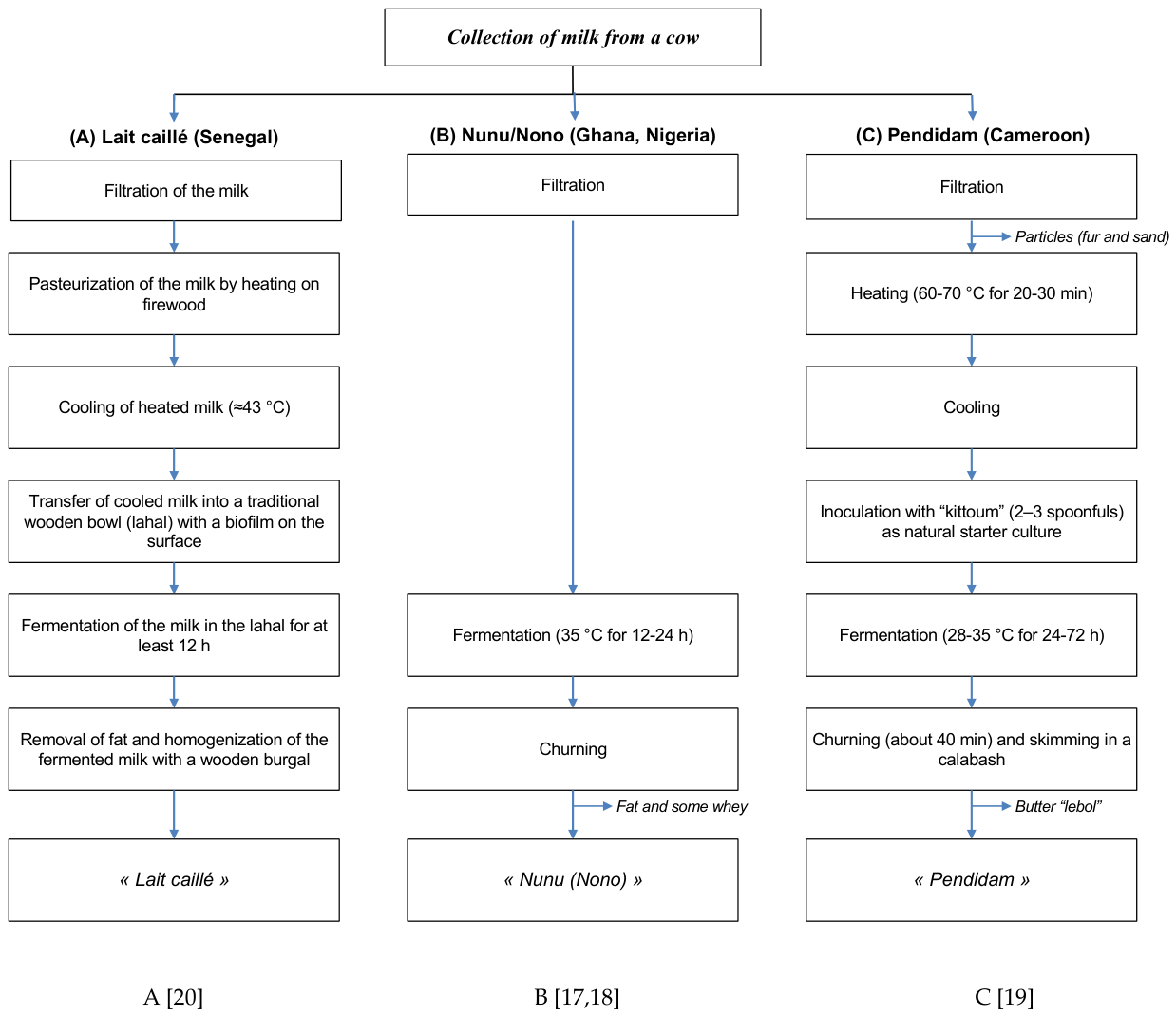

Table 1.
Minimum composition types and standard of identity of fermented milks (Codex Standard for Fermented Milks CODEX STAN 243-2003).
Table 1.
Minimum composition types and standard of identity of fermented milks (Codex Standard for Fermented Milks CODEX STAN 243-2003).
| Fermented milk | Yogurt, alternate culture yogurt, and Acidophilus milk | Kefir | Kumys | |
|---|---|---|---|---|
| Milk proteina (% w/w) | Min. 2.7% | Min. 2.7% | Min. 2.7% | |
| Milk fat (% w/w) | Less than 10% | Less than 15% | Less than 10% | Less than 10% |
| Titratable acidity, expressed as percent lactic acid (% w/w) | Min. 0.3% | Min. 0.6% | Min. 0.6% | Min. 0.7% |
| Ethanol (% v/w) | Min. 0.5% | |||
| Sum of microorganisms constituting the starter culture defined in section 2.1 (cfu -1g in total) | Min. 107 | Min. 107 | Min. 107 |
Min. 107 |
| Labeled microorganismsb (cfu -1g total) | Min. 106 | Min. 106 | ||
| Yeasts (cfu -1g) | Min. 104 | Min. 104 |
a Protein content is 6.38 multiplied by the total Kjeldahl nitrogen determined. b Applies where a content claim is made in the labeling that refers to the presence of a specific microorganism (other than those specified in section 2.1 of Codex Standard for Fermented Milks CODEX STAN 243-2003 for the product concerned) that has been added as a supplement to the specific starter culture.
Table 2.
Some qualitative primary characteristics of the three fermented African fermented dairy products.
Table 2.
Some qualitative primary characteristics of the three fermented African fermented dairy products.
| Fermented dairy products | pH (Range) | Final titratable acidity range (%) | References |
|---|---|---|---|
| Nono (Nigeria) | 4.22-4.70 | 1.34-1.50 | Omola et al. [22] |
| Nunu (Ghana) | 3.40-6.04 | 1.00-4.5 | Akabanda et al. [18] |
| Lait caillé (Senegal) | 3.04-4.56 | 0.60-1.25 | Diatta [21] |
| Pendidam (Cameroon) | 3.35-3.66 | 0.68-0.73 | Bayoï and Noubasra [19] |
Table 3.
Microbiological safety of some milk and dairy products in Sub-Saharan Africa (adapted from Leone et al. [24]; Bayoï and Noubasra [19] and Maïworé et al. [7]).
| Country | Milk source | Milk product | Processing technique | Microorganism | Prevalence n/N1 (%) |
Mean Log (CFU2/ml) | Reference |
|---|---|---|---|---|---|---|---|
|
Ghana |
Cow |
Raw milk |
None |
E. coli | 74/150 (49.3) | Not reported | Saba et al. [25] |
| 28/224 (12.5) | Not reported | Addo et al. [26] | |||||
| Listeria spp. | 20/114 (17.5) | Not reported | Owusu-Kwarteng et al. [27] | ||||
| Listeria monocytogenes | 10/114 (8.8) | Not reported | Owusu-Kwarteng et al. [27] | ||||
| Yersinia spp. | 19/96 (19.8) | Not reported | Donkor et al. [28] | ||||
| Klebsiella spp | 15/96 (15.6) | Not reported | Donkor et al. [28] | ||||
| Staphylococcus spp | 14/96 (14.6) | Not reported | Donkor et al. [28] | ||||
| Bacillus spp. | 11/96 (11.5) | Not reported | Donkor et al. [28] | ||||
|
Boiled milk |
Boiling over open flame for up to 1 h |
Fecal coliform bacteria | Not reported | 0.72 | Parry-Hanson Kunadu et al. [29] | ||
| E. coli | Not reported | Parry-Hanson Kunadu et al. [29] | |||||
| K. pneumoniae | Not reported | Parry-Hanson Kunadu et al. [29] | |||||
| Boiling |
E. coli O157:H7 | 12/19 (63.2) | Not reported | Parry-Hanson Kunadu et al. [30] | |||
| S. aureus | 6/19 (31.6) | Not reported | Parry-Hanson Kunadu et al. [30] | ||||
|
Nunu |
Spontaneous fermentation |
E. coli O157:H7 | 3/9 (33.3) | Parry-Hanson Kunadu et al. [30] | |||
| S. aureus | 1/9 (11.1) | Parry-Hanson Kunadu et al. [30] | |||||
| Spontaneous Fermentation |
Listeria spp. | 11/84 (13.1) | Owusu-Kwarteng et al. [27] | ||||
| Listeria monocytogenes | 4/84 (4.8) | Owusu-Kwarteng et al. [27] | |||||
| Spontaneous fermentation in calabashes or rubber buckets for 1-2 days |
Enterococcus faecium | Not reported | Akabanda et al. [31] | ||||
| Nigeria |
NR | Raw milk | None | S. aureus | 6/80 (7.5) | NR | Okpo et al. [32] |
|
Cow |
Raw milk | None | S. aureus | 17/100 (17.0) | Omoshaba et al. [33] | ||
| None | Methicilin resistant S. aureus | 15/100 (15.0) | Omoshaba et al. [33] | ||||
| Raw milk | E. coli | 15/160 (9.4) | Yakubu et al. [34] | ||||
| E. coli O157:H7 | 3/160 (1.9) | Yakubu et al. [34] | |||||
|
NR |
Pasteurized milk |
NR |
Salmonella spp. | 2/13 (15.4) | Okpalugo et al. [35] | ||
| Streptococcus spp. | 5/13 (38.5) | Okpalugo et al. [35] | |||||
| Enterococcus spp. | 3/13 (23.1) | Okpalugo et al. [35] | |||||
| Pseudomonas spp. | 3/13 (23.1) | Okpalugo et al. [35] | |||||
| NR | Nono | Fermentation | S aureus | 8/80 (10.0) | NR | Okpo et al. [32] | |
|
Cow |
Nono |
Fermentation |
E. coli | 27/100 (27.0) | Maikai et al. [36] | ||
| Enterobacter spp | 8/100 (8.0) | Maikai et al. [36] | |||||
| Klebsiella spp. | 6/100 (6.0) | Maikai et al. [36] | |||||
| Proteus spp. | 3/100 (3.0) | Maikai et al. [36] | |||||
| Citrobacter spp. | 2/100 (2.0) | Maikai et al. [36] | |||||
|
Senegal |
NR |
Raw milk |
None |
Coliform bacteria | NR | 4.93 | Breurec et al. [37] |
|
Salmonella Johannesburg |
1/15 (6.7) | NR | Breurec et al. [37] | ||||
| Coxiella burnetii | 6/15 (40%) | Breurec et al. [37] | |||||
| Coagulase-positive Staphylococcus |
NR | Breurec et al. [37] | |||||
| Pasteurized milk | Not reported | Coliform bacteria | NR | 7.51 | Breurec et al. [37] | ||
| Coagulase-positive Staphylococcus |
NR | NR | Breurec et al. [37] | ||||
|
Cameroon |
Cow |
Pendidam |
Fermentation |
Total coliforms | < 3 | Bayoï and Noubasra [19] | |
| Fecal coliforms | < 2 | Bayoï and Noubasra [19] | |||||
| Staphylococci spp. | < 2 | Bayoï and Noubasra [19] | |||||
| Mesophilic Spore-forming bacteria | < 4 | Bayoï and Noubasra [19] | |||||
| Reducing sulfite Clostridia | < 5 | Bayoï and Noubasra [19] |
NR: not reported; 1: number of positive samples/total number of samples; 2: colony-forming units (values from Breurec et al. [37] are expressed per gram).
Table 4.
In vitro screening and characterization of six (6) potential probiotic LAB from Pendidam and Kindirmu fermented milk products (Nodem Sohanang et al. [45]).
Table 4.
In vitro screening and characterization of six (6) potential probiotic LAB from Pendidam and Kindirmu fermented milk products (Nodem Sohanang et al. [45]).
| Food samples analyzed for LAB isolation | LAB isolates | LAB isolates showing antimicrobial activity | LAB isolates with probiotic aptitudes | Potential LAB probiotic screened from the food samples | Identification of potential probiotic from the food (number of isolates) | ||
|---|---|---|---|---|---|---|---|
| Pendidam | Kindirmou | Pendidam | kindirmou | ||||
| 25 | 40 | 22 | 6 | 4 | 2 |
Lactiplantibacillus plantarum (1) Lacticaseibacillus casei (4) |
Lactococcus lactis (1) |
Table 5.
Effect of the best starter culture consortium on some physicochemical characteristics of Nono during milk fermentation at 30 °C for 24 h (adapted from Ikele et al. [40]). *mix = Lactobacillus plantarum, Lactobacillus casei and Lactococcus lactis (extraneous cultures) + Lb rhamnosus isolated from Nono.
| Samples | pH | Moisture Content (%) |
Water Activity |
Viscosity (mpa.s) |
Total Titratable Acidity (%) |
|---|---|---|---|---|---|
| Fresh milk | 6.66 ± 0.02 | 87.12 ± 0.01 | 0.99 ± 0.00 | 5.33 ± 0.29 | 3.50 ± 0.20 |
| Commercial Nono | 6.56 ± 0.05 | 87.51 ± 0.25 | 0.99 ± 0.00 | 165.3 ± 2.52 | 2.93 ± 0.12 |
| Starter culture mix* | 4.49 ± 0.02 | 87.30 ± 0.02 | 1.00 ± 0.01 | 113.7 ± 7.64 | 5.50 ± 0.30 |
Disclaimer/Publisher’s Note: The statements, opinions and data contained in all publications are solely those of the individual author(s) and contributor(s) and not of MDPI and/or the editor(s). MDPI and/or the editor(s) disclaim responsibility for any injury to people or property resulting from any ideas, methods, instructions or products referred to in the content. |
© 2026 by the authors. Licensee MDPI, Basel, Switzerland. This article is an open access article distributed under the terms and conditions of the Creative Commons Attribution (CC BY) license.
Copyright: This open access article is published under a Creative Commons CC BY 4.0 license, which permit the free download, distribution, and reuse, provided that the author and preprint are cited in any reuse.