

Submitted:
10 November 2026
Posted:
13 November 2026
You are already at the latest version
Abstract
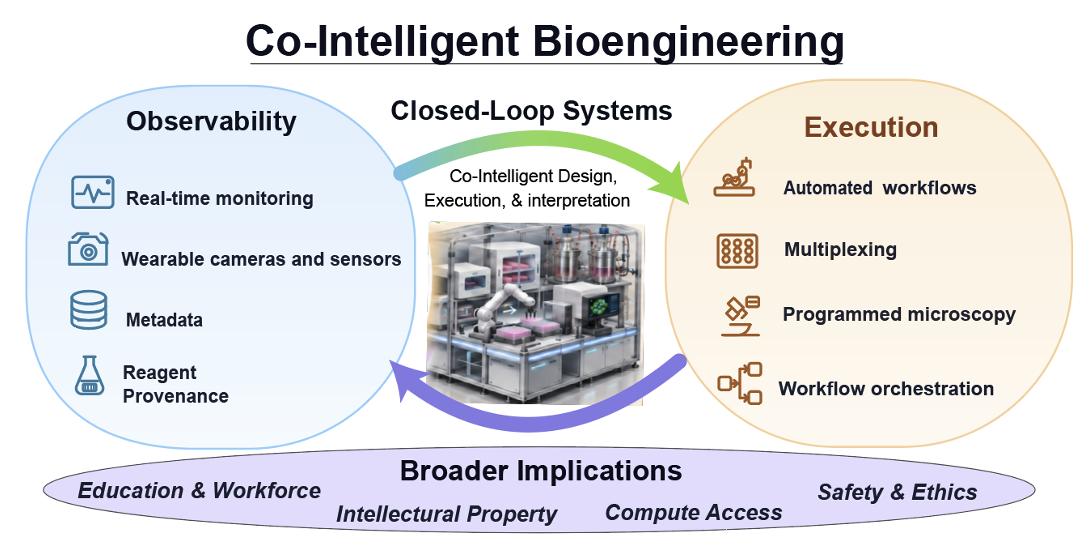
Artificial intelligence is poised to fundamentally transform the field of bioengineering, accelerating our ability to understand, predict, and manipulate living systems. Here we discuss a future of Co-Intelligent Bioengineering, in which human scientists and AI agents work together across the scientific and engineering process, from ideation and hypothesis generation, through the design, build, test, learn cycle. Realizing this vision will require overcoming two major challenges: developing an observability layer that captures the rich experimental data, tacit knowledge, and decision-making processes of laboratory research; and bridging the execution gap between rapidly advancing AI reasoning capabilities and the slower physical realities of biological experimentation. Progress on these fronts will enable increasingly autonomous, partially closed-loop scientific systems that continuously learn from and adapt to experimental outcomes. Yet this transformation also raises profound questions about scientific understanding, human oversight, safety, and the future of bioengineering education. Here, we explore the emerging opportunities and challenges of Co-Intelligent Bioengineering and argue for a future in which human insight and machine intelligence are integrated to accelerate discovery while preserving scientific rigor, creativity, and responsible innovation.
Keywords:
AI
; agentic labs
; lab automation
; bioengineering
Copyright: This open access article is published under a Creative Commons CC BY 4.0 license, which permit the free download, distribution, and reuse, provided that the author and preprint are cited in any reuse.