
Submitted:
11 November 2026
Posted:
13 November 2026
You are already at the latest version
Abstract
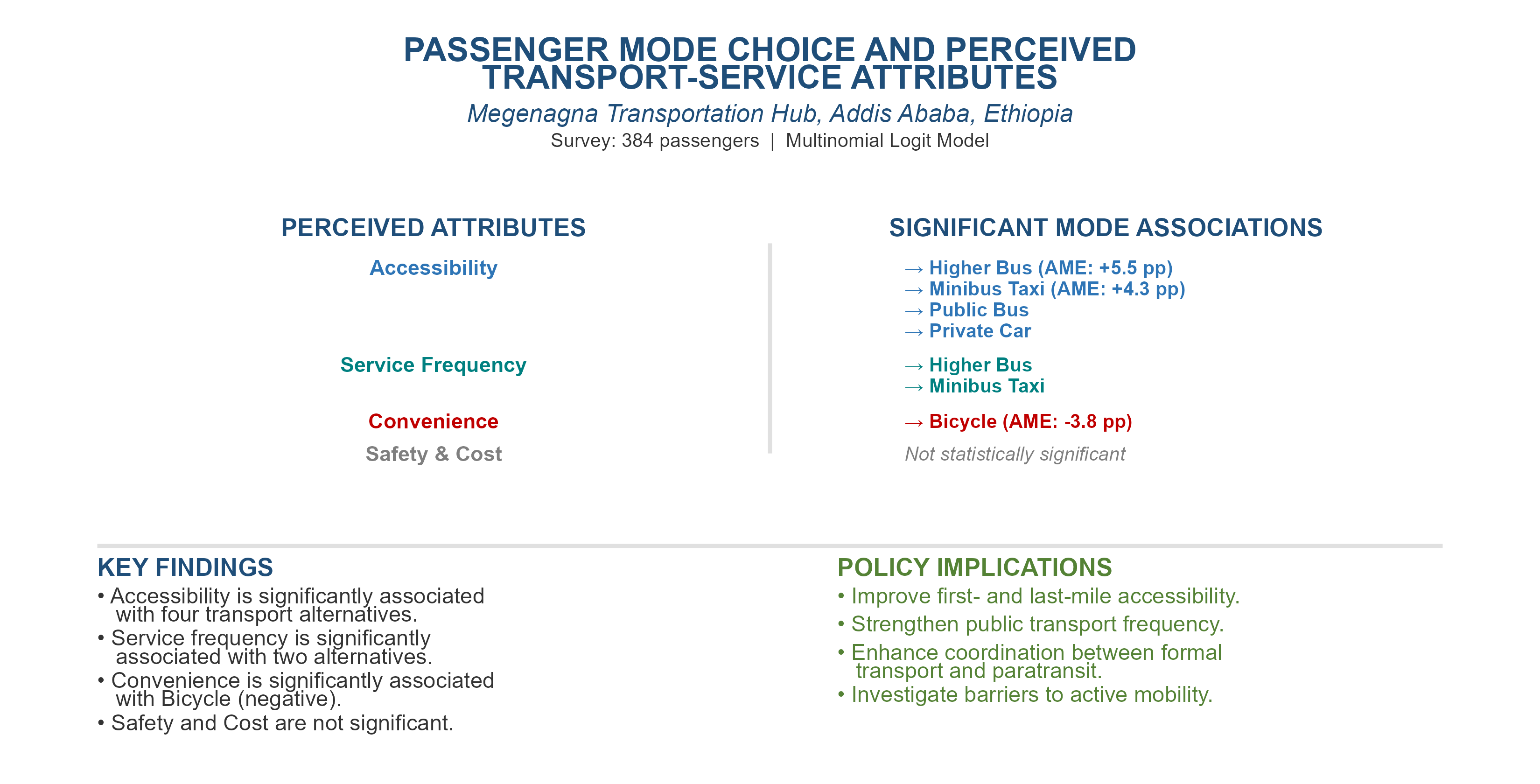
Perceived accessibility, service characteristics, and travel costs shape passenger mode choice at multimodal transportation hubs, yet many African cities have not explored the relative associations of these factors. This study examines reported mode choice at Megenagna Transportation Hub in Addis Ababa, Ethiopia, using survey data from 384 passengers. We estimated a multinomial logit model with five standardized percep-tion-based attributes and alternative-specific constants, and assessed statistical uncer-tainty using 1,000 nonparametric bootstrap replications. Perceived accessibility was significantly associated with four of the seven non-reference transport alternatives, while service frequency was significant for two. A one-standard-deviation increase in perceived accessibility was associated with a 5.5-percentage-point increase in the pre-dicted probability of choosing Higher Bus and a 4.3-percentage-point increase for Minibus Taxi. These are model-based probability estimates, not evidence of observed passenger switching or causal effects. These findings highlight the relevance of acces-sibility and service frequency for hub-level transport planning, including first- and last-mile connections and coordination among public transport, paratransit, and active mobility services. Given the cross-sectional, single-hub design, interpret the findings as context-specific associations.
Keywords:
mode choice
; multimodal transport hubs
; perceived accessibility
; service frequency
; paratransit
; multinomial logit
; urban planning
Copyright: This open access article is published under a Creative Commons CC BY 4.0 license, which permit the free download, distribution, and reuse, provided that the author and preprint are cited in any reuse.